|
FAQs on Brackish Water (mostly
terrestrial) Crabs, other Crustaceans
Related Articles: Fresh to Brackish
Crabs,
Related FAQs:
|
 |
Red Claw Crab and salt 2/23/15
I tried to find a similar post on your site sorry if this has already
been addressed.
<Oh?>
My dad put together an aquarium for my kid and i wanted a crab, well i
wanted a blue crayfish but those were $25 and the crabs were $3 and they
were equally as cool if not more so.
<Quite so. Land crabs are nifty animals in lots of ways.>
ANYWAY i did do research beforehand and i DID know brackish is
preferential if not essential.
<Something like that. Since these crabs are essentially amphibious,
assuming the "land" is somewhere humid and warm they only spend part of
the time underwater. Brackish water probably helps them, in the long
term, but yes, they do seem to live many months with just access to
freshwater. That said, their distribution in the wild is apparently
coastal rather than inland. Their full common name, "Red Claw Mangrove
Crab", is probably accurate, and being cynical for a moment, the missing
word "mangrove" surely wasn't dropped accidentally by the exporters!>
Depending on who you ask.
<Indeed, the scientists who collect them versus the people selling them
in pet stores!>
Well i got her anyway, as the petstore carrying them was keeping her in
a cramped freshwater tank. So i justified putting her in my tank and
opposed to the petstore or some more ignorant owner.
<Understood.>
Now, more to the point, i was sitting on the floor staring at her for a
while and i noticed a bag of rock salt next to me. Being the weirdo i am
i shoved some in my mouth and then thought maybe i can give the crab
some.
<Sure! Provided that salt is not iodised, it should be fine. Not as good
as marine aquarium mix, but better than no salt at all.>
So the question is, can i give some to the crab?
<Yes.>
Can i safely put a chunk on her rock and have her not die?
<No, you can't stick a chunk in the tank! Grab a cheese grater
or a chisel, grind off or chip away some bits, allowing 6 grams per
litre/3-4 teaspoons per US gallon. So if you have a 3 gallon bucket,
then 9-12 teaspoons of salt is about right. That will create slightly
brackish conditions (for reference: full seawater is 35 gram salt per
litre, so what you're making is about one-sixth normal seawater
salinity). Dissolve salty chunks in water completely before adding to
the aquarium! Now, each time you do a water change, you can replace
plain freshwater with a bucket of this slightly brackish water.>
It seems relatively safe and possibly beneficial to give her some to
satisfy her dietary needs.
<Dietary needs are primarily protein and calcium! Bits of white fish
fillet, unshelled shrimps, and even things like cooked peas and soft
fruit. Iodine is the missing thing here, and a prime cause of deaths
with crabs. You can buy "crab food" that contains iodine, but it's
cheaper and easier to grab some iodine vitamin supplement as used in
marine tanks, and dose at one-half the amount recommended on the bottle.
Some "sea vegetables" are iodine rich including Sushi Nori and other
seaweeds you can pick up in Asian food markets.>
But im no expert on crustaceans (though i do have a 17 year old hermit
crab) Would this be a terrible idea?
<Dumping a sodium chloride lump in the aquarium would be
catastrophically bad.>
Do you think she would know to "lick" it? Could she "lick" too much and
die? I figure she'd be fine since she's in the water most of the time.
Are they're any other options to satisfy her salt needs? Maybe a small
dish with saltwater in it on her platform?
<Now you're thinking right!>
Thanks for any input.
<Most welcome, Neale.> My red claw crab is missing 2 legs
5/27/13
I purchased a red claw crab yesterday at a local fish store and i was
feeding the fish tonight and noticed that my crab had 2 legs missing on
one
side he is still getting around the tank ok and he is eating but will
his legs grow back or will he die?
<These legs can be regenerated, through successive molts, IF the
conditions are propitious here. A lack of predatory tankmates, enough
food, alkalinity and calcium, land to get out of the water, scavenge
about on... Read here:
http://www.wetwebmedia.com/FWSubWebIndex/fwcrabhlthf.htm
and the linked files above; esp. re foods/feeding and systems. Bob
Fenner>
Red claw crab (Perisesarma biden), comp., fdg., beh.
4/17/13
Hello again WWM, I have a 29 gallon tank (about 40% land, water is 4
inches deep at deepest point, sand substrate, brackish water, heater
that keeps it 80 degrees during the day, 76 at night, quite humid,
plenty of slate rocks, 6 good size grasses in and out of water, hang-on
15 gallon filter that I've modified to work as a waterfall) with 6 crabs
(3 females, 2 males and one I haven't checked) in it.
<All sounds good.>
I have a couple questions that I can't seem to find any
answers to. First of all one male crab is getting ready to molt and is
missing both claws.
<Likely fighting; what these crabs do; isolate the victim if at all
possible.>
Will he be able to eat at all without them?
<No.>
Is there anything I can do to help him if not?
<Could try hand feeding, but crabs aren't real smart, so could be
tricky.
Possibly crab will have new claws after moult, but if not, will need
feeding.>
Also after reading I'm going to pick up an iodine supplement as soon as
possible, but the store is quite a trip. Can the iodine in potatoes
provide any help for them in the meantime?
<Some, if they could digest potatoes, which I doubt. Sushi Nori and most
seafoods will be better.>
I have included them in their diet along with bloodworms, banana, and
occasional orange and avocado.
<All sounds ideal.>
They seem to enjoy them but is this just a wasted effort on my part?
<Nope.>
My final question would be is it normal that none of the crabs are
burrowing?
<Normal. These crabs prefer to climb, when they aren't killing each
other anyway.>
They are all quite active (except the one close to his molt) but I want
to make sure this isn't a sign of bad conditions. Thanks for your great
information and responses, AA
<And thanks for the kind words. Cheers, Neale.>
Brackish water crab 10/24/12
Hello. I am planning on dedicating my 135 gallon aquarium to brackish
water crabs. It is 72 x 18 x 24 inches high. I am planning on having
land and water sections so I can keep a variety of crabs. How many could
I keep in this aquarium? What parameters should I keep the aquarium at?
I know I want red clawed crabs (Perisesarma species) and fiddler crabs
(Uca species) with a few others I may find interesting. What other crabs
would do well with these? Lastly, what would be your recommendation as
to a set up for my aquarium (substrate, heater, decorations, etc)?
Thanks for taking the time to answer my questions!
<You could probably keep dozens of small crabs in a tank this size… but
Red Claw Crabs and in fact most other crabs don't necessarily work well
in groups, and mixing species is almost never a good idea. A certain
amount of "attrition" is likely as dominant crabs attack weaker ones.
Having big groups probably helps in the same way as it does with Mbuna
and other aggressive animals, but still, there'll always be a certain
degree of risk. But there are two workarounds worth suggesting. The
first is Thai Micro Crabs. You'd only need a very small aquarium for
these (even 10 gallons) since they're pretty peaceful and all they
really need from the keeper is lots of floating plants (they prefer to
hang upside down from such plants). Alternatively, consider Fiddler
Crabs. The males are mostly bluffers rather than fighters, so if they're
given enough space, serious fights are normally avoided, especially if
you have ensure each male has a safe burrow (or cave) it can retreat to.
Fiddlers and Red-Claws shouldn't be kept together for the same reason --
Fiddlers lose out, and the Red Claws treat weak specimens as live food.
The big plus with Fiddlers is that they can work well Mudskippers or, if
you prefer to maintain a reasonable depth of water, salt-tolerant
livebearers such as Guppies and Mollies. Since your aquarium is quite
large, setting up a half-water, half-land system shouldn't be difficult,
so keeping Fiddlers with Mudskippers and/or livebearers should be easily
do-able. Oh, and one last idea. Why not go marine? Mantis Shrimps for
example are even more fun than crabs, and you could use dividers to
maintain several specimens in one tank. But even with regular shrimps,
crabs and lobsters, there's plenty of variety that could all live
together. A marine aquarium set up with live rock and just various
crustaceans would be easy to maintain and relatively inexpensive
(without the fish, you shouldn't have any real problems maintaining
adequate water quality). Cheers, Neale.>
Re: Brackish water crab, other BR Livestocking
10/25/12
Hey Neale. Since getting your reply I've been researching tank
mates for the 135 gallon. I would like your opinion on the
tank. I am planning on getting *Uca crassipes* as the crab.
<A good species.>
As for the tank mates, I am considering the following: *Brachygobius
nunus,*
<Yes, but could be eaten by much larger tankmates, so be careful.>
violet goby,
<Yes, but it is quite big, and needs a good 55 gallons of water.>
mudskipper,
<Yes.>
Celebes Rainbowfish,
<Despite often being reported as brackish-water fish, Celebes Rainbows
are not, and don't make sense in this sort of moderately brackish
system.>
and Anableps.
<Possible, but do research this species thoroughly. It is challenging
and does get rather large (so could, conceivably, view the smaller fish
as food).>
As for plants, I am going to get the red mangrove and water sprite.
<Doubt the Water Sprite will tolerate high salinity for long. Plastic
plants make a lot of sense, along with (possibly fake) bogwood roots and
branches.>
Finally, I am going to keep the water parameters at 25 to 26 dC, 7.5 to
8.0 pH, 16 to 18 dH, and a SG of 1.005 to 1.015.
<This is quite a range of specific gravities! I'd pick a value that
makes sense for the community you want, say, SG 1.005 or 1.010, and
stick with it.>
I am planning this as a mangrove set up, hence the mangrove fiddler
crab, so if any of these fish are not native to mangrove swamps/forests,
please tell me.
<Fiddlers and Mudskippers for sure. Violet Gobies and Anableps are more
mudflats and tidal estuaries, but could appear in such areas around
mangroves. Bumblebees mostly live in rainforest streams, whether
brackish or not.
Keeping this in mind, which mudskipper would you recommend? I also need
your advice as to how many of each of these I could house comfortably in
my 72 x 18 x 24 inch high aquarium.
<Look at the Indian Dwarf Mudskipper, Periophthalmus novemradiatus.
http://www.wetwebmedia.com/ca/volume_7/volume_7_1/mudskippers.html
It's a small fish, around 6 cm/2 inches in length, and because it's
small, you could keep a large group of 6-8 specimens at least, and in a
big group aggression problems will be minimised.>
Thanks!
<Welcome, Neale.>
Re: Brackish water crab 10/25/12
Okay Neale, a couple more questions. If I were to keep *Anableps
anableps, * *Gobioides broussonnetii, *Periophthalmus novemradiatus, and
Uca crassipes, how many of each would I be able to house comfortably?
<Difficult to say with fish like these in a system with less water than
it's gallons would suggest. You say it's a 135-gallon tank; let's assume
it's only half filled, and that half will be as much rocks as water. So
tops, we're looking at around a quarter that gallonage, or around about
30-35 gallons. Not a huge amount of water, I think you'll admit. Still,
for small gobies like BBGs, together with the largely amphibious Uca and
Periophthalmus species, that's a lot of space. A dozen BBGs could
probably fit into that amount of space together with the Fiddlers and
the Mudskippers. But add the bigger fish to the equation and things can
really complicated, really quickly. Anableps basically need a big tank
(they get to 15-20 cm/6-8 inches or so in length) but with a flat
"island" in the middle covered with just enough water for them to beach
themselves. Sounds odd, but if you can imagine Shamu beaching himself at
Seaworld, that's pretty much what Anableps like to do. Yes, that fits in
nicely with Mudskippers, but only if you have huge amounts of space,
like in a public aquarium. Realistically, your Mudskippers will be
terrified of such big fish as Anableps (on the whole, fish and
Mudskippers don't mix, with the exception of species like small Gobies
and Guppies that simply don't pose much threat).>
What about without Anableps anableps? I am still looking for a
mid-swimmer.
Can you suggest one that can be found in mangroves?
<Shortfin Mollies would work, though they might be slightly too big and
so scare the Mudskippers. Guppies, including Endlers can work very well
(though big Mudskippers might view small Guppies as live food).>
Do I even need one in this tank?
<Ideally, no. The thing is that Mudskippers don't enter water where they
see fish, at least, not big fish. They're not good swimmers, and their
defence is to stay out of the water when they see fish, and to jump into
their burrows when they see land predators. They don't really swim much,
if at all. So, the best Mudskipper tank is set up just for them, and
trust me, they're such smart, active fish you really don't need any
other fish. Some folks add Guppies, as much as live food as extra
colour, any baby Guppies being occasional snacks for the 'Skippers.>
What type of filtration do you suggest?
<If simply Mudskippers, then "cheap and cheerful" is fine, because
they're mostly on land anyway, and have a high tolerance for ammonia. A
decent sponge filter could be more than adequate, but otherwise an
internal canister. What you don't want are pipes or overflows hanging
out the tank because Mudskippers WILL find them and escape through
them.>
Will I even need any with the red mangroves?
<Nope.>
Oops, that's a few more than a couple. Anyways, I want this to look
aesthetically pleasing to the eye with a lot of activity and movement.
Would you suggest putting some *Brachygobius nunus* in instead of
Anableps anableps? (even though *Brachygobius nunus *aren't from
mangrove swamps. I don't mind, as long as there is activity and
movement.)
<Anableps is a difficult fish, so yes, I'd recommend looking into their
needs and setting up a tank just for them. They're nervous, skittish,
and don't do well unless you plan around them carefully (they're not
delicate at all, but easily killed through poor planning). BBGs are very
low-key fish, so if colour and movement is what you want, then Mollies
or Guppies would surely be the better bet.>
Last question: Where would this put me as far as stocking? (As in with
*Brachygobius nunus, **Gobioides broussonnetii, *Periophthalmus
novemradiatus, and Uca crassipes, how many of each would I be able to
house comfortably?) Just exploring my options. Thanks again for your
time and speedy responses!
<Do see above. Cheers, Neale.>
Re: Brackish water crab - 10/27/2012
Okay, I don't know how this happens, but I thought of a few more
questions as I was reading your reply. This time it is a few. First,
since I'll be getting Red Mangrove *Propagules* (seeds) and because they
grow slowly, I think I'll get a small filter. Second, (actually the
first question), what type of rock would you suggest I put in there for
the 'Skippers?
<Whatever you want. Avoid rocks with metallic seams though.>
(Sorry, just had to.) I was thinking live rock, but then thought of the
mudskippers and their soft(?) bellies versus the porous rock and
discarded the idea.
<Live rock will die in anything less than full marine.>
I would like something native to Mangals. (Found that term online. Means
"Mangrove Biome, I think.) Second question: would it be possible to
create a catty corner beach slope to try and separate Red Clawed Crabs
from Fiddler Crabs?
<Can't imagine they'll stay apart unless completely divided. Crabs climb
and burrow.>
(Sorry, just can't get the idea out of my head for some reason!) Third,
would violet gobies scare the mudskippers?
<Yes.>
Here's what I'm thinking (4 options):
Option 1:
1 to 2 dozen BBGs*
a few fancy guppies (for color/activity and occasional live treat for
'Skippers)*
eight Fiddler Crabs (on one catty corner island)
four Red Clawed Crabs (on the other catty corner island. Also, notice I
cut the number in half; twice the potential size, half as many. Or I
could make their beach twice as big....)
four to eight mudskippers* and
two Violet Gobies
Option 2:
1 to 2 dozen BBGs*
a few fancy guppies*
eight Fiddler Crabs
four Red Clawed Crabs and
four to eight mudskippers*
Option 3:
1 to 2 dozen BBGs*
a few fancy guppies*
eight of Fiddler Crabs *or* Red Clawed Crabs**
four to eight mudskippers* and
two Violet Gobies
Option 4:
1 to 2 dozen BBGs*
a few fancy guppies*
eight of Fiddler Crabs *or* Red Clawed Crabs**
four to eight mudskippers*
*Exact numbers subject to vary based on a lot of variables
**(Please don't make me have to pick. I love HUGE things, such as RCC
[huge for a crab], but I've always wanted to witness the male Fiddler's
claw in all its daily motion... :{ I can only set up one tank and my 135
is my largest.)
So? What do you think? Thanks again for everything!
<Hmm… do review earlier messages. Red Claw Crabs best kept alone. Uca
species compatible with Mudskippers of similar to slightly larger size.
Guppies can work with Uca and small Mudskippers. Gobioides spp not
really compatible with Mudskippers, but harmless, and can get along fine
with Guppies, and perhaps small crabs if the latter have land to get out
onto.>
-AquaMaster
<Cheers, Neale.>
Red Claw Crab - Sesarma bidens, gen. captive husbandry...
Good
10/20/12
Hello,
<Heather,>
I just wanted to write to share my experience with Red Claw Sesarma
bidens crabs.
<Fire away!>
Fellow crab keepers, do not let pet stores tell you the crabs are
freshwater....provide brackish water (1.005).
<For sure.>
Color will improve, molting will occur without mortality and frankly,
the crabs seem more lively.
<Indeed.>
I also provide heated water to simulate tropical conditions (I live in a
cold weather area).
<Wise, indeed necessary, as well.>
My tank is also set up with little coco moss "islands" and plenty of
rocks, crevices, decorations to hide in. Most important
observation...THESE CRABS ARE NOT SOCIAL....I started out with five...I
have one left (a male named Spiderman Crab).
<This can be a common problem, yes. Doesn't always happen -- does depend
on size of vivarium, sex ratio, availability of moulting spaces. But you
are quite right, as with all crabs, you should always assume they'd do
better singly than in small groups.>
I have witnessed horrors only seen in movies in relation to keeping
these crabs together...they will eat one another...even though my crabs
are fed a variety of foods (crab pellet, fresh fruit/veggies, and white
fish/shrimp), they eat one another.
<Quite so.>
I used to think it was just "opportunity to clean up" after a natural
death...that is until I witnessed Spiderman Crab taking a weaker,
smaller crab into his burrow (this crab had two of his tankmates--one
mutilated with all legs missing and still alive--on his side of the tank
and it did not take CSI to figure out what had happened - I literally
caught him eating another crab's leg) of course, this crab I have left
also happens to be the largest, healthiest and definitely aggressive (I
put a small glass crab collectable into the tank just to see what would
happen and he attacked it!)
<Nature red in tooth and claw… and as you've seen, well within the range
of "normal" crab behaviour.>
Also they are curious and will definitely hide out in the filter, or
even escape, so be extra careful when setting up your tank so minimize
accidents.
<Another wise observation. I have kept a crab that literally burrowed
through a giant sponge filter in the overflow chute down the side of a
large aquarium, creating its own burrow.>
Spiderman Crab escaped via the filter and luckily my dog kept going
under the chair and crying so when I investigated I rescued the crab and
then redesigned the filter cords to minimize chance of another Houdini
escape...recap...one crab per enclosure, brackish warm water, variety in
diet, secure enclosure and add variety in decor to occupy crab = one
happy crab keeper.
<Thanks for this detailed report. Do think that this will help, inform
others considering these animals as pets. Amphibious crabs can be very
fun "exotic" pets, particularly if you only have limited space, and
their needs are minimal in terms of diet and healthcare. But there are
some non-negotiable considerations you've explained here, and when
people try to keep them in freshwater community tanks, or with
freshwater turtles, or really anything other than a crab-specific
vivarium, things can (and usually do) go catastrophically wrong. There
are one or two breeding reports for this species online; if you're
minded, have a read, and you might find another way to deepen your
enjoyment of these unusual animals. It's not easy to do, but it is
do-able. Cheers, Neale.>
Halloween Moons Crab -- mite/springtail infestation
10/8/12
Hello, I need some advice. I have two Halloween moon crabs (g.
quadratus)
and I am having a problem with these little tiny jumpy white bug things
that I was told could be springtails.
<Likely so. Springtails and similar primitive hexapods are common in
warm, damp environments like vivaria.>
I did have living plants in the crabitat. I have isolated the crabs in a
brackish water (1.005) bath and now need advice on how to sterilize the
tank.
<Hydrogen peroxide is the easiest. Rinse well afterwards and it's
completely safe. You can also buy aquarium sterilising chemicals from
good aquarium shops.>
This is my second infestation in two months time.
<And will not be the last. Uneaten food inside the vivarium will
inevitably attract more of the little hexapods, if conditions attract
them. So, look at aquarium cleanliness: remove uneaten food, crab wastes
as soon as possible.>
also, my one crab molted and regrew two rear legs, but now her shell is
cracked and there appears to be a hole on the seam. Upon inspection the
other crab has a crack along the seam as well (up alongside underneath
the orange spots.
<Do make sure you're providing adequate calcium and a source of iodine.
Do read:
http://www.wetwebmedia.com/fwsubwebindex/fwcrabfaqs.htm
>
Thanks for your help.
<Most welcome, Neale.>
re: Halloween Moons Crab -- mite/springtail infestation
10/8/12
Neale,
thanks for your advice and info…
<Glad to help.>
I provide brackish water 1.005 in a one gallon jug...how much iodine
should I add to the water jug...I use a table top fountain that holds @
20 ounces at a time...but I replenish the water from the one gallon
jug...the fountain has a carbon filter in next to the pump, but I still
completely clean and change the water weekly.
<You can buy so-called iodine supplement for marine aquaria in some
aquarium shops (it actually contains iodate/iodide salts rather than
iodine itself). Dose at 50% the amount recommended for marine aquaria.
Alternatively, and this could work very well with amphibious crabs,
provide iodine-rich foods, Sushi Nori springs to mind, at least once a
week. Cheers, Neale.>
Red Claw Crabs 1/25/12
Most people on the internet seem to think these crabs are mostly
aquatic, I saw that you guys say they are mostly land.
<They will'¦>
The problem I have is that my crabs never come out of the water
(I've only had them for four days, so I shouldn't say
never).
<Quite so.>
I do have the tank set up as aquatic only with a few bits sticking out
of the water. But still, they seem to only like the water.
So, I guess my main question would be, why do you claim they are mostly
land crabs
<Because they are -- in the wild at least. They live in mangrove
forests feeding on leaf litter and carrion. Do read up on Perisesarma
species, which is what these are.
http://en.wikipedia.org/wiki/Perisesarma
They're shore crabs, If they don't come on land in your
aquarium, then something is amiss. They won't come out if
there's something scaring them, or if the air is too cold or too
dry. They're also EXTREMELY territorial, and if one crab claims the
one small bit of land, the others may not be "allowed"
out.>
and is there a resource that can give me a step-by-step on how to set
up and care for these crabs?
<Not that difficult. Set up something like you'd create for
mudskippers, with a couple inches of warm, brackish water (SG 1.005 at
25 C/77 F is fine). An under tank heater would be ideal. The rest of
the tank can be sand, rocks, bogwood. Make sure the air inside the
aquarium is warm and damp, but a slight flow of air is important to
prevent mould. Keep the hood secure because these animals WILL escape
if they can. Use filter floss or plastic mesh to plug any large gaps.
Crabs are cannibalistic at times, especially when moulting, so provide
lots of caves and such hiding places.>
I am also wondering how you know so much about them, and speak with
such authority when there seems to be so much miss-information out
there?
<Because I'm clever. More seriously, because I'm a marine
biologist by training, an aquarist by inclination, and I've spent
some 20-odd years reading scientific as well as hobby literature on
brackish water animals. Perisesarma spp are classic brackish water,
mangrove crabs. There's really nothing at all mysterious about
them. Yet unscrupulous retailers continue to sell them as
"freshwater crabs" or "aquatic crabs", and
willfully ignorant aquarists vigorously resist any attempt by people
like me to tell them what these animals need to do well. It's
significant that the people who succeed with them, e.g., actually breed
them, are those who understand their ecology and provide brackish water
for the adults and marine conditions for the larvae. Cheers,
Neale.>
Red Clawed Crab (Pseudosesarma moeshi /
Sesarma bidens), sys., fdg. 12/6/11
Hi
Thanks for the excellent and informative site. I really don't know
how people managed without the web in this hobby. There is just so, so
much to learn.
<Thanks for the kind words.>
I recently purchased 4 of the above for my 140L with, what I must
confess, was breathtaking newbie stupidity. I thought, being from the
coast as I am, a crab's a crab. It lives in the water and eats dead
fish. It was in the LFS freshwater area, so I assumed freshwater.
Nope!
<Ah, yes, indeed. These are brackish-water
crabs.>
I now understand that they need an omnivorous diet, land and brackish
water. So I went into action to see what I could do. I straightaway got
two bits of bogwood stood end on in the tank and secured them above
water as a temporary measure and today began construction of Island of
the Crab People, Prototype 1. Layered polystyrene sewn together with
fishing gut, with a small rim to hold fine gravel, on top of which I
placed a few flat rocks for cover. It's elliptical and about 1 foot
x 0.5 feet. This was secured to the bogwood with more gut.
<I see.>
The plans for Island of the Crab People, Prototype 2, are to include an
area of the same construction and dimensions, only with a deeper rim.
All layers will be aquarium siliconed together and the tray filled
shallowly with gravel to make a depression for a small brackish water
pond.
<Okay.>
The finished article will hopefully be both islands incorporated in one
kidney-shaped island made from sufficient layers of polystyrene
siliconed together for buoyancy, but with a deeper rim than prototype 1
to hold a deeper area of sand instead of gravel, for burrowing. I was
thinking of placing ballast underneath to improve the centre of gravity
and the exterior will be finished by brushing all over with silicone
and rolling in sand, I'll probably do a couple of coats of
that.
<Good.>
Anyway, I thought I'd see what you thought about the remedial
actions I have made/plan to make and see if you have any suggestions
for improvement.
At some point in the distant future I'll set up a proper vivarium.
I'm becoming attached to my Crab People already (sorry, too much
South Park) and I don't mind giving them a home to themselves.
<Is usually necessary. They aren't really compatible with much
else in the long term. In a really big, sandy beach type aquarium you
might keep them with salt-tolerant fish like "feeder" Guppies
that are fast enough to avoid trouble (fancy Guppies are too dim and
too slow). But really, crabs are crabs, and best kept on their own.
They're aggressive, territorial, well-armed, omnivorous,
opportunistic and persistent. Not a good combination.>
In the meantime the island will have to serve as the cash isn't
exactly flowing at the moment.
<Fine.>
Now to the other questions. (It does say don't worry about length
of the email in the instructions for contacting WWM - you asked for
it!)
<Quite so.>
Part of what I thought about the island, except for scuttle space, was
an area to place food on to stop them from dropping it in the
water.
<Yes, but they will feed under water.>
From my reading and observation, I understand they like to scoff out of
the water. Nope, they just drag it off the island back to a crevice in
the bogwood, eat a bit and drop it in the water.
<Yes.>
I'm assuming this is down to lack of cover on the island. Any
suggestions as to what I can use, or will they make their own cover
when I get sand?
i.e. burrows.
<Don't worry about it. Feed sparingly, and feed sensibly. For
example, a clam on the half shell could feed several crabs. It's
shell would prevent it being moved around. Likewise some soft banana
smeared on a bit of bogwood would be another good food choice. When
hungry, they'll scour the tank for tidbits so don't worry too
much about spillage. Just remove uneaten food after an hour. A turkey
baster is super-useful for spot cleaning underwater.>
I'm well briefed on what to feed them now, but how long should I
leave the food around for?
<See above. Don't worry too much about this. They are
scavengers, and to some degree, need time to crunch up things like the
bones in whole lancefish and the shells of unshelled krill, both of
which provide the calcium they need.>
With fish I give them a minute, but I can easily see that with crabs
it's going to be a lot different. Also, how much food should I put
down per crab and how often? I'm totally clueless about how much to
feed and I can't see anything about it anywhere I've
looked.
<A claw-sized hunk once a day is ample.>
I've read about adding iodine to the water during moulting. In the
concentrations recommended, would this harm fish?
<Is safe. But you shouldn't be keeping them with fish anyway; at
least, not fish you value. Feeder Guppies are a possible bet because
they might breed quickly enough to make good any occasional problems.
But even then, any Guppies that move slowly or get old will be eaten --
and not everyone enjoys the sight of a still-breathing, still-living
fish being dismembered by a crab. Trust me, these crabs can be
brutal.>
I have come across suggestions that the amount of salt that the crabs
require wouldn't even harm a salt intolerant fish, i.e. salt to SG
1.010.
I'm taking this with a pinch of, um, salt(!). Could you confirm yay
or nay on that?
<SG 1.010 at 25 C/77 F is about half-strength seawater. That's
ideal, but not essential. SG 1.005 is a good starting point and will
cost half as much!>
The other thing is they don't seem to be actually using the island
I have made. One has come over, dragged a bit of lettuce back to the
bog wood, chomped for a while and dropped it in the water. It then
returned, hauled away a bit of salmon (better fed than the cats, these
things!) and ate a bit before, yep, it dropped it in the water. Again I
think this is maybe due to lack of cover or it could just be early days
yet and exploration will occur overnight.
<It is their nature to drag, dismember, and generally make a mess.
Don't worry too much.>
Any comments you can make would be appreciated, especially on
feeding.
Cheers
Gordon
<Best wishes, Neale.>
Re: Red Clawed Crab (Pseudosesarma moeshi / Sesarma bidens)
12/8/11
Hi Neale
<Gordon,>
Thanks for the advice. I really appreciate you taking the time to help
me out. Unfortunately I am going to pickle your head just a little
further.
<Sure.>
A vivarium with feeder guppies sounds ideal, really. I'm not
bothered if the crabs catch the occasional fish but I would object if
the guppies had no chance, though.
<Quite so. A lot depends on the size of the tank. If there's
only 5 or 6 gallons of water, and it's all just a couple inches
deep, then the odds aren't in the favour of the Guppies. But if the
vivarium is a 55-gallon tank and there's 6-8 inches of water, so
some 20 gallons of the stuff, then the Guppies might be okay. Use some
common sense. Basically, if the crabs can catch small fish, they will.
Fiddler Crabs tend to be quite safe with fish, but Red Claw Crabs are
much more vicious.>
It would be great to see the crabs with damp sand to burrow in and
being able to behave a bit more normally than just sulking on a bit of
bogwood.
<Yes. Leaf litter, moss or coir (coconut fibre, sold in reptile pet
shops) can work for this.>
I've had cats all my life so a bit of predatory brutality isn't
exactly unusual for me. Still, "aggressive, territorial,
well-armed, omnivorous, opportunistic and persistent" makes it
sound like this is going to be a real adventure!
<Ah yes, crabs and cats share very much the same outlook in life,
dividing everything into [a] stuff I can kill and [b] stuff I can't
kill.>
My only one worry with feeder guppies is WWM's warning to usually
steer well clear of them due to ethics and disease.
<Quite so, in terms of using them as live food. This is much
different. Where sold, "feeder" Guppies are crossbreed
Guppies, and genetically they're much better than fancy Guppies.
They're also cheap. So you can try a few out and see what
happens.>
I won't be putting the guppies at the mercy of a dedicated killing
machine that's much bigger than them, so ethics doesn't really
worry me. As long as they are generally able to avoid the crabs
that's fine, since it's more or less the way things go in
nature. Disease is, however, more of a worry. Are fish likely to pass
pathogens/parasites over to inverts or are they too far removed?
<Little to no risk. Crabs are scavengers anyway, so they're
pretty resistant to disease right out of the box. They feed primarily
on dead and sick animals rather than healthy ones.>
From looking at these little guy's natural habitat, mangrove leaf
seems to be their staple diet in the wild. Apparently oak leaf is a
suitable substitute but I can't honestly remember where I found
that. I've been digging deep on them and read so much that it's
becoming a bit of a blur.
<You can actually buy live mangrove plants, though they're
mostly sold to marine aquarists.>
It's hard to find any proper scientific literature on them though,
sadly. I confirmed the leaf diet with someone's PhD thesis and
that's about as good as it's got. From the same thesis, silt
would appear to be the natural substrate at the sites that were
investigated, i.e. very fine particles, and that stands up for an
estuarine environment. Do you or any others have any experience of
using silt in aquaria? My first thoughts are anoxia in the sediment and
difficulty in keeping plants to break it up owing to the crabs munching
them.
<It's doable, but not ideal. For one thing, silty water is murky
water, which isn't attractive. A mix of 50/50 silica sand and coral
sand will give you an attractive substrate with some buffering
capacity, and you can stir in some crushed shells to add interest. Clam
shells and mussel shells would both be very authentic. You can also use
silicone to glue together "reefs" of oyster shells, either as
lumps by themselves or onto fake mangrove roots -- either would be
extremely authentic additions to any brackish water system.>
As a related aside, is it possible to get hold of tropical
invertebrates other than shrimp, crabs, crayfish and snails.? i.e.
worms and other substrate dwellers. Obviously anything that hatches
into an adult with wings is out. I'd be barred from stocking
anything if a swarm occurred in the living room.
<There are such animals to keep, but selecting them is difficult.
But if you know where to look, or can order them, yes, they're out
there. There are lots of brackish water Nerite snails, e.g., Clithon
species. though crabs will probably eat them. There are brackish water
hermit crabs as well, including Clibanarius tricolor, the popular
Blue-Legged Hermit kept by most reef tank keepers. It needs high
salinity, SG 1.010 upwards, but is cheap and hardy. Again, wouldn't
trust this completely with the Red Claws. Then there's the Mangrove
Horseshoe Crab, Carcinoscorpius rotundicauda, a species sometimes sold
as a freshwater species but like the Red Claw really needing middling
to high salinities in the long term.>
Another concern I have with the crabs is that my tank pH is at 6.8,
which I know is a little low for them but, as I understand it, brackish
will be >7.5 and within their suggested pH range.
<Yes.>
If I set up a pool on their island as brackish will they end up
suffering pH shock if they are chopping and changing between pool and
tank? Or do crabs, being "amphibious", not work that way? If
it is an issue, I may be able to persuade wifey-o that a vivarium is
essential and is needed soon.
<Just change the water completely. The crabs walk in and out of
different puddles in the wild, and really aren't affected by pH,
salinity or hardness in the same way as animals that are completely
submerged all the time.>
I doubt that they're going to be a real danger to the fish I'm
keeping them with now - 1 lonesome blue gourami. I might actually need
some help on this little terror too. When the crabs get bigger it might
be more of a worry. They're only at 0.75" to 1" carapace
width just now.
<Nice.>
Would salt to SG 1.005 harm the gourami?
<Yes.>
I've read most anabantids are extremely salt intolerant.
<Yes, with very few exceptions, e.g., Anabas testuideus, the
Climbing Perch, which is actually quite common in low-end brackish
water environments. There's also -- amazingly enough -- a brackish
water Betta species, called Betta sp. "Mahachai".>
1.005 doesn't sound like much but it's about 10 000ppm as
sodium chloride (not that I'll be using sodium chloride, don't
worry).
<Indeed, it's about 9 grammes marine aquarium salt per litre,
well above what freshwater fish enjoy. Some can tolerate this, to be
sure, but it isn't ideal.>
And the gourami'¦
The gourami bullied her other gourami tankmate, I didn't think much
of it, it wasn't too serious. Then the tankmate died. No fault of
the bigger gourami, just the fishkeepers who thought that a filter from
an already cycled tank meant that the tank we put the filter in was
ready to go. We slapped our foreheads, let it cycle and got a couple of
Bolivian rams to add. The surviving gourami hounded them to death. The
poor little things didn't stand a chance, stressed with the
transfer they were gasping a bit, and listless.
<Oh dear oh dear. I have to admit, I'm not a fan of Three-Spot
Gouramis in either their Blue or Golden form. One of the first fish I
kept, harassed everything in the tank, and haven't touched them
since.>
I saw this behavior with newly introduced golden rams before, so I
wasn't unduly concerned, but the gourami moved in and started
fin-nipping and not giving the rams a chance to stay still and get over
the stress. Both were dead the next day. Could it be the gourami now
sees the tank as "her's"?
<Yes.>
Would adding more gouramis help disperse the aggression amongst the
same species?
<Can, yes, but assuming you add so many she can't bully them
all, i.e., six or ten of them. Actually, this species does rather well
in large groups.>
Would adding some Danios to distract the gourami work?
<Unlikely.>
(Is this what a dither fish is?)
<No. Dither fish convey to bottom-dwelling fish (such as cichlids)
that it's safe to come out. The theory is that bottom dwellers
can't see above the waterline, so don't know if there's a
predator there like a heron or fisherman. But surface-swimmers do,
because they're swimming up close. So, if the Danios are nervous
and hiding, then the bottom-dwellers will assume there's a danger.
If the Danios are happy, the bottom-dwellers will come out of their
hiding places.>
I'd like to see her try to nip a Danio! We're also considering
that she might just be an evil little sod in character, but we
don't really know.
<Could easily be a bad tempered one, yes. Some Three-Spots are
lovely, others mean.>
There seems to be a lot of conflicting opinions out there on the net.
Admittedly it's been my wife that's been doing most of the
research on this front so I'm not fully up to speed. Some are
saying gouramis are fairly aggressive and should be kept singly, some
to keep them as a school of four, others that the school of four should
be different varieties. I trust the judgment of you folks on WWM more
than most so a bit of help would be welcome.
<Just isn't a reliable species, but does tend to harass
"similar" fish like other Gouramis as well as Cichlids, while
generally ignoring dissimilar schooling fish like tetras and barbs and
Danios.>
Cheers
Gordon
<Cheers, Neale.>
Re: Red Clawed Crab (Pseudosesarma moeshi / Sesarma bidens)
12/9/11
Hi Neale
<Gordon,>
Don't worry, I'd give the fish in a vivarium plenty room to
move.
<Cool.>
Thank you for advice on substrate - I really hadn't thought about
the display aspects of a silt based vivarium. As for invertebrates,
I'll have a look about.
Cheers for the heads up on the brackish Betta. I love anabantids and
having seen some pics of Mahachai I think they top splendens in beauty
by a long shot. One for the future I think. Do they have a similar
character to splendens? e.g. males in a separate tank etc.
<Yes, Mahachai seem very similar to wild-caught Betta splendens.
They do well in captivity, but sadly, they're not much
traded.>
"Ah yes, crabs and cats share very much the same outlook in life,
dividing everything into [a] stuff I can kill and [b] stuff I can't
kill" - this cracked me up! I can see my little crabby killing
machines and I are going to get on just fine. If the furry killing
machines don't get them first, that is.
<Quite so.>
The gourami I really don't know what to do with. I had read about
them before she was introduced but I never read about them being evil
little sods. We were hoping to make Ctenopoma (spotted climbing perch)
the focus of the tank but I fully believe she'd kill one of those.
(Obviously crabs and slow-moving Ctenopoma wouldn't be mixed).
<Ctenopoma acutirostre are some of my favourite fish, but yes,
they're slow, stealthy fish with very mellow personalities, and
shouldn't be kept with anything aggressive. Corydoras, Congo
Tetras, that sort of thing make good companions.>
We might have to look at rehoming Madam Gourami. Any suggestions on
this front? I've read a lot of American sites that seem to say you
can take fish to LFS and they'll take them. Is this the viable in
the UK or is it a case of an advert at pets at home?
<The Maidenhead Aquatics chain will normally take unwanted fish and
rehome them. Check their web site for a branch near you.>
If you've any experience of keeping Ctenopoma words of wisdom would
also be gratefully received. I know - gill spines, BIG mouth, shy and
slow to eat but that's all from web pages. If you have any pointers
from direct experience I'd love to hear them.
<There are some nice articles here at WWM:
http://www.wetwebmedia.com/fwsubwebindex/ctenopomaart.htm
http://www.wetwebmedia.com/fwsubwebindex/c_acutirostrea.htm
I have kept them, and they're very hardy and easy to keep, except
in one regard: they usually don't care for flake or pellets, so
you'll need wet-frozen bloodworms, chunks of fish and seafood,
earthworms, and so on.
In terms of personality, I find them extremely similar to Angelfish,
except with somewhat larger mouths, so tankmates need to be somewhat
larger.
http://www.wetwebmedia.com/fwsubwebindex/ctenopomafaqs.htm
>
Once again, thanks for taking the time out to help this pair of well
meaning but inexperienced newbies
Gordon and Denise
|
Scylla serrata? BR crab ID, care...
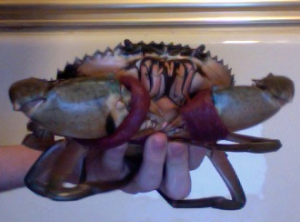
12/4/11
Today while checking in at the local Vietnamese market (I'm
always amazed at the things that turn up there in the seafood
sections. I've picked up some pretty neat aquarium
inhabitants there), I noticed they had something labeled
"freshwater crab" and seemed to be active and doing
well in room temperature water. I picked one of them up, as
I've always wanted some large crab species that didn't
need a chiller. At least, hopefully these don't need
chillers.
<Quite so. Scylla serrata is a tropical species. It's also
frequently used in laboratories where it has proven to be quite a
hardy animal. One of my professors at university had done some
neurobiology work on this species.>
After a bit of research, I'm fairly sure she is a 2 pound
female Scylla serrata. As of now, she is sitting in a 40 gallon
by herself until I get a good idea as to what sort of setup she
needs. My main problem is, I have found little to no information
on keeping these in captivity. Apparently they are brackish?
<In the general sense, yes. They move in and out of
estuaries, and seem to be tolerant of a wide range of
salinities, at least as adults. The larvae are less tolerant, but
that's only an issue if you're planning on breeding from
her!>
She is in full fresh now, and I'd like to get her in brackish
as soon as possible if it'll be healthier, but I'm not
really sure what salinity to go for.
<Something from the middle of the range upwards would be
ideal, from about SG 1.010 at 25 C/77 F upwards. If you have a
saltwater tank already, then adding one bucket of marine aquarium
water alongside every one bucket of tap water should be an
economical way of maintaining this animal. She'll certainly
be much more tolerant of nitrate than, say, corals. Of course you
could also keep her in marine conditions.>
What tank size should I put her in?
<Big as possible.>
I have no idea how much waste a crab this size is going to
make.
<A lot! On her own, I'd have though something around the
55 gallon mark would be the minimum, given she's already a
big animal. A heavy-duty external canister would be required for
filtration -- or at least something with a high turnover and that
you can clean easily and regularly.>
My other question is diet. What would be the best thing to entice
her to start eating?
<Like virtually all swimming crabs, Scylla serrata is a
predator. A good starting mix would be frozen lancefish, cockles,
and, in modest amounts, mussels and unshelled shrimps (these
contain a lot of Thiaminase, which you probably want to
minimise). As with any large crab, iodine is going to be a key
nutrient, as well as calcium, so an iodine supplement, at 50%
dosage, as used for reef tanks will be important.>
She's active and aggressive, which I take to be a good sign,
but shows no interest in food. I'm hoping she'll come
around and eat later and is just stressed out now or
something.
<Agreed. Plus, at very low salinities, she may well be
"unhappy" in whatever sense that means to a
crab.>
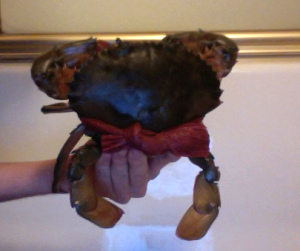
I attached a picture in case you have any other ideas to what
species she is. (Disregard the crab straightjacket, they all had
those on at the market, and I took it off as soon as we got
home.)
<Cool looking best.>
Thanks for any help.
<Best of luck, Neale.>
|
|
|
Salt, plants, and crabs --
07/21/11
Dear plant and crab expert,
<Yikes! Quite a combo, there'¦>
I'm converting one of my 10 gallon tanks to a
paludarium. Most of the tank will be water (approximately 4
gallons), with lots of shelves on the back (for plants), and a shelf on
the left with a ramp for easy access in case a land animal falls in the
water.
<I see.>
I'm planting it with hairgrass, several crypts, and any other
plants I can think of, even though I want it to be an Asian biotope
(Samolus sp, baby tears, etc). I'd like to host red claw
crabs (Perisesarma bidens),
<These are best kept as brackish water animals and
don't do well in freshwater indefinitely.>
Hermit crabs (Uca sp.),
<These are 100% brackish/marine animals -- whatever the retailer
says -- and will die unless kept in brackish to marine
conditions.>
and some aquatic insects (springtails, water louse, water
striders).
<May not/will not be compatible with brackish water
livestock.>
I can't really find a solid answer about how much salt is
needed'¦ I was hoping 1 tsp of reef salt per gallon would be
enough.
<SG 1.003 would be the absolute minimum; that's about 6 grammes
per litre of water. Teaspoon measurements are very, VERY inaccurate,
but 6 grammes is about 1 level teaspoon. Check it yourself using
kitchen scales and act accordingly. Above SG 1.003 you'll have
problems with plants; below, the Uca and probably the Perisesarma will
be less robust, dying.>
I also can't really find out whether that would kill the plants or
not.
<May well do unless you choose plants carefully. As it happens,
Samolus valerandi is extremely salt tolerant. On the other hand,
Hemianthus callitrichoides is not. Eleocharis species sometimes
tolerate slightly brackish water but it varies between species. Hardy
Cryptocoryne species like C. wendtii tolerate slightly brackish water,
and C. ciliata is a true brackish water specialist. So do your research
here, for example:
http://homepage.mac.com/nmonks/Projects/FAQ/2d.html
>
If I use reef salt, would I still need iodine supplements?
<Yes.>
I'll also likely add some glass shrimp to the tank- if they get
eaten, that's okay.
<These tolerate slightly brackish water well.>
Because the land area is built of shelves, is it ok if the crabs
don't have a dry area to tunnel in? The terrestrial and aquatic
plants should provide hiding places to help them feel secure.
<The plants will also be food for the crabs, especially the
Perisesarma.>
Can you recommend any other inverts that would do well in this
setup?
<Crabs generally don't cohabit with anything, and you would be
very unwise to mix Perisesarma and Uca; the Uca are essentially
non-aggressive (if territorial) deposit feeders that sift mud and
algae, while the Perisesarma are aggressive opportunists that will view
the Uca as potential food.>
I was also considering Nerite snails'¦
<Can work extremely well with Uca and shrimps.>
Thanks, David
<Cheers, Neale.>
Re: Salt, plants, and crabs -- 07/21/11
What about moon/Halloween crabs?
<Gecarcinus quadratus.>
I was thinking maybe mixing a mostly terrestrial crab with a mostly
aquatic crab so the smaller ones could escape'¦
<Not a chance of mixing Gecarcinus quadratus with Uca
spp.; do understand that crab species DO NOT cohabit in the
wild, and most view one another as either rivals for living space or
potential meals. There is an ample literature on this based on crabs in
reef tanks; do read.>
It's ironic to me that Uca might be less likely to eat plants, but
prefer more salt'¦
<Hmm'¦ not really ironic, merely a reflection of the fact
these crabs come from beaches and salt marshes where freshwater
aquarium plant species are absent.>
I might have to decide whether to kill my plants with salt or serve the
crabs a salad bar. It's a shame. I might end up having to scrap the
crabs altogether,
<Do look at Thai Micro Crabs.>
and go with Cambarellus Patzcuarensis var. Orange, also known as the
dwarf mexican crawfish.
<A fine beastie, though irregularly traded.>
At least it's plant-safe and peaceful according to everything
I've read.
<Hmm'¦ the smaller crayfish are less aggressive and less
destructive, but it would be unwise to assume non-aggressive and
non-destructive. Potentially safe in mixed species tanks, but do bear
in mind these have only been in the trade a year or two, so there's
very little experience to draw on, and certainly not every combination
of crayfish, fish, and plant hasn't been tried.>
Not sure if it would ever leave the water though..
<Fully aquatic.>
I don't want the land area to go to waste.
<Paludarium systems tend to work best with frogs, to be honest,
rather than inverts. You might consider tree frogs alongside, say,
similar sized aquatic frogs or newts. Mudskippers are of course another
possibility, and can, if species are chosen carefully, cohabit with Uca
spp. and certain brackish water livebearers, such as Mollies. Provided
the plants above the waterline are insulated from the brackish water
and watered with freshwater, there's little risk of salt poisoning
them, and conversely, there are true brackish water plants that might
be placed under the waterline to green things up there. Cheers,
Neale.>
Re: Salt, plants, and crabs 7/23/11
Sorry, I've been doing a lot of research. I think instead of giving
the fiddler crabs (Uca sp) the minimum amount of salt, I'll give
them whatever is ideal. Do you think 1.008-1.010 would be about
right?
<Ample.>
After a lot of research, I've found a list of plants that should
survive at those levels... I'll put it here so you can share it
with others. I assume some of these plants won't make it, but most
should, as long as they're
acclimatized slowly.
Variegated Acorus (Acorus gramineus var. 'variegatus')
Terrestrial/Emersed
Cryptocoryne pontederiifolia Terrestrial/Emersed
Crinum Calamistratum Submerged
Lilaeopsis novae-zealandiae (Microsword) Terrestrial/Emersed
Glossostigma Terrestrial/Emersed
Java Moss Terrestrial/Emersed
Java Fern 'Windelov' Undecided
Anubias Nana Emersed
Azolla Floating
Various Crypt species (already had) Submerged, will allow to grow
emersed
Hairgrass Submerged
<Would be very, VERY surprised if most/any of these would survive
above SG 1.005 at 25 C/77 F. Would strongly recommend you run the tank
at SG 1.003 at 25 C/77 F to start with, using those plants. That's
just short of 20% seawater, and more than ample for most brackish water
fishes and livestock.
It'd be acceptable for your Fiddler Crabs, and being relatively
benign animals, you'd have lots of options for things like Endler
Guppies, Black Mollies, or, if you can get them, oddball livebearers
such as Micropoecilia parae melanzona, Micropoecilia picta, and Limia
nigrofasciata.>
For livestock, I'm thinking (I know, I can't seem to make up my
mind!) 3-5 Fiddlers, 5-10 opae'ula shrimp AKA Halocaridina rubra
(I'll have hiding places to let them get away from the fiddlers in
case they think they're food)
<Very likely. Do bear in mind Cherry Shrimps adapt well to slightly
brackish water, and in fact virtually all shrimps are worth trying at
low-end brackish water.>
In addition, Fiddlers are mostly Diurnal, while the Opae'ula shrimp
are mostly nocturnal. To wrap it up, I think I'll throw in a couple
horned/corona Nerites and a ghost shrimp.
<Clithon corona, Clithon sowerbyana and Neripteron auriculata would
all thrive in brackish water.>
The tank is a 10 gallon. I know they like to dig, but I think
they'll have to settle for man-made tunnels made out of 1/2"
PVC pipe.
<Cheers, Neale.>
|
Crab identification 11/17/10
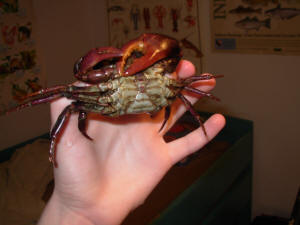
Hello, I was wondering if you could help me identify a large crab
that I recently bought from Petco. They had it labeled as a
"Thai Red Devil Crab" but all my internet searching on
this name has not found any results. He is about 4 1/2 to 5
inches across with a purplish red shell. His left claw is much
bigger than his right, but not quite as much of a difference in
claw size as Fiddler crabs. On a side note, I was wondering if
crabs use their large claw for anything other than attracting the
ladies. Anyways, I currently have him in a 10-gallon semi
brackish tank (he will be upgraded to a 25 soon) with a cave to
hid in and one of those small turtle docks to allow him to get
out of the water. Is this setup ok or should I switch to a
terrarium? I also included some pictures of him and one of my
crayfish for your convenience. Any help would be appreciated.
Zach
<Hello Zach. You appear to have a male "Thai Devil
Crab". They're periodically traded but I have no idea
what their Latin name might be. In any case, they get quite
large, and they are notoriously aggressive and
predatory. They do appear to be more or less aquatic in the same
way as many other estuarine crab species -- i.e., by choice they
stay underwater, but that can venture onto land for short
periods. An arrangement of rocks above the waterline that allowed
the crab to bask under the light should it choose to would be
helpful, but otherwise don't worry about providing this beast
with a land area. Thai Devil Crabs don't seem to be
amphibious in the same way as Soapdish Crabs or Red-Claw Crabs.
One clue is their rather flat body compared to the much more
boxy, deeper body shape typical of amphibious and land crabs.
They do require brackish conditions though, SG 1.005 is ideal,
and I'd also recommend using marine aquarium Iodine
supplement at about 50% the recommend dosage. Although crabs are
carnivorous given the chance, their diet should be distinctly
mixed with plenty of green foods alongside meaty treats such as
tilapia fillet and unshelled prawns. As for differences in the
size of the claws, so far as I know this species has claws of
similar size, so your chap has probably lost a claw at some
point, and it'll be a few moults until the new claw matches
the other claw in size. Crabs do indeed use their claws for all
sorts of things, from signaling to one another through to
dismembering prey, snipping off vegetation, crushing snail
shells, climbing up things, and of course for nipping at anything
that attacks them. Crabs are fascinating animals, among the
Nature's success stories, and quite a sophisticated and
modern group of animals despite their sometimes archaic
appearance. Cheers, Neale.>
|
|
 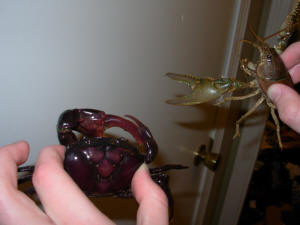
|
Re: Crab identification, salt 11/17/10
Hello again and thank you for the quick reply. I don't think
my crab lost his claw in a fight as all the other crabs in the
tank also had one large and one small claw. He also uses his
small claw to pick up food like
fiddler crabs. His large claw has roughly the same proportions to
his body as a fiddler but his small claw is a little bigger
proportionately. If both his claws were the same size as his left
I don't think he could move them. I'm sorry if you
didn't get the picture I will paste it to this message. As
for the salinity, should I use marine salt or is their a salt
specifically made for brackish water? Sorry if that sounds dumb I
don't know much about saltwater tanks.
Thanks in advance
Zach
<Hi Zach. The claw could easily have been damaged prior to
collection.
While it is not uncommon for crabs to have dissimilar sized claws
through accidents and fights, Fiddler crabs are exceptional in
having one claw massively overdeveloped as a signaling/fighting
tool rather than one for feeding and climbing. So far as I know,
crabs don't do the lobster thing of having one claw for
crushing and one claw for snipping. Yes: marine salt mix is what
you need, not "tonic" or "aquarium" salt used
for treating freshwater fish. Around nine grammes per litre
should be ample, with iodine added. Without the iodine, large
crustaceans are extremely prone to moulting problems in
captivity. Iodine-rich foods such as Sushi Nori make particularly
good supplements to their diet for the same reason. Cheers,
Neale.>
Re: Crab identification, sys 11/17/10
Hi sorry for so many questions (this is the last one) but how
long can these crabs live in freshwater? The salt in his tank is
"aquarium" salt. I might not be able to get marine salt
for a couple days will he be ok until then? I don't know how
long Petco had them in freshwater but he's been in my tank 5
days. Thanks.
Zach
<Hello Zach. "Aquarium" salt will do for a few
weeks, but in the longer term the lack of calcium salts as well
as iodine could cause problems. If you can, add 1 teaspoon baking
soda (sodium bicarbonate) and 1 tablespoon Epsom salt (magnesium
sulfate) per 10 litres alongside the aquarium salt.
These will provide some of the minerals crustaceans need for
their shells.
Also, add the iodine, either in the water, or through foods rich
in iodine (there are some special crab pellets available from
companies like JBL).
Cheers, Neale.>
|
|
Can a crab heal damage to its eye?...
and another question. Callinectes spp. habitat, comp.
8/8/09
Hello WetWebMedia crew! A few weeks ago I received a medium sized
Cardisoma guanhumi in the mail. His body (without the legs) is
probably about 5 inches across and he's a lovely blue color.
My only concern is that I noticed a strange brown spot on his
left eye. It is the same color as the coconut fiber substrate
that I have been using, so at first I was not alarmed. However,
it has been a long time now and that spot is still there in the
exact same spot and I have never seen him make any attempt to
wipe it off. Upon further inspection the spot has a different
texture than his surrounding substrate and looks like his eye is
actually damaged (BTW his eyes are yellow). I do know that crabs
can regenerate lost limbs, and I also know that crabs have
compound eyes like that of a fly or a wasp. My question is this:
Can a crab regenerate from eye damage with successive molts, or
is an issue like this permanent?
<Not the eye itself, no... just the exoskeleton... Perhaps
this mark is superficial, just on the external non-living matrix,
and will be shed...>
My picture of the crab is over 2MB in size, far larger than what
you guys said you'd like to deal with. Instead I'll post
a link to a website where I asked this same question (its always
good to get a second opinion.)
http://www.monsterfishkeepers.com/forums/showthread.php?t=257078
<... this does look like something "outside" to
me... and the left eye still functional underneath>
Second Question:. The person who I bought this lovely animal from
is also offering Blunt-Tooth Swimming Crabs (Callinectes
bocourti). He labels them as "Barbados Freshwater
Crabs". They certainly look like lovely animals. He did
state to me that they'd be much happier in brackish water and
that freshwater should only be a short-term arrangement for
them.
<I agree... is really a marine animal>
First of all, can these animals survive in the long term in a
freshwater habitat?
<No>
In spite of what he told me, I have heard of Blue Crabs
(Callinectes sapidus) being kept indefinitely in fresh water and
I don't find it unlikely that this closely related species
can't do the same.
<A reasonable assumption... though I don't think/consider
that either do "ideally" in totally freshwater settings
indefinitely. For instance, I doubt that they will moult, grow
t/here>
Also, in my 20 gallon tank I have a blue crayfish and a LOT of
baby ghost shrimp (who's population exploded after the
crayfish failed to eat the original 3 I put in there). Is there
any chance that the crab and the Cray can forge a peaceful (if
tedious) co-existence or is there really no hope for a good
outcome if the two were to meet?
<Not likely to "get along" IMO/E>
Thank you VERY MUCH for your time.
<Welcome. Bob Fenner>
|
|
Crab from Wal-Mart... NO!
12/12/08 I just bought a crab from Wal-Mart and it was labeled
Red Thai Crab. <Perisesarma bidens, I'd imagine. A small (5 cm)
potentially predatory brackish water crab. Doesn't do well in
freshwater (i.e., it dies) and needs mostly land with just a little
water for bathing.> <<Dang! I thought, had heard/read that WM
was getting out of the livestock biz... Now this!? RMF>> I read
on here that a Fiddler Crab has one large claw and one small. <Uca
sp; only the males have a giant claw, the females have equal claws.>
My crab is just like this and I was wondering if Red Thai Crabs are the
same way. Also I need to know how to care for it. <Basically you
need a vivarium, similar to what tropical frogs need, except the water
half of the tank should have around 6-9 grammes of marine salt mix per
litre of water. So, get a 10 or 20 gallon tank. Fill with rocks, coral
sand and bogwood to create mostly land. Fill with a couple of inches of
brackish water. Use a heater to keep it at 25 C/77 F. Make sure
there's a tight fitting hood: these crabs WILL escape given even
half a percent of a chance!> I have hermit crab food that Petland
told me they would eat. <Eat most anything. A bit of fish flake, the
odd piece of white fish or seafood, and regular servings of vegetables
such as tinned peas and sliced cucumber.> Do I have to supply heat
for it or will it be fine in it's pet carrier with just the heat
from the house? <Needs heat. Will die at room temperature.> In
it's carrier it has aquarium gravel and a half coconut shell and
enough water to come up to the top of the gravel but I made sure to put
more rocks on the one side of the carrier so he would be out of the
water when he wants? <Too small.> Can they drown if I have to
much water? <Yes; it's a LAND CRAB. It uses water for breeding
and drinking, but that's about it.> Oh and about his size he is
about one inch in total size (legs and all). I understand I haven't
given you much to go on but I don't have the right equipment to
send you a picture. Any help you can offer would be great. Thanks.
<Good luck, Neale.> <<I apologize to Neale for writing over
his response, but PLEASE, DON'T buy these animals... write to
Wal-Mart... protest they're offering of inappropriate life to
consumers... Boycott their purchase! Bob Fenner>>
my crab... F, really BW... color
change... beh. -- 06/12/09
Dear Crew;
I have a red clawed crab that I have had for almost 6
months now. He always seems pretty happy and forages around a lot for
food. I feed him shrimp pellets and the odd tiny piece of orange (which
he attacks and drags into his cave to devour). Today I looked at him
and he has suddenly gone really red. I mean really red: his legs, his
chest, and even some of his back. The little guy has molted twice now
and I don't remember the colour change. He seems really active, the
water is clean, I don't know if something is
really wrong, or really right. Can you help me?
Thanks!
Rachel
<Hi Rachel. It's difficult to know whether or not what
you're seeing is normal, and the best approach with crustaceans
generally is to focus on preventative healthcare. We know precisely
what Perisesarma bidens needs to do well: an aquarium with dry land to
explore; marine aquarium iodine added at half the normal dose; and
brackish rather than freshwater conditions, 6 to 9 grammes of marine
salt mix per litre of water being adequate. If you do all these things,
your crab should be in good health. If you're not doing all of
these things, then it's possible you're seeing some sort of
negative reaction. If he's active, that's a good sign, so if
you correct conditions in the tank, hopefully he'll settle down and
have a healthy life. Cheers, Neale.>
Crab from Wal-Mart... NO!
12/12/08 I just bought a crab from Wal-Mart and it was labeled
Red Thai Crab. <Perisesarma bidens, I'd imagine. A small (5 cm)
potentially predatory brackish water crab. Doesn't do well in
freshwater (i.e., it dies) and needs mostly land with just a little
water for bathing.> <<Dang! I thought, had heard/read that WM
was getting out of the livestock biz... Now this!? RMF>> I read
on here that a Fiddler Crab has one large claw and one small. <Uca
sp; only the males have a giant claw, the females have equal claws.>
My crab is just like this and I was wondering if Red Thai Crabs are the
same way. Also I need to know how to care for it. <Basically you
need a vivarium, similar to what tropical frogs need, except the water
half of the tank should have around 6-9 grammes of marine salt mix per
litre of water. So, get a 10 or 20 gallon tank. Fill with rocks, coral
sand and bogwood to create mostly land. Fill with a couple of inches of
brackish water. Use a heater to keep it at 25 C/77 F. Make sure
there's a tight fitting hood: these crabs WILL escape given even
half a percent of a chance!> I have hermit crab food that Petland
told me they would eat. <Eat most anything. A bit of fish flake, the
odd piece of white fish or seafood, and regular servings of vegetables
such as tinned peas and sliced cucumber.> Do I have to supply heat
for it or will it be fine in it's pet carrier with just the heat
from the house? <Needs heat. Will die at room temperature.> In
it's carrier it has aquarium gravel and a half coconut shell and
enough water to come up to the top of the gravel but I made sure to put
more rocks on the one side of the carrier so he would be out of the
water when he wants? <Too small.> Can they drown if I have too
much water? <Yes; it's a LAND CRAB. It uses water for breeding
and drinking, but that's about it.> Oh and about his size he is
about one inch in total size (legs and all). I understand I haven't
given you much to go on but I don't have the right equipment to
send you a picture. Any help you can offer would be great. Thanks.
<Good luck, Neale.> <<I apologize to Neale for writing over
his response, but PLEASE, DON'T buy these animals... write to
Wal-Mart... protest they're offering of inappropriate life to
consumers... Boycott their purchase! Bob Fenner>>
Fiddler crabs versus peacock eel
10/21/08 Hi <Hello,> I have a freshwater tank with three
gold fiddler crabs, one male and two female. <Uca spp. are brackish
water animals... don't last long in freshwater conditions... On the
plus side, at least some Spiny Eels tolerate brackish water well, and
may even be healthier in it than freshwater.> Well I got a peacock
spiny eel, who was about 5 inches, and the next morning he was being
eaten by the female crabs. <The eel died; the crabs ate the corpse.
Spiny Eels die very easily, frequently from bacterial infections. For
example, they can't be kept in tanks with gravel. Must be sand.
Gravel scratches the skin, allows bacteria to get past the mucous
layer, and within days they die. This happens SO OFTEN that it is
depressing. Brackish water around SG 1.003 (as opposed to
"teaspoon tonic salt per gallon" nonsense) may be beneficial
to Spiny Eels because it minimises the risk of bacterial
infections.> I don't understand what happened. He was perfectly
fine all day long... and I know that my tank is in great condition.
<Do you have sand or gravel in the tank? If gravel, that's
likely part of the issue. Spiny Eels are also easily starved. You
can't keep them with things like loaches and catfish because they
don't compete for food. If you stick one in a community with
loaches and catfish, it will get steadily weaker with time. They
obviously don't eat flake or pellets, and need a meaty diet of
things like earthworms or frozen (not freeze dried) bloodworms. Just
getting food into them is hard enough without keeping them with other
nocturnal fish that steal the food first.> Is it possible that the
crabs could have killed the eel? <No. Uca spp. are primarily
detritivores, though they will eat carrion.> The eel was somewhat
slow moving and was still very young. I am very upset about the eel, it
was very beautiful and I would really enjoy having an eel in my
community tank. <Sadly, these aren't "easy fish" and
I'd encourage you to read my thoughts here before doing anything
else: http://www.wetwebmedia.com/FWSubWebIndex/spinyeelsmonk.htm >
Ashley <Cheers, Neale.>
Re: fiddler crabs versus peacock eel
10/21/08 Thank you so much for the fast response! <Most
welcome.> Well I do have a sand/gravel substrate, however the
aquarium store had large gravel. <Hmm... in my opinion, plain smooth
silica sand is the way to go, particularly with small (sub-20 cm)
specimens.> And the eel was buried in there when I got it. Do you
think it is possible that the eel got the infection at the store?
<Quite possible.> I watched the eel quite intently and he never
buried himself. <Possibly prefers the hiding places available above
the substrate. In any case, they feed by pushing the rostrum (the
"trunk" on the nose) into the sand to uproot insect larvae
and worms. So even at that level, sand helps.> He actually spent
most of his time swimming near the top of the water. <They do indeed
like swimming among the roots of floating plants. They're great
escape artists though, so be warned that they're also apt to jump
out, if they can.> Also do you have any suggestions on what I could
do to get my tank better prepared for a peacock eel? <Do read my
article; that's everything I know about them!> I have three
small Cory cats, will they be a problem for the eel? <Does rather
depend on the size of the tank and how much food you put in. Assuming
you were generous with the food, these fish might get along just fine.
The real problems come with "bullies" like loaches and Plecs
that will keep the Spiny Eel away from its dinner. Earthworms are the
secret to success with the Mastacembelidae, and they will thrive on
these tasty morsels.> I guess I should let you know that I have a 55
gallon tank with a mostly sand substrate. There is some small white
gravel mixed in with the sand. <Hmm...> I have got platies,
swords, mollies, tiger barbs, 2 rainbow fish, paradise fish, the Cory
cats, and the crabs. Everybody lives perfectly fine together. I usually
put a small amount of aquarium salt in the water. Would this be
recommended for an eel? <I suspect the Fiddlers are on borrowed
time. They're amphibious and will spend all their time trying to
get out. The vast majority of specimens in freshwater aquaria last but
a few months. It's a shame they're sold at all, to be honest.
Adding "small amounts of salt" won't really have much
effect either way. They won't make any of these animals healthier,
but if you want to waste your money on boxes of salt, then go ahead,
you aren't doing any harm either.> Ashley <Cheers,
Neale.>
Re: fiddler crabs versus peacock eel
10/21/08 Well thanks again...I know the crabs need air every
now and then. <No, it's not "air now and again" for
these crabs. They're land crabs. They live, feed, socialize on
land. They only go into the water to moisten their gills and to breed.
That's it. Otherwise they're as much land animals as, say,
frogs. When kept properly they spend 95% of the time on land. The males
are very cute, standing about waving their giant claws to scare rivals
and flirt with females. This is why they're always trying to
escape: it's like trying to stop a bird from flying away.> I
have an external power filter and the crabs climb up the tubes. But i
have built a plastic mesh enclosure so that the crabs can get to the
air but not fully escape. <Sooner or later, crabs escape. I say this
as someone who had to get his parents to take apart their kitchen units
to rescue a Cardisoma crab when I was a teenager! The thing was the
size of a softball and yet managed to escape...> I read your article
and it definitely gave a lot more knowledge about the eels. I do
believe that if I try eels again I will get the gravel out and get some
live worms... You've been most helpful! Ashley <Happy to help.
Enjoy your fish. Cheers, Neale.>
Re: Crab Questions, Fiddlers fiddling
about 10/16/08 Good evening, As an update of sorts, the day
after this email I had a problem in the Fiddler Crab tank. The
reservoir previously described had served me well for maybe a few
months or so, but for some reason it backed up and flooded/washed out
some of the land portion. I had to do some temporary rearranging in the
tank and remove the circulating pump and also put in a different filter
that wouldn't suck up the sand until I could do another setup. The
next morning I was surprised to see the smaller female (who had been
missing a leg from the beginning, now carrying eggs) with two more legs
missing. <Mmmm> I immediately spotted the legs lying near the
food dish and observed the male (about the same size) chasing her and
trying to grasp at her. I had never seen him act like this before. I
reached down to scare him away from her and within 30 seconds he was
chasing her again. <As a food item> I decided to go ahead and put
her into the hatching tank that I had set up (ridiculously small at two
and a half gallons). I provided filtration and some areas for her to
get out of the water and she was soon exploring and eating. I added
extra calcium (cuttlebone) in her food dish. About three days later she
released her eggs during the night (at the new moon) and she was
cleaning her front when I found her. I found it possible to see the
young in the hatching tank by holding a flashlight to the glass. They
were light in color and anyone trying to do this will see them better
against a dark color. I couldn't get a photo of them since they
were so small. After that I moved her into a three gallon tank with
land areas and a filter with the thoughts of that being a place for her
to be left alone to eat, etc., with no competition. The water was the
same brackish strength as the water in the main tank, came from a
mature aquarium, and the filter should have been mature at this time.
<Very good. Necessary> Now as luck would have it all these events
coincided with a gasoline shortage where I live that lasted more than a
week. This figured in my not being able to get all the things I should
have, ideally, had on hand for the hatching tank. I used phytoplankton
(I have since read that zooplankton would've been better?)
<Yes... actually both... the phyto to feed the zoo-> but by day
five there were very few left though some were noticeably larger as if
they had went through a molt or something. By day six they were all
gone. I kept a day by day account of all this that might help me in the
future if I decide to try again with a larger hatching aquarium and a
heater to prevent fluctuations. I did get the surprise of seeing the
male and the other female (the larger one) in the main tank mating
right out in the open. Their burrows had been messed up in the
reservoir incident and maybe that is the reason for their, uh, lack of
modesty. So, of course I took photos! <Heeee!> The male
doesn't seem to give this larger female any trouble, but then again
she is larger than him. Sadly, less than two weeks after releasing her
eggs, I found the little female dead (definitely) on land in the
hospital tank. The past two days beforehand I didn't see her eating
and she wasn't as "all over the place" as usual. In a way
she was my favorite of the three, partly because of sympathy about her
initially missing a leg and also because while the other two had made
burrows, she was always out roaming eating more than the others and
taking shelter under whatever was handy instead of having a more
permanent home. I know Fiddlers are said to have short lives, but I
would think that if she had lived out a full lifespan she would have
been larger. <Mmm, size/growth a matter more of food, conditions,
than age> Now I'm a bit paranoid about the two I have left. As
expected, the larger female has developed eggs and I am anxious to see
if she will release them on the full moon (versus the new moon, when
the other Fiddler released hers). Since losing my favorite, I don't
know if my heart is in trying with another batch of zoea right now or
not. Any comments or advice will be appreciated. Thank you for your
time, Crab Enthusiast <Thank you for sharing... please do continue
to report your experiences, observations. Bob Fenner>
Crab Questions, brackish sys.
9/23/08 I have three Fiddler Crabs (Uca minax I am almost
certain, one male and two females) and they live in a 2/3 land setup in
a ten gallon glass rectangle aquarium (or paludarium, if you prefer).
The water is about two inches deep (just enough to allow for a filter
and also a circulation pump) and they have sand for burrowing. Under
the sand there is a layer of gravel, and I have a small reservoir in
the corner on the land side into which water is continuously pumped via
tubing running from the water portion. The water moves out of the
bottom of the reservoir, flows through the gravel and passes under the
retaining wall (about 1/4 inch gap) and back into the water portion.
The water is brackish (made with Instant Ocean) and I have a fresh
water dish on the land portion that I also use for a food dish. If Uca
minax ranges from Texas to Maine on the eastern coast of the U.S., at
what temperature should they be kept? <Likely "room" is
fine throughout the year, with some sort of cover/barrier covering most
of the top> I live in the Carolinas and though it has been hot for
months the room in which these Fiddlers are kept is about to get
chilly. <As it is in the wild> I have their home on a sturdy
wheeled cart so they can be moved. <Neat> If a heater is
necessary could I use one of those flat, submersible heaters that are
meant to be placed in a fish bowl under the gravel (no experience with
those)? <You could... See Dr.s Foster & Smith re> I notice
that under-the-tank heaters warn (after you open the package) that they
should not be used on aquariums that contain water because the tank
could crack. <Mmm, there are some low wattage ones that are fine
here> Another temperature issue is that one of the females had eggs
and must have released them (no sign of anything in the water, only the
tiny white things that already live there), and now the other female is
carrying eggs also. I have looked at everything I can find about what I
need to do to attempt to raise a batch (quite a long shot, I know) and
I am probably about to purchase some phytoplankton, Artemia hatchery,
etc. in hopes of giving it a try (I have a small spare tank running for
this purpose). <A worthwhile venture> In the past I received
great advice from your site about three Blue Legged Hermits
(Clibanarius tricolor) that I have been maintaining alone in their own
aquarium. What is the ideal temperature for them? <Seventies F.>
What is the best way to go about dosing such small systems with
something like Kent Marine Super Iodine? <Dilute in new water just
ahead of water change-outs> Or is that impractical for the amount of
water, the Instant Ocean providing enough trace minerals, etc.? <Is
likely adequate... no need to supplement.> Thank You, Crab
Enthusiast <Welcome. Bob Fenner>
Fiddler crabs versus peacock eel
10/21/08
Hi
<Hello,>
I have a freshwater tank with three gold fiddler crabs, one male and
two female.
<Uca spp. are brackish water animals... don't last long in
freshwater conditions... On the plus side, at least some Spiny Eels
tolerate brackish water well, and may even be healthier in it than
freshwater.>
Well I got a peacock spiny eel, who was about 5 inches, and the next
morning he was being eaten by the female crabs.
<The eel died; the crabs ate the corpse. Spiny Eels die very easily,
frequently from bacterial infections. For example, they can't be
kept in tanks with gravel. Must be sand. Gravel scratches the skin,
allows bacteria to get past the mucous layer, and within days they die.
This happens SO OFTEN that it is depressing. Brackish water around SG
1.003 (as opposed to "teaspoon tonic salt per gallon"
nonsense) may be beneficial to Spiny Eels because it minimises the risk
of bacterial infections.>
I don't understand what happened. He was perfectly fine all day
long... and I know that my tank is in great condition.
<Do you have sand or gravel in the tank? If gravel, that's
likely part of the issue. Spiny Eels are also easily starved. You
can't keep them with things like loaches and catfish because they
don't compete for food. If you stick one in a community with
loaches and catfish, it will get steadily weaker with time. They
obviously don't eat flake or pellets, and need a meaty diet of
things like earthworms or frozen (not freeze dried) bloodworms. Just
getting food into them is hard enough without keeping them with other
nocturnal fish that steal the food first.>
Is it possible that the crabs could have killed the eel?
<No. Uca spp. are primarily detritivores, though they will eat
carrion.>
The eel was somewhat slow moving and was still very young. I am very
upset about the eel, it was very beautiful and I would really enjoy
having an eel in my community tank.
<Sadly, these aren't "easy fish" and I'd encourage
you to read my thoughts here before doing anything else:
http://www.wetwebmedia.com/FWSubWebIndex/spinyeelsmonk.htm
>
Ashley
<Cheers, Neale.>
Please Read ASAP... Fiddler crabs... missing
legs... poor English... too typical no reading, understanding of
animals needs 8/5/08 Yes, <Yes?> I would like to know if you
could help with my fiddler crab... I just bought it 2 days ago and I
have just notice... that its missing 3 legs...yeah....where he has his
huge claw. which I know its a male. <Likely shock from poor
handling, maintenance. Will grow back if looked after properly. Fiddler
crabs (Uca spp.) are of course BRACKISH to MARINE water organisms that
shouldn't be kept in freshwater tanks. They need more land than
water. Like to burrow. Keep in an vivarium (not an aquarium) with maybe
an inch or two of warm (~25C) brackish (SG 1.005-1.015) water with a
big sand bank (coral sand and silica sand mixed 50:50). Stabilise the
sand with bogwood roots and various stones, ideally calcareous ones
like tufa. Fiddler crabs are NOT compatible with fish. Period. They are
too easily damaged by them, and aquarists that are keeping fish
invariably have the wrong tank for Fiddler crabs. Fiddlers are
omnivores and need a mixed diet containing small invertebrates and
algae. Bloodworms, Sushi Nori, catfish pellets, algae wafers, etc.
would all work well. Gregarious; keep in groups of six or more, with
more females than males. Males will display to one another but rarely
cause physical damage if given adequate space. Great escape
artists!> Can you please help me I don't know what to do? should
I return it. <Hope this helps, Neale.>
Mangrove "swamp"/ mudskipper,
fiddler tank? 7/31/08 Hi Crew (or should I say crew member), This
is 40 gal des (not sure anyone remembers her). I have a bee in my
bonnet (or perhaps gobies) as I have a new project idea. My tank has
been fallow for ages now, and I was paging through the book by
"The Complete Aquarium" by Peter Scott. Anyway, I came upon
the Mangrove swamp with the mudskippers and fiddlers and I was utterly
charmed. <It is indeed a lovely aquarium.> Anyway, I have been
researching this topic-- where to get the critters and plants, how to
raise mangroves, what to put in the tank, how much water and sand,
brackish, the range of topics. But a few things seem blurry to me (well
more than a few...), but I 'll try for brevity. <Would highly
recommend looking over Richard Mleczko's chapter on mudskippers in
my 'Brackish-Water Fishes' book. He's easily the world
expert on keeping these fish in captivity, and discusses every aspect
of their care as well as all the different species you'll see on
sale. In fairness, the chapter on Mudskippers in the Aqualog Brackish
Water Fishes is also very good.> So here it is-- Basic setup: 40 gal
breeder and stand; Orbits' compact florescent (2 92 watt bulbs).
Plans: Replace actinic bulb with 6700K and keep the 10,000K. <Do
make sure the tank is "mudskipper-proof", as these fish will
climb out of any gaps they find.> Divide tank roughly in two with
plastic, rock up to about 8 inches or so. Place (no.? ) potted mangrove
trees grown from seeds (already with leaves, etc) around mostly one
side. <Mangroves grow very slowly, and you may find plastic plants
or houseplants in plastic pots (to keep the salty water out) will work
at least as well. Plants like Philodendron work very well for this sort
of thing.> Fill around with (? type sand-- oolitic, aragonite, etc?)
about one inch on one side and about 1/4 to 1/3 on the other <Sand
type doesn't matter, but a mix of coral sand and smooth
silver/silica sand is probably the best in terms of appearance and
"stickiness". The coral sand will also add a bit of buffering
to the system.> fill with brackish mixed water 1.05 or so salinity
(I have an RO system), over the top of sand on both sides. <SG 1.005
upwards to seawater is fine; 1.05 would be hypersaline and deadly!>
Use small internal power filter and guarded 50 watt or smaller heater (
although I'm going to bet it isn't going to go on much).
<Would highly recommend an external heater to avoid problems with
mudskippers climbing onto a glass heater and scalding themselves.
Failing that, make sure there's a plastic guard around the heater.
But seriously, undertank heaters similar to those used for amphibian
set-ups would be better. Filtration is relatively unimportant to
mudskippers because they spend so little time underwater, so use
whatever suits your budget.> Aquascape with some large flat rocks,
coral pieces, shells, and driftwood (a little!). Cover with bullet
proof plastic (I don't expect it to get shot, but it doesn't
warp.) Cycle. <Always a good idea cycling the tank before putting in
fish, but funnily enough Mudskippers are ammonia-tolerant "right
out the box", presumably so they can survive in their wet burrows
while the tide is out. They also spend most of their time on land, so
aren't exposed to the ammonia anything like as much as regular
fish. So provided you did lots of water changes so the ammonia stayed
below 0.5 mg/l, you could probably cycle with the Mudskippers.> Add
quarantined (? number of mudskippers (P. kalolo) and fiddlers (and ?).
<Richard isn't a fan of mixing crabs and Mudskippers, so be
careful here. Big crabs will nip small Mudskippers, and big Mudskippers
will eat small crabs. Fiddlers are probably the best crabs to go with
because they're deposit feeders rather than omnivores, but be
careful. Periophthalmus kalolo is a fairly aggressive species, so
either avoid having more than one male or else overstock the tank so no
single male becomes hyperdominant.> Pull up a chair in front and
watch! <Sounds about right.> So maybe my questions are apparent
here. 1. I was told to plant the seeds in a gallon pot, I'm
guessing clay. Is this a good size. I think the pots sound like a good
idea given the root strength. What do you think of the gallon size and
how many do you think I should do in a 40. The picture in the book
(which is a 40) shows four , and I don't think the pots are that
big. I was thinking 3? <Mangroves are trees, so whatever you do with
them and however you pot them, eventually they will get too big. I
don't actually rate them highly for this sort of set up.> 2.
What kind of sand? The book says silver, but I was thinking aragonite
or even oolitic to keep pH high. <Without undergravel filtration,
the buffering effect of a mound of coral sand is limited. Buffering is
proportional to the surface area of coral sand in contact with moving
water; in the case of a layer of coral sand without undergravel
filtration, only the top grains of sand are in contact with moving
water. So I'd not fuss about this issue.> 3. What rock is safe?
I think limestone would help the pH, but I think granite is the most
common, in the yard sort of rock (I don't intend to buy it.) Is
there rock I should NOT use? (Obviously nothing that would be too sharp
on the fish.) <Again, don't be too worried about the pH issue.
Marine salt mix will buffer the water nicely, and if it doesn't,
you can also add a bit of home-brew Malawi Salt mix to up the carbonate
hardness. I've described this elsewhere on WWM:
http://www.wetwebmedia.com/FWSubWebindex/fwhardnessfaqs.htm So choose
rocks that look nice, aren't spiky or rough, and don't have
metallic seams in them that might poison the fish/crabs.> 4. I know
driftwood is acidic, do you think the other stuff would out weigh it?
Do I need to add something for hardness, pH? I have B-Ionic. I was
thinking though that that was a bit overkill. <Bogwood will have
minimal effect. If it does, up the carbonate hardness as stated
above.> 5. Stocking number? (mudskippers, crabs). Any safe critter
to put in there. I am guessing I don't have room for much.
<Mudskippers are funny about tankmates. Your best bets are things
like small brackish water livebearers, perhaps Guppies or Limia. But
big Mudskippers will eat small fish, while big fish terrify Mudskippers
who view them as predators.> 6. Cycling? I have read not such good
things about BioSpira, that it isn't refrigerated. I have never
seen it refrigerated. Fish food? Shrimp? <Any of the above. Or just
let nature take its course, using the Mudskippers or crabs.> 7. I
live in the desert, should I think about a fog maker, to get up the
humidity a bit? <The lid on the tank should take care of this
automatically.> OK, I think that's enough. I was working on
brevity. Thanks Crew!!! You are terrific! --des <Hope this helps,
Neale.>
Re: Mangrove "swamp"/ mudskipper,
fiddler tank? 7/31/08 Hi Neale, Thanks for the great information.
<Would highly recommend looking over Richard Mleczko's chapter
on mudskippers in my 'Brackish-Water Fishes' book. He's
easily the world expert on keeping these fish in captivity, and Just
ordered off Amazon. <<I am sure you will enjoy.>> >
<Do make sure the tank is "mudskipper-proof", as these
fish will climb out of any gaps they find.> Yes, I have kept
Jawfish. Tricky little devils. Fortunately mudskippers aren't $180
like those cool blue spotted Jawfish. Just when I thought it was safe
to remove the netting around filters and the like, he jumped to his
death! So no more removing netting, though without hang on the back
stuff should be easier really-- until trees grow. <<Ah, seems
you're mentally prepared at least! The difference is that
Mudskippers are gobies, and are equipped with a neat suction cup that
lets them climb up vertical surfaces, including glass.>>
<Mangroves grow very slowly, and you may find plastic plants or
houseplants in plastic pots (to keep the salty water out) will work at
least as well. Plants like Philodendron work very well for this sort of
thing.> The way I read Scott's book, it was the ceramic pots and
not the actual trees that kept the bank up (along with rock. So you are
really not depending on tree growth. <<I have the book and
checked. My issue with ceramic pots is they're porous, so will let
salt in. If you're growing salt-tolerant plants like mangroves or
Nypa palms or whatever, then use whatever pots you want.>> >
<SG 1.005 upwards to seawater is fine; 1.05 would be hypersaline and
deadly!> Oh yes, woops! It's not a typo really, but I am
familiar with all this. Just will have to go through the numbers again.
<<Good.>> Thanks for advise on filtration and heaters!
>below 0.5 mg/l, you could probably cycle with the Mudskippers.>
Cycle with fish! Yikes! This is new info and I have never seen this
(though saw they were tolerant of ammonia. <<Some mudskippers
will happily frolic around sewage outfall pipes. They are incredibly
tough fish.>> What about quarantining these guys (gals)? I have a
ten gal QT. I was thinking in terms of about 2-4 inches of water and
some rocks (or maybe dinner plates. <<Since they're the only
fish in the tank, quarantining them is redundant. Of course you
can't use formalin or copper medications in a system with crabs,
but brackish water will kill off Whitespot anyway.>> >
Periophthalmus kalolo is a fairly aggressive species, so either avoid
having more than one male or else overstock the tank so no single male
becomes hyperdominant.> What's your definition of overstock of
P. kalolo in a 40? <<Depends on the size of the fish, and how
much land there is. Richard's basic idea is that if all the fish
are crammed onto the same bogwood branch or sand bank, none of them can
make a territory. I'd be looking at half a dozen specimens, at
least.>> Or can you sex the fish to determine which is male?
<<Difficult to sex Periophthalmus spp. except to say males are
more aggressive!>> Also I was told to overstock the crabs. Both
because they are aggressive, and because some will be eaten-- this from
a guy who does barbarus which are even nastier. <<P. barbarus
usually ends up being kept alone.>> >
http://www.wetwebmedia.com/FWSubWebindex/fwhardnessfaqs.htm Thanks for
the link. > <Hope this helps, Neale.> You're all great!
<<We do try.>> --des <<Cheers,
Neale.>>
Fiddler crab not
moving, feared dead. 3/6/08 Greetings Crew! I have a brackish tank
with 4 Fiddler crabs (3 until yesterday, when I rescued another from
PetSmart) I have had 2 of the crabs, a female and male, for longer than
a year with everything ok. However, I woke up this morning to find the
older female back-down with legs in the air...er, water, and not
moving. I got her out, moved her around, tried to provoke a response,
but nothing. I don't want to get rid of her for fear she may be
molting, but if she is dead and I leave her in she will foul the tank.
She has been this way for over 12 hours. Thanks for your help. Phillip
<Hello Phillip. Sounds as if she is dead. Even when moulting, crabs
have mobile mouthparts and gills. So if nothing is moving at all on
your crab, she's probably dead. There's some reports that
Iodine is a critical supplement that needs to be added to aquaria for
crustaceans to do well in the long term. It's an inexpensive
addition you can buy from any store catering for marine aquarists.
Certainly worth a shot to see if that improves things with the
remaining crabs. Do also bear in mind that Uca species only live for
about 18 months in the wild, so anything beyond that in the aquarium is
a bonus. Cheers, Neale.>
My crab isn't moving, BR 1/1/08 Hello crew,
<Greetings and happy new year!> I was wondering if you would be
able to help me out. I have a crab (*Seserama bidens*), sold to me as a
Red Claw Crab. <Ah yes... now known as Perisesarma bidens, though
the red-claw crabs traded may be multiple species, given that
Perisesarma bidens is primarily from East Asia while most exports are
from Southeast Asia and elsewhere.> I bought it close on a month ago
and he quickly became my favourite addition, roaming about searching
for food and generally acting in a brazen manner. <Quite so. These
are rewarding pets when cared for properly, and well worth their own
specialised quarters.> However, I recently purchased a 30 gallon
tank filled 2/3, bogwood creating a land area and a rock pile for my
two crabs to hide in (the other being a golden fiddler (*Uca *sp.) )
and for my dragon goby (*Gobioides broussonetti*). <A nice
collection of livestock.> The new tank seems healthy (specific
gravity at 1.005). that's the only real thing I measure) the
guppies and platys that share it with them are doing fine, and the
fiddler is quite lively. Crushed coral for substrate, java fern
floating around, trying to get some pieces to take root. <All sounds
fine, though strictly speaking Platies aren't brackish water fish,
though my experiences agree with yours that they do well at low
salinities.> The problem is the red claw, who used to be quite
active, scavenging around his log as well as in the water, recently
took to hiding. I assumed it was just molting, and after maybe three
days, and no actual result, I picked out the rock he'd been holding
on to from the rocky pile as he had not been eating or moving and I
feared the dragon, who also likes that spot, might stress him out.
<Curious. I'd have associated hiding behaviour with moulting,
too. Crabs of most sorts are potentially antagonistic towards one
another, so do check there isn't bullying between the Perisesarma
and Uca crabs.> He looked just as he always did, no colour change,
nothing that would indicate molting to me. As I have mentioned he used
to spend a good bit of time on land, I thought maybe he just
couldn't get up there now (he'd been missing a leg upon
purchase, I know it's a no-no, but he was the only one left, and I
hadn't really noticed till I got him home). <A missing leg
usually isn't a problem when these crabs; they're quite tough
and regenerate lost limbs quickly when kept in brackish water. On the
other hand, our ability to prevent secondary infections in
invertebrates isn't good, given that things like copper are toxic
to crustaceans even at very low doses.> So I slipped him onto the
wood and sprinkled a few bloodworms in front of him, he stayed for a
while and then crawled off and fell into the water where he landed
upside down. Despite much flailing he was unable to right himself, so I
stuck the net in and he quickly righted himself. He's been there in
the open, next to a large shell for over a day, not really moving and I
still haven't noticed him eating. He's not being bothered by
any of his neighbours. What do you suppose is wrong with him? <Very
difficult to say. One problem with these crabs is they're often
traded as freshwater animals, and if they've been kept in
freshwater at the wholesaler and the retailer, then they can lose
condition. Uca crabs are much worse in this regard than Perisesarma,
but it is still one more factor beyond the aquarist's control. We
don't really know anything much about secondary infections or
parasites of crabs. Pretty much they're either healthy or dying. If
yours is going to recover, it will, but otherwise the best you can do
is watch, keep the water clean, provide suitable food, and if the crab
dies, remove it at once.> My mother keeps telling me he's dead,
and I try to tell her he's just molting, do you suppose this is so?
He'd often sit for a while not moving before hand, but never for
days! I don't really know what's typical molting behavior for
crabs, I'd always thought they hid away after they molted, or
during, not beforehand. <Moulting is very obvious and usually over
in a couple of days. One problem with crabs and indeed freshwater
crustaceans generally is iodine. While small shrimps seem to get enough
iodine out of the water or their food, larger animals like crayfish and
crabs apparently benefit from iodine supplements. These supplements can
be purchased from stores catering to marine aquarists as iodine
supplements are widely used in reef tanks. At this point it might be
too late for the red-claw crab, but any new specimens you buy, and the
Uca crab as well, will benefit.> I wouldn't think it would be a
problem with my levels, as the fiddler and everyone else are doing
fine. I heard a rumor of Java ferns being poisonous to fish, he ate a
good chunk of one before I moved them, could that be a factor?
<Possible, though normally animals stop eating the Java ferns
because they taste nasty long before they actually get sick.>
I'm just trying to think of everything here, no matter how absurd.
I apologize for my lengthiness, but the instructions on your site said
include every detail. Any thoughts would be well appreciated, -Collin
<Hope this helps, Neale.>
Re: BR crabs... Now: Specific Gravity 1.010... for
Hermits, Dragon Goby... 1/2/08 Hello there, <Hello Collin,> I
wrote in yesterday about a crab who's not up to his norm, and I
will for sure be trying to track down an iodine supplement (as
recommended by Neale) to help out at this stage, whatever good that
will do. I had heard about this, but there is a slight lack of
aquarists specializing in crustaceans or BW tanks in my area and I
couldn't find anything locally on it, but I know of one place that
probably has it and knows what they're at. <Anywhere
specialising in reef tanks should have this, and failing that, you
could obtain online.> But! I have another question: I read on your
site that the blue-legged hermit crab (Clibanarius tricolor) could be
acclimatized to a specific gravity of 1.010 <Apparently so. Do
acclimate them carefully, and take great care to identify the crabs
carefully before sticking them in a low-salinity environment. SG 1.010
is at the low end of their range, and you will of course need to make
sure other things like water quality are "marine
standard".> I was wondering if you could tell me if the
inhabitants of my brackish tank would be fine with this level of salt,
as my findings on the internet have been rather inconclusive with
different authors throwing numbers around as if they were just that:
numbers. There doesn't seem to be any set specific gravity that
people can rely on for these animals. <Uca and Perisesarma should be
fine; both spend minimal time in the water and likely breed in the sea
anyway. If you're concerned, put a small basin of plain freshwater
for them to drink somewhere on the land. An upturned Oyster shell stuck
in the sand would be ideal. Guppies can be acclimated to anything up to
full strength seawater safely, but you must do this very slowly, over
several weeks. You can actually buy "marine guppies" as
feeders for marine fish. The Dragon goby will be very happy at SG
1.010. The only chap who can't be kept there is the Platy.>
Anywho, my tank has a golden fiddler (*Uca *sp.), dragon goby
(*Gobioides broussonetti*), Red claw crab (Perisesarma bidens), two
guppies and two platys. So I was wondering if you would be able to tell
me if I would be able to house this little guy sometime in the near
future with the current inhabitants, maybe rehousing the guppies and
platys? Also, would I be able to add the hermit with the current bottom
dwellers that are on the go in there given this is all a 29 gallon
tank? I may be short one red claw crab within the next week or two, if
that's a factor. (Given his current condition. <I would imagine
they will ignore each other. Hermits are too well armoured to be
molested by small crabs, and since the hermit is fully aquatic, your
land crabs won't encounter them much anyway.> Though I was
watching him "scratch" his claws off one another, and against
his legs. I know the fiddler and red claw both came from the same tank,
same store, only the red claw had been in there about a month later
till I bought him, I hadn't really been counting. Could have been
FW, I wouldn't be surprised, I'll ask them soon.) <Usually
these things are sold as freshwater.> So yeah, thanks in advance for
reading my email, You guys are awesome -Collin <Glad we could help.
Cheers, Neale.>
Clibanarius tricolor biotype 1/14/07 Hello Robert,
<Neale> I can probably rustle up a few pictures. There are also
some useful sources on Wikipedia, which we used in my book (which I
finally have a preview copy of, by the way). So there's other
options, too. <Have the ones you sent along, thanks. Will post with
credit to you> Since you're a marine guy, perhaps you'll
know whether the blue-leg hermit sold in the UK (Clibanarius tricolor)
is the same as the one in the US. I've mentioned it in the article
because it does well down to SG 1.010. I assume it's a rocky shore
or estuarine species that gets collected as a cheap reef critter. But I
don't know anything specific about its ecology. Can you enlighten?
<I do think this is the same animal/species... and yes to its
euryhaline tolerance> Cheers, Neale <BobF, out in HI... trying to
catch up!>
Fiddler Crabs 12/14/06 My son brought two fiddler crabs home
from school after a class project. We have tried to learn about them
from internet searches, but only recently found your web site. It has
some great information! <Ah, good... We intend to be useful (timely,
accurate, significant, meaningful... in our information presentation...
And always open to review, suggestions for improvement> We've
set up a small tank with aquarium gravel, and we set a 3/4" deep
dish (actually the bottom of an old pencil case) in the center.
We've added some plastic plants and a small aquarium feature, which
the crabs seems to like to hide under. We keep gravel and brackish
water in the dish. We feed them ground hermit crab pellets, bits of
krill, and bits of cuttlefish bone. I remove approx. 1/5 of the water
every night and replace it with fresh, and clean the tank every two
weeks. <Sounds very good> We've had the crabs two months. At
first they were very active, scurrying around the stones at night. Now
they seem to spend all their time in the water, hiding under the tank
features. <Mmm, not atypical behavior. Are shy animals that
don't like a lot of "commotion"> They became active
again a few days ago when I cleaned the tank, but soon went into hiding
again. In the time we've had them, they have not molted. <Will
do so in time... with growth> Does this sound like normal behavior?
<Not unusual thus far> Is there something more we should be
doing? <Do you know, have you tried to find out the name of the
species you have? Some fiddlers have quite different requirements...
e.g. the saltiness of their water...> We really like the little guys
and want to take good care of them. I'm not prepared to invest a
lot of money in equipment, but would at least like to know what I
should be doing. Thank you for your help! Mary <Please consider
setting your child on the task of discovering the species involved
here... And write me/us back re your progress. Bob Fenner> Re:
Fiddler Crabs 12/15/06 Thank you! I will share your reply
with my son and set him upon his research task! Mary <Ah, good.
BobF>
Dismembered crab 11/28/06 I suspect this question will end up
being mostly academic because I have a feeling the critter in question
will be an ex-critter by the time I get home. I've got two red claw
crabs <Likely Fiddlers, Uca> in a 25 gal. brackish tank that had,
up until last night, coexisted just fine. They had established separate
territories and mostly didn't interact at all. Well, I added some
new plants last night and this morning awoke to a crab devoid of its
pinchers. Completely amputated cleanly at the joint with the body. It
was flailing around upside down and couldn't right itself. I moved
it back up to its territory and placed it somewhere where it was hidden
and mostly upright. As I said, I'll be surprised if it survives the
shock, but if it does, is there anything I can do to help it survive
until it molts and starts to get its front claws back? <Separate it
from the other conspecific crab> I know that those claws are what it
uses mainly to feed itself and it doesn't seem to have alternative
legs that it uses like our crayfish do. And would adding something like
Melafix make any difference? <No to adding this or any other phony
or real medicine... time, feeding, keeping the water quality
constant... When the crab molts a few times, it will re-generate its
missing limbs. Bob Fenner> Sarah
Re: Dismembered crab 11/28/06 Thanks for the suggestions. And
no, it's not a fiddler, it's a red claw crab, Sesarma bidens or
whatever they've changed the taxonomy to. Sarah <Ahh, thank you
for this. My input remains the same. Bob Fenner>
Brackish Fish and Crabs - 3/5/2006 I am very interested in
having brackish crabs and brackish fish. I have not bought a decent
sized tank yet but I want to research types of fish first. I like
puffers (who doesn't) but obviously, they cannot go with crabs and
the like. <<Depends on the personality of the puffer, but you are
right, as a rule.>> I have gone on very many internet sites and
they sometimes have information on brackish crabs and fish in the same
tank, but only ever say top dwelling fish and short finned fish. One of
the only examples of brackish fish and crabs was red claw crabs and
bumblebee gobies but those are bottom dwelling! If possible, could I be
told of all possible combinations of fish and crabs (in brackish
conditions) including more than one type of fish to one type of crab?
<<Too many variables, you are going to have to do your own
research here.>> I like red claw crabs but would go for another
like fiddlers. I would only aim at having one or two crabs in a tank.
To make a more specific analysis of what type of tank I am after I
would have to say an around 50-gallon tank with a lot of depth and
width (not much of a tall tank person). For internal decoration and
design, I would like to have a fake rock cave with its entrance facing
the front of the tank so I can still see the crabs inside (maybe logs
so they can reach the air not sure yet on what add so they can reach)
<<Do make sure you house the crabs you choose properly, and
create a dry land area, if necessary.>> I would really like to
know some names at least of some top dwelling short finned brackish
fish. If there are no good combinations, if possible, could I be sent a
table or something in which it shows what brackish fish can go with
what? <<No such table exists, sorry!>> This is a lot to ask
but it would be extremely helpful and I may have asked things against
your policies (apologies if I have) but I saw that I had to type
properly and I hope I did so adequately. <<Capitalized I's
would be nice too.>> I will not expect a question this long to
get a full reply instantly and I do hope this is a free service
otherwise oops. <<It is, yes.>> Yours sincerely and
thankfully whether I get the things I asked for or not (very long
message to read), James Briscoe <<Look into Orange Chromides;
they are a beautiful low-end brackish Cichlid. Good luck with your
research. Lisa.>>
Marine Inverts in Brackish Aquaria? - 01/03/2006 I've
looked all over the web on this question. <All of it? It's a big
place.> So ya'll are my last hope on this one. <I'll see
what I can do Obi-Won...I mean Michael.> I have a light brackish 29
gallon with an Archer and a Leopard Puffer. My question is can I buy a
saltwater crab and acclimate it to my tank. <Generally speaking; no.
Reef Invertebrates come from one of the most stable environments and
can not adapt to such a change.> I am willing to increase my
salinity, if need be. <Research WWM re: the proper environment for
marine inverts.> I know puffers eat crabs and snails, however mine
is pretty small and well fed with lots of cover in tank for hiding.
<You'd be surprised how much damage that little beak can do.>
Maybe a larger crab or hermit? <See above.> Thanks, Michael
<Welcome, Adam J.>
Crabs & Puffer? 5/31/05 Howdy, <Hi, Pufferpunk
here> I am wanting to add a brackish water crab that can stay in the
water all the time in my 10 gallon tank. A blue legged crab was a
thought, but I'm not sure he can stay in brackish water. The other
part of the problem is that I have a figure 8 puffer in there too.
I'm thinking the puffer will eat a blue legged crab even if he
could survive the water conditions. I've read plenty of websites
that just say nothing can go in with the puffer (crabs and other
cleaners that stir up the sand). For a small tank with only 1 fish, I
wanted some other small creatures to climb on the liverock and stuff.
Needless to say, snails are out of the question. Any suggestions?
<Crabs & snails are puffer food. I don't suggest adding
anything a puffer can eat. There really is no clean-up crew for that
tank, you'll have to do your own maid service. In a 10g, it is best
to keep the puffer alone (interesting enough tank w/just the puffer)
but you might be able to get away with a couple of bumblebee gobies as
tank mates. They may get eaten though, if that is the kind of F8 you
have. You just can't tell with a puffer! ~PP> Thanks, Brian
Fiddler Crabs on the Lam! I had 2 fiddler crabs, both tried
to escape the tank, one did. <Yes, they are great escape artists.
Best to keep the water level down a couple of inches & keep a tight
fitting lid on top, taping off any entrance for cords, etc, where they
can climb to get out.> I have read that they sometimes require time
away from water but must be kept moist. I have mine in a deep 40g.
tank, how often should I remove him and for how long should I keep him
out of the water? Does this require a separate tank? <A floating
piece of driftwood or plant should suffice.> I have only had these
for about two weeks but would like to keep the one I have left, and
hopefully from escaping! I still haven't found the other one! <I
have found them on the opposite ends of my house, from where they
escaped & my dog has found a few! ~PP>
Red Claw Crab <Hi Anthony, MacL here. The only red claw
crab I know of is actually a brackish crab often sold for freshwater.
Is this what you have?> I purchased a red claw crab from a local
Fish store about 2 weeks ago. I believe the crab is a female due to the
very small claws. Anyway, recently she has had her abdomen hanging
open. <Maybe releasing eggs?> I figure she was getting ready to
molt, but she hasn't done anything for 2 days now. She has already
molted once since we have had her and it didn't take long. She has
plenty of different kinds of food. Also these past 2 days she is
flipping herself over on her back. <Not a really good sign.> Can
you tell me what is wrong? <I'm just guessing here but I think
you probably have her in fresh water and she needs some salt. I also
think it might be a difference in PH as well.> I have searched
through the internet, but cannot find any information on Red Claw
Crabs. <I did a search on google and came up with tons of thing on
them. You might try www.google.com> Thank you for your time and
patience. <Anthony you might do the research on them and decide if
it needs to be in brackish water or not and make a decision from
there.> Anthony <An excellent site re this species: http://wrongcrowd.com/aquaria/crab/
RMF>
Rogue Crab >Hey WWM crew. >>Hi. >I have a slight
problem. >>Me too, but I'm not going to talk about it right
now. >My red clawed crab has decided to take a walk on the dry side
of the tank. >>The "dry side"? As in "the
outside"? >I have spent two days looking and am at a loss as to
where it is. >>What kind of crab is this, exactly? A land hermit
crab? A saltwater hermit crab? A freshwater fiddler crab? Is it a tasty
crab, maybe? >Two questions. Will it still be alive this long
outside the tank? >>I have no idea, since there are so many crabs
we can be talking about, here. If it's a land hermit, and
you're keeping it in a tank with NO dry areas, then it's off to
find a new flat, better digs and all that. Otherwise.. >And if so,
how in the HELL do I track the little bastard down??? >>Find a
sexy girl crab, maybe? >I'd like to find him before the cats do,
and if he's perished I'd really rather not find him by smell.
>>What if the cats already found him, and that's why you
can't? >Any help you can pass along would be greatly
appreciated. Thanks, Keith P.S. Don't tell my wife.....
>>Mum's the word! I'd start checking the kitty dumplings,
myself. Marina
Rogue Crabby FOUND! >Dear crew, Crab found!!! >>Hee!
Great. And don't say I spilled the beans to your wife! >More
importantly, ALIVE!!! Apparently it had been living in the power filter
for the last week... >>Must like it there. >So now, what do I
do with it? >>Scold it. >It's not a hermit, but I
don't know much more about it than that. It was sold to me as a
"red clawed crab," I didn't read the scientific name.
Didn't think I'd need to. Best descript. I can give is that
it's about 3/4" across the back, and is shaped like a big
brown Chiclet (gum), with arms and legs. It has darker brown patterning
over a lighter shell, with two big red pinchers up front that are white
on the tips. And it's freshwater. >>That's somewhat
helpful. >I've offered meaty foods, but it's never showed
much interest. Could it be wanting algae, or just anything that's
decaying enough to be tasty? >>That may be, or it's also
wanting a private flat, a room of his own so to speak. If you don't
mind it being in the filter, leave it there. If you do, then give it a
hole to call home, and don't worry about feeding it directly at
this point. You could try a few things, but let's try that first,
see if it's happier having some privacy. When you scold it,
don't wag your finger too close to those claws. Marina >As
always, any help is welcome. Keith
Rogue Crab goes to the Rogue's Gallery >Hey Marina, a
parting note on my eight legged headache. >>I suppose he's
too small of a bit of meat to be enjoyed that way, eh? >After much
searching, I have a solid I.D., and another "fish experiment"
to irritate the wife with. (Not to say she doesn't enjoy the tanks
I have, she's even encouraging a saltwater project. But, She IS
jealous of the time it takes to care for, and more importantly view
them. And the only reason she wants marine is because she wants, and I
quote, "Nemo fish." <sigh>) >>Oh lord, not Nemo
again! (A tip, they do NOT need anemones!) >I have discovered myself
to be the proud owner of one Sesarma bidens. >>A who? If you can
possibly send in some decent pictures, we'd love to have them
archived on the site. >A fresh to brackish species from southeast
Asia. >>Ah! >Eats anything handy, as long as it's not
moving. >>Thank goodness for that, and other small favors.
>Not known for chasing fish, fortunately. Likes to trek out on dry
land a few hours a day. >>So he might appreciate something more
resembling a vivarium, or mangrove setup. >Smart, strong, fast, and
hardy apparently makes for a notorious escape artist. But, at least I
know why my filter cartridge lasted twice as long as normal, he cleaned
it for me... Go figure. Looks like I'm entering the world of
<GASP> species tanks! >>Sounds like every filter needs one
of these guys. >As if my life wasn't interesting enough. Oh
well, something new for the kids to poke at. Keith >>I like the
way you think. Glad to know you've nailed him down, so to speak.
And thanks for the follow-up. Marina
Brackish Arthropods and Catfish 7/11/03 What kind or kinds of
crabs can live in a brackish water aquarium? <quite a few shrimp and
crabs.. some of which are seen in the trade like ghost/grass shrimp,
mangrove and fiddler crabs... none of which are compatible with your
puffer which will pick their eyes out if not eat them outright> I
currently have a 65 gallon tank with bumble bee gobies, green scats,
puffers, and mollies. My tank has a sand bottom that needs some house
cleaning. Got any ideas? S/y, Carole <The is an Albina (not
"albino") Pleco that is brackish tolerant. A good scavenger
and innocuous. Ships out of South America: http://amazingrays.50megs.com/custom2.html
Best regards, Anthony>
Feeding (freshwater crab) I just got an aquarium, my first
fish was the classic gold fish I just got two more fish and a crab, am
not sure what kind but its small and has one big claw and one very
small, <<Sounds like a fiddler crab, and depending which type you
have may be better off in a brackish system.>> my question is am
not sure what or how to feed it, I was told the shrimp pellets but it
doesn't seem interested, am not sure if that's what I should be
trying to feed it and if it would eat them after a while when I left it
would never get a chance because the (small white fish with orange on
its head) eats all the food as soon as it hits the tank <<Hmmm...
most crabs are termed opportunistic omnivores, which means they'll
eat just about anything they can get their claws on, which sometimes
included each other, depending on the type of crab. I would ask the
place where you got the crab what the Latin name is, hopefully on their
shipping list, and use that to find more information about this crab.
In the mean while, here is a URL to get you started:
http://www.wetwebmedia.com/BrackishSubWebIndex/braccrabs.htm - and do
read the FAQs beyond. Cheers, J -- >>
hi (Collected brackish crabs...) <<Hello...>> my
name is Samantha. <<Mine is Jason - how are you?>> I went
crabbing the other day and all the crabs we caught were to small to
keep. when we got home my little sister asked how long does it take for
a crab to grow an inch. I told her I' find out for her . so if you
could please e-mail me that would be great. bye Samantha <<You
sure asked the tough question... for starters, crabs and their other
cousins in the Arthropoda family actually shed their skin in order to
grow in a process called molting. So... the real answer to your
question is: It depends on how often the crab molts. This can be once
every couple of weeks to once a month or once every couple of months
depending on the type of crab. Even then not all crabs grow to large
sizes, some stay small. If you want to read up some more on crabs, here
are a couple of links:
http://www.wetwebmedia.com/marine/inverts/arthropoda/crabs/swcrabs.htm
http://www.wetwebmedia.com/BrackishSubWebIndex/braccrabs.htm Hope that
is helpful. Cheers, J -- >>
"A Craw-Fish by any other Name would Chew
Plants..." Mr. Fenner: I am in the early stages of preparation
for building my first community tank. I am planning a 35-Gal tank with
many live plants and two species of schooling middle fish, one species
of surface fish, and an additional species of bottom-feeding/Pleco-type
fish. Is this feasible? <Sure> My main concern is this: I feel
that in the future I may be unable to defend myself against the
irresistible charms of lobsters and crayfish. <They are delicious...
prepared properly!> Is there a place in a perfectly harmonic
community tank for one of these invertebrates? <Mmm, no, not really.
There are some fresh to brackish crustaceans that are
"better"... please read:
http://www.wetwebmedia.com/shrimpfw.htm> I hear that they have picky
tastes in water pH and temperature, are destructive to aquatic
landscaping, and can be determined to bust out and go AWOL. Is there a
way to have fish AND Yabbies? <Again... not really... their tastes
are actually "too cosmopolitan", and many species are known
to be quite "eury" condition... adaptable to widely varying
conditions... but most all what folks call "lobsters",
crayfish, crawdads, ditch "bugs"... are all too destructive,
fish-eating to be "harmonious" in a community tank... Maybe
two tanks? Bob Fenner> Please advise.
Freshwater crabs Hello, I want to try keeping freshwater
tropical crabs. The species that is often on sale in the UK, small red
crabs. I can't find any books or articles on keeping them. I would
like to know; 1. what they like to eat, 2. how many to a tank, 3. if I
can keep a few fish with them as well, 4. how long they live, 5. what
sort of tank (plants, rocks, shelter, etc), 6. ph of the water, 7.
filtration, 8. how much oxygen, 9. and how simple they are to look
after. Thank you <Hmm, I suspect it is Sesarma bidens you are
referring to. Please start with this site:
http://wrongcrowd.com/~aquaria/crab/ and use your search engine with
the common and scientific names to find more. Some general husbandry
information can also be found on our site:
http://wetwebmedia.com/brcrabs.htm Be chatting, Bob Fenner>
I just got from our pet store tiny red claw crab now I cannot
find out much about them & how to care for them they are not
hermit crabs but red crabs I looked up res Caribbean crabs found
nothing I need to know more what they need thanks Sharon >> Not
enough information, I'm afraid. Maybe call, go back to the store,
and ask them to check their invoice for the scientific name of these
decapod crustaceans... And do keep your eye on the crab... Some get
quite big, and many are opportunistic... eaters of other livestock they
can get their claws on
|
|