brackish tank with F8 puffers, BBG's, Balloon mollies
8/15/14
Hello crew! I did read through the before you write section, and had
quite a good laugh I might add.
<Cool.>
So I hope to not make many mistakes in writing this. As many people have
said, the service you provide is truly irreplaceable and greatly
appreciated. So I have recently started a low end brackish tank that
currently has 2 figure 8 puffers, they are very small as of now at
around 1/2 inch each.
<Nice.>
I ordered 4 bumblebee gobies and they are coming in tomorrow. The
current water parameters are as follows:
pH-8.2
Ammonia- 0 ppm
Nitrite- 0 ppm
Nitrate- between 10 and 20 ppm( sometimes I have a hard time deciding
which one because the colors are very similar, and I have a tendency to
be indecisive ;)
SG- 1.002, and will be increased to 1.004 and be maintained around there
<If that; SG 1.003 would be safer if you have plants in there.>
I do not have a GH/KH test, but it is coming in the mail next week.
<If you're using marine aquarium mix, GH and KH will take care of
themselves. These offer fairly good buffering capacity, which can be
augmented by adding some calcareous material to the substrate or inside
the filter.>
But the substrate is aragonite sand, and the water in my area is very
hard.
<All good.>
On to the questions that I have. I have read that bumblebee gobies can
be difficult to feed.
<Not especially, but they are slow feeders. They will take brine shrimp
and bloodworms, frozen or live, that drift past them. But they won't
chase stuff down.>
I have a device that looks like a turkey baster, but thinner. I am
hoping to use that to try to get food to them.
<Maybe, but thin pipettes will be easily blocked by the food. So you'll
need to experiment.>
But I want to run an idea past you guys, and I hope that you don't judge
me because it is kind of cruel( or so I have been told). I was thinking
of getting balloon belly mollies, particularly 3 females and 1 male. The
point of this would actually be to supplement food for the gobies, or if
the puffers get feisty. The reason for the balloon belly mollies in
particular is actually because they are deformed and the fry are less
likely, from what I have read, to thrive very well. Which I would think
would make them an easier meal.
<In theory, yes, but Mollies produce so few fry on a *daily* basis that
supporting predators this way doesn't really work unless you have many
dozens of them per predator. Another problem is that Molly fry swim at
the surface, whereas BBGs are down at the bottom.>
So I know it is mean, but could it work?
<Unlikely. And in any event, the Figure-8 Puffers may well harass the
Mollies. Puffers aren't reliable tankmates for slow-moving species like
Balloon Mollies, even fairly good species like Figure-8s.>
Thanks for everything you guys do! Have a great day, and I hope to hear
from you soon.
-Sam
<The BBGs can be fed on frozen foods and small chunks of seafood. Just
provide enough that they can get at it without the puffers stealing it
first. Cheers, Neale.>
|
Re: More on Archers, also BR acclim. f'
6/20/13
One last thing- when acclimating an archer kept in freshwater at work to
my brackish water at home, should I just use an airline drip over an
hour or so, or I'd there a better method?
<The drip method is overkill; brackish water fish have evolved to
tolerate rapid changes in salinity, and don't need such molly-coddling.
If you're going from freshwater to low-end brackish (up to SG 1.005)
then you can simply net them out of one tank and pop them into the
other. Or do the water changes to up the salinity in the tank. Whatever.
For bigger changes, then putting them in a bucket part filled with water
and doing 2-3 additions of new water to change the salinity (and fill
the bucket) will be adequate, perhaps over 30 minutes. Keep a lid on the
bucket though -- Archers are incredible jumpers.
Cheers, Neale.>
|
|
New Brackish Tank (Bob, and some Goldfish compatibility
stuff too!) 5/31/13
Hi All, Before I begin, I want to let you know how much I appreciate
your site. The information is invaluable. Before recently (last fall)
getting back into the hobby, I had experience with marine tanks (10
years ago) and now have a few freshwater tanks established. Because I
love talking about them, they are currently; 55 gal planted (15 platys;
6 Boesemanni rainbows; 3 Bushy Nose Plecos) 65 gal goldfish (1 Calico
Ryukin; 1 Black Moor; 1 red fantail) 29 gal misc ( 10 platys; 1
Rio-Negro Pleco) Platys; started with 3… Anyway, I have a 150 gal (48" x
24" x 30") which is approaching the end of a fishless cycle. Originally,
the plan was an Oscar and sailfin Pleco. Or a bichir and suitable mates.
Filtration is Eheim 2227 and 2 x Emperor 400 hob. The new idea is a
brackish system with a Violet Goby and Mollies (possibly something else
compatible... bumblebee goby?)
<Possibly, but BBGs are fiddly to feed, whereas Violet Gobies are "gulp"
feeders, so I'd choose one or the other. Violet Gobies are much more fun
though, so I'd go with them if you have the space. Basically, Violet
Gobies get along with anything that leaves them alone, and if adequately
fed won't even eat livebearer fry. Mollies are basically easy-going,
except that can be a bit hard on other similar-looking fish, such as
Guppies. One nice thing is that Mollies and Violet Gobies are both
algae-eaters in part, so adding algae wafers every few days will feed
both species adequately well on those days, and you can offer bloodworms
and brine shrimps on the other days. As for tankmates, you have a lot of
space in 150 gallons, so you could go with a small group of Monos or
Scats, or an Archerfish (these tend to be a bit territorial *in aquaria*
if not in the wild, so most easily kept singly unless you have a large
group of them, say 5 or more). Green Chromides would be another option;
very pretty schooling fish, but not so easy to get as their small
cousins, Orange Chromides, that would of course do equally well,
especially in a decent sized group that minimised any territorial
aggression -- unlike the social Greens, Orange Chromides seem to form
pairs and hold territories. Other options that wouldn't compete with the
Violet Goby include Siamese Tiger Fish (yes, some are brackish fish) and
any number of Sleeper Gobies. I'd be leery of either Pufferfish (often
nippy towards Violet Gobies, though the Figure-8 might work) and
Colombian Shark Catfish, which would likely compete strongly for the
same sorts of food, so you'd need to get the Violet Goby feeding freely
first before combining them. For some other ideas, check out my FAQ,
here:
http://brackishfaq.webspace.virginmedia.com/Projects/brackishfaq.html
There are really too many brackish water species in the trade to list
here, though getting hold of specific species or varieties can be
tricky. You may want to choose options that tolerate seawater
conditions, with a view to upgrading the tank in due course. That's what
many people do.>
Conditions: pH: 7.7 - 8.2 (range of tap) Hardness (ppm): always > 200
(have seen it approach 300) Alkalinity: always high ( > 200 ppm)
<All sounds fine for brackish.>
My concerns are: 1. Tank decorations include three pieces of driftwood
(one rather large piece) and a few sprigs of water sprite (to help with
acclimating). Would the driftwood have any adverse effect on the
brackish system?
<Not with you level of hardness, no. Wouldn't bank on the plants doing
well that deep down the water column though -- the tank lighting doesn't
look very strong. Do also bear in mind that once you get above SG 1.003
few commonly traded plants do well, and above SG 1.005, hardly any.
Unless I was going for the "taste of salt" type aquarium (which is
perfectly viable for low-end brackish systems) I wouldn't bother with
plants. Bogwood, rocks, oyster shells and other maritime clutter will
produce a more authentic look. Again, see my FAQ.>
2. Will converting the tank destroy the beneficial bacteria already
established? (Assuming I should do this over the course of two or three
weeks).
<Freshwater bacteria will do fine up to about SG 1.003, even if salinity
is changed all in one go. But above that go in small changes of salinity
upwards, perhaps SG 1.003 to 1.004 one week, to 1.005 the next, so the
bacteria can change. Precisely when and how this happens is obscure, but
people who up the salinity too much in one go often have a filter/water
quality problem.>
3. The substrate is rounded pebble. Should I drain and make it sand? Or
will it work as it is?
<Violet Gobies prefer sand, yes, but if the gravel is smooth and fine
enough for burrowing, they won't mind. A mix of about 30% gravel, 70%
sand does, I think, look especially authentic, like a river bed, and the
gravel helps to tone down the brightness of new sand (as sand ages in
aquaria, it darkens).>
4. Will converting to a brackish system make my currently high levels
too extreme?
<No. Brackish water fish thrive on hardness and high pH levels, in the
case of mid to high salinity species, often tolerating higher hardness,
pH and even salinity levels than marine fish!>
Notes: I do not want to fight against my water conditions. If I am
blessed (cursed) with high pH and alkalinity, I would like to stay in
that area. (Sometimes makes me sad since I would love to see some Clown
Loaches as pets).
<Brackish is not your only option. There are LOTS of freshwater fish
that thrive in hard water. Here are a couple article that I've written
on the topic:
http://www.wetwebmedia.com/fwsubwebindex/HardWatrCommTkStkMonks.htm
http://www.tropicalfishfinder.co.uk/news_article.asp?id=2572
There are plenty of adaptable species like Danios and Corydoras that
will do perfectly well in "liquid rock", especially the farmed species
widely sold today. X-Ray Tetras are perhaps the pick of the bunch --
they look like classic delicate soft water fish from South America, but
they inhabit coastal streams and can supposedly tolerate 35 degrees dH,
which is much, MUCH harder than Lake Malawi! A big school of those in
the planted tank with a few species of Corydoras at the bottom, some
Bristlenose Plecs for algae duty, and maybe a school of Endler's or
Common Guppies at the top of the tank, and you'd have a lovely community
aquarium!>
One other q before I go: The 65gal from above. I am looking to add three
dojo (weather) loaches. Some sites say they work great with goldfish. I
tend to shy away from adding _anything_ with goldfish. Do you have an
opinion?
<Mixing Weather Loaches with standard (non-fancy) Goldfish is fine,
assuming water quality is good -- the problem for many unfortunate
loaches is that the average Goldfish keeper doesn't keep their Goldfish
aquarium terribly well! But provided you have 0 ammonia and 0 nitrite,
and do the usual 25% water changes every week or so, Weather Loaches
will cohabit with Goldfish (which are, when all is said and done,
basically big cyprinids like minnows or barbs). Fancy Goldfish are a bit
more of a mixed bag. The hardy, robust varieties like Black Moors and
Common Fantails that can swim and feed reasonably well should be okay,
but I wouldn't combine the more exotic Fancies with anything other than
their own kind -- Lionheads with Lionheads, Ranchus with Ranchus, and so
on.>
Thank you in advance for the information and hope I am not too wordy!
Attached a (bad) photo of the tank.
-Douglas
<Glad to help! Neale.>
Re: New Brackish Tank (Bob, and some Goldfish compatibility
stuff too!); BR stkg. f' 7/16/13
Hi there,
I wanted to say thank you for the previous email's information and
wanted to ask a few more questions.
<Welcome.>
Since the last email, I have changed the tank quite a bit. Added slate
and sand to parts of the tank as well as a rocky bed along the back
corner. I have also added a tunnel/cave in anticipation of the violet
goby (I hope he/she appreciates the work placed into the hiding spot).
Salinity is approx. 1.007 and levels are, once again, nearing safe
levels (tank was drained, redecorated, and salt added). Filtration is
same. Your comments from the last email have me thinking a lot. I am
still looking at a violet goby and sailfin molly mix, though I have been
looking in the lines of scat and mono's.
<All good fish, and not incompatible, if their social and dietary needs
are considered.>
Let me present my thoughts/ questions as numbered items since it helps
me to organize (hope it makes the answering easier).
1. Will the goby exist in harmony with the scat (or will he be
considered food once the scat gets larger)?
<Violet Gobies and Scats get along well, and pose no real threat to one
another. However, Scats are very greedy fish, so do ensure both species
get enough to eat. Sinking algae wafers may be helpful here (Violet
Gobies enjoy them) as well as "planktonic" foods like brine shrimps that
the Scat can't monopolise.>
2. I have read sources which say scats (and monos) need higher salinity
levels as they mature. Others say they do not. Would these be healthy to
keep in a low brackish range with the goby?
<They will be fine at anything from SG 1.005 upwards, provided carbonate
hardness and pH are sufficiently high.>
3. After reading about monos, I am concerned about territory issues as
they grow. A group of 5 (with a scat) seem like quite a load on the tank
size (150 gallon). (Tank is deep as well. Only 4 ft long).
<Monos can be tricky, it's true, but if reared together and there's
added disruption in the form of the Scat, they should be okay in 150
gallons.>
4. Currently I have some Java Fern, Wisteria, and Water Sprite in the
tank.
Assuming my salinity can raise just a little more and these guy will
still survive? (~1.01)
<Probably not. Remove before they die.>
5. Assuming I should only look at one Scat with this tank size? (Can you
tell I am hesitant in overpopulating the tank. I have never seen
anything good come from a cramped or populous tank).
<Scats are big and messy, so with the Monos, you'd probably want to
stick with a single Scat; of the varieties sold, the Silver Scat is
generally the more modest sized (only gets to15-20 cm/6-8 inches). The
Common Scat (identical with the Red or Ruby Scat, even though as babies
they look different) gets to 20 cm/8 inches at least, potentially more.>
Thank you again for the assistance. Lots of information on the site and
I have learned quite a bit. Just sometimes need to ask the questions
before I make a mistake. Attached photos of new design. Cut them down to
size for email. Hope they are not too small.
-Douglas
<Nice tank. Would spend some time looking at (underwater) photos of
mangrove roots and oyster reefs, as well as harbours, to get some ideas
about a more "brackish" look, though what you're doing, with plastic
plants, could wok just fine! Cheers, Neale.>
|
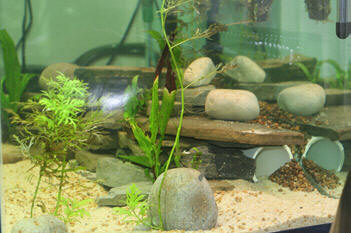
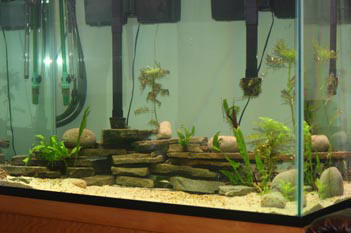 |
|
Re: New Brackish Tank (Bob, any insight into Scat/Mono
behaviour from your obs. in the wild?)
8/2/13
Yet another hello!
Had a quick question concerning a, seemingly, odd behavior.
<I will respond here and place your query in Neale's in-box; he's out
till 8/6>
My violet goby (the ninja hiding master) has slowly started to come out
during the day.
This evening I was taking in the opportunity to admire him as he was
hanging on the glass (top of the tank actually).
The Monos have been very curious about him (but lose interest quickly
upon approach). The silver scat on the other hand has decided to become
quite the fin nipper!
<Not atypical w/ Selenotoca>
I have not read anywhere they had this behavior. The scat has _never_
acted aggressive toward any of the Monos.
<They're faster; more aware>
The goby arrived with some tattered tail fins so, until now, I had
not thought anything out of the ordinary.
I will, obviously, continue to observe the behavior in the tank but was
wondering if you had encountered Scat/Goby aggression before?
<Yes; they're curious animal species; like to "examine" everything...
with their mouths, eyes>
Would there be steps I could take to reduce this?
<Really best to do as you state below... The other fishes here are too
likely to outcompete the Goby for foods as well>
I am looking at "alternative" housing, but options are thin.
(55g planted with rainbows, Plecs, and platys) and (65 goldfish / loach)
are not good candidates.
I do have a 35g, with the mollies. SG: 1.003 (cube-like tank
24wx18dx22t) which is an option, but very small for the goby.
<I might try moving the Scat here for a few weeks... see if this takes
some of the "vinegar" out of it>
29g "other" with some plants and platys but they could be moved if
needed.
Am I "jumping the gun" or did I get a foul-tempered scat? (or one that
is just curious as to what this wiggling thing is that looks like food?)
Oh, Scat is around 2 inch and goby is around 6 inch though I
don't feel size is ever a real issue (just talk to a puffer!).
<Mmm, well then; at this size, either one could go in with the mollies
for quite a while>
Other than this, life is well and the Monos are still voracious eaters!
Always hungry and never leave a scrap! Feeding them multiple small
meals.
Is it easy to overfeed them?
<Not really no; they swim off all categories in short order>
I read they require a good bit of food since they are quite active and
metabolism is higher at the temperature they are in.
<Ah yes>
Continual gratitude,
-Douglas A. Dunn
<As continuous welcomes. Bob M. Fenner>
|
new 55 gal brackish, set-up, stkg.
12/17/10
Hi Neale,
<Jessica,>
I have my new 55gal brackish aquarium set up.
<Kept at a real low salinity, I take it? 5 grammes/litre, for a
specific gravity about 1.002-1.003 at 25 C/77 F.>
I've been adding the pinches of flake food ever couple of days as
you suggested (for nearly a week now) and so, minus the heaters (which
I'll have in the next day or so) and the plants which are on their
way, the tank is set up.
<Cool.>
I'm wondering though if I should add a platy or two? I know they
are tolerable to lower temperatures and I'm wondering if this might
help the cycling process along?
<May well do, but don't you already have some mollies? Mollies
are good fish for new brackish and marine aquaria. Much hardier in such
conditions than they are in freshwater. Platies will do okay in
slightly brackish water too, at the salinity listed above. Limia
nigrofasciata are among my favourite livebearers for slightly brackish
tanks, but you could also use Wrestling Halfbeaks or even Endler
Guppies in the same way.>
Like I said I'll have the heaters in a few days and I could wait
until then or should I wait even longer to add any fish?
<Don't add any fish until you have the right temperature in the
tank, but as you've noted Platies, especially Variatus Platies, can
tolerate cool water remarkably well. Xiphophorus variatus can tolerate
water down to about 15 C, and here in England they're sometimes
sold as coldwater fish and make a great alternative to
Goldfish.>
I had a friend of mine suggest using Zeolite. Are you familiar with
it?
<Yes.>
Do you think it's a good product?
<In certain situations, like hospital tanks where a biological
filter can't be used.>
I've heard/read that it traps ammonia and eventually becomes part
of your biofiltration. Should I use it during cycling?
<No.>
Should I use it at all?
<No.>
Another thing I was wondering about is if I do a complete fishless
cycle in my tank will I still have ammonia spikes whilst adding the
fish?
<Shouldn't do. Ammonia is ammonia, and provided you've added
enough pinches of flake to match the amount you'd give the first
batch of fish, it makes no difference whether the flake went through
the gut of a fish or simply decayed through bacterial action on the
gravel.>
Could the Zeolite be beneficial then?
<No.>
Also I've been adding small amounts of marine salt each week to my
freshwater aquarium during water changes for the fish but also for the
filter since I am planning on switching over that filter and using it
in my
55gal as well rather then keeping the 10gal up and running. If I add
all the salt at once I've read that you say it wouldn't harm
the fish since brackish water fish are accustomed to sudden changes in
salinity but could it kill all the beneficial bacteria in my
established filter?
<Changing from 1.000, i.e., freshwater, up to 1.002, i.e., slightly
brackish water, will not stress filter bacteria.>
And if that's the case at what point would it be safe for me to
switch the filter to the 55gal(which has about 1 1/2 tbls of salt per
gallon)?
<Please don't use teaspoons or tablespoons for measuring out
salinity. Far too risky! Salt absorbs water from the air over time, so
spoonfuls steadily become less and less salty and more and more watery,
even though they all look the same. The easy approach is to use a
hydrometer, a floating glass one will cost about $5. At 25 C/77 F, the
right specific gravity for this set up will be 1.002. Alternatively,
weigh out the salt. You're aiming for 5 grammes per litre, or 0.65
oz per US gallon. You can download a Windows
and Mac application on my website that shows you how salinity,
temperature and specific gravity are related, and the program works in
both metric and US units.
http://homepage.mac.com/nmonks/Programs/brackcalc.html
Compared to spoonfuls, weights are much more reliable, and a hydrometer
gives you a pretty good indication of specific gravity provided the
water temperature in each bucket is close to 25 C. Do read here, on my
Brackish FAQ:
http://homepage.mac.com/nmonks/Projects/FAQ/2a.html
>
Should I raise my fresh water tank to that level of salt and then
switch the filter or could I do that sooner?
<Shouldn't make a huge difference either way, given the very low
salinity we're dealing with here.>
Also a question about tankmates for my mollies platies and blue Acara
(when I get it). Could I add a Betta?
<No, none of the traded Betta species comes from brackish water.
There is a brackish water Betta known as the Mahachai Betta that comes
from slightly brackish swamps. However, it isn't much traded, and
you're only likely to see it if you're a member of a Betta
club.>
How about a rainbow or fiddler crab?
<Neither of these are aquarium residents, both need a vivarium with
mostly land. On top of that, Rainbow crabs will catch, eat small
fish.>
How about some sort of shrimp maybe or Algae Eater?
<Cherry Shrimps and Amano Shrimps thrive in slightly brackish water,
and in fact I keep some of my Cherry Shrimps in a slightly brackish
system with Limia nigrofasciata and they breed constantly! Shrimps are
good for algae control, but supplement them with Nerite snails for a
good all-around algae-control combination, around one Nerite per 4-5
gallons, possibly slightly more depending on how quickly algae grows in
this system.
Algae-eating catfish do not belong in a brackish water system, but you
might try Florida Flagfish, wonderful little fish rather like
territorial dwarf cichlids in personality. They feast on algae, and get
along fine with Acara and Livebearers.>
I don't mean to add all of these but if I were to add one or two
which would be compatible and how many would you recommend?
Thanks a ton!
Jessica
<Hope this helps. Cheers, Neale.>
Re: new 55 gal brackish 12/17/10
That does help! Thanks!
<Cool.>
I'll be buying a hydrometer asap. Online if I can't find one
around.
<Indeed. Weighing salt will do. Measuring teaspoons almost never
works reliably.>
I do have mollies so I suppose I should switch them over first.
<Agreed.>
So once I get the heaters and raise the temp I should add the mollies?
Say 3 of them?
<Sure.>
I'm loving the cherry shrimp idea. How many of these should I
get.
<A big swarm, at least six, preferably 10 or more to start
with.>
You were saying they breed well so would 2 females and 2 males
suffice?
<Doesn't seem to work that way. While you might be okay, chances
are in a 55 gallon tank they'd simply lose one another. Get
sufficient that they can form a school, and that behaviour will keep
them together. Certainly no fewer than six. They're cheap as chips,
so get as many as your budget can stand, that'd be my advice. They
look really good in big swarms.>
Also I have a few plants ordered like I said (java moss, java fern,
Anubias) will the shrimp eat or harm any of these plants?
<Neither Nerite snails nor Cherry shrimps should harm healthy
plants.>
I really like the shrimp because I wanted something different for the
tank.
Any other tank mate suggestions? Gobies maybe?
<Bumblebees could be an option, though they might eat baby shrimps.
Knight Gobies certainly will eat shrimps as well as small fish, up to
about the size of a male guppy.>
Or perhaps clown loaches?
<Not a brackish water fish. Horseface Loaches, on the other hand,
can be kept in slightly brackish water.>
I would like one more kind of fish. I know you mentioned glassfish in
an earlier email but I'm not so fond of those.
<Glassfish are fun in gangs because they tend to lunge at each
other, I guess figuring out who's top dog. They do lack colour, and
some folks prefer brightly coloured fish. In that case, look at any
hard water Rainbowfish you like, as all should thrive at SG 1.002.
Melanotaenia boesemani is particularly popular and does well in
slightly brackish water.
Madagascar Rainbowfish and Celebes Rainbowfish will also do well. I
mentioned Florida Flagfish as something else you might consider, and
another killifish that could work would be the Asian Killifish, often
traded in its Golden Wonder form. Although predatory and territorial,
it handles itself alongside Mollies rather well. Does need floating
plant cover and a corner with a gentle current to be happy. Do read
some more on brackish fish options here at WWM and on my Brackish FAQ,
and you may well find my book useful too.
http://www.wetwebmedia.com/brackishsubwebindex/BrackishSubWebIndex.htm
http://homepage.mac.com/nmonks/Projects/brackishfaq.html
The list of brackish water fish in the trade is extremely long, and far
more impressive than many assume.>
Any suggestions would be great. Thanks again! You've been lots of
help!
Jessica
<Cheers, Neale.>
Re: new 55 gal brackish, stkg. -- 12/19/10
Ok, I'm warming up to the glassfish idea. Especially in a gang of 6
or so.
That could be neat.
<Can indeed. They are very effective predators though, and small
fish, such as Molly fry, will be eaten.>
What about a rainbow shark?
<Cannot be kept in brackish conditions.>
Would he eat the shrimp?
<No, but not really an option here.>
So far I'm looking at :
1 Blue Acara
6 glassfish
8-10 cherry shrimp
And I have:
3 mollies
2 platies
As well as:
10 Molly fry
And
4 platy fry
(The fry range from 4-12 weeks)
<These should all work well, with the proviso that adult Glassfish
can, will eat any juveniles they can fit in their mouths;
realistically, up to about an inch or so in length.>
What do you think? It's not over populated is it? I don't want
to have too many fish either cause I'd like to continue raising
Molly and Platy fry.
<Ah, in that case skip the Glassfish. Wrestling Halfbeaks and Limia
nigrofasciata would make good companions. Cichlids are generally inept
predators, so while the Acara will eat some fry, its impact should be
minimal.>
Eventually I'm pretty sure I'll have to give some away but for
now I'd like to raise a few more.
<A worthy goal, and rearing fry to maturity is harder than many
assume, even in the case of "easy" fish like Mollies.>
Alrighty, thanks AGAIN! :)
Jessica
<Cheers, Neale.>
Re: stocking and scaping new 55 gal brackish
12/22/10
lol. So I'll skip the glass fish then. So many ideas! Hard to
decide!
<That's the fun!>
I like the halfbeaks idea and seeing they're livebearers that would
be a really neat addition! Another challenge to see if I could raise
some of their fry!
<Much written about them here at WWM; halfbeaks are my favourite
fish, and I routinely keep, breed them at home.
http://homepage.mac.com/nmonks/Projects/Halfbeaks/halfbeaks.html
>
So I picked up some driftwood yesterday. (from the beach, I live very
near the ocean... I can see it :) so I boiled it now I'm soaking
it. One piece I picked up is too large to boil and I'm a little
afraid of the bleach and soak method. For now I have it soaking in my
tub. I've been filling the tub with really hot water when it cools
I drain it and fill it up again. Could I just do this a few times and
it be safe for the tank?
<Should be. Provided the wood smells clean and not oily or organic,
it should be fine.>
It's really smooth, sun bleached stuff. No bark, no splinters
etc.
<Cool.>
I can also get black sand from a beach nearby. Very cool stuff.
It's slate sand. All the cliffs and beach are slate. Could I boil
this and use it?
<Yes, but I'd use a thin layer initially, to see how things go.
It might be too sharp for burrowing fish such as gobies and eels, so
choose fish accordingly.>
I'm also wondering if epoxy is a safe adhesive to use?
<Can be, but the safest is aquarium-grade silicone sealant.>
Umm so many questions!
Thanks for the answers!
Jessica
<Glad to help. Cheers, Neale.>
Re: stocking and scaping new 55 gal brackish
12/22/10
Hello Neale!
I agree! It is fun picking out fish!
<Indeed it is, Jessica. With brackish water livestock there's a
bit more effort involved, but also some unusual species you
couldn't keep otherwise, so the trade-off is worthwhile, if
you're an advanced aquarist at least.>
Actually I bought some Guppies. I know they're the most common fish
almost ever but they're neat and I'm kind of addicted to
raising fry which I hear guppies are the millions fish so I wanted to
try my hand at them. I got just 4. 1male:3females.
<Should be fine.>
My LFS agreed to take any raised fry for me if my tank gets
overstocked, so I'm covered there.
<Cool.>
Eventually if the livebearers get out of hand I may then go with the
glassfish idea. At least I know what kind of fish to get to keep them
under control when need be!
<Indeed.>
In the mean time I'm going to keep looking for the halfbeaks.
(There's none available close by. And when I say close by I mean 5
hours or more, I doubt if they'd make that sort of commute)
<Halfbeaks aren't widely traded, but they are traded, and
Wrestling Halfbeaks are on all the Southeast Asian exporters'
lists. So asking your local retailer should turn up some specimens if
they get stuff from Singapore, etc.>
I may try the sand eventually. For now I'm going to leave the tank
alone as it cycles. The black sand is quite smooth ( to my touch
anyways) I could walk barefoot on it, as long as it wasn't a hot
day! lol
<Cool.>
But umm, eels you say? There's an eel I could get? Compatible with
my fish?
Livebearers, Acara etc.? That would be neat if you have any suggestions
there!
<Peacock Spiny Eels (Macrognathus siamensis, often erroneously
Macrognathus aculeatus) should work well. Another option is the
Horseface Loach. Both thrive in slightly brackish water. In either
case, these are shy, burrowing fish and the Spiny Eel won't eat dry
foods, so review their needs carefully before purchase. Notorious
jumpers, so keep the tank securely covered.>
Alrighty thanks again Neale!
Jessica
<Glad to help. Merry Christmas, Neale.>
Re: stocking and scaping new 55 gal brackish
12/25/10
The Horseface loach sounds really neat. Hopefully I'll be able to
find one when I want to get one. Selection around here is not the
greatest.
<Ah, but there's no need to buy all your fish on Day 1! Let the
retailer in your area know what you're after, and see if he/she can
bring some specimens in some time.>
In the meantime my male guppy died. His mouth was stuck open yesterday.
I searched the net a bit for what it might be but I couldn't see
anything stuck in his mouth. When I woke up this morning and found him
dead his mouth was still open. Should I be worried for my other
fish?
<Well, I tend to be a bit "ho-hum" about dead Guppies and
Neons because they're such poor quality generally. If water quality
seems good, water chemistry seems right, and everything else in the
tank seems happy, I'd simply remove the dead fish and keep a close
eye on the tank over the next few days.>
They all seem fine. The ammonia levels in the tank are still very low.
So I don't think it has anything to do with the water quality.
Maybe stress from transport? New environment, etc.?
<Perhaps, or something else. Difficult to say with fancy
Guppies.>
Also should I go out and buy another male or just see if the females
are already pregnant? Chances are one of them will birth a
male'¦
<Either, but I wouldn't add any new fish for at least 2 weeks,
preferably 4. Treat the collection of fish you have know as a
"quarantine" of sorts, and wait to make sure everything is
hunky-dory. If, by the end of 4 weeks, they're all happy, then yes,
feel free to add another male.>
Ok, well... Thanks
Jessica
<Cheers, Neale.>
Overstocked? 9/8/10
Hi, love your site. Learned so much from just reading.
<Thanks for the kind words.>
I have a 55 gallon brackish tank. sg 1.015. Aragonite
and live sand as substrate. Dead corals for decoration and some plastic
plants. Coralife 9 watt uv sterilizer, Fluval 305 canister filter.
<Not enough filtration. You need at least another Fluval 305 to get
the right sort of turnover in a tank this size. Fluval 305 has a pump
rated at 260 gallons/hour (actually turnover is apparently 185
gallons/hour). For big fish like these that come from high water
current environments, you want a turnover of at least 8 times the
volume of the tank per hour, i.e.,
440 gallons/hour. Realistically then, that's two Fluval
305s.>
Stocked with
3 spotted green puffers
1 figure 8
2 silver scats
2 monos
4 black mollies
<Okay. Two things here. Firstly, you're quite a bit overstocked.
Scats and Monos are fairly large fish, and even by themselves three
Green Spotted Puffers would "fill" a 55 gallon tank.
Secondly, your salinity is a bit high for Figure-8s, though the other
fish should be fine. In fact, you might consider getting rid of the
Figure-8, going up to SG 1.018 and using live rock and a skimmer.
Actually, a skimmer works down to about SG 1.010.>
I am constantly cleaning the tank, due to the puffers.
<Insufficient mechanical filtration; as I say, more filtration
needed.>
Tested water param.s. Amon. .5, Nitrite .5,
<Again, two many fish, not enough filtration.>
Nitrate 10-15ppm, ph 7.6, dKH about 9 drops to turn it yellow. Temp. 80
degrees.
<Bit too warm; nudge that down to 25 C/77 F.>
Question is, am I overstocked?
<Yes, and under-filtering.>
I just cant seem to get the ammonia and nitrites down to 0
<Indeed.>
Secondly, Amquel plus claims to make the nitrites and ammonia and
nitrates non-toxic for fish and the biological filter can still eat it.
Is this only temporary and is it released back into the water column as
free ammonia once again. or is it permanent.
<Don't even think about this question. It's totally
irrelevant to what you're trying to do.>
Is the dead coral causing problems?
<Clean coral skeletons shouldn't be causing any problems at all.
I hope these are from marine aquaria though, and not bought as bleached
corals!>
I set it up this way so I could go full marine if I chose to without
changing a lot.
<Indeed, and many people do use their brackish water systems this
way, eventually combining a few damselfish or lionfish with their
brackish water stock.>
Thank you for your time Cliff
<Glad to help. Cheers, Neale.>
Re overstocked? 9/8/10
Thank you for your help Neale.
<My pleasure.>
The corals actually came from a dive off the keys in Florida about 15
years ago. They have never been in aquaria until now. I used a bleach
solution to clean them up and let them sit for several weeks before
using them in the aquarium.
<Cool. My concern is with the trade in bleached coral skeletons,
which is not even remotely sustainable. In fact I believe here in
Europe it's illegal, in much the same way as rhino horn or tiger
pelts. But if the corals were collected from a beach, they were dead
already, so bringing them home is just fine.>
A friend suggested to add a Marineland BioWheels rated for 70
gallons.
although it would help, is it a good idea. (a lot cheaper than another
Fluval) .
<Sounds good. You might also consider an undergravel filter,
particularly a reverse-flow one, which as Bob Fenner explains elsewhere
on this site is one of the best low-cost, low-tech ways to maintain any
aquarium, even a marine tank. The good thing about reverse-flow is it
pushes waste and faeces up from the substrate into the water column,
making it a breeze for your canister filter to keep the tank
clean.>
I may just go ahead and go full marine then to add live rock and a
skimmer.
Doing this would be ok with the stock that I have then. correct?
<Except for the Figure-8, yes. He's a low-end brackish puffer.
Given the size of your tank, thinning it out a little would be no bad
idea. I'd also encourage you to go look at Al Auve's tank
here:
http://www.monsterfishkeepers.com/forums/showthread.php?t=109455
I've written a piece about his aquarium for an upcoming issue of
'Tropical Fish' here in the UK. It's not just one of the
best-looking brackish tanks, but also one of the best-looking aquaria
of any kind I've ever seen. A lot of the stuff was DIY, which kept
the cost down even if it did increase the labour. He's a member of
the Brackish Water Aquarium Mailing List, so if you want to discuss the
details, that might be the place to start.
http://php.indiana.edu/~pdmckinn/Brackish/brackish.html
>
I am so grateful for you and your crew. Thanks a million, Cliff
<Happy to help. Cheers, Neale.>
Marine, brackish, marine mis-stocking
5/5/10
Hello,
I believe I have probably the most odd-ball or rarest tank around.
<I'll say.>
I have always been interested in brackish fish but wanted to step
outside the box. After a year of homework I think I have found the
perfect match.
<Hmm...>
I currently have a 120 gallon tank with 1 silver scat, A clown
fish,
<A reef-dweller, and so far as I know, doesn't occur in brackish
water at all.>
1 green scat, shark cat, 1 mono (they school together),
<What, the Mono and the Scat school together? Yes, this does happen,
though not necessarily ideal for either.>
2 sergeant Major damsel,
<Only somewhat tolerant of high-end brackish conditions.>
1 jewel cichlid (wild caught),
<Not really a brackish water fish, though tolerant of low-end
brackish conditions.>
1 porcupine puffer,
<Diodon spp. are only occasionally found in estuaries.>
1 fuzzy lion fish,
<Likewise, Dendrochirus are occasionally found in estuaries, but it
isn't their usual environment.>
and 1 datnoid.
<Again, of the five species, only two are brackish water
specialists, and neither of them occurs in marine conditions, so far as
I know.>
I acclimated them in separate tanks slowly about a year to be
precise.
Bringing brackish up slowly and marine down slowly until they matched
salinity (1.13).
<Surely you mean SG 1.013?>
I then joined them together in one tank (120g). All was fine but I
decided to get more creative and add some invertebrates.
<Indeed. Fish are "osmoregulators", meaning that all
species have some ability to adjust their salt/water balance to match
their environment.
You've imposed rather too liberally here for my tastes, but under
some conditions, the tolerance *some* fish have for non-optimal
salinity is remarkable. Invertebrates are different. Most are
"osmoconformers", meaning they have no ability to regulate
their salt/water balance. In many cases, as with echinoderms, seawater
is essentially used as their bloodstream as well, so they're doubly
sensitive to variations in salinity.>
I added red leg hermits,
<Some of which come from estuaries and may be able to adjust to
below normal marine salinity.>
Nerite snails,
<Many of which are intertidal and able to adjust to varying
salinity.>
chocolate chip starfish,
<Will not adapt to below normal marine salinity!>
electric blue hermits,
<Again, some Clibanarius, including C. tricolour, are known to be
adaptable to below normal marine salinity.>
and red wrath anemones.
<No ideas what this is.>
Again all was good but started having problems with nitrates so I
bumped up filtration (Fluval fx5, Marineland 350, Skilter 250, and 2
powerheads). I know over kill, but these are going to be big fish.
<Hmm...>
Ok that's not all. Here is where I become lost. I have just raised
salinity back to marine after 1.5 years being brackish. I have added
live rock and would like to keep my babies.
<Returning to normal marine salinity is essential here, but I
can't see the Datnioides or the Hemichromis lasting long under such
conditions.>
I am also upgrading tanks again to a 180g custom with sump. My question
is how will my babies be with lps corals, feather dusters, and some
more exotic anemones?
<Will vary. Puffers and Porcupinefishes simply view corals and
anemones as food, and will also eat tubeworms without a moment's
though. Scats and Monos are somewhat reef safe. Colombian Sharks are
also reef safe but will eat mobile invertebrates, particularly
crustaceans.>
I seen the scats eat upside-down jellyfish and I'm a bit worried
about them eating corals and dusters. Have you heard anything about
scats and corals or anemones?
<Scats generally don't eat corals and anemones, but if hungry,
will nibble at anything. They don't have strong jaws though, so are
about as reef-safe as a "good" Butterflyfish species.>
I don't want to separate the fish but will if I have to.
<If you don't, I suspect the laws of biology will separate off
some of these fish to the Big Aquarium In The Sky.>
It just took so long to get my project to this level. Please give some
good advise.
<I've done what I can.>
Thanks
Shaun.
<It's hugely tempting to create fun brackish-plus-marine
collections, and if planned carefully, such tanks can be real
eye-openers to those who haven't seen these species combined.
Rather than collecting "one of everything" though, I'd
recommend you looked a bit more carefully at the species you have, and
maybe remove some to make space for some real oddballs. Here in England
you can find things like Congresox talabonoides and Platycephalus
indicus in some shops, and while sold as brackish water fish,
they'd be better in marine tanks.
http://homepage.mac.com/nmonks/Projects/FAQ/7h.html
http://homepage.mac.com/nmonks/Projects/FAQ/7i.html
In a fish-only or FOWLR tank such oddball species would be
fantastically weird companions for Monos and Scats. More easily
perhaps, there are genuine marine/brackish puffers out there, including
various Arothron, Chelonodon and Takifugu species, and these would do
rather better than Diodon spp. Likewise, while there are some cichlids
that adapt to saltwater conditions -- in the wild as well as in aquaria
-- most of them can't. Hemichromis bimaculatus isn't among the
marine-tolerant species so far as I know, though interestingly its
close relatively Hemichromis letourneuxi is one species that can adapt
to marine and even hypersaline conditions, and there's so much
uncertainty about what species exists in the trade, and whether
they're hybrids rather than species anyway, it's difficult to
know precisely how long your Hemichromis will last in saltwater
conditions.
http://homepage.mac.com/nmonks/Projects/FAQ/3f.html
http://fl.biology.usgs.gov/projects/salinity_tolerance.html
I'm worried that in trying to be too off-the-wall, you're
actually stressing, and likely killing, some of the fish and many of
the invertebrates you have. As you understand, the overlap between
brackish water and marine fishkeeping is huge and under-appreciated.
But at the same time, there really are many animals best kept in either
one or the other conditions. Sit down, read some more, and think
carefully about what you're trying to achieve here. Cheers,
Neale.>
Brackish tank inquiry... set up, stkg... mistakes... leaping
before looking... 7/11/09
Dear WWM,
I have a ten gallon freshwater tank, in which I have kept a Java loach,
and two firebellied toads for almost two years. Recently I transferred
them all to a friends house while I was on vacation so that she could
watch them for me, and the toads managed to squeeze through the gaps in
the tank and, essentially, "run away".
<Ah, in other words, ended up dried out on the carpet. Scientist
that I am, I tend to avoid euphemisms where possible, because they
often allow us to dodge reality and avoid responsibility. Yes,
amphibians should always be kept in tanks with tight-fitting
hoods.>
After this, I decided to make the tank a full tank, and add some new
fish. My choices were a snail, some ghost shrimp (the loach got used to
eating the crickets that were meant for the toads, and has refused to
eat pellets and flakes since they disappeared, so they're for him,)
a Pleco, and of course, a 3" Silver-tipped Shark.
<Shrimps and snails make great choices for 10-gallon tanks. But a
Plec? Or Sciades seemanni? Insane choices! Plecs get to a good 45 cm in
length within two years, and the Sciades only a bit less. In any event,
Sciades seemanni is a migratory, schooling fish that needs a lot of
space as well as tankmates of its own kind; kept singly, they
invariably become neurotic, pacing water in one corner of the tank, and
clearly unhappy. Within the group they make all kinds of audible clicks
and other sounds, so it's obvious they're constantly
"talking" to one another; without the comfort of other
members of their own species, singletons must have a pretty miserable
life.>
Upon getting home, I decided to do some research beyond what the pet
store told me, and stumbled across the knowledge that my shark is
doomed to a slow death if I don't transfer him to brackish water,
and eventually a larger tank.
<The old mistake of doing research after buying the fish. Yes,
Sciades seemanni is a big fish that needs brackish water. Of course,
I'm assuming your Silver-tip shark is Sciades seemanni, as opposed
to the non-brackish, but equally big and gregarious Silver Shark
Balantiocheilus melanopterus.>
Now, the larger tank I can scrounge up fairly easily in time, but I was
wondering if the other fish would be alright in brackish water.
<What other fish? The shrimps and the snails are Shark Catfish food;
as for the Plec, no, it can't be kept in brackish water, and no,
loaches can't either. So, all pretty simply. If you add enough
marine salt mix (not tonic salt, cooking salt or aquarium salt) for the
Sciades seemanni to be healthy, you'll kill the other fish.
Juvenile Sciades seemanni are happy around SG 1.005 at 25 C, which is
about 9 grammes of marine salt mix per litre; adults will need around
half-strength seawater up to fully marine conditions; aim for SG 1.010
at 25 C, or about 15.5 grammes of marine salt mix per litre.>
I looked around to see what I could find, and most of the sites I found
only seem to list things like how to breed them, how big they get, what
they eat, etc. I know that I'll have to move at least the shark
soon (this is day one of him being in my tank, and he seems lethargic
already,) unless the others can handle the brackish water he needs.
<The eat primarily molluscs and crustaceans in the wild, so squid,
cockles, mussels and prawns all work well, as will small portions of
white fish (frozen lancefish are ideal). Keep the diet varied to avoid
problems with thiaminase (mussels and prawns contain a lot of this
dangerous enzyme).
They generally take good quality catfish pellets readily. Aquarium
specimens generally get to about 20 cm or so in length, but they can
get bigger. Breeding doesn't occur in captivity.>
Also, if I do end up needing another tank to move him into immediately,
I want to know which of the other fish, if any, I could move into it
with him.
<Sciades seemanni get along extremely well with other brackish water
fish of similar size: Monos, Scats, Archerfish, Green Chromides, etc.
They also work well in marine aquaria with non-aggressive Damsels,
Tangs, Angelfish, Lionfish, etc.>
I don't want to buy more Silver-tips,
<Not an option really; these are very sociable fish that need to be
kept in groups of at least three specimens.>
since they do grow so large, but I can't stand the thought of
returning him to the store that sold him to me, and abandoning him to
his fate. Thanks in advance for whatever help you can give me. :)
Oh, in retrospect (seem to be doing that a lot today) is the fact that
he's venomous actually a danger to my other fish?
<No danger at all; only a danger to you, if you net the thing
clumsily and jab yourself on his pectoral and dorsal fin spines. These
fish, though predators, are extremely gentle towards anything they
cannot swallow whole.>
The loach has been known to pester his tankmates.
<Well, he won't be in the brackish water aquarium, so
shouldn't be an issue.>
Thanks so much for reading this,
Kristen
<Do please read around the subject of brackish water fishkeeping,
either here in WWM, or in my book, Brackish-Water Fishes, which your
library might be able to get, even if you don't want to buy a copy.
Cheers, Neale.>
Tank mates (brackish, freshwater; selection) --
6/14/09
We have 3 tanks. 55 gallon, 29 gallon, and 20 gallon. The 55 gallon has
2 Plecos, 2 Raphael's, 3 guppies, 4 small regular Gourami's, 5
dwarf Gourami's, 7 small angel fish, 4 kuhlii loaches, 3 horse face
loaches, 3
serpae tetras, 3 transparent tetras, 2 red Dalmatian Mollies, 3 common
platys, 1 sword tail platy.
<That's quite a collection! I wouldn't recommend mixing
Serpae tetras with Angelfish or Guppies though, as Serpaes are
notorious fin-nippers.>
The 29 gallon has 1 horseface loach, 1 Beta, approx 20 neon tetras, 5
Glo fish, 3 serpae tetras, 2 common platys.
<Keeping Serpae tetras with Bettas (note the double "t",
it rhymes with "better") is another no-no.>
The 20 gallon has 1 green spotted puffer, 3 Dalmatian Mollies, 4 tiger
barbs and 1 small algae eater.
<What's an "algae eater"? Do you mean Pterygoplichthys
sp "Plec" or a Sucking Loach, Gyrinocheilus aymonieri?
Neither of these will live in a 20 gallon tank for more than few
months, and Gyrinocheilus aymonieri is infamous for becoming extremely
aggressive when sexually mature at around 20 cm/8 inches. Both these
fish get to 30 cm/12 inches in length, and even the 55 gallon tank will
be cramped.>
We have been slowly turning the 20 gallon tank to brackish water and
it's about full brackish now and all of the fish seem to be doing
fine, even the tiger barbs and algae eater.
<If this tank is full brackish, the barbs would be dead. So what do
you mean here? Adding a teaspoon of aquarium salt per gallon isn't
"full brackish". Even at a low level for brackish water fish,
say, a specific
gravity of 1.005 at 25 degrees C, that's 9 grammes (about three
level teaspoons) of marine salt mix per litre of water, 1.2 ounces per
US gallon.
The Green Spotted Puffer will of course get much too big for a 20
gallon tank; adults are around 15 cm/6 inches in length.>
Do I need to move anything from the 20 gallon to another tank?
<Yes; the barbs and the "algae eater" whatever it might
be. Nerite snails are (by far) the best algae eaters for brackish water
tanks, but Puffers do tend to view snails as food, so this is a risky
move.>
If so, which of the tanks would they fair best in? Also, I would like
to get a dragon goby to put in the 20 gallon tank. Would this be
acceptable?
<Not a chance. Again, Gobioides broussonnetii is a big fish, in fact
one of the biggest gobies of all, getting to 50 cm/20 inches in the
wild. As such, it needs a big tank, 55 gallons being a fair choice for
a single specimen.
It's a poor choice for life with a Pufferfish, given how aggressive
mature Green Spotted Puffers tend to be.>
Thanks, Pam
<Cheers, Neale.>
Re: Tank mates (brackish, freshwater; selection) --
6/14/09
I haven't just been using regular aquarium salt in the 20 gallon.
It's marine salt.
<Good stuff! Don't use regular aquarium salt at all; it's
plain cooking salt, and I don't need to tell you the sea (or
brackish water habitats) aren't just cooking salt and water!
Aquarium salt is specifically for use as a medication for freshwater
fish. It has no value in either brackish or saltwater aquaria.>
I will test my water better and get back with you. In the mean time,
are you saying the dragon goby would do ok in the 55 gallon fresh water
tank?
<Definitely not saying this! Dragon/Violet Gobies (Gobioides
broussonnetii)
may last a few weeks or even months in freshwater aquaria, but they
invariably sicken and die prematurely. So unless in the very short term
-- i.e., a few weeks while you're re-jigging your aquaria to free
up the 55 gallon as a brackish water system -- I would recommend
strongly against adding the Goby to the a freshwater tank.>
Also, I know the Serpaes don't usually mix with the angels and
such, but they have been ok so far. Are you suggesting I should remove
them anyway?
<Serpae tetras were my very first tropical fish. I quickly learned
that they attacked Angelfish and Gouramis. They actually have a feeding
frenzy, and you'll often see shredded fins in tanks containing just
Serpae tetras, especially the long-finned variety. I'd recommend
only ever keeping them alone, or with things that hide all the time,
such as nocturnal catfish or loaches. I honestly don't recommend
them at all as community fish. Hardy and pretty yes, but well behaved,
often not. As always, your own experiences will vary, but if you see
damage to the fins of other fish, or suddenly find yourself having to
deal with Finrot because a fish has been nipped, you'll have your
answer.>
Also, will the barbs be ok with the fish that are in one of my other
two tanks?
<Tiger Barbs tend to be nippy, especially when kept in insufficient
numbers (less than ten). So again, choose tankmates very carefully.
Like Serpae tetras, Tiger barbs are not a species are recommended, and
indeed most aquarium books will state clearly "not with
long-finned or slow-moving fish" or words to that effect. On the
other hand, Tiger Barbs work great with tetras, barbs, loaches and
other fast-moving fish.>
Thanks, for your help. I love my fish and don't want to hurt any of
them,
<Jolly well hope not!>
but as you can see, I like a wide assortment.
<That's fine, and in fact part of the fun of the hobby. It's
like being zoo keeper who gets to collect all kinds of fun animals. But
do review their needs prior to purchase. If you don't have a book
to hand, and you can't find anything here at WWM that helps, feel
free to ask us about a fish on offer at your pet store. We're not
selling anything, unlike the guy at the store, so our advice is as
unbiased as can be.>
Pam
<Cheers, Neale.>
Brackish Stocking -- 05/03/09
Hi. First off, I find your site very informative and helpful. For one,
I was about to use Zeolite in my brackish tank, but found out it would
pump ammonia into my tank...
My 29gl set up is as follows...
- 3 Juvy monos and a goby.
- ph 8.0 SG 1.008
1) I was thinking of sealing the openings of the tank, adding a turtle
dock and putting some fiddler crabs in there. Would the monos/goby eat
them?
<Given half a chance, yes. More specifically, Fiddlers really
aren't going to be happy on a turtle dock; they're burrowing
animals that spend most of their time on land. They work well in tanks
with a little water but big mounds of sand and bogwood.>
2) One of the monos bullies the other two to no end. It doesn't
seem territorial because he just goes after them wherever they are. I
feel like adding more monos but I know as adults they get large and
when I upgrade to a larger tank say 55gl, it still wont be large enough
for them.
<This is, unfortunately, quite common. I find mixing Monos, West
African Monos, and Scats solves the problem. They school together well
enough, without actually being violent. In groups of 6+ Monos generally
settle down, but it is far from uncommon for people to end up with just
a single (or a mated pair) of Monos per tank. All this said, 29 gallons
isn't nearly enough for Monos; realistically, you'll want a
tank twice that size.>
3) I could add Mollies to the tank but I've read in some cases,
gobies attack them as well.
<Knight Gobies are predatory and certainly will eat small fish.
They're not really nippy though, and given sufficient space,
Sailfin Mollies should work fine with them.>
4) Donate my monos somewhere and restock the tank using the goby as a
guide for suitable tankmates (suggestions?). I am not married to the
monos and I find the goby very charming...
<Knight Gobies are actually very good in groups, when you see some
of their midwater territorial behaviour. They also work well with
Glassfish, Orange Chromides, small Archerfish species (such as Toxotes
microlepis, though this prefers a lower salinity, SG 1.005 or less).
Other compatible goby
species include Butis butis and Violet/Dragon Gobies. At a low salinity
(SG 1.003) you could also keep Asian killifish, Florida Flagfish, and
catfish such as Hoplosternum littorale or the "small" variety
of Mystus gulio.>
I suppose I could try 1) - 4) above and monitor all this for a few
hours but I wanted to see what you think before I add anything else to
the tank.
<Do peruse my Brackish FAQ for some comments and thoughts on other
brackish water fish, here:
http://homepage.mac.com/nmonks/Projects/brackishfaq.html
>
Thanks in advance
Michael
<Cheers, Neale.>
Question about Brackish Tank, stkg.
5-10-09
I had emailed before when I had figure 8 puffers and a Pleco together
in a Brackish tank.
My Puffers seemed healthy up until the last day and then died.
The Pleco seems to be doing well and thriving in the brackish
water.
I am wondering how long I should wait after 2 fish have died to add any
new ones.
<It is good to figure out why your fish originally died before
adding more.>
Also what fish would you recommend for a 26 gallon brackish water tank
with the Pleco that are hardy fish.
I have looked up a little information and was recommended these
species:
Etroplus suratensis, Etroplus maculatus, Datnioides microlepis,
Poecilia species
<I would not recommend the Etroplus suratensis (Green Chromide)
because they get very large and a 26 gallon tank is not large enough.
The Etroplus maculatus (Orange Chromide) would be great for your tank.
The Datnoides microlepis (Fine scale tigerfish) also get too large for
a 26 gallon tank.
Of the Poecilia species I would recommend the short-finned molly
(Poecilia sphenops). They would do well in your brackish 26 gallon tank
with plenty of room to spare.>
What combination of these fish would you recommend and how many of each
species?
<You could easily get 5-7 short-finned molly's and maybe 1 or 2
of the orange Chromide. Both fish species are non-aggressive.>
Thank you, you guys are amazing!
Candace
<You are welcome! Merritt A.>
Advice for brackish with marines -- 02/19/09 I have
a 75 gallon brackish tank which I've converted to saltwater over
the last year. stocked with 3 green scats, 1 Monodactylus argenteus, 2
Gymnothorax tile morays, many snails and 2 Sailfin mollies. SG of
1.022. currently shopping for larger (150 gallon) tank as the scats are
getting very big. I would like to add marine fish to my tank but unsure
how they will mix with my brackish fish. <In my personal opinion a
150 gallon tank will be quite well stocked with what you have already.
Scats as well as Monos produce a copious amount of waste, as may the
morays, which when grown may try to eat at least the Sailfins, maybe
some the others, too. If you disagree with my opinion in terms of
enough space for further additions, only choose assertive species and
fast eaters, which can compete with the Scats and are large enough to
be safe from the eels. Such fish mix well with the species you
have.> Are Scats or Monos reef safe? <Scats have often been used
to clear marine tanks of algae and even Cyano bacteria, Monos are also
commonly seen in large, public FOWLR tanks. However, both are known to
sometimes pick on coral polyps and in a home aquarium of 150 gallons I
believe the damage they can do will be too much for the corals to
survive. Also, the waste they produce will make it difficult to let any
but the least demanding corals grow. You can try some small frags from
a friend, maybe mushroom polyps, but don't expect too much.> or
should i try sticking with fish only or a FOWLR tank? <These options
have better chances for success.> thanks for your advice, not much
literature on scats or monos in marine tanks. <No, because this
combination is only common in very large, public FO and FOWLR setups
where both can be kept in larger groups.> Brian <Cheers,
Marco.>
Puffers/Turtles/Overstocking=Doomed Tank --
10/24/07 Yeah, I'm new with the whole "fish thing"
and I have 2 turtles, one soft (size of a 1/2 dollar) and red eared
(sized of a quarter), I also have two fiddler crabs, 13 tiger barbs, 2
gourami, 2 fire mouth cichlids, 7 pretty feeder fish and a fat guppy, 2
Chinese sucker fish, and 2 zebra danios.... <OMG! Not all in the
same tank with the 3 GSPs?!!!> I know, I have WAY too many fish, and
my LFS said it would be fine (obviously) to have all these fish (except
put the turtles in a giant aquarium or kiddie pool when they get
bigger.... <You know but you do this anyway? I don't get it.
Turtles eat fish. They need to be removed. Anything that takes a bite
of those puffers will die. > I definitely cannot afford to get a
bigger tank. <Well, you already know the turtles need a huge
tank.> or even any size to put the other fishes in. I can't sell
them back either because I love them. What should I do? Are they all
just going to die? <Yes, everything in your tank will die from being
poisoned by their own waste (No amount of water changes can keep up
with what you are housing) or eaten by the turtles & puffers.
Forget about how much you "love" them (if you truly loved
them, you would have researched their needs first) or whether the shop
will give you any money for them. Return the puffers, feeders (do not
belong with tropical fish), turtles, crabs (they need some land), at
the minimum! ~PP>
Ideal Brackish Livestocking? 9/7/07 Hey WWM crew, I
have a 125 gal tank that is brackish (1.015 spec. gravity). It has
about 100 gallons of water in it (water level lowered for mudskipper).
At the moment, I have a mudskipper (who loves his floating log!) and a
fluctuating school of mollies (breeding, eating, breeding, eating...).
This tank is at a science museum, and I want to stock it with a good
variety of species to demonstrate the awesome, often overlooked species
of brackish communities. This will be a whole display area about
estuaries and how to protect them. The specific gravity does not have
to stay so high (I know to lower it gradually if needed). What would be
your "dream team" of brackish fish (and inverts!) in this
tank? If you could give me different scenarios for different salinities
(that the mudskipper would still be okay with), that would be great. I
found the place on the site on "brackish livestock
selection", but it only considered smaller tanks for lower
salinities. Any help would be greatly appreciated! PS--tank chemistry:
ammonia 0, nitrites 0, nitrates always below 40. pH around 7.9. Thank
you!!! -Melissa <Hello Melissa. Well, I could start by telling you
to get hold of a copy of my book, "Brackish Water Fishes"
from TFH. That covers just about all the species you're likely to
see in the trade. Over here on WWM, my article "Brackish Livestock
Selection" covers three scenarios divided out by salinity as well
as tank size. The final set of suggestions specifically covers large,
high salinity brackish water aquaria, and is perhaps most relevant to
you (http://www.wetwebmedia.com/BrackishSubWebIndex/brlvstk_sel.htm).
Now, mudskippers make things a bit complex, because they respond to
other fish in particular ways. If the fishes in the tank are too
small... they eat them. But if the fishes in the water are big and
active, the mudskippers stay on land more of the time, which isn't
necessarily good for them. Mixing them with anything other than gobies
and livebearers therefore tends to be dodgy. As such, I'd tend to
be looking at medium sized things like knight gobies (Stigmatogobius
spp.), violet gobies (Gobioides spp.), orange Chromides (Etroplus
maculatus), and perhaps (Anableps spp.) if you can get them. Flatfish
such as Brachirus and Trinectes spp. would also work well, though
they're something fiddly to feed, being nocturnal predators on
insect larvae and the like. All these fish would prefer a slightly
lower SG, maybe 1.010-1.012, as would, incidentally, your mudskippers.
In terms of education value, all of these suggestions exhibit quirky
things. Violet gobies are highly specialised to feed on algae and small
invertebrates they either get by gulping water or from sifting mud.
They have big mouths, tiny but sharp teeth, and rudimentary eyes. They
live in muddy estuaries. Anableps have adapted to feed on insect larvae
(midges and mosquitoes mainly) that are very common in shallow brackish
water. To avoid predators from above they have eyes that see above the
waterline. They are livebearers as well. Chromides are cichlids, but of
a very primitive sort, and closely resemble the marine ancestors from
which the rest of the cichlids evolved. As such, they're a kind of
living fossil. They are also among the few non-marine "cleaner
fish", picking parasites off larger cichlids, Etroplus suratensis,
that live in the same habitat. They generally breed readily in aquaria,
and as such are good value to watch. Knight gobies are classic gobies
in shape and lifestyle, and given that gobies are perhaps THE
definitive brackish water fish group, make a useful addition to the
tank. They are rather predatory though, and will quickly work through
excess molly fry! If you were feeling adventurous, you could try one of
the smaller puffers (Tetraodon biocellatus would be ideal) and even
spaghetti eels (Moringua spp.) if your retailer can get hold of them.
They're lovely mini-moray eels (~40 cm) that feed on insect larvae
and dig into the sand. Totally harmless and very easy to keep.
Invertebrates for the brackish water tank can be fiddly to obtain, but
my favourites would include Clibanarius tricolor (the blue-leg hermit
kept in reef tanks), Nerites such as Vitta usnea, and even small crabs
like Uca spp. Hope this helps, Neale> New tank set up, FW
leaning to BR. Bumblebee Gobies...
5/11/07 Hi all, <Hello!> Its been a while since I last wrote
in. I am about to be the proud owner of a new 60
gallon tank. Wondered if you could answer a few questions as
my set ups have never been this large. <Will do my
best.> I now plan to keep tropical fresh water fish. I
love the brackish fish especially the bumble bee goby and
wondered if they could be adapted to the fresh water
environment. <Basically no. A few supposedly brackish water fish are
actually freshwater fish that tolerate salt, such as glassfish and
wrestling halfbeaks, and these are obviously fine in freshwater.
Bumblebee gobies are a mixed bag. Some species are found in freshwater
and can potentially be kept in even soft/acid conditions. However,
identifying bumblebee gobies to species level is basically impossible
for aquarists. So as a default position, BBGs are best kept in a
brackish water tank (and ideally a single species one, as they're
quite tricky to feed).> Brackish fish are quite hard
to find here in Scotland and I found my choice limited hence
the decision to go freshwater. <Often people don't
realise the variety of brackish water fish out there. Besides the
things like scats and monos, there are also numerous cichlids that do
well (if not better) in brackish water, and there are also a few marine
fish that thrive in (strongly) brackish water, such as various Arothron
and Lutjanus spp. as well as a few inverts, like blue-leg hermit crabs.
Agreed, brackish water fish are not easy to obtain on a single trip to
your pet store, but over the year you are bound to see many different
types. In the UK, you have some good options for mail-ordering fish,
with stores like Trimar Aquaria and Wholesale Tropicals offering
overnight delivery. Skim through a copy of a British fishkeeping
magazine like PFK and you'll find lots of such dealers. These
places often have lots of brackish water fish, and would be able to
plug any gaps you can't find locally. I'll add that when I live
in Scotland (Aberdeen) I didn't have much trouble getting brackish
water fishes. There were a couple of decent shops in Aberdeen plus
another in Dundee. Trips to Edinburgh or Glasgow would likely be
rewarding, too.> I also plan to have some clown loaches how many I
believe they like to be in groups. <Correct, they are sociable, and
best kept in at least trios.> I have a supplier near by also that
stocks mollies reared in fresh water will they thrive the same?
<Rearing mollies in freshwater doesn't change anything. They are
sensitive to high nitrates (anything much above zero), low pH, and low
hardness. Keeping them in brackish water fixes these problems, which is
why they do best in brackish water. So even if reared in freshwater, if
you plonk a molly into water with high nitrates or a low pH/hardness,
it'll get sick.> I will have a shallow sand bed (playsand) and I
know it must be stirred regularly to prevent gas and
toxins. is there any freshwater critters available that can
aid in this. <Anything that burrows. I happen to like Malayan
livebearing snails (Melanoides spp.) but these will breed rapidly if
you overfeed the tank and do not remove organic waste quickly. Loaches
and catfish also clean sand very effectively, and so will most benthic
cichlids.> Finally I would like to have some real plant
life. I thought if I bought them potted they
would thrive better than placing then directly in the sand. <Potted
plants are a bit of a con in some ways. Many plants do not thrive when
potted, and need to be unpotted at once. Java ferns and Anubias, for
example, shouldn't even be put in the ground at all! What matters
is the development of the roots. I'd sooner take a loose plant with
a decent root system than a potted one I cannot observe properly.>
What are your recommendations? <For plants? Depends on your level of
experience. Because sand is pushed about a bit by large fishes like
clown loaches, you want to choose plants that develop deep root systems
quickly, such as Vallisneria. Alternatively, go for Java ferns and
Anubias that grow attached to stones/wood, as these don't care
about the substrate either way. In fact, sticking with epiphytic plants
like Java ferns, Anubias, and Java moss, plus floating plants like
hornwort and water sprite, might be the best option. That way you only
need 1-2 cm of sand, and there's zero risk of anaerobic decay.>
Thanks ever so much Lesley <Cheers, Neale>
I know certain fish can transition from freshwater, brackish, and
saltwater. 5/11/07 Hello Crew, I hope everyone is
having a good day. <So far, so good!> I know certain fish can
transition from freshwater, brackish, and saltwater. <Indeed. Such
fish are called "euryhaline fish" as opposed to
"stenohaline fish" that are confined to freshwater or
saltwater habitats their entire lives.> Does their food need to
change also? <A good question. It depends upon on the fish. Certain
fish live in one environment for part of their life cycle, and another
environment the next part of the life cycle. In many cases, there are
dietary changes along with these ecological changes. Atlantic Salmon
for example live in freshwater as hatchlings and for the first few
months of their life, feeding mostly on insect larvae. They then go to
sea for a few years where they feed on crustaceans of various kinds and
small fish. Once they reach a certain size they will migrate back into
rivers to spawn, but during this spawning run they don't feed much,
if at all. They then return to the sea and begin feeding again, in
preparation for the spawning run the next year. Other fishes, like
scats, simply eat whatever they find wherever they go. These fish move
between freshwater and the sea all the time, and what they eat depends
only on what they encounter. For the aquarist, one of the striking
things about brackish water fish is their greediness. The problem is
making sure you don't overfeed them and compromise water quality as
a result. Some brackish water fish are predators, and need a primarily
meaty diet, but most are omnivores and take a variety of foods
including algae, plant matter, frozen foods, and pellets.> I know
the salt levels change, but what other effects does it have on their
bodies? <The change in salinity is the main thing euryhaline fish
have to deal. So in freshwater a scat (for example) will be pumping out
excess water while conserving salt, but doing the reverse when it is in
the sea. Secondary issues will be differences in temperature (the sea
varies more slowly than neighbouring rivers so may be cooler or warmer
depending on the season), pH, hardness, and other aspects of water
chemistry. Salt water also provides more buoyancy than freshwater, and
euryhaline fish also need to adjust the amount of gas in the swim
bladder to keep the same level of poise when swimming.> I am
particularly interested in mollies. <The relationship between
mollies and brackish water is complex. Mollies are naturally found in
freshwater, brackish, and marine environments. But in aquaria they tend
to do poorly in freshwater, being very prone to fungus, finrot, and the
"shimmies". It is not 100% clear to me that they need
brackish water, and some aquarists have suggested that it is the
ambient level of nitrates that matter. In brackish water nitrate is
less toxic than in freshwater, so the mollies will thrive even if the
nitrate levels are quite high. It certainly seems to be the case that
people who have luck keeping mollies in freshwater aquaria also keep
the nitrates at very low (practically zero) levels. In ordinary
community tanks where the nitrates are around 20-100 mg/l, mollies just
don't do well.> Thank you, Ann
<Cheers, Neale>
Large Brackish Tank 3/6/07 Dear WetWebMedia Crew,
<Hi Ben, Pufferpunk here, for your brackish water needs.> I am
setting up a 230gal U.K. <276 USG> brackish tank of which will
have a lowered level. <You need to calculate how much
water will be left after lowered. Let's just guess
it's by 1/3rd, which would leave around 150UKG or 180 USG (sorry,
I'm from the US & need to think in USG--you'll see
why).> I intend to try and grow mangroves in there and have a
raised section for the archers to squirt at. <Nice!>
My predicted stocking so far will be: monosx6, scatsx6, archersx5 and
some green puffers. If so, how many
<puffers>? Also, with green puffers can I
add mudskippers or is that a no-go? <Whoa!!! You really
need to start considering the ADULT sizes of these
fish. Scats grow to the size of a dinner plate & require
50 USG ea. Monos grow to a foot long & like lots of
swimming room. A school of 6 adults would require a 300+ USG
tank. Archers also grow to a foot & require a minimum
tank size of 100 USG each. As far as the puffers, they
require a min tank size of 30 USG each & are extremely nippy
fish. No mudskippers with the puffers. You need
to reconsider you stocking plans. Your tank may look quite
large empty but after filled with the heavy decor these fish all
require, as adults, that does not leave them as much room to swim as
you think. ~PP> Thanks for any help, Ben <Please Ben,
next letter you send, check your capitalization,
spelling & punctuation, before emailing
us. We have to correct all of that, before sending over to
our FAQs--very time consuming.>
From Brackish to Marine 10/11/06 Hello
Bob, <Hi, Pufferpunk here today.> I am aware of Mollies being
able to live in a saltwater environment (reef). I personally have some
mollies on my reef tank right now. I've been reading about brackish
water fish and I am really interested in buying some species for my
tank. My question then is if I buy a Targetfish (Terapon jarbua) and
some Scats from my local fish store, would I be able to acclimate them
to a saltwater environment in a short period of time, like I did with
the mollies (8 hours) or I would have to establish a brackish water
tank, then increase the salinity as the fish mature along months/years?
<I'd go with your latter idea. The fish you mention
both live in marine conditions as adults. Beware, the scat
grows as large as a dinner plate & neither may be reef
safe. ~PP> Thanks, JP Marchetti
Keeping Marine Fish in Brackish
Water 9/10/06 <Hi, Pufferpunk here> I was wanting
something like an oyster toadfish or scorpionfish for a tank mate in my
brackish water tank. I was wondering how hard and rare it would be to
find one of these types of fish for such a setting? <Bad idea to
keep a marine species in brackish water salinity.> I saw an orange
toadfish and a scorpionfish of the same color in a LFS (Live Fish
Store) <Actually, LFS usually stands for Local Fish Store.> but
unfortunately they were marine. <Yup!> I had told them I had a
brackish water tank with an albino moray with a salinity setting at
1.008 and they told me that if I were to raise my level up to about
1.015 I would be able to put one of those fish in my tank as the
salinity they were using was at 1.016. This does not sound right to
have marine settings at 1.016 when marine settings should be at 1.020
or better. <You're quite correct.> So far my eel is thriving
in my tank with no problems and he has one very healthy appetite. I
would rather risk getting something I can have adapt to what I have
than forcing my little guy into those kind of changes. Are there any
options to take that I could safely add such a fish to my tank? Are
there any other venomous fishes that are easily gotten that I could
look for to add to my brackish tank that you are aware
of? Even a stone fish would be good. <Yes, according to
Neal Monks (see: http://homepage.mac.com/nmonks/aquaria/brackfaqpart1.html?),
there are lots of venomous brackish water fish. All of the waspfishes
(family Tetrarogidae) are venomous, of which Neovespicular
depressifrons (butterfly goby waspfish) and Notesthes robusta
(freshwater scorpionfish) are the most commonly traded. Some of the
toadfishes are venomous, but the aquarium species Allenbatrachus
grunniens is not one of them. It has been reported that scats are
venomous (having toxic spines in the dorsal fin) but other reports deny
this. At the least, they should be handled carefully, just in case.
Shark catfish (Ariidae) and eel catfish (Plotosidae) are both venomous.
The Colombian shark catfish, Hexanematichthys seemanni, has venomous
pectoral and dorsal fin spines. The eel catfish, Plotosus lineatus,
normally sold as a marine fish, does well in brackish water. It has a
very powerful venom in the pectoral and dorsal fin spines. Good luck
finding these fish & be careful! ~PP> Thank you
Re: Venomous Fishes in Brackish Waters
9/11/06 <I Just got another note from Neale Monks
about keeping a venomous fish with your moray: "Morays are tricky.
There are two basic kinds, fish-eaters and invert-eaters. The fish
eaters (e.g. Gymnothorax) have sharp conical teeth and view their
tankmates as potential food. Probably exactly the same as with marine
morays. Probably only safe tankmates are big, robust beasts, like GSPs
or dog-faced puffers, that are able to take care of themselves. The
invert-eaters (e.g. Echidna) have blunt teeth for cracking shells and
tend to ignore all but the smallest fish. They seem to work fairly well
with monos, scats, etc. I don't think being venomous or not will
make a big difference, because by the time the fish has used its venom,
your moray will be dead. So you want something that says
"don't touch" to the moray. Puffers will do that with
their bright colours and puffing-up, and so will Colombian shark
catfish thanks to their "clicking" warning (though these must
kept in a group). I fear butterfly-goby waspfish will be too small
(they're only 8 cm long) but the Bullrout Notesthes robusta is
essentially a sluggish lionfish, and not much molests it. Otherwise,
his best bet is to keep the thing at 1.018 and add a snapper or
grouper. Either of these should do fine, as well as being an
entertaining pet in its own right." Just though you'd like to
know... ~PP>
Stocking a Brackish Tank 2/19/06 <Pufferpunk
again> Thanks for the response. Just wondering, that sounds like
quite a bit of under-stocking for ~80 gallons. And would the archers be
happy with only two in the tank? They are schooling fish, <Actually,
archerfish adults are solitary fish.> but as I am mostly into
freshwater, the general rule for me is about an inch of fish per
gallon. Of course this doesn't really work with bigger fish (would
you keep an Oscar in a 12?), but I would think that because
they school, they wouldn't really be needing that much
space over 75 - 80 gallons. <Well, you just argued against your
1"/gal rule. This only applies to fish that are
thin-bodied & 1-2" long. You must always consider
adult size.> Also, thanks for clarifying the whole scat thingy.
LFS's can be pretty dumb when it comes to fish. Another thing, I
have never had problems with bogwood or driftwood lowering the pH in my
FW tanks (although it would probably help, as I have mostly fish that
prefer a pH of around 6.5, and I don't use pH buffers), would this
be different with BW? <Yes, salt will eat away at the wood.> If
this was true, wouldn't the mangrove swamps of brackish water have
an effect on the pH? <Mangroves are living plants, not dead
driftwood. You are also not taking into consideration that
the ocean is getting constant 100% water changes.> I know that I am
probably bugging you with this but I have one more question, totally
unrelated to this topic: for marine tanks, like shark tanks,
etc., how would you do large water changes, while keeping the salinity
at a constant level? Just a question, I would never think of keeping
sharks, however one of my LFS's has a 2000 gallon shark tank, and I
got kind of curious. <Since I've never kept a 2,000g shark tank,
I can only guess that they have a wonderful filtration system &
also have huge vats of premixed salt water ready for water changes,
along with a drain & fill system.> Thanks a bunch, your site has
been an ongoing source of knowledge for me, and I congratulate you on
the good work. -Eddy <Thanks & good luck with your
project. ~PP>
Puffers and Gobies and Crabs.. Oh My! - 3/21/2006
I have read very much on the figure eight puffer and the bumblebee
goby. <<That's always the smart way to start!>> I have
a 20 gallon and a 10 gallon brackish water tank. They both
have java fern and moss and driftwood, pots and rock with coral
substrate. <<All sounds good, except the driftwood. It
will deteriorate in salty water. What is the current SG in
your tanks? Are they cycled? If so, how?>> Now in the 20 gallon I
have two fiddler crabs. They will be moved to the ten gallon
once I get the gobies and figure eight. My plan is to have
one figure eight and five gobies because they both don't get too
large, and if need to I can invest in a 40-50 gallon later down the
road. <<It is best to start puffers, and all fish, in their final
homes. You are lucky here though, as you can keep one figure
8 puffer and a few bumblebee gobies in the 20-gallon tank for
life. Is the tank long as opposed to tall?>> So my
questions are, can I keep them together? <<Yes.>> Will they
be able to live out the rest of their lives? <<Yes.>>
Another question is, can the fiddler crabs live with the puffer or
not? My guess is no, but they are pretty large compared to a
puffer's mouth. <<Crabs=puffer food. Check out
www.thepufferforum.com for great articles and info on caring for your
puffer.>> Thanks a lot Mark <<Glad to
help. Lisa.>>
Brackish Fish and Crabs - 3/5/2006 I am very interested in
having brackish crabs and brackish fish. I have not bought a decent
sized tank yet but I want to research types of fish first. I like
puffers (who doesn't) but obviously, they cannot go with crabs and
the like. <<Depends on the personality of the puffer, but you are
right, as a rule.>> I have gone on very many internet sites and
they sometimes have information on brackish crabs and fish in the same
tank, but only ever say top dwelling fish and short finned fish. One of
the only examples of brackish fish and crabs was red claw crabs and
bumblebee gobies but those are bottom dwelling! If possible, could I be
told of all possible combinations of fish and crabs (in brackish
conditions) including more than one type of fish to one type of crab?
<<Too many variables, you are going to have to do your own
research here.>> I like red claw crabs but would go for another
like fiddlers. I would only aim at having one or two crabs in a tank.
To make a more specific analysis of what type of tank I am after I
would have to say an around 50-gallon tank with a lot of depth and
width (not much of a tall tank person). For internal decoration and
design, I would like to have a fake rock cave with its entrance facing
the front of the tank so I can still see the crabs inside (maybe logs
so they can reach the air not sure yet on what add so they can reach)
<<Do make sure you house the crabs you choose properly, and
create a dry land area, if necessary.>> I would really like to
know some names at least of some top dwelling short finned brackish
fish. If there are no good combinations, if possible, could
I be sent a table or something in which it shows what brackish fish can
go with what? <<No such table exists, sorry!>> This is a
lot to ask but it would be extremely helpful and I may have asked
things against your policies (apologies if I have) but I saw that I had
to type properly and I hope I did so adequately. <<Capitalized
I's would be nice too.>> I will not expect a question this
long to get a full reply instantly and I do hope this is a free service
otherwise oops. <<It is, yes.>> Yours sincerely and
thankfully whether I get the things I asked for or not (very long
message to read), James Briscoe <<Look into Orange Chromides;
they are a beautiful low-end brackish Cichlid. Good luck
with your research. Lisa.>>
|
|