|
FAQs on Freshwater Algae
Identification
Related Articles: Algae Control in Freshwater
Aquariums by Bob Fenner, Dealing With Algae in
Freshwater Aquaria by Neale Monks, (some) Algae (in moderation) Can Be Your Friend,
ppt presentation, Part 1, Part
2, Part 3, Part 4, Part 5,
Part 6, by Bob
Fenner, Algae
Eaters, Otocinclus, Loricariids, Siamese Algae
Eaters/Crossocheilus,
Related FAQs: Freshwater
Algae 1, FW
Blue-Green Algae, FW
Algicides, Algae Eaters,
Aquarium Maintenance,
Freshwater Aquarium Water
Quality, Treating Tap Water for
Aquarium Use, pH, Alkalinity,
Acidity, Freshwater Algae
Control, Algae Control,
Foods, Feeding, Aquatic Nutrition,
Disease,
|
|
|
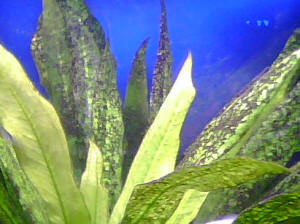
Freshwater algae ID please 3/11/18
Dear Crew,
<Hey Janet>
I'm usually able to figure things out, but this one has me stumped.
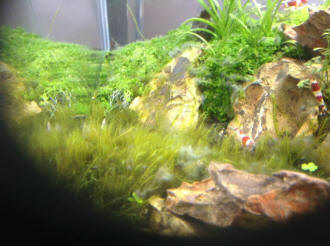
I have a 7.5 gallon freshwater tank with crystal red shrimp. The shrimp breed
regularly. The tank has been running for about a year. Nothing has really
changed since that time. It has an Eheim 2213 canister filter, Archaea slim pro
led light (on 8 hours/day) Amazonia aquasoil, all live plants/mosses, dragon
stone and driftwood. 30% water change every week, no additives. The algae is
attached to plants only and is found at all levels of the tank.
I cannot figure out what type of algae this is. It started appearing about 3
months ago. When I trim the plants (monthly) I can get about 75% of the algae
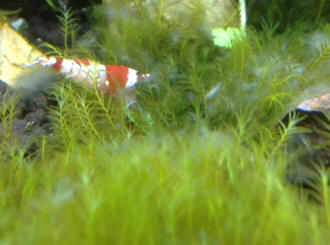
out, but it is a tedious process and it always returns. The algae is soft, fuzzy
and bristle like. Attached are some pictures.
<Soft, Mmmm...>
Could you ID this please?
<Looks to be a species of the genus Cladophora to me>
How might you suggest I change conditions in my tank to eliminate it?
<Softer, more acidic water conditions with less available nutrient>
Will Otos eat it?
<Not usually. This stuff can be tough... try pulling on it>
Is this actually algae or something else?
<It is a Thallophyte as far as I can tell by your pix. Do you have the capacity
(an inexpensive USB hooked up microscope of a few hundred power) to send along
more resolved images?>
I humbly thank you!
Janet
<Glad to share. Bob Fenner>
|
 |
|
Re: Freshwater algae ID please 3/12/18
Bob, thank you for your quick reply - and on a Sunday! I do have a very good
microscope. Could you suggest an attachment for taking pictures (via
computer) using a regular microscope?
<Mmm; not really; am unfamiliar nowayears with makes, models and technology.
Have an old timey light transmission and Intel-Play myself.
Perhaps the bb's for such?>
I have not looked in to this before and it would be a good purchase.
Thank you very much for the ID. I will investigate and work on getting some
better images for you.
Janet
<Thank you Janet. Am always glad to use ref.s, think back on my college
phycology classes, experiences.
Bob Fenner>
|
|
Black algae? /Neale 10/12/17
Hi, could you advise what this black substance is in my tropical tank? It seems
to have appeared after topping up my gravel.
<Appears to be Red Algae -- so called because of its appearance in alcohol
rather than in life. Various types such as Brush Algae and Beard Algae, among
others. Difficult to eliminate, but does tend to be noticeable only in certain
conditions -- will direct you to some reading:
http://www.wetwebmedia.com/fwsubwebindex/fwalgcontrol.htm
http://www.wetwebmedia.com/ca/volume_6/volume_6_3/fwalgae.html
Essentially, a combination of good water quality, fast-growing plants, and
possibly the use of suitable algae-eating fish, will be the way to keep these
algae out of your tank (or at least present in innocuous amounts).
Cheers, Neale.>
Black algae? /RMF 10/12/17
Hi, could you advise what this black substance is in my tropical tank? It seems
to have appeared after topping up my gravel.
<Ah yes; does appear to be a Blue-Green "Algae" (Cyanobacteria). Does it feel
slimy? Occurs in a few colors, morphologies. Please read here re:
http://www.wetwebmedia.com/ca/volume_6/volume_6_3/fwalgae.html
Bob Fenner>
re: Black algae?
Thank you for the prompt and helpful reply
<Most welcome! Neale.>
|
 |
|
Fuzzy algae and algae-eaters
7/15/15
Hello crew,
<Hey Aaron>
I have a 25 liter tank, well maintained for a year and a half, with a filter
that sprays the filtered water onto the top surface of the tank and aerates the
water this way, forming a modest current in the process. NO2=0, NO3~10, pH~7,
GH=7-14 range. KH=6-10 range. The substrate is glass marbles and short plastic
grass. In addition there are some plastic plants for decoration.
The temperature is maintained between 25.5 and 28 C.
<Okay>
My 7 critters include a male and female platy fish, two Otocinclus affinis
catfish of unknown gender, one remaining "Amano" shrimp,(I started out with
four), one Nerite (Clithon) snail (I started out with two) and one rabbit snail.
Each of these has a job to do to keep the substrate, glass and plastic plants
clean and they seem to go about it happily and efficiently. The
harmony among these creatures is palpable.
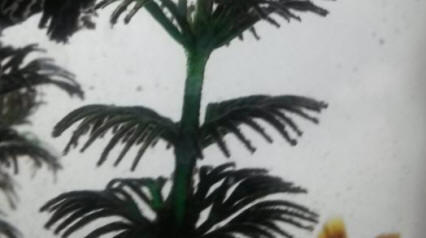
Over time the plastic plants have grown a fuzzy dark brownish-black
covering of algae (or perhaps diatoms).
<Likely a mix; but mainly algae species; yes. Perhaps an unpalatable type/s, as
your Otos and snails don't consume it. There are many possibilities here;
including almost all Divisions of true algae and Blue Greens>
I've read your section on algae but I still am not sure what I'm looking at in
my aquarium. I'm not too bothered by this
dark fuzzy stuff, although it is not aesthetic. I can control it myself by
removing the plastic plants and letting them air dry for several days, then
knocking off most of the dried up chips of the dark stuff. But, rather than do
that,
I'd like to raise the kind of critters that would be happy to eat it, since it
is so thick and perhaps nutritious to some lucky creature. I feed my critters
flaked fish food and also Spirulina flakes, so that everyone gets the kind of
food they need. I am careful not to overfeed them, and I change about 1/4 of the
tank's water about once a week.
<Good>
Can you tell me what kind of algae I have here and who would be happy to
dine off of it?
<Ahh; cannot.... w/o microscopic examination, and possibly other testing (e.g.
for storage foods, photosynthetic pigments...) one can't tell just by
macro-looking>
I've attached a photo I hope is clear enough to be helpful.
Thank you,
Aaron
<Something I would like to mention is the possibility of switching out the
marble substrate (or putting some fine gravel under it) to provide nutrient
competition and perhaps some Protist predation for this "fuzzy stuff".
Cheers, Bob Fenner>
|
 |
|
White algae coating new driftwood
4/23/13
Hello crew,
<Elisabeth >
I emailed a couple of weeks ago about some Ramshorn snails which I
unintentionally introduced into my tank. I proposed an assassin snail, but
my impression was that you didn't think it was such a great plan. But I
happened to be going to downtown Toronto where there is a very reputable pet
store called Menagerie. They suggested a Kuhli loach. I got two.
Within
days I was seeing no Ramshorn snails at all. Success!
<You might actually be in the market for more snails for the loach.>
I got a few other things too which seem to have lead to a new problem. I got
a balloon platy, two Endler's live bearers, a largish piece of driftwood and
four plants they called water bananas. I had the blessing of the reputable
pet store, so I thought all would be well. I went home and moved some plants
around, added the driftwood, the bananas, and the new fish.
It is now three days later and I suddenly have white algae all over the
driftwood. It completely envelopes the majority of the wood, but it is
nowhere else. It is not on the plants which come into direct contact with
it. Very strange.
There is something which might be like it on WWM's algae identification
page. Collin's post: Any Idea what this is? 12/6/10 attaches two pictures
which might show a similar growth, but it is hard to tell with the
photographs being rather poor quality (my own included).
<The "white algae" is fungus growing on the remaining soft parts of
the wood. It is harmless to the fish and will eventually
disappear. You can take the driftwood out and rinse the fungus off,
but it will likely return until all the soft material has been consumed.
It's just something you have to get past. Once it runs its course, it
will stay gone..>
What concerns me is the speed with which it grew. It appeared and enveloped
the driftwood in about 8 hours. I am also concerned that something is wrong
in the tank, but I don't know what. Any thoughts? Should I act? If so, what
should I do?
Here are the details of my tank:
10 gallon planted freshwater tank78 degrees Fahrenheit PH 7.8 - 8.0Ammonia:
0 ppm NitrIte: 0 ppm, Nitrate: < 5 ppm Three neon tetras One male guppy One
male balloon platy Two Endler's livebearers Two Kuhli loaches Two Nerite
snails
<You're fine, though I wouldn't add any additional livestock to the tank.
The neons may struggle in that hard alkaline water and the Endler's and
guppy will hybridize if their genders allow it. Also note that your
Endler's are almost certainly endler-guppy hybrids already as it's very
uncommon to find pure livestock.>
Thank you for any help you can provide.
Elisabeth
<Welcome. - Rick>
PS. I am aware that I have asked you many questions. When my current visa
bill is cleared, I will certainly donate!
<Appreciated.>
|

.jpg) |
|
Can't get a grip on algae control, FW Red Alg. ID...
11/11/12
Hello,
<Cin>
I have visited the various question areas for problematic algae in a
planted tank but still don't know what to try next. Here is the
issue and as much information as I have to provide you, and hopefully,
you can give me some new ideas. 100 gal freshwater planted
tank set up in April. It is not heavily planted, only liquid CO2
added. Plants include Vallisneria and Anubias (dwarf and regular)
and one water sprite. Have approximately a 40/60 mix of Eco
Complete/Gravel as a base for the plants. Lighting consists of
6500K T-8s (originally running 12-14 hrs a day). Water parameters
include: zero ammonia/nitrites, and about 5 ppm nitrates, recently
got water tested for phosphates and that is high. Just got a
phosphate resin pad to reduce those. Filtering consist of two
Fluval 405's and two 12" sandstone bubblers running off two Rena air
pumps (for oxygen at night). Originally, I reduced lighting to 7-8
hours a day but that only caused decline with my Vallisneria and water
sprite. Algae issues are:
dark flat algae growing on my plants, rock, and driftwood (photo
included), green spot algae on glass but not much of a problem, some
kind of an algae film growing the length of the tank at gravel level and
up only about 1/2" to 3/4" , as well as brownish blotchy film on glass
higher up (second photo). I do water changes of approx 15% weekly,
ph 6.8 to 7.0. As you can see from the first photo, I have Siamese
Algae Eaters (2 - 4") but they don't appear to be helping much. I
had a Pleco previously that I removed because he was too big and
disrupting my plants and since then have gradually had an increasing
algae problem. Can you suggest anything else I
could try to get rid of this? Thanks
Cindy
<Mmm, yes... the bulk of this is likely "Beard Algae"... a noisome
Rhodophyte. Read here:
http://wetwebmedia.com/FWSubWebIndex/BeardAlgF.htm
You can/could just wait and see what your use of HPO4 filtrant avails
you... but I'd be reading the citation and the linked files above. Bob
Fenner>
|
.JPG)
.JPG) |
Re: Can't get a grip on <beard> algae
control
11/11/12
Thanks, Bob. What do you think should be the minimum hours to run my
lights without having an adverse effect on the plants?
<Most types of plants, lighting, circumstances, six to eight hours per day.
B>
Cindy Cotton |
| Bigger PIX: The images in this table are linked to
large (desktop size) copies. Click on "framed" images to
go to the larger size. The dreaded "beard algae", actually a
Red/Rhodophyte... and easily avoided w/ proper lighting, filtration,
circulation and limitation and use of nutrients by competitors. |
|
%20MD.JPG)
|
|
Could it be algae?
8/8/11
<... Review our guidelines... hundreds of megs of pix, NOT
megs>
Hello crew at Wet Web Media... My name is Eldrich Freeman.
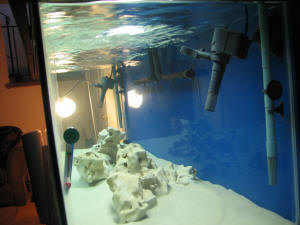
You've helped me a bunch recently. Thanks by the way... I was
wondering if you could help me with a possible problem with my
tank. I have a 135 gallon (long) aquarium.
It has 2 Rena XP3 filters. I also have to MarineLand 295 gph
power heads. I have stocked the tank with Pool Filter Sand and
Texas Holey Rocks. I'm going to house Mbuna Cichlids. Notice
that I said that I'm going to house them. I have no fish in
the tank. It has been running for about 2 1/2 months (maybe 3)..
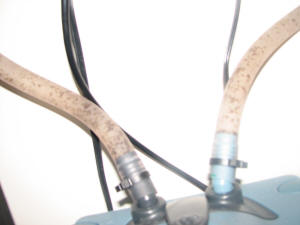
Maybe this is a problem or maybe it isn't. I noticed
yesterday that I have dark spots developing inside the tubing of
my canister filters (intake and outtake). Both filters have
developed these spots. I can't seem to tell what color these
spots are. Maybe brown but the look black to me. Is this
normal?
<Yes... part of the reason Eheim makes their own green
tubing>
My water looks like you can drink from the tank. I mean it's
crystal clear.
<I see this>
Is this something that I should worry about?
<Nope>
Is this something that I just simply have to use elbow grease to
get rid of. I was told that you need some algae in your aquarium.
If this isn't a problem then I'm sorry that I've
waisted <wasted> your time. I have also attached pictures
of the spots so maybe you could help me with a solution to this.
I hope that these pictures can help. Thanks for your time.
<This is largely Diatom growth, though other Protists,
Monerans are likely present... You could run a flexible brush
down these lines, but I'd simply ignore this coating of the
inner surfaces. Bob Fenner>
|
|
|
|
Any Idea what this is?
12/6/10
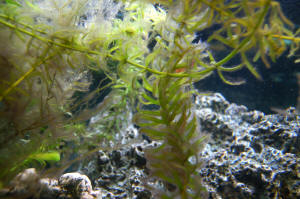
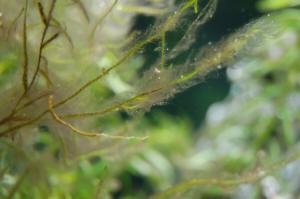
I received some of this Aledea and a few small tropical
freshwater fish from my fathers tank when I went up for a visit.
The tank originally only had a 40w fixture that had come with the
tank. Since we decided to add the plants I purchased an extra
fixture with roughly 130w. The tank is a typical 4ft 75g. About a
month after we stared getting this growth on the plants. Any Idea
what it is and is it harmful?
Collin
<Hello Collin. This is just algae of some sort. Harmless in
itself, but an indication that the environment isn't right in
some regard. I will remind you that Elodea is a COLDWATER plant
and rarely does well in tropical aquaria. When kept in water
above, say, 18 C/64 F is has VERY HIGH light demands, and simply
won't thrive under less than 3-4 watts/gallon. It also needs
hard water and won't thrive in soft water or at acidic pH
levels.
Overall, a very poor choice for tropical systems, though a good
pond plant and viable in unheated aquaria with 2-3 watts/gallon
lighting. But please, do scale down your images before sending
them, to around 500 KB or so each. On a Macintosh, the built-in
(and default image viewing) application Preview does this nicely;
just open the image, choose Adjust Size from the Tools menu,
select 640 x 480 from the Fit To pull-down menu, and then click
OK. The result will be an image ideally sized for use on e-mails
and web
pages. I'm sure similar tools exist for other operating
systems such as Linux, Windows, etc. It's a small thing for
you, but makes our life massively easier because full-size images
clog up our limited file space
for e-mail attachments, eventually causing other e-mails to be
bounced back unread. I'm sure you'd be pretty annoyed if
it was *your* message bounced back as undeliverable! It also
makes it easier for us to quickly download your images and view
them without having to wait a minute or two. Cheers,
Neale.>
|
  |
Re: Any Idea what this
is? 12/6/10
Thank you for your quick response and I am sorry about the
attachment size, I just wanted to make sure the resolution was
adequate to show the organisms detail. I spoke with my father who
gave me the plant and apparently I was mistaken about the species.
It is not Elodea Canadensis as I had thought. He received it from a
LFS some years ago and he says it grows well in his ponds and
aquarium which he keeps around 70 and it dies off in the pond
during the winter. Anyway he isn't sure of the species, but
he thinks it maybe Anacharis.
<Possibly, but more like some sort of Lagarosiphon or Egeria,
both of these genera being more common in the trade than Anacharis.
Do look at Egeria densa, Lagarosiphon major, Elodea callitrichoides
and Elodea nuttallii, all of which are moderately to very common in
the trade. Potamogeton crispus is also kept in ponds, but rarely in
aquaria.>
He also mentioned that it has one white flower per node of the
stem. I have not had it bloom yet. Apparently the leaves are also
much larger than Elodea Canadensis. Based on this new information
does this ring any bells?
Collin
<The white fuzzy stuff remains algae. Cheers, Neale.> |
Bright Orange Algae, FW
10/27/09
I have a freshwater tank. I recently switched from a 100 gallon tank to
a three hundred gallon tank and suddenly noticed bright orange algae
growing on my fake plant and the top of a shell in my freshwater. What
is this stuff I have never seen it before??
<Probably just algae, and if its orange, then the chances are
it's blue-green algae (Cyanobacteria) which, despite the name,
needn't be blue-green in colour. Blue-green algae has a distinctive
musty smell, and
when you look at it, it's slimy and made up of tiny threads all
matted together.>
I looked on your site and really only found stuff for saltwater.
<Do see here:
http://www.wetwebmedia.com/ca/volume_6/volume_6_3/fwalgae.html
>
Thanks do much
Troy
<Cheers, Neale.>
Re: Bright Orange Algae
10/29/09
Thanks so much the info is greatly appreciated. Is this blue-green
algae bad?? or poison, because I kinda like the look of it as long as
it does not spread to everything?
Thanks,
Troy
<Blue-green algae is not in itself usually poisonous (though in
large amounts, it can consume oxygen from the water, harming the
animals in the tank). However, blue-green algae usually only develops
in tanks that have
underlying problems. So they're an early warning that something
isn't right. Typically, blue-green algae grown in tanks that [a]
have poor water circulation; [b] have high levels of nitrate and
phosphate in the water; and [c] are receiving strong direct sunlight.
Without fixing these problems, it grows very rapidly, and long term,
can cause problems in itself. Cheers, Neale.>
|
Coralline algae growing in freshwater tank???
12/3/08 Hi all, <Robb> I have enjoyed reading
through all the Q&As on your site. There is so much useful
information. Thank you for the work you do. <Am very glad we
can share> I have kind of a unique situation that I am unable
to find much information about on the Web. Getting right to the
question: Is it possible this is coralline algae growing in my
freshwater tank? <Mmm, yes... but could be a few other
possibilities...> I have attached a photo of the questionable
specimen. This purplish colored growth is hard and scaly to the
touch. It flakes off if I scrape it with my nail. So far, it is
only growing on the rubbery parts of my faux saltwater decor. I
have not seen any evidence of it growing on my rock yet. If this
is coralline algae, how could it have gotten into my FW tank?
<The spores... for algae... can be air-borne, come in through
the tap/source water, in foods, decor, with the water with
introduced livestock...> How is it surviving, growing, and
spreading? <Conditions allow it> And most importantly, if
it is coralline, how do I continue this growth? <Preserve
those conditions, limit the introduction of predators and
competitors> Tank specs and info: I have a 30g freshwater
African Cichlid tank that I decorated to look like a saltwater
tank. It has 4-5" of aragonite crushed coral substrate.
Texas Holey Rock. It is filtered by an Eheim Pro II canister
filter and an internal 24 watt UV filter. My lighting consists of
six 6-bulb SuperBright White LED puck lights that I bought from
Home Depot (provides that shimmer effect) <Neat!> and a 96
watt PC dual-actinic bulb (I also have a 50/50 bulb on hand). All
decor in my tank (other than the TX Holey Rock) is faux marine
decorations. I perform a 5g water change each week. I prepare my
WC water a day prior to the WC. In a 5g bucket I add tap water,
~5ml water conditioner, 1 Tbsp Magnesium Sulfate, 1 tsp Sodium
Bicarbonate, and 1 tsp Instant Ocean salt mix. The water sits in
the bucket for at least 24 hours with a water pump providing
circulation, air pump oxygenating the water, and a heater to keep
the water at ~79 degrees. <Sounds/reads very good indeed>
Water parameters as tested on 11/27/2008 @ 8:30 am Temp: 81.9 F
PH: 8.2 Ammonia: 0 ppm Nitrites: 0 ppm Nitrates: 10-20 ppm
Phosphate: 0 ppm KH: 8 degrees or 143 ppm GH: Either off the
charts or test is expired (over 90 drops into test solution and
no change in color) I have no tests for specific gravity,
calcium, magnesium, or any of those other saltwater parameters.
Livestock includes (2) Tretocephalus Cichlids, (2) Electric
Yellow Labs, and a Pleco. All fish appear very healthy and
active. Thank you very much for any insight you could provide!
-Robb W. <I would enjoy this material... and take a look
through a microscope at a bit of it if/when you can... the
general structure of the cells, any inclusions can give ready
clues as to the general Division or Phylum of the life here.
Thank you for sharing. Bob Fenner>
|
 |
|
Strange algae? 9/12/08
Good afternoon,
I have been looking for an explanation and I haven't been so
successful identifying this "algae". I have a
moderately planted tank and a few of my plants, an Amazon sword
and an Anubias most notably, have developed what I can only
describe as a black rusty look on some of the leaves. It
isn't a hair algae or what I have seen of black algae on the
internet, in fact there is no actual stubble, hair, moss or
anything...it looks more like mold on a piece of bread, but
blackish.
Any ideas what this could be and how to get rid of it?
tank is a 20 gallon long with 40 watts lighting. ph about 7.8 set
up for a long long time
<Greetings. Anubias are adapted to living in shady
environments, and so unlike plants from bright light
environments, they don't have adaptations that help them keep
free of algae. Because their leaves are slow-growing, if you put
them in a bright spot, they do tend to get covered with algae. In
small amounts this doesn't do much harm, but over the long
term can end up smothering the leaf, perhaps speeding up decay.
In any case, there's two steps to keeping Anubias algae-free.
The first is to put the plant under some shade. Floating plants
are great for this, otherwise just use something fast-growing
that will cut out some, though not all, of the light. Secondly,
use Nerite snails or some other gentle grazer to remove algae
from the leaves. Plecs and bristlenose Plecs don't work --
they tend to damage the leaves -- so if you opt for a fish,
choose a gentle species like Garra flavatra or Crossocheilus
siamensis. Amazon Swords should be largely algae-free if
they're happy, though hair algae along the edges of the
leaves can be a problem. Again, Nerite snails or some other
gentle algae-eater can help, but otherwise simply pulling away
grossly infected leaves is usually the quickest fix. Do bear in
mind Amazon Swords won't be happy if the light intensity
isn't strong enough for them. You're looking at 2+ watts
per gallon for most Echinodorus, coupled with a rich substrate
(not plain gravel!) and appropriate water chemistry and
temperature. Cheers, Neale.>
|
|
Re: strange algae? 9/13/08
Hi,
<Hello again,>
I have about 2 watts per gallon.
<When you say "about" what do you mean?>
I was just wondering if this is some kind of maintenance issue that
I am overlooking. I do a 20% water change weekly, I have sand and
gravel mixed, so I usually do an off
the top vacuuming, as far as filters...
<Sand and gravel by themselves aren't going to feed your
plants. Imagine sticking a pot plant or garden plant in sand or
gravel. Would you expect it to live for long? Obviously not. While
fish wastes to indeed provide some nutrients, particularly nitrate
and phosphate, iron and other minerals are lacking. The ideal
approach is to put some soil in the substrate, usually by mixing
with gravel first to stabilise it, then sealing it in with a
"gravel tidy" (really just a mesh) and then covering that
with some clean gravel or sand. That's perhaps not an option
here, so instead you'll need to use fertiliser pellets and
insert them close to the roots of the Amazon Sword. One pellet a
month should do the trick nicely. You'll notice that the leaves
on your plant are quite pale yellow-green, and that's commonly
a sign a plant is "starved" of iron.>
I usually rinse the pad if it is overflowing back over the intake
or replace it if it seems extremely loaded and clogged. I use a
penguin 150 and a whisper 10 on a 20 gallon long (30")
aquarium. I use flourish occasionally, but not usually weekly. Tank
is lightly stocked with a couple of small platies and a bumblebee
catfish. Lights are on 12 hours a day.
<You could try switching to 5-6 hours on, 2 hours off, then
another 5-6 hours on. This "siesta system" for reasons
not entirely clear does seem to stress algae without harming
plants.>
This particular algae is also on some of the rocks and gravel. The
algae on the sword plant is on the older leaves, not so much on the
newer ones.
<It's common for algae to get to old leaves before new ones,
for reasons to do with how plants naturally keep themselves in
algae-free in the wild. If algae is everywhere in the tank, do
review the causes of algae, particularly direct sunlight and
excessive nitrate and phosphate in the water. I'd recommend
some Nerite snails for basic algae-removal, and perhaps some
shrimps, though I'd be concerned the Bumblebee Cats would eat
them.>
Do you think a filter intake tube and filter box cleaning/and a
thorough gravel cleaning might be in order...or possibly more
flourish and smaller more frequent water changes could help get
this under control...
<The filter itself shouldn't be a major factor, though if
the filter is clogged then water flow will drop, and that does
favour Blue-green Algae especially.>
Do you know what type of algae it is?? Sorry about the quality of
the picture.
<Different conditions favour different algae. Green Algae like
bright strong light and clear water. It's almost never a pest
because most fish eat the stuff readily, and it isn't the alga
you're dealing with here. Blue-green Algae looks like red,
black, or blue-green slime, and usually occurs where the water is
polluted (i.e., nitrate-rich) and/or water flow is weak and/or the
tank is getting direct sunlight. Red Algae, despite the name, is
brown to blue-black in colour (or at least the freshwater varieties
are). It does well in polluted tanks with poor water movement; it
doesn't seem to need bright light. It tends to look like
threads or fuzz and grows on solid objects and very often as a
fringe around the edges of leaves. I suspect that's the algae
you're dealing with. Finally, there's Diatoms (or Golden
Algae) which form the greasy slime you get on the inside of the
glass walls of the tank. Characteristic of dimly-lit and/or
immature tanks. Usually settles down by itself, so rarely becomes a
major problem. Cheers, Neale.> |
Black coloured algae in tank
-05/15/08 Hi I have a 3Ft tank with African Cichlids in it. My
water has always looked great... last week my Electric yellow died for
no apparent reason and the same day I noticed lots of fry in the tank.
Did she die during childbirth? <Unlikely. Perhaps she starved to
death, since they can't eat while mouthbrooding, which is why you
*must* isolate the females for several weeks (ideally months) to
"fatten up" before placing them in a tank with males of their
species. If she died, the fry could easily have swum out.> I removed
the fry and then all of a sudden this creamy/brown slimy stuff appeared
everywhere. I did a water change, taking out almost half the water, the
tank seemed fine for a few days and then all of a sudden the tank is
now very cloudy with black soot looking algae? all over the rocks,
gravel and plants (all artificial). <Doesn't ring any bells
I'm afraid. Blue-green algae is notorious for suddenly appearing,
but is very distinctive in appearance. The usual "black"
algae is hair algae, actually a dark reddish-green, but again, it is
very distinctive.> I cant seem to find any info when I Google images
for black looking algae, nothing looks like the stuff in my tank.
yesterday I vacuumed the tank, took out and cleaned the plants and
rocks and its all back again just as bad as yesterday. <A photo
would help. But by default, here are the things you do: First check
water parameters, at minimum nitrite and pH. Secondly clean the filter,
obviously taking care not to harm the bacteria but otherwise rinse out
any detritus. Finally, do a big (75%+) water change and give the gravel
a deep stir and siphon while taking out the water.> Thanks in
advance for your help. <Cheers, Neale.>
|
Red-orange residue in freshwater Cichlid
tank... Likely BGA... 2/18/08 Hi!! <Hello
Christina> I have a 75 gallon tank that has been set up since
Xmas of 2007. It cycled very well and houses African Cichlids of
various types. Everyone is happy and doing very well...I have two
female holding eggs and possibly one more, not sure yet. About
two weeks after setting the tank up I notice a red-orange slime
that started to cover everything in the tank. <Yuck!> It is
very obviously coming from the surface as it does not cover
surfaces under plants or other decorations. I have had no
Cichlids die though I have twice put in an algae eater
(Plecostomus) and they both died within two days. <Yikes>
Recently I clean all decorations, did a 50% water change and
within one week the slime was back. <Good name for it... is
likely to some large extent a Blue-Green Algae... aka
Cyanobacteria... many can be quite toxic to ingest> The city
says it's the water system we have that removes all chlorine,
<Mmm, the system you have at home? As in some gear to treat
the potable source> but the water system people tells us that
it's the city water and is a result of oxidized iron settling
in the tank. <Mmm, doubtful... not this amount... not to where
you can actually see it accumulate> I am at a loss and very
disappointed because the tank looks so bad. At least my little
guys are okay right now. Any insight would be wonderful. Thank
you so much for you time, Christine <Mmm, there are a few
approaches to limiting, controlling BGA... More circulation,
chemical filtration, sequestering microbiologically, competition
with other photosynthetic life, nutrient export... Please read
here: http://wetwebmedia.com/FWSubWebIndex/fwbgafaqs.htm and the
linked files above. Bob Fenner>
Re: Orange slime, FW algae ID, contr.
f's 2/19/08 Thanks so much Bob...I will
read up on that link right now. I forgot to mention that we also
have the red color in our showers and toilets. This is why I
think it's the water and not something in the tank. <Mmm,
maybe, but just a small possibility these are the same... the
shower is likely a ferrous stain, but the pix you sent show an
algal sort of growth...> Our water system guy did say that
coquino has a lot of iron in it, but I didn't think it would
be so high as to leach in and settle so quickly. <Mmm, no...
if this "high", the life would be gone entirely here.
The iron however is likely aiding the BGA... > Our system is a
softener with a carbon filter. I attached a couple pictures and
now that I'm looking at in in the pictures it seems more
orange-brown. In the first picture you can see how it settles as
there is a distinct line where there is no slime. Can algae grow
so quickly? <Oh yes... some forms/types can double their
biomass every few hours...> Two weeks ago tomorrow this tank
was very clean of this slime. Thanks again for all you help
Christine PS...That is my female Yellow Lab that has been holding
eggs since last Tuesday...any idea when they might hatch???
<Should be within four days or so at temp.s of the higher
70's, low 80's F.> Thanks again!!! <Do read re
means of limiting this algal growth... Bob Fenner>
|
|
|
Algae or what? FW 11/1/07 Hi Crew,
Recently ( 3 month ago) I setup planted 20 gallon hexagon tank: fish= 6
harlequin Rasboras and 3 gold rams plants= water sprite, Amazon swords,
java moss and java fern. Water parameters: pH= 6.7, NH3= 0 ppm, NO2= 0
ppm, NO3= 5 ppm Lighting= 40 Watts, 12 hrs per day <All seems
fine.> I do not have any algae on the glass at all, but I see long
gray hair on the driftwood. What is that? Is it dangerous for fish?
<Ah, no, this isn't algae, but is likely fungal or bacterial in
nature. It's common on bogwood (or any other kind of wood) that
hasn't been "cured" properly. It indicates that the wood
still contains sufficient organic material for bacteria or fungi to
feed on. It is basically harmless, though perhaps unsightly. You can
wash it off if you want. Some fish will eat this "mould",
such as Plecos, and snails and shrimps may well peck at it too.>
Thank you for your help Mark <Cheers, Neale>
Algae issue - short black fur 10/3/07 Hi WWM
crew, I have hunted everywhere for a solution to my algae issue with no
luck. It looks like short dark brown/black fur. It's about 6-7mm
(0.3 inches) long and really thick (just like fur) and it's
covering all of my rocks and even most of the plants. I have been
looking for solutions such as creatures to eat the algae, but have had
no luck. I have other tanks in more daylight and they don't have
this algae problem so it's not a question of light. The tank with
the problem is a 200L community freshwater with alkaline pH, 26 degrees
Celsius, low population (2 small calvus, 2 Bristlenose cats, 5 small to
medium rainbows, 1 small dickfeldi, 1 medium butterfly, 1 medium
Kribensis). The tank is mostly landscaped with rocks, but there are
some hardy plants (still getting shredded by the fish!) and 1 long,
thin piece of driftwood. Hope you can help because my once beautiful
tank is looking like some weird furry alien landscape - very bleak and
dull!! Thanks!! Lachlan <Despite the blue-black colour, this short
furry algae is a type of red algae. Nothing really likes to eats it.
Almost certainly the problem is lack of natural plants while having
relatively bright lighting. For example, you usually see this sort of
algae in either unplanted tanks or tanks with slow growing plants like
Anubias and Java fern. So, there are two options. The first is to add
fast growing plants like Hygrophila, Cabomba, or even floating plants.
Through allelopathy, these plants will prevent algae of all types
growing. You may need to increase the lighting in the tank for this to
work though -- paradoxically, algae is more of a problem in poorly lit
tanks than strongly lit ones! The alternative is to accept it as part
of the environment. The fish certainly won't care, and especially
at breeding time, this hair algae forms a home for the micro-organisms
baby fish like to eat. About the only fish I know of that eats this
type of algae is Jordanella floridae (the Florida Flagfish) though only
when hungry. How effective they will be against an established
population I can't say, but since they're nice fish in their
own right, definitely worth a shot. Cheers, Neale>
|
|