|
FAQs on African
Cichlids
Related Articles: African Cichlids, Malawian
Cichlids: The Mbuna and their Allies By Neale
Monks, Kribs & Their
Cousins By Neale Monks, The Blue
Followers: the Placidochromis of Lake Malawi by
Daniella Rizzo,
Related FAQs: African Cichlid Identification,
African Cichlid Selection,
African Cichlid Behavior,
African Cichlid
Compatibility, African
Cichlid Systems, African
Cichlid Feeding, African
Cichlid Reproduction, African Cichlid Disease, &
Cichlids of the World,
Cichlid Systems, Cichlid Identification, Cichlid Behavior, Cichlid Compatibility, Cichlid Selection, Cichlid Feeding, Cichlid Disease, Cichlid Reproduction,
|
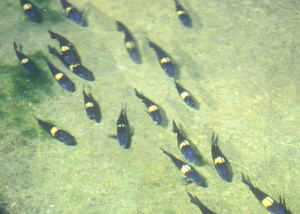
"What's the Haps,
man?" A pond of Africans
|
Assisted Living Community Tank 1/9/17
Hope this e-mail finds y'all well. I am setting up a 220g
(72"x24"x30") tank at a senior assisted living community that I
work at in one of our memory care/activity centers as studies have shown
the benefits of aquarium stimulation in seniors with dementia.
<Sure helps me>
The aquarium will house African Cichlids. Equipment on
the aquarium will be: two 36" LED lights, two Fluval FX6 canister
filters, two 500w titanium heaters with thermostats. First question with
equipment, would a Hydor or
two be beneficial or not?
<Hydor is a manufacturer... they make quite a few products. I'll guess
you're referring to their in-tank pumps... The answer here is yes; I'd
use these>
Second the Lifegard external heater chambers, would they work, any
experience with them and are they worth it?
<Mmm; can work... Am not a fan of most Lifegard products... not well
engineered or manufactured (my opinion, history); IF you don't need to
use external heater holders, I wouldn't. Instead, I'd place two two
hundred plus wattage submersibles down near the bottom in the back
corners. Folks won't see the cords, and the likelihood of air exposure
(w/o turning off) and breaking is minimal>
Moving on. The aquarium will have approximately 200lbs of cichlid sand
(white), 100-150lbs of lace rock, stacked in two separate piles one
larger than the other (in theory anyways, we all know how much rock work
gets moved) set on egg crate and possibly glued, and Black painted
background.
The goal is to have as much color and movement as the aquarium would
allow with all stated above equipment. Number of fish and direction is
where I tap out.
<Okay!>
Thank you guys and girls in advance for your response. I am really
striving to get this aquarium as right as I can for the benefit of our
residents and their families.
Jacob
<Please send along pix when you're about done Jacob. Bob Fenner>
Re: Assisted Living Community Tank 1/9/17
Wow that was a quick response. Yes the Hydor I am referring to would be
the in tank Koralia.
<Oh. Yes>
I will most definitely send pictures upon completion.
<Thx>
Tank was just ordered so another 2-4 weeks for glass and stand/canopy to
come in. I've looked at some of the cookie cutter guides and well they
just don't go to 220, unless I'm not looking right.
<?>
And I don't want to start just doubling, tripling, etc. because I know
it doesn't always work that way.
<What?>
So I guess that's where I'm needing a little more assistance/guidance.
<With what? B>
Re: Assisted Living Community Tank (RMF, you're the Goldfish expert
here!)
<<Two caputs are better than solo! B>> 1/10/17
Well yeah the cookie cutter thing was a different site. Sorry I get
quite in depth in research sometimes and get completely lost on where it
came from occasionally. Stocking. What African cichlid fish to put in
this massive piece of glass to get the most bang for the buck...most
color and most movement.
<<Hello Jacob. I will throw some general advice out here. When it comes
to situations like retirement homes, hospitals and community centres,
some thought has to be given with regard to maintenance. Some weeks the
fish "carer" will be away for vacations, or move to another job, or be
too busy to check the tank. It's a good idea to plan around the
"worst case scenario" so that the fish don't suffer and the tank doesn't
look unsightly. So while fish tanks can/do work great in this
situation, I'd tend to recommend the tougher species that will tolerate
things like high nitrate levels (inevitable in water changes are
missed). I'd also choose adaptable species that don't require any
particular water chemistry to do well (another thing difficult to
manage, especially for beginners). Why mention all of this? Because
Mbuna are quite demanding fish, and if the tank is somewhat less than
perfectly monitored, what you tend to end up with is the hardier
species, often hybridising, and resulting in a rather dull tank of
indifferent looking fish. Mbuna need low nitrate and high hardness, so
one question is how often will water changes be done? Another is what's
your water chemistry, and do you need to add buffering salts to raise
hardness? Not saying Mbuna aren't an option, but will stress they're not
anything like a zero-maintenance option. So, with all this in
mind, what might work nicely? A couple of definite options are cyprinids
and characins, both of which tend to be more tolerant of
nitrate (and "old" water generally) than Mbuna and other cichlids. On
the cyprinid front, don't neglect Goldfish! Big, hardy, colourful, and
out-of-the-box interested in human beings, these are true pet fish that
provide countless hours of engagement to those sitting in front of the
tank. A 200-gallon tank is an amazing volume of water, and would allow,
say, 6-8 specimens of top-quality Goldfish to reach a very healthy adult
size. The varieties on offer are amazing, personal favourites of mine
including the Yellow Goldfish (which looks more like a giant golden barb
than anything else) and the classic Black Moor (probably the toughest
fancy variety in the trade, easily able to coexist with indoor strains).
With 200 gallons Shubunkins really come into their own, their mishmash
of colours working really well if kept as a big school on their own.
Turning to characins, quite a few of the old favourites are tough as
nails. A school of Anostomus anostomus for example is unlike anything
else in the hobby, and with 200 gallons you could keep a big group
without squabbling, and get to enjoy them differently to those of us who
have to keep just one (which is what I have to do!). They get along
great with robust catfish as well as active schooling fish like
Columbian Tetras or Buenos Aires Tetra that have plenty of colour and
movement. Again, a big tank provides space enough for big groups. Both
Goldfish and the hardy tetras are adaptable with regard to water
chemistry, making them especially easy fish to keep. Just some thoughts,
anyway! Cheers, Neale.>>
Re: Assisted Living Community Tank
1/12/17
When it comes to maintenance it pretty much falls on me.
<Oh!>
I have kept haps and peacocks before and have done fairly well.
<Cool. While Haplochromines are much less aggressive than Mbuna, they're
socially a bit more tricky. Females a bit plain, so while a harem would
appeal to an expert fishkeeper intent on breeding, casual hobbyists
either get just males (which speaking as a male myself sounds rather
frustrating!)
or else pairs, and the females have such a hard time they often die
prematurely. Tanganyikans are less sexually dimorphic; Tropheus for
example would be an outstanding choice in a really big tank because
they're extremely beautiful but also less prone to aggression in large
groups. One thing about Tropheus is you basically can't mix them with
anything. Partly it's because of the need for large groups. If there's
space for another fish... add another Tropheus! But partly it's their
diet. They must have virtually only algae-based foods. Easy enough with
the right flake food.
But if you add anything else for other types of fish, such as bloodworms
or standard pellets, they're prone to bloating. Anyway, Google
"Tropheus" to get some idea of the range of colours. Some, like Tropheus
Moorii 'Ilangi' are as colourful as any marine fish.>
Have been out of the cichlids since 2005 when hurricane Katrina whipped
out my tanks. Water changes will be 35-50% every two weeks. Myself and
another employee will be responsible for day to day maintenance of the
tank and we
will have a company come in once a month for major maintenance. Two
filters will be cleaned alternately with water changes. All the
buffering chemicals will be on hand. Everything has built in double
redundancy in the tank. Two
filters, two heaters on separate thermostats, two battery backups and
the circuit the tank is on is also on a 500kw generator that will run
for 5 day as I have kept fish for 15 years and I know about water
chemistry and all that fun stuff. I tend to plan for worse case
situations and also discuss all the options. I've discussed South
Americans and goldfish and Africans is the way the company is wanting to
go. I appreciate the very detailed response and I will surely try again.
<Welcome. Neale.>
75?gal freshwater hardscape aquarium. Reading re Af. Cichlids
12/8/15
Hey yall! Always my go-to site when i have questions. :) Ok, so, I've got a
question about my current setup that i was hoping you could help me with.
I've got a lake Malawi cichlid tank going, in a 75? Gal tank. (The reason for
the ? Is im not entirely sure what gal. Size it is. It was a gift, and i know
its taller than my 55&60 gal, so i assume 75.)
<Mmm; there are about 231 cubic inches per gallon.... could measure the three
dimensions, multiply, divide by this number.... there are other ways of
figuring; by filling multiple times w/ a bucket of known volume;
measuring the delivery rate of a hose and timing the fill....>
I currently have 6 yellow lab cichlids, 3 kenyi cichlids, and 1 electric blue
johanni. The problem i have is aggression, mainly the johanni.
<Oh yes; you either need to remove; or add more fish/es. READ here:
http://www.wetwebmedia.com/fwsubwebindex/StkgLkMalawiTksArtBailey.htm
and the linked files above>
He's gotten to be overly
aggressive and im not sure what should be done to curb it. Alot
<.... no such word>
of people recommend "overstocking", but being I've always been told that's a
huge no-no, I'm hesitant to do it and don't know the proper amount.
<Reading....>
Water parameters are all good.
<.... of no use>
Ammonia:0 nitrites:0 nitrates:5. I was wanting to get yalls opinion on it, as
this is my first cichlid tank.
<Ahh; then LOTS of reading>
I really appreciate it. I've tried to get the johanni and isolate him from the
others, but that is one smart fish. Short of draining most of the water and
pulling the 60lbs of rock out of the tank, he is impossible to nab.
<Might try trapping; but...>
So any suggestions would be great. P.s, i tried the "cichlid trap" (two liter
bottle cut and flipped to make a diy lobster trap.) But, alas, he was still
smarter and stayed clear. (Only one who refused to go into it. Caught all my
other cichlids though. Lol)
<Drain the tank.... Bob Fenner>
Re: 75?gal freshwater hardscape aquarium.
12/8/15
Just some additional information. The tank is about 5-6 months old. The cichlids
are all still juveniles, so i was thinking maybe this could have something to do
with sexual maturity?
<Yes>
Or is it a stocking/species issue?
<This too>
I understood that there is general nipping and aggression in a cichlid tank, but
he's (the johanni) going all out and chasing pretty much anything that moves.
<Could try adding more of its species.... BobF>
Biblio. of Malawi Fishes, over 1,700 citations
1/1/14
http://malawicichlids.com/mw14001.htm#2013list
Selling value 11/4/13
Was wanting to possibly sell some of my Cichlids. I
have not found any definite prices. The ones I am thinking of selling
are:
- Metriaclima Lombardoi male; 4-5"
- Pseudotropheus Socolofi male; 3-4"
- Aulonocara Baenschi(?) 1m, 1f; 3-4"
-Melanochromis Paralellus will be selling 40-50 fry when they get about
2" or so, and there is another batch on the way, Female is holding
again!
If you can help me with pricing these fish I would really appreciate
that!
Thank You very much!
<Mmm, well, you can/could look on sites like Aqua Bid for input re going
rates... I will tell you that pricing for African
Cichlids is highly variable... time and region wise. Better to try a
wide audience; maybe Craig's List, eBay... rather than the LFS, fish
clubs directly... Any of these might go for a few dollars to no-takers.
Bob Fenner>
Our mixed tank. Af. cichlids, gen.
6/18/12
Well my fiancé and I are fairly new to having cichlids but I have done a
lot of reading up on them and still have so many questions.
They are in a 50 gallon tank lots of hiding spots (clay
pots and caves). Most of them are African except one or two, which I
have heard is uncommon (We had purchased them early in our hobby). They
have gotten along fine now for months so I believe they are okay.
<Time will tell... the family of fishes can be very "feisty">
I know we have two spotted jewels (one is red the other is a Pearl color),
two peacocks, three Kenyi's (one blue and the other two yellow) , and
one dwarf pulcher I believe. Then in a separate 30 gallon tank I have
two black convicts (1 male 1 female) that are getting along great
(already have eggs). First off my fiancé put red lava rocks in our tank
and I am against it because I'm worried they are to sharp to have with
our fish. Is this something I should insist he take out.
<Yes I would>
Second, one of our yellow Kenyi has had an increased darkness is the
stripes and face what could this be?
<Maturing; natural behavior>
The Kenyi had some eggs laying on one of the pots but now they are gone.
What could have happened to them?
<The same>
I have seen some pictures of rainbow colored cichlids and I'm really
looking for something that color that we could add to our tank, any
suggestions.
<In this volume? Maybe a very aware catfish... no more cichlids. Do read
here:
http://www.wetwebmedia.com/FWSubWebIndex/afcichcompfaq2.htm
Our fish now are mostly friendly for cichlids I suppose, every time we add
new fish they just check the new Guy out a little but I feel they aren't
too aggressive.
About how many fish could our 50 gallon keep?
<About what you have already>
Also does the white spot on the bottom fin always mean it's a male?
<Are "egg dummies"... see WWM re African Cichlid Reproduction>
How can I tell the difference of gender?
<And re this as well>
Thank you for your time!
<Learn to use the site please. Bob Fenner>
Red
Empress, sys. 9/9/09
Hi there, I was curious as to the tank requirements for a Red
Empress.
<Protomelas taeniolatus>
I have a 30 gallon that I have previously used for cichlids and
was wondering if it would be large enough.
<Not a chance. Adults are up to 15 cm/6 inches in length, and
the males are aggressive towards each other (and not exactly
gentle around the females).
They're open water fish that like swimming space. Given these
characteristics, you'd be hard pressed keeping them in even a
75 gallon tank, let along a 30 gallon one. On the other hand,
it's a stunning fish,
and in 150-200 gallon tanks, a harem would look superb. It's
hard to pick Malawians for 30 gallon tanks, and to be honest,
with smaller tanks like these, I tend to point people towards
Tanganyikans instead. Not only are there more smaller varieties,
among the Lamprologines especially, but they're also somewhat
less aggressive. The flip side of course is that Tanganyikans
tend to be less colourful, though some are very pretty fish in
their own way.>
I like to do my research before taking in animals and I want them
to have the proper habitats, and that is why I am so thankful
that you guys at WWM give such good advice!
<Thank you.>
Thank you so much in advance! Lena
<Cheers, Neale.>
Re: Red
Empress, Af. cichlid comp. 9/10/09
Hi there, and thank you so much for the info!
<You're welcome.>
Like I said, I always rely on your advice! But I do have another
question.
I have another 30 gallon with one male Haplochromis (Pundamilia)
nyererei and I was wondering if it would be possible to get
another of the same species and gender in the tank.
<Almost certainly not. It is an aggressive species.>
I know that our boy is extremely aggressive (killed the rest of
the fish in the tank!) so I was hoping that to put another of the
same aggression level in there with him would work out.
<Doesn't work this way. The misconception aquarists often
have is that if you have two fish of equal aggression levels,
they would realise this, and simply shake hands (fins) and
coexist. Unfortunately nature doesn't work this way. The
territory holder has the advantage for a start, and if there were
any differences in size, the smaller fish would be harassed,
likely killed, if it couldn't escape. Males are brightly
coloured, making them vulnerable to predators, so are genetically
programmed to do everything they can to secure a mating. For all
your fish knows, he's the dominant fish in this particular
spot, and a female could swim by any moment. He'll be damned
before he lets another male share his territory. Simple as
that.>
I think that this species is the most beautiful and would like to
have another, but I am unsure if they are too territorial or
simply too aggressive to have with other fish.
<Not an easy species; Pundamilia nyererei is one species known
for hyperdominance, males becoming extremely aggressive, to the
degree they kill anything kept with them that they consider even
a remote threat. Your main problem is really that you're
working with small tanks where bigger tanks are required.
Let's be crystal clear: 30 gallon tanks have almost no value
in Malawi cichlid keeping. Even a 55 gallon system isn't of
much use beyond keeping a single harem of one male and five or
more females (smaller harems rarely work well, let alone pairs).
To keep multiple species well, and certainly to keep the more
aggressive fish like yours, you need to be after 100, 150, 200
gallon systems. I wish it weren't so, but it is, and
that's that. I don't have that kind of space; ergo, I
don't keep Malawi cichlids!>
If it would not work out with another of this species, what other
fish would be suitable?
<Nothing much. Even a Plec would likely spend all its time
hiding.>
Or is the tank only large enough for our Haplochromis
(Pundamilia) nyererei friend?
<Essentially, yes.>
Thank you again, and I look forward to hearing back from you!
Lena <Sorry can't offer anything more positive to say.
Cheers, Neale.>
Re: Red
Empress 9/10/09
Thanks again!
<Happy to help.>
I suppose I will be keeping just this fish then.
<I guess.>
I did not know to much about it when I got it, well, the breeder
told me a bunch of info, but it was all wrong. So now I can only
have this one fish in my tank?
<I expect so.>
Will he be alright in the 30 gallon by himself?
<Yes.>
Well, I actually have a Pictus catfish in there too, and they
seem to get along just fine.
<Hmm... this catfish requires completely different water
chemistry, and is also a schooling species to boot, so not a
textbook combination.>
Like I said, I think he is just beautiful and I do not want to
have to rehome him, as much as I like the look of a multi fish
set up, it is not worth it to me if I cannot have the fish that I
love so dearly.
<You can have a multi-fish set up, but just not in 30 gallons.
Pundamilia spp. can be kept in harems in 55 gallon tanks upwards,
and in bigger tanks, mixing them with a second genus of fish that
looks entirely different would be a possibility. The art is in
avoiding anything too similar (same genus or similar colours) so
that males of each species don't view one another as threats.
With cichlids where the males are prone to becoming
hyperdominant, making careful choices is very important.>
Thanks, Lena.
<Cheers, Neale.>
Re: Red
Empress 9/10/09
Hi and thanks once more. I just have one last question about my
cichlid; what is the average lifespan? Just wondering because I
know that Oscars live for a long time, I am hoping that my
Haplochromis (Pundamilia)
nyererei will live a good long life as well! Lena
<These medium-sized cichlids should live between 5-10 years,
possibly longer under good conditions. Cheers,
Neale.>
MCH
Portal launching 09/28/08
Dear all,
Those of you who have been reading Malawi Cichlid Homepage (
www.malawicichlidhomepage.com ) will know that we have not been
doing the regular monthly updates for a while due to serious
technical problems. We have now relocated and restructured the
site to allow for much better functionality. Our new address is
www.mchportal.com. Today is our "official" launch of
the new site. As of now we will continue, as scheduled with our
monthly updates.
Please take a minute to come and see the site and tell us what
you think about it.
For a list of this month's updates click on this link :
http://www.mchportal.com/mch-updates-mainmenu-30/1-latest/6-update-30-september-2008.html
.
Thank you.-- George J. Reclos Ph.D.
Madagascar
export 11/13/07 Greetings: I currently have a license
from the US Fish and Wildlife to import fresh water fish and I
really want to import native Madagascar cichlids and/or rainbows
for personal collection. I know of an excellent aquarist in
Madagascar but have no exporter. Do you know of anybody
interested on exporting fish from Madagascar? Regards Jose
Gonzalez <Will post your note. I would contact Paul
Loiselle... is he still with the New York Aquarium? As he has the
most extensive experience here... and I'll send this to our
own cichlid expert, Chuck Rambo for further input. Cheers, Bob
Fenner>
Care of
suspected zebra cichlid, Blue Cichlid Problems 8/28/07 Hey
there.. this is going to be a long one :) We used to have a lot
of fish when I was growing up, guppies, mollies, gouramis and a
lone goldfish, I think, but we gave them away eventually, along
with our tank. I recently decided to get the aquarium going again
and now have a small tank installed with smooth glass pebbles at
the bottom and a couple of shells at each end serving as hiding
spots. There is an aquarium shop close by, and since they
didn't stock guppies, I asked about a tiny blue fish I
spotted in one of the tanks along with Angels. The shop guy told
me it was a 'Blue Mafe' (sic) and spelled the name out
for me. He said that the only problem with the fish was that it
would attack any other species of fish in the tank and should
only be kept with its own kind. I went home and looked up
'Mafe' on Google and Wikipedia, but after a few days of
searching I am now convinced that he actually meant "Blue
Morph". I am fairly certain now that it's a cichlid,
given its body shape and aggressiveness. The fish is just less
than an inch long and a pale blue in colour, with dark vertical
stripes that sometimes disappear entirely. (for reference, I
found this picture that looks very much like it, except that the
fins aren't yellowish like they appear here, they're
white with iridescent blue
http://badmanstropicalfish.com/mb_pictures/Pseudotropheus_zebra.jpg
) When I went back to the shop they gave me the one I pointed out
as well as another just like it that was in the molly tank, and I
was assured that the size of tank that I had should be sufficient
for them, however on the day I brought the pair home, one
eventually died in a few hours, I am guessing from the stress,
since it was constantly bullied by the other one and not allowed
into the lower levels of the tank. I found it lying at the bottom
of the tank finally, so I took it out and changed the water. The
other one seems to feel secure under its shells, where it darts
the moment there is any sudden movement in the room. It was a bit
disheartening to have one of the fish die, so I read up some more
about cichlids and learn that they ought to be kept in groups as
opposed to very small numbers in order to tone down the
aggression. After my experience with these fish I also believe
that I need a much larger tank even for these tiny fish, though I
think they're supposed to grow to a few inches in length.
However I doubt I will be able to get a bigger tank for a few
weeks since an impending house-shift has been suddenly preponed.
I would like your advice on whether I ought to return this fish
to the aquarium and get new ones when we shift, or if I can
maintain Morph in the temporary tank for a few weeks more, and
what I can do to make it more comfortable where it is in the
meanwhile. The tank I have right now will probably hold only half
a gallon of water. I know this looks ridiculously tiny compared
to the advised tank-sizes I've seen on the net, but so far
there doesn't seem to be an oxygen deficiency problem (have
had it a few days) since the tank is fairly shallow, as well as
that I'm recycling about 1/3 of the water every couple of
days. Is this too often? How do I make out if it's getting
stressed? Also, will he/she get too lonely if kept alone for a
while? (like I said, a few weeks before we're settled in) The
tank bottom has a lot of different sized smooth glass pebbles and
the two shells I mentioned, which the fish seems particularly to
like. Should I put a few more large pebbles to provide cover,
since Morph seems to be a bit timid all of a sudden, though if I
sit motionless for about five minutes he/she comes out and gets
very agitated, going up, down and side to side very rapidly along
the tank wall and I get the impression it's probably trying
to chase me off :P Also, as far as I can make out, it hasn't
eaten any of the food pellets I put in. I finally removed them
from the surface since I didn't want them decomposing. I
tried powdering one of the pellets and sprinkling some (when
Morph wasn't running for cover) but spat it out after
sampling a bit. What does it eat?? I don't really want to
keep the morph if I can't take care of it for the next few
weeks, but if it is possible to keep it reasonably comfortable
for a short while, given the current tank, I would like to do so,
and would appreciate your advice. I'd also like to know..
what do the colour changes mean? Does the appearance of the
stripes mean it's relaxed or stressed? And.. how do I tell if
it's a he or a she? I don't see any egg spots but would
they appear as the fish grows up? Thank you so much for reading
through this. -Archana < It sounds like you have an Mbuna
species from Lake Malawi. There are over a thousand species with
geographic variants to add to the confusion. These fish are fast
aggressive cichlids that feed on algae off the rocks. They like
hard alkaline water. These fish are very territorial. In the wild
the bigger the territory the more algae is available for them to
feed on. Fish communicate by changing their color patterns and by
displaying their fins. Bright bold colors with erect fins usually
mean aggressive behaviour. A dull fish with clamped fins is
trying to hide and not be seen. I would advise that you turn the
fish back in and wait until you are set up for what ever fish you
really want to get. If you do decide on cichlids then I would
recommend a book by Ad Konings called "Enjoying
Cichlid". It is a great book an covers most of the types you
will find in
stores.-Chuck>
African Cichlid Questions... ID, gen.
care 7/13/07 Hey, I love your site; it has gotten
me through many rough spots. I have three African Cichlids (at
least that is what Wal-Mart said) in a 10 gallon tank. I have had
them between 5 and 8 months (depending on the fish). While I was
at school they were with other cichlids in a 20 gallon tank, but
with the summer I bought them a tank of my own. They are three
different species of fish, but I don't know what they are
(remember Wal-mart fish). I promise I will not send any future
babies to a pet store because of cross-breeding, but I have a few
questions. 1) What kind of cichlids are they? < The usual
African cichlids sold at Wal-Mart are usually cichlids from Lake
Malawi in Africa. They are usually the rock dwelling cichlids
called mbuna.. > Where are they from? < Initially from Lake
Malawi but they are very easy to breed and currently are probably
from a fish farm in Florida.> How large will they get? <
Usually around 4 inches depending on the species.> One is a
bright yellow, about 2 1/2 inches at the moment, with a stripe on
its dorsal fin that was black when I got him but is grey right
now. He is the smallest of the fish, but I think he is the
oldest. < Probably a Labidochromis caeruleus or "yellow
lab" from Lion's Cove.> The second is light blue and
about three inches long. She or he can get as light as almost
white with a very light blue color to a darker sky blue color and
for spots on the anal fin. This fish likes to dig tunnels in the
rocks under the hiding spot. < Probably a Ps. zebra or
"cobalt blue".> The third is the largest at 4 inches
the last time I measured him, maybe a month ago. When I bought
him he was a yellow gold with large black spots. Sometimes his
spots are so large and dark that you almost can't see that
they have any color around them. Right now the spots are so faded
that he looks gold. The spots are almost not visible. I will try
to attach pictures, but I don't know if it will work. <
Sounds like a Nimbochromis venustus. A large predatory
cichlid.> 2) Is my tank large enough or do I need to invest in
a larger one? <A ten gallon tank is too small for this group
of fish. The yellow lab with get a little over four inches. The
cobalt blue will get up to 4 to 5 inches. The venustus will be
the biggest one at about eight inches but could get up to a foot
if it is a male. Think about a 40 to 55 gallon if you intend to
grow these fish to adult size.> I went for ten gallon because
of finances and space in a dorm room. I do have space for a
larger one if I need it. 3) Moving back and forth from college
frequently is difficult. What is the best way to transport my
fish? Thanks a ton! Melissa < Get large plastic bags from the
fish store for each of the fish. Don't feed the fish at least
a day before the move. Place just enough water in the bag to make
up about 1/3 of the bag. Leave the rest for air. Place one fish
in each bag. Twist the end of the bag and secure with a rubber
band. Place the second bag over the first bag in the opposite
direction to pinch off the corners of the bag. Rubber band the
second bag. Place the bags in an insolated ice chest. Should be
good for 24 hours. If the move is going to be longer then you
need to use oxygen from a fish store. Then the bags will be good
for up to 48-72 hours or
longer.-Chuck>
Keeping Ps.
acei 3/27/07 Hello, I am soon getting a 29 or 30
gallon tank I plan to have an under gravel filter and a regular
filter (don't know what brand or type yet). I would like to
get Acei (name at pet store) cichlids I went online to see if
that was the real name and it was, I didn't do much research
so I was hoping you could tell me a little about them ( water
qualities, how many I can put in the tank, etc.) Mainly I would
like to know about breeding them, are they mouth brooders or cave
spawners? Any information you could give me would be greatly
appreciated. Veronica < This is a very interesting cichlid
from Lake Malawi. It likes hard alkaline water at about 77 F. In
the wild it eats algae off of driftwood, so it needs a diet high
in Spirulina algae. They are not very aggressive as far as Lake
Malawi cichlids go. You could peacefully keep six or eight in
your tank as long as it is well filtered and you do regular water
changes. They are maternal mouthbrooders with females holding
eggs and fry fro up to a couple of weeks. If the adults are well
fed they may not go after the
fry.-Chuck>
Metriaclima
lombardoi Maylandia, NNS 12/28/06 hi, I have 3
Metriaclima lombardoi Maylandia. don't know the sex so far.
<You will. Please see here: http://fishbase.sinica.edu.tw/Summary/speciesSummary.php?ID=2374&genusname=Pseudotropheus&speciesname=lombardoi>
what should be the salinity of the water? <Mmm, some people
add "salts" made to mimic the make-up of Lake Malawi...
if your water is "naturally" hard, alkaline... I would
just keep up a routine of frequent partial water changes>
anything specific that I should feed them? Vishal <Possibly...
Please read here: http://www.wetwebmedia.com/FWSubWebIndex/afcichfdgfaqs.htm
and the linked files above. Bob
Fenner>
Coloring up
African Cichlids in Captivity 11/26/07 Hi, what
can I do to enable the color to come back on my
African cichlids? <Mmm... a few direct
things... species compatibility, numbers of genders selected,
providing suitable water quality, frequent partial water changes,
good nutrition> I purposely only purchased one cichlid in each
genus so I wouldn't run into this problem.
<Mmm, this won't do it> But it seems a lot
of my cichlids are losing color in my 80gal
tank. I thought only cichlids in the same
genus lose their color? Any pointers?
Thanks, Josie <Please read here: http://wetwebmedia.com/FWSubWebIndex/afrcichlids.htm
and the linked files above. Bob
Fenner>
A Colorful
African Cichlid Tank or Marine Tank - 11/10/06 OK
thanks chuck. Why is it difficult to put more than one
male "open water" species in that tank? <Males guard
open spaces as territory to spawn. Males will fight because they
can basically see each other.> Seems like it's
really difficult to maintain color in an African cichlid
tank. No matter how hard I try, there's always a
stipulation when it comes down to keeping your African tank
colorful. Please tell me Chuck. I'm going to break
it down real quick. I want color, activity (fish
always on the move), and variety. Can I accomplish
this with Africans? Or should I just go with
saltwater? Seems, the way it's going at this point
in time, there are WAY too many obstacles to
overcome. Now with you knowing exactly what Im trying
to accomplish, do you think Africans are the right choice for
me? Or marine? If I can find a way to have
those three things without having a mess of a tank with harsh
aggression, then I'd like to stay with it. Thanks
< The cichlid tank can give you color and activity. The salt
water tank will give you much more diversity in the body shape
and color patterns of the fish. You won't have the same fish
density in a cichlid tank but you won't have to worry about
reproduction for the most part. The cichlid tank would be cheaper
and easier to maintain. The cichlids would still try to breed
even if you one had one sex in the tank. This would cause
aggression to some extent. Cichlids all have pretty much the same
body shape. I could do it with a cichlid tank because that is
what I know best. I know the fish and know where to get them. I
haven't kept a saltwater tank so I really can't compare
the two as to which one would be easier to set up and maintain.
Both would look nice but my standards may not be the same as
yours.-Chuck>
Lake Malawi Cichlid Questions -
04/27/06 Hi, my mom bought 5 Cichlids from Lake Mbuna.
<These fish are actually from Lake Malawi. Mbuna is the native
term used to describe the rock dwelling cichlids.> She keeps
them in a 10 gallon. < Waaaaaaaay too Small. Should
be in a 30 at least.> I know that that is NOT a good setup,
and she now knows that too. < So when are you going to change
it?.> She has/had one 3" (male?) Blue Cobalt, one 2"
female Kenyi, one 1 1/2" (Male?) Yellow Lab, one 2 1/2"
(male) Gold Mbuna, and one 2" (male? female?) Red Zebra. Bad
mix, right? <The mix is OK in the proper set up. A 30 to 55
gallon tank with lots of rock work would work out just fine.>
Apparently so. The Blue Cobalt and the Kenyi get along great, but
the G. Mbuna has decided that even though the B. Cobalt is bigger
than him, he's the boss. So, the Red Zebra and the Yellow Lab
were miserable. I removed them, before they were seriously
mauled, and, about 4 days ago, put them in my 30 gallon with my
Peacock Eel, 7 Zebra Danios, and 2 Gold Dojo Loaches. Well, I
wondered why my Loaches were hanging out on high plants so much.
I got to looking 2 days ago, and found that Cody's (smaller
loach) front fins were nearly gone. So I wasted no time putting
the Red Zebra back in the old tank. (I know it was him because
the Yellow Lab is petrified of everything moving.) Anyway, the
Red Zebra was nearly dead 2 hours later when I checked on him. So
I hurriedly set up a 10 gallon hospital tank with an extra
heater, filter and airstone. I put him in there, and added some
MelaFix and a teaspoon of salt per 2 gallons. He wasn't
getting any better, and in fact, was getting a thick slime on his
lower body. This morning I remembered I had some Maracyn and
added that. Now he's doing WAY better. No more slime, and
he's much more lively and he's eating. If he recovers,
can he stay in the 10 gallon by himself? < Eventually he will
get up to 4 inches long. Pretty small set up for a 4 inch
fish.> He was very lively in the 30 gallon, and we became very
attached to each other. I really like this little guy. (guy,
girl, I don't know which...) Can he have any other tankmates,
or does he need to be alone? < Lake Malawi cichlids actually
do better when they are very crowded but proper filtration and
water changes are required to make this work.> Oh, and about
Mom's tank, it now has the Gold Mbuna, the Blue Cobalt, the
Kenyi, and a Rhino Pleco, who is more aggressive than any Pleco
I've ever met. (Not very aggressive, but if they nip at him,
he becomes the killer mutant Pleco) Is that too much? < All
these fish get to be at least 4 inches. Swap them out for fish
that are smaller and less aggressive.> They seem to be okay,
except for the G. Mbuna. He won't let anyone else come
anywhere out of their half of the tank. Thank you so much for
your help, Zhara Zorgon PS: The Red Zebra's name is Nemo. Mom
named him. :) < Do a Google search on the WWM website for Lake
Malawi or mbuna for more FAQ's about these
fish.-Chuck>
Starting A Lake Malawi Cichlid
Tank 2/26/06 Hello, I've been researching
Lake Malawi Cichlids, and I have a few questions that remain
unanswered. It's my understanding that a crowded
tank works best. Once the tank is cycled,
what is the best method for
initial stocking? Clearly you can't put
them all in at once. Further, I have seen
it written that when introducing a new species to an established
tank that you should re-arrange the tank--but as I
slowly stock a tank, I don't exactly want to be
doing this every other week--any advice on stocking a new
cichlid tank? I'm tired of buying books
only to not find this info! Thanks, Katie < Buy small immature
fish under two inches to stock your tank. Make sure they are all
pretty close to the same size. Over that size they begin to get
very territorial because they are old enough to breed, then you
need to do the rock thing. Cool down the water temp to the mid
70's to slow down their metabolism. For long term stability
try and buy fish that do not resemble each other. Check out a
book called "Enjoying Cichlids" by Ad Konings at
CichlidPress.com-Chuck>
New (African Cichlid) Fish
1/1/06 We have recently purchased two new fish for
our aquarium, but can't seem to find much of any information
on them. I am hoping that you may be able to help us
to find out more about these fish. They are
Pseudotropheus Socolofi Albino's. (Snow white
socolofi). Any information that you can provide for us
would be much appreciated. Thank you. >> You do
not need to look up Pseudotropheus socolofi, really any
Pseudotropheus will be good. You can find basic information here:
http://www.thetropicaltank.co.uk/Fishindx/socolofi.htm
a great place to get cichlid info is here: http://www.cichlidae.com/
Good Luck, Oliver
Eating Tilapia Re: the Q&A below, I
have to say...a big, mean Tilapia is quite delicious :-)Mel <
The fish that are often listed in fish markets as a food fish are
Saratharadon mossambicus. They are pond raised in geothermal
springs in Utah. Never heard of T. butikoferi as a
food fish.-Chuck> Adding a Tilapia butikoferi with
Oscars 12/16/05 Just a couple of things really.
Firstly, great site and keep up the good work! < Thanks>
Could you please tell me what the hell a Tilapia butikoferi is
and find me a picture and/or any information on it as it's
not on Fishbase.org nor can I find it anywhere else using Google
etc. <snip> < The tilapia gets bigger and meaner that
the Oscars. As long as they are all the same size then they might
get along. The tilapia will dominate the tank.> <snip>
< Many books say that the tilapia butikoferi only gets to
about 10 inches, but I have personally seen some in the Midwest
close to 18 inches. A big mean fish is hard to get rid
of.-Chuck>
New to Freshwater, Cichlids 7/23/05 Hi
there, After doing months of
"homework", I finally purchased a 55 gal
(4' W x 1' L) aquarium/stand setup and in a few weeks,
once my water (well water) is ready, I will be
purchasing African Cichlids. I have been
working with a family owned pet store and they have been very
helpful with answering my questions but I have also
spent hours reading your site and I thought it might
be a good idea to get some info from you as well (that is
if you don't mind). <Not at all. Good to have
multiple inputs, different points of view>
Some other items that I have purchased
are a 300 gph AquaClear Power Filter with BioMax
CycleGuard, AquaClear Filter Insert Ammonia remover,
Acura 1000 Automatic Aquarium Heater, Cycle, Kent A F
Cichlid Chemistry, Kent Cichlid Essential Mineral
Supplement, Tap Water Conditioner, Freshwater Master
Test Kit for pH/High Range pH/Ammonia/Nitrite/ and
Nitrate. I know that the best #'s are the
following: Ammonia and Nitrites should be 0, Nitrates
< 25 PPM, and Temp should be about 80. Can you tell
me if there is anything on my list that I should not
use or if I should use additional items to maximize the water
quality for my fish? <Mmm, you might
want a bit of redundancy in your power filtration... that is, to
add another device... hang on likely> The store clerk
recommended doing a 25% H2O change be done every
3 weeks while cleaning the filter 3 days before or
after water change. <Mmm, I change about this much water on my
African cichlids every week (they really like hard, alkaline...
and "new" water)... I encourage you to do the same...
and with two power filters to change just one each time... to
preserve biological filtration capacity> I told him
that I was planning on changing the water 25% once a week but
he insisted that would be too much, is this correct?
<Mmm, not IME/O> My second concern
is that when I visited the store today, I noticed some
of the Cichlids had an orangish stringy substance
about 2" in length hanging from the
underbelly. When I asked the clerk
about this he told me it is part of their birth canal,
but I was a bit suspicious about his answer since I
have and plan to continue investing a lot of money
into my aquarium, I don't want to risk bringing
home sick fish. Can you tell me if he was
correct in his answer or bending the truth? <... not part of
the birth canal... Perhaps just waste product... but they might
want to offer better foods...> I was
also told that no other species of fish could share an
aquarium with African Cichlids but I would like your opinion on
this as I would like to add a few different species to
add to the ambiance of the aquarium. I have
noticed that some of the posts on your site. included
different types of fish sharing homes with Cichlids. <There
are other "rough and tumble" species that either come
from the same lakes, or have similar "outgoing"
temperaments, that mix with African Cichlids>
Finally, I have also read on the q&a
site that there are different recommendations on how
many fish should be cohabiting in a specific size
tank, I am thinking about starting with the 1" fish or the
3" fish, how many would you recommend in a 55
gallon tank? The book I bought "The
Guide to Owning Malawi Cichlids" by David E. Boruchowitz
recommends crowding them makes them less territorial
and some of the WWM crew have said that some peoples
tanks are way overstocked, what would be the best thing for
my fish. Your help is greatly appreciated, Bobbi
<Almost always better to understock... if there are too many
fishes, and "something" goes wrong (which happens
eventually to all), there can be real trouble, stress... for them
and you! Best to buy small individuals (an inch or two in length)
of whatever species you're interested in and have them grow
up together. Bob Fenner>
An Offer of Help Hey crew! I was wondering if you guys
have visited Duboisi.com. Well, on there they have a tank profile
every month. Mostly all Tanganyikan Cichlids. I think it is a
great site, although I would love to see something like that with
marine tanks of all sorts. Reef, as well as predator tanks. I
think it could be a great addition as I really enjoy seeing other
people creations. I realize you all have enough on your plates,
so if you'd need any help, I would love to volunteer my time.
Let me know what you think. <Will cc ScottF and AdamC here
re... think they've already added such a component to our
"Conscientious Aquarist" online zine. Bob
Fenner>
Juvenile Malawi's Hi, <Hello> I
just have a quick question I hope you can answer. I
have recently started a Malawi tank and was able to find someone
locally who breeds some fish from this lake. <Neat>
I picked out the following F1 juveniles; 5
Metriaclima estherae (1 blue male, 4 females), 3 Labeotropheus
trewavasae (1 male hopefully - he is starting to get the orange
top - and 2 females). The estherae's are all about
1 inch and the trewavasae's are about 1.5 inches with both
males a little bigger. My question is when will the
female estherae's start to turn orange and if the trewavasae
is a male when will he start to get his blue as they are all
colorless right now. <Likely within a month, two> I
can't find any info about how fast they grow or how long it
takes to reach maturity and this is my first time with cichlids
this small as all at the LFS are bigger and have their colors
already. <Mmm, well, you can/could "speed things up"
with frequent feeding, partial water changes... a bit high
temperature... But better to take your time here... your animals
will live longer, better lives for it.> I also have 6
Aulonocara st. (cobue) on hold from this guy and won't be
ready to bring home for another few months and just wondering the
same question as with the others. <These
"Peacock's" grow more slowly, color up later...
likely a few months for them> The cobue's will have a
separate tank from the others as I am hoping to witness all of
these fish breed at some point. Thanks <They likely will. Bob
Fenner>
Questions about Cyphotilapia frontosa Hello, Did a
search on the Frontosa, but not much info out there. Was
wondering if I could get help in correct care for these
fish. I have 2 fish, approx 3"/4" long in a 100
gallon tank. Tank temp is 80 degrees Fahrenheit. Tank is filtered
by two Emperor 400 gal/hr bio filters. They are the only
fish in the tank except for some feeder mosquito fish which they
seem to be ignoring. What would be the correct feeding for
these fish? Any other info would be most appreciated. < Your
Cyphotilapia frontosa are found all over Lake Tanganyika.
They are primarily found in deep water. The water should be hard
and alkaline. Your filtration is fine. They get up to 35cm. There
are many different geographic variants so you should not mix
Frontosas from different areas. One male to two or three females
is best. In your tank you could probably have a group of up to 6
fish. In they wild they eat sleeping cichlids at night, so they
will never chase your feeders. They like shrimp and worms when
they are small but will accept pellets and flake foods
too.-Chuck> Thanks, FrankF African Cichlid
Omnibus Hi, and thanks for the great site. I am preparing to
set up a new tank. It is a 72" x 24" x 30" that I
will be using primarily for African Cichlids. I have read so many
conflicting articles and I'd like to set this up right from
the start. 1. what is the absolute best filtration system/s I can
use. Should I use wet/dry, add refugium? supplement with
mechanical? < The best filter is the one that you are able to
service quickly and easily. I prefer hang on the back power
filters such as the Emperor series from Marine land. Two emperor
400's will pump up to 800 gallons per hour. The bio wheels
will provide plenty of biological filtration> 2. what kind of
substrate? < If you plan on keeping Mbuna then they really
don't require that much sand. An inch or so of well washed
sand should be plenty.> You could use crushed coral if you
live in an area where the water is soft. Many people find it too
bright and it washes out the colors of the fish.> 3. What is a
recommended model of each of these? 4. What about fluidized bed
filters? I have read that they keep down nitrates? Is this true?
< Fluidized beds work pretty well as long as the power is
consistent. The bacteria live on the outside of each of the
beads. AS the water is pumped over them they do a good job of
converting ammonia and nitrites to nitrates. If they are working
properly they should be generating lots of nitrates from the fish
waste. That is what you want to happen.> 5. What size pump for
the wet/dry? < At least one that will pump 500 gallons per
hour.> 6. I have several fish I will be transferring from
other tanks and I'd like your opinion on how many I could
add. I have a giraffe catfish, < This catfish will eventually
get too big.> 3 jewel cichlids, < Although these do indeed
come from Africa they are not rift lake cichlids and would not be
able to compete for long with the others.> 2 bumblebee
cichlids, < Pseudotropheus crabo is one of the larger Mbuna
from lake Malawi and may turn very dark as it gets older.> 1
electric blue, < Only the males color up. Females stay a
silvery gray color. The males may not color up unless there are a
couple of females in the tank.> 3 elec. yellow. < These
fish are relatively peaceful for Mbuna.> I would like to add
some peacocks to this mix, and maybe some red zebras. < Red
zebras and peacocks would go well in this tank. Look for a book
by Ad Koning called " Enjoying Cichlids:. There is lots of
good information about cichlids that will help you.-Chuck>
Please advise, thanks, Jim G.
Re: new set up >Hi, and thanks for the great site. I
am preparing to set up a new >tank. It is a 72" x
24" x 30" that I will be using primarily for
>African Cichlids. >I have read so many conflicting
articles and I'd like to set this up >right from the
start. >1. what is the absolute best filtration system/s
I can use. Should I >use wet/dry, add refugium? supplement
with mechanical? >< The best filter is the one that you are
able to service quickly >and easily. I prefer hang on the back
power filters such as the >Emperor series from Marineland. Two
emperor 400's will pump up to >800 gallons per hour. The
bio wheels will provide plenty of >biological filtration>
Q1: Is this option better than using a wet/dry with additional
mechanical like an Eheim? I am looking for the best system, and
am willing to put some time into maintenance and service. I am
willing to spend the money also, so I guess my question, to
rephrase it, is: if you did not worry about the money, and you
were willing to spend some time on servicing/maintenance, what
would you use for a 215 gallon setup for African cichlids. <
With money as no object ideally I would set up two Marineland
Tidepool filters with the SOS surface skimmer attachments. Each
tide pool would have a pump that pumped 400 GPH. In the filter
trays I would use a coarse filter pad that comes with the filter
then the finer blue filter pad. In the last tray I would place
the crushed coral or oyster shell to keep the water buffered at a
high pH.> >2. what kind of substrate? >< If you plan
on keeping Mbuna then they really don't require that >much
sand. An inch or so of well washed sand should be plenty.> You
>could use crushed coral if you live in an area where the
water is >soft. Many people find it too bright and it washes
out the colors of >the fish.> Q2: Is the African cichlid
substrate (CaribSea African Sahara sand?) good to use? < That
would be fine.> >4. What about fluidized bed filters? I
have read that they keep down >nitrates? Is this true?
>< Fluidized beds work pretty well as long as the power is
>consistent. The bacteria live on the outside of each of the
beads. >AS the water is pumped over them they do a good job of
converting >ammonia and nitrites to nitrates. If they are
working properly they >should be generating lots of nitrates
from the fish waste. That is >what you want to happen.> Q3:
If my nitrate levels are high, how do I go about getting them
down. Assuming that the water changes are regular (25% weekly),
and the water I am using has no real nitrate problem. I am
getting readings in my 55 gallon tank of 100+, though ammonia and
nitrite read fine. < High nitrate levels usually indicate a
high organic load somewhere in the system. Clean the filter and
vacuum the gravel deeply to remove all the organics that have
accumulated. Move rocks and things too and get the sediment out
that has accumulated there too.> >I have a giraffe catfish,
>< This catfish will eventually get too big.> Q4: Too
big for the 215 gallon? Can I let it go in my pond when it gets
too big? The pond is in Texas (Houston) and it is one half an
acre with an average depth of 5 feet. we have blue gill, catfish,
bass, and gars in there now, with an assortment of turtles, frogs
etc. < In much of the literature they have this fish getting
over 2 feet long. But I have personally seen one at the Steinhart
Aquarium in San Francisco close to 3 feet long. He needs warm
water an would probably not make it through the winter.> Q5:
What is your estimate of how many fish I can keep in this 215
gallon, assuming it will be mostly peacocks, mbunas, etc.? <
With the filtration system I recommended above I think you could
keep 100 fish with a 50 gallon per week (25%) water
change.-Chuck> Thanks again for all of the help, Jim g
Free Fish? Yeah Right! Hi crew!! <Hi! Ryan
with you> It's been a year since I've written.
<Welcome back> I had a moderately successful 120 gal.
Marine FOWLR then. Since then, I graduated and got a job, got
married, moved into my own home, and had a baby (actually my wife
had him, I just watched.) So you can imagine things got crazy.
One of the first things to go down the tubes was the tank.
Thankfully, the fish survived, and I was able to give away or
sell them all. Had to throw away the LR, bloody shame, about $800
worth, but no one trusted it...I wouldn't have either.
Anyway, great to talk to you again, on to the questions... As you
can imagine, I haven't the time or the funds (no one told me
home ownership and parent hood was going to COST anything!!) to
redo the tank, because I would insist on at least $1500 worth of
LR, and a new filtration set-up (my old one was terrible), etc
etc....very costly. <Gotcha> But a new opportunity
has presented itself. My best friend, maybe 10 months ago,
decided he and his wife wanted a fish. They bought a 10 gallon
set-up, one of the fancier ones, and 3 cichlids. I believe they
were African, they were the really common colorful (blue and
yellow) kind that every pet store in the world has, not sure
exactly on sp, and went along. <Likely Africans> I
told them that this tank would definitely dwarf these fish, and
that they wouldn't live as long, and they were ok with that.
<Eat each other is more like it> Well, the one killed
the other two, and now is about 6 inches long and proportionately
fat. I didn't imagine this could happen, but it did. Now the
fish sits still all day long, and is neglected, because my
friends have decided fish aren't for them. <Many make this
choice> And my 6 foot long graduation gift sits in the
garage making me want to cry. They want to give me the fish and
the set-up and everything. I figure with the tighter budget, I
cannot afford the LR necessary to redo the marine setup the way I
want, and have decided that a colorful freshwater set-up is in
order. I have a fluorescent hood, 2 Ebo-Jager heaters, air pump,
all the stuff I need EXCEPT substrate and deco, and the filter. I
plan on going with an Aqua Clear 500, because I've had great
success in the past with them, and the shop I intend to buy
livestock from uses power filters exclusively, with great success
as well. SO... I'm going to start with this huge yellow
cichlid and from there, I don't know. Are there any cichlids
that can't be mixed with this one ( I think it's
Aulonocara sp.)? Should I even accept the gift? <I have done
extensive projects with African Cichlids- and there are
limitations. There are few tankmates that can defend themselves,
other cichlids aside.> Are there other fishes besides cichlids
that can go in there? <Biotopic display is your best bet.
Figure out exactly what type of African cichlid it is, and which
lake it comes from. Add mates from there.> It is a 120,
which is pretty big for a FW, so I thought I might have some
options. <Lots, but keep it natural> I am
particularly fond of Angels (which I know are a cichlid),
Gouramis, Loaches and maybe a school of Tetras or Danios. <All
South American fish- If you're going this route, don't
accept the gift. Different water needs.> The shop I mentioned
has a pair of gorgeous very dark blue Sciaenochromis fryeri that
I would like to add next. And last but not least, I would like to
use black sand. <Not recommended for this application> Is
this appropriate? If not, what else can I use to enhance the
colors of the fish? <Nice lighting, proper feeding regime.>
And is there such a thing as black sand that can be had for
cheaper than the $14 per 25 pound bag at the fish store?
<Maybe you could split a bulk order with someone locally- Your
best bet. I would really research a biotopic display- They're
easier to maintain, more peaceful and more successful
long-term.> Sorry for the novel. Hope all is well with
everyone. Thanks as always. Matt <Anytime!
Let's see some pics once you're up and
running.>
Frontosa Aggressiveness Hey guys! First, great site.
Second, I have a few questions. :) Background info: several
months ago, my husband and I purchased a small breeding colony of
F0 Cyphotilapia frontosa, Blue Mpimbwe. There were two males -
one missing an eye - and two females, all of which got along
pretty peaceably. (We wanted to add more females to get a more
desirable ratio, but we read that they would not be accepted as
part of the colony.) We put them into a 125G tank in our living
room and added aragonite, and later rock with caves. We try to
feed them a varied diet; the other day I ran out of prepared food
and fed both chopped up whitefish and frozen krill. Without
intending to, I apparently induced spawning. Sadly, the next day
One-Eyed Jack was torn up badly. We removed him to a quarantine
tank immediately, but his injuries were just too severe, and he
died. (He was my favorite, too.) On the plus side, one of the
females was obviously carrying. I fed a few cubes of bloodworms
to the tank later that day, and she dropped her eggs,
unfortunately. I guess the bloodworms were just too tempting to
resist. We were able to save one egg, which we later realized
wasnt even fertilized, but the others were eaten. Now, a
few days later, she is being picked on by the other female! Her
dorsal and tail fins are a little ragged. After doing some
research, I think that we will begin feeding smaller, more
frequent meals to reduce the overall level of aggressiveness in
the tank. I am also considering getting some more cichlids to
make it more difficult for any one fish to consistently track a
victim. My questions: 1. Is it true that more female Blue
Mpimbwes would not be accepted as part of the breeding colony?
< Any time adding cichlids to an established tank you need to
redecorate the tank to break up established territories.
Unfortunately with frontosa being so large this is not easy to
do. You could try to add more females but it will be very
expensive with no guarantees of success. The more females you add
the better it would be. Just make sure your filter can handle the
extra load.> 2. If thats the case, can two breeding colonies
of the same species live together in a tank? < If the tank was
larger it might be possible but I wouldn't add any more males
at this time.> 3. If thats not possible, is there a particular
species that works really well with Frontosas? < In the wild
these fish come from deep waters 100'+ where it is dark and
they feed on sleeping Cyprichromis. Anything they can't eat
whole and that can tolerate their water conditions can be a
potential tankmate.> 4. Is our plan to reduce aggressiveness
workable? Do you have any other suggestions? < Depend on what
you want to do. Do you want to show them off or breed them? If
you want to breed them then I suggest that you get two large
sections of PVC pipe. Each section should only be large enough
for each female to fit into. The male being the larger fish
should not be able to enter the pipes. Put a pipe at each end of
the 125. A female should take over each pipe. At feeding time
everybody will come out to eat. The females will then retreat
back into their pipes. When a female is ready to breed then the
male will entice the female out to breed in the center of the
tank. When spawning is complete she will return back into her
pipe. The trick is to get both females to spawn at nearly the
same time. Lots of good food and a large water change should do
it. I have seen this technique with a pair and it works. The egg
crate method will work too. Separate the tank into 1/3 sections
using an egg crate type of plastic panels used for overhead
florescent lighting. The fish can still see each other but the
male in the center section can't get to the females or each
other. They can still breed through the crate material If you
want to show the fish off too then you will need to come up with
another suitable refuge for the females instead of the pipe that
can be both attractive and functional.> 5. Is it possible that
the carrying female actually interfered with the breeding and
that the other female was the one who actually deposited the
eggs? (We did not get to witness the breeding.) <
Frontosa are greedy eaters. If there is a food source around like
eggs then the other fish surely will try and get to that source.
In the wild she would retreat to a crevice in the rocks away from
the other fish.-Chuck> Thanks, Evelyn
Frontosa's Mouth Hi, Thank you in advance to
reading my question. <That is what we are here for.> I have
a group of frontosa cichlids that seem to keep their mouths
closed, like they are stretching their upper lip downward. They
are only about 3 inches and too young to be holding. It's
only a few of them, the rest are fine. <Something like that
typically isn't an environmental problem. This might be a
case of physical deformities, and these birth defects are growing
more pronounced as they age. Frontosas breed quite
easily after the 3 year mark, and many people don't take into
account that in order to have good and healthy fish, breeding
needs to have multiple healthy blood lines. Chances
could be that the three fish that you have might be severely
inbred by the breeder. Mouth and eye deformities are common in
inbred cichlids. Many responsible breeders look for issues like
this and cull those fry so to keep lines pure.. If the case is an
issue of birth defects, then there isn't much you can do.>
When I feed them they don't/can't seem to open their
mouths to feed, but they get close to the food and somehow scoop
it. It is really puzzling and I can't figure out what is
causing this. Any help you can lend would be greatly appreciated.
<Probably the best thing to do is keep an eye on
them. Make sure that they are given clean water, and
monitor to see if they are eating properly. With a
hindrance to be able to eat they might not be getting all the
food that they should.> Thank You Adrian <Wish I could be
more definitive with an answer to help you and your
fish. But, I think it's best to keep an eye on
them and see what happens. -Magnus>
Cichlid site - 10/16/03 Wow. I looked at
cichlidrecipe.com... what a great site! <Isn't it? I love
it!> Thanks for referring it. <My pleasure> I
am now going through and identifying my tank members and
determining how to re-prioritize my tank. <Exactly what I
did> I do note though, in Matt Pederson's
recommendations for a 55g tank he has a dozen cichlids plus 2
catfish...not far from mine at all, although the selection of
fish perhaps does not include so many that grow as large or as
aggressive. <Could be likely but just another point of view.
He may have three filters on his tank and as you said more
"like" type fish. I still don't think
over stocking an aquarium is a good idea at any level> I will
study it more carefully. <Very well. Good luck to
ya.> Thanks again Paul. <Thanks for the
question. We might have just helped a great many others with our
exchange.....so........thank you -Paul> Jeff
Scared Africans Hi "Crew," I have had my 46
gal cichlid tank up and running for about 18 months now, and
everything is going wonderfully well. The water is as
clean as a home aquarist can make it, and the fish are thriving
physically. I have one issue with my tank though, and
I have never been able to get a good answer. The
problem is, the fish seem to be agoraphobic - if they see even a
slight movement outside the tank, they disappear into the
rockwork. I have to hide behind my couch to enjoy my
fish - it's unorthodox, but it isn't that big a
deal. I have to ask out of curiosity though, why are
these fish so flighty? All the cichlids I've seen
in pet stores are more inquisitive than shy. The
particulars: 3 Malawi cichlids (1 Zebrasoma, 1
Pseudotropheus auratus, and one unknown, plus 2
Plecos. I have no NH3, NO2-, pH is 7.9, temp
76. The tank is in a corner of the dining room, not in
a heavily trafficked area.<could be the
dilemma> The only thing I can think of is that the
bowfront distorts the fishes perception and has warped their
minds.<could be lol> Do you guys have any
ideas?<Maybe move the aquarium to a place where people are
around it the majority of the time> Thanks in
advance,<Well from what you are telling me everything seems
fine except for the fact that you fish are not used to your
presence. They could be acting like this because you are not home
a lot during the daytime hours, maybe they are just very timid?
there are many factors involved. I would not be too concerned
with this. Good Luck and I hope the fish become bolder in the
future. IanB> Nick
African Cichlid id >Mr. Fenner, and or crew, I was
wondering if you could tell me what kind of fish I have here, and
if you could direct me to an online resource for researching my
fish. Thanks Much. >>Mbuna! Or, it appears to be
a large Pseudotropheus zebra, though it's been so long since
I've even had access to my own book on African I.D. (this is
a classic African lake cichlid, hailing from Lake Malawi, though
other rift cichlids are from lakes Tanganyika and Victoria as
well), and so much has changed these past decades concerning
taxonomy of the Africans I could be wrong. Try this
place, Tim http://www.africancichlids.net/index.html
http://www.cichlid-forum.com/
>>Best of luck! Marina
What are African Cichlids? - 5/23/03
This a completely stupid set of questions.
<there are no stupid questions> Are African
cichlids fresh, brackish or salt water? <They are considered
freshwater organisms. There are some trace salts and minerals in
the waters of the lakes from which they come from, but not enough
to make them salt water fish nor true brackish for that
matter> Would a typical freshwater filter, lights, etc, be
sufficient to have them thrive? (90 gallon tank)<Absolutely.
You just described my Aulonocara tank. They key is to research
the fish you want and then to get them as young as possible. Pay
special attention to their full grown captive size so as to not
overstock> How many 2-4 inch fish could I
keep in 90 gallons, with a decent rock layout? <More than
likely, unless you go Tanganyikan, most cichlids from the African
lakes range from 6 inches and up captive adult size. I think the
current thought is about 1 inch per 3-5 gallons because of
freshwater fish metabolism is a bit higher in part due to their
general aggressiveness> I love your site, and
appreciate any advice you can give on these terrible questions.
<No worries. Thanks for the kind words. Please go out and pick
up a book on African cichlids as well as do a search in google or
your favorite search engine for more information on them. Here is
a site that I absolutely love as a start: http://www.cichlidrecipe.com/
Take care James. Paul> James
| Re: African Cichlid ID HI How are you
today? Still the greatest site out there. Question! Can you
ID this African for me? He was tank born and raised and I
have had him for 5+/- years but have never been able to
positively identify. Thanks in advance. Dennis Vigliotte
<I believe that is the Nimbochromis fuscotaeniatus. If you
have a copy of Ad Koning's Malawi Cichlids in their
Natural Habitat Vol. 3 there is a nice picture on page 240.
Hope this helps! Ronni> |
|
|
Electric Blue and Yellow Hi I have a tank with Electric
Blue and Yellow Cichlids. Could you send us as much information
about them as possible (Breeding, tank setup etc). <<Please
go to http://www.wetwebmedia.com/FWSubWebIndex/fwsubwebindex.htm
and click on the links for Cichlids. You will find a ton on
helpful info there.>> Also I have heard rumors and mixed
information about these fish, which I was wondering if you could
clear up for me. 1) What are the stripes on these fish from?
Stress? or Poor quality? <<The stripes can be caused by any
number of things. Stress, poor water quality (thus causing
stress), excitement over something, adult or juvenile coloration,
spawning behavior, etc.>> 2) In Electric Blue do you find
that the male and female are aggressive to each other?
<<Depends on the fish themselves. Aggressive behavior is
generally the norm but there are always exceptions.>> 3)
Also how do you tell the difference between male and females? 4)
What food is best? for little electric blue and yellow and for
big? <<A combination of foods works the best. New Life
Spectrum makes a wonderful Cichlid pellet but also use frozen
bloodworms, krill, and some vegetable/algae foods. When using
frozen foods, be sure to thaw them completely before
feeding.>> 5) What plants are best? <<Cichlids are
notorious diggers so it's hard to get any plant to stay put
in their tanks. They also tend to eat any of the softer species.
Anubias works the best as it's a firmer plant that they
don't eat but it will still need to be well anchored.>>
Regards Paul and Leanne <<Take care, Ronni>>
Re: cichlids that change color I have had an aquarium
for several years now. About two years ago after a massive loss
of fish in our tank due to a very aggressive fish we had to start
from scratch. We once again got a cichlid. We believe it is an
electric yellow but now are unsure. It was about six months after
we got it that it started changing color. It went from bright
yellow with black fins and the small distinctive white spot on
it's lower tail to a black with blue stripes coloration. At
first I thought it may be sick but it continued to eat and swim
with no real strong behavior changes. That was about 18 months
ago. Could it of just been reaching maturity? Or is it something
else? <<Very interesting. Electric Yellows should stay
yellow/black even when mature but I don't know of any others
with their distinctive coloration even when juveniles. Even
though, I highly doubt that it's anything but a natural color
change. The only thing that really come to mind for an
explanation is depending on where you bought it, it's very
possibly a hybrid. A true Cichlid breeder will frown on the
crossing of two species but many people that keep them end up
inadvertently crossing them just because so many of the species
spawn so readily. They will then take the juveniles and sell them
to an LFS who is often none the wiser. So if you got this from
your LFS that could be what happened. If you got it from a
breeder I'd have to wonder. If this is in fact a cross,
without seeing a picture (and possibly even with one) I
wouldn't even be able to guess what the Electric Yellow would
have crossed with since so many of the blues/blacks look
alike.>> It's still healthy, with no physical
indications of illness. The color has never reverted though
sometimes it does look brighter than at other times. <<This
color brightening is not uncommon. Mine used to do this on a
regular basis. It can be brought on by water quality, lighting,
pretty much anything. Mine used to get very intense colors when
they were angry or in the mood to spawn.>> The only other
fish is our "algae eater" (other name just to long)
that is approximately5-6 inches in length and we've had it
since we started the tank. <<Well, whatever it is it sounds
like it has the temperament of the Electric Yellow. My yellows
were never a problem but I had several others that I was unable
to put Plecos in with because of aggression.>> Are we wrong
about what kind of fish it is or is this just normal for this
type of fish? Please help identify this fish if you can. Brenda
<<Hope I was of some help. Ronni>>
African Cichlids What is the most important pointers in
raising a completely successful 60 gallon tank housing 6 African
Cichlids? At present my fish appears to be
experiencing Ich/Fungus. Lots of shaking, white spots,
and one with bulging eyes. HELP. I was told to raise
the temp to 80 degrees and change 10% of the water for the next 5
days. What is a good book to read that will cover
starting a new tank and the care of cichlids? Thanks
in advance, Tracy <Hi Tracy. First off lets get the
current fish healthy. There are plenty of meds for ich
and fungus, just be sure you are medicating for the correct
disease. Start here: http://wetwebmedia.com/FWSubWebIndex/fwfshparasites.htm
Next up... Water quality. Unless you purchased the
fish in their current condition, chances are water quality
brought about the current ailments. I like the water
change idea, should get things back in order. Some
good test kits for ph, ammonia, nitrite, nitrate, and since we
are dealing with African Cichlids, you will want to test for
water hardness as well. Other pointers/considerations: compatible
tank mates, full grown size (fishbase.org is good for this),
proper tank decorations, good food, good filtration,
yadda yadda yadda, and a good book. I personally do not have any
recommendations, check out your LFS, amazon.com, and your local
library. I do however try to avoid the books that
advertise a certain brand of product. Oh yes, do check out our
FAQs as well. -Gage http://wetwebmedia.com/FWSubWebIndex/afrcichlfaqs.htm >
Cichlid Tank I have a 220 gal tank I'm setting up
for Tanganyika cichlids I will have a 5" inch bed of
CaribSea rift lake authentic with about 200 pounds of moon rock.
I was thinking about using HDL tri base palletized carbon with
the right now bacteria and wondered if you have knowledge or
experience with it's use. <have not used it myself> I
have some mineral mud that looks more like dirt and wanted to
grow some mangroves or house plants and maybe some aquatic
plants. I was wondering what types to use seeing as some absorb
ammonium/nitrites/nitrates better than others. <Anything fast
growing should work fine.> Also I would like some
suggestions on what types of animals fish and inverts that are
available to use in this endemic tank, <I would invest in one
of the many books available on Tanganyikan cichlids, there are
plenty of choices, it is really up to you http://wetwebmedia.com/FWSubWebIndex/afrcichlids.htm
> by the way the carbon would go in place of the bio balls, I
was maybe thinking of using lava rock. <avoid the lava, too
much potential for problems. Best Regards, Gage> or maybe a
mix of that with cichlid mix with tufa chunks any suggestions
please thank you in advance.
MALAWI CICHLID HOMEPAGE has just been updated. You can
visit www.MalawiCichlidHomepage.com/aquarium/update.html to see
whats new this month in our website. More than 40 new pages and
tens of high quality photos have been added this month. You are
also welcomed to our new layout which we hope you will like.
Please sign our GuestBook which is located at the bottom of every
page. We are very interested in your comments and suggestions.
This feedback will help us to improve this site. In case you
encounter problems with our new layout, we suggest you turn your
letter size to small (option found in the view tab in your
browser). The Authors Francesco, Frank and George George J.
Reclos Ph.D. HOLARGOS GREECE <Thanks George. Will post on WWM.
Bob Fenner>
Looking for cichlid pix and info. can u send me a pic
or info on Crytocara moorii <Please read through the African
Cichlid materials stored here:
http://www.wetwebmedia.com/FWSubWebIndex/fwsubwebindex.htm Bob
Fenner>
Re: Help with ID Please! Hi Thanks for the IDs. Thought
they would be Zebras but not sure. I took new pics tonight that
might ID them for sure.
http://communities.msn.com/RIOTFISHDUDE/newfishpicsoutofthebags.msnw
BTW my guess for the stripes is Red Top Zebra. <it does appear
that you are correct>
Help with ID Please! Cichlids Robert or Anthony;
<Anthony here> Thanks so much for all the help.
<quite welcome> Got the first batch today at the place
mentioned in earlier posts. I got 13 fish including a pink
convict (I think) don't know how I got him, never saw him in
a tank but was in the bag with what might be red top
zebras. <really should be returned in the long
run...doesn't belong with Malawian African cichlids> Could
you take a look at:
http://communities.msn.com/RIOTFISHDUDE/petesnewafricansoridplease.msnw?Page=1
and tell me what you think these are so I can feed them right and
avoid any major incompatibles? <standard African cichlid
pellets and green based foodstuffs. Very hardy fish. Blue and
Oranges are Zebras, Spot is a H. livingstoni or polystigma and
the picture of the striped fish is not clear enough to ID>
Thanks Peter <kindly, Anthony>
African Cichlid? can you please help me
I bought a fish from this guy and I don't know what it is he
said it was a cross between a red empress and a sulfur headed
peacock it looks very very nice the body has blue and turquoise
green all over the body and the top fins has green and baby blue
and on the anal fin it has around 10 or 12 egg dummy thing can
you please help me Richard <Sounds like a variety of Peacock
cichlid, Aulonocara species. -Steven Pro>
Cichlid ID Thanks you have been a great
help.... I have one bumble bee cichlid can't tell if it is
male or female.... it has only 2 dots on dorsal fin. I also have
3 orange and one is peach more than orange they are males I think
they are very colorful on fins ...lots of dots on them....do you
know what type the oranges ones are....I have also one blue one
that has just 2 dots on dorsal fin...is that a female... I
also have one little yellow one can't see any dots at all but
it has stayed small I got them all about the same time in June of
last year... now I have 4 new babies.... that have gotten a
little brave the last few days...lol... they are popping out and
shaking at the feeder fish that I have in the tank... guppies and
minnows .... I will am gonna try and take pics with my pc camera
today and will send ya a pic of tank... maybe you can give me
more ideas... thanks very much for quick reply!!!!! Angela
<Sorry it took so long for your reply. We had some technical
difficulties with your email. You probably have what used to be
referred to as Pseudotropheus zebra. This is no longer a valid
name and your fish are probably hybrids when you consider the new
taxonomy. Nothing to worry about though. They are still great
fish when they are not being too mean to each other. -Steven
Pro>
"The" African Cichlid? Dear Mr. Fenner, I was just
wondering if you happened to know the scientific name of the African
Cichlid. I am doing a report in school for this project and just
wondering where I could find it at. I saw your webpage and decided to
ask you if you happened to know it. <Mmm, there are actually several
hundred "African Cichlid" species... not one. Go back to WetWebMedia.com
and pick out one by name (scientific or common), input the URL
fishbase.org on your search tray, and plug in the name... Bob Fenner
|