|
FAQs About Newts & Salamanders, Amphibians with tails...
Related Articles:
Amphibians,
Turtles,
Related FAQs:
Amphibians 1,
Amphibians 2,
& FAQs by Groups/Species:
Axolotls,
Efts,
Fire Belly Newts,
Hellbenders, Tiger Salamanders, Water Dogs, & African Dwarf Frogs, African Clawed Frogs, Rubber Eels/Caecilians, Turtles, Amphibian Identification, Amphibian Behavior, Amphibian Compatibility, Amphibian Selection, Amphibian Systems, Amphibian Feeding, Amphibian Disease, Amphibian Reproduction,
|
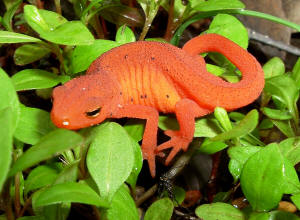
Eastern Newt (Notophthalmus viridescens viridescens). Commonly called a Red-spotted newt, here pictured
in the juvenile stage where it is called a red eft.
|
Newt troubles 4/3/19
I have a eastern red spotted newt.. had him for months and he was
thriving.. checked him today and his tail looks like its rotten or burnt
not sure, I cant find anything on it and I'm freaking out please help!
<Newts are generally pretty tough, but they can be subject to bacterial
infections similar to Red Leg as seen in frogs. Assuming this is
Notophthalmus viridescens, one problem you have is that there are
aquatic tadpoles, terrestrial (bright red) "Efts", and then once more
aquatic sexually mature (and duller brown) adults. If yours are in their
aquatic stage, then treatment will be quite simple, as per Xenopus or
some other aquatic amphibian, as described here:
http://www.xenopus.com/disease.htm
Treat as per Red Leg and you're probably doing the best you can. The
terrestrial "Efts" are going to be trickier to medicate because they're
not bathed in the antibiotic, so you'd have to feed it to them. I'd
recommend a vet if that's the situation here. Cheers, Neale.>
Axolotl Sys.
2/10/15
Hi
<Dora,>
I just read your answer as to amount of water needed for just one
axolotl as well as goldfish. 75 liters.
<Round about, yes.>
Wow. Standard aquariums don't even come that big where I come from. 35
liters the most. This means I have to have one specially made for just
one fish.
<Yikes. What about a pond? Surely in Mozambique an outdoor pond for
Goldfish would work pretty well. But just make sure there's NO chance of
the fish getting into local water bodies, e.g., after heavy rain.>
Did I get the calculations right?
<Yes.>
Also, can I give them fish fillets thawed from supermarket box bought?
<Well, yes, but not the only thing. Goldfish are herbivores more than
anything else. Cooked vegetables (peas, spinach, squashes of all sorts,
courgette/zucchini) and even cooked rice make useful staples, and
they'll also nibble on things like lettuce leaves given the chance.
Small amounts of meaty foods can be added; white fish fillet and prawns,
for example, but
in very small amounts. If at all possible (perhaps mail order?) Koi
pellets will make the best and cheapest staple. But mostly green foods,
as mentioned above, work great. Axolotls are predators, and generally
need meaty foods. Earthworms are excellent foods, if you can get them.
But otherwise small pieces of white fish fillet (tilapia is ideal) and
occasional seafood (squid, prawns mussels, cockles). Prawns and mussels
contain Thiaminase, which causes health problems, so despite being
convenient, shouldn't be used more than, say, 20% of their diet.>
Thank you
Dora
<Most welcome. Neale.>
Re: Axolotl Sys.
2/10/15
Thank you Neale
My goldfish are Ok as far as food.
The axolotls are another story.
I was given pellets for koi fish and told they like it
<Uh, no. Would lions eat grass? Koi is basically salad in a pellet,
ideal for herbivores.>
Mine don't seem to want to eat them
<Indeed not.>
Will try the tilapia
<Good call. Cheers, Neale.>
Re: Axolotl Sys.
2/10/15
Thanks Neale
<Dora,>
Makes sense but I want to tell you a story not related to fish. When I
arrived in Mozambique early 90s I joined a group of people that wanted
to look after animals in the zoo. There weren't that many. 6 lions all
bred in captivity and during their civil war. They were feed grass and
scraps of waste and had survived for 20 odd years
<Crikey! Doesn't really sound the ideal diet for Lions... Have just read
(online) an article called "Vegetarian Lions and a Smoking Chimpanzee"
and wow!>
Meat was new to them. But they got into it as if they had known what it
was. Last night I gave shrimp and tilapia. Its still standing there.
<The Axolotl? They're pretty hardy. Should do well given the right food
and cool water.>
Don't know when last they eat but am hopeful
<Cheers, Neale>
|
Fire Belly Newts; beh.
11/10/14
Hi! I just recently got two baby Japanese Fire Bellied Newts. They're very young
and are completely terrestrial still. I just wanted to ask if it is
normal for them to not be very active at all at a young age. They sleep
together in a little hole just about all day.
<Well, assuming you do have a Cynops species, then yes, they should be aquatic
much of the time, around two-thirds of the time in the water, a third on land.
Something like that. Some even spend almost all their time
in the water, doing little more than resting among floating plants, basking
under the light (though remember, they can dry out, so a heat lamp isn't needed,
and there should be plenty of humidity in the vivarium). So, think
about why they might not be going into the water. Firstly, they're shy. If there
are bigger creatures in the water, even something that seems harmless to you,
they'll stay on land. Secondly, they don't very warm or very cold
water. Room temperature is usually ideal, but if there's direct sunlight on the
water it might be heating up a lot during the day. Thirdly, they don't like poor
quality water. Check the filter works. You probably don't want to
use anything with a motor, but an air-powered sponge filter is perfect, and
should also help keep the water moving and oxygenated. Finally, they become
inactive if they aren't getting enough to eat. Live food (typically small
insects and insect larvae) are usually essential for the settling-in phase when
you want them to put on weight, while frozen alternatives are usually accepted
once they're happy and associate you with dinner.
Cheers, Neale.>
|
 |
|
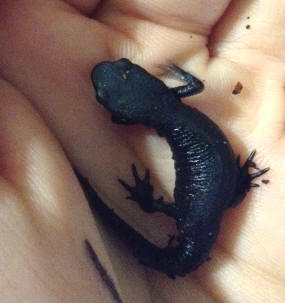
Eel with hands, have pics 10/25/14
I have an eel with hands and arms just behind the head area and cannot
find a reference to any such creature. It has been living in the
aquarium at the shop I work in for at least a year and was said to be
caught locally in a Texas lake. Have video that shows the hands much
better, but can't seem to load it from phone to email.
<While the photos aren't especially useful, they do at least show the
presence of pectoral fins and a dorsal fin. So my guess here would be
Anguilla rostrata, also known as the American Eel. It's widespread
across
Texas, though as elsewhere in the world, the construction of dams has
prevented this catadromous species completing its reproductive cycle,
causing it to be much rarer now than it once was.
http://www.tpwd.state.tx.us/huntwild/wild/species/ameel/
Biology is essentially identical to the European eel, Anguilla anguilla,
which is hardy, long-lived in unheated tanks, predatory, and generally
easy to maintain on a carnivorous diet provided it cannot escape. Some
European Eels have been kept for decades in aquaria, though breeding is
of course impossible. All eels get pretty big given good conditions, so
do bear that in mind. Cheers, Neale.>
|
.jpg)
.jpg) |
Re: Eel with hands, have pics; Siren
10/26/14
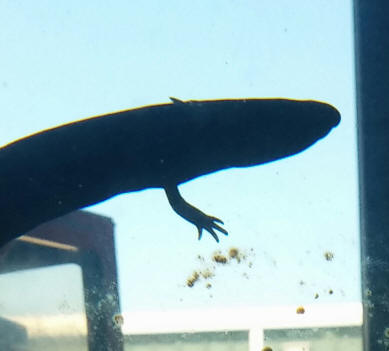
Thanks, Neale for the quick reply. However I would like to ask again
about the hands. Specifically hands that grab, hold on to objects in
tank and use to paddle around. I just took 10 photos and he moves so
quickly that it's difficult to capture both of the hands at once, but I
was able to get one clear photo of one of the two hands. My question is
do these eels normally have functioning hands as such. Thanks again
<Ah now, the hands really are odd. No, Anguilla rostrata doesn't have
hands. Nor does any other fish. Clearly this is some sort of amphibian,
probably a salamander of some sort. Does it have "feet" as well as
"hands"?
Does it have external (feathery) gills? The Lesser Siren (Siren
intermedia) for example has front legs but not back legs, and the front
legs have four fingers on each hand rather than three (which is what's
seen on Dwarf Sirens, Pseudobranchus spp.). Your photo seems to show a
beast with four toes and small feathery gills, which would suggest a
Siren species, either the Lesser (Siren intermedia) or Greater Siren
(Siren lacertina), though the Greater isn't native to Texas so far as I
know. Hope this helps, Neale.>
|
 |
Re: Eel with hands, have pics
10/26/14
Thanks, Neale-yes this thing has the feathery gills, and 4 fingers on each
hand. No rear 'legs' and the hands are very dexterous as it can be seen
grasping at objects in the tank, using them to pick up things and carry
them around like small shreds of algae and for burrowing under the rocks.
For days at a time it's out of sight, under the bottom, then comes out and
races around for a while then back under. A curiosity in the paint shop I
work in that keeps kids and adults wondering what it is. Thanks again
<Glad to help solve this mystery. Times like this a zoology degree seems
almost useful! Cheers, Neale.> |
compatibility -Angel comp./selection
05/20/08 Hi, <Hello,> My name is Mike. I currently own a
paddle tail newt and have for several years. I hear they are very
aggressive towards their species and other amphibians, that is why I
have housed it alone. <Quite right.> For quite along time though
I have been interested in buying a fish or a couple fish to go in the
10 gallon tank with him. <Nope. Amphibians are invariably best kept
away from fish. Enjoy your Newt for what he is, an animal that must be
kept on his own where he will be happy and healthy.> The other day
at a pet store I saw the cutest fish. They were freshwater green
spotted puffer fish, not very large. <Two things here. Firstly,
"freshwater Green Spotted Puffers" are nothing of the sort;
they need brackish water aquaria to do well. Secondly, small puffers
are merely baby puffers, and this species gets to a very stocky 12-15
cm long.> The temperature for them and my newt were very similar. I
did not buy any because I wanted to find out more about compatibility.
<Very good.> As you guys probably know there is not much info on
paddle tails so I came to this website. Would there be issues with this
combination? <Many, many issues. Different water conditions for a
start, but also the Puffer would simply bite the Newt to pieces.> I
also saw those small but long black fish with red tails that are
considered "sharks". <Epalzeorhynchos bicolor, also known
as Labeo bicolor. This is another fairly big (12-15 cm) fish that needs
a lot of room to swim about in. Easily a tank four or five times the
size of the one your Newt is in. It is also potentially very
aggressive. A nice fish for the large, robust community tank, but
otherwise best avoided.> How about them with the newt? <Nope.>
Thanks, Mike <Glad to be of help, Neale.>
Salamander.
Feeding/hlth. issue. 5/16/14
We found a salamander (tiger I think) in western Oklahoma almost a year
ago. It has a steady diet of earthworms, grubs, crickets and
grasshoppers as the seasons allow. It has shed it's skin several times
and largely goes undisturbed unless we freshen its water or soil. The
last time we found a skin was about 2 wks ago and it has not opened its
mouth to accept food since that time. He is large, abt 8 inches long
with a width of abt 1 1/2 to 2 inches at its widest. Could there be
residual skin keeping its mouth
adhered?
<Unlikely, but providing a decent depth of swimming water will help. A
lot of amphibians like to get wet when moulting so they can push off
sheets of skin using their arms. This said, I would review other
potential problems.
Check ammonia in the water, review your use of vitamin supplements,
etc.>
Help, we very much enjoy this little critter!!!
<Quite so. Good luck, Neale.>
Fire Belly Newt :(
9/26/13
Hi, I've had my 2 newts for about 6 years... The "Big Guy" has started
losing the tip of his tail and the bone is showing! Eeek! He's not
happy :( They are both a good 6" long in a 10gal. tank. It's happened
before and cleared up on its own, but this time about 1/4" of bone is
showing.... Any suggestions?
Thanks, Pam
Port Stanley, ON
<Mmm, such troubles are almost always due to issues of environment
(water quality principally) or nutrition (lack of vitamins, HUFAs,
iodide-ate... supplementation). Read here re:
http://www.wetwebmedia.com/FWSubWebIndex/salamnewtFAQs.htm
and the linked files above that cover all Amphibians. I'd be changing
water out, supplementing... Bob Fenner>
RE: Fire Belly Newt :( 9/26/13
Hi Bob, Thank you for getting back to me... I will change the water
again.
I feed them newt food from the store, but mix it up a bit with minnow
pieces, dew worm and blood worm.
<I'd skip this last... Chironomid larvae. See WWM et al. re>
The PH had gone up in the tank (pretty sure it was from the minnow I was
feeding them). I picked up some PH down and some Melafix,
<Worse than worthless. See WWM re this as well>
it's melaleuca for treating bacterial infections and open wounds in fish.
Think it would hurt to try it?
<Yes; this sham product should be taken off the market>
Thanks, Pam
<Welcome. BobF>
RE: Fire Belly Newt :( 9/27/13
You are awesome!! Thanks so much :) He has already come out of hiding!
<Ah good. BobF>
|
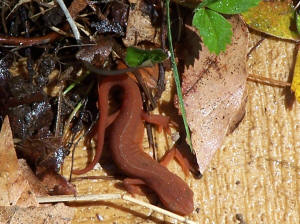
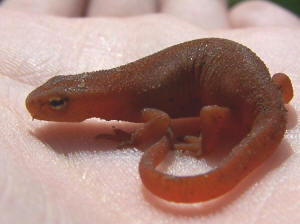
My newt, Todd, isn't moving a lot..
5/16/12
(see picture above) This is Todd. I found him yesterday under a rock
with two red lined salamanders.. I LOVE salamanders and newts! And Todd
looked so cute, I made him a little home, and I put some worms in there;
along
with a few frog eggs. *Only 2 dead frog eggs* Well, Todd doesn't move
much, and I never see him eat. Can you give me some help?
<Does look like Notophthalmus viridescens. Needs warmish (room
temperature) conditions, mostly water, with somewhere they can crawl out
onto the land (something similar to a terrapin or turtles habitat, a
10-gallon tank being
fine for 1-3 specimens, but don't use anything smaller than that). Do
need a good filter to keep the water clean! Feeds extensively in the
water: daphnia and bloodworms are favourites. May be stressed
immediately after capture. Will settle down, and can do well in
captivity given proper care and forethought. Do research captive needs
of Notophthalmus viridescens online and in books. Cheers, Neale.>
|
 |
|
Re: My newt, Todd, isn't moving a lot..
5/17/12
Alright! Thanks so much!
<Welcome.>
I'll fix his little home and see if he likes it.
<Real good.>
If not, I'll let him go.
<Remember: don't let him back into the wild if he's spent any time in a tank
with pet amphibians or fish. That's how diseases of domesticated animals
gets into the wilderness, and can cause massive harm. If in doubt, discuss
with your local park ranger or Fish & Wildlife bureau. Cheers,
Neale.>
Re: My newt, Todd, isn't moving a lot..
5/30/12
Um, Hi. So, I was checking on Todd today; and I have been feeding him
worms, and frog eggs, and such; and I noticed that he's really skinny.
Plus, he's moving around more now than he was when I took those
pictures.
Is he okay?
<Probably not. He's clearly starving. What you're offering him isn't
being eaten in sufficient quantity. Read through my previous e-mails on
what these Newts require to stay healthy. A good, clean aquarium of
adequate size, filtration, the right temperature, and a variety of live
or frozen foods. Quantity isn't a substitute for quality, so be sure
that what you offer is eaten, and remove anything that isn't eaten
after, say, 10 minutes. Clearly this beast is on the way to an early
death, and something you're doing (or not doing) is to blame. Review,
and act accordingly.
Cheers, Neale.>
Re: My newt, Todd, isn't moving a lot.. – 5/30/12
So, I checked his water,
<Meaning what… I do need numbers to say anything helpful. Otherwise
we're just chatting...>
and I gave him some more food out for him. He also has ate two tadpoles
since I last emailed you. I'll keep an eye on him.
<Feeding him tadpoles isn't a very good idea. If you think about it,
it's more likely he'll catch a parasite or disease from another
amphibian than any other kind of animal. Look for safer, better foods as
quickly as you can. Cheers, Neale.>
Re: My newt, Todd, isn't moving a lot..
He eat a few bloodworm as well. And I will recheck the water when I get
home.
<Ok. BobF>
|
Fire Bellied Newt 2/20/12
Hey, my name is Jack, just recently within the last week, I've
bought 2 fire bellied newts, good and healthy in the shop, still acting
good and healthy, but the larger one (i assume it's an older
female), has white patches on it's skin, they appear to
look like air pockets under the skin.
<Not good.>
I'm not sure what they could be and/or what they mean,
<Bacterial infection.>
i browsed through some of the forums, found nothing about it...? The
container consists of a water heater, set at 18 degrees, an air sponge
filtration system, a piece of Bogwood and dull coloured gravel. Any
ideas what it could be? please get back a.s.a.p. worried about her :(,
oh and you can only notice the patches whilst she's
underwater...Thank you very much
:)
<How big is the aquarium? What's the water quality like? (A
nitrite test kit result, at minimum, not something like "oh,
it's good" as that tells me nothing at all.) There's a
pretty good visual guide to Xenopus disease here:
http://www.xenopus.com/disease.htm
While your newt isn't the same species at all, the typical diseases
are common to both species. Cheers, Neale.>
Salamander young fdg.,
care 2/1/12
Hi I'm Blake.
<Hello Blake.>
A few days ago i was at my friends house and we were in the woods and
we found some salamander/newt larvae in a pond.
I decided to take some home. I put them into a 10 gallon tank.
There's an aeration system and some live plants in there and about
5 inches of water.
<You will also need a biological filter. Without this, these animals
will soon die. Also get a nitrite test kit. If you can't do either
of these things, return them -- these animals are doomed without at
least a minimum level of basic care.>
The thing is what should i feed them?
<Small live foods; daphnia, for example. But nothing at all until
the biological filter has been running at least two weeks.>
They are really tiny and only have front legs and gills. They are about
an inch long.
Thank you!
<No problems. Cheers, Neale.>
ID
And one other thing, How can i tell that type of newt/ salamander they
are?
<Consult a book on local amphibians. No idea where you live, so
can't suggest anything. Here in England, the most common newt seems
to be the Palmate Newt. Elsewhere, you'll need to do your own
research.>
Or do i just have to wait?
<Could well be. Cheers, Neale.>
Re Salamander young ID 2/1/12
I live in Columbia Illinois. Monroe county.
<Well there you go. You'll need to find a local naturalist or
herpetologist who can help you out. And when you do, don't forget
to say 'thank you'!
Cheers, Neale.>
Re: Re: Re: re: 2/1/12
Believe me i wont.
Thank you for everything! You guys are great help!
<Most welcome. Have fun with your Newts! Cheers,
Neale.>
Re: Re: Re: Re: re: Salamanders... What WWM is
not 2/2/12
I will!
But can they live 2 weeks without food?
<Yes. It's more important you get the biological filter up and
running for a week at least before you start feeding. And for the first
3-4 weeks of the biological filter running, feed only very small
amounts every couple days.>
Or do they just eat the stuff of the bottom in the gravel?
<No, they don't "scavenge". They really do need small
live foods, and as they get bigger, then appropriate wet-frozen foods
such as brine shrimp and bloodworms. Adults will eat earthworms and the
like. Generally, wild-caught Newts and Salamanders don't take
freeze-dried, flake or pellet foods.
Cheers, Neale.>
Re: Re: Re: Re: Re: re: 2/2/12
Thank you!
I'm going to get the filter tonight and do you have to buy the
blood worms or brine shrimp online? Or can you buy them at pet
stores?
<Wet-frozen bloodworms and brine shrimp are sold in pet stores.
Because they're frozen, they aren't easy to send by post. Do
understand freeze-dried foods are very different, they're stored at
room temperature,
but probably won't be eaten by wild Newts. Cheers,
Neale.>
Re: Re: Re: Re: re: Salamanders... 02/08/12
They all died :(
<Too bad. Do please review my previous e-mails about the need for a
mature biological filter and a live-food diet of appropriate size.
Newts rarely die for no reason! Starvation, environmental stress are
the likely issues here. Cheers, Neale.>
Re: Re: Re: Re: Re: re: tadpoles
2/9/12
I think it was bcuz the food was not live.
<Indeed. I think what we're interested here in WWM is less
discussion and more correction. So next time you keep Newts, remember
what I said, and keep them accordingly. Maybe get a tank cycled ahead
of time, kept mature
by adding a few large pond snails, and so having a ready aquarium for
them when you next find some tadpoles.
Cheers, Neale.>
Re: Re: Re: Re: Re: re: 2/9/12
I think it was bcuz the food was not live.
<Indeed. I think what we're interested here in WWM is less
discussion and more correction. So next time you keep Newts, remember
what I said, and keep them accordingly. Maybe get a tank cycled ahead
of time, kept mature
by adding a few large pond snails, and so having a ready aquarium for
them when you next find some tadpoles.
Cheers, Neale.>
Hi, do you recommend feeding marbled salamander larvae with only front
legs guppy fry? 2/20/12
The guppy fry is about 5 days old and is really tiny.
<Won't do any harm, but why? What's the point using a live
food you can't provide in the long term? Without wanting to start
another running commentary on keeping amphibians, it is VERY important
you establish a safe, inexpensive supply of foods suitable to your
species. For very small salamanders, that may well be things like
Daphnia, glassworms and mosquito
larvae. Secure those foods first, then buy your pet amphibian.
Don't do it the other way around or you'll end up with another
starved-to-death amphibian. Cheers, Neale.>
Salamander vomiting up its own throat.
Help!!! 1/4/12
Hello,
<Kyle,>
I possess a morbidly obese yellow spotted salamander (Ambystoma
maculatum).
<Hmm�� unusual for amphibians to become "obese"
as such; do wonder if there is some other, metabolic, problem at
fault.>
He is extremely large, at about eight inches long and three inches wide
at this bloated belly.
<Does he feel heavy, or is the bloating soft or watery? In other
words, does he feel like he's far (solid) or more like he's got
oedema (soft, as if filled with fluid)? Oedema, or "dropsy",
is something that is not uncommonly reported among captive Ambystoma.
It is most often caused by a systemic bacteria infection, though poor
diet can be part of the problem. Treatment will be by antibiotics,
ideally injected, and obviously this requires a trip to the
vet.>
I have been trying to get him to lose weight over the last five months
or so with NO success. Anyways, the other day I woke up to find out
that he had literally vomited up his esophagus! I thought he was going
to die so I took him all around town to different clinics and no one
had any idea what to do.
<You mean veterinarian clinics? Finding one that treats amphibians
isn't easy, to be sure. But there are some. You may get useful help
here by contacting one of the herpetological clubs in your country.
Even a national forum may be worthwhile. Here in the UK, The Amphibian
Forum is pretty good:
http://www.theamphibian.co.uk/amphibian_forum.htm
If you live someplace else, a little time searching for a national club
or forum could pay dividends here. If all else fails, universities with
herpetological departments may be of help in tracking down suitable
vets.>
I felt I had to act fast or lose him, so finally I bit the bullet and
shoved his throat back down his mouth. When he figured out what I was
doing he stopped struggling and actually swallowed his throat back
down. He is looking almost normal today, and seems to be breathing much
easier. His throat is still slightly swollen though, and I worry that
this may be a symptom of a much bigger problem.
<Yes!>
I apologise if this isn't clear, I find it hard to explain. Any
help would be greatly appreciated. I am very worried that he isn't
going to make it. Also, if he turns out to be OK, how do I get him to
lose weight?! I'm driving myself crazy!
<Would take this chap to a vet. Do strongly believe that obesity
isn't the issue here.>
With great respect,
-Kyle
<Hope this helps. Neale.>
Re: Salamander vomiting up its own throat. Help!!!
1/4/12
Neale,
<Kyle,>
I left out something critical! He used to be one of my coworkers pets,
and he actually used to be slim with no sign of illness.
<Oh?>
She unknowingly put the then skinny salamander in with her green
anoles.
<Doesn't sound ideal��>
The reason he is so large is that he ate three green anoles in one
sitting!
<Ah��>
The problem is that he is not losing the weight. Just wondering if that
will give you a better idea of what I'm dealing with.
<Well, if he's eaten three lizards, then he'll get thinner
once he passes out the faeces. In reality, that shouldn't take
long. Salamanders have simple digestive tracts that don't retain
food for long, though body temperature will affect that, and if the
Salamander is cold, food can "sit" in the gut for a long
time. Is the vivarium warmed? Ambystoma spp. are happiest at
subtropical temperatures, around 18-20 C/64-68 F, and that applies to
both air and water temperature.>
I will be sure to get him to a vet as soon as I can find one... And
have you ever heard of a salamander throwing up his insides?
<No, and I doubt that he is "vomiting" his digestive tract
up. For a start, only the oesophagus could come up through the mouth,
as below that is the stomach, and I assume you haven't seen that!
So, we might be seeing some sort of prolapse with the oesophagus coming
upwards through the mouth. A prolapse is usually caused by bacterial
infection, and with fish at least, a combination of Epsom salt (1
tablespoon per 5 gallons) together with antibiotics can work
wonders.>
The part of me that isn't worried is extremely curious. Thank you
very much.
-Kyle
<Hope this helps, Neale.>
Fire Belly Newt bloating 12/13/11
Hello.
<Hello Jane,>
I have a 32 year old firebelly newt.
<Cripes! A veritable Methuselah among newts.>
We went on a vacation about 4 months ago and left him (Jimmy) under the
care of a houseguest. When we returned he was quite bloated.
<Oh dear. The thing is, with cold-blooded animals like newts,
lizards and fish, you're almost always better off NOT feeding at
all. These animals can go weeks, months without food and not come to
harm. But inexperienced carers make the mistake of overfeeding, and too
much food is far more likely to cause problems.>
We had only been gone one week. I assumed he was overfed so cut back on
his feeding.
<Yes.>
He only eats ReptoMin pellets- and has his whole life.
<Okay.>
He lives alone in a filtered water aquarium. Rocks, wood and plastic
plants.
His swelling went down a bit for about one month, but now it has
reappeared and is worsening, slowly, over the past 2 months.
<Not good, but clearly not immediately lethal either. So there's
some room for optimism.>
I handle him and he feels just like a tiny water balloon.
<Soft and jellyfish, rather than firm? So like he's holding
water rather than full of solid faeces or something? Does sound like
some type of oedema as opposed to constipation. Oedema is difficult to
treat directly.>
His head and legs are all normal, just the area between all fours is
swollen. It is clearly fluid retention, but some sites say it
could be from starvation, which I assure you does not happen here.
<And is very unlikely anyway, given you know how/what to feed
him.>
(He has been on the same feeding schedule for 32 years.) And some sites
say it could be kidney failure, or bacterial disease.
<Quite so, or a combination. Overfeeding itself isn't likely to
cause either of these problems. But too much food in the water,
rotting, could have messed up water quality so badly a secondary
infection kicked in. Or else, the wrong food might have been used, and
exposed the newt to some type of nutritional problem. Really hard to
say.>
How do I know what to do?
<I'm not sure you can. A vet is really the only person who can
offer objective assistance here. In the short term, Epsom salt as per
aquarium fish may help reduce bloating, see here:
http://www.wetwebmedia.com/fwsubwebindex/SaltUseFWArtNeale.htm
But there's something called Amphibian Ringers Solution that's
used to treat amphibians. Because amphibians don't have a
watertight skin, if placed in a slightly saline environment, water
oozes through their skin into the water around them. You can't do
this for too long, half an hour is about the most, but it can work. It
won't fix the underlying problem -- that will require antibiotics,
e.g., a Maracyn 1 and Maracyn 2 combination -- but it can lessen the
symptoms, making life easier for the newt. There's a recipe
here:
http://www.caudata.org/cc/articles/bloatEDK.shtml
I've never tried this myself, and I'd urge you to get in touch
with the folks on this amphibian forum before tying it out yourself.
Better yet would be finding a vet who knows how to treat newts, and
have them take care of the newt for you.>
I tried to hand feed him to see if he would eat, but he did not.
<No, and don't try.>
He is acting normal in every other way, although not as mobile as he
once was. He is not floating or flipping as suggested by other
diseases. I am nervous to take him to a vet who most likely will
not know what to do and might stress him further.
<Understandable, but if the newt isn't getting better, you
mightn't have much choice.>
He has been in the same habitat for over 20 years now, and has not had
water "changes" like for a fish tank, but rather water added
on a regular basis to maintain volume.
<Ah, now, this isn't ideal. Do remember, water evaporates, but
salts are left behind. So each time you top up with water, you add more
salts as well, Over the years, the water chemistry could become quite
weird.
Conversely, if you only ever used distilled or RO water, the lack of
any sort of minerals at all could mess up his kidneys too.>
His home has never been moved, ever, and he has thrived for all these
years. I am quite nervous that he is seriously ill and I might lose
him. He is part of our family. If he were your fellow, what would you
really do to try and help him? Please, any suggestions will be
greatly appreciated.
Thanks- Jane
and Jimmy
<Hope this helps, Neale.>
Obese Salamander Over Winter
11/14/11
Hello Crew!
<Kyle,>
I have been caring for a very obese yellow spotted salamander
for some time.
<Ambystoma maculatum, I take it?>
I live in Michigan, and the salamander's previous owner attempted
to put it
in the same tank with green anoles. To her surprise, the
salamander ate THREE juvenile anoles in one
sitting!
<Uh, yeah, these animals can, will eat anything they can swallow.
Plus, given these salamanders are cold-climate animals, and the Anoles
are warm-climate animals, one or other would have been kept in the
wrong conditions. Assuming that this vivarium was at room temperature,
the Anoles would be stressed from lack of warmth and moving about
slowly, so they'd have been easy targets. Conversely, in tropical
conditions the salamander would have been ravenously hungry because
it's metabolism would be operating MUCH faster than normal. Either
way, a bad combination of species.>
She did not have that salamander long before she offered it to me.
Seeing as it was wild caught in the first place, I have kept it in a
very large egress window well with a large water dish for the past
summer to watch over it while it recovers while still giving it as
large and natural of an environment as possible.
<Well, the main things are space, humidity, cool temperatures, and
no direct sunlight. They're actually reasonably easy to keep, by
the standards of terrestrial salamanders at least.>
Now though, winter is approaching and I don't want to turn the
Salamander into a Popsicle!
<Unlikely to be an issue. So long as the vivarium is more or less at
low room temperature, down to about 10 C/50 F, they'll be fine in
winter. Keep them frost free, obviously, but otherwise don't worry
too much. It's entirely normal for them to eat very little in
winter, so feed sparingly, removing anything that isn't consumed
quickly.>
The window well has about four inches of sand in places, and has a
liberal amount of leaf litter on top of everything.
<Would probably skip the sand in favour of something that holds
humidity better, such as coconut fibre. Plus, coconut fibre is
super-cheap, extremely convenient to buy in solid blocks, and can be
cleaned out as soon as it gets dirty, e.g., weekly. Sand is abrasive
and does little to hold moisture, which are two bad things when keeping
salamanders!>
Will the salamander be able to overwinter in these conditions?
<Yes, given the above caveats.>
I know that he is a local species but I don't know how deep they
make their burrows.
<No need if the vivarium is frost-free. Simply provide some sort of
shelter, like an inverted half-coconut shell with a "mouse
hole" opening he can crawl in and out of. There are also lots of
nice cork and plastic burrows and caves sold in pet stores. Any of
these will be fine. What he really wants is a cool, shady, damp place
to rest. Not wet, because that encourages fungal infections, but damp,
like you'd see under a flowerpot in the garden.>
Also, if he can survive outside in these conditions, will his fatness
have an effect on his chances of surviving?
<Don't release him into the wild. Chances are he'll be eaten
by the first predator he encounters. Plus, after being kept with
Anoles, he's likely been exposed to infections and parasites that
might not harm him but could harm wild animals. Either keep, rehome
through a pet store/herpetology club, or euthanise (discuss with a vet
first).>
Ever since I got him he rarely burrows.
<Which is good! This species does well in captivity and unlike many
other amphibians loses its shyness.>
He just lays around. =P I am fully willing to change his environment to
help him overwinter, and I am also willing to bring him inside if I
have to.
<Yes, do so. Without a deep burrow, which you can't really
provide in an enclosure, he'll freeze. You must keep this animal
indoors, even in a frost-free basement or garage.>
I would just prefer to not have to set up yet ANOTHER tank if I can
avoid it haha.
<I see. Well, he will need a vivarium around the 10 to 15 gallon
mark, but other than that, these aren't difficult beasts. Don't
need lighting or UV-B, don't need heating, and don't need
anything fancy in their tank beyond coconut fibre (or moss) and a
couple of suitable caves or hollow ornaments. Spray periodically with a
mister to keep the humidity up, secure with a hood or pane of glass to
stop him escaping, and that's it!>
Thank you for your time and efforts.
-Kyle
<Cheers, Neale.>
Identification
Salamander ID 10/13/11
Last night we found an interesting animal that may be a snake or
worm....it was shiny black looked like a worm but has 4 small
legs...can you identify this for us?
Thank you Denise A Zeo
< Can't be a snake or a worm if it has legs. Chances are it is a
slender salamander. Do a Google image search on slender salamander and
see if it comes up.-Chuck>
Minewt... turtle incomp.,
hlth. 10/1/11
Hello,
I'm slightly worried. My brother gave me his Chinese Fire
Bellied Newt
<Cynops
orientalis��>
three days ago. I'm not sure how long he had it, I don't think
very long. Minewt, that's my newts name.... get it?
<Yes.>
I know lame, anyways his arm was kinda nipped by my brother's
turtle and my brother said he will be fine because it will grow
back.
<Turtles and Newts should not be kept together.>
My questions are how long does it usually take for his arm to grow
back?
<Varies greatly from species to species, and not all species can
regrow limbs. Won't happen at all if conditions aren't
healthy.
http://www.caudata.org/cc/articles/series_limb1.shtml
But in good conditions, should grow back in a couple of months.>
His arm wasn't completely bitten off its still kind of
attached.
<Potential for secondary infection is very high without a clean cut.
A vet can help you out here, or else a trained animal health
professional, e.g., at an animal rescue place, or perhaps even the
zoology department of a university.>
And also, I don't think he is eating either,
<Won't happen then.>
my brother told me he eats pellets and gave me the pellets he had, is
that because Minewt is in a new tank?
<They don't eat pellets. Wet-frozen krill and bloodworms would
make good foods, or live earthworms small enough for the newt to
swallow.>
Or is because of his arm?
<If infected, yes.>
Some more information, Minewt hardly ever moves, he is in the same spot
like all day; when he was in my brothers tank it was filtered and had a
turtle and two fish in it. Is Minewt lonely?
<No.>
Or just in shock with the new environment still?
<Environment may well be unhealthy. Animals settle into a new tank
within a few days, certainly less than a week. For this species, there
is an excellent care sheet here:
http://www.theamphibian.co.uk/Fire-Bellied_newt_caresheet.htm
Note the importance of a tank of suitable size, a filter, regular water
changes (with water conditioner) and the right diet.>
I have Minewt in just a basic starter kit kind of tank. He has a piece
of bark to be on and sleep under because I read the like to sleep under
stuff. He has half water half gravel and the water is de-chlorinated
and the temperature is at about 70 degrees, he is not in direct
sunlight, or near anything that radiates heat. Am I worrying about
nothing?
<Does sound like care isn't quite right here. Read on their
needs, and act accordingly.>
Sorry just don't want him to die.
Any information would be great :)
Thank you,
CattRose
Oh also how can I tell the gender? Hahaha
<Mature males are brightly coloured during spring. Rest of the time
they're very similar. Cheers, Neale.>
Fire Bellied Newt Question 5/12/10
Am wondering if I have a newt that may possibly have some or fungal
infection
<Certainly possible. Indeed, not uncommon if water quality isn't
good.>
A couple days ago I noticed one of my newts has several reddish spots
on the back of its body. None of the others have this.
<Ah, now this is fairly worrying. Amphibians are very prone to what
would be called Finrot on fish, but tends to get called Red Leg in
amphibians. It starts off with sore patches of the skin, then an
infection sets in, and the frog or newt eventually dies if left
untreated.>
Do you think this is something I should be concerned about?
<Yes!>
I can send a photo if you wish to see it.
<Sure thing. But I'm fairly sure this is what we might call Red
Leg, and a trip to your local pet reptile/amphibian specialist store,
or your vet, should result in the necessary antibiotics, e.g.,
tetracycline. There is a viral form of Red Leg that is basically
untreatable, but it isn't common among pet amphibians and usually
the problem is bacterial. As with fish, things like Aeromonas and
Pseudomonas are responsible, and the triggering factors are either poor
water quality, physical damage, or both. Speed is of the essence here!
Without immediate treatment, amphibians with Red Leg quickly reach an
irreversible point from which death is inevitable. Also review the
conditions in the vivarium. Is there enough space? Appropriate
humidity? The right temperature? Filtration? Use of water conditioner?
Stocking density? Diet?>
Brandie
<Cheers, Neale.>
Re: Fire Bellied Newt Question 5/14/10
thanks for the information.
<You're welcome.>
But by the time I read this email it was too late for my newt :( Just
hope none of the others get it.
<Hope has nothing to do with. Red-leg is usually caused by the
environment, so reflect on how you're keeping these newts, in the
knowledge that something isn't right. Identify the potential
problems, fix them, and your remaining livestock should be fine. If the
tank was overstocked or underfiltered, the death of one of the newts
may well mean conditions improve for the remaining animals. Be
thoughtful of that fact before you rush out to buy a
replacement.>
Brandie
<Cheers, Neale.>
Eastern Newts, hlth. 3/6/10
First of all great website, I've been dying to find out what's
wrong with my pet newt.
I've had this eastern newt since she was a red eft about 15 yrs and
her eyes are disappearing, first it was one and yrs later the other is
slowly going away, what is causing this, I started giving her pellets
years back could it be that? it says they can grow limbs back but so
far nothing, is it old age? she's a fighter, she almost died
several times but fought hard and is a survivor.
Can anyone please help
Sincerely,
Robert
<Robert, 15 years is a good age for Notophthalmus viridescens, so
old age may be part of the problem. As animals age, their immune
systems do tend to worsen, and they become more sensitive to
environmental problems. So far as things to check go, as always, a good
place to start is a review of water quality. When both eyes become
infected, that's usually a sign of poor water quality, with the
cornea becoming cloudy and eventually the eye swelling outwards as
fluid collects behind the eyeball. Because Notophthalmus viridescens
spends so much time in the water, it is particularly sensitive to
non-zero ammonia and nitrite levels. Eyes won't grow back,
unfortunately. Good quality pellets should provide an adequate diet,
though I'm someone who does recommend a varied died, admittedly
with pellets as the core, but with suitable live foods as well.
Earthworms, small crickets, waxworms and so on are good for this
species. Cheers, Neale.>
Re: Eastern Newts 3/7/10
Thank you for your help
<No problem.>
Her eyes didn't get cloudy or swollen or infected, but actually got
smaller and smaller over time until they were gone
<That's odd. Could indeed be either metabolic (i.e., a dietary
thing) or an infection of some type.>
I use always bottled water, she has never been in tap water, so I was
thinking maybe she is missing a mineral or something in her diet
<I'm not sure salamanders get anything directly from the water
in terms of calcium or whatever, though that's a branch of their
biology I'm sure we're generally ignorant about. Bottled hard,
basic water (i.e., mineral water rather than distilled water) is
generally fine, though expensive, and if that means you scrimp on water
changes, I'd always recommend going with tap water (not softened
tap water) rather than anything else. Salamanders will adapt to hard,
basic tap water just fine, though you do of course need to add suitable
water conditioner.>
And I give her frozen bloodworms once in a while, with the pellets as
the staple It must be the water somehow, maybe I should clean it more
than once a week
<Bloodworms are always popular, but they aren't especially
nutritious.
Earthworms are better because they contain soil, and the soil is
(obviously!) mineral rich. Failing that, running two or three different
blister packs of wet frozen foods at a time is a good workaround,
perhaps bloodworms, krill and fortified brine shrimp. Between them,
these would make a good supplement to good quality pellet
foods.>
Thank you for your help and if you ever hear of anything please let me
know
You guys do a great service
Thanks
R.F.
<Glad to help, and thanks for the kind words. Cheers, Neale.>
My new fish :D Molly, Angelfish, Newt
incomp. 1/31/2010
Hi There!
My name is Libby.
<Hello Libby,>
I have owned and operated my own fish tanks for about 12yrs now. I just
got a couple of freshwater angelfish today and I also picked up a
couple of Marble Lyretail (sp?) Mollies.
<Not an ideal combination. Although Mollies sometimes do okay in
plain freshwater, they are more reliably in slightly brackish water.
Angels, on the other hand, are soft water fish, and while they'll
live in hard water, they won't tolerate brackish water. In other
words, these are two types of fish you'd be unwise to mix. Do read
here:
http://www.wetwebmedia.com/FWSubWebIndex/mollies.htm
>
I'm in the process of floating them in their tank (which are two
separate tanks I'm working with). One tank I have is about 10g and
is currently housing a Paddle Tail newt (Sally) whom I have had for
about 6yrs.
<Well, these are coldwater amphibians, and have no business living
with tropical fish.>
My other tank which is about 5g is currently empty, and is temporary
housing for my Angelfish until I set up my 30g tank. I was originally
planning on introducing my Mollies in with Sally.
<Nope. Optimal water temperature for your newt, Pachytriton
labiatus, is 15 degrees C; Mollies and Angels are both hothouse flowers
that need temperatures above even those of the average tropical fish,
and are best kept at 28 degree C or even slightly higher. There's
no overlap here at all.>
Sally has lived with many other fish in the past and only gets
aggressive if she gets bothered first. Other than eating old, dying
fish, I have never been concerned with her attacking and killing my
other little buddies. She's even been homed with Tetra's before
and never harmed them.
<You really are keeping your newt far too warm. Do please review the
needs of this species. Your newt will have a much shorter life kept too
warm.>
I've had Sally with Mollies before, but I'm wondering if I
would honestly just be better off with introducing my Mollies to my
Angelfish. My only concern is if they would get along okay. I've
never owned Angelfish before, but am very prepared for the road ahead
of me.
<Farmed Angels, which is what I assume you have, are quite
straightforward fish. Do read here:
http://www.wetwebmedia.com/FWsubwebindex/fwangelfishes.htm
>
I would really like to have them together, but I'm wondering if the
Mollies would be too aggressive with my Angels?
<They're a bad combination because of differing water chemistry
requirements. In terms of behaviour, they should ignore one another,
but both species have the potential to be aggressive, occasionally
cause major problems in community tanks.>
Is this something I can accomplish? Should I just play it safe and keep
my Mollies in Sally's tank? Gosh, I have so many other questions I
don't know where to begin, but I guess this will do for now :). I
hope to hear from you soon!
Thanks!
Libby
<Time to do some reading, I fear. Hope this helps, Neale.>
Axolotl not well 12/16/2009
Hi
<Hello Dani,>
Love your website is great!!!
<Thanks>
Please help me I have 2 axolotl's one golden with pink gills and
one is black. The golden one has begun to look sunburnt and has what
appears to be blisters or peeling skin?
<On the whole Axolotls are very hardy, but poor water quality can
cause them to become sick. Check the ammonia and/or nitrite levels.
These should be zero. If they're not, then think about why
that's the case. Make sure you aren't feeding them too much,
that the biological filter is appropriately sized for the tank and the
size of the animals, and that the tank is big enough for the two
Axolotls. A good filter to use for Axolotls is the old fashioned
undergravel filter. So long as the gravel on top of the filter plate is
5-8 cm deep, and there is a good strong water current, this should
provide a low maintenance filtration system that works well. To keep
clean, simply stir the gravel once a week and siphon away the
dirt.>
I have gone to extremes and did a complete water change but I checked
the water before emptying and the PH wasn't too high. We live in
Rural Qld in Australia and temperature gets up to around 33 - 39c on
any given day.
<These are coldwater animals, and anything above 25 C is going to
stress them. Direct sunlight will also harm them, especially the albino
specimen.>
I have them in a cool corner where there is no sun. I am getting very
worried as the golden one hardly ever eats the black one lets me hand
feed him any food bloodworms or pellets but the golden one just waits
for it to drop to bottom, he sometimes will look for it and swallow it,
(I have changed to big rocks as had a problem when the golden one ate
gravel he had a blue belly)
<Gravel doesn't normally cause problems.>
I have tried a few different filters but the pet shop here is only
small and is hard to find what I really need for them. How full should
you have the tank?
<Almost to top, but leaving enough space that they can poke their
noses out of the water should they want to. The water should be at
least 30 cm deep, but deeper water than that is even better. A good
aquarium for them would 75-100 cm long and 30-45 cm deep and broad. In
smaller tanks they tend to fight, biting at one another's gills and
feet. Bullying will prevent the weaker specimen from eating properly.
They are best kept singly or in matched pairs; males have a swollen
cloaca at the base of the tail, while females tend to have shorter and
broader heads.>
The pet shop only had them in shallow water? Would they prefer
that?
<No.>
There names are doodle and noodle and they are my little boys pride and
joy please help, we do love the little critters and are hoping that
they will be ok.
Thanks for all your help.
<Hope this helps. Cheers, Neale.>
Re: Axolotl not well 12/17/09
Hi
Thanks so much for speedy response, am on net now and trying to order
online a new filter as my local pet shop doesn't have a big range
and thinking they might not know a lot about axolotls...
<Maybe so. There are some good, cheap books out there about Axolotls
and amphibians in general. One I happen to like is called "Keeping
Amphibians" by Andrew Gray. It's a very easy read, but with
lots of very practical
information as well as activities and facts that will expand your
hobby.>
Again thank you have bought more tests kits today so hoping can keep
water ok for them.
<Good luck. Cheers, Neale.>
Re: Axolotl not well 12/18/09
Hi Neale
I am devastated my albino axolotl (doodle) just passed away. Will my
other axolotl (noodle) die too? Am very worried checked water and all
levels are neutral so they say? I can't believe noodle was laying
on doodle
protecting him was very upsetting.
Danielle
<Hello Danielle. I'm sorry to hear about this. It's always
sad when a loved pet dies. I would certainly do a 50% water change just
to be on the safe side, and I'd double check that there aren't
any potential sources of poison in or around the tank (e.g., insect
sprays, paint fumes, careless children dropping things into the tank).
But assuming conditions are good for Axolotls, there's no reason
why the healthy specimen should sicken and die. Just to recap,
we're looking for 0 ammonia, 0 nitrite, a pH around 7.5, water that
is "moderately hard" to "hard" (i.e., 10+ degrees
dH), and a temperature between 15-25 degrees C. Bad things for Axolotls
include very warm water, soft water, acidic water, and water that
hasn't been dechlorinated. If you can, use a dechlorinator that
doesn't just remove chlorine but also chloramine, ammonia, and
copper, since all of these things can occur in some tap water supplies.
A good tip is to test the pH of some water the moment it is put in a
glass, and then again 24 hours
later. If the pH is about the same, that's good. But if the pH is
very different, that can imply you have unstable water chemistry. This
sometimes happens with water from wells. You'll need to leave such
water for 24 hours before use, and ideally add some Rift Valley cichlid
salt mix at about 50% the dose needed for cichlids. Note that this
isn't "salt" salt, but a mix of minerals that raises the
pH and stabilises the hardness levels.
http://www.wetwebmedia.com/FWsubwebindex/fwh2oquality.htm
Cheers, Neale.>
Fire belly newt acting weird 11/25/09
hello, Jake here
<& Bob here>
I bought 2 fire belly newts a week ago, one small, and the other is a
little bigger. anyways the bigger one is I think is doing ok. the small
one is the one that I'm worried about. I looked in the tank today
and the small one was on the leaf, I watched him for a little, I
noticed he moves really really slow( twitching like) does not walk. he
didn't use his hands or feet just kind of acting like a snake would
crawl. then he curled up, I think he used his tail more then is
ligaments on the dry area. my tank is water and land based with a water
filter. I feed them live bloodworms. help . what do u think is the
problem?? is there anything I can do??
<Mmm, can't tell from what you've written here Jake. And the
fact that one of the two seems fine usually rules out environmental
issues. Perhaps if you read here:
http://wetwebmedia.com/FWSubWebIndex/amphibdisfaqs.htm
and the linked FAQs files above (in blue), "something"
important will occur to you. Bob Fenner>
Question about two tiger salamanders... sys.,
comp. 9/27/09
Hello,
I have two tiger salamanders, a female and male, Now I they are in a 80
gal tank and we are making them a terrarium.
<These are semi-aquatic amphibians, and swimming space with clean,
filtered water is rather important.>
I was wondering what type of plants can I put in there with them.
<Underwater, most any aquatic plant would work, though I'd
recommend something simple, like floating Indian Fern, that won't
get in the way when you're filtering or changing the water. A Java
fern or Anubias on a piece
of bogwood would also be easy, since such epiphytes don't require a
substrate. On the land side, since these amphibians burrow, the
standard recommendation is to use moss for the substrate, and then a
couple of cork
half-cylinders. Together this will recreate the leaf litter environment
these salamanders enjoy, the cork representing the decaying tree trunks
and other hollows where the salamanders hide during the day.>
Like I said I have an 80 gallon tank so I have them room. I have a
large swimming area for them and a small drinking area. They are very
smart animals, They know what water hole is for what.
<Hm...>
The female like to be in the water the most ( the larger one) the male
will go in the water but only for a little bit, he like to chill over
by the small water hole. They are a great joy to have. And they love
their home, but like I said just not sure what plants I can put in with
them. If anyone can help me out I would be very grateful.
<A few small potted plants with the (plastic) pots hidden in the
moss might be an option. Good houseplant choices would include things
like Acorus, Lobelia, Spathiphyllum and Syngonium. Almost any small
fern or epiphyte
would be an option as well. However, some of these plants need bright
light, and your Salamanders won't like that, and more
significantly, lights produce heat, and heat raises the temperature of
the vivarium if
ventilation isn't sufficient. Hot, dry air would be lethal. So
balance the various factors depending on your tank, and adjust the plan
accordingly.>
Thanks.
P.S I am in Madison Wisconsin USA. I know the state law is I can only
have three but I have no plans on getting more salamanders but does
anyone know what other amphibians I can put with the salamanders that
they will not eat or will not eat them.
<You can't. Tiger Salamanders (like other Ambystoma species) are
for single-species set-ups only: if they can swallow another animal,
they will. In captivity they are known to consume dead mice (pinkies)
so I wouldn't trust them with anything else.>
Thank again everyone!
Tim n Jordan
<Cheers, Neale.>
My possibly sick red-spotted eft... Newt
care �� 06/12/09
Hello! I found and kept a red spotted eft the other day while
hiking.
<You really shouldn't do this... there are plenty of neat
amphibians bred in captivity that are a lot easier to keep.>
I did a lot of research about habitat and diet, etc. Ended up putting
him in a 10 gallon tank with dirt and lots of plants. He also has a
water bowl. The problem is, I don't think he's been eating,
although its hard to
tell because his food moves around a lot :) I've tried meal worms,
baby crickets, and a newt pellet food.
<Pellet foods won't be taken, that much is certain. I'd
start with small earthworms; most amphibians find these very palatable.
Choose earthworms that are small enough to swallow whole, and
initially, the smaller the better. You could try holding the earthworms
with forceps in front of the newt to see if he goes for them. It's
also important to realise that they feed a good deal under water, so
rather than a water bowl, arrange the tank so it is two-thirds filled
with water, but with a land area above the waterline filled with moss
or coir (coconut fibre; cheap and easy to change when dirty). You can
get nice little plastic islands for terrapins/turtles that
"stick" onto the glass via suckers, and these are great way
to make land areas. Otherwise a pile of bogwood branches and/or rocks
will do the trick, though obviously you can't put moss or coir on
these because it'll just fall into the water and make a mess.
Anyway, the newt will happily eat
bloodworms, daphnia and other small live foods added to the water. Use
an air-powered sponge filter to prevent the water becoming dirty and
harming the newt, and change 25% per week, adding dechlorinated water
each time. Keep it cool, certainly no warmer than 20 C in summer, and a
good deal less in winter.>
Also, he looks kind of brownish instead of his normal bright orange and
he seems quite lethargic. Do you think he is sick and if so, what
should I do to help him? Thanks!
Lisa
<Cheers, Neale.>
Re: My possibly sick red-spotted eft ��
6/12/09
Ok, thanks for your help! I think I'm going to set him free so he
can be happier.
<Hmm... if he's come into contact with any ornamental fish, pet
newts, or any other aquatic animals, do not let this animal loose! If
the nets, buckets or anything you used were also used in an aquarium,
pond, or
vivarium, you mustn't release this animal. That's how diseases
and parasites of pet animals get into the wild. It's very important
not to be lazy and just let pet animals go free. So if you can't
honestly be sure this newt was isolated from all other aquatic pets,
then think before releasing the animal. If you can't keep it,
either consult your local Fish & Wildlife Bureau for advice, or if
they can't help, painlessly destroy the animal (a vet will provide
you with information on euthanising amphibians if you ask). And yes,
it's much easier for all concerned not to bring wild animals into
the home, however cute or attractive they might seem. Sorry to
make this all sound complicated, but there are a lot of irresponsible
people out there who have caused MAJOR damage to the environment by
thoughtlessly releasing pet animals or wild animals that have been kept
alongside pet animals. Please don't join their ranks! Cheers,
Neale.>
Re: My possibly sick red-spotted eft ��
6/12/09
True. I've never had any other fish, newts, amphibians, etc as
pets, though. And I bought the tank he's in new from the pet
store.
<Good, this all means you can release your newt with a clean
conscience!
Well done. Cheers, Neale.>
Red Spotted Newts
Newts Acting Hungry 06/03/09
Hi, my name is Nate, I can't seem to find the information I'm
looking for so I thought I'd ask a professional. here's the
question, how do you know when the newts are hungry and what they are
in the mood for eating? I hope you have the answer. please answer as
soon as you can.
< When a newt want something it is usually on the prowl to find it.
That means it will be very active in search of food. They usually eat
anything but start with some live food live black worms or small
earthworms will
really get him going.-Chuck>
Fire-bellied newt behaving oddly 05/20/09
Hi WWM,
<Hello,>
I am the owner of two Chinese fire-bellied newts and they've been
healthy/happy for the 4 years I've had them (got them from a pet
shop, not sure of their age). I fed them 2 days ago and feed them raw
meat (they won't eat anything else) ~1-2x a week.
<Not mammal or bird meat, I hope? These are very bad for cold
blooded animals: the lipids in mammals and birds that are liquid at our
body temperature can solidify at the lower body temperature of newts,
reptiles and so on not adapted to eating such fare. Over the long term,
these solid
lipids -- fats -- clog up things like blood vessels. Not good!>
I looked at them today and one looked all sunken into the rocks like he
was dead. Worried, I opened the tank and put him into my hand where
he
remained very still. His eyes were half-open (I didn't know they
could do that), his chest was flat on my hand and he looked dazed and
confused.
<Doesn't sound good; really, veterinarian help is what you need
here. We're fish people rather than newt people!>
Suddenly, he began to writhe in my hand and his back legs clamped
against his tail. I put him back into his tank where this continued for
20 seconds
or so...more writhing and tail lashing (the other guy ran away from
him!) Then, it stopped. He pushed up back to his normal stance and
walked around
a bit like nothing happened. He's now walking around only semi-ok
with his little elbows sometimes flexing backwards and his chin on the
ground so he can't move. What's going on?
<Not old age, anyway: these things live well over 10 years! So start
by reviewing basic conditions: things like water quality (0 ammonia, 0
nitrite) and temperature (cool, around 16-18 C ideal). Simply feeding
the same (inappropriate, if bird or mammal meat) food can lead to
obvious long term problems that manifest themselves in just the vague
sort of way you're describing; indeed, that's where I'd put
my money. A vet may be able to provide a vitamin shot, and certainly
offering a proper, varied diet will help the other one do well and may
turn the sickly one around too. Ideal foods including live earthworms,
live mosquito larvae and live bloodworms; frozen equivalents should be
taken, but forget about freeze-dried or pellet foods, not particularly
useful.>
Can newts have seizures?
<No.>
Thanks for any and all help!
Allison
<Cheers, Neale.>
Fire Belly Newt 3/27/2009
Hello.
<Hi.>
I put a lilac branch for the newts to climb on and now I have noticed a
clear slime growing on the branch.
<Is this within a few days? If so, most probably fungal decay.
Harmless in itself, but will be consuming oxygen and dumping ammonia
onto your filtration system. Generally, it isn't a good idea to add
fresh wood to an aquarium.>
I did some research and all I can find is a web page
http://waynesword.palomar.edu/slime1.htm
that has what looks like that type of slime. Listed on the page under
Slime Mold In A Fish Aquarium. Named plasmodium.
<Perhaps, but there is absolutely no way you can identify this
either way, unless you're a mycologist. All fungi look very
similar, once you realise the mushroom part is simply the fruiting body
and the fungus itself is the mass of white threads.>
I was looking at one of the newts mouths and noticed what looks like a
cut under the bottom lip. I am not sure how to treat this.
<Use an amphibian-safe anti-fungus medication.>
Can I use a anti fungus fish medication?
<If the package states clearly "Safe for use on
Amphibians". If not, don't use it. Amphibians differ from fish
in many ways, not least of all breathing through their skins, so some
chemicals harmless to fish can cause major problems for amphibians.
Your local amphibian/reptile specialist pet store should be able to
help; failing that, call a vet.>
I took out the branch and I think I will change the water to be safe.
Also, can I use salt treatments?
<Not with amphibians, no.>
After reading up on this slime on the web, I am worried about the
newts.
<The two things are not really related. The fungi that cause fungal
infections on fish and amphibians are ubiquitous to aquaria, being part
of the normal nitrogen cycle. How do you think fish faeces and uneaten
food is broken into the ammonia the bacteria use? Correct, it's
fungi that do that! So the saprotrophic fungi are there
already.>
Can you please help? Thanks.
<Cheers, Neale.>
Help, my pet axolotl wont eat. 12/07/08 <Oh?
Well, without a little more information, there's not much more I
can say than "too bad". So help yourself but reviewing the
environmental needs of these animals. Chances are, you're failing
on one or more of them, and consequently your Axolotl is sick. Axolotls
need clean, relatively cool water. The tank should certainly contain at
least 30 gallons of water and be equipped with some type of filter,
rated at not less than 6 times the volume of the tank in turnover per
hour. In other words, if the tank contains 30 gallons of water, the
filter should be rated at 6 x 30 = 180 gallons per hour. The tank and
filter need to be so big because these are potentially large and messy
animals. Keeping them in smaller tanks when young is possible but
really a bit stupid, because if healthy they grow quickly and will
either pollute the small tank (getting sick) or outgrow it so rapidly
you've wasted a bunch of money on a small tank and filter of no
further use. Next up, the water should be not too warm. Room
temperature is usually fine; anything around 15-20 C will do. Make sure
the tank isn't much warmer than this, and in particular take care
not to put the tank in direct sunlight or near a room heater, warm air
vent or whatever. Conversely, if the room gets very cold in winter,
adding a fish tank heater set to its minimum setting (typically 18 C)
should keep the water warm enough. It's a good idea to place a
heater guard (a plastic mesh) around the outside of the heater to
prevent burns; some heaters come with these anyway, otherwise buy one.
Just as with any fish, water quality is critical. Amphibians generally
are sensitive to ammonia and nitrite, and if the water isn't
filtered and regularly replaced (50% weekly) they develop a variety of
infections and diseases that are difficult and expensive to treat. So
check (at minimum) the nitrite concentration if you have a filter, and
if you've not yet installed a filter, check the ammonia instead.
Nitrite tells you how well (or not) a filter is working, while ammonia
tells you how poisonous the water is thanks to the waste the Axolotl
has produced. When feeding Axolotls, take care to offer a variety of
things, but sparingly. Don't overfeed, and don't use pellet
foods day in, day out. Pellets are fine a couple times a week, but vary
the diet with chopped seafood, earthworms, bloodworms, and so on.
Cheers, Neale.>
Re: help... Axolotl fdg. 12/9/08 my pet
axolotl (Wooper) has stopped eating, I fed him beef and sinking
pellets. He used to happily munch down both, now he barely even eats
his beef. Though he is metamorphosing, he is losing his gills and the
webbing on his tail. I wonder if the metamorphosis could be affecting
his eating. <Hmm... didn't I answer this question a day or two
ago? Do look here:
http://www.wetwebmedia.com/FWSubWebIndex/fwdailyfaqs.htm Look at the
question "help, my pet axolotl wont eat" and you'll see
some comments. In any case, Axolotls do not metamorphose under normal,
home aquarium conditions. If he is losing his gills and webbing, it is
MUCH more likely you are seeing Finrot. As the bacteria destroy the
skin, the gills and fin membranes erode. This is almost always caused
by either [a] poor water quality; or [b] aggression between
individuals, with poor water quality making things worse. Review water
quality ensuring that you have ZERO ammonia/nitrite levels and a steady
pH; check your filtration is adequate; ensure water temperature
isn't too high; and if anything doesn't seem right, then act
accordingly. Cheers, Neale.>
Red-belly Newt (RMF, any thoughts?) 9/8/08
Hi
My name is Bryan.
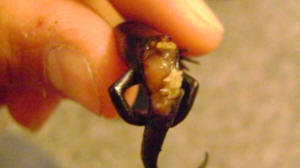
<Hello Bryan,>
I have a fire belly newt that has a rather large wound on it. it
started out as a sore actually I had 2 newts that each had a small
red sore on it's skin. so I quarantined both of them in
separate containers with dirt and some water I also applied a
triple antibiotic to there sores well after two weeks one of the
newts got better so I put him in the tank with the 2 others that
are healthy.
<Which antibiotic? Not all are safe with amphibians. It's
also absolutely critical to establish the source of the wound.
While I agree that the infection is likely a secondary bacterial
infection that should respond to antibiotics, amphibians are
notoriously sensitive to poor water conditions (ammonia, nitrite)
and if these are in the water, it's not going to
recover.>
(He seems to be doing fine now) but the other one seemed to have
gotten worse. At this moment he's been away from the others for
about 3 weeks now and he hasn't eaten though I have tried to
feed him. his sore however has seemed to have gotten huge. so huge
that his entire tail is falling off, I can see his spinal cord, and
his back legs seemed to have stopped working and now his tail is
becoming fuzzy. I haven't taken him to the vet as I don't
have the money.
<I hate to say this, but I'm not convinced this guy will
recover. Amphibians do indeed have amazing powers of regeneration,
but this looks just too far gone. I'd like to be proven wrong.
At his point you really don't have much option but to maintain
each Newt in its won clean container, with no substrate or anything
likely to collect germs or detritus. Filter using Zeolite to remove
the ammonia directly; an air-powered box filter will be fine for
this. Replace/recharge the Zeolite weekly. Do not feed the Newt!
I'd be using Maracyn (Erythromycin) in the water, and changing
75% the water weekly, re-dosing with Maracyn as required. Even with
all this said, because multiple Newts have become sick, I'm
really concerned that there's something environmental wrong
with your system. Do check pH stability, nitrite and ammonia.
I'd also be tempted to pick up the phone and call a
vet.>
I also have stopped applying the triple antibiotic, and started
applying a small amount of diluted hydrogen peroxide.
<Yowser!>
is there anything else I can do short of pray. he seems to be a
resilient little bugger, but I'm afraid that his next step is
death :(
<Would tend to concur with your gloomy prognosis, in which case
euthanasia may be kinder. Bear in mind the methods useful for
killing small fish are not necessarily appropriate for amphibians,
so again, consultation with a vet or other expert would be relevant
here.>
Help Please
<A bit out of my depth here, so have asked Bob Fenner to
comment/pass on to someone who might know better. Cheers,
Neale.>
I also attached a photo of his wound
<Ugh.> |
 |
Re: Red-belly Newt (RMF, any thoughts?)
9/8/08
Well thanks for trying. unfortunately he died today. I found him in
his container, not moving and his wound seemed to have been
decaying :(.
The other newts are fine. By the way it's not the water because
he was in his separate container, and the other one that was sick I
bought him that way, (and no he didn't transfer anything to the
others. They're as fat and happy as can be lol) I also clean
their water weekly and make sure everything is in tip top shape.
Well again thanks for your help
Oh and here are a couple pics of my other fire bellies. (chuck
he's the chubby one in the solo pic, buster and, Stewie the one
who died his name was Dave. We'll miss ya buddy)
<I'm sorry (but not surprised) the poor chap died. Please do
review the needs of these animals and act accordingly. I'm
slightly concerned that you say you "clean their water
weekly" -- usually when people say this, they mean they
don't have a filter in the system, and simply change the water
every week. This won't do! You do need a proper filter. I'm
also a bit concerned about the substrate; it appears to be bright
red gravel of some type. Other than looking a bit odd, the problem
is that it is jagged and hard. With amphibians, you want the
softest thing you can find, because their skins are extremely
delicate and easily damaged. So Number 1 on my list of things to
change would be the substrate, swapping the red gravel stuff for
smooth, silica sand (not sharp silica sand and not coral sand).
Silica sand can be purchased very cheaply at garden centres, here
in England for the equivalent of 5 dollars for 50 pounds of the
stuff. As a broad rule, bright coloured gravels appeal more to the
aquarist than the animals -- in the wild animals rarely live in
vividly coloured habitats, and the overwhelmingly bright conditions
can stress them. You don't mention pH or nitrite levels, rather
this vague "tip top shape" statement. Again, when people
use phrases like that it's because they don't have (or use)
test kits. Again, not good. At the very least get a nitrite test
kit and use it to make sure the water is safely maintained at a
zero nitrite level; anything above zero is dangerous, and between
the sharp gravel and possibly (likely, if unfiltered) water quality
THAT is why your Newt got sick and why the others are exhibiting
symptoms as well. I'm grumpy and unsympathetic in this respect:
I don't give a hoot about witty names for animals and whether
or not someone says they love their pets. What I do care about is
that their animals are properly cared for, and when animals get
sick, especially in as dramatic a way as this specimen did, it
means something is very wrong. So, I say again, review the living
conditions, ensuring the water is filtered and the substrate is
soft before doing anything else. Cheers, Neale.> |
 |
|
Re: Red-belly Newt (RMF, any thoughts?)
9/9/08
Well thanks again I'll definitely change their gravel
actually I do have a filter in the tank.
<Good to hear.>
my nitrate levels are at 0 and the Ph level is at 7 I do check
them.
<Nitrate is immaterial, it's nitrite (with an I) or even
ammonia I'm concerned about. It's perfectly possible to
have zero nitrate but high levels of ammonia -- because the
biological filtration process isn't happening! So please do
consider this factor and use a nitrite or ammonia test kit. It is
incredibly easy to kill amphibians by not ensuring the water is
clean and the environment appropriate. Filtration, removing
uneaten food, keeping the tank cool (under 20 C/68 F), zero
ammonia, zero nitrite; that's what you're aiming
for.>
and as for the fat one in the pic I've had him 6-7 months now
with no problems.
<OK.>
Again the others are doing well they aren't exhibiting any
symptoms I've been monitoring them daily since the one got
sick
<Fair enough. But that Newt didn't burst apart for no
reason; your job is to run through the possibilities, reviewing
environmental conditions, and act accordingly. The lifespan of
these newts is around 20 years if properly looked after. By that
standard, 6 months is just the beginning.>
Thanks again.
Bye.
<Cheers, Neale.>
|
I found a salamander and I don't know what kind it
is? 8/7/08 Hi I am currently in Manitoulin island (Sand
field) yesterday I found an orange salamander and I'm not really
sure what kind it is this is a picture off of the internet exact copy
of the one I found could you please tell me what kind of lizard it is
<Not a lizard... salamanders are amphibians...> what it eats,
<likely earthworms, insects, other small invertebrates.> and what
kind of habitat it lives in and all that stuff because I was thinking
of keeping it if it is ok to <Absolutely not! Do not keep this
animal as a pet. Apart from the fact it may well be illegal to do so,
wild-caught Salamanders are very difficult to care for in captivity.
Populations of many species are endangered in the wild because of
pollution, so removing specimens as pets simply makes a bad situation
worse.> because I tried to research it all I got was an image that
said that it was from the U.S.A in Tennessee? Sincerely, Lauren, age 12
<Lauren, while I think it's great you're interested in
unusual animals, you must remember that wild animals (mostly) don't
adapt well to captivity. Keeping something like a Salamander is also
very expensive. You will need a large enclosure with a hood, peat and
sphagnum moss for the substrate, a heater, a thermometer, a device for
measuring humidity, and rocks and wood for the animal to explore. You
will need to provide live food for the thing for the rest of its life.
Salamanders can live for as long as 20 years in many cases, so this is
a big undertaking. Many species have toxic secretions in their skins,
so you have to handle them extremely carefully (that's why their
bright colours -- Nature's way of saying "don't
touch!"). If they get sick, as many will if not kept 100%
perfectly, then you have to deal with vet bills because you can't
treat them at home without medications. So we're talking well over
a hundred dollars just to get set a home up for one Salamander, let
alone what it'll cost week in, week out to feed and potentially
cover healthcare issues. In other words, before anything else, go buy a
book on pet amphibians. Libraries and bookstores have plenty. Read it
cover to cover. Once you're in a position to spend the time and
money required, please do feel free to get back in touch and we can
recommend some good, hardy species worth keeping. Amphibians can be
rewarding pets, though few ever become "tame". Bottom line,
enjoy this animal in the wild, take some photos with your camera, and
then release it somewhere dark and damp so it can get on with its
natural life. Cheers, Neale.>
|
Sick
fire belly-newt... more info. pls. 7/8/08 Hi, I
have 3 fire belly-newts in a cage, they all had ��white
spot�� recently and now one of them is sick again. Its
skin is started to become kind of brown and it hardly moves at
all. It almost never goes underwater and it hides in a fake bush
all the time. Also it eats very little. If you know what it is
and how to cure it then please let me know. With best regards.
Bergur Iceland <Could you send along a photo or two? Might I
ask, what do you do to maintain these animals, water, food-wise?
What did you do to "treat" the "white
spot"... Bob
Fenner>
Re: sick fire belly-newt
7/12/08Hey, I'm not quite sure what I feed them: (tore
the paper off a long time ago) but its something those in the pet
store recommended, ill send a picture. <Looks to be a Tetra
product... need more than this...> I have fresh water in the
cage, heat is always around 23-27°.And I treated them with
'fin rot and fungus control' <Ingredients?> I feed
them 5-6 of these every other day (break 1 or 2 in half for the
smallest one) I keep some water by the cage to let it warm by
itself and never put hot water in with it. trying to prevent it
from this green slime, and can you tell me how to get rid of it?,
<Best by use of live plants... to compete for nutrient...>
I Washed the cage about 2 weeks ago and its back already. L.
Bergur <Likely these salamanders are suffering from a nutrient
deficiency primarily... need vitamin supplementation, provision
of UV light to help produce "D"... There is a huge mass
of useful information re this species captive care on the Net...
Bob Fenner>
|
|
Re: sick fire belly-newt ��
07/16/08 Hey, Thanks for all this, I'm really grateful:),
but if you can I'd really like if you can recommend any of
those stuff, like what type of plants, what kind of vitamins and
food, and the light. I have one of those but its broken:( (my
bunny got to the power cord). Ok, please let me know, Bergur.
<Mmmm, no sense "reinventing the wheel" or other
common/shared knowledge sources. Please peruse this search
result:
http://www.google.com/search?q=fire+belly+newt+culture&rls=com.microsoft:en-us:IE-Address&ie=UTF-8&oe=UTF-8&sourceid=ie7&rlz=1I7GGIC
Bob Fenner>
|
Compatibility -newts
05/20/08 Hi, <Hello,> My name is Mike. I currently own a
paddle tail newt and have for several years. I hear they are very
aggressive towards their species and other amphibians, that is why I
have housed it alone. <Quite right.> For quite along time though
I have been interested in buying a fish or a couple fish to go in the
10 gallon tank with him. <Nope. Amphibians are invariably best kept
away from fish. Enjoy your Newt for what he is, an animal that must be
kept on his own where he will be happy and healthy.> The other day
at a pet store I saw the cutest fish. They were freshwater green
spotted puffer fish, not very large. <Two things here. Firstly,
"freshwater Green Spotted Puffers" are nothing of the sort;
they need brackish water aquaria to do well. Secondly, small puffers
are merely baby puffers, and this species gets to a very stocky 12-15
cm long.> The temperature for them and my newt were very similar. I
did not buy any because I wanted to find out more about compatibility.
<Very good.> As you guys probably know there is not much info on
paddle tails so I came to this website. Would there be issues with this
combination? <Many, many issues. Different water conditions for a
start, but also the Puffer would simply bite the Newt to pieces.> I
also saw those small but long black fish with red tails that are
considered "sharks". <Epalzeorhynchos bicolor, also known
as Labeo bicolor. This is another fairly big (12-15 cm) fish that needs
a lot of room to swim about in. Easily a tank four or five times the
size of the one your Newt is in. It is also potentially very
aggressive. A nice fish for the large, robust community tank, but
otherwise best avoided.> How about them with the newt? <Nope.>
Thanks, Mike <Glad to be of help, Neale.>
Newts hand fell
off and possible ich? 5/12/08 Hi, <Hello> We have a tank
with an Eastern spotted newt, snails, a mussel, a tadpole & plants.
I got them all from a biological supply company. I've had the tank
set up like this for more than a month. We don't have the filter on
all the time because I've read so much that low flow is good for
newts. <Yes, but so is good water quality.> I have a new filter
& I turn it on once a day for 30-60 minutes. The tadpole seems
healthy but when I turn on the filter he can get sucked over to the
intake. <I would use a piece of sponge over the filter intake to
slow the inflow, but allows you to run the filter 24-7, which is really
what is needed. Amphibians are very sensitive to poor water
quality.> I do water changes 1x week. I don't have the heater
on. We feed the newt worms from our yard every other day. <Probably
needs more variety to its diet.> The newt's front left hand fell
off - I don't know why. I'm hoping that it will grow back.
<Most likely due to water quality.> There are now white spots on
the rock, stick & aquarium wall. Is it ich? <No> Is that bad
for the tadpole? You said ich meds can be harmful to newts. <Copper
is very deadly to inverts and amphibians, and will not help what you
have here.> A more natural ich treatment said to turn up the heat
but I don't want to do this because newts like it cool. How can I
tell if the mussel is healthy or even alive? <I'm guessing you
have a freshwater clam.
http://www.wetwebmedia.com/ca/volume_4/V4I2/golden_clams/golden_clams.htm>
Any help on any of the problems/ questions would be much appreciated. I
have a new computer and I'm having troubles with the picture
editing - I'm sorry they're big. <Looks like the white spots
are bacterial or fungal growths, most likely will clear up with
improved water quality. Is definitely not Ich which is not visible to
the naked eye nor able to infect anything besides fish. Please see here
for more http://www.wetwebmedia.com/FWSubWebIndex/salamnewtFAQs.htm
> <Chris>
Fire Belly Newts, shedding, biting
4/6/08 Hello I have 2 fire belly newts one is Japanese and one is
Chinese. I've had Floyd for about 9 years and ChaCha for about 7
years. Recently I noticed that Floyd (Chinese Fire Belly Newt) has been
shedding a whole lot and he had what looked like to me a bite mark on
his back. <Could well be fighting... doesn't happen much, I
admit.> They used to hang out together a lot but now seem to stay on
opposite ends of the tank. <I see.> I'm not sure if ChaCha is
hurting Floyd or if it maybe something else but it seems to be getting
worse. Do I need to separate them or get rid of one of them? I love
them both so much and just want to know what is best. Thanks for any
help you can give. <Time to separate them I'm afraid. Or at
least use some sort of divider for the time being. There are "tank
dividers" available in fish shops, but plastic egg crate or
similar cut to size works just as well. Do also treat with an
amphibian-safe antibacterial or antibiotic to prevent secondary
infections. Cheers, Neale.>
|
Help with Sick Eft! �� 03/18/08
Hi folks. Wonderful site you have. It's a great resource for
all us avid pet owners. <Thank you> I have a question for
you regarding my pet red eft. I'm worried that he might be
sick. I've had him for almost a year, and he was quite active
and happy until several weeks ago. He has always been quite a
shed-er, sloughing layers of skin regularly. But recently he has
seemed unable to get all the skin off, and it has turned black in
the patches he can't remove. The black covered his tail and
his hind toes. The tail part has now been partially removed, but
his skin underneath is wet and weeping, and many pieces remain.
His toes are now gummed up with black skin. And he has become
very inactive, preferring to hide all the time, and I haven't
seen him eat or go for a swim in his pond in these past weeks. He
seems uninterested. He's also weak; I take him out to play
and he has very little energy. He has also dulled in color
considerably; in the two photos I've attached, perhaps you
can make out the dull brownish on his head and spine. He used to
be far brighter. Do you have any ideas about what this could be,
and what a treatment plan might look like? Thanks so much for
your help. Yours, Reed Black <This may be due to some dietary
deficiency and/or water quality issue... Amphibians are quite
sensitive to both issues... Please place the following term
"Notophthalmus v. viridescens husbandry" in your search
tool and read... esp. on Caudata.org re. Bob Fenner>
|
|
<It appears you have a good terrestrial
environment. Is the aquatic one made with pre-treated, stored
water? What do you feed? BobF>
Re: Again: Help with Sick Eft! Thank you.
For the water, all I'm doing is adding a couple drops of
"Reptisafe" water conditioner to new York city tap
water -- should I be doing more? <I would... treat and store
the to-be used water. Read:
http://wetwebmedia.com/FWSubWebIndex/fwmaintindex.htm the second
tray...> I feed with black worms only. I've tried wax
worms and baby crickets, but both are too large! I also tried
brine shrimp but he didn't seem interested. Any other ideas?
<Again, the Net... I kept small Salamanders and Newts as a
lad... but can't recall much re their care... I do endorse
the use of vitamin prep.s, baby types as liquids or commercial
ones labeled for such use> Thanks so much for the quick
response. Yours, Reed Black <And yours, Bob Fenner>
|
Newt Shedding and Behavior Changes, Cynops
pyrrhogaster care/fdg. 2/10/08 Hello! I recently
purchased a fire-bellied newt and am currently concerned about some
aspects of his behavior. I've had him for about a week and he
hasn't eaten at all. <Mmm, should by now... what do you know re
this animal's recent past? Was it wild-collected? It may be in a
"resting state" if so metabolically> He also just shed his
skin last night. <Do this> He wasn't kept in the best
environment in the pet store that I rescued him from, and the staff
there were far less than knowledgeable. The water in the tank was so
dirty it was green and all of the other newts at this store had been
eaten because they were kept in a crawfish tank. <What a
nightmare!> My little guy looked so pitiful that I had to get him
out of there immediately. Upon making this decision and informing the
pet store employees of it, I started trying to set up a tank for him.
Having no real knowledge of newt-care myself, I tried to ask questions
and got answers that I later found out were completely bogus. I began
to do my own research as soon as I got him home. Right now he is in a
small tank with a gravel substrate, one plastic plant, and a small boat
that he is rather fond of. <... and a place to get out of the
water?> Knowing that the uneaten food can cause problems for him, I
keep an eye on his tank and cleaned it thoroughly just last night.
That's when I noticed the film covering him and helped him to shed
his skin. I was hoping that would explain why he hadn't been
eating, but his behavior hasn't changed. <Perhaps residual
stress... simply being challenged from the shops lack of care>
I've been feeding him Jurassic Diet Newt and Aquatic Frog Food;
could it be that he just doesn't like it? <Yes... or doesn't
recognize it as food...> What would be the best food for him?
<Please read here re:
http://www.wnyherp.org/care-sheets/amphibians/fire-belly-newt.php>
Thanks for your time and help... I may not have anticipated
newt-ownership, but now that I have my little Mac, I want him to be
happy, comfortable, and healthy. -Annie Shattuck
Newts... sys. 12/24/07 Hi.
I just had a question about newts. What size cage should a paddletail
newt be kept in? <Pachytriton spp. newts are fairly large and very
long-lived (if kept properly). Under good conditions you can expect an
adult size of around 15 cm/6" and a lifespan of well over 10
years. Their natural habitat is very specific: cold, fast-flowing
streams with excellent water quality and lots of oxygen. As such
you'd do well to provide them with a reasonably spacious aquarium
with a decent filter. I'd recommend a tank that allows at least 40
litres/10 US gallons for one or two adults, and a bit more if you keep
extra specimens. A "long" rather than "tall" 80
litre/20 US gallon tank would be perfect. Use an electric rather than
air-powered canister filter to create the good water quality and strong
water current these newts prefer. Heating isn't usually required,
but do avoid keeping the tank anywhere excessively warm; these newts
want water around the 15-18C/59-64F mark. Because they extract a lot of
oxygen from the water, in small tanks that get too warm these newts can
easily suffocate. Hope this helps, Neale.>
Newts, sys., www.Caudata.org ��
12/6/07 I just had a question about newts. What size tank should a
paddle tail newts be kept in? Thanks! <An excellent
husbandry/culture site, info. here:
http://www.caudata.org/cc/species/Pachytriton/Pachytriton.shtml Bob
Fenner>
Primitive fish? ID... Axolotl
likely 11/27/2007 Hi there, I was a sushi
restaurant tonight and they have a tank (~50 gallons) with an
eel-looking fish in it, but it has two feet (with little bitty toes) up
front in place of fins, no fins in the back (one long caudal fin/back
fin?) and it has external lungs (I think?) they look little flowers
instead of ears. It has a flattened head with two nostrils on the
underside also. No one at the restaurant knew what it was. One girl
said it is a water salamander. I have done searches since I got home,
and no luck yet. She said it also buries itself/wedges itself bc it
seems to float otherwise? I saw it just sitting on the bottom. It was
in a tank with some other fish (Arowanas-I think, and some angelfish
-looking things). Just wondering if you could help me out. I know it is
not a mudskipper, and the pictures you guys have of Ropefish and some
bichirs and lungfish look a little bit like it, but no external lungs??
<Greetings. The feathery structures you are calling
"lungs" would be external gills. Certain amphibians have
gills throughout their life, the most famous of which is the Axolotl.
Oddly enough, *baby* Bichirs do in fact have external gills, but they
lose them once they are more a couple of cm long. It's almost
certain this animal was an Axolotl. The varieties kept by hobbyists are
usually either grey or pink. Axolotls have broad mouths and short
stubby arms and legs. Typical size for an adult is around 20-30 cm.
Axolotls are essentially salamander tadpoles that never metamorphose
into adult terrestrial salamanders, and just stay being tadpoles,
getting bigger and bigger but otherwise not losing their juvenile
characteristics. This process -- neoteny -- is surprisingly common in
the animal kingdom, and there's good reason to believe that humans
are in fact neotenic apes, since in many ways we have the physical
attributes of juvenile apes (lack of body hair, big head, flat face,
constant learning ability etc.). I hope this helps. Cheers, Neale.>
<<Great, Neale... RMF>>
Fire belly Newts acting weird -11/18/07 For a
long time, I've had two fire bellies (Japanese). They have a knack
for stopping everything they are doing and they will just sit for a
really long time, until I just shake the aquarium to make sure they are
alive. I am worried it might be from a sickness or something and I
wanted to verify that nothing was wrong. <For the love of all that
is holy why are you shaking the vivarium? Newts, like virtually all
other amphibians, mostly do nothing for about 23.5 hours out of every
24. They have a low metabolism and when not actively foraging for food
or engaging in breeding/social behaviour, they sit still. It's what
they do. If you want an active pet, get a dog and take long walks
across the rolling hills. Shaking the vivarium is only going to make
the newts more stressed and less likely to move about when they see
you. By sitting still they hope that horrible animal that hurts them
and disrupts their world (i.e., you) won't notice them and will GO
AWAY!!! So please, sit down, read a book about amphibians, and respect
their biology. Once they've learned you're a source of food and
not a threat, they're more likely to move about when you're in
the same room watching them. Cheers, Neale.>
Newts... as pets �� 10/9/07 Hi ,
My Name is Amy , and I am thinking about buying a newt , and I have a
question about them. Can Marbled Salamanders or Newts be kept as a pet.
Thanks Amy <Greetings Amy! Any animal can be kept as a pet, provided
you can give it living conditions and a diet similar to what it needs
in the wild. In the case of Ambystoma opacum, the Marbled Salamander,
this means a fairly cool vivarium with lots of moss and coconut fibre
for burrowing into. They belong to a group known as "mole
salamanders" which should give you a good clue as to what they do
most of time -- stay underground! They are shy, rather reclusive, and
spend long periods of time doing nothing at all. They dip into shallow
water to moisten themselves, and only enter ponds for breeding purpose.
They like a vivarium that is like a forest -- lots of mosses and ferns
for them to climb about it! So plan on something with a good lighting
system so these plants will grow. A species for advanced amphibian
keepers, really. Cheers, Neale>
Newt Compatibility - 10/07/2007 Hi , My name is
Amy. I am thinking about buying a newt , and I have a few questions.
What would be the best type of newt to start with? What other
amphibians can be kept with a newt? Can I also keep frogs with them?
Any advice would be helpful. Thanks, Amy <Hello Amy. Newts can make
good pets, but it's a good idea to research them thoroughly
beforehand. For the most part they are secretive animals, and unlike
salamanders don't ever seem to become tame. By contrast with newts,
several salamanders will become tame if looked after properly and can
be easily hand fed; Axolotls and Tiger salamanders for example. Two
newts that will do particularly well in captivity and can be
recommended for beginners are the Paddle-tailed newt (Pachytriton
labiatus) and the Red-spotted newt (Notophthalmus viridescens).
Paddle-tailed newts are almost entirely aquatic, and need a clean, very
well filtered, room-temperature aquarium with tangles of plants (real
or plastic) to clamber about on. They look very primitive, rather like
some sort of Devonian-era tetrapod. Males will fight each other, but it
is possible to house a single male with one or more females. Maximum
size is around 18 cm. Red-spotted newts require similar conditions,
though they are a little more terrestrial and will climb about on a
wet, mossy ledge or similar structure. They are a bit smaller at up to
15 cm, and generally ignore one another and will work fine in a group
provided they are not overcrowded. Mixing different species of
amphibians is generally not a good idea for a variety of reasons
including aggression, competition for food, and the risk of parasites
being transferred between species. Much better to concentrate on a
single species, keep a group of them, and then experience the fun of
breeding them. Cheers, Neale.>
Tiger Salamander, hlth. ��
9/29/07 <Hello "?". Andrea with you tonight. The Shift
Key for that pesky letter "I" is directly under Caps Lock on
the left.> I am having problems with my Tiger Salamanders and Water
Dogs. <Bummer. They are always so cute. Lets see if we can help.>
They are getting white spots all over there bodies and are dying. I
tried to separate the sick ones from the ones without spots. The next
day some of the ones I separate now have the white spots. I don't
use tap water I have a water well. It seems to be coming in from in
from the wild ones collected from only one pond. Is there any type of
medicine I can use to cure this? It seems it is only a day or two after
they get the spots that they die. Please help here is my email address
xxxx@yahoo.com. Thanks for the help. <Wow, sounds like ich, HOWEVER,
amphibians cannot get Ich and Ich meds CAN harm many amphibs. It is
hard to tell from what you are telling us, but if you could send a
picture, that would help a great deal. Are the spots small or large?
Are they fuzzy looking, flat, open, raised? Any more detail you can
give would help a great deal. In the meantime, here is a great link on
amphibian disease on WWM. Read it, and the linked files at the top. You
just might find an answer on what it is, and how to treat it. Until
then, I'd stop taking pets out of that pond.> <You're
welcome?> <Andrea> re: Tiger Salamander ��
9/29/07 Andrea <No problem. Can you please do me a favor and
edit this with capitalization and such so we can use it on our site? We
post these on our site, and can't edit them all. Thanks so much,
and no more ich medicine. A picture will really help. Also, read those
links! Andrea> thanks for answering me. the spots are small and
white and start as only a couple and within 24 hours the hole body is
covered and there is no slime feeling on the dead animal. and it seem
to spread very quickly. I took all the animals out of the tank and
bleached it out and it did not make any difference. I took a couple of
the sick animals out and tried some Ick medicine with no luck. I will
try and get a picture for you. I deal with a lot of different reptiles
and have never seen this before if I find some thing out that takes
care of this problem I will let you know and we are not taking anymore
animals out of this pond. thanks again for your response
Axolotl hlth., no useful info. ��
03/18/07 Hi I have an axolotl he has been
vomiting all day no its more like dry reaching because nothing comes
out All my water levels are fine <Data, not subjective
evaluations> I have large rocks on the bottom but I'm thinking
maybe he has swallowed one what are the changes that he has.
<Possibly> He also goes up for air and then tries to vomit again
I have owned axolotls before and I've never seen this. Any advice
would be appreciated Therésè <You've presented no useful
information... on system, maintenance, water quality, foods/feeding...
Can't read minds (that well)... Bob Fenner>
Re: axolotl 3/19/07 My ph is sitting at
7.4 My ammonia levels are at 0 nitrate is at 0.05 <Good> He is
feed every 2 days aqua master axolotl food about 5 pellets we had
feeder fish in the tank <A very poor idea. Not suitable prey, and
carry disease...> but he took no interest in them so they were
removed my tank is 600mm by 300 by 400 just over half
full I'm using a crystal clear aquarium 380
filter with 3 stage filtration at 100 litres an hour his
water is changed at 1/3 every 10 days I'm using A.C.E ammonia
chlorine eliminator <I would stop using this product (used to
contain Formalin... toxic), and just let new water set about for a few
days ahead of use> and aqua plus water conditioner all my rocks are
the size of a 50c piece or bigger there are no plants in he tank he has
one round barrel to hide in I don't use a light and I have no water
temperature gauge hope that is enough information for you Therésè
<Other than doing away with the "treatment" above, I would
try more "lively" foods... Worms of appropriate size, and
insect larvae... e.g. Blackworms (Ambystoma means "cup
mouth"; they scoop up their food), earthworms, mealworms... Bob
Fenner>
Axolotl - damaged limbs 1/6/07 Hello
Crew at WWM. I have a sad but true story, and am hoping that you may
have some advice to help. We have an adult female Axolotl which was
attacked by an Australian Bass that was temporarily placed in her tank.
<A mistake> Her hind feet are now gone, as are most of her front
legs and a large part of her tail. She now remains in one spot in the
tank, but on the very odd occasion will try and move (with difficulty),
and her frilly gills still 'wave' every now and again. She
hasn't eaten for 5 days now. I wasn't sure of the likelihood of
her regenerating the limbs and tail given the extent of the damage and
her age? <Mmm, one can only do their best, be patient, and hope>
The damaged limbs and tail turned white and eventually the white part
'disintegrated' over the space of two days. Is this what
usually happens to damaged limbs in water or could it have been some
sort of bacteria? <Yes> I have done a water change and am
monitoring the water to keep it as clean as possible to give her a
better chance of recovery. I have heard that salt baths can
assist with some Axolotl infections, though wasn't sure if it would
do much good given the extent of her injuries in this case? <I would
be careful re the amount of salt administered here... Perhaps a level
teaspoon per ten actual gallons of system water> My main concern is
that she is not interested in her food. She is hand fed, usually frozen
blood worms, and she normally loves her food. Since she was attacked, I
have literally been holding food right up to her mouth, but she turns
her head away. Is there something else I could feed her or place in the
water at this time to help her eat? <Perhaps some live (other)
insect larvae and/or freshwater worms (tubificids)... an occasional
earthworm/nightcrawler of small size... I would administer a
vitamin/food stimulant product (these are packaged/sold for aquarium
use... either marine or freshwater, doesn't matter here... And I
might consider adding a source of useful iodine/ide... to possibly aid
repair, conversion...> If you have any other suggestions that would
help in regards to her comfort or the healing process I'd be
grateful. Thank you. <Life to you my friend. Bob Fenner>
Axolotl trouble - 4/20/6 This is the first time
I have ever tried to contact any of your crew, but I really am in need
of some advice. Firstly I have a 4ft x 1ft x 2ft coldwater
tank, how many gallons is it? <<It is a nominal 60-gallon, but
holds a few gallons less than that.>> Secondly all my fish who
cohabit with my two seven year old axolotls are fine except for one,
which recently has presented what looks like a few scales missing on
one side, but more worryingly doesn't seem to be able to open his
mouth, what on earth could this problem be? <<Could be a myriad
of things. Do you mean the axolotl is experiencing this? Do
the standard tests for ammonia, nitrite and nitrate, to be sure these
aren��t the culprit. Make sure water quality is
high, temp is in the low 60��s.>> And how should I go
about helping him? <<Read here: http://www.geocities.com/Yosemite/4301/axolotlhealth.htm
and browse through the topics on the left hand side
menu. You should find what you are looking for.>>
Thank you very much for your trouble. <<No trouble at all,
I��m glad to help. Lisa.>> Emily-Jane,
Lancashire.
Newt Growing Spots - 04/05/2006 Hi! I can't seem to
figure out what's wrong with my newt, if anything. He
has a yellow-orange underside normally, but lately there are
black-brown speckles on his belly. He is acting normal and
eating well, but if he's sick, I want to be able to fix the problem
so he doesn't die. Please let me know what this could
be. Thanks! Lauren < If everything else looks normal then
I think the spots are part of the normal coloration. Look for reddish
sores or wounds that seem to get bigger. These are bacterial infections
that require treatment.-Chuck>
Bloated Newt - 09/13/06
My sister has 3 Firebellied newt's. Just before we went
on holiday about 10 days ago we noticed that one of them was looking a
bit fat. A friend has been feeding them while we were
away. They will only eat bloodworm. When we came
back yesterday he now has bloated up to about 3 times the side he
normally is. I read one of the other posts on your website
where it said that you just need to let is run it's course but he
just looks so big around that neck that looks like it will choke
him. How long do you think that it will take to go
down? We have now separated him off into a tank with shallow
water on his own as he just floats in deeper water. Thanks,
Sarah <Your newt may have eaten some decaying food that is rotting
in his gut. The bacteria is multiplying and producing gas that is
causing the boat. Usually they are able to vomit up any bad food. Sorry
don't have a solution but I would suggest you check out some
newt/amphibian websites. Start with Kingsnake.com and see if you can
find a chat group or communicate with a vet that may be able to
help.-Chuck.>
High nitrate and cloudiness...
amphibian system 2/9/06 Hello I desperately need your
help. <Really?> I have a 60 gallon tank with about 20 gallons in
it. It has been running for 6 years. The past few months I have had
cloudy water and nitrate levels over 160. <... yikes> I have done
several water and filter media changes and lots of vacuuming and even
taken some rocks out of my tank. I added plants and even tried leaving
it alone for a while. All I have in my tank is one fire
bellied newt. pond stone. very little gravel. some plants. and two
glass fixtures and two rocks that gave always been in there. no matter
what I do the water does not clear up and the nitrates do not go down.
I have a Fluval 2 plus underwater filter. I have tried all different
kinds of media for this and nothing helps. <...
unusual...> I feed my newt live Blackworms/bloodworms. I was curious
if I should add an air bubble thing. Or maybe different plants or some
sort of gravel under the pond stone. <Does need a filter of some
sort...> Or take everything out. Please help! I have been all over
your web-site and tried some of your suggestions but nothing seems to
work. I have checked the water and other than the nitrates its all
right. the tap water I use has a ph of 7.6 but the tank is
7.2 they treat the water with
chlorine and chloramine. I use Amquel. Some cycle. and some metal
remover. please let me know what I should take out or add. Also whether
I should restrict sunlight or my tank light or expose it too more.
please help. I know you guys don't specialize in newt tanks but all
the other sites have been no help. And your site is the best. Thank you
very much Jason <... First, I would check your checker...
your test kit may be off... Next, I would start changing more of the
water more frequently... at least a quarter every week, while vacuuming
the bottom. Do please give specifics re the media tried... And lastly,
if it is just the newts you have, are concerned with, I would not be
overly concerned with nitrate per se. Bob Fenner>
Newts... env. dis. -
04/05/2006 I have 3 fire belly newts in my cage. I have had them
for about 3 weeks. I noticed that after two days the water gets really
scummy and slimy. Also yesterday I was cleaning the cage and noticed
that one of the newts' hand was missing like it was burned off.
Also another one of my newts has what looks like burned skin, it is
white and on the tip of the nose, tail and body. What is going on? Do
they fight or is it bacteria and what should I do.
Jaleesa
<Mmm, reads like you may have environmental/water quality issues...
You need filtration here... as the declined state of your habitat is
allowing disease to mal-affect your amphibians. Please read here:
http://wetwebmedia.com/FWSubWebIndex/amphibians.htm
the linked files above re Systems, Feeding... Bob
Fenner>
Looking For Aquatic
Herps - 2/21/2006 I'm interested in acquiring axolotls
for a home aquarium as pets and hopefully breeders. However;
while I have found plenty of information about them and their care; I
have had no luck in finding out how to actually obtain one as a
pet. I've only managed to find biological labs which
will only sell to researchers. Could you tell me where to
find a dealer/breeder for axolotls, or perhaps a classified/auction
site where they are likely to be available from private
hobbyists? Any information would be much appreciated. <
Kingsnake.com is like eBay for snakes, lizards frogs, turtles and
salamanders. You will find someone there to sell you
one.-Chuck>
Turtles Will eat The
Newt 10/22/05 Hello, I would like to thank you for your extensive
question database which has provided me with many answers! I was
wondering just how long one red-eared slider baby would be
alright in a ten gallon tank. I've been researching and planning
for providing a great home for one of these guys for a long time and
realize that one day it will need a nice happy pond. < A ten gallon
tank would only work for a few months depending on the temps you turtle
is kept at.> Would a Whisper internal (10i) filter be good for about
5 gallons of water for the little guy? < Turtles are messy feeders.
A filter helps but only as long as you are willing to clean it. Clean
it often and do many water changes.> I also have one fire-bellied
newt and was wondering (although I am quite doubtful) if they would be
okay in the tank together until the turtle grows larger, or if a
separate tank right at the beginning would be necessary. < Turtle
will try and eat the newt every chance it gets. The newt may also be
toxic to the turtle.> If this is possible, my newt tank is planted
heavily with live plants. I would not mind if the turtle ate them, but
have heard that some plants are not okay for a turtle to eat. I have
Mondo grass, Anacharis, java moss, and a few other plants (I don't
know the names of the others.) < Turtle would pick at the Anacharis
and probably leave the others alone but it would be a bull in a china
shop with all the plants being uprooted every chance he gets.> I
also have a five gallon tank at home that is not being used and think
that either the newt or the turtle could stay in it for a while. (I
think the newt would be happier there than the turtle since it would
only have about 2-3 gallons of water.) I previously had three newts,
but the other two were VERY young and, like many pet store fire
bellies, had a rough beginning and came to me with rot which I was
unable to cure. I eventually separated them from my adult, who is
still living a happy and healthy life hanging out in her favorite
plant, the Anacharis bunch. Also, what is your opinion on the
occasional snack of a ghost shrimp for aquatic turtles? < Great.>
(I know I am asking many questions here.) There is a very large debate
over whether to use gravel or not. Of course cleaning is easier without
it. I read where someone had used no gravel but had vinyl flooring in
the bottom to give traction. Do you think the turtles really care? <
No not really.> Like fish do, would turtles eat their own poo if
there was no gravel to trap it? < They have been known to eat their
own fecal matter if they are hungry and no other food is around. Many
fish stores carry gravel vacs that will do a great job of cleaning your
gravel while siphoning the tank water.> Thank you in advance for you
time and patience with my plethora of questions. I appreciate what you
do in an attempt to rid the world of people who improperly care for
their pets. < Just plugging away one question at a
time.-Chuck>
"She turned me
into a" newt or other water "lizard",
ID 4/14/06 Hello all, Your saltwater site has
helped me through lots of tough spots. Thanks very much. Now I have
jumped into freshwater "critters" with both feet.
Oops. My work associate gave me a "Leopard Water
Gecko" for my son. There is no such animal. She gave me very
specific instructions in care which I will follow to the
letter. But I thought I would see if there was anything I
was missing. Now I'm stumped as to what type
of critter I have. Please help. He does not seem to have
gills but he lives under shallow water. He can and does come
out of water. The water temp is around 70 and he seems fine with
that. He resembles a firebelly newt in basic head and body
shape. Even his tail is shaped like a water
animal. His belly is yellow and his top is brown (similar to
the color of a river bottom) and he has black spots all over him. I
have not gotten a pic yet. <Would help...> I was hoping I could
get a possible ID on description. Thanks very much, Beth <Perhaps a
yellow-bellied salamander... a commonly kept species. Please see
here: http://www.caudata.org
Bob Fenner>
Pimples on Fire Belly Newt 1/11/06 I bought a
Fire Belly Newt the other day. About 2 days later, he had
two little white bumps on his back that almost look like pimples. I
asked the store workers what they thought it was; they had no idea. Do
you have any idea what it could be or if there is anything I can do to
stop it? < Newts come from areas with very clean water. Dirty water
often causes bacterial infections to their sensitive skin. Clean the
filter, vacuum the gravel and do a 50% water change. If things get
worse then I might try a weak Methylene blue solution as for treating a
fungus.-Chuck>
Amphibians in aquarium? and freshwater plenums, anemone
questions I was skimming over your site again; this time the fresh
water section and I saw the amphibian part. <Yikes... yes, another
"section" started... to fit a few incoming FAQs... that
needs/deserves serious/non-serious "skull sweat"... input,
imagery...> There's only a little about aquatic frogs so I was
wondering if you could help me with something else. Could you put
Axolotls in an aquarium with fish? <Hmm, yes... have seen these
neotenic salamanders placed, kept with peaceful fishes in private,
public aquariums> I've got 2 in a 20g upright with no heater or
anything for filtration, there are 3 Cory cats in there too they're
doing great but I was wondering if I could set up my 180 as a
freshwater-tropical and put them in? <Not so much tropical... Though
my fave hobby sites for Ambystoma:
http://www.fortunecity.com/Roswell/chupacabras/4/calixto.htm states
they can/will live at 75F... I would use this as an "upper
limit" temperature wise.> Is there an average temp that the
fish and axolotls will tolerate together? I know cannibalism could be a
problem with smaller tetras but I'm willing to take that risk.
Also; have you ever heard of using a plenum in a fresh water system?
<Yes, have even done this... for decades...> How well would/does
it work? are there drawbacks? <Same sort of arrangement as
marine... an hypoxic water area on the bottom (good to have a drain
arrangement for here...), a grade or two of media above separated by a
screen (I put soil mix in under the screen with coarser gravel...).
Downsides: some chance of anaerobiosis...> My saltwater plenum works
great but there is quite a bit of Cyanobacteria lately (the tank's
a year old), is that an issue in a fresh water tank? <A
possibility... but with regular "good" maintenance, use of
live plants... a calculated risk...> my last question is in regards
to my anemone. I bought it as a "corn" anemone. It's
Bright green with orange tips and it's bubbled (just like a bulb
anemone) but I haven't seen any bulbs anemones with this
coloration. It's scientific name started with R., so it definitely
wasn't labeled as e. quadricolor. <Mmm, maybe a
"Radianthus" species, or one that is labeled as such...
Please take a look through our general coverage of Anemones:
http://wetwebmedia.com/anemones.htm ... You may see this species, and
find that Clowns will pair up with ones that they don't do
naturally in captivity...> My maroon lives in it too. And one more
-sorry-. What's normal growth rate for anemones? This one's
almost doubled its size in 2 months (I feed silver sides too) it's
also got funny division around the tentacles; some are splitting up to
4 times on each one. Is that normal. <Normal under highly favorable
conditions... or it may be this specimen was/is "just
expanding"... get squeezed down for shipping...> Sorry for the
length. Your advice is appreciated as always. Dustin <Thank you for
writing. Bob Fenner>
Water Dog Information Sought Have you heard of a freshwater
fish named a water dog and can you tell me where I can get information
on this fish <Not a fish... but an axolotl... an amphibian...
something between the fishes and reptiles... Like a salamander. Here is
a nice site that describes them, their captive husbandry:
http://www.icomm.ca/dragon/salmndr.htm <Bob Fenner> Connie
Ambystoma... Water Dogs I recently purchased what the pet
dealer told me was a mud dog, it is an aquatic animal of some sorts, it
has gills, a tadpole like tail, legs, and dragon looking things that
come off of the side of it's head. If you know what I am referring
to please let me know what they eat the guy that sold it to me had no
idea what it ate ? <gee whiz, my friend... it is critical that we as
responsible aquarists don't purchase any such animals on impulse
without knowing anything about how to keep them alive. Not the least of
which is how to feed them. I am very grateful that you have inquired
for this information after all, but please do consider for the future
that we must research out captive charge's needs before buying them
for fear of taking responsibility for an inappropriate animal (with
needs that will not or cannot be met by you). That said...in the wild
they are said to eat worms, tadpoles, insect larva, crustaceans and
fish. Some in captivity have even been fed thawed pink mice (lab food).
Do look up the genus Ambystoma. Best regards, Anthony>
Newt... not political Dear Sirs, I have a 10 gal. freshwater
aquarium with 4 guppy, a Buenos Aires tetra and a African toed frog;
would it be possible to add a newt to the collection?
<not likely my friend. Many reasons here. Tetras can nip their
flesh... there's not enough "land" to climb out on, and
the clawed frog will get large enough to eat it one day> I'm
thinking of making a sort of cage out of hardware cloth on the top so
that I can have the tank full of water and still have a newt. Of course
I'll also have a floating island for the newt to go on, would this
work? thanks! Elizabeth <it would be best to have a separate
dedicated tank for the newts. I suspect they will not fare well or die
prematurely in a fish and frog display. Kindly, Anthony>
Axolotl with a belly full of? Good morning! I have
a long question that might not have a very happy answer. I
recently purchased an axolotl at a local pet store, he seems to be in
good condition and he acts normally. (He's really nearly the
neatest thing I've had in my freshwater tank) but
he's got a large mass in his stomach, it's
black. I'm well aware that anything they can fit into
their mouths, they will, but are they able to pass anything they can
fit in? The place that I bought him from admitted they
didn't know a whole lot about him, just the basics,
"They're freshwater....and I guess they'll eat just about
anything" And that was it. I bought him and
spent the evening doing research (I know I know! that's
the wrong order, but he was so cool!) So in my reading I
found out that they shouldn't be kept in gravel bottom tank because
they have a tendency to swallow gravel, and therein lies my
problem. The tank at the LFS has a gravel bottom, as does my
own tank, I quickly moved the gravel to only one side of the tank (the
side that I don't put the food on) but I think he swallowed a fair
amount of gravel regardless. This particular axolotl is 4-5
inches long, he's been eating normally and I haven't really
noticed anything weird except for that his belly looks like its full of
something black. I haven't seen any evidence that
he's passed anything since I brought him home (god knows he's
been eating though - two dozen white cloud and more brine pellets than
I can imagine.) I'm not sure if I should just wait it out or what I
should think. Forgive me for my lack of
preparation! You're advice would do me
wonders. Thank you for your time.
Rachael
<Not much to do at this point with this neotenic salamander. I would
just keep up its maintenance and hope for the best. Bob Fenner>
Teratogens and Salamanders Hello Mr. (Dr?) Fenner - <Just
Bob please> I came across your article "Treating
Tap/Source-water for Marine Aquarium Use" while trying to track
down chloramine test kits. I found your article very
interesting. I work with tiger salamander larvae - which are
obviously freshwater! - <Yes... Ambystoma tigrinum?> but many of
the things you mention are applicable to amphibian larvae as
well. I was wondering if we could chat on the phone so I
could get your advise/opinions on some of the aquarium chemicals I have
use/ plan to use. I realize you don't want to be seen as promoting
one brand or another but I'd like to avoid any pitfalls you or your
colleagues have encountered. <Better to just hash out on the
Net.> I can be reached at the number below; alternatively I would be
happy to pick up the $ if you send me a number and time to
call. Thanks in advance for your time. Danna Schock <Do
you have specific questions, concerns? For the sake of sharing with
others who might use this information, let's try keying this out.
Bob Fenner>
Housing Newts with Other Species In addition to adding a
shrimp to our ten gallon, we intend to get another ten gallon aquarium
and move the frog (Pickles) in with two fire newts, for which my oldest
boy is saving his pennies, is this going to work ? <Oh, wow, I have
absolutely no idea.... I'll pass this along to Gage for
his input; hopefully he'll be able to help you on that one better
than I can.> Thank You <Batter up! HI, Gage here I may
have missed what type of frog you have, but I am not sure mixing
anything with newts is a great idea. I have never kept them
myself, but there are some good reasons to keep them in a species only
tank. I found the article below while searching on Google,
check it out, hope it helps you in your decision. Best
Regards, Gage http://www.livingunderworld.org/amphibianArticles/article0007.htm
>
He Put the "Otl" in Axolotl.. My axolotl's
gills are badly damaged! What can I do?!?. <The best thing to do
with any sort of amphibian/salamander/axolotl when they have body
damage is to simply make sure that the animal has freshwater in which
to live in. They usually heal themselves quite quickly when
given a bacteria free environment with nice freshwater.> Can the
water's PH balance cause this? Can he repair himself? <The pH
shouldn't have effected the animal in that way, unless the water
levels are extremely acidic. If his gills are damaged by
tears then hi might have an aggressive tankmate that's hurting
him. Or perhaps he has some skin/gill parasites that are
making him rub on things damaging his own gills. There are
some great sources online to learn more about axolotls. here
is one with some brief info. http://www.geocities.com/Yosemite/4301/axolotlhealth.htm
Hope that helps.-Magnus>
Axolotl Hi guys, Your site really helps heaps! Anyway, I got
an axolotl a while ago and named him Chips. Chips is gold, and eats
those frozen blood worm blocks, anyway, at the fish store they told me
to hand feed him, otherwise he wouldn't eat much, so I went home
and stuck my hand in the water with the food. He then tried to hide in
the corner and his tail touched my hand, He then freaked out and
started swimming round the tank like mad, he then hit his head on the
glass and sat on the bottom of the tank for ten minutes hardly
breathing. He recovered and I've decided not to hand feed him again
until I find out how. <good plan, they will need to become
comfortable with their surroundings first, then recognize you as the
one who brings the food. Even after that, getting your hands
in the tank is a slow process.> I now try to push the block down
into the water so it will sit on the bottom, in the hope that he would
find it and eat it. But as you should know, The blocks start to
disintegrate and the worms fly everywhere. He then spends ages trying
to push his head between the river pebbles, in an effort to grab
whatever he can. <Use finer gravel, and searching for them is part
of the fun. Try different foods, formula one is good and meaty and
sinks, beef heart, live Night crawlers, etc.> I'm worried that
he's not eating what he should, and that I'm missing out on
being an axolotl owner, how do I "train" him to trust me?
<In the words of Otis Redding "Try a little
tenderness". It may be a while before he adjusts to
hand feeding, just focus on the husbandry aspects at first, then once
he gets used to you can move in for the hand feeding. I
found this site, you may find it of some use. http://www.geocities.com/Yosemite/4301/axolotlfood.htm
Best Regards, Gage> Thanks, It would really be appreciated
Chip's Owner
Clownfish, cant find help anywhere I've been researching
the web for over an hour and cant seem to find what wrong with my pair
of freshwater clownfish. <I have never heard of a fish with the
common name "Freshwater Clownfish". Do you know
what the Latin name or other common names are for this
fish. I really can not help because I'm at a loss
of what fish you are referring to. They can only swim up,
not side to side anymore. This behavior has been going on
for weeks, but never so bad. <That is also something unusual in any
fish...> They had Ick about a week ago and doesn't seem to be
there anymore, I treated it. In addition, there may or may
not have the white cotton around mouth. <The white cotton around the
mouth is a Fungal infection that you can treat with
medicines. But, if it has cleared up already then most
likely the medicine you treated with helped fight the infection.> I
cant tell what's normal. Please help. Also, my newt wont
eat, has no arms. but has been alive for weeks, should I perform
euthanasia. <Did your newt have it's arms bitten off? did the
newt lose it's arms? a bacterial/fungal infection? Is it sharing
the tank with the fish? If so, Newts really shouldn't be
with fish (aside from feeder guppies), they should have their all their
own. If you have the newt separated, and are providing it
with constant supply of freshwater then there is a chance that your
newt will regrow it's arms. To learn more on newts go to
this site:
http://www.centralpets.com/care/pets/reptiles/salamanders/2541/1/1/petcare.php It
should offer you information on how to care for your little guy.>
thanks so much Diana Boyer <good luck, and let me know what type of
fish is a "Freshwater Clownfish". The only thing I
can think of is a Marine Clownfish that was forced to acclimate to
lower salinity. -Magnus>
No idea what's wrong with my clownfish First of all, I
really appreciate your response I am really new to this whole thing and
so far it seems pretty hard. <No prob, that is what we are here
for. Once you get the hang of it, it won't be hard at
all.> I've had the tank for about a month now. its a
30 gallon tank. ammonia was high one time, so we put AmmoLock in it,
and just did again today. <With all new tanks there is a point were
the ammonia builds up. It's the start of the nitrogen
cycle. You need to give tank time to build up the beneficial
bacteria to help break down waste and other harmful things.>
to treat the Ick, we used Ickguard. I don't think the
newt has ever eaten. he is in the same tank.
<You should set up a tank specifically for these
animals. They need specific environment to
thrive. Here is another reference for you to read and learn
more about these amazing critters.
http://www.livingunderworld.org/caudata/database/salamandridae/cynops/
Our newts have tanks specifically designed for them, and are very happy
and healthy.> we have tried 3 different foods, but he is still alive
despite having no arms, he swims fine too. <They loose their arms in
nature from disease or predators, and have the ability to regrow them
given the proper conditions.> but doesn't look very
happy. <I wouldn't be happy if I had no arms and
hadn't eaten in a while either. heh ) the newt chills on a raft at
the top of the tank, he is a Chinese fire-belly newt, it is obvious to
me that he has lost a lot of weight since when we got him over 3 weeks
ago. <The best course of action is to set up a tank for
him. It does not need to be large. We have a 3.5
gallon hex tank with rock work and water at the bottom so our can swim
and climb out when he wants to. We have had ours for many
years.> I have seen one of the fishes in the tank snip
at the newt, but I also read about the possibility of him having a
disease. <if a fish should nip at the newt it can break the skin and
allow bacteria to get into the wound and thus give the newt bacterial
infections that can lead to bacterial rot of limbs or death.> in the
beginning, he had a newt friend that somehow disappeared, so I was
afraid he got depressed, but am weary about putting another newt in
there and getting that one sick. <"somehow disappeared"
isn't good. it could possibly have been
eaten. I would NOT but another newt in this
tank! You have already lost one, and this one is not eating
and has lost it's arms. That should tell you that the
conditions are not right and you shouldn't have one in this tank,
let alone add more to the mix. Read everything you can on
the care of newts and set up a tank specifically designed to care for
these animals. Once this newt becomes healthy and eats, then
and only then should you even think about getting more.> since last
night, I lost one of my clownfish. the mouths of the
clownfish (clown loach), seem to always be open. <If fish have their
mouths always open it could be a sign that there isn't enough
oxygen in the water. or that the ammonia levels are high
enough that it's damaging their gills. I would start by
adding an airstone and air pump to the tank to help raise the oxygen
levels.> we have only done one partial water change this month, and
it was for the Ick treatment. also, the heater kept coming
unplugged, so the water temp has been up and down, I did not raise the
temp. of the tank when putting the Ick treatment in. I will definitely
purchase a water testing kit this weekend. <having a test kit will
really help you realize what is happening with the tank. and
know where the cycle level is at.> and ill email you with the
results. I know something is wrong, because I lost my two catfish last
week too. thanks a lot. Diana Boyer <I suggest you also look at
getting some books on freshwater tanks. Read and research as
much as you can, this will help you understand what is happening in
your tank. You can't rush into setting up a ecosystem
like this. Good luck. -Magnus>
Goldfish, newts and mosquito larvae control I was wondering
if goldfish and newts can be housed together, because I have a mosquito
larvae problem? And I read that goldfish can eat the
larvae. < Sure. Fish do eat aquatic insect larva. Both
goldfish and newts have similar water requirements too.-Chuck>
A question about a newt Hello, I am worried about a white
spots and white areas spreading among the Chinese newt's
neck, spine, and tail. I think it is a fungal infection
although I am not sure, it is smooth to the touch. The newt
hasn't been eating as much as it has been in the past. I think its
the water conditions and I changed the water and the white areas
haven't decreased but increased in width among the spine and
tail. Any advice on how to solve this? I am having difficulty
in finding web sites regarding newts. < If the spots are
spreading and appear more like patches then I think you have a
bacterial infection. Many times these infections are caused
by dirty water and high in nitrates. Without a culture this
would be guessing. My best advice is to make sure the water is clean
and the filter has been serviced. An antibiotic I would try is
Nitrofuranace or Erythromycin. Good luck.-Chuck> thanks.
Belly o' Fire, Toe of Newt! Is it ok to keep [a] fire
belly newt in my tropical fish tank with my fish and frogs? Thanks.
< Fire-belly newts are mostly aquatic but do benefit from an area to
get out of water for a short time. It could be some floating plants or
a turtle raft. As long as the fish don't physically eat the newt or
pick on him he should be fine. The main problem will be getting food
down to him where he can eat it. Try earthworms or mealworms.
Commercial aquatic turtle food is good too if he will eat
it.-Chuck>
Bloated Newt 3.28.05 Chinese Fire Belly Newt is extremely
bloated. Any suggestions or ideas on possible causes? <I'd be
willing to bet the bloating is related to the newts diet or something
else that it has ingested. I would try varying the diet (I am not sure
on what all a fire belly newt will eat) any roughage would be a plus,
worms, avoid dry pelleted foods for a while. There is also the
possibility that it ingested something foreign like a piece of gravel
or other substrate which caused a gut impaction. Gage>
Newt Problems One of my newts bit
off three legs of a smaller one. Now it looks
as if the legs are "shedding" or like they have a
fungus. I keep cleaning out the tank to make sure
the water is clean but am not sure what to do for the
poor thing. It has now been a week since this happened
and I am afraid the poor thin will die. I have
since removed the other newt. Can someone help me to help
this little creature or is he destined to die? Theresa
< The legs will grow back if they do not fungus. I would get a Dr.
Turtle block by Zoomed and place it in the water. Take a wet
cotton ball and wipe down the fungus off the legs.-Chuck> Frozen
blood worms for my newt??? hi!!!! ok I have just recently gotten a
newt.( I think an Oregon newt) I read that they eat live worms and beta
fish. the place I bought my newt however, said that I can
feed them frozen blood worms. is that alright? what else do you
suggest??? thank you very much? also one more little question... do you
know anything about house geckos??? if you do when is it alright for me
to start feeding my baby gecko crickets? right now I am feeding it
flightless fruit flies... >> Your newt can be fed with frozen
blood worm, he may also it other frozen foods such as brine shrimp and
Mysis. Your gecko should be ready to start eating small crickets soon.
Try it with half sized or quarter sized crickets, the only way to find
out is try it! good luck, Oliver