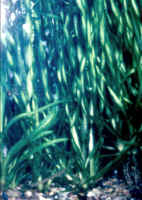
Thin Val and Hygrophila corymbosa - 10/28/2012
Hi
<Sarah>
I was just looking at buying these plants and would like to know if they
would survive in a tank with
7.4 ph and 10 dh and 54x2 watts of light in 55 gallons (1.8 watts/
gallon)
<I think you are okay on pH and hardness, but the lighting level is
pretty low. A very rough rule of thumb would be 3-4 watts/gallon, but
there are a lot of variables, not the least of which is how deep the
tank is. My reference book shows those plants need a bit more than low
light.>
Problem is my water is too hard and alkaline for other plants, so I
thought these would be good, but I am
not sure if they would be ok with the amount of lighting...
<Hmm. My water is harder and more alkaline than this and I keep several
standard plants in modest lighting conditions. I've found wisteria to do
very well in those conditions, as well as Cabomba, naja grass (aka guppy
grass) Christmas moss, and Java moss. Here is a link to a lighting
article Bob Fenner wrote that might be helpful:
http://www.wetwebmedia.com/PlantedTksSubWebIndex/lightingags.htm and
there are a bunch more articles on planted tanks in general, including
some write-ups on specific plants, including both Val and Hygrophila.:
http://www.wetwebmedia.com/PlantedTksSubWebIndex/AquariumGardenSubWebIndex.html
>
What do you think?
Thanks,
Sarah
<Welcome. Rick>
Corkscrew
Vallisneria 12/30/11
While all my plants (Anubias, Anacharis, moss, banana plant) seem to be
doing well and propagating (my lighting is low, 30 watts for
1.5 watts per gallon), the Val.s seems to be melting
away.
<Not enough light, plus "corkscrew" Vallisneria is easily
damaged in transit, planting, and often doesn't do well without
extra care. Cheap and cheerful common Vallisneria, Vallisneria
spiralis, is generally the easiest species.>
I was careful with the white crown bases, trying to keep them above the
surface as much as possible while sill rooted, but it seems that each
day more leaves are melting away. The parameters are GH 120, KH
80 and PH 6.5-7.
<Is a bit softer than ideal for Vallisneria.>
Temp is 76 degrees. I read on your FAQs section that soft water
and acidity are not great for gals.
<Does seem to be the case, though they can, do live in soft water
environments.>
I pulled the propagated Val.s out and put them in a 2.5 gallon tank
with 2 watts/gallon (no fish, small filter, one snail) to see if I
could get better results. They are doing fairly well. I
have plant 'food' that I had added for the past two weeks but
have not done this week as of yet. I pruned them today, but did a
pretty botched job. I would like to buy a few more but don't
want to waste money if I am doing something wrong. Should I ditch
this plant in favor of another low-light plant that would do better
with this water quality?
<Yes, would look at Amazon Frogbit and Indian Fern as floating
plants to prevent algae problems, and if you want specimen plants, look
at hardy Crypts, such as Cryptocoryne wendtii.>
Teresa
<Cheers, Neale.>
Re: Corkscrew Vallisneria
Great! Thanks so much!
<Real good. Cheers, Neale.>
Vallisneria, Guppy Fry
Feeding 12/3/11
I have a couple questions that I thought would be easy to find answers
to by Googling,
<No; obviously you haven't used the search tool (also Google) on
WWM. Do so>
but have yet to find reliable consistent info. So i
apologize in advance if my questions are rather... basic.
<Ok>
1. I have an interest in growing some Vallisneria along the back of my
aquarium. Does this grow in a sand substrate?
<... yes>
If so, does the type of sand matter (play sand vs. pool filter sand vs.
specific aquarium sand)? If not, could you recommend a long grass-like
plant that would grow well in a sand substrate?
<Read here:
http://www.wetwebmedia.com/PlantedTksSubWebIndex/vallisneria.htm
2. I am also interested in breeding guppies but have a couple questions
about feeding them. I want to hatch my own baby brine shrimp. Lots of
"recipes" I see for brine shrimp say to use 1 tsp or 1/2 tsp
of eggs. How many fry will this feed? I want to keep a constant supply
of them growing, but don't to waste any.
3. Along those lines, I understand that guppy fry require a varied
diet, but how varied does it need to be? If i just did baby brine
shrimp, crushed flakes, and maybe some infusoria, would this be
sufficient? I could also do egg yolk, and frozen blood worms. I guess
the main question is, would baby brine shrimp be okay as the only live
food the fry get? I don't really want to culture more live food
(microworms, etc.) but if it would significantly improve the health of
the fry, I would be willing to do it.
Thanks for your help!
-Matt
P.S. here are my tank stats if it matters for these questions: 20 gal
for a couple guppies, 10 gal to raise the fry, both are fishless
cycling now, so the water params are poor now but I won't add fish
until they are both cycled, I plan on using sponge filters in both
(another random question: would it be better to use 2 smaller sponge
filters on opposite sides of the tank or one bigger one for the 20gal?)
sand substrate in the 20, bare bottom for the fry tank.
I think I did something stupid
re: plants... 9/17/11
Hi crew,
<Hello Duncan,>
Haven't written in a few weeks - busy setting up my 220L (4')
tank in the classroom I teach in. Top website as always - how do you
find the time??
<With difficulty.>
I took delivery of a bunch of plants today while waiting for the tank
to finish cycling, including 5 small Vallisneria spiralis plants (about
20cm tall but only 5-10 leaves on each plant) that had very short
roots. Having read Bob's articles on how to plant them, I was
careful to leave the crown above the gravel substrate. Problem was,
this only left 0.5-1.0 cm of root/plant in the gravel - within an hour
4 of the plants were floating about the top of the tank on water
currents. I thought I shouldn't leave the Val like that -
Watersprite yes, Val no.
<Indeed. With Vallis, holding them down with a few carefully placed
pebbles is a good idea. Don't crush the stems, but just wedge them
around the Vallisneria, ideally trapping some of the roots. The plants
settle in quickly, and you can remove the pebbles in a week or
so.>
I decided to try trying a section of the roots with cotton thread to an
object with greater surface area to put under the gravel and weigh the
plant down, so keeping it in the substrate without burying the
crown.
Unfortunately all I had on hand were cotton balls (like those used to
remove make-up). As soon as I left for home I realised I had probably
made a BIG mistake - the cotton balls are of course bleached and
I'm now worried that the bleach will leach into the water, and kill
both the plants and the semi-established bacteria in the filter (Eheim
Classic 2215). I used a total of 2 cotton balls (torn into 5
pieces).
<Unlikely to cause any real harm.>
In short, should I be worried, and if so what is the time-frame on the
damage that will be caused to the organisms in the tank? I can get back
there to remove the cotton balls on Monday (today is Friday).
Cheers and thanks for your help,
Duncan.
<Would remove the cotton wool, but otherwise not panic. Dilution by
the aquarium will go a long way towards preventing problems of this
sort. Rock wool is sold for aquaria if needed, but honestly, it
isn't needed, and often just gets annoying after a while as it
splinters into clumps. Cheers, Neale.>
|
Vallisneria Spiralis
questions 8/14/11
Hi crew,
<Sus>
It's been a while, how's tricks?
<Fine, thanks>
Neale if you're reading and you remember me, you'll be
delighted to learn that after all my false starts, adding and
removing of specimens and endless efforts to breed those
Microgeophagus altispinosa, I do at last have a breeding pair -
they've just spawned for the 3rd time. I have 6 juveniles
remaining from the 1st spawn, which are 8 weeks old and doing
well, and 3 remaining from the 2nd spawn, which are 5 weeks old
and growing fast. I'm running two 20 gallon tanks and a fry
tank, rotating two brine shrimp hatcheries, and the endless
chores and the hum of 5 air pumps throughout the house drives me
crazy..but I love it!
<Will pass on to Neale. He's on holiday>
So anyway, to my question, which is now plant related. The
Vallisneria Spiralis in my breeding tank (and to a degree in the
grow-out tank, where I only have a few plants) seems to be
struggling. Both tanks have a fine gravel or sand substrate, and
the val. is planted so the crown is just visible above the
substrate (unless the rams dig them up, I usually have a few of
them anchored only by their runners around the spawning
site).
<Ah yes>
Generally speaking the crowns send out frequent runners and
sprout healthy new plants very readily - I thin them out from
time to time by removing cramped up plants, but some leaves
appear crinkled rather than twisted, and new leaves are sometimes
deformed. Many of the val. leaves are turning brown at the tips
and edges, occasionally developing small holes in the tip of the
leaf which spread. Some older, thicker leaves have a dark grey to
black appearance around their edges. The whole collection has a
rather a yellowy green appearance, rather than the bright lush
green I would like - I have attached one or two images, although
this shows a limited amount of leaf deterioration rather than
their sickly colour.
<I see this; with some diatom growth>
I understood that Vallisneria is pretty hardy left to its own
devices, and haven't wanted to complicate matters too much -
so I don't add any fertilisers (maybe the odd daily drop of
iron rich liquid fertiliser, if I remember), I don't bother
adding CO2, and I haven't used any root tabs since I last
re-planted the tank a few months ago. Water parameters are pH
7.5, ammonia 0, nitrites 0, nitrates 5-10ppm. Water is moderately
hard/alkaline.
Water changes 10-20% once per week.
I have just added one reflector to the grow-out tank - perhaps I
should add one or even two reflectors to the breeding tank. What
else can I do to improve the appearance of the Vallisneria -
growth doesn't seem to be an issue, it's slow and steady,
but they seem to be lacking something and don't look
luxuriant and healthy.
<Mmm, well, "something" is apparently missing... I
would use a complete fertilizer on a regular basis.>
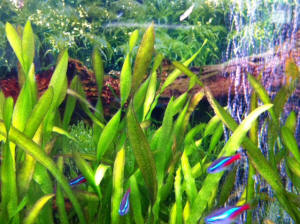
I also seem to be having an algae "problem" in the
breeding tank at the moment...diatoms and green spot algae
cropping up as fast as I can scrape it away, probably
over-feeding - so some discolouration of the leaves may be due to
that. No hair algae on the leaves though, just
discolouration.
I added some Cabomba caroliliana to both tanks a while back for
variety, but ended up removing all but the smallest of clumps -
it's growth was tall and stringy, sending out roots at all
manner of heights, older growth discoloured very quickly, and the
tips broke off and clogged the filter intake. Not sure where I
went wrong there??
<Not an easy genus to grow under many standard aquarium
conditions>
So, I guess I'm looking for a bit of guidance on how to
improve the appearance of the Vallisneria (and perhaps be more
successful with the green Cabomba, as it's an attractive
plant), and resolve the algae issue, without compromising the
breeding conditions? Quite prepared to throw some funds at
it..
<Have you read on WWM re these genera? Please do. Bob
Fenner>
Thanks very much!
Susie
|
|
|
Re: Sickly Dwarf Gelius Barb,
now plants, lighting 10/2/10
Ok great - thanks, have had a read and will look into other plants. One
thing - the tank has two 15 watt power-Glo tubes but is 45 cm deep. Is
that bright enough for Vallisneria?
Thanks again!
Susie
<You need at least 2 watts per gallon, and reflectors are essential
in my experience if you don't have space for three or more tubes
running the full length of the hood. The depth of the tank is an issue,
and best results will come from blue rather than orange or pink tubes,
i.e., colour temperatures above 6,500 K. That's because blue light
penetrates water better than red light. You'll know if you have
enough light because happy Vallisneria grows extremely fast, sending
out daughter plants on a weekly basis, and requiring cropping back
probably monthly. Cheers, Neale.>
Vallisneria, plants in the
cichlid tank (Malawi, Tanganyika) 2/16/09 Hey Crew, First and
foremost today I would like to congratulate you all on a very well put
together and extremely informative website!!! I read your stuff till my
eyes hurt almost every night. Anyways, on to business. Here's my
setup 100 Gal.(60"x24"x16"), Fluval 305(3 trays sintered
glass, 2 trays API ammocarb, 1 tray nitra-zorb), Penguin 350 running
standard cartridges and bio-wheels, H.O.T. Magnum 250 running micron
cartridge, 2 Hydor Koralia 3's, Hydor inline 300 watt heater,
60" Hamilton HO lighting canopy with 1 each 10,000K day and
actinic(room for two more T5 bulbs) on for 10hrs per day. 80 lbs pea
gravel mixed with 20 lbs aragonite base cichlid mix, 80 lbs Utah lace
rock, and 1 large piece African driftwood. Water parameters are PH 8.2,
KH 9 degrees, GH 12 degrees, NH3/4 0ppm, NO2 0ppm, NO3 10ppm, temp 78
degrees. I use baking soda, Epsom salt, instant ocean marine mix, and
Kent trace elements for cichlids. All water mixed, aerated, and heated
the night before, of course. Maintenance includes gravel vacuum, 75%
water change(stocking density is heavy), filter maintenance, and water
testing, all weekly. Fish include various Malawi and Tanganyika
cichlids, all of which are thriving, two pair breed all the time. I
know they shouldn't be mixed, but all is well for over a year now.
Not much aggression as I rearrange rockwork weekly. If problems arise
I'll have a good excuse to buy another tank!!! Phew. Okay,
here's my questions. Will plants(Vallisneria, Java moss, Anubias,
etc.)thrive under my lighting? Should I add more bulbs to my hood? If
so what K temp? Can I plants these in small clay pots with fertilized
pond soil and then bury in my gravel? If so what would a good
soil/fertilizer combo be? What other plants will thrive in my water? As
well any recommendations for growing plant in a cichlid tank you could
throw my way will greatly appreciated. I know my beloved cichlids will
mow these like grass, but that's half the idea. Sorry if the tank
description was long, just wanted to be as descriptive as possible. I
would also like to thank the crew in advance for all the great pointers
I am sure to receive. Yours Truly, Victor <Hello Victor. Vallisneria
is very adaptable, and while it prefers really bright light, grows
reasonably well even under moderate levels. So provided you have at
least 2 watts per gallon, I'd fully expect Vallisneria to do very
well in your tank. Since Vallisneria species are native to both Malawi
and Tanganyika, they are one of the most appropriate plants to keep
with Rift Valley cichlids. Nimbochromis livingstonii for example is a
species that specifically inhabits Vallisneria thickets. Colour
temperature largely doesn't matter for plants because they are much
more adaptable in this regard than corals. But the ideal is around
5500-6500 K. Vallisneria can be planted in pots, but quickly grow out
of them as they expand across the tank. If you want just a small clump
of them in one corner, then those plastic pots with rock wool will work
fine, provided you remember to put iron-rich fertiliser tablets in
among their roots once a month. Alternatively, if you're growing
lots of Vallisneria, then using a plant-friendly substrate will make
sense, even if it's just one half (of whatever) of the tank. I find
a mix of pond soil and gravel to about an inch works great. Put a
gravel tidy (or any fish-safe plastic mesh) on top, and then cover with
another couple inches of gravel or sand. The gravel tidy will keep the
cichlids from making a mess if they dig. Putting large stones around
the first few clumps of Vallisneria will help prevent them being
uprooted. Epiphytes (Java moss/fern, Anubias, etc.) and floating plants
obviously couldn't care less about the substrate and rely solely on
fertiliser added to the water. Epiphytes tend to grow slowly, so a
half-dose per month should be ample. Floating plants are nutrient
greedy, so use a full dose for them. Floating plants are superb for
removing nitrate, which is useful in cichlid tanks, and also provide
the shade cichlids prefer. But do bear in mind most cichlids are
partially herbivorous, and will view many species as food. Hard water
is not a problem if you choose the right plant species, and in fact
things like Java fern and Vallisneria actually prefer it since the
bicarbonate salts are a prime source of the carbon they use for
photosynthesis (which can cause issues with KH and pH stability through
the light/dark cycle of the day, so once plant growth becomes rampant,
keep a check on water chemistry). Hope this helps,
Neale.>
? about jungle Val 2/23/08 Hi. I saw
your article on Wet Web media, and I hope you don't mind me
bothering you. I'm expecting some jungle Val I bought from eBay any
day now, and I can't find info anywhere on how far apart these
should be planted. My goal is for them to make more plants than I
bought. Do you have any experience on this you'd mind sharing with
me? Thanks, Daniele <Daniele, giant species Vallisneria should be
planted at least 10-15 cm apart. If they're happy (i.e., under
bright light and in hard, alkaline water) they grow exceedingly
quickly, and the daughter plants appear on runners about 8 cm long. So
they will quickly fill out any empty space. Unless you have a giant
aquarium, you likely won't need very many specimens before they
take over the tank! Cheers, Neale.>
|
Val's are melting - New planted tank
11/12/07 Hello. I am on the second week of fishless cycling
of my 12G Eclipse planted tank. There are the parameters: Ammonia
8 Nitrites 1,5 Nitrates 5 The light is 2W per gallon. My
Vallisneria is melting away. Not brown, but turns transparent as
we speak. The crowns are planted properly and the substrate is
Seachem Flourish Do I need to cut the old leafs, or wait, or
dilute the ammonia? All other plants are OK as of now (water
sprite, Amazon sword, java moss, and java fern) Thank you, Tanya
<Hi Tanya. What's the pH and hardness of the water?
Vallisneria do best in water with moderate to high levels of
hardness, especially carbonate hardness. In soft water,
especially at acidic pH levels, they do not thrive, and I have
seen them melt just as you describe within a couple of days under
such conditions. The ammonia level is very high, far too high for
fish, and really much higher than you need to cycle a tank. Even
1 mg/l ammonia will do for cycling a tank. While ammonia
doesn't normally harm plants (it is, after all, fertiliser)
I'd still be diluting the ammonia concentration. Having this
much ammonia won't speed up filter maturation any, because
the limiting factor for bacterial population growth isn't
likely to be the ammonia availability but oxygen. In the
meantime, remove dead leaves carefully from the crowns of the
plants. All else being equal they will settle back in and new
growth will develop in a matter of weeks. Vallisneria is
temperamental about being moved (in fact, most plants are). But
it is a robust species, and once settled in should do fine.
Always ensure the crowns are at or above the surface of the
substrate. Good luck, Neale.>
Re: Val's are melting - New planted
tank 11/14/07 Neale. PH is 7.0. Hardness
-don't know because the master kit is still in the mail. Cut
the melted leaves off the Val's as you recommended, diluted
the ammonia and will wait. Thank you, Tanya <Hello Tanya. That
pH is a little on the low side for Vallisneria, which suggests to
me you may have a lack of carbonate hardness. While Vallisneria
can grow in soft water, they always seem to be more delicate
under such conditions. For now, wait until your test kit arrives
and then we can investigate further. With luck, your Vallisneria
will get over their sulk and start growing back. They often do,
and once settled in, they're quite reliable, bullet-proof
plants. Cheers, Neale.>
Re: Val's are melting - New planted
tank 11/14/07 Neale. The test kit is here (Tetra
Laborette). GH 21 KH 0 or 1 PH 7 The volume is 12G I want to keep
a pair of Apistos or Blue Rams. What is better for my water
parameters? What about a pair of Kribs - my last choice? Thank
you, Tanya <Hello Tanya. The carbonate hardness (KH) is very
low. This is going to cause serious problems in a small aquarium.
Carbonate hardness is what holds the pH steady. General hardness
(GH) doesn't do this to any great extent. Unless you are an
expert fishkeeper, I wouldn't recommend keeping any aquarium
at less than 5 degrees KH. We have an article all about low
hardness aquaria, here: http://www.wetwebmedia.com/FWSubWebIndex/fwsoftness.htm .
Have a read of that to understand the risks and benefits, and how
to work around low carbonate hardness. I can tell you from
personal experience that soft water where the pH fluctuates is
lethal to Vallisneria. They die practically overnight in such
conditions. As well as CO2, Vallisneria removes carbonate
hardness from water as a source of carbon, so the more they
photosynthesise, the softer the water gets and the more the pH
fluctuates. Apistogramma species often (but not universally)
prefer soft water conditions, in which case using some plant
other than Vallisneria could make sense. Cryptocoryne for the
bottom of the tank and Ceratopteris for the top would be ideal.
Mikrogeophagus ramirezi want soft and unusually warm (28C) water.
Kribs prefer neutral pH and moderate hardness, but are tolerant.
They are oddly sensitive to pH though: acidic pH results in
all-female broods, and basic pH all-male broods. To get a balance
of male and female fry you need pH 7.0. Cheers,
Neale.>
|
Re: Jungle Val. Hi there. <Hello> I am hoping you can
help me with this problem. <Will certainly try'¦> I
received (via the web) 10 Jungle Val plants. They came via USPS
priority and the inside of the box was relatively warm considering it
is still winter in the northern part of Illinois. The plants themselves
looked dark green and were from 18 to 36 inches, with good root systems
and some runners. The leaves had been carefully rolled and double
bagged. <Sounds good so far> I soaked them in some 70* water for
a few hours and then planted them in my planted' tank. <A true
quarantine period would have been better here.> Within 48 hours all
the leaves turned to mush and began to disintegrate. Most of the leaves
are now gone. <Yuck!> The question is: What went wrong? <While
it's certainly not desirable, this does happen from time to time.
The may have been a change in the pH or some other value that affected
them. The change in temperature may have been a factor here too. The 70
degree water that you soaked them in was undoubtedly cooler than your
tank temp and the wide range of temps experienced over a few days
(including shipping time) may have shocked them. Check the roots and
see what they look like. If they still look somewhat OK, it's
entirely likely that the plants will grow back, it will just take a
little time. My tank specs are: 125 gal. 50% RO, 50% tap 3
inch substrate mix of gravel and fluorite PH 7.2 KH 2 400 watts MH 8-9
hours p/day Plant tabs and Jobe spikes PMDD 2 ml p/day approximate 20
amazons, anacharis, crypt. wendtii, water sprite. (plants are doing
well especially hair algae) CO2 2 bubbles p/second approximate 40
tetras/SAE's/FFF. <This all sounds good.> Any idea's
would be appreciated. Thanks. Gil <You're welcome! Ronni>
Eel grass HI!!! M working on the biomass assessment and fiber
characterization of Vallisneria gigantea for my research. I've been
urfing the net but so far, the info i got about this invasive plant is
not enough. I would really appreciate it if you can send me more
information about this plant. I really need it. Thanks a lot <Hmm,
suspect you know more than any, perhaps all humans I've met on this
pest and aquarium species... Do take a look through the brief
references on the genus on our site, and if you're not more
familiar than I on computer based bibliography searches, and other
techniques for looking through what's known in print... do take a
look at the articles posted there on those topics as well. Home Page
Bob Fenner, who would also search the AGA (Aquarium Gardeners
Association) archives for references and practical husbandry matters.
>
|
|