|
Related FAQs: Koi
Varieties, Koi Selection,
Related Articles: Kohaku,
Taisho
Sanke, Showa
Sanke, Tancho
Koi, Bekko
Koi, Utsurimono
Koi, Koromo
Koi, Kin/Gin Rin Koi, Asagi/Shusui Koi, Kawarimono
Koi, Hikarimuji
Koi,
Hikari Utsuri Koi, Hikarimoyo
Koi, Doitsu Koi,
Butterfly Koi
Back to the Overview on Pond Livestocking,
/Aquatic Gardens, Design,
Construction & Maintenance
Koi Varieties
|
|
|
by Robert Fenner |
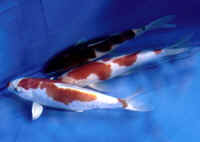
What do you call these?
|
 |
Aquatic Gardens
Ponds, Streams, Waterfalls & Fountains:
Volume 1. Design & Construction
Volume 2. Maintenance, Stocking, Examples
V. 1
Print and
eBook on Amazon
V. 2
Print and
eBook on Amazon
by Robert (Bob) Fenner |
 |
There are many "carps" in freshwaters
around the world, wild and ornamental, natural and purposely and not
human-introduced. The wild brown/green European Carp, Cyprinus carpio,
a sometimes food and game fish in the United States is the same species
as the adored Nishikigoi, Koi, Brocaded or Ornamental Carp... in all of
its many varieties.
As far back as 470 B.C., carp were cultured for
food as well as for color, but it's not until the Tsin Dynasty
(265-316 A.D.) that writings list the types available then. Five colors
are detailed, red, black, yellow, blue, white from this time. Much
later, the Japanese included Nishikigoi in their ponds. The majority of
modern varieties were developed under their care, starting in the late
18th century.
There are a few "accepted" schemes for
labeling ornamental carp, Nishikigoi, koi (by body color, three/four
types of scale patterns)... and all are acceptable (to me) as long as
they're descriptive, consistent and agreed upon by
immediate/concerned parties. Different parts of the world, different
hobby groups/clubs of clubs utilize varying schemes here, so don't
let what is presented here throw you.... there are literally hundreds
of descriptive varieties.
In terms of "knowing" koi well
enough for identification, you might consider learning their names by
an historical approach (which types came first, later... who was
involved in their development, which line lead to each...), a cladistic
descriptive classification (all shiny, not so...), or rote memorization
("I have an Ohgon, it's that shiny sun-colored fish over
there")... To each their own.
Do remember that all koi are
the same species, in fact, identical with the common carp, Cyprinus
carpio, and like domestic dogs, Canis familiarus, can/do
interbreed freely... Hence, you may find some "odd varieties"
of koi at times.
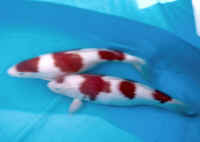
| Kohaku are
white bodied koi with red markings (sometimes more orange than
red) |
|
| Taisho
Sanke, aka Taisho Sanshoku, White koi with
principally red (Hi), and lesser black (Sumi) markings. |

|
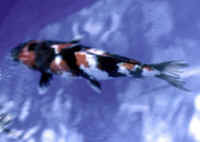
| Showa
Sanke, aka Showa Sanshoku, Black bodied koi
principally red (Hi), and white markings. Similar to Taisho Sanke,
but with more black markings, including on the head and margins of
the pectoral and tail fins. |
|
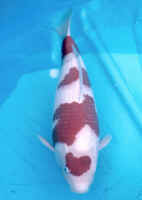
| Tancho: With
a "Red Sun" marking on head, and lacking other red on the
body. Best if the "spot" is bright red, w/o bleeding
color, and circular, centered on the head. |
|
| Bekko
("Beck-Oh"): Solid body
colored koi with black markings. Utsuri are often similar in
appearance, but are black koi with single complementary color
varieties. I like to think of Bekko as "Turtle" with
markings on their backs only... unlike the Utsurimono whose dark
body bands extend under/around the belly. |
|
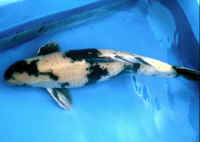
| Utsurimono:
Black bodied koi with one color markings. |
|
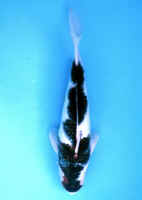
| Koromo:
Similar to Kohaku, but with accents of blue, black, purple mixed in
with some to much of the red, due to cross-breeding with
Asagi. |
|
|
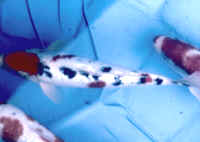
Gin/Kin Rin scaling
Gin Rin: Refers to pearl-silver reflective
scales
Kin Rin: Refers to pearl-gold reflective scales. A rare
variety.
|
|
|
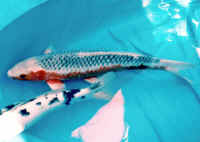
Asagi/Shusui
Asagi: ("Sky Color"). Blue gray bodied koi,
sometimes with red that comes up to the midway up on the head and
body.
Shusui: Basically a doitsu scale Asagi. Large scales
may be just along the midline of the back on the sides, or
both.
|
|
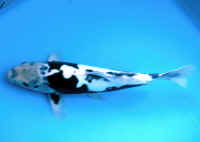
| Kawarimono: This is the
"left-overs" category of koi classification. These are
non-metallic colored koi that just don't fit into the other
varieties (with the exception of Goshiki). In most cases, for lack
of many entries, this "generic" grouping of Kawarimono
typically compete against each other in shows. |
|
| Hikari
Utsuri: Includes all metallic Showa (and in some schemes,
Utsuri) varieties. |
|
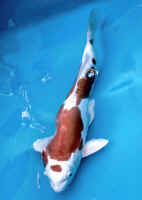
| Hikarimoyo: These are metallic koi
of two or more colors other than Hikari Utsuri. |
|
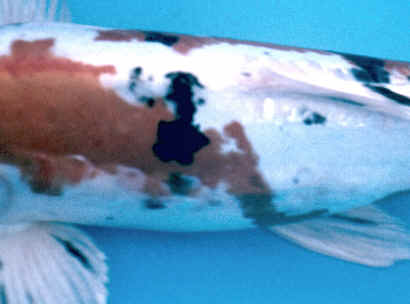
| Doitsu:
Mirrored scaled koi... with enlarged rows of scales along the
midline of the back and/or the sides of the fish. The derivation of
this name is from the Japanese/Nijongo for "Deutsch", for
German scaled carp... initially bred for ease in scaling/preparing
the fish for human consumption. Varieties are Kohaku, Sanke and
Showa. |
|
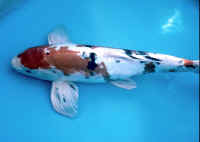
| Butterfly
Koi: A long finned making of all the other varieties of
koi. The name "Butterfly" is appended to the front of the
Japanese designation. |
|
Or, if you'd like, and to reinforce the diversity of these
sports and their classification, we can/will discuss them by the number
of colors they bear:
Or perhaps a dichotomous key is more to your liking:
Bibliography/Further Reading:
http://www.koi.com/encyclopedia/
(Pan Intercorp's excellent classification)
Fujita, Grant. 1992. The new way of selecting koi. Koi USA
11,12/92.
Hansen, Galen. 1992. Goromo. Koi USA 11/12, 92
Kuroki, Takeo. 1993. Classification of Nishikigoi. pt.s 1-0 TFH 3/93
on
Tave, Douglas. 1989. Inheritance of scale pattern in koi. TFH
5/83.
|
|
Aquatic Gardens
Ponds, Streams, Waterfalls & Fountains:
Volume 1. Design & Construction
Volume 2. Maintenance, Stocking, Examples
V. 1
Print and
eBook on Amazon
V. 2
Print and
eBook on Amazon
by Robert (Bob) Fenner |
|
|
|