|
FAQs on Calcium and Alkalinity in Seawater, Troubleshooting & Fixing
Related Articles:
Calcium and Alkalinity Explained by Anthony Calfo,
Calcium,
Biominerals, Using Kalkwasser, The Use of Kalkwasser
by Russell Schultz, Calcium
Reactors, Marine
Maintenance, Marine Water
Quality, Magnesium in
Seawater, Strontium in Seawater,
pH, Alkalinity, Marine Alkalinity, Live Sand, Marine
Substrates, Reef Systems,
Refugiums,
Related FAQs: Ca/Alk 1, Ca/Alk
2, Ca/Alk
3, & FAQs on Calcium & Alkalinity: The Science of Calcium & Alkalinity,
Importance, Measure, Sources, Use of
Additives, Products,
& Calcium, & FAQs on
Calcium: Rationale/Use, Calcium
Measuring/Test Kits, Sources of
Calcium, Calcium Supplements,
Dosing, Chemical/Physical Interactions, Troubleshooting/Fixing, &
Calcium Reactors,
& FAQs on Calcium Reactors: Rationale/Use, Selection, Installation, Operation, Media, Measuring, Trouble-Shooting, By Makes/Models, & pH, Alkalinity, Marine Alkalinity, Marine Alkalinity 2, Marine Alkalinity 3,
Marine Supplements 1
|
There is a bit of ongoing balance twixt
Biomineral (mainly the Alkaline Earth elements Calcium and
Magnesium) AND alkalinity... Too much of one or t'other
results in precipitation (Calcium/Magnesium Carbonate...) of the
other... Regular testing, water changing/augmentation are
requisite, esp. in "boosted" systems with abundant
light, much biomineralizing life/metabolism.
|
|
I can't figure out what's wrong! Gen.
reef maint. and Alk. f's
1/22/19
Hello,
<Sassi>
I am writing to ask if you can think of something other than the normal tank
parameters that might cause a new reef tank to not be quite right.
<Mmm; a bunch of possibilities>
I have a Fluval Peninsula AIO 13 gallon tank that is doing very very well, live
sand, live rock, 2 small fish, lots of hermit crabs, snails, bristle worms and
copepods. 2 peppermint shrimp and several happy corals. Pulsing Xenias,
snowflake toadstool, yellow elegans toadstool, Zoas, colt coral and even a tiny
frag of Montipora, and a tiny frag of Pocillopora, (both recommended beginner
sps corals). All the corals are out and happy, growing and doing well. I do
weekly water changes but don't add a lot of supplements
...just Seachem Plus. Per Sally Jo Headlee at GARF.
<Looks very nice indeed>
In the 13 gallon I have one Midas blenny, Lowly Worm. And 1 Firefish Incognito.
You never see him except to eat. There is a crab of some sort in the live
rock,....he never comes out so he must be a filter feeder or eats copepods. I
don't know, but he's never hurting anything so I leave him alone He's not even
eating my beautiful bristle worms! I have a wonderful group of them now. I like
them a lot. Do you know they have faces with eyes!!
<Ah, yes; and facial palps!>
I got really close with my camera and actually was eye to eye with one,.... what
a revelation. I thought they were like earthworms, but they are not!
Cute little faces really.
Per my API test kits,...this tank has 0 ammonia, 0 nitrites, 0 nitrates.
Calcium is high like 800 on the test, and the KH is high too. It took 16 drops
to turn the test from blue to yellow.
<Do reduce these by serial dilution... and cutting back on supplementation>
Any way, this is my successful tank, and I love it. But the corals are growing
and I'd like to move the
ones that will get bigger(the toadstools and the Colt coral) to my new tank
..............and herein lies the problem!
*************************************************
My new tank is a Innovative Marine 25 gallon Lagoon style tank. Short and
square. I wanted more floor space and not a lot of height, I need to be able to
work on my tank. Like the other tank, it's an AIO. Sump in the back, which works
well for me, much easier to work on back there instead of on the floor! I used
to have a big tank with a big sump. What a pain! .
In it has Live Sand, but instead of real ocean rock it has that Walt Smith brand
man made rock (I was trying to do the "right" thing and save the reef!). It's
done with the cycling and diatoms,....and it's nice and clear.
It's been about 2.5 months it's been running.
<Okay>
I have a little bit bigger pump than came with the Lagoon tank, because their
pump was really bad and really noisy, so I put one of my backup pumps in. I have
lot's of flow and my jets are aimed up to always ruffle the water we need lots
of oxygen in the water after all. I do this in the little tank too. Both jets
are aimed up.
<Should be fine>
So, my testing is showing the tank to be on the downward side of the Nitrate
spike you get at the end of cycling,....it's between 20 and 10 ppm on the API
Test Master Salt Testing kit. The Ammonia is 0, the Nitrite is 0 as would be
expected. The KH is high, just like in the 13 gallon tank,....our well water is
high in dissolved minerals. And although I haven't tested the Calcium I'm sure
it's fine too since it's a new tank and nothing is using it up. The Walt Smith
Rock is calcium carbonate.
<Yes; Walt and his wife Deb are friends, have been to their place in Fiji a few
times>
It is my plan to add more live sand,....it's on it's way. I just read on your
site that if you are going to have live sand, 3 inches deep is better than 1 or
2 for the nitrate bacteria.
<This is so; the deeper the better; IF not deep, then finer grade>
I have added my cleanup crew, hermit crabs (reef safe ones) and a variety of
snails. I have added copepods. I have some of Sally Jo's Garf Grunge mixed into
the sand bed too. I also seeded some of the 13 gallon tank's sand into the new
tank. So, I do have copepods, but no where near the thriving community of them I
see in the 13 gallon tank which is just crawling with creatures. This tank has a
few of the larger copepods walking on the rock now and then,....a few of the
little ones that look like shrimpies with big white eyes. Mostly though I see
things zooming around in the water, against the black back of the
tank,....millions of them. They aren't floating, they all have different
trajectories, so I know they are alive. But there is almost nothing inhabiting
the rock,...I don't think they like that Walt Smith rock,....but it's too late
now to take it out. I don't want to kill the ones that are living in it.
<This takes time. I would move a good deal of the substrate from the 13 to the
25>
The one thing that both tanks have in common is the PH. It is always between 7.8
and 8. It doesn't go up to 8.2 or 8.4. The only supplement I use is Seachem Reef
Plus,....Sally Jo said I need to use that 2 times a week.
Otherwise, I only feed New Life Spectrum Thera A pellets, no frozen thawed food
at this time. Lowly Worm and the Firefish are happy with the pellets and so are
the other creatures.
Ok, so the problem is this,.....Despite the water parameters being ok,...not
perfect,....but getting there.....why won't my little pieces of corals open up?
<Mmm; could be a few things... from the too-low pH, a lack of useful food/s, to
a deficiency in "something"... like iodide/ate, iron....>
I have a tiny piece of colt coral, a small cutting of my big gorgonian
coral,...and some button polyps from Sally Jo. Only the Button's are open all
the way, the colt coral is all scrunched down in his barnacle, and the Gorgonian
won't open his polyps. He's just laying there with them poking out but not open.
All three of these are fully open and growing like weeds in the 13 gallon tank.
I'm so frustrated. I thought that softies like some nitrate in their water for
food? Am I wrong?
<All in balance; but yes, some NO3, HPO4....>
I can't buy any fish for this tank until I know that things are balanced and
thriving! I don't want them to suffer and die. Can you help me figure out what I
still need to correct?
<For now I'd experiment with adding just one thing at a time... DO try some fine
frozen food/s (or a blended product), OR iodide-ate (SeaChem's line is a fave),
OR Fe...>
I've done many small and 1 large water change, to bring the nitrates down,..
..I will of course continue doing so. But I can't figure out what I've done
wrong in this new tank. I will take a couple pictures for you,....maybe you can
think of something I haven't. Thank you. Pictures below.
First the 13 gallon tank that's doing well. It is right next to a window, has
plants behind it, but still get tons of real sunlight. I think that's partly why
it does so well. And I don't scrape the back wall, the snails need something
green to eat, there's no algae in the tank any where. Plus the algae filters the
light coming in a little.
<Yes; I'd leave this be>
The 3 month old Lagoon tank...looks like mars or some place uninhabited! I hate
that look. I hate that Walt Smith rock too. It's ugly. But it's better for the
environment I hope. The new tank has a fancier light,....better for corals it
said. It's a Current light. With the fancy interface, but I don't use that part
really. The one thing I don't have in this tank is pumps,.. there is so much
flow I didn't think I needed more. I have them if I need them though. .
Thank you for taking the time to even read this massive post,....I hope the
pictures aren't too huge.
<They're fine; thank you>
Amanda Wilson in Jackson, NJ, USA
<Do please keep me/us informed as time goes by with what you're trying, the
apparent results.
Bob Fenner, San Diego, CA, USA>
|
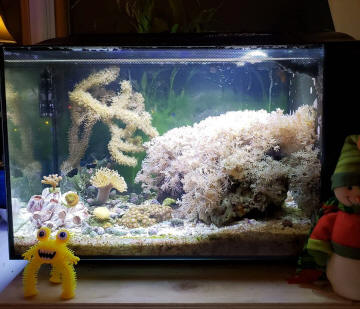 13 gal.
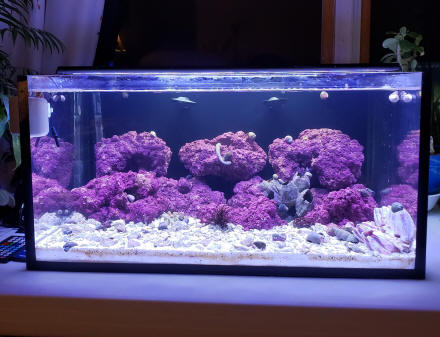 25 gal.
 |
|
Re: I can't figure out what's wrong!
1/23/19
Thank you Bob for you fast reply! You always amaze me.
<Welcome Mandy>
About the calcium and hardness, I don't ad any calcium to my water,...I'm
not sure why it's so high, maybe it's just my well water. I guess I should
test it.
<Please do... the SeaChem product likely adds... Do you have, make reverse
osmosis for your drinking, cooking? I'd cut the well water with this if so>
And since it doesn't seem to be a problem in the 13 gallon tank I hate to
start to do serial dilution of anything. I will only upset the whole thing!
The corals seem quite happy there and so do the fish and other creatures.
<Real good; I do agree>
About taking half the substrate from the 13 gallon tank and seeding it into
the 25 gallon, I can do that....I have new sand coming and it can replace
what I will remove,....but it will stir up what Sally Jo calls a "Sewer" in
my 13 gallon tank!
<Ahh, good>
All the stuff suspended in the substrate will be in the water after I do
that. Won't that cause the 13 gallon to have a huge nitrate spike and kill
all my creatures? Perhaps I don't understand this well, please elaborate?
<Use a siphon hose, and pour off the supernatant... the floating water and
debris>
I have considered taking half of the live rock in that tank, (chisel it into
two pieces) and move one side to the new tank, but at this point the Xenias
on that live rock will all die in the new tank, the last little group
I put in scrunched down and just disappeared! It was so sad. I don't feel I
can do that to them even though I have lots of extras. They are my favorite
coral of all. Sorry. I know many people don't like them, people consider
them to be weeds, but I love Dandelions best too. I'm a nut.
<Then we are nuts>
So, about the Iodide, I have the Seachem Iodide already, I lost my one and
only cleaner shrimp when he was molting a few months ago, so I thought I
might need more Iodide. I only used it once though, because then on your
site it said do not add things you don't test for, and I don't have an
iodide test kit. (I will get one though.)
<Do use this>
Why would I add Iodide to a new tank with new saltwater mixed up,....I use
Instant Ocean Reef Crystals I assumed that the salt has the correct amount
of Iodide in the mix?
<It "drops out of solution" very easily>
But if you think that might be what's missing, I can add it. I'm not sure
about Iron,...it's in the Reef Plus I believe. So is iodine....but it's very
small amounts. Maybe I need more? Once again, I though that salt mix would
have all these things in the proper amounts,... and I've been doing water
changes too,....lot's of fresh saltwater.
<Try just one change at a time... Good science!>
You know, there is one thing that was different in the new tank than the
older one,.....I started it with a different salt mix. Red Sea Coral Pro
Salt. It had great reviews and I thought it might be a step up from the Reef
Crystals, I wanted to try a SPS coral,....but when I told Sally Jo she said
NO. Go back to the Reef Crystals, and I have for the last few water changes.
I don't know if that might be part of the problem. The RED SEA Coral Pro
salt is much heavier they say in Magnesium, Calcium and Carbonates and some
other coral building stuff than regular salt mixes.
From their label on the can of salt:
"Coral Pro Salt Mix provides the biologically balanced, elevated levels of
the foundation elements (Calcium, Magnesium & Carbonates) necessary for
sustainable, accelerated growth and enhanced vitality of all corals."
Maybe this Red Sea Salt mix is why my calcium and my hardness are so high?
<Could well be a contributor>
I didn't really use test kits when I started the first tank,....so I didn't
test it until after I used the Red Sea salt,....and both tanks are the same.
Even the old tank got some new water made with the Red Sea Coral Pro salt.
Maybe thing just aren't balanced because of it?
<Again; a possibility>
About adding food, I do, I feed the hermits and snails a few pellets
everyday, don't want them to starve in such a naked tank. There's nothing
left to eat in there since they ate all the diatoms.
<A fine small food, like Cyclops (-eeze) would be my first choice to add
here>
Ok, I'm sorry I think I have too many questions!
Mandy
<No worries. BobF>
Re: I can't figure out what's wrong!
1/23/19
Ok! I didn't think about using a siphon! But when I pour off the dirty water
won't I lose copepods and bacteria too?
<Not much of them, no. For bigger animals (like crustaceans), pour the water
through a net>
Isn't that why you want me to move the sand to begin with? To move copepods
and bacteria? I could use a fine net for the bigger creatures I guess.
<Ah yes and yes>
OK. I'll do that. It's Oolite sand, that's my favorite. Even if it does get
stirred up easily. It's still the prettiest and softest sand. Then there is
a little crushed coral on top.
Then after I get the sand back into the newer tank, I can add 1 dose of
Iodide.
Perhaps that will help.
<Am hoping so>
One thing though that I still don't understand is why do I have such a hard
time keeping the PH up.
<Mmm; it's likely a good deal due to your high Calcium level... there's a
negative interaction twixt high alkaline earth (Ca, Mg...) content and pH>
It's very stable,....it's stays at 7.8 all the time on my tests.....maybe
too many people breathing in the house?
<I hope not... though too-sealed homes can have such an effect>
I've read that any where from 7.6-8.4 is ok,....but only for fish. Corals
and inverts need 8 and above. I've added baking soda,....several times, it
never stays up.
The other tank is at Ph 8. Not high enough really either,....but again,
everything is thriving. I just don't get it! I think it must be the liverock
is just a much better Rock.
<Likely is the rock>
It's real ocean rock,....and millions of thing live inside it, I see them
crawling around when I use my camera and get really close, there are thing
in there that are just amazing! Long whiskers and funny curly bodies,...
things that walk upside down and then flip over and never miss a beat!
WOW!
I love watching them. My favorites though are the ones that look like tiny
shrimp and have big white eyes....they are so fast! They love the barnacles
best.
Bob, there is nothing in my life more wonderful than that 13 gallon tank.
It s like looking at heaven. I really want the 25 to be just as happy.
<In time... B>
Mandy
Re: I can't figure out what's wrong!
1/23/19
Thanks so much Bob, I will give it more time and do the things you
suggested
Mandy
<Thank you Mandy. B>
Re: I can't figure out what's wrong!
1/23/19
Bob,
<Mandy>
I tested my well water, straight from the tap, not through the Pure filter.
It only took 2 drops for the color to change on the Calcium. Very low.
<Ahh>
And it only took 3 drops for the KH to change! So, we don't even have a lot
of minerals in our well water.
<Not ones involved in hardness at least>
We do live in the Pine Barrens in NJ. The soil is very sandy and acidic I
believe. Lot's of mountain laurels and pines.
<Have been to a few places in New Jersey; many small water districts in the
Garden State, and the ones I'm familiar with do have good/great water for
human use... not much dissolved solids>
There is a little Phosphate,....it showed .5 ppm's.
<Likely fine for your set-up/s>
The PH of the tap water was the lightest yellow (lowest reading),...7.4. Of
course, it doesn't measure lower than that on the test, so who knows it
might be even lower.
<Mmm; yes...>
I have drinking water test strips, I will check it with them too,....can
always use a second data point.
<Good>
Ok, on the drinking water test strip it was again at the lowest color, which
says reads ph 6. So, I guess our water is somewhat acidic. I wonder why the
test strip doesn't go lower than ph of 6?
<Just what the kit is made for. There are lower colorimetric assays for pH
et al. I taught H.S. chemistry and physics>
I wonder how that affects my water in my salt tanks?
<Yes; this water's "hydrogen ion content" will eat away at the alkalinity,
reserve in your mix, and that of the substrates (rock, gravel/sand) in the
tank itself. You might... should look into increasing the amount of baking
soda, or using (better) a pH bolstering product. Again, another SeaChem
product is my choice... This should be mixed into the change out water ahead
of use, all allowed to sit a few days... if you can, a week ahead of its use
next maintenance interval>
So, it must not be my water that is sending the Calcium and hardness up so
high. I must have been the Red Sea Coral Pro salt mix.
<Possibly>
Or maybe the Walt Smith rock gives off a lot of minerals in the beginning?
<Indeed it can. It is touted as being "ocean cured" after being made (on
shore)... but the cement part is quite alkaline for a while>
They do say to let it cure until the PH gets up to 8 or higher in the fine
print online.
Is that what's happening? I thought because there is no ammonia or nitrite
it was all cured?
<Could be>
Do you even have to cure dry rock?
<Not for the same reasons as live, but yes; it does need to soak... to
remove excess materials that are easily soluble>
It's never even been in the ocean,...why would you have to cure it at all?
<If it's the product I've met with... made in Fiji; then it has been
cured... again, by being placed underwater on the shallow reefs for months>
The sand is just regular CaribSea brand. I don't think it's the sand
releasing the calcium,....or minerals,.....or is it?
<Also a potential factor>
I just had a light bulb come on in my head! IF the water comes in slightly
acidic....does that do what vinegar would do if you dosed the tank with
vinegar?
<Indeed; yes. All acids are proton donors, electron acceptors>
I've read that people do that to release more calcium and minerals from
their rock and substrate. Maybe it's just happening naturally in my tanks
because of the water being at PH of 6.
<Well; actually all this is a mix... IF you add equal numbers of Hydrogen
ions (acid) and Hydroxyl ions (base), you end up with a neutral pH solution:
7.0... >
When I had large reef tanks, 150 gallon and 50 gallon, they were all fine
too with this local well water....something's different in this new tank.
And the only think that's different is the Walt Smith Rock.
<You could soak or to save time, boil a piece in tapwater, measure the water
pH after....>
This is weird.
Mandy
<Mmm, just unknown for now. BobF>
Re: I can't figure out what's wrong!
1/23/19
So, I guess that reading isn't too weird,...for the pH in the tap water.
<Nope>
I read this that says that a pH of 6-8.5 is normal in underground water.
Like well water.
https://www.water-research.net/indexphp/water-treatment/tools/the-ph-of-water
In general, a water with a pH < 7 is considered acidic and with a pH > 7 is
considered basic. The normal range for pH in surface water systems is 6.5 to
8.5 and for groundwater systems 6 to 8.5. Alkalinity is a measure of the
capacity of the water to resists a change in pH that would tend to make the
water more acidic.
Mandy
<Ah yes. B>
Re: I can't figure out what's wrong!
1/24/19
Bob, the Walt Smith rock I got is not the one they put in the ocean. I spoke to
them on their FB Page and he said I bought the one that is never in the ocean.
<I see; like their 2.0 product... quite alkaline>
They also make one that is put in to the ocean,....but Liveaquaria doesn't offer
it on their website, so I never knew about it.
I wish I had. It wasn't cheap and I believed it had been put in the Ocean
because I watched their video where it shows it being in the ocean for a while
then shipped out.
But that was the 2.0? Or 2.1? I don't know. Either way, I ended up with just dry
rock.
Thanks,
Mandy
<The test I mentioned. B>
Re: I can't figure out what's wrong! 1/24/19
I just checked the Reef Buffer online and it says it raises Alkalinity a lot
too,....will that be ok in my tank?
<Ah yes>
I already am off the chart on alkalinity. It took 16 drops to get the color
change.
Maybe baking soda is better for my situation?
<Try it and see. The carbonate in commercial products is "stronger" and
more persistent than bicarbonate... BobF>
Mandy
|
Chemistry question... a joke? Snow incident? 5/9/16
Yes we're having a strange week this week. Having some strange chemistry with
out personal 90 gal
Had a few cats paws
<Pocillopora spp.>
that we got this week from a show start rtn on us so we sat down and checked the
chemistry and all the levels were well beyond normal parameters
Alk 2.8
Cal. 100
<Heeeee!>
Mag 0 yes zero
<Right>
All tests say they are unexpired salifert tests kits
<Happens>
Added chemicals to bring levels up with only a little change to the cal up
50 points
Will be checking the test kits out with brand new unopened test kits
tomorrow.
All corals are open and look happy besides the new cats paws that are just about
all dead with tissue loss.
Salt is running 1.025 temp 78-78.8 orp is 430 no3 2.5-5
Thanks again
Tom Smith
<Welcome... I guess. B>
Re: Chemistry question
5/9/16
Will get results for new kits around 11-12 .
<PM? For what? What units? You know what I give/gave for physics and chem.
classes sans units of measure; a big fat ZERO score>
But looking a good water change, carbon and rechecking this evening on levels.
Any ideas of a chemical that could alter the chemistry so much ( if it is not
all three test kits going bad at the same time) as alk was 8.0 cal 400 mag 1350.
<I really... have no idea what you're referring to. Sorry. This reads as some
sort of alk/alkaline earth snow storm...
READ here:
http://www.wetwebmedia.com/alktrbfix.htm
and the linked files above
Bob Fenner>
Trouble with Calcium Levels
1/23/15
Hi-
<Howdy>
My name is Ron. I have a 220 gal reef tank with about 180 pounds of live rock
that has been running for about 2 years now. It is heavily stocked with about 25
SPS corals, 3 LPS corals & about 15 fish. I was having good success keeping my
calcium level around 420. My alkalinity level is at 9 and my magnesium level is
1290.
I was dosing daily:
Kent marine- Part A(Calcium)- 10 ml -8 times a day
Kent marine- Part B(Alk) - 11 ml -8 times a day
Kent marine- Magnesium - 2 ml -2 times a day
About 3 months about ago I switched from tropic Marin reef pro salt to HW Marine
Mix Reefer Salt and I have noticed I can't get my calcium higher than 385 level.
<Can see where this is going...>
So I increased my Part A and Magnesium daily dosing as follows:
Kent marine- Part A(Calcium) - 10 ml -12 times a day
Kent marine- Part B(Alk)- 11 ml -8 times a day
Kent marine- Magnesium - 5ml -3 times a day
My level are still about 380 for Calcium, Alkalinity level is at 9 and my
magnesium level is 1290.
Since my Calcium levels weren't coming up I began mixing about a gallon of
Kalkwasser and adding it tom Auto Top Off.
Give that I am dosing approx 120 ml.s of Part A a day & 15mls of magnesium a
day, I have the following que stions:
-Am I dosing to much Part A (Calcium) for a tank this size?
<Could be>
-I was told most people don't dose magnesium daily Should I not be dosing
Magnesium ?
<I would only try do adjust Mg once a week... via water changes>
-Should I not be using Kalkwasser in my ATO if I am dosing Part A & Part B?
<... I'd do a bit of reading here.. and ONLY/SETTLE on ONE supplementation
route. EITHER the A and B (and not Kent), OR Kalk with punctuated Mg (likely
MgSO4) adjustments... OR better still, the use of a decent Calcium reactor...
plus minor ongoing adjustments. What you really need to do is STUDY the basics
of Alkaline Earth and Alkalinity balance... and WHEN you understand their
interactions, set upon ONE modality of manipulation.
Else-wise you'll continue to be a ping-pong-ing pawn of the folks profiting from
selling you mis-supplementation.
Bob Fenner> High calcium concentration
3/25/14
Hello Mr. F,
How are you?
<Fine Andrei; thank you>
My tank finally seems to have settled into a path towards the right
situation. (largely thanks to wwm resources and your direct help )
<Ah good>
I have some more questions if you are kind enough to help me:
1) I have changed my lighting 10 days ago to 5 LED Radion fixtures. I am
in an acclimating for 6 weeks period now and everything seems to be all
right , but I guess that the normal growth of the sps corals and clams
slowed, because not changing anything in the setup, the calcium
concentration climbed. Now I have 550 mg/l.
<Yikes>
I would expected the kH to drop, but is 3.05 meg/l which is pretty much
normal and the Mg is 1280-1300 mg/l. The ph of the system swings from
8.05-8.15 . Salinity is 34.9-35.2 . I see no precipitation on pumps and
heaters. Is this value ok for my sps corals?
<Not really>
What should I do?
<I'd slowly add alkalinity to drop out the Calcium, or execute some
sizable water changes to dilute it>
I was adding Ca by 2 ways: Ca reactor and because it was not enough (
before the light changing ) also by Kalkwasser for the top up water (
which now, with the LED not heating the water and less evaporation is
much less than before ).
<Yes; these two can be done together. Even Daniel Knop has told me he
does this>
I have slowed down the Ca reactor ( 1 bubble of CO2 every 3 seconds ) .
But for now both are working because I feel that if I stop the reactor
my kH will drop too much, and if I stop the Kalkwasser my ph will drop
too much. What is your opinion on this?
<I would augment the KH via supplement/s for now.
Turn off, discontinue the Kalk>
2) it has been 5 months now that my refugium is working connected to the
system and located in the basement. It is 140 x 40 x 18 cm so about 100
kg of fine sand 0.5-1 mm . Chaetomorpha growing above the sand, some
live rock and like 20 Nassarius snails patrolling . I am not happy with
it because I fear that I am doing something wrong. I don't see the kind
of action I was expecting in the sand.
<Could be the Ca>
There are some worms that dig some small tunnels like 2-3 cm under the
surface, but only here and there , there are thousands of live Artemia (
I guess )
<Mmm, no>
above and many brittle stars and other small sea stars, but I was
expecting more after 5 months. Is this normal, could I do anything more?
I added from the beginning some 20 kg of live rock directly on the sand
to seed it.
<Patience>
3)I have in quarantine a diadema dotty back that is sitting there for 2
months. It has proven very aggressive and tried to kill another purple
dotty back and a small wrasse that were bought on the same time. My fear
is that if I place it in my 1000 l DT ( 210 cm long ) it would nip at
the fin of my prized ( and by now huge ) Zanclus Cornutus that I have
for more than 1 year in there. What do you think? Even with the huge
difference in size, it could prove aggressive?
<Not likely here and with the Zanclid, no>
Thank you once again for your help,
Andrei from Romania
<BobF in San Diego, but off to Cozumel for diving tomorrow>
2 Part dosing concerns. RHFarley recipe
2/11/14
Evening crew
<Chris>
Approximately 1 month ago I decided to try my hand at 2 part dosing
utilizing Randy’s 2 part recipe 1
<... as detailed here:
http://www.reefkeeping.com/issues/2006-02/rhf/
I take it you followed the proscribed "recipes">
3 days ago I tested and found my alkalinity at 12.5 dKH and my calcium
at 224 so followed the directions and added a bunch of calcium (half of
what was required)
<... a bunch; half...>
The following day I retested and found a small change but nowhere it was
supposed to be so discontinued dosing altogether
<Good>
I just checked again today and the alkalinity has actually
increased 13.104
<Mmm>
What am I doing wrong? What should I do to correct it?
<Can't tell w/ the information provided... but you have some sort of
unbalanced system of alkalinity vs. alkaline earths mix here... You
can/could fix this in a few ways... my best advice (if this were the
last time we communicated) would be to do at least one massive (like
half) water change, or a few consecutive daily ones of 20-30% to dilute
whatever compounds are present, and THEN to measure all factors, utilize
enough "Part 2" to precipitate out the excess alkalinity... over days
time, through additions of bolstered change out water>
Test kits being used are Hanna
PH travels between 8.1 and 8.2
Let me know and thanks in advance for your assistance
Chris
<Have you read on WWM re? Try this:
http://www.wetwebmedia.com/calcalkmar.htm
and the linked files above. The reactions, interactions of the chemical
species here are actually quite simple to understand. Bob Fenner>
Alkalinity Too High... too much added to a one month old
sys. 6/10/13
I have a 110 gal FOWLR tank, (I used to have some
corals and sold them from a previous 42 gal and a small lettuce coral
got left behind and is in my new tank)
I believe this happened to me.
Buffers alone are not generally a good method as they raise pH
little, and result in excessive alkalinity. Unfortunately, the labels on
many commercial buffers are written in ways that convince aquarists that
the pH will be fine if they just add some buffer. More often than not,
the pH is not improved for more than a day, and the alkalinity rises
beyond desired limits.
<Can; yes... And I'd emphasize/state that this is not the case w/ all
buffer/ing products. Some manufacturers are more "completely honest". A
fave: SeaChem>
My PH is at a desired level now but my alkalinity is too high
now. My calcium was a bit too low so I added 2 caps of
Purple tech.
<... not a fan of this (or many) Kent products>
I was going to test the calcium tomorrow and see where it stood. I
I was just going to leave the tank alone to settle down once the calcium
is right. All my other water parameters are good
Am I on the right track or is there anything I should do about the
alkalinity now?
<... Depends... on what the alkalinity is due to... carbonates,
bicarbonates... When, where in doubt, best to do either a massive
(pre-made) or successive water change/s... to dilute the "Dead Sea
effect" of having added (so many, much) products>
My tank is a little over a month old
<?! You shouldn't have to be adding anything here>
and my first water change/maintenance is scheduled for 1st part of July. I
can ask for it sooner if necessary. I cant lift the canopy off myself so
I have to have someone do it.
<Mmm, do look about re gear that can help you w/ automating lifting this
top... there are hinged arrangements, even infra-red signaled motorized
lifters!>
Thanks so much.
Barbara Wilhite
<A pleasure to share, help. Bob Fenner>
Reef Alkalinity, pH, 2-Part Calcium, and Extra- Strength
Tylenol 1/11/13
How-do, Crew?
<Hello Mike>
Please accept my humble first foray into what seems to be the standard
preamble for all WWM inquiries: concerning the general awesomeness
of the vast repository of information and the conscientious stewardship
over same, I hope that the sincerity of my appreciation is not
diminished by the fact that my praise is just another ripple in a sea of
thanks.
<Your thanks is very much appreciated.>
Despite poring over what seems like every word written on the subject,
both here on WWM as well as on countless aquarist message boards of
questionable merit, I am still not fully processing some aspect(s) of
the alkalinity/pH balancing act. I hope to finally wrap my head
around this topic that baffles too many of us, and all the better if my
particular question helps untangle the concept for others.
<Mmm, have you read all of our information? A new article I wrote
has been added recently that
gives a pretty good idea of how this balance works. I think you
will find it unique. See here
http://www.wetwebmedia.com/CaAndAlkGasta.htm>
My reef tank is 100 gallons and very mixed. Cnidarian inhabitants
include Zoanthids/Palythoa; a sparse population of various mushrooms;
Nephthea; a few LPS such as Trachyphyllia, Favia, Acanthastrea,
Euphyllia, Caulastrea, Goniopora (healthy for more than a year),
Scolymia, Echinophyllia, and SPS such as Stylophora, Seriatopora,
Montipora, and a good deal of Acropora.
Through careful placement, and occasional relocation, to provide
individual-specific lighting/flow/etc, nearly everything is thriving.
Whether by effort, luck, or likely a combination, allelopathy seems to
be a non-issue and where corals have grown to abut their neighbor, sharp
demilitarized zones have appeared but stabilized with neither combatant
obviously incurring more damage than can be sustained while continuing
to expand into less-contested areas. Intentionally kept sessile
invertebrates consist of two Tridacna clams (approximately 5" and 6"
respectively) and a few soft and hard tube worms. More motile
inverts are the standard platoon of usual suspects: Mithrax and Petro
crabs; Nassarius, Turbo, Nerite, and Cerith snails, an Alpheid shrimp
(paired with a Cryptocentrus roommate), with Strombus, Abalone, and
Fromia rounding out the creepy crawlies. At night the rocks swarm
with amphipods, bristle worms, and tiny serpent stars. A handful
of small reef fish are the backup band for a Zebrasoma flavescens,
Hepatus tang, Pseudocheilinus ocellatus, a male/female pair of
blue-throat triggers, and the crowd-favorite Ostracion cubicus.
From the overflow, water drops through a 200 micron filter sock
(replaced twice weekly), into a sump chamber containing a 40 ounce bag
of Chemi Pure. From there it passes through a baffle containing
approximately 8 lbs of rock rubble (which is flushed thoroughly during
weekly water changes).
Pumped at a languid pace through a 15w Aqua UV sterilizer and then into
another chamber holding a bag containing about a cup of Brightwell
carbon where the water is also put through a biopellet reactor.
The effluent of that reactor exits directly under the intake of a Reef
Octopus Extreme skimmer in the same chamber. Water temperature is
maintained with a pair of 250w heaters also located in the sump.
There is a calcium reactor, and a Mag-Drive 2 pump returns the water at
about 250 gph. Two Vortech MP10s in the display assist with
circulation. The reef is lit via an Acan led fixture and monitored
by Neptune Systems Apex.
I have to say, I appreciate the opportunity to be so descriptive about
my tank... and after proofreading for spelling errors I must admit a
mildly arrogant warm fuzzy feeling.
<Hah, and indeed very well written. Wish all are queries were
written this well.>
25 years of fishkeeping expressed in a pretty strong little setup...
although my experience reading WWM FAQs suggests that I've just left
myself open for a parenthetical smack down-a-la-Fenner (or Calfo, et
al).
Current conditions:
79.0 (varies < 1 degree over 24 hours)
pH (at high noon... one hour after lights begin ramping up) 8.07
1.024
ORP 320
As of most recent testing, last evening:
NH3 0
NO2 0
NO3 <5
PO3 0 (a very light dusting of brown on the substrate 2-days after
water-change/vacuum belies this value)
dKH 13
Ca 340 ppm
Mg 1100 ppm
K 380 ppm
And so finally, my question: With respect to my equipment and
livestock, what are the practical steps I can take to correct the
imbalance between my dKH, pH, and Ca and should I?
<Actually your parameters are pretty good with the exception of your
calcium level although I would not let the dKH get up much higher or you
may encounter precipitation issues.>
Despite the high dKH and low pH and calcium, my livestock appears
healthy with corals growing very quickly.
<Considering your fish load/size, the pH isn't that bad, at least not an
issue to worry about.>
Some Acros, Euphyllia, and Montis push 1/2" per month. I'm
hesitant to mess with success, but still manage to do so.
<That can get you in trouble. Your SPS/LPS corals should be
lowering the dKH as they do absorb carbonates to grow new skeletal
material.>
I dose (Brightwell) Mg and K when they test below 1200 and 500,
respectively.
<I would develop a weekly dosing regime based on weekly test results
rather than wait until those levels fall.>
My pH hovers between 8.0 and 8.18. I installed my calcium reactor in
the hopes of eliminating my use of 2-part B-Ionic to maintain calcium
levels.
<In my opinion a much better route to go. I do not use a calcium
reactor but dose Brightwell Calcium
twice per week. I'm not a fan of two part dosing, never seems to
balance out.>
I was advised to use liquid supplements to bring calcium up to the
desired level (420 ppm, I understand) and then dial in the reactor to
maintain it there. I've been testing, dosing, and dialing (in that
order) for more than 3 months to no avail.
<How often to you test and react? May not be giving the system
enough time to stabilize.>
Despite religious substrate-vacuuming, weekly 20-gallon water changes
with (Kent Super) buffered ro/di mixed with Tropic Marin salt, I can't
achieve a balance. I understand that the high dKH can cause
calcium to precipitate out of solution, but I'm not certain where the
elevated dKH originates.
<Mmm, read the article and see if that clears things up a bit better.>
I'm clearly chasing my tail here and after combing through WWM and
soliciting advice from reefer friends, renown LFS crews (I'm happily
situated at the geographical midpoint between the excellent shops in
NYC, Jersey, and Greenwich, CT), and lately strangers on the street...
I am at a loss for how to end the tedious, dangerous, and expensive
cycle of testing and dosing. Despite the dire economic
consequences for the vendors who finance their children's' educations
with sales to me of Salifert test kits by the case, B-Ionic by the drum,
and Jack Daniel's by the pallet (without regard for its carbon content,
I assure you),
<Now you're talking, Jack Daniel's for your dosing needs.>
I promise to name any new species I discover in my aquarium after the one
who finally sets me on the path to alkalinity Nirvana.
Thanks for your time, any direction, and hands-down the most helpful
resource on the internet.
<The article should simplify the understanding of calcium/alkalinity for
you but if not, please get back to us.>
Cheers
<And the same, James (Salty Dog)>
Mike
Re Reef Alkalinity, pH, 2-Part Calcium, and Extra- Strength
Tylenol 1/14/13
Thanks for the quick reply and sage council.
<You're welcome Mike.>
My reefer buddy/neighbor was highly impressed that I got such personal
attention from the Salty Dog himself.
<Mmm, I am just one of the knowledgeable crew here at Wet Web Media.
I am bound to learn something after 30 some years in the hobby. :-)>
I read your new article and you're right... it did lift some more of the
fog. The next day's testing still showed calcium at 360 pm, but
per your suggestion, I stopped dosing 2-part and switched to Brightwell
liquid calcium. Without the alkalinity component of the regimen,
my dKH started creeping lower. It's down to 11 from 13.
However, just as expected, the pH dropped as well. My new basement
is 7.97 instead of 8.00.
<I would dose a product such as Seachem's Reef Buffer. Reef
Builder is used to raise alkalinity when pH is not a problem.
These are the products I use and have had good success with them.>
To counter this, I dialed back the calcium reactor: I increased
the pH in the reaction chamber to 6.90 from 6.70 and slowed the drip
rate to about 50 ml per minute from more than double that. My
reasoning is that it's more controlled to push the calcium up with the
liquid additive rather than the drip.
<Reactors are a good tool when properly dialed in, and you are correct,
raise the calcium by liquid or powder to the level you desire and then
dial in the reactor to maintain it. If calcium still reads low a
week after, bring up the level with liquid/powder then increase the
reactors calcium output. May have to do this awhile until you zero
in on your target calcium level.>
My method had been to test for Ca, Mg, K, and dKH around the same time
in the early evening daily, dose as needed, and then repeat the tests in
about 24 hours.
<Mmm, never dose calcium and alkalinity buffers on the same day.>
My monitor keeps me on top of the pH constantly. Using Brightwell
products, at the specified maximum daily dose, Ca, Mg, and K have all
been steadily increasing about 10 ppm per day as the dKH slowly drops.
Per your advice, I've been keeping a chart of test results (and
subsequent actions performed) so that once the system stabilizes, I'll
be able to recognize a dosing schedule instead of reacting to
deficiencies.
The concern now, for me, is that without the dose of alkalinity that I'd
been adding with the B-Ionic 2-part, the pH dips well under 8.0.
You didn't make any formal objection to my low pH in my original note,
and I do subscribe to the ideology that lowish-and-stable trumps
high-and-swinging, but once I see a 7 where the 8 should be on my
monitor, I instinctively reach for whatever base-in-a-bottle is closest
and a measuring spoon.
It's been 4 days since my last 20% water change, and I'm planning
another this evening. I'm disciplined enough to follow direction
and so I can summon stoicism enough to resist the urge to adjust.
But even if the shift is gradual, there must be a point where pH is
categorically too low... and stability be damned.
<A heavy fish load can cause pH problems as well along with overfeeding
and dosing liquid/powdered coral foods.>
I have two smaller species systems: one for an Antennarius
maculatus that I rescued after some soulless jerk who'd requested him as
a special order from a LFS refused to accept him due to a stumpy "leg"
that's either a deformity or injury, and the other is a "mild" reef with
a community of seahorses. These two tanks are each independent
from the larger mixed reef, and each other, and each has a sump setup
nearly identical to my reef but with GFO reactors instead of biopellets
and minus the UV sterilizer and calcium reactor. The seahorse
system had identical alkalinity/pH/Ca issues to the reef and so I
applied your suggestions to that tank as well. It's two hours
before lights-on and my monitor reads a pH of 7.93. (Down from an
average of 8.08 and a hard 8 bottom.) I'm keeping one browser
screen open to the monitor and I'm ready to duck out of work and break
two-states'-worth of traffic laws should it click southern, but where is
the line in the Bimini-pink? Is there a definitive "too low?"
<I'd be cautious if it falls below 7.8. Do give the Seachem Reef
Buffer a try, I believe you will like it.>
After reading your new word on the matter and following the advice in
your email, my dKH, Ca, Mg, and K numbers are all heading in the right
directions and I thank you. But I'm still keeping that bottle of
Jack next to my other additives because it feels like I'm playing
chicken with my pH. In your estimation, will it level-off or
should I begin to slowly raise it?
<If things get worse, definitely increase the Jack Daniels dosing.>
If so, how would you suggest?
<A brandy glass rather than a jigger. On the serious side,
patience, and do try the above mentioned product and no other
alkalinity buffers until parameters stabilize.
When you calibrate your probe do you use both a low and high pH
calibrating solution? If not, do so, this should tell you how
accurate your probe is reading a low and high range. A good probe
should read +/- 0.5% over
the low and high range.>
thanks again,
<You're welcome. James (Salty Dog)>
Mike
Re Reef Alkalinity, pH, 2-Part Calcium, and Extra- Strength Tylenol
1/15/13
Not to be a pest... but riddle me this, Sensei:
<OK, we'll give it a shot.>
It's only been a few days since my last water change, but in light of
the difficulties I've been having balancing alk/pH/Ca/Mg/K, I thought
it'd be wise to 'reset' with double-quick changes. My replacement
water is approximately 32 gals ro/di (with an onboard meter reading of 1
TDS), aerated for at least 3 days and heated 24 hours before use.
The water had been lightly (unmeasured, but perhaps 2 tsp) buffered with
Kent SuperBuffer prior to adding Tropic Marin (unleaded... regular) salt
to 1.024 (via Sybon refractor). I use this water to change all 3
of my systems at the same time with approximately 4 gallons allocated to
the 20 gallon Wartskin system, 8 to the 40 gallon pony tank, and the
balance to the 100 gallon reef. I checked immediately prior to
performing the changes and the prepared seawater had a pH of 8.3 and dKH
of 10 according to reagent tests.
What I can't figure out, despite just carefully re-re-re-reading your
calc/alk article, is the result of this water change. Here's how
it played out: All 3 systems tested out at 11 dKH the evening
before the water change, and no adjustments were made. The pH is
continuously monitored by my Apex and were each around 8.05 just before
I began to change water (about 6 hours after lights-on). Might be
noteworthy that the 40 gallon seahorse rig had bottomed out at 7.93 (the
other tanks held fast at 8.0) hours earlier, at the tail end of the
unlit period. Water change completed, and with only elapsed the
time it took to drag the 32-gallon Rubbermaid filled with yellow water
out of the room, I checked the monitor expecting to see a slight uptick
in pH. No soap. The pH in the reef and the Wartskin system
hadn't budged... and more worrying - the seahorse tank had dropped from
8.04 to 7.94. I tested all 3 systems for dKH with a reagent kit
and they were all still pegged at 11.
How is it possible that the pH of a system plunged from 8.04 to 7.94
after the addition of water with a pH of 8.3 and dKH of 10?
<Mike, we are not looking at a huge change here, a pH change of 0.987%
is negligible. Reagent type pH test kits cannot even measure that
close. I think we are nitpicking here which is causing you to
consume more Jack Daniels.>
I can rule out probe error since my probes are newish and I calibrated
them myself about a week ago using solutions of 7.0 and 10.0.
I had picked up a jar of Seachem Reef Buffer on the way home, and so
after reading the label carefully, I dosed 1 tsp into the seahorse
system which, according to Seachem would raise the pH .1 and dKH by.5.
After an initial pH spike, it did.
So now it's about 15 hours later and the pH levels are at their usual
low-point.
<High dKH levels do not necessarily guarantee a high pH. It means
the buffering capacity is there to maintain the pH if no acids are being
generated in the system. Low pH can be caused by many things,
uneaten foods, fish waste, waste residing in the sandbed, etc, etc.
You are also using CO2 in the system for your calcium reactor and that
is also coming into play here as CO2 does drive down the pH. What
is the pH of the reactor output water just out of curiosity?>
The 100 gallon and the 20 gallon are both at 8.04, which is a welcome
improvement over yesterday's low. However, the 40 gallon seahorse
rig is at 7.93 which is the same as the low-point prior to the water
change and addition of Seachem Reef Buffer. As I understand it, my
dKH of 11 means that there are plenty of carbonates in my water... and
my pH should be stable.
<It is stable, it's at 7.94 and holding.>
It appears to be so, however it's stable around 8, while all
labeling/marketing leads me to have expected it to be around 8.3.
<In a well developed system, maintaining a pH of 8.3 can be difficult.
I have never measured 8.3
in any system I've ever had, generally reads 8.1 - 8.2 tops.>
Admittedly, my understanding of this subject for years was based on
marketing-copy on labels rather than actual chemistry, but what I'm not
getting is how my water can have a dKH of 11 and still show a pH at or
under 8.
<As above and another read here and related articles in the header.
http://www.wetwebmedia.com/marphalk.htm
http://www.wetwebmedia.com/calcalkmar.htm
http://www.wetwebmedia.com/alkalinity.htm>
I've stopped dosing Ca/Mg/K in any form since even the maximum daily
dose (per Brightwell) only had a 50% chance of raising the respective
element by 10 ppm according to tests the next day. Some days the
dosing appears to slightly raise levels, other days the levels were
static or diminished.
Over a 3-month timeline, I've poured many bottles each of Ca/Mg/K into
my systems and the levels have NEVER improved from high-scores of
370/1140/370 ppm, respectively.
<Corals do absorb Mg, Ca and carbonates but you should easily be able to
maintain correct levels.>
I'm planning on doing another water change in two days. Should I
omit any buffer from my new batch of prepared seawater?
<With a present dKH of 11, yes, it's not necessary.>
This is intensely frustrating and I'm certain there are other folks in
identical situations.
If you'll indulge the pun, what element are we missing?
<What I would do for starters is shut down the reactor and hand dose
calcium and see if it raises you pH slightly without the CO2 in use.
Do you have vigorous surface water movement to help expel any CO2 that
may be in the water? Do you use a gravel cleaning type siphon when
you change water? Getting that decaying matter out of the sandbed
does lower acid production in the system.
Something in your system is producing acids which helps lower pH.>
I've added a column to my pH/dKH/Ca/Mg/K chart labeled "JD" to keep
track of how many drinks I owe you next time you're in the city.
<Hah, you might have to drag me to my room like a wet beach towel.
James (Salty Dog)>
Mike
Re Reef Alkalinity, pH, 2-Part Calcium, and Extra- Strength
Tylenol and now LED Lighting 1/21/13
How-do, James?
<Hello Mike>
Just wanted to give you an update and the satisfaction of knowing your
suggestions worked like a charm.
<That is great!>
Following your advice, since last we spoke, I've used unbuffered ro/di
for both top-offs and water changes.
<Good.>
All 3 of my systems have been treated to two ~20% water changes in the
past week, and since my rookie season back in middle-school, I've never
performed a water change without vacuuming out the substrate, so no
worries there.
<Great!>
dKH is down to around 8-9 and the pH in the 3 systems have only dropped
slightly: now hovering between 7.90 and 8.08. With the dKH
presently low enough so I'd expect it to not inhibit raising Ca, Mg, and
K.
<Should not affect K, potassium and sodium are chemically similar.>
I've been dosing the maximum recommended daily infusions of Brightwell's
potions and I'm happy to report that the independent systems are now
registering uniform numbers of 420, 1220, and 420 ppm, respectively.
<Another great.>
If the pattern continues, tonight's testing (24 hours after the last
dose) should show nearly 500 ppm each for Ca and K, and Mg somewhere
around 1300. Hopefully, it will now be a simple matter of
dosing/adjusting calc-reactor to keep these levels appropriate and
steady.
<See, not as difficult as you thought.>
Thank you.
You haven't steered me wrong yet, so I wanted to ask for your blessing
to begin adding (Seachem Reef) buffer back into the systems now.
<You have my blessing but do monitor and do not test for dKH the same
day you buffer.>
I would like to stop seeing my pH dip below 8.0. But so I don't
fall back into the you-can't-overdose-it-so-just-chuck-some-in mentality
that caused me so much grief in the first place, I was thinking that I
should make it a new rule to add a teaspoon or two to the 32-gallon
garbage can which stores my ro/di for both refilling top-off reservoirs
and mixing new seawater. Good
amount to start with?
<Sounds like a plan. But as I mentioned earlier, good dKH levels
do not necessarily bring the pH up. The capability is just
present. Any acids or CO2 generated by the system can lower the pH
regardless of what level of alkalinity is present. Good water
surface movement should rid the system of any CO2.>
LED...
And since I'm graced with an audience with James "Helios Brings Me
Coffee" Gasta, may I pick your brain about another topic that gives many
of us fits? It's safe to say that LED reef lighting has officially
graduated from the risky realm of early adopters to solidly mainstream.
Unfortunately, the relative novelty and explosive evolution of the
technology means that there seem to be few hard-and-fast rules such as
the old watts-per-gallon gospels which made selection and installation
of halides and T5s (the laserdiscs of the hobby, in my opinion...
brilliant for about 20 minutes before they were supplanted by slicker
technology) fairly simple.
<The technology is here to stay and is a good one. I also work for
Orphek LED lighting so I am pretty knowledgeable about LED lighting.>
Again, I've combed through WWM and can't seem to find the end-all
diagram that explains the approximate PAR requirements for different
families of photosynthetic cnidarians. I've done a fair share of
reading about PUR (lots of it written by some dude named Salty
something),
<Hah.>
but since many manufacturers either don't make these specs known, or
perhaps alter design too fast to keep up with documentation, is there an
accurate way to use conventional PAR readings to make an educated guess
as to PUR at the spot in question?
<Good LED lighting manufacturers will tune the spectrum to the PUR
range, the range corals best respond to. This range is 400-550nm
and 620-700nm. Halides produce some of the PUR range but they also
produce light in spectrums not needed by the corals so a good LED system
that has a PAR of 200 in the PUR spectrum is very close to a halide lamp
with a PAR of 400. Some companies use a certain brand of white
diodes that measure high in terms of PAR, but these particular diodes
also emit some green and green light does produce a high amount of PAR
so PAR readings can be misleading. Corals do not use light in the
green spectrum.
A good LED manufacturer will have spectrographs available so the buyer can
readily see what the PAR distribution is in the spectrum the LED fixture
emits.>
I have an Acan 800 series (sorry, Mr. Orphek... Acans were talked up to
many of us here in the NYC area. If I had it to do all over again,
and more importantly... had the money back... but if you can't be with
the one you (now) love... you understand I'm sure...)
<Certainly, the LED business is highly competitive.>
suspended over my water surface from 8" to 2' as I've tried to find the
ideal height. I can't find a spectrum chart for my fixture, but
the manufacturer claims the blue LEDs are 460 nm, and the whites are
12000k.
<Doesn't mean too much without viewing a spectrograph. I would
never buy a LED fixture if I could not see a spectrograph of the light
it emits.>
I understand that the blue is primarily for my enjoyment,
<Nope, blue falls into the 400-480nm range and is useful for coral
growth.>
not so much for photosynthetic purposes and so they're nearly always
cranked to the limit for maximum coral-color-pop, but I've dialed the
whites from 80% all the way down to 16% (with at least 48 hours between
adjustments) and can't seem to find a sweet spot. Most of my
corals: sps, lps, and softies are all colorful and growing like weeds.
<Then you must have found the sweet spot. Best to check your
lighting with a PAR meter if you want to be sure they are receiving
enough light in the location they are in.>
But too often for my satisfaction, I'll invest in an exquisite and
expensive
frag which will then either brown or bleach within days of arrival.
Sometimes two corals with identical requirements will brown and bleach
within a few inches of each other in the display.
<Depending on the lighting used where they came from, they are reacting
to the new lighting and/or increased intensity.
New corals should be light acclimated to LED lighting. Always
remember, the lighting corals utilize does not appear as intense to us
as it does to the corals. Our eyes are much more sensitive to the
light spectrum not required by corals to photosynthesize. I'll
attach an article for you to read.>
According to a PAR meter, and with an oversimplified description of
strata, with about a 20-80 split (with blue dominating white LEDs) I
read ~60 on the substrate, ~90 at mid-level, and ~150 in the nosebleeds.
My coral placement is informed by expected species-specific light
requirements, and I often relocate animals if they seem unhappy. 8
out of 10 wind up settling in and taking off. With respect to my
lighting equipment, do my PAR readings indicate an obvious error/course
for correction? Is there such an animal as a PUR-meter?
<A PAR of 60 on the substrate would be sufficient for Ricordea and other
soft corals but not enough
light for SPS/LPS. The PAR meter should not be set on "sunlight",
use the other setting as the corrective
calculations are programmed in the software for artificial light.>
I've taken to using freshly clipped
sps frags as pass/fail PUR detectors. Is there a better way?
<With a PAR meter that you know is calibrated correctly. Remember
that PAR meters measure all light
from 400-700nm and an LED's light may measure what you believe is low
but the PAR meter is actually measuring only the light being emitted by
the fixture. So if the LED light is emitting light covering most
of the PUR range, than a PAR reading of 100+ should be sufficient for
most corals although 125+ would be much better for SPS corals.>
You're 2 helpful emails away from me naming all my future children
James.
<Even if they are girls? Well I guess you could name them Jamie.
:-)>
6 more, and you get a rent-free room in my house.
I would prefer monthly shipments of Jack Daniels. :-) In the
future, and when changing the subject, please send in a separate email.
Makes it much easier for Bob to archive in the FAQs.
Have fun. James (Salty Dog)>
Mike
Re: Help. Domino Effect Chemical Disaster
9/30/12
Hi Bob,
<CK>
Chros K here again with a quick question. I have been doing much
reading lately, and thank you for the links that you have provided, I am
understanding more and more everyday. There is one thing that does
not seem to be "clicking" for me though. On top of regular water
changes to lower my calcium, I keep reading that my alk is too low
because my calcium is too high.
<Can be an inverse reaction, yes>
Will forcing my alk up with a buffering agent like SeaChem reef builder
actually "force" my calcium down.
<Very likely so, yes>
Or is it only by lowering my calcium by diluting it through water changes
that will cause my alk to eventually raise? If I can use a buffer,
is it safe to use in my aquarium, or should I only be using it in top
off water, or water change water?
<In the latter two>
I was not able to afford Tropic Marin this month so I purchased instant
ocean marine salt. I mixed a gallon and tested the calcium level.
It was 380.
<Fine>
Did a 10% water change, and expected to see at least a little
improvement, but my parameters are still as follows:
Calcium 500
PH 8.1
Mag 1170
Alk 7.7
Can I raise my magnesium temporarily to bring it more in line with the
proper calcium/Mag ratio?
<Yes>
If so, what would be a safe level?
<A few hundred more ppms if you'd like. I'd try raising the
alkalinity/reducing Ca conc. first>
It does not seem to me that 1500 is good, so I hesitate to do it without
checking with you first.
Thanks,
Chris K
<B>
Reef Tank Chemistry
3/26/12
Good Evening,
<Evening Frank, Bobby here>
I tried searching your site, but I couldn't find the
answer to the exact problem I am having. I have had my 55 gallon
reef tank with 29 gallon sump for about 5 years now. It has roughly
50lbs of live rock. I made all the beginner mistakes (unfortunately),
but over the past 3 and a half years the tank has been relatively
stable. Now I have some strange interactions going on in my tank
chemistry. Currently my tank specs are: 79 degrees, SG
1.025, pH 8.3, dKH off the charts, calcium off the charts, phosphates
at 1.0, nitrates at 10, and zero nitrite. As you may have guessed
I also got a hair algae bloom with those parameters. Typically my
parameters include 0 phosphate, dKH 11, calcium 400-450, almost zero
nitrate. My corals (Zoas & SPS) have retracted. My green
bubble tip anemone of 2 years is still looking healthy and eating
well. My fish (1 Percula Clown, 2 Chromis, 1 Lawnmower Blenny, 1
Mandarin, 1 Kole Tang) are all doing well in color and feeding
properly. I have done 2-25% water changes over the past week
using Instant Ocean salt. I do run a protein skimmer (Marineland
sump good for 100 gallons) and a 9W UV Sterilizer. I haven't
dosed Calcium lately since its been so high. I typically use
Kent's Liquid Calcium and every week a dose of Purple Up.
<I would suggest you stop using this product. It has no
proven impact on the system and is quite literally finely ground up
sand in water>
I haven't dosed dKH either. I haven't introduced
any new animals or equipment. And I should mention I use RO/DI
water from my LFS that I tested zero TDS. What am I doing
wrong? I'm already stressing my system.
I don't want anything to die. I am lost on the next move to
make as the water changes didn't even make a dent in the tanks
parameters. I purchased a phosphate reactor this weekend so that
will be in this week and should take care of my phosphate problem
(which I never had before).
<What Phosphate removal media do you intend to use? I
would suggest GFO.
Go slow however to start with.>
But what about the high Calcium and dKH? Usually (from my
understanding) if dKH is high Calcium is typically low. I am
stumped. Any help would be appreciated. My LFS looked at me
as if I was the crazy with those parameters (and still having a living
anemone). They advised me of your site and well I've been
reading all evening. You guys are great for doing such a site and
responding to so many questions. Thank you!
<The most likely scenario here is that as the phosphates rose in the
system (1.0 is very high for SPS), the corals stopped growing while at
the same time you continued to dose the calcium and alkalinity
components. This resulted in the high level. You don't
mention a magnesium level. This parameter is important in
addition to Alkalinity and Calcium. You mention
that the Alkalinity and Calcium are 'off the charts' but I need
you to be more specific to be of more help. You also need to test
the Alkalinity and Calcium of the freshly made saltwater so you
know what you are placing in your tank. So to summarize, continue
with the water changes, this will help the Phosphate issue as well as
lower the Calcium and Alkalinity (to the extent of the values of the
fresh saltwater). Test your magnesium levels, 1350 ppm is the
goal with a bit of variance on either side being fine. Put the
Phosphate reactor in place with GFO, go slow, 1/2 the recommended dose
to start. Stop all additives at this point until you get the
parameters where you want them. >
Frank<Bobby>
Chemistry Issues
3/23/12
Good Evening, <Evening Eric, Bobby here>About a month
ago I upgraded my 9 gallon tank to a 125. The
only good thing that happened is everything has survived. Ever
since the new tank as been running I have not been able to get my
parameters where I need them to be. Currently my calcium
and Alk are Low. The Alk is 6.8 dKH and the cal is 380. I
am also running an aqua c calcium reactor and use Kalk in my auto top
off. I have been trying to use buffers to raise the cal
and Alk <Please specify which buffers. 2 Part or a product
sold over the counter as a buffer. Buffers are not a good way to
raise either parameter> and within 20 minutes the levels fall
back down to where I started.<The problem with buffers> My
tank also has a low ph 7.7-7.8 which I am assuming is due to the low
Alk <More likely due to the use of a Calcium reactor. The
excessive CO2 not absorb by media is getting into the system and
lowering PH. A normal thing with the use of Ca Reactor>. Do
you have any ideas what may be going on? Can a new sand bed cause
this? CaribSea base rock? <It is most likely that you are
simply not providing enough Cal/Alk to compensate for the consumption
of the tank. A couple of solutions. If your current process
(Kalk +Calcium reactor) is maintaining the levels you posted above, you
can raise those levels using a '2 part' solution like the ESV
brands or by using the bulk products from Bulk reef supply. Use
the following Calculator to see how much you need of which product to
raise your levels to your target numbers. Your current process
will then maintain those numbers.
http://www.bulkreefsupply.com/store/reef-calculator
The second option in your case is to increase the amount of
Kalkwasser you are using (Saturation is about 2 TBS/gallon of water)
and/or increasing the effluent drip from your calcium reactor. That
being said, option one is the best, and safest option. Please let
me know if you have any specific questions>Thanks, Eric<Welcome,
Bobby>
Re: Chemistry Issues
Thanks bobby for the quick response. Here are my current levels
including the levels with the reactor. My ph was low before I
even installed the calcium reactor. I am actually going to be
putting a co2 scrubber on my tank tomorrow. Do you think this
will help? Any other ways to blow off the excess co2?
Currently I have the effluent dripping into a water bottle with a
airstone. This is actually raising the ph back to 7.2 before
overflowing into the sump.
PH in reactor - 6.5
Drip Rates - Slightly Broken Stream
Bubbles - 1 per second
Effluent dKH- 17.2
Effluent ph - 6.8 (Set up seems adequate and functioning
properly>
Tank Alk - 9.5 dKH (60 minutes after adding Brightwell alkaline
buffer)
Tank cal - 400 (60 minutes after adding Brightwell calcion)
<If this is the product you are using,
http://brightwellaquatics.com/products/alkalin83.php
, stop using it. You need to use a '2 part' system such
as this,
http://brightwellaquatics.com/products/reefcodeb.php
. You do NOT want to use buffers to raise alkalinity and calcium, as
you have seen, it is not a long term fix. Another, cheaper option
for these products is here,
http://www.bulkreefsupply.com/store/products/calcium-alkalinity-magnesium/two-part-calcium-and-alkalinity-solution
. >
Do you think it is dangerous to bring the ph down in the reactor to 6.2
or so? <It is a dangerous areas as it is likely you will dissolve
the media into mush> Also since I am using the Kalk in my ato how
often should I add more. I am evaporating around 3 gallons or so
a day. <You need to dissolve a set amount into a set amount
off water. For example, if you add 10 gallons of RO/DI water to
your top off container, perhaps you add 10TBS to the water, let it mix,
then settle out. You need to determine how much you have been
adding first and then maintain that while you resolve the '2
part' piece.>
Eric <Bobby.
Chemistry Issues
3/23/12
Good Evening, <Evening Eric, Bobby here>About a month ago I
upgraded my 9 gallon tank to a 125. The only
good thing that happened is everything has survived. Ever since
the new tank as been running I have not been able to get my parameters
where I need them to be. Currently my calcium and Alk are
Low. The Alk is 6.8 dKH and the cal is 380. I am also
running an aqua c calcium reactor and use Kalk in my auto top
off. I have been trying to use buffers to raise the cal
and Alk <Please specify which buffers. 2 Part or a product
sold over the counter as a buffer. Buffers are not a good way to
raise either parameter> and within 20 minutes the levels fall
back down to where I started.<The problem with buffers> My
tank also has a low ph 7.7-7.8 which I am assuming is due to the low
Alk <More likely due to the use of a Calcium reactor. The
excessive CO2 not absorb by media is getting into the system and
lowering PH. A normal thing with the use of Ca Reactor>. Do
you have any ideas what may be going on? Can a new sand bed cause
this? CaribSea base rock? <It is most likely that you are
simply not providing enough Cal/Alk to compensate for the consumption
of the tank. A couple of solutions. If your current process
(Kalk +Calcium reactor) is maintaining the levels you posted above, you
can raise those levels using a '2 part' solution like the ESV
brands or by using the bulk products from Bulk reef supply. Use
the following Calculator to see how much you need of which product to
raise your levels to your target numbers. Your current process
will then maintain those numbers.
http://www.bulkreefsupply.com/store/reef-calculator
The second option in your case is to increase the amount of
Kalkwasser you are using (Saturation is about 2 TBS/gallon of water)
and/or increasing the effluent drip from your calcium reactor. That
being said, option one is the best, and safest option. Please let
me know if you have any specific questions>Thanks, Eric<Welcome,
Bobby>
Re: Chemistry Issues
Thanks bobby for the quick response. Here are my current levels
including the levels with the reactor. My ph was low before I
even installed the calcium reactor. I am actually going to be
putting a co2 scrubber on my tank tomorrow. Do you think this
will help? Any other ways to blow off the excess co2?
Currently I have the effluent dripping into a water bottle with a
airstone. This is actually raising the ph back to 7.2 before
overflowing into the sump.
PH in reactor - 6.5
Drip Rates - Slightly Broken Stream
Bubbles - 1 per second
Effluent dKH- 17.2
Effluent ph - 6.8 (Set up seems adequate and functioning
properly>
Tank Alk - 9.5 dKH (60 minutes after adding Brightwell alkaline
buffer)
Tank cal - 400 (60 minutes after adding Brightwell calcion)
<If this is the product you are using,
http://brightwellaquatics.com/products/alkalin83.php
, stop using it. You need to use a '2 part' system such
as this,
http://brightwellaquatics.com/products/reefcodeb.php
. You do NOT want to use buffers to raise alkalinity and calcium, as
you have seen, it is not a long term fix. Another, cheaper option
for these products is here,
http://www.bulkreefsupply.com/store/products/calcium-alkalinity-magnesium/two-part-calcium-and-alkalinity-solution
. >
Do you think it is dangerous to bring the ph down in the reactor to 6.2
or so? <It is a dangerous areas as it is likely you will dissolve
the media into mush> Also since I am using the Kalk in my ato how
often should I add more. I am evaporating around 3 gallons or so
a day. <You need to dissolve a set amount into a set amount
off water. For example, if you add 10 gallons of RO/DI water to
your top off container, perhaps you add 10TBS to the water, let it mix,
then settle out. You need to determine how much you have been
adding first and then maintain that while you resolve the '2
part' piece.>
Eric <Bobby.
Re: Cloudy Water In
Freshly Mixed Salt Water Follow-Up 1/10/12
Hi Bob,
Thanks for your reply to my question.
I have reviewed the link you gave me. I just have a couple of more
follow-up questions.
I will raise the SG to 1.025 as you mentioned.
As I mentioned I turned off the powerheads and filters, as per the
recommendation on a WWM post. This hasn't remedied my cloudy/foggy
water. I will probably turn them back on again.
I checked the alkalinity using a Seachem test kit. It measures
between 2-2.5 meq/L.
<Mmm, yes... has been precipitated out by the too-high (combined
salt mix and tapwater) biomineral (Ca, Mg...) content>
Somebody mentioned I should try Seachem Clarity. Will this help with my
problem or do further harm or nothing at all?
<Will fix the issue in terms of clarity, but not the root cause...
you have an abundance (too much) of biomineral here that has combined
w/ carbonate, bicarbonate... to make the milky appearance... You need
to have less of the former, more of the latter. Have I referred you to
reading here:
http://www.wetwebmedia.com/catrbfix.htm
and the linked files above?>
Also, I read (in your book, and other sources) that a SG of 1.025 is
for reef tanks, not FOWLR. Am I correct?
<Depends on livestock... but better for all to be near seawater
strength/concentration... This too is gone over and over on WWM>
I agree that there is a interaction between my water source and the
salt mix (Instant Ocean). I used the API Tap Water Filter in my
previous set-ups.
<Too expensive and slow...
(I now live in a different state, with different water). Should I use
it, and start all over?
<.... please read here: http://www.wetwebmedia.com/water4maruse.htm
... and the linked files above>
You mentioned using the live rock now, which will help clear the
water.
This maybe my next step, or the Seachem Clarity.
Again, many thanks for the crew's help.
Jerry
<You're getting there Jer... BobF>
Re: Sudden cloudy reef tank
Hey Bob!. Sorry to hear about the pub closed. Wanted to thank you again.
Will bring Mag up before doing my water changes
<Do such supplementing IN the water change water, NOT in the tank
itself>
and also retest my batch of salt/test against another test kit. As I
have said, great site and have learned and
used your advise when dealing with my own problems. A must read for
anyone!
<Ah good. B>
Re: Sudden cloudy reef tank 5/20/11
Hi again Bob. Well I am concerned now with my Alk. at the high end of
"safe levels" due to test results from my new batch of Tropic Marin. The
results are: Alk. 4.5, Cal. 375, Mag. 1062.5, Ph. 8.3, Temp 78', Sg.
1.025-1.027.
Would it be best to augment my Mag. level to keep Cal. from
precipitating when I do my water changes?
<Mmm, yes... Strange that the Tropic Marin product is even this much
"off" from a 1:3 ratio of Ca:Mg concentration. Simple Epsom Salt will
do... but first do check your checker... that is, assure your Mg test
kit is accurate>
The tank parameters are same as above except Cal. precip down to 275. My
test kits are a few months old. Use Seachem and/or Salifert kits.
<Good brands I'd warrant>
Will retest Alk. at LFS. I have used Brightwell Aquatics Magnesion
(powder) to augment Instant Ocean. This is my first batch of Tropic
Marin Salts. I do dose Brightwell Aquatic Kalk+2 only if Alk. is 2.0-3.0
and calcium is low, and help with Ph support.
<Mmm, I want to emphasize that cross-mixing brands here is not often a
good practice. Just stick w/ SeaChem...>
I have had problems raising magnesium so that's why I started using
Magnesion.
<Mmm, better to have a slight imbalance in alkaline earth
metals/elements than to have one twixt these and Alkalinity>
Your knowledge and responses would be greatly appreciated.
Thanks again. Was the pub open?
<No pub unfortunately... was past one AM by the time tickets were
redone, some vouchers issued, and San Diego is in ways a one pony town..
BobF>
There is something wrong with Ca and KH.
11/22/10
Hi, thank you for your previous answers, it is very appreciated.
<Welcome>
I have a new question about Ca and Alkalinity levels in my
aquarium.
I have 150 litres aquarium, which I change around 15 l water once a
week.
Day after my water change I usually test it and everything looks fine,
or almost fine.
Last test was made on 13 nov.
Ca with reeflab 450
Ca with Salifert 488
Alkalinity reeflab 3,26 meq/l (9,13)
KH Salifert 10,75
mg 1290
Sr ungefär 22 ( added little Sr week before)
<This is just Strontium? An additive I take it. Is the value in ppm?
Is there a decimal place missing?>
But after one week, before changing water things go weird again.
Ca reeflab 500
Ca Salifert 497
Alkalinity reeflab 3,4 meq/l (9,52)
KH Salifert 11,2
mg 1290
Sr 0(have not added any)
How is that possible that ca och kH raise by themselves.
<Something added or solubility (something dissolving into the
water)>
I have not added anything in my water except food for the fishes and
tryfood for corals. Is dropping in strontium affecting ca and kH
somehow?
<Mmm, no; should not. The amount of Sr is tiny, of little
consequence in alkalinity, biomineral chemistry>
Could something in my water affect test results so they start showing
wrong. As you can see alkalinity and kH tests show different numbers,
but at least they move up and down together.
New mixed water has ca about 430, mg 1250, kH about 9
This same thing has been going on for two months now. Added Sr only
during one week, but I think its better and safer just to make water
changes. Everything in my aquarium seems to do fine. (Montipora,
Ricordea, anemone, Clownfishes, fanworms, snails, shrimps, and many
more).
In my case I have to make water changes to keep ca and kH down, not to
raise them like others do, ain't that weird?
Thanks.
<I suspect there is something more in the "Sr
ungefär 22"... Do check on the make-up of this product
and report back. Bob Fenner>
Alkalinity Falling As Calcium Remains High
10/9/10
<Hello Gene>
First, I did do some research before writing. I know you guys/gals
encourage that - as you should.
<OK>
My dilemma: I'm running a CR <calcium reactor> and for a
number of months my KH in my display
tank was running 9, 10 or even 11 on any given day. CA usually stays
around 420. Lately, with the addition of a large monti - my KH has been
dropping - now running about 8 an approaching 7. CA has remained steady
- in fact today it was 480. I thought I had this CR dialed in - but
perhaps not.
<The dKH in ocean water is generally 7-8dKH.>
I can dose Alk daily to raise the level in my tank, if needed. However
(and this may be a problem of a different nature) the KH of the
effluent coming from the CR is only about 14 - seems low to me. I use a
controller for the CO2 and have the high side set at 6.67 and low at
6.48.
<Higher than needed calcium levels tend to precipitate buffers and
is
likely what is happening in your system. High dKH and high calcium
levels cannot chemically co-exist.
Whenever the dKH or alkalinity starts to rise, the calcium
concentration will either go down or, you will have a very difficult
time raising your calcium levels to the concentrations you want in your
reef tank. Best to maintain the dKH at 7-8, and calcium at
400ppm.>
Looking forward to any advice you may have.
Thanks,
<You're welcome. James (Salty Dog)>
-gene
Re Alkalinity Falling As Calcium Remains High 10/9/10
<Hello Gene>
Thanks for your insight. Perhaps I was becoming concerned over
something I shouldn't. I'll continue to monitor my parms -- and
try avoid alarm if dKH stays within the 7-8 range.
A dKH range of 7-8 is perfectly acceptable and recommended for reef
aquaria.
Have you read here? http://www.wetwebmedia.com/alkalinity.htm>
Regards,
<Ditto. James (Salty Dog)>
-gene
Re Alkalinity Falling As Calcium Remains High 10/9/10 -
10/10/10
<Hello Gene>
Wow -- thanks for that link, James!
<You're welcome.>
I really appreciate the advice you guys share knowing that you have no
other motive than to help me succeed.
<You are correct, Gene. No other motive other than to help fellow
aquarists succeed. The "crew" are all volunteers, including
Mr. Fenner.
James (Salty Dog)>
-gene
Re Alkalinity Falling As Calcium Remains High 10/9/10 -
10/10/10
Yep, met Bob in Orlando. What a really funny guy. I love his humor and
speaking style.
<Yes, he is like Santa Claus, everybody likes him. James (Salty
Dog)><<Ho, ho, hooooooo!>>
Calcium/Alk Question, KCl, CaCl2 anomaly
5/18/10
Hey guys,
<Bryan>
I've been reading for a little bit a bunch of articles Anthony
Calfo wrote on your site in regards to calcium, alkalinity, pH, and
magnesium. I've been having issues with my LPS (I have no SPS)
abandoning their skeletons and I can't figure out why (ammonium,
nitrates, nitrites all at 0ppm, pH at 8.2). Well I suspected it was my
calcium the other day so I tested it, it was at 540ppm,
<Too high.>
my Alk was at about 8dkh and my magnesium was well into 1500ppm.
<Also too high.>
I make a DIY 3 part solution, calcium is made from Prestone driveway
heat which is calcium chloride based. Also I target feed all my LPS
every morning.
<Yeeks, would not use industrial type products for aquarium
purposes. They really aren't a good enough grade for such, can
contain impurities.>
I have only done two water changes in the last year because my
parameters seemed ok so I never thought anything would be an issue.
Well, after reading an article by Anthony I've come to the theory
that I have an excess of chloride ions because I've done nothing to
dilute them over the last year. Could that be a possible reason why all
my LPS are ditching their skeletons? Due to stress and an abundance of
chloride ions in my water?
<The Prestone product does contain a small amount of potassium
chloride and this could have a negative effect on your LPS corals if
levels are high enough. Calcium chloride should not be used long term
but for "quick fixes" of strayed calcium levels. I believe
your two major problems are excessive use of calcium chloride, and two
water changes in the last year isn't going to do much in the way of
diluting the calcium chloride ions. Your other major problem is lack of
water changes. Water parameters alone are not indicative of good water
quality. LPS corals are a little more tolerant of water conditions than
SPS, but still require good water quality and twice monthly water
changes of 10% will dilute impurities and replace many of the trace
elements these corals may/will require. Your LPS corals are telling you
something and you need to react. As to parameters, you never stated
nitrate levels. It would be interesting to know what they are.
James (Salty Dog)>
Re Calcium/Alk Question 5/18/10
Thanks for the reply.
<You're welcome.>
Nitrate levels were at 5 ppm about a month ago so I did a wet skim
water change and the next day they were undetectable. I have a great
fuge in my basement in a 100g Rubbermaid stock tank.
<Ah, wasn't aware of this, does aid in nutrient removal.>
Your reply is online with what I was theorizing. I will step up the
water changes in order to dilute the impurities. Thanks for your
help.
<You're welcome. James (Salty Dog)>
Re: Calcium stuck at 350
3/23/10
Could you please explain a little simpler. What does RMF mean. Are you
saying I may have to much Magnesium and that could be keeping my
Calcium down. I have never added any Magnesium to the tank.
Thanks for the added response.
<Interesting... Oh, yes, there is interaction/displacement in
solution in having a mis-balance of alkaline earth materials (in this
case Calcium and Magnesium... you want to have about 1:3 ratios of
these), and am wondering
re the source of your Mg... I would "check your test kit"
first, but go further and check your bag/s of salt mix... any other
additives you're using in quantity. And please report back to us
your findings. BobF/RMF>
Re: Calcium stuck at 350 3/23/10
Good morning Bob, thanks for adding to my inquiry. Last night I checked
my new mixed saltwater, and the Calcium was 350, and the Magnesium was
as 1500.
In my tank the Calcium was still 350 and the Magnesium was at 1250
(previously I stated it was at 1500, but that was from the new
saltwater mix). But even at 1250 I should still be able to get to 400?
Correct? (400 X 3 = 1200).
<Yes... barring other conditions permitting>
So last night I tried adding a half cup of Kalkwasser to my new
saltwater, and let it mix overnight, and I checked it this morning and
the Calcium was still at 350.
<... Mmm, I am not a "big Kalk fan">
To me everything points to a bad test kit, but I just bought it and it
don't expire till 2012. My Alkalinity is at about 2.5 ( 7 DKH
correct?)
<... From mEq/l? Yes>
Before I started using Kalkwasser, I was using just the fresh RO/DI
water and adding Super Buffer DKH,
<? This may be your source of error/trouble here>
to raise the Alk, and Ph to where it should be. Should I be adding
anything before I mix the salt, or Kalkwasser.
<... you should be reading. Let me stop here and refer you:
http://wetwebmedia.com/marine/maintenance/maintindex.htm
scroll down to the tray: "pH, Alkalinity,
Biominerals...">
I am just so confused that even in a 5 gallon bucket of new saltwater
that when I add Calcium or even Kalkwasser to it that I can't get
the Calcium level above 350.
<You likely have carbonate, bicarbonate interactions going on
here... that are precipitating the free Calcium>
I also have a Iodine kit and that read at just below .9 which I know is
on the high side.
<... and see WWM re this as well>
I've read that coralline algae will use up a lot of calcium, and I
do have it all over my tank, and rocks, but that couldn't be using
up that much could it. I'm just stuck at 350 and can't get any
higher.
<... this is not a bad "place", concentration to be
"stuck at">
All my Corals are doing good except my Colt Coral, he's OK just not
opening all the way, and I'd like to get
into clams, but I know I need to fix this problem first.
Please Help, Thank you
Aaron
<Please help yourself. What you seek is archived, gone over and over
on WWM. BobF>
Re: Sudden deaths/algae outbreak, using WWM
3/7/10
Hi Crew(Bob)
<Michael>
Thanks for your reply
<Welcome>
Yes, I am familiar with your site
But maybe I need to understand the search tools better.
<Mmm, I won't make excuses for the breadth of subject material
covered, nor say much re its organization/presentation here. My analog
(four drawer file cabinets) and hard drive arrangement is mirrored
on/as WWM... with topics presented in first to medium to last order,
the organism groups arrayed logically, historically per the more
recent, standard works in respective fields>
So my DKH is way to <too> high, and I need to bring it down. Am I
right or wrong in the following: I need to bring DKH down and Ca up, by
doing water changes and adding Calcium (Tropic Marin Bio calcium)
<Mmm, simple water changes with a decent brand of synthetic salt mix
will do likely>
I usually add the calcium to the tank
<... In the way of what product/s?>
directly via the sump,
<Not a good idea... better by far to mix up with pre-made, stored
seawater.. Again, this is all gone over and over on the site>
I have two small pumps there to aerate the water and to help make the
calcium dissolve faster. When topping off evaporated water, I add newly
made R/O water mixed with a buffer to correct PH(Usually Salifert)
value to that of the tank(8.3)I add it directly to the sump. Is that
alright?
<Read>
Another thing could I add the R/O water without buffering it?
<Depends on what your system water is>
and thereby bringing down DKH? Or is there any danger connected to
that?
I just don`t understand how the DKH got that high?
<I'd first check your test gear... and read...>
I must say that water chemistry can be a bit confusing sometimes.
Regarding the nitrates what I meant was that when I tested the tank
water it read out 0, but the R/O came out with the reading
5(Salifert)
<There is summat wrong either with your RO or test kit>
Thanks for your help
<Read here:
http://wetwebmedia.com/marine/maintenance/maintindex.htm
scroll down... Re Alkalinity, this and Calcium, Magnesium...
BobF>
Re: Sudden deaths/algae outbreak
3/7/2010
Hi Bob
Thanks again for your reply
<Welcome>
I have contacted a local LFS, and have arranged to bring a sample of my
water so he can run some tests. so hopefully I will get to the bottom
of this.
Thanks again for your help. And take care over in sunny California.
Have been having the coldest winter in 15 years myself. With night
temperatures down to -25 degrees Celsius.
<Brrrrrrr! BobF, out cooking/serving two hashes today. On
on!>
|
Please Help/Cloudy Water 10/29/09
<Hello Craig>
Please help, I have a new 40 gal. reef set up. Tank has been
running about 60 days now, I have a Duncan Coral, torch,
frogspawn, Acans, polyps and a ultra grade maxima clam, all seem
very happy and growing nicely, however can not get the tank clear
for more than a day a week. It will be crystal clear for a day
and then bam! The only way to describe what happens is that it
looks like someone smoked a pack of cigs and blew it into my
water, it literally looks like smoke in the water. Then over a
few days it will become clear and then bam again it
happens,,,,,,help me. Tank has 40lbs of live sand, 50lbs live
rock, a sump below with built in refugium which houses some live
sand, ball of Chaeto, and small rubble. Lights are a 150 14k M.H.
and two 24 watt actinic. Specific gravity 1.025, calcium 500, dKH
9.5, mag1350, pH 7.9-8.1. No nitrates, temp 78-81. What is
happening,
<Stop smoking::-) >
almost ready to give up. Three fish in tank, Watchman Goby, reef
chromis, Firefish along with some Astreas, blue leg hermits, and
two Nassarius snails.
<Craig, are you dosing both calcium and alkalinity buffer on
the same day.
If so, this may be your problem, some products may react that
way. Is best to dose these additives on alternate days. I would
get that calcium level down to around 400ppm.>
Thanks,
<You're welcome. James (Salty Dog)>
Craig
Re Please Help/Cloudy Water 10/29/09
Thank you,
<You're welcome.>
I do dose Ocean Blend A, B, not on a daily basis because levels
were pretty high, but when I do dose it is probably with in a few
minutes of each other in the sump.
<I do dislike using A and B products. Always seems to be
difficult to balance the parameters.>
Will calcium come down on its own and should I still dose the
Alk, to maintain current levels?
<Seeing as how you maintain your magnesium level, the calcium
loving corals will slowly reduce the calcium level. I would not
dose either A or B until calcium lowers to 380-390 and dKH down
to 7. A good product I have found and am using is Tropic
Marin's Alka Balance. It maintains calcium levels and keeps
dKH at an acceptable level. High dKH levels aren't necessary
in a properly maintained/stocked system.>
Also is it ok to do water changes, I was just wondering if I was
having some type of bacterial bloom?
<Is possible but unlikely to continually recur. Yes, no
problem doing water changes. You should not have to dose calcium
or buffer for some time and I'm thinking during this period
you may not experience cloudy water.>
Tank is only 60 days old.
<Yes, a young tank, not fully seasoned yet.>
Did not want to get rid of bacteria if tank was still in its
process of establishing, does this make sense?
<No, you will have plenty of bacteria on the live rock alone.
No worries here.>
Also what is exactly happening if it is the product, is it coming
out of solution, the label says dose both daily,,,,,
<Precipitation may be taking place here due to your high
calcium level.
See if the problem continues without dosing this product and/or
when the calcium level
lowers to 380-400ppm.>
Thank you for your time and patience with me,
<You're welcome.>
had a 14 gal bio cube and dosed same stuff on a daily basis and
tank was the most healthy out all I have ever had,
<Mmm, what did you maintain your calcium level at in that
system?>
now I just have a smokey mess.
<I know the feeling, I'm enjoying a fine cigar right now.
James (Salty Dog)>
Re Please Help/Cloudy Water 10/30/09
<Hello Craig>
Attached are some pictures. You may be able to tell if this is
the problem you mentioned. If so, why does this happen?
<Simply put, calcium and carbonate (a component of alkalinity)
can precipitate from the water if the concentration of each of
them rises too high.
And it appears what is happening in your system with a calcium
level of 500ppm and a slightly high dKH of 9.5.
This problem will stop once levels are returned to the norm. Do
keep the magnesium level at 1280-1300ppm, is important for the
corals to be able to absorb all the calcium available.>
Thanks,
<You're welcome. James (Salty Dog)>
Craig
|
 |
|
Re Please Help/Cloudy Water 1/5/10
Thanks, took your advice.
<And did what?>
I know it has been a while. One day did a 5 gal water change on
this 40 gal tank with Tropic Marin salt and boom, cloudy for a
week. This was the week before Thanksgiving, went home to Vt for
8 days at x-mas checked levels and calcium was 450, Mag was 1500,
dKH was around 6ish, tried adding a little buffer to get it up to
7ish and once again smoky. For some reason I can not raise Alk
with out this happening. I know Mag is high,
<Shouldn't cause cloudiness.>
<<Actually James... it well could. RMF>>
but I know something is way messed up, not much growth or
coralline algae after 4 mo. Please give me your opinion so I can
once again enjoy this hobby.
<What product are you buffering with at present?>
Thank you.
<You're welcome. James (Salty Dog)>
Craig
Re Please Help/Cloudy Water 1/6/10
Ocean's Blend A and B (Referring to what supplement the
querior uses.)
<I'm not a fan of the two part solutions. Have used them
in the past and cloudy water after dosing was one of the reasons
I discontinued use of such. Took too long to clear up.
You may want to dilute/mix with freshwater before dosing, may
help some.
James (Salty Dog)
Re Please Help/Cloudy Water 1/6/10
Took your advice and did not add anything as far as chemicals for
quite awhile.
<OK. As far as the cloudy water goes, you may want to try
Tropic Marin's Alca Balance. It controls both calcium and
alkalinity and does not cloud water. Is what I use, a great
product. Take a look here.
http://www.premiumaquatics.com/Merchant2/merchant.mvc?Screen=PROD&Product_Co
de=TM-ALCA-400G&Category_Code=Tropicmarin
James (Salty Dog)>
Re Please Help/Cloudy Water Now Trace Elements
1/6/10
Also what is a good product as far as trace/essential elements,
some corals losing vibrance.
<May not necessarily be caused by a lack of trace elements.
Have you read here and related
articles/FAQ's?
http://www.wetwebmedia.com/growingcorals.htm
James (Salty Dog)>
Re: Tropic Marin Salt/Cloudy Water Query
1/6/10
Good morning Bob,
<Hiya James>
I was talking to Lou/Tropic Marin re above subject, asking for
any input he may have that I may have missed. Below is his reply
to me. You may want to post on the dailies if you like, and I
will save should the querior write back.
Cheers,
James
<Will do so. Thank you. BobF>
Subject: Re: Tropic Marin Salt/Cloudy Water Query
1/6/10
Hi James,
Not much to add to what you have already said.. The key here, is
that this is clearly a calcium carbonate precipitate. A couple of
possibilities'¦The Ca test could be off and this tank
actually has a much higher Ca level than what he thinks it is to
me, this is the most likely cause).....He doesn't mention
phosphate levels at all. A very small amount of phosphate in the
tank will keep a lot of Ca in solution. If he is running a
phosphate reactor ALL THE TIME, he could try shutting it off to
see if that makes a difference'¦..Lastly, his alkalinity
test could also be off (much less likely, it is much easier to
test for) and the Alk might be much higher than he thinks. Any of
these might cause the issue.
BTW, there is no reason that using other products with TM salt or
Ca should make this happen IF all of the parameters are in
line.
Let me know what you find out.
Lou
Re Please Help/Cloudy Water 1/7/10
<Hello Craig>
Thanks, I will order Alca balance and be in touch.
<Craig, I've talked to a contact at Tropic Marin for any
additional input he
may have regarding your problem. I've pasted Lou's reply
below for your information.
James (Salty Dog)>>
"Hi James,
Not much to add to what you have already said. The key here, is
that this is clearly a calcium carbonate precipitate. A couple of
possibilities'¦The Ca test could be off and this tank
actually has a much higher Ca level than what he thinks it is to
me, this is the most likely cause).....He doesn't mention
phosphate levels at all. A very small amount of phosphate in the
tank will keep a lot of Ca in solution. If he is running a
phosphate reactor ALL THE TIME, he could try shutting it off to
see if that makes a difference'¦..Lastly, his alkalinity
test could also be off (much less likely, it is much easier to
test for) and the Alk might be much higher than he thinks. Any of
these might cause the issue.
BTW, there is no reason that using other products with TM salt or
Ca should make this happen IF all of the parameters are in
line.
Let me know what you find out.
Lou"
Craig
Re Please Help/Cloudy Water 1/8/10
James,
<Craig>
no reactor, and have not tested for phosphate. Tank has a
refugium in sump and a big ball of Chaeto growing. Confused about
the level of phosphate he spoke about, I thought the goal was to
keep phosphate at 0000000000,
<I believe what Lou meant is that small levels of phosphate
hinders absorption by calcium loving inverts. I will forward to
Lou to confirm.>
Thanks and be in touch, by the way, added 10 ml of the Alk buffer
to a gallon of top off water last night and all seemed well, Alk
was 8 just a few minutes ago.
<Great.>
My trusty local fish store told me the dKH should be 10 or more
and the only way to fix my problem was to do a 100 percent water
change,,, sounds fishy...
<Is fishy, perhaps he is overstocked with salt mix, 7-8 dKH is
just fine.>
Thank you,
<You're welcome. James (Salty Dog)>
Craig
Re Please Help/Cloudy Water 1/8/10
Craig,
I did forward your recent email as I mentioned to you. Lou at
Tropic Marin responded and I have attached his email to me
below.
James (Salty Dog)
Hi James,
You are partially correct, about what I was saying I meant.
What you said to him is true but to a very small extent if we are
talking about low levels of phosphate. What I also meant though,
is that if one is running a phosphate absorber all the time, it
is possible then to have extremely low levels of phosphate in the
tank approaching zero. In these very rare cases, the lack of
phosphate might facilitate what he is seeing. Another example of
the principle I am talking about is if you try to dissolve some
type of Ca in distilled or RO/DI water, the concentration you can
achieve before it starts to precipitate is much lower than if
there is even a small amount of phosphate present in the
water.
All the best,
Lou Ekus
(the Big Fish)
Director of US Operations
Tropic Marin USA
Re Please Help/Cloudy Water 3/3/10
Me again,
<Hello Craig, James again also.>
I thought I was in the clear until,,,, you know I had switched
A/B products to Kent Nano which I currently use, but I cannot
seem to get levels to come up. I am at 8 dKH and around 400
calcium, Mag is 1400.
<Those levels are great.>
However if I dose small amounts in 40 gal tank eventually it will
start to smoke up which from all this is precipitation
of?????????????????????? everywhere I read says dKH 7-11, cal
380-450. Does this mean that if dKH is 7, cal should be 380 and
if dKH is 11 cal should be 450 or can dKH be 7 and cal be 450,
hope I am not confusing you.
<You are confusing yourself, not me. First off, dKH is an
acronym meaning Degree Karbonate Hardness (German origin, measure
for carbonate hardness alkalinity), and is the scale most test
kits use and is not directly related to calcium.>
Is there a ratio between the two to keep in balance?
<No, each parameter has recommended values. dKH acts as a
buffer to keep pH stable and your reading of 8 dKH is just fine
and there is no ratio that needs to be met.>
I just don't understand that with my ####s above I can't
raise them.
<You have NO reason to raise these parameters higher than they
are presently at, do understand this. I know in previous emails I
have given you plenty of information regarding this.>
Or is there a possibility that my Salifert test kits are not
giving accurate readings and that calcium could be high so when I
add A/B product this is why smoke happens. or vice versa.
<I believe in past threads, I've suggested to have your
LFS take these tests and compare readings/confirm.>
I just think that if my numbers are correct I should not have
this problem every 4-5 days.
<Many A/B products will actually state in the instructions
that cloudiness may/will occur for a short period and is just one
of the reasons I do not care for these type products.>
Make any sense, I hope so cause I am starting to think I
don't know what the heck I am doing anymore.
<I do not understand why you are bent on using A/B products if
cloudy conditions persist.>
Please give me your input,
<I have, in past threads, and with input from Lou Ekus of
Tropic Marin. To help you better understand dKH (alkalinity) and
calcium, I do suggest reading here and related articles/FAQ's
shown in the header.
http://www.wetwebmedia.com/calcalkmar.htm.
Also re-read previous threads, as much of the above has already
been gone over.>
Thanks,
<You're welcome. James (Salty Dog)>
Craig
Re Please Help/Cloudy Water... Ca, Alk trb.
3/3/10
Don't get mad.
<Not mad at all Craig, a mad description is when I saw my wife
shaving in the tub and told her she looks like Don King...Now
that was MAD.>
I think I now understand.
<Very glad to hear this.>
The link said keep dKH 8-12.
<I prefer keeping my dKH no higher than 8, but my tank is not
overstocked and well maintained. Is really to one's
preference based on the individual system. The 8-12 are
guidelines and best suited to aquarists with a low experience
level.>
Ok fine, I looked at previous discussions with you and you said
you use Alka balance. From what I read It says it lowers dKH to
7???? Why would I want it at 7 when it should be 8-12,
<Europeans have long been keeping their reef systems at 7-8
dKH with great success (per Lou Ekus/Tropic Marin).>
If you believe in this product let me know and I will order some
today.
<I believe in this product as it works as intended. This
product does exactly what it says, but would not be for you if
your system is overstocked,
have a tendency to overfeed along with a lack of tank
maintenance/water changes. Basically I'm saying is to have a
very low nutrient level and incorporate the use of a good protein
skimmer
to allow efficient export of dissolved nutrients.>
I would cross reference water test with lfs but do not trust
them. I will order some different kits also.
<Before you do this, check the small yellow sticker on the
Salifert kits, this indicates the shelf life of the kit. If there
is no sticker, I would replace the kit.>
This same lfs said I had to drain entire tank and start again.
Successful tank+ internet aquarium stores= no money for lfs.
<Yes, there are many LFS's out there to be cautious of.
James (Salty Dog)>
Re Please Help/Cloudy Water/James Going For The
Longest Thread Record Hoping For A Good Cigar From Bob
<Catching Anthias> 3/5/10
I know about the Anthias, I would catch him if I could. He is a
d@#$, the big bully of the tank. Not to start in again about
Alk/cal problems, you said you were more concerned about fish
load, I thought corals use a great deal of Alk to build their
calcraous <calcareous> skeletons, or am I wrong.
<You are correct. What I was trying to get across to you, and
you are still not understanding, is that an excess of dissolved
nutrients can quickly deplenish buffers (dKH), and is why I made
that statement. I'm not saying you cannot use Alka-Balance,
but if the system is producing excess nutrients due largely in
part by over stocking/feeding, an additional buffer supplement is
likely to be required. So, if those conditions exist, it
wouldn't make much sense to use Alka-Balance and still need
to buy an additional buffer supplement to raise dKH to an
acceptable level. With Tropic Marin Alka-Balance, the alkalinity
can be easily reduced to 6 to 9 dKH while the calcium
concentration can be raised to a natural level simultaneously.
With this being said, this product performs best in well
maintained tanks with an acceptable stocking level of waste
producing animals.>
thank you,
<You're welcome. James (Salty Dog)>
Craig p.s. you know an easy way to catch an Anthias who moves at
the speed of light.
<No easy way that I am aware of. Is unlikely it would be
suckered into a trap.>
Re Please Help/Cloudy Water 3/5/10
I am sure you will here from me again,
<We are always here to help, Craig.>
I will try to gather as much knowledge as I can on this
issue.
<Great, and all can be found on our site.>
So next thread won't be so long. Hope you win the award and
get your cigar, Craig
<Ha! Have to have a little humor at times, Craig.
Cheers, Salty Dog>
Re Please Help/Cloudy Water 3/29/2010
James,
<Craig>
The other day, Tuesday, I did a 5 gallon water change, and once
again all hell broke loose. Tank was cloudy for 3-4 days. Why?
Calcium was 380 dKH was 8 before. Salt was Reef Crystals, and was
close to my existing water as far as chemistry. Maybe slightly
higher, but it was only 5 out of 40 gallons. Now today, which is
Sunday the tank is crystal clear with similar chemistry. What the
heck is going on? Water is RODI , tds 0.I, am lost and
frustrated. I used spell check.
<Craig, we have been through all this before, I have given you
all the advice I could muster, I've linked you to several of
our articles, have even asked Lou Ekus/Tropic Marin for his input
which he so graciously
provided. I suggest you again read all the threads below. Again,
if all the water parameters are in line (including magnesium) as
you say they are, and you are sure your Ca and dKH test kits are
accurate, there is no reason, based on the information you
provided, that this should happen. I have no more
suggestions/answers. Bob and the crew may have some, but I'm
fresh out. James (Salty Dog)>
Craig
|
|
Substrate question Mystery of the
dissolving substrate. SW Substrate Replacement
9/2/2009
Hello,
<Hi Cassidy, good to hear from you again.>
Quick question - I had a 2-1/2" - 3" super fine
aragonite substrate in my 300G reef tank and it seems to be
getting smaller and smaller as the months pass.
<Is normal, will dissolve in time.>
I've head its normal for some to dissolve but at this rapid
of a rate?
There is now only about 1"-2" left after a year. I am
wondering if this is affecting my buffer capacity since there are
some issues like rapidly falling Alk and ca.
<I remember you had issues with falling alkalinity. - If your
alkalinity keeps dropping the substrate will get used up
faster.>
Does it need to be cured prior?
<If you are replacing it with 'dead' sand, you should
rinse it first to knock the dust off.>
I was thinking about just turning off the pumps, getting the
substrate wet then use a measuring cup to pour onto the bottom of
the tank so it doesn't take several days to settle.
<That's fine.>
I'm thinking I need to add about 100 Lbs to get back where I
was.
Should I stir it up to mix the live sand with the new sand or let
the sand dwelling creatures take care of that?
<You can just rake it in with your fingers - I use a small
plastic beach rake myself.>
Is that how you would approach this - is there a preferred
method?
<If you are going to add 100 pounds, don't add it all at
once. 20 - 40 pounds a day
As always your advice is appreciated.
<How is the alkalinity issue working out?>
Thank You,
Cassidy
<MikeV>
Also where may I make a donation? I didn't see a link.
<There is a button on the lower right hand side of the
homepage, Thank you.>
Re: Substrate question Mystery of the dissolving
substrate. SW Substrate Replacement Alk still falling like a
stone. 9/5/2009
Thanks for the advice Mike...
<hi Cassidy, sorry for the delay in getting back with you -
had another short notice trip out of town>
The DKH issues still persist. I had the CA lowered as you
suggested but no change on the DKH at all. Mag stays constant at
1200-1300 levels. I have the ca reactor running wide open 24/7 w/
about 3 bubbles per second. Effluent from ca reactor tests
fine.
<Hmm... what is 'fine'? What is the pH coming out of
the reactor and what is the pH of your tank's water? Your
alkalinity is being 'burned up' at an alarming rate.
Almost as if someone was pouring an acidic solution in the
tank.>
Have been adding about 2 table spoons of both liquid buffer and
powder buffer per day just to keep dKH at 6.5-7 levels. I can
dose 1/2 cup of liquid calcium every other day just to keep it at
360ppm - I don't want to add more than that for fear of a
snowstorm.
<A 'snowstorm' is caused by high calcium and very high
alkalinity Should not be too much of a concern here.>
I have no idea what the issue is now. I'm at a loss. My tank
is pretty heavily stocked but I've seen people with 10x as
much as I have without these issues. Very mixed tank. Lots of LPS
and some SPS.
<I see this in the pictures You do have a highly stocked tank
>
If I don't dose for Alk it will drop to 2 dKH in 3 days.
<Shockingly fast.>
I didn't want to let it go any lower than that for fear of
causing harm.
Same with Ca.
<Understood.>
I am running carbon and Seachem Phosban - but everything I read
says that it shouldn't affect these things. I ran tank with
out for 1 week to test but problem persisted.
<Those will not cause this.>
Hopefully something isn't terribly wrong!
<Something is very wrong.>
I attached a few pics to share so you can see the stocking
amount.
<I propose this. Please, do test your water and send in the
readings. This one is going to take a little work to figure
out.
1. pH of your tank with your lights on and your lights off.
2. pH of the water coming out of the reactor
3. pH of your top off water and the water you use for changes
(with the salt already mixed in)
3. Alk for the above..
4. Ammonia, nitrite, nitrate and phosphate (These are all thinks
that will drive down your Alk.)
5. What are you feeding and how much?
6. How much water are you changing a week and how much are you
topping off for evaporation per day?
Please get these answers back to me and we will go from
there.>
Also could you identify what kind of starfish those are?
<I can't ID it.>
I keep pulling them out of the filter socks.. A couple every
week. I think my sand sifting starfish are reproducing - or some
type of huge mutant Asterina?
<Looks like an Asterina, perhaps one of the other crew members
will jump in with an ID.><<Is. RMF>>
Thanks,
Cassidy
<MikeV>
|
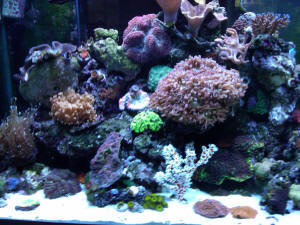 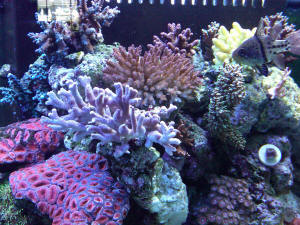
 |
Strange Calcium/Alk/PH levels?
7/5/09
WWM,
<Jason>
Thank you for taking the time to help me with an ongoing issue I have
with my tank and strange readings I am getting.
<You're welcome.>
My tank is fairly new, it's only been running now for around 4
months. I test the day before every water
change and my Calcium is consistently 520+, my PH is 8.4 (towards the
end of my light cycle) and my alkalinity measures between 9 - 10 DKH. I
do not dose any calcium/Alk supplements, and I only dose SeaChem Marine
Buffer (1/2 the recommended dosage) once every 4 days. I perform 5
gallon water
changes (29 gallon BioCube) every week. I use Coralife sea salt with a
RO/DI unit in front of a Culligan water softener (uses sodium not
potassium). I measured my RO/DI water only (no salt) and my Ca reading
was between 0-20.
RO/DI with the salt added, the Ca levels are at 380. Thinking I may
have had a bad test (API) I purchased a Salifert Calcium test, it gave
me the same results. Again, thinking it was me not performing the
tests
correctly, I took my water to two different LFS stores, they both came
back with the same readings. I am using Aragonite sand from CaribSea,
and I have all live rock (no human made rock). I have had levels 520+
since I started testing 2 months ago. Any ideas as to what is causing
these high levels of calcium?
And any ideas as to what I can do to lower these levels?
<You did not indicate whether you have any calcium loving
invertebrates in your tank. Calcium levels generally do not fall with
nothing to absorb the calcium. Aragonite is actually calcium carbonate,
and will help in keeping the calcium level up. You may want to read
here.
http://www.wetwebmedia.com/calcalkmar.htm>
I really appreciate everything yall do for us reefers. The service yall
provide makes it so much easier for people like me to get and stay in
the hobby. Keep up the good work!!!
<Thank you. James (Salty Dog)>
Jason
Re: And Then There Were Six, LTA... Now,
Ca/Alk ish f' 6/30/09
Hi Bob,
<Darryl>
The LTA seems to be getting better, well, not worse anyway...
Regarding my "bit too high" Ca levels. I went out and bought
a KH test kit to answer your question. I hadn't been measuring Alk.
previously.
It came in at 8 dKH, which according to the WWM Alk. FAQ is at the
lower end of the acceptable range, which makes sense. So my question
is, what should I do about it?
<Please read here: http://wetwebmedia.com/calcalkmar.htm
and as much of the linked files above as it takes>
I currently rely on fortnightly 20%
water changes to maintain the water chemistry, without any
supplementation. I use local tap water aged for two weeks in a plastic
trash bin for two weeks - continuously stirred with a small
powerhead.
Thus far, this has worked well. The readings I gave you haven't
budged since the tank finished cycling and I'm not too keen on
jumping on the supplement rollercoaster if I can avoid it.
<You very likely can... again, please just read>
Currently the only calcium consumers users are the coralline algae, 1
Euphyllia, 1 Faviidae, some hitchhiker fanworms, and some Clavularia.
I've intentionally kept the system understocked as I'm new to
the hobby, lazy, and want a nice, but relatively maintenance free
system with some margin for error.
<Understood... and my focus as well>
The system is almost entirely diy. 50 gal display w/ 50+ lbs LR, 15
gallon sump. Flow is about 400 gph. Supply = 1" DIY PVC pipe
siphon overflow,
<Mmmm>
Return = Calfo style closed loop manifold. I know I need a bigger
siphon. It's huge pain to keep it balanced, fiddling w/ partial
siphon makes me nervous... I like the horizontal overflow design but
haven't been able to upgrade just yet as it necessitates a tedious
breakdown to drill the tank. I'm currently planning to simply
build a larger-diameter overflow with the only other difference being a
larger diameter sleeve over the siphon intake to get more water from
the top.
The occupants include:
1 C. strigosus , 3 Chromis viridis, and the aforementioned M.
doreensis.
+ incidentals
A few small patches of (growing) Porites. three or possibly four
species of Zoanthid, M. sculptus (several), various fanworms, micro-
Brittlestars, sponges, tunicates
+ pests
A. Majano, small Xanthidae, Bryopsis, Lobophora, some sort of
(S)tomatopod, which is tiny and looks like Gonodactylellus affinis.
Thus far these guys haven't been too bad. The stoma whacks a crab
every now and then but I didn't want those crabs anyway. The algae
are kept in check with some very occasional yanking and low
nutrient
levels from underfeeding, currently about 10-15 Spectrum pellets twice
daily + some fine meaty goodness (mixed blended mussel/shrimp/etc ) for
the LTA and Torch on Sunday. No Spectrum on Sunday since the fish clean
up any scraps.
This stomatopod, I suppose he precludes the introduction of skunk
cleaner shrimp?
<Would likely be consumed, yes>
I'd like to get one or two but I don't want them to get
whacked. He's just a wee little thing, but he's wily and thus
far evaded all attempts at capture.
Darryl
<Sounds/reads as a very nice system/project indeed... and with a bit
of looking/seeing, perhaps changing salt mix brands... you will very
likely be able to get your alkaline earth, biomineral ratio in enough
balance. BobF>
Fun w/ Calc/Alk 6/30/09
Thanks Bob,
<Surely welcome Darryl>
Ok ok, RTFM it is then. <!> That's cool. Phew, that was a lot
of reading.
I sorta get it, I think, though it's been a while since I've
had chemistry 101. pKa and all that. So, I guess this is fairly
common.
<Ah yes>
I'm using Red Sea Coral Pro salt mix, and I'm sort of stuck
with it as it's the only salt mix my LFS seems to sell.
<Try mail-order... there are some deals about>
There's nothing in the FAQs mentioned about that specifically but I
did see a lot of talk about fiddling w/ supplements to try to bring up
alkalinity. Ok, I can go get some Kent buffer powder
<Look to SeaChem...>
and see if that works. But first a few observations. ( It's nice to
use my ChemE degree from time to time. ;-)
<Dang!>
First I tested my tap water. It's soft as a baby's bottom, dKH
was unmeasurable with my test kit ( < 1 dKH ) and the same with Ca (
< 20 mg/l ) but there's about 0.25 mg/l of PO4 and SiO was very
high, off the charts. I'm hypothesizing that this is what's
throwing off my mix.
<Could be>
Then I tested the aged mix. First, there's an off-white
precipitate, so something's definitely up there. Calcium Phosphate
and/or Silicate is most likely. So, drum roll please. PO4 had dropped
to 0. Ah ha!
<There's a clue>
I didn't bother to test for SiO but presumably it's dropped a
bit as well. I've measured it in the display and it's present,
but at much lower concentrations (~ 2 mg/l). Though I don't clearly
understand (yet) what the impact of these anions have on the mix but I
can see how they might compete with the carbonates, though, by removing
Ca from the mix
<Yes... this and Mg (which you should test for) and to a much
smaller extent Sr...>
I'd expect it to have the opposite effect, high Alk, low calc, but
I'm gonna run with it anyway. Besides, nobody seems to really
understand seawater chemistry. ( A little rationalization's good
for the soul. )
<Till it becomes too self-delusory... e.g., witness "U.S.
Defense"... nothing defensive about traveling halfway around the
world, murdering other countries' citizens... in the
"cause" of "peace". Murder begets murder>
So here's what I tried. I added about 1/4 tsp of Sodium Bicarbonate
to the water (12 gals), not the tank, just the premixed. Then measured
it up again. dKH = 12, Ca more or less the same but I expect it will
drop some, and the pH was unchanged.
<We'll see>
Now, I saw that NaHCO3 is generally not advised because it can
radically increase the pH, but here it's just a bit of a tweak with
no appreciable increase in pH. Do you think it's ok to continue
down this road or am I just asking for trouble?
<There are better approaches... and likely none worth really
pursuing, given your set-up, stock, intentions... Myself? I'd
simply change salt brands, perhaps mix with mostly R.O. water if you
make it at home>
I suppose RO/DI is an option
<Oh! Yes>
but at 25c a box. Bicarbonate sure is attractive.
<Am an old timey advocate>
I plan to test it again before I change the water, and have an
unadulterated barrel of water in the wings in case its radically
off.
Darryl
<Real good. BobF>
Re: Clumping sand, calcium deposits everywhere...
corr. to resp. 6/13/09
Hi Mr. Fenner,
I was hoping it would be you responding! Thanks so much for investing
your time and insight into other peoples complex issues.
<Welcome>
Firstly, you mentioned a DKH around 12 or just under 5 mEq/l was near
precipitation level.
<Yes... if coupled with high/er biomineral (Ca and Mg mostly)
concentration/s>
What is a more ideal alkalinity?
<Mmmm... 9 to 12 dKH or 3 to 5 mEq/L at the most on the high
ends>
I though between 4 and 5 mEq/l was kind of akin to that magical 450 ppm
calcium that everyone wants, and no one gets.
<This is too much Ca... I would shoot for about 400, and be
satisfied with 350>
Secondly, I ran all the tests, and the only real anomaly was that the
reactor media instigated an alkalinity of 24 (DKH) within its test
cup.
Otherwise the tank water, and cupped water with tank sand and refugium
sand, separately, all tested relatively the same. Ph of 8.3, calcium
levels have dropped to between 350 and 370, and the alkalinity was
running between 12 and 14 DKH.
<So?>
So, it appears the calcium reactor is not tuned very well.
<Do see WWM re media choices here>
I admit that there is no Ph controller, just a bubble counter and the
effluent is measured with a ph probe monthly and adjusted from there
(its usually pretty close to 6.5). The drip rate is probably a very
fast broken drip. We do go through media at a faster than normal rate.
I bought the media second hand, it was a bulk bag, at least 30
pounds.
<Oh! Could likely be "it" here>
It was unmarked, but supposedly it was Caribsea (looked like it) and
was bought from his personal friend, the owner of JL aquatics. We have
pretty well finished the bag now (over perhaps two years), maybe I
should switch to the larger chunk media?
<Another brand... try Knop's Korallith for a while...>
BTW it is a precision marine, I believe the model is CR 422, it's a
popular model and I use it with success elsewhere.
I hate to ask for advice with a calcium reactor but I don't really
know how to better tune this thing. Also, how the heck am I going to
reverse the trend of sand clumping?
<Mmm, different/better media, higher effluent pH (6.8), slower drip
rate...>
And...how to do all this without shocking tank inhabitants (full reef,
shrimp, giant clam, you name it)?
<Slow change...>
Lastly, if you ever need a set of eyes or ears in Toronto, let me
know.
Thanks again,
Kev
<Thank you, BobF>
Alk/Mg/CA Questions: When the quest to hit a
specific number has you running in circles. 5/28/2009
Hello Crew...
<Hi Cassidy.>
I've been trying to figure out what exactly is going on in my 240G
reef tank with the ionic balance.
<OK>
To summarize - I had hired a company to setup a fish tank; it turned
out to be a reef tank. I knew nothing about it what so ever. I took
care of it personally for the first 3.5 months, then hired several
company to perform maintenance. They started dosing chemicals for ca,
mg, ph, trace, etc. .
<Most reef tanks do need supplementation. That is largely based upon
what is in the tank.>
Ever since then things have not been where they should be.
<Things aren't looking healthy? Too much algae growth?>
I have since fired them and started to manage it myself again. I read
and read and read but cannot figure out what's going on.
<You are trying to hit theoretical 'perfect' numbers, and
all too quickly discovering how hard it is. Remember, stability in a
given value, even if it is slightly low, is much better than fighting
to hit a perfect value. That is why most values for marine tanks have
ranges rather than absolute values.>
Tank Specs are:
240G
55G Sump
4 x 250W MH 20000K
ASM G3 Skimmer
2X72" Actinic
2x 1/3" HP Chillers
Phosban Reactor
Berlin Style / Closed Loop System
Photo Period is about 8 Hrs for MH and 2 hours before and after with
actinic.
40G water changes are performed weekly.
All filters/pads/socks are cleaned every 3-4 days.
Carbon/Phosban is changed monthly.
<Sounds like a nice setup.>
Water Conditions are:
CA: 500ppm <Ragged edge of high>
DKH: 7.5-8 <Fine>
Ammonia: 0
Nitrite: 0
Phosphate: .01-.03 <A little high.>
PH: 8.3-8.55 <Fine>
Nitrate: 10 ppm <OK>
Magnesium: 1100ppm <A bit low given the calcium level.>
SG: 1.25-1.26 <Very good>
Temp is constant at 77-78° <Very good>
My CA is always decent; around 420-480 ppm.
<That is fine, realize that as a general rule, the higher your
calcium, the lower your alkalinity is going to be.>
However, DKH always drops rapidly after water changes/buffer to
increase ALK.
<It drops to what?>
PH is constant around 8.3 evening / 8.45 day time. In an effort to
combat the low ALK I purchased a Dual Chamber "Marine Technical
Concepts" MTC PROCAL Reactor. Was a breeze to setup and running
fine. But the ALK is still low.. 7.5-8 without dosing any buffer.
<You added a calcium reactor,. Adding calcium will drive your
alkalinity down.. In either case, a dKH of 7.5 - 8 is fine as long as
it is stable. Do read here: http://www.wetwebmedia.com/calcalkmar.htm
>
My calcium continues to climb and it was at 500ppm last night.
<Turn the reactor off, stop adding calcium.>
I am concerned that this is too concentrated and I am worried about the
'snowstorm' effect.
<I would be too.>
My initial though was that the MG was low and it is at 1100.
<It is low - generally, you want the magnesium to be at three times
the calcium level, so you would want a calcium level of at least 1350
This is easily done by adding simple Epsom salts.>
I performed a large water change 50% to try and 'reset' the
balance. My MG is still low at 1100 so I added some liquid SeaChem Aqua
Vitro Ions and it has not raised the MG one bit. I use Sea Chem Reef
Salt (not sure if that matters). I have a 1.5-2" fine sugar sized
sand bed. I am not sure if its worth noting that there has been a
explosive growth of coralline algae since the CA Reactor was added.
<Stop adding supplements, turn off the calcium reactor. Add some
Epsom salts to get the magnesium levels up.. Continue with normal water
changes. Measure your alkalinity daily to see what it is doing. If it
starts going under 7, add a tablespoon or two of plain old baking soda.
Don't add anything else for a week.>
I am worried the CA is too high.. is this going to have a negative
effect on my corals/inverts?
<Only if you get a 'snowstorm'>
Is there any simple way of getting the DKH up and keeping it where it
should be?
<Again, 7 - 8 is fine as long as it is stable Trying to hit
'exact' numbers will have you running in circles adding this
and dosing that.>
My tank is heavily stocked - is it at all possible they are making use
of the carbonate and magnesium and not using the calcium consistently?
Its my understanding that all these elements work in synergy with each
other and should be used proportionately by the livestock.
<They do, but you are overdosing on calcium>
Any insight into this would be greatly appreciated - I'm ready to
pull my hair out. And I've been through three maintenance companies
that have not been helpful at all.
<My advice is very simple. Stop adding things to the water and turn
your reactor off. Correct your deficiency in magnesium using nothing
but a tablespoon or two of plain Epsom salt, Test your water daily to
get a read on what it is doing. If you see the alkalinity dropping
below 7, add nothing but plain baking soda. Add nothing to your change
water other than salt mix. After a week to 10 days, see where you are
in regards to calcium\alkalinity\magnesium>
Also on a side note - I have an issue with feather dusters.. they are
multiplying by the thousands.
<Must be the tiny feather dusters>
I know they are beneficial but when they get to this point they are not
very easy on the eyes. Is there any method to decrease their
growth?
<They are breeding because you have an excess of nutrients in the
tank (Nitrate and phosphate). Try adding some algae to your sump to
help with the nutrient control. The feather dusters will decrease in
time. Remember, NOTHING good happens quickly in a reef tank.>
Or do people want these? More than happy to collect them and give
away.
<You could try a local pet store.>
Thanks again and sorry for the looooong email,
<My pleasure, do write back after a week with the readings. From
there, we can see where your system sits and what it needs.>
Cassidy
<MikeV>
Re: Alk/Mg/CA Questions: When the quest to hit a
specific number has you running in circles. 5/29/2009
Mike,
<Hi Cassidy>
The DKH will drop and drop...
<Add baking soda as necessary to buffer it back up. Alkalinity will
continue to drop as long as the calcium is high. Once you get your
calcium down into the mid 400 range, the alkalinity should
stabilize.>
I have yet to let it get down past 5 but each day it will drop a point
or two and doesn't seem like its going to stop.
<May want to add more substrate to help buffer the system
too.>
I will follow through with your advice with Epsom salt and baking
soda.
<Good, add the Epsom salt now, that will 'unlock' the
calcium that is in the tank so your corals can use it. Add baking soda
only as needed to keep your alkalinity up. Do keep up with your regular
water changes.>
You were not quite clear about the calcium reactor. I know I turn it
off - but after 10 days if things return to normal shall I turn it back
on and turn it on very very slowly to see what happens?
<That will depend on what the levels are and what is in your tank;
do write back then. As the saying goes, "let's see where we
are before we figure out where we are going.">
I know my levels were way off before the ca reactor and was hoping that
would be the end all - of it. Again thanks for the advice!
<My pleasure, again, do write back, and do test your water
daily.>
Thank You,
Cassidy
<MikeV>
Re: Alk/Mg/CA Questions: 6/4/2009
Mike,
<Hi Cassidy>
I have followed your advice. My levels are: Ca 460, Mg 1250, DKH 8.
<Ahh, much better.>
I've had to add 1 tbs of baking soda every day or two to keep it
there.
<Not surprised, you should have to add it less and less as the
calcium level dropped.>
I have also had to add about 1/4 cup of Epsom salt to get my mg up (not
all at once of course). I think they are where they should be now.
<All of your readings are good.>
Would it be wise to start the CA reactor up again - very slowly and
gradually
of course.
<Yes, very slowly, and keep monitoring your levels, it may take some
time for everything to get into balance. If your calcium levels start
skyrocketing again, turn the reactor off. We need to find the balance
between what your tank is using as opposed to what is being
introduced.>
Its my understanding that the Ca reactor should also add the amount of
mg that I need. Is this correct?
<Between that and regular water changes, you should be fine.>
I have never really tested the effluent output of the reactor for MG -
and since its off I can't now.
<Do monitor the Mg levels and supplement if necessary.>
I've noticed that much of my coralline algae is bleaching out now.
Rather rapidly. I'm assuming it will come back when the reactor
goes back on.
<Some will come back, the algae growth was pushed by the high
calcium levels>
How should I proceed to keep things stable?
<Turn your reactor back on, very slowly and continue to monitor your
levels. What you are aiming for is a consistent level of calcium in the
tank. Adjust your calcium reactor flow as necessary to sustain
it.>
Thanks,
<My Pleasure.>
Cassidy
<MikeV>
High PH High Alk Low Calcium-
5/10/09
Hi, this is a great site with a lot of information. I read through the
FAQ section regarding Calcium and Alk and I believe I have an idea
about what is going on with my tank, but wanted to find out your
opinion. I have a 90 gallon with a 30 gallon sump with about 110 lbs of
live rock and I use Oceanic Salt Mix. I recently changed out my
substrate in the main tank about a 1 1/2 weeks ago to Bio-Activ Live
Aragonite sand from play sand, about 2 inches of sand. Ever since the
change, my Ph and Alk have been high and my calcium level is low.
Current readings are PH 8.5-8.6, Calcium 260 ppm, Alk 13 dKH. Prior to
the change my Alk was always about 7-8 dKH, Calcium 400-450, and PH
8.1. I haven't noticed any affect on my fish and invertebrates, but
have noticed my corals are not opening up completely like they did
before.
<I'll bet>
If I try adding calcium, it does not increase and I get a white
build-up on my powerheads and glass (I've reached saturation). I
did a 20 gallon water change 2 days ago with no change to the
parameters. Is the change in Ph, Alk, and Calcium due to the new
substrate?
<Very likely so; yes>
What can I do to fix the problem?
<... lower your alkalinity... The high carbonate is precipitating
the biomineral>
If there is nothing I can do , how long will it take for this to fix
itself? Thanks in advance
Andrea Walton
<Ahh! Andrea, "woman of the sea"... Please read here:
http://wetwebmedia.com/calcalkmar.htm
and the linked files above, particularly
"troubles/hooting"... You may have to remove, replace the
substrate... Bob Fenner>
|
pH/Kalkwasser drip 4/7/09
Understanding Calcium/Alkalinity
Crew:
<Doug>
I have a two hundred gallon marine tank with mostly rock and sand
up stairs it has a 75 gallon sump down stairs.
Sitting on top of the tank are 3x150 10K HQI MH and 4 X96W 03
actinic CF.
Lights are on 7 hours a day.
I have a 5,000 gallon per hour pump with 15 feet of head to the
tank.
The tank has 6 fish and the largest is a Yellow Tang and a total
of 13 other small inhabitants made up of soft and hard corals and
a 6 inch long clam.
The water returns in a 3 inch pipe to a 4 foot high tower in back
of the 75 gallon sump with a diffuser panel at the top and three
5 gallon buckets of live rock rubble above the water line in the
tower. Below the water under the tower another 100 lbs of live
rock.
A Protein skimmer near the sump has ozone and a new calcium
reactor (not working yet) in the sump.
A 1/3 hp chiller and water stays around 78 degrees.
Water change is 20 gallons twice a week with RO/DI water and
Corallife salt.
Water is aged with air and circulation on both fresh and salt
holding tanks. Salt water is buffered to 8.3 PH in holding
tank.
My system info on the control and testing this morning reads
Temp 77.8
PH 8.19 now, but I buffered this morning and it rose a little. I
don't want to raise it too much.
ORP 381
DO 6.0
Conductivity 54
Salinity 35 PPT
Calcium 360 after buffering this morning
KH 14
Phosphate 0
Nitrate ion 0ppm
About 90% saturation.
One of the concerns I have is the PH is always falling to 8.10
during the day
<Is normal for a slight drop in pH during the day.>
and calcium always goes down as low as 320 overnight. I would
need to drip buffer pH and calcium
all the time to keep up and I think this will cause a ping pong
problem.
<A high dKH such as yours (14) can cause calcium to
precipitate. I'd keep this around 8 or 9.>
I got a new calcium reactor but its not working correctly
yet.
I had the pH built up slowly to 8.3 last night and calcium to
400. I tried for the first time a Kalkwasser drip.
I used 1 tsp in a gallon of RO/DI water after lights out. This
morning the pH was again was 8.16 and the calcium was 360.
I guess I need to try two tsp tonight after buffering everything
back up to STDs?
I know I got to get the reactor working!
But I still wonder what is driving the pH down and the calcium
without a heavy load of fish and other items in the tank.
Maybe the pH buffering is driving the calcium down and dKH
high.
<Exactly. Do read here my friend.
http://www.wetwebmedia.com/calcalkmar.htm>
Should I just get the dKH and calcium right and let the pH settle
where it wants to over 8.0?
<Just get the dKH down to 8 or 9 and you shouldn't see the
calcium swing as much. Are you keeping your magnesium levels up?
Is a major element of seawater and helps corals to absorb the
calcium.>
Thanks for your time.
<You're welcome. James (Salty Dog)>
Doug
pH/Kalkwasser drip query -- 04/07/09
Bob,
There are two photos included with the query. I couldn't open
either of them.
James
<Strange... I could/can... maybe you have some sort of
blocking software at
work on your machine that won't allow... B>
Maybe, next time that happens I'm going to disable the Norton
software and see what happens.
J
<Ok!>
|
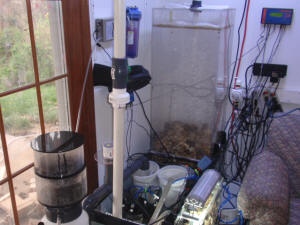
.JPG) |
Calcium And Alkalinity 3/16/09
Hello,
<Hi John>
I'm having some troubles with alkalinity/calcium and from my
readings on WWM I'm not alone. Most of the posts I've come
across though are low calcium + high alkalinity or someone trying to
get high calcium and high alkalinity (ie. 200 marbles...), or someone
trying to use 5 or 6 cross branded supplements, etc...
After reading Anthony's book, Bob's book, and several other
books from the library I have a BASIC, I repeat - BASIC understanding,
but still need some help and/or re-assurance.
My Ammonia, Phosphates, Nitrite, Nitrate are zero according to my API
Master Reef Test Kit. Phosphate is the hardest color scheme and I very
highly doubt it's really zero but it's the lowest bar on the
color chart.
I tested for calcium and it was 380 and the Alk was 10.5, so I tried
using B-Ionic 2 part. Knowing what I know now this was probably a
mistake since the Alk was already at or above ideal and 380 is not too
bad.
<In my opinion, 10.5 is high. I much prefer 7.5 to 8.5.>
After about a week of mixing in 10 ml per day in the a.m.; I have a 65
gal w/25-30 gal sump, skimmer, refugium - w/Chaeto, my Alk had gone up
to between 12 and 13 and calcium at 400. BTW, I change 20% water weekly
w/standard IO.
Can I add one or two doses of just the calcium part of B-ionic? 5-10 ml
per day, to gingerly bring the Alk down to 10-11 and keep the calcium
around 400 until things get re-balanced?
<This is exactly what I do not like about the two part mixes, rarely
produces a nice balance.
I would not add any more of the alkalinity buffer, let's get the
dKH down around 8. Consider switching
to separate supplements rather than two parters, I believe you will be
much better off.>
Thanks as usual for any help.
<You're welcome. James (Salty Dog)>
Re Calcium And Alkalinity 3/16/09
James's comment:
<This is exactly what I do not like about the two part mixes, rarely
produces a nice balance.
I would not add any more of the alkalinity buffer, let's get the
dKH down around 8.....>
I'm thinking about using the B-Ionic separately until it's gone
now that I have a better understanding of how cal/Alk are related.
<Certainly, I did not mean to throw them out, just switch when you
run out.
I'd post a link for you to read but cannot get the Wet Web Media
site to come up for some reason. Go to www.wetwebmedia.com and Google
search calcium and alkalinity, then choose "Understanding
Calcium And Alkalinity".>
Long term though what do you recommend for calcium and alkalinity as
separate supplements? It looks like the B-Ionic does have some trace
elements as well, Iodine, Strontium, etc.. I'd prefer as few
bottles as
possible, as with the water changes I'm doing I don't see my
system getting too out of whack ( knock on wood). I can foresee adding
very small amounts just to keep things optimal.
<A few options here. Tropic Marin has a product called Alca-Balance,
which is geared at keeping calcium levels up and maintaining a lower
but safe dKH (7 to 9 dKH) all under one cap. See here on this product.
http://www.tropic-marin.com/web/english/homepage.html
I haven't used the product so I cannot attest to it's
performance, but Tropic Marin is known for quality products.
Presently, I use Seachem Reef Advantage Calcium which includes
magnesium and strontium. I might add that it will not maintain a
1280ppm level of magnesium. At least it doesn't in my system. For
buffer, the Seachem Reef Builder.
I also dose magnesium with Tropic Marin Bio-Magnesium, I do like that
product. My iodine supplement is Lugol's solution which I can get
at the drug store; one drop per 10 gallons of water weekly. I do a 10%
weekly water change using Tropic Marin salt, and dose no other
supplements.>
Thanks again!
<You're welcome. James (Salty Dog)>
Rebalancing Calc/Alk -- 02/28/09 I'm
sure you've answered this before, but I haven't found it.
<<Okay>> My question is: having been on vacation for 2
weeks and not adding the 2 part supplement (I use B-Ionic), my calcium
is at 430 and alkalinity is around 7 dKH. Not bad,
<<Agreed>> but I'm surprised my calcium did not go down
over this time as I have lots of SPS corals in my tank.
<<Mmm'¦perhaps growth/bio-mineral uptake was merely slow
during this period>> When I left, the calcium was about 440 and
the alkalinity about 11. I left them high because I knew I would be
unable to dose over the two weeks and could not expect my house sitter
to handle it. <<I see'¦not ready for that Calcium
Reactor yet, eh?>> Anyway, I presume I should try to raise the
dKH some. <<To about 8 or a little more should do>> Should
I do this by using only the Alkalinity part? <<You can>> Or
should I use baking soda to give it more of a 'jolt'?
<<Hmm, not sure what you mean by 'jolt''¦but if
pH is an issue/is already high (8.3 >), the Sodium Bicarbonate will
not impact re and thus may prove the better choice>> Eric
<<Simple water changes with a properly prepared and aged quality
salt mix are usually the best (and most beneficial) method for getting
water chemistry back in balance'¦but either of your listed
options will do what you ask here. Regards, Eric Russell>>
|
Miracle Mud And C-Balance Not Balanced 2/16/09 ID Of
Critters On Live Rock Hey guys, <Hello Steven> I
have a few questions for you and I would also like you to ID
something in my tank. Let me give you a tiny bit of background
before I get started. I have a 55 gallon reef right now and I
would like to upgrade to a 200 gallon reef when I move out :) . I
am making some changes in my 55 gallon reef to test out some new
things before I implement them on a larger scale. Right now I use
the Berlin method of filtration with an AquaC Remora Pro for
skimming, RowaPhos to remove the extra phosphates, and C-Balance
to keep the calcium and alkalinity in check. In my new tank I
would like to try to keep the maintenance cost down so I figured
why not try out for Miracle Mud'¦I figured I could save
some money on C-balance and maybe not even use a calcium reactor.
Here is the problem: I put the Miracle Mud in the Aquafuge with
some Chaeto and reduced the amount of C-balance that I added by
around half. The calcium level is going up but the alkalinity is
going down. My calcium is around 470 and the alkalinity is around
2.8 mEq/L. I called Ecosystem and they said that the mud
won't boost the alkalinity as much as the calcium. I called
Two Little Fishes and asked them if I could use more of part B to
balance things out and they told me never to do that. They told
me to always add equal amounts of part A and B. I have been using
some reef buffer by Seachem to keep the alkalinity raised
instead. Is this a viable long term solution? Will I end up
problems down the line using the combination of C-balance,
Miracle Mud, and Reef Buffer? <This is one of the reasons I do
not like using Part A/B products. I'm for dosing a la carte,
supplement individually when required. Your 2.8meq/L reading is
just fine.> Next Question... I am using the Aquafuge medium
with a 404 mini pump (for additional flow) and the 24 watt light
that it comes with. Even with the extra flow from the 404 mini I
am still having problems with algae covering the mud and Chaeto.
It is getting so annoying that I am thinking of selling the fuge
and going back to using C-balance exclusively. <The mud
isn't what is causing the algae problem, it is excessive
nutrients in the water. I've used the Ecosystem Fuge and I
did not have any algae problems due to the Miracle Mud.> I
sent you a picture of the Aquafuge so you can get an idea of my
setup. Did I put too much Chaeto in the Aquafuge? <I think so,
half of that would be good. You may want to read the FAQ's
here on Miracle Mud filtration.
http://www.wetwebmedia.com/mudfiltrfaqs.htm> Should I add
another mini pump to get some more flow? I am not really happy
with this setup-up compared to the old method of just adding
C-balance. Can you let me know where I went wrong? I don't
want to have problems like this in my new setup. <You never
mentioned nitrate levels, stocking levels...what are they?>
Now I have one more question. I found a website that sells a 3
part Calcium-Alkalinity dosing product that is really really
cheap. I could use it in the 200 gallon aquarium without worries
that it will get excessively expensive. Can you let me know if it
is a reputable brand? I can get 10 gallons of each part for 90
bucks.
http://www.tbaquatics.com/shop/index.php?main_page=product_info&cPath=4&products_id=100
<I've never heard of it. Try posting this on one of the
reef forums. On another note, I'm not a big fan of adding
calcium and buffer simultaneously. Is better to dose on separate
days.> If this is the same as C-balance then it's a great
deal. <Can't help you much here, best to post. I prefer to
use products like Seachem, Tropic Marin, etc, and buy in the
larger sizes which makes it more economical to use.> Last
thing I promise. There are two things in my tank I was hoping you
could ID for me. I have some sponge looking things that are
growing in low light areas of the tank and also little white
circles that are appearing my rocks. I have included pictures.
<Pictures are too blurry, but I'm thinking they are a
sponge of some type.> Thanks!
<You're welcome. James (Salty Dog)
Steve
|
 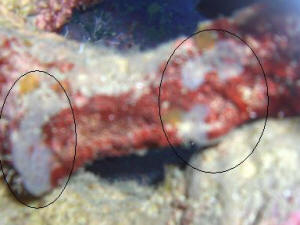 |
Calcium, Magnesium, Alkalinity and PH
1/29/09 Hi Crew, <Hello Ranjith> I understand
that maintaining high ALK and CA can be difficult and even counter
productive. <Yes, high dKH levels tend to keep calcium ions from
rising.> I have a 120 gal reef and have the following parameters *
Alk - 3.5+ Meq/L * CA - 300ppm to 320ppm * PH - 8.4 (measured close to
lights out so is the high point) * MG - 1200ppm I can't seem to
reach CA levels of 350 or more (am sure you are going say high Alk is
the problem). <Has much to do with it.> It started with 250ppm a
few weeks ago. I started with Tropic Marine bio calcium but quickly
realized this will cost way too much to push 120 gal up by 100ppm. So I
shifted to Calcium Hydroxide. I dripped initially using 2 teaspoons in
1 gal of water to get the water o 800ppm and then dripped the clear
liquid only. This was done once at night and once in the early morning
2 hours before lights come on. The product I use is from Merck "
http://www.merck-chemicals.com/india/"
(is this a known chemical company?). <No idea.> It is the GR
grade which is analysis grade (better grade I presume?) <Likely as
good a grade as you would get from a LFS.> I was able to raise CA
from 250 to 300ppm in 2 weeks time. I was not getting any rise after
300 so I shifted to the slurry method. I dose using the slurry method.
Basically, mixing half teaspoon in approx 1 liter of water and pouring
this into the skimmer outlet in cup size amounts. I wait a few seconds
in between each cup sized addition for the water to be clear in the
area I pour into. Once a week I add 10 spoons (50 Gm.s) of tropic
Marine bio calcium (calculated as per what is given on the bottle) This
has over last 3-4 days raised CA to 320ppm (20ppm rise). I realize due
to my Alk being high my CA might be getting precipitated. <The
Germans are keeping dKH levels at 5-6 dKH in that regard (personal
conversation with Lou Ekus of Tropic Marin).> I have the following
livestock one moon coral, 1 leather finger, 2 Zoanthid colonies, 2
Palythoa colonies. An 8" Volitans Lionfish and a 4" Skunk
Clown. Layer on top of Coralline (pink, purple and green) are taking
off well on the live rocks and even covered the PVC framework. It
however grows better in the lower regions of the tank. I have tested
with a brand new Elos test kit for CA and the possibility of it being
out of whack are pretty low right? <I'd say pretty low, but how
about your dKH test kit, is it reading correctly? Most calcium test
kits require using distilled/RO water as the dilution base for accurate
readings. Does your test kit state this?> Should I continue to add
Kalk slurry, or use calcium chloride to reach the range ? <Calcium
chloride is good for quickly raising calcium levels but not recommended
for long term use. Stay with what is working for you.> Can you tell
me if I should just sight tight and relax or continue the efforts to
reach a CA of 350+? <Seems to me like we have been through this a
couple of weeks ago. If it were me, I'd discontinue using any
buffers. Let the dKH drop to 5-6, see if there is a noticeable
improvement in raising your calcium level.> Cheers <Good day to
you. James (Salty Dog)> Ranjith
Re: Calcium/Alkalinity 1/30/09 Hi James
<Hello Ranjith> Nope this is the first time I wrote regarding
calcium. <OK, no problem.> I was unaware of levels and thus happy
as I had never tested before :) I use a RedSea kit for Alk. It seems to
be pretty correct but may not be very accurate. <Mmm, pretty
correct, buy may not be very accurate?> The Elos kit is not needing
any distilled or RO water. Just uses tank water directly.
<That's nice.> I have stopped adding buffers except calk
since I started it as calk is indirectly supposed to help keep Alk from
going down. Are you saying I should stop adding calk as well till the
alkalinity reaches 5ish? <No, just the buffer. Your tank is lightly
stocked so it may take some time for the dKH to come down.
Comparatively speaking, you just have less money in the bank. But since
you are a conservative spender, the money is not going to be taken out
too often. Mmm, wait a minute, you mentioned an 8" Lionfish, never
mentioned what size tank you have or your filtration system makeup.>
Cheers <Good day. James (Salty Dog)> Ranjith
Re: Calcium/Alkalinity 1/30/09 Hi James
<I feel slighted. You spell your name with a capital "R"
but mine in small case:)> The tank is 120 gal with 160pounds premium
live rock. Runs a EV180 (under powered pump currently) 5" DSB
<A good choice in skimmers.> Rare water changes sadly. <Yes,
very sad. James (Salty Dog)> Cheers Ranjith
Re: Calcium/Alkalinity 1/31/09 Hi James,
Apologise for the lowercase in your name. <Hey, was just a bit of
humor on my part, no offense at all.> Am doing this from a handheld
so might have overlooked. My name on the other hand is set in a
signature so came correctly :) Will read the response you sent now that
I have corrected the language mistake :) Cheers <James (Salty
Dog)> Ranjith
Calcium/Alkalinity... imbalance 12/5/08
Hello all <Hiya> I have any issue with raising my Ca levels above
250. My PH is at 8.5, and my Alk levels are at 14Dkh.? <The high dKH
is preventing you from raising your calcium level.> I think that if
I add Kent Turbo Calcium to my top off RO water, my Ca levels should go
up while my Alk drops a bit. Is that correct? <Nope. The only
product I know of that will raise calcium and lower dKH is Tropic
Marin's Alca Balance.> I would add the granules to the water I
use to compensate for evaporation (about 1 gallon a day). If this is
correct when should I see a noticeable difference when I test? Thanks
in advance. This relationship in water chemistry can be kinda
confusing... <Yes, and is why you need to read here.
http://www.wetwebmedia.com/calcalkmar.htm> Thanks and Happy Holidays
<You're welcome and ditto to you. James (Salty Dog)>
Re: Calcium/Alkalinity 12/8/08 James,
<Hello> Thanks for your reply. <Welcome.> I have read the
attached article and have learned a lot. I think I will do a couple of
water changes before I add anything else to my system. <Good. James
(Salty Dog)> See ya
Supplement Juggling Act...Igor Lives... Ca, Mg
and dKH 12/3/08 Hi there, <Hello Richard> First, the
problem (or at least what lead me to conduct some tests). My Acros and
Montiporas look bleached or all brown (as opposed to individual
colours) but polyp extension is good. Corals showed some growth in
first 2 months in my tank, but over last 2 months there has been almost
none. Parameters, SG 1.024, temperature is 24-26C, ammonia=0,
nitrite=0, nitrate=0, phosphate=0. I know you will say these are
probably being consumed at source so not strictly zero but I have
focused on nitrogen cycle items being the cause of discolouration to
the detriment of other tests and herein I think may lie the problem?
<Mmm, I wouldn't look here.> Upon deciding to test more
widely, I have found that magnesium was approx 800 ppm/l, calcium was
320 ppm/l and alkalinity/carbonate hardness was around 20dKH. <With
magnesium at 800ppm, your corals are only able to absorb 62% of the
calcium available which in turn means at a calcium level of 320ppm,
only 198ppm is available to the corals. Magnesium must be kept close to
1280ppm for the measured calcium to be 100% available for the corals.
The high dKH is also hurting you in this regard and a dKH of 8 would be
a good target goal. The Europeans are now striving to keep dKH levels
as low as 7dkH giving better dKH, calcium, and magnesium balance. (re
phone conversation with Lou Ekus of Tropic Marin)> As mentioned
above, these readings have lead me to move away from suspecting
nitrates/phosphates as a problem and to now suspect the problem is with
these readings. <Absolutely!> Since these readings, I have added
magnesium and have managed to get this level up to around 1150 ppm. It
seems difficult to go beyond this and I don't want to start dumping
too many supplements in the tank. <Getting the dKH back to normal
would be my first concern.> I am now trying to figure out how to
raise the calcium and lower the dKH level and would appreciate your
comments regarding:- <Here is a good place to start.
http://www.wetwebmedia.com/calcalkmar.htm> 1) addition of small
amounts of seltzer. Is this method a mad scientist approach or is it
OK? <Mad scientist> I tried it and the dKH went down to around
8dKH after adding a few fluid ounces, which really surprised me. I can
only assume the test kit is working but I worry about such a large
swing in what was a very short time. <Quite possible the seltzer
could have had an effect on your reading. Did you check it again the
following day?> 2) Whilst the dKH was down to 8ppm, I started adding
small amounts of Kalkwasser and bio calcium. Although the calcium level
rose to maybe 340 ppm, the dKH level has also risen to around 18dKH
again. <In your particular case, I wouldn't be using Kalkwasser
because of what it can do to elevate dKH levels.> 3) How much Kalk
should be added and how? I don't have a Kalk reactor and I used to
mix with some vinegar and add around 1/2 teaspoon dissolved in vinegar
and then diluted in 5 litres of water. <No more vinegar, unless you
understand what your doing and why, stop adding supplements such as
this and seltzer. You are likely to create more problems.> I would
then add this manually during the evening in small amounts. I am
starting to wonder if this was excessive and that my corals (all small
frags) never took up this Kalkwasser and that I slowly but surely ended
up raising carbonate levels by blindly and continuously adding
Kalkwasser? <As I stated above, the corals cannot absorb all the
calcium available unless magnesium is at the proper level.> I am now
loathe to keep trying to balance this out with supplements/more Kalk as
it seems like things will just escalate into a supplement 'arms
race.' Should I try partial water changes? Tank is around 260 lites
and I was thinking of 15-20 litre water changes every day for maybe a
week or so. <I would go this route, no more supplements and change
10% of the water every other day. Monitor calcium, magnesium, pH, and
dKH daily and keep a record of such. Use a salt rich in calcium and
magnesium such as Reef Crystals or Tropic Marin. I've been using
Tropic Marin and am very pleased with the product. My second choice
would be Reef Crystals. Read the link and related articles/FAQ's
I've pasted above. Do get back with me in a week or so replying to
this entire email along with your test results. James (Salty Dog)>
Richard
Re: Supplement Juggling Act 12/10/08 Hi
James, <Hello Richard> Thought I would post an update. <Ah,
good.> I have made 3 partial water changes of around 80 litres
during the week. System volume is around the 240 mark, so this is a 33%
water change. I haven't re-tested magnesium yet but dKH is down to
14 and calcium is now hovering around the 400ppm/l. <Getting better
now, isn't it?> I will try and bring the dKH down further with
more water changes over the next week. <Great.> I have been using
regular Instant Ocean as I live on small island with very little choice
for aquatic products. However, the only marine LFS does now have some D
& D H20 pro marine salt, which is more inclined towards reef
setups? <Might want to try some, evaluate, compare to IO.> One
final question, a few local reefers I have spoken to recently have told
me to stop wasting money on salt and just head down to the Ocean and
collect the real instant NSW. One in particular has told me he has used
NSW for several years, with no problems re waterborne parasites,
diseases etc. Would you recommend this and would you treat this water
(UV sterilize) before use? <Mmm, Richard, do read here, will be much
more informative than what I have the time to state here.
http://www.wetwebmedia.com/seawater.htm James (Salty Dog)>
Richard
|
Sick Yellow Long Nose Butterfly, env...? 7/25/08 Hello,
First I just wanted to thank you for your time! I am new to the
hobby, but my tank is not! I have a 110 gallon reef tank I got
from a friend, it has been established for 2 years plus. I am in
the military and got it from someone within an hour from where I
live so the move was painless. The tank tests out good, 0
nitrates, 0 nitrites, 0 ammonia, 8.2 ph, salinity 1.025,
phosphates 0, calcium around 550. <Mmm, this is too high...
what is your alkalinity, Magnesium concentration?> I have a
yellow long nose butterfly ,who even though I say is sick really
isn't, he eats fine and doesn't act any different I just
want to know if what I see is bad. He has a small brownish spot
on his side that looks a little slimy if you will, and at the
right angle you can see it very well. <Mmm... might be an
injury... but could be due to water quality issues... or a bit of
both> He eats great and is constantly looking in the rocks for
more food, but, occasionally he rubs himself against the rocks to
itch or whatever. Can you shed some light on what you think his
illness is? If it will go away on its own then I wont do
anything, he is 100% healthy, could it be possibly a bruise? well
let me know, there is nothing in my tank that could pick on him,
all peaceful fish, 4 false Percs, royal Gramma, random gobies.
Well, let me know, mike <I'd be reading re the chemical
issues mentioned above... Reading re Forcipigers as well... are
you familiar with using our search tool, indices? Bob Fenner>
Re: Sick Yellow Long Nose Butterfly 7/25/08 my Alk is
perfect at about 2.7, I just had added too much calcium
supplement. <Ahh! What brand? Other components?> I think he
injured it on the live rock the first couple of days being too
hyper and scared. <Very easily so... and should heal on its
own in time if so> Thanks for the quick response, also, are 4
t5 high outputs enough for an open brain, thanks, mike <...
Should be... Trachyphyllias can be set up higher if not...
BobF>
Re: Sick Yellow Long Nose Butterfly... who knows what...
induced env. troubles 7/26/08 the calcium supplement is
purple up, <... please, stop writing, and start reading... on
WWM... Do search before...> I was adding once weekly, but now
I know that I only need to add it probably once every 2 or 3
weeks. I am going to not add any for a while to let it go back
down, I am also using a supplement that I know you are not a fan
of, lol, I think it is white snow or something like that, <...
is wall board paste... two Li'l Squishies... More disdain for
consumers... you> I read in your threads all the time you
think it is worthless lol, which is why I haven't used it
lately. <Nor your spelling/grammar checker> I am glad to
have found your website, it is very nice to be able to get quick
responses from experts and not LFS ignorant know it alls lol. Did
you get a degree in Marine Biology? thanks again, mike <...
Keep reading Mike... and following directions if you want our
help. BobF>
|
|
Low pH and Alkalinity & High Calcium -- 06/23/08 Hello
WWM crew, <<Greetings Erika>> Once again I come to
you... : ) <<Ah'¦job security!>> Thank you
for all your help and for your web site, it is VERY helpful.
<<We are all pleased to be of service>> I do
searches, read, make a plan, and then take it slow.
<<Excellent>> It's something you seem to always
recommend. : ) <<Can and does help save aquatic lives/help
prevent hobbyist's frustrations>> OK, this is my
situation. I have been slowly getting my tank ready to be a reef
tank (It has taken about 6 months; I just recently added the last
pieces of LR). I think it's ready, but my levels are off.
<<Oh?>> Here are my specs: 75 gal tank, about 75 lbs
of LR, 2.5" of LS, a 405 Fluval canister filter (I took out
the ceramic chunks, left only sponges, carbon + denitrate
gravel), <<Still much here to trap detritus'¦I
hope you are cleaning the sponges and rinsing the carbon and
gravel weekly>> a Remora Pro skimmer, 1 Rio 1400 and 1
Koralia 4, <<This tank could use more flow in my
opinion'¦perhaps one or two more of the Koralias>>
and a T5 Tek light system. I do 10% water changes every other
week. These are my levels: Temp 81F, salinity 1.026, Amm 0, Trite
0, Trate 20, <<I'd look to that canister filter re the
Nitrate readings>> pH 7.9, <<Not
terrible'¦though lower than I like>> Alk 2.0
mEq/l, <<Should be a bit higher (2.5-3) Phos .5 <<Too
high'¦and again, possibly a function/result of the
canister filter) and Calcium 520. <<Too high
also'¦I would let this fall to about 400ppm>> My
pH has been 7.8-7.9 all along, can't seem to get it higher.
<<How is this measured (test kit, strips,
meter?)'¦have you 'tested the tester?'>>
After reading, I bought a buffer to raise the alkalinity, and I
started to use it, but yesterday I found on your site the
"marble analogy", so I stopped because my calcium
levels are very high and I don't want to raise the alkalinity
also and create some havoc. So what would you suggest?
<<Hmm'¦what is your water-change regimen? If the
values you state are accurate, then this tank is 'out of
balance.' I would service that canister
filter'¦removing the sponges and gravel altogether and
employ carbon only for chemical filtration (still
rinsed/exchanged at least bi-weekly). Then perform a large water
change or two (30% or more) to reduce pollutants and bring
bio-mineral levels in to balance>> Do you think it's ok
to continue like this? <<No'¦ You have trouble
brewing here. Best you get your water chemistry back up to par
now>> Right now I have an engineer goby, an ocellaris
clown, 5 chromis, 2 cardinals and 1 yellow tang (all in QT
because of an ich outbreak). <<Possibly stress related due
to water quality issues>> In my DT I have some shrimp,
snails and hermit crabs. I wanted to add some anemones + soft
corals <<'¦!>> while they are in QT (still
have 4 weeks to go), that way if they happened to have some ich
on them, it would die off in the fishless DT. Do you think this
is OK? <<The duration is fine'¦ But if you have
been researching our site then you are aware that for the most
part we DO NOT advocate mixing motile and sessile inverts, and
especially in a tank of this size>> Thank you in advance
for your help, Erika <<Happy to share. Eric Russell>>
Re: Low pH and Alkalinity & High Calcium - 06/24/08
Hello Eric, (nice name, he he) <<Hiya Erika! (you
too!)>> Thank you for your prompt reply. <<I hope it
was of use>> So after your response it seems to me that all
my problems probably involve my canister filter, <<Maybe
not all (water changes?), but certainly a large part I think.
These are very useful and efficient tools'¦but they need
be employed with thought to the system'¦and they must
not be ignored>> so this would be my plan: 1.-Take out
everything from the canister, except the carbon, so I would kinda
be just using it as water movement, right?
<<That'¦and for chemical filtration (serviced as
previously described)>> 2- I'll get an HOB refugium to
help with the nitrates and all that other good stuff that comes
with it. <<Very beneficial>> Put a DSB + some Chaeto.
<<Excellent>> 3- I'll buy another Koralia 4 to
help with flow + the output of the refugium will add more also,
do you think it's enough? <<Much better, yes...I am a
huge fan of strong water movement in marine aquaria. I would
position the powerheads opposite/facing each other to create some
random turbulent flow>> 4- I'll get soft corals only,
and not anemones, <<A wise decision>> I wanted to get
at least 1 for my clown, <<The clownfish will be fine
without such'¦and will likely 'take' to one of
the soft corals>> you think I'm asking for trouble?
<<Mixing anemones and soft corals? Yes'¦for a
myriad of reasons (have you researched here yet re?)>> I
don't want trouble. <<Doesn't always happen right
away'¦but sooner or later'¦>> I also
wanted to add a clam, which one is the easiest to take care of?
<<This can be tricky with noxious soft corals, but the
allelopathy can be mitigated somewhat with careful stocking and
good chemical filtration (see here re:
http://www.wetwebmedia.com/chemFiltrMar.htm). Tridacna deresa is
the more 'aquarium durable' of the species of this genus
commonly available to aquarists, in my opinion'¦Though I
don't class any of them as 'easy''¦or even
particularly suitable for 'novice' reef keepers>>
You asked what tests do I use, they are all API liq. tests, are
these OK? <<These are likely "ok" if
fresh'¦though I am more comfortable with Seachem or
Salifert test kits>> If I do this, do you think the Calcium
will go down and the Phosphate also, on their own? <<With
what information I have, yes'¦the water changes should
help balance the Earth element/bio-mineral content'¦and
attending to the canister filter should affect your Nitrate and
Phosphate levels. But'¦ Be sure to test/retest for the
desired result, and be aware there may be other factors not yet
discussed that may also need to be addressed>> Or do I need
to add any chemicals? <<At this stage, good basic
maintenance and husbandry should be all that is needed>>
Thanks again, <<A pleasure to share>> Sincerely,
Erika <<Regards, EricR>>
|
| Calcium, calcium, where for art thou?
6/10/08 Hello all, <Greg> Thank you in advance and again
for your incredible advice. I have a question regarding calcium
levels with a brief aside to my bubble coral. I've attached 5
pictures of my 150 which is 19 months established. What you cannot
see in the pictures are the protein skimmer, UV sterilizer, Phosban
reactor, Chiller, Wavemaster controller and refugium. I've been
running the following levels for a year now since Bob gave me the
advice. Salinity 1.025, PH 8.2, Phosphates 0, Alkalinity 6.5,
Calcium 450, Temp 75. My corals have exploded over that time
period! The second picture is of my bubble coral and the two clowns
that adopted it a year ago when their LTA didn't survive. The
bubble never seemed to mind. I noticed about a week ago that the
bubble was either opening for a short period of time, opening only
on one side or not at all. I thought perhaps that the clowns were
getting too big and/or being too aggressive for its liking. Today,
there are only a few small bubbles that open on it and the rest of
it, well, let's just say that it looks very bad. <Need a
substitute...> I check the PH, Alkalinity and calcium every two
to three days. Three days ago, one of my calcium test kit solution
bottles ran out of juice so I opened up a new test kit. To my
horror, the new test kit read the calcium level in my tank at 315.
I checked it again, then tested it on a new batch of salt water I
mixed up the day before. The batch of new salt water read at 420,
so I know the new test kit is working. <Likely so> After
three days of adding 3 teaspoons of Kent calcium in the AM and 3
teaspoons of Purple Up at night, <I would not use this last
CaribSea product...> the calcium level is still about the same.
I can tell that my other corals are looking fuller, but I think the
bubble is already too far gone. Is it possible that my corals are
sucking in so much calcium that I cannot get the levels back up
after 3 days of dosing? <This is the "outbound"
reason, yes. The addition of the PurpleUp is not helping
either>> Can you recommend a better way to increase the
calcium level in a healthy way? <Mmm, yes... a few...> How
much is too much to add in a day? <Also covered...> I did a
water change 6 days ago, but perhaps another one right away with
the new batch of 420 salt water will average it up faster?
<Perhaps> (FYI - I stopped adding Kent Strontium and Molly a
few months ago as the LFS told me that my a breakout of red algae
was probably caused by it. My thinking now is that the algae
outbreak was caused by low calcium levels due to a bad test kit).
Your thoughts on my adding the Kalkwasser drip? <I would only go
this route with monitoring Mg...> Thanks again. I hope you enjoy
the pictures, Greg Esposito <Please read here:
http://wetwebmedia.com/caratuse.htm and the linked FAQs files above
in order. If possible, practical, I'd add a calcium reactor...
a sump/refugium with a thick DSB with fine oolitic sand... use a
Kalk drip in addn.... Bob Fenner> |
|
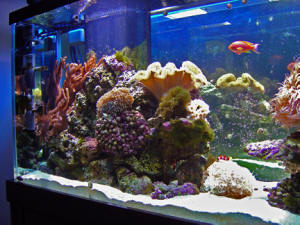 
|
Liquid Calcium and Alkalinity -- 04/02/08 Hello,
<<Hi there>> Well, I can now personally attest to the
drawbacks of liquid calcium? <<Oh?>> After maintaining a
dKH of 10 for months, I now can't get it over 7 dKH after using
liquid calcium (calcium chloride) for months. <<Ah, I
see'¦the buildup of Chloride ions have thrown your water
chemistry 'out of balance''¦as you seem to be
aware>> It appears the chloride ions have run amuck.
<<Indeed>> Any idea how to get the dKH back up to 10 or so?
<<Mmm, yes'¦several large water changes should make a
difference as you need to remove/dilute the Chloride ions in the
system>> I've added Seachem alkalinity buffer, but it's
not helping much before the pH gets too high (8.5). <<And the
'opposite' is usually the case with this
product'¦evidence of the high Chloride residual
possibly>> Is a dKH of 7 bad in a reef aquarium? <<It's
not 'bad''¦but 8 dKH or higher is preferred>>
All inhabitants are fine, but coralline growth has slowed. <<No
need for panic at this point... Do the water changes and conditions
should improve/balance should return. Then, research some alternate
methods for Calcium supplementation. Calcium Chloride is fine for the
'occasional adjustment,' but really should be avoided for
'continuous and frequent' use>> Thanks, Greg
<<Happy to share. EricR>>
Ugh, These Blasted Test Kits!...And Maybe A Little
Kalkwasser Seesaw Effect? -- 03/18/08 Yep, admittedly I fell prey
to bad test kits, first with alkalinity and then with magnesium.
<<Very common, in my opinion>> Here is my issue, 1000
gallon system, my reactor used to be able to maintain Alk and calc at
appropriate levels, the test kit I was using (Red Sea as I couldn't
get Salifert at the time) <<Do try Seachem's line of test
kits'¦good quality for value>> for magnesium was reading
1200 ppm. Little did I know it was below that by 200ppm per my Elos
kit, <<I'm not familiar with this
brand/manufacturer'¦though I do seem to recall favorable
comments from Bob re>> and I was using Kalk which was eroding it
further. <<Mmm, yes'¦I'm not absolutely certain of
the science behind it, but I believe it is something to do with the
addition of Kalkwasser increasing the precipitation nuclei of the water
column, thus promoting the disproportionate loss of Magnesium>>
Needless to say I fell into this desperate addition of varying buffers
to maintain Alk and calcium until magnesium finally hit 1300+ (I'd
like to stabilize it at 1400, I'm running Zeo Mag in my reactor and
it's putting out 1350). <<I think it likely the reactors and
the Kalkwasser additions are battling each other'¦probably
best to discontinue the latter>> So, long story short, tested my
levels last night, Mag 1300, Alk 8, CA 400. My reactor ran all day, is
well tuned in with a pH of 6.5 and Alk output off the scale. I dosed
Kalk for a while today to raise pH as it was floating around 8.1 and I
wanted to get it higher (dripping maybe 20 drips per minute, in a 1000
gal system I thought it was just about right). Tested Alk tonight and
it was 7, CA 360 and Mag 1200! <<Refer to my previous statement
re the Kalkwasser use>> I do have a little detritus but not a big
buildup. I don't understand why I can't nail down solid levels.
I increased the CA reactor output and it's a steady stream, but I
am really wondering at this point if I am not best off adding another
CA reactor. <<This would be preferable to the Kalkwasser
additions>> I do have heavy SPS but I can't believe they are
sucking that much calcium. <<If exhibiting heavy or even just
'good' growth their demand can be considerable>> I am
beginning to wonder if I am not in some type of runaway supplement
nightmare <<'¦yes>> (I add all according to
directions), but the sheer fact that Mag fell by 100 in a day (per my
Elos test), indicates to me stop dripping Kalk, use Seachem's
buffer for pH if need be, and dose mg according to directions until it
stabilizes. <<Sounds like a plan>> I don't have any
nutrient sinks that I know of (only DSB is a DSB 30 gal trash but it
has no detritus in it). Any help is greatly appreciated!
<<Stopping the Kalkwasser dosing and stepping-up the Calcium
reactor(s) should make a dif'¦oh!..as well as a large water
change to help bring all back in 'balance.' Regards,
EricR>>
Water Chemistry Help! Ca/Alk... 3/9/08 Hey Crew,
<Hello.> We are having problems with our water chemistry and are
not sure how to fix it...seems we're just running in circles!
<Happens at times.> Anyways....our dKH is at 17, <Too high, as
you likely know.> our ph is at 8.1, calcium is at 320ppm, nitrate is
at 15, 0 phosphates, 0ammonia, 0nitrite.... we have been trying to
raise our calcium forever and have had no success. We have a 180 gallon
tank... that has all LPSs and SPS. We had a calcium reactor running and
we have shut it off while we try to solve the problem. <OK> We
have a 20 gal sump, and a protein skimmer rated for 220g. There is a
lot of flow in the tank; we have 1 250k halide, and 72 in. pc
Corallife. We were using purple up, Kent marine, Seachem, and now a
friend suggested we try Tropic Marin. <I would stick to one
supplement to sort this all out...and dodge the Purple Up for good.>
Our tank has been going for a year now. We have about 300lbs of live
rock and can't seem to really get the coralline algae to start
growing well either. Our fish are very healthy, some corals are
thriving...some are getting by....and others are recently
deteriorating.... PLEASE HELP! Cheers, Mark and Lindsay <You need to
test your magnesium level in your tank. This can have an impact on
balancing your Alk/calcium to proper levels. A link to a great article
on this below. Good luck, Scott V.> http://www.advancedaquarist.com/issues/oct2003/chem.htm
|
High Calcium and Alkalinity
1/22/08 Hey Guys:) <Hello Ringo.> I have your books on
my shelf (and in the bathroom). <Excellent books, this will be
passed along to Bob.><<Oh stinky boy! RMF>> I have
a simple set up: 50 gallon tank, approx. 70lbs live rock, Compact
lighting - 36" Power Compact 192 Watts (1 actinic and 1
daylight) which sits about 8 inches above aquarium, heater, Red
Sea - Prism "deluxe" hang on skimmer, Eheim
"professional" filter, two power heads (1 oscillates),
about 2in. live sand/crushed coral - mixed, small air pump
w/airstone. I use Tropical Marine mix and change about 5 gallons
per week. I use Sea Lab No 28 automatic replenisher (dissolves
only to replace depleted elements - calcium, strontium etc. ., as
well as Kent Marine PH Buffer. Fish ; 2 Scooter Blennies, Lawn
Mower Blenny, Green Mandarin, Fuzzy Dwarf Lion, Copperband
Butterfly, and a Spotted Hawkfish. Looking for a FU Manchu next.
<Please skip the Fu Man Chu lion, your tank is already
overstocked, it is too small for each individual fish you list
(except possibly the lion/Hawkfish), and definitely so when mixed
together.> Invertebrates; Various "really cool
polyps", 2 Emerald Crabs <Not for long with the lion.>
Macro Algae; 3 Red branch, Caulerpa, Chaetomorpha, Coralline,
Little bit of Halimeda, Looking to acquire more types of Macro
when available. Feed; Alternate between -Freshwater Mysis, Hikari
Blood Worms and Frozen Formula One. Once a day feedings.
Lighting: 8 hrs actinic, 6 hrs daylight (total, not one then the
other:) Temp; 77 F No ammonia, nitrite, close to undetectable
nitrate. PH = 8.3 Problems are: KH = 16 Calcium = 470 I mix 3
gallons filtered tap w/2.5 Distilled water and the salt mix,
mixed the night before. System is 2 years old and even though I
mixed tap with distilled water I still have 16 KH. As far as the
Calcium I have no idea for a simple method of lowering it.
<Water changes.> I live in Los Angeles if this helps. I
have the option of a media basket on my skimmer. I was thinking
of adding Laguna Peat Granules to the basket and seeing if this
would lower the KH. <You have a greater problem going on that
needs to be found, causing the high levels.> If this is a good
idea, how frequent should this be changed out for new? Got any
ideas? <I assume that you are not dosing any Ca/Alk? I would
first test the water you are using to mix for Ca/Alk, this
includes the distilled. If these levels are high than source some
different water. Many LFS will sell RO water fairly cheap. If
your water tests fine, then try a different brand of salt. Some
salts out there are known for these high levels. Thanks, Ringo
Gene <Welcome, please do some more reading regarding your
livestock and their needs, I included some starting links with
related FAQ's for you below, good luck, Scott V.>
http://wetwebmedia.com/algaeblensart.htm
http://wetwebmedia.com/mandarins.htm http://www.wetwebmedia.com/BFsBestWrst.htm
Re: Calcium / Alk Question 2/10/08 Thanks
guys for all the help! You report that increasing the calcium
over 400ppm will naturally decrease the Alk. I haven't got a
clear understanding of this quite yet. Here is my understanding
based on what I have read, you can tell me if I am wrong. For
example, everyone warns about having calcium and Alk high at the
same time, in Anthony's document he discusses the analogy of
100 marbles. To add to this is it true to say by adding to a
bucket of 100 marbles some red it will drop a few blue marbles
(perhaps some red as well) out of the bucket, but by adding a lot
of red or blue marbles in large qtys or suddenly it will
basically break the bucket and release all blue marbles? In other
words, by slowly adding calcium to over 400ppm will it slowly
decrease my Alk below 12-13? (perhaps my example is not
reflective of 100 marbles already in bucket) <This analogy is
not exactly accurate. Calcium can range up to 500ppm with out
precipitating. It is when pH is raised while there are high
Alkalinity and calcium levels that precipitation occurs. That is
why I never recommend adding buffers that raise pH to the reef
tank.> Given a natural decrease in Alk by raising calcium,
would you see some precipitation of Alk (but not a complete Alk
crash) <You should not see precipitates of Calcium if you add
this slowly. When Calcium precipitates it makes a white clump
like a snow flake but much smaller.> The reason I ask is I
have my system now at 400ppm of calcium, Alk is still around
12-13 (have not added any buffers for a couple weeks, regular
daily 2-4g water changes). I have noticed what appears to be some
precipitation going on in the water column. I have no calcium
deposits on anything, the sand is not caked together, and the pH
has never spiked. <Your water change schedule for close to a
400 gallon system is way too small and ineffective. You say you
have a 330g tank with 70g sump. Regular 2-4gallon daily water
changes would be top off water for evaporation. This is not
considered a water change and will not aid in
controlling/stabilizing the system. You need to make 30-50gallons
of new saltwater at a salinity of 1.025s.g. and temp of 78F and
let stand for 24 hours. Then retest salinity to make sure all is
well. Then remove the same amount of water from your 330g and
replace it with the new water. I change 50g every 2 weeks in my
300g system. This water change will help a great deal more.>
In the event of a snowstorm crash, what is the typical duration
time for such a crash, days, hours, weeks, minutes? <The
"snowstorm" will take minutes to happen. It will crash
Calcium, and Alkalinity and pH will get very high. This will
stress and kill much of what you have. If your water turns all
white like milk then immediate water changes with new saltwater
is needed to possibly save as much livestock as you can. I highly
recommend large water changes with new saltwater before trying to
adjust your system with chemicals. It will be much safer for you
as you are not very familiar with the chemistry aspect of the
ionic balance of alkalinity and calcium vs. pH.> Thanks as
always! <Hope this helps, Rich> Bryan
Re: Calcium / Alk Question, and water change
periodicity/amounts 2/10/08 .....Thanks! As for water changes
I have a bucket of pre-mixed salt water. Once a day a drain opens
up from the sump, we then add 7 gallons of fresh pre-mixed
aerated salt water to the tank, the remainder drains out of the
system. This achieves 50 gallons per week. Based on this
description, it is still ineffective? My understanding is that
more frequent small water changes are better, by going daily I am
taking this to the extreme. <David Boruchowitz, editor of TFH
magazine did a study on water changes and the mathematical
reduction of nutrients when water changes are done in smaller
frequent schedules or in much larger frequent schedules. His
study proved not only mathematically, but also in his aquariums
kept that larger water changes are much more effective than
smaller ones. The study was done with control tanks to verify
results. In summary, I advocate larger weekly water changes than
smaller daily ones. You are basically doing a 1.75% daily water
change. In my experience and understanding of dilution of
nutrients the larger water change would be more effective.> As
for the snowstorm, how high of a pH would spark this, 8.4?
<The pH would need to be closer to 9 or higher. For now double
check your test results by using a second test kit and do a
larger water change. (around 50 gallons) This should help a lot.
I would like to know what the Alkalinity level is after 2 large
water changes. It should fall back to a reading of 8-10
DKH.-Rich> Best Bryan
|
High Alkalinity/Calcium 12/3/07 Hi Crew:
<Hello Rich> Great site! I have a question regarding alkalinity.
After much research, I decided to try my hand at a reef tank.
<Congratulations, good to hear.> Here are the specifics for my
tank. Acrylic 125 gallons, 2X250 Metal Halides (14K phoenix bulbs),
2X65 T5 actinics, Two Vortech pumps with wavemaker, PanWorld return
pump, Phosban reactor, Aqua C EV-180 Skimmer and a Geo's reef
calcium reactor with Milwaukee Controller. <Sounds like a great
setup.> The tank has been up for 3 months and there is noticeable
coral growth. I've been doing my testing weekly to make sure the
environment is somewhat stable for the corals. The results have been ok
with the exception of my alkalinity. Every time I test it, it
increases. It started at 8, then to 10, ultimately reaching it's
current status of 15. Calcium is 475, Magnesium is 1300. All test are
done with Salifert test kits. My question is, "Is my Alkalinity
too high? And if so, how do I lower it? I do 10% water changes weekly.
Your assistance is greatly appreciated. Thanks, Rich <Both your
alkalinity and calcium are high. Considering they have risen over a
period of time it sounds like you need to turn the output of your
calcium reactor down. You could also increase your water change
amount/frequency to get back to normal. In a new tank with much
coralline algae growth the numbers will lower themselves fairly quickly
with the reactor output turned down. I would test alkalinity a few
times a week until you get your reactor output balanced. Good luck,
Scott V.>
Re: High Alkalinity/Calcium 12/3/07 Scott V.,
Thanks for the quick response. <Very welcome.> I'm headed
home to turn down the down the output in my calcium reactor and do some
water changes. Thanks so much! <Sounds good. Have fun, Scott V.>
Rich
Question about alkalinity and calcium 11/28/2007
Good evening crew, <And morrow now from HI> Thank you for the
great service you provide. This is a fantastic resource for us all.
<Welcome> My question is about Alkalinity and Calcium. My
aquarium is a 75 gallon reef with a mix of hard and soft coral.
Filtration is via a sump/refugium, Euro-Reef Protein Skimmer, Carbon,
and serious water circulation. Everything is happy and thriving; three
and a half years old. Until the beginning of October I was supplying
the alkalinity and calcium requirements with "Seachem" Reef
Builder and Reef Advantage Calcium and was up to 6 teaspoons of each on
alternating days. Alkalinity was pretty stable around 3.5meq and
Calcium hovered around 400ppm. Then I decided to try Kalkwasser and
slowly increased the dosage from 1/8 teaspoon to 5/8 teaspoon added
twice a day, early am and around 10 pm. <Mmm, okay... though am a
bigger fan of dripping at night myself> I am using the slurry method
as described in the Book of Coral Propagation. Dosage was determined by
limiting the pH change after dosing to around .2. <Okay> Here is
the question: This amount of Kalk isn't enough to keep the
alkalinity and calcium at the levels mentioned earlier. <No... It
won't> In fact I am supplementing the Kalk with Reef Builder and
Advantage Calcium <See the ingredients labels of these
products...> to the tune of 4 teaspoons on alternating days as
before and am still not keeping up with the demand. Even with the Kalk
and supplements Calcium levels and alkalinity seem to be falling.
<Mmm, okay> Pretty soon I will be back to 6 teaspoons of each
just like before I started using the Kalk. What am I missing. I have
read that Alkalinity and Calcium demands for an "average"
aquarium can probably be met with 1 teaspoon of Kalk per day. Am I
missing something? <Not necessarily... you may have a bunch of
biomineralizing life than some "average"... but... there is a
good chance you're adding A and B to make C here as well... i.e.
combining ready alkalinity and precipitating alkaline earths...> So
far the most noticeable plus from the Kalk is better protein skimming.
Any hints? Thanks so much, Ralph Napiany <Mmm, yes... reading. Start
here: http://wetwebmedia.com/calcalkmar.htm and on to the linked files
above... start with "Importance, Science"... Bob
Fenner>
|
Low dKH & Low Calcium
Sudden Alkalinity and Calcium Drop -- 11/18/07 Hi
Guys/Gals, <Hello Jackie! Brenda here> Why is it that you
correct one problem only to develop a new problem? <It does
seem to work that way sometimes!> I have a 90 gallon saltwater
reef tank with a 20 gal sump. I have struggled with high nitrates
for about a year. I recently added a CPR hang on refugium and my
nitrates have gone from 20 to 0, and my phosphates have gone from
.05 to 0. <Yeah!!!> Great news right? <Yes!> However,
I now have a new problem. My calcium is typically 320. <This
is a bit low. See here:
http://www.reefkeeping.com/issues/2004-05/rhf/index.php > My
dKH is usually around 8 dKH. <Have you checked magnesium?>
I normally test my tank parameters every two weeks when I do a 30
gallon water change. However, when I tested my levels this week
it appears my dKH is 6.4, calcium 300, pH 8.25, nitrates 0, and
phosphates 0. What would cause my dKH & calcium to decline?
What can I do to increase my dKH & calcium? <Have you
tested your water change water? Have you changed test kits, or
salt? It is possible that the demand in your reef tank is now
higher. Are you dosing with calcium, alkalinity or magnesium? If
not, you may want to start. Randy Holmes-Farley has some great
chemistry articles. The Reef Chemicals Calculator listed in his
thread is very useful, and will help you determine how much to
dose. He also has a do-it-yourself Calcium, Alkalinity and
Magnesium recipe. See his articles here:
http://www.reefcentral.com/forums/showthread.php?s=&threadid=102605
If you do not want to use the DIY recipe, your LFS should have
the Calcium, Alkalinity and Magnesium that you need.> Any
advice is greatly appreciated. Thanks, Jackie <You're
Welcome! Hope this helps! Brenda>
Re: Low dKH & Low Calcium Sudden Alkalinity
and Calcium Drop, Testing/Calculating Salinity -- 11/18/07 -
11/20/07 Hi Brenda, <Hello Jackie!> Thanks for the info
and the link. <You're welcome!> I really like
Randy's DIY Calcium, Alkalinity and Magnesium recipe. The
only thing I currently dose is iodine. <Are you testing for
iodine? I don't recommend dosing anything with out testing
first. You may not need to dose Iodine with frequent water
changes.> Do you know if a salinity calculator is available
anywhere? I never know what my salinity will be after my water
change. I often wonder if there is a way to calculate new
salinity based on the existing salinity of the main tank, and the
salinity of the new water...Any ideas? <I'm not sure I
understand you correctly. Why do you need to calculate before and
after? It should be the same. It is important to match the
salinity of both new and old saltwater, before the water change.
If you are not testing, this could explain the sudden change in
calcium and alkalinity. I recommend using a refractometer. See
here:
http://www.drsfostersmith.com/product/prod_display.cfm?pcatid=10490&Nty=1&Ntx=mode+matchallpartial&Ntk=All&pc=1&N=0&Ntt=refractometer&Np=1
A sudden change in chemistry can be very stressful on your live
stock. Are you topping your evaporated water off on a regular
basis? Have a wonderful holiday!!!! <Thank you! I hope you and
your family have a wonderful holiday also!> Thanks, Jackie
<You're welcome! Brenda>
|
Calcium/Alkalinity 8/8/07 Dear Wet Web Crew,
Thank you, thank you thank you. We would all be raising goldfish if it
were not for you folks. My question has to do with that old favorite,
pH and alkalinity. My make up water is RO/DI and has a pH of 6.0. I
have been using Coralife salt mixed to 1.023. My mix container has an
airstone and pH measures 7.1. I use a frequently calibrated Pinpoint pH
meter. I dose daily with Kalkwasser and have a limewood airstone in the
tank. Pushing my alkalinity seems to be impossible. I was using
Seabuffer. That seemed to raised my alk but my pH never stayed up. pH
Goes up after Kalkwasser and then falls. I started to use C-balance and
I do get an initial pH spike and it falls back down. I am not gaining
traction. I have varied the dose and frequency and no matter what I try
I can't my pH falls back to 7.8 range. I have been all over your
site. Read everything at least once. Reading about the marble analogy
made me wonder about calcium. I measured the calcium in my make up
water and found it to be 500ppm. I have retested this over again. I am
reading 500ppm. Could this be the reason that my pH doesn't stay
up? According to the Coralife spec that comes with the salt, my makeup
water should read pH 8.2 - 8.3. and calcium should be 430-450 ppm. I am
not sure how to proceed to attain the desired 8.2 - 8.5 pH. <Josh,
have you read here? http://www.wetwebmedia.com/calcalkmar.htm>
Thanks again for your help <You're welcome. James (Salty
Dog)> Josh
Re: Calcium/Alkalinity 8/8/07 Thank you James.
Yes I have read this article several times. That is why I am writing.
Not being a chemist I second guess my interpretation of the information
and my data. <OK> I am trying to get a handle on what I am
confronted with. Again, I cannot get sustained increase in pH. I dose
daily with Kalkwasser. I have been adding 2 part additive. I hesitate
getting caught up with buffer (but perhaps I should??) <I've
been using SeaChem's Reef Builder for a couple of years with good
results.> Calcium is 500 ppm. Is this calcium level so high that it
is preventing my pH from rising? Should I stop adding Kalkwasser? Any
other advise? <Every aquarium, depending on conditions, may have
both an actual and a "potential" pH. The
"potential" pH refers to the level the water will reach when
all of the components of the buffer system have reached equilibrium.
These include temperature, carbonate balance and, most importantly,
dissolved carbon dioxide. Ideally, the actual and "potential"
will be equal. It is important to realize that the carbon dioxide gas
dissolved in the water must be in equilibrium with the atmosphere
before the "potential" pH can be obtained. The reason carbon
dioxide is so important is that, when dissolved in water, it ionizes to
form carbonic acid. So, a surplus of carbon dioxide will cause a
reversible shift of the pH to the acidic range. Another factor in
maintaining pH is the long term effect of the nitrogen cycle. As
animal/food wastes are processed by the biological cycle, acids are
produced, and these acids react directly with the bicarbonate buffers,
slowly eliminating them. Your goal then, is to maintain good water
quality, keep animal loads within the range your tank can support,
frequent water changes, the use of an efficient protein skimmer and
incorporate a good filter media such as Chemi-Pure. You do not mention
the type of filtering system you are using. A sump/wetdry works very
well in eliminating carbon dioxide from the system along with
saturating the water with O2. When mixing seawater for water changes,
the make-up water should be aerated 24 hours before adding the salt
mix. This will eliminate any CO2 in the water. From what you have
provided me with, I'm guessing excess nutrients is causing your pH
control problem. Do read here also.
http://www.wetwebmedia.com/nutrientcontrol.htm> If you could address
all of these questions it would confirm my assumptions. Thank you.
<You're welcome. James (Salty Dog)> Gratefully yours,
Josh
Re-Balancing Calcium/Alkalinity...Do Those Water
Changes - 06/25/07 I sent this before but I didn't really ask a
question to my second question. <<Hmm, don't know who made
the reply to you...for future reference please include previous
responses>> What am I doing wrong and what can I do to lower the
Alk. <<I've read through your previous query below...the
first thing I would do is stop dosing everything>> Water change?
<<Indeed...a couple large water changes a day or two apart are
the single best thing you can do to get this system back in
"balance">> I do a 25% water change every 2-3 weeks.
<<Do the large water changes to bring your calcium/alkalinity
back to NSW levels. Monitor these levels to determine a real
"need" for supplementation re...many systems can be
"supplemented" through simple water changes. If you find you
need additional supplementation then stick to one of the two-part
supplements (only), following directions and monitoring closely to keep
the system balanced. Regards, EricR>> > Hi there. > I was
recommended to your site from the LFS. They are very informative but
said if they are not available to check you guys out and this site is
awesome. I do have a few questions though. I have been doing this for a
couple of years now and there is still soooo much to learn. I have two
tanks. A 55 gallon and a 24 gallon Nano. My 24 has been doing great but
my 55 not so lucking. First was the Red Slim and then the bacteria.
Question is in regards to my 55. > First - Protein Skimmer. I have
one rated for 150 gallons. A few months ago I had to empty it once a
week and it would be full of green liquid. Now since a month ago I have
to empty it every 2 days and the liquid is brown. What do the colors
mean?? No smell to it. Is it bad? All I have in there is 1 damsel, 1
sea horse, 1 engineer goby and a few coral. Not much as I have been to
scared to add anything to it since my last disaster with the bacteria.
> Second - Cal/Alk. I know u have had plenty of questions on this.
Calcium use to be at 420 with the use of purple up only but now it has
dropped to 300 and Alk was at 7 meq/l which if I am right is too high
which is another reason I think that my PH has been holding at 8.4 when
it use to be always at 7.8. I love that it is at 8.4 but the Cal
dropping and Alk high I don't trust. Another LFS (which I don't
trust, they just want to sell) told me to use the B-ionic 2 part mix
which I have been using. The Calcium is going up to 360 and that's
when I noticed the Alk at 7 meq/l. So I have been only adding the
second part mix which is the calcium plus purple up. Everything else is
fine expect for the phosphate which is at 1.0. I have added some stuff
to lower that now. > This is what I have in my tank. Protein
Skimmer, wet/dry filter, UV light, hang on filter. Lighting is 2 12k CF
daylight and 2 65w blue bulbs > Thanks > Bill M
Low Calcium (And Use/Misuse Of Supplementation) --
06/15/07 Hi Crew, <<Hello Marti>> I have done a search
on WWM and read everything I could find on "low calcium", but
nothing seemed to answer my question. <<Mmm...is sometimes
'between the lines'>> I have a 75-gal tank with about
110-lbs of live rock and 20-lbs Aragonite sand. I have had the tank 5
months, and I cannot get my calcium over 300, even though I add about
½-gal Kalkwasser each night (2-tsp powdered Kalkwasser,
dissolved in 1-gal filtered water, dripped slowly over 10 hours).
<<Maybe a symptom of this system being so new/young and still
finding its 'balance.' There really is something to be said for
letting a system run 'sans livestock' for 6-12 months...but so
difficult to convince/convey in our society of 'instant'
gratification>> Other additives include: Weekly - Seachem Marine
Buffer, according to directions, and Kent Marine Strontium &
Molybdenum Daily - Kent Liquid Calcium 1 tsp, and Two Little Fishies
C-Balance (part "A" in the morning, part "B" in the
afternoon) <<Yikes Marty! This use of so many differing alkaline
and calcium supplements all together is surely the issue here. How did
you come to use so many products to boost calcium/alkalinity? Assuming
your system even requires supplementation (many systems get 'all
they need' from frequent partial water changes), you can't just
throw all these elements in to the tank and hope for the best. The very
first thing you need to do is stop this supplementation and perform
several large water changes to get this tank back in balance. Oh...and
start reading here (http://www.wetwebmedia.com/calcalkmar.htm) to gain
a better 'understanding' of Calcium and Alkalinity and their
'relation' to one another>> I do 10% weekly water changes
with Reef Crystals Salt. I make up saltwater a day before the changes,
test salinity and pH (adjusting up with Kalkwasser if necessary), and
use a heater and power head to mix and bring to temp before using.
<<I would prefer to see you give the salt a 'few days' at
least to mix thoroughly/complete its chemical processes before
using>> I had been using Instant Ocean, and thought I would have
better luck with Reef Crystals, but it didn't make any difference.
<<The salt mix is not to blame here>> My pH runs between
8.3-8.5, S.G. 1.025, Alkalinity 2.4-2.75 meq/L (7 - 7.7 dKH).
<<More like 6.7-7.7 dKH...a bit low...and likely also resultant
of the misuse of supplementation>> I was using the Nutrafin
Calcium test kit, but even bought a new Salifert test kit, to be sure I
was getting the correct Calcium levels. Stocking: 3 Blue-Green Chromis
2 T.R. Ocellaris Clowns 1 Rock Blenny 1 Flame Angel 1 Yellow Tang 3
Peppermint Shrimp 2 Serpent Stars 20 Astrea Snails 1 Featherduster Worm
15 Blue-Legged Hermits For corals, I have: 1 frag Zooanthids 1 Anthelia
coral 1 Mushroom neon green frag <<Mmm...I see no need for the
supplementations you list>> Since my stock shouldn't be using
"tons" of calcium, <<Indeed...and easily replenished
with simple water changes>> what could possibly be the problem?
<<As stated...the misguided overuse of Calcium and Alkaline
supplements. How did this all come about I wonder...did
'someone' start you down this path?>> My Alkalinity seems
good, <<Could be better/a bit higher>> and pH is correct.
Anything else I should be testing, doing, adding, not doing???
<<As stated...stop dosing>> Any help would be greatly
appreciated - you guys and gals are the best! Best Regards, Marti
<<Once you do the water changes/get this system back in balance,
test to confirm the need for the addition of Earth/bio-mineral elements
and proceed slowly with a single product/methodology if needed. For
your system as it is now, and IF you find you need to boost
calcium/alkalinity, I suggest the careful (testing often and closely
following instructions) use of the C-Balance two-part supplement.
EricR>>
pH/calcium-reactor 5/19/07 Hi crew,
<Mohamed> I try to maintain my calcium at 400ppm, KH 8 and PH
8.30 <Okay> When not adding calcium, my calcium drops to under
300ppm and KH 4 within a week. <Wow! I wonder what the input/s,
output/s are here?> Will a low calcium of 260ppm stress SPS?
<Can, yes>
---------------------------------------------------------- Is 8.30 to
maintain Ph to <too> high? <No> My top up water is Kalk
which maintains a high Ph, <Mmm, no my friend... does/will NOT
maintain a high pH... will only temporarily boost from the hydroxyl
(OH) input... See here: http://www.wetwebmedia.com/calcalkmar.htm and the linked
files above> my controller is set at 8.30 so if my Ph drops below
8.30, Kalk is dosed but only if the float switch is activated (water
drops below tank level). One of my problems is that when the lights are
off, evaporation is low so the float switch will not be active, my Ph
drops to 7.91. Is this a problem? <Can be... the pH
"point" itself is not problematical, but the swing/change is
too much in this given period of time... The diurnal fluctuation of
more than 0.2 part of a pH point can be trouble... The long and short
of this is that you need to READ, understand what you're doing...
Provide a source of carbonate, bicarbonate to BUFFER your pH> I have
read in some books that PH should not increase/decrease by more than
2/10, <Oh! I am in agreement...> can you please explain by
example, please, e.g. from 8.00 to 8.20 <This is a valid example>
------------------------------------------- I plan to build a calcium
reactor but will like to know what range should my PH be set?
<Depends on the design... but if this is a "stock" carbon
dioxide gas feeding unit...> e.g. PH reaches 8.20 switch off the Co2
and switch it back on if the Ph reaches 8.30 thanks Mohamed <Mmm...
better for you to read here: http://www.wetwebmedia.com/calcreactors.htm and the linked
files above, and where the embedded links lead you... and for you to
experiment with what you devise... there is a bit more to your proposal
than you are presently aware of... That would require a good deal of
going back and forth to determine what you know, what you're trying
to do/accomplish... Read and assemble your specific questions,
design... and we'll chat. Bob Fenner>
Calcium/dKH levels Hey guys, First off, let me
start with the obligatory 'great site' comment. I'm
relatively new to the hobby and have enjoyed your site and found it
rather useful! Huge amounts of info in one place - what a treat! Now
for my problem - I recently got my reef tank going - cured the live
rock for 4 weeks, and have had the tank up for another 4 weeks. 4 weeks
ago I did a 100% water change, and another 50% water change 2 weeks
ago. <Why the large water changes? Not that I am against them. I
have had reason to perform such large changes before.> I was
wondering if you had any thoughts on why my Calcium and dKH readings
are so low (see below). I've been through the faq's on these,
and I've found info on how to raise or maintain levels using
reactors/Kalk/2-part additives, but can't figure out what can cause
them to be low. I'm using RO/De-Ionized bottled water, <And
aerating or circulating it for a day? Or using it straight out of the
bottle? Please aerate/circulate prior to use. Many FAQ's are filled
by Q&A's on the subject.> so I can see that I'd lose a
little Ca there, but shouldn't there be enough Ca and buffer in the
salt mix (Instant Ocean) that after two weeks these levels
shouldn't be so low? I'd prefer to maintain the levels through
routine water changes, but if I need to dose, then I need to dose - but
I'm worried there may be some cause for the low levels that I can
remedy rather than having to dose. I have a 20 gallon tank with a
pseudo ecostyle/CPR DIY HOT refugium with grape Caulerpa, spaghetti
grass and some red algae (Gracilaria tikvahiae) & Kent bio-sediment
(4inches). I'm also running an Aqua-C Remora skimmer & carbon
and have 2-36W power compacts - 1 actinic, 1 6500k (12 hr photo-period
with refugium on an alternating/overlapping 14hr cycle). There is 25lbs
live rock, 1 Percula clown, 1 yellow watchman goby, a cleaner shrimp, a
BTA, and various polyp/soft-coral/mushroom cuttings in the tanks (not
to mention various snails and hermit crabs) Water parameters are as
follows: Salinity - 1.021 @ 80 degrees Temperature - 80 degrees pH -
8.3 Alkalinity - dKH = 6 Calcium - 250 Ammonia - nada Nitrite - nada
Nitrate - 2.5ppm All water quality parameters tested using Red Sea test
kits. While I have you on the line - let me through one more question
your way - there are a couple of dead spots (low flow presumably
leading to low oxygen) in my refugium where some Cyanobacteria have
sprung up - I've siphoned it out, and was hoping that the other
algae would out compete the Cyano for nutrients, but I'm not
holding my breath. Short of cranking up the flow (running a Rio 600
right now) through the refugium, are there any other things I can do
about this? <Take a lot at the extensive FAQ's on
Cyanobacteria.> Thanks for your response and a great site-Matt
<You are welcome. -Steven Pro><<"It's" the
new LR, decomposition... using up the biomineral and alkalinity here.
RMF>
Calcium Precipitation - 2/21/07 <Hey Ray,
JustinN with you today.> Thanks for your response, <As I'm
not the original responder, I cannot take credit, but I'm sure
whomever did respond is quite welcome.> I would, however, like more
detail on the snow effect I notice with adding the calcium supplement I
use. What more information do you need? <Don't think any
information is needed from you on this one, pretty self
explanatory.> Your input is greatly appreciated! Thanks, Ray
<Well, Ray, the "snow effect" is the precipitation of
calcium out of your water. This is occurring because your water
chemistry is skewed, out of whack. This problem stems from the
misapplication of buffering and calcium supplements. To simplify the
concept, water can only retain so much of the calcium solution, and
when this amount is exceeded, it causes the calcium to bind and become
unusable, creating the snow globe effect you speak of. First as far as
solutions go: Stop dosing! Get a reliable alkalinity test, get a
reliable calcium test, and have a thorough read through this excellent
article: http://www.wetwebmedia.com/calcalkmar.htm and the linked
files in blue. Don't skim this article, read it, know it, learn it,
live it! Every time that you cause a precipitory event in your tank,
you are starting a roller coaster of chemical stability that you no
longer have control over! Good luck, my friend. -JustinN>
Alkalinity, calcium and pH 2/18/07 Hi Everyone, I
have a 72 gal FOWLR tank (with a 1" bed of live sand - aragonite)
that is almost 4 months old with 2 percula clowns, a six line wrasse, a
yellow tang, and a coral beauty angel. I have a regal tang in
quarantine almost ready to join the others. The fish are very happy and
healthy, but I'm not! <!> My problem is that my alkalinity
has gotten too high (6.57 meq/l), my pH hovers around 8.0 to 8.15, and
my calcium level is 280ppm. I think I know how this happened. In my
quest to raise the ph, I added Proper pH 8.2 <Mmm, this product
should only be used in freshwater settings> to excess not realizing
that it was cranking up the alkalinity. My question is this: How do I
correct this situation? <Mmm, best with time going by, regular water
changes... and leaving this product out> My plan is to do 10% water
changes daily (or every other day - I routinely do them weekly)
<Good... but I'd stick with the weekly... with pre-mixed/stored
water... and 20-25%> to gradually bring down the alkalinity using
RO/DI water (with Instant Ocean salt). This is where I get a little
lost. What do I do to get pH and calcium levels in order. My goal is pH
= 8.3, calcium = 350-400 ppm, and alkalinity = 3.5 meq/l. Are these
proper values for a FOWLR system? <Yes> I'm trying to
increase the coralline algae growth on my live rock. I need a plan of
attack - a recipe for success if you will. Hope you can help. Thanks in
advance. Mike. <Thank you for writing so clearly, thoroughly... The
water changes with the Aquarium Systems salt mix, the stock, substrate
you list... should "do it"... in a few months time. Bob
Fenner>
- High Calcium & Alkalinity - Hello, lord I love this
site and the information! I am very new to the marine aquarium. Have
spent many enjoyable hours on this site. I have had my tank for 5
months. It is a 70 gallon tank, with an Excalibur skimmer, AquaClear
wet/dry. I do water changes everyday of about 2 gallons. I test the
water every week. NH3=0, nitrites=0, nitrates=20 (I have not been able
to get this down under 20, I am looking at a 350 Magnum, or Fluval 404
for chemical/mechanical filtration). pH=8.2, salt 1.024. I use either,
RO water, DI water, or spring bottled water, sometimes tap water
treated with Amquel, but I age it for at least a week in a large (brand
new) garbage can. I have about 50 lbs of live rock and a going to get
more in time. I have 5 clowns, 1 flame angel, 1 Foxface tang, 2
damsels. 2 peppermint shrimp, 1 coral banded shrimp, about 10 turbo
snails, 2 hermit crabs. 2 yellow polyps, 3 mushrooms, 2 green star
polyps. (oh... one anemone, that I bought at a LFS BEFORE, I read the
articles on this site) It seems to be fine, except it has not attached
to anything, but it does stay in one corner. The clowns love it and
have settled down very nicely....right now one of the clowns have taken
to one of the green star polyps as home. I researched and read about
just about everything except water hardness. I have a Ca+ kit... (sea
test), I used it a few times but thought something was wrong with this
kit as I could not get a reading... I would use about 50-60 drops
before the color would change. My LFS said my kit was reading wrong.
Tonight I just bought a KH kit (Hagen) . The KH was 100 mg/ml, however
the GH was over 2000 mg/ml. So with a high Ca+ and a high GH my water
source is very, very hard, yes? <Quite possible, yes.> So
apparently my Ca+ kit was working....am I in big trouble??? <Only if
you keep adding calcium or alkalinity buffers.> I live outside of
Buffalo, NY, and as I was talking to my husband about this, my son said
"Duh...this area has very hard water, which is the first thing
they learned in chemistry..." (son is 17)... I had chemistry too,
I guess I was not paying attention to that little detail... <Or it
had little application on the day.> Will this give me trouble?
<Again, only if you are trying to supplement calcium or alkalinity
through other means.> My tank has just started to grow nice purple
coralline, algae is under control with my nice tang, who now eats Nori
seaweed to help with his diet, so does my cat who loves the seaweed. Do
I do anything? If so, what??? <Regular water changes, don't add
anything for calcium/alkalinity.> I am having so much fun with this
tank, and the learning process. I checked on most of anything I bought
before hand, took my Marine book (yours) to the store with me, read on
the Internet. But I never thought about the Ca+, I thought I would
worry about that later as I added more live rock to build up my reef.
Anything in excess is toxic... help! Do I panic? <No.> or can I
ignore... <Don't ignore either... will pay to keep an eye on
things.> Thanks so much for any help! Kris <Cheers, J -- >
Maddening Problems With Simple Solutions? Hello, and thanks
for taking the time to read my email.....(Greatly Appreciated!!!!) :)
<That's what we're hee for! Scott F. at the keyboard
today> Here is the problem, well two problems.... <1> My alk
is consistently too high 6.5 meq L-- 18 dKH and my pH is stuck at
7.9--8.0 causing serious problems with corals. ( make up water is RO )
I need to lower the alkalinity so I can raise pH...<2> I have an
EcoSystems Reefugium mounted above the tank which has gravity fed
return into display. The amount of bubbles that it releases as the
water enters into the display is entirely unacceptable (I believe its a
1 1/4 " return line). I have contacted them on this matter and
they have no insight to the problem. Please help i am ready to
dismantle it and start stamp collecting instead!!!!!Much Thanks in
advance Anthony Pastorelli NYC Fireman Bayside, Queens, NY <Well,
Anthony- please don't take up stamp collecting yet! I suppose a
simple approach to the high alkalinity problem might be to either dose
more Kalkwasser (which has the effect of lowering alkalinity over
time), or possibly using some (gasp!) un-buffered RO/DI water when you
mix your salt...As far as the microbubbles are concerned- I'd try
to construct some kind of "baffle" under the return with
acrylic, or even use the most simple of all techniques- employ some
sponge under the return flow to help catch 'em...Just some
thoughts, but maybe they will work, or at least inspire you to try
similar ideas...Good luck! Regards, Scott F>
Water chemistry problem Date: Sun, 20 Feb 2005
Okay, I want to give this up and get a hamster. I recently moved from a
40 gallon /w 20 refugium to a 12 gallon. I didn't have a ton of
livestock, so it all fit perfectly fine. It is now three days later and
I'm having major problems. I've been doing large water changes
(75% or so) in the event of a small cycle. I WISH that were my problem.
I did a water change, and tested the SW mix to be a pH of 8.3. Dandy. I
put it in the aquarium. 5 hours later, it's 7.0. (not to mention
dead clam, my fish are dead, and my cleaner shrimp is dead). So I do
another 100% water change. Same thing, 4 hours later my pH is down to
7.4. I've been using tap water (like I've been doing 11 years)
so I decide to try distilled water. I buffer it to 8.3 with alk buffer
+ IO salt mix, and do an 80% water change. I come home from work (5
hours later) and it's 7.5 again. I test my calc - kinda low, 325
PPM, so I should be able to add alk buffer ok to up the ph - right?
WRONG. The instant I add a SMALL amount of alk buffer I cause a
precipitation. OF WHAT? My calc is LOW! my pH is LOW!
ARGHHHHHHHH!!!!!!! Words cannot describe the frustration. Could it be a
bad batch of salt? K I'm going to go sit in a corner and bang my
head against the wall. <Mmm, something is definitely awry here... DO
keep that bag of salt sealed against exposure from the air... This is
definitely the chief suspect here... the formulations of all major
brands of synthetic are purposely over-buffered... none have the direct
capacity to cause precipitation with what you describe... DO mix up
some and test in "just a jar"... and relate what you observe,
pH, dKH, calcium, magnesium concentration. BobF>
Re: Water chemistry problem Date: Sun, 20 Feb
2005 Hun, I'll be on YIM in like 5 min. We'll troubleshoot. =)
It's going to be OK!! & def no hamsters, no matter what Bob
& Anthony say. A pH drop is only due to a few things.. Calcium
reactor (not your prob) Low alkalinity (hmmm...) Too much CO2 because
of inadequate aeration (see how to test for that below..) Too much CO2
in the tank because of the air in your house Excess acid being made
from a nitrogen cycle Aim Re: D'oh! How to test.. http://reefkeeping.com/issues/2004-09/rhf/index.htm
Re: Water chemistry problem Date: Sun, 20 Feb
2005 hard to say from the limited info, but one scenario that fits:
something done (usually one good slip of a supplement - too heavy
handed, or extremely skewed source or tap water) starts a precipitous
reaction (can be Ca or Carbonates) and anything done during the precip
(like water changes or "reverse" supplements) to correct it
only fuels the reaction! The infamous example is a
"snowstorm" of calcium... but it works just the same with
carbonates settling out. And the snowstorm isn't always so
literal/obvious (cloudy water( but the chemistry tells a different
(real) story. I dunno if this is your situation my friend. I just flew
home tonight. A bit of a rough weekend after all :( Am bushed too...
I'll be online for a bit if by chance you are up to chat... else
I'll be available to help out if needed/wanted. Ant :)
Re: Water chemistry problem Ok, Instant Ocean (a
250 gallon bucket with a sealing lid, so no air contact long term)
mixed with distilled water and nothing else yields 375 ppm calcium, 2.5
meq\L alk, and a pH of 8.1 Not the best, which is why I usually alk
buffer it. My mg kit is out of reagent, I'll have to get some more.
Any thoughts? <Yes. Very different than the dropping pH, snowstorm
in your principal system... Why is this? BobF>
Re: Water chemistry problem As an added note, any
additives cause precipitation...and there is precipitation all over the
glass, and a large crystal on the Kalk drip tube (which I've
stopped). No ideas... <Mmm, well, you've gots a wild mix of
bi/carbonates and alkaline earth materials joining together... the
all-too-usual result of a/the Kalk habit.... worse in small systems....
older, less-well maintained...> pH is sitting happily at 7.5,
can't raise it, both Kalk and alk buffers cause more
precipitation... <Time for the MASSIVE water change... make that
transfusion. BobF>
Alk/Ca skewed.. water changes to cure 2/18/05
First I want to say thanks for all the help in the past. In the few
years I have been keeping an aquarium, I have made many mistakes and
the information on this site has got me (and the critters) through all
of them. <thanks kindly... do tell friends about our site> The
setup is a 72 gal bowfront that has been running for about a year now.
It is an upgrade from a 50 gal setup that we had for about 2 years that
we got when a pet store went out of business. So far it has been stable
and easy to maintain. The over flow drains through a filter sock to a
20 gal sump with a Turboflotor skimmer and I also use a SeaClone
hanging on the back. <unless these socks are cleaned near daily...
they degrade water quality by allowing solids to linger and dissolve,
and rob them from (suspension) skimmers that could otherwise export
them> I get a cup or so of the stinky stuff every couple of days
between the two. I also have a home made refugium on the back of the
display that is full of critters as are the overflow box and the sump.
There is about 110 lbs of Fiji rock and 4-6" fine sand. I have
been lax in doing water changes (about 10% every 3-4 weeks) but the
water quality has always been very good with the exception of the
calcium always testing on the high side. <do investigate why...
supplements, hard water, etc. And please do larger, more frequent water
changes: Dilution is the Solution to Pollution. Else "things"
will catch up with you over time> I added an elegance and bubble
coral about 3 weeks ago, and the next day they both looked great. The
second day the elegance looked great but the bubble did not expand
fully. After about 4 days the bubble was not opening so I tested the
water and found that ammonia, nitrate, nitrite, and phosphate were all
zero (as usual) but ph was at 7.8 (afternoon), alk was at about 2.0
meg/l and calcium was at almost 600 (I don't use any calcium
supplements at all). <yikes... scary if accurate. Do test your
readings on other brands of test kits... LFS service perhaps?> Over
the next 4 days I dosed with small amounts of Kent Superbuffer and did
3 small water changes (about 10% each). Within about 4 days the ph was
up to 8.3 in the evening, alk was up to 3 meg/l and calcium was back
around 500. <still high on Ca and dangerous over time. If your tap
water is not high in Ca, then the sea salt and water changes if big
enough should bring these numbers into a safe and more balanced
range> That was about a week ago and the bubble is still opening
less each day. It is not near anything else and in a corner with light
flow. It is also at the same place relative to the lighting as it was
in the LFS and under the same lights as the LFS (4- 65w pc 2 are
actinic) What am I missing? <patience... needs time (weeks) to
slowly recover. Be sure to feed this very hungry (naturally) coral 3-5
times weekly with small bits of meaty food> The tank is currently
stocked with: 5 green Chromis, 1 percula clown, 1 hippo tang, 1 sunrise
Dottyback, 1 mandarin (I know, but the fuge seems to do the job and the
other guys seem to leave him alone), 1 serpent star, 10-12 Nassarius
snails, a dozen or so hermits and a small crab that I have only seen
twice and can't identify. There are also uncountable zooanthids
(hitch hikers) several purple mushrooms, a small cluster of xenia, a
colony of green star polyps, several Ricordea, 2 small colt corals (I
think) and the latest additions are an elegance coral and a bubble
coral (the problem child). Any advice you could give would be
appreciated, and thanks again for all the help in the past. your fellow
fish addict. Chris <best of luck! Anthony>
Calcium and carbonate hardness Hi Guys.. (No gender bias
intended) <None taken> Man what a great site. I've been doing
this long enough to remember the only good source of info being printed
materials like Moe's Marine Aquarium Handbook, and college
textbooks on marine biology, not that they weren't, and still are,
a great source of info. It's almost mind-blowing the amount of good
(as well as useless) info out there now, and its great to have such a
knowledgeable and respected staff to sort through the bull%#$@ or fish
poop as it may be. <Ha!> I work at a local mom and pop LFS part
time, and doing some aquarium maintenance service. I've been
working on and off for the last 15 years or so in the fish trade
starting as a employee at a pet store in New Mexico while I was going
to college there, still the best job I ever had and was lucky to start
out at a place where there were so many knowledgeable people who cared
about the hobby, just wish there was more money in it :) Anyway,
I'm rambling and haven't even asked my question. <I
understand... had/have a similar background> The query involves a
problem I'm (as well as a few customers of mine are having) with KH
and CA concentrations (I know I know don't fall asleep yet). Just
wanted you to know that I have a pretty firm grasp of the fundamentals,
although I'm constantly amazed by what I don't know, and I have
perused the previous posts pretty thoroughly, but I'm still stuck.
The Issues are dangerously high calcium, 650ppm and up depending on the
test kit, (and I have tried several) accompanied by a higher than
normal K. I know this is next to impossible as the only issues I've
had in the past entailed proactive measures to keep CA and KH up to
reasonable levels. This is not; however, an isolated event as I have
seen this problem several times, and all without some kind of
precipitation event AKA "snowstorm". With my customers I have
always assumed it was due to blindly dosing with 2 part buffers and not
testing for results until too late. <Commonly this is so> I
always recommend the cessation of any additive as well as a series of
water changes to get things under control. <Our standard spiel as
well> Magnesium levels were also checked and adjusted as I've
found low levels of this can skew CA levels. <Yes> I was always
amazed at the congruous high levels of CA and KH, as I thought this was
impossible, or at least very unlikely, for more than a few hours at a
time, something has got to give, but I've seen this happen for
weeks based on testing and retesting with differing brands of reagents.
<Can indeed "happen"... with the influence of other
compounds present...> Here's the kicker, for me anyway, I just
set up a 30 gallon reef tank in my office not the first (or the 20th)
I've set up and I'm having the same issue! Me, this does not
happen to ME, I solve other peoples problems, I don't actually HAVE
problems, lol, I'm really not that egotistical no problems to solve
equals an uninteresting hobby, right. Jeez someone edit me I'm
getting long winded, and now I'm writing about how long winded I am
and. Its just that I don't get out much and.... AHHH!!!!
<Perhaps a small vacation...> The new setup is a 30 gallon cube
with a 5" DSB, 40 lbs live rock (or "once live" rock,
freebies from the bottom of the rock culturing pool) Remora skimmer a
couple powerheads and about 80 watts of PC light, pretty standard.
I've added nothing to the tank except Oceanic salt mixed with RO/DI
to the sg of 1.024, and a few hermits. My calcium levels are 660ppm and
my KH is 130 mg/L, yes that is not a misprint, and it has been there
for over a week. <This is likely due to the Central Garden and Pet
salt mix> The tank appears to be normal no precipitation normal new
live rock stuff coming out, tube worms, few bristle worms, the Aiptasia
and the rock anemones seem to be doing fine lol, little bit of diatom
growth, start of some green algae. This is where I would normally start
dosing some calcium gluconate to kick off the coralline algae but I
don't think that's prudent, obviously. My other parameters are
normal pH 8.0 (a little low maybe) NH3 up a
little for a few days now at 0, same with NO2,
no phosphate, no NH3 yet. Like I said I have
added no life except my "once live" rock and the hermits.
Should I do anything proactive to bring these ridiculous levels down.
<Yes... switch synthetic salt brands> Something beside a water
change, and yes, the salt mixed with RO and tested in a separate
container tests out equally scary. There is some variance between test
kits but they all test within 20-30 ppm for Ca2+,and 10 mg/L KH.
I'm worried that at any second my tank is going to turn into a 30
gallon snow globe, no shaking necessary with the help of my powerheads
keeping the flakes in suspension, not what I had in mind. Help.
<We've had a few reports re the Oceanic brand and these issues.
Look into making a deal (for volume) for Instant Ocean IMO... Bob
Fenner>
Re: calcium and carbonate hardness, Oceanic salt mix Thanks
for the reply. <Welcome> I have heard by some that Oceanic brand
salts have higher than normal CA levels, but lower KH. My batch seems
to have high levels of both. <This is a highly inconsistent
product> I have heard some GREAT reviews of this salt so thought
I'd try. My guess is that the people who have had good luck had a
pre-existing set up and switched to Oceanic. If they had low CA and ALK
then a PARTIAL water change with this dissolved rock could actually
improve their water conditions, in a reef that was already established
and calcium hungry. <Correct> But for new setups, never again. I
will be switching back to IO or TM, so will all my customers. <Ah,
both good products> Just ordered my Reef Invertebrate book,
can't wait. A.J. Ginther <I look forward to "hearing"
your review. Bob Fenner>
Balancing Calcium and Alkalinity 5/21/05 Believe it or not,
I've actually read that article several times.. I think what
you're trying to say is as long as you have a balance between
Alkalinity and calcium, it shouldn't be a problem. So in my
situation, I'm going to have to slowly drop Alkalinity to the
desired range (8-12dKH), and then maintain both calcium and alkalinity,
right? <Yes, true... all changes should be slow. Yet I wonder/fear
you may engage in a see-saw regime of supplementation that many folks
do when trying to cure an imbalance. In most cases (this one indeed) I
usually recommend an even-keeled sea salt like Instant Ocean and large
water changes several over a couple weeks) to dilute the imbalance and
return you to par. kindly, Anthony>
ppm or dKH?/Ph update Well, my Ph didn't rise a bit after
aerating, still 7.8,..UGH! Even my Alk seems to have fallen a bit from
11dkh to 9. I don't get it? <no worries... this actually makes
things easier for us. Your Ca is high and does not need any heavier
Kalkwasser. You will continue to test and dose Kalk to stay in the
400ppm range. Now with your ALK and pH depressed... they indicate the
need for simple buffers. Baking soda will be fine here. Use small
amounts and be patient (too fast dosing can precipitate out and get
really ugly). This sodium bicarbonate will raise your pH and
Alkalinity. If you find it easier... buy and use a two part supplement
(but do a water change or to balance Ca and Alk before starting dose...
you must begin in balance to continue in balance). Or perhaps a Calcium
reactor is in the plans down the road for you. Both are easier than the
Kalk and buffer seesaw... but they are a lot more expensive too. Kalk
also has many benefits over all. The lack of a pH rise after aeration
is a good sign> Maybe I should attach airline to another of the
powerheads... it doesn't do much for the aesthetics of the tank
however. <to be specific, dear... my recommendation was to aerate a
glass of water. Aerating the whole tank is too easily influenced by
other factors (DOC levels, bio-load, feeding etc). I suspect that
aerating the sample glass will not be much different though (no
change). Still.. to be sure, run that test. The venturis are a mess on
the tank. Too many bubbles, irritates coral and some fishes, causes
salt creep. Again, my recommendation for aeration of we needed it was a
better skimmer (more oxygenation here) or an extra airstone in the
sump> I hope to find a better way the increase circulation once we
figure out this problem. Maybe I feed too much?? <feeding does
burden this process... but I'm inclined to feed heavy myself and
compensate with good water changes and aggressive skimming, carbon,
etc> About every other day, my 3 clowns, 5 assorted shrimps, 3
dominos, and 3 (?) fish all enjoy fresh from the beach chopped assorted
snails, you know, the type that wash ashore stuck to the rocks.
<very dangerous to feed in the long run. Disease and metal
contamination in the flesh. Unless you live on a rural Australian
coastline, you simply reside too near (big picture... 100 miles above
and below your coast) industry and people. The first several miles of
water on this and most any beach are off limits in my book for water or
food collection. The diseases you could bring your fish alone are
scary. At least freeze the snails first for several weeks or more to
kill off some possibilities. Still not fool proof> Then on and off I
give them a bit of flake Marine food and Spirulina algae. Would you be
happy on this diet?? <it is a very limited diet. Lacks fresh
vitamins and fatty acids. Keep your flake and Spirulina, freeze the
snails, add frozen Mysis shrimp, gammarus shrimp and or plankton/krill
(frozen), and perhaps a quality pelleted food (perhaps in stead of the
flakes). Vibra Gro ranks high for me. Nori seaweed for tangs and angels
too (dried)> Oh yes, 75 gallon tank. Thanks my friends!! Pam
<best regards, Anthony>
Alkalinity and pH I have a quick question about alkalinity.
Last Wednesday I brought home an Elegant Coral and a Open Brain Coral.
<both are placed on the sand bottom right? They must to survive...
see archives here at WWM> By the weekend the Elegant Coral had
developed brown jelly disease and infected the open brain above it.
<above it suggests placement of at least on rock. Hmmm...
free-living SPS corals become stressed and abraded when polyps cycles
cause wounds and tears on live rock... leading to infection. May not
have been your problem... could have been shipping/handling if they
were new at LFS. Still... you sound like a new aquarist. Do consider
that quarantine is necessary for all new fishes and corals (4 weeks in
a separate tank). This prevent s the spread of such infection s to your
whole tanks, saves lives and has many other benefits. Please visit the
wetwebmedia archives on this topic as well. Also... buy a good
reference book and read it to guide your purchases before bringing
livestock home my friend> I immediately sucked the disease off them
and removed them from the tank. I fresh water dipped them and tried
them again. Of course too late, the next day I removed them completely.
<indeed... it is highly contagious/virulent. Best treated in QT for
any chance of survival and more so to protect the rest of the tank>
Since then (Sunday) I have been fighting a low PH. <not caused by
the corals of course... if anything, the waning pH of the system
stressed the corals and was a catalyst> About 7.8. <Doh!> I
have been adding Kent PH Buffer. Today it is about 7.9. The thing that
scares me the most is my alkalinity is 16.32. <holy cow!> I
checked twice yesterday which was over 18 and today it is 16.32 (DKH).
What can I do to lower this and raise the PH at the same time?
<dilution is the solution to pollution: water changes. And if your
Ca is low (under 375ppm here), use Kalkwasser to raise pH without
raising Alk directly> I haven't been adding any 2 part calcium
additives at all. Just the Tropic Marin Calcium. <sounds like things
have gotten out of kilter. Several large water changes and then resume
with Kalk/buffer or 2-part mix (but shake very well before every
dose... critical!)> Thanks, Ian Roff <best regards,
Anthony>
Ca/Alk This is like the never ending question, sorry, but I
am learning so much from this conversation. <indeed the purpose my
friend> The reason for using the Seachem Reef Calcium and SeaBuffer
is to maintain proper Ca & ALK levels. <agreed on premise and
half on application. The SeaBuffer is fine and necessary for buffers
(carbonates). The Reef Calcium however does not maintain readily
USABLE/assimilated calcium for coral growth. Its a great product for
corallines, but not recommended for almost any other calcifying reef
animal no matter what your test kit reading says. This unfortunate
reality is time tested. Calcium gluconate is a supplement to Kalkwasser
and for growing corallines but should not be used as a primary vehicle
for Ca maintenance> What I didn't think to tell you was I have
been adding Sea-Lab #28 blocks since week one. <OK... but here you
have a problem with accumulating Chloride ions. Please, my friend... if
you do not delve deeper into the chemistry of it (no fun anyway for
most), trust me: The two best ways to provide calcium for your tank are
Kalkwasser (calcium hydroxide... or calcium oxide) or a calcium
reactor. Liquid or dry calcium chloride has significant issues and
pitfalls with proper use, and calcium gluconate is not useful too much
beyond corallines> According to their booklet this includes Calcium,
Strontium and all trace elements and in fact further state that Ca is
400.0 ppm. <not as a long term solution in my opinion. A good
product for small tanks with large water change schedules. Else,
Kalkwasser for bigger aquaria (over 40 gallons)>> Am I good with
this product? If not, should I use Seachem along with Sea-LAB #28
already added? <neither... Kalk and SeaBuffer if not using a calcium
reactor> As to ALK, I also have (not used in this tank yet) Sea-LAB
#14pH which controls Alkalinity. Would this product work as well?
<possibly... little to go wrong here. I do like most SeaChem's
products very much. A fine company> I have no problem getting the
product you suggested, I'm sure you have great experience using
these and feel confident is suggesting them and I appreciate the
advice. Just wondering if I should/could use what I have on hand?
<target the ingredients used and not the brands. Calcium chloride
and calcium gluconate are deal breakers in any form by me> As always
"Thank You" from the bottom of my fish tank :-) Dave
<cool... I have never been thanked from the level of detritus
before... humbling <G>. Best regards, Anthony>
Calcium/Alkalinity More Follow up: Let me start our with a
great big "Thank You" for all the help. <Anthony Calfo
with the follow up... and you are welcome, my friend> With valuable
resources like this site and my "Recently Ordered" copy of
CMA (can't wait to get it). There's no doubt that "this
time" my tank will be a success. As a follow up to my last
questions; I was (no longer) adding Sea-Lab #14 and #28 (without
testing for Ca, just following directions and watching pH. I now know
this was foolish of me.) and suspect this is the cause for my very high
Ca and maybe my red slime out break. Along with my (Ca) test kit I have
purchased the SeaChem Reef Calcium as Anthony suggested, but am waiting
for Ca to return to normal levels before beginning this product.
<agreed... and a second Ca test kit wouldn't be a terrible idea
either for comparison> The Ca rate is dropping. From 1080 this past
Sunday to 675 today. My concern is for my Domino Damsel and the
dropping pH. Down to 7.7 from 8.3. <agree... dangerously
low/fast> Yesterday I started adding Baking Soda to my 55g tank to
attempt to stabilize the pH. I have searched the FAQ's and web, but
failed to find the recommended dosage. <there is not amount per
tank/gallonage as everyone DOC and acid levels vary by system. The
dosage of baking soda is limited by how fast a given amount makes your
pH rise. Just start slow and be sure to use no more than will raise
your pH .2 in one day><<Mmm, would have suggested measuring
alkalinity... using this as a basis of determining "alkaline
demand". RMF>> I'm currently adding 1 1/2 tsp per day.
(Based on the dosage of Part B on the Sea-Lab #14, figuring it was also
baking soda) Am I on the right track here? <the amount is
reasonable... but simply test your pH an hour later to verify> Thank
you for helping Dave <best regards, Anthony>
High Calcium / Low Alk Hi guys, My pH is stable at 8.3, but
my alkalinity is 4.5 and my calcium is over 520! <wow... please
immediately stop using additives and do several large water changes to
correct the imbalance. You are in danger of a crystalline (and
catastrophic) precipitation> What is the best way to remedy this
situation. <large gentle water changes> I'm currently using
the EVS B-ionic system; should I just use the Alkalinity component for
a few days and lay off the Calcium? <nope... the condition got this
way because you either added the new 2-part to the tank when it was not
balanced (you must be balanced to continue with balance)... OR... (my
guess) you have been using the calcium part without shaking it
vigorously before every single dose. These products separate in the
bottle (pour some in a clear graduated cylinder and see overnight the
separation of clears). After some time this has caused the
imbalance> Thanks again, Adam Have you read through our archives
including here: http://www.wetwebmedia.com/calcalkmar.htm Best regards,
Anthony>
Re: High Calcium / Low Alk Thanks Anthony, I have more
information now. OK, yesterday (before I got your email) half of my
fish were breathing very heavily and very quickly, and were lethargic.
My blue damsel (who is the first fish added to my tank after cycling
over 6 years ago) looked like he was dying for sure. He was lying on
the sand, and occasionally falling on his side. As it turns out I also
noticed that my skimmer wasn't functioning. So, I aggressively
skimmed for the past 24 hours, pulling out about 2 gallons of nasty
dark yellow stuff, and performed a 20 % water change. I also added
fresh PHOSGUARD and carbon. <excellent thinking and recovery
strategy. Kudos> The blue damsel has come back to life!!! Acting
like himself again!! So have the rest of the fish. Side question: when
I began skimming, it was out of whack for the first two hours
(over-foaming). Is this related to any of what we are discussing? Have
any theories? <too many possibilities for why... skimmate production
is influenced by the integrity of the proteinaceous sheen at the
surface, barometric pressure (bubble size), colloidal matter in the
skimmer neck (helps climbing bubbles) and the list goes on> I now
realize that my alk was never low at 4.5 meq/L, but I do understand the
risks associate with having calcium and alk so high. <whoa! My
fault... I thought you meant 4.5 dKH (which would be scary low)... as
meg/l go... it is fine and on the high end> My understanding is that
my alk level is fine, but my calcium level needs to be more like
400-450. Would this be safe, and considered 'in balance'?
<agreed> >One last question that has been driving me crazy: I
just ordered an RO/DI - it will be here within a week. What additive do
you use to prepare/reconstitute (match your pH etc) for RO/DI water?
<tons of info on this topic in the archives of wetwebmedia.com The
gist of it is to aerate your water first... then buffer it slightly...
mix well... then salt (a 36 hr or longer process). No need to
remineralize the purified water to high alk... just med tap water
levels is fine> What effect, if any would this have on the balance
we are discussing above. <it will be negative if carbonate
buffer/solutions are abuse (excess)> Thanks Anthony, you saved me
from a potential crash. My fish thank you also. Adam <our great
pleasure. Anthony>
How Much Time Does My Tank Have? Hey there Crew,
<dude...> I have a dilemma. <fess up buuuudy> According to
the LaMotte calcium test, my calcium level is over 800. <how cool is
that... you have a living snow globe!> My alk is 3.0 meq/l (8.4 dKH)
according to Fastest kit. <the slightly low ALK is expected and
necessary to prevent "snowfall" (crystalline precip of
carbonates)> Ammonia=0, Nitrate<5ppm, pH ~8.2, SG = 1.025. Back
in October 2002, I was using SeaTest Ca test and getting readings about
600 or so. I stopped using the two-part and did greater than 25% water
changes weekly in addition to my 10% weekly water changes. I have not
added any Ca additives since the end of October. <something does not
add up then. Test your source water for high calcium. The Ca must be
coming from somewhere. If the tap is high and you have a lot of evap,
perhaps there's your ticket> I did my last 25% water change last
week, and switched to LaMotte test kit for Ca this week. My current
procedures don't seem to be lowering the Ca. <we simply need to
ID where its coming from. Sea salt mixes up at 325-450 ppm Ca at
best.> I have about 100lbs of Fiji LR, and aragonite mixed with fine
sand as substrate. I have a 3 inch across brown Acropora sp., colony of
yellow colonial polyps, green star polyps, metallic blue mushrooms, a
bubble tip anemone, Astrea snails, 3 peppermint shrimp, and a few blue
legged hermit crabs, 3 damsels, and a tomato clown all in a 55 gallon
with built in corner overflow (with newly installed Durso), going into
a 10 gallon sump where there sits an AquaC Urchin in the first chamber,
then Chemi-pure and PolyFilter, couple of pieces of LR, and a Mag9.5
return pump. Skimmer is producing about a 1/4 cup of skimmate daily. I
top off with buffered deionized water. <Hmmm... shoots that
theory> My 10% weekly changes are done with aerated, buffered water
made 4 days in advanced. The major 25% changes have been done with
regular tap water, aerated, then buffered, then salted over 4 days. I
use Instant Ocean. <yes... under 400ppm likely... Ca coming from
elsewhere. Mix a batch of new saltwater and test that before it goes
into the tank> However, my Acropora has started to grow (new white
tips all over, and it's starting to grow over the dead skeleton
base), with full polyp extension. It took many months to acclimate, I
guess. My colonies of yellow polyps and green star polyps are
spreading, and the coralline growth is running rampant (so many new
spots growing all over rocks and glass, I can't scrape it off front
pane fast enough). Snail shells are covered with coralline and I can
see where new shell is calcifying(?). Help me please. Or should I ask
how much time does my tank have before it crashes? Thanx, Randy M.
Yniguez, MA <we should be able to control these levels simply with
new seawater made with purified water. Kindly, Anthony>
How Much Time Does My Tank Have? Ca/Alk problems Thanx for
the response Anthony. I shouldn't try to raise alk level then?
<nope... could be fuel for the fire> Is the tank
"naturally" trying to prevent precip on its own? <sort
of... or rather, high levels of both coincidently are difficult and
unnatural. In a healthy tank, when one is high, the other is moderate
at best. Here, though, you Ca is frightful. Dilution ASAP with
confirmed low "low" (normal -350ppm) new seawater is
needed> I will persist with the water changes after I test a new
batch of sea water. What (side) effects could occur if I did about a
50% water change? <nothing bad with properly mixed/aerated NSW
conditions> What long term effects are there if I allowed Ca to stay
over 800? <hell breaking loose> Would alk start going down?
<yes... very likely> Would the addition of more Ca loving
organisms help alleviate or lower Ca levels? <not direct or
appropriate. It assumes that they can even calcify in the skewed
dynamic> Should I continue to buffer top off and water changes?
<minimally and normally but not to excess> Thanx, RY <best
regards, Anthony>
- Stabilizing Calcium/Alkalinity - Hi there All A
question regarding my tank: Calcium levels were found to be low 280ppm,
started raising it using Red Sea Reef Calcium, level went to approx
450ppm. Alkalinity was measured at the same time and found to be very
low 2.0meg/l ,started raising it using Red sea reef Kalk. I seem unable
to raise alkalinity any higher than it is now 2.5meg/l and calcium
levels have moved past the 500ppm mark! <Yes, well... calcium and
alkalinity at high levels become mutually exclusive - meaning if one is
high, the other will be low. Please read this article: http://www.wetwebmedia.com/calcalkmar.htm
> I have had a very stable Ph up until now, but this has also
dropped to a level of 7.9 during the day! Will be even lower at night!
I have noticed the tips of the Caulerpa in the tank becoming
translucent and dying off - more recently a large section of razor
Caulerpa disintegrated completely! The chemistry in my tank is
obviously out of whack - could the addition of these products have
started the roller-coaster ride? <Would be my first guess.>
Please advise as to what can be done to stabilize things. <Stop the
additions for now, do a couple of water changes, and read that
article.> I have started water changes already but need a long term
solution for maintaining both calcium and alk without affecting ph. I
would prefer not to use Kalkwasser, a liquid supplement looks good to
me. <A calcium reactor looks even better to me.> I have great
difficulty obtaining most supplements in my country. Any advise would
be greatly appreciated. Cheers Hilton <Cheers, J -- >
High Calcium & Alk Hello & Good Day! <Good day to
you> I've read all through the Calcium and Alk FAQs and
they've added to my confusion. Here's the scenario; Tank is
75gal with 75lbs LR and DSB. Tank completed it's cycle 10days ago.
Since then I've added 2 dozen snails and 1 dozen hermits over the
course of seven days. A few days ago I decided to start testing Calcium
and Alk to see where I stood and to make sure my Coralline was going to
do well. Day 1 of testing Calcium / Alk in main tank = Cal 210, Alk
11.5 So I added some Tropic Marin Bio-Calcium. 'Contents are
calcium ions, hydrogen carbonate and all 70 trace elements found in
natural sea water.' Day 2 of testing Calcium / Alk in main tank =
Cal 300, Alk 13.8 tested Replacement Water ( 10gals ) = Cal 270, Alk
9.9 Added Tropic Marin to both. Day 3 ( Today ) of testing Calcium /
Alk in main tank = Cal 315, Alk 15 tested Replacement Water = Cal 255,
Alk 12.2 '¦So'¦ I --thought- that as one raised the
other would lower but it actually looks like both are rising in my main
tank. I'm adding the Tropic Marin as directed but now that my Alk
is out of the recommended range I'm leery of adding anymore.
<The Tropic Marin could be raising both.> What should I do? Wait
a couple days and test again? Use a product to lower Alk? If so, what?
I'd like to start placing some actual fish in the system but not
until I can understand and handle what I've bitten off so far.
Thanks for your time! Scott <I would start by doing several large
water changes (25%-50%) over the next 7 to 10 days, without adding
supplements. This should dilute the imbalance. Then resume
supplementation with a 2part calcium supplement, Tropic Marin, or Kalk.
Best Regards, Gage>
- Ca KH difficulty - Hello all, I hope all is well. <And
hello to you, JasonC here...> My question is in regard to my
difficulty maintaining alkalinity and calcium levels. My readings are
as follows: Alk 11 deg, Ca 340, pH via pinpoint 7.90 prior to lights on
8.2 just prior to lights off, 0 ammonia, <10 nitrate. In a 75 gal
tank + 5 in the sump I do 6 gal weekly water changes with buffered aged
DI prepared water (pH 8.3, 13 kH). The only stony I have is an E.
divisa, and I maintain a medium sized crop of Hailmeda (growing like
crazy, using significant Ca) along with 90lbs nicely covered live rock,
star and button polyps and some mushrooms. I am trying to maintain pH
above 8.3 (I want to utilize a Xenia scrubber), Ca around 400 and KH of
13. In order to keep the measurements I have, I find myself needing to
dose 1/4 tsp. calcium hydroxide via the slurry method, and 2 tsp.
Seachem reef buffer daily (in excess of Seachem directions). I
wouldn't be so concerned except for the fluctuating and depressed
pH. <I would be looking for sources... things that would lower your
pH - large amounts of Halimeda could contribute via respiration over
night... likewise, this could be a calcium vacuum for you, you might
want to keep the stuff in check, perhaps sell/trade some back to your
LFS. Also, if your house has been closed tight all winter, you might
try opening a window or two and freshen the air in the house - this
sometimes gives temporary help.> I monitor pH continuously and test
parameters 3 times weekly. Is there something I am missing or should I
continue to test/increase buffering and slurrying? <In your case,
with the pH as low as it is in the morning, you could do some real harm
with a sudden pH shock by adding a slurry... you might be better off
slowly dripping the same slurry overnight, which would help offset the
pH drop.> Thank you for all of you advise in the past. Ed in NJ
<Cheers, J -- >
- Low Calcium Redux - Jason, many thanks! <My
pleasure.> A final point: You suggested, <<I'm not real
familiar with the Tropic Marin Bio-Calcium, but I'm pretty sure
it's calcium carbonate along with a bunch of other stuff... quite
likely that this is what has your alkalinity where it is now.>>
Yes, that could be it...or, it could be all the buffer I've been
adding: Kent's Superbuffer - dKH. <Ahh... you left that detail
out before, that would also bring up the alkalinity.> I have been
adding 1 1/2 scoops every other day. I think it wise to cut way back on
the buffer additive for now, and take readings to make sure the dKH
doesn't drop too far. Make sense? <Yes, good plan.> Thanks
again, Jason. Best, Ralph <Cheers, J -- >
Interesting pH question Bob, <Anthony Calfo in his stead.
Bob travels to Hawaii this month, my friend> I almost had a fish
holocaust yesterday caused by a dead Halimeda polluting my tank.
<quite possibly a vegetative act of sexual reproduction like we
experience with Caulerpa (the Halimeda looked bleached and speckled
afterwards yes?). This is caused by not pruning the colony
adequately/often enough (allowing it to complete a life cycle) ...
and/or... not doing adequate water changes and/or supplementation of
biominerals (Calcium/Alkalinity) to keep up with the demand of a
growing colony. Heed these needs and you can easily enjoy such algae in
the future> Water turned green and cloudy and anemone turned
stringy. Fish not happy! I removed the offender and did a massive (30%)
water change and waited to hope things cleared up. I have a refugium
algae filter and live rock as my main filtering mechanisms. Everything
is clear and the fish and anemone are looking really good this morning.
Phew! <very good to hear. Water changes are life savers
<G>> I have always had low ph (7.9 measured in the AM). My
hardness runs around 3-4 meq/L. <the pH is indeed low, but the ALK
is fine> Calcium before the incident was 380. <no problem... a
whisker flat. If the dosing of such minerals is inconsistent though to
get these averages... that would be part of the calcareous algae
problem (dosing small amounts of Calcium daily, yes?)> The Halimeda
was new and the water parameters are not terrible for it, so it was
probably just not a healthy specimen. <more likely stress induced if
not a lack of pruning. If not the above, then perhaps the addition of a
few gallons of freshwater for evap top-off in the tank recently causing
a saline differential suddenly> There is another Halimeda from the
same shipment that is vibrant green--another verification of the water
quality. <not a fair indicator... different stages of life cycle
possible here> Anyhow, I would like the ph higher for my sanity.
<agreed> I have a nice coral substrate, but getting old. <over
18-24 months needs some exchanging/refreshing> So I started
replenishing it with new aragonite sand about a month ago. I thought
that might help with the water parameters, but the ph is still about
the same. (As an interesting side note, I used to have ridiculously
high Ca as measured by my Seachem kit. Now I figure that was due to a
not very good quality saltwater mix. I have switched to Instant Ocean.)
<very good... agreed with the move> I thought with this large
water change that the ph might budge higher a little. It didn't. I
had to make up new saltwater yesterday after doing all of these water
changes. After testing the tank ph this morning, I ran out to my garage
and tested the pH of the water that has now been heating and mixing in
my trusty Rubbermaid for almost 24 hours. It measured 7.8!! I'd
like to fix the pH of my synthetic saltwater before I even think of
tackling the pH in the tank. I use tap water that is pretty hard. I
fill the container, add my salt and Amquel and allow it to mix with a
powerhead and heat for about a week with the lid on the barrel to
prevent evaporation before using. This lasts me several water changes
usually. I don't usually test the ph, figuring the synthetic salt
should take care of this. <agreed/largely> Could the lid on the
container been preventing gas exchange, keeping the ph down? <in any
vessel yes... but what of the display tanks low pH? Test any/all by
aerating a glass of saltwater outside for 6-12 hours and seeing if you
get any pH increase> What should be the procedure? Should I buffer
it with baking soda prior to adding the salt? <depends on the
pH/hardness of the freshwater you are using> If I keep the lid
slightly open, don't I then have to worry about salinity due to
evaporation? <very little concern here... do encourage good gas
exchange> I don't usually do any Kalkwasser dosing or anything.
I do have a Kent 2-part calcium buffer around when from when I first
set up the refugium and the Ecosystem folks said that I might have to
dose calcium with this set up. I got it just in case, but haven't
really used it. <I would strongly encourage Kalkwasser use... and
strongly discourage any liquid calcium (chloride) long term usage [much
info in our archives and out on the 'Net about the dangers of using
liquid calcium long term... problems often after a good 8 months or
more]> Thanks again for all of your help. You have made my aquarium
hobby much more enjoyable. Linda <with kind regards, Anthony>
Halimeda going vegetative and Kalkwasser 5/19/03 Anthony,
Sorry to think you might be Bob. He answered me about a monster sea
cuke a few days ago (don't worry, it has found a new home...).
<no worries... we all share a communal mailbox and all help as/when
needed <G>> > <more likely stress induced if not a lack
of pruning. If not the > above, then perhaps the addition of a few
gallons of freshwater for evap top-off in the tank recently causing a
saline differential suddenly> Bingo!!! The LFS guy told me my
salinity, at 1.025, was a little high. I have been attempting to lower
it over the last few days and got it to between 1.022-1.023, but now
realize that it was too fast for the tank's occupants. <Ahh,
yes. A common catalyst. Have done this myself...heehee> Normally, I
top-off my tank (about 45 gallons) every few days with 1 gallon of
freshwater treated with Amquel. I put the Amquel in the bucket then
simply pour water from the aerating sink tap into the bucket very fast.
This is allowed to sit for at least 15 minutes and then poured directly
into my pump return chamber that feeds directly into the display area
of my tank. <just curiously... was the affected Halimeda near to the
outlet/return? Makes matters worse/argument/diagnosis stronger>
Whatever is leftover is left in the open bucket under the tank for top
off another day. I hope this works because I hate to have to add even
the noise from a small air pump to my small house just to bubble the
make-up water! I have no corals, but do have live rock and some inverts
and macroalgae in the refugium and a few up front in the display (if
they survive my abuses). Low maintenance is really important to me,
which is why I went for the algae scrubber filter to begin with. I
tried to find everything about the Kalkwasser slurry from the faq's
and I will go get your book and skim through that section. <do use a
keyword search for "Kalkwasser slurry" on google for our
website, if you haven't found the excerpt. Its on one or two of the
FAQ pages> Can I modify my top-off regimen by mixing up the
Kalkwasser in the 1 gallon bucket to create the slurry and then pouring
in to top-off at night after the lights are out every night? <not
really... a slurry is made in a small glass of cold/cool water and shot
in immediately... no Kalk (slurry or super saturated solution) can be
left exposed to air (as in open bucket) as it forms insoluble calcium
carbonate (the chalky sheen on the surface of the water) and wastes
Kalk> Do I need a digital pH meter or will an accurate testing kit
suffice (I have the Seachem Multitest)? <a digital meter will be
highly recommended if doing the slurry method... else simply use Kalk
in a slow drip of supersaturated solution. That will likely be fine in
your case here with a lower demand in the tank for calcium (sans
corals)> How long do I wait to check the pH change for each slurry
addition? If I haven't been dosing calcium up until now, how do I
know what the daily Ca dose should be for a healthy tank, knowing that
I also am trying to get the pH up (recall it is around 7.9 currently).
<all explained at length in the archives my friend... my apologies
for the redirect, my friend... but we struggle to deal with the volume
of mail we get every day and must rely on our archives rather than
rewrite popular topics over> What is the best way to raise the pH in
a Rubbermaid barrel full of low pH saltwater mix? I left the power head
on all day with the lid off and it is still just as low. Can/should I
just use baking soda? <baking soda (small amounts slowly) is usually
all one needs... Kalk helps afterwards in the tank> I thought
Instant Ocean has buffers to equalize things? <sort of... but you/we
must understand that the formula is fixed, our source waters among
users across the world (and even seasonally with a single user) varies
widely. We must be realistic and make adjustments for our individual
needs in some cases based on this> All the water has in it now is
Amquel and IO mix... Linda <have you read this article yet, my
friend: http://www.wetwebmedia.com/calcalkmar.htm
perhaps a good primer. Kind regards, Anthony>
Water Chemistry: Alk and pH 5/23/03 hi Anthony I need some
advise on this I started to use reef advance and reef builder for one
week then I tested ph, ca, alk, this is results ph 9.0, ca 440ppm, alk
5.03, so I think ph and alkalinity are way too high. It has been one
month and a half and thinks do not go down what can I do to lower alk I
thank you again Genaro <agreed... please do at least 2 large water
changes (30-50%) in the next 7-10 days to dilute the skewed water
chemistry. Then resume a more sensitive schedule of supplementation
(smaller doses and tested more often). Do read here if you haven't
yet: http://www.wetwebmedia.com/calcalkmar.htm
best regards, Anthony>
Kalk Slurry question- 6/4/03 Hello Folks, this question is
for Anthony if possible. I am using his "Kalk slurry" method
of adding calcium. It is a 90G tank with a 4 -5 DSB and 90lbs. of live
rock. It is a very new tank, only a month or so old, but with a mix of
existing rock from a 5+ year old tank, it cycled quickly. Right now it
only has live rock in it, nothing else. I add 3/4 of a teaspoon of Kalk
in a cup of cold RO water and stir it up and pour it in, takes about a
minute. This is done about 7 am. It takes the PH from 8.2 to 8.4.
Lights come on around 3:00 pm. Now if I needed to add more Kalk, could
I? <you can indeed (several daily in high demand tanks... aged and
mature with fast coral growth). But in this case... it is doubtful if
you even need the 3/4 teaspoon daily. Check the accuracy of your test
kit if it says otherwise.> The PH is at 8.4 when the lights are on,
so I can't imagine I should dose more, <agreed> but the
calcium level is doesn't want to go above 320, with a KH of 11.
<ahhh...there's your problem, bud. High alk and high Ca are very
difficult , if even natural, to maintain concurrently. Read here and
all will be revealed <G>: http://www.wetwebmedia.com/calcalkmar.htm
> I use Instant Ocean salt. I have the same problem in my older tank
and I had tested the Magnesium levels in that one, they are about 3x
the calcium level. What else can I do? <the problem is the ALK, my
friend. Let it stray down towards 8 or 9 dKH and you will then see you
Ca rise without changing a thing. As it is now, you are just
precipitating it> I don't want to drip and I can't afford a
Calcium Reactor right now. Your help would be greatly appreciated.
<no worries... heed the "marble analogy" in the
article/link above. Best regards, Anthony>
- Calcium Question - Hi, <Hello, JasonC here...> I
realize you guys are inundated with questions regarding calcium and
alkalinity, but I've decided to add a few more if you don't
mind. I've got a 30 g reef tank moderately stocked with many types
of mushroom corals, polyps, a leather and colt coral, and Xenia.
Recently I've been trying to raise calcium levels b/c after testing
w/ a kit I found they were about 260 mg/L. I've been adding
b-ionic, Kalkwasser and also SeaChem reef calcium. With all these
additions, the calcium levels don't raise much but I've found
my alkalinity went to the top of the chart (Salifert test) and this
goes back to normal levels after about 2 days. My coralline algae on
the back of the tank has started turning a bright pink color and is
spreading all over the tank, which I take as a good sign.
<Indeed.> First of all, is it normal for the alkalinity to spike
so high yet the calcium levels don't change? <Not necessarily
'normal' but is predictable.> The polyps retract (including
the Xenia) when I add these supplements and after a few hours they come
back out. <You are probably adding too much at one time... should
meter out over the course of the day.> What would you recommend to
bring the calcium levels to where they should be? <Depends on the
makeup of your system. If I were to just hazard a guess, I'd bet
you don't have a lot of substrate or live rock - natural sources of
alkaline reserve.> Should this be spaced out over days or done at
once? <Always best to make additions/changes slowly.> Finally, I
notice the tank does much better when I do a water change (about 5 g
ever 2 wks) then with any supplement I put in the tank. Is this always
the case? <Not always... but seems to be in your instance.> Or
can one figure out a supplement regiment that has the same effect?
<Sure, but I'd be looking to stabilize the alkalinity first...
calcium will fall into line after that. Please read here: http://www.wetwebmedia.com/calcalkmar.htm
> Thanks for your help, Ben <Cheers, J -- >
Water parameter problems 6/20/03 I have a 6 month old 120
gallon tank with 30 gallon sump. My water ph and ca stay low constantly
- 8.01/350 respectively. While my alk is sky high 13.4 dKH. <the ALK
is high... getting a bit dangerous in fact and directly related to why
your Ca is low. Read more here: http://www.wetwebmedia.com/calcalkmar.htm>
Other parameters as follows water temp 80, phosphate .4,Nitrite 0,
Nitrate 0,ammonia 0, sg 1.022. I have 2 clowns and a flame angel, and
several soft corals. I have been using a 2 part ca additive regularly
(Calxmax). <hmmm... if using the two part product and still with an
imbalance, it tells us one of two things: 1) you started dosing the
tank without adjusting the water first (2 parts only carry on balanced
supplementation of a balanced aquarium... cannot magically correct an
imbalance), or 2) dosing of the supplements has been done without
vigorously mixing/shaking the products with every use... they settle by
density in the bottle and can skew your chemistry is dosed this way>
Thanks for any suggestions. Kevin <do read in our archives too
(google search from WWM home page) about opening a window and aerating
the tank to take care of depressed pH. Very common. Best regards,
Anthony>
Calcium and alk stuff! Hello crew! Thank you in advance for
your help! You have helped setup my reef tank over the last year and
now it is quite nice! Your help has been invaluable. I had let my reef
tank go several months without checking the Calcium or alkalinity.
<Shame, shame, shame.> When I first checked it last week, it was
at nearly 700 ppm Calcium, an alkalinity of 1.8 meq/L, and a pH of 7.9.
<Ew> This occurred because I was using a SeaChem's line of
reef additive without testing the results. I never added a buffer
solution! <Yep> My first corrective action was to buy Kent's
buffer solution and raise the alkalinity to 4.0 meq/L. I also started
using your "Lime Slurry" method. I started adding
¼ of a teaspoon to 16 oz of pure RO water and then added
this to my tank in the AM before lights on. I increased this daily
while checking the pH with a digital pH probe. Now I am adding 1
teaspoon the same way and my pH only increased this morning from 7.95
to 8.06. Also this morning my calcium was down to 595 ppm and my
alkalinity is 4.0 meq/L. <Sounds good to me, although the calcium
seems abnormally high for that alk level> Adding 1 teaspoon a day is
raising my pH slowly and I will continue until I reach a peak pH (just
before lights out) of 8.35. <Why? Your calcium and alk levels are
already very high. Don't be so concerned with the pH number,
it's more important that it isn't swinging all over the place.
During the day, my pH hovers around 8.0, it's very common.> At
that time I will stop adding everything and determine my daily Calcium
usage just like I read on the WWM website! I use SeaChem's test
kits and receive very consistent results. My source for the Calcium
Hydroxide is Ball's "pickling lime". I read on WWM site
that you CAN and CAN NOT use baking soda (Sodium Bicarbonate) to buffer
the water. Can you explain when it is acceptable and when it is not
acceptable to use it? <See below> Can you also explain the best
method for adding it? <Dissolve in purified water then pour in sump
(if you don't have a sump, dissolve it good and slowly pour it into
an area of high flow)> What I read on WWM was that there would be an
ionic mis-balance caused by using baking soda. What is that about?
<Here's an little blurb from http://www.wetwebmedia.com/alkalinity.htm
"Baking soda, sodium bicarbonate, is a significant portion of most
dry mixes of sea buffer. I do not recommend using sodium bicarbonate
alone for most aquarists, especially new and less experienced
individuals, without the strong admonition that it can raise pH quickly
and dangerously without due caution. Baking soda should only be used in
small portions when water quality can be tested frequently."
I'm not sure about it creating any sort of an ionic mis-balance,
but it is very commonly used with great success. > I am a chemical
engineer and have a decent understanding of a reef's chemistry and
I need more explanation before I can accept this statement. I only used
the Kent buffer because I had a gross alkalinity mis-balance and did
not want to take any chances while correcting it. Now that I am at a
stable point I want to start using baking soda to buffer my reef. <A
better way to do this is to pick up a balanced calcium and alk
supplement (such as ESV's b-ionic, Kent's Tech CB, Two little
fishies C-Balance, etc). Otherwise you'll be going back and forth
trying to balance these levels.> What is the affect of Boron when
buffering? <You don't have to go out of your way to add it,
there is usually an overabundance in our systems anyways.> biweekly
water changes keep enough Boron in the system to prevent this
"ionic mis-balance"? <You got it> I plan on adding the
Sodium Bicarbonate in my automatic top water system. Do you see a
problem with this? <Nope, but why don't you use the Kalkwasser
in it instead?> Do you have a suggestion for determining the right
amount of Sodium Bicarbonate to add? <Randy Holmes-Farley wrote an
excellent article about this and other stuff in Advanced Aquarist:
http://www.advancedaquarist.com/issues/nov2002/chem.htm
You'll find how much to add in that article. -Kevin> Thank you
and happy reef watching! Jeff
Ozone and Alkalinity Question - 8/10/03 Dear WWM crew,
<howdy> My 240 gallon tank is currently running at 375 mv to 398
mv without my Clearwater ozone generator turned on (last several days).
<very fine> The ozone is set to turn on at 345 mv. <And your
hi-point is set for just under 400 I presume?> If I understand it
from Bob's book, that over 400 mv is dangerous to the life in my
tank. <rather... it's the high end of the safe zone. Agreed>
My tests for alkalinity yield 14.0 dKH. My calcium is 350. Any advice
or suggestions? <your ALK is too high... do let that stray down to a
ceiling of 12dKH. The calcium is fine however. No need to fixate on
specific numbers... just stay stably within a range> Current
parameters: Ph ranges from 8.28 in the a.m. to 8.4 in the p.m. Calcium
Reactor effluent Ph is 6.78 Ammonia=0 Nitrites=0 Nitrates=25
Salinity=1.026 Temperature=80 (temperature is controlled) 300 lbs live
rock in display, small amount of live rock in refugium. Live rock
teaming with copepods and amphipods. Several white Syconoid sponges
present on the rock. Small amount of coral gravel (1 to 2") in
display and refugium. Good amount of macro algae in refugium. (Light on
24/7) <all fine> Fish=Picasso trigger (In sump waiting for a
home), blue tang, 3 yellow tangs,6 blue/green Chromis, 6 line wrasse,
watchman goby, green mandarin and scooter blenny. Corals=torch coral,
brain coral, cabbage coral, colt coral, Kenya tree coral, button
polyps. Inverts=Crocea clam, bubble tip anemone, cleaner shrimp, coral
banded shrimp, tube anemone (in refugium), several hermits and a few
snails. <dreadful to see the anemone mixed in with sessile
cnidarians/corals... do reconsider removing to a species tank or
ancillary tank at least (very risky long-term as a motile cnidarians...
unnatural too)> Additional equipment=Acrylic tank with corner
overflows, 3-175 w 10k M.H. w 2 - 95w blue actinic VHO's, CS8-4
Euro reef skimmer, 4 maxi jet 1200 powerheads in display tank and 2 Mag
1200 return pumps. <you have a fine system overall... no worries.
Best regards, Anthony>
|
|