|
Related FAQs: Hydrozoans, Hydrozoans 2, Hydrozoan Identification,
Hydrozoan ID 2, Hydrozoan ID 3, Hydrozoan ID 4, Hydrozoan ID 5, Hydrozoan ID 6, Hydrozoan ID 7, Hydrozoan ID 8, & Hydrozoan Behavior, Hydrozoan Compatibility, Hydrozoan Selection, Hydrozoan Systems, Hydrozoan Feeding, Hydrozoan Disease, Hydrozoan Reproduction,
Medusoids/Jellies (Ctenophores, some Hydrozoans,
Scyphozoans): Jelly Identification, Jelly Behavior, Jelly Compatibility, Jelly Selection, Jelly Systems, Jelly Feeding, Jelly Disease, Jelly Reproduction, Fire Corals,
Lace
Corals, Stinging-celled Animals
Related Articles: Cnidarians, Fire
Corals, Stylasterines, Hydrozoan Jellies,
Water Flow, How Much is Enough,
Not Corals! But Still Stinging-Celled
Animals: The Hydrozoans, Part 1
To: Part 2,
Part 3, Part 4 |
|
| by Bob Fenner |
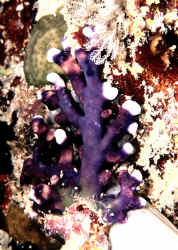
Distichopora
violacea Red Sea
|
Notable to aquarists and divers alike as being
beautiful, fragile and slightly to highly toxic to the touch! Watch
your hands underwater... and don't touch your mucus membranes w/o
washing your hands after diving or working in your tanks.
Ouch!
Hydrozoans are the
"other" Class of cnidarians (Anthozoans making up the mainly
Polypoid corals, anemones, sea fans... and Scyphozoans the
"real" Jellyfishes that live most of their lives as medusas,
inverted bell-shapes). Most of the Hydrozoans are small, obscure not-so
funny to touch Christmas tree sort of affairs, but they include such
notables as Portuguese Man of War, Fire Corals
(Millepora), and the beautiful delicate Stylasterines (Lace Corals) amongst their
ranks.
These are colonial animals,
sometimes a branch per colony, other times a specialized part (like the
"Sail" in the Man 'O War...).
Order Hydroida: Hydroids, the most common
Hydrozoans. Most are "tree-like" in shape with their stinging
cells much like small leaves or ornaments. Most reproduce sexually,
with mature attached colonies releasing small medusae that form at the
base of their "branches"... these swim off producing either
eggs or sperm, that if joined, metamorphose into a planula larval form
that if fortunate, is blown by currents to a suitable reef surface and
attaches, becoming a new branched colony.
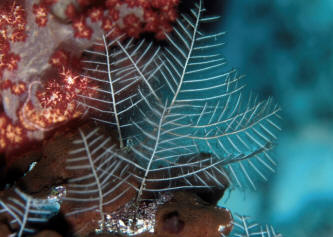
Genus Aglaophenia:
| Aglaophenia sp. Fiji. |
|
Bigger PIX:
The images in this table are linked
to large (desktop size) copies. Click on "framed" images
to go to the larger size. |
|
|
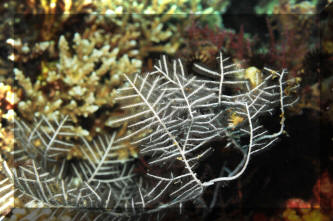
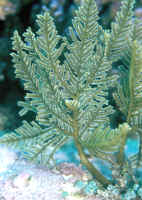
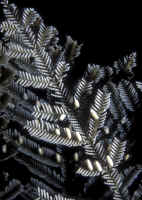
| Aglaophenia cupressina
Lamouroux 1812, Feather Hydroid. Indo-Pacific. To about two feet in
height. Zooplankton filter feeder. Occurs in whitish and tan
varieties. A colony in Australia and one showing reproductive
structures in N. Sulawesi. |
|
Bigger PIX:
The images in this table are linked
to large (desktop size) copies. Click on "framed" images
to go to the larger size. |
|
%20MD.JPG)
%20MD.JPG)
|
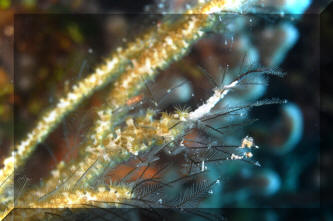
| Aglaophenia latecarinata
Feather plume hydroid. Branches out from a dark central stalk in one plane;
1-3". Here in Cozumel 2019. |
|
Genus Antennellopsis:
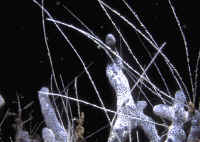
| Antennellopsis sp. Very
narrow single strand colonies. N. Sulawesi images. |
|
Bigger PIX:
The images in this table are linked
to large (desktop size) copies. Click on "framed" images
to go to the larger size. |
|

|
Genus Cnidoscyphus
| Cnidoscyphus marginatus. Unbranched
Hydroid. Yellow, alternating polyps. To four inches. Cozumel 2017 |
%20MD.JPG)
|
Bigger PIX:
The images in this table are linked
to large (desktop size) copies. Click on "framed" images
to go to the larger size. |
|
%20MD.JPG)
%20MD.JPG)
|
Genus Dendritica:
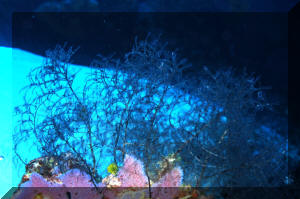
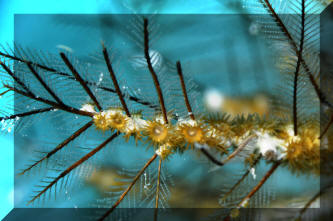
| Dendritica dendritica Feather bush
hydroid. Central stalk accompanied by angular side branching and
sub-branches that bear polyps. W. Atlantic. Cozumel 2012 |
|
Bigger PIX:
The images in this table are linked
to large (desktop size) copies. Click on "framed" images
to go to the larger size. |
|
|
Genus Gymnangium:
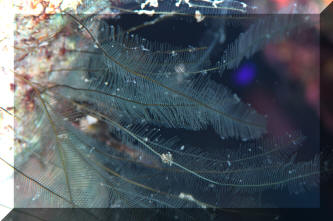
| Gymnangium eximium, (Allman 1874),
Indo-Pacific; Sri Lanka, Fr. Polynesia... Here in the upper Red Sea (?!).
2019. |
|
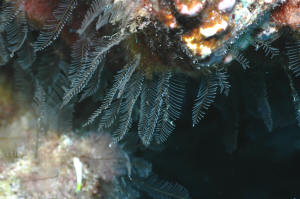
| Gymnangium hians (Busk 1852), Feather
Hydroid. Found in areas of good current on underhangs, in caves (pukas).
Gray to light brown in color. 2-3 inches in length. Indo-Pacific. Hawaii
pix. |
|
Bigger PIX:
The images in this table are linked to large (desktop size) copies. Click on
"framed" images to go to the larger size. |
|
|
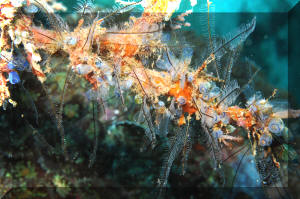
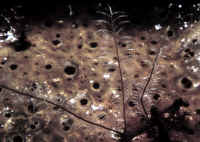
| Gymnangium longicauda, Feather
Hydroid. 3 1/2 to 12" tall. Thin, close-spaced individual branches with
whitish branchlets. Found worldwide in tropical seas. Cozumel |
|
Bigger PIX:
The images in this table are linked to large (desktop size) copies. Click on
"framed" images to go to the larger size. |
|
%20MD.JPG)
%20MD.JPG)
|
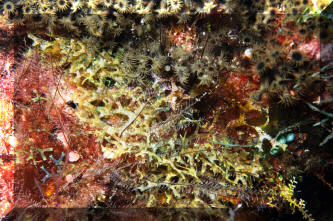
| Gymnangium speciosum, Slender Feather
Hydroid. Found on reef tops in areas of good water quality and current.
2.5-5" tall. Tropical W. Atlantic. Here in Cozumel 2016 |
|
To: Part 2,
Part 3, Part 4
|
|