|
Related FAQs: Marine Crabs 1, Marine Crabs 2, Marine Crabs 3, Marine Crabs 4, By Species/Group: Arrow Crabs, Emerald Green Crabs, Decorator Crabs/Sponge Crabs,
Fiddler Crabs,
Pom Pom Crabs, Sally Lightfoots, &
FAQs on: Marine
Crab Identification, Crab Identification 1,
Crab Identification 2,
Crab ID 3, SW Crab ID 4, SW Crab ID 5, SW Crab ID 6, SW Crab ID 7, SW Crab ID 8, SW Crab ID 9,
Marine Crab ID 10,
Marine Crab ID 11,
Marine Crab ID 12, SW
Crab ID 13, SW Crab ID
14, SW Crab ID 15,
SW
Crab ID 16, SW Crab ID 17,
SW Crab ID 19,
SW Crab ID 20,
SW Crab ID 21,
SW Crab ID
22,
& Crab Behavior,
Marine Crab Selection,
Marine Crab
Compatibility, Marine Crab Compatibility 2,
Marine Crab
Compatibility 3, Marine Crab Systems, Marine Crab Feeding, Marine Crab
Reproduction, Marine
Crab Disease, Micro-Crustaceans, Amphipods, Copepods, Mysids, Hermit Crabs, Shrimps, Cleaner Shrimps, Banded Coral Shrimp, Mantis Shrimp, Anemone
Eating Shrimp, Arrow Crabs, Emerald Green, Mithrax/Mithraculus
Crabs, Crustacean
Identification, Crustacean Selection, Crustacean Behavior, Crustacean Compatibility,
Crustacean Systems,
Crustacean Feeding,
Crustacean Disease,
Crustacean
Reproduction
Related Articles: Hermit Crabs, Squat Lobsters, Crustaceans, Fiddler
Crabs, Arrow
Crabs, Algae
Control, Nutrient Control and
Export,
/A Diversity of Aquatic Life
Crabs For Marine Aquariums? Part
1
To:
Part 2,
Part 3,
|
|
|
Bob Fenner
|
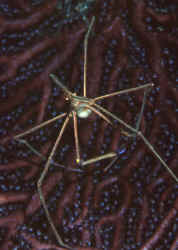
Stenorhynchus seticornis
|
 |
New
Print and
eBook on Amazon
Marine Aquarium Algae Control
by Robert (Bob) Fenner
|
To place the "real" crabs and their relatives
in taxonomic perspective let's do a/the usual rundown on their
systematics starting from the:
Subphylum Crustacea:
About 42,000 species of some of the most familiar
arthropods; crabs, shrimps, lobsters, crayfish, wood-lice (sow-bugs,
rolly-pollies, you know, terrestrial isopods, and aquatic, even
parasitic marine ones). Many small members in fresh and marine habitats
of importance in aquatic food chains. Primarily aquatic, mostly
marine.
Some common characteristics of the
crustaceans: 1) Their heads are more or less uniform with five pair of
appendages: they have two pair of antennae
(this feature is distinctive within the phylum); the third pair as
opposing, biting, grinding mandibles. Behind
the mandibles there are two pair of accessory feeding appendages, the
first and second maxillae. 2) Their bodies trunks are composed of
distinct segments covered by a chitinous exoskeleton strengthened by deposition of calcium salts. 3) Crustacean
appendages are typically biramous (two major elements). 4) They
typically have a carapace covering the trunk of their bodies. Enough of
this detail. We'll cover this stuff in more general survey pieces
of the mega-groups. On toward the lobsters.
A systematic resume of the Crustacea is necessarily
large and complex. Allow me to semi-skirt around a full discussion
here. The nine Classes that don't include our family of interest
enclose the primitive cephalocaridans (C. Cephalocarida), the Class
Branchiopoda (fairy shrimps, tadpole shrimps, water fleas
(Daphnia); the Class Ostracoda, Class Copepoda (Anchor worm,
Lernaea), Classes Mystacocarida, Branchiura, Tantulocarida,
Remipedia, Cirripedia (barnacles), whew! & finally, our:
Class Malacostraca:
Comprises almost three-fourths of all described species
of crustaceans and most of the larger forms, such as crabs, lobsters,
and shrimps. Characteristics: Trunks typically composed of 14 segments
plus the telson ("tail"); the first 8 segments form the
thorax, the last 6 the abdomen; all segments bear
appendages. Four Superorders: Syncarida, Hoplocarida, Peracarida, and
the one we want to talk about, the Eucarida.
Superorder Eucarida
contains many of the large malacostracans. They have highly developed
carapaces displaying fusion of all thoracic segments (the
cepahalothorax). Eyes are stalked... Two living orders; the
Euphausiacea (krill) and the:
Order Decapoda includes the familiar
shrimps, crayfish, lobsters and crabs. This is the largest order of
crustaceans with @10,000 species. Decapods are distinguishable from
euphausiaceans and other malacostracans in that their first three pair
of thoracic appendages, The remaining five pairs are legs (Decapoda=
"ten feet"). Decapods are further divided into two Suborders,
the Dendrobranciata, with "tree-like" branched gills, body
laterally compressed..., eggs planktonic, nauplius as the first larval
stage (as in Artemia, our brine shrimp), Infraorders, Sections,
Superfamilies... See Barnes re their higher taxonomy.
Infraorder Anomura, families of Hermit Crabs, Sand or Mole Crabs. Depressed
carapaces, third pair of legs never chelate, fifth pair
reduced....
Superfamily Galatheoidea, Family Galatheidae:
Squat Lobsters. Genera
Cervimunida, Pleuroncodes. Crab/Lobster-like crustaceans with
well-developed tail fans. First legs as chelipeds. Superfamily
includes the Porcelain Crabs of the genera Petrolisthes,
Pachycheles, Porcelana, Polyonyx, and the freshwater
Aegla.
Superfamily Hippoidea, Sand or Mole Crabs. Have
symmetrical abdomens that are flexed beneath the thorax. Cephalothorax
flattened to cylindrical. First legs chelate or subchelate (never
chelipeds). Fifth pair greatly reduced. Common in sandy surf zones.
Infraorder Brachyura, the true Crabs, marine,
freshwater and terrestrial. Have broad carapaces which are fused with
their epistomes. First legs as heavy chelipeds, third pair never
chelate. Have symmetrical abdomens which are tightly held against the
cephalothorax (Not able to "flap" quickly). Further divided
into five Sections.
Family Calappidae, the Shame-Faced or Box Crabs.
Mostly hide in the sand by day. Great eaters of snails. To eight
inches in diameter. Hepatus and Calappa regularly imported.
Calappa calappa (Linnaeus 1758). Giant Box
Crab. To 13 cm. Indo-West Pacific: Japan to Australia and
Hawaii. N. Sulawesi pix. Tan to orangish in colour.
http://www.sealifebase.org/summary/
SpeciesSummary.php?id=21135 |
%20MD.jpg)
|
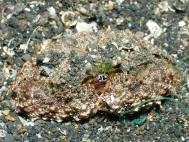
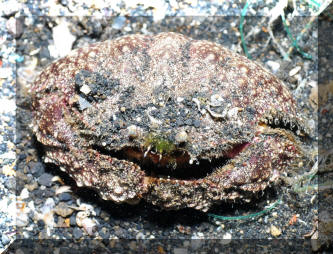
| Calappa hepatica (Linnaeus 1758). Bumpy
carapace. Color generally white and gold but may be overgrown.
Indo-Mid-Pacific; Red Sea, East Africa to Hawai'i. N. Sulawesi
pix. |
|
Bigger PIX:
The images in this table are linked
to large (desktop size) copies. Click on "framed" images
to go to the larger size. |
|
|
Family Cancridae; Cancer or Dungeness Crabs. Oval
bodies.
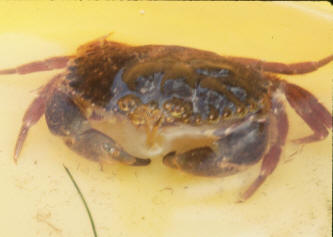
| Cancer antennarius, The Red Rock Crab. To
seven inches across. Chelipeds with black tips, red spots on
underside. Eaten by birds, humans... in turn mainly eats algae
(Ulva). |
|
Family Capillidae;
| Capilius maculata Hoover, J.P. 1998, The 7-11 Crab. To 4 inches across.
Aq. pic. |
%20MD.JPG)
|
Family Dromiidae: Sponge Crabs. Have hairy,
spherical bodies. Pinchers generally with light colored tips. Carry a
sponge colony or mussel shell on their backs.
Family Epialtidae: Imitator Crabs
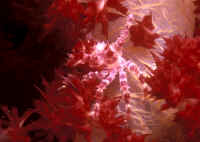
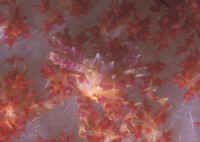
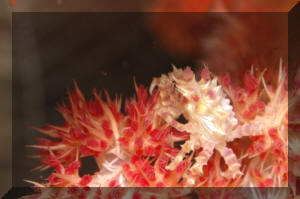
| Hoplophrys oatesii. Soft Coral Crab. Bodies laced with pink
and white lines to match their host soft corals of the genus
Dendronephthya. Indonesia. N. Sulawesi pix. |
|
Bigger PIX:
The images in this table are
linked to large (desktop size) copies. Click on "framed"
images to go to the larger size. |
%20MD.JPG)
 |
| Pelia mutica, (Gibbes 1850) Cryptic Teardrop Crab.
Typically covered in red and blue sponges. To .75". Bluish claws with dark
spots. Roatan 2019. |
%20crop%20MD.JPG)
|
Bigger PIX:
The images in this table are linked
to large (desktop size) copies. Click on "framed" images
to go to the larger size. |
|
%20MD.JPG)
|
Family Ethusidae: Sumo Crabs
| Ethusa sp. Pemuteran, Bali 2014 |
/Dasycaris/Ethusa%20sp.%20BALI%20(6)%20MD.JPG)
|
Family Eumedonidae: Urchin Crabs
| Tiaramedon spinosum Thorny Crinoid Crab. Indo-W.
Pacific and Japan. To 1.5 cm. (5/8"). |
%20MD.JPG)
|
Bigger PIX:
The images in this table are linked
to large (desktop size) copies. Click on "framed" images
to go to the larger size. |
|
%20MD.JPG)
|
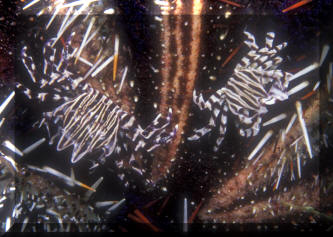
| Zebrida adamsii White 1847. Urchin Crab.
Beautiful contrasting white, brown body banding. N. Sulawesi
pix. |
|
Bigger PIX:
The images in this table are linked
to large (desktop size) copies. Click on "framed" images
to go to the larger size. |
|
%20MD.JPG)
|
Family Grapsidae; Marsh, Rock, Spray Crabs. Have
flat, quadratic shaped bodies. Many amphibious, and need to be able to
get out of the water (keep tank covered).
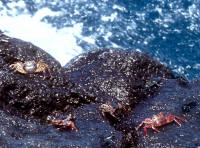
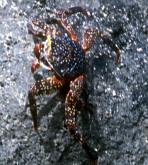
| Grapsus grapsus, the Sally Lightfoot Crab.
Galapagos pix. |
|
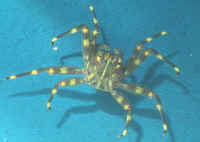
| Percnon gibbesi, the Nimble Spray
Crab. Tropical West Atlantic. Live in reefs, rocky areas. Hide
under Urchins and rocks. |
|
Bigger PIX:
The images in this table are linked
to large (desktop size) copies. Click on "framed" images
to go to the larger size. |
|
%20MD.JPG)
|
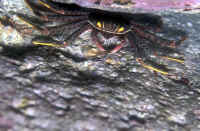
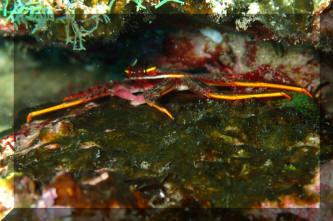
| Percnon planissimum (Herbst 1804), the Flat Rock
Crab. Found in shallows on roundish boulders scurrying out of view. Carapace
about one inch in diameter. Nuka Hiva, Marquesas, Polynesia pix. |
|
Bigger PIX:
The images in this table are linked
to large (desktop size) copies. Click on "framed" images
to go to the larger size. |
|
|
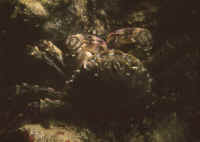
| Plagusia depressa. Both sides of the
tropical Atlantic. To four inches across. This one facing up on a
pier piling in Belize. |
|
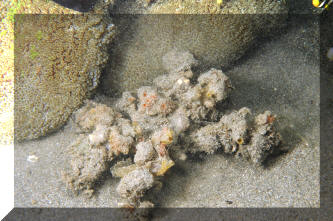
I nachidae: D ecorator Crabs
Camposcia retusa Blunt Decorator Crab. Bali 2014 |
|
Family Latreillidae: Arrow Crabs
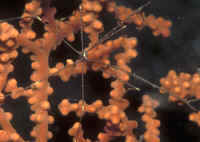
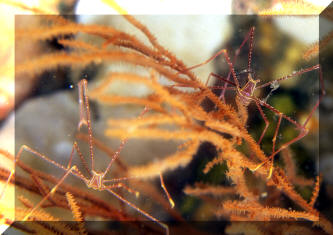
| Latreilla valida Haan 1839. Oval carapace,
very long thin legs that are red-banded. Indo-Western Pacific;
Australia, Philippines, South Africa. N. Sulawesi pix. |
|
Bigger PIX:
The images in this table are linked
to large (desktop size) copies. Click on "framed" images
to go to the larger size. |
|
|
| Stenorhynchus debilis (Si. I. Smith 1871),
the Pacific Arrow Crab. Baja California to Peru. To five inches
overall diameter. Costa Rica (Pacific side)
2011 |
%20MD.JPG)
|
Bigger PIX:
The images in this table are
linked to large (desktop size) copies. Click on "framed"
images to go to the larger size. |
%20MD.JPG) |
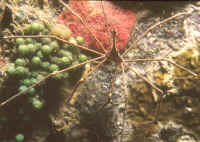
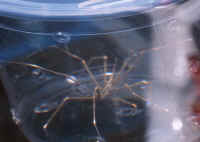
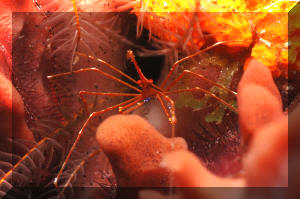
| Stenorhynchus seticornis
(Herbst 1788), the Caribbean Arrow Crab. Not to be trusted with
small to medium fish tank-mates (may spear with rostrum, otherwise
consume). Safe with hardy native corals and anemones, larger
fishes. A small individual in Belize and one at wholesalers
shown. |
|
Bigger PIX:
The images in this table are
linked to large (desktop size) copies. Click on "framed"
images to go to the larger size. |
%20MD.jpg) |
To:
Part 2,
Part 3,
|
|
New Print and
eBook on Amazon
Marine Aquarium Algae Control
by Robert (Bob) Fenner
|
|
|