|
FAQs on Mudskippers
Related Articles:
Mudskippers, An
Introduction for Aquarists by Gianluca Polgar, Mudskippers, Gobies & their Relatives,
Related FAQs:
True
Gobies, Gobies
2, Goby Identification,
Goby Behavior, Goby Selection, Goby Compatibility, Goby Feeding, Goby Systems, Goby Disease, Goby Reproduction,
Amblygobius Gobies, Clown Gobies, Neon Gobies, Genus Coryphopterus Gobies, Shrimp Gobies, Sifter Gobies,
|
 |
|
Re: Spaghetti Eel... which reminds me of bugs bunny
11/10/18
Hello Neale and all you cool people in WetWebMedia!
<Hello Ben,>
Thank you for the reply. The smaller eel immediately begin eating chopped shrimp
and bloodworms, while the larger eel looks like it's not hungry yet.
Or maybe it's eating the bloodworms when I wasn't looking. Closer examination
reveals that the larger eel actually does have a pinkish face.
It's the smaller one that is not pink. But both has the same morphology.
The smaller one is now more outgoing and will leave the sands for food, while
the big one is still behaving like a mole or a bugs bunny.
https://www.youtube.com/watch?v=tHaDQgCWiZ0&feature=youtu.be So, maybe one
of them is M. Microchir and the other one is M. Raitaborua?
Or maybe they are both M. Raitaborua, and simply changed colors when getting
old! :D
<Could be either situation. I admit they don't look like the same species, and
maybe their behaviour is different too. But you really can't be sure without
contacting someone who actively studies this genus, or at least knows the common
fishes collected in this area. Indeed, there may be other Moringua species
(described or otherwise!) that we aquarists aren't aware of, and without photos
online, we wouldn't be able to compare them to the fishes in front of us.>
My salinity is 1.005sg (fluctuating) at the last water changes, so I hope it's
still within range.
<If they're eating, it's probably fine; with Moray Eels at least, refusing food
is a good sign the salinity is wrong.>
These eels will hide under bright lights (just like my white cheek moray), but
when I reduce the lights, they will eventually come out, especially when
smelling food.
<Correct.>
It is rather difficult to find more online info about these spaghetti eels, even
though our local fishermen and procurers here are familiar with them and their
behavior.
<They are extremely rare in the aquarium trade, in Europe at least. So likely
very few experiences among the sorts of people who write web pages!>
They are known as agreeable pets, but not as desirable as morays (morays are
considered more "beautiful"). And to catch them would require some patience as
they only easy to catch in the rivers at certain times of the year.
<May well be migratory, by the sounds of it.>
Well, thank you for your time, and I hope my report will be useful for all you
WetWebMedia fans out there who wish to know more about these spaghettis!
<Oh, I am quite sure this will help those luckily enough to obtain Moringua
spp.>
Best Regards, Ben
<Cheers, Neale.>
|
|
Some mudskipper questions 9/4/18
I've gotten interested in keeping some Periopthalmus novemradiatus
(dwarf Indian mudskipper) in my 180 liter tank (47.55 gallon) and i was
wondering about several things:
<Fire away.>
how to make substrate they can burrow in? i have found that a combination
of sand and pottery clay should work, but it will stink after a while,
any other options?
<In terms of actually doing this, it's very hard in a home aquarium. You
will find it easier to buy various pieces of straight and bent PVC
tubing (as used for domestic plumbing) and create some burrows, then
bury them in the sand or gravel. Your Mudskippers will usually use these
without complaint. You can use coral sand mixed with smooth silver sand,
but it won't really 'stick' together in the same way as mud. By all
means experiment though.>
i was also wondering about algae control and was thinking about adding
brackish water snails, i have Nerite snails in my other brackish tank of
which i could get more, however i can also get Littorina littorea
(common periwinkle) for it which is cheaper, but I'm not sure if they
can stay in brackish water.
<Littorina littorea can tolerate strongly brackish water, but only down
to about half-strength seawater, so maybe SG 1.012 at 25 C. Your bigger
issue is that these snails are temperate zone animals, with only limited
tolerance for high temperatures. They may adapt to maybe 25 C, but their
mortality is likely to be higher than at, say, a normal 15-18 C. That
said, these snails are strongly intertidal and will spend all their time
trying to escape from warm water -- that is my experience simply keeping
them indoors at room temperature. So certainly worth trying, but don't
expect miracles.>
and is lava rock safe for mudskippers, as i have a couple of nice pieces
around but they are kind of rough, so i wonder if mudskippers can get
damaged by it?
<It is certainly a risk. I would suggest not using it. Best stick with
bogwood roots, water worn cobbles, etc.>
Met vriendelijke groet,
Thijmen
<Cheers, Neale.>
Re: some mudskipper questions 9/4/18
thanks for the answers, you are fast.
<Glad to help.>
i still have some pottery clay somewhere so I'll mix some with sand put
it in a bucket and check for smells for a few weeks, just to check how
bad it is.
<Is this unfired (soft) clay? Seems an odd addition to an aquarium.
Can't
think why it wouldn't work, but never seen it used in an aquarium
myself.>
since i prefer not to experiment with animals I'll get some Nerite
snails for algae control
<Probably best. Various estuarine species available, such as Clithon and
Neripteron species, do turn up in the trade. There are some true
freshwater species (mostly Neritina spp.) so check first.>
i kind of like the looks of lava rock but i guess I'll find another rock
to keep the land part from collapsing
<Wise. Cheers, Neale.>
Re: some mudskipper questions
9/5/18
The clay i have is unfired river clay that has been filtered of
impurities, the bag even states the river it's from. (The Waal from
memory)
<Interesting.>
I'll be adding some sand and pea gravel to reduce the amount if clay i
need. (Keeping the top layer mostly clay.)
<Understood. Mudskippers are diggers though, and in water, small
particles (such as clay) will eventually sink to the bottom, below
larger particles like gravel and sand.>
A tip i got from another place was to add some mud from a river, lake or
estuary to seed it with bacteria, is that a good idea?
<I can't think why clay would have filter bacteria on it. So no, doesn't
sound like it would help. Filter bacteria live on solid surfaces exposed
to oxygenated water. The best places to get them into your fish tank are
things like floating plants (their roots are covered with bacteria) and
the surface layer of sand or gravel from a mature tank.>
And i'm currently busy figuring out how to make a tidal system, working
on airlift pumps, though i wonder if it would be able to lift water high
enough.
<Indeed. There's no real reason to create a tidal flow here. Tidal
systems are available and used in some reef tanks, but they're often
expensive. Mudskippers spend almost no time in the water if they're
happy, and really you only need enough brackish water for them to bathe
and osmoregulate. The rest of the time they'll be much more interested
in the bogwood roots, rocks, hollow ornaments, plastic plants, and any
potted plants (kept out of salty water!) in the vivarium that they can
explore. Cheers, Neale.>
Re: some mudskipper questions
10/21/18
The tank is finished, I put in 4 Periophthalmus novemradiatus, I plan to
get some Clithon snails for the water part at a fair that is happening
in 2 months.
<Cool.>
Other than that I want to set up some live food cultures, do you have
any suggestions?
<Only that there's no real need. Mudskippers feed on a range of foods,
and will do very well on flake and frozen foods smeared on the sand or
rocks.
River shrimp could be offered of course, and flies such as wingless
Drosophila and even Houseflies will be readily taken while they're
foraging on the land.>
And I wonder if Artemia nauplii are too small as food.
<Probably, yes, because Mudskippers aren't very effective hunters in the
water. It's better to offer them terrestrial prey, such as small
insects.
Cheers, Neale.>
|
 |
|
Re: some mudskipper questions 9/16/18
I was looking on feeding options for my mudskipper tank and happened on
2 species which might even survive in there: Palaemon varians which is a
brackish shrimp (sold as river shrimps here) and Gammarus oceanicus
which is a gamble, they are a marine species of scud but some sources
say it can be fine in brackish. I am thinking if going for a salinity of
sg 1.007 and a temperature of 24 degrees Celsius. Can either of them
survive in these conditions?
<Salinity will be fine for Palaemon varians for sure, and probably
Gammarus oceanicus long enough for the Mudskippers to find and eat them.
I'd be offering the Gammarus just a handful at a time, keeping the
others in a cold, fully marine bucket or even nano aquarium until
required. Now, the Palaemon varians are a bit more durable, and they're
often sold in the UK as live food. They will live some days in tropical
conditions, and indefinitely at room temperature. Nonetheless, you will
want to remove any dead ones before they decay.>
Also i am looking for plants to grow emersed, so far i have found, java
fern and red mangroves. Unfortunately the mangroves will need to be
replaced as they grow too big. (Bonsai techniques seem impossible with
them.) I may be able to also get seeds of a Japanese Salicornia sp. I
wonder if that is an option?
<It is entirely possible to make the vivarium a freshwater system as far
as the plants go, and that opens up the option for all sorts of
houseplants.
Epiphytes are ideal, as these can be attached to bogwood and rocks, and
misted with freshwater as needed, without worrying about their roots
being in brackish water. Otherwise you can glue or wedge small pots into
the bogwood, and again, that keeps their roots away from the brackish
water at the bottom of the tank. I've even seen Nepenthes pitcher plants
in these sorts of tanks! So instead of growing plants up from the
bottom, you're growing trailing plants and vines that go downwards. But
the key thing will be that there needs to be a basin of some sort in the
vivarium that has brackish water in it. Your Mudskippers will visit the
brackish water as/when needed, and have no problems at all handling
freshwater misting inside the vivarium. Hope this helps, Neale.>
Re: some mudskipper questions
9/21/18
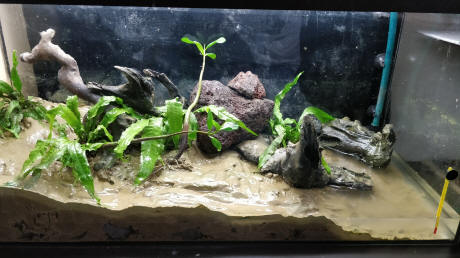
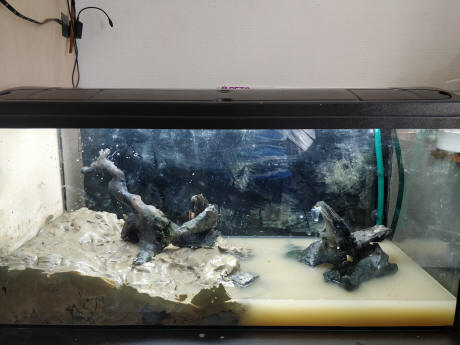
The tank is starting to get together, going to extend the land area
until i have a 75*40 cm land part, leaving me with 25*40 water.
<Looks cool.>
But i can't find a good source on how many mudskippers will fit. how
many Periophthalmus novemradiatus can go in this tank?
<Overstocking is beneficial here, because it prevents males from
establishing territories. Keeping just twos or threes often goes wrong.
But in any case, I think you could easily keep at least 6-8 specimens,
perhaps more. Mudskippers are much more ammonia tolerant than many other
fishes because of their unique ecology.>
And i read adding fiddler crabs is a possibility, i might want to add a
couple of them as well.
<These are a bit tricky to maintain. Do read up on their needs.>
I am still waiting for red mangrove propagules to get back in stock, and
i am adding some java ferns, I'll put some rocks under the wood to keep
it out of water to slow the decay brackish water causes.
<Indeed. Decaying wood isn't a problem for the Mudskippers, so long as
the water is properly buffered against pH drops.>
The green hose will twice a day pump in some water from a sump, and then
siphon it back out as the water level does not allow easy filtering in
the tank...
<Sounds like a plan. I've used an internal canister lying on its side
where water depth is very low. Good luck! Neale.>
|
 |
Re: Don't know if you'd have...
12/13/14
Indeed… can we ask the recipient to resend her message, my reply?
<Aye>
Am enjoying playing “spot the difference” in your/my replies to today’s
FAQs… are you trying to breed Misgurnus? Would be very cool. Like you, I
suspect “chilling” part of the process. One Russian paper mentioned
collecting them from icy water, keeping them cold in labs, then warming
up/using hormones.
Cheers, Neale
<And I do concur re your stmt.s re Cobitid repro. in captivity...
Perhaps we can switch off being superhero/street guy ongoing. B>
Suzanne,
Do you happen to have the emails I sent earlier this week? Specifically,
the first reply about Mudskippers?
We've lost our copy, but want to add it to the website. Ideally, the
reply with your original question would be used.
Regards and thanks,
Neale
FW: Mudskipper Question 12/13/14
Hi Neale,
Let me know if you received this and if this is what you were looking
for.
By the way, I appreciate your information and help. I got the little guy
in some low end brackish to get him started and he seems happy enough.
Cheers,
Suzanne
<This is very helpful Suzanne, thank you! Neale.>
Hello Bob,
I see you moved it into my mailbox. I paste the cleaned version of the
text below.
Cheers, Neale
—
Mudskipper Question 12/14/14
Hello, I used to chat to Neale years ago and as far as I know, he's got
more information on mudskippers than anyone else, or so it seems.
<By no means true. Richard Mleczko is the person I defer to on these, as
well as Gianluca Polgar.>
I have his book on Brackish fishes and find it very useful. However, I
have what may be a simple question. I recently got a mudskipper (I have
kept many in the past) that was kept in freshwater and I'd like to get
it into brackish water, which I believe is optimum for them.
<Definitely.>
I have him in freshwater now with a mature filter running and
appropriate land for him to rest on (part land, part water set up). I
have just got some marine salt and I'm not sure where to start. All the
other mudskippers I've gotten were already in a brackish tank, so I
didn't have to worry about acclimation, or do I even with this one?
<Mudskippers aren't fussy. They can jump into seawater from the land,
and back out again, without any ill effect. But filter bacteria can be
sensitive to salinity changes. So gradual changes would be sensible.
Make up some SG 1.005 water, and do a 20-25% water change, replacing
your freshwater with this. Repeat a day or two later, and so on, until
you'd replaced all the water with this slightly brackish water. That
shouldn't be too big a change for the filter bacteria.>
I know they are pretty hardy fish, but I don't want to lose this little
guy. He's one of the smallest P. barbarus' that I've had, the others I
had were much bigger. This little guy is maybe 3-inches at most.
<But do recall the very young (larval) Mudskippers will be marine
(planktonic) animals.>
So I suppose my question is, how much salt should I start with to get
the mudskipper back to brackish and not to lose all the bacteria in my
filter?
<Above SG 1.005, you can get nitrite and ammonia spikes as the filter
adjusts to saline conditions. Mudskippers have a high tolerance for
these, so I wouldn't worry overmuch. After all, they don't go in the
water much given the option.>
What amount of salinity am I to be aiming for in your opinion? I have
always kept them in low end brackish, not very salty at all.
<The ideal is half-strength seawater, SG 1.008-1.012. But as you
correctly observe, Mudskippers are very tolerant. They just don't like
freshwater conditions indefinitely. SG 1.005 is probably viable.>
Thank you for any and all help you can provide. Also, are there any new
sites I can go to for good information on mudskippers.
<Not that I'm aware of. There's some stuff here of course, at:
http://www.wetwebmedia.com/ca/volume_7/volume_7_1/mudskippers.html And
my own Brackish FAQ has some stuff Richard helped me with:
http://brackishfaq.webspace.virginmedia.com/Projects/FAQ/5c.html Both he
and Gianluca used to have websites, but they seem to have vanished.>
It is so hard to find quality information on them, though I do know a
fair bit about them myself, been keeping them easily about 2008. Kind
Regards, Suzanne
<You're probably an expert by now, better than most of the folks
throwing together tropical fish encyclopaedias based on their
experiences of Guppies and Angelfish! Cheers, Neale.>
Re: Mudskipper Question
<Neale; I've lost the prev. corr. somehow here> 12/12/14
Thanks Neale and sorry for the original mis-spelling of your name, shame
on me, especially as I have your Brackish Fishes book.
<Not a problem.><<He IS a man of Tao>>
Thank you very much for all of your help. I am going to change the water
starting tomorrow. I was hoping to hear from you before I did anything.
I've only had him 2 days, so I figured he wouldn't be suffering too
badly from being in freshwater, but my experience in the past has shown
that they do better in brackish conditions and I would like to keep this
one around for as long as possible, as they are one of my all-time
favourite fishes.
<Indeed, quite exceptional pets.>
Thank you so much again. I shall be looking at your site, and actually I
did remember Richard Mleczko being mentioned in your book, but couldn't
remember his name when I wrote the email to you. Shame that Richard and
Gianluca Polgar no longer have websites, we could use some decent
genuine information on these little fish.
<Gianluca has his academic website up, here:
http://www.mudskipper.it
There's a tonne of great stuff there. Maintenance of Mudskippers isn't
actually all that nuanced. Most genera are easy to keep (Boleophthalmus
excepted because of its herbivorous diet) and adaptable with regard to
salinity (see Richard's chapter in the Brackish book). Most mortalities
come from lack of salt, dry air, escape, and insufficient quantity of
food.
Aggression can be severe (especially with big species like P. barbarus)
but the smaller species thrive when "crowded" in much the same way as
Mbuna.
Beyond that, these fish aren't that difficult.>
Kind Regards,
Suzanne
<And to you, Neale.>
FW: Mudskipper Question 12/15/14
Hi Neale,
Let me know if you received this and if this is what you were looking
for.
By the way, I appreciate your information and help. I got the little guy
in some low end brackish to get him started and he seems happy enough.
Cheers,
Suzanne
<Sounds good. Yes, thank you, the message came through, and I think is
pasted in today's FAQs. Cheers, Neale.>
<<Thanks to you both. RMF>> Indian Dwarf Mudskippers; repro. 8/1/13
I have several Indian dwarf Mudskippers in a fairly large tank
with lots of land and hiding places. They all seem healthy very active
and come for their food at meal times. Very little aggression.
<Neat animals, society to keep/observe>
Recently I was cleaning the filter when I noticed what I thought was a
stone under it. In picking it up I squashed it and found it was an egg.
The tail was very evident and the inside had some form.
<? the tail?>
I have since found another egg on land so put it into the water near the
heater. (I read somewhere that Indian Dwarf leave their eggs in water
rather than the burrows although my skips digs burrows in the sand and
under the rocks.)
<This is where all mudskipper species I'm aware of deposit their eggs>
Today I checked and the egg is still where I left it but it now has 2
white spots on the shell.
Question Do I leave it where it is?
<I would... perhaps with an inverted strawberry basket or such over it>
If it hatches will the others eat it?
<Don't know... What other life (animal) is in this tank?>
If I put it into a birthing chamber in the tank will it drown after
hatching? (space is very limited in the water)
<Perhaps>
Any information would be appreciated as I can find very little on
hatching the eggs on the net.
Many thanks Beverly
<Can you send along a pic, resolved/cropped... some better description,
perhaps including size, shape, colour of the egg?
Bob Fenner>
Re: Indian Dwarf Mudskippers 8/4/13
<<Reproduction is Mudskippers is not extensively studied. But latest
observations suggest they lay their eggs above the waterline but within
damp, underground burrows within the male's nest. This is remarkable
because the water within the burrow is oxygen-deficient, as is the mud
itself, so apparently the male takes air from outside the burrow and
releases it within the burrow, creating a sort of "diving bell" where
the eggs can get oxygen. He usually does all of this broodcare of the
eggs alone, without the female. But once the eggs hatch, he moves the
eggs down from burrow and somewhere the tide can wash the hatchlings
away. As with most gobies, the hatchlings are very small, planktonic,
and drift about on oceanic currents for a period of time (no-one knows
how long for sure) before metamorphosing into juvenile Mudskippers. Some
more details are here:
http://jeb.biologists.org/content/210/22/3946
http://www.mudskipper.it/Reprod.html
http://www.wetwebmedia.com/ca/volume_7/volume_7_1/mudskippers.html
Spawning by Mudskippers is not unknown in aquaria; rearing the eggs has
not been done yet, and without moving the eggs to a marine aquarium and
rearing on marine infusoria (do-able, but difficult) it isn't likely
Mudskippers will be bred in captivity any time soon. That said, if you
do it, you'll make front-page news in the aquarium -- and likely
scientific -- literature!
Cheers, Neale.>>
Mudskippers! Stkg./Sel.
3/6/12
Hey there everyone! Well as always, I've been scheming up new tank
ideas here and there...and recently have found myself attracted to mud
skippers!
So while i have just started researching i had a few questions that
primarily will determine whether i will/should keep these cool
creatures.
So here are a few questions....
1. Yes or no- Are there any species that would work out for a 10 gallon
tank?
<Not really, no. Many would be fine with just 10 gallons of water,
but you'd need dry land on top of that, so realistically, you'd
want 20 or 30 gallons for even the mini species like Periophthalmus
novemradiatus, the Dwarf Indian Mudskipper.>
2. If no to the first question: Are there any species of mud skippers
that would be fine in a small group in a 20gallon tall tank which has
been tricked out to maximize the use of the 'tall' portion via
roots/ DIY background with a waterfall to take up more space in the 20
gallon?
<See above.>
3. probably what i should have asked before.....whats the smallest
commonly imported mud skipper species?
<Again, see above.>
4. is low end brackish, being around 1.025 in salinity a good water
salinity for these guys?
<Half-strength seawater is ideal, so SG 1.010 at 25 C, but anything
from 1.005 to 1.025 at 25 C is generally fine.>
was just wondering those few things before i dove into the specific of
care requirements...
thanks!
-John
<Cheers, Neale.>
Re: Mudskippers!
– 3/7/12
Hey thanks Neale! (by the way the group of Toxotes microlepis is doing
great!
<Real good.>
Their eating the cichlid pellets and Hikari carnivore pellets and they
also love the freeze dried shrimps but of all else, live crickets go
the fastest. So just wanted to thank you again for your suggested ideas
for pellet food! I even have a video of them if your interested or if
you need me to get a few pics of them up close for ID or reference
needs)
<Sure.>
so from what its looking like in my 20 gallon i could house a very
minimal amount of the dwarf Indian mudskippers or other wise known
as Periophthalmus novemradiatus.
<Yes. The Indian Dwarf. Nice fish. Small enough that aggression
isn't usually lethal.>
Im panning on a diy background that will have a terraced descending
pools of water with sand so its not all just one flat incline from
water to land....and also i will then be able to use the height of the
tank as well.. and even make a waterfall with an internal filter! Oh
the possibilities!
<Indeed. While an authentic mangrove look would be nice, the fish
couldn't care less. So long as they have stuff to climb on,
they're happy.>
So how many would you suggest for a 20 gallon system with maximum
surface area in mind and of course tons of hidey holes and perching
spots? 2? MAYBE a trio?
<Would get more than that; 5 or more. Overstocking is the key here:
in smaller groups, you will likely end up with one bully and the others
being picked off over the months.>
I'm reading their naturally aggressive as its in their nature.
<Yes. Males, at least.>
lastly just out of curiosity.... has there been success with keeping
them alongside red claw crabs or any of the semi terrestrial brackish
water crabs?
<Not Red-Claw Crabs, no. They're dangerous to small
'Skippers, and meals for the bigger species. With Mudskippers this
small, best to keep on their own or with harmless algae-eaters such as
brackish water Nerite species.>
Probably wouldn't work at all but just wondering...
thanks again!
-John
<Cheers, Neale.>
|
Mudskipper Tank Question
1/21/12
Hi
In the process of 'renovating' my mudskipper tank as I
seem to know more about there natural habitat.
I believe I have a Periophthalmus takita on hand.
Besides sand is there any other form of mud that I could use in
the tank.
<Not really. Much as mud would seem a nice addition, it would
make the tank very cloudy and could block up the biological
filter media. In a near to full seawater salinity system you
might try some of the live sands sold to marine aquarists. Some
of these are quite fine, though not quite mud.>
Or any substrate that may have the same consistency as mangrove
mud? There's the option of collecting mangrove mud, but not
overly confident that it will be clean enough for my purpose or
the inclusion of any harmful critters/bacteria in them.
Also thinking of adding a purple spot gudgeon native fish of
Australia, easily accessible here (Im in Australia btw). Will
they be able to tolerate sg up to 1.005-1.010? Understanding the
requirements of min water volume needs to be catered for. Does
most gudgeon species have a good salt tolerance?
<Some Mogurnda species can tolerate brackish water, but they
would be very poor companions for Mudskippers. Mogurnda are
larger and more aggressive, and as such would scare the
Mudskippers which generally do not like swimming in water where
there are large fish. Keeping the Mudskippers out of the water is
clearly not good for their health. Conversely, large Mudskippers
view smaller fish as food. If you must add fish, you could try
something like Black Mollies or Guppies depending on the size of
the Mudskippers in question, but otherwise it's best to
concentrate on the needs of your Mudskippers and leave it at
that. Cheers, Neale.>
|
|
|
Re: Mudskipper Tank Question
1/21/12
Ok thank u very much
<My pleasure.>
Ill use fine sand 2/3 of the tank will b land and in the water i
will get a couple of feeder fish and shrimps
<Well, I wouldn't use feeder fish to feed the Mudskippers;
that would be risky. Remember, cheap fish can introduce diseases
that are expensive to treat!>
So we have some movement in the water, if they get eaten then
they get eaten :)
<Funnily enough, Mudskippers don't like movement in the
water. Remember their ecological niche: tide pools and beaches.
Anything moving in the water is viewed as a potential threat
because Mudskippers can barely swim.
Mudskippers are best kept alone, even a bit overcrowded if you
want, because that reduces aggression. You only need enough water
to keep them wet. The rest can be rocks, sand, bogwood branches,
fake mangroves, really anything they can climb and explore. Feel
free to go nuts with those sunken wrecks and skull bones you see
in pet shops. For once, they're just the thing! The more
clutter, the better. Cheers, Neale.>
|
Re: Mudskipper Tank
Question 1/24/12
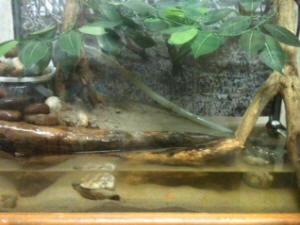
Here's a picture of the updated tank. thanks
<Real good. Do upload, share these on the Forum so
others can be inspired.
Cheers, Neale.>
|
|
|
Re: Mudskipper Tank
Question 1/24/12
would land hermit crabs be a good tankmate for mudskippers
or will they scare them as well on land which means they
will never go on land
<Depends on the size and species. Some land hermit crabs
are brackish water animals, but some aren't. Telling
them apart is hard, so you would need a pool of freshwater.
Mudskippers will be scared of bigger crabs, but very much
smaller ones might be seen as food, so you have to be
careful.>
also if they can go with them can they hurt them with their
claws?
<Potentially, yes. Fiddler Crabs are much better bets.
They're deposit feeders meaning they sift mud and
algae, so they tend to ignore Mudskippers, all else being
equitable between them.>
thanks
<Cheers, Neale.>
Re: Mudskipper Tank Question
1/25/12
Ok thanks. Sounds risky for my mudskipper. Might rethink it
more. Thanks.
<Real good. Cheers, Neale.>
|
|
mudskipper query,
sys. 10/26/11
hi
since mudskippers are mainly brackish water fish
<Fishes>
I am familiar with the requirements of keeping them in brackish
tank.
but will they be able to do well in a saltwater tank with an sg. of
1.020
<Not likely permanently, no. Bob Fenner>
thanks
Wil Alonzo
re: mudskipper query 10/26/11
"The plural for fish (as in more than one species) is fishes.
B"
ok no problems thanks for that wont take the chance then...
on a side note... ammm i think I am correct with my use of the word
fish for a group of mudskippers here, not fishes =)
interesting i thought....! hehe
http://australianmuseum.net.au/fish-and-fishes
Fish and fishes
People often ask about how the terms 'fish' and
'fishes' should be used.
In fact it is often said that there is no such word as
'fishes'. This is not true.
A group of fish of the same species are called 'fish'. Two or
more species of fish are called 'fishes'.
For example, a number of Eastern Australian Salmon swimming together
can be called a school of fish. But if one Tarwhine starts swimming
with the Eastern Australian Salmon they are called fishes.
Books such as the Sea Fishes of Southern Australia and Coastal Fishes
of South-Eastern Australia use the term 'fishes', because more
than one species of fish are included in the book.
but thanks for your advise on the mudskippers might have to just set up
a different tank for them.. they are awesome to have.
Wil Alonzo
re: mudskipper query 10/26/11
fair enough =)
I've always struggled to differentiate the 2.....
Wil Alonzo
<No need to struggle. A simple terminology diff. above sub-specific
rank.
B>
Can a mudskipper coexist in a
mixed cichlid tank 1/13/11
with 2 Senegal bichirs,1 RES,2 mini crabs, and Chinese algae
eaters? They're in a 60 gal.
<Not likely; no. Too likely to be brutalized. Read here:
http://wetwebmedia.com/mudskipfaqs.htm
and the linked files above. Bob Fenner>
Mudskipper Tank
1/12/10
Greetings from Canada!
<And likewise from the UK!>
I want to setup a mudskipper/Brackish tank. (1.005)
<For want of anything more detailed on WWM, do take a look at my
Brackish FAQ for the basic requirements of such an aquarium, here:
http://homepage.mac.com/nmonks/Projects/FAQ/5c.html
There's also a great big chapter on these fish in my "Brackish
Water Fishes" book. Do remember while some species of Mudskipper
are small in enough to keep in groups, some are notably aggressive and
have to be kept alone (Periophthalmus barbarus is notorious in this
regard). So choose your species carefully, and with consideration of
the size of the tank and how many specimens you want to keep.>
Basically there will be 2 shore(right/left) with a lake in the middle
(sand bottom)
<Do remember they spend 90% of the time out of the water.>
I am planning on a full glass cover, heat pad & reg heater.
<The glass cover is a good purchase. A heater pad shouldn't be
necessary, but do make sure you get a glass heater for the water that
is protected by a heater guard. Mudskippers easily burn themselves
otherwise. In theory, the warm humidity above the water will warm up
the air throughout the vivarium. The glass cover will keep the warm air
inside the tank, but do remember you will need a slight gap for
ventilation otherwise mould becomes a problem. Tanks designed for frogs
should give you some idea of what's required.>
No filter, Java fern Java moss and probably some mangrove.
<Would skip the plants, except perhaps the mangrove. Mudskippers
appreciate fairly saline conditions, around SG 1.005-1.010, and you
won't find Java fern or Java moss will do well. Better to stick
with plastic plants.>
Also thinking about 2 rivers, from the middle with underground
pipe/powerhead so the water comes back out and each end flows back in
the middle.
<A waterfall of some sort, with water from a filter trickling down a
stack of pebbles would actually be very nice, and the Mudskippers will
happily graze the algae that grows here.>
3 Questions...
-What kind of plants can I use to separate water/land and to cover the
1/2 pipe of the "rivers" (Mangrove, bamboo, some moss looking
stuff..?)
<Wouldn't use live plants at all. Concentrate on bogwood roots
and other things that can be used to create a tangle of branches and
twigs along which the Mudskippers can climb. The more cluttered, the
happier the Mudskippers will be.>
-Will the MudSkip eat my little Bumblebee Goby?
<If a Mudskipper can catch and swallow a small fish, it will.
Conversely, if the fish are the same size or bigger than the
Mudskipper, the Mudskippers get scared and don't enter the water.
Bottom line, they're best kept alone. Depending on the Mudskipper
species, Guppies, Limia spp., or Mollies might be appropriate
tankmates. So if you wanted some colour, choose a livebearer of
slightly smaller size than the Mudskipper.>
-Finally, How to separate Land/Water (I'm thinking
Glass/Rock/Woods) so my sand doesn't fall into the water!
<Slates are useful for propping up sand banks, and bogwood roots
will also do this job quite well. But since Mudskippers like to dig,
don't expect any arrangement to be stable forever! Design things so
that rocks can't fall down easily, and ideally use a gravel tidy to
secure the bottom half inch of substrate like a cushion along the
bottom pane of glass, so that if a pebble does slip, it won't crack
the glass.>
Any kind of idea would be greatly appreciated Great and I do mean, The
greatest (WWM is my go to book) Site! Thanks again
Phil
<Hope this helps! Cheers, Neale.>
Dragon goby with
mudskippers? 9/20/09
Hello crew,
<Hello Joanne,>
I just wanted to ask a question regarding my set up; I have a 45 imp.
gallon 4-foot set up which contains half a dozen Indian Mudskippers
(believe they are, indeed, novemradiatus. Little stunners),
<Indeed, a lovely species; hardy, small, and easy to keep.>
4 orange Chromide and 8 glassfish (I know the advice runs to species
only for mudskippers, and initially I had them in a smaller tank on
their own; they were so placid and intriguing I moved them into the
downstairs four footer for all to enjoy).
<Mudskippers do become more aggressive as they mature, but this
species is generally fairly placid, particularly if sufficiently
overcrowded that no one male can claim the whole tank.>
Obviously the tank isn't full, probably about 20 galls? Maybe a
little more, but not much. It's half full.
<There are good reasons not to mix fish with Mudskippers. In brief,
Mudskippers tend to be nervous of fish that are bigger than they are,
and so dip into the water less often. Conversely, they'll eat
substantially smaller fish given the chance. While they can be mixed
with other fish -- there is a nice display of West African Mudskippers,
Anableps, and Sailfin Mollies at the London Aquarium -- you do have to
be careful. Orange Chromides can be quite territorial and aggressive
when sexually mature, and I'd be very careful about combining them
with Mudskippers.>
There is, of course 'land space' for the 'skippers. The SG
is 1.010. I have recently seen the violet/dragon goby at my LFS. I
thought they were quirky, but MUST be predatory looking at those teeth,
left the idea alone and went home. However, my curiosity drew me to
look on-line and discover that they are not predatory, but use the
teeth for algae scraping.
Bizarre!
<Yes, very bizarre fish indeed. Shame your tank is too small for
them. You really need something around 40-55 gallons.>
My question, then, is could a violet goby exist in this set-up, or is
it not big enough?
<Not big enough. Plus, even though you know the Dragon Goby is
harmless, it might terrify the Mudskippers.>
I fear I know the answer, but would like to hear it from someone
else.
Thanks!
Jo
<Do read Richard Mleczko's chapter on Mudskippers in my
brackish-water fishes book, should you get the chance. It's a very
useful resource.
Cheers, Neale.>
Mangrove "swamp"/
mudskipper, fiddler tank? 7/31/08 Hi Crew (or should I
say crew member), This is 40 gal des (not sure anyone remembers her). I
have a bee in my bonnet (or perhaps gobies) as I have a new project
idea. My tank has been fallow for ages now, and I was paging through
the book by "The Complete Aquarium" by Peter Scott. Anyway, I
came upon the Mangrove swamp with the mudskippers and fiddlers and I
was utterly charmed. <It is indeed a lovely aquarium.> Anyway, I
have been researching this topic-- where to get the critters and
plants, how to raise mangroves, what to put in the tank, how much water
and sand, brackish, the range of topics. But a few things seem blurry
to me (well more than a few...), but I 'll try for brevity.
<Would highly recommend looking over Richard Mleczko's chapter
on mudskippers in my 'Brackish-Water Fishes' book. He's
easily the world expert on keeping these fish in captivity, and
discusses every aspect of their care as well as all the different
species you'll see on sale. In fairness, the chapter on Mudskippers
in the Aqualog Brackish Water Fishes is also very good.> So here it
is-- Basic setup: 40 gal breeder and stand; Orbits' compact
florescent (2 92 watt bulbs). Plans: Replace actinic bulb with 6700K
and keep the 10,000K. <Do make sure the tank is
"mudskipper-proof", as these fish will climb out of any gaps
they find.> Divide tank roughly in two with plastic, rock up to
about 8 inches or so. Place (no.? ) potted mangrove trees grown from
seeds (already with leaves, etc) around mostly one side. <Mangroves
grow very slowly, and you may find plastic plants or houseplants in
plastic pots (to keep the salty water out) will work at least as well.
Plants like Philodendron work very well for this sort of thing.>
Fill around with (? type sand-- oolitic, aragonite, etc?) about one
inch on one side and about 1/4 to 1/3 on the other <Sand type
doesn't matter, but a mix of coral sand and smooth silver/silica
sand is probably the best in terms of appearance and
"stickiness". The coral sand will also add a bit of buffering
to the system.> fill with brackish mixed water 1.05 or so salinity
(I have an RO system), over the top of sand on both sides. <SG 1.005
upwards to seawater is fine; 1.05 would be hypersaline and deadly!>
Use small internal power filter and guarded 50 watt or smaller heater (
although I'm going to bet it isn't going to go on much).
<Would highly recommend an external heater to avoid problems with
mudskippers climbing onto a glass heater and scalding themselves.
Failing that, make sure there's a plastic guard around the heater.
But seriously, undertank heaters similar to those used for amphibian
set-ups would be better. Filtration is relatively unimportant to
mudskippers because they spend so little time underwater, so use
whatever suits your budget.> Aquascape with some large flat rocks,
coral pieces, shells, and driftwood (a little!). Cover with bullet
proof plastic (I don't expect it to get shot, but it doesn't
warp.) Cycle. <Always a good idea cycling the tank before putting in
fish, but funnily enough Mudskippers are ammonia-tolerant "right
out the box", presumably so they can survive in their wet burrows
while the tide is out. They also spend most of their time on land, so
aren't exposed to the ammonia anything like as much as regular
fish. So provided you did lots of water changes so the ammonia stayed
below 0.5 mg/l, you could probably cycle with the Mudskippers.> Add
quarantined (? number of mudskippers (P. kalolo) and fiddlers (and ?).
<Richard isn't a fan of mixing crabs and Mudskippers, so be
careful here. Big crabs will nip small Mudskippers, and big Mudskippers
will eat small crabs. Fiddlers are probably the best crabs to go with
because they're deposit feeders rather than omnivores, but be
careful. Periophthalmus kalolo is a fairly aggressive species, so
either avoid having more than one male or else overstock the tank so no
single male becomes hyperdominant.> Pull up a chair in front and
watch! <Sounds about right.> So maybe my questions are apparent
here. 1. I was told to plant the seeds in a gallon pot, I'm
guessing clay. Is this a good size. I think the pots sound like a good
idea given the root strength. What do you think of the gallon size and
how many do you think I should do in a 40. The picture in the book
(which is a 40) shows four , and I don't think the pots are that
big. I was thinking 3? <Mangroves are trees, so whatever you do with
them and however you pot them, eventually they will get too big. I
don't actually rate them highly for this sort of set up.> 2.
What kind of sand? The book says silver, but I was thinking aragonite
or even oolitic to keep pH high. <Without undergravel filtration,
the buffering effect of a mound of coral sand is limited. Buffering is
proportional to the surface area of coral sand in contact with moving
water; in the case of a layer of coral sand without undergravel
filtration, only the top grains of sand are in contact with moving
water. So I'd not fuss about this issue.> 3. What rock is safe?
I think limestone would help the pH, but I think granite is the most
common, in the yard sort of rock (I don't intend to buy it.) Is
there rock I should NOT use? (Obviously nothing that would be too sharp
on the fish.) <Again, don't be too worried about the pH issue.
Marine salt mix will buffer the water nicely, and if it doesn't,
you can also add a bit of home-brew Malawi Salt mix to up the carbonate
hardness. I've described this elsewhere on WWM:
http://www.wetwebmedia.com/FWSubWebindex/fwhardnessfaqs.htm So choose
rocks that look nice, aren't spiky or rough, and don't have
metallic seams in them that might poison the fish/crabs.> 4. I know
driftwood is acidic, do you think the other stuff would out weigh it?
Do I need to add something for hardness, pH? I have B-Ionic. I was
thinking though that that was a bit overkill. <Bogwood will have
minimal effect. If it does, up the carbonate hardness as stated
above.> 5. Stocking number? (mudskippers, crabs). Any safe critter
to put in there. I am guessing I don't have room for much.
<Mudskippers are funny about tankmates. Your best bets are things
like small brackish water livebearers, perhaps Guppies or Limia. But
big Mudskippers will eat small fish, while big fish terrify Mudskippers
who view them as predators.> 6. Cycling? I have read not such good
things about BioSpira, that it isn't refrigerated. I have never
seen it refrigerated. Fish food? Shrimp? <Any of the above. Or just
let nature take its course, using the Mudskippers or crabs.> 7. I
live in the desert, should I think about a fog maker, to get up the
humidity a bit? <The lid on the tank should take care of this
automatically.> OK, I think that's enough. I was working on
brevity. Thanks Crew!!! You are terrific! --des <Hope this helps,
Neale.>
Re: Mangrove "swamp"/
mudskipper, fiddler tank? 7/31/08 Hi Neale, Thanks for the
great information. <Would highly recommend looking over Richard
Mleczko's chapter on mudskippers in my 'Brackish-Water
Fishes' book. He's easily the world expert on keeping these
fish in captivity, and Just ordered off Amazon. <<I am sure you
will enjoy.>> > <Do make sure the tank is
"mudskipper-proof", as these fish will climb out of any gaps
they find.> Yes, I have kept Jawfish. Tricky little devils.
Fortunately mudskippers aren't $180 like those cool blue spotted
Jawfish. Just when I thought it was safe to remove the netting around
filters and the like, he jumped to his death! So no more removing
netting, though without hang on the back stuff should be easier
really-- until trees grow. <<Ah, seems you're mentally
prepared at least! The difference is that Mudskippers are gobies, and
are equipped with a neat suction cup that lets them climb up vertical
surfaces, including glass.>> <Mangroves grow very slowly, and
you may find plastic plants or houseplants in plastic pots (to keep the
salty water out) will work at least as well. Plants like Philodendron
work very well for this sort of thing.> The way I read Scott's
book, it was the ceramic pots and not the actual trees that kept the
bank up (along with rock. So you are really not depending on tree
growth. <<I have the book and checked. My issue with ceramic pots
is they're porous, so will let salt in. If you're growing
salt-tolerant plants like mangroves or Nypa palms or whatever, then use
whatever pots you want.>> > <SG 1.005 upwards to seawater
is fine; 1.05 would be hypersaline and deadly!> Oh yes, woops!
It's not a typo really, but I am familiar with all this. Just will
have to go through the numbers again. <<Good.>> Thanks for
advise on filtration and heaters! >below 0.5 mg/l, you could
probably cycle with the Mudskippers.> Cycle with fish! Yikes! This
is new info and I have never seen this (though saw they were tolerant
of ammonia. <<Some mudskippers will happily frolic around sewage
outfall pipes. They are incredibly tough fish.>> What about
quarantining these guys (gals)? I have a ten gal QT. I was thinking in
terms of about 2-4 inches of water and some rocks (or maybe dinner
plates. <<Since they're the only fish in the tank,
quarantining them is redundant. Of course you can't use formalin or
copper medications in a system with crabs, but brackish water will kill
off Whitespot anyway.>> > Periophthalmus kalolo is a fairly
aggressive species, so either avoid having more than one male or else
overstock the tank so no single male becomes hyperdominant.>
What's your definition of overstock of P. kalolo in a 40?
<<Depends on the size of the fish, and how much land there is.
Richard's basic idea is that if all the fish are crammed onto the
same bogwood branch or sand bank, none of them can make a territory.
I'd be looking at half a dozen specimens, at least.>> Or can
you sex the fish to determine which is male? <<Difficult to sex
Periophthalmus spp. except to say males are more aggressive!>>
Also I was told to overstock the crabs. Both because they are
aggressive, and because some will be eaten-- this from a guy who does
barbarus which are even nastier. <<P. barbarus usually ends up
being kept alone.>> >
http://www.wetwebmedia.com/FWSubWebindex/fwhardnessfaqs.htm Thanks for
the link. > <Hope this helps, Neale.> You're all great!
<<We do try.>> --des <<Cheers,
Neale.>>
Mudskippers, sys. -
07/11/08 I'm setting up a 20 gallon long mudskipper habitat,
but I'm starting from scratch. I know next to nothing about these
little guys other than that they need humidity and somewhat brackish
water and 2/3 land with 1/3 water in their tank. <Sounds great.>
While I have ideas about the substrate needed (I was thinking Zoo
Med's Excavator Burrowing Substrate), as well as the type of lid
(likely a standard hood with glass bottom and openable flap), and type
of salt to add to the water (I have some instant ocean at home from a
failed attempt at keeping a GSP), I'd appreciate any and all
guidance you guys have to offer. <Mudskippers are actually quite
hardy and easy to keep, provided you accept them on their own terms and
not try to force them into a standard aquarium.> Because mudskippers
spend 90% of their time on land, do I need to worry about cycling the
tank before adding it? Or can I just set up the tank and introduce it?
I'm only getting one. <You can cycle the tank with the
Mudskippers. They are relatively tolerant of ammonia. Do check which
species of Mudskipper you have in your area. Some species (e.g.,
Periophthalmus barbarus) are large and very aggressive, but others
(e.g., the Dwarf Indian Mudskipper, Periophthalmus sp.) are much
smaller. http://homepage.mac.com/nmonks/Projects/FAQ/5c.html The
smaller species at least can be kept in groups, and if you want to see
the males display, that's recommended.> Also, any
recommendations on a particular type of filter to get? <External
canister filter of some sort recommended simply for the ease of
positioning inlet/outlet pipes given the peculiar arrangement needed
for this type of vivarium.> Will an underwater heater be enough to
heat the whole tank, or do I need a different kind of heater?
<I'd actually recommend against a standard heater because of the
danger the Mudskippers will climb onto the heater and get burned.
Instead consider either an inline heater that connects to the outflow
from the canister filter (e.g., the Hydor ETH brand) or else an
undertank heating mat of the sort widely used to heat reptile/amphibian
enclosures.> Do they need aeration in the water? <Nope; they get
almost all of their oxygen from the air and can tolerate quite stagnant
water if they must. Not recommending you keep them thus, but merely
making the point these fish come from a harsh environment and are very
adaptable "right out the box".> Thanks! Micah <Do
heartily recommend you look at Richard Mleczko's chapter on these
fishes in my Brackish-Water Fishes book. It's the only really
detailed text on Mudskippers written for the hobbyist, and covers
dozens of species in depth as well as all the main issues like diet and
social behaviour:
http://www.tfhpublications.com/fish/brackish-water-fishes.htm Good
luck, Neale.>
Mudskippers... sys.,
fdg., 7/25/08 Hey folks! So I've had my
mudskipper tank half set up for about 2 weeks now. I say half set up
because in my 20g long I have 4 fiddler crabs (2 male and 2 female) and
1 mudskipper (the dwarf Indian variety, with a red fin), and I have
some bits of driftwood that the crabs climb up on as well as some slate
rocks that the skipper regularly uses to hang out on. <Sounds
nice.> In the tank I have a combination of black gravel and black
sand serving as substrate, and I've rigged the filter/heater set up
so that, even though the heater is on its side (It's a Rena heater
-- encased in thick plastic so as to keep the skipper from burning
itself), it works because my internal canister filter outflow is
connected to the intake of the heater. Thus, the water is constantly
being run through the heater, and the tank stays a balmy 80 degrees. I
have a glass lid on top to keep in the humidity, which I measure at ~
70% with one of those gauges you can get for frog tanks. <All
good.> The tank has all of the bare minimum essentials to keep
everyone going, and I feed the crew frozen bloodworms, mysis shrimp,
Spirulina brine shrimp, or freeze-dried brine shrimp, though I've
honestly only ever seen the skipper go for the freeze-dried business,
which makes the least sense of all. <Do try live insects, like
bluebottles or small moths. Mudskippers feed extensively on live
insects, and are remarkably agile. Wingless fruit flies would be ideal
for smaller species/specimens.> I tried frozen daphnia once, but I
think those might have been too small for it to really register as
food. <They don't really feed underwater.> The food does seem
to disappear overnight, but I don't know whether the skipper is
just waiting for me to leave him be before going searching for tasty
bits or whether the crabs are just chowing down. <My assumption is
that they are day-active animals.> I've read that ghost shrimp
might prove an enticing treat for the mudskipper, but it's still on
the small side, so I don't know whether the ghost shrimp would just
outmaneuver him or, at worst, intimidate him. What alternative foods
would you suggest? <Terrestrial insects.> That was question one.
Question two has to do with how to make a better set up. I have a lot
of vertical room to play with, and I wouldn't mind giving all the
creatures something to climb on. I plan to add more driftwood, and
perhaps more cork bark, but I'm curious as to how plants would work
in a brackish paludarium? <Not necessarily all that well, unless
they're brackish species. You can put regular pot plants into
planter pots (i.e., pots that are glazed and don't have a hole at
the bottom) and so isolate them from the salty water. They'll do
well like that.> The water is only slightly brackish right now (I
added maybe 1 tablespoon per gallon of water since they were being kept
in FW, and there's only enough water in there to make sure the
heater and filter are covered, so probably around 4-6 gallons). <You
will need SG 1.005+ in the long term.> I keep live plants in all of
my tanks save my Mbuna tank, and I'd love to be able to experiment
with the greenhouse-type environment that a paludarium provides, but I
don't want to do anything that might involve introducing a
poisonous plant. <I'd frankly concentrate on plastic plant and
large bits of bogwood or really anything you'd put into an
amphibian environment.> Finally, a crowding question. In a 20 g long
with a few different rocks to rest on, how many dwarf Indian skippers
can I introduce? I've read everything from just 1 to 6. Thanks!
<I'd either keep one or a fair sized group, say six specimens.
Twos and threes are often unstable because the dominant one becomes a
serious bully. When overcrowded, Mudskippers tend to work rather better
as no one fish can "take over". Essentially the same as with
Mbuna.> Best, Micah <Cheers, Neale.>
Periophthalmus kalolo, gen., ID,
Sys. 12/12/07 Greetings from Alaska... <And likewise
from England,> I just returned from visiting relatives in Fiji. I
also regularly visit American and Western Samoa, both for business and
pleasure. I have a few questions concerning Mudskippers: <OK, fire
away!> (1) The species I've observed in both Samoa and Fiji
I've tentatively identified as Periophthalmus kalolo. However, in
Western Samoa and Fiji I've seen larger specimens with somewhat
different pattern--the most numerous animals are small (2-2.5 in),
beige ground color with chocolate brown irregular cross-bands. Larger
animals (5-6 in) lack the cross-bands, having a poorly defined pattern
of darker blotches and whitish speckling on a light brown ground color.
Does this represent more than one (sympatric) species, or merely
ontogenic pattern changes? <Not sure about this. Periophthalmus
argentilineatus is also known from both Fiji and Samoa. Both species
are pretty similar, though Periophthalmus argentilineatus is slightly
larger and has a series of short silvery vertical bands on the lower
half of the body, just above the anal fin. Both species have reddish
dorsal fins, speckles on the flanks, etc. and it is common for multiple
Mudskipper species to live in the same place. To be 100% sure what
species you have, I'd recommend sending photos to Richard Mleczko,
who wrote the Mudskipper chapter of my brackish aquarium book, and has
kept and caught just many different species. His web page is at the
link below: http://homepage.mac.com/nmonks/mudskippers/goby.htm His
e-mail link is on that page. There is also an excellent section on
mudskippers in the Aqualog book by Frank Schaefer. Both his book and
mine actually have correctly identified Mudskipper photos, something
not at all standard in the aquarium press!> In American Samoa,
I've only seen the smaller version in brackish mangrove streams and
swamps. In Western Samoa and Fiji I've found both small and large
specimens, always inhabiting mangrove stands in full seawater. Do you
agree with my species identification? <Impossible to say: the silver
bands on the ventral surface is the only useful distinction, and you
haven't mentioned these. Do also bear in mind that male and female
Mudskippers can look very different.> (2) I have several mangrove
rhizomes currently growing in full saltwater (same as the habitat from
which they were taken). They've begun to sprout roots, but no
leaves yet. My hope is to establish a large marine tank for the
mangroves in one of the deep-set windowsills in my house (long Alaska
daylight enables tropical plants to thrive, believe it or not), along
with halide lighting and a heater to make suitable habitat for
mangroves, small fiddler crabs, Periophthalmus, Gobiodon, Brachygobius
and possibly a small Pseudomugil species. <Brachygobius spp.
don't like seawater. The traded species in the hobby are really
freshwater fish in the wild, and while low-end brackish water suits
them very well in captivity, they certainly don't need to be kept
in very salty water. While I've heard the odd story of people
acclimating them to marine conditions, I've also heard it go wrong,
and the poor little fish die. Surprisingly to some, Brachygobius spp.
can be found in soft, acid blackwater streams in their native
habitat!> Concerning the latter, I'd like to try P. gertrudae,
because they're small. My question is, are they strictly
freshwater, or can they thrive in saline water as can some other
species in the genus? <Pseudomugil spp. -- known as
"blue-eyes" in the trade -- include freshwater, brackish
water, and salt water species. While I dare say freshwater species will
tolerate low-end brackish conditions around SG 1.003, I wouldn't
attempt keeping them in anything more saline. Pseudomugil gertrudae in
particular is found in soft, acidic water conditions. If you want
something small and colourful, you'd be better off with a brackish
water killifish or livebearer of some type, perhaps Micropoecilia
picta.> (3) The set-up I envision (will probably have to get a local
Plexiglas outfit to construct it for me) is to make an approx. 72"
x 24" x 24" tank with three screened standpipes of different
heights at one end to simulate tidal changes--check valves on each one
so water level can be changed manually. Stand pipes emptying into
another, comparably-sized tank on the floor (which might be dedicated
only to filter media). <Sounds great, but Mudskippers at least
couldn't care less about salinity variation. They adapt very well
to fixed salinity environments, ideally around SG 1.010 though slightly
above or below is acceptable.> Siphon from a large canister filter
to draw water from the lower tank, with the outflow pipe attached to
the end of a Plexiglas "planter" at the back of the upper
tank, in which a bottom compartment of about 3-4" depth is covered
with a fitted plastic screen. Over this will be planting substrate and
the mangroves. The idea is for the water to cycle up through the
mangrove planter, and then into the tank, thence through a standpipe
back down to the lower tank, etc. Do you think this set-up will work?
<I'm no plumber, but the theory sounds good. As I say though, it
isn't the sort of project I'd engage with just for the sake of
the Mudskippers. They spend 90% of their time on land, ideally on sand
or flat rocks or smooth bogwood, so what they really want is a complex
terrain made up of those materials. Some burrows are also appreciated
(PVC pipes stuck into the sand are ideal). Beyond that, a pool of water
for bathing is all they require. They are actually extremely hardy and
adaptable fish; the reason they have a mixed reputation in the hobby is
solely because people try to keep them in freshwater or marine tanks,
neither of which are acceptable. They want a brackish water
vivarium.> I guess I'd have to fill the bottom tank and start
cycling the water when the lowest stand-pipe is open to avoid
overflowing the bottom tank. I've also thought of setting up the
lower tank with anemones, soft corals and a few Amphiprion, Dascyllus
and Chrysiptera. <No. Don't do this. If there are aggressive or
large fish in the water, the Mudskippers won't go swimming. This
causes problems. Mudskippers inhabit areas completely devoid of other
fish, i.e., dry land. They can't and won't deal with active or
territorial fish. Ideally, Mudskippers should be kept alone. Small fish
can be viewed as food, hence my recommendation to with livebearers, so
that you can at least expect the population to sustain a certain amount
of predation. Fish of similar size to the Mudskippers terrify them. In
the wild, when they see fish in the water, they stay on land or go into
their burrows.> (4) Are P. kalolo imported to the US? It probably
wouldn't be difficult for me to get a collector's permit in
Fiji (or in Samoa), but a lot of hassle to get the animals into the
states, which I would prefer to avoid. <It may be imported
occasionally but it isn't a staple. For the North American market,
the trade is dominated by Periophthalmus argentilineatus and
Periophthalmus barbarus, and sometimes Periophthalmus septemradiatus,
at least according to Richard. European aquarists additionally get a
"dwarf" (~6 cm) species known as the Indian Mudskipper,
likely identical with or related to Periophthalmus novemradiatus.
Periophthalmus barbarus is the one to avoid if you can, partly because
it is huge (~20 cm) but mostly because males are unbelievably
aggressive and will sometimes kill everything in the tank kept with
them! In any event, none of the retailers seem to identify Mudskippers
properly, so the best you can do is consult a reliable book and
identify the Mudskippers yourself.> Sorry for the length of the
e-mail, and thanks in advance for our consideration. Sincerely, Fred
<Hope this helps, Neale.>
Re: Periophthalmus kalolo
-12/14/07 I have relatives in England (unfortunately, I've
never met any of them). One of note, who passed on several decades ago,
was a distant cousin, Abdullah Archibald Hamilton. <Very
interesting. One of the more famous converts to Islam, and a noted (and
aristocratic) statesman of note.> Then I'm fairly certain
that's what the larger specimens were--I saw one identified as P.
argentilineatus in the Sydney Aquarium while visiting my son there in
2005. I wasn't noticeably different than the animals I saw in W.
Samoa and in Fiji. <The two species, P. kalolo and P.
argentilineatus, are very similar, but once you know how to tell them
apart (and assuming the fish are mature) then distinguishing them by
eye should be possible.> I did notice poorly-defined ventro-lateral
(silver) markings on one of the larger specimens I caught and took into
the vali house so my granddaughter could see it. Also learned that,
while nearly impossible to catch during the day, both species are
easily caught by hand at night when dazzled with a hand-torch
(flashlight). <Interesting.> Thank you for the references!
Unfortunately I took no photos, as I kept forgetting to charge my
camera. <Always the case.> Yeah...I figured either that or
ontogenic pattern changes. However, with the clues you've given I
believe both species were present in both Viani Bay, Fiji, and in
Vaigaga, W. Samoa. For aquarium purposes I'm only interested in the
smaller P. kalolo. <The size difference isn't all that great,
and I'd be more worried about minimising the number of males in the
tank than cherry-picking species.> Aha--thanks for the warning.
I'll have to set up a small separate tank for Brachygobius, then. I
would like to, as my LFS regularly receives very large individuals with
deep orange, rather than just yellow, bands. Very impressive. I'll
add there is a possibility I'll be working in General Santos City,
Philippines for a year--so I may get opportunity for first-hand
observation of Brachygobius habitat preferences, God Willing. <Very
good. Goby taxonomist Naomi Delventhal, who wrote the Goby chapter in
my brackish book, has taught me a lot about these fish. They are
essentially indistinguishable to species level without examination
under a microscope, hence my preference these days to refer to them as
Brachygobius spp. rather than any one species. While most do occur in
brackish water in parts of their range, something like half the species
are found in freshwater habitats as well. My feeling is that most
starve to death in aquaria, and the belief that the lack of salt is the
issue is erroneous. A fascinating but misunderstood group of fish.>
Thanks again for the tip. I've read that P. cyanodorsalis and P.
signifer are both found in full salinity water in the wild. The former
species, being small and colorful, might work (a friend who owns a very
good aquarium shop in Rockdale, NSW has told me this species has been
tank-spawned). Your recommendation of small live-bearers reminded me
that I already have a small population of Heterandria formosa. I
"rescued" one gravid female from a "feeder" tank at
the aforementioned LFS, and she has regularly given birth every few
weeks since then. Heterandria live in brackish as well as fresh
water--I've caught then in salt marshes in southern Georgia, USA.
<Indeed. Would work well with Mudskippers, though quite probably
more as live food than anything else!> Sorry, I wasn't clear in
my previous e-mail. The variable-height standpipes are to raise and
lower water level, not salinity, in imitation of tidal ebb and flow. I
intend to keep the tank at fixed salinity. <Ah, yes, this would be
ideal. Richard Mleczko is a great fan of this sort of thing with
Mudskippers. Not required, but looks very nice.> That's the
purpose for the standpipes--I hope to lower and raise water level from
14" to 8" to 4" and back again, keeping the water at
each level for about eight-hour increments. I plan to have the mangrove
planter at 12" height, so at the lower water levels there will be
fairly extensive above-water substrate available (not to mention the
roots I hope the mangroves will put down as they grow). Also, I brought
back some hollow bamboo sections from the remains of a Viani Bay
relative's old raft to facilitate burrow-making. <Good. Do bear
in mind that wood sometimes rots more quickly in saline water. No idea
why, but does seem to happen.> As far as I can tell, the animals I
observed in W. Samoa and Fiji were in fully saline habitat (I just
remembered seeing some near Savusavu, Fiji that were in a tidal creek,
but the ones at my daughter-in-law's family's place in Viani
Bay were in fully saline conditions--one could swim only a few yards
out from the mangroves where the Periophthalmus were, and see myriads
of reef fishes, including Gobiodon, Damsels, Lionfish, as well as soft
and hard corals). There was no fresh water on the island, other than a
large rainwater tank my daughter-in-law's relatives maintain for
their needs. Having said that, it does seem best to opt for brackish
conditions--hopefully, I can gradually reduce salinity to about
12-16ppm without harming the mangroves, once these have become
established. <The precise salinity isn't important. Mudskippers
are perhaps best thought of as "tidal" rather than brackish
water fish. So yes, if the tidal water is marine, e.g., a rocky reef
along a beech, then yes, they'll be in more or less normal marine
salinities. But they are also common in tidal brackish water
environments, and the lower cost of maintaining them thus can be
beneficial to the aquarist! Lower cost = cheaper water changes = more
water changes = better water quality. Reduced salinity also places less
stress on their osmoregulatory system, and is also less likely to be
acceptable to marine or freshwater parasites. The one thing they
don't like is freshwater. I'm not aware of any true mudskipper
than tolerates freshwater indefinitely.> Sorry, I wasn't clear
again--the damsels would be kept in the second, lower tank (into which
the standpipes from the Periophthalmus tank would empty). They would
not come in contact with the mudskippers. But, if I reduce salinity to
about half seawater as you suggest, I won't be able to keep marine
damsels anyway. <There actually are several brackish water
damselfish, usually sold as "freshwater damselfish" even
though they don't do especially well in freshwater conditions. See
here:
http://homepage.mac.com/nmonks/aquaria/brackfaqpages/Marine_fish/(7e)damselfishes.html
Most hardy marine damsels, like Sergeant Majors for example, will
thrive at SG 1.018 too, and could be used.> However, there are
several outstanding N. American small brackish spp that would thrive,
such as Adinia xenica, Fundulus rivulus, Cyprinodon variegatus,
Poecilia etc. I kept two 55gal housing populations of these and other
N. American brackish spp for about seven years back in the mid
'90s. The fishes I released when I disassembled the tanks were the
several-times-removed grandchildren of the original stocks.
<Poecilia spp. especially work well with Mudskippers. Wild-caught
Mollies for example make nice additions.> I have noted their
apparent fear of going too far from shore, and concluded this was due
to fear of predation. <Precisely. Mudskippers are very good jumpers
on land, and rely on that to avoid predation from terrestrial
predators. But in the water they are poor swimmers. So they don't
like being in water where there are other fish of similar or larger
size.> I attempted to keep 7 specimens of a W. African
species--considerably larger than P. kalolo--back in the early 90s,
with moderate success. However, they were vicious, and their powerful
jaws made short work of any fish, crustacean or insect placed in their
tank (and occasionally each other). I had identified them to species,
but don't recall it now--the males in particular had blue and red
bands on their dorsal fins (very similar to those on a Rainbow
Darter--Etheostoma caeruleum--a species which I currently keep).
<Those are definitely P. barbarus. The males have brilliant red/blue
dorsal fins. But as you say, this species is incredibly vicious and
highly predatory. At least in the UK, this species is now very rarely
traded, the "dwarf" Indian Mudskipper species being a far
nicer aquarium fish.> Yep. Sorry for the earlier "jumbled"
reply--hope this comes out better. Sincerely, Fred <Glad we could
help. Please do get in touch with Richard; he really knows his stuff
when it comes to 'Skippers. Cheers, Neale.>
|
Non Planted FW aquarium. 10/20/07 Hi Neale!
<Hello Bryan,> Once again I am need of more sage advise...
my girlfriend just got back from a family trip back east, about
halfway through the trip she told me that she had found something
that we could "do together" and was bringing it home
with her. when she got home she presented me with a book called
"Aquarium Style" by Matthew Christian. which surprised
me, because to this point the only thing she has ever said about
my hobby is "You got another _____ing fish tank!? are you
out of your mind!?" <Ah, I do know this book. Not sure
what to make of it. On the one hand, a book demonstrating all the
different ways a freshwater aquarium can be put together is a
brilliant idea. And the ideas given (while not all to my taste!)
are certainly interesting and attractive. But on the other hand,
some of the tank ideas seem to me to be flawed. The author seems
to make no account of things like social behaviour, adult size,
stocking levels, etc. So while the tanks *look* great, I'm
not sure that in the long term, the fish populations used are
appropriate.> The book itself is interesting, and quite a bit
different than the usual book that I would read, it is very heavy
on visuals and doesn't bog the reader down with long texts
and big Latin words (my usual preference) it is no doubt designed
to capture the interest of beginners and bring them into the
hobby by showing 30 or so "themed" tank designs (some
very practical and sustainable, others not so much...
unfortunately she has taken a shining to the later) unfortunately
there are some pretty big red flags if one reads the text... from
describing live plants as "good if you want a natural look
or to give your fish a place to hide" to recommending 15-20
tiger Oscars for a "medium sized tank" and suggested
stocking levels that border on obscene for all of the tanks...
<Exactly my sort of concern.> but the aquascapes presented
are all captivating and well thought out, even if some of them
probably crashed within days (or hours) of the photos being
taken... anyway, I'll get off my soapbox now and get to the
heart of my question. As I said before, this is the most interest
she has ever taken in my hobby and I don't want her to lose
that interest by telling her that the tanks she thinks are so
pretty are destined to be an algae infested nightmares that will
crash and burn within weeks. <Understood.> I want to break
down my 29 gallon and give it to her to do whatever strikes her
fancy with, but I also want to make sure that her first fish
don't end up floating... the tank she has picked out has a
really interesting concept, and I can see how it would catch her
interest, the photos are very striking, it is titled
"crystal cave" and features an assortment of geodes,
crystals, and broken glass tumbled smooth as the substrate.
<Hmm... no, in the long term these tanks don't work. A
bright purple geode now looks like a green-brown lump after a few
months. The sharp edges are terrible for bottom dwelling fish,
and unless you're a skilled geologist, oddball rocks can be a
potential source of dangerous metals like copper.> I'm
sure that properly done it could be a great system, but I am
having a hard time figuring out how to maintain it and keep algae
off of the crystals and the system in balance long term... I
don't think she is going to be interested in snails (and at
this point neither am I, due to the previous snail infestation
issue... by the way, the DIY snail trap has been more successful
in the past few days, I think I am starting to get the outbreak
under control...) <Good!> and although I will sand all of
the sharp edges I still don't think this tank will be
suitable for cories, otos or algae eating shrimp either.
<Indeed.> as I said, I am probably going to use the 29
gallon planted tank, obviously the lights are going to have to
devolve, as PC's on a non planted tank are going to give me
pea soup... <Not so. In dimly lit tanks, you get brown algae
and to a lesser extent blue-green algae; in brightly lit tanks,
the algae you get is green algae. Brown and blue-green algae is
difficult to control biologically, but lots of animals eat green
algae, so it's much easier to keep in check using shrimps,
Nerite snails (which don't breed in tanks), Otocinclus,
etc.> I am thinking of using only LED "moonlights"
which I think may have an interesting effect on the crystals, any
idea of how fish will react to only LED illumination? should I
throw in a really low output t12 for a more traditional light
cycle? <Fish don't generally care either way about
lighting. Most prefer shady conditions if given the choice, but
adapt to the relatively bright lighting in some aquaria easily.
In other words, do what you want. Within reason, the fish will be
fine, particularly if there are shady areas for them to hide in
should they want.> Also I will probably continue to use the
Penguin BioWheel 330 that is on the tank know, I know it is way
overkill for a 29 gallon, but if the system is going to be
"un-planted" I think its going to be necessary. <Not
a problem.> she has taken a liking to Angels and Gouramis, and
if we stocked 1 pair of one of these how many other smaller fish
(maybe cardinals, glowlights, rasboras, etc.) would be safe in a
system like this? <Angels can/do view small fish the size of
Neons as food, so choose tankmates with care.> also any ideas
for algae control besides regular water changes? (I already do
10-15 gallons weekly) <Plants are the only algae control that
works. Everything else boils down to some sort of manual
control.> I'd appreciate any advise that you might have on
keeping non planted systems stable, honestly I got into the hobby
skipping the usual first steps of fake plants, pink gravel, and
burping clams and dove right into planted tanks, so I have no
practical experience with these kind of systems, hopefully I can
get her interest into planted tanks soon, but for know this is a
good first step! <Un-planted tanks are easy, and present few
problems. The main thing is to ensure what you use a decor is
explicitly aquarium-safe. While there's nothing to stop you
raiding a garden centre for interesting rocks and substrates, you
do need to make sure said materials are safe. Rather than geodes
and fossils, which are a waste in the long term, going with
attractive and demonstrably safe rocks is a much better way
forward. Pink and silver granite, for example, looks spectacular
in aquaria, and is completely safe. It also helps to choose
colours sensibly; light-coloured gravels, or funky blue or red
gravels, tend to make the fish *less* colourful. Fish adjust
their colours to their surroundings. The best colours are almost
always where the sand is black or brown. If you want bright sand
and colourful rocks -- keep a rock garden! But if you want your
fish to look nice, choose natural-looking rocks and sand, so the
fish settle in better. One book I might recommend is called
"The Complete Aquarium" by Peter Scott. I mention this
book because it has a similar format to the one you have, but the
tanks are *much* more carefully thought out, and all are based on
some sort of biotope. As well as freshwater set-ups there are
nice brackish and marine ones too. Anyway, the reason I mention
this book is that at Amazon it's going for the princely sum
of $2.46, so won't break the bank! I think as a supplement to
what your g/f is trying to do, you'll find it a good
read.> Thanks, Bryan <Hope this helps, Neale>
Re: Non Planted FW aquarium. - 11/20/07 Hi
Neale! <Bryan,> I took your advice and ordered "the
complete aquarium" and man was it $2.50 well spent! I also
picked up a few other books for a buck each and now I have a
pretty decent little library for under 20 bucks! I am going to be
trolling Amazon from now on when it comes time to buy a new book,
thanks again for pointing me in the right direction! <It's
a neat book. Slightly old-fashioned, but the aquaria demonstrated
are wonderfully done and very inspirational.> Anyway, the
girlfriend has been fully bitten now... which is a good news
bad/news situation... good news is she is getting into planted
tanks, bad news: she likes oddballs... puffers, four-eyed fish,
crabs... and paludariums. I've been itching to try a
paludarium for a while so this is a good thing, but the only tank
I have available for use is a 29G standard... which no matter
which way I try to slice it I cant figure out how to get more
than about 10-12 gallons of water into a paludarium setup, and I
am not looking forward to trying to keep 10 gallons of brackish
water stable... anyway she thinks the little "red clawed
Thai crabs" in 'Aquarium Style' are cute. <That
tank would be fine for a small paludarium, especially if you used
a lot of wood to create the above-the-water scenery. There is a
small species of mudskipper on sale, nominally referred to as
Periophthalmus novemradiatus but this identity is uncertain. It
usually goes by the name of Indian or Dwarf Mudskipper. Maximum
size is around 10 cm, though 5-6 cm is typical in aquaria. It has
a reddish dorsal fin rather than blue, but is very pretty and not
too aggressive. Mudskippers work best either singly or in large
groups, where numbers prevents too much damage through fighting.
In any case, these fish do supremely well in aquaria, and far
better than things like the West African Mudskipper,
Periophthalmus barbarus, a singularly nasty and aggressive (as
well as big) species that was the most common species in the
trade hitherto.> I have no idea what they are and the only
guesses I can make are (1) they probably prefer brackish water,
and (2) they will probably eat anything they can catch... <Yes
and yes. They are Perisesarma bidens. Relatively easy to keep,
and some hobbyists have even bred them! Not to be mixed with fish
for precisely the reasons you give. Although not fish-eaters in
the wild (like most land crabs they eat fruit and detritus) in
the confines of an aquarium, sooner or later they nip and/or kill
small fish kept with them.> I doubt that I will be able to
keep much with them in a freshwater tank... (if they'll even
survive in a FW tank) in a brackish setup what could I keep with
them? <Nothing. Enjoy them for what they are: entertaining
little critters! By all means add brackish water snails if you
want. Things like Nerites do a reasonable job of algae-control,
and Malayan livebearing snails make ideal salt-tolerant
scavengers that keep sand spotlessly clean.> Puffers should be
able to look out for themselves and four-eyed fish occupy a
different niche so they would probably be ok right? <No and
no. Puffers will simply take the crabs apart if they are big
enough, and if they are too small, the crabs could catch the
puffers. Anableps need a peculiar sort of tank all their own.
Basically a long tank, half-filled with water, with a
"table" in the middle onto which they can rest with
their eyes poking out. In anything else, their longevity tends to
be unimpressive, and they usually fare poorly mixed with other
species except maybe things like Mollies and Guppies.> What
about dragon gobies and/or mollies? <I wouldn't mix any
fish with red-claw crabs. Fiddler crabs are often fine with fish,
since they're almost pure detritus feeders and have little
instinct to catch prey. But red-claws are opportunists and will
have a go at anything.> And if I go with FW what about land
hermit crabs? Are they a danger to fish and is there a danger to
them drowning in a paludarium? <Can work very well in
paludaria, but terrestrial hermit crabs easily drown. They would
need a tank with a very gentle slope so they could crawl in and
out of the water easily. Not all species are brackish water
animals. Also, they are 99% terrestrial, and only bathe to
moisten their gills and to breed. For a generic brackish water
aquarium, two fully-aquatic hermits are better choices: between
SG 1.010 and marine, go with the commonly-sold reef hermit
Clibanarius tricolor, and below SG 1.010 Clibanarius africanus
works well. Neither of these poses much threat to fish, and both
are hardy. Clibanarius africanus is, unfortunately, rather rare.
Clibanarius tricolor on the other hand is cheap and easy to find
(sold as the "blue-legged hermit" to marine aquarists)
and does well in mid to high salinity systems with monos, scats,
etc.> I am trying to find a way to incorporate something
different (and no matter how hard I try she just doesn't
think cardonica shrimp are interesting...) but still keep a
stable ecosystem, <Amano shrimps aren't my thing, but
there are some great alternatives. Cherry shrimps are lovely
because they breed so readily, and will turn any aquarium into a
veritable reef tank given the chance, literally crawling with
shrimps of all sizes. Long-arm shrimps are also amazing animals.
These are Macrobrachium spp., and a variety of species are now
traded. Macrobrachium rosenbergii is the best/worst depending on
your point of view; at about 15 cm in body length but with claws
that are at least as long again, this is seriously impressive
animal that will make hardened cichlid keepers break down and
weep. It is also fun to watch and can be easily hand-trained. On
the flip side, it is territorial and a confirmed fish-eater in
aquaria. There are, thankfully, many smaller species such as
Macrobrachium sp. "Rusty" and Macrobrachium "Red
Claw" that are smaller and easier to keep. Some will form
stable harems (one male, multiple females) and breed readily in
the aquarium. They can be easily sexed: males have bigger claws,
often with coloured bands on them.> an oddball brackish tank
is very intriguing to me, maybe 2 four-eyed fish, 1 small puffer,
1 dragon goby 3-5 crabs, maybe a trio of same sex mollies? This
is likely too much for 10-12 gallons of brackish water right?
<Yes, too much and the wrong stuff.> If I do go with a FW
setup are there any land dwellers you could suggest that would
fit in with your more standard aquarium fare? <Nothing
commonly traded. The problem for fishkeepers is that the bulk of
freshwater invertebrates are insects, and these don't make
good pets for a variety of reasons. Brackish water habitats are
the prime places to see amphibious fish and crustaceans, and to
some extent molluscs as well.> She likes Killies, Gouramis,
and the more colorful Cory's too, so we could probably put
together a FW setup she likes, I'm up for pretty much
anything, and if I had the space I'd have about a dozen tanks
and I would be trying everything I've mentioned above,
I'm just looking for a nudge in the right direction
considering the set-up I have to work with and the critters that
are grabbing her attention. <Hmm... if she likes
"critters", then arguably a marine system is the best
option. If you forego light-sensitive things like corals, and
don't keep any fish, maintaining a basic live rock plus
shrimps, snails and small echinoderms tank isn't all that
hard or expensive. In terms of brackish water, fiddler crabs and
Mudskippers are a classic combo, though not without some amount
of work to get right. Amphibious crabs can be superb pets, but in
my opinion they are best kept alone.> Thanks again for all the
help! ~Bryan <Cheers, Neale.>
|
|
Re: Non Planted FW aquarium. Periophthalmids...
BR f' - 11/21/07 Hi Neale, Ok, fiddlers and
mudskippers sounds like a plan to us, just a few more quick
questions: any idea where I should look for the mudskippers you
mentioned? <In the US, your best bet is probably somewhere
like Frank's Aquarium (www.franksaquarium.com). He has Dwarf
Mudskippers in stock as well as a variety of crabs (though not,
right now, Uca spp. fiddlers). While I've never used
Frank's Aquarium, I know he makes a real effort to import and
correctly identify interesting and unusual stock.> I don't
see any on Aquabid, and my LFS's don't usually carry
brackish fishes (some occasionally do, but they are always in FW
tanks) I may have to have someone special order them for me, do
you have an idea of a fair price range? (Don't wanna get
ripped off...) <Mudskippers are going to be around $5-10 a
piece, and fiddler crabs about the same, maybe a little less.
Fiddlers are in the "freshwater" trade, so getting them
should be possible even through the more stodgy retailers.>
and also when you say "either singly or in large
groups" how large is a large group? <Either one or six
upwards, in my opinion. Varies with the species. Dwarf
Mudskippers are fairly tolerant, but P. barbarus will kill
tankmates. So, identify the species being traded, and act
accordingly. At the moment I'm hosting Richard Mleczko's
Mudskipper pages, and that's definitely the place to start
reading. He's the absolute world expert on these fish in
captivity, and wrote the chapter on them for my book (which,
without blowing any trumpets, is a must-read for any mudskipper
fan and one of the best chapters in the book). Anyway, the web
address is: homepage.mac.com/nmonks/mudskippers/ .> I'm
thinking it is best I only keep 1 in my 30 gallon, right? <You
could easily have half a dozen Dwarfs in there, assuming there
was plenty of climbing places and water to swim about in. Since
Mudskippers climb up stuff, plastic plants and roots can be used
to create a 3D structure quite easily. Richard actually advocates
overcrowding Mudskippers to prevent aggression. If the
'skippers can't set up territories, they get along
better. Because Mudskippers are extremely tolerant of pollution
(they are, after all, swamp dwellers that spend half their time
in dysaerobic mud burrows) this isn't at all risky, and in
fact it is easier to overcrowd Mudskippers than, say, Mbuna.
Mudskippers are insensitive to ammonia, for example. They're
very easy to keep in some ways. But on others, a challenge. They
are sensitive to cold air, for example.> Also, what is a good
stocking density for fiddler's in the same set up?
<Fiddlers are generally harmless animals and get along fine in
groups. The males "fight" through displaying, and
hardly ever physically damage one another.> And lastly what
can I keep with the above combo? the Chain LFS by my house gets
dragon gobies every once in a while, I have a feeling the poor
critters needs aren't being met, and I'm pretty sure they
are in FW tanks, and I'd like to try and rescue one if it
will fit into this system... <Dragon Gobies (Gobioides spp.)
are big, easily 30 cm in captivity, and up to 60 cm in the wild.
They need a decent-sized aquarium. Even filled with water a 20 or
30 gallon tank is too small, and half filled definitely too
small. Mudskippers are funny about tankmates. Small fish may be
eaten, and big fish frighten them, and the 'skippers
won't go into the water. The best tankmates tend to be
livebearers and halfbeaks of similar size. Endler guppies would
be ideal for the smaller Mudskippers, and Mollies for the larger.
Other gobies of similar size can work well, as will flatfish.>
oh, and plants, I didn't see a section on the webpage
dedicated to brackish plants, will Bamboo tolerate brackish
water? <Not that I'm aware of. Mangrove plants would be
better.> We wanted to do a combo of Bamboo and floating,
flowering plants, but I can't seem to find any info on what
can tolerate brackish water. <I'd recommend going with
plastic in this instance: easier to set-up "just so" to
get lots of 3D structures. Look at what people use in amphibian
and reptile set-ups. Wood, leaves, vines, etc are all the sorts
of things you want.> Thanks again for everything! ~Bryan
<Good luck, Neale.>
Re: Non Planted FW aquarium. - 11/21/07 Hey
Neale, Sorry, I should have looked harder, I just found the
section on brackish plants, I have a good idea of what I can and
cant use, but I still want to know about the compatibility of
Bamboo and floating plants like lilies, what is the highest SG
they will tolerate? Thanks! ~Bryan <Generally SG 1.003, which
is too low of Mudskippers. Honestly, go with plastic. It's
easier. Or else choose brackish-water marginal plants. Mangroves
are obviously the ideal, and cheap and easy to obtain. There are
also various palms that can work well. Cheers, Neale.>
|
Where to Find Mudskippers? 3/9/07 <Hi
Christopher, Pufferpunk here> I am very interested in setting up a
55 gallon brackish water aquarium in a mangrove style but I
cannot find mudskippers (the wanna-be star of my species
tank) anywhere! I saw one person mentioning that she finds them
in her LFS in New England for $15, but this is one thing
that you seem to not be able to buy on the Internet. I asked
the people at a great fish shop and the owner did not know
of any. Is there any place to look or should I think
more about a cichlid species tank instead?
Thanks <I have seen them occasionally, on
www.aquabid.com. I wouldn't keep more than 3 mudskippers
in a 55g tank--1 male & 2 females. They are very
territorial. What other fish were you
considering? Most brackish species grow too large for a 55g
tank, other than gobies. ~PP> Thanks, Christopher
Mudskippers in full saltwater? 11/25/06 Hello
Bob (or anyone who happens to get this question), <Lev> I am
asking this out of pure curiosity. Can Mudskippers tolerate full
saltwater? as in, 34-36ppt? <Yes, have seen some species in the wild
and captivity kept in this "strength" of seawater> Thank
you in advance! P.S You book, "Reef Invertebrates" is truly
the greatest reference on Refugia and all familiar inverts I have ever
set eyes on. I love all of the neat pictures as well. <Ahh! Thank
you for your kind, encouraging words. Bob Fenner>
My Mudskipper isn't eating! 3 day system... cycled?
Cond.s? 7/19/06 Hello,
I am new to
mudskipper keeping, actually it has only been about 3 days. I have a 10
gallon tank, which is 1/3 filled with a reptile bedding, 2/3 filled
with brackish water. <What spg?> I have a big rock in the water
as well. A mat heater under the tank, nice and hot n humid the way they
like them. <Mmm... how hot?> I have a 3 inch African mudskipper.
I have attached pictures incase i have incorrectly identified him.
<None came through> Well my question is this i have guppies in
the water and 5 small crickets and 1 large cricket on the land.
<Mmm, I would not leave these in the system continuously> He
hasn't touched any from what I've seen. He does look a little
skinny, from when he came home from the petstore, is there anything
wrong? There isn't much on your site nor on the web about
mudskippers. any suggestions? Thank you in advance! Mike <... is
this system cycled? Please read here: http://www.wetwebmedia.com/BrackishSubWebIndex/bracsyscomps.htm
If there is ammonia, nitrite present, this may well be deterring your
mudskipper from eating... Do take care to supply stable conditions... a
ten gallon is not easy to keep steady, optimized due to its small size.
Bob Fenner> Mudskippers ... tidepool system planning
2/14/06 Hi crew, Great site. Bit of a weird question, Just found my
LFS selling mudskippers and have a vision of a tank set up but unsure
how to get it and wondered if you could help. <Will try> I would
like to have a tidal tank, I have a 4 foot Tank which I would like to
divide in two halves, one Side with skipper/skippers in and the other
with Fiddler crabs in, I would like to set it up so I could have high
tide in one side and low tide in the other side then every 4 hours or
so the tide changes So the high tide water flows into the low tide side
Increasing the water level to high tide, Is this possible? <Yes>
If so what would I need? <A mechanism... a pump, some means of
"turning" the water hither and yon> How would I set it up?
<A few possibilities... I'd go semi-high-tech., and look for
float switches, a controller (these are commercially available) to pump
the water slowly from one side, then over to the other... Look to
Octopus, Neptune... as controller brands...> And could it be done on
a budget? <If you're handy...> If I can't set my vision
up I will not get them but I have longed to have skippers for a long
time, please help Many thanks Stu <Do please keep good notes, take
some pix and write up your experiences to share... I will help you sell
to the print/pulp and e-zine markets. Bob Fenner> One Mudskipper
per 10 Gallon Tank 1/4/06 Hey guys, I have a 10 gallon
mudskipper tank setup, and I was wondering how many Indian mudskippers
you would recommend housing in there. I have read that keeping two
together is probably not the best combo and I really want to keep more
than one, but am not sure if 3 would be pushing it. Thanks for all your
help. <Mud skippers are pretty territorial. If you only have one
side of the tank substrate exposed to the air then I would recommend
only one. If you can set up a dry spot on each side of the tank then
you might be able to get away with two. They look really cute but they
have strong jaws for crushing crabs.-Chuck>
Mudskippers and Frogs Hi, I was wondering if anyone knows if
mudskippers and African dwarf frogs can live in peace with one another.
The mudskippers are Indian mudskippers, so they aren't as
aggressive as other species (So I've heard). I also heard that ADFs
can tolerate brackish water (not sure if that's true though).
Thanks for all your guys help, you guys are awesome! < In the wild
mudskippers eat little crabs and insects they catch on the shore. Even
if the frogs could survive the brackish water, I got to believe that
the mudskipper would try and eat a little frog in a heart beat. I would
not recommend it. Get the mudskippers up and going first. They usually
go after anything that hits the water or the bottom of the tank in an
instant. Once you see them eat I think you will change your mind about
adding a little frog.-Chuck> Companions For Mudskippers
Thanks for the info Chuck. Is there any sort of crustacean or small
critter you think would be able to coincide with mudskippers? thanks
again! <Mudskippers are really a weird little fish that look kinda
dopey and harmless but have a set of crushing jaws second to none. I
think any sort of little critter will be eaten or crushed by the
mudskippers. There are fish that can handle the water chemistry and be
too big to be bothered, but I think that anything that goes up on the
land is fair game.-Chuck> Mud skippers 7/29/04 Hi Bob
<MikeD here> I recently bought myself two mud skippers<awesome
little creatures, if somewhat belligerent. Are you keeping them in the
same tank? If so, use caution as they will frequently attack and kill
each other. Likewise, they have to be able to get completely out of the
water, and will drown otherwise> and was told that I could feed them
normal fish pellets, however I tried this and they don't seem to
want to look at it.<Yep, these are another live food to start with
fish in many cases. Try some ghost shrimp flopping in the mud, or even
crickets, small worms and flies. Once they know you they'll often
switch to raw shrimp, squid and such, even small crabs> What do they
live on? The last thing I want is for these awesome beggars to
die.<Best of luck to you. These can be very demanding and
tricky!>Please help
Mud Skippers (continued) Hi Bob Martin here <Mike D here
again> Thanks for the reply, this info helps a great
deal.<You're very welcome> You mentioned feeding worms, would
earth worms suffice or do they require blood worms?<Earthworms would
actually probably work better as live bloodworms can be hard to come
by. "Stripping" them of extra internal mud often helps
maintain water parameters, meaning to squeeze from the front to the
back. Later, after your 'Skippers get to recognize YOU as the food
source they will be much more likely to accept any meaty food you give
them>
Looking for mudskippers Hi I'm Daniel, I was wondering if
you guys knew of a place in southern California that sells
mudskippers. I am in te Riverside area and I'm willing
to drive for them but not too far. any help locating a
supplier would be nice. < I am afraid that you will have to call
around and ask the stores. These fish are not rare and are easily found
in wholesalers in No. Ca. Unfortunately they require a special tank
that not to many stores are willing to dedicate to just one species of
fish. I am sure that if you call and ask a store would be more than
happy to get you one.-Chuck>
Mudskipper info Hello Bob, <Hi Lee Ann, not Bob, but
Pufferpunk here. I do some of the BW Qs here.>
I talked to you last summer when my son bought
a Bichir. You were very generous with information and our
Bichir is doing great. <Very cool
fish! I'm glad it's doing well.> Well, I finally
got my dream fish too... Mudskippers. <My dream fish
too! I have a 55g river tank set-up (perfect for
'skippers), there are frogs living in the tank. But
someday...> I have wanted these since I was twelve... and that was a
VERY L-O-N-G time ago indeed :*). I walked into my local pet
store and there they were... 5 of them. <Wow!> I
bought the all ! When I got home I began looking for info on
your website and the rest of the Internet. That's when I
discovered... there isn't very much. I followed your
link to Richard's website and his site has the most info next to
the Japanese website and I gleaned all the info from
there. I did find one other really good site, but it is all
in Japanese and unreadable unless you can read that language. <To
translate (roughly) from Japanese-English, post the address here:
http://babelfish.altavista.com/translate.dyn. Tadah!>
Fantastic site though... looks very thorough. I
have found one more site and I would like to pass it on to you in the
hopes that maybe you all would put it up on your website
too. It has a lot of info and I know anyone that has
Mudskippers would sure appreciate being able to find it so easily on
your website. It took me hours of searching to
finally find it. Here is the links for it: Aquaria Central -
Mudskippers http://www.aquariacentral.com/fishinfo/brackish/mudskip.htm
Here's the Japanese site just incase your interested in looking at
it: Marli's Mudskipper Land http://ki.itigo.jp/marli/mudskipperland/index.htm
http://ki.itigo.jp/marli/mudskipperland/j_mudskipper_xx.htm
Know I will learn how to set up a mangrove tank. I just love
this idea... I've toyed with it for many years. But now
that I actually have my Mudskippers... I will do it. For now
they are in my regular tank with the level dropped and Styrofoam
floating islands for them. The pet store had them in pure
freshwater and said they came that way from their dealer. I
was really wondering about that... I'm sure they're not too
happy in complete fresh water. I will gradually get them
into brackish in the mangrove tank. <Don't raise the
SG more than .002/weekly water change, or you will destroy the FW
nitrifying bacteria faster than the SW bacteria can
develop. They are different animals & we aren't sure
at what SG the changeover occurs.> I would like to try and create a
tide too. I will divide the tank into part land and then
sloping into deep water. That way they can have their choice of where
they want to be and I can get the Archer fish I have always wanted
also. I want to make an area with mud or fine sand for them
to dig in also. The tank is 75 gal. so I will be able to be
real creative with that. I am so excited.
<Boy, I'm excited for you & your
mudskippers! Sounds like they're going to have a great
life. The skippers & archers both will like to eat
crickets. 75g is a good size for 5 of
them. Usually 1 male will be the "alpha"
skipper.> Thanks again for your great site
and info... God Bless :*) Lee Ann Hightower <Thanks for the
links. Enjoy your new friends. ~PP>
Sexual Dimorphism in Mudskippers? (10/28/03) Do you know the
difference between a male and a female mud skipper? thank you, Miranda
<I see mudskippers so rarely that I haven't had an opportunity
to stare at a bunch of them and try to figure that out. But I can tell
you what I've found on knight gobies, which are related: on the
male, the second dorsal fin is significantly longer, and the rays on
the first dorsal are somewhat longer. When the male is courting the
female, his fins get noticeably darker. When the female is egg-heavy,
she gets rather tadpole-shaped, and you can see her ovipositor, which
is rounded on the end. The male's papilla, when visible, is more
pointed than the female's ovipositor. Another thing you may see in
a mudskipper that isn't applicable to knight gobies: the different
species have color bands on the dorsals. I would guess that those will
be brighter in the male than in the female. If any of this helps,
please do let me know, so I know what to look for when I eventually get
my own mudskippers! Thanks.... --Ananda>
Tropical Freshwater System... Hello Team, <Hello> I
have a 90cm, 36" tropical freshwater planted aquarium with
significant rock & woodwork that has been running smoothly with an
undergravel filtration system for going on a month now. Next week I
plan to introduce the first of my inhabitants, likely to be a Silver
Shark at this point. <I would consider something other than the
silver shark. These fish will grow to 13in> I am planning
on a peaceful, mixed community which will hold the likes of neon &
Amazonian glowlight tetras, bronze catfish, striped loaches, rams,
& various other peaceful community fish such as guppies & the
like. <Sounds good, minus the guppies, these live bearers prefer
hard alkaline water and the tetras do not.> I was wondering, would
it be safe to introduce any freshwater crustaceans or invertebrates,
such as small crabs or yabbies? <maybe some japonica or ghost
shrimp, crabs do not like to stay in the tank and would be more than
happy to snack on small fish.> Common sense tells me no, but I just
adore the mixed fish-invertebrate marine systems & was hoping to
acquire a similar affect throughout a tropical enclosure. Also, I am
thinking of creating a mudskipper tank. Would half-water, half-land be
advisable? That tank would likely be closer to 150cm,
or 60" in length. Would this be sufficient, & do
the skippers require fresh or saltwater? <I do not have any
experience with mud skippers, their is a tiny bit of info on our site
http://www.wetwebmedia.com/mudskipfaqs.htm
http://www.wetwebmedia.com/mudskippers.htm
looks like they "Live in brackish; mangrove and mudflat regions
from Africa to Samoa." I would start with a search on google.com
to see what info you can find on mudskipper
husbandry. -Gage> Much appreciated, MDC.
Mudskippers mudskippers mudskippers! Aaah, I wanted to buy a
mudskipper because I am thinking of setting up a tank that is half land
and half water and at once, the fish/reptile thingy, mudskipper came to
mind, I was wondering if you had any advice on mudskippers, or if you
knew a site that sold them. please e-mail me back soon. <Will add a
piece on the family, Periophthalmidae soon... wrote a couple of survey
pieces on/for brackish water while on holiday last week... Do you have
access to a collection of hobby magazines (a club, college library?)...
there have been some excellent survey articles on mudskippers the last
few years. Keep an eye on WetWebMedia.com and if I don't get to
them, please remind me. Bob Fenner> Steven
|
|