|
Related FAQs: TWA
Invertebrates, Fishes of the Tropical
West Atlantic, Tropical West Atlantic
2,
Related Articles: Algae,
Vascular Plants, Introduction
to Fishwatcher's Guide Series Pieces/Sections, Lachnolaimus maxiumus/Hogfish, Hogfishes of the Genus
Bodianus,
Invertebrates, Algae and Vascular
Plants of The Tropical West Atlantic: Bahamas to Brazil, Part
7
To: Part 1, Part 2, Part 3,
Part 4, Part
5, Part 6, Part 8, Part 9,
Part 10, Part
11, Part 12, Part 13, Part 14,
Part 15,
|
|
| Bob Fenner |
More Stony Corals
|
Family Pocilloporidae: This family, erected (made up) by Gray
in 1842, is second only to the Acroporids in importance as contributors
to reef formation. Pocilloporids reproduce sexually year round by way
of planulae larvae, asexually by fragmentation. Most forms are
finger-like (digitate) to branching (ramose). The family was made up of
five genera until recently (Madracis and Paulaustrea are now part of
the family Astrocoeniidae according to Veron, 2000).
Genus Madracis Edwards & Haine 1849, Finger, Pencil,
Cactus Corals. the only genus of the family found in the Atlantic (also
in the Pacific). This genus placed by Veron (2000) in the new family
Astrocoeniidae.
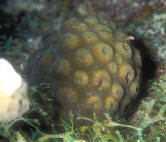
| Madracis dedactis (Lyman 1859), Ten-Ray Star
Coral. Tropical West and East Atlantic. Colonies to six inches in
height. Typically with ten septa per corallite. Cozumel pic by
Di.F. |
|
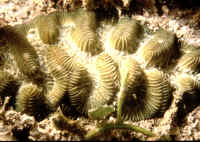
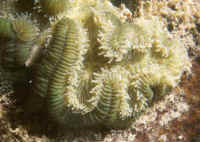
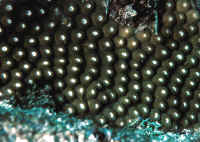
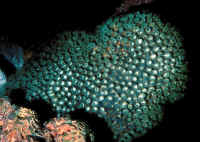
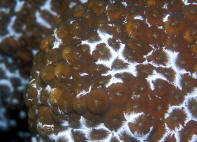
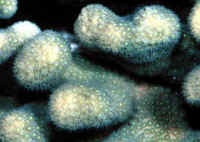
| Madracis formosa Wells 1973, Finger
or Cactus Coral. Colonies made up of densely packed small
thumb-like branches with blunt ends. Appear fuzzy when open. Dull
to Green with yellow central corallite color. Bahamas photo and
close-up. |
|
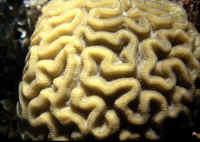
Family Faviidae Gregory 1900. The second largest family of
stony/true corals (after the Acroporids of course). More than twenty
genera (24)... Most are roundish to hemispherical and "brain
like" in appearance, though there are some notable exception. All
bear zooxanthellae and are colonial.
Genus Colpophyllia Milne Edwards and Haime 1848. One
species.
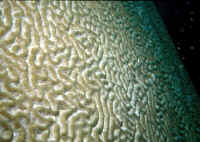
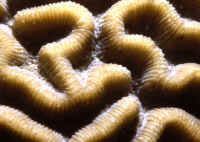
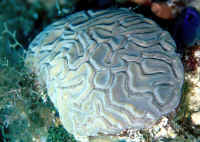
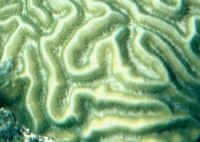
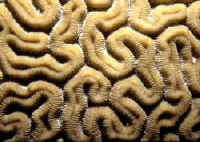
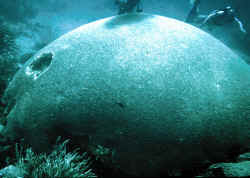
| Colpophyllia natans (Houttuyn 1772),
Symmetrical Brain Coral. Large roundish to hemispherical
colonies or encrusting. Long snake-like valleys. Septa short, equal
and pointing out. A fine ambulacral groove runs along the top
between corallite walls. The world's largest Brain Coral on the
right off of Flying Reef, Tobago; below, a view of it edge-wise and
a colorful shot and close-up of smaller specimens in the
Bahamas. |
|
Genus Diploria Milne Edwards and Haime 1848. Massive,
meandroid colonies. Columellae (centers of corallites) are interlinked
with ridges. All tropical West Atlantic.
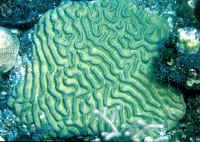
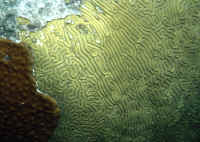
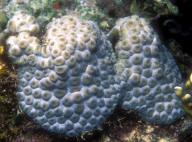
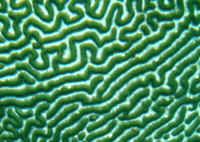
| Diploria labyrinthiformis (Linnaeus 1758).
Typically hemispherical in appearance. Often with some valleys
being parallel, spaced about 5-8 mm. apart. Below, a boulder being
shared with a Montastrea in Belize and two Bahamas images. |
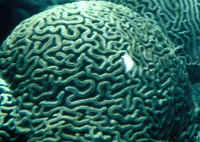
| Diploria strigosa (Dana 1848). Massive or
encrusting. Valleys spaced 6-9 mm. apart. Surface is smooth. Tobago
images. |
|
Genus Favia Oken 1815. One of the most widely distributed
(though not that common) genera of stony corals. Most corallites
circular, uniform in appearance. Plocoid (corallites that are conical
with their own walls). Genus and family named for Greek:
"Honeycomb" (favus) which the regular size, arrangement of
corallites approaches.
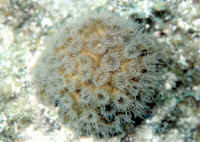
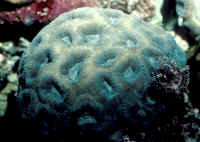
| Favia fagrum (Esper 1797). Small colonies
that may be encrusting or hemispherical. Corallites of variable
shape, with one to many mouths. Bahamas and aquarium
images. |
|
Genus Manicina Ehrenberg 1834. Rose Corals. One species,
tropical West Atlantic. Free-living or attached. Note groove on top of
valley walls.
| Manicina areolata Linnaeus
1758. Though its range is restricted to the
Tropical West Atlantic it continues to be mis-sold
as Trachyphyllia geoffroyi Audouin 1826, the Rose Coral
by some dealers. Below, two four inch specimens in less than a foot
of water in a seagrass bed in Placencia, Belize, the second
with tentacles extended. The last a hemispherical "adult"
specimen of about a foot diameter in the Bahamas. Close-up at
right. |
|
Genus Montastrea Blainville 1830. Massive, flat or
dome-shaped colonies. Monocentric and plocoid corallites.
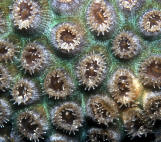
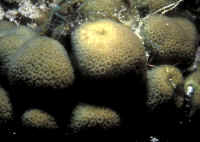
| Montastrea annularis (Ellis and Solander
1786), Lobed Star Coral. Tropical West Atlantic. To ten feet
tall. Common. Found as clusters of columns with domed tops. Living
polyps on upper areas of colonies, dead, eroded below. Corallites
appear as uniform in size, shape. Conical to flush with colony
surface. Longer and short septa alternate, small, compact
columellae. Cozumel pix by Di.F below. |
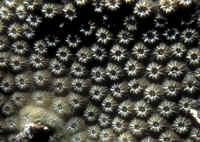
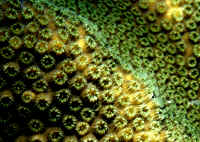
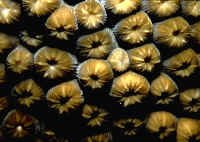
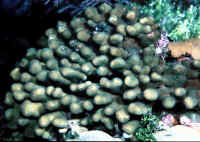
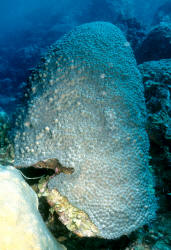
| Montastrea cavernosa Great or Large Star
Coral. Colonies as boulder shaped domes. Distinctive
blister/cone-like corallites of larger than other TWA species
(about 9mm in diameter). At right, a massive colony in Bonaire.
First row below: Some pix taken in St. Lucia showing color and
shape differences. The latter at night while this colony was
feeding. Last, a close-up by Di.F in Cozumel. Second row
below, some pix from Bonaire, the last at night. |
|
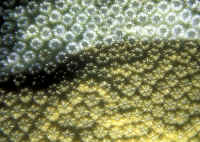
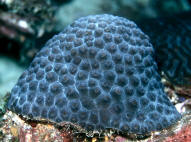
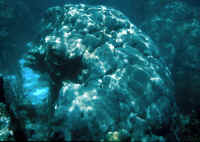
| Montastrea faveolata Mountainous Star Coral.
In mounds or large sheets, with bumpy appearance, with corallites
more or less arranged in vertical rows. Belize image. |
|
To: Part 1, Part
2, Part 3, Part
4, Part 5, Part
6, Part 8, Part
9, Part 10, Part
11, Part 12, Part
13, Part 14, Part
15,