 |
|
| Home | Marine Aquariums |
Freshwater Aquariums |
Planted Aquariums |
Brackish Systems |
Ponds,
lakes & fountains |
Turtles & Amphibians |
Aquatic Business |
Aquatic Science |
Ask the WWM Crew a Question |
| Please visit our Sponsors | ||||
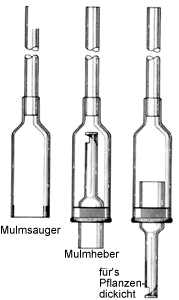
Mixed Up About Salt Mixing Hi guys, couple questions about adding salt. <Sure!> I am using Tropic Marin and was wondering how much salt per gallon of water should be adding when making up new water? I have been adding 1/2 cup and it seems to be to much. < I am a Tropic Marin user, too. I use about 2 cups per 5 gallons, and that seems to yield a s.g. of 1.024-1.025 at about 79 degrees F.> Last thing I have been mixing about 20 gallons at a time in a Rubbermaid trash can...RO/DI water.. let aerate and heat for a day then I add Seachem buffers. I then add the salt. <Great procedure!> Question is......when I add the salt to can it is clear (water) but after 3 to 5 days the water is still very cloudy, I continue to aerate the whole time, but it doesn't seem to ever clear out.. then when I do use the water there is a thick white film on the sides of the can that I have to rub/scrub the clean off. The water in the tank does clear up though. What do you think? Thanks a lot Bryan <Good observation, Bryan. I notice this phenomenon at times, too. I think that it probably has something to do with some of the salt or buffer components not dissolving completely into the water, or perhaps, even falling out of solution.... As long as the water mixes up to the correct specific gravity, pH, and alkalinity, I would not be overly concerned. Keep up those water changes! Regards, Scott F> Re: just for fun.....how to get to the site yourself Keeheeheeheehee! (or as Anthony would say <hehe>)--yes, no sense offending anyone so let the general public find it themselves! If you want to get to the site yourself, go to http://www.google.com from your main internet connection (the one in WetWebMedia didn't offer to translate, but it worked from both Netscape Navigator and Internet Explorer) and search for Aquatechnic. There's a bunch from Singapore, about the 4th or 5th one will be for aquatechnic.de, with a "translate this page" next to it. click on the translation and you'll be in the site in machine-translated English. The SOGfix is the best (read the picture captions, too), but the whole site is funny..... <Something's lost and gained in translation. Bob F>
Fresh and salt water (of gravel vacuuming, planted tank stasis) Hi guys I have a couple questions regarding both my fresh and salt water aquariums. I have been involved with fresh water for about twenty years. I have a forty gallon planted tank so full of plants you could almost not see the substrate, my LFS told my that with this many plants I should not have to vacuumed the gravel. I am mainly concerned that it will cause an out break of algae. What do you guys think? <Mmm, eventually you'll either have to make small disruptions to the substrate to "clean" it, add nutrient, or totally tear it down and re-set it up... this latter time interval can be six months to a few years... depending on many factors... plant species make-up, augmentation of liquid supplements, CO2, fish food feeding, initial use of soil...> I have power compact lighting, Fluorite substrate, CO2 injection, Hot Magnum, 125 penguin BioWheel and about thirty or so fish mostly all small. On to my ten gallon reef I was also told by my LFS that I would not want to vacuumed my gravel in my mini reef. You guys helped my remedy some bad advice in part of this LFS. My xenia is pulsing again and every thing is fine except I have a red slime diatom loose in this tank. Previously when I took the LFS advice to treat ick in the reef tank it seems to inadvertently cause the diatom out break and told me to treat it with Maracyn. <Not recommended... not a real cure... as you will find> Since then I did several massive water changes with RO water and the diatom has come back. Could it be from not vacuuming the gravel? <Not likely... the materials/nutrients are still in the system from the original colony... recycled> Or is it because my tank is only about four months old? <A somewhat disposing influence> Maracyn which I now know is not a cure but a temporary removal and should not be used in reef tanks. I have since stopped taking advice from this LFS and read articles on your web site which is a real learning experience. The jump from fresh to salt water is significantly different and I was subject to bad advice, that really upsets me. But you guys have got me in the right direction. Thanks Dave McCorkell <Let's keep talking, sharing till you feel comfortable and can aid others. Bob Fenner> Re: Ammonia Bob, <<Not Bob, JasonC here...>> I believe I may have found the source of my ammonia problem. <<ok>> I vacuum the substrate surface ever time I do a water change every week (approx.. 13% removal) and my ammonia was still traceable. The tank has been running for 2 years, I have never had this problem before. I clean all of my filters every week. What the problem was is that I was not vacuuming deep enough, the tank has a 1-1/2" s deep sand bed and I realize that the fish waste and other junk was not just on the surface, but deeper in the sand bed. How often should you move around LR? <<Whenever the mood strikes. If I were you, I'd look into perhaps some more or larger powerheads in the tank so that some of this detritus makes its way into your filters and not into the sandbed. Constant vacuuming of the sand bed will disrupt the ability to produce/harbor beneficial organisms like copepods and the like that would normally deal with the detritus for you.>> Thanks <<Cheers, J -- >> Water Change, Big Reef System Dear Mr. Fenner, <Anthony Calfo in your service> Due to the constrain on my aquarium frame (350 gal tank), my local aquarium shop recommends to build a sump within the aquarium itself with a tied-in refugium. <I'm not sure what the aquarium size/frame has to do with an external sump but I will trust your decision on this. I am assuming the tank cannot be drilled because it is made of tempered glass. I cannot think of another common exception.> Will the lighting effects the bio filter performance on the in-tank sump? <yes... light does inhibit nitrifying bacteria. A darkened glass or acrylic will at least be necessary for an in-tank sump> Will it be covered by algae population and have adverse effect? <severely adverse if algae or any debris is allowed to accumulate or culture on the bio-media> Does 340W of fluorescent light enough for a 350gl tank if I want to keep hardy invertebrate and some soft coral? <that would be rather low lighting only suitable for the lowest light demanding coral. Even then they will need to be kept in the top 12" of water> How can I avoid bringing parasites such as marine ich from live rock? <the best way is to quarantine all new fish, plants and live rock for 4 weeks in a separate quarantine tank.> Can I sterile the parasite infected base rock by completely drying them up? <that will not sterilize it, my friend. Many parasites can encyst and weather extended periods of drying out. Keep wet and quarantined to run fallow without a host for more than 4 weeks instead> Is refugium very effective therefore almost necessary for a successful reef system? <I must admit that it is VERY helpful in many ways and many forms (RDP, seagrass, rubble, plants, plankton, etc)> Best regards! Liao I Ching <do consider that with enough live rock and two good skimmers a wet dry filter will not even be necessary (nor the internal sump). I suspect that the internal tank sump will be more aggravation than it is worth and that the bio-media will contribute more nitrate than its inclusion as bio-media is worth. Anthony Calfo> Water Changes Hello again, Thanks for the feedback on my previous question. I was reading about water changes on your site. Thanks for taking the time to organize all of this for us. I have a water softener at home, but I didn't come across many FAQ's concerning softeners. <One word of caution concerning water softeners. I have read one report of someone using a brand of salt and not noticing that the salt included compounds that alleged to clean the water softener. These compounds, whatever they were, were toxic to fish.> In an article, Bob states that tap water is just fine. <For some applications> Please give feedback to a possible way of preparing water for a water change. I have a 55g tank and currently doing 5-10% changes every week, depending on how much water I feel like carry over to the tank. Here's my thought: What if I : - filled a ten gallon bucket with straight tap water; water is "softened" but unfiltered - I add no "de-chlorinizers", is that a word? <They are called dechlorinaters and I would use them.> - I put an air stone in overnight - Next day, I add Kent Superbuffer. Is this the kind of buffer I need to add? <It should be fine.> Can I just add baking soda, and if so, how much per gallon is safe? <Use test kits to confirm the pH and alkalinity.> - I continue aerating for a few hours - I then add Instant Ocean salt, mix, and wait a few hours before adding to tank <More like 24 hours.> Does this sound like a reasonable plan? <See notes above.> Up to now, I've just either been mixing salt with DI water immediately, then pouring it into tank without waiting; <This can be dangerous.> or I've been mixing salt and water immediately, then waiting overnight to add it. Neither of my current ways seems appropriate, based on the info on the site. Please help me be a better fish/reef keeper. <My strong preference is to use DI water. Aerate and heat that water for 24 hours. Then add the salt mix and wait another 24 hours. At that point, test for pH and alkalinity and adjust as needed. In another 24 hours, it is ready for use.> Thank you, Randy M. Yniguez, MA <You are welcome. -Steven Pro> Water Change & pH Problems Dear Mr. Fenner, I have recently diluted my 100 gallon tank from 1.024 to 1.022 during a water change and observed a drop in PH from 8.2 to 7.9. I have checked the water quality from Ammonia, Nitrite and Nitrate, almost zero concentration. Water buffer is still high. However, the PH remains below 8.0. What should I do? Change more water? <Usually the best move. I would first double check the pH and alkalinity of the new water to ensure it is in the proper range. Please search through WWM regarding saltwater mixing issues.> Best regards! I-Ching Liao <You are welcome. -Steven Pro> Water Changes Hi, I have a 50 gal., fish only tank. I mix my water in a separate 25 gal. container with a power head and heater and have been leaving it for a week or more between changes; works great! <Good protocol. About same as mine. Please read: http://www.wetwebmedia.com/water4maruse.htm> Lately, I've been changing 2 gals. every 2-3 days to try to prevent any spikes in the quality of my water between major cleaning/changes. In your opinion, will the replacing of the 2 gals. and using it again so soon have any adverse effects? If so, any opinions on how to handle this? <S/b fine. Please see: http://www.wetwebmedia.com/water.htm and the FAQs beyond> I know the quantities I've mentioned may sound a little trivial, but I've had quality problems in the past which have lost me some of my favorite fish and water quality is #1 on my list of priorities for problem prevention. Thanks, Rich <Best to shy on the side of conservativeness here. Bob Fenner> Maintenance Questions Pretty new to the aquarium hobby, but have been at it about 8 months now. Was told to wait a while before I vacuum the substrate, so I have. Now, I realize that when I try to vacuum the base of the tank, all of my live sand goes into the hose/snake as well. <Mmm, give it a preliminary stir with a wood or plastic dowel (to break up the chunks!) and devise or buy a siphon with an "exploded end" (we used to make our own out of plastic bottles with the bottom cut off and a good length of tubing attached to the narrow end...). Such "funnels" allow you to stir up the bottom, remove the muck, but leave the substrate behind> Looking for a trick to avoid this from happening. Was also wondering how long I should wait before I change the white and blue pad in my canister filter. (the water is still crystal clear, I believe due to the protein skimmer) <Do this on at least a weekly basis... good to remove the grunge there before it dissolves, returns nutrients to the water... fueling algae growth et. al.> Love the web site. Thanks, Tim Gauen <Thank you, Bob Fenner> Maintenance Questions Pretty new to the aquarium hobby, but have been at it about 8 months now. Was told to wait a while before I vacuum the substrate, so I have. Now, I realize that when I try to vacuum the base of the tank, all of my live sand goes into the hose/snake as well. Looking for a trick to avoid this from happening. <If you have a DSB, you should not need to gravel siphon it. Occasionally some detritus might settle there, but you should not insert the siphon into the sand.> Was also wondering how long I should wait before I change the white and blue pad in my canister filter. The water is still crystal clear, I believe due to the protein skimmer. <Depends on the brand and model, but generally every 1-3 months.> Love the web site. Thanks, Tim Gauen <You are welcome. -Steven Pro> Top-Off Water pH Problems Sorry to bother you with another question again so soon, but I am at a loss as to what to do about my top-off water's pH. <No problem.> I purchase RO water from my LFS. I've tried Kent's Osmo-Prep as well as Seachem's Marine Buffer, but what keeps happening is that the pH is fine as soon as I add it to the RO water, but by the next day the water is highly acidic and below my pH test scale. I aerate the water as soon as I bring it home and keep it aerated as I use it throughout the week, but it will not maintain an acceptable pH. What I'm trying to do is have freshwater constantly aerated and pH adjusted so that I can just pour it in the tank once or twice a day to make up for evaporation. Can you recommend a way to do this? Or do I need to pH adjust the top-off water each and every time I add it? <You should not need to keep adding buffers everyday. Perhaps you are just testing too quickly and the RO water has not had enough time to mix with your buffers. I use Seachem Reef Builder and Marine Buffer, about 1/2 teaspoon of each for every five gallons, and have not had a problem.> Thanks so much again for your assistance! Karen <You are welcome. -Steven Pro> Chloramine Deaths. Hi There, <cheers!> Recently, I've had deaths in my tanks directly after partial water changes that must have been chloramine-related. <Not likely... more commonly a discrepancy in temperature or pH. Do you really have so much Chloramine that you can smell it from feet away? Most dechlorinators easily neutralize this treatment> I unfortunately used a "one-step" product for my water changes that I will never use again. <do reconsider that most every Dechlor product is virtually identical in efficacy> A friend told me about your site. I'm glad he did! I've did a good deal of reading of your site. I'm intrigued about your "vat method," -- letting water sit or be mixed for a week or more before being added. <chlorine will dissipate in open air but chloramine never will... a chemical bond that must be broken (with a de-Ammoniating product.. most conditioners)> My question is, what will this method do, if anything, to "toxic metals?" <absolutely nothing> Should I be concerned about this? <hmmm... rare in potable tap water. If concerned, get a prefilter stuffed with PolyFilter pads to draw water through> Thanks! Walter B. Klockers Plano, TX <best regards, Anthony Calfo> Water changes Is it harmful to do water changes too often or in too large of a quantity? I have consistently have had a problem with brown rusty film on the inside of my tank & on the substrate. I clean it off and it shows up again pretty heavily within a week I know you are supposed to get that within the first 2 months of a new tank. My tank is 7 months old ( 72 gal) and I chg 5 gals once a week. I was wondering if that is to much and that my tank keeps recycling? <Five gallons in a 72 gal. system... once a week... actually may not be enough. Please read: http://www.wetwebmedia.com/water.htm and the FAQs beyond> One other problem I have that I can seem to get rid of is very small air bubbles. When I shut off the wet/dry they seem to go away when there is no water movement- I have tried putting an elbow joint on my water pump intake and have tried inserting foam sponges in the return section of the wet/dry. Any other suggestions. Thanks <Yes. Please go to the homepage of WWM: www.WetWebMedia.com and use the Google Search at the bottom with the terms "bubbles", "wet-dry"... and read the areas you're led to. Bob Fenner> Water changes (necessary, expedient, just for making ones arms longer?) Hi, I heard some people go without water changes for months if ever. My tank has live rock and fish and it has been one month since my last water change and there is no ammonia and no nitrates and my ph is 8.2. Do I still need to do a water change or can I base my water changes on my water parameters named? <Water changing is the cheapest, safest, most important aspect of aquarium maintenance. Please read: http://www.wetwebmedia.com/water.htm and the linked files, FAQs beyond. Bob Fenner> Use of Vinegar Bob, <Steven Pro this morning.> I have several customers that are hearing about adding vinegar to their SW and Reef aquariums to lower nitrates and boost calcium. <I have heard of its use for boosting calcium when used in combination with Kalkwasser.> Some of them say that is has worked for them. Is this advisable and what are the long term effects of it? <I would refer you to the writing of Craig Bingman. He has a webpage that is listed on the WWM links.> Their is another LFS in the area that is suggesting this and says that you don't have to do water changes if you do this. <A highly suspect recommendation.> He told a customer that he hasn't done water changes in his store in a year. His fish, though, look horrible. He uses a lot of ozone, copper, and apparently vinegar. The fish in his maintenance accounts, such as yellow tangs, are pale, fins ragged, and just about everything looks like is has lateral line disease. Even damsels. Could the vinegar be causing this or the lack of water changes? <More likely the latter.> Thanks, Larry McGee-Aquatic Designs <You are welcome. -Steven Pro> Water Changes Stressing Yellow Tang. Hi WWM Guys, <Cheers, Glenn> I don't know how my FOWLR tank got by until I found y'alls site. <whew... a lot of pressure answering this query with a lead off like that <wink>> I perform a 10 gallon salt water change each week for my 75 FOWLR tank. <very nice schedule> Every time, my Yellow tang seems to stress out for a day or so. Then he goes back to his normal self. <hmmm...odd and shouldn't be> The new water is usually w/in a degree of the tank water. PH & SP are the same. I siphon water from the bottom of the tank and then slowly pump new water back into it. Would a sudden reduction in Nitrates stress a fish? <a little... > I would not think so. I've recently started using aged tap water. However, he reacted the same way w/water from the LFS. They use RO for their water supply. Any ideas, what I'm missing here? <do check the other components (Alk, Ca, etc)... but you may simply have a skittish individual. Are the other fish generally undisturbed by it? Perhaps the bright lights with the water level drop shock it... eh, maybe not <wink>. Your YT may be just sensitive> Thanks again, Glenn <kindly, Anthony> Re: Water Changes Stressing Yellow Tang. Thanks for the advice Anthony. <Steven Pro this morning.> My other fish hide during the change, which is done with the lights turned out. Afterwards they come out and go about their normal routine. Here in North Texas, we're blessed with hard tap water. Although it's murder on plumbing fixtures with rubber o-ring valves) PH is usually 8.0 - 8.1 ..I guess my YT is just sensitive. BTW, his ailment (Velvet or Gill Flukes) are gone. I took your advice and gave him daily FW Dips for 8 days. Of course he did not go willingly. I had to remove all the LR every day to catch him though. <I think I know why you Yellow Tang is nervous about you doing something in the tank :).> Do you have any advice for catching fish in tanks full of LR? <Feeding then scooping quickly with the net or using a small barbless fishing hook. Once you catch them the first time, it is far easier on you and your fish to place them into a bare bottom quarantine/hospital tank with easily removable inert decorations.> Thanks, Glenn <You are welcome. -Steven Pro> Auto top-off RO water in reef tank If you use raw RO water for auto top off what should be added. I do not used Kalk. -RGibson <Well, Kalkwasser would be nice. Other than that, the water should be aerated and buffered. -Steven Pro> Water Change? I'm having trouble with my water quality and am trying to get all of the levels back to normal. At first I had 0.25 ppm for ammonia and did a 30% water change (I have a 100 gallon). The next day I still had very slight ammonia present but waited until the following day to do another 30% change. Today I checked the water and the parameters are as follows: PH = 8.6 Ammonia = 0.0ppm Nitrite = 0.25ppm Nitrate = 60ppm I was thinking of doing a 25% water change tonight? Do you agree with this and do you think this should take care of it? It's been 3 days since my last 30% change. <assuming that the tank is past the "break in period" for cycling (over 8 weeks old?), then yes... water changes until you figure out the cause of the buildup...although .25 ppm or less is not much to get too excited about> I'm thinking that I'm overfeeding and that is what is causing my problem. What do you think? <far and away the most common reason. Too much or too fast. Best to feed several very tiny feedings daily that all get consumed in the top third of the tank. Food falling to the bottom is overfeeding in most every case. A good skimmer would also be a great benefit too> My tank is 100 gallon and I currently have no live rock or corals, just fish: 1 Naso Tang (5 inches or so), 1 maroon clown (3 inch), 1 clown triggerfish (2 inch), two very small yellow tangs (1-2inch), and a Mexican rock wrasse (5 inch). <no new fish please... you have plenty to grow to adulthood in this sized tank> I feed them a variety of things but as an example of a day's normal feeding: I normally feed them one of the frozen cubes (brine shrimp, or Formula 1, etc.) and put about a 2 x 4 section of dried seaweed on a clip as well. I pour the dissolved cube in slowly (not all at once) giving them time to eat before I put in more. Does this sound like too much food? Can you give me some guidelines? <doesn't sound like a lot of food to me, but two things. Stop or reduce the brine shrimp ( a low nutrient and nearly useless food even if well liked by fishes... they starve slowly over time eating it). And never pour the thawed food juice into a FO tank... drain the juice off of the meat (strain through a net, for example). This juice accumulates and feeds horrible algae blooms in time even with a good skimmer producing skimmate daily> Thanks for your help! Sorry to bother you with this beginner stuff. . . .Thanks for your help! <no bother at all... keep learning and sharing. Anthony Calfo> First Water Change Bob, <Steven Pro this evening.> I have been reading your articles and find them extremely helpful. I have a quick question you: I have a new 40 gal. saltwater reef tank w/ 40 pounds of live rock (no fish yet). It has been cycling for a week and a half. I did a test on it and found that the cycle has completed, 0ppm nitrite, 0ppm ammonia, ph8.3, but my nitrate are up above 60ppm. Now for the question: I am ready (I think?) for the first water change and am petrified. I have setup a 5 gallon bucket (with city tap water), an air stone, added the salt, buffer and Prime (for the chlorine in the city water). Everything looks good. How long should I leave the change water set before pouring it into the tank? 24 hours? 48 hours? <24 hours is plenty of time> Also, when removing the water out of the tank, should I "dig" into the pebble coral on the bottom or should I just remove it from wherever? <Yes, you do want to remove any detritus that has settled from your liverock into the gravel substrate.> Any help would be great !! as I am biting my nails for this first step. Gregory Hustead <Take it easy and enjoy you aquarium. -Steven Pro> How much or %of water can be change in a reef tank at one time or over two days <Please help yourself; read here: http://www.wetwebmedia.com/water.htm and the FAQs beyond. Bob Fenner> Water changes Bob, I have a 46 gallon tank with 45 lb. Live Rock. I have (2) peppermint shrimp and (1) green Chromis and (1) clownfish (2) turbo snails and (1) blue Linckia. I remove approx. 4 gallon of saltwater every week(8.7%). Does this seem good enough as far as water changes go or should I do a water change every 2 weeks? <Weekly is better for your tank.> Is Baking Soda the best solution for low Alk. or is just a temporary fix? <There are better commercial preparations, such as Seachem Reef Builder.> Well Bob you haven't let me down with any of the information you have give me. Thanks <Glad to hear you have found the information useful. -Steven Pro> How much water should I change per week? <About 15 gallons> or every other week? <30 gallons> for 125 g tank -Steven Pro Sand bed cleaning I got a question regarding hydro-cleaning a sand bed. I've got a 125gal tank with about 5-6in of fine (sugar sized) sand. I haven't vacuumed it for about three months because I've been attempting to 'automate' the process by employing a highly diverse and strong fleet of detritivores (spaghetti worms, amphipods, copepods, Mysid, cucumbers, micro stars, brittle/serpent). regardless of how great the system sounds on paper it just doesn't work well enough. so no am stuck with ultra fine sand that needs to be hydro-cleaned. <Or stirred perhaps... not shaken, call me Bond> can you recommend or point me to a place where I could get a cleaner designed to get waste and not sand? I've heard that they exist, but are pretty expensive. id rather DIY the vac. <This can be done... easy enough to build a large enough diameter gravel vacuum... that you can "fine tune" the flow with so you don't suck out the fine substrate...> anyways am struggling with a dissolved organics issue and am left with few options. <Why?> am doing frequent, large water changes 50% every week <This is too much> and I vacuum out large patches of Cyanobacteria and other slimes/algae. so at least the organics locked in them are out of the system. <99.9 some percent water...> also I harvest my Caulerpa tank regularly, sadly that's the only thing that is enjoying the sewage issue. oh, and the bio load exerted by my livestock is medium-low. god, I hate vacuuming tanks... it looks like my quest for a (mostly) carefree system got me into trouble. thanks Jon Trowbridge <Time to investigate your options a bit more... do post your query, situation on our chatforum: http://talk.wetwebfotos.com/ Bob Fenner> The Automatic Aquarium Water Changer Hi there, I am emailing from the UK. I have seen The Automatic Aquarium Water Changer in several books, and also on the internet. I have asked about this equipment in pet stores, but not been able to find it. Do you know if there as a seller of this in the UK? <You might try the folks at TMC: http://www.tmc-ltd.co.uk/ If anyone knows where/if this product can be procured there they will. Bob Fenner> Regards Keith Charlton Automated Water Replacement System Hi Robert! How are you? <Fine> I was wondering if I could get your expert opinion on this setup. I implemented an automatic drip system for my 72 gallon reef tank. I was hoping through the constant water exchange that I could maintain pure high level quality water in this environment. <A good approach> My system is basically set up like this... I have a 20 gallon tall hex mixing tank under my 75 gallon reef tank that fills up very slowly (with 1/4" tubing from my RO unit located in the kitchen). The water fills up to the 10 gallon mark set by a large toilet like float switch, (Home depot). The large float switch is enclosed in a plastic tube & clamped to the side of the tank . This tube prevents water from getting inside the switch and keeps the float mechanism basically pretty clean of salt free. <Okay> I have a small pump that is mounted 3 inches down from the high water mark in this mixing tank. The pump is always on & constantly pushing water pressure through 1/4" inch tubing over to my Wet Dry sump which has a very small float switch (Polypropylene Valve Body Polypropylene Float - http://www.mcmaster.com) that is mounted about 1/2 foot down from the top of the sump. <With you so far> I also have a small powerhead in the 20 hex that is constantly on and circulating the water all week long. I try to keep the SG and temperature at the same level with what is in the tank. Saltwater drips out of the main tank very slowly into a bucket and new RO saltwater drips in to the sump very slowly (drips in at approx. 2 gallons per day). I also add one cup of RO water without salt for evaporation each day. I am hoping that I am getting a true balance here. <Me too> My question is... Is it ok to utilize a slow water replacement system like this and how beneficial are it's affects in overall water quality? Am I disrupting the balance or chemistry of the water or am I improving the overall balance... removing nitrates, keeping PH level high? <Very beneficial> Do you know of anyone who does this? <Most public aquariums, many breeding facilities> Is it ok for me to do a 5-10% water change each Friday in additional to the slow water replacement? Really appreciate your comments. <Sure, but likely unnecessary. BTW, so I can sleep tonight... have you tried shutting off power to one, all pumps to "see what happens"? Any overflow fail-safe mechanisms in place? Be chatting. Bob Fenner> Re: Automated Water Replacement System Yes, Actually, as long as the float mechanisms in the mixing tank and sump do not get clogged (left in open position) I am ok. If the power goes off only a few gallons of water from the main tank will come down into the sump. Water does not go back into the mixing tank from the sump. <Mmm, I would still have... an overflow box... curtain of sorts around the edge... excuses/explanations aplenty on hand...> The RO water comes in very slowly to the mixing tank and I usually close the valves once I have the 10 gallons needed for daily water exchange. I then open the valves once again at the end of the week to fill the mixing tank once again for weekly water change. <What if you forget?> I would not leave this operation running for a few days unattended.... <How about a timer with solenoids then?> actually I have lost a few nights sleep worrying about it but when I turned off the power I felt a little better! I should probably check the valves every so often. <Sorry to be such a "worry wart"... just have had an amazing number of spilled water mishaps/accidents over the years. Bob Fenner> Re: Automated Water Replacement System If I do build some kind of redundancy into this setup and it is fail proof do you know if there is any kind of market out there for my system? Would you know of people who would care to set something up like this? It was not that expensive... just the RO unit. <I do think there is some "build-able" market for this arrangement... Many water treatment tools in place now... and many more to come on-line in coming years... Worth investigating, test-marketing. Bob Fenner> Topping off Hi Bob, When you top off a tank to replace evaporated water, should you use seawater with a lower salt concentration? <No... unless you're trying to raise the spg... just freshwater. Bob Fenner> Tony Re: topping off That is what I thought but I wanted to be sure. Thank you for the quick response. <You're welcome my friend. Be chatting. Bob Fenner> Tony Water change and septic Robert, I live in the country and have an aerobic/aerated septic system (doesn't use a leach field, sprays out like a sprinkler system). It is suppose to process approx 3,000 gal a month. Would it be a problem to the septic if I flushed my 10 gallons a week water change? <Mmm, ten gallons out of a few thousand should be fine> If so, would it be okay to pour out on the lawn or would it kill the grass? I need somewhere to dispose of it, any other ideas if these don't work. Thanks, I reread your book consistently. <More than me!> Lee parker <Be chatting my friend. Bob Fenner> Weekly water changes are making me weak. Hi, I got a 75 gallon tank which has been set up for a month. I have about 80 lbs. of live rock in the tank with 4 inches of substrate and a plenum. I have a pro AquaC remora skimmer running. I left the AquaClear 2000 with filter in. I got the engineering goby out of the main tank (He was eating the snails and hermits and partial carcasses were dissolving in the tank, digging deep pits, ...) and put him in the refugium I am building. I've reduced the number of fish (Finally there are 3 - 1 inch damsels, 1 - 2 inch damsel, 1 - 3 inch yellow tang, and 1 - 2.5 inch new guinea wrasse) and their feeding. I included some macro algae in a cage that is slowly growing and the red tree sponge is doing quite well. Is there anything else I can do but wait for the nitrates to go to 0? <All sorts... Read: http://www.wetwebmedia.com/no3probfaqs.htm and the links, FAQs beyond... and wait> They are 60 which is down from 220+ when I got the first slime covered 50 gallon tank with a damsel last Christmas. <Yikes, quite an improvement> BTW I clean the filters every 2 weeks. <Patience my friend. Bob Fenner> Water changes Hello Mr. Fenner, <<Jason C here, doing my best Bob Fenner impersonation, practicing for his upcoming dive trip, hope you don't mind.>> I hope everything is going well for you. I have been reading your web site for a few months now and enjoy very much. I have been reading about fish and corals more then anything. Today I read about water changes and I am wondering if I have been doing something very wrong. I have 75 gallons and I change 5 gallon each week. I have a fair dusting of diatom on my gravel. When I do the water change I run the hose over the top of the gravel (not down into it) to clean up this algae. I run over the whole area of sand that is not taken by my LR. Is this okay to do? I am wondering if I am harming my balance by taking this algae from the gravel as often as I do. Or was the point in your writings not to go down into the gravel all over. I hope you are understanding what I mean. :) <<Your water changing practices, including the gravel cleaning are all plenty adequate; certainly no harm being caused by taking the diatoms off the top. You might want to clean the gravel more thoroughly once a month or so...>> Thank you for your time to read this. I hope that you are able to write back. I will look forward to hearing from you. Carlos <<Absolutely my pleasure. Cheers - J>> Water changes Hello again, friend. I hope this letter finds you well. <Yes, thank you.> I have a question regarding water changes.. I have a 75 gallon tank that I've been doing a 10 gallon weekly water change on since I got it.. I'm currently considering adding a quarantine tank underneath the tank, and it would knock out some of the space I use for my 5 gallon buckets to do water changes.. my question is this.. would 5 gallons every week still be enough? <Possibly... but ten every two weeks would be better...> Or should I relocate my buckets to a storage closet and keep it up with 10? <This would be the route I would go> Also, for a 10 gallon quarantine tank.. I mentioned I have a Prizm skimmer.. would this be enough filtration (provided there is some live rock in the quarantine tank) or will I need to add more? <S/b fine... might add a small outside power filter or inside sponge filter (air or power)> Other than that my quarantine tank will just need a heater/thermometer (I wouldn't think any powerheads as the Prizm is supposed to be for larger sized tanks and should move the water plenty) Please do let me know if I've forgotten any thing! Thanks again from Atlanta <Lighting for the live rock, a timer... Bob Fenner> Bill Hammond Surface skimming Bob, Once again, I am seeking your help. I have had a 40g tank running for about three months. I have about 40 lbs of live rock along with 2 fish and a handful of inverts. My problem is that I noticed a need to skim the water's surface. I have a Bak Pak II skimmer currently running and it does a fine job except it is not designed to skim the surface. Is there any product that I can add to the Bac Pak system that will solve my problem, or am I going to have to add another hang on? <Hmm, you might be able to rig up a "surface skimmer" that would work in conjunction with your Bak Pak pump... a floating ring, with tubing down to it sort of arrangement... Maybe adding some aeration (a stone, venturi intake on a powerhead?)... Do you know the source of the material at the surface? Perhaps the periodic (weekly?) drawing of a clean paper towel, wicking across the surface, a dipped-pitcher are the simplest approaches here...> If so, what? IYO, how would you solve this problem? I am thinking about the powerhead to the Bak Pak in a removable box of some sort which would allow surface water in instead of tank water. <Hey, me too> IMO it would need to be removable (every other week, month?) so the tank water could be skimmed as well. Or, is this not a problem I should be worrying about? <Worth investigating. You don't want material coating the top of the water... gas diffusion problems> Thanks for your guidance in trying to keep me (the neophyte) on the wide path of saltwater. God Bless America. Thom Walters <Be chatting my friend. Bob Fenner> Many roads to aquarium success I have two small (46g & 30g) tanks with live sand and live rock. When the water levels get low, I add just a gallon of straight distilled water. <Reverse osmosis would be fine, cheaper> I don't have regular stand-by salt water mixed and ready to go. When I do my 5% water changes every three weeks then I use saltwater that I make fresh. Is it harmful to a system to be just dumping in water like that? <Not very harmful... five percent is not much> I have seen no visible signs of harm, my tanks have been up and running for almost a year with no livestock problems. I run powerheads and powerful skimmers only. <Your success is all that is important, not specific methodologies. Bob Fenner> Using rain water for changes Good web site. <Thank you> Just a question re water changes. Is there any potential problems with using the water collecting rain from the roof of my house into a covered water butt for the water changes? <Yes, unfortunately... dust et al. coming off the roof area with the water, the aggregate pollution that such rain can contain, problems of storage (bugs, algae...) and moving such saved water about are the principal downsides of such collection practices. OTOH sometimes this water is superior for particular ornamental aquatics uses... I have saved such "free water" around the world for potable purposes as well as breeding, rearing soft, acidic water organisms, foods... Do get, use test kits for aspects of water quality that concern your applications. Bob Fenner> Cheers Martin Make up water adjusting Hi Bob.... Hope all is well there with you!!! As usual, I have a question!! Well, as you well know, as the water in the reef aquarium evaporates, the salt is left behind, and raises the salinity level of the water. I have been replenishing the water with fresh water to correct this. It occurred to me the other day that I should probably be adjusting the ph of this replacement water before I pour it (slowly) into the tank. My tank's ph level is always right around 8.0. Is there really a concern here, or should I just keep going along as I have been?? The tank is thriving. <Some checking of pH and related alkalinity is prudent... in the overall maintenance scheme... and boosting both (depending on source water) is a good idea with water replacement. I use a "pinch" (some science now, eh?) of baking soda in the ordinary tapwater I do make up with here in Southern California (land of the "liquid rock" tapwater) where our mains water has quite high total dissolved solids, alkalinity, pH... Bob Fenner> Thanks, Bob... Pat Marren Water change bubbles Bob, Once again, I turn to the master. In trying to raise the PH which was just slightly low, I did my first water change in my new tank (live sand only, so far-LR tomorrow). I got a bazillion fine bubbles in the tank. They were just flowing out of the Bak Pak 2 water return in a cloud. I put filter floss over the opening of the return pipe but it didn't help much so I turned off the air to the skimmer. surely this isn't normal. What am I doing wrong? <Likely not much... maybe some hygroscopic particles came in with the water change... and your system is new (and will become less "bubbly" with age)... but the Bak Paks do have this propensity... You might want to rig up a "dump area" like a hang on device in the tank... with more material (bioballs, Dacron...) to dissipate these for now... Bob Fenner> I hope by now you have recovered from your "working" vacation but, I have found with age, it takes a "few hours" longer. <Wowzah, been back for two weeks and am way past due for getting out again!> Thanks for the help. Thom Walters Re: Reef tank (diligence, maintenance) Hey Bob, My tank seems to be under better control. My maze brain is looking healthier and the long tentacle is better, but my gravity reading is quite high about 1.025 to 1.026. I read some articles on your website but couldn't find what the best gravity range should be, <This is right about right... do check on the accuracy and precision of your specific gravity tester though... and there is a section on spg on the marine index: http://wetwebmedia.com/spg_salinity.htm> maybe I wasn't look in the right place. <Amazing... don't know how we could make the arrangement of materials on WWM any more logical, accessible... did you consider using the Google search tool there? Try inserting the words "specific gravity", "salinity"...> Also once a month I change about 10 gallons of sea water in my 30 gallon, should I be doing more? <See the section on "Water Changes"... better to do five gallons twice a month> Also when ever I change my filter cartridge on my Eclipse bio-wheel 3 hood it seems like waste matter enters the tank even when I turn off the pump, replace the filter, and then turn it back on. <Yes, design defect/user failure, but no big deal> Do I even need a filtration system for such a small tank or is my skimmer (sea clone) good enough? <You need a filtration system> Again thanks for all the advise, you have kept me sane this week. Have a great weekend. Thanks Jason <Keep studying my friend. Bob Fenner> Algal blooms with water changes Hi Bob Hope you are doing well these day's. I have a question about my water changes. I make up my water about 7 day's before I do the initial change. My salinity is a steady 1023.Every time I do my water change, I seem to get an alga bloom. All of my readings are, calcium 450, alk 11dkh,ph8.3, no nitrate or phos. detectable. Do you know what is causing this?? <Possibly silicates (SiO2)... or other "rate limiting" material in the source water...> I don't have a algae problem until I change the water, hope you can help, everything in my tank looks great. As always ,thank you very much. <Look into an inexpensive reverse osmosis unit. One with a "carbon" contactor filter in its flow path. Bob Fenner> Water changes (mal-affects causes) Hi Bob, A quick input if you will...what's wrong with my fish after water change??? My yellow tang swims around in circles & gets dizzy looking. A couple of water changes ago, I lost a damsel; so I'm wondering what's killing my fish or almost killing my fish. I change 5 gallons a wk & 10 gallons during any major tank clean of my 55 gallon. So, what's affecting my fish the most? The temp of my new water?? The salinity of new water?? Low oxygen of new water?? or just changing out to much water. All of the above! I do match the new water with tank water pretty good, I think...I guess what I'm trying to ask, what are fish most sensitive to during water change?? thanks, Lee Harris Dallas, TX <Very good question... and "who knows?"... perhaps all the above. My ongoing advice can be found under "Seawater"... on the WWM site... pre-mix and store it... Bob Fenner> Water change? to Mr. Fenner, How are you Robert? <Very well my friend, thank you> I have a quick question. I have been recently bringing down a high nitrate environment. I have a 180 gal tank and have been doing about 40 gallons at a time. When I did my last water change everything in my tank stopped moving and shriveled. I use tap water with declorenease. It sits with a large power head overnight. <Hmm, a dangerous protocol... Please read through the "Seawater Use" section on our site: www.WetWebMedia.com and you will find I encourage a good week of mixing, waiting ahead of such new water use...> When I had checked my salinity the first time they were both the same. Afterwards I realized that the hydrometer was broken. My new readings are 1.022, nitrates are at 40, nitrites are 0, and ammonia is 0, ph is 8.4. I believe that the salinity may have been off now, The clams have folded in on themselves but are still alive. some of the snails died but seem to be coming out of shock. All of the corals are wilted and shrunken in. The zooanthids are closed. They all secreted some sort of slime, I am assuming as a protection. <yes, likely... and maybe from chemicals in the new synthetic in addition to or instead of a difference in spg...> My question what to you does it sound like I did wrong. And will my corals and clams survive? Desperately needing advice, Ryan Alexaki <All will likely be fine... Do look into reducing your nitrates in other ways other than dilution ("Nitrates" FAQs on the WWM site), use of "Macro Algae" and perhaps more live rock... a deep sand bed, maybe a plenum set-up in an attached sump... and do develop a solid routine of pre-making your seawater (with a marked volume in the tub, and a container of about the right volume for the sea salt... to get the spg about right, and let aerate, heat for a good week ahead of use. Bob Fenner> Tank maintenance Hi Bob, I have had my reef tank for 10 months, and the past 2 months or so, my nitrate, nitrite, ammonia are all zero. I understand one of the major reasons for water change is to remove nitrate, but if my nitrate is already zero, then does that mean I don't need to do water changes anymore? I am currently doing 5% weekly, and I use Salifert test kits. <Actually yes, though it seems unnecessary by your measures... the materials that are changed in/out by the water changes are needed in the processes of expediting nitrogenous and other cycling... If you could set-up replicate systems, and change water in some and not in others, you would derive this fact through experience> Secondly, I am just having no luck with Salifert's Strontium test kit. It keeps telling me that my St is well over board for quite some time. Are there any other Strontium kits out there you'd recommend? <Look to LaMotte and Hach companies> Thanks again, and again, and again ;) Brian <Life to you, Bob Fenner> What do you think about all of the water changes we are doing? Are they necessary? <A very good part of a regular maintenance program... ONCE the system is up and running> The almost seem to be doing more harm than good...it comes back twofold whenever we do one. We have been doing 15 gal. a week basically for the last 2 months and are getting nowhere....can we cut back on that and try the Kalkwasser route? <Sure, it's your tank... And do consider pre-mixing and storing your water... I have a detailed approach to this stored at the www.wetwebmedia.com site> I am having trouble finding a way to get it into the tank unfortunately. :( No one around here has a device to do a continuous drip like it says to on the bottle. <Not that necessary... pour the allotted material in when you're around the tank...> I am trying to order one...suggestions for in the meantime? Can I pour in a cup a day? <Yes> Does it have to be dripped? Will the Cyanobacteria ever just "go away"? <Yes, it will be supplanted by other life forms> It seems that every time we scape it off and suck it out (with siphon) it is back and worse within three days. I feel like nothing we do is helping. I am going to purchase more powerheads this weekend to see if we can pick up the flow in there as per your suggestion. <Good... little by little...> We are also going to try this weekend, to hook up a small "sump" next to the main tank in which we'll place the struggling Halimeda and possible other plants in the future (Caulerpa) <Yes> . We are going to see if we can run it siphon style from above in the tank, down to the plants and then down again to the sump under the tank...I hope that it will work! <I hope you mean through a constant level box arrangement... maybe see some of the designs at www.cprusa.com> The Cyanobacteria won't just start taking over that sump will it? <No, once conditions are more favorable, they will be gone> Should we put any substrate in there to plant the Halimeda in? <Yes, some live rock> Or just let it sit towards the bottom? Also, about the lights...if I leave them on all day over the little sump (to the side of my tank) won't they bother the fish at night when it is usually very dark? <Not really... the wild is quite bright where much of this life hails from> Thank you again for listening and trying to help! If we ever get through this we'll probably have to name our firstborn after you in appreciation! hee hee! :) RT <An honor, even if in jest, Bob Fenner> I recently went to a well known marine fish store in my area and was talking to an employee about water changes. she told me I was doing it wrong because I wasn't "vacuuming" the bottom substrate. I was under the impression that you only did this kind of water change with fresh water fish. my friend and I did this vacuuming change to his tank and the water out of the gravel was dark brown. did we do the right thing? should I do this from now on? my substrate is crushed coral. I was previously doing about a 10 gallon water change every two weeks on a 55 gallon tank. filtration is 2 Fluval 403's, UV sterilizer, protein skimmer, 1 bio-wheel, 50 lbs of live rock. >> I'm a fan of the periodic "gravel vacuuming and/or stirring" philosophy... I would do this with your regular water changes... but no more than half the tank at an interval (the left side on the mid-month, right at the end of the month...). To keep the system in "dynamic equilibrium" (one of my favorite oxymorons)... Bob Fenner Filtration Recommendations Hi Mr. Fenner, After several-years' leave from the marine aquarium hobby, I am currently planning to purchase a 180-gallon tank, which will contain live sand, live rock, and as many fish and crustaceans as possible. I am also currently writing a list of both chemical and mechanical means of filtration that I will need to purchase, which brings me to several questions: (1) I have been looking into the denitration unit that NatuReef manufactures, which the company claims is the end-all to water changes. I was wondering what you thought this claim, as well as what the positives and negatives of such a unit are. Am I wasting my money? <I think the claims are not useful or accurate... Many things are accomplished by frequent partial water changes... not simply a reduction in nitrate concentration... Yes to the wasting of money... dilution of all waste accumulation, replenishment of alkaline reserve, biominerals, elevation of ReDox potential...return of consistency in chemical, physical make-up of the seawater en toto... are best, cheapest accomplished by periodic gravel vacuuming along with water changes... Period.> (2) How much live rock and sand, in pounds, is needed to eliminate the need to purchase a wet/dry unit? <A guess for a 180 gallon system? Somewhere between 1-2 pounds per gallon... Depending on several factors... Let's list a few: density and shape, make up of the rock... amount, types of livestock, foods/feeding, other aspects of filtration, maintenance...> (3) Are there any other pieces of equipment that you would recommend, such as UV sterilizers? <Not a UV IMO, but an algae/muck/mud filter in a sump with continuous lighting... a protein skimmer (needle wheel type), a calcium reactor with CO2 infusion, a controller if you have the big money...> I would greatly appreciate any advice that you could offer me. Thank you very much! Brian P.S. I have been reading all of your Q & A archives and have found them to be very helpful. Thanks!! >> <Thank you! I greatly enjoy the interchange, Bob Fenner> Gravel Cleaners? I see gravel cleaners at the store, and all there is, is a tube with a larger tube at the end, how do you, use, it, do you have to suck on the small end or something. Someone told me to attach the smaller end to the suction side of my above the rim filter. _ >> You've about summed up what a gravel vacuum is, but these valuable cleaning tools don't have to be "sucked on" to start them. Oh no! As a bonafide aquarist from way back, I could show you many a technique for getting them going. The simplest is perhaps just dunking a good part of the flexible hose in, placing your thumb over the end, and pulling the hose out. Release your thumb and voila (!) water flow. Some folks are so deft of hand that they can just pinch the flexible siphon line, jerk the line back towards them... And then there are the "scooping the vac part up in the air to get the water flowing" crowd... Anyway, point made. Vacuuming part of your substrate while doing water changes is an added bonus... more liquid wastes (their "heavier", more dense) on the bottom, particulates that will become liquid wastes removed... Compare features... and make sure and get one with a long enough siphon hose... IMO, a good six feet... to fit into your siphon bucket... Or one of the models that comes with a very long siphon, or attaches to a 3/4" garden hose... to vent the waste water to a sanitary drain. Bob "the Jimi Hendrix of Siphons" Fenner I saw a commercial on TV about a new fish aquarium gravel cleaner. It sucks the water through the filter and back in to the tank, without any hoses or stuff. I haven't seen that commercial since. where could I find out about it? >> Probably the newer Eheim Extractor... you can find it on their home page... http://www.eheim.com/... a battery operated gravel vacuum... I would still use a regular variety and just vent the water and muck to waste. Bob Fenner I have a question. I have "city" water. When I put the water in my tank, it has tiny white particles floating in it that do not go away. When I put the water in my son's 10 gallon goldfish tank, I use a product called "Trans Clear" because he has a floating algae problem which may or may not be related. His tank seems clearer than my 30 gallon freshwater tank. No matter how much Trans Clear I put in my tank, the problem is still there. What can this be? Should I contact my water company about it? Will an in-home filter stop it? Should I buy water to put in the tank? It looks so terrible right now. Help! >> The material you mention could be a number of things... probably some sort of cationic flocculant... or a precipitating agent for getting rid of it... all from your water dept.... And yes, I'd contact them if you're concerned... Regarding the source water for your use, I wouldn't buy water per se, but do myself use a type of filter called reverse osmosis for cooking and drinking and pet-fish use. Alternatively, there are some other water clarifier products on the market you might try. Brite N' Clear from Mardel works with many municipal waters. And don't worry too much re the looks themselves... the situation is probably not toxic to your livestock (or you!). Bob Fenner, who has seen the future of potable water, and doesn't like it one bit Bob- 1) How is the best way to prepare and mix new saltwater for a water change? 2) What is the best food to feed a percula clown, yellow-tailed damsel, lawnmower blenny, Lemonpeel angel, bi-color angel, Kole tang and Banggai cardinal in a reef tank? I currently use a 1/2 Formula One and 1/2 Formula Two. Occasionally I will also use some dry flakes as well. The fish seem to enjoy Formula One over Formula Two. In fact, some avoid Formula Two all together. I just want to make sure I am feeding them a proper diet and will make any changes you suggest. Thank you. Rob >> Wow, thanks for two questions I feel confident I can answer! (Better not get too cocky here, it's just that there have been a spate of "great unknown" queries of late). 1) There is a best way to pre-mix synthetic... in a separate container, in advance of use. Get/use a chemically inert, clean "trash can" or similar large, water-holding container and place it within reach of your system or sump(s). Make a mark on the edge where about a given amount of salt mix makes oh so many gallons of finished product. Place the water, mix together and a powerhead to keep all circulating... plus maybe a heater (best all plugged into a switchable "ganged" power strip so you can turn on/off all at the same time. Cover and let circulate for a few days to a week or more... until time to be used. For extra points, get a piece of tubing that you can attach to the power head for pumping the mix tank water to your system. Voila! 2) Hmm, re the foods. If you like my friend Chris Turk's (Ocean Nutrition) frozen food line, you might want to switch the Formula Two out and try their Angel Formula... and I'd add some more greens, like from the oriental food store/section... or store bought equivalents... and do check out the other items the bigger ones have on offer: tunicates, sponge material... yes, I 'gave' this idea (along with the "algae" one) to friends in the trade as well. Bob Fenner In a reef tank, where the nitrates should be 0 or close to it, is it really necessary to do water changes. I mean, if it not removing nitrates, what else is a water change really accomplishing? <Holy Star Trek, I must be caught in a time warp Captain! Here we go again (maybe I should start using Vitalis on my hair/head like ole Ronald Reagan?). Yes, even if your magical concentration of nitrates is zero, zilch, nada, you still SHOULD carry on with water changes. There are obviously more chemical species in aquarium environments than these compounds, and the single "best" (easiest, least expensive, minimal disaster proneness...) is frequent partial water changes. Such changes dilute shifts and accumulations in such materials, add buffering capacity, other essential chemical nutrients... Take a look at my pieces on water changes/changing on the wetwebmedia.com site for much more... Water is more than nitrates and H2O...Bob Fenner> Question: I know a lot has been said about the 20% monthly water changes. My Question is does this start after your aquarium has been established and all the tests are normal or does it start exactly after one month a new aquarium has been set up? My tank has been set up for one month with damsels in it. Everything is ok but Nitrite. Should I wait for it to cycle or start in on my monthly water change? Bob's Answer: Wait till the nitrites "disappear" and count this as day one. IMO, this simple, effective practice should start up as of day one. In other words, do begin those changes monthly or even more frequently ... just AFTER the nitrites go to zero. Question: I have a 120 gallon tank with about 180 pounds of live rock a bunch of coral, some fish and a shark. In order to keep the water temperature down, I have mounted 3 fans that blow directly on the water (a chiller is not in the budget yet). Presently, I evaporate and replace 2 gallons a day. So in a typical month I evaporate 50% of my entire tank, PH is always about 8.3, is there any reason I need to be doing any type of water change? Bob's Answer: Sure, lots.... what's going into the system? Food, livestock, changing materials from life processes... and what's leaving through evaporation? Mainly water and some gases. Over time, what do you end up with? Something in the way of a/the "Dead Sea Effect". By changing part of the water out, you'll maintain some dynamic equilibrium chemically, physically and biologically. It's cheap(est) insurance for stable, optimized water quality. Question: Hi Bob- I wondered about your practice with water changes - how much and how often, or not at all? Bob's Answer: As a general rule, some ten-twenty percent a month minimum. Best more frequently, smaller percentages. Absolute best, continuously as in "drip" (e.g. the folks at Monaco). Never have seen a system that the simplest, cheapest, most-assured method of improving, maintaining water "quality" (as in overall viability) wasn't frequent partial water changes. Folks who profess otherwise are trying to sell you something. Check out which is cheaper per desired results... and keep using pre-mixed synthetic or stored-treated natural) for changes. |
|

|
Features: |
|
| Featured Sponsors: |