 |
|
| Home | Marine Aquariums |
Freshwater Aquariums |
Planted Aquariums |
Brackish Systems |
Ponds,
lakes & fountains |
Turtles & Amphibians |
Aquatic Business |
Aquatic Science |
Ask the WWM Crew a Question |
| Please visit our Sponsors | ||||
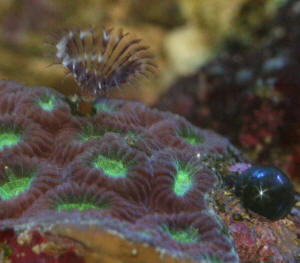
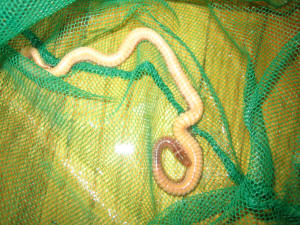
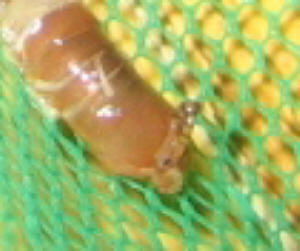
Mysterious tubeworm 04/23/2008 Ok, i have a question and i can't seem to find the answer in the archives. <<Lets see if we can find the answer then>> I have a basic 29 gallon "bio-cube". An extra pad for mechanical filtration and have removed the bio balls since all they seemed to do was get tiny pieces of food caught in them. We have a emerald crab, 5 blue legged hermit crabs, 1 skunk cleaner shrimp, about 15 snails (give or take with about 7 of them Turbos and the rest Astraea), 1 rose tipped anemone, a percula clown fish, a long nosed Hawkfish, 1 star polyp coral, 1 mushroom coral and about 5 other polyp corals can't remember what they're called now. <<Ok>> The tank has been up and going for about 5 months. Now for the actual question, i have recently found a tubeworm thanks to the power of the flashlight. It is black and grey stripped and it absolutely despises light. Before i noticed the tubeworm snails had been dying off and the shells conveniently are located around the rock the worm is hiding in. Of course i didn't actually realize this until I knew there was a worm there. Everything else seems fine and snails are cheap so i really don't mind feeding him. The problem is that i can't take a picture because it has to be dark or he runs and the flash just reflects off the glass. So no one other than my g/f has seen it. All i want to know is what it is. It doesn't seem to be a real danger of the tank since nothing else other than snails are dead, I just worry about it getting bigger and eating my coral. And since it's deathly afraid of light, even the over night blue lights how the heck i can get him out without removing the entire rock which would be a pain since it is a bottom rock and a main support for another layer or 2. <<Firstly, tubeworms, with regards to a feather duster worm, wont be the cause of death to the snails as they are filter feeders and are not predacious. Tube worms are split in to three categories, and your first port of call is to view this page and linked articles and FAQ's. As more specifics are required to give you an ID on this. http://www.wetwebmedia.com/feather.htm >> So main questions, could you give an estimated guess on what type of worm it is? I've seen the mouth and know for a fact it's a tubeworm. And how would you suggest getting it out if it does begin to be a problem? <<A guess is hard due to the lack of more specifics like does it have bristles? is it segmented etc etc. Please do read more on the link above. Regards. A Nixon>>
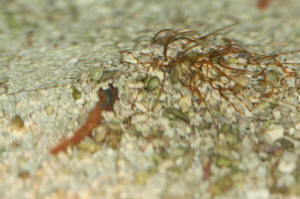
Worms in my tank, ID 04/07/2008 Hello, <<Hello Mike, Andrew today>> I have a 135 gallon tall tank that I am trying to set up for a reef system. So far I have 50 lbs of LS and 100lbs of LR in it along with 4 damsels. <<Eeeeesh.. Could cause aggression issues>> The tank has been set up and running for just over 4 months and all water readings are good. I have 1 250 watt MH light over the tank and 8 LCD moonlights. <<I would suggest you need more lighting. A single metal halide lamp is enough to cover 2 feet in tank length>> My problem is this, last night I took a flashlight and shined it into the tank to see how everything was going and noticed what looked like waste floating by but after deeper study it was swimming and not floating. I noticed 4 or 5 very small worm like creatures swimming around. They were white and seemed to follow the light as I moved it around the tank. I caught one of them and placed it in a container and took it to my LFS but they had already closed and now the thing is dead. Does anyone have any idea what this may be and is it harmful or not. <<A photograph would be better for me to provide an ID. Do have a read through the worm Articles and FAQ's found here. http://www.wetwebmedia.com/worms.htm >> I hadn't had any problems with the tank so far but I did buy another 10 lbs of LR about 3 weeks ago and had it in a quarantine tank for a week before putting it into the main tank. I'm sure this is where they came from. Any help with this will be greatly appreciated, and I love the site. Your help has been indispensable so far. Mike <<Please do read through the linked Articles and FAQ's. There are many many species of worm this could be and i could not begin to ID this without a good photo. Thanks for the questions Mike, the reading above will help. A Nixon>> Some sort of worm? 04/05/2008 Hello, <<Hey, Andrew today>> I am new to your site and would just like to say that its is great! <<Thanks for the comments>> You definitely have the most information out there and are very knowledgeable. Anyway, I just restarted my 5 gallon nano reef tank and currently have a male and female emerald crab (by luck), an arrow crab, and I purchased a small hammer coral today that seems to be doing fine. My question is that I have TONS of copepods everywhere and they seem to be surrounding these worm-like things that are buried in the substrate. I can see them between the crushed coral and the glass, they don't seem to be moving however. They are brown/tan in color and are less then a millimeter in thickness, and the longest one is about 3 inches. Do you have any idea what they are? <<Without a photo to identify, i would use your internet search tools and lookup Sipunculans and Eunicids..Either are good contenders, more so, the Sipunculan>> They seem to be multiplying rapidly and just live in the substrate. I am thinking about buying a blue Mandarin to control the copepods, will this also control the "worms" as well? Thank you for your help. <<Mandarin wont go for the worms, no. Certainly would not entertain adding a mandarin to a 5 gallon tank>> Eric Olah <<Thanks for the questions, hope this helps. A Nixon>> huh? 03/25/08 Hello, I have recently found tiny thin clear ( transparent) worm with a dark line down there back or complete black in my room. We have 2 dogs that stay in our room at night with us. We did a complete clean of our room, but now they're are back. They were first by a damp towel on the floor. please help me if you can, Im extremely disgusted that they keep coming back, and that I cannot find anything on the net. <I'm sorry, but this is an aquarium and pet fish/aquatic animal website. I'm not sure how we can help you here.> thanks Amanda <Best, Sara M.>
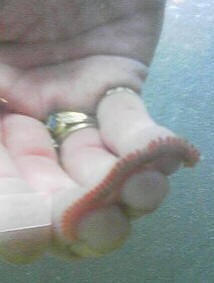
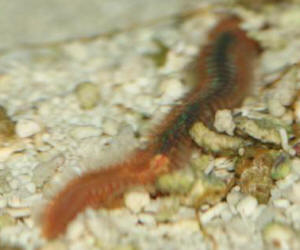
four to six inch centipede type worm in Long Island Sound Port Washington -- 03/10/08 We went for a walk along the beach by sands point Long Island. A small estuary had a bunch of 4-6in long centipede type worms. Some appeared to be ejaculating a white substance out of the back end. Do you have any idea what type of specimen we saw and what it was doing. Thanks Sara <Many species possibilities... Search re the locality name (smaller to larger) and the words "Errantiate Polychaete worms"... The white stuff is/was reproductive material. Bob Fenner>
Worm ID: Sedentary Polychaete -- 2/11/08 Hello crew. <Hi there!> My name is Craig and I have something I can't truly place a finger on. You guys have a wonderful site, but if there were more pictures and more behavior patterns it would help. (eek) <Thank you. There's always room for improvement!> But nonetheless, you have helped me so much over the months that I have known about ya. <Ah, good to hear!> So I truly hope you can help me identify this. <Hope so.> First off, established 60g tank, current set up over 1 year running. PH, cal, no2, no3, ammonia, right at where they're supposed to be for sps and clam health. HQI and PC lighting, great feeding habits for sps/bivalve health. <Okay. Normally we'd need the actual numbers and specs, but since this is basically an ID question, I won't give you too hard a time ;-)> Ok, I have something on my live rock that I'm not sure is a hair worm. I have read all your documentation on hair worms and I'm still not sure it's one. <Okay> There are now 5 that I have spotted, but my tank is about 4 years running. Or I should say the rock is, as the actual tank has grown over the years. <Funny how that happens!> But there could be more on the backside of the rock that I can't see - but they seem to like the light. These things are actually one of my favorite to watch. They only come out under the light and seem to sleep under the moonlights. <I can relate to that!> I am running a reef tank and have found just a few of these things. They are hair-like but only 1 single strand, <Hmmm, interesting. Usually these hair-like 'strands'/tentacles are seen as a pair (Spionid, Chaetopterid worms), or a grouping of many strands extending from a single crevice/hole in the rock/sediment (Terebellids, Cirratulids).> ..all white with no pigment change, and live 1 to a tiny hole deep in the rock. They do not move homes and the tentacle is around 1"-2" at the moment, and they poke at the rocks searching for their food, and they seem to only look for detritus in a circular pattern. <If you hadn't written that these were hair-like and preferred the light, I would have guessed Sipunculids/Peanut worms.> Now, from what I understand about hair worms, there are many, many types, <Usually the term "hair worm" refers to a Cirratulid polychaete, sometimes confused with a Terebellid/Spaghetti worm. However, as a common name, it's often used as a blanket term for any worm/polychaete with hair-like strands/tentacles (such as those listed above).> ..but they do appear to semi-stick to whatever they touch at the very tip and they're not moving homes ever. They also react very quickly when disturbed. They have been slowly growing over the years getting longer but never thicker. I saw the first one about 3 years ago and can't even tell you when I got that certain piece of rock, but it was super premium Fiji that was given a "life friendly cure". <Very good.> Now, I also have a very nice cleaner crew in my tank (20+ snails of dif. spec/15+hermits, Lawnmower Blenny, Six-line Wrasse 2 Fairy Wrasses 1 Skunk Shrimp, 2 Peppermint Shrimp , Sand Sifting Star, random other Asterina , and a Sally Lightfoot Crab), and none of these guys touch these things. <Interesting> I thought surely the blenny would kill them but nope, he won't even bite near them when they're out. <These fish are mostly herbivorous. My list of suspects would have included the wrasses, hermits, shrimps and crab!> They seem to clean their area at night when the "arm" is retracted. <Mmmm.> They also seem to have a small effect on mushrooms that are near their home as when they search, the mushroom will close, but this may just be from the physical interaction. <My thoughts as well.> The mushrooms have no other ill effect and come back out quickly if left alone. (yet that can be frustrating in itself when it's a nice mushroom and people are looking) <Murphy's law strikes!> Once again, it is the size of a small hair, completely white/translucent, yet housing the habits of an anemone tentacle rather than a worm. <?> Now while I know you're probably going it's a hair worm.. <I'd need to see an entire worm to have any hope of identifying, but they're likely one of any number of harmless/beneficial sedentary polychaetes that hitchhike into our tanks. Worms with these hair-like tentacles generally feed on detritus/particulate matter.> ..I truly need to know if they are dangerous to any coral/clam/sps/LPS or anything else living! <They're harmless in that they're not capable of stinging other organisms. However, their feeding tentacles can sometimes irritate sensitive corals. I've seen this happen with zoanthids in particular. Repeated contact can cause the polyps in that area to stay closed and occasionally lead to decline.> As soon as I spotted them over the years I rearranged my rocks where they couldn't reach anything important and some people here are saying bristle worms are ok yet for me they're bad (lost a really nice maxi clam to a bristleworm back in the day.) <Although you read about the occasional coral eating bristleworm (Hermodice carunculata), most are harmless/beneficial scavengers.> I tried to get a pic of it for you but it's pretty invisible and I don't have a good camera for photos without a flash and to be honest, I feel as if you need a video. So, if you think it may be some other random thing that hitched a ride please let me know. They're kinda housing some decent spots in my tank and I'm afraid to put anything near them cuz of the mushrooms reactions. <Understandable. I'd keep an eye on the situation. If you notice a problem, you can plug the worm's hole in the rock with some superglue gel. Hopefully, it won't be necessary though.> So thank you first off for reading this and then a 2nd thank you for your thoughts on this creature. <You're very welcome!> Sorry for the super long detailed version of the item but hey, I have found long term tank housing comes from knowing the animals behavior that are in it. <Absolutely. Knowledge benefits all!> Sincerely Craig Brucker P.S. Even if it takes you a long time to respond to this please do, as I have had this tank for a while and I'm not going to do anything differently until I hear from someone who can identify them. <Unfortunately, I can't give you a positive ID but as stated above, these are likely harmless/beneficial little polychaetes that can be easily dealt with should the need arise. Take care, -Lynn>
Worm ID: Spionid/Chaetopterid? - 12/25/07 Hi
there. <Hi Jamie.> I have a strange worm in my tank that I am
struggling to identify. The worm is around 50mm <5cm/~2'> in
length and is white and brown on the body. <Are you actually seeing
the body of the worm, or a tube? Where is it situated/living -- in the
substrate, on a rock, in a rock, elsewhere? This is where a photo could
really come in handy.> It has two tentacles (which are translucent
and about 300mm long) <Yikes, 300mm/30cm/almost a foot in length?
Are the tentacles mobile/active?> and comes out during the day
(which makes me think it isn't a spaghetti worm). Through some
searching the closest I can find is a Mud Whip Worm. <Polydora spp.
-- shell borers in the family Spionidae.> However I can find very
little information on mud whip worms and so can't be sure that this
is exactly what I have. Do you have any clues as to what the worm might
be? <Sounds very much like something in the family Spionidae, or
Chaetopteridae. The two hair-like translucent
tentacles/'palps', are characteristic of worms in these two
families. These detritivores/particulate feeders live in hardened mucus
tubes, or 'U' shaped burrows. Some tubes look very much like
parchment, others have bits of substrate, shell, sand grains, or even
silt cemented to the outside. This is most likely what's in your
tank, but without a photo/more info..? Please see these links, as well
as Google Spionidae and Chaetopteridae, for more
information/confirmation: Spionidae:
http://www.reefs.org/library/aquarium_net/1197/1197_1.html
Chaetopteridae:
http://www.reefs.org/library/aquarium_net/0897/0897_5.html> Thanks
very much! Jamie <You're very welcome! -Lynn>
|
|

|
Features: |
|
| Featured Sponsors: |
/Amphipods/image004.jpg)