|
|
|
Amongst the stinging-celled organisms (corals, anemones, jellyfishes ) only the coral anemones (Corallimorpharia) rate near equal in hardiness and adaptability to captive care than the various polyps and sea mats that make up the Order Zoanthidea. Though not as spectacular as other cnidarians, Zoanthids are common and widespread over the worlds' reefs, often occupying fringe physical environments (intertidal, back reef, other shallow areas, over dead corals). This ecoclinal tolerance points up their resistance in aquariums. Their toughness in the wild is of advantage to reef aquarists looking for sturdy coral-like livestock. The Place of the Zoanthids in Cnidarian Classification: Bothersome hydras, jellyfish, sea anemones, tube anemones, reef and non-reef-building corals, soft and hard, black, horny and stony, sea pens, sea pansies , sea wasps, Portuguese men of war and sea fans; these are the stinging-celled animals, the Cnidaria ("Nigh-dare-ee-yah"); in some older texts as the Phylum Coelenterata These organisms are radially symmetrical (hence inclusion in a sub-Animal Kingdom, the Radiata), are made up of two basic tissue layers and possess salient "stinging" cells. These are grouped as thread-like (volvent) barbed/spined with and without toxins (penetrant), and "sticky" for anchoring (glutinant). Their body shapes come in two basic formats; a sessile polyp-like and free-swimming medusa-like. The basic features of these body-types are evident; most species are either one or the other, Medusoid or Polypoid, others pass through both in their life cycle. The body cavity formed by the tissue layers bears series of tentacles around a single body/mouth/"anus" opening/mouth (the coelenteron). There are few freshwater members (e.g.
Hydras), most are marine in shallow tropical waters, though they are found worldwide at
all depths. There are some ten thousand described species with a rich fossil history
dating back before the Cambrian Period. A Brief Classification of the Phylum Cnidaria : Class Hydrozoa: simple, tube-like stomach. Small medusa stage and a small to large Polypoid stage. simple, tube-like stomach. Small medusa stage and a small to large Polypoid stage.
Class Scyphozoa: Jellyfishes. Have four-chambered stomachs. Most have large medusa and small polyp stages. @ 200 species. Jellyfishes. Have four-chambered stomachs. Most have large medusa and small polyp stages. @ 200 species.
Class Anthozoa: Class Anthozoa: Class Anthozoa: Class Anthozoa: Class Anthozoa: Polyp stage only, stomach divided into numerous compartments. Polyp stage only, stomach divided into numerous compartments.
Identification/Distinction from Related Forms: For folks who have a hard time telling Zoanthids apart from the similar appearing sea anemones (Order Actinaria) and coral anemones (Order Corallimorpharia), youre not alone. Here is a Table comparing and contrasting external features of these groups. Physical Trait Differences between Zoanthids, true Anemones, Coral Anemones
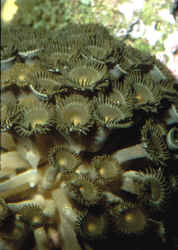
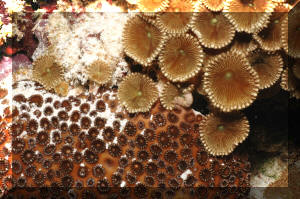
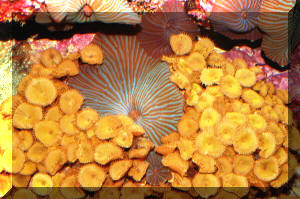
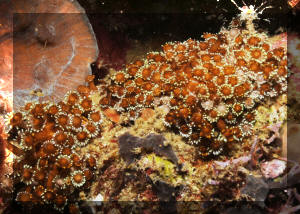
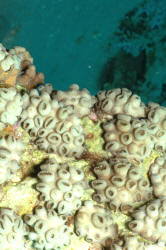
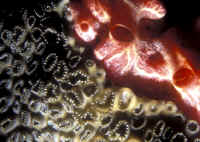
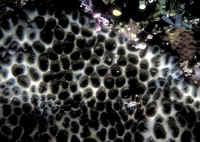
All three Orders members lack the heavy external calcareous skeletons of true or stony corals (Order Scleractinia); theyre entirely soft-bodied polyps. In terms of mouth/body openings Zoanthids bear a single ciliated groove (called a siphonoglyph) at their edge, versus two in most anemones and none in the coral anemones. Only the Zoanthids are truly colonial, sharing nutrient and nervous impulses directly through their membranous mats (hence some of their common names, sea mats) or stolonic basal connections. Each anemone and Corallimorpharian polyp is independent, though some may appear joined at their bases. The true anemones have robust bodies and tentacles. Zoanthids are generally small (less than an inch in any dimension), button-like with two small rows of weak tentacles at their polyp margins. Corallimorphs have series of small tentacles radially arranged across their oral surface. (see images). Species of Interest to Aquarists: Zoanthids are sold as "polyps" of different sorts, mats and more creative names. There are several species offered year round from all tropical oceans. Zoanthus sociatus, from the Caribbean, is relatively large (1.2" polyps) with 60 short tentacles; bright green when in good health. A few species of the genus Palythoa are also often collected out of the Western Atlantic for the trade. Zoanthus danae from the Pacific is another excellent species that is commonly offered. Several other Zoanthus, Parazoanthus and Palythoa spp. are offered out of the Pacific around Southeast Asia. The most popular by far is Parazoanthus gracilis imported from Indonesia. A similar, almost as pretty congener is P. swiftii, out of the Atlantic. (images)
Genus Parazoanthus:
Genus Protopalythoa:
Genus Zoanthus:
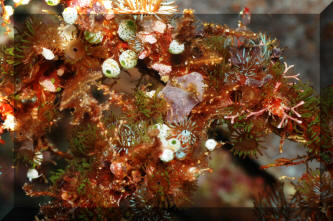
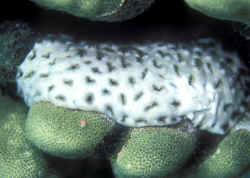
Selection: Though zoanthids are generally received and offered in good shape most everywhere, there are a few guidelines Id adhere to in picking them out; mainly re appearance and symbiosis. Choose specimens that exhibit all their polyps open; not necessarily all at the same time. Ignore ones with visible dead, whitish material. If theyve recently been "separated" from a mother colony, give the new piece time to heal before purchase. Healthy specimens that are colored should be deep and consistently so; those with their zooxanthellae in decline should be avoided. Symbioses: Many zoanthids live in close association, either commensal or mutualistic with other species, particularly sponges and algae; and they "get along" with most other kinds of sessile marine life as well; neither quickly overgrowing them or being supplanted by true corals, other zoanthids, corallimorpharians or even some anemones. Regardless of their innocuous nature, zoanthids should be purchased without their symbionts. Die offs from specimens purchased with sponges and algae are way too common. To repeat; the exception to the rule of zoanthid hardiness is the ones that come attached to commensal sponges and algae. Many of these perish easily. Environmental Conditions: Water Chemistry and Physics: The sea mats and polyps that are zoanthids are far more tolerant than other cnidarians to waste accumulation and otherwise less than ideal water conditions. Nonetheless, minimal nitrate (less than 10ppm), phosphate (one ppm) and undetectable ammonia and nitrite should be your target. Circulation: Practically speaking, zoanthids cannot receive too much water movement. Such flows should be chaotic; that is, not consistently blasting from one direction. Lighting: Many of the species of zoanthids kept by aquarists are hermatypic, living with endosymbiotic zooxanthellae within their tissue. These forms appreciate moderate to intense lighting; either metal halide or shallow placement in settings with adequate full-spectrum fluorescents. Behavior: Introduction/Acclimation: New specimens should be "drip acclimated" underwater and, if possible quarantined for a good two weeks, or longer, until all polyps show signs of reconstitution and feeding. Predator/Prey Relations: These polyps capture small suspended crustaceans, not large life in the wild and "in captivo". Likewise, they are decidedly shunned by would-be pests and predators. It turns out their tissues bear potent poison (Palytoxin). Fishes and predatory invertebrates give them wide berth with one exception. There are some known predaceous snails that consume zoanthids. If you find these on your colonies, they are simple to remove. Reproduction: Though zoanthids reproduce sexually much as do the true corals, the most common form is asexual. Under regular conditions, very frequently youll find a piece of material at the base of a colony gives rise to a new individual; a reproductive method termed gemmation. Foods/Feeding: Even the "green" zoanthids with internal algae helping them make their food require supplemental feeding. Most successful reefers feed their zoanthids every day or two with either a mash of small zooplankters blown over the animals with a turkey baster or some solid, meaty foodstuff placed on the polyps. Its best to subdue circulation at this time; done practically with a timer. Diseases: Other than absolutely dissolving and falling apart, zoanthid "disease" is difficult to diagnose. Some or all polyps staying closed all the time with their tentacles enfolded is a danger sign. Here you should look to you water quality and consider effecting a large (50% or more) water change if all else checks out. One other "environmental disease" should be mentioned. For folks using metal halide lighting in shallow water, a white bumpy condition on zoanthid oral disks has been linked with excessive light. Affected specimens need to be relocated to less bright, deeper conditions. There are proponents of the use of iodine as a preventative and treatment for this group; within moderation such dips and periodic additions should do no harm. Close: For reef livestock period, few organisms can match the zoanthids for hardiness and longevity. Their tolerance for "challenged" spaces and conditions where they occur naturally is mirrored by their success in captive settings. New reef aquarists, or those uninitiated with keeping stinging-celled life should consider this group and the corallimorpharians for "practice" before moving on to such groups as the true/stony corals or anemones. Other than initially selecting healthy specimens and providing them with brisk current and adequate light, there is very little to the husbandry of these polypoid Cnidarian animals. Bibliography/Further Reading: Barnes, Robert. 1987. Invertebrate Zoology; 5th ed. Saunders, Fl. 893pp. Fenner, Bob. 1992. Cnidaria: Stinging celled animals. FAMA 7/92. Fenner, Bob. 1996. A diversity of aquatic life; Coral anemones: Order Corallimorpharia. FAMA1/96. Fenner, Robert. 1998. The Conscientious Marine Aquarist. Microcosm, VT. 432 pp. Gosliner, Terrence M, Behrens, David W. & Gary C. Williams. 1996. Coral Reef Animals of the IndoPacific. Sea Challengers, Monterey, California. Gutierrez, Santiago. 1991. From a reefs point of view; Zoanthus. FAMA 12/91. Humann, Paul. Reef Creatures Identification; Florida, Caribbean, Bahamas. New World Publications, Inc. Jacksonville, FL. 320pp. Mancini, Alessandro. 1992. Zoanthidae in tropical marine aquariums. FAMA 3/92. Graphics/Caption Material: 1,2) The most desired, or at least most often sold zoanthid, Parazoanthus gracilis, en masse at a L.A. wholesaler, and growing well in an aquarium. Exclusively imported from Indo. 3) The similar Atlantic Parazoanthus swiftii in an aquarium setting; note the dark "mouths". A partially open and closed (to show what the polyps look like) Palythoa; lets call it a Pacific white encrusting zoanthid; this one in Cebu, Philippines. 5.5) Is a Palythoa species in an aquarium, showing optimum color. 6,7) Dont buy your zoanthids like this! Two examples of "polyp" animals growing on their commensals, 6 on algae, seven on an encrusting sponge. Both pix P.I.8-11) Examples of the closely related and hardy false or coral anemones, Order Corallimorpharia. 8,9) Aquarium pix of the most common mushroom coral genera, Actinodiscus and Discosoma; the latter apparently happily sharing a rock with a zoanthid colony. 10,11) Two other corallimorphs; a gorgeous specimen of Ricordea floridae, and a big elephant ear (Amplexidiscus) in a batch at a wholesalers. Note the groups flatness and numerous, small, radially-arranged tentacles. 12,13) Two close-ups of large anemones to demonstrate their salient characteristics: Stout, upright, large single polyps, well-developed, numerous tentacles, and a mouth terminating in both corners by ciliated grooves, the siphonoglyphs. 12 is a giant green anemone (Anthopleura xanthogrammica) off California. 13 is an unid.ed giant in Cebu. 14-17) Some anemone close-ups from the Red Sea to show their tentacular elements. Large, well-developed, numerous. Best tried after zoanthids, corallimorpharians. Class Anthozoa: Class Anthozoa: Polyp stage only, stomach divided into numerous compartments. Polyp stage only, stomach divided into numerous compartments.
Identification/Distinction from Related Forms: For folks who have a hard time telling zoanthids apart from the similar appearing sea anemones (Order Actinaria) and coral anemones (Order Corallimorpharia), youre not alone. Here is a Table comparing and contrasting external features of these groups. Physical Trait Differences between Zoanthids, true Anemones, Coral Anemones
All three Orders members lack the heavy external calcareous skeletons of true or stony corals (Order Scleractinia); theyre entirely soft-bodied polyps. In terms of mouth/body openings zoanthids bear a single ciliated groove (called a siphonoglyph) at their edge, versus two in most anemones and none in the coral anemones. Only the zoanthids are truly colonial, sharing nutrient and nervous impulses directly through their membranous mats (hence some of their common names, sea mats) or stolonic basal connections. Each anemone and Corallimorpharian polyp is independent, though some may appear joined at their bases. The true anemones have robust bodies and tentacles. Zoanthids are generally small (less than an inch in any dimension), button-like with two small rows of weak tentacles at their polyp margins. Corallimorphs have series of small tentacles radially arranged across their oral surface. (see images). Species of Interest to Aquarists: Zoanthids are sold as "polyps" of different sorts, mats and more creative names. There are several species offered year round from all tropical oceans. Zoanthus sociatus, from the Caribbean, is relatively large (1.2" polyps) with 60 short tentacles; bright green when in good health. A few species of the genus Palythoa are also often collected out of the Western Atlantic for the trade. Zoanthus danae from the Pacific is another excellent species that is commonly offered. Several other Zoanthus, Parazoanthus and Palythoa spp. are offered out of the Pacific around Southeast Asia. The most popular by far is Parazoanthus gracilis imported from Indonesia. A similar, almost as pretty congener is P. swiftii, out of the Atlantic. (images)
Selection: Though zoanthids are generally received and offered in good shape most everywhere, there are a few guidelines Id adhere to in picking them out; mainly re appearance and symbiosis. Choose specimens that exhibit all their polyps open; not necessarily all at the same time. Ignore ones with visible dead, whitish material. If theyve recently been "separated" from a mother colony, give the new piece time to heal before purchase. Healthy specimens that are colored should be deep and consistently so; those with their zooxanthellae in decline should be avoided. Symbioses: Many zoanthids live in close association, either commensal or mutualistic with other species, particularly sponges and algae; and they "get along" with most other kinds of sessile marine life as well; neither quickly overgrowing them or being supplanted by true corals, other zoanthids, corallimorpharians or even some anemones. Regardless of their innocuous nature, zoanthids should be purchased without their symbionts. Die offs from specimens purchased with sponges and algae are way too common. To repeat; the exception to the rule of zoanthid hardiness is the ones that come attached to commensal sponges and algae. Many of these perish easily. Environmental Conditions: Water Chemistry and Physics: The sea mats and polyps that are zoanthids are far more tolerant than other cnidarians to waste accumulation and otherwise less than ideal water conditions. Nonetheless, minimal nitrate (less than 10ppm), phosphate (one ppm) and undetectable ammonia and nitrite should be your target. Circulation: Practically speaking, zoanthids cannot receive too much water movement. Such flows should be chaotic; that is, not consistently blasting from one direction. Lighting: Many of the species of zoanthids kept by aquarists are hermatypic, living with endosymbiotic zooxanthellae within their tissue. These forms appreciate moderate to intense lighting; either metal halide or shallow placement in settings with adequate full-spectrum fluorescents. Behavior: Introduction/Acclimation: New specimens should be "drip acclimated" underwater and, if possible quarantined for a good two weeks, or longer, until all polyps show signs of reconstitution and feeding. Predator/Prey Relations: These polyps capture small suspended crustaceans, not large life in the wild and "in captivo". Likewise, they are decidedly shunned by would-be pests and predators. It turns out their tissues bear potent poison (Palytoxin). Fishes and predatory invertebrates give them wide berth with one exception. There are some known predaceous snails that consume zoanthids. If you find these on your colonies, they are simple to remove. Reproduction: Though zoanthids reproduce sexually much as do the true corals, the most common form is asexual. Under regular conditions, very frequently youll find a piece of material at the base of a colony gives rise to a new individual; a reproductive method termed gemmation. Foods/Feeding: Even the "green" zoanthids with internal algae helping them make their food require supplemental feeding. Most successful reefers feed their zoanthids every day or two with either a mash of small zooplankters blown over the animals with a turkey baster or some solid, meaty foodstuff placed on the polyps. Its best to subdue circulation at this time; done practically with a timer. Diseases: Other than absolutely dissolving and falling apart, zoanthid "disease" is difficult to diagnose. Some or all polyps staying closed all the time with their tentacles enfolded is a danger sign. Here you should look to you water quality and consider effecting a large (50% or more) water change if all else checks out. One other "environmental disease" should be mentioned. For folks using metal halide lighting in shallow water, a white bumpy condition on zoanthid oral disks has been linked with excessive light. Affected specimens need to be relocated to less bright, deeper conditions. There are proponents of the use of iodine as a preventative and treatment for this group; within moderation such dips and periodic additions should do no harm. Close: For reef livestock period, few organisms can match the zoanthids for hardiness and longevity. Their tolerance for "challenged" spaces and conditions where they occur naturally is mirrored by their success in captive settings. New reef aquarists, or those uninitiated with keeping stinging-celled life should consider this group and the corallimorpharians for "practice" before moving on to such groups as the true/stony corals or anemones. Other than initially selecting healthy specimens and providing them with brisk current and adequate light, there is very little to the husbandry of these polypoid Cnidarian animals. Bibliography/Further Reading: Barnes, Robert. 1987. Invertebrate Zoology; 5th ed. Saunders, Fl. 893pp. Fenner, Bob. 1992. Cnidaria: Stinging celled animals. FAMA 7/92. Fenner, Bob. 1996. A diversity of aquatic life; Coral anemones: Order Corallimorpharia. FAMA1/96. Fenner, Robert. 1998. The Conscientious Marine Aquarist. Microcosm, VT. 432 pp. Gosliner, Terrence M, Behrens, David W. & Gary C. Williams. 1996. Coral Reef Animals of the IndoPacific. Sea Challengers, Monterey, California. Gutierrez, Santiago. 1991. From a reefs point of view; Zoanthus. FAMA 12/91. Humann, Paul. Reef Creatures Identification; Florida, Caribbean, Bahamas. New World Publications, Inc. Jacksonville, FL. 320pp. Mancini, Alessandro. 1992. Zoanthidae in tropical marine aquariums. FAMA 3/92. |
|
|
|