 |
|
| Home | Marine Aquariums |
Freshwater Aquariums |
Planted Aquariums |
Brackish Systems |
Ponds,
lakes & fountains |
Turtles & Amphibians |
Aquatic Business |
Aquatic Science |
Ask the WWM Crew a Question |
| Please visit our Sponsors | ||||
|
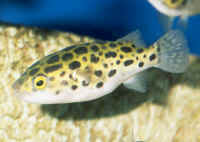
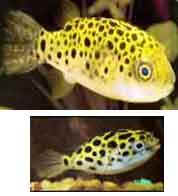
Mislabeling Puffers at WWM (to do... correct... done) Hi Bob, Ananda said I should speak to you about the mislabeling & misinformation of FW & BW puffers in the FW/BW puffer section of WWM. Click here. For example, the green spotted puffer (you have named green puffer) , pictured as t fluviatilis, is really called t nigroviridis (t fluviatilis is commonly known as the Ceylon puffer, which WWM's photo has a scientific name of t schoutedeni. That fish [schoutedeni] actually looks just like the green spotted, but is FW). It says no salt is needed, when actually this is a high-end BW fish that prefers SW as an adult. <Yikes! Will check> (mine are at 1.022). It lists Figure 8 puffers (t biocellatus) as FW puffers, when they are actually BW. I could also add a lot of other info (if space prohibits). Puffer ID can be very confusing. Many LFS have their fish mislabeled & folks don't know what they have until they write in to me (or others that are knowledgeable) to find out the correct names, aggressiveness & water conditions necessary to keep their specific puffer. Jeni (Pufferpunk) <Jen... I've neglected this area of the site... for way too long... mea culpissima. Hope to fix on the morrow. Thank you, Bob F> Those Tetraodon corr.s Jen/PP, have made most of the suggested changes you sent along ayer, but am finding a conflict with T. biocellatus. Fishbase. org lists it as a FW species: http://www.fishbase.org/Summary/SpeciesSummary.cfm?ID=25175&genusname=Tetraodon&speciesname=biocellatus Can you find me a ref. to otherwise? Thank you, Bob Those Tetraodon corr.s Hi Bob, I thought there might be a conflict w/that one. I have a friend Robert T. Ricketts (perhaps you know him?) who has been keeping puffers for over 40 years. Almost everything I know about puffers I owe to him. Here is his article about F8s: FIGURE 8 Comments by RTR on the subject: Fishbase always cites their references. For the F8 and the GSP, the ecological info is from Rainboth, W.J. 1996. But I have not looked up the original citation. Fishbase is a compilation of data from any or all available data in the scientific literature, but that serves both for assurance and as a warning. A fish having been found in a survey of this or that habitat in the massive Tonle Sap has little or nothing to say about that site being the population center for that particular fish, or a stray from other habitats, or a fringe population with marginal survival prospects. The distribution and ecology of these fish has not been studied widely as they have no economic importance. Reports include them mostly as found here and there, but they are rarely key species in studies. Those indigenous groups using tropical fish collection as an income supplement are not literate populations. Collections tend to be seasonal (water and weather conditions permitting) and time-available from other activities. The collected specimens are pooled and later transported to a "wholesaler" or agent who arranges transport and handling to a population center or abroad. The paper trail, if any, is not detailed or particularly accurate. By the time the creature passes through an importer in the States or elsewhere, the a regional wholesale distributor, then the LFS, it is highly unlikely to have traceability back to even the country of origin, much less finer-grained data. Without some non-trivial economic importance, fieldwork is too expensive to be supported. What little information we have that is really useful tends to come from talented individuals, such as Dr. Ebert on puffers, who happens to have a personal affinity for a group or family of fish, and has made enough side notes and generated enough personal experience to compile some publication for hobbyists after years of field work on other topics. Several individuals have done similar works on Rift Lake fish, Rainbowfish, etc. Those reports are our only real and valuable ecological source data." Robert And again on the same subject: My personal experience with these fish is that they do best in light brackish water (~1.005) over aragonite substrates (to support the high pH), with no exposure to unoxidized metabolites, and minimal exposure to nitrate (<20ppm). Under such conditions I expect them to live 15-20 years. In FW conditions I have never had one survive more than a few years, and they have been subject to chronic or repeated cornea and skin problems. YMMV, but I would never put one of these fish under my care into FW. When Dr. Ebert's book came out, one of the things that delighted me most about it was that this fish, along with the GSP, were both noted as doing far better in brackish conditions. Both of those observations matched my own. I have no way of knowing whether or not the fish we see in the trade are collected from the inland areas reported on fishbase, or from coastal, estuarine, or mangrove areas and potentially represent different populations. My personal experience does not at all agree with the fishbase report. But then they list the fish as being an algae and plant eater as well (from stomach contents). Obviously they have missed the experience of seeing these fish feed in captivity - algae or plant material is ingested routinely, along with the mollusk or small crustacean feeding on it. So there they are not incorrect as much as they misunderstand and misinterpret, or simply have never observed either in the wild or captivity, the dynamics of feeding for the fish." Robert I completely agree w/RTR. I have read over & over, circumstances where a person's F8 was failing, only to be put into BW & start to thrive. I also wanted to remind you that the green spotted puffer (t nigroviridis) is a high-end BW puffer that prefers SW as an adult. There is also a t nigroviridis shown in the disease portion said to be a FW fluviatilis. It might also be a good idea to mention in that section, the high probability of puffers coming in w/internal parasites. I Usually wind up treating most of them w/Discomed. Jeni <Jen/PP & Robert, I will amend our brief information on this species to include this note, and post all for others edification. Thank you, Bob Fenner> Those Tetraodon corr.s/ some beautiful pix on a Japanese puffer site Almost forgot-- I wonder if you might be able to use the photos from this site: Japanese Puffer Site. PP <Umm, not without their permission. Shorter answer, no. Bob> F8 Tank-10/27/03 Jeni, <Hi Ryan> I want to do a tank centered on a Figure 8 puffer. <One of the prettiest puffers in my book!> Tell me what your model Figure 8 tank would be like. Size, substrate, tankmates if any, plants....as if you were starting from scratch. <Funny you asked. I just had a 29g tank open up & have been wanting F8s for a while. I have 3 F8s, 2 pairs of knight gobies & 6 bumblebee gobies. They all get along great. I use crushed coral for substrate & keep the S.G. at 1.008-10. I have it decorated w/lots of places to investigate & a tall mangrove root (fake) in the middle. I don't use live plants in BW tanks. They are usually decorated like SW tanks, w/fake corals, etc. You can see my F8 tank (& all the rest of them) here: http://wetwebfotos.com/Home?actionRequest=userview&userID=1918> On a side note, I think this would be a fun feature for WWM. Have the expert post there model tank idea for different biotypes. <Cool idea!> Thanks, Ryan <You're welcome, Jeni (Pufferpunk)> Puffer Tank Set Up Questions Jeni, <Sorry, Jeni's moving...Ananda here today...but I'll keep this around so she can answer it when she gets back.> I want to do a tank centered on a Figure 8 puffer. Tell me what your model Figure 8 tank would be like. Size, substrate, tankmates if any, plants....as if you were starting from scratch. <Hmmm. Probably a 75 or 90 gallon tank, for five Figure 8s. I would set up a modular, Habitrail-like system for them to explore and swim through, along with assorted rocky nooks and crannies for them to hide in (no sharp stuff in the tank). I'd want to be able to rearrange stuff pretty easily. Breaking up the sight lines is a key feature of this tank: the puffs should be able to swim into places where none of them can see any of the others. The substrate in the main tank is sand. Filtration is pretty heavy-duty: a wet/dry filter, which feeds into a refugium full of Vallisneria for nitrate reduction. The refugium is also the snail farm, with lots of pond snails for the puffers. The substrate in the refugium is Fluorite. The refugium is lit on a reverse light cycle with T5 lighting and good reflectors. I'd ask the people on the WetWeb chat forums for suggestions on pumps & stuff. I'd put SCWDs on the returns so the puffs can play in the outflow, and probably include a couple of powerheads, too, with the intake guards securely fastened on the powerheads.> On a side note, I think this would be a fun feature for WWM. Have the expert post there model tank idea for different biotypes. <That does sound like a cool idea. I'll pass it on and see what happens....> Thanks, Ryan <You're welcome! --Ananda> Re: sick puffer (07/27/03) Hey Ananda - thanks for the quick reply. <You're welcome...it so happened that I was online when your email came in.> The puffer's belly is still white. <Oh, good. Puffer bellies are good stress-barometers.> The slug came from my garden (was on a leaf). <Are you using any fertilizers or pesticides? If so, I would avoid using the garden slugs.> I went back & checked on him after turning off light & adding water and he seems much better! He attempted to eat a couple of antibacterial sticks. I put in a couple of mosquito larvae and he did eat one of them - still seems to be having some trouble seeing them. <Ah. If he's having trouble seeing, do a water change. That can be a symptom of a water quality problem.> Are they ok to feed? <That depends on where you're getting the mosquito larvae from. If they're from a pond or something near your house, you need to be *certain* that the local government does not spray for mosquitoes. If you're certain that they're "organic" mosquitoes (pardon the pun), they should be okay.> Thanks again, Donna <You're welcome. --Ananda> Copper and puffers (07/26/03) <Hi! Ananda here tonight...> 1. Had beautiful gold spotted puffer in tank with serious ich outbreak. LFS said treat with copper power in show tank. NOW know that was a bad idea. <I would never treat anything in a show tank...> Conscientious Marine Aquarist suggested puffer fish OK with copper Ananda said get out of copper and do daily water changes in QT tank Which is right????? <To some degree, both. I always try to steer people away from using copper with puffers and other scaleless fish because they are *so* touchy with copper. While it is *possible* to treat puffers with copper, it is also *difficult* to maintain the copper at a level which is sufficient to kill the parasites without endangering the puffer. (As an example, a couple of days ago, one reader lost a puffer moments after putting it into a coppered tank. The tank had been used to treat an angel, which survived the same level of copper that was lethal for the puffer.) Add to that the fact that copper will also kill all beneficial bacteria in a setup, and that means the hospital tank is likely to have some ammonia -- which is deadly to any fish. The combination could easily prove too much for a puffer to take. Freshwater dips are significantly less dangerous to the puffers (as long as you keep their heads submerged so they can't gulp air!). And the daily water changes are designed to do accomplish two things: keeping the ammonia levels down and removing any ich from the bottom of the tank.> 2.Also, tank had constant bubbles from Iwaki 55rlt pump with wrong sump ( too small) and couldn't keep up with water flow and was sucking air too. Is this a source of stress for fish? <It could be. --Ananda> Thanks, Russ - Info about Tetraodon suvattii - Hi, <Hello, JasonC here...> Been reading your site for quite some time now, very informative on all aqua subjects....love your site ! :) I'm looking for more info on a puffer "Tetraodon suvattii", the arrowhead puffer/pignose puffer. I tried google-ing your site or the web, but I couldn't find much info. Have you had this puffer before? <No.> My LFS had 2 in, they sold one the first day. Then the other one was kept with a clown knife (4"), 4 red snakeheads (5") and 2 lung fish. Yesterday when I went by to check it out again, it's now in it's own tank - he killed every other fish!! Yeah, so....all I know now is that he'll be quite aggressive, no tankmates. <Well... I think like many things, your mileage might vary. Like most puffers, they will eat most anything that fits in their mouth, but for the most part are 'supposed' to be peaceful. Of course, the puffer might not have read the same books I did so...> But I would like to know if they're freshwater or brackish? <Freshwater.> What temperature should they be kept in? <Tropical temperatures - 75-80F> ( my house is pretty hot during the summer, it could get to 29/30 C with just room temperature) And tank size? <As large as you please... seeing as this one might end up being kept singly, you probably don't need anything too large, a 55 would be excellent. These fish only grow to about 4.5". You might consider a sand bottom as these fish bury themselves to hide and wait for food.> Kevin <Cheers, J -- > Unwell Leopard Puffer Fish >Hi, >>Hello, Marina here, but am also sending this to the resident brackish expert, Ananda. >About three weeks ago, I purchased two Leopard Puffer Fish (about 1" long). They're currently in a 90 Gallon Brackish Water aquarium that I've had for about two years. Partial water changes are made religiously once a week. The one puffer fish is doing fine, looks healthy/eats/moves around a lot. The other puffer started off fine, but after a few days, I noticed his belly had a few thin dark lines. It almost looked as if food had leaked out of his stomach, but not through the surface of his skin. Since then (about three weeks), his belly has gradually gone from white, to a dark black color (from his tail, moving up towards his head). He spends a lot of time laying at the bottom of the tank, still get's excited during feeding time, but seems to have problems eating (choking). As of today, I also noticed ick in the tank (two visible ick cysts on our Australian Finger Fish, and upon closer inspection, both puffers are speckled with ick as well). I returned to the pet store to learn that the puffers we purchased were from a tank that was placed under quarantine shortly afterwards due to ick. >>Great. At least you know, yeah? >I'm now treating my tank with ick medication, but my concern is still with the one 'black bellied' puffer. Could this have been caused by the ick? The other puffer does not seem affected in the same way, and aside from the ick, all other fish are doing fine. Should I be considering some sort of internal parasite or infection? I asked some of the employees at the Pet store and got strange looks as a result. Searching the internet has not provided me with much information on any Puffer Fish related illnesses. Any suggestions would be greatly appreciated. >>I'm giving you this link on f/w puffer FAQ's.. http://www.wetwebmedia.com/BrackishSubWebIndex/fwbracpuffaqs.htm http://www.wetwebmedia.com/FWSubWebIndex/fwpufffaqs2.htm http://www.wetwebmedia.com/BrackishSubWebIndex/bracpuffaq2.htm Please follow the links within links, sorry I can't be of better help at this time. Specific gravity for a green-spotted puffer? <Ananda here today fielding the puffer questions...> I bought what I think it a Tetraodon nigroviridis about 6 months ago. The store had it in water with a specific gravity of 1.016, but because this did not correspond with most of the research I'd done, I took it down to about 1.005. Do you agree with this, and is this puffer that specific as to what its salt level can be? <Actually, this puffer can go from fresh water as a baby to full marine water as an adult. One guy in Malaysia reported finding them in the wild in waters with the specific gravity ranging from 1.012 to 1.019. These were probably the larger fish, which would be more visible.> I ask for two reasons, which I hope you'll comment on. First, the puffer is now much less colorful than it was when I first got it. It went from a bright yellow with distinct spots to a dull grayish color with less distinguished spots. I'd like the brightness, but I also want the fish to live. <I'd say he'd appreciate some more salt.> Secondly, I have two larger tanks. My 55 gallon has two Brazilian puffers and three figure eights, and this tank has very little salt. My 30 gallon houses this spotted puffer in 1.005 water. My wife and I are thinking of turning the 30 gallon into a salt water system, and I'm wondering if this spotted puffer would do fine in the fresh system with the other puffs, or if it could even stay in the 30 and go to salt. Or if neither would be a good thing. <How big is the puffer? If you gradually turn this into a saltwater system, your puffer should be fine. Do check out our puffer FAQs, starting with the links here: http://www.wetwebmedia.com/BrackishSubWebIndex/fwbracpuffers.htm > Thanks, Andy B <You're welcome. --Ananda> More on green-spotted puffers and specific gravity... Thanks for the response. This puffer is about 2.5 inches. Do you think it is too early to take it up to 1.019? <Probably not... but personally, at that size, I'd keep it lower -- maybe 1.010 or so.> By the way, I did look at the wetwebmedia puffer links, but on this particular puffer no salinity info is given. <Hmm. Another thing to add to the to-fix list...> Thanks again. Andy b <You're welcome. --Ananda> - Pernicious Puffer Problems - Hi wet web crew!! <Greetings, Tom, JasonC here...> I'm having problems with my puffer. I started off with 3 figure 8 puffers in a 55 litre tank. There were all fine for about a month, then the largest one attacked the smaller 2 and they both died. I kept it as just one puffer since then, but he has recently gone off his food and has started to swim at the top of the tank, head up. It looks like he is breathing in air, but he doesn't puff up. when i put some food in (brine shrimp is what he is on at the mo, i couldn't find any bloodworm) he looks at it very excited but doesn't eat it. He hasn't changed colour, still seems quite mobile and hasn't lost much weight. <Well... puffers sometime go on hunger strikes, why they do it is not easily revealed. They are also sensitive to water quality, so you might want to look there first. You should also read through all the FAQ's we've accumulated as we get a lot of questions about these fish. Here's a good place to start: http://www.wetwebmedia.com/BrackishSubWebIndex/fwbracpuffaqs.htm > any advice you could give me would be very much appreciated! Thank you Tom Hird <Cheers, J -- > A Puffer by any other name would smell... Hi! <Hi, Trish... Anthony Calfo here answering Bob's mail while he is away on a fantasy fish collecting trip, as we are told, wearing nothing but a natural bikini made from the hide of a capybara that he caught himself, and armed only with a buck knife clenched between his teeth> I recently bought 4 baby puffers - the spotted green kind. <AKA: Green Puffer, Spotted Puffer, Leopard Puffer, etc.> However, different websites seem to give it different Scientific names. Some say it's TETRAODON FLUVIATILIS, others say it's TETRAODON NIGROVIRIDIS. <I'm not certain...Bob can confirm, but it is my understanding that they are one in the same and that T. nigroviridis is the valid name> The pictures of both species on the internet look the same so I can't tell which species mine is. My puffers have an iridescent green background with round spots. What is the difference between Tetraodon Fluviatilis and Tetraodon Nigroviridis? Would really appreciate it if you can clear up my confusion...Thanks, Trish <I'll borrow your confusion and add it to my own cerebral clutter... best of luck to you, Anthony> Picked a Peck of Pimpled Puffers (marine, but applicable to FW puffers as well) Mr. Fenner, <Geri...Anthony Calfo here answering Bob's mail while he is away studying to become a Tibetan Sherpa> I have 3 small green spotted puffers in a 30 gal brackish tank. <adorable fish... you are keeping them brackish, right? what's your salinity?> They are all eating well and are very lively. I have had them about two weeks and two of them have developed small bumps (no discoloration-just raised areas) under their skin. The bumps were first noticed on their bellies and now one fish has a couple on his side. I need help in determining what these bumps are and if I need to treat them. Please reply-Thanks for the advice. <tough to diagnose from a general description of the symptom, but here goes: if the bumps/dots are symmetrical and identical in size... and not larger than a common grain of salt (as opposed to an uncommon 5lb grain...in which case you can forget the quarantine tank and just find a small deer to lick it off, hehehe) you may very well be dealing with an external parasite. Not at all uncommon with this species and not as obvious to you compared to pictures of large-scaled fishes in books. You must be very careful using medication with these fish and follow manufacturer's recommendations for scaleless fishes (or halve the dose for twice the time). Otherwise, large or asymmetrical bumps will rule out most if not all common parasites and you'll look for other pathogenic symptoms. I would highly recommend Dieter Untergasser's Handbook of Fish Diseases. A great and easy to understand book with pictures and fool-proof flow charts. We need to narrow the puffers condition down before we medicate. In the meantime... look for medicated fish food at the LFS and maintain consistent water quality. I'm (educated) guessing that your fish have common white spot and will need a parasite medication. Keep us posted, Anthony> Pufferfish (again!) Hi Bob, Please accept my apologies for burdening you with yet another Pufferfish question! <Okay> I recently obtained an attractive 30 UK gal tank as a gift and I have chosen to be boring and fill it with brackish puffers as with all my other tanks! <Nice gift> I have heard from various sources that keeping two puffers together results in one being dominant and bullying the other to death whereas keeping them in a small group would ease the one on one bullying as it has in my 150gal puffer tank. My proposed stocking ideas for my 30 gal is either two figure eights puffers or one green spotted puffer on its own (or if I have any luck, a Ceylon Puffer!) Would it be wiser for me to add 3 figure of eights so its more of a group? <Yes> Or would it be better to go for just one larger fish such as a Green Spotted rather than keeping several Figure of eights together in a small tank? Many thanks for your advice once again, <Worth trying the group first. Do keep an eye out, perhaps a phone call in to suppliers for "oddball" puffers in their imported shipments... from Africa, Asia... there are very often "contaminants"... not-listed species mixed in... Bob Fenner> Kris
Puffer A friend just gave a puffer and a another fish but its not a puffer, anyway He gave me the aquarium, filter, air pump, everything, I just got them yesterday and now the other fish is dead, but the puffer is looking lively. I don't know what's wrong, My aquarium is 35 gallons and I put enough salt that I bought on the store. Could you tell me what's wrong. <Not with this information. Please read through the brackish sections of our site: http://www.wetwebmedia.com/brackish.htm Much to learn, discover, enjoy. Bob Fenner> Colomesus psittacus I have a 75 gallon freshwater tank with the following fish: 5 green barbs, 2 Bala shark, 3 dwarf Gourami, and 2 Suckermouth cats. I just bought 3 Colomesus psittacus which the aquarium store said were compatible with my set up and would only grow to 4-6". (tank has small pebble base, lots of plants, large rock formations and driftwood.) The information I have been able to find on this fish is conflicting. Are they freshwater or brackish? <Actually kind of both... found along Atlantic coast and inland waters... please see here on fishbase.org: http://www.fishbase.org/Summary/SpeciesSummary.cfm?ID= and the Freshwater Puffer FAQs on our site here: http://www.wetwebmedia.com/fwpufferfaqs.htm > Will they become aggressive? They are fairly peaceful now. I don't want to have these little guys either get hurt, or harm my other fish. Thanks, Happy Holidays, Elizabeth <I've had good luck with this species leaving most everything else alone (unlike so many other freshwater to brackish puffers), and all but your Gouramis are fast, smart enough to stay/get out of their way. I would just keep them fed (meaty foods daily) and keep an eye on them. Be chatting. Bob Fenner> Figure Eight Puffer Fry Hello again Mr. Fenner, I hope you are doing well. I am writing to seek some advice about one of my quarantine inhabitants. I want you to know I have done all of the research I could get my hands on, and have exhausted all of my theories. I am getting somewhat desperate here. <Let's jar your memory, give you a bit more to cogitate furiously with> On October 24th I received a call from my LFS about a nasty torn finned Figure Eight Puffer (Tetraodon biocellatus) they needed help with. I have little experience with fresh to brackish water fish, but was happy to see what was the matter. I went down there that day to see the puffer. The staff expressed to me that they felt the puffer was pregnant. How they came to that conclusion I do not know. :) I had no reason to doubt their concern, so I told them I would take her home and see what happens. She was about 2 1/2 -3" in length and beyond the norm for puffer chubbiness. It's fins were torn quite badly (I am convinced it was shipped and bagged with others of it's species) <Common, and common result> but she ate well and adapted to my QT tank without incident On November 2ed almost over night, her belly darkened and had 2 distinct lumps. One below it's mouth and 1/4" below that, a much larger darker swell. I did all of the research (asked on WWF and Ananda was quite helpful) <As I've seen> I could, and honestly became convinced it could not be a pregnancy. Bloat? Naww.. she swam around like she owned the tank and ate like a mad fiend. Five days ago I awoke to go start my morning tank chores to find one very FAT mama puffer and 5 little babies hiding behind a banana leaf plant. I put the puff fry in my nursery tank and proceeded to freak out at how large mama was. Calmed down some and guessed she ate the rest of the family. :) <...! Are you sure these are puffer babies? All tetraodontiform fishes are oviparous... not livebearers... Takes two to tango, with pelagic period...> I have tried everything under the sun to get these little fry to eat. I am down to 3 fry now. They are about 1/2 the size of an eraser on a # 2 pencil. So cute they will drive a person crazy. I have tried newly hatch brine, and Mysis, slurry of all sorts of ingredients, baby snails and SMALL pods from my refugium are all that seem to sustain them. Now they seem to have lost interest in that and are rather lifeless. I think another puff fry is going to be lost today because it is bottom dwelling and looking rather sad. I add a low dose of vitamin supplements to their water as well. Water quality for the fry and mama are all good. Ammonia, Nitrite & Nitrate 0, temp a balmy 80*, soft water flow. 2 of the three do look somewhat active, but how to stimulate their appetite is at this point unknown to me. Any suggestions are beyond welcome! <Live baby brine shrimp... which you can hatch out... but for now which you can have your LFS strain out (with a fine mesh, usually white in color, net under their larger net...) Now about mama. She is looking to have signs of bloat now. She will not eat, hardly moves. I thought I would give a Epsom salt treatment a try, but I have a nagging suspicion that it was birth her fry. any trauma related to it that is causing this reaction. Is it at all possible for infection to accrue, as I have seen with marine fish, after birth? <Yes> I always hesitate to give any kind of chemical treatment without a firm belief in the cause of the illness. I am not sure about the presumptions I am making. She was fine the day of and the day after her birth. It sounds like an infection setting in to me. <Which hopefully can, will solve itself with time, good general care> Again, if you have some thoughts as to what might be at play here for both I am all ears. I hope I gave all of the information needed. I have the fry and mamma's plight well documented so if you need additional information I would be glad to supply it. Forgive me for the long post. Hope to hear back from you soon. I wish I could repay you for your time and effort. Happy Holidays Lenore <No worries re notions of remuneration. My "pay" is manifold in your, others involvement in life, concerns even just here, let alone the obvious good exercised else... Don't consider that there is much more to do than you have mentioned... if/when the young are a bit larger do try a glass dish on the bottom with some Tubifex/tubificid worms... Be chatting. Bob Fenner> Re: Figure Eight Puffer Fry Mr. Fenner, Okay, I thought I was freaking out before, now I think it can be called going crazy. Not puffer babies?? ::insert hysterical laugh:: What the heck could be going on that I could misinterpret this. I am 99.9% sure that the puffer in my QT is in fact a figure eight. The babies are small, but I swear to you on all that is holy that they look to be a miniature of the puffer. <Amazing... strange> Good grief, not live bearers. That's great. ;) Okay, now that I am thinking that my .1% might be a big factor here. Could you suggest a possible other fish (similar in appearance to the figure eight?) that I would mistake as a puffer? <More likely... that whatever young they are were transferred in the bag, introduced into the system in some other way... these do look like very small versions of the "parent" I trust> I will try the baby brine once again and cross my fingers that they will take to it. Thank you for your obviously much needed help. :) Lenore <A pleasure, yet mystery for sure. Bob Fenner> Puffer with problem Hi, My figure-8 puffer has a large growth on his tail just before his back fin. It looks like a blister. There is no discoloration. His appetite is fine. Antibiotics have been ineffective. What is it? How can I treat it? <Likely some sort of subcutaneous tumor... best to ignore it... chemicals won't "treat it", surgery is more dangerous, stressful than it's worth. Good water quality, feeding... will see this animal to its best health. Bob Fenner> Thank you, Paul Re: sent from Puffernet Jason, <Hello,> Thanks for the suggestions and I will check out the FAQ's on the puffers. But I am not familiar with copper. Is that copper like the metal? <Same element as the metal, but in liquid form.> Any way is it something that is normally carried at the pet store? <Yes.> Again thank you for your time and help. I'm sure my puffer thanks you as well. Ed <Ed, also check out Bob's answers to various FAQs on Copper in Marine systems. Obviously your puffer isn't a marine fish, but I think some of the information in these links will be of some use as well: http://www.wetwebmedia.com/marparasitcurefaqs.htm http://www.wetwebmedia.com/copperfa.htm Hope that's helpful. Cheers, J -- > Problems with a Figure-Eight Puffer <JasonC here, helping out while Bob is away diving.> Bob Fenner Hello I recently sent this message to the folks at Puffernet and they said to send my message to you. <really.> I just copied what I sent them put it on the bottom of this letter. The only thing new with my puffer is the worm looking thing in his eye was there one morning and when I got back from my run it looks like it popped out. <hmm...> My puffers eye is almost back to normal <glad to hear this.> but I worry that if it was a parasite he may have eaten again because I saw it nowhere in the tank. <may have gone into the substrate.> and he is always on lookout for food. <sounds good.> He also still has a bump on his back it doesn't look like it has moved to much. Again thank you for your time and any suggestions on what to do would be a great help. thank you ed Purdy <Ed, it sounds like you should probably take actions with copper or other similar mechanism that would kill those evil-nasties. I would suggest you read through the following FAQ on WWM: http://www.wetwebmedia.com/fwpufferfaqs.htm - from what I can gather your puffer will respond well to copper and so now might be the time to use some. Cheers, J -- > Figure Eight Puffer Concerns >Hello I own a figure 8 Pufferfish, shortly after I >brought him home I noticed that he had a bump on his >back. It has continued to grow and since move. I think >he has a parasite of some sort growing under his skin >and don't know what to do? The parasite has since >split into two or multiplied at times it looks like >there is a worm in his skin. I never see it move I >just wake up and it is in a different spot. It is >currently in his eye and I can see what looks like a >little worm wrapped up in his eye. Please let me know >what you think this might be and what to do to help >the little guy out. Other wise he has a great appetite >swims fine and acts normal. Thanks for your time. >Ed Purdy Spotted puffer Hi I have a question about Pufferfish. I bought a spotted puffer about 2 months ago and he acts and looks really healthy. The other day I noticed something strange , he turned a different shade. He was laying near an ornament I have and was really dark. When I looked in the tank he came swimming over to me like always and his color went back to his normal shade. A friend of mine has a spotted and a figure 8 and he said he noticed the same thing only one of his turns lighter. Is this normal? <Yes, normal> Do they do this for camouflage? Or is it a mood thing? <Both as far as I'm concerned. Bob Fenner> Eating Problems Hi there, I just browsed through your FAQ page and I think you may be the only one to help me. I have a common spotted puffer (the brackish variety), about 1.5in. long in a 10 gal. tank. Actually, there WERE two of them...unfortunately I fell for an undergravel filter system which, because it trapped all the waste, caused my nitrite levels to skyrocket. (strangely, the ammonia was fine) Daily water changes did nothing to alleviate the problem, probably because the readings were way off the charts. The one little fellow died as a result (I think that's what it was, anyway). Not wanting to kill another, I took the whole system out and replaced it with a canister filter (Aquaclear). The powerhead from the undergravel is still in there (with a small Quickfilter) for extra movement and hopefully so a biological filter will develop in there. <Yes> The nitrite levels are fine now BUT, and here's my current problem: the fish won't eat (at least not the way he should). Even in the cruddy water, he ate like a pig, but now he just picks at his food. Furthermore, he likes to explore the tank a lot (tons of rock-caves), and every once in a while, he disappears behind the powerhead. Whenever he reappears from there, his belly is completely black. After a couple of minutes, he'll go back to a nice bright white (belly) but I am a little worried. Could he just be moody (as was suggested by the LFS)? <Yes, likely so> Also, I put a java fern in there, hoping it would live, and so far it's looking pretty good (except when he tears chunks out of it). I read that it is a good idea to make plant matter available to them as food every once in a while. Does this go for all puffers? <To some extent, yes> My species? He seems to love it (at least he did, when he still ate...). Besides the plant, he gets a variety of silver sides, brine shrimp, salad shrimp (the little ones from the supermarket) and blood worms (all frozen) and (when I can get them form a reputable tank) live snails. He hasn't had snails lately, but he's not interested in any of the other stuff. Any ideas? <Likely no problem here. Some residual reaction from the nitrite poisoning... and these puffers do go on feeding strikes for no apparent reason from time to time> Also, I'm getting conflicting info on the salinity levels: some say 0.800, others 1.005 and others again 1.020. Mine is at around 1.008-1.010. Could this be the problem? <Could be a contributing factor... the high side I'd use is 1.010... low 1.005> How quickly should I elevate salinity if it's too low? <Please read here: http://wetwebmedia.com/bracmaint.htm> The LFS had him in water which was barely spiced. Anyway, could it be that he's still getting used to the new system? <Yes> Is he, maybe lonely? <Not likely> I know they're supposed to get nasty as they get older but these two seemed to play really nicely together. I plan to get him another buddy but not until I get everything straightened out perfectly. I'm still doing frequent water changes, but I test for levels first so I don't stress him unnecessarily. He gets treated with StressCoat (when necessary) and I add Stress Zyme with every water change. Also, my pH levels are right around 7.0. <Should be a bit higher...> Again, I've gotten conflicting info on ideal levels, but the general consensus seems to be that it should be a little more alkaline. I didn't want to mess around with too many things at once, but could this be the solution for my problem? <Once again, likely a contributing factor> (If so, how quickly do I change the pH level?) Anyway, I think I've written too much but I'm hoping you can give me the info I need. Many thanks, Nina <Do read over the WetWebMedia.com re pH/Alkalinity in freshwater systems. Bob Fenner> Re: Puffer Eating Problems Very grateful for the quick and helpful response. He IS eating now, just not as quickly as he should. Again, thank you very much. Nina <Good to hear/read of the improved appetite. Should continue to do so. Bob Fenner> Lymph on FW Puffer Great site. My figure eight puffer has Lymphocystis I believe. <Very common> They are large clear bumps on his underbelly. I've asked several aquatics stores what to do, but they've offered little advice. Is there something you would recommend to treat this ailment? <If large enough, discrete... can be carefully pried off twixt thumb and a finger nail... Salt of appropriate strength/use helps, as does lacing/soaking foods with a vitamin preparation. Please read here: http://www.wetwebmedia.com/lymphfaqs.htm and the links beyond. Bob Fenner> Joe Sick puffer Hi, I recently purchased a figure 8 puffer that's about an inch and a half long. He's currently in a 10 gallon freshwater tank with 4 painted tetras and a ghost shrimp. He occasionally chases the shrimp, but other than that he's left everyone alone. <So far... Please read: http://wetwebmedia.com/fwpuffers.htm> The tank has an Aquaclear 150 filter filled with the sponge and Ammocarb in a bag. The heater keeps the tank at about 78 - 79 degrees and the pH is about 7.3 . I leave the light on during the day (there's a Brazilian sword plant in the tank). The tank has cycled and I've added 2 tablespoons of Aquarium Salt. <This is one of the freshwater puffers...> He was eating fine for about a week (fed freeze dried brine shrimp and live blackworms twice a day) but today he refused all foods at both feedings (morning and night). He looks thinner and seems weaker (hanging out on the bottom a lot). Is he sick? Is there anything I can do? Any advice would be greatly appreciated. Thanks for your help, Eric <Your Puffer may well be sick... perhaps just not acclimated... I would try offering it other foods, perhaps a bit of cut shrimp, squid or crab meat. Bob Fenner> Re: sick puffer Thanks for the quick reply ... unfortunately I just flushed the little fella. No idea what happened unless he wasn't well cared for at the pet store or maybe couldn't acclimate to the new tank. Thanks anyway. Eric <I am hopeful that your apparently cavalier action and message here are simply my (mis)interpretation. What did Pliny the elder write, "If a man would be unkind to his parrot (and you with a psittacine e-nomen), then why not his country...". Be chatting. Bob Fenner> Green/gold puffer Robert, first off, a very informative sight. <Where? Oh, you mean site...> Next, a question which no one at the pet store could answer. I bought a freshwater green/gold puffer. All was well until she (I am assuming it is a she) got sluggish. A couple of days, she was hanging on, not doing too well. However, I noticed a small bubble egg-sack with eggs inside. It was laid on the slant of a rock. My questions are : does this sound like an egg-sack? <Maybe, but not of a puffer> also, does this breed lay pre-fertilized eggs? <No, egg scatterers, no parental care... eggs float about in the epipelagic environment...> or does the male come and fertilize after? <They spawn (release their gametes/sex cells) into the environment after a bit of "courting-dance"> it seems that throughout the past days, the eggs are getting more white (or yolky?) <Likely "fungussing"... if these are eggs (from somewhere), they are "going bad", decomposers consuming them> for now, I have removed the dead puffer and all other fish to see what happens. I have a real small tank (under 5) and want to see if they will hatch (or if they are even fertilized) Also, how long approximately does it take from lay to hatch? I appreciate your expertise, Glenn <Do you have any snails in this system? Other sorts of life? Bob Fenner Re: green/gold puffer Robert thank you for the response. here is the thing...there were only two other animals in the tank. One a guppy which the sack is bigger than, and a snail smaller than half a pinky-nail....Leading me to believe that it was the puffers work. These are the only three to have ever inhabited the tank. Now, the sack is in there alone. Any ideas? <Hmm, think this may be that small snail, or perhaps others hiding in your substrate... Next most likely possibility, an insect (from outside the tank) using your system to reproduce... next category? Algae of different sorts that look "egg sack like"... Have you got an inexpensive microscope (up to fifty power?) or friends in a bio. lab with same? Perhaps a closer look would be revealing. Bob Fenner> Re: green/gold puffer I've got a microscope...ill take a look. thanks for your help. <Ah, and likely a doctorate in invertebrate zoology! Make it known if I may be of assistance my friend. Bob Fenner> Pufferfish (brackish...) Hi Bob, Thank you so much for all the information on this website. We recently (3 weeks ago) added a spotted green puffer fish to our established freshwater plant and fish tank (30 gallons). He seems to be doing very well. We feed him living and frozen brine shrimp. Just today, I noticed that he has two small white spots on his one side. I'm very worried about this. <Are they "symmetrical", as in evenly placed on both sides of the body? If so, these may be nothing more than "tubercles"... natural structural parts of the puffers body... Otherwise, you may have cause for concern... as this isn't really a freshwater fish, as you likely know, but a brackish animal... that likely has too different water quality requirements than your plants, likely your fishes as well... As in a need for hard, alkaline water with ionic/salt content: http://wetwebmedia.com/fwpuffers.htm > From looking over your site, I think I should feed him a more well rounded diet (addition of blood worms? <A good idea... a favorite food of this group, as are tubificid/black worms> I've tried dried plankton, he hates that), and maybe add some salt to our tank. But we do have some plants and other fish, including Corydoras julii, Siamensis, and albino shrimp, so I am worried about adding salt into the system. <You should be... the Corydoras can take some salt, the shrimp, not much...> The fish store supposedly has acclimated their puffer fish to freshwater. <Though they cannot live permanently in "very" freshwater... this species migrates in/out of the sea...> I really love this Pufferfish, so I am willing to do what it takes to keep him healthy. Your help is greatly appreciated. <In any length of time (months) this animal will need different water conditions. I know this is hard to come to grips with... but I'd either trade it back in, or place it in a different type of system... There are other brackish livestock, including fishes, invertebrates and plants... but what you have cannot practically be kept together. We can/should chat this over if it's not clear. Your friend in fish, Bob Fenner> Sincerely, Carina Howell Figure eight puffers HELP! I recently got 3 figure eight puffers and was told to add half a bag of Sea Salt (1 bag does a ten gallon tank, and I have them in a 5 gallon for now) for brackish water. After careful measuring, half a bag equaled two cups of sea salt. <I do hope you didn't add all this... unless the fish you bought were in the same specific gravity water...> From all the reading I have done in the past few days (the more information, the more confused I get), it seems this guy at the aquarium store was on crack! THAT'S A LOAD OF SALT for a small tank that's supposed to be brackish, not MARINE ! How do I fix this (even though my little guys seem fine for now, they are eating fine, maybe just not as active as they could/should be?). <I wouldn't change anything at this point. A good practice, especially when dealing with such small volumes is to pre-mix any/all new water... like for water changes... and use a hydrometer to match the spg...> I'm afraid to come home and find them belly up! One week and I'm already attached to Gholum, MeGosh and Abigor! <Hopefully the beneficial microbes necessary for filtration made the rapid ionic and osmotic transition. Bob Fenner> Sincerely, Jennifer Dixon Juvenile Green Puffer I have two green spotted puffer, and two figure eight puffer's in a 30 gallon brackish aquarium. All have been living peacefully together (more or less :) for a couple weeks now. My question; one of the green spotted puffers developed a cloudy "film" over one eye last night while I slept. Do you have any idea what this could be? <A "sort of secondary" infection, likely bacterial, stress-related... likely from the system being so new... crowded puffer-wise... and likely will solve itself> None of the other fish have any evidence of this, and the one fish with the cloudy eye still seems to be swimming around healthy, and eating. Did he maybe get in a fight? Or do you think he is sick? Thanks for your AWESOME site, and priceless advice. Good-day! <Maybe a fight, and not really so "sick" as in treatable for a condition, agent. I'd just keep the system on an even keel and wait this out. And you're welcome. Bob Fenner> Tiny Tank, freshwater puffers, lobster feeding Are there any types of fresh/brackish water puffers that would do well in this size tank? <In a 4.4 gallon? Not really... hard to keep water chemistry/physics stable... and "mean" fish/es that can/do damage to each other when confined...> I want to start off by keeping freshwater and brackish puffers, and then when I'm more experienced at keeping them, move onto keeping marine puffers. I'm going on holiday for two weeks soon, and I know that you can get feeding blocks for fish, but what can I do to feed my lobster while I'm away? <Get a fish food feeder here, and give it a few pellets per day of something "fish meal" based (like the Hikari "red" food).> Thanks Tim Jeffree <And do reconsider the Puffer situation. You need/want to a larger system to ensure your success here. Bob Fenner> Puffers and Lobsters (freshwater) Hi, I've got a freshwater lobster that's about six inches long. I keep it by itself in a little fishtank, because it used to nip my catfish. Could I introduce some little figure eight puffers or green spotted puffers into the tank? <I wouldn't... they're likely to get eaten at night> I'm afraid that either the puffers would get eaten, or the lobster would get eaten. Do you think that it'd be a safe combination? Also, do you know how long the lobster can live for? <A few to a handful of years. Bob Fenner> Thanks Tim Jeffree My 3 Puffers Hello. I am hoping that you will be able to help me with my puffer fish. I have 3 of them, in a 6 gallon tank. They are pretty small still, and I think that they are MBU Puffers. <Yikes... a very small volume of water for this species... hard to maintain stably... and these can be very "mean" toward each other> They are the green one's with the black spots on them. <Hmm, actually... this may be another species. Please see our site: www.WetWebMedia.com and in turn Fishbase.org for identification of this "freshwater puffer".> Lately I have noticed that their colors are changing. Sometimes the green is a deeper green and sometimes it is a more fluorescent green. But then sometimes there is some brown coloring between the white area and the green. What is this caused from? <Could be simply "mood" changes, nutrition, water quality, even communication amongst them> I was reading some of the other people's problems with their puffers and one person said their puffers turned brown and then died. Are my fish sick? <Maybe... most likely from "water quality" issues... may well be "brackish", needing some regular concentration of salts...> I feed them blood worms, and all 3 of them eat them aggressively, so I don't think that it's from lack of food. <Solely this one item? Their diet needs to be expanded my friend. How healthy would you be only consuming your one favorite food?> I have also noticed that one of them is always trying to jump out of the tank. Is the tank too small for them. <Yes, for sure> I have heard that the puffers will do okay in either a large or medium size tank, and like I said before, they aren't very big. What does it mean when they don't have their tail flared compared to when they do have it flared? <Once again, a number of possibilities: the beginning of a rapid flight/swimming due to... aggression, fear... communication?> I have also noticed lately that one of the fish is hanging out in the very top corner of the tank where he is cornered in behind the heater and the filter. Is there something wrong? <Possibly... likely this is the more subdominant individual and it's finding solace in staying out of the way of its nippy conspecifics... do look into either a larger system, making it brackish, and/or trading in all but one of these fish.> Sorry for all of the questions, but I am new to this and I love my puffers and don't want them to die. Thanks - Kari <I appreciate this... extend your caring to investigating proper husbandry of your wet pets. Bob Fenner> Puffer Info Hello again. Thank you very much for your advice before regarding my puffer fish. I had questions about my 3 green and black spotted puffers in a 6 gallon tank; one of them was starting to turn brown. Well, the one that was turning brown died the next morning, <Yes, sorry to learn of this loss> it was sad, but the other 2 are still ok for now. I put a couple of rocks in the tank and they seem to like that. But one is a lot bigger than the other, and is constantly starting to chase the little one around. The little one spends a lot of time hiding behind the rocks now. I am afraid that it will die. <All very typical... need larger quarters to get away from each other> It is still eating great and everything. Today I was in a pet store and I noticed that one of the tanks had little puffers the same as my small one with other bigger fish. Unfortunately I don't remember what kind of fish they were with. I was wondering if the little puffer would do okay in a 30 gallon tank that has about 5 mollies in it, a small guppy sized fish that has horizontal stripes on it, a Gourami, and 2 fish that look like bleeding hearts but they are darker shades of reddish orange. They are all pretty lively but docile in the sense that they don't nip at each other and pretty much leave each other alone. They are all bigger than the little puffer except for the one with the horizontal stripes on it. But it's an extremely fast little guy. Would the little puffer eat him? I would really like to get the little puffer out of the small tank with the mean big one in it. What do you think? Thanks! Kari <Well... the Puffer is not likely to be bothered too much by the fishes you list... in fact, the Puffer is much more likely to bite bits out of some of the new tankmates... You ought to check the physical/chemical requirements/ranges of these fishes to assure that they are mixable... maybe on fishbase.org... many of the fish species you list tolerate/enjoy hard alkaline, even brackish water, the "tetras" you tentatively identify do not... Bob Fenner> Unidentified puffer Hi, I have been racking my brain trying to figure out what puffer I have. None of the pics look quite right (juv Fahaka, juv MBU)....that is until I stumbled across your page. You have a fish at the top of http://www.wetwebmedia.com/fwpuffers.htm labeled as an unidentified puffer. Do you know what it is yet? I have that very same fish and I am not sure what species it is. Anyway, get back to me, I am rather interested to know what info you have on it. Clayton <Well, thanks for causing me to get off my duff re this photo/specimen... think this is a Tetraodon lineatus (see fishbase.org for another image, info.)... though not as distinctly "lineated" as some smaller individuals I have seen. Perhaps check out the other twenty one species of the genus on fishbase as well... Bob Fenner> Puffer confusion!!! (brackish id) Dear Robert, First of all I'd like to thank you for a great website. I'm in the process of putting together my second website at the moment, and I'm running into some difficulty with classifying Pufferfish. My confusion lies in the fact that there exists t. fluviatilis and t. nigroviridis. I have been researching and trying to differentiate the two the best I can, since I'm going to be profiling them in my website, "Puffernet". If I'm not mistaken, the two are from the same part of the world (southeast Asia) but are brackish and freshwater, respectfully. Is this correct? <Both these Tetraodons are brackish and fresher water... take a look at the coverage of nigroviridis (note spelling) and fluviatilis offered on the fishbase.org site> I don't seem to be the only one confused on this matter, as many genome sites (you'd hope they would know the difference) are calling them the same fish when there's two different species as per you and fishbase). It would seem to me that t. fluviatilis has a more torpedo-like shape and is brackish, while t. nigroviridis exhibits a more club-like form and is freshwater. <Like, agree with your morphological assessment> If I am correct in my nomenclature, are there any other distinguishing characteristics for these two fish? I do realize that t. nigroviridis is an inhabitant of freshwater streams and rivers, and wish to pass that information onto the masses so these fish can be properly cared for. Once again, I was wondering if you could shed a little more light on differentiating the two fish. Thanks so much for your time. Fred <Both fishes do best in water with some consistent salt mix make-up... both pugnacious, nippy toward unwary tankmates, both require meaty foods in their diets... fluviatilis "shinier", more discrete, consistent, smaller dots... Bob Fenner> Death of 2 puffers hi there... <Hello> will be grateful if u could help enlighten me... I bought 2 green spotted puffers... let's call em A and B... I put them in a fairly large aquarium round 4 to 5 feet wide kinds...A was pretty active when I brought it back, eating all the bloodworms I'm feeding them... but B is kinda sluggish... and when tries to eat something, A chases after it, so B gave up and I haven't seen it eating at all for few days... and soon B develops this horrid brown black colour all over it's body and start getting real skinny... after a few more days it died... I tot it was some rivalry stuff with the 2 of em so I ignored A...is still eating fine and pretty active until one day it refuses to eat and at the end of the day it turn brown like B and died... I don't know what's the problem cuz at first I thought it was the water ... I just use freshwater without adding salt) cuz some sites says that puffers can survive in freshwater... so I tot B was weaker... but then the active A sudden death just puzzles me... before they died they don't seem to have any growth whatsoever on em and the color on their body always fluctuates from yellow to brown patches... is it really hard to keep puffers?... I heard they are hardy fish and the thing is my dad rear his other tropical fishes in his tanks till the water turns green and they still seem to be all right... thanks <Yikes... very likely these "freshwater" Puffers were not so "fresh"... Please take a read over the "Freshwater Puffers" materials stored on our site: www.WetWebMedia.com and try to identify what type you had... I suspect these two perished mainly for lack of the salts found in their natural waters. Very common, and unfortunate. Bob Fenner> Puffers I was wondering if you could help me in figuring out what is on the bottom of my tank. I have two small green puffers and I feed them shrimp pellets and meal worms - as I was told by the people I bought them off of. I have been reading your web site and do plan on feeding them more of a variety. What my problem is that a cottony growth develops over the rocks and any leftover chewed up food they leave. It looks like a moldy fungus and I am afraid of what it is doing to my fish. I clean their tank once a week and this stuff appears almost right away. Do I need to stop feeding them what I have been immediately? What could be the cause of this growth and is their a way of preventing it? <Good descriptions... and yes, you are very likely correct about the "moldy fungus" here... this is probably a mix of decomposers that are having a "field day" due to the abundance of ready foodstuffs and lack of competitors for such... do look to changing your food offerings as you say, and increasing aeration, circulation and filtration here... and you will find less of this material as time goes by> Thank you so much for your time Nicole P.S. I also have a 45 gallon tank running with no fish in it because I plan on putting the puffers in their; the problem is it is very salty and I wasn't sure whether too much salt is as harmful as not enough salt?! <Yes... best to "aim for medium saltiness, and steady"... a specific gravity in the "teens" (1.011-1.018)... and pre-mix, store new water for changes... for a week or so ahead of using... and to acclimate your puffers for a day or more "per thousandth" ahead of moving them into a different system with a different specific gravity. Bob Fenner> Puffer Fish I have a question for you. I just found out that I bought a Figure-eight puffer (even though he was sold to me as a green-spotted puffer).. anyways I did not do much research on these fish before the purchase and I am next to new at this. This is my question.. it's a pretty simple one actually. Is feeding him shrimp pellets ok?<If this puffer will eat them, sure. Do also offer some meatier fare daily... like frozen/defrosted krill, shrimps of different sorts, silversides... as it is best to keep these tetraodonts full... Please read over the "Freshwater Puffers" on our website: www.WetWebMedia.com for much more> He seems to really enjoy them even though some people have said they have difficulty feeding puffers pellets.. <Once tried, these fish really enjoy pelleted meat-based dried foods> the reason I am suspicious is a few web pages say I should feed him shrimp/snails to keep his teeth filed down. Is this true.. and will the pellets do that or do I need to buy the shrimp/snails? <Hmm, well, they will/do "chew" on most any hard material in their environment to do the same... I wouldn't buy snails for this purpose, but neither would I "peel" other shelled foods> Do I need to do this when he is young.. guesstimating he is an inch in size. I rescued him from Wal-Mart and I'm sure he was fed primarily flakes in rancid water knowing them. He seems healthy in my opinion at this point but I do not have much experience with fish and disease. TTYL, James <As I say, please read over the FW puffer piece and FAQs posted on the WWM site... you need to know a few things about this animals desired water chemistry and temperament and... Bob Fenner> Puffers and brackish water Dear Mr. Fenner, Thank you for making yourself available to us for questions! <An honor, privilege and pleasure my friend> I have two green puffers in a 5.5 gallon tank. How much ocean salt do I put in to make it brackish? <Hmm, better to encourage you to purchase a simple "hydrometer" a tool for measuring specific gravity/density of liquids... and to "shoot for" about 1.010 or so... but not all at once. Get a good grade of "synthetic sea salt" like Instant Ocean, and add a tablespoon or so per day (over many days) till this is about so... and take care to learn about how much to add to pre-made "water change" water so it's about the same for your routine maintenance> And will doing this improve their appetites? <Assuredly yes... and color... and health overall> I have read that they should be voracious eaters, but as yet they are not. <Try a variety of meaty foods... along with the salt additions> Thank you so much for your time!! Sincerely, Kathy Grove <You're welcome. Bob Fenner> New FW Puffer Mystery species/husbandry... Hello, I just bought a fresh water puffer and have never heard of or seen this one it is about three inches long and on bottom it is white on top it has big stripes going back from black to goldish light green color the name they said it was is a Belem puffer but I see it nowhere on your site. <Only know of one place to send you here. www.fishbase.org... search their under the genus Tetraodon for descriptions, images that match your specimen> I have this one in a 20 gallon long now do you know of any other fish that will go with it? <Not without knowing the species...> He is very aggressive from what I have seen I have a Plecostomus in a different tank can I put him in their he is about 7 " long. Also I was thinking something like an Oscar or convict will any of these work with the puffer? <Maybe... would investigate the types of life this animal is found with in the wild... and NOT buy livestock ahead of such investigation in future... You know better. Bob Fenner> Green Puffer Hi Bob! My husband and I have 4 Green Puffers. Two adults, and 2 babies. One of the adult puffers fades really bad in color. Going from his beautiful bright green, to a pale green to where you can barely see his black spots, and then back to his beautiful green again. Is this a sign of stress? He isn't acting any different and is eating like the fat boy he is. I am hoping that you have the answer! Thanks! Stephanie and Doug <Thanks for writing. Likely there is nothing wrong with the "flashing" adult puffer. These fish do shift brightness and markings with their moods... this one is likely just communicating with its kin. Do take a read over the freshwater puffer section and FAQs on the www.wetwebmedia.com site for more input on their care. Bob Fenner> Ceylon FW Puffers... actually to brackish Hello, I have two Ceylon puffers in my 55gal FW tank. We call them Jeckel and Hyde. One minute they are swimming around, or shall I say up and down, and eating like pigs, in full color. Their little bellies are white and the spots are bright. The next minute, they are laying on the bottom, all black in color and barely breathing. Once they start swimming again, their bright and healthy looking. We just don't get it. The smaller of the two is getting worse, with more down time, I think he might die soon if I don't do something. We feed the frozen brine shrimp and occasional blood worms. What could it be? Michelle <Hmm, couldn't find this common name anywhere in my feeble memory, on ICLARM's FishBase, in TFH reference works... but do know this is actually a marine to brackish water species... and that likely what is happening has to do with a lack of salt in your Puffers water. Can your other livestock tolerate much salt? Like a teaspoon per ten gallons or so of uniodized (ice-cream, kosher...) salt? Or better, the same amount from a synthetic salt mix (like for marine fish tanks)? This is what they really need. Maybe take a read through the freshwater puffers section and FAQs on the www.wetwebmedia.com site: http://www.wetwebmedia.com/fwpuffers.htm Sort of like you and I trying to "catch up" by drinking seawater... Bob Fenner> Re: Ceylon FW Puffers Hi Bob, Thanks for the email, I didn't expect to hear from you so soon. The real name for the Ceylon puffer is Tetraodon, I think. <Ah, likely T. fluviatilis... common names are actually my bane!> I don't usually use the scientific names. They resemble green spotted puffers in body shape and size. Anyway, the smaller of our two Ceylon's passed last night:( for reasons unknown. You do put the right salt in our tank after every water change, our water is brackish. As soon as the little one died, the big one started failing too. I don't no what to do:( Michelle <Any idea of how brackish your water actually is? Maybe the conductivity as a measure? I would/am still inclined to place more salt as I wrote last... Bob Fenner> Figure 8 Puffer Hi Bob, I was wondering what other "mean" fish will a figure 8 puffer get a long with. Thanks! <Larger, faster, meaner types... the best really are other brackish water species... the other not-so freshwater tetraodont puffers, Monodactylus, scats, Chromides, archerfishes... you can find a bunch about these possibilities, even brackish water plants through a read through past hobbyist magazines... and goosing me to get more of my brackish pieces on our WWM site... Bob Fenner> Freshwater Puffers? I found your address on the wet web media site. I seen a figure eight puffer and a green puffer at the pet store the other day. The worker was unable to help me. I was wondering if you could. I would like to know what kind of things they like to eat, are they aggressive, and where could I find more info about them? Any help you could give me would be greatly appreciated. Thanks Jodi > Hi there. Yes these two (really brackish and marine, though somewhat adjustable to more freshwater conditions) these puffers are eager eaters of most anything meaty. Most folks feed them "human consumption" type shrimps, fish flesh... And, unfortunately they're both notoriously "nippy"... not necessarily aggressive, but do real damage to easier going tankmates (fish and invertebrates), and thus should be housed only with "tough, mean" types of livestock... best, really in a dedicated "brackish" setting with other rough and tumble fishes, plants that can/do tolerate some concentration of salts. More information? Hmm, try inserting the word for their genus, Tetraodon, in your search engines, directories. Be chatting, Bob Fenner Sick puffer maybe I have 2 figure 8 puffers and 2 spotted puffers in a 5 gallon freshwater tank. One of the spotted puffers just recently started sitting on the bottom or close to it in the corner. It looks like it has a discoloration line between the white part of the belly and the spots. It is kind of a dark area, all the way around. If you know what this could be please write me back. Annie <Sounds like what folks term a "stress syndrome" of these fishes (they're brackish to marine)... with nervous involvement, parts of the body do discolor... I would read and heed the materials stored on our site re these tetraodonts: http://www.wetwebmedia.com/puffers.htm You need to add some non-iodized salt to the system, maybe some live rock (yes, as if this were a marine system) to speed (re)cycling in the different ionic environment... Bob Fenner Re: sick puffer......... I am sorry to bother you again but today when I woke up my puffer whom I wrote to you about yesterday had puffy cotton like stuff on his body around his fin. Could this be something different? The per store says that its ick and I got him some "Furacyn" medicine but he looks worse today. :( Also, do I need to add salt to my tank? I mean, I have neons, swordtails, shrimp, and baby swords. It is just a 10 gallon tank. Will the salt hurt them at all? Sorry to bother! Thanks a bunch! > <Not ich... did they ask if the appearance was white, discrete spots? Likely a secondary infection of some sort of fungus... and once again, nutrition and environmentally related. If you can understand the following, do add the salt and amend the foods as previously recommended. No amount of medicine otherwise will stop this problem... No to adding much salt with the Neon Tetras... Please either trade the puffer in (it will eventually eat the Neons) or the Neons... otherwise, the Swords will be fine with the salt... The Puffer is a brackish to marine species and quite nippy/aggressive... with easygoing freshwater species... I would have encouraged you to leave such a fish out of your system. Bob Fenner Hurt puffer......... Hello! I have a spotted green puffer. He is in a freshwater tank with female swordtails and guppies. I feed the other fish tetra color and I feed him brine shrimp pellets. His tail is curled up and his left fin is starting to rot it looks like. Not like Ich but just deteriorating. I have only had this tank set up for a week and the day after I got the tank set up I had baby swordtails. My fish went through a lot of stress separating the babies from the tank so that is probably the cause of this. What could be wrong with him? Ich? Fin rot? Maybe just a fight with another fish? :( I love my fish so much and I don't want to loose any! :) PLEASE help me?!?! Thanks so much! > <Likely the tail curling is nothing (this is what these puffers do) but pectoral fin is trouble... and likely due to being in a strictly freshwater environment (this species is actually more marine) and a too-limited diet... I would add "some" salt (a teaspoon per gallon ultimately... a teaspoon per day until you reach this amount... if you have no plants... or other livestock... the swords are fine... that are salt intolerant. And do look into other frozen, freeze-dried foods like Tubifex, mysids, krill, bloodworms... for your puffer. These two changes will reverse the current trend. Bob Fenner> Figure 8 Puffers Will figure 8 puffers get on well with these fish. If I get two fish, will they bother each other instead of the other fish? Sucking loach Red tailed black shark Dwarf Gourami Kuhli (Eel) loach Bronze Catfish Neon tetra Zebra Danio Guppies Flame tetra > > No... these fresh to brackish puffers are "nippy", and will outright eat the neons and guppies... and bite the other fishes as they can approach them... Bob Fenner Re: Figure 8 Puffers Are there any other types of freshwater puffer that will get along with these fish? Thanks Tim Jeffree > IMO not really... even the truly freshwater species from the Africa and South America are fin nippers... Best kept with other similarly "mean" fish livestock. Bob Fenner |
|

|
Features: |
|
| Featured Sponsors: |