|
FAQs on African Cichlid
Compatibility 2
Related Articles: African Cichlids, Dwarf South American Cichlids, Cichlid Fishes,
Related FAQs: African Cichlid Compatibility
1, African Cichlids,
African Cichlid Identification,
African Cichlid Selection,
African Cichlid Behavior,
African Cichlid Selection,
African Cichlid Systems, African Cichlid Feeding, African Cichlid Reproduction, African Cichlid Disease, Cichlids of the World, Cichlid Systems, Cichlid Identification, Cichlid Behavior, Cichlid Compatibility, Cichlid Selection, Cichlid Feeding, Cichlid Disease, Cichlid Reproduction, Cichlid Systems, Cichlid Identification, Cichlid Behavior, Cichlid Compatibility, Cichlid Selection, Cichlid Feeding, Cichlid Disease, Cichlid
Reproduction,
|
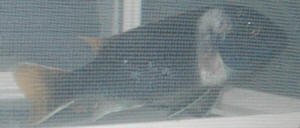
We can't just all get along.
|
compatibility of rift lake fish; Bichir and Af. cichlids
9/29/17
Hello!
<Jonathan>
I have a question about compatibility. I have an 18 inch
Polypterus ornatipinnis in a 110 gallon aquarium. For some time
he’s been by himself, I got him as a small specimen but have been able
to pellet train him and he is growing well and absolutely beautiful. He
has become my absolute favorite aquarium fish. A while ago a friend who
was moving across country gave me a Labidochromis caeruleus. After
quarantine, I didn’t have a great place to put him, so I stuck him in
with the bichir. I figured he at least wouldn’t hurt the bichir, and
wanted to see if they might be compatible. They have been getting along
great, in fact the yellow lab cleans up after the rather messy bichir.
My question is, how suitable are other rift lake cichlids with this
fish?
<With smaller, peaceful species, should be fine>
I understand that this bichir inhabits lake Tanganyika?
<Yes, among other areas:
http://fishbase.org/summary/Polypterus-ornatipinnis.html>
Would something like Calvus work? or Neolamprologus brichardi?
<Both should be fine here>
Or would Malawi cichlids be able to withstand his boisterousness better?
<I'd stick w/ Tanganyikans. Malawians might bite the Bichir's fins;
would definitely compete for food>
I’d expect that if he were to land in a community rift lake tank, given
his size, it would probably be large (I have a 220 plywood tank not
being used, would this be suitable for a handful of cichlids and my
bichir?)
<Yes>
Any other fish that make particularly good tankmates with this guy?
<I'd investigate Characins and Catfishes, perhaps Mastacembelids that
hail from Lake Tanganyika and other parts of the Bichir's distribution
(per the Fishbase link above).>
Thank you
Jon
<Welcome. Bob Fenner>
Yellow Lab Whitish belly 10/26/15
Hi I've had my Yellow Lab for about 2 months now it has grown a bit but where it
was all yellow it has a whitish belly or bottom half is this normal or is there
something wrong ?
<Possibly>
the Fish acts as it always has eats well
<.... what re water quality? What other life is present?>
always the first to the top . he is a bottom dweller always around the rocks
slight aggression when the electric blue enters his space
<The color could be a matter of the interaction here>
but nothing major .. its a 90 litre tank I feed it new era pellets and also a
green seaweed mixture from LFS (not sure whats in it) but the fish seems to like
it
Any help would be really appreciated. Thanks in advance
Regards,
Elias Hage
<I'd remove/separate the two African Cichlids. Bob Fenner>
Re: Yellow Lab Whitish belly 10/26/15
Thanks
<Welcome>
Hey everyone! So, quick question. Is fin-nipping normal in an African
cichlid aquarium.
10/4/15
<Absolutely.>
I have a 60gal heavily hardscaped aquarium with some vegetation, water
parameters are all excellent.
<Helps to be specific here.>
In the tank i have 7 yellow labs, 3 kenyi cichlids, 1 electric blue johanni, 1
red fin shark, 1 bristle nose Pleco, and 1 Senegal bichir. The reason I ask is
it just seems like there is a little more aggression than i would expect at such
a young age (all the cichlids are under 3 in.) 1 of the smaller yellow labs even
having a small chunk of his dorsal fin nipped off. (currently
treating with MelaFix to help healing process.)
<Be ready to quarantine/relocate this fish...whatever injured it may be
unlikely to stop.>
It's really only the bigger yellow lab male terrorizing the smaller ones,
<Try isolating him in a spaghetti strainer/colander floating in the tank where
he can see and smell the others but not reach them, it may calm him down and
curb territoriality but be prepared to remove the fish permanently if not.>
and occasionally the johanni (though I expect it from him). Now before you say
mention tank size and occupants, allow me to dispel your worries. The red fin
shark is the largest fish currently in the tank, as he is the only one who is
fully mature. Right now he occasionally terrorizes (though mostly ignores them)
all of the cichlids, and they do what they can to avoid him. He will be moved
once they get bigger than him and the roles reverse. As for the bichir I am
aware of how large they get, and that he will need to be moved into a larger
tank eventually. I have a 150gal on standby in my garage, but seeing as he is
only about 2 inches,
<Well, why not set it up sooner than later? Better for all concerned including
your own enjoyment.>
I don't feel the need to get it going just yet.
<Best to be proactive rather than wait for the situation to inevitably escalate,
imo>The cichlids leave the bichir alone, almost to the extent where it seems
like they are afraid of him. They will clear a path whenever he swims by and do
their best not to be in front of him. So any help would be greatly appreciated,
as well as any tips of what to expect with maturity.
Thanks!!!!
<I would utilize your access to a larger system soon, much of this aggression
would be curbed. Hope this helps! Also check out
http://www.wetwebmedia.com/FWSubWebIndex/afcichbehfaqs.htm EC3>
re:
Honestly i just don't have the money to get the 150gal up and running yet.
I still need to get the filtration system and heaters, decor, etc. The tank
itself was a gift. I've been putting money away for it, so it'll definitely be
ready by the time they get big enough, but not anytime soon. Im a 23yr old
college kid, not exactly rolling in cash yet.
< Ahhh yeah been there, done that! It seems like the tank is the 3big expense
but of course it ain't so unfortunately lol. I do a lot of DIY on my tanks., as
with anything there is speed, quality, and costliness, pick two hehe.>
XD ok, I'll definitely use the spaghetti strainer idea, though my gf may kill me
when she finds out.
<It'll stay between you and me :)>
Lol thanks for the quick response, ill keep yall updated. :)
<Please do, your experience can help others down the line.>
Help: loaches (incomp. w/) African cichlids and catfishes.
8/5/15
Hello, let me start off by saying your web is amazing, it is full of information
i have used with great results in my planted tank.
<Gratifying indeed to realize. Thank you for your kind acknowledgement>
ill get to the point in a second, but first some context.
I setup a second tank about 4 or 5 months ago, a custom made 74 gal with a cave
in one of the corners for the planned residents.
The tank is decorated with lava
<Hopefully not too sharp edged!>
and river rocks, and very fine volcanic gravel, it is planted with giant
Vallisneria, Vallisneria spiralis, Anubias, java ferns, mosses, giant Amazon
swords and a single Madagascar Aponogeton, all of them thriving on a low light
setup.
Tank was designed for a spotted Raphael catfish, stripped Raphael catfish, 7
glass catfishes, 2 south American bumblebee catfishes, and an African butterfly
fish, some of them were added instantly (don't worry, used cycled filter media
right from the start and monitored water parameters often). Ammonia is 0,
nitrites 0, nitrates go from 15 to 20 ppm.
<With you so far>
A few days ago i bought (mistakenly) 3 dojo loaches from the lfs, i kind of went
crazy because i love loaches (14 Kuhlis in planted and 5 zebras), big mistake
because i hadn't really researched the fish thoroughly and just then realized
they need colder waters.
<Yes>
Thing is, i live in El Salvador, where temperatures all year long are
between 22 (at the lowest, for a few days only) and 33 C (at the highest, again,
for a few days). But my tanks stay around 24-27 C.
<Mmm; the Misgurnis will likely do fine at this elevated temp. range>
Keeping a cold water tank would actually be very expensive as i would need a
chiller, what i tried to do is keep some of the windows open to allow for more
ventilation and the tank has stayed at 24-25 C for these past days. Loaches are
playing and eating well (quite aggressive eaters!) and love to annoy the other
tank mates, specially the talking catfishes which they very often stack above
of, the catfish are mostly indifferent to this.
there are various caves and some thin and long ones for the Dojos.
<Good>
Now onto the big problem: A fellow aquarist is tearing down his African
cichlid tank due to moving and not having much space in his new home,
he gave most of the cichlids already to another aquarist but he has not enough
space and so there were 4 cichlids left, he has no one left to give them to that
he trusts, so he's kind of pressuring me into it:
<Mmm; not compatible with what you list as already there. Will pick on the
Cobitids, Raphaels>
Demasoni, Labidochromis caeruleus, Pseudotropheus saulosi and what i believe is
an acei(?). I just started researching on African cichlids, and seems like there
are two different types, according to the lake they come from. Are these four
cichlids even compatible among themselves?
<Yes; given either crowding, or sufficient space>
i know they prefer high ph and high temperature (though 24 - 26 C should be
alright, no?) also hard water.
<Yes; per Lake Malawi conditions>
Through research I've found none of my fish need particularly low ph, so would i
be right in thinking they would do well in high ph? right now my ph is 6.7,
though i make a mix of tap and filtrated water; tap is 7.6 and filtrated comes
at 6.5-6.4.
<You are correct. Incompatible environment-wise as well as temperament>
what i will do is slowly mixing in more of the tap water between water changes.
i will probably not raise the ph all the way up to 8, but keep it around 7.6 or
around that.
Do you think it is at all possible to pull this off?
<Yes; don't do it. Either another tank, or trading one or the other group of
fishes in>
i haven't taken hardness into consideration, and i don't have something to
measure it at the moment though a fellow aquarist has (it is rare to find such
equipment here). And then what about aggressively? i can add a few more caves
and rock but im not sure if that will contain those cichlids, i don't want to
find my Dojos with their fins all torn down or a glass catfish being beaten to a
pulp, it has been quite hard to get these fish (mostly the glass, which i had to
go to a neighboring country for). Is it safe, risky or impossible?
<The latter. Will not end well.... eyes missing and worse>
We could take them to local fish store but they are untrustful; they say angels
and goldfish are ok together, one tiger barb is ok and they have conditioners
that cycle the water "instantly" (they also say most of the bacteria is in the
water).
<Tell them; they need help>
They also carry ick quite often in their multi tank system so taking these guys
over there is most likely demise, and these cichlids were hard to find too
apparently. I like them, though i have never had any cichlid bigger than an
Apistogramma or a German blue ram. So i don't know if ill be able to house all 4
of them but if i can house at least two or even one it will be good.
I also don't have the money or time to keep a third tank right now. i will be
waiting for your response, thanks for your time and sorry for the long read.
Keep up the good work guys!
<I'd try Craig's List and equivalents there.... One group of fishes OR the
other>
Rob.
<Bob Fenner>
Re: Help: loaches African cichlids and catfishes.
8/5/15
Hey, thank you for the fast response, way faster than i was expecting hahaha.
<Welcome>
Yes, i assumed it would be impossible, and i planned the "catfish" tank for so
long only for a few fish to come and destroy it all.
Lamentably, my friend is yet unsure on what to do about the tank, were it
smaller (its a 110 gal) i would have taken it along with the remaining cichlids
and who knows, maybe set an African setup of my own.
<This is best>
We will try to see what we do with them, but as a backup plan i can only think
of dismantling a broken fridge i have laying in the warehouse and make it the
cichlids home, its about 1.5 m long so it is pretty big, i would have to put
some weak powerhead i have laying somewhere and probably a bubbler as
aerator/filtration until i get a proper filtration system. Could work?
<Oh yes; decades back there were wholesale outfits that used refrigerator
linings (I recall Doc Adams place in Long Beach....). They're sturdy and
chemically inert... and cheap!>
Anyway, seeing these colorful guys, and my not so colorful guys has kind of made
me want to get something more flashy. Most colorful fish i have is my pair of
macmasteri and single German blue ram and viejita which are in the planted tank
along with the Kuhlis and zebras, controlled aggression with caves and dense
vegetation. Anyway, i would like to try a bigger cichlid, if there is such a
thing as a cichlid that could get along well with what i have in the catfish
tank, that is.
<Mmm; well; there are some more "peaceful" S. Am. Cichlids... Geophagines,
Acaras, Festivums and more.... but you only have the 72 gallons... and these
might well harass your dwarf cichlid spp.>
As i said my only experience is with the dwarves and they only notice each
other, they are pretty oblivious to my Kuhlis and zebras. But i would like a
bigger cichlid for the catfish tank, is there a possible candidate?
<Angels are my best suggestion>
I've looked around for information and experiences trying to mix my fish with
cichlids but so far nothing conclusive. American cichlids are very abundant so
that's why im asking, but if any cichlid will bring havoc to my fish then i will
probably just stick a boesemanni rainbow school, which will bring me to another
international journey for them.
Thanks again, keep up the good work.
Rob.
<Thank you for sharing, being part of it. BobF>
Re: Help: loaches African cichlids and catfishes.
8/5/15
Alright, thanks.
Acara WONT be in same tank with dwarves, don't worry.
No blues, more T5s.
Will dose micro and macro nutrients made by fellow aquarist.
Will try potting method suggested. thanks.
<Muy bien>
Re: Help: loaches African cichlids and catfishes. And plant nutr.
8/5/15
Ok, ok one last email, im really getting a lot of ideas and whatnot right now
along with a few popping questions about various things.
First of, there is a blue Acara sale, they are $2.50, there are also wild
Salvadorian convicts and captive bred, green terror(though these are huge). I
like the blue Acaras, would they do well with the Dojos/talking catfishes/glass
cats, etc?
<Yes; likely so; but as stated, I would NOT trust them w/ the Dwarf Cichlid
species>
a friend told me he once had a blue Acara that tore to shreds everything in his
path, then again i don't know in what conditions he had it. By the way, the
"planted" (very dense planted tank) is the one with the Kuhlis, zebras and
dwarves, it is a 40 gal, while the "catfish" tank is mildly planted, and is
where the new cichlid would go, so it will not bother the dwarves.
<I wouldn't risk it... How many times do I have to key this?>
Now, a question about the planted tank. I have tried Glossostigma twice, failed
twice. I have three T5 tubes (24 watts each) and two T8 (30 watts), no T2 for
sale, and fish stores sell plants but not proper equipment, it is rare if there
is even substrate so most aquarists use soil.
<Tis better>
I also have a blue compact fluorescent
<Of very little functional use>
(15 watts) directed above some alternanthera reineckii, Rotala rotundifolias and
some other red plants which i really don't know their names, but they are doing
great, i have even propagated them to a few aquarists and they are bright red
and orange.
<Neat!>
Carpeting plants are another story, they never seem to do well, (Cuba and
Glosso). Is the light insufficient?
<Likely so; could be a nutrient deficiency... useful iron, other.... do you
supplement?>
i have a DIY CO2 system that runs for about a week pumped through a powerhead,
there is soil substrate and i dose florapride after every water change (every
10-12 days).
<Ah; good>
There is an aquarist who has a lot of planted nanos which are very impressive,
Dutch styled tanks with either shrimp or small schools. He says he makes his own
liquid fertilizers of macro nutrients and micro nutrients and sells these at
about $3.50 the liter.
<Cheap; and worth trying>
he also claims to making something similar to flourish excel though this was
harder to make as some of its components are banned in the country. Would these
fertilizers do any good if added or am i already dosing everything i need?
<Yes; they well might>
Are my carpeting plants failing due to lack of fertilizers or lack of light?
<.... ? Are we caught up in a time vortex?>
it is a 1.2 x .40 m of area and .30 m of height so its not too tall.
I could maybe get a few more T5s if light is what is missing or a few more blue
fluorescents (11000 k if im not mistaken).
<... no blue>
Or do you think im lacking nutrients, maybe micro nutrients that aren't found in
the soil like some metals? copper, zinc, boron? sometimes i wonder if the Glosso
is actually getting to the soil, i have a layer of silica sand of about 1.5-2.5
cm above the soil, i sometimes wonder about that with other plants with small
roots.
Lastly, more of a question about how these plants work, lets take for example,
Ludwigia repens, everybody plants it in soil in here but the plant never roots
where it is planted, if you take out the plant it has no roots, it maybe sprouts
some near the top parts but never where planted, is this plant actually getting
nutrients from the substrate or is it all from the water column?
<Try shallow potting in a more "clay" soil; with fine sand, gravel on top>
Many thanks, im sorry to have asked so much today, there were a lot of questions
that have been bugging me for a while.
I will be trying Eleocharis parvula today by the way, hope i get it right this
time.
Thanks again.
Rob.
<Welcome. B>
Fresh water eels 12/5/14
I need any and all info on fresh water eels.
<Without a "please" or "thank you" you're unlikely to get "any and all"
unless you were offering to pay. And even then, I hope you say please
and thank you at the pub and grocery store!>
Also main point of interest, can they be in a 50 gallon with cichlids?
<No. That was easy, wasn't it! For the benefit of other readers: None of
the freshwater eels, family Anguillidae, make good aquarium fish except
when kept on their own in very large tanks. They are nocturnal,
predatory, messy, grow to a large size, and are notorious for escaping
out of tanks.
Best avoided. Spiny Eels aren't true eels of course, and the Tanganyikan
and Malawian species are sometimes kept (by expert fishkeepers!) in
Tanganyikan communities and (non-Mbuna) Malawian set-ups respectively.
On the other hand, Spiny Eels are notoriously difficult to keep
successfully, with most specimens ending up dead when casual aquarists
buy them without understanding their very specific needs (sandy
substrate, never gravel for example) and very fussy feeding habitats
(worms and other small
invertebrates mostly, never flake/pellets, and no live feeder fish). Do
read:
http://www.wetwebmedia.com/ca/volume_4/v4i3/Spiny_Eels/Spiny%20Eels.htm
http://www.wetwebmedia.com/fwsubwebindex/spinyeelsmonk.htm
"Cichlids" covers a lot of ground so your question is so vague as to be
meaningless. Some of the small species such as Macrognathus
circumcinctus might be kept with Angelfish for example, quite
successfully even, the two species largely ignoring each other (swim at
different levels) but eat some of the same sort of foods (bloodworms,
brine shrimps, etc.). On the other hand, only a lunatic would throw any
Spiny Eel into a rough-and-tumble cichlid collection including things
like Convicts or Jack Dempseys. The bottom line with Spiny Eels is you
arrange the tank for the Spiny Eel, and only then choose appropriate
fresh or brackish water tankmates. Orange
Chromides for example are salt-tolerant and would work nicely with
Macrognathus aral, a species that's a bit less delicate if a little salt
is added to the water (5-6 gram/litre). Cheers, Neale.>
Re: Fresh water eels 12/5/14
First off, i am horribly embarrassed by how rude my email was to you,
and ya'lls must think I'm a total POS. I would like to extend an apology
to you. Secondly, best email response ever to a rude email. Thirdly
thank you for this info, it'll help me a lot with my aquarium goals.
<Glad to help, and thanks for the kind words.>
P.s. They are the African cichlids that are super common at like big
chain pet stores. Like your electric yellows, electric blues, the
whites, etc. no jack Dempseys or flower horns in this tank, a 50 gallon
would do a fish that nice and big justice.
<So, we're talking about generic Mbuna here, likely hybrids of
"Pseudotropheus" for the most part. Mbuna aren't good choices for life
alongside Malawian spiny eel species. The problems are aggression and
diet, Mbuna being aggressive and also needed a greens-based diet rather
than the high protein diet Spiny Eels need. Indeed, too much protein is,
as I'm sure you realise, dangerous for Mbuna, which is why you use
Spirulina flake as their staple not common aquarium flake. For sure
Mbuna will eat the bloodworms and brine shrimps a Spiny Eel would need,
but the results would be obesity, constipation, bloating, liver damage
and other problems (kind of like what happens when humans eat too much
steak and not enough salad).
I've also seen Mbuna (Yellow Labs, at that, which are "peaceful" by
Mbuna standards) rip the fins from Bichirs, which are eel-like, so
that's another reason not to mix them. I can't stress too strongly how
difficult eels of all kinds are to keep. Choose an eel species --
Ropefish and Tyre-track Eels seem most widely sold -- then build the
tank around them, removing or exchanging existing fish as required to
create the right community. If you look over WWM, you'll find a lot of
eel tragedies. Truly, many/most of eels (Ropefish, Bichirs, Spiny Eels,
"freshwater" Morays primarily) wind up dead. In the right tanks all of
these are hardy and easy to keep -- but the
right tank for them is very rarely a community tank, a cichlid
community, a planted tank or even a jumbo fish aquarium. It's something
very specific to their needs. To be honest, with eels, the best bet is a
brackish or marine system into which a small Moray species can be kept,
the marine species being particularly pretty. Cheers, Neale.>
Trouble with Red Hook Silver Dollar Cichlids...
incompatibility 8/25/14
Hello:
I have two red Hook Silver Dollar Cichlids that are in a tank with a Red
Empress.
<Red Empress variety of Peacock Cichlid? May be a clue. These fish come
from Lake Malawi and need hard, alkaline water... which your Silver
Dollars don't. While there is a middle ground for them I suppose that
might work -- around 10-12 degrees dH, pH 7.5 -- if your aquarium was
set up correctly for the Red Empress, it wouldn't be a nice place for
South American characins, and if dumped into this tank from one (e.g.,
at the retailer) where the water was soft could kill them quite quickly
if they failed to adapt. So some information on the aquarium is
essential to answer this question.>
Today they started mysteriously turning gray, swimming upside down, and
then wedging on the side of the tank in a vertical position.
Unfortunately they both died within a matter of an hours of each other.
What caused this?
<Almost certainly something wrong with the environment. When two or more
fish of the same species sicken and die at the same time or within a few
hours/days, then the environment is almost always the explanation.
Something was toxic to them. Water chemistry could be a stress factor as
mentioned, but also water quality. How big is this tank? Red Hook
Metynnis (Myloplus rubripinnis) are large fish, up to 25 cm/10 inches in
length, though 20 cm/8 inches would be considered large for aquarium
specimens.
Either way, we're talking aquaria around the 300 l/75 US gal size, with
commensurate levels of filtration. You also mention the fact you have
two Red Hook Metynnis; do remember these are as much schooling fish as
Neons, and keeping fewer than 5-6 specimens is asking for trouble.
Another factor is diet. These fish are more or less entirely herbivores
in the wild, and their diet must include some greens or at least
plant-based foods (such as Spirulina flake). Overuse of meaty foods of
the sort the Aulonocara like
will do them no good, potentially some harm.>
I did a water changed and all levels were fine so I'm confused and very
upset.
<I'm confused too because you haven't sent any sort of data. Read,
review and send along some information including aquarium size, what
sort of filter is used, and ideally water chemistry and water quality
measurements, not vague comments about them being "fine" because that's
of no help to me at all.>
Kathy
<Cheers, Neale.>
Re: Trouble with Red Hook Silver Dollar
Cichlids 8/25/14
Neale:
Thank you for your response. I will send you the requested aquarium
information when I get home from work tonight.
Kathy
<Cool. Glad to help. Neale.>
Acei Cichlid Compatibility
1/19/14
Hi!
<Hello Lauren,>
Your site has been an invaluable resource for me as my husband and I try
to set up our tanks. Currently we have a 55 gallon tank with: 1 Rainbow
Shark (about 1.5 inches), 3 Electric Green Tiger Barbs (about 1 inch
each), and 1 Acei Cichlid (about 1.5 inches at this point.
<I see.>
I'm trying to put fish in slowly so I don't overload our tank, so I plan
on getting at least three more Tiger Barbs next week to calm them down.
<Indeed, the more Tiger Barbs, the less chance of them being nippy. They
should work nicely with the Rainbow Shark because that species is bigger
and quite brusque itself. But the cichlid is more of a gamble, and it's
easy to confuse territoriality or predatory behaviour with being able to
fight off a nippy tankmate.>
My husband wants Cichlids, but also wants lots of activity and color in
his tank.
<As a broad, reliable rule -- don't mix Rift Valley cichlids (what are
inaccurately called "African Cichlids" by some) with community tropical
fish. Pick one option, and tailor the tank around that. Of the Rift
Valley cichlids, there's a further subdivision between the Mbuna (which
are always best kept amongst themselves) and the non-Mbuna things like
Peacocks and "Haps" (which are all best kept *away* from Mbuna). Of
course there are a few South American and even some West African
cichlids that might be kept in a community tank, notably Angels and
Kribs. But many casual hobbyists aren't aware that these are cichlids
and tend to assume "cichlids" and "Rift Valley" cichlids are one and the
same thing! In short, sit down with your spousal unit and ask him to
explain what he means by "cichlids". You may well get lucky with a
single Pseudotropheus acei in a community tank, but beyond that, mixing
Rift Valley cichlids, especially Mbuna, with community fish is a bad
idea, a VERY bad idea. Besides different personalities, they have
different environmental requirements. Do bear in mind the Pseudotropheus
acei will need hard, alkaline water, whereas the barbs and shark are
more soft to middling hardness water fish.>
I've already seen some aggressive behavior with the Acei and the Barbs,
but I don't know if rounding out the school by adding more barbs would
help this or not.
<Adding more Tiger Barbs will reduce fin-nipping and fighting on the
part of the barbs, but it's an incremental thing. Six is better than
four, but not as reliable as ten, and a dozen is even safer.>
Obviously the Barbs aren't schooling half the time because there aren't
enough of them and there's usually aggression when they split up and go
it solo.
<Yes.>
Any recommendations for this tank? What to add, what not to add?
<See above. The Pseudotropheus acei isn't a community tank fish by any
sane standard, though by Mbuna standards its pretty mellow (which is
just below "psychotic" by community tank standards, bear in mind, since
all Mbuna need to be tough, pushy fish just to survive in their
extremely competitive environment in the wild). Pseudotropheus acei
would be a great choice for use in a quiet Mbuna system alongside
Labidochromis caeruleus for example.
The two species are pretty much a classic combo, in fact! No need to add
any other species because the two of them offer a nice contrast in terms
of colours (blue vs. yellow) and occupy different levels of the tank
much of the time.>
Any help would be appreciated, as I'm completely new to this.
<Much on WWM to help you, but do also look for modern books on cichlids
at your local bookstore or library.>
Also we have a 15 gallon tank with an Angelfish and an Albino Rainbow
Shark. (Both are fairly small, under 2 inches.) I know they will
eventually outgrow this tank, and am planning to upgrade to a 35 gallon
tank within the next 2-3 weeks.
<Wise.>
We originally had a single Tiger Barb with the Angelfish (before we
found your site), so the poor thing was nipped at quite a bit, but the
next morning the Barb was swimming sideways and upside down and died by
that afternoon.
<Oh.>
We haven't had any problems with any of the fish in that tank since.
Once I upgrade to the 35 gallon tank, I was thinking of adding another
Angelfish and some schooling fish. What do you think about Cardinal
Tetras?
<A good combo with Angels, but do need soft, or at least not hard water
to do well. Easier choices can be found, such as Penguin Tetras, Emperor
Tetras and especially X-Ray Tetras.>
Again any suggestions would be most welcome.
<See above.>
Thank you in advance for all of your help. I know for a fact that I
would be lost without your site.
<And thanks for the kind words.>
- Lauren
<Cheers, Neale.>
Re: Acei Cichlid Compatibility
1/24/14
Hi again!
<Welcome.>
Thanks so much for your advice. We're watching the Acei carefully, and
if any problems appear, we've resolved to rehome the barbs and shark.
<Cool.>
I have one last question. Since my last email, we have added more tiger
barbs (one more of the electric green, and two of the regular striped
tiger barbs). Now that there's six of them, they're schooling
beautifully.
However, the Acei is schooling with them! He's barely ever alone
anymore.
Have you seen this before?
<It's quite common for fish to school with a different species,
particularly when young. While I've not seen this specific combination,
I wouldn't be too alarmed provided all the fish are happy and feeding
well.>
Thanks again,
- Lauren
<Cheers, Neale.>
|
cichlid compatibility; adding an Amphibian...
8/4/13
I have recently completed a 36 gallon bow front paludarium tank
with 25 gal. of water and the rest land/air space with water falls and
very moist moss/soil with constant very low flow water circulation on
land. I have four common African cichlids
<... common? I take it these are some sort of mixed Mbuna>
about 2 " long and one Pleco. Would there be any amphibians that I could
put in my land area who's toxins wouldn't contaminate the water and kill
the fish if it decided to venture off into the water?
Thanks
Randell
<Mmm, no to stocking any amphibian here. There's not room w/ what you
have already, and both the Africans and Loricariid would work any woe.
Bob Fenner>
Re: cichlid compatibility 8/5/13
I have one bumble bee, two electric blue johanni, and a red
zebra. along with the Loricariid. Here's a picture of my setup. I was
leaning towards a salamander. but how big of a tank would I need for
that to work?
<I wouldn't try it/this period. Too likely that the Amphibian, any
amphibian will be picked on by the Mbuna, sucked on by the Pleco...
harassed to damage, death>
that's 5 gal. per fish and 11 gal for the salamander. I understand there
is some possibility of someone getting eaten but with the right matching
of sizes would it be possible? There is a pool at the top left
corner of the tank that the water flows to initially that's about 1/3 of
a gallon shallow water. Would there be anything that
would stick to the wetland and avoid the deep water? reptile or
crustacean?
<Mmm, maybe a crayfish... though it in turn might damage your fishes
if/when it gets to the main body of your system.
BobF>
|
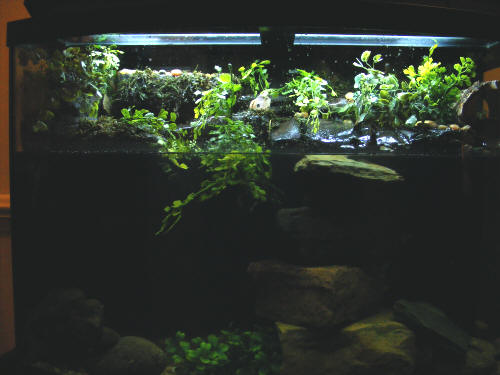 Nice!
Nice! |
African Cichlid Trouble, Compatibility, And Reading -
10/15/2012
Hi Team,
<Hi, Sandeep! Sabrina with you tonight.>
I went through your website and the faqs. You guys are doing an awesome
job. Thank you guys for being there.
<Thank you so much for these kind and encouraging words.>
I wanted to consult you for this issue. I had 6 Blood parrots in my
previous set up (tank 6X2X2).
<Is this in.... feet? inches? or? If in feet, then that's a
great sized tank.>
They all died due to some issues with their lungs.
<Gills. No lungs in fish, except for very rudimentary lung-like
structures in some few very strange fish (like, as the name implies,
lungfish). The blood parrots, a hybrid of South American cichlids,
have just ordinary gills.>
I had consulted my nearby dealer to check what was happening , and tried
all those things like cleaning the gavel, cleaning the filter and
changing the water.
<This was good advice from the dealer. I only wish they'd
suggested you test your water....>
Then applying ocean free's different kinds of medicines (almost in all
colors).
<Medicating is ALWAYS dangerous, unless you know EXACTLY what you're
treating.... Mixing medications can have disastrous effects, both
on the fish and on the biological filtration of your tank, which then
worsens the water quality, thereby reducing the fishes' chances for
survival and recovery....>
They died after around 3 months one by one. I couldn't eat or work for
days.
<Sorry to hear it, Sandeep.>
Now I have that tank in a new setup, all African cichlids.
<A very vague statement.... Africa, as you know, is an enormous
continent, with many, MANY different fishes from different places with
different needs. Typically, however, when folks say "African
cichlids", they're usually referring to the fish of the great rift lakes
- Malawi and Tanganyika. For the moment, I'll assume that's what
you mean.>
They all seems to be healthy. But they too are dying without any reason.
<By definition, then, I think it's safe to assume that they're actually
not healthy. There is something "wrong" here, either with the fish
or with the water.>
No bacterial or fungal infection that one could see from outside. No
change in behavior. However almost every day the juvenile ones keep
dying and this is something which I would never expect. I have a red
dragon Flowerhorn as well in a 3X1.5X1.5 tank
<I'm still not sure exactly what unit of measurement you're using, but
if this is in feet, then this tank should be considered very small,
especially for a Flowerhorn, and even more so if you're mixing species
of African (rift lake) cichlids. And I do very much hope that the
Flowerhorn is not in the same tank as the African cichlids; please do be
aware that Flowerhorn, a hybrid of South American cichlid species, has
VASTLY different water requirements from those of rift lake cichlids!
Water that would be good for the Flowerhorn would ultimately weaken or
even harm rift lake cichlids, and vice verse.>
he is with me for a month now. He is nearly 2 inches long. But he
wouldn't come out at all. He would always hide behind the filter. He
eats well otherwise.
<Hopefully just acclimating.... However, at his small size, if he
is in with rift lake cichlids, he may just be trying to hide to stay
alive.
Really, these fish can't mix; their water requirements are just far too
different.>
Now I am afraid if it's the same issue that my parrots had is happening
to my African cichlids as well? How do I diagnose the issue, and how do
I fix it?
<Sandeep, your first and most important step is to have a very good
understanding of the "health" of the water in the tank. You will
need to test the water for Ammonia, Nitrite, Nitrate, and pH, at a
minimum.
Ammonia and Nitrite must always be ZERO, and Nitrate as low as possible,
at least below 20ppm. If you do not have test kits for this, see
if your local fish dealer will test them for you. Ask them to tell
or show you the readings; don't settle for an answer like "Your water is
okay" or "pretty good".... you need to know the actual values to
have a clear idea of the quality of your tank's water. As far as
pH goes, most South American cichlids want soft, slightly acidic water,
though many will tolerate a very wide range, as long as the pH is
stable, and the Flowerhorn is no exception to this. The rift lake
cichlids, on the other hand, have VERY specific pH and hardness
requirements, and can suffer if those are not met. I would advise
you to read, on WetWebMedia and other places, about the needs of the
fish you are keeping. As you gain a better understanding of the
animals, where they come from, and what they need, you'll be better
prepared to provide for them - and you'll enjoy them more, too.
They're great fish, and learning about them is almost as much fun as
watching them!>
Please forgive me if my question is not clear , or if you had already
answered these before.
<The only lack of clarity is a lack of detail.... Without
information like the readings for water quality, number of fish in the
tank, how long the tank has been established, etc., there's
unfortunately not a lot that we can tell from a distance. Your
best move is going to be to test your water, have a better understanding
of the needs of your fish, and keep learning and enjoying. Your
fish will thank you for doing a little bit more research. Here are
just a few links to help you get started:
http://wetwebmedia.com/FWSubWebIndex/fwmaintindex.htm (a listing of
articles and FAQs on maintenance, water quality, disease.... Scan
through and see which of these might be most helpful, and start
reading....)
http://wetwebmedia.com/FWSubWebIndex/tangcichsystems.htm
http://wetwebmedia.com/ca/volume_5/volume_5_2/malawian_cichlids.htm
http://wetwebmedia.com/FWSubWebIndex/StkgLkMalawiTksArtBailey.htm
http://wetwebmedia.com/FWSubWebIndex/malawisysf.htm
http://wetwebmedia.com/FWSubWebIndex/tangsysfaqs.htm
Please also note the other links on those pages to other FAQs that may
be of interest, and also be aware that there is TONS of information
available via a simple Google search - not just at WetWebMedia, but all
over the 'net. Rift lake cichlids are a very well-loved and
enormous group of fish that is written about quite often. You
might also enjoy Ad Konings books, which you might find here:
http://www.cichlidpress.com/ . He's a cichlid "hero" of sorts, and
his books are quite nice. I hope these leads will get you started
in the right directions, and I'm sorry I can't give you a short and
simple answer to your problem. The only "real" answer, like so
much in life, is to learn.>
Thanks & Regards
Sandeep MK
My best wishes to you and your fish. -Sabrina>
African Cichlid Trouble, Compatibility, And Reading - II - 10/15/2012
Hi Sabrina,
<Hi again, Sandeep!>
Thanks for the quick reply. Sorry about the confusion.
<No worries.>
1st tank: Malawi and Tanganyika (all measures are in feet). Nearly 20 of
them in it.
<I see.>
2nd one : Flower horn. Alone in the tank. Again the measures are in
feet.
<A good tank for him to start out in. Hopefully he is just
acclimating, but do keep a close eye on him and his behavior.
Water changes won't hurt, either.>
I am located in Bangalore India, and we don't have much options to test
the water (at least not available in common, however will check all the
options available )
<Is it an option (and affordable) to purchase test kits online?
With shipping costs, etc., perhaps this is cost-prohibitive, I don't
know. But if it's possible, it might be worth your while. In
the US, one of the best "easy" (and easily available here) test kits are
those made by API (not the test "strips", the liquid reagent kits).
Let me know if you want/need a link to see what kit(s) I mean. In
any case, if it is not possible to get test kits (or even if it is,
it'll be a while before they get there if you have them shipped), your
only current course of action that is really useful (aside from reading,
of course!) is water changes. Possibly big water changes, too,
since we can't currently know what exactly is "going on" in your tank
water. What you describe sounds more environmental than anything
else, and fixing the environment (with water changes) is perhaps the
best thing to do.>
Thank you for all the links.
I'll read through them and will get back to you if I have more doubts.
<I do hope you'll find helpful information as you read.>
Thanks & Regards
Sandeep MK
<Best wishes always, -Sabrina>
African Cichlid Compatibility
Lake Malawi Cichlid Combinations 3/23/12
Hi. Thank you for your time. I have a 55 G tank with Aquaclear 70 and
Emperor 280 hang-on filtration. I would like to have a good combination
of yellow, blue, and orange in the tank but keep it on the
"less-aggressive" side of the African cichlids. I was
thinking of:
Labidochromis caeruleus (yellow lab), Melanochromis cyaneorhabdos
(maingano), Maylandia estherae (red zebra), Melanochromis parallelus,
Saulosi, Rusty cichlid, maybe a couple Synodontis catfish. I don't
think I'd be able to keep all these, but what combo could work? And
how many total fish? Research says 1 m to 3 f at least, which is my
plan. However, I would probably enter them into aquarium as juveniles.
Do I wait and see and trade in/out as they get bigger?
Also breeding is not important to me, would an all-male or all female
tank spell disaster? Sorry for so many questions but thanks again.
Joe.
< I like the idea of maximizing the color schemes of the cichlids.
It is another advantage to use the different colors from the different
sexes from species that exhibit sexual dimorphism. You have plenty of
circulation with both filters. Keep the water temp in the mid to low
70's F to minimize the aggression from territorial males. I would
recommend getting six juveniles of each desired species. Hopefully you
will get a sex ratio of 50% males and 50% females. When they mature you
can keep the best looking male and trade in the others. This will give
you the desired sex ratio. Two species you mentioned are great choices.
M. parallelus has a dark blue male with horizontal blue stripes while
the females are white with black stripes.
Male M. parallelus looks too much like the M. cyaneorhabdos, so I would
leave the M. cyano. out. The P. saulosi has yellow striped females
while the males are blue with black stripes. Take a look at the L.
caeruleus from Chisimulae. This species has a light powder blue male
with a very bright white female. Look for a red zebra strain with
cobalt blue males. Check out the different Labeotropheus species. There
a many geographic variants that are sexually dimorphic. The key for
mixing the Lake Malawi cichlids is to try and keep the patterns
of all the fish different. Look at any of the Ad Konings Lake Malawi
books to get different ideas and then check out which species are
available on Aquabid.com. -Chuck>
Re: African Cichlid Compatibility
African Cichlid Compatibility II 3/25/12
A lot of good advice thanks. The yellow labs and red zebras are a
definite. Although they might crossbreed.
< Crosses are between the two are not likely.>
I'm not too worried since the fry wont be around for long if
I have catfish.
< Synodontis may get smaller fry but adding a piscivore like a
Nimbochromis or Dimidiochromis species would take care of all
fry.>
I need to just decide on which blue species I like that will get along
with the other two. How is the temperament of Cynotilapia afra sp.?
< Females are usually a dull bluish grey color. Males are not as
territorial as the zebra types as long as the sizes are about the
same.>
Lots of variations on these as well.
You mentioned Synodontis for catfish, could they be substituted with
Pictus catfish?
< The long feelers will most likely be bitten of by the cichlids
thinking they are worms. Rift lake Synodontis species are the ones most
commonly used in these tanks. >
I've read mixed reviews. I have a few in a community tank now, they
seem fine with high pH.
<Try them out and find out for yourself.-Chuck>
|
Electric blue girl has no
eyes. 7/6/11
Hi, I'm from Australia so excuse my metric measurements. I
have a 225litre tank (4 foot x 1.5 x 1.5) all Malawi cichlids
communal breeding tank.
<Mmm, not much room really; and will cross-breed>
Water quality perfect, great tank for the last 4 years. Then I
introduced a breeding pair of Moorii,
<Not w/ Mbunas I hope/trust>
I must not have quarantined for long enough or they were too
stressed and got Ich from my existing stock, either way, I lost
my big male but treated in time to save the rest. I have 4
venustus (not Malawis I know but they like it in that tank) that
all started exceeding mucous to stave off infection and they all
came out in perfect health but my electric blue girl has issues
with here eyes now. It's almost as if here eyes are
rotting.
<Likely first attacked...>
It started as a cloudy haze over the eyes, not fluffy or
anything, but then as the cloudy layer slowly fell off there is
no eye behind it any more on her left side. The eye is still
visible on the other side but it is receded into the head and too
small for the socket and she is completely blind now.
I have put her back in the holding tank ( same size) but may have
to move her to a small fry tank so she can eat as she can't
really move around where she wants to she just swims in all
directions and runs into everything.
<... sad>
Clearly this isn't a curable condition but Amy idea what it
is or how to treat it if I ever encounter it again.
<Stock compatible species in suitable settings... plenty of
cover, not over-stocked>
I will send a second email with pics as for some reason I
can't attach them to this email.
Sarah
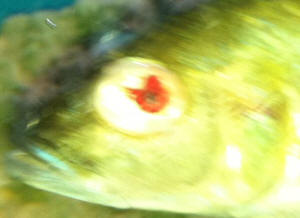
<Bob Fenner>
Electric blue girl photo 7/6/11
There is no eye here just an empty socket. Just a big gaping
hole, no swelling, no recognizable infection or fungus remaining,
the other side is almost as bad but is not improving.
<... BobF>
|
|
|
Sunken
stomachs 6/22/11
Hello. My name is Jennifer, and after searching your website I decided
to write for some advice. I have a 92 gallon bow front tank
with 15 assorted Mbunas/Peacocks/Haps and 2 Plecos (a standard
LFS variety and a Royal Pleco). The cichlids are all juvenile (4-6
months old). Everyone seems to be very happy and healthy. They all are
growing nicely. All tank parameters are good and temp is 78. I have
both a mechanical and biological filter and do a 25-30% water change
weekly.
<What sort of nitrate accumulation do you measure here?>
I noticed a few weeks ago that my Carolina Swallowtail and my Blue Ram
<? are these common names for Aulonocaras? Am unfamiliar. The last
isn't a/the dwarf from S. America I hope/trust>
were developing sunken bellies. I wasn't surprised since they are
the two smallest fish in the tank and the swallowtail hides all the
time to the point I've never seen it eat and am surprised it's
still alive. The Ram is a very good eater though. In the last week
I've noticed that all the fish seem to be developing a sunken belly
including my most dominant fish who eat the best. I feed a
carnivorous/herbivorous sinking mini Cichlid pellet twice a day and
rotate between sinking discs/sinking algae pellets/peas once every
couple days. I try not to overfeed them and up until now
they've been fat and happy. Now they're skinny and happy. The
only other thing I've noticed is every once in a while one of the
fish will scratch on a rock.
<Not necessarily indicative of anything>
They don't seem to repeat it and it's maybe one fish once a
week. I was thinking they weren't getting enough food because of
the mini pellet, but don't want to overlook an actual problem.
<I'd be adding other foods, substituting for this diet. Please
read here: http://wetwebmedia.com/FWSubWebIndex/afcichfdgfaqs.htm>
Wouldn't I have more aggression if it was an underfeeding
problem?
<Likely a bit of both; along with possibly an influence of water
quality (temperature and nitrogenous et al. accumulation)>
I was thinking of treating with Praziquantel and then feeding
Metronidazole soaked food to kind of cover the parasite basis.
<I would NOT do this. Where would such parasites have come
from/vectored?>
I did recently lose my other Blue Ram to what looked like a growth on
his gills. It started small and then grew to the point he couldn't
really open his mouth to eat. Otherwise he was a very fat and happy
fish and tried to eat even up to the day he died (he did not have a
sunken belly). Any help would be appreciated and I would love for you
to tell me to feed them more.
Thanks so much.
<Do please read through our section on African Cichlids:
http://wetwebmedia.com/FWSubWebIndex/fwlvstkind2.htm
Scroll down... Need to know the species involved here (usually Mbuna
don't really mix well w/ Peacocks, Haplochromines/Utakas...) and
the issue re NO3, decor... Bob Fenner>
please help
6/20/11
Hello, I have a 55 gallon fresh water fish tank. It contains
one Jack Dempsey, one African Cichlid,
<What sort? Some sort of Pseudotropheus zebra hybrid? Will be rather
aggressive, and does need a much different (i.e., plant-based) diet
compared to the largely carnivorous (e.g., insect larvae, crustaceans)
preferred by Rocio octofasciata.>
and my pride and joy an electric blue Jack Dempsey.
The electric is about three inches long where the other two fish are
between 2-2.5 inches. I woke up this morning to find that front part of
my electrics face had turned black and lost its shiny blue
color??
<Stress.>
What have I done wrong?
<Can't tell from your data, but could well be stress caused by
behavioural problems. Two male Rocio *will not* cohabit in 55
gallons.>
These fish are prone to be very aggressive, but they have lived in
harmony for over six months now.
<They're sexually mature now, and likely physically stronger,
too.>
I have already tested the water today and all the levels came back
normal.
<Meaning what? What is the hardness? The pH? The nitrite level? The
nitrate level?>
I just do not want to cause any more harm to the my electric.
<Review aquarium conditions, review the needs of these two species,
and act accordingly. This is very likely a social or environmental
problem you've caused, so easily fixed by making the appropriate
changes. Cheers, Neale.>
Oscars... Incomp. w/ Af.
Cichlids - 2/9/11
Hello I've had 1 male and 1female Oscars together for the last four
years, and recently the male died while we were moving house . she wont
eat and looks very depressed its been 4 days now she usually eats
several times a day!
Would you think a 5inch blue cobalt
<Cobalt what?>
would be ok to go in with her. Thank you for your help from narelle the
fish lover
<Mmm, not likely... Depending on the size/shape of this system,
other neotropical cichlids might go, and others. Read here: http://wetwebmedia.com/FWSubWebIndex/oscarcompfaqs.htm
and the linked files above. Bob Fenner>
Multifasciatus Shell dwelling
Cichlids? Comp. 1/28/11
Hello all and thanks for the advice.
<Glad to help.>
Okay so I FINALLY got my 55 gallon tank cycled. It has sand 3 cichlid
caves about 15 shells (will definitely be getting more that's all
my LFS had in stock at the time) and some rock work. It has about 400
gph filtration on it (I know it's at least 300 because the one HOB
alone is that much but the other... came with the tank so I'm not
sure... has some sponges and a carbon bag). A 250 watt heater. It has
one Bristle nosed Pleco in it ATM. Here's my issue'¦.
<All sounds great!>
I want Multifasciatus Shell dwelling cichlids and have done extensive
research on them. The one thing I can't seem to find is what they
can be kept with.
<Almost anything that [a] likes hard water and [b] stays at the
surface and [c] won't harass them.>
So I have some ideas... an forgive me if it's stupid... I'm new
to cichlids... which is why I'm doing a ton of research. I've
looked into Cyps but I don't think 55 gallons is enough for a
proper shoal of them.
<Would tend to agree.>
I've looked into Altolamprologus Calvus species... and I've
seen conflicting article on them. Some say they're relatively
docile and others specifically mention that they should not be kept
with Shellies.
<Well, there are some small shell-dwelling Altolamprologus calvus,
but they are predatory but peaceful, and would either cause problems
through eating very small Shellies, or else get battered by territorial
Shellies of similar size. So not a good choice.>
I've also looked into Julies... didn't get to far into that
one. What about these?
<Yes: the dwarf species like Julidochromis ornatus will not stray
far from a big rock pile. So put all the rocks at one end, then all the
shells at the other, and neither Julies nor Shellies will mix!>
Peacock Cichlids?
<Much too big; even if they don't eat the Shellies, they'll
terrify them.>
They're Malawi though. I really like the way they look but what the
prognosis on fry health and Shellie health with these guys around?
<Instead, look at some of the Central American livebearers. Guppies
and Endler's for example can work extremely well. I'd expect
Wrestling Halfbeaks to work well too. Goodeids such as Xenotoca eiseni
might be an option. Some of the smaller Rainbows work as well, for
example Celebes Rainbowfish. Cheers, Neale.>
FAQ about
compatibility. Af. cichlids... 1/19/11
Hello,
I'm new to the fish world however I do have some knowledge based on
reading some articles on the net.
I have a 50-55 (not exactly sure) gallon aquarium with fresh water
heated to about 78*F. As a decor, I have a plastic plant, A
medium-large Castle with multiple entrances and a medium sized cave
with only 1 entrance. I'm Using an AquaClear Filter (designed for
70 gallon) and an AquaClear Power head
(designed for a 50 gallon) my heater is a Fluval E200 and I'm using
standard sized blue rocks as my floor.
<Okay>
I was interested in breeding some fish with hopes of selling them to
have this hobby pay for itself to a certain extent as well as having a
really nice looking school. Currently I have 4 Neon Tetras with two
other types of Tetras I found in my mom's tank that I'm not
quite sure what they are but they looked interesting, and a Scavenger.
All but the Scavenger are there only temporary to allow the bacteria to
form and give me something to look at in the meantime while I figure
out what exactly it is I want to breed,
unless they can remain in the tank after without getting killed. My
uncle wants to give me two Neon Jewels (one male one female) and they
have spawned in his aquarium many times before. However I also wanted
to breed Electric Yellow fish because I find they are very beautiful
fish.
<Ok>
I know my uncle doesn't remove the parents or the eggs/fry at any
time and now 6 months later they're still alive and healthy, even
though he has many much larger fish in his aquarium (one of them being
a Silver Dollar that is about 6-8" long I'm not quite sure).
His aquarium has all sorts of fish, very colourful, but I'm unsure
of what any of the other are. He said to let they be and they'll be
fine. Would I be able to do the same even with the Electric Yellows
breeding in the same aquarium?
<Mmm, maybe... but better to separate... to optimize
results...>
Also, could I follow the same procedure for the Electric Yellow?
<IF I understand your description of these both being African
Cichlid species, yes; quite similar>
But above all, I need to know if these fish could co-exist in my
aquarium
<Mmm, no... are very aggressive. Will for sure kill your Neons,
likely other tetras... perhaps the scavenger as well>
and get along nicely, if not, what would you suggest I replace the
Electric Yellow with? (the Neon Jewel is a gift I cant refuse)
<Is this a Hemichromis species? IF there is enough room two of these
African Cichlid species should be able to coexist in a four foot long
system>
Thank you very much for your time and I appreciate your help,
Jesse
<Welcome. Bob Fenner>
30 Gallon Stocking, Af.
Cichlids... not-mixing Malawian and Tanganyikans
1/16/11
Greetings from Texas! I wanted to first off thank you for taking the
time to read this. If a similar topic has already been answered, I do
apologize, for I did not see it during my browsing of the site.
<You are welcome Jillian>
I am in the process of preparing my 30 gallon tank as a cichlid
setup.
<Small for anything but some species of dwarf, smaller
cichlids>
I would like to put 3 Pseudotropheus acei (1 male and 2 females) and 3
Labidochromis caeruleus (all females) in there.
<Ahh, I would not do this... mixing Mbuna/Malawi and Tanganyikan
Cichlid species in general is not a good idea. The former too
aggressive vs. the latter>
I'm really quite fond of the aceis, and am willing to add a second
filter and do extra water changes to keep them healthy and happy. I
searched for a smaller cichlid that resembled an acei, but alas, I
found nothing.
<This volume is really too small...>
My question is, would this setup work, given the proper amount of care
and maintenance? Also, I'm planning on moving a single Golden
Wonder killifish into the 30 from a smaller tank. Will he be picked on
by the cichlids?
<Yes... very likely killed in short order>
Again, thank you so much for taking the time to read this.
Regards,
Jillian
<I'd be reading, researching a bit more; and saving up for your
next, larger system. Bob Fenner>
cichlid issues
Managing Mean Malawi Cichlids 12/6/10
I could spend all day reading through all your wonderful info! Thanks
for all your hard work!
< Thank you for your kind words.>
I have a 55 gallon tank which used to house 5 cichlids, all measuring
about 4-6 inches, and 1 Pleco. The aquarium shop I purchased them from
had them labeled as "random cichlids", so I sent pictures to
another shop to have them identified. The results: pearl zebra (male),
OB peacock (female), zebra obliquidens (male), Labidochromis caeruleus
(not sure of sex), Labeotropheus fuelleborni (female). The
Labidochromis caeruleus would swim completely vertical in the corner of
my tank. He/she did this from day one.
He/she ate just fine. Then out of the blue he/she started getting
wounded by the tank bully. (I believe my bully was the pearl zebra,
though I was told it was probably my zebra obliquidens.) I added lots
more rocks for hiding, but nothing seemed to help. He/she would receive
a wound... heal... repeat. Finally, I took the fish back to the shop I
bought it from, and was told that the fish "had been ousted by the
other fish", and that, "there is nothing I can do except
remove him/her". I really loved that fish, but sold it for fear
that he/she would just die otherwise. After my Labidochromis caeruleus
was gone, my OB peacock became the target. (At least I think that was
the problem.) She was always fine before. I saw no physical problems
with her at all. Then she stopped eating, started losing weight,
swimming vertical, then hanging out at the bottom of the tank. (It
almost appeared as though she couldn't stay afloat. As soon as she
would stop swimming she'd sink really fast. Even crashing on the
tank floor, sometimes.) I looked for eggs and found none. Every other
fish seemed just fine. Is this just due to stress?
<When fish are constantly being harassed they may develop internal
infections that may not be noticeable on the surface.>
I did extra water changes upon noticing her strange behavior (I weekly
change out 20 gallons anyhow.), rearranged the tank, and added more
hiding spots, I also bought some egg crate and separated her from my
suspected bully. Nothing helped. She eventually died. :( Was there
anything else I should have tried?
<When a cichlid is being bullied the best thing to do is remove the
fish until it recovers.>
I really want to avoid this sort of thing in the future. Are these
particular fish not good tank mates?
< In the wild Lake Malawi cichlids are very territorial. The bigger
the territory the larger the source of food reserves and an increased
ability to attract a mate. When they are placed in an aquarium with a
few other fish then the aggression is taken out on the lowest fish in
the pecking order.>
No matter how many hiding spots I add to my tank, my pearl zebra seems
to claim them all! Is it just going to be impossible to keep any other
fish with this guy?
< The best way to put a Malawi cichlid tank together is to buy many
small fish and let them grow up together. They will establish a pecking
order when they are small and are less capable of inflicting damage on
each other. Now that the fish are larger it becomes much more difficult
to match up suitable tankmates with a fish that is an established
bully.>
I've read that overcrowding my tank may help. With a greater female
to male ratio. Is this accurate? Others say "never overcrowd your
tank". I love these fish and want to make this work. However,
there is so much conflicting information out there that I'm
confused half the time!
< Overcrowding an Mbuna tank is a common way to keep these fish, but
you need to be prepared first before trying this. Make sure that the
filters turn the water over at least 5 times per hour. Keep the water
temp around 75 F. Feed a food high in Spirulina algae content. You need
many hiding places. Then when you add other Mbuna around the same size,
you need to add them at night and rearrange the rock work the next day.
This keeps them trying to establish territories. Adding 25-30 adult
Mbuna can be expensive.
Females are less aggressive that males so that will help too.>
Another thing, my Labeotropheus fuelleborni currently has fry in her
mouth. It has been about 16 days since I noticed the lump in her mouth.
Is it OK to remove the fry now, or is it better to wait closer to 21
days?
< I would remove the fry after 7 days, after the egg sac is
completely absorbed.>
I put her by herself in a 10 gallon tank, as she was being chased
endlessly by my pearl zebra. This is the tank I'll keep the fry in
until they are big enough to make it on their own in my large tank.
Should I just
let her release them?
< No I would strip the female after a week. The longer you wait the
thinner she will become.>
My fear is that she'll eat them before I get the chance to remove
her.
< That is why I am recommending that you strip her after a
week.>
Also, could her breeding be the reason for all the other tank
aggression?
< No not really. the aggression is caused by the bully fish having a
large enough territory to feed on the algae off the rocks. The bigger
the territory the more food is available. The breeding female is a
bonus to the area.>
If so, what more can I do in the future? I've done hours upon hours
of web reading, but cannot seem to get this all quite figured out! Any
advice, to my hopefully not overwhelming amount of questions, would be
greatly appreciated! Thanks! -Lisa
< I would like to recommend a book. It is called Enjoying Cichlids
by Ad Konings. It is written by many cichlid experts from around the
world and can give you some very useful insights on managing cichlids.
-Chuck>
Mbuna and Crayfish (Species
specific advice needed)
Crayfish and Cichlids 9/15/10
Hi, I am looking at stocking my new tank (48"x15"x20")
with these critters;
15x Pseudotropheus Demasoni
5x Labidochromis Caeruleus
1x Crayfish.
I am going to put a crayfish in the tank, the question is; which one
has the better odds of co-existing relatively peacefully in my setup? I
plan to plant the tank with Java Fern / Java Moss tied in amongst
large/medium rocks and driftwood. A sheltered area and a substrate that
will allow for the crayfish to burrow will be provided.
As far as my research indicates my crayfish options are;
1) Cherax Destructor
2) Procambarus Clarkii
3) Cherax quadrinatus
I am currently favouring Cherax Destructor as the information I have
found indicates this species to be shy, primarily veggies although
opportunistic and of a medium size.
I hear the Procambarus Clarkii have been introduced to Lake Malawi, are
small so more can be kept and are more likely to be the victim of Mbuna
attack. However, I think they are a bit ugly.
I worry the Cherax is a bit to carnivorous and well adapt to catching
fish, also too large to work well.
What crayfish would you choose (if you had to) from those mentioned, or
from your own experience? I am well aware of the risks of keeping crays
with fish.
Also how do you think Pomacea bridgesii will fair in this setup? Thanks
for reading! Stu, Cumbria.
< All crustaceans need to molt or shed their outer skin to grow.
When they do this, they are unprotected for a few hours while the new
exoskeleton begins to harden. Cichlids seem pretty smart and can sense
when this happens. The poor crayfish soon becomes a banquet block for
the cichlids.
If you drill a hole just big enough for the crayfish to hide in the
driftwood you might have a chance. I have never had good luck with
crustaceans in my cichlid tanks. The cichlids always seem to find them
or eventually out compete them for food.-Chuck>
Re Mbuna and Crayfish (Species specific advice needed)
Mbuna and Crayfish 9/16/10
Thanks for the response chuck.
All crustaceans need to molt or shed their outer skin to grow. When
they do this, they are unprotected for a few hours while the new
exoskeleton begins to harden. Cichlids seem pretty smart and can sense
when this happens" I was aware the molt was the 'risk
point' although I did not know cichlids where that aware of it
happening!
I am going to create the crayfish a sufficient hiding place/burrow, I
am more concerned with which species of crayfish, if any specific
species, will aid the equilibrium of the tank.
The only indication of which species is best from your reply was maybe
a smaller species since I can create an entrance to it's cave too
small for the Mbuna to get in, is this right? It's just
Pseudotropheus Demasoni will likely get into any nook that will
accommodate any of the previously mentioned Crayfish species, so maybe
Cherax Destructor, which burrows is my better choice? This also could
indicate the need to stock only larger Mbuna.
To recap the specific species of fish I aim to stock;
15x Pseudotropheus Demasoni
5x Labidochromis Caeruleus
To recap the specific species of crayfish I may stock;
Cherax Destructor or,
Procambarus Clarkii or,
Cherax quadrinatus
Are you able to shed any light on my questions;
"What crayfish would you choose (if you had to) from those
mentioned, or from your own experience?"
"Also how do you think Pomacea bridgesii will fair in this
setup?"
My apologies if I was unclear in my original post, I am new to the
hobby and written communication is not my strong point.
Thanks!
< All the species you have mentioned have large claws that will be
used to capture sleeping cichlids. As the crayfish feeds it will need
to shed its outer skin when it molts. At this time it is susceptible to
attacks by
cichlids. The yellow Labidochromis has tweezers like teeth that
specializes in picking off crustaceans between the rocks. All the
species you mentioned range from 4 to 10 inches in length. A three inch
cichlid would have no trouble pulling a crayfish out into the open for
all to feed on. If you wanted to try one then try the cheapest one.
That way you are not out too much money. If it looks like it is going
to work and you are satisfied with the results then get the one you
like the most. The apple snail will also have problems in an Mbuna set
up. When the snail extends its antennae they usually get picked off.
The cichlids like the taste of snails and will continue to pick on it
until it dies.-Chuck>
Re: Mbuna and Crayfish (Species specific advice needed)
Crayfish Companions
9/17/10
< Mbuna are not recommended to be housed with crayfish.>
I will take your word for it and look into different combinations, I
don't want to watch a crayfish become dinner.
To say the least it is getting a bit frustrating trying to find
anything that can exist with a crayfish!
The only definite I have is White Cloud Mountain Minnows, which look a
little drab in my opinion.
Are you able to suggest anything with a little colour would make a
better tankmate for a Crayfish?
< Try rainbows, tetras, barbs silver dollars, Basically anything
that is fast moving and stays in the mid to upper water column.>
Are small Tanganyika Cichlids an equally bad choice?
< Mbuna have rasping teeth for scraping algae off of rocks. These
same teeth do a pretty bad job on other fish and tank mates. Lake
Tanganyika cichlids, like Julies and lamps would not be as bad. They
still might become dinner for the crayfish.>
Maybe Guppy's or Molly's or if there are any Apistos that
can handle pH 7.0-8.0?
< The male guppy's flowing caudal fin makes him an easy target.
Mollies may be worth a try. Apistos, like most cichlids like to stay
close to the bottom to be safe with a crayfish. A. steindachneri and A.
cacatuoides are two species that can handle hard water. But I still
wouldn't trust the crayfish.>
I really want something a little 'different' so have skimmed
around these options.
I have literally spent the past few months 'writing off'
various options due to incompatibility in one way or another.
Thanks for the advice! It is really appreciated.
< Once again, think fast moving, mid to upper water column schooling
fish. I would go cheap at fish to see how clever the crayfish is at
catching fish before investing too much money.-Chuck>
Aggressive female cichlid
Malawi Cichlid Pecking Order 8/19/10
Hi, Wonderful Crew, I have a 75 gallon tank with a variety of Malawi
cichlids, most of which are Mbuna.
Among the mix are 3 Metriaclima zebras: a male greshakei, a female
estherae, and a pearl (callainos).
I can't sex the pearl. I thought it was female. The greshakei and
the estherae have mated a number of times and produced offspring.
The pearl is ignored by the otherwise aggressive greshakei and other
male fish in the tank (which is why I assumed it was a female).
The pearl seems to be on a mission to kill the estherae. From what I
can tell, it tries to get the estherae to let go of the fry in her
mouth while the estherae is holding.
In addition, and especially after the estherae comes out after
releasing her fry, the pearl chases her around the tank relentlessly. I
have built a big reef of lava rock for the fish to hide in, but I am
worried about the
estherae. I just introduced a female (from what I can tell) greshakei,
so I'm hoping this will at least give the male another female to
"bother" and also distract the pearl.
I have read through all of my books and searched the internet, and
I've read maybe one account of a female cichlid trying to get fry
from another female's mouth.
Have you heard of this kind of behavior with zebras? The fact that the
pearl is ignored by the males but is so aggressive with the female
doesn't make sense to me.
Any help or insight would be appreciated. Thanks, Laura
< In the wild , males are aggressive to defend territories. Since
many cichlids eat algae, the bigger your territory the more algae=food
you control. If you have excess food you can share with a female and
entice her to spawn with you. When a male enters the territory they are
chased away as competition. Within the male's territory there is
also competition from the females. The most aggressive female will
chase other females out of the territory. This means there is more food
for her to eat and have a bigger spawn when she breeds. When she has
bred she can no longer use her mouth to defend herself. Other females
will then drive her off and the next most dominant female will then be
able to spawn. In the aquarium the brooding
females have nowhere to go. They end up getting beat up by dominant
males and non breeding females. This is usually why I recommend
removing a female out of a community tank that has just
spawned.-Chuck>
Jewel Cichlids and a tank divider
7/13/10
Hello!
<Hello,>
I was reading the FAQs on cichlid breeding and African breeding and I
was hoping you might be able to shed some light on a recent situation.
My husband and I setup our 55 gallon African tank (slowly accumulating:
1 auratus, 1 Firemouth, 1 yellow lab, 1 electric blue, 1 bumblebee, 1
red jewel) about nine months ago. Last month, we added a second red
jewel.
<You do realise that "African tank" is meaningless in this
context?
Firemouths DO NOT belong here anyway, and not just because they're
Central American. They rely almost entirely on bluff, and when kept
with aggressive cichlids tend to get battered. Often, their jaws are
dislocated. As you hopefully realise they are earth-eaters that sift
smooth sand. Their jaws can't exert the same kind of force as
Mbuna. Next up, Jewel Cichlids come from soft, acidic West African
rivers. They DO NOT like the hard, basic
water that Mbuna need. Your mixture of fish here makes no sense, and is
a disaster waiting to happen. Did you do any research at all? Surely
you read that Melanochromis auratus males will dominate a tank as small
as 55
gallons, and if they can, kill off everything else? This is
madness!>
This past weekend, on Friday, I noticed a small nest of what I thought
at the time were eggs, lying in the substrate (Fluorite) in one corner
of the tank. The two jewels seemed to be protecting that territory.
<As they do. Hemichromis species become sexually mature when
comparatively small, around 2-3 inches long.>
The next morning I looked more closely and they were not eggs, but
rather a nest of the tiny, wriggling fry. Upon further inspection, a
second nest of wrigglers was found in the true corner of the tank, in a
small dug-out spot in the substrate.
<Cool. But do understand at the pH 7.5-8.0 that Mbuna need
you'll likely end up with all one sex of fry, which is
pointless.>
Obviously, I missed the egg laying completely, and only stumbled across
the fry. Saturday morning, my husband decided to install a tank divider
to keep the other cichlids away from the new family. As the jewels had
clearly claimed one side of the tank, the divider was placed in a
manner that divided the tank into 1/3 and 2/3 sections. We run two
filters in the tank, and I turned off the one on that side.
<Bad move. Without water flow the bacteria will die. Plus, removing
water circulation and cramming potentially very aggressive fish in an
even small tank will make things worse for them. Tank dividers are
worthless, and
almost as bad as breeding traps. If you want to breed fish, remove the
parents or the fry to another tank. It's as simple as that. Trying
to mess around with the display tank is pointless and just going to
create new problems. In any case, you need totally different water
conditions for the Hemichromis spp., so they need to be moved anyway.
As does the Firemouth. What fish are left in the 55 gallon will
eventually be killed off by the Melanochromis auratus. Do please read a
book on cichlids before progressing further with this project.>
Later that day, the wrigglers were free-swimming and we watched the
parents buck away any other fish coming near the divider, and they
would seemingly scoop fry wandering towards the danger and then deposit
them back near the "safe" side, opposite the divider.
<Yes.>
I checked them Sunday morning and all looked well, but by Sunday
afternoon I could only count twenty (when previous counts were easily
100+)! By Sunday evening, we couldn't find a single one. I've
read that Jewels, especially younger couples, will eat their eggs for
their first few spawns, but I haven't read that they will eat their
fry.
<Can easily happen if they're stressed by the other fish.
It's essentially recycling the energy. The parents
"calculate" the odds of rearing a batch of fry, and if the
numbers are poor, they eat their eggs or fry, and then spawn again when
they feel the odds are better.>
But my real question is this: was the addition of the tank divider a
factor in the parents eating their fry?
<Sure. Anything that changes the environment in a way the fish see
as negative can cause this behaviour.>
Could the parents have become suddenly displeased with a suddenly
smaller living space - or unable to save fry that were able to squeeze
through the divider's holes? Or is this all considered normal in
the early broods of the Jewel cichlid?
<Entirely "normal" reaction to a bad situation. Hope this
helps. Cheers, Neale.>
African reproduction woes
Malawi Cichlid Aggression 6/11/10
Hello, I have set up an African cichlid tank with 3 Aulonocara
stuartgranti (German Red) and 3 Yellow Labs. I just got the second
German Red female
yesterday and the original female has not stopped harassing her since.
She spends most of her time hiding under a shell or behind one of the
plants. Do you know why this would be?
< There is a pecking order among the males and the same for the
females for breeding rights. This way only the best males get to pass
on their genes with the best females.>
Before I added her the peacocks seemed to have no interest in spawning
with one another and now she (original) stays on the heels of the new
female any time she shows her face? Could the original now be
interested in spawning?
<If she was interested in spawning the males would be the aggressive
ones in the tank and both females would be hiding.>
Also, the 2 smaller Labs appear to be attempting to spawn (looks like
they are chasing one another's tails in circles in the substrate)
but every time they start the largest Lab comes and chases them apart.
I believe the largest to be a male, if I got another female or 2 would
he leave them to their thing or would he still interrupt them?
< Once again the fish are expressing a pecking order. The two
smaller yellow labs already know who the main lab is. They are fighting
for number two spot.>
There is plenty of rockwork and plants around the edges of the tank and
the middle is all open swimming area so everyone should be happy. I
have 2 Tetra whisper filters, both rated to filter the tank by
themselves, and a powerhead in the tank so there is a lot of current as
well. I really want one of these species to spawn but have never bred
fish before so I don't know if I'm missing something. Thank you
for your time.-Joshua
< In the wild their territories are larger than most aquariums. When
adding new fish you should re-aquascape the tank to provide all new
territories.-Chuck>
Mbuna Cichlid Compatibility
5/26/10
Thanks for the work you do with the website; it has been very
informative for me.
<Cool.>
I have kept simple community fish for several years and am now planning
on setting up a 55-75 gallon Mbuna tank with a sand substrate and a lot
of rocks to provide as much of a natural environment as possible.
<OK. But this aquarium is small for Mbuna. I'd think VERY
carefully before doing this. By all means look at Malawians, but avoid
Mbuna.>
I intend to use two Marineland Penguin 350 filters and do weekly 30-40%
water changes. My target pH and temperature are 8.0 and 78*F
respectively.
I would like to put several different species in the tank with one male
and three females of each (if possible; I know sexing is difficult at
the juvenile stage) and need to know if I should expect problems with
hybridization or too much aggression.
<Yes and yes.>
The fish I'm considering are Labidochromis Caeruleus,
<An excellent species, and along with Iodotropheus spp.,
Labidochromis spp. make good additions to Malawian communities. They
mix okay with Dwarf Mbuna, in particular Pseudotropheus demasoni and
Pseudotropheus saulosi, but shouldn't be mixed with the non-dwarf
Pseudotropheus or any of the Melanochromis or Labeotropheus.>
Melanochromis Johanni,
<Not quite as psychotic as M. auratus, and a single male should
ignore dissimilar fish kept with it. But be sure not to add any
cichlids with similar colouration.
Metriaclima lombardoi, and Maylandia greshakei.
<These are both what I loosely call Pseudotropheus, and can/will
hybridise.
(Many Pseudotropheus species were cleaved off into the genus Maylandia,
but for reasons too tedious to discuss here, a minority of
ichthyologists prefer the name Metriaclima rather than Maylandia for
those species. The main thing for aquarists to understand is that
Pseudotropheus, Metriaclima and Maylandia are all the same thing as far
as Mother Nature is concerned, and all will interbreed given the
chance, with a high probability of producing hybrid offspring. So for
long term success, do not mix Pseudotropheus, Metriaclima and/or
Maylandia. Anyway, as for aggression, Pseudotropheus lombardoi is
aggressive, about the same as Pseudotropheus zebra, so wouldn't be
my choice for a peaceful community. Pseudotropheus greshakei is perhaps
a touch less aggressive, but not enough to make a difference here. Do
look at Pseudotropheus demasoni and Pseudotropheus saulosi instead.
Cynotilapia spp. can be worthwhile too, though getting good quality
Cynotilapia afra is difficult thanks to chronic mixing and
careless breeding of the different regional forms. At least some
Aulonocara would work in this tank too, if there was adequate open
water for them.>
All would be added to the tank as juveniles at as close to the same
size as possible. My main concern is for the aggression level of the
male Johanni.
<This will depend on the availability of caves and the colouration
of the other fish. Melanochromis johanni isn't a peaceful fish by
any definition, but it is towards the lower end of the Mbuna aggression
scale, unlikely virtually all other Melanochromis.>
Also, should any of these species be expected to breed and/or hybridize
when kept together in a tank of this size?
<Yes and yes.>
Very Respectfully,
D. DeWald
<Do spend a little time reading books by Konings and Loiselle before
buying these fish. It's easy to make a random Mbuna tank that ends
up with hyperdominant male and a bunch of hybrid offspring. But
it's quite difficult to create a stable, attractive Malawian
community that offers a range of colours and behaviours you can observe
at leisure. Cheers, Neale.>
Re: Mbuna Cichlid Compatibility
[Chuck?] 5/26/2010
Neale,
Thanks for the quick response and advice.
<Most welcome.>
I've purchased a 75 gallon aquarium and am planning on pursuing the
Mbuna setup with some modifications.
<OK.>
How many species can/should I put in a tank of this size while
maintaining proper male/female ratios and what species would you
recommend?
<I think two or three carefully chosen, dwarf or near-dwarf species
would work well here, preferably in harem situations of one male with
two or three females. Labidochromis are sufficiently mild that 2 males,
3 females
would be fine. But male Pseudotropheus and Melanochromis tend to be
much more aggressive towards each other and unresponsive females, so
you really don't want more than one male within each group of these
species.>
I have a group of Labidochromis caeruleus already in another tank and
would like them included in the setup.
<They are an excellent species and highly recommended. It's a
shame the other Labidochromis species aren't more widely traded, as
on the whole they're quite mild, trustworthy fish, if a bit too
nippy for hard water community tanks. Do also be sure to introduce the
Labidochromis before anything more aggressive, e.g., the Pseudotropheus
demasoni or Melanochromis johanni.>
I read up on Pseudotropheus demasoni as you advised and am worried
about the aggression they show toward their own kind.
<Indeed.>
Is it true they must be kept in groups of 12 or more?
<All territory-holding male Pseudotropheus are aggressive towards
each other and unresponsive females, so to some extent it's true
that overstocking tanks reduces aggression by making it impossible for
any one male to claim a territory. On the other hand, it's
male/male aggression that usually ends up with physical damage or
death. Given space, and especially if the females are introduced before
the male, a single male Pseudotropheus demasoni with 3-4 females should
do okay. There are no guarantees, but it's an approach that works
more often than not. Of course, you also keep just female
Pseudotropheus demasoni!>
Thanks again, D. DeWald
<I've cc'ed our cichlid guru Chuck here, so if he has any
ideas on this, I'm sure he'll chime in. In the meantime, do
track down the Konings or Loiselle book of your choice, and have a good
read. Cichlid communities do need to be planned if they're to work
in the long term. Cheers, Neale.>
Re: Mbuna Cichlid Compatibility
[Chuck?]
Subject: Re: Mbuna Cichlid Compatibility 5/28/10
<Unfortunately most of the Lake Malawi cichlids in the hobby belong
to the Mbuna group. These cichlids make a living by defending a large
rocky area. This area is guarded to keep other cichlids away so all the
algae will be
consumed by the dominant cichlid. He can then allow a potential mate to
enter his territory if she is willing to spawn. In most aquariums there
is not enough room to establish a territory so then the entire tank
becomes the territory. All fish are then subjected to attacks by the
dominant fish.
When that fish is removed then another moves up the ladder and starts
the process all other again. Cichlids like Labidochromis do not eat
much algae so develop weak territories to attract potential mates. Here
are a few
guidelines that I use when I recommend fish for a Lake Malawi community
tank. Get all colorful fish. In many cases the females are rather drab
and silvery. Many cichlid species have females with just as much color
as the males. Get at least six of each species. Assuming a sex ratio of
50/50, this will leave you with three of each sex. Pick the best male
and get rid of the other two. This will leave you with a small harem of
each species.
Put all the fish together in the tank when they are under two inches.
All of these fish will be immature and can then peacefully group up and
establish a pecking order. Keep the water temp below 77 F. Many
aquarist's keep the water too warm. This creates a breeding frenzy
and the males will be "on" all the time. Don't pick
cichlid species with the same colors and markings. Many times they will
be mistaken for conspecifics and treated as such. Cichlids that are
colorful and not too aggressive would be Mel. parallelus,
Labidochromis sp. Ps saulosi, Ps acei, Ps
lanistacola/livingstoni, In a lager tank I would try a small group of
red zebras and a small group of a Labeotropheus
species.-Chuck>
Re: Mbuna Cichlid Compatibility [Chuck?]
6/10/2010
Neale,
Continuing with the 75g Mbuna setup... I've decided to get
Labidochromis caeruleus and Pseudotropheus acei (extremely
clichéd beginner setup, I know)
<With good reason. It's a combo that works. Nice contrast in
their colours and behaviour. Also eminently compatible with some sort
of Synodontis!>
with a black background and black sand to emphasize their colors.
I'm looking for one to two more reasonably mild mannered Mbuna
species to put with them that will add some color.
<I wouldn't another Mbuna, but rather a midwater cichlid that
won't compete for space. Remember, the Mbuna are merely a subset of
Malawian cichlids;
there are lots of others!>
I love the look of Pseudotropheus demasoni, but I think they're out
because of the danger of hybridization with the aceis (aggression also
being a factor).
<Certainly a risk. Besides, that's more of the same. You want a
different shape and a different colour.>
Any suggestions?
<Iodotropheus is always an option, and very mild mannered, but the
specimens widely sold really aren't all that colourful. Most of the
Haplochromines should work too, for example Nimbochromis livingstoni,
the smaller Aulonocara (e.g., Aulonocara baenschi), and the
"Utaka" cichlids (e.g., Protomelas and Copadichromis spp.).
Your tank is unfortunately too small for Cyrtocara moorii, one of the
nicest of the big but peaceful Malawians. Also, don't discount the
idea of a school of dither fish. A school of Swordtails or Australian
Rainbowfish would not only add colour, but would also encourage good
behaviour from the cichlids. I wouldn't add these alongside
midwater cichlids, but if all you had were rock-dwelling species,
they'd work well.>
Very Respectfully,
D. DeWald
<Cheers, Neale.>
Electric Blue Tankmates
5/24/10
Greetings Crew,
I have a question or two about a Sciaenochromis ahli. I was in my LFS
the other day and I saw one that is over 3 inches in length and full
color, it is just gorgeous and I would really like to buy him. The
question I have is where can I put it without it causing problems. My
current setups include:
72gal bow front: 20 frontosa fry 3 Red Empresses (breeding set) 1
medium
sized Pleco 7 Corydoras
30 gal:6 Labidochromis caeruleus
55 gal:8pseudotropheus demasoni
Would it be possible to put him in with the Demasoni?
<Mmm, maybe... there is always danger when mixing, adding to an
extant Mbuna set-up... I'd do the "usual" of moving
rock/decor about, placing the fish when you can/will be present that
day, should there be too much damaging agonistic/territorial behavior;
have a plastic floating colander
to place/isolate the winner/loser...>
I know to avoid fish of similar color and design because of the
aggressive nature.
<Mmm, colour isn't the only signal releaser here>
Or the other option would be in the 72 but it seems like it would be
getting crowded.
<... not do-able>
I'm only going to keep 4 or so of the Frontosas, I just have to
wait till my friend and LFS takes the rest. So it would be the 3 Reds,
4 Frontosas, 1 Pleco and the Corydoras. I am planning to get another
tank to setup downstairs I just don't know when I'm going to
get around to it so it might be a temporary move either way any input
would be helpful.
Thanks Paul
<If you have time, interest, I'd invest in a few standard
Cichlid works... perhaps the tetra series by Paul Loiselle would be the
best/better starting point for you here. Bob
Fenner>
Yellow Lab and peacocks, Aulonocara sys.,
incomp./Mbuna, others 5/19/10
Hello,
I would like to set up my 29 gallon (US) tank to house German peacocks
and yellow labs.
<This aquarium is too small for Aulonocara spp.>
I found a pair of Peacocks that I really like at my LFS. I would like
to mix them with 2-5 yellow labs.
<Fine. But a "pair" of Aulonocara is a myth since these
fish don't pair. At best, the male will harass the female to death
with the single-mindedness of the worst imaginable wife-beater. Keep at
least two females per male. If
you chose a smaller, milder Aulonocara species, such as Aulonocara
baenschi, you could keep a male and two females in an aquarium at least
33 US gal/150 l in size.>
I would ultimately like to see at least one species spawn and
breed.
<Start by keeping them alive.>
My question is what else could I put in this tank?
<Are you kidding me? This tank would be wildly, insanely overstocked
as it is.>
Could I mix these species with a Johanni or demasoni?
<Not a chance. Mbuna should NEVER be mixed with Aulonocara. Their
needs are different and the Mbuna are MUCH TOO AGGRESSIVE for the
Aulonocara.>
How about rainbow fish?
<The larger Melanotaenia spp do mix well with most Aulonocara
spp.>
killifish?
<No.>
Kribs?
<No.>
or a Xenomystus Nigri?
<No.>
These are really my top choices for tankmates. If I controlled the
overcrowding how many cichlids could I put in this community tank?
<You need to do some reading. Here's an article I penned a
couple of weeks ago for another site about Aulonocara. Might give you
some ideas about what's involved:
http://www.tropicalfishfinder.co.uk/news_article.asp?id=1990
You do need at least 150 litres even for the mildest species, and
that's keeping them all by themselves. Realistically, find
something around the 210 litre/55 gallon mark, and keep a trio of a
mild species like Aulonocara baenschi or Aulonocara sp.
'Stuartgranti Maleri', and by all means then add a few
Labidochromis for the rocks and a school of Melanotaenia as dither fish
if you want.>
What other colorful, compatible cichlids could I mix with these fish
that would allow them to breed if provided enough rocky caves and
hiding spots?
<Aulonocara don't use caves and hiding spots. Again, read. These
fish live in the transitional zone between rocky cliffs and open water.
What they need is open swimming space, with just a few caves they can
use at night.
Swimming space, some open sand, maybe even some Vallisneria around the
edges are all much more important.>
Thanks again for the advice.
-Joshua
<Always happy to help. Cheers, Neale.>
Cyphotilapia frontosa in 72 gallons;
compatibility with Corydoras 4/29/10
Greeting WWM Crew
<Hello,>
I have a few questions regarding a couple of fish tanks that I have
recently set up. The first one is a 72 gal bow front that's been up
and running for 2 months now, I currently have 20 Frontosa fry ranging
from 1" to 1 1/2" and 7 peppered Cory cats. How many would
you recommend that I keep in the tank when they start getting
bigger?
<In a tank that size, you're really hard pressed to keep more
than one male and two females. Cyphotilapia frontosa is a schooling
species as you presumably know, and when kept singly they tend to be
shy. But as with most
cichlids, the males are bigger than the females and more likely to be
snappy towards one another. In all honesty this is a species for tanks
well above the 100 gallon mark.>
They were given to me so I have no problem donating them to my LFS.
<Fortunate. The thing with keeping big fish in relatively small
tanks is the tanks end up looking grubby, even if the fish themselves
remain healthy. You can't decorate the tank with rocks that
"scale" up to the size of the fish being kept, so the
aquarium looks like a glass box with some fish in it, rather than a
slice of Lake Tanganyika (or whatever). So, while you could keep a
trio, I think you might find trading them all in for something more
appropriate would be a better bet. Take a look at Neolamprologus
sexfasciatus and especially Neolamprologus tretocephalus for example.
This latter is very much like a half-size Cyphotilapia frontosa,
getting to about 15 cm/6 inches, and coloured much like Cyphotilapia
frontosa, just a bit more "neon". Choosing rocks for either
of these
species would be easy, some nice dark granite boulders for example
would be perfect, and you could also use some Vallisneria for greenery.
The result would be an altogether more exciting aquarium.>
Also, would you recommend that I keep the Cory cats in there as they
get older? I have heard stories that they can make a nice snack along
with getting stuck in the Frontosa's mouth.
<Quite so. Cyphotilapia frontosa is a fish-eater, and will attempt
to swallow anything it can. I've seen them mixed with the larger
Callichthyidae including Hoplosternum littorale and Brochis britskii,
but I think Corydoras will be pushing your luck.>
Regards
Paul
<Cheers, Neale.>
Re: Cyphotilapia frontosa in 72 gallons; compatibility with
Corydoras 4/29/10
Thank you for the fast reply. I did some looking into the options for
alternative fish you gave me and the Neolamprologus tretocephalus would
be a excellent replacement but alas none of the fish stores around town
stock
them. Ordering may be a option but spendy.
<Well worth it. For one thing, good mail order suppliers can get you
wild-caught and F1 stock, which will be bigger and have brighter
colours. Moreover, recall you're setting up the tank for fish that
can live ten years. Over the time you have these cichlids, you'll
be spending money on electricity, water, food, etc. So even if you
spend an extra $50 up front on mail order cichlids, that's a
trivial amount of money in the long term.
Better still, if you have some wild-caught or F1 fish, then selling
their offspring will be a lot easier, especially if the species being
kept is relatively rare but attractive.>
What would you recommend for tankmates for the frontosa?
<On the whole you want relatively peaceful fish too large to be
eaten, but the size of your tank places a severe limit here. On the one
hand Cyphotilapia are nervous and shy, so dither fish can encourage
them to swim about more. But on the other hand Cyphotilapia are easy
targets for bullies and nippers. Most serious Cyphotilapia keepers keep
their Cyphotilapia alone, devoting all tank space to providing good
conditions for as large a school of Cyphotilapia as possible. The most
common tankmate species are peaceful bottom dwellers, typically
Tanganyikan Spiny Eels and some of the larger but non-aggressive
Synodontis.>
The owner of the breeding set has 2 males and 1 female peacock cichlid
that he called "lawanda" and they seem to get along, (they
breed as well but the fry never survive). I would rather not have the
same fish as he does (trying to stay unique).
<Aulonocara sp. Lawanda, and indeed other Aulonocara spp., have been
kept with Cyphotilapia. But these is an unreliable rather than definite
option.
Aulonocara are "nippy" fish, and if they decide to go for the
fins of your Cyphotilapia, then the Aulonocara will have to go. Given
the relatively small size of your tank, I wouldn't recommend it.
Cheers, Neale.>
Re: Cyphotilapia frontosa in 72 gallons;
compatibility with Corydoras 4/30/10
I have been throwing around this for an idea, I have a 55gal with 8
Demasoni a 30 gal with 6 yellow labs.
<Nice.>
Could I take these 2 and combine them in the 72 bow and put the
Frontosa in the 55gal since I will probably only keep a few of
them?
<Wouldn't do this. Cyphotilapia really do need much more than 72
gallons, and downgrading to 55 gallons for anything more than a few
months is pointless. In a smaller tank you'll not only run the risk
of stunting them, but higher nitrate levels will make Hexamita
infections far more likely.
Plus, in a smaller space you can't keep so many, so social
behaviour issues become more likely as well. Do understand Cyphotilapia
need to be kept in large groups, and while trios work, they will be
much shyer and therefore less likely to show their best colours and
behaviours. As I've stated before, it's better to choose a
species appropriate to the tank you have, rather than try to force a
species into a tank that's too small for them.>
I know they will need a much bigger tank when the get over the
5"-6" mark and maybe by that time my wife will be willing to
let me get a bigger tank.
:)
<You're going to be stuck with these fish for 10+ years. Think
carefully about that. I dare say the good lady wife will much prefer a
tank with smaller, more vivacious cichlids like those mentioned before.
The tank will be prettier, and she'll be happier allowing it space
in the house. Trust me on this. A big tank with three bored looking
cichlids will not win you any praise. Cheers, Neale.>
Re: Cyphotilapia frontosa in 72 gallons;
compatibility with Corydoras 4/30/10
Thank you so much for all the advise. You guys truly run a great
service for us hobbyists.
<Kind of you to say so.>
If I do choose to order fish online myself is there a site you would
recommend? I live in the central US and there isn't a lot of
options for stores beside the large pet chains.
<I can't speak from experience, but I've heard good things
about these two:
http://www.tangledupincichlids.com/stock.html
http://www.tfdfish.com/
Flipping through the pages of TFH magazine for example should reveal a
few other online retailers. Fish clubs are also outstanding places to
get fish DIRT CHEAP. Seriously, some of these clubs have auctions where
bags of
unusual cichlids go for a buck or two. If you live anywhere near a
major city, see if you can visit a club. Even allowing for membership
and gasoline, you'll probably save a tidy bundle. Plus, these fish
breeders are often only too happy to give guided tours around their
fish rooms, and that's a great way learn about cichlids you've
never seen. Cheers, Neale.>
Slow Cichlid
Albino Peacock Cichlid Not Adjusting 3/31/10
First off let me tell you about my tank. I have a 67 gallon tank with a
whisper ex70 power filter, a Aquaclear 110, under-gravel filtration
with 2 power heads, and a 250 watt Marineland Visi-thermal submersible
heater. The fish in the tank include: 1 electric yellow cichlid, 1 male
and 2 female electric blue cichlid, 1 male and 2 female red zebra
cichlid, 1 male and 2 female red peacock cichlid, 1 male bumblebee, 1
African brown knife, and 1 male acei. For cleaners I have a Synodontis
eupterus catfish and a Pleco. All around 3 inches. The electric blues
are the only fish that have reached sexual maturity (I know this due to
one of the females is prego). I have been searching high and low for a
male albino strawberry peacock, my local mom and pop store have been
trying to order one but they always run out. So I went to another store
(bad idea) the stores only light was that of the fish tanks everything
else was painted black. looked as if the tanks haven't been cleaned
sense they opened, even there 600 gallon tank. I turn the corner and
they were selling a 3 inch pair for 59.99 I was so thrilled I
didn't think of all the bad stuff pointing at me. I HAD TO HAVE
THOSE FISH! After we got in the car my friend who was with me said
(which I didn't give a second thought at the time) they sure did
catch those fish really easily..... Got home put the bag in the tank
and started the wonderful process of draining the tank a bit and
rearranging the 40 pounds of slate rock formation. Forgot that hey this
isn't the store I've gotten all my fish from, I don't need
to put them in my quarantine tank. So I cut the bag and let them go in
with my wonderful fish as I put some food in. didn't take long for
them to
take turns going after the two new fish and they took it didn't
really try to swim away, So I turned off the light to see if that would
help. By morning the female was missing most of her right fin and
couldn't swim without flipping upside-down so I grabbed her and put
her in my breeding net on the top of the tank she seemed to do somewhat
ok in there. I then contemplated what to do with the male he wasn't
eating and was just laying on the bottom of the tank a few tears in his
fins nothing big though. I later decided to take them both and put them
in my hospital tank, The male was easy to catch also very slow and
stayed at the bottom of the tank. female seemed to be doing better and
my friend told me just put her in the tank with the male. BAD mistake
she got stuck in the corner and beat herself pretty bad the first night
so I put her back in the net. Male still wasn't eating, 3rd day
female died mid day and the male started to eat. He really was
supermatic about eating though, a flake would hit him in the head and
he would go for it he just kind of randomly grabs them or sucks off the
bottom rock. He seems really slow and by slow I mean handicapped, he
stays at the bottom doesn't seem to mind anything. I actually have
him in with a dozen ghost shrimp that I've been breading. I guess I
am just wondering is he sick, injured, or is he just a bad fish. is
there
anything I should do? In about a week I'll be burping my female and
was planning on putting the babies in the hospital tank but I have him
in there. I've read that albino's tend to be not as hardy as
other fish due to the amount of inbreeding that happens.
< Albinos are usually not a very strong fish. They are easily picked
on unless they are much larger than the other fish. They probably
weren't treated very well at the store and may have gotten an
internal infection from this stress. Make sure the water is clean, hard
and alkaline. Keep it around 75 F. Treat with a combination of
Metronidazole and Nitrofuranace.
These can be purchased online at Drsfostersmith.com. Once he starts to
eat regularly then you can put him back in the main tank. When you put
him back you may need to rearrange all the rocks so the fish need to
reestablish their territories. The peacock may never be able to go in
the mixed community Lake Malawi tank. In the wild peacocks like in the
dark shadows and caves leaving the open water to the much more
aggressive Mbuna.-Chuck>
Jewel Cichlid Pectoral Fin Completely Bitten Off,
Af. Cichlid/Mbuna incomp. 2/26/10
Hello there,
<Hale and well met.>
I scanned the website for the answer but only found fins missing due to
disease.
<Oh?>
Hoping you can tell me if isolation and medicine is necessary
please.
Added a lovely Jewel to my 55 last weekend with established brutes
johannis and auratus' hurt her.
<No surprises there. Mature Melanochromis auratus can, indeed will,
kill everything kept in a 55 gallon tank alongside them. This is well
known, and one reason why this species (and to some degree
Melanochromis generally) are not recommended for beginners. Loiselle
cautions that mature Melanochromis auratus require aquaria at least 180
cm/72 inches long otherwise they are "likely to kill or injure
tankmates", and Loiselle also says of Melanochromis johanni that
it is "virtually impossible" to keep more than one mature
male per aquarium. I'm just putting these two quotes here from one
of the world's African cichlid experts just to make the point that
this type of physical damage is not at all surprising.>
The Jewel is now missing a pectoral fin completely.
<Yes.>
Would very much appreciate your advice.
<Obviously needs its own aquarium. Hemichromis spp. prefer soft,
slightly acidic to neutral water anyway, and aren't suitable
additions to hard, alkaline Malawi systems. Under good conditions, the
fin should grow back, assuming only the rays and membrane were damaged,
and not the bones and muscle at the base.>
I've already removed a kenyi from the tank last week and thinking I
need to have the formerly mentioned brutes join him.
<Indeed.>
Hope to hear from you soon. Thanks so much.
Lisa
<Cheers, Neale.>
Re: Jewel Cichlid Pectoral Fin Completely Bitten
Off 2/28/10
Thank you Neale - much appreciated. Just say no to
Melanochromis.
<An approach that's always worked for me.>
Have a good day, Lisa.
<Likewise, I'm sure. Cheers, Neale.>
Question on African Cichlids
Dying African Cichlid -- 02/25/10
Hello all. I have a question in regards to African Cichlids. At work
there is a tank that has these little critters. There a number a brown
and orange ones which I think are a Pseudotropheus according to your ID
section if I have that right. There are also some blue ones that might
be partially from the Mbuna group. I guess this depends because of the
fish farms do all that mixing. The blue on these fish are not as rich
as the one in a photo I saw on your site under the ID page. These guys
are a little more faded. There is one other one that is largest in the
tank. It is albino and it has the same patterns on its sides as the
blue ones. I am guessing it belongs to a different group of African
Cichlids. My issue is that one of the blue one developed what I believe
to be cataracts a few weeks back and it is completely blind. In
addition, it has a severely arched belly. My guess is that it has had
no food as it cannot see where the food is. It color has gone from that
blue I described before to a dark gray color. It swims mostly
vertical
against the side of the tank looking for food. From my observations, it
has to be suffering from hunger pains and is becoming an annoyance to
the other fish. The others will peck at if it has invaded territory.
From what I read about this guys, they are territorial and protective
of breeding areas. They can be mild aggressively as well.
Unfortunately, I think this fish is going to die at some point within
the next week or so. I think it might be beyond saving. I spoke with
the employee at our company that feeds the fish the other day and
related to her that she should contact the party in charge of coming in
and caring for the fish. I spoke with her today and she said she
spoke with the party. She stated that the party was aware of the
fish's condition the last time they were in to maintenance the
tank.
She said the guy did not seem to care as if he was not going to do
anything about it. What an idiot. I mean the tank is always clean and
well maintained. The fish are always in good health. My question, what
can we do if the fish dies. We have no equipment to catch it. It spends
all of its time on the side of the tank opposite to the side that
has
the only opening into the tank to feed them. Thanks for your help on
this.
I really enjoy your site and reading on these little critters. Neal
Hammersmith
< Unfortunately fish are only objects to sell by many people in the
fish business. An African cichlid that has been squeezed out by a lack
of available territories really has no place to go. Have the service
remove the fish and let the fish die on him and not on you. A dead fish
may create ammonia spikes. It will be unsightly and smelly. Next time
they come in have then remove the fish so you don't have too. The
fish will probably just be thrown away in the trash.-Chuck>
Mbuna and Friends (Labidochromis aren't
Mbuna!), comp. 11/11/09
Good Morning from not so sunny Devon.
<And likewise from a decidedly overcast Hertfordshire.>
I have a question about Malawi Cichlids.
<Fire away.>
How peaceful are the females?
<Generally non-territorial, though compared with the average
Corydoras or Angelfish, quite pushy at feeding time.>
I would imagine it would depend on the species, so I'll try to be
more specific.
<OK.>
I have a large corner tank (70gallon) with some platies and a
Bristlenose in it. I was thinking that I could add maybe a trio of
young Yellow Lab females.
<In a big tank, this should work well. Yellow Labs are nippy
(towards slow-moving fish) and pushy, but they aren't especially
territorial and their small size means their "firepower" is
somewhat limited. So while not
textbook community fish, they can be kept with fast, active species
that like similar water conditions.>
I know it is unusual to mix Malawi's with anything but
Malawi's, but I'd also heard of people using various species as
dithers (as long as they like hard water of course)...
<Indeed, mixing some Malawian and Tanganyikan fish with robust
livebearers can work very well. Does depend on the size of the tank,
particularly the depth. Since livebearers tend to swim at the top,
especially if there are plenty of floating plants (like Indian Fern)
they often keep out of the way of the more benthic Cichlidae.>
After doing much reading it seems apparent that Labidochromis are the
most peaceful group, and that a small gang of females may co-exist with
the tanks current inhabitants (with the addition of a heap more
rockwork).
<Indeed, Labidochromis is comparatively peaceful.>
Should you think that this may work, I have a second suggestion that I
think would probably be more risky...
<Yes...?>
If I had a peaceful tank with some platies and female yellow labs...
would the addition of a male Aulonocara spoil things?
<Potentially. Certainly worth a shot, but choose a small, relatively
mild species, and introduce it as a young specimen so that it grows up
assuming the Platies and indeed the Labidochromis are "part of the
scenery".>
I was considering one of the smaller species - A. baenschi or A.
stuartgranti.
<Both excellent species.>
Being an open-water swimmer, the peacock would maybe be more in direct
contact with the platies and therefore object to them, or even predate
on them? Their diet in the wild consists of small invertebrates as far
as I know, but I would imagine that could stretch to fish small enough
for their mouths?
<Unlikely to eat adult Platies but will of course eat any
fry.>
Lastly, just out of curiosity, I have two questions that have come to
me as I've done my research that I haven't found an answer
for:
Would an all-female Mbuna community be significantly more peaceful that
the usual harem set-ups?
<Yes, keeping just females is a good approach. For those species
where both sexes have bright colours, this can be a very clever way to
avoid problems.>
Are other members of the Labidochromis group as peaceful as the yellow
labs (Mbamba, Hongi etc...)?
<Are we talking about the females? On the whole, all female
Labidochromis are similar in terms of (non-) aggression. But there are
variations among the males, with Labidochromis caeruleus being towards
the peaceful end of things.>
Thank you for all your help!
<Cheers, Neale.>
Re: Mbuna and Friends (Labidochromis aren't
Mbuna!) 11/11/09
Neale,
<Hello Chris,>
Thank you for your clear and concise answers! They were more positive
than I hoped for so it's all steam ahead for a trio of yellow lab
girls and possibly one each of Aulonocara Baenschi and Stuartgranti
(I'll go for the Yellow Baenschi and Red/Blue Stuartgranti I
think)
<Do use juveniles though, not adults!>
Your comments about the merits of female Malawi's has me trawling
the net once more... wondering what other species may provide suitable
females for my mellow cichlid and assorted ditherer tank...
<Ah, the slippery slope...>
I see P. saulosi, P. lombardoi and P. demasoni have colourful females,
yet their species in general have quite fearsome reputations. Would
their females be relaxed enough to join in the party?
<Wouldn't bank on it.>
Or should I stick to other female Labidochromis like Hongi and Mbamba
and just count myself lucky to have a mixed Malawi/community set up
without the brawling and murder?
<I would stick with Labidochromis spp.>
I do wonder considering how beautiful and peaceful they are why I
can't seem to find any details about all-girl Malawi set-ups on the
web anywhere...
<A good question, for which I have no ready answer except that, on
the whole, it's the males that have the more varied colours,
whereas females tend to uniformly blue or whatever.>
Chris
<Cheers, Neale.>
Re: Mbuna and Friends (Labidochromis aren't
Mbuna!) -- 11/12/09
Thank you once more Neale. One final question, do you have any
suggestions for other possible peaceful African lake inhabitants for my
tank?
<I would not.>
It's an itch I need to scratch before I can settle my mind on the
final stocking list.
<I can understand this, but I'd stick with Yellow Labs for now,
and see what happens. If they're a great success, you'll be in
a better position to understand the situation and judge whether adding
further Malawian or Tanganyikan cichlids makes sense.>
I'm not really sticking to any biotope, just aiming for a colourful
collection that won't kill each other or the platies.
<And that's the tricky bit.>
I've found something called the Blue Follower that could be
peaceful, but it may be slightly large and free-roaming for my
70gal.
<Indeed, Placidochromis spp. are relatively mild fish, and Platies
at least should be rather good dither fish. I can't see
Labidochromis causing them any great problems either. But they do need
a lot of swimming space as well as open sandy areas. Do read here:
http://www.wetwebmedia.com/ca/volume_6/volume_6_1/placidochromis.htm
>
Cheers
Chris
<Cheers, Neale.>
Cichlid kills...
Cichlids Gone Savage 10/17/09
I've been having my cichlid tank for about 6 months now & I
have the following types, Pseudotropheus estherae (2), Pseudotropheus
saulosi (4), Labidochromis caeruleus (5), Iodotropheus sprengerae
(2)...On a daily basis, they get 1 meal in the morning, 1 meal at night
and 1 supper.
Recently, I had to make a business trip to Japan so I got a friend to
feed my cichlids while I was gone. When I came back, I found a dead
Labidochromis caeruleus in my tank. The strange thing was that it had
lost both eyes & the whole internal portion of the fish was wiped
clean.
There was no damage to the outer body. Is this normal for cichlids to
attack the eyes & internal organs of the fish? Regards, Roger
< Very typical for fish to take out the softer organs. The skin is
protected by tough scales and numerous rib bones. Eventually those
would be gone. Of the species you mentioned the Labidochromis are
definitely the pussycats of the group.-Chuck>
Mixing Tropheus In A Lake Tanganyika Tank
9/10/09
Can Lamprologus Caudopunctatus be kept with Tropheus? Thank you.
Phil
< While both of them obviously share the same water conditions, the
Tropheus will ultimately chase the Lamprologus around and they will not
thrive. Fry under 2" would be able to go together for awhile but
the
Tropheus get big enough to breed they will chase all fish away from
their territory. Tropheus have teeth and can inflict lots of damage
very quickly.-Chuck>
Re: Red Empress, Af. cichlid comp.
9/10/09
Hi there, and thank you so much for the info!
<You're welcome.>
Like I said, I always rely on your advice! But I do have another
question.
I have another 30 gallon with one male Haplochromis (Pundamilia)
nyererei and I was wondering if it would be possible to get another of
the same species and gender in the tank.
<Almost certainly not. It is an aggressive species.>
I know that our boy is extremely aggressive (killed the rest of the
fish in the tank!) so I was hoping that to put another of the same
aggression level in there with him would work out.
<Doesn't work this way. The misconception aquarists often have
is that if you have two fish of equal aggression levels, they would
realise this, and simply shake hands (fins) and coexist. Unfortunately
nature doesn't work this way. The territory holder has the
advantage for a start, and if there were any differences in size, the
smaller fish would be harassed, likely killed, if it couldn't
escape. Males are brightly coloured, making them vulnerable to
predators, so are genetically programmed to do everything they can to
secure a mating. For all your fish knows, he's the dominant fish in
this particular spot, and a female could swim by any moment. He'll
be damned before he lets another male share his territory. Simple as
that.>
I think that this species is the most beautiful and would like to have
another, but I am unsure if they are too territorial or simply too
aggressive to have with other fish.
<Not an easy species; Pundamilia nyererei is one species known for
hyperdominance, males becoming extremely aggressive, to the degree they
kill anything kept with them that they consider even a remote threat.
Your main problem is really that you're working with small tanks
where bigger tanks are required. Let's be crystal clear: 30 gallon
tanks have almost no value in Malawi cichlid keeping. Even a 55 gallon
system isn't of much use beyond keeping a single harem of one male
and five or more females (smaller harems rarely work well, let alone
pairs). To keep multiple species well, and certainly to keep the more
aggressive fish like yours, you need to be after 100, 150, 200 gallon
systems. I wish it weren't so, but it is, and that's that. I
don't have that kind of space; ergo, I don't keep Malawi
cichlids!>
If it would not work out with another of this species, what other fish
would be suitable?
<Nothing much. Even a Plec would likely spend all its time
hiding.>
Or is the tank only large enough for our Haplochromis (Pundamilia)
nyererei friend?
<Essentially, yes.>
Thank you again, and I look forward to hearing back from you! Lena
<Sorry can't offer anything more positive to say. Cheers,
Neale.>
Re: Red Empress 9/10/09
Thanks again!
<Happy to help.>
I suppose I will be keeping just this fish then.
<I guess.>
I did not know to much about it when I got it, well, the breeder told
me a bunch of info, but it was all wrong. So now I can only have this
one fish in my tank?
<I expect so.>
Will he be alright in the 30 gallon by himself?
<Yes.>
Well, I actually have a Pictus catfish in there too, and they seem to
get along just fine.
<Hmm... this catfish requires completely different water chemistry,
and is also a schooling species to boot, so not a textbook
combination.>
Like I said, I think he is just beautiful and I do not want to have to
rehome him, as much as I like the look of a multi fish set up, it is
not worth it to me if I cannot have the fish that I love so dearly.
<You can have a multi-fish set up, but just not in 30 gallons.
Pundamilia spp. can be kept in harems in 55 gallon tanks upwards, and
in bigger tanks, mixing them with a second genus of fish that looks
entirely different would be a possibility. The art is in avoiding
anything too similar (same genus or similar colours) so that males of
each species don't view one another as threats. With cichlids where
the males are prone to becoming hyperdominant, making careful choices
is very important.>
Thanks, Lena.
<Cheers, Neale.>
Do I have the tank from hell? (Yep; Mbuna),
incomp., sys., repro. 6/8/09
Greetings Crew:
No big emergency here, just some curiosity about the denizens of my
tank and what seems like only scant reference to my fish by submitters
of comments/questions.
<Oh?>
I had written to WWM some weeks ago about a small auratus (about 1.5
") who had seemed to be floundering (eventually passing), and
received a reply sometime later from Neale. He was fairly adamant that
my tank was catastrophe in waiting, and I thank him for taking the time
to give me his advice.
<Melanochromis auratus is widely accepted as being among the more
aggressive Malawian cichlids, so my opinion here isn't all that
unusual. Writers such as Konings and Loiselle would suggest 250
litres/55 gallons,
minimum, for this species. Yours is still a baby, and I submit that you
aren't even close to seeing what it's adult behaviour will be
like, so do observe carefully as the months pass, and act
accordingly.>
My tank is 29 gallons freshwater and my initial foray into the hobby
purchased Feb 27, 2009. It contains the following stock: (Descriptions
are my conclusions based on hours of perusing various sites for photos,
and articles from your site to articles by Paul Loiselle and
beyond.
<The danger here is that hybrids can look very like photos of
"real" species in books; when shopping for Mbuna, you should
operate from the perspective that all retailers will happily sell you
poor quality or hybrid
fish if they can get away with it. While that isn't true, and some
shops pride themselves on selling "the real things", a lot of
generic pet stores haven't a clue about Malawian cichlids, and
readily sell the infamous Mixed African Cichlids that irresponsible
hobbyists and indeed wholesalers dump on them. If you're critical
right from the start, you will have the right frame of mind, and be
ready to ask the right questions.>
I have found identification to be confusing since a female of one
species may appear to be a male of another species and vice versa.
<Indeed, which is why I strongly recommend shopping for specific
species via retailers known to trade good quality Mbuna.>
Since doing a thorough examination of dentition a la Loiselle is beyond
my ability, or inclination, at this point, someone with greater
knowledge can perhaps point out the errors of my way.
<My general advice is uniformly this: Firstly, shop carefully.
Secondly, choose a single species per genus. That way, the risk of
hybridisation is low (essentially nil) and you also have the benefit of
the fact females of
different species within genera may look alike, but females of
different species in different general are usually easy to tell apart.
A female Pseudotropheus is very different to a female Melanochromis,
for example.>
1 Melanochromis auratus male, 3", black with a beautiful purple
horizontal stripe mid-body and a less distinct purple stripe above. He
has distinct egg markings on his anal fin. He is quite territorial and
the "meany" of the tank.
<He'll get increasingly mean, and will almost certainly kill (or
at least damage) any other males in the tank.>
1 Melanochromis auratus female, 3", white with well defined black
horizontal stripes mid-body to top.
<Would do better with a few more females, though your tank isn't
really suited to maintenance of M. auratus.>
1 Melanochromis auratus male, 3", bright gold/yellow with well
defined black horizontal stripes from mid-body to top, which from
reading a myriad of descriptions could be a female or a non-territory
holding male. I opt for the later based on observed behavior to date.
Could prove to be wrong later though.
<Remove surplus males while they are still alive.>
2 Pseudotropheus socolofi, 2", Albino (Pandani Rocks?)
1 Labeotropheus fuelleborni, 2" Orange w/black splotches, egg
markings on the anal fin 2 Pseudotropheus demasoni, 2"-2.5",
Blue vertical striped (Pambo rocks; these are not identical, one's
stripes are not as vivid and has light blue tipped main back fins,
while the other has distinctly white tipped main back fins)
<This tank is way overstocked for the types of fish you're
keeping.>
2 Chromobotia macracanthus, Clown loach, 2"
<Doesn't belong in this aquarium, and will get damaged
eventually; prefers softer, more acidic water anyway.>
1 Plecostomus, 3"
<Presumably a Pterygoplichthys species of some kind; while some
folks keep them in Rift Valley tanks, they are competing for food,
i.e., algae, and as this catfish matures it will put severe stress on
water quality. Take it out.>
I am curious why there is such a lack of interest in the auratus by
hobbyists, they sure are interesting. The Albinos are rather docile but
are quarrelsome with each other, the demasoni and the fuelleborni are
curious but otherwise docile.
<Male Labeotropheus spp. tend to be most aggressive towards their
own kind, either other males or unresponsive females. Pseudotropheus
socolofi are a "dwarf" Mbuna that generally work well in
large groups, the males usually, though not always, directing
aggression only towards each other or fish
with similar colours. Of the species named, Pseudotropheus socolofi is
the only one I'd reckon viable in a tank a mere 110 litres/29
gallons in size, and even then, at a pinch.>
The Plec stays in the background doing its thing. The loaches are the
stars and generally are ignored by the others and seem oblivious to the
"threats" of the others.
<So far...>
The tank has cycled and seems to have settled out. Latest water test
today was Ph 7.4, Ammonia 0.0, Nitrites 0.0, Nitrates 10.0, temp 77dg.
I haven't gotten a test kit for alkalinity and hardness yet, though
I do have a commercial type test kit for my swimming pool. It has
reagents for total alkalinity and hardness, but I haven't spent any
time trying to find a suitable conversion table. The tank readings with
the pool kit were: Total Alkalinity 70ppm, and Hardness 130 ppm.
<The fact the pH is so low isn't a good sign. You're looking
for a pH around 8, and that means you need a much higher level of
carbonate hardness, by which I mean upwards of 10 degrees KH (178 mg/l
CaCO3). Do read my article on water chemistry, look over the Rift
Valley salt mix, and act accordingly.
http://www.wetwebmedia.com/FWSubWebIndex/fwh2oquality.htm
>
I have gone through a bout of Ich on one of my original loaches (who
eventually passed on), treating with half doses of Aquari-Sol in
deference to the remaining loaches, and raised the water temp to 84 dg.
No further sign of it at this time.
The biggest nuisance is brown algae. We are trying to restrain from
overfeeding and reducing the number of hours the tank light is on.
<Reducing light intensity largely won't help. Instead, increase
light intensity, and foster the growth of green algae that the Mbuna
will eat, if you don't overfeed them. Brown algae, by which I
assume you mean Diatoms, will get by even with ambient room
lighting.>
The black auratus and the white and black striped auratus mated on May
14th. I just happened to be watching the tank when the black guy
started bending and quivering. I thought the Nitrites might be out of
whack but they were fine. After a few minutes the two began a circling
dance with the male bending and quivering and then the female dropped
an sack that looked like a grain of rice and immediately turned and
scooped it up with her mouth. She dropped six sacks and after each
would approach the anal fin of the male to fertilize the eggs. The
whole thing probably took about ten minutes and then each went their
own way to cover. The male has seemed to be a little less cranky and
the female just hides in her cover. She has
shown interest in eating when I feed the others but she does not take
in food that I have seen. From what I've read, incubation can be
from 12 to 21 days. I hope she won't be harmed by the lack of
nourishment.
<She will be harmed, yes. You MUST isolate her for a good three
weeks afterwards so she can be fattened up. Obviously, she can't
eat while mouthbrooding, and three weeks without food is a LONG time
for a fish this small. Whether you remove the male(s) or move the
female to a 10 gallon quarantine tank is up to you, but if you
don't do this, she will eventually starve to death, or die from
something related to her steadily diminishing energy reserves. Males
will attempt to mate with her the moment she releases her fry.>
She seems okay, with her fat mouth and we are anxious to see what's
next.
<It's certainly fun to breed these fish, but do please think
about what you're going to do with the fry! Few shops will accept
M. auratus fry.>
I understand from what Neale wrote and from other sources I have read,
that mayhem can be in the future but at this point these guys are quite
enjoyable and other than chasing about have not done harm to each
other.
<Famous last words...>
Neale suggested I return the loaches and the Pleco since they compete
for food, but none seem to be starving, and the loaches get along quite
well even with the black terror. He just ignores them, unless they are
trying to eat and then he butts his nose into their business.
<So far... the bigger issue is your water chemistry is wrong for the
cichlids, and if you optimise it for them, the Clowns will
suffer.>
I am certainly an inexperienced hobbyist and defer to your cumulative
years of experience and will be cautiously observant and ready to take
action as these guys and gals mature.
<Many, many books on African cichlids; would heartily recommend you
invest in at least one, and read. You can't really go wrong with
anything written by Paul Loiselle or Ad Konings.>
Regards
<Cheers, Neale.>
Cichlid Questions 05/26/09
Mbuna by Himself
Hello Everyone. I have a series of small questions regarding a fish I
recently adopted, whom I've named Shaman. My boss at work had a
cichlid living in a dirty, half-filled 30 gallon tank, and he
wasn't feeding it, so I asked him if I could have it to spare the
poor fish a miserable existence and imminent death. To make a long
story short, I brought the little guy home, and he is currently housed
alone in a 10 gallon tank (I realize from my reading that this is
really too small a size for a cichlid of any sort and intend to rectify
that as soon as I get another paycheck). To compensate for the size as
best I can, I have been performing fairly frequent 25% water changes
(every 3 days or so) and being very stickler on my tank levels.
The pH has remained in the range of 7.8 to 8.0, the temperature at a
steady 80 degrees, and the ammonia, nitrates, and nitrites at zero. He
has been with me just over a week and a half and seems to be adjusting
well to his tank, despite its size, and I have been feeding him on a
base diet of Cichlid Staple twice a day, with bloodworms or brine
shrimp for a small mid-day snack (he prefers the bloodworms). I've
done a lot of reading about him since I acquired him so suddenly, and
discovered he is a Purple Mbuna (Melanochromis vermivorus) - and
because I've read they like to burrow in the rocks a bit, I've
provided him with ample gravel and a rock cave big enough to hide him
easily, as well as a nice piece of driftwood.
There are no plants in the tank, as I haven't been able to find
consistent information as to what type would be good for him, plus I
was worried about overcrowding it and him not having room to
swim. With that base established, here is my question - I never
intend to house him with other fish unless it is necessary for his
social health, since I really wasn't expecting to have even him. So
- a) is it necessary to house him with other fish or will he be happy
on his own?
< He prefers to be by himself.>
And - b) when I go about getting him a new tank, what size would you
suggest?
< If it is just for him then a 20 gallon would work
ok-Chuck.>
I apologize for the length - I just want to be certain that he has a
good, healthy home now that I've brought him out of the poor one he
was in. Any response will be deeply appreciated.
Thank you ~ Sarah and Shaman
Re: Adding Smaller Fish
Adding Malawi Cichlids
Hey Chuck, With regard to your last reply, are you saying that as long
as it is a different species of African cichlid, I should be OK?
<As long as they look different then the established fish then it is
worth a try. If you have a blue zebra with black stripes then do not
add another fish that is blue with black stripes. The established fish
with look at it as a rival and go after it.>
You said "Hopefully the new species don't look anything like
the established fish or they could be in trouble." I do recall
adding a Red Zebra to the mix and within one hour I had to take him
back to the pet store, as his death was imminent. The funny thing is
that his only nemeses was that other Red Zebra, the other fish did not
pay him much mind. I am just getting into these fish, a former Discus
man myself, love the aggression though. Would Peacocks be a good
match?
< Try the blue ones first. The yellow ones are pussy
cats.-Chuck.>
Regards, Craig
Re: question about electricity and water... Af.
cichlid beh. 5/17/09
hey thanks for taking the time to answer my question. I appreciate
it.
<Happy to help. But please, the thing I like more than anything else
is proper capitalization of sentences. I'm one of those people
who's proud of the English language, and like to see people use it
properly.>
got one more for ya! I have 5 African cichlids in 30 gallon tank.
red-zebra, ice-blue rainbow, electric yellow, acei(acai), and some
grey-colored one....the biggest is the red-zebra and I recently put him
in his own 20 gallon tank so now I got four cichlids in the 30. My
question is how I can get my electric yellow and ice-blue rainbow
cichlids to swim around a little more.
<You can't; this tank is too small for these species, and the
super-dominant fish will be attacking all the others. Do review the
needs of Mbuna, in particular their need for space, and act
accordingly. Even Dwarf Mbuna would cause problems in a small tank like
yours, let alone standard Mbuna. Also, don't mix more than one
species of Pseudotropheus (also known as Maylandia, Metriaclima)
together; this invariably ends badly. Learn the Latin names of your
fish, make sure you buy the real things and not cheap hybrids, select
the right species for the right sized tank, and put together a
community of Malawi cichlids that works.>
the sit in weird positions at the very top of the tank and don't
move. I thought taking the red-zebra out(he is very aggressive and much
larger than the others, which are all same size) would make them swim
around more but they sit there all the time. I do water changes every
week and move my decorations around every time. there is plenty of
caves and hiding spots but that stuff doesn't seem to matter. any
thoughts????
<Just the usual thought along the lines of "someone bought a
random selection of Mbuna and now they don't understand why
one's in charge, half of the rest are terrified and all the others
are dead".
http://www.wetwebmedia.com/ca/volume_5/volume_5_2/malawian_cichlids.htm
There are plenty of good books of Malawian cichlids -- most anything by
Konings or Loiselle for example -- and I'd encourage you to buy one
of these books, spend an evening or two reading it, and then think
again about keeping these superb but difficult fish. Cheers,
Neale.>
Mainly Malawi tank (Some others) compatibility
question 5/12/09
Hi, I currently have a 115 gallon tank (48" x 32" x
18"). My water temp is 78*F and the pH generally stays around
7.6
My community consists of the following:
1 Frontosa
1 Sunburst Peacock
1 OB Peacock
1 Unknown Peacock (some type of smaller hybrid I adopted, looks
somewhat like a Red Zebra)
2 Electric Yellow
1 Albino Ice Blue
2 Elongatus
2 Blue Zebra
1 Red Zebra (Unfortunately the other 2 I had were females and they died
while holding fry)
1 Dinghani
2 Maingano
1 Taiwanii Reef
1 Venustus
1 (I forget the name of it, it's some sort of Protomelas
"Steveni" I believe, but can't remember the name of it.
Sort of a blotchy white and brown, although more uniform blotches than
the OB Peacock)
1 Common Angelfish
<?! NOT compatible>
1 Fire Eel
<May prove hard to get food to>
1 Ocellated Synodontis
1 Spotted Sailfin Pleco
I also currently have 3 Maingano fry (just under 1/2") hiding in
there, and my OB Peacock has recently dropped it's fry but I'm
yet to find them if they've survived.
<Too likely crosses... am not a fan of...>
Sorry for the long intro, I just wanted to give you as much info as
possible.
I realize that my tank, by nature, already has compatibility issues,
but in about a year I haven't had much trouble so far with it, and
everyone seems to be getting along peacefully. I know with keeping
African's it's kind of trial and error for a lot of things when
adding different species. But my question isn't really about my
current stock list, it's about additions I plan to make.
<Oh... well, let me make a couple of comments re what you presently
list...
The Frontosa will get large/r... might cause some trouble in future...
and definitely the Mbuna will outcompete the Aulonocaras here in time
(years...) reproducing, crowding them out, beating them up...>
I was wondering what the odds are of a rope fish getting along in my
tank,<Zero, or too close to it... can't really compete for food
at all in such a setting>
and what requirements I would need to make it work. Also, I was at a
pretty reputable dealer in my area and decided if I didn't get a
Ropefish I want to possibly get a Stingray
<Mmm... no... In fact, let's skip ahead and say... you should
either: 1) Get a few more tanks right away... as you've really
"got the bug"... 2) Work part time in a public aquarium, or
3) At a good sized, perhaps your
own, retail setting>
(It's right at the top of my list for fish I really want to own). I
realize that they have quite different requirements from my current
fish, but was reassured by one of the workers with more experience with
Cichlids that it might be possible if I rearrange my tank so that
around 1/3 or possibly a little more is mostly just open sandy area, so
that my Cichlids don't have any territory (rock, caves, etc) to
claim, and wouldn't nip at it, resulting in a $100 fish dying.
<Not going to happen. Incompatible plus other issues>
I was just curious about what your opinions are on mixing a Stingray or
possibly a Ropefish with my current stocklist.
(Also, due to their similarities, I'm not sure how the Ropefish and
Fire eel would get along)
Thanks in advance,
Patrick.
<Take your time... but don't mix these... What you have now is
already untenable in the long-run. Bob Fenner>
Labidochromis caeruleus Aggression
4/15/2009
Hi Crew,
<Hello,>
I have a 50 gallon aquarium:
Ammonia: 0
Nitrite: 0
Nitrates: 0 (it's heavily planted)
pH: 8.2
dH: 10-12
The tank is about two months old, and houses four Electric Yellows
(Labidochromis caeruleus) -- one 3" adult, and three 1"
juveniles. I like plants, and my plan was to start with the Electric
Yellows, then add
Pseudotropheus acei (because I understand these two species do not
uproot plants), and Red Rainbowfish (Glossolepis incisus) as dither
fish.
<I have mixed feelings about Rainbows in Malawian tanks, and
certainly, it's important the tank is deep enough that there is
space for the Rainbows to swim about without invading the territories
of the rock-dwelling cichlids.>
I had some algae growing on my plants, so I purchased one female
American-Flag Fish (Jordanella Floridae), with the intention of
purchasing two more at a later date (she was the last one at the
store). I had read of others using Flag Fish in Cichlid tanks for algae
control, and since they tolerate hard water, and many other
algae-eating fish do not, I thought the Flag fish would be a good
choice.
<Hmm... wouldn't have been my first choice, though I understand
your rationale. Florida Flagfish are more subtropical than tropical
fish, and moreover, they're fairly territorial. Being much smaller
than the cichlids,
this would put them at a disadvantage when it comes to
fighting.>
After a two-week quarantine, I moved the Flag fish to the Cichlid
tank.
After a week she had a lot of the algae cleaned up (they really are
algae-eating machines), and I was patting myself on the back for my
flawless planning, when I spotted her half-eaten corpse floating in the
tank. I'm pretty sure it was murder, since she was perfectly
healthy the night before, and I had observed the smallest Electric
Yellow chasing her now and then, which I thought was odd, since the
Yellows completely ignored
two White Clouds that had previously been in the tank with them.
<While this might simply be a dead fish that was cannibalized by the
others, I agree with you that there is a chance the fish might have
been killed outright. I don't actually think it's all that
probable, but it is possible. I'd expect to see the fish injured
before it was killed, and usually you can remove fish that
"aren't working" when you see torn fins or missing
scales.>
I do actually have some questions after that lengthy preamble: Dare I
introduce other fish to this tank?
<Yes, provided they're *at least* as aggressive (and as large)
as whatever is in their now. That's a basic rule in Malawi and
Tanganyikan tanks generally. You start with the weaker fish, and keep
adding stronger fish.>
I thought Yellow Labs were on the low-end of the aggression scale; but
if this is low-end aggression, I think I'll stick with
livebearers!
<It's all relative. Compared to, say, Pseudotropheus zebra or
Melanochromis auratus, Yellow Labs are pussy cats. But they're a
heck of a lot more aggressive than Neons or Platies! I wouldn't
hesitate to recommend Yellow Labs as good "starter" Malawi
cichlids; they're excellent fish in every way. But they are
territorial, and they are biters. I've seen them strip the fins
from something as heavily armoured as a Senegal Bichir. Not in my
aquarium, I hasten to add, but at a rather careless retailer.>
Perhaps my mistake was introducing a single fish?
<Perhaps, but I don't think this is critical here.>
Should I introduce the Rainbows and Pseudotropheus acei all at once, or
at least in groups of three?
<I'd have put the Rainbows in first, but in this case, I'd
add a group of six as/when. I'd add the Pseudotropheus acei a
couple of weeks later.>
Perhaps I should give away the Electric Yellows and go with just
Rainbows and a group of the Jordanella floridae...
<Depends what you're after! These are all great fish, just not
necessarily compatible ones! That's always the tricky part.>
If I can't use the Flag fish, what species can I used for algae
control? (I tried putting in some pond snails from my other tank, but
the largest Electric Yellow snacked on those within about 30
seconds.
<Indeed, Labidochromis are snail-eaters in the wild. I'd perhaps
try Nerite snails if you can find them: they are so heavily armoured
(and smooth) that fish have problems getting at them. I've kept a
couple in my pufferfish tank for some weeks now, seemingly without
problem. I'd also consider the floating plants option: plants like
Amazon Frogbit will remove nutrients from the water and filter light,
and for whatever reason this seems to help stop algae if the plants are
growing quickly enough. As for fish, these are a mixed bag really when
it comes to algae control, and whenever you add a fish, even an
algae-eating one, the extra nitrate and phosphate that results will
inevitably make your tank more prone to algae problems. Since some
algae types, like blue-green and hair algae, aren't consumed by
fish at all, you can end up trading one problem for another. My
recommendation is to allow algae to do its thing, perhaps even using
bright light so you encourage the pretty green algae over the more
dismal brown algae. Then all you need do is wipe away the front glass.
If you take a look at photos of Mbuna in the wild, you'll be
inspired, I think, by how algae-covered the rocks are, and when this
algae is thick and furry, it can be very attractive, in its way. It
goes without saying that Mbuna eat algae, so one thing you can do once
the algae is established is skip feeding them one or two days a week:
let them eat algae instead!>
Thank you very much for your help, and thanks again to Neale, who
previously helped me with a Molly question; said Mollies are now in
their 40-gallon planted tank and doing well.
Carla
<Thanks for the kind words, Neale.>
Back up generator & tank update, Af. Cichlid
comp. 04/03/09
Hi Crew,
<Summer,>
Neale, hopefully you're around to answer this UK specific query. I
want to get a backup power generator for my 240L Jewel tank, and was
wondering if you have any suggestions for purchasing one in the UK.
<Not really, no. Never used one.>
Also, I have a power surge protected multiple outlet extension cord. Is
that equivalent to a GFI?
<I'm not an electrician, but I don't believe so. A ground
fault interrupter (or residual current device) protects against
imbalances between the live and neutral wires, whereas a surge
protector protects against voltage spikes. I believe that many UK homes
have ground fault interrupters fitted to the main household circuit
anyway (in my case, they're the "trip switches" in the
cupboard under the stairs) but surge protectors are usually bought
specifically for things like computers.>
If not, what do you recommend?
<I'm honestly not in a place to make a recommendation here.
I'd suggest talking with someone qualified or at least experienced;
I'm neither.>
On another note, my 240L tank is doing very well except I chose to go
with Mbuna cichlids and despite my research and advice I got from the
LFS, a casualty occurred. I got 2 red zebras, 2 yellow tailed aceis,
and one yellow lab. The yellow lab, now named Satan, whom I though was
the least aggressive, ate one of my Rat Pack zebra Danios!
<Ah, well, most fish will eat anything they can catch/swallow. I was
pretty shocked to see my Glassfish eating Neon tetras! Labidochromis
are opportunistic feeders compared to the predominantly herbivorous
Mbuna, but even so, it's the nature of cichlids to "suck it
and see".>
I saw a tail hanging out of Satan's mouth, had a wee cry, moved the
rest of the Rat Pack into a breeding net for a few hours until I got a
filter for the smaller tank into which I had already moved Speedy G (my
snail), and transferred them into it when I got the filter.
Everybody's ok, and water test results in both tanks are zero
ammonia, zero nitrite, & 20 nitrate.
<Good.>
I keep making mistakes! At least the zebra died in a more natural
manner and not from water poisoning. Satan was in my bad books for a
while, but now I know he was just doing what he does, and he's very
interesting to watch.
<Not really his fault. Also, do separate aggression from carnivory;
funnily enough, most predatory fish are very peaceful towards things
they can't eat, specifically because they don't want to draw
attention to themselves.
In some case, uber-predators such as Needlefish and Ctenolucius
characins are nervous, schooling animals that can easily be bullied by
smaller but more aggressive fish! Piranhas are the classic examples,
with many stories of them being hounded by things like Convict
cichlids.>
He's moved every piece of gravel from underneath a piece of bogwood
to make himself a nest.
<Normal.>
At least I think Satan's a male, suppose he could be a she.
<They're quite difficult to sex; mature males should have longer
dorsal fin edges at the back, and a bit more black on them, but to be
honest, unless you have a bunch of them living together, telling them
apart isn't easy.>
I also want to get some Star Sapphire (Scientific Name: Placidochromis
sp. "Phenochilus Tanzania" ) cichlids and have ordered more
yellow labs. Are those ok with my current Mbunas?
<The Pseudotropheus zebra and Ps. acei wouldn't be good
companions for Placidochromis, no. You'll notice that I invariably
instruct newcomers to the Malawi cichlid game to avoid Pseudotropheus
spp simply because they are far too aggressive. I know they're
widely traded, but then, so are cigarettes: doesn't make them good
for you! Placidochromis are also fairly large fish; we have a new
article on them in the recent CA magazine, here:
http://www.wetwebmedia.com/ca/volume_6/volume_6_1/placidochromis.htm
>
Many thanks,
Summer
<Cheers, Neale.>
Metraclima Tankmates, Chucks 2 Cents
3/18/09
Hi Crew,
<Hello Brian,>
I am steadily populating my 550 litre Malawi cichlid tank. I currently
have 8 Pseudotropheus saulosi, 6 Iodotropheus sprengerae and 6
Labidochromis caeruleus.
<By the way, the genus name should be capitalised, i.e.,
Pseudotropheus saulosi.>
The male sprengerae are the largest and most aggressive tank members
but mainly fight amongst themselves.
<Sounds normal. It's pretty mild fighting by cichlid standards,
since they don't hold territories. It's rare for Iodotropheus
to actually do any harm, hence their wide recommendation as good
"beginner fish".>
I am hoping to add some Metriaclima greshakei to the mix.
<Maylandia greshakei are "in the middle there" with regard
to aggression, for example being a bit less feisty than Metriaclima
zebra, though a significant step up from Labidochromis or
Iodotropheus.>
Are these compatible or are they too aggressive?
<In 550 litres/145 US gallons you may be fine. Metriaclima greshakei
will almost certainly ignore the yellow Labidochromis and the purple
Iodotropheus, but there may be some tension between the (dwarf)
Pseudotropheus saulosi and the (much larger) Metriaclima greshakei.
They are similar enough in colour and ecological niche that there may
be "crossed wires" between the two. So this is the main
hazard, and if you wanted to play it safe, you'd choose one or the
other.>
I also like German Red Peacocks but I expect I will need to choose one
or the other of these as the peacocks are non-aggressive.
<Aulonocara are mildly to moderately aggressive, but in a big tank,
if you keep a "colony" of one male to 2-3 females, they
should largely keep to themselves, especially if there are lots of
rocky caves to go around. I wouldn't mix more than one species of
Aulonocara.>
Any advice you can give would be much appreciated!
Many thanks Brian
<Cheers, Neale.>
< Chucks .02 $ , The M. greshakei will probably become the most
dominant fish in the tank depending on size. They will defend
territories against all other cichlids, especially those with a similar
color pattern. The Ps saulosi will not get as big nor are as aggressive
and will probably not thrive.. The I.. sprengerae are not as aggressive
but can hold there own. The red peacocks are a bad idea. They will be
the least dominant and will hide all the time and you will probably not
see them at their best. Instead of the greshakei look at something like
and Ps. acei. Not very aggressive because they eat algae off of
driftwood. Then you might get away with the red peacocks depending on
the aggression of the Rusty 's.-Chuck.>
Re: Metriaclima greshakei (Chuck,
disagree?) 3/18/09
Many thanks Neale,
Would you advise against keeping 2 or 3 specimens of different
varieties of male only Aulonocara?? This would prevent hybridisation
problems but I wonder of there may be other reasons for ensuring only
one species per tank i.e. unable to exercise natural
behaviour/fighting/less colouration displayed etc??
Thanks
Brian.
<Closely related cichlids (i.e., members of the same genus) rarely
differentiate between species, so three males of one species or three
males each of different species will fight about the same amount.
Indeed, since
species differ in how aggressive or simply how big they are, mixing
species can result in one fish bullying another. All things considered,
if you want to keep things simple and ensure your Aulonocara develop
their best colouration and exhibit the full repertoire of behaviours, a
colony of one male to 2-3 females is the way to go. Let me put this
another way. If you simply want brightly coloured fish, then goldfish
will do the trick for a fraction of the cost and a lot less hard work.
The point to cichlids is their behaviour. A pretty fish is a pretty
fish, and after a few weeks, even the prettiest cichlids is just an
annoyingly aggressive mouth to feed
if all you wanted was looks. What encourages people to stick with the
family Cichlidae is that they aren't just pretty fish; they're
behaviourally complex. And to fully appreciate this, you want boys and
girls together in an appropriate number. Cheers, Neale.>
Re: 10 fish in 200 litres and one bad fish, African
cichlids... 2/14/09 Hi We have ten African cichlids in
200 litres and one of them is displaying aggression constantly. It will
chase one fish in particular, regularly and a couple of the others
every now and then. Once the aggressive fish has cornered the fish that
has been its main focus it begins the shake or vibrate. When the
aggressive fish has finished chasing or vibrating it will spit stones
and this is a daily activity. The bullied fish sometimes looks for a
bit of peace and swims over the wall into the weir where all the other
fish can still see it but not reach. How do I stop the aggression or
what should I do? <What you are seeing is what most dominant male
Rift Valley cichlids do. You haven't told me the species, so I
can't be any more specific. But I will make the point that the
widely sold Melanochromis and Pseudotropheus spp. cichlids are
incredibly violent and aggressive, and a 200-litre tank is barely
adequate for even a single male of either genus, let alone a group of
them. (Dwarf Pseudotropheus might give you a little more latitude, but
not much.) So get back in touch with a list of the cichlid species, and
I will try and analyze the situation a bit better, but in the meantime,
no, there isn't something you can do to easily fix this. More than
likely the dominant male will eventually kill off any weaker males, and
then bully any females on sight. It's incredibly important to
identify Rift Valley cichlids prior to purchase, and then double-check
that you can accommodate their behavioural quirks. The *worst* thing
you can do is buy a bunch of "mixed African cichlids" as
these tend to be Pseudotropheus hybrids of unpredictable size and
temperament. In a small tank like yours, you should be sticking with
the smaller or milder species, such as Labidochromis. Cheers,
Neale.>
African? ID request - 2/13/09 Malawi Cichlid ID
Dear Bob and Crew, I want to start by thanking you for the service you
offer to the aquarist community. I read through your FAQs regularly and
consider this my top source of knowledge. I'm a fairly well read
novice of SW aquariums, but I had to take mine down to move several
hours away (my fish and shrimp made it to a reputable fish store, but
much of the live rock was destroyed - a loss that still stings me). I
haven't been able to resume the hobby due to expense. My brother
with whom I live, however, has resumed fishkeeping. Unfortunately he is
not nearly as deliberate and cautious as I. He purchased a few fish for
his 60 gallon, but only one remains. The store from which he purchased
them (a store I am fairly wary of) labeled them "Africans."I
intend to take over maintenance of the tank, and if he moves out
leaving the tank behind as I expect, I may take it over as my own. But
first things first, I need a proper ID for this scrappy little guy so I
can ensure his home has appropriate conditions and possibly select
tankmates (I fancy having a planted tank). Please see the attached
photos for details. He is about 4 inches long. I appreciate your help,
thank you in advance. ~ Keith < Your Melanochromis auratus from Lake
Malawi likes hard alkaline water. It would not do well in a planted
tank.-Chuck> <<RMF can't find the file for the
images>>
Malawi Cichlid ID II - 2/13/09 Thank you Chuck.
While I'm disappointed to hear he won't get along with plants,
it's very relieving to know his actual species. What I am beginning
to read of his species leads me to assume he will not tolerate another
of his own species and will likely bully any smaller fish of any
species. < Looks like a female. Males are mostly a dark color. You
could use her in a Malawi Cichlid tank set up but they usually
don't do well with plants or community fish.> I now wonder if
aggressiveness, rather than hardiness was the contributing factor to
him being the "last fish standing" in my brother's tank.
Keith < Probably a combination of both.-Chuck.>
Haplochromis Help Victorian Haplochromis With Problems
2/7/09 Hi, Just wondering if you might know what is wrong with
our Thick Skin ( Red Tail). His eyes are milky and puffed up and one of
them has a white spot on the film of his eye. Regular water changes are
being done and the pH levels are about 8.2. His tank mates include 5
females and 1 male & 3 female Lombardoi. Both males are same size
and we have yet to witness them being aggressive in anyway, but I
don't want to rule it out if there is a possibility that one
doesn't like the other. Any ideas as to what we can do to fix the
red tails eyes? He is the only one with this condition. Thank you in
advance! Matthew & Angela < Your Haplochromis red-tail is from
Lake Victoria. The Ps. lombardoi are from Lake Malawi. The Ps. are
usually bigger faster, have thicker scales and more teeth that the
Victorians. If there was any serious fighting then the Victorians would
surely come out on the short end of the stick. Victorian cichlids do
not like elevated water temps. Anything over 80 F and they start to get
sick. It sounds like you male has come down with a bacterial infection.
I would recommend isolating him in a hospital tank and treating him
with either Nitrofuranace or Erythromycin. Keep the water at around 75
F. Follow the directions on the package.-Chuck>
Nimbochromis venustus tank mates 1/31/09 Hello
everyone in the crew. First just want to acknowledge the knowledge that
you guys seem to possess in the field of aquaria, take it from a guy
who spends 5 hours out of each day reading up on keeping my tanks
healthy and happy. Ok now on to my question I have a 20 gallon tank
with a N. venustus only with the standard equipment, I guess Aquaclear
30 power filter, air pump, heater and just added a powerhead (Aquaclear
20) to give him a current to swim. I want to know what algae eater I
can put in there with him? < The regular Pleco will work out fine as
long as he is too large to be eaten by the venustus.> Something
small because he is the focus of this tank. < Small Plecos will be
eaten. Think about quickly scraping the algae off the back of the tank
with a single edged razor blade.> I wanted him only in there but
there is algae all over the back of the tank and the few rocks. I have
in there and the sand in the bottom is getting dirty and I hate those
syphon things making a mess sometimes. I feel its a waste of time I see
more stuff floating around after I use it. I had put in some feeder
fish in there and they did a number on the algae (actually got fat
eating that stuff) until he ate them but I don't want to feed him
feeder fish(will cry if he dies) and whilst I'm on that topic, is
it ok to feed him krill ? < Depending on the size of the fish, krill
can be fed as part of a variable diet.> What can i feed my damsel in
my 30 gallon saltwater( feeding him brine shrimp now), i plan to give
him back and stock the tank better but for now I'm watching my
coralline grow. <Go with a New Life Spectrum Pellet Food for salt
water fish.> I have a lot of patience ( watched that saltwater tank
for 1 year with only water and sand).Thank you very much and I would
appreciate any advice except telling me my tank is too small for one
venustus( I will upgrade if I have to but I only want him in a tank)
< Eventually the Nimbochromis venustus will get up to 8 inches when
properly cared foe. When the nitrates exceed 20 parts per million and
the cannot be kept under control with just water changes then it will
be time to upgrade to a bigger tank.-Chuck>
Kenyi cichlid question, incomp. ~
01/12/09 Bob, I just inherited a 4" yellow male Kenyi
cichlid from my son because it was eating all his other fish. <Wild
Pseudotropheus lombardoi primarily feed on algae from rocks and
zooplankton in the water. But as you have observed, these fish are
highly aggressive and very opportunistic, and have been reported to eat
small fish many times. Still, they're best maintained on a largely
algae-based diet.> I have this bad boy in a 20 gal tank alone in my
office. <"Alone" being the operative word.
Super-aggressive even my Mbuna standards.> I would like to get him a
buddy however I have no clue what to get that he will not bully or eat.
<He does not want nor need a buddy. If it's edible, he'll
eat it; if it isn't, he'll kill it anyway. Can be kept in
groups in big, overstocked tanks, but that simply isn't an option
in a tank this size.> Can you send me some advice? Thanks, Lenora
<Enjoy your fish for what it is: a colourful, active, but
oh-so-nasty little killer. Cheers, Neale.> Re: Kenyi cichlid
question Thanks so much for your prompt reply! You were a huge
help. Lenora <Pleasure is all mine. Good luck, Neale.>
SYNODONTIS/PLECO FOR MALAWI TANK 10/14/08
Hi Crew,
I was hoping you could advise on some bottom feeders for my 125 gallon
Malawi tank set up. The fish I intend to stock are Iodotropheus
Sprengerae, Labidochromis Caeruleus, Pseudotropheus Saulosi and
Copadichromis 'Midnight Mloto' which I will be adding in that
order.
<All great fish and well chosen.>
I would like a few bottom feeders for this tank. Synodontis are nice
fish but I would like a species that doesn't grow too big, say
under 9 inches maximum and isn't a cuckoo fish that will lay eggs
in the cichlids batch where the cichlid eggs are likely to get
eaten.
<I wouldn't bother. Cichlids "sift" the sand great
themselves, and if they can't keep the substrate clean, then
you're overfeeding/under-cleaning. About the only thing you might
add are some Malayan livebearing snails to keep the sand turned
over.>
They will need to enjoy a majority herbivore diet with the occasional
treat of brine shrimp or
daphnia to fit in with the Cichlids. Can you please recommend a few
options??
<The only _bona fide_ benthic fish traded that would fit a Malawi
system would be Synodontis catfish and a few Mastacembelus spiny eels.
Mastacembelus can be great, but they're predatory, with at least
species being major predators on juvenile cichlids. Mastacembelus spp.
also suffer from being a bit delicate in some ways, and certainly very
prone to escaping. Synodontis are egg-eaters even if they aren't
brood parasites, and because they forage at night, when cichlids are at
their weakest (in terms of brood care) they just aren't an option
in tanks where you'd like fish to breed.>
I understand that common and Bristlenose Plecos are often used in these
tanks. My PH is 8.3. Will this be within their tolerance range??
<Yes, they can survive, just, but they do tend to get hammered by
territorial cichlids. Consequently they hide a lot, and you may as well
not keep them because you won't see them much. That said, at around
pH 8, I have kept both Ancistrus and Panaque species in Malawi tanks.
If the pH wasn't higher than 8.0, the Horseface Loach (Acantopsis
choirorhynchos) might have been an option in a tank with a sandy
substrate. These fish are so fast moving they tend to avoid problems
with cichlids by burrowing into smooth (silica, not coral) sand. They
aren't especially predatory, despite their large size. The same
might be said for Garra spp., which also seem to thrive in moderately
hard (to 20 degrees dH) water.>
I would rather add fish that will thrive in this PH as opposed to just
survive. When should I add these fish relative to the Cichlids? I have
plenty of ocean rock for all residents to establish territory in so
this may not matter hugely.
<Honestly, I wouldn't bother. Apart from maybe Nerite snails,
nothing much will thrive under these conditions AND be harmless towards
eggs/fry.>
Any guidance you can give will be greatly appreciated.
Thanks
Brian
<Sorry can't make any better suggestions. Cheers, Neale.>
For Chuck or Neale (Cichlids;
compatibility)
10/14/08
Hello, I wrote to EricR twice now and he has been very helpful. My
first issue was noisy plumbing for my 135 gallon drilled tank that I
installed a 2" bulkhead and PVC drain. This goes down to a plastic
bin that has a drip drawer, white/blue filter pad and then pot
scrubbies for biological filtration. This is pumped back up to the main
tank via a spray bar. Pump is a Quiet One 4000. My next question was
about stocking the tank. The original message and EricR's reply is
below. He requested that I contact Chuck or Neale for a better opinion
on freshwater stocking...
<Oh...?>
Right now I have a Lab Electric Yellow Cichlid and a Hypostomus
plecostomus. I am thinking about giving the Plec to a friend since they
are a huge bio-load and get big. My main fish I want to be either a
Jack Dempsey or a Green Terror. I cannot decide on which one though,
what is your opinion?
<Would tend to agree that Plecs are more trouble than they're
worth in Malawi/Tanganyikan tanks. Removing algae by hand is more
effective, and a big catfish will raise the nitrate level through the
roof, and infinitely bigger problem re: cichlid maintenance than a bit
of algae! As you hopefully know, African cichlids are prone to Hexamita
and other problems if exposed to high nitrate levels. Now, I
wouldn't keep either the JD (Rocio octofasciata) or the Green
Terror (Aequidens rivulatus) in a Malawi tank. Both are aggressive
fish, and the Green Terror (in my experience) is the less predictable
of the two species, and could be quite nasty towards the (much smaller)
Yellow Lab (Labidochromis caeruleus). My concern is that Yellow Labs
are fairly peaceful (by Malawi standards) and tend to work better with
"dwarf" Mbuna and non-aggressive Malawians such as
Iodotropheus and Cyrtocara. Aulonocara also work great, if you have
lots of open water above the rocks. I'm not a big fan of mixing
Malawians with Tanganyikans, though I dare say Tropheus and perhaps
even some of the bigger Lamprologus might work well.>
The rest of the fish will be 5 Silver Dollars, a Senegal Bichir, Acei
cichlid, and my yellow lab. I know the Acei and yellow lab may not be a
good mix with the JD or GT but the footprint of the tank is pretty big
and 5 silver dollars for distraction will help too. Do you think that
would be ok?
<Mixing Malawians with community tropicals can work, and indeed is
widely done here in England for display tanks in offices and
restaurants. You will frequently see Malawians of various types with
Leporinus, Silver Dollars and Plecs. Do I recommend this? No, not
really; there are just too many variables to guarantee that every
combination will work. Where the display tank is managed, it's easy
enough for the service company to remove fish that aren't working;
hobbyists don't always have that option. Apropos to your selection,
I've seen Malawian cichlids literally dismember Senegal Bichirs by
biting their fins away, one peck at a time. The poor Bichirs end up
unable to swim, and eventually die.>
If not, can you recommend some acceptable colorful replacements for the
Acei and Yellow Lab?
<Would encourage you to concentrate on Malawian cichlids if
that's your interest.>
With these 9 fish in my 135 gallon I would think the bio-load and
keeping Nitrates under 20ppm would be pretty mediocre, do you?
<From this perspective, you should be fine, though take nothing for
granted. Generous filtration (upwards of 6 times the volume of the tank
in turnover per hour) will be essential. Do watch pH though, and
balancing the carbonate hardness the Malawians need against the
tolerances of the (soft water) Silver Dollars will be tricky.>
Can you guess on my expected water change routine once full grown?
<As ever in freshwater, 25-50%, weekly, making sure pH and hardness
of new water is similar to the old water taken out.
Thanks for all the help! Dan
<Cheers, Neale.>
Re: For Chuck or Neale (Cichlids; compatibility)
10/14/08 Thank you, I am learning a lot. I move about 800gph
(after head loss on my 1000GPH pump) on the 135 tank so I am right at 6
times turnover. <Feel free to bump up the circulation with
powerheads!> I have a friend who can take my yellow lab and Plec so
I can start with a clean slate. I am pretty new at stocking and
compatibilities (my past tanks only housed around 2 fish). I love
Cichlids and want to keep with that species. <Do invest in a good
cichlid book before doing anything else. This group is one that DEMANDS
research. There are great prizes and terribly problems. Do see some
suggestions here:
http://www.wetwebmedia.com/FWSubWebIndex/bookswwmsugg.htm > I also
like bright colors. I have kept Oscars in the past but they are a huge
bio-load and are messy, I want more fish than just one or two.
<Hmm... would recommend dwarf to medium sized species: a lot of
cichlids get their best colours when in social groups, where the males
have to compete with one another AND flirt with the females. But that
requires careful planning so the males don't beat the heck out of
each other, and you don't want the females bullied by the males
either.> Jack Dempseys have always appealed to me. Let's discuss
2 different scenarios... <OK.> 1 Jack Dempsey 5 Silver Dollars 1
Senegal Bichir (be ok with the American JD Cichlid? I just think they
are very interesting acting and looking fish) <The Bichir
shouldn't be mixed with JDs. Bichirs are just too docile and easily
bullied. They may be predatory, but they aren't aggressive and they
don't have the speed to avoid trouble. JDs work best with cichlids
of equivalent temperament and heavily armoured catfish. Suspect
you'll find a JD/Silver Dollar tank a bit boring after a while.
Think carefully before dedicating a large tank to one aggressive fish
and a bunch of mindless characins -- you'll have to care for them
for many years. A collection of smaller cichlids more easily
accommodated in groups could be a lot more fun to watch.> any other
recommendations? <Do consider medium sized Central Americans of low
to moderate aggression (e.g., Firemouths, Archocentrus spilurum,
Archocentrus sajica) as these can be reliable community fish that
combine well with large barbs and tetras. West African cichlids also
offer some good options: Pelvivachromis taeniatus, Pelvivachromis
subocellatus, Nanochromis transvestitus, Nanochromis parilus, Tilapia
joka to name but a few of the smaller, more peaceful species.> Or...
Malawi tank... 1 Yellow Lab What others do you recommend? A colorful
smaller (3-6") Malawi community tank would be very cool. <Do
see my thoughts on these fish here:
http://www.wetwebmedia.com/ca/volume_5/volume_5_2/malawian_cichlids.htm
http://www.wetwebmedia.com/FWSubWebIndex/malawisysf.htm Many, many
options. Tanganyikans can also be fun, usually being a little less
difficult to keep in groups. What they lack in sheer colour they make
up for in overall prettiness and variety.
http://www.wetwebmedia.com/ca/volume_5/RV_Cichlids.htm
Cheers,
Neale.>
Re: For Chuck or Neale (Cichlids; compatibility)
10/14/08
Ok, I have done a lot of research and have read every link you
provided, thank you. I will nix the idea of a Senegal Bichir, even
though I have wanted one for a while because of the fascinating
look.
<Sounds wise. Wonderful, peaceful (if predatory) fish best suited to
quiet community tanks with things too large to be eaten but not big or
aggressive enough to be scary. Congo tetras, Dwarf Synodontis,
Ctenopoma acutirostre, etc.>
My current plan is to get rid of my Hypo Plec and keep my Yellow Lab
and do a Malawi tank. After reading your links these are the fish that
I am planning on, hopefully all pretty tame and should mix well.
1 Labidochromis Caeruleus (my current Yellow Lab)
1 Iodotropheus Sprengerae
1 Peacock
1 Utaka
1 Cyrtocara Moorii
1 Aulonocara (fire fish)
<Peacock cichlids and Aulonocara are the same thing, so take care to
mix compatible species here, or better yet, keep one male, two females
of a single species so that hybridisation doesn't occur. There are
just so many wonderful species in this genus that tracking down just
the right one for your tastes won't be hard. Many can be obtained
mail order, even if your retailer doesn't stock them.>
That should be an entertaining tank with mild temperament and still 1
"main" fish (Cyrtocara Moorii).
<A wonderful "gentle giant". Do remember it's an open
water sand-shoveller, so plan the tank accordingly. The open water area
will do double duty as the swimming space for the Aulonocara spp. and
the Utaka, both of which are more zooplankton eaters than anything
else.>
Opinions? I am still unsure about sexing though. I have heard that it
is very hard to tell Cichlids when young.
<Almost impossible in most cases. Females and juvenile males share
the same colours, usually some variation on a theme of vertical dark
bands.>
I also want a colorful tank once full grown which after reading seem to
be mostly the males.
<No, you want males and females. Question: do you smarten up and
look your best when watching football on TV or when going out someplace
to flirt with girls? Fish are just the same; you'll get best
colours when the males have a reason to have their best colours on
display. While they will also use their colours to threaten rival
males, you don't necessarily want to contrive that situation. Much,
much better to have one brilliant coloured male and 3-4 (admittedly
less colourful) females. You will have peace, harmony, and an
interesting tank with lots of social behaviour going on. You won't
get bored because you'll always have something to observe. Trust me
on this. In any case, the females of many species aren't
"dull", just different. Female fish often (in my experience
anyway) turn out to be easier to tame and generally more friendly,
perhaps because they aren't so worried about territories and the
like. Look at the big picture, not just the colours. A successful tank
is balanced, engaging, fun to watch, and fun to keep. These fish will
be around for 5-10 years a piece, so you may as well plan
ahead.>
Thank again, hope I am not eating too much of your time.
<Cheers, Neale.>
Re: For Chuck or Neale (Cichlids; compatibility)
Hmm, I didn't know that Peacock cichlids and Aulonocara are the
same thing. 10/16/08
<Yep.>
5 medium fish in a 135 will seem under-stocked. Do you recommend that I
just keep those 5 or what would you add?
<Keep 5 species, but upgrade the numbers, so you have decent sized
populations of each kind.>
If sexing is pretty much impossible to do when young, how can I
intelligently mix the sexes?
<You don't. Standard practise is you buy six or eight fish, and
then remove surplus individuals. Do please read books like those by
Paul Loiselle, Ad Konings, etc... there's a tonne of stuff written
about cichlid aquaria.>
When you say that I should only keep 1 of each genus you mean 1
peacock, 1 lab, 1 utika, etc?
<A single species per genus is wise. Limits aggression somewhat and
usually avoids hybridisation. It's too easy to buy a dozen cichlids
now, and then a year later to end up with a couple dozen runty,
muddy-coloured hybrids no-one wants.>
Thanks, I am trying to limit my replies :)
<Happy to help. Cheers, Neale.>
I understand now. Peacock, Maylandia, etc are the genus and there are
then further subcategorized (zebra, lombardoi, etc).
<Correct!>
Also just wanted to thank you for all the help. I am ordering a book
you recommended as well. Thanks again!
<Good luck with your aquarium, Neale.>
Re: For Chuck or Neale (Cichlids; compatibility)
10/16/08
Sorry, Confused a little. You said "keep 5 species but upgrade the
numbers so you have decent sized populations of each kind." Then
later you wrote "a single species per genus is wise." Can you
explain this?
<A single species per genus would be one species of Maylandia, for
example five specimens of Maylandia zebra, one male, four females.
Keeping mostly females with this genus is not big problem because the
females of many Maylandia species are attractive fish in their own
right. Maylandia lombardoi for example has yellow males and bright blue
females with blue-black vertical stripes. Maylandia estherae are even
better, with a whole bunch of forms depending where they're caught.
One nice variety is Maylandia estherae 'Meluluca', where the
males are blue but the females orange with black blotches all over them
(think marmalade tabby cats!). Repeat for other genera (Aulonocara,
Labidochromis, etc.) taking care whatever you choose will get alone.
Some Maylandia are very aggressive and not compatible with
Labidochromis, so mix-and-match accordingly.>
Are you saying to get multiple labs, peacocks, etc?
<Yes. Cheers, Neale.>
African Cichlid Compatibility -
6/3/08 I am new to owning cichlids and purchased some fish from a
pet store. <Welcome to cichlid keeping! Certainly one of the most
challenging but rewarding bits of the hobby.> I have 3 Red
Zebra's, 1 Albino Zebra, 1 Kenyi, 1 Auratus and a peacock of some
sorts. Are these fish compatible? <Depends on the size of the tank.
But broadly speaking Melanochromis auratus and Pseudotropheus zebra are
"psychotic" as far as aggression goes, with mature males
easily killing other fish in too-small aquaria. These cichlids are
commonly kept in highly overstocked systems because that prevents any
one male from marking out a territory, and therefore aggression becomes
less severe. But an overstocked tank is EXTREMELY difficult to maintain
and requires massive filtration and lots of big water changes. For a
beginner, that sort of system isn't really viable. Pseudotropheus
lombardoi (the "Kenyi" of the trade) is very aggressive but
only half the size (at about 7 cm) of Pseudotropheus zebra or
Melanochromis auratus (both of which reach about 15 cm). In other
words, it is at risk of being killed. Aulonocara spp. cichlids
("peacocks") are aggressive but not excessively so. But they
are big and they are highly active open water swimmers, and need to be
kept in groups in very large tanks to do well.> If not, which would
you suggest I return to the store? And what would you replace them
with? <That's really up to you. For beginners, there are
definitely good species to begin with and bad species to begin with. A
lot of people start out with Malawi cichlids just by buying a bunch of
fish, and then get surprised when there's a massacre, and end up
with a single "mean" fish. It's also easy to end up with
hybridisation in the tank, and that means you end up with baby fish you
can't sell or give away. I've written my thoughts on Malawi
tanks and Malawi cichlids on another site, here:
http://www.tropicalfishfinder.co.uk/article_detail.asp?id=80 Have a
read through that, and if you want some more information, get in touch.
None of the species you've bought is a good beginner's fish.
I'd recommend the usually well behaved if lively "yellow
lab" Labidochromis caeruleus and the rather placid purple
Iodotropheus sprengerae as two ideal species for beginners. At least
some Aulonocara, such as Aulonocara baenschi, have a well-earned
reputation for being good beginner's fish as well, though they are
touchy about water quality.> All are in a 30 gallon tank. <Really
too small for Malawians, except perhaps some of the Dwarf Mbuna, but
even then you're dicing with death.> Thanks! <Hope this
helps, Neale.>
Rainbows in a "peaceful" African tank 4/26/08
I have 90 gallon tall tank that is stocked with Peacocks and Haps
(Total about 20, all juveniles ) . I still have top level of the water
empty. Can i get 4-5 Rainbows Boesemanni? Do you have any
experiences/recommendations? I know they are not same biotype but I
heard Rainbows are tolerant to high PH . <Can be done, but not 100%
reliable. Rainbowfish should be fine with non-aggressive cichlids of
similar size, particularly if the cichlids are juveniles when
introduced. But do keep a close eye on things, and we aware that some
bullying, and even fatalities, can occur.> Or do you have a other
fish suggestion for the top level for African tank. <Rainbows and
livebearers are the usual recommendations. Depending on the Rift Valley
cichlids being kept, options include things like Ameca splendens,
Xenotoca eiseni, and swordtails. Choose fast, robust species with a
certain degree of aggression themselves. Very occasionally you see
Tanganyikan killifish (Lamprichthys tanganicus) on sale here in
England, as well of course Cyprichromis spp. cichlids which are the
classic open water cichlids.> I wanted to also thank you all for a
great service that you do for this hobby. <You're welcome!
Cheers, Neale.>
"M'buna compatibility" or
"Sentencing platies to death" Finding Platies A New Home
4/13/08 Hello! I've got somewhat of a moral dilemma. I've
got a 300 liter tank (150x40x50 cm) that I've been preparing for
m'bunas. Everything seems to be in order: some 50 kg of rocks with
caves a-plenty, extra filtration (2 x Eheim 2217 canister filters; one
as a bio filter, the other mechanical), a couple of Anubias and a Java
firm tied (and now mostly rooted) to a piece of ultra-boiled drift
wood. It's been cycling for two months now and the water parameters
are stable for the past 3 weeks at: ph=8.0, dKH=8, dGH=20, NO2=0,
NO3=10... So far, so good I think. On Tuesday, I'll be receiving my
fish from an M'buna breeder. All are juveniles measuring no more
than 4 cm. The species are as follows: 10 x Pseudotropheus elongatus
"usisya" 10 x Labidochromis sp. "hongi" 6 x
Labidochromis caeruleus 2 x Pseudotropheus sp. "acei" 1 x
Maylandia zebra 1 x Cynotilapia afra (This may seem like a lot of fish,
but it fits what I understand to be a proper "1 fish per 10
liters" ratio...) So what's my problem, you may be
wondering... Well, for the second month of the cycling process, I
"borrowed" 8 of my sons' platies (they say I stole
them... it's a matter of semantics, really): 4 orange + 4
silver-blue "Mickey mouse" (one of the orange died almost
immediately, the others are quite healthy, with 3 pregnant females).
They're all about 4 or 5 cm right now. So why don't I just
return the platies to my sons? Because they shattered their aquarium
last night! (long story). I've tried, unsuccessfully, to find a new
home for the platies, so I have to make a decision: keep them in my
tank even once the m'bunas arrive, or send them down the toilet of
death. Which option is less cruel? Will they be tortured to death by
the cichlids? Can I really bring myself to flush 7 perfectly healthy
platies? Any other options that you might suggest? Thanks in advance,
David < Keep the platies in the cichlid tank until suitable homes
can be found. As the cichlids grow you will have time to either set up
a new tank or find a new home for the platies. Over time the cichlids
will take their toll on the platies but you have a few
months.-Chuck>
Re: "M'buna compatibility" or
"Sentencing platies to death" Finding Platies a New Home II
4/13/08 Great! Thanks for the tip! I thought my margin for action
would be days or even hours after the cichlids arrived, not months.
Gives me plenty of time to set up a new tank for the platies. <Most
Mbuna don't start to get too territorial until they get around
5+cm. At that size they are starting to mature and stake out some turf.
If you add some floating plants they will hide out and you could
probably keep them in there even longer.-Chuck.>
|
6 fish too many or too few? --
04/1/08 Hello, I had a few questions about stocking fish.
What is a good time frame for stocking new fish after having a
bout with sickness? All seem well now in the tank and I was
hoping to be able to stock a few more fish... but I want to see
what you guys think about it since I have had some trouble with
sickness around a month ago. <Depends on the sickness. If
Ick/Whitespot for example, once treated and cured, you can add
quarantined livestock safely a few days later. But if the problem
is something like Finrot or Fungus, then you need to establish
the triggering environmental issues first. Since those diseases
are often caused by overstocking, adding yet more fish could be a
very bad idea. Much the same goes for things like
Hexamita/Hole-in-the-Head. Broadly speaking then, it's a good
idea to leave an aquarium for a couple of months after problems
so that you can be sure everything has settled down.> Also, I
have a 55gal aquarium housing 6 African cichlids. How many would
you recommend in a 55? I have what I believe to be, 2 Jewels, 1
Electric Yellow, 2 Aulonocara and 1 Nimbochromis. All the fish
are small except for the Electric Yellow and he is about 4
inches. <Well, for a start these fish probably shouldn't
be combined, and long term you could have problems. Jewel
Cichlids (Hemichromis spp.) are very territorial and need
soft/acid water. The other fish are from the African Rift Valley
lakes and need hard/basic water. Yellow Labs (Labidochromis
caeruleus) are boisterous but not overly aggressive. Aulonocara
spp. vary but tend to be fairly easy going in spacious tanks. In
theory at least they work well with Yellow Labs. Nimbochromis
spp. are big and potentially predatory fish, so you need to
choose tankmates for them with great care.> I really like
these fish, but I am new to them. I am feeding them a Wardley
brand Cichlid flake food and was also wondering if this is a good
food choice for them. <If they eat it, fine. But the golden
rule is VARIETY! So mix things up a little. Cichlids will
typically eat anything if they're hungry. Chopped seafood,
frozen bloodworms, tinned peas, brine shrimps, all kinds of
things could be used. Plant material, live daphnia and live brine
shrimps have a useful laxative effective on cichlids and help to
prevent constipation.> Until I had a bout with illness I would
give them a treat of freeze dried bloodworms as a treat 2 times a
week until I read somewhere that it wasn't such a good idea
due to unwanted parasites and it can cause some to bloat, is this
correct? <I personally never found any point to freeze-dried
bloodworms. They're expensive for what they are. But they
should be perfectly safe. The main problem with dried foods is
bloat, or more specifically constipation. As I say, use a variety
of things to prevent this. Wet frozen foods are my favoured food
items. Safe, inexpensive, and available in a huge variety.>
Also, I saw at PetSmart, there is a product of lighting for
cichlids... is this something I should purchase? The bulbs are a
little pricey and the ones I have now are fairly new, didn't
know if changing the bulbs was a thing I really NEED to do at
this point or will the regular hood bulbs that I am using be fine
health wise. <Sounds like a racket to me. No, cichlids
don't need special lights. Yes, some colour lights will make
the blues or red stand out more. But it's an optimal effect,
and nothing to do with the health of the fish. Most cichlids
don't care about whether you even have lights on the tank or
not!> Thank you for your time and love your website!
<Cheers, Neale.>
Re: 6 fish to many or too
few? 4/3/08 Great to know! I think I will put the 2
Jewels in my daughters 10 gallon tank unless you think that it
will be too small for 2 Jewels. Its empty and was just waiting on
her to pick something out for it... Oddly enough she has been
wanting the fish in our big tank... :) If I give her the 2
Jewels, that will leave the Electric Yellow, 2 Aulonocara and the
Nimbochromis in the 55gallon tank. I will just hold off on doing
something with the Nimbochromis when he starts fighting with the
others, but can you give me some nice suggestions on what
cichlids would go well with the yellow and 2 Aulonocara as comfy
tank mates and color variety? And again thank you for your time
and information! <A 10 gallon tank is indeed too small for
Jewel Cichlids -- Jewels can get to 8"/20 cm in captivity,
though admittedly 5-6"/12-15 cm is more typical. They're
also territorial and quite waspish when spawning, and I'd
recommend nothing less than a 30 gallon tank for a breeding pair.
A large tank than that would be essential if you planned on
keeping them in a community setting with other species. Selecting
tankmates for Yellow Labs and Aulonocara has been covered
elsewhere on WWM (see African Cichlid behaviour, selection FAQs)
but the main thing is you avoid Mbuna. Going with species such as
Iodotropheus sprengerae (Rusty Cichlid) and perhaps
Pseudotropheus acei (but not with blue fish!) usually works well.
Avoid keeping species from the same genera or you'll get
crossbreeding. Both these species appreciate being kept in
groups, three or more. The Pseudotropheus acei should be one male
to two females, but the Iodotropheus sprengerae are not
territorial so get as many as you want. Cheers,
Neale.>
|
|
Lake Malawi cichlid questions,
comp. mostly 3/23/08 Hey crew, <Micah> A
few questions, on varying subjects. I've got a recently
established (no ammonia or nitrites as of yesterday, woo!) 55
gallon freshwater tank in which I keep 5 similarly-sized (about
2.5 inches each) Lake Malawi cichlids. I haven't identified
them all yet, though I'm decently sure that one of them is a
Pseudotropheus crabro, and one is a red zebra -- they're all
some variety of Pseudotropheus from what my research has told me.
Unfortunately, the only label on their tank was "assorted
African cichlids." <Mmm, too often a bunch of hybrid
junk> I've had these guys in my tank for about 3 weeks,
though this weekend, I added many cleaned river rocks that my
boyfriend picked out while he was camping in the mountains, and
built some cave structures out of them to add some variety.
They've already starting making the caves larger by
re-landscaping the substrate (a crushed coral aragonite type
deal), and seem to be enjoying themselves. I feed them a few
different foods, and I try to limit myself to feeding them once
per day. <Twice would be better> Depending on the day, they
get Spirulina-enriched brine shrimp, red bloodworms, pellets,
algae wafers, or something called emerald entree, which is a
frozen combination of krill, spinach, lettuce, and many other
things. They seem to be doing well, and I've been watching
them carefully since adding the rocks, and testing the pH
regularly to make sure the addition didn't throw anything off
kilter. If possible, they seem to be more active and more hungry.
I'm wondering if it's okay for me to be considering
adding 3 more "assorted African cichlids." That would
bring the total to 8 in a 55 gallon tank... I'm not sure
whether I'm just being greedy or not, as there are no real
aggression problems now since there's territory to claim
galore (between the fake and real plants, various decor, and rock
caves), but they're so fascinating to watch that I'm
itching to add more. Insight? <Should be done sooner rather
than... as these fishes can become fiercely territorial...
You'll read re the benefit of crowding or not...> Second,
I'm considering adding an algae eater...any recommendations?
<An armored South American... Loricariid...
"Pleco"... of size, toughness. See WWM re> Third,
I'm disassembling a small aquarium which contains a few
mollies and 3 ghost shrimp of varying sizes. The person
that's adopting my mollies isn't interested in the ghost
shrimp (they freak him out, apparently), and I'm trying to
figure out which of my 3 established tanks to add the ghost
shrimp to, in the hopes of keeping them not only from getting
eaten, but from eating their companions. I have the cichlid tank,
as described above, and I have a 20 gallon tank (also freshwater)
with 5 dwarf Gouramis, 3 balloon body mollies, 3 Danios, and 1
lonely Otocinclus. I also have a 10 gallon freshwater tank with 3
male guppies, 2 Hatchetfish, and 1-2 Otocinclus plus a seemingly
infinite number of common pond snails that I've given up on
eliminating. Which of the three tanks would you recommend as a
compatible home for 3 ghost shrimp of varying sizes? <Not the
cichlid...> Finally, one of the cichlids has utterly stumped
me in terms of identification. S/he started off a rich, chocolate
brown, but some time in the last week, has started to show
distinctly purple-looking vertical stripes. Any ideas? I
haven't been able to get a good picture. Thanks so much for
all your help! Micah <A few choices... Need a good pic. Bob
Fenner>
Re: lake Malawi cichlid
questions 3/26/08 Oh, and one more question. Would my
Mbunas be interested in the little pond snails that are
attempting to hijack my smallest community tank? I'm more
than happy to scrape a few off and offer them up, I just want to
make sure that no harm can come of feeding small Mbuna common
pond snails. Thanks again! Micah <Snails are a fine food for
many cichlids, either whole or squished. HOWEVER, you do need to
take care they don't transmit diseases. Obviously if the tank
donating the snails has Whitespot or whatever, don't use
them. But more seriously, you want snails that have been in
captivity for a long period of time (many months, if not years)
and haven't been collected from a pond that contained
goldfish or similar. Snails are notorious parasite carriers, even
for humans. In aquaria, the parasites can't finish their life
cycles so quickly die out, but it is certainly possible for
snails in goldfish ponds to carry viable parasites. Unlikely, but
possible. But with this caveat mentioned, snails can be used
safely if the snails have lived their entire lives in aquaria.
Cheers, Neale.>
Re: lake Malawi cichlid
questions 3/26/08 Thanks so much, Bob! <Uhh,
Neale... RMF> I think I'm going to put the ghost shrimp in
the dwarf Gourami tank...the fish in there are big enough/fast
enough that I'm not terribly worried that either one will
bully the other, and from what I've read the lone Oto in
there would be happier back in my smallest tank with his friends,
anyway. <Otocinclus certainly are schooling fish.> As for
the brown cichlid, I've done more research and have more or
less positively identified him/her as a rusty cichlid (a/k/a
Iodotropheus sprengerae). <A lovely fish. Generally peaceful
and non-territorial. Often called the best Malawi cichlid for
beginners being hardy and easy to keep. Take care not to mix with
Mbuna (tends to get pulverised by them). Gets on well with Yellow
Labs though, as well as open water things like Aulonocara.>
Apparently the variety in diet has encouraged the little guy to
show off his true colors. Only 2 more to go, identification-wise.
Then on to gender! Heh. <Good luck.> Your site and
assistance has been invaluable, as always. -Micah <Cheers,
Neale.>
|
Mbuna aggression. -03/17/08 Hello there.
<Lisa,> Just a quick question. I experienced a horrible encounter
with introducing an Mbuna to an established tank yesterday. Despite
rearranging decor and shutting off the lights, about a half
a dozen Mbuna went after the new guy. They ripped him to shreds.
<Happens with Mbuna, unfortunately. Why you need to select species
super-carefully, and ideally introduce them all when young, and the
most aggressive last.> Poor guy. I immediately isolated him to a 10
gallon hospital tank and added Melafix (I also see you made this
recommendation for an individual with the same problem). <Not I said
the Little Red Hen. Melafix is not something I'd personally
recommend/use for this sort of damage.> Is there anything else I can
do for his damaged fins and open wounds? <Industrial-strength
anti-Finrot/Fungus medication of your choice. Maracyn for example.>
I cannot see any gashes but I know the Mbunas' teeth are sharp...
<Indeed so, for scraping rocks.> Should I raise the temp to high
seventies? <I assume this is degrees-F! Yes, Mbuna should be
maintained at 25C/77F regardless.> I have plenty of filtration and
using an established sponge filter for bio and aeration purposes.
<Good stuff.> Thank you. Lisa. <Cheers, Neale.>
Re: Mbuna aggression. 03/19/2008 Thanks Neale. I
have Maracyn-2 on hand. I have about 1 tsp of Melafix in the tank. Is
it okay to add the Maracyn to the Melafix? Shall I do a 25% water
change first? Thank you. Lisa <Hi Lisa. Water changes are always
good when finish one course of medication and before starting a new
course of medication. Melafix and Maracyn can be used together without
problems. Cheers, Neale.>
|
My questions concerns Rift Lake Cichlid
Compatibility, Stocking Levels and General Husbandry 2/29/08
Hi folks - thanks for your hard work on the web site; I find the
questions and responses really interesting and helpful.
<Thanks.> I have 4 specific questions about my own tank
which is a 180L Juwel Vision, 92 CM Long. Perhaps I should set
out the details : Tank has Rockwork piled in three linked
sections all the way up the back, and some real plants (so far so
good on those, Java Fern and Vallis) Current Stocking is :
Aulonocara OB x 1 (about 4 inches) Pseudotropheus acei 'White
Tail' x 1 (about 4 inches), Pseudotropheus Socolofi x 1
(about 4.5 inches), Pseudotropheus Aurora (formerly classified
Metriaclima I think) x 1 (about 3 inches) Albino Pseudotropheus
Macropthalmus 'Red Cheek' (about 3 inches) Iodotropheus
Sperengae x 1 (about 2 inches) Labidochromis Caerulus (yellow)
(about 2 inches) Labidochromis Hongi (about 1.5 inches) <Not
exactly text book stuff! Iodotropheus and Labidochromis certainly
shouldn't be combined with aggressive Mbuna. They might be
fine now, but over the long term, I'd not be so sure...>
Hemichromis Guttatus (about 2.5 inches) <Completely wrong
environment.> Neolamprologus Tretacephalus (about 3.5 inches)
Neolamprologus Leilupi (females - accidentally) (about 2.5
inches). Julidochromis Ornatus (about 2 inches) <Far too
delicate to be mixed with Mbuna. Possibly Iodotropheus and
Labidochromis, but not Pseudotropheus and Aulonocara.> The
Jewel does well. The leleupi is accidentally female (I wanted all
male to remove breeding aggression but either I deserve the Nobel
Prize for fishology or she slipped through) and in fact spawns
quite a bit, and I do see fry in the tank occasionally - perhaps
this gives her a little more Mojo to stand up to the Mbuna, which
she does very well. <Staggered.> I would move out the Julie
(back to my LFS) except that I accidentally bought him with a
defect (one ventral fin higher than other, perhaps tumour that
side) and I know he won't get picked up by anyone else;
he's no trouble, feeds well and is healthy otherwise. I'm
happy to let him serve out his time in the tank whatever that may
be. <OK.> The tret does fine; he has taken a number of the
Pseudotropheus down a peg or to and from what I read trets are
generally able to look after themselves. <Up to a point, but
this isn't usually what you want, because sometimes things go
wrong and you find the formerly happy fish dead.> The
Aulonocara is a very aggressive specimen (I had more peacocks in
there initially but he knocked them off one by one so I now have
Mbuna and he is far less full of himself now). I would not add
more Peacocks to this tank as long as he is in it, or perhaps not
at all looking at the rest of the stocking. <Aulonocara can be
aggressive, so this isn't unusual.> All other fish are
thriving. The Mbuna under 3 inches were purchased and added in
the last 2 months as I realised I did not in fact have enough
fish in there (6 or 7 total) to prevent constant territorial
disputes, and lost a couple of fish that way. <You have WAY
too many fish for 180 litres. I'm simply flabbergasted this
is working at all. I have set up similar sized tanks with Mbuna
and yes, it can work, but over time there does seem to be a
certain amount of attrition once male fish become fully
grown.> My filtration is Fluval Four Plus internal, Plus Juwel
Internal but upgraded to 1000 LPH pump. I do a weekly 35% actual
water volume change with Seachem Prime, and this plus some Java
Fern and Vallis plants keeps Nitrates closer to 10 than 20 at all
times. I have not detected ammonia or nitrite (API kit) since the
tank cycled a year ago. <Fine.> I feed exclusively New Life
Spectrum Cichlid Formula, and my rockwork has a general carpet of
green algae which they all graze on occasionally. <Good.>
Phew, sorry for dragging on. My first question is whether I
should be using a commercial rift lake buffer or other additive.
My Ph in the tank is 7.8 (7 from the tap; my rockwork is tufa,
substrate crushed coral) and although I do not think it impacts
on the Malawi, I think it has slowed growth of the tangs
somewhat. Would I be better to attempt to hold Ph at say 8.3 -
8.5 as a happy medium ? <The pH is immaterial. What's the
HARDNESS, specifically the CARBONATE hardness. That's what
matters with Rift Valley cichlids, because what you want is pH
stability rather than any specific value. The short answer is
that if you live somewhere with hard, basic water right out the
tap (e.g., Southern England) then water changes alone should be
adequate to maintain water chemistry. There are plenty of cheap
DIY recipes for Malawi salts, so if you want to make some, go
ahead. This said, Nitrate is usually the limiting factor with
Tanganyikans, not water chemistry. What is your nitrate
level?> My second question is whether I am done with stocking
this tank ? <Oh yes.> I ask this because I saw some answers
to questions on stocking a 30 gallon which suggested 20 Mbuna,
and that seemed aggressive to me. Having regard to adult size and
whatnot, I think I may be done, but you know the temptation to
add just one more...if I am not maxed or overstocked, what would
be a nice addition ? I don't consider the tank to be overly
aggressive; the balance is pretty good at the moment.
<"At the moment" is the operative phrase.
Overstocking tanks works when [a] all fish are equally aggressive
and [b] you have massive amounts of filtration and [c] you are
prepared to do 100% water changes weekly. The idea is you make it
impossible for any one fish to hold a territory. In your tank,
you have some massively aggressive fish and some relatively
non-aggressive fish, so the bullies can and will assert their
dominance eventually.> My third question is whether I am doing
anything awfully wrong in keeping the present mix. <It's
all very wrong in many ways. If it works right now, fine. But I
can see lots of ways things can go wrong in the long term.
Differences in water chemistry, behaviour, hybridisation, etc.
Your fish are juveniles right now, and you may simply be lucky.
But some of that stuff is very likely to kill some of the other
stuff, no two ways about it.> My fourth question is whether I
should be supplementing their diet more. <The more varied the
diet, the better. So yes.> Many thanks for your advice. Eoghan
<Cheers, Neale.>
Re: My questions concerns Rift Lake
Compatibility, Stocking Levels and General Husbandry FAO Neale
2/29/08 Hi Neale - many thanks for your reply and advice.
<Cool.> I just wanted to answer your question on nitrates
and just ask for more information on a couple of other things.
<Go ahead.> The nitrates in the tank are at all times
closer to 10 than 20; as stated, I do a 35% or so (i.e. never
less) minimum change weekly, and have PolyFilter in both filters,
changed every six weeks or so. <Very good.> I was
considering the tank to be pretty well overfiltered with the
Fluval Four Plus and Juwel 1000 - noting your comment on massive
overfiltration would you add/change the filter set-up and if so
to what ? <Change for the sake of change isn't much fun,
so if water quality is good, then leave things be. But with messy
fish I'd tend to go with high capacity canister filters
(whether internal or external) over the low pressure Juwel
Compact internal filters. I have a Juwel 180 litre tank next to
me here, and it mostly contains small fish (tetras and the like)
but there is also one quite big Panaque. She produces a lot of
solid waste (mostly wood chippings!) that the Juwel filter simply
can't handle. It doesn't have enough "suck".
Those Juwel filters are great for biological filtration, but for
mechanical filtration, you want a nice big external canister
filter that you can position in the tank somewhere it sucks up
the dirt.> Noting then your comments on having some massively
aggressive fish in there; I actually thought I had chosen the
relatively less aggressive Africans, within that frame of
reference, i.e. they are pretty much all massively aggressive
compared to other fish. <Yes and no. There's no such thing
as a generic African cichlid. Some species, like Neolamprologus
brichardi, are as peaceful as any dwarf cichlids. Same with the
smaller Julies. And then you get the other extreme, like
Melanochromis spp., some of which will literally take over the
aquarium and attempt to kill anything they view as a rival. It
*isn't* easy getting a balance, and to some degree most
people keeping Rift Valley cichlids end up making mistakes. But
broadly you have three classes: Tanganyikans (except Tropheus);
peaceful Malawians (Iodotropheus and Labidochromis); and then
nasty Malawians (Pseudotropheus, Melanochromis, etc,). It's
best not to mix these three.> The Jewel I introduced having
read around a lot on their compatibility and I suppose,
summarising, there was a lot of support for the view that they
could go in with Malawis, albeit that there was also plenty of
opinion that they could not. <Jewel Cichlids may do okay in a
Malawi tank, but the water chemistry is all wrong for them. They
come from rivers where the water is often soft and acidic (though
admittedly some species also live in brackish water). So while
they're adaptable, I doubt you'll get them best from them
in terms of colour.> I was hoping that by carefully selecting
different colourations I could go with my current mix until they
began to hit closer too adult size at which point I would have to
move some out and/or upgrade. <Colour is indeed important, and
fish tend to be most hostile to fish that look similar. But there
are fish that simply try to hold an exclusion zone around
themselves, and weaker fish can lose out.> Looking at the 12
fish in there, could you suggest what is in fact appropriate for
the tank (180 litres, 92cm long) ? <The number is not the
problem, but the variety.> All fish are male except the
leleupi (I'm staggered about the fry too - apparently this
shouldn't be possible in that set-up !). Your comment on
having way too many fish for 180 litres was a bit of an eye
opener - I actually had only 8 fish in at one point and they beat
merry hell out of each other; the mood has calmed down completely
since I added the newcomers; I would say there is now no
territorial aggression as a result but of course am monitoring
carefully. Going by my Nitrate readings I am presently happy with
the bioload and my current maintenance regime - I would greatly
appreciate your advice on what to keep and what to move, if I can
not arrange e.g. a 55 gallons over the next couple of months.
<If things are working for now, then maybe leave things be.
But my feelings are these: Firstly, make sure you have only one
species per genus. You don't want to have to deal with
hybrids, and moreover, species in one genus are more likely to
fight than any other combination. So just one Pseudotropheus
species (including Maylandia/Metriaclima), just one Lamprologus,
and so on. Secondly, decide if you want a Mbuna tank or an
"everything else" tank. Robust Tanganyikans and
non-aggressive Malawians (like Iodotropheus and Labidochromis)
can coexist. It isn't recommended, but it can work if
you're careful. Mbuna (Pseudotropheus, Melanochromis, etc.)
are best kept alone, possibly with Tropheus if there's space
for them. Aulonocara work better with Mbuna than more peaceful
fish, though that varies with the species concerned. I would
recommend looking at any one of the many excellent books on
African cichlids. There's a nice little book called
'Fishkeepers Guide to African Cichlids' by Paul Loiselle
that covers the basics and can be picked up on Amazon for very
little money. But there are many other more detailed books out
there.> Thanks again, Eoghan <Cheers, Neale.> Re: My
questions concerns Rift Lake Compatibility, Stocking Levels and
General Husbandry FAO Neale - I promise not to keep
coming back to you all day, but had to say thanks again for the
advice in both your responses and the time taken to set it out. I
will take it all on board. Eoghan <Happy to help; it's
better to ask questions than to make mistakes. Good luck! Cheers,
Neale.>
|
|
Cyrtocara moorii 1/15/08 Hello Neale,
<Ghulam,> I have had an empty tank now for a long time and
its driving me crazy and have ants in me pants. <Oh!> The
LFS's that are in my country never have anything good.
<Have you considered keeping native fish? You'll probably
find that many of the fish in your country are the sorts of
things I'd never get a chance to keep here in the UK!> I
have ordered Pseudotropheus saulosi 2 months ago and I finally
got a call from my LFS to go and pick them up when they turned
out to be moorii haps. <Wow. Those are two VERY DIFFERENT
species. Some mistake.> Now for my question, can I add
1m-3f Cyrtocara moorii (Haplochromis moorii) and then add
the salousi in a month or 2??? <Quite possibly. Pseudotropheus
saulosi is small and only moderately aggressive; Cyrtocara moorii
is a huge fish (up to 20 cm) and stays over sand rather than
rocks. So provided your tank was divided into a rocky reef at one
end and a sandy open area at the other, these two should work
rather nicely. Cyrtocara moorii is apt to be bullied by
aggressive Mbuna though, so choose other tankmates carefully.
Cyrtocara are more typically kept with Labidochromis, Aulonocara,
Iodotropheus, etc.> 200 Gallon EMPTY Tank...HELP! <Good
size. I kept Central American cichlids in a 200 gallon tank and
found it very easy to manage aggression in this sort of tank.>
Thanx again in advance and much appreciated for all your advice.
Ghulam <Good luck, Neale.>
Cyrtocara moorii? Part 2 1/15/08 Hi
Neale...again! <Hello Ghulam,> My final question until I
get life in my tank...yoo-hoo! <Oh happy day!> That was
really a fast reply. Ok so I will go for it tomorrow as I cant
look at my tank anymore like it is "Empty"... I have
setup rocks on the whole back side of the aquarium and open space
in the front half. <Could work, but I suspect having rocks on
the LEFT of the tank and sand on the RIGHT would be better, as
that would mean rock-dwellers and sand-dwellers would each get a
better use of the space in the tank.> The LFS has
Labidochromis caeruleus, so how many of each species do you
recommend in my 200 Gallon. <These are very mellow fish, and
half a dozen would be fine in a 200 gallon tank. The
Pseudotropheus saulosi should ignore them, as Pseudotropheus
saulosi tend to go for blue fish with stripes. So yellow
Labidochromis should be safe.> I was thinking 1m-3f Cyrtocara
moorii? and not sure about the yellow labs ratio. <In a 200
gallon tank, the sex ratio shouldn't matter much, especially
if there are lots of rocks and caves; all the Labidochromis
should have space to spread out. But ideally, two males to every
four females.> Thanks ever so much!!!!! Ghulam <Good luck
with it all, Neale.>
|
Re: Pseudotropheus socolofi albino holding? Mixing
Lake Tanganyikan Shell Dwellers With Malawi Cichlids 1-11-2008 Hi
Chuck, Thank you very much for your note last week. I am pleased to
report my albino survived Bloat. I treated him with medication for five
days and he is much better! (This leads me think it was pathogen
related.) I am going to keep him in the 10 gallon hospital tank.
I've already begun to convert his new 10 gallon to a home with
crushed coral substrate. I have some holey rock on the way also.
I'm wondering if Cracker will get along with four cichlid shell
dwellers? < In the wild they don't encounter each other. The
shell dwellers come from Lake Tanganyika while your Ps. comes from Lake
Malawi. If the shell dwellers are attacked they will simply retreat
into their shells. You may not see them very often but they should be
safe as long as they can get their entire body inside.> Cracker is
about 3 inches in length and I don't foresee further growth esp. in
small housing quarters. I understand the Dweller's suitable
companions are Danios and a small Pleco (Corys and Otos are dinner for
them). < Shell dwellers come from hard alkaline water. Danios and
domestic Plecos can usually handle the water requirements as long as
they are not too extreme.> Do you think mixing Cracker with the
little guys is asking for trouble? < Cracker may try and get them
but they will just hide if they feel threatened. Not much to look
at.-Chuck> If so, I will just have to add my six tank for the Shell
Dwellers...Hope to hear from you and thanks! Lisa.
Planning a 55 Gallon African Cichlid Tank
1/7/08 Planning to revamp my 55 gallon tank with new fish. Have
completely cleaned it out, have tested the water for three days
straight, pH is coming in at a 7.0, nitrates and ammonia etc. seem to
be in order and temp is at approx 76-80 degrees. I would like to have a
cichlid tank and noticed the Aquarium store in my area has a very
strong selection of African Cichlids which are quite beautiful. Could
you please advise how many fish I can purchase, what types of Cichlids
would mix well together, and what non Cichlid fish I could also have
that would mix well. Thank you, Eric <Lake Malawi cichlids do make
an attractive and active tank. They like hard alkaline clean water.
Water should be between 75 and 77 F. The pH needs to be up around
7.4-8.0. The filter should run at least 150-300 GPH. There are
approximately 1000 cichlid species from Lake Malawi. Most of the
cichlids in the hobby come from the rocky habitats and are referred to
as Mbuna. They eat algae off of the rocks so they require a diet high
in vegetable matter. Generally these fish need to very densely
populated because they can be very aggressive and have lots of sharp
teeth. By keeping them crowded the aggressive males are able to chase
all the fish and not just a selected few. Generally I would recommend
getting all the fish as juveniles and let them grow up together. I
would get about thirty. As some of the males mature they can be traded
back to the store. This would leave you with about 20+ adults. A good
book would be "Enjoying Cichlid" by Ad Konings. It covers
most of the available cichlid species in the hobby. Good fish to go
with them are Australian rainbows and Synodontis catfish from Lake
Tanganyika.-Chuck>
Cichlid Compatibility with other Cichlids and other
type fish 1/6/2008 Hello, <Hello,> I apologize
beforehand as I know this type of question has been answered; but I
have looked through the site and other sites and being new to cichlids
still I am not sure on some compatibility issues. Your help if you have
time would be most appreciated. <No problems.> I have a 46 gallon
aquarium. Mostly sand, some small gravel substrate. HOT Magnum filter
with BioWheel. Plenty of rock with caves and hiding places. A small
quantity of plants, mostly broad leafed variety. Currently, I have two
(2) male blue ahli (Sciaenochromis ahli) in the tank. Both are about 5
inches long. No other fish are currently in the tank. These have been
in the tank for approximately one (1) week. <Hmm... Sciaenochromis
ahli are notoriously aggressive, and one of those two fish will likely
kill the other eventually. A 46-gallon tank is simply too small to
expect two mature male Sciaenochromis ahli to coexist. Do bear in mind
also the maximum size of this species, up to 20 cm/8" for males, a
little smaller for females. A single territorial male will easily hold
your 46-gallon tank as its private demesne, to the exclusion of any
other fish you add, including females. As a "community" tank
resident, Sciaenochromis ahli is (realistically) a species for the
200-gallon tank.> I would like to add additional fish to the tank at
this time or near future as all parameters are looking good; e.g.
pH=8.0, Temp=76F, NH3=almost 0, Nitrate and Nitrite= almost 0.
<Water quality does need a little clarification. While aquarists new
to the hobby often focus on pH because it is easy to understand, it
actually isn't all that significant beyond the fact it needs to
remain stable. What matters more to Mbuna is carbonate hardness
(measured in degrees KH, usually). To a lesser degree, general hardness
(degrees dH) is also important.> I plan on setting aside time to
perform maintenance on the aquarium once every two (2) weeks including
vacuuming, filter change-out, and 30 percent water change. <Not
nearly enough. Mbuna are very intolerant of old water, and you need to
be doing 50% water changes WEEKLY.> These would be my expected
typical maintenance items. Any upset in water conditions, which I test
daily, would result in earlier maintenance being performed. <If you
do big, regular water changes, you shouldn't need to do water tests
anything like as frequent as daily. Once a month should be fine.>
<<Mmm, weekly would be better. RMF>> Please feel free to
let me know if I need to expect to do more to keep optimum tank
conditions as I am open to any advice. <Have done so, above.>
Now, my questions. 1. Can I place two (2) electric yellow lab
(Labidochromis caeruleus) and two (2) blood parrot (unknown scientific
name; believe to be hybrid) with the two (2) blue ahli's? <Not a
chance. Labidochromis caeruleus is a small (~10 cm/4") relatively
peaceful Mbuna only marginally more aggressive than something like a
Krib. As such, it's a good resident for robust cichlid communities
alongside things like Lamprologus and Aulonocara of similar size. But
when kept with aggressive Mbuna, it tends to get hammered, and at the
very least will spend more time hiding than swimming in the open. Blood
Parrots are weak, deformed, large hybrid cichlids formed from some type
of American cichlid cross. Not sure anyone knows for certain. In any
case, because they can't swim properly they can be easily bullied
by "proper" cichlids. They are best kept on their own or with
big but peaceful things such as Tinfoil Barbs and Plecs.>
Additionally, I assume these fish would need to be of a similar size;
correct? <Nope. When mixing cichlids, you add them all when
relatively young and ideally pre-territorial, but with the least
aggressive first, and the most aggressive last.> 2. Is this too many
or too few cichlids for my 46 gallon tank? <Yes.> 3. In addition
to the cichlids in question 1; I would like to add a Synodontis catfish
and a black ghost Knifefish. Is this possible? What is the probability
they would coexist peacefully? Or is that dependent on each fish's
"personality"? <You could possibly mix a really robust
Synodontis with the Sciaenochromis ahli. Something like Synodontis
nigrita or Synodontis njassae for example. But that presupposes the
tank is large and filled with abundant hiding places, and do remember
you won't see the Synodontis catfish. Ever. They are very, very
nocturnal and shy, and when kept with aggressive tankmates simply
don't leave their hiding places. Knifefish require completely
different conditions to your cichlids, and cannot be combined.> 4.
Finally, I have read much on your site related to plecostomus having
their eyes removed by cichlids. Are the types I am considering or the
type I have ones that would do this? Could I put a Plecostomus in the
tank and expect a peaceful coexistence? <Nope.> 5. Finally, if I
purchased a large enough shark (be it red-tailed, rainbow, etc.) could
this be placed in the aquarium with the cichlids? <Nope.> Thank
you very much for your time and help. <Hope this helps.
Sciaenochromis ahli was, unfortunately for you, a poor choice for a
first cichlid, and in all honesty you should consider replacing it with
a species more amenable to the sort of tank you have in mind. A 46 US
gallon tank is not large, and works best when stocked with fish around
the 5-10 cm/2-4" mark. Dwarf Lamprologus for example would offer
you a much better range of opportunities, as well as the ability to
stock the upper layers of the tank with things like livebearers and
halfbeaks. Similarly, West African dwarf cichlids combine brilliantly
with barbs and small oddball fish such as African Butterflyfish.
Cheers, Neale.>
Mixing Rift Lake Cichlids 12/18/07 Dear WWM,
Hi have a cichlid tank of multiple kinds from different lakes. (warned
but worked out fine) In there I have a brichardi which has no problem
swimming with the big fish. I believe its a male since their not to
hard to sex and it has the longer fins and that ugly bump on its head.
I would like to breed them since their small and I've read that
they take good care of themselves. The problem is that its recommended
to buy them as fry and let them pair off but I already have one. If I
were to add a female in there would they pair up or not at all? <
Very risky. If they are not compatible the male may kill the female
right away. Some aquarists have been successful by placing a glass
divider between the pair and waiting to see how they react to each
other. On a weekend when you are home you can lift the divider and see
them interact. If he turns on her you can always replace the divider
and try again later.> Or if I added 2 females and try to get them
somewhat smaller then the male so less of a threat? < Giving the
male a choice can be better than a forced pair. The female that is not
chosen will be killed or driven out of the tank.> Also since I have
other more aggressive fish in there like a yellow zebra will that stop
them from mating even thou it doesn't ever bother it and the
brichardi has hiding spots that the zebra cant get into? < The
brichardi may breed and get a batch of fry going in your community
tank. When one of the fry ventures too far away from the safety of the
rocks it will be chased or eaten by the zebra.> I also have a
Tropheus red or moori whose only stress comes from a my Firemouth which
is the same size 3 inch. I would like to add other Tropheus in there of
different colors but will that work since I've read that they are
highly aggressive towards each other? <If the new Tropheus is a
similar color to the existing Tropheus then the bigger fish will chase
the smaller one around to the point it will be wounded or killed. The
bigger the differences in the color the better the chance that they may
get along.> The Tropheus I have now has never chased or bothered
another fish so I would say that its not mean. I'm interested in
the duboisii, plus would it be better to get 2 of them at once of the
same kind or it be fine to get 2 at once that are different types of
Tropheus? I rather have a variety. <Add the fish you want at the
same time. This will prevent a single fish from getting chased too
much.> I also might turn my 75 tank into a tangy lake tank and just
add a divider for the yellow zebra so I don't have to give it up
since its gorgeous haven't seen another quite like it. If so do you
think a frontosa and will be compatible with my Tropheus, brichardi,
Firemouth (American I know..)? Cause I don't want the frontosa to
eat my others while they sleep as I heard. Plus how rapidly do they
grow? I like the fish but not the bump, is there a specific type of
frontosa which doesn't have such an extreme bump but still have the
nice blue and white markings? < Go look at the N. tretacephalus.
Gets about 5", has the markings but not the bump.> Thank you
for your time I know I had a lot....Chris PS I can't fine nice
white or light tan silica sand anywhere, can you help me out on a
website or places I should look at locally. I checked my Home Depot and
Lowes and pool shops but they had nothing nice looking. < Try
CaribSea for substrates.-Chuck>
| Mixed Rift Lake Cichlid Tank... comp.
12/10/07 Hi I have a cichlid fish tank which presently contains
a mix of Tanganyika and Malawi cichlids. I was told that it was a
bad idea but I've had them for two years and so far no trouble
except for the Malawi attacking their own kind. Now I'm looking
to get rid of all my Malawi fish except for one the yellow lab
(king). And I see at my local aquarium shop that they will have a
single Malawi fish in with all Tanganyika fish. Will this be ok or
do you think that it will start to attack them since there wont be
another Malawi like its kind? < You Ps. zebra is very aggressive
and probably won't tolerate any similar looking fish in your
tank. This fish is heavily scaled and has lots of sharp teeth to
scrape algae off of the rocks. This can be a deadly combination if
this fish starts to pick on any of the other fish.> The one
which I have I believe is a yellow lab but with no black markings.
It's been the king in the tank and the largest for 2 years so I
wonder if it will harm new fish which aren't as aggressive.
< Probably.> I ask this because I want to change my tank to
strictly Tanganyika fish since they are more calm and work better
with my Tropheus moori but don't want to give up my lab. My
tank present has... 1 possible yellow lab( identical to it but no
markings) 5 inch 1 small Firemouth 3 inch 1 Tropheus moori 3 inch 1
brichardi 2.5 inch 1 Melanochromis auratus 4 inch 1 Upside Down
catfish 5 inch I'm sending a pic of my yellow fish so that
hopefully you can tell me what it is for sure. Plus I would like to
add a peacock to the mix which I hope won't get killed by the
lab since is very aggressive. < Based on the photo you
submitted, your Ps. zebra actually eats algae scraped off the rocks
very similar to your Tropheus moori from Lake Tanganyika. Your
zebra will always be the dominant fish in the tank. The other fish
probably will never fully color up while he is in the tank. I am
very surprised that the Firemouth is still in there. I would like
to recommend a book titled "Enjoying Cichlids" by Ad
Konings. This will help you how to best set up your tank so all
your fish will look their best and live for a long
time.-Chuck> |
|
|
African Cichlid... and Neotropicals (Firemouth)
systems 12/7/07 Dear Crew, I have a few question please. What
temperature range is best for the African Cichlids? The thing is that I
have a Teco Conditioner (Chiller, Heater & UV built all in one) and
it does not keep a constant temperature. If I set it on 24 Degrees
Celsius, the unit only starts chilling at 26 until it reaches 24 then
stops, and it does this very slowly, not quick so it should not shock
my livestock. So is it ok for the temperature to be between 24-26? If
not then please specify the best range. Cichlids I would like to house
in one tank (200 Gallon with Wet/Dry Filtration) and hope I can also
breed. 2-4 or more Pseudotropheus demasoni (Pombo Rocks) 2-4 or more
Labidochromis caeruleus 2-4 or more Firemouth Also what about using a
RO/DI Unit? Thank you. Ghulam <Hello Ghulam. The temperature
variation you describe will not cause any problems. Firemouth cichlids
(Thorichthys meeki) are not Malawi cichlids and I personally
wouldn't mix them. Mbuna are quite violent animals; Thorichthys
meeki are mild and have quite specialized jaws unsuitable for fighting.
That's why they flare their red gill covers instead. Only rarely
will Thorichthys meeki actually "lock jaws". If Mbuna and
Thorichthys meeki get into a fight, things might turn nasty.
Pseudotropheus demasoni is incredibly nasty towards other blue fish of
similar shape and pattern, though yellow and orange Mbuna like
Labidochromis caeruleus and Maylandia estherae are said to work well
with it. So by all means replace the Thorichthys meeki with another
Mbuna, but choose the species carefully so that it isn't blue and
doesn't have vertical bars. Using RO water in a Malawi cichlid tank
is a good idea. It keeps the nitrate levels low, so the fish are
healthier. But you will need to add minerals to harden the water. You
can buy "Malawi Salt" mixes, or you can make your own. A
common Rift Valley salt mix is as follows. Per 5 gallons/20 litres 1
teaspoon baking soda (sodium bicarbonate) 1 tablespoon Epsom salt
(magnesium sulfate) 1 teaspoon marine salt mix (sodium chloride + trace
elements) Stir in the bucket, and then when dissolved, add to the
aquarium. Make changes to water chemistry in small steps so as not to
stress any fish. Cheers, Neale.>
"Fixing" my Cichlid Tank Malawi Cichlid Tank
With Aggression Problems 10/26/07 I currently have two
Zebras, three Yellow Labs , one Kenyi (small, and submissive), 1 Blue
Hap, and an Upside Down Catfish. in a 29 gal tank. Realizing that the
tank is too small, I'm considering moving them into a 55 gal. <
Good idea.> Right now, the tank is very tense, and one zebra
terrorizes all fish. There were actually more fish in there, but the
problem zebra has reduced the numbers. I am considering moving everyone
into a 55 gal. tank. I was also considering adding 5 more zebras,
another Kenyi, and eventually 4 Yellow Lab fry, (now in a grow out
tank), but they won't be ready for quite some time. The cichlid
selection is not great at my LFS (only one in the area). So my choices
are limited. I can get the zebras, Kenyis, Yellow Labs. (Also Auratus,
Venustus, Convicts, and Jack Dempseys., which I'm assuming are not
suitable). I'd like help with what species and what numbers I
should add. I don't want to have a 55 gal problem tank!!! Also
considered just using the cichlids that I have, and adding Tiger Barbs
or Rainbows??? Can you make a suggestion, please? J Ken and Sharon J
< Moving up to a 55 gallon tank is a very good idea. The zebra and
Kenyi can get very big and are very aggressive. Considering what your
local store is offering I would skip the convicts and Jack Dempseys.
The Malawi cichlids have teeth, are heavily scaled and are too fast for
the New World cichlids to defend themselves. I would recommend six of
all the rest of the Malawi species. This will give you thirty fish in a
55 gallon tank. You need lots of rockwork and a couple inches of fine
sand. Keep the water temp at 75-77 F. I recommend keeping these fish
crowded to disperse the aggression from a single fish. This means a
powerful filter that will turn the water over at least 5 tank volumes
in an hour, and lots of water changes. As the fish get bigger you can
remove some of the larger more aggressive males. In the end you will
have about 20-24 fish that should get along fairly well. A very good
book to consider would be "Enjoying Cichlids" by Ad Konings.
There are 100's species of cichlids in Lake Malawi and this book
may expose you to some of the other less aggressive
species.-Chuck>
Tilapia snyderae 6/6/07 Dear crew, I love
your site! I refer back to it for almost everything. I currently breed
blue and gold rams and Hemichromis lifalili. Due to the recent
acquisition of several tanks I have decided to start a new breeding
project, which is when I happened upon Tilapia snyderae. I have
searched and searched but the only thing I could find on these guys is
that they are on the IUCN Redlist. (Sorry if I missed anything, I did
try your cached search) I was wondering if you had any information on
these guys such as adult size, tank requirements, etc. Also, I plan on
using separate breeding tanks for pairs, but I also want to do a large
show tank. Would they be compatible with the Hemichromis lifalili? Any
suggestions would be appreciated. Thank you for all your time and help.
Stevie <Mmm, Am going to place this query in Chuck Rambo's
in-box, as he is our resident "all-cichlid" expert... On
fishbase.org this species max. size is given as a mere 5 cm... I
suspect it might do poorly with Hemichromis (Please check your
spellings... particularly of scientific names)... Do see the ref.:
http://fishbase.sinica.edu.tw/Summary/speciesSummary.phpID=10678&genusname=Tilapia&speciesname=snyderae
and use the other species of this genus names given to seek further
info. of use. Bob Fenner>
Tilapia Snyderae Info -- 06/07/07 Dear crew, I
love your site! I refer back to it for almost everything. I currently
breed blue and gold rams and Hemichromis lifalili. Due to the recent
acquisition of several tanks I have decided to start a new breeding
project, which is when I happened upon Tilapia Snyderae. I have
searched and searched but the only thing I could find on these guys is
that they are on the IUCN Redlist. (Sorry if I missed anything, I did
try your cached search) I was wondering if you had any information on
these guys such as adult size, tank requirements, etc. Also, I plan on
using separate breeding tanks for pairs, but I also want to do a large
show tank. Would they be compatible with the Hemichromis lifalili? Any
suggestions would be appreciated. Thank you for all your time and help.
Stevie <This cichlid is only from Lake Bermin in Cameroon. It gets a
little over 2" long in the wild ,but I have seen captive specimens
almost 3"long. They come in three color morphs, green, red, and a
light brownish grey. In the wild they get lots of vegetable matter like
algae and live plants. I would recommend a diet with lots of Spirulina
in it. They also will eat insects and other invertebrates. I would stay
away from "wormy" foods. They can handle a wide range of
temperatures and pH values. They are substrate spawners that can spawn
as small as 1".They form very strong pair bonds. If you wanted to
set up an West African dwarf cichlid tank, I would recommend adding
Anomalochromis thomasi, a Pelvicachromis species, a Nanochromis
species and Hemihaplochromis multicolor. All of the Hemichromis species
are pretty much bullies. I would try H. cristatus instead of the H.
liffalilli. They are smaller and may be somewhat less
aggressive.-Chuck>
Adding Cichlids To An Established Lake Malawi Tank --
05/05/07 Hi Chuck-I am hoping you can help me round out my 75
gallon Mbuna tank. I currently have 3 Acei (pretty sure one
male and two females), 1 experatus ( male only the two females
didn't make it through the tank upgrade for unknown reasons), 2
Kenyi( only females), 3 trewavasae(1 M, 2F), 3 red zebra(1 M, 2F), 2
jewel (pair) and 3 auratus( 1M, 2F). My tank conditions are
good- Amm.-0, Nitrite- 0, Nitrate-5. My pH is 7.8 and the
temp is currently 79 F. I am wondering how many more fish I
can add to the tank? Right now everything is fine but they are all
3" and under. I was thinking of adding 2 or 3 more Kenyi, a male
and two females, my females are the only two fish that get into real
fights in the tank- so far no permanent damage. And maybe
one more set of Mbuna but want to know if I will pushing the
overstocking thing? Also I don't know if I should
re-home the experatus or get him some females? Last question-Do you
think my Jewels will be OK? It was the one fish I purchased
on the word of a store person and now researching I don't know if
it will work. Your advice is great and helps me to have a quality home
for my fishies:-) thank you soooo much!! Thanks again!! Christie <
Some aquarists stock Malawi tanks on the light side. I prefer to keep
them over stocked. Your basic question of "How Many Fish?"
depends on water chemistry, filtration and maintenance. If you can keep
the nitrates under 25 ppm between water changes then you can add more
fish until it starts to exceed this number. With these cichlids you
need to take into account aggression and territory. Now that your fish
are three inches long it may be difficult and expensive to find and buy
larger fish. first try and buy fish slightly larger than the ones you
currently have. When you bring them home you need to rearrange all the
rocks and decorations in the tank. Add the new fish and turn out the
lights. The next day, all the fish will be fighting with each other
over new territories. Reducing the water temp to 77 F will help calm
things down a little. Eventually as you get more fish, the jewels will
run out of places to hide and probably can't compete with the Lake
Malawi cichlids. If the like the M. exasperatus then get more, unless
you like another fish better.-Chuck>
Other critters with African Cichlids 4/22/07
Hi, I have a 65gal with African cichlids and one crazy crab. She is
bright purple and tentatively identified as a Thai Devil Crab (or maybe
Mangrove, or Soapdish). <Well, the Thai and Soapdish crabs are the
same thing, Clariosoma camifax. Anything sold as a "mangrove
crab" could be literally any one of hundreds of estuarine
crabs.> An Aulonocara tried to take a shrimp away from her and she
ate him too. <Repeat after me: fish and crabs do not mix.> The
other fish keep their distance. I am curious about other
critters I could add. I have not been able to find much info on spiny
eels. Are there any small ones? Would there be a bloody
showdown? I have lots of hiding places but that might not make a
difference. Do you know of any good resources on this subject? <The
Tanganyikan spiny eels do turn up very occasionally in the trade, and
some can be kept in aquaria with cichlids. Do bear in mind two things
though: firstly, they are rather territorial, and secondly, they are
very predatory. Most of the African spiny eel species in the trade are
also rather large. Mastacembelus moorii (formerly Afromastacembelus
moorii) is very typical: over 40 cm long and has a large mouth capable
of eating quite large prey. In the wild young cichlids are an important
part of its diet. In terms of additional info, there are a couple of
species in Baensch's Aquarium Atlas vol. 2, and you can find
information on size and diet easily enough on Fishbase. Large spiny
eels are all much of a muchness in terms of care, and your main
problems are [a] stopping them from escaping and [b] making sure they
have enough food to eat. They *do not* scavenge whatever the guy in the
shop might suggest. Worms, particularly earthworms, are a favourite, as
are things like river shrimps. If you breed your own feeder fish, then
those are an option too, but spiny eels are *exceptionally* sensitive
to external bacterial infections and under no circumstances should be
fed cheap feeder fish from the aquarium shop. Once settled in, they
usually eat frozen foods such as whole cooked prawns.> Thanks- Jay
<Cheers, Neale>
Oysters in aquarium 4/22/07 Hello! I have a 75
gallon tank with African Cichlids( Malawian). I am wondering
if it is OK to put some oyster clusters in the tank with them.
<Should be fine. What looks great is siliconing the oysters together
to make a great big reef. You can pick up silicone sealant cheaply from
any DIY store. Follow the instructions, as it's pretty noxious
stuff while curing. The fish will appreciate this complex habitat, and
in fact many fishes (though not cichlids) exploit oyster reefs as homes
and nesting sites.> I have read about crushed oyster shells, but not
about the whole oyster cluster. My concerns are that they
have such sharp edges. <A valid concern, but cichlids are usually
fine about this. They use their lateral line system to "feel"
their way around, and being very maneuverable swimmers, don't
normally bump into things.> My second concern is the best way to
clean them. I have a lot of other rock work and caves for
hiding but really like to look of these clusters. Any advise
is great! Thank you! <Rinse, rinse, and rinse again is
the best way to clean things. If these are collected from the beach,
then you need to "cure" them, perhaps in the sunshine for a
few weeks, to allow anything organic to die off and decay. (In museums
they use insects to speed this up, so why not put the shells near an
ant colony and let the ants do the work!) Afterwards, it's just a
case of washing away any dirt left behind. It's actually pretty
unlikely anything in the shells could cause harm to your fish,
particularly if the oysters were sold as food or collected from a
clean, unpolluted beach.> Christie <Cheers, Neale>
Compatible Ornate Bichir and African bumblebee cichlid
4/21/07 We have a Ornate Bichir (dinosaur eel) in one
tank and we are thinking of getting rid of that tank. I have
a African bumblebee cichlid in a really large tank all by himself.
<Not sure what an "African bumblebee cichlid" is. Do you
mean Pseudotropheus crabro, http://www.fishbase.org/Summary/SpeciesSummary.php?id=2359 ?
Always a good idea to use Latin names, saves confusion.> I was
wondering if they can be in the same tank??? I think we are just tired
of having two tanks. <If the cichlid is Pseudotropheus crabro
(maximum length ~9 cm), and given that the bichir is Polypterus
ornatipinnis (maximum length 60 cm) then absolutely not. The bichir is
a piscivore, and sooner or later will view the much smaller cichlid as
a snack. Bichirs hunt at night, when cichlids are (generally) at their
most vulnerable. If the cichlid is something else entirely, then
provided it is ~30 cm or so on length, i.e., big enough not to be
viewed as prey, then non-territorial cichlids and bichirs can be kept
together without problems.> Thank you Lisa Brooks <Cheers,
Neale>
Mixing Dempsey with Frontosa 3/22/07 Hello, I
am picking up an electric blue jack Dempsey today (abt 1 inch). He is
going to be in a 10 gallon tank by himself until he gets big enough. I
have a number of tanks and will move him into bigger tanks as he grows.
I was curious if I could put him with a blue Zaire frontosa that is the
same size. I understand that both fishes have aggressive behaviors but
this is only a temporary thing until the Dempsey grows since I believe
that the frontosa grows at a significantly slower rate. They are both
pretty mellow when they are this size. Would you advice against this
mix? < Water wise they have about the same requirements. The Dempsey
will be much more aggressive than the frontosa. The frontosa is an
ambush predator that waits for its prey. the Dempsey will be more
active and probably push the frontosa around.-Chuck>
Mixing Lake Malawi Cichlids - 03/20/07 Hey, I
recently bought four P. lombardoi and one M. chipokae. I was just
wondering if these fish are compatible? They seem to be doing fine and
are growing surprisingly fast. < All of these cichlids come from the
same lake and have the same water and food requirements. As long as
these stay about the same size they should get along just
fine.-Chuck>
Figure eight puffer... comp. with Af. Cichlids -
03/20/07 Hi, I have two cichlids, one electric yellow and
one zebra (both about 1.5"), I was wondering if these two fish
could live in a 55 gallon tank with two figure eight puffers? The
puffers I'm interested in buying are very small and one of my
cichlids is kind of a jerk so I'm a little nervous about adding him
to a tank with the little puffs, although I've read they can hold
they're own. Thanks for you help, Meg <No, for multiple reasons.
Firstly, this species of pufferfish needs slightly brackish water, and
brackish water causes harm to most freshwater fish, including Mbuna
cichlids (specifically, it is linked to something called Malawi Bloat).
Secondly, puffer fish rarely mix well with other fish. It's simply
easier for everyone to keep puffers in their own tanks, in most cases
on their own. A 20 gallon brackish water tank with a figure-8 puffer
would be a fun project in its own right. Finally, while puffers can
defend themselves (not least of all by puffing up!) it doesn't
follow through that they can 'tame' aggressive tankmates or
reach an armed truce with them. Mixing aggressive cichlids with
potentially easily damaged pufferfish is just asking for trouble.
Cheers, Neale>
Discus With Lake Malawi Cichlids...NOT! -- 2/26/07 Hi.
Thank you for your earlier help. Have another query.... I have 2 female
Metriaclima lombardoi maylandia (Blue Morph I think they are called).
Are they compatible with Discus? Thanks, Vishal < Discus come from
the warm soft acidic waters of the Amazon River in South America. The
M. lombardoi come from the hard alkaline waters of Lake Malawi. They
are also very aggressive and have sharp teeth. Your discus would not
last too long mixed with these fish.-Chuck>
Tank Compatibility With Mbuna - 1/18/07 Hi all just
have some questions with compatibility I have A 55 GAL Mbuna tank. I
currently have 3 blue zebra 2,M 1,F will be trading in the
2nd male for a female soon 3 red
zebras 1,M 2,F 3 yellow labs
2,M 1,F also trading in the second male for
a female soon 1 African butterfly fish ( are they a type of
cichlid? One guy told me they were but I don't think so.) I
know butterflies usually have the less hard water but mine is doing
just fine is happy and growing fast. <The butterfly
fish is not a cichlid and actually comes from slow moving swamps in
Africa. They like to eat floating insects. Over time he would
be best in another tank.> I got all of these fish as
juveniles so I wasn't sure of sex until a few months ago. I am not
planning on keeping any of the fry my fish have started
producing. There has only been one aggression problem
towards the second blue zebra male that started a week ago.
The subdominant male will be going to someone else for a
female. When I finish the tank I'm planning to have 10-12 cichlids.
The tank is planted with Java fern and a few other plants I
can't identify. It has coarse sand substrate and lots of
rock caves. I was wondering if there any species of Mbuna/
Lake Malawi cichlids with a dark/black color/pattern that
will get along with my fish in a single /pair or trio? <
Dump the BB zebras and get a trio of Ps. saulosi. Smaller, less
aggressive and females are prettier. Ps. Demasoni is a very pretty fish
but very aggressive.> Also a friend of mine is starting a tank.
It's a 38 gallon. She is taking 3 of my yellow lab fry and
wants a female blue zebra and maybe 1 or 2 colorful
cichlids from other species. She likes the yellow ones
with the black stripes and the blue ones that look similar.
Any others that may work? perhaps ace i (sp)? < The
female BB zebra is vey plain looking and will still be aggressive
towards the other fish. The Ps. acei is a fairly peaceful Mbuna that
eats algae off of driftwood.> Also she wants tiger barbs and glass
fish I've herd of tiger barbs being kept with some cichlids
but glass fish? < Glass fish will be bothered by the tiger barbs and
I don't think will thrive.> Perhaps they won't be seen?
My cichlids don't bother anything that looks like
it's not alive/food/other fish, like my African
butterfly. < Your cichlids are more interested in other cichlids.
Your butterfly fish looks like a floating leaf and at the top of the
tank where cichlids usually don't hang out. Glass fish will wander
into the cichlids territories and be chased away.-Chuck>
Cichlid Compatibility 1/21/07 I think I
just said blue zebras in my last message but they are
actually cobalt zebras. Male and female both have striking colors.
They don't bother any other fish. I have had no
aggression problems except for a scuff between the two blue
zebra males. The subdominant male is being traded for
a female. The king of the tank is actually a red zebra male
not the cobalt. Ps. saulosi is very hard to come by in my area as well
being extremely over priced so don't plan to switch my cobalts out
with the Ps. saulosi, but thank you for the suggestion. My butterfly
has been in with the Mbuna for almost a year with no
ill effects. It takes food out of my hand a wonderful little
fish! Why do you suggest that he be moved to another tank?
<If the cichlids ever discover that this little fish is actually a
fish and not a floating leaf it will soon become a meal for them. Right
now they are fooled into thinking that it is not alive. Cichlids are
pretty smart and may figure it out one day.> I'm not sure if I
read your reply right but I wanted to know about a darkly
colored Lake Malawi cichlids with a dark/black color/pattern
that will get along with my fish. If you meant the Ps.
saulosi as a possible solution to this then it's a no go
for me unless you can suggest some one that sells them in
singles or pairs at a good price and ships them to slight
rural areas in the U.S (I live so far out I can't even
get cable) It's hard getting good fish when you live so
far out. Not many people here even sell cichlids. Except at
Wall-Mart, and I've given all the Wall Mart fish the nick name
of Typhoid Marys. You never know what's riding in with
those fish. I think the johanni is a rather dark blue/black species. I
have seen it in my area. Could it be compatible with my
fish? I think it's a Malawi isn't it? <
Melanochromis johanni is a mildly aggressive cichlid from Lake Malawi
that may get along with your other fish if they are all the same size.
I would like to recommend a book called "Enjoying Cichlids"
by Ad Konings. It can be purchased at Cichlid Press.com. You can get
almost any fish you want online. If you can get FedEx, UPS or USPS that
you can get fish shipped overnight to your front door. Look on
Aquabid.com for Malawi cichlids that are available. I think you will be
surprised.> Thank you for the Ps acei suggestion for my friends
tank. She likes the coloration and should be happy to know that
it's compatible with the yellows. Now I just have to
break it to her that she can't put the glass fish in with
the other ones. Thank you so much for your prompt reply and
sorry to bother you again. < Between the book and the website I
think you will have no problem getting new fish. Write anytime you have
a question. That is what we are here for.-Chuck>
Keeping Assorted Cichlid Species in a Small
Tank 1/8/07 Hi, My name is Dylan <Hi Dylan,
Pufferpunk here> I have 2 questions 1: Can I keep 2 Malawi blue
dolphins, 4 electric yellow cichlids and 2 yellow regal cichlids in a
120 litre aquarium with 3 clown loaches and 1 bristle nose catfish?
<Whoa! 120L equals a little under 32
gallons. Have you done any research on the adult sizes of
these fish? The Malawi blue dolphin, can grow to
impressive size in aquaria with males reaching over 11 inches and
females smaller at 8 inches or so. Large tanks of 75 gallons
or more would be a good idea if you plan to house several
adults. Minimum recommended tank size for the electric
yellow 5 inch adult is 50g. The 6 inch Yellow Peacock
Cichlid does well in an aquarium that is at least 50 gallons with
plenty of rocks for territories and a sandy
bottom. Clown loaches can attain 1 foot (sorry,
I'm from the US, you'll have to do the conversions
yourself). Fish like cichlids, are extremely aggressive
& need room to escape each other.> 2: Can I keep a black ghost
knife in a aquarium with the above fish? <Absolutely
not. You'd need a tank 3x the size you have now to keep
this 18 inch fish. They are difficult to feed, as they only
accept live worms as food. I think you need to do much more
research on the species you are interested in & find smaller fish
for your tank. Be sure to also research the importance of
cycling a tank, before adding fish (just in case you are new at this
hobby). Fishless cycling is recommended. Please,
the next time you write us, be sure to use the proper capitalizations
in your letter. I corrected this one, so we can send it to
our FAQs. ~PP>
New 125 set up 1/5/07 Hello Gentleman,
<And some gentle women...> Thank you all for the service you
provide. I've learned a great deal about freshwater and
specifically African Cichlids but still have a long way to go. A copy
of Barron's Malawi cichlids by Barron's was ordered today. I
have successfully kept a marine aquaria for over 20 years however new
family has placed demands on time that do not permit constant
monitoring and maintenance of salt tank. Sooo.... Setting up 150 gallon
African (Malawi predominately) tank. I bought two new Aquaclear 110
filters and an Professionel 2 Eheim 2028. Filled it with around 1"
of "live Cichlid sand?" <Do monitor your flow rate every
time you glance at the tank... to assure this isn't getting too
clogged here> and piles of rock. Lighting will be 4 foot fluorescent
tubes that I saved once they aged beyond the recommended spectrum
output however still power up. <Ahh, a good save, use> What is
the minimum number, yea different huh? Fewest I can keep in a 150 with
this filtration and proper maintenance without "encouraging"
aggression. I was thinking this combination: 16 fish 1-3 inches at
introduction. 8 different species one male and female of each. Hope
that at least one pair will hook up. Labidochromis
caerulens 1.5-2.5" $6 Labidochromis
Mbama 2-2.5" $8 Aulonocara
jacobfreibergi Undu Reef 1.5-2" $8F $12M
Aulonocara jacobfreibergi Carolinae swallowtail
2-2.5" $5F $8M Aulonocara stuartgranti Codue McClear or
Nagara 1-1.5" $8F $12M Aulonocara? German Red Male
3.5" $30M $12F Metriacima estherae Red Zebra 2-2.5" $6F $12M
Cynotilapia Afra Jako Reef 3-3.5" wild $20M 18F <Good
choices... "pairs" or trios of these would/could all go
here> Here are some questions that I have: If these species will
coexist could you recommend an introduction schedule based on
temperament/ Will I be having trouble with aggression because I am not
crowding them? <I would place them in the order presented... the
Labidochromis first, the Kaiserfishche/Aulonocaras next...> Just
trying to keep maintenance time down. Will the Spirulina flake and dry
seaweed foods I fed the marine tangs provide adequate nutrition for
cichlids? <Mmm... I would add at least another staple dry food that
would provide a bit more bulk/nutrition... I use (and plug unashamedly)
Pablo Tepoot's "Spectrum" fish foods... of appropriate
pellet size... almost exclusively for my African Cichlid tanks> Can
you recommend a skimmer box that I can place the Eheim drain pipe in so
I skim the surface? <Mmm... I'd take a look at Eheim's
product itself for doing this. Please see their site, or search the Net
re... a few etailers carry this> I tried using a leftover from my WD
however too many bubbles. Yes I know I should have kept WD but I really
needed to simplify the system with little ones around. Okay here's
a silly one. For years I vacuumed around coral rock but always could
pick out waste. Also had many crabs and scavengers to clean. The new
set up has so much rock I'm not sure how I will clean in all the
crevices and caves? <I encourage you to do as I do... with (weekly
in my case) water changes, I pick up, re-build the various rock
formations to one side to the other... bigger rock on the bottom, with
an eye to preventing falling down problems... and vacuuming about,
under... Helps to disrupt a good deal of territoriality as well...>
I know there is an obvious answer thanks. Hope you and yours had a
great holiday season. I really appreciate any assistance you can offer.
Sincerely, Mike ph <Thank you for writing, sharing Mike. Bob
Fenner>
Holes in a Paroon shark. African Cichlid, Pangasiid
incomp. 12/30/06 Hello! I have a Paroon shark <Pangasius
sanitwongsei Smith, 1931... a REALLY big catfish> that has been in a
tank with cichlids for about 5 months now. I had a Moray Eel
<...> for about 3 days and after researching it (should have done
that before I bought it) <Yes> I decided to give to my
cousin's saltwater fish store. In the morning the day I gave him
up, he was belly up in the tank, then when I came home, his head was by
my sharks spot in the tank and it was obvious that they were bitten. I
put medicine in the tank and tried to nurse them to health. It was
apparent one shark would loose <lose> his eye because it was
bloody then just turned black like his skin. It was almost like his
skin grew over the eye. Well my cichlids picked on the
sharks and would bite his eye and his side fin (in front)
<Incompatible...> so I put the shark into my 10 gal feeder fish
<... dismal> tank with some medicine so he could heal in peace.
He has been in the tank for 3 weeks and where his eye was started to
turn pink. Silly me I thought it might be regenerating. Well, now there
are holes where his eye and fin used to be. It appears like its rotting
or something. I have no clue what is going on. Can you help and let me
know what it is and how I can treat him? Thanks! Jennifer Mercer
<What re water quality, testing... Please read here: http://www.wetwebmedia.com/FWSubWebIndex/fwdis3setsfactors.htm
and the linked files above. Bob Fenner>
Tankmates for Shell Dwellers? 12/28/06 Hello
Crew, and thanks for your help in the past! I have a 20g
tank that was populated by four Lamprologus ocellatus, two Meleagris
and a Pleco. I'm sorry to say that one of the
Ocellatus basically bullied the others to death one at a time, and my
two Meleagris died quite suddenly after a water change (pH
fluctuation?) so I'm left with the Pleco and one really feisty
little shellie. I plan to introduce some new shell dwellers
(haven't decide which kind), but I'm wondering if there's
any type of fish I can keep with them to occupy the middle to upper
regions of the tank. It's a small tank, so I know that
my choices are limited, but with them all living on the bottom the
whole thing looks rather sparse. <Mmm... yes> Is there anything I
can keep in such a small space that won't eat them and that they
won't also pick on? Thanks a bunch! -Tara <I would
look into whatever species of mid-sized African Tetras you can...
likely Alestes species... Bob Fenner>
Af. Cichlid Beh.,
Sel. 12/28/06 Hello Bob, me
again..........Jason. Hope the holidays were good
for you! <Thus far...> I have a question regarding the
sex of a blue dolphin African cichlid. I've read
through the forums and all over the internet and
the literature says it's very hard to distinguish
between male and female. <Mmm, Cyrtocara moorii is best sexed... by
allowing a mix of individuals to "sort themselves out" in a
large setting> I have a blue dolphin that is rather
aggressive against my other peacocks and Mbuna, he/she
chases constantly. <Not atypical beh.> The anal fins
are more rounded (but not incredibly short) and the color is
a nice sky blue. <Could/can describe either sex when small, perhaps
in poor condition...> He/she is only under 3.5"
therefore there is no apparent hump on the head. Between
the aggression and the light, yet vivid sky blue color, do
you think this is a male? <Possibly... but not able to
tell decidedly here> I am trying to create an "all
male" African tank to avoid breeding and dull coloring.
<Mmm... where's that Chuck Rambo?! This can be an unrealistic
goal... that is, your fishes will not show their "best"
color, behavior w/o the presence of females... and may still be overly
agonistic> I think I might run into some trouble if this
is the ONLY female in the tank. Thanks again Happy New
Year!!! <Again... I would keep a close eye on all your stock... for
signs of too-overt aggression here... and remove the most damaging
individual/s as these problems evidence themselves. Bob Fenner>
Freshwater tanks - African Knifefish question, cichlid
in/comp. 12/28/06 Hi there. <<Hi, Stacy.
Tom here.>> Can I put a Black African Knife Fish in with a couple
of African Cichlids? Just starting a new tank and am not sure of this.
<<It depends a great deal on the size of the tank that you're
starting, Stacy. Less than a 50-60 gallon tank would be too small.
These fish can grow to a foot in length. Factor in the size of the fish
you want as tank mates as well. Compatibility-wise, they need to be
with large fish since smaller fish might look like 'lunch'.
(Tank size again.) You'll need to provide cover, i.e. hiding
places, for them since they're not particularly active during the
day. Beyond this, your question is a bit difficult to answer without
more information regarding what I've already mentioned and the
species of Cichlids you'd like to house your Knifefish
with.>> Please help. Thank you. Stacy
<<You're welcome even though it's only a start. If this
isn't enough to go on, you know where to find us. :) Happy Holidays
to you. Tom>>
Pairing Up Cichlids 12/21/06
Greetings! An aggressive catfish made stealth attacks, including a
lethal one against one-half of a pair of jewel cichlids we had
introduced into our 12 gallon tank. We got rid of the
catfish and the surviving jewel finished off the rest of the
garden-variety tropical fish. So we have one jewel now about
4 inches long and it appears quite healthy. Perhaps a
Garbo-esque existence is what this fish desires, but we think the
aquarium would be more interesting with a pair of fish. If
we were to introduce a new cichlid, should it be a young one or a fish
closer in size to the original fish assuming a larger fish can be
located? Any other suggestions regarding the introduction of
another fish? Thank you, Neil <This jewelfish now "owns"
this tank. Any new cichlid would be considered a threat and would not
survive 24 hrs. I can understand you wanting to get a pair of cichlids
since they are very amusing to watch, but a 12 gallon tank would be
asking for eventual problems. Trade the jewelfish back to the store and
ask about getting a half dozen dwarf cichlids. Let a pair develop
naturally and the others can be traded back to the store. They will
breed and take over the tank guarding there fry.-Chuck>
Adding Ps. Saulosi To A Malawi Tank 12/5/06 Hi, I have
a 30 gallon with 3 Eureka Peacocks and 2 Electric Yellows. All 5 are
males as I do not want any breeding in this tank. One of the peacocks
is dominant in the tank and does chase the others a little. I would
like to add 2 Ps. salousi's to this tank because I like the blue
color and I figure stocking more would reduce the aggression a bit. Do
you think this would be okay? Thanks for your input. < This is a
great fish. I saw them in the wild while diving in Tawani Reef a few
years ago. They do not get too big (3"max) and are relatively
peaceful compared to other Mbuna.-Chuck>
| Ps. Acei Being Attacked By OB
Peacock 11/20/06 Heya crew, I have a problem with an Ps.
Acei in one of my tanks. The 46 Bf has an Emp400(2 act.
carbon cartridges) and a Pen 330(2 sleeves of crushed coral) 100
lbs of various stacker rock, 78-79°, 7.7 pH, <.3
nitrite, 0 ammonia, 4.5KH, 21GH. 10 gallon water changes every two
weeks. In the tank are 5 yellow labs, 3 acei, 2 OB Peacocks, 2
adolescent ail. Peacock (hansbaenschi), 3 Brichardi (planning to
move to a 15 soon for pairing and breeding). It's been my
belief that the OBs have been aggressive towards other fish.
I've seen them nibbling on my moorii when I had them, bless
their little hearts... neither of them have survived,
even in med tank(10 gallon with Whisper30/60-which have 19 fry at
the moment). One of my acei, a smaller one, has apparently been
attacked by a fish... if you have the picture, you should be able
to see (only after magnification of the picture can I now see the
damage) only about 5-7mm of fin remaining on it's right side.
Now my real concern is the whitish and grey area all along it's
neck around the fin. Since the med tank is being
occupied, I've put the acei into a brooding
net. It's eating, moving around a
bit... But it just looks like there's... mold?
maybe... under the scales. I've a few pictures to
come along with this letter... I hope we can get this
figured out, you're help would be most appreciated. SDB -
S.Car. < The OB peacock is really a cross between a peacock and
an OB Mbuna. Probably an OB zebra. This makes it a more aggressive
fish than the regular wild peacock and probably the trouble maker.
Your acei probably has a bacterial infection. If you treat the
entire tank with Nitrofurazone then the bacteria will be killed and
you tank will probably have a problem with the biological
filtration. This may cause an ammonia spike. Treating in a hospital
tank would be best.-Chuck> |
|
|
Wrong Cichlid for Mild Mannered Cichlid Tank 11/21/06
Thanks again Chuck. I must be doing something wrong because
I followed your advice regarding mild-mannered Mbuna (or
ones that aren't as aggressive). I purchased
the mainagano or something like that, and
he's destroying my cichlids..............even my large
ones over 5". < The genus Melanochromis in general is very
aggressive except for the M. parallelus. All others are very dangerous
to other fish. Don't substitute! I don't think I recommended
the mainagano. The M. chipokee or M. vermivorous would be a total
disaster.> I currently have 8 cichlids, 3 tiger barbs, 3
clown loaches, 1 Synodontis cat and 1 Pleco. Am I
overstocked enough to relieve some of this aggression or do
I need more cichlids in my 75gal? When you say overstocked,
are we talking 20 or 10 or what? lol Thanks again <The
tank should contain only the Lake Malawi cichlids. The clown loaches,
barbs and Pleco can go. The Synodontis cat can stay if it is a
multipunctatus, petricola or nyassae. In a 75 gallon with lots of rock
work you could put 20 to 30 cichlids in there with good filtration and
lots of water changes.-Chuck>
Dominant Cichlid Colorations 11/21/06 Hi
Chuck. I was reading the forums on your website and read
that the Labidochromis Sp. Mbama was a good choice to go with
other peacocks and haps. I just purchased him
today and since I put him in, he is a totally different
color than he was in the store. He was dark black with
light blue stripes. Now he is completely light
blue with no black at all. I have him under a 50/50
actinic/daylight bulb. Are these his true
colors now, or will he get the dark black bars and vivid
colors back? I also purchased a Haplochromis
zebra and I can barely see his black
striping. Is this a stress issue or is this there
permanent colors in the new tank with my other fish? Best
regards < Many cichlids are sexually dimorphic. This means the
females look different then the males. In an aquarium one male will
become dominant and pick on any other male that shows any other
dominant colors. This is usually the best colored one and the one that
is purchased at the store. If you go back to the store and look in the
same tank you will now see another male has colored up and taken the
place of the fish you just bought. Your fish is now in a new situation
and has not yet established his place in the pecking order so takes on
a submissive coloration. When your fish become dominant or get into a
fight their dominant colors will return if they are healthy. This is a
real problem for aquarists that buy Featherfins from Lake Tanganyika.
Sometimes they only color up when breeding. The rest of the time they
are a silvery fish with no color.-Chuck>
Clown Loaches With African Cichlids 11/21/06 Are you
serious, I read a few FAQ's on WWM that said clown loaches are
a good bottom feeder and dither fish for African tanks.
<<Mmm, where is this stated? RMF>> Also, I
need something to eat algae and the forums also said Plecos
are good. I can't leave them in
there? Please give me your advice. Thanks < Clown loaches
come from Asia and usually require soft acidic water. They get a foot
long over time. There are African Riverine tanks and then there are
Rift Lake tanks. I do not mix the terms although some of the crew
members may not differentiate and call everything African. I am aware
that many people mix African cichlids with all other kinds of fish.
These are the ones that usually write in with problems. When I make
recommendations I try to do what is best for the fish and in the long
term Eventually this is best for the aquarists too. Synodontis cats
like S. multipunctatus and S. petricola work best as bottom feeders.
Florida Plecos work good on algae if they are big enough. Smaller ones
get picked on.-Chuck>
Peaceful Lake Malawi Cichlid Recommendations
11/8/06 OK great thanks for
replying. I'm going to have to do some research on the
Utaka open water species. Which species are
they? Haplochromis, Labidochromis etc? < Labidochromis
sp., Melanochromis parallelus, Ps. saulosi, Ps. lanistacola,
Gephrochromis sp. are rock/sand dwelling species that are not too
aggressive as long as most of the fish are the same size. The open
water fish are less territorial but it is difficult to keep more than
one male per tank and most of the females are not very colorful. Look
at the genera Copidachromis and Protomelas. A great book to get would
be "Enjoying Cichlids" by Ad Konings from Cichlid Press. Lots
of species to pick from.-Chuck>
Not Mixing All African
Cichlids 5/8/06 Hey guys. Previously I was
dealing with Chuck and he has answered all of my questions greatly.
<Mmmm, Chuck is "out" currently> I'm having a bit
of an issue with my African Cichlids regarding activity. I
have mostly peacocks, a mainland, and a yellow lab. My fish really
don't move much at all and they're not too active for being
cichlids. Which species are most active that aren't
terrors and are pretty colorful? <Mmm, not Aulonocaras for sure...
Many of the "stock" Mbuna species are quite active...
however, they may beat up your Peacocks> I love the peacock's
colors but they're sort of like statues without much spunk at
all. I like the zebra species' personality but
they're far too aggressive for what I'm desiring. <Yes> I
want my African cichlid tank to be on the move constantly (or at least
most of the time). I like fish that dig for food at the
bottom and look around the tank with curiosity. My angel
fish and Severums and pretty much every other south American cichlid I
have ever owned, are MUCH more active than the Africans. Is this the
way it is with African cichlids opposed to American, or am I just
getting the wrong species? Any suggestions? <The mix of
species... You really need to decide which you want... the Peacocks OR
a more active Mbuna mix> Thanks so much everyone
<Welcome. Bob Fenner>
Re: African Cichlid Sel. 11/8/06
Thanks for the quick reply Bob. What about the
"Haps" are they more active or at least almost as active as
the Mbuna your recommending? <There are many species... but a good
deal of the Utaka/open water species are a good deal more active than
Aulonocaras... and not near as "mean" as the rock-dwelling
Mbuna> I was thinking maybe, a few Electra's and some
other's which I'm not aware of their names. Thanks <Many to
re/search, sort from... Enjoy the journey. Bob Fenner>
Adding Cichlids To An Established Tank 10/8/06 Hey
guys, quick question. I have an African Cichlid tank and I
want to add two female Labs with my one male Yellow Lab, can
I do this without harassment and breeding? <Lower the water
temp to 75 F. Rearrange all the rockwork then place the females in the
tank and turn off the lights. The next day the male may be looking for
a territory but may not feel like breeding at this lower temp. But even
then they may still try to breed.> I've read through all of the
forums and info and couldn't find specifically the
answer I was looking for. What do you recommend I
do to avoid breeding and how many females to avoid fatality? < You
could try keeping all males.-Chuck> Thanks, Jeff
Af. Cichlid
Comp. Issues 10/4/06 Hi there! This site has been so
helpful. I hope you can help me too! For the past
10 months my 29 gal tank has been stocked with 1 very dominant 5 inch
bumblebee, a 3 inch peacock, a 2inch electric yellow, a 2 inch red
zebra, and one unknown (2 inch purple roundish and sometimes striped)
cichlids along with a 3 inch Synodontis Catfish. <Yikes... a small
space for such a diversity of sizes...> It was a happy but
aggressive tank until last week when the Zebra passed, probably due to
stress and not getting enough food. My local fish store
suggested over crowding the tank. <Is one approach...
have done this and understocked on many occasions to prevent
over-aggression> Although I was hesitant, I purchased a
4 inch Cherry Zebra to try and balance the bumble bee and a smaller 2
inch Blue Moori. <Yikes...> (I fed the old fish, turned the light
off and re-arranged the rocks before introducing the new fish) <Good
techniques> However, the aggressiveness of the tank has
gone way up. All the fish are picking on each
other. The Moori is scratched up and hiding in the corner
and the Zebra is hiding out in the plants. The rest of the
fish are taking every opportunity to chase them and each other around.
<Time to separate at least the most alpha fish> There are plenty
of hiding spaces and a mix of live and plastic plants. The
water is about 78 degrees. pH is at 8.0 I do water changes
twice a month and use Kent Cichlid Chemistry and Aquarium Salt as
suggested on the labels. So you have any other
suggestions? Is this tank too crowded? <Mmm, yes> Are
there any other ways to chill these guys out? Thanks for
your help. Mara M <You can/could try "floating" the
meanest one in a plastic colander or breeding net for a few to several
days, but likely the only real solution is to place all (even allowing
for putting in more fishes...) in a much larger setting... "The
bigger the better." Bob Fenner>
Re: Cichlid Issues 10/4/06 Dear Bob,
Thank you for your reply. My sister
has an empty 10 gallon tank. Would that be big enough for my
5 inch Bumble bee? Or could I give her of the 2 smaller
ones? Thank you so much, Mara
<I would move this largest fish. B>
African Cichlid Tank ( Lake Malawi ) 10/1/06 I am
currently in the early stages of an African Cichlid tank and still find
myself doing plenty of research as to compatibility. <Good> I
currently have 1 Yellow Lab and 1 Melanochromis auratus. In
my readings I have learned that because of their aggressive nature I
should populate my tank so that it is somewhat crowded, thus keeping
the aggression in check. <Yes, either this or purposely sparsely
populated... in either case with plenty of "habitat"...
broken rock openings/stacking, tunnels...> My confusion is in the
fish I keep. I have read several places not to keep fish
that look alike as they will become aggressive and territorial towards
each other... this makes sense to me. However I have also
read of aquarists that have several Yellow Labs in their tanks and when
I visit my LFS I see tanks with fish of the same species all the time,
no visible aggression. <Is done for the purpose of display, easy
retrieval... can be done in captivity, but with age, size...
reproductive behavior ensuing... Troubles> I know that of the Lake
Malawi cichlids the Yellow Labs are more docile than most but I was
hoping for a little direction so that I can populate my tank with a
successful outcome. Thank you Bill <Mmm, I suggest you borrow or buy
Paul Loiselle's excellent Tetra Press books on African Cichlids
here... too much to state on the Net/here re this issue... But please
read here also: http://www.wetwebmedia.com/FWSubWebIndex/afcichselfaqs.htm
and the linked files above. Bob Fenner>
Mixing Malawi Cichlids With South American Cichlids
9/19/06 I am about acquire a Jack Dempsey from a friend, and I
would to tankmate him with a African Lake Malawi. Both of
these fish are aggressive I know this , and was just wondering about
compatibility,? Also My Malawi is currently in a 55 gallon
tank with 2 Black Red tail Sharks, an Albino Red Tail( somewhat smaller
than the other 2), a "Camouflage" Loach, and a catfish of
sorts I am unsure. I also had a Severum (spelling?) in the
tank and had moved him to a separate quarantine tank for treatment of
Ick, after he got well I moved him back, and the Malawi has been
ruthless with his attacks, I have since placed the Severum into a spawn
cage for his protection, what is going on!!?? PS the same
Malawi is in question for the JD arrival < Most Lake Malawi cichlids
available in stores are referred to as Mbuna. These are rock dwelling
cichlids that make a living defending territories so they can scrape
algae off of the rocks. In the aquarium they pretty much claim the
entire tank sometimes. They are very fast and have very sharp teeth.
New World cichlids often can't keep up and are soon chewed
up.-Chuck>
Cichlid Community Tank 9/16/06 Hi Bob, Thanks for
your reply, I have been busy trying to establish the correct species
and this is what I have come up with so far. Some of these I am
absolutely sure about and others not so sure. 1.Pseudotropheus Demasoni
M dark blue 1-1/2" aggressive 1 Pseudotropheus Demasoni F lighter
blue 1"slightly aggressive 1 Labidochromis Caeruleus M deep yellow
2-1/2" passive 1 Labidochromis Caeruleus F deep yellow 1-1/2"
passive 1 Labidochromis Caeruleus F beige 1-1/2" passive 1
Pseudotropheus polit M blue but changes to light on mood
3" low aggression 1 OB Peacock F orange blotch beautifully colored
with blues etc. 3" low aggression 1 Aulonocara Nyassae F orange
blotch 1-1/2" low aggression 2 Melanochromis Johannii M Blue with
stripes 2" low aggression 2 Melanochromis Auratus F yellow with
black stripes 1-1/2" low aggression 1 Hemichromis bimaculatus M
light brown with turquoise dots and black diamonds 2" low
aggression 1 Hemichromis Bimaculatus F? light brown with turquoise dots
and black diamonds 1-3/4" low aggression 1 Pseudotropheus Zebra
Albino M white red eyes 2-1/2" highly aggressive 1 Pseudotropheus
Zebra Albino M white red eyes 1-1/2" highly aggressive 1
Protomelas steveni ? yellow black 1" medium aggression 1
Protomelas Steveni ? yellow black 1" low aggression 1 ??? olive
brown / black 1-1/2" getting very aggressive You are right about
maintenance, I clean the filters twice a week and have increased the
weekly water change to 30%. So far the group of cichlids seem fairly
peaceful except for the odd confrontation. If you could comment on the
community mix, I would appreciate that. I am thinking of a second tank
as well as you suggested. Thanks Miles < All the Pseudotropheus are
highly aggressive. The Melanochromis and Hemichromis will be medium to
high aggression. Eventually the Hemichromis will be worn down by the
faster more aggressive Lake Malawi fish.-Chuck.>
African Cichlid Tank crowded time bomb -
09/14/06 Dear Marina and volunteer crew, <Hi there...
Marina's long since absent> First off, I would like to
compliment you on all the valuable information available on your
website. Last night was my first visit and I learned a lot from a hour
reading and a little searching. I have a few questions and if you can
help, that's great, if not, I learned even more putting this
together. Some background: I, my wife and daughter are first time
aquarists. We have 58 us gal. Hagen aquarium Commenced set up July 25,
2006 Cycled the tank with limited seed stock (no fatalities but lots of
learning) Tank settled down after about three weeks and we started
buying Malawi cichlids We have 19 fish <Mmm, going to be
trouble/crowded in time...> to date and are struggling a bit with
species and male or female We have attached some photos and kept each
one under 70kb <Not here unfortunately> We run two canister
filters (Fluval 305 and EHEIM 2215) One power head with filter for
cleanup after feeding Water change 40% per week now that tank is
settling in (gravel is vacuumed during the water change) Lights are
Aqua Glow / 12 to 14 hours per day Ammonia is zero Nitrite is zero
Nitrate is less than 5 PH is 7.8 to 8.0 Temperature is 78 to 80F Buffer
is good Small amount of green algae starting to form Our questions are
as follows: Can we reasonably sustain this amount of fish in the
aquarium? <Not indefinitely... even w/o a description of species...
"African Cichlids" can be crowded when small (not sexually
mature), and with very regular maintenance, feeding and possible
removal of "alpha types" kept for a while... but...
eventually mayhem, reduction in population here> Our goal
is a community tank, did we choose a good mix for the community?
<Once again... you don't state species... and there is a huge
range of easy-going-ness to not...> Any advice on potential problems
based on our fish stock? Do we have any natural mating pairs? Our OB
zebra seems very energetic when lights go off and she swims back and
forth and up and down through the bubble stream of the air
stone for almost an hour each night then settles down. All other fish
take their places and settle down as soon as lights go off. I know we
have two jewels and these are River origin but so far are handling the
chemistry, any comments? <... need more data> We feed two times a
day, morning and evening. The food type is Nutrafin Max, spectrum grow
and spectrum Thera + A, is this adequate? <Yes> We are just
trying to do the best we can for our fish and appreciate any advice. I
am constantly amazed at how the time passes, our family has a new
48' wide live color screen. We get so much enjoyment out of
watching our community grow and every cichlid seems to have a distinct
personality. One thing we are finding out is that aggressiveness is
part of who these fish are, we are learning to accept that. <Need to
keep a sharp eye... and remove real troublemakers... Likely the Zebra
first here...> Thanks in advance for your advice and comments.
Finding Nemo....... Sorry, one correction. Water change is 20% per week
not 40%. Its late Miles <Do consider another tank... at least for
"time outs" and the odd fish that will need to be removed
enroute to being shipped out permanently. Cheers, Bob Fenner>
Malawian Cichlid Killing Off All Other Fish 7/25/06
I bought the cichlid (pictured) as a kinesis about 2 years
ago. Slowly but surely she's killed off 4 Malawi's,
4 Firemouths, 4 blue rams and the Krib I bought her with. This happened
over the 2 years, which made it difficult to spot the culprit, as the
Malawi's were pretty aggressive too (as was the parrot, who
hasn't spawned for 2 years and become a lot more placid of
late). Now she's turning her attention to my Pleco and
she doesn't lay off....! She's never bothered with
the 2 clown loach or the Cory and just seems confused by my red parrot
cichlid. She's just over 3 inches in length and is
housed in a 100 litre planted and rocks tank with my 5 year old parrot,
the clowns, Cory, a couple of unidentified medium size and mostly
nocturnal cats (also pictured) and my 4 year old Pleco. All advice
I've had is to remove the Krib but I'm thinking this may not be
a Krib at all, so I'd be happy if you could let me know what you
think it is? Also if you know the cats pictured here that
would help loads. Then I'd know what to remove to where
as the parrot and Pleco have grown so much it's getting a little
crowded in there, especially as the 'Krib' spends half the day
chasing my Pleco around. Cheers Vern < Your male Melanochromis
chipokee or vermivorous is well known in cichlid circles as a very
aggressive cichlid that usually kills its tankmates. It comes from Lake
Malawi and usually takes over an entire tank as its territory. the
other fish you mentioned had no chance against this fish. It has teeth
and is very fast. Go to planetcatfish.com and try to find pictures of
your catfish. Once you find them you will get a lot of good info about
their care.-Chuck>
Re: Malawian Cichlid Killing Off All Other
Fish. Rare Cichlid Not So Rare 7/25/06 Chuck Thanks so
much for your response. It's immediately answered my
concerns. I fear there's nothing else left but to wave
good bye to my new 'purple' cichlid. My local store
has offered to take this back and exchange for other fish, which I
think I will now have to do. I'll probably opt for some
smaller and less aggressive cichlids, such as rams as I don't want
to overcrowd the tank and risk my Parrott taking a
hammering. The only thing I've noticed after doing a
spot of research is the 'rare breed' status attached to the
purple cichlid on most websites. So I'm really looking
for a good home for him now....All the best Vern < You cichlid is
actually very common in Lake Malawi and could easily be exported all
day long. It is rare in the hobby because nobody wants such an
aggressive fish. It was probably a trade in from another aquarist with
similar experiences.-Chuck>
Blind Pleco 7/25/06
Hi WWM Crew, I have kind of an odd problem. I have a tank with a couple
African Cichlids and a "common Pleco" for cleaning purposes.
I noticed today he looked a little different, and coaxed him out in the
open to discover that where his eye used to be was a hole. I found the
same on the other side. The holes are perfectly round and don't
show any other signs of damage or infection. What could have caused
this? All my other fish are fine. Will the Pleco have any quality of
life, or should I "put him out of his misery"? Thanks so much
for the help. Chris < The African cichlids have fed on the eyes of
your Pleco. He will be fine as long as he can find some food on the
bottom of the tank. Not much to look at though.-Chuck>
What kind
of fish can you put in the same tank as African Cichlids? Not
reading 8/22/06 I just bought a 55gl tank a few weeks
ago and the first 2 fish I got was African Cichlids. Then I
bought a clown knife and a black ghost knife. <Mmm... not
compatible> The cichlids started eating the clown's tail and
left the ghost alone. <Not for long> Well I just found out that
they killed and ate the ghost. Can you tell me what kind of
fish I can put in the tank with these to mean fish? I
don't want to waste anymore money. Thanks, Kerry Coburn <Please
read here: http://www.wetwebmedia.com/FWSubWebIndex/afcichcompfaqs.htm
and the linked file above... Bob Fenner>
Red Zebra Cichlid Questions
6/20/06 I recently bought a Red Zebra Cichlid to add to my
community (cichlid) tank. I'm fairly new to cichlids, but am really
enjoying learning more about them and how to best take care of them. My
local fish store had a tank of six or seven of them- all bright-ish
orange, about three inches in length, several distinct egg spots on the
anal fin. No idea if it's a male or female. Any ways, I put him/her
in the tank, and for whatever reason, they just did not seem to all get
along. As a last resort, I moved her to my emergency tank- which
currently houses four Rasboras, three neon tetra's, and a
fancy male guppy, all sick when I bought them a month and a half ago,
but much better now. (I've just kept them there to keep an eye on
them.) The tank is only 10 gallons...it's been a day
and a half and s/he has shown no signs of aggression to the smaller
fish. I keep her well fed, I don't think she even really
understands the whole live food concept. The pH in the tank is same as
in my cichlid tank- 7.8ish (normal ph for my tap water here in the
city) and so is the temp. (wavers between 78-80) My
question is this- Honestly if she doesn't attack the other fish, is
there any harm in housing them together? < Given enough time the
African cichlid will eat the smaller fish. It is not a matter of if but
when.> I know a 10 gallon isn't a large tank, but will s/he be
fine for a few more months there? <Probably not. This fish will get
up to 4 inches long. It may be stunted in a 10 gallon without lots of
water changes.> Also, I have scoured the 'net looking at other
pictures of red zebra's and have come across no red zebra's
with the same dark liver shaped markings on her sides. They start right
past her gills and move down her side, (on both sides) and all the fish
in her tank had this same, odd "marking". Looks almost like
something inside of her is showing through! The lady at the pet store
said it was normal, but I'm still suspicious. Ever seen
anything like it? If she's acting normally (when not being
bullied!) do you think I should worry about it? < Some red zebras
have been commercially bred to exhibit a mottled pattern. It is not a
disease.-Chuck> Any help or advice would be greatly
appreciated. Nicole
African Cichlids 6/17/06 Is
it tough to keep African Cichlids for a beginner? <Mmm, not in my
opinion (this is about all I currently have... and am abidingly
lazy...). There are some species that take much more care, aren't
as hardy as others, but by and large, as a group, African Cichlids are
tough, simple to care for> I'm not a beginner on keeping fish
but to this I am and i want to start one in a 60 gallon fish tank.
Luckily I live in an area which the water in the faucet is hard and 7.5
pH. How many fishes can i Add??
Which ones ? Do all Malawi cichlids get along?? with themselves or
other specific non cichlids. What do should i do?? What do i need to
know?? <Try reading... Start here: http://www.wetwebmedia.com/FWSubWebIndex/afrcichlids.htm and
the linked files above. Consider buying, library-borrowing a book or
two on the subject. There are some penned by Paul Loiselle which are
excellent... to the point, useful> I went to a lot of fish websites
for 3 months and the information i need to know isn't a lot of help
like which kinds should i keep together. a lot of websites and fish
stores confuse me about what fishes go with what, others say no and
others say that yes, so its difficult. I know that the aquarium world
is big and sometimes rough out there. <Time to read... not just the
Net... Please write us back when you have more specific questions,
issues. Bob Fenner>
African Cichlids and plants
6/17/06 Hey I am going to start the Malawi Tank. I added A lot of
rock ornaments on the black sand. I was wondering if the Malawi
cichlids will have a taste of bamboo plants i added in there (i hope
not}. <Bamboo? Not an aquatic group of plants...> It looks nice
in there, I placed the bamboo in the sand and in the holes in the rock
work. I probably don't think so because its so tough and the leaves
wouldn't taste really good for them. Thanks, wish me luck. <Not
into wishing... Try reading re plants that are native to these fishes
habitat... there are a few sold... Crinums, Anubias... I would go even
with artificial, polyethylene rather than terrestrial which will soon
rot, decompose... Bob Fenner> Re: Malawi cichlids... the excited
aquarist 6/17/06 Would it be fine if i add a group of
these fish in a new 60 gallon tank: Some bumble bee cichlids, some
powder blue cichlids, some auratus, and some electric yellow labs. If i
can how many of each should i add in there?? <... these could all be
mixed... start with small/ish specimens (two inches or so)... three or
four of each... Bob Fenner>
Re: Tankmates For African
Cichlids 6/17/06 Can A group of adult Silver dollars be
in a juvenile Malawi tank?? A lot of websites and stores told me that
they are pretty good dither fish. <Can be,
but I advise against this... get rather large, like different water
quality... I'd like to steer you to more appropriate choices...
biotopic even... Bob Fenner>
Tankmates For African Cichlids
6/15/06 Are all of these fish compatible in Malawi cichlid tank?
Senegal Bichirs, Red Tail Shark, clown loaches, Green Puffers,
Plecostomus, Clown Loaches, Tinfoil barbs, a large butterfly fish,
large Blood parrot cichlids, and maybe a large crayfish. What about the
Banded Leporinus? And no, I'm not cramming all of these fish in a
tank, I just want to get an idea of this. thanks YOUR SITE IS GREAT!
< Thanks for your kind words. As far as these fish going in an
African cichlid tank: 1) Senegal Bichirs-Can tolerate the same water.
Probably won't be able to catch or eat any of the cichlids until it
gets large. May be a problem to feed since the cichlids will gobble up
most of the food once it hits the water, leaving none for the Bichir.
The African cichlids need a vegetable based diet. The Bichir won't
touch veggies. If the cichlids get hold of the meaty type foods for the
Bichir then they might come down with bloat 2) Red Tailed Shark- Might
make it. The shark is fast and can handle a wide range of water
parameters. If it tries to fight a cichlid the teeth marks and torn
fins left by the cichlid would not look too good. eats the same food.
3) Clown Loaches-They are prone to get protozoan infections. Once they
settle in they can be pretty tough. Problem once again is getting food
down to them, like the Bichir. They get big too up to a foot. 4) Green
Puffers-Can handle the same water for awhile. Over time these puffers
need to converted to salt water. Too slow, will get picked on by the
cichlids. 5) Plecostomus-Lots of different species. Check out
planetcatfish.com for specific Pleco species that may go with the
cichlids. 6) Tinfoil Barbs-Big silver dither fish. Probably would go
well in an Malawi tank. 7) Butterfly fish-NO! 8) Parrot cichlid-Big
dumb cross that will go with just about anything. 9) Crayfish-The
crayfish will always be going after the fish. When the crayfish molts
the tables are turned and the fish go after the crayfish. 10) Banded
Leporinus-Gets big (12") and loves to jump. Should be OK until it
gets too big.-Chuck>
Malawi Cichlid Tankmates
6/16/06 Can Oscars be in the African Cichlid tank? <Oscars get
to be about a foot long. None of the African lake Malawi cichlids get
that big. Oscars usually are meat eaters while most of the Africans eat
algae. When you feed the Oscar the meaty foods the other fish will eat
it and probably cause digestive problems. This applies for the red
devil, jack Dempsey and jaguar cichlid too.> What if the Oscars were
in there first?? <You can try it. But I don't think that this
will work in the long term. Someone will get hurt and sick and I
don't think you will be happy with the results.> What if I added
peaceful fish first and then slowly moving it up to aggressive? <
The aggressive fish will be that way from the start. Letting the less
aggressive fish establish a territory is only going to be a temporary
solution.> The African Butterfly fish cant be in there because its
too slow Right?? < This fish comes from slow moving water. The fast
moving cichlids will stress it out and it will jump out of the tank the
first chance it gets. If it sticks around it eventually will get picked
on because it can't swim away.> What else? Oh! and what would
happen if i added a jaguar cichlid, jack Dempsey, or red devil in
there???? < I have seen tanks in stores where all of the fish are
mixed together and they seem to get along just fine. These are
temporary situations and are set up for the convenience of the store
and not necessarily for the optimum health of the fish. When I answer
these type of questions I am mainly concerned with the long term well
being of the organisms involved.-Chuck>
Tankmates For Melanochromis Chipokee
6/3/06 Hey guys! I sent you the pics of the Melanochromis chipokee,
and I was just wondering if there are suitable tankmates for her.
I currently have a 40 gallon tank, and she is the only resident.
How many/what other fish could go in with her? Or are my fears
that it is too aggressive justified? Just looking for some
info/advice. What would you do in this situation? Thanks < You
have a Lake Malawi cichlid that gets fairly aggressive. In this
situation you could trade/give this fish up and get fish that you
really want. I you wanted to keep her then you need at least a filter
that will pump at least 150 to 250 gph. Lots or rocks, and at least a
dozen Lake Malawi cichlids of at least the same size or larger. Search
on the WWM website for Lake Malawi cichlids to get some idea of what
you are getting into.-Chuck>
Eel Won't Go With
Cichlids 5/27/06 The pet store recently advised me that
I could put a snowflake eel into my 55 gal tank with
cichlids. He is about 8 in long-when I introduced him to the
tank the cichlids started to nip at him almost
immediately. He had moved into a rock formation and has
stayed put-but the cichlids continue to go in and nip at
him Was I misinformed-should I remove him from the tank (do
you think the cichlids will kill him) Please advise. <
Yes the cichlids will kill him. Take him back for a full refund.>
The cichlids are African cichlids about 2 in long-I think they may be
spawning -they are nest building. Thanks, David < The breeding
cichlids makes no difference on the eel. They were trying to eat
him.-Chuck>
Lake Malawi Cichlid Mayhem
5/25/06 I'll lay out my question and then give some background
details. I have read your site extensively and
am following the advice "it's hard to give too much
information". Here's my question: Why
would a pair of Pseudotropheus yellowfins suddenly both turn
up with nasty wounds on their backs and mouths and die in
the same night when they had (seemingly) gotten along well
with all tankmates for months? I am a 6-month aquarist
novice. I have a 65 gallon cichlid tank with a
male and female (carrying fry) Pseudotropheus Kenyi, male
and female pseudo. albino red zebras, male Melanochromis
johanni, male melano. auratus, female yellow Labidochromis
(just got done carrying fry), a Pleco and a Synodontis
multipunctatus. The male yellow lab got beat up
and is in our 12 gallon hospital tank
now. There are four pseudo. yellowfin fry growing
up (they're about 1/2" long now) in the adult
tank. Their parents are the source of
my question. We used to have one
male and two female pseudo. yellowfins (they're a dark
purple-gray color with bright yellow top and tail fins). < Sounds
like Ps. aurora.> Six weeks ago one female yellowfin
disappeared and we never any sign of
her again. Weeks of peace and harmony went
by. The remaining pair of yellowfins did well,
and their fry are scattered in safe crevices of the main
tank. We resigned yourself to the notion
that when I had the tank lid open for several hours to catch
the male yellow lab on the sly and put him in the hospital
tank, the female yellowfin must have jumped out and gotten
eaten by our dog or something (we were at a loss for any
other explanation of the instant and total disappearance of
a 2.5" long fish). < Could have easily died and been eaten by
the Pleco.> Thinking all was now well, we decided to buy
the last fish we wanted: a female johanni
and another female Kenyi. My husband did the
shopping ten days ago and came home with a female Kenyi and
a "female johanni". The moment I saw
the "female johanni" my husband bought, I knew it
was actually a male Melanochromis of some other sort --
turns out it's an auratus (good grief, if the cichlid
expert is out for the day, don't take the word of just
anybody at the pet store!!). <Big difference between a yellow female
johanni and a black and yellow auratus.> He's
doing great as the smallest non-fry fish in the tank, but
the female Kenyi died the night she got home from the pet
store. She had no visible wounds upon her
death. Seven days went by without incident, but
two days ago I came home to find both our adult yellowfins,
one female and one male, with nasty wounds around
their mouths and what looked like one huge, circular wound
right on top of their back. Both fish had the
same kind of wound on the back which spanned approximately
1/3 the length of their bodies and was semicircular upon
side view. They both died that night. When
I (heartbroken) took their bodies to the "cichlid expert" at
our pet store, his opinion was that the male auratus, only a
resident for one week, was the primary suspect for such
aggression. The other fish experts at the store
offered two contradictory opinions: one said that
since the male yellowfin normally shares a large
synthetic log with the Synodontis, perhaps the female
yellowfin tried to move in to spawn and the Synodontis
aggressively kicked them both out. The third theory
was that we have some sort of bacterial infection (this was
espoused in part by the fact that the other fish hadn't
been as aggressive to feed that morning and the night
before). Ammonia and nitrites are 0 and pH is
7.8. (We'll be adding crushed coral to the
gravel during our next cleaning to help keep the pH a
little higher). Temp is 78 degrees F. We bought
the medication the store recommended (PimaFix) but did not
administer it yet because that evening the fish ate
voraciously again and we saw no other
afflicted fish. The only other thing out of the
ordinary now is one very cloudy eye on the female albino
zebra. The male albino has been excavating
gravel, so perhaps she received a mating injury, but
that's just a guess. Can you help me
understand what might have so suddenly killed my pair of
parent yellowfins? I'll admit I get very
emotional about our fish and this incident has made me
question whether I will be able to remain a cichlid keeper
for long. If there's an eminent danger
lurking in our tank, I want to know and remedy it!!
Sincerely, Kristy, Raleigh, NC < There are basically only a couple
of things that really are a problem with Lake Malawi cichlids. One is
aggression. Usually you see weaker fish being chased by more dominant
fish and the tails of the loser are being slowly bitten off. These fish
do have teeth and can do some damage but it is usually not overnight.
It happens most often after a few days. Now a fish that is being
aggressively chased can attempt to jump out of the tank and kill itself
by striking the glass top and knocking itself out. This may explain the
mouth damage that you observed. The second reason is internal
infections. Your fish really need an all vegetarian diet. Fish that are
fed too much protein have problems with internal blockages. These
blockages feed the bacteria and protozoa in the gut and they start to
fed on the food and not the fish. the microorganism grow and distend
the belly area. The fish stops eating and usually hangs out in the
corner until it dies. Other fish can eat the carcass of the dead fish
and this can cause others to bloat up and die. The distressed fish is
usually pretty well colored and is the prettiest , and easiest fish to
catch at the store. This may explain the female Kenyi's death. The
marks on the back are done by the Pleco eating the bodies of the dead
fish.-Chuck>
Yellow Labidochromis Tankmates -
5/17/2006 Hello, I have a 38-gallon aquarium, which I am planning
on stocking with yellow labs, and I was wondering if they would
get along with socolofi. If not, can you suggest
appropriate tankmates for this size aquarium, or would it be
better to go with a single species only? Thanks. <
If you are interested in breeding the yellow labs , then it is always
best to go with a single species per tank. Pseudotropheus socolofi (
Named after world famous Florida fish farmer, Ross Socolof ), would
probably dominate the tank and not allow the yellow labs to breed, but
if they were all the same size or a little smaller than the labs they
would get along well enough to keep them together. Other fish to
consider would be Ps. acei, Ps. saulosi, Mel. parallelus, or any of
the blue colored peacocks, (Aulonocara sp.).-Chuck> Yellow Labido
Tankmates - 05/16/2006 Hi, I am currently cycling a 38-gallon
aquarium in preparation for some Mbuna. I am planning
on keeping yellow labs, but I was wondering if Ps. demasoni would
make good tankmates? < No, way too aggressive.> I know that
demasoni are quite small, but I'm concerned about
aggression, and have heard many conflicting opinions thus
far. Also, what would be an ideal number of fish for
this tank size? < About 12 considering water changes and
filtration.-Chuck> Thanks! Kate
Plecos For A Lake Malawi Cichlid Tank 5/9/06 Hi
Crew, I have 5 Malawi cichlid tanks and cleaning algae has almost
become a full time job. My LFS suggested adding Plecos and I narrowed
my choice down to Queen Arabesques. I chose these because I didn't
want plant eaters nor did I want Plecos that would outgrow my tanks
like the common Plecos that reach 24". When I went to pick up my
Queen Arabesques I noticed some beautiful King Tigers and decided to go
with 2 King Tigers and one Queen Arabesque, one for each of my 3
largest tanks. Right now they are in my quarantine tank and my question
to you is regarding pH. Here is my dilemma: Malawi cichlids
are usually kept in a PH of 7.8 - 8.2. I've read Queen Arabesques
do best in a of 7.6 or less. After purchasing the King Tigers I read
online that their max PH should be 7.2. I wonder if this is true as
Queen Arabesques are closely related and come from the same region. My
LFS told me the Plecos would adjust to the higher cichlid ppm. This
even suggested I take them from the LFS water (6.8 - 7.0 PH) and place
them right in my 8.2 PH tanks that very same day after slowly adding
tank water to their bag water over a period of several hours. I
didn't think such a drastic shift in PH was a good idea, and I had
planned to quarantine them anyway, so I placed them in QT (where they
have been 3 days) with a pH of 7.2. My plan has been to slowly raise
the pH over the course of 2 weeks. Now I'm questioning whether I
made the right decision choosing these Plecos, and whether the higher
pH will have long term negative side effects for them. Could a happy
medium be found by lowering the pH slightly in the cichlid tanks to 7.6
or 7.8? Or would this cause problems for the cichlids, as well? Please
advise. If I've made a poor choice in buying these Plecos, I can
always return them to the LFS. Cindy < Many Lake Malawi cichlids eat
algae. To reduce algae growth I would check the nitrates and try to
keep them under 25 ppm with water changes and by vacuuming the gravel.
As far as placing Plecos with Lake Malawi cichlids you have four
problems. First is aggression. These cichlids are very
territorial and will defend their areas using their sharp teeth. The
fins and eyes will be attacked and the Plecos will be forced to hide
most of the time. Second is temperature. Lake Malawi cichlids prefer to
be kept in the mid to upper 70's F. Your Plecos come from the Rio
Toucatins where the water is up to 82 to 84 F. Third is the pH. The
cichlids can handle a pH in the 7's but they will not show much
color. Any higher than that will stress the kidneys of your Plecos and
they may become weak and sick over time. Last is the diet. I am not
overly convinced that these Plecos even eat algae. Many of these Plecos
eat invertebrates, wood, and plants too. Check out their diet at
Planetcatfish.com.-Chuck>
Snails in A Lake Malawi Tank - 05/06/2006 Hello Bob, I am in
the process of setting up a African Cichlid (Malawi) aquarium. It has
been in cycle for 5 weeks. I have 5 Black Mollies in the tank to aide
in the cycle period. Water parameters are all in a range conducive for
a proper Malawi habitat (I have read volumes of information and tried
to come up with a "middle of the road" approach as to these
water parameters). With the pH at 8.2 and specific gravity at 1.003 is
there a species of snail (omnivorous) that I could introduce
that would aide in keeping the tank clean as well as being compatible
with the other inhabitants. Thank You, Jack < Livebearing burrowing
snails keep the substrate very clean, are relatively small and pretty
much nocturnal. The only problem with them is they seem to get into
everything and may impede the moving parts of a power
filter.-Chuck>
Lake Malawi Cichlid Questions - 04/27/06 Hi, my
mom bought 5 Cichlids from Lake Mbuna. <These fish are actually from
Lake Malawi. Mbuna is the native term used to describe the rock
dwelling cichlids.> She keeps them in a 10 gallon. < Waaaaaaaay
too Small. Should be in a 30 at least.> I know that that
is NOT a good setup, and she now knows that too. < So when are you
going to change it?.> She has/had one 3" (male?) Blue Cobalt,
one 2" female Kenyi, one 1 1/2" (Male?) Yellow Lab, one 2
1/2" (male) Gold Mbuna, and one 2" (male? female?) Red Zebra.
Bad mix, right? <The mix is OK in the proper set up. A 30 to 55
gallon tank with lots of rock work would work out just fine.>
Apparently so. The Blue Cobalt and the Kenyi get along great, but the
G. Mbuna has decided that even though the B. Cobalt is bigger than him,
he's the boss. So, the Red Zebra and the Yellow Lab were miserable.
I removed them, before they were seriously mauled, and, about 4 days
ago, put them in my 30 gallon with my Peacock Eel, 7 Zebra Danios, and
2 Gold Dojo Loaches. Well, I wondered why my Loaches were hanging out
on high plants so much. I got to looking 2 days ago, and found that
Cody's (smaller loach) front fins were nearly gone. So I wasted no
time putting the Red Zebra back in the old tank. (I know it was him
because the Yellow Lab is petrified of everything moving.) Anyway, the
Red Zebra was nearly dead 2 hours later when I checked on him. So I
hurriedly set up a 10 gallon hospital tank with an extra heater, filter
and airstone. I put him in there, and added some MelaFix and a teaspoon
of salt per 2 gallons. He wasn't getting any better, and in fact,
was getting a thick slime on his lower body. This morning I remembered
I had some Maracyn and added that. Now he's doing WAY better. No
more slime, and he's much more lively and he's eating. If he
recovers, can he stay in the 10 gallon by himself? < Eventually he
will get up to 4 inches long. Pretty small set up for a 4 inch
fish.> He was very lively in the 30 gallon, and we became very
attached to each other. I really like this little guy. (guy, girl, I
don't know which...) Can he have any other tankmates, or does he
need to be alone? < Lake Malawi cichlids actually do better when
they are very crowded but proper filtration and water changes are
required to make this work.> Oh, and about Mom's tank, it now
has the Gold Mbuna, the Blue Cobalt, the Kenyi, and a Rhino Pleco, who
is more aggressive than any Pleco I've ever met. (Not very
aggressive, but if they nip at him, he becomes the killer mutant Pleco)
Is that too much? < All these fish get to be at least 4 inches. Swap
them out for fish that are smaller and less aggressive.> They seem
to be okay, except for the G. Mbuna. He won't let anyone else come
anywhere out of their half of the tank. Thank you so much for your
help, Zhara Zorgon PS: The Red Zebra's name is Nemo. Mom named him.
:) < Do a Google search on the WWM website for Lake Malawi or Mbuna
for more FAQ's about these fish.-Chuck>
|
|