 |
|
| Home | Marine Aquariums |
Freshwater Aquariums |
Planted Aquariums |
Brackish Systems |
Ponds,
lakes & fountains |
Turtles & Amphibians |
Aquatic Business |
Aquatic Science |
Ask the WWM Crew a Question |
| Please visit our Sponsors | ||||
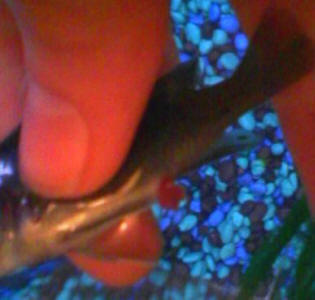
Electric Blue Cichlid with Black Mouth 6/3/06 Hello I have an electric blue that we got about a month ago. He has been doing really good until my husband put a Pacu in there when I told him not to. The Pacu was given to him by a friend and I don't know where it has been. It has been in our take now for about 2 days and I noticed that my electric blue has black blotches around it's mouth. They aren't little spots really unless there is a lot of them and they look like a blotch b/c they are all clumped together. My fish seems to be fine expect I noticed that it is like digging on the bottom of my tank moving the rocks all off the bottom?? Do possibly know what is wrong with my blue and what I need to do!! I find him shrimp pellets, could this be causing the black stuff?? If you would like to see pictures please let me know. Thank you and I will be awaiting your reply! Christie < Your cichlid now has a companion and is setting up boundaries by placing piles of gravel around the tank to delineate where his territory starts and stops. The darkened areas around the mouth are probably from the gravel being too coarse and injuring his mouth. Try changing to a smaller/finer substrate.-Chuck>
Cichlids floating vertically - need your help! 6/2/06 Hello, Our office has 15 Cichlids in a 55 gallon tank. Two of the fish are floating vertically, with their head up and have been doing so for several days. However, when we feed them, they eat and swim normally. It does appear they are being picked on - they have chunks missing from their fins. <Sounds like submissive behavior... other fishes beating them up, their signaling that they "give"> The service that cleans the tank says they are probably dying and we might just want to flush them but we have trouble doing that when we don't even know what is wrong. It is sad to watch them "float" and we don't want them to suffer. Do you have any suggestions? Thank you! <I would move these servile fishes, but you need to carefully observe the others, remove the bully, bullies as well. Bob Fenner>
Problems adding first fish 5/28/06 Hi, <Hello> After cycling my new aquarium (38 gal) for about 3 weeks, the ammonia and nitrite levels were both 0 and nitrate was about 20 ppm. <OK> I then changed 50% of the water, and yesterday I added some fish (3 yellow labs and 2 socolofi, all juveniles). Well, this morning I woke up to find all of the labs and one of the socolofi dead. I removed the dead fish and tested the water again. Ammonia: 0 ppm, nitrite: 2 ppm. I immediately did a huge water change (about 75%). The other socolofi looks ok for now, but what happened? What should I do now? Confused... <What happened was too many fish to fast. The biological filtration couldn't keep up with the addition of 5 new fish. The tank had a mini cycle as evidenced by the nitrite reading. The last fish will probably be fine but give the new tank time to catch up. Don't add anything for a couple of weeks, then it will be ok to add 1-2 new fish, after proper quarantining of course.> <Chris>
Lake Malawi Cichlid Mayhem 5/25/06 I'll lay out my question and then give some background details. I have read your site extensively and am following the advice "it's hard to give too much information". Here's my question: Why would a pair of Pseudotropheus yellowfins suddenly both turn up with nasty wounds on their backs and mouths and die in the same night when they had (seemingly) gotten along well with all tankmates for months? I am a 6-month aquarist novice. I have a 65 gallon cichlid tank with a male and female (carrying fry) Pseudotropheus Kenyi, male and female pseudo. albino red zebras, male Melanochromis johanni, male melano. auratus, female yellow Labidochromis (just got done carrying fry), a Pleco and a Synodontis multipunctatus. The male yellow lab got beat up and is in our 12 gallon hospital tank now. There are four pseudo. yellowfin fry growing up (they're about 1/2" long now) in the adult tank. Their parents are the source of my question. We used to have one male and two female pseudo. yellowfins (they're a dark purple-gray color with bright yellow top and tail fins). < Sounds like Ps. aurora.> Six weeks ago one female yellowfin disappeared and we never any sign of her again. Weeks of peace and harmony went by. The remaining pair of yellowfins did well, and their fry are scattered in safe crevices of the main tank. We resigned yourself to the notion that when I had the tank lid open for several hours to catch the male yellow lab on the sly and put him in the hospital tank, the female yellowfin must have jumped out and gotten eaten by our dog or something (we were at a loss for any other explanation of the instant and total disappearance of a 2.5" long fish). < Could have easily died and been eaten by the Pleco.> Thinking all was now well, we decided to buy the last fish we wanted: a female johanni and another female Kenyi. My husband did the shopping ten days ago and came home with a female Kenyi and a "female johanni". The moment I saw the "female johanni" my husband bought, I knew it was actually a male Melanochromis of some other sort -- turns out it's an auratus (good grief, if the cichlid expert is out for the day, don't take the word of just anybody at the pet store!!). <Big difference between a yellow female johanni and a black and yellow auratus.> He's doing great as the smallest non-fry fish in the tank, but the female Kenyi died the night she got home from the pet store. She had no visible wounds upon her death. Seven days went by without incident, but two days ago I came home to find both our adult yellowfins, one female and one male, with nasty wounds around their mouths and what looked like one huge, circular wound right on top of their back. Both fish had the same kind of wound on the back which spanned approximately 1/3 the length of their bodies and was semicircular upon side view. They both died that night. When I (heartbroken) took their bodies to the "cichlid expert" at our pet store, his opinion was that the male auratus, only a resident for one week, was the primary suspect for such aggression. The other fish experts at the store offered two contradictory opinions: one said that since the male yellowfin normally shares a large synthetic log with the Synodontis, perhaps the female yellowfin tried to move in to spawn and the Synodontis aggressively kicked them both out. The third theory was that we have some sort of bacterial infection (this was espoused in part by the fact that the other fish hadn't been as aggressive to feed that morning and the night before). Ammonia and nitrites are 0 and pH is 7.8. (We'll be adding crushed coral to the gravel during our next cleaning to help keep the pH a little higher). Temp is 78 degrees F. We bought the medication the store recommended (PimaFix) but did not administer it yet because that evening the fish ate voraciously again and we saw no other afflicted fish. The only other thing out of the ordinary now is one very cloudy eye on the female albino zebra. The male albino has been excavating gravel, so perhaps she received a mating injury, but that's just a guess. Can you help me understand what might have so suddenly killed my pair of parent yellowfins? I'll admit I get very emotional about our fish and this incident has made me question whether I will be able to remain a cichlid keeper for long. If there's an eminent danger lurking in our tank, I want to know and remedy it!! Sincerely, Kristy, Raleigh, NC < There are basically only a couple of things that really are a problem with Lake Malawi cichlids. One is aggression. Usually you see weaker fish being chased by more dominant fish and the tails of the loser are being slowly bitten off. These fish do have teeth and can do some damage but it is usually not overnight. It happens most often after a few days. Now a fish that is being aggressively chased can attempt to jump out of the tank and kill itself by striking the glass top and knocking itself out. This may explain the mouth damage that you observed. The second reason is internal infections. Your fish really need an all vegetarian diet. Fish that are fed too much protein have problems with internal blockages. These blockages feed the bacteria and protozoa in the gut and they start to fed on the food and not the fish. the microorganism grow and distend the belly area. The fish stops eating and usually hangs out in the corner until it dies. Other fish can eat the carcass of the dead fish and this can cause others to bloat up and die. The distressed fish is usually pretty well colored and is the prettiest , and easiest fish to catch at the store. This may explain the female Kenyi's death. The marks on the back are done by the Pleco eating the bodies of the dead fish.-Chuck>
Treating Electric Blue Cichlid for
Bloat - 05/10/2006 Thank you for the response. Now I would
like to know if what I am feeding them is sufficient based on your
response that it may be related to diet. I feed Spectrum large fish
formula and AquaDine. I feed lightly twice daily and
alternate. Once in a while I give them bloodworms only as a
treat (once every 2 weeks). I have a 54 corner with
Juruparis (2) and was told to feed them the bloodworms once in a while,
that's why I have them. <The Spectrum is fine for all fish and I
have never had a problem with it. The AquaDine I believe is sold in
bulk at fish stores and in general I feel that the food loses its
vitamins when exposed to the air. Bloodworms are very meaty and usually
cause problems for Lake Malawi rock cichlids referred to as Mbuna and
Tropheus from Lake Tanganyika. They are probably fine for South
American cichlids like Eartheaters. I would not recommend the
bloodworms for the rift lake cichlids.> I am picking up the
Metronidazole tonight, should I remove the carbon? < Yes.> Also
should I put the meds with some blood worms and feed them to the fish
right away? I have read on your sight to do that in some cases. Thanks
again for your assistance and education in this matter. < If the
fish are still eating I would mix the Metronidazole in a few teaspoons
of water until it is all dissolved. Then pour it over some Spectrum
pellets. Give it a few minutes to absorb the liquid then feed the
fish.-Chuck>
Disease Problem In A Rift Lake Cichlid Tank 5/9/06 Greetings from Wisconsin! I would like to thank everyone at Wet Web for having such a great site dedicated to helping this hobby and for educating all of us! < Thank you for your kind words.> Now to my question, I have a 90 gallon freshwater set up with 1 red empress, 1 hap ali, and a breeding pair of brichardis with some pictus cats and Plecos. (hope my spelling was up to par). I am running a Eheim pro 2 with a Marineland TidePool wet/dry. My ammonia is 0mg/l, nitrite is < 0.3mg|\l, ph 8.5, and a general hardness of 7 dh. Yesterday my hap ali started gasping for air and was not eating. He is swimming around the tank but hangs out in the corner mostly. Then today I noticed my Red Empress flashing or scratching on the bottom. My LFS recommended I treat with Clout so I added 9 tablet for the 90 gallon with the sump. The package says to treat for 24 hours unless parasites are still visible. Well, mine never were visible. Should I re-dose or let the tank be? Am I treating with the correct meds. As of tonight my hap is still not feeding, I understand the meds need time though. I am leaving out of town Wednesday and leaving my tank in the hands of my wife who is not that knowledgeable with fish. I would like to make sure I am taking the right steps before I leave so I do not come home to a disaster. Any advice would be appreciated. Best Regards, Michael Bukosky <Do a 50% water change, vacuum the gravel and clean the filter. Your ahli probably has an internal bacterial infection. Treat with Metronidazole. Use a tablespoon of rock salt per 5 gallons of water for the external protozoa that are harassing your fish. The internal infection may be related to diet.-Chuck> Lake Malawi Cichlid Problems - 05/06/2006 I have a red zebra, I think that's what he is, with other assorted cichlids in a 55 gallon tank. He is usually chasing all the other fish around being very dominant, and very active. Yesterday he was kind of "mellow" for his standards, and today when I woke up he is hiding in a cave under two rocks. He is very lethargic and I noticed he has red blotches, almost a line of red, running along the base of his tail. Could you help me in identifying the problem and how I can fix it?! < Sounds like he got into a fight and lost. The damaged tail fin may recover if the damage is only limited to the fin itself and not down to the caudal peduncle.> 2 of the other fish in the tank, also not sure of the names, they are purple with about 8 vertical bars along the side, (Could be one of a dozen species.) at the fish store ,they were labeled small African cichlids (mixed in with the electric yellows, red zebras (I think), and other small cichlids. Anyway, I noticed them mouth fighting pretty hard the other night. Both of their mouths are pretty torn up, one worse than the others, and they were hiding for a few days and not eating. Today they finally came out, but are still kind of hiding an not eating. Will they eventually eat once their mouths are healed up? And should I do anything to help the healing process. There is aquarium salt in the tank per instructions on the box. Thank you for any help you can give me! Dave < The damage to the mouths should heal if they do not fungus. Keep the water clean and well filtered. If you see fungus then treat with Nitrofuranace.-Chuck>
Electric Yellow Has Gone Belly Up - 05/06/2006 What an awesome website! I have a light yellow cichlid (about 3" long) that has been lying on the bottom of his 29-gallon tank for about 1 1/2 weeks. He used to be able to right himself enough to swim to the surface to eat and hang out. Tonight, he's spending all his time on the bottom, upside down. He shares his tank with 1 blue cichlid and 2 algae eaters. Part of his back tail fin is jagged but the rest of him looks fine. He's had some run-ins with the blue cichlid before and they've always worked it out and the yellow cichlid's fins have healed before. Is this enough information for you to help me help him? Thank you. Debbie Harmon <The blue cichlid has probably damaged the electric yellow internally, or has stressed it to the point where it now has an internal bacterial infection. Isolate the fish in a hospital tank and treat it with Metronidazole.-Chuck>
Red Zebra With Tail Problem
2/17/06 I have several African cichlids in a 30 gallon tank as well
as 2 Bala sharks and 2 gouramis. They all get along well and
are still relatively small. I am concerned because my cherry
red cichlid is behaving like his tail is paralyzed. He
cannot seem to swim normally and is constantly vertical in the
tank. Do you have any suggestions on what may be
wrong? He does not have any unusual swelling or coloration
and he is eating well; he just isn't moving his tail at
all. All of the others are fine. < When you fish was
small he probably got bit by his mother while being released from her
mouth. The trauma has probably damaged the backbone. He will probably
not recover but will continue to grow.-Chuck>
Malawi Tank Problems - 04/10/2006 Great website and resource that you provide! I hope this email gets through....I tried sending one directly via the WetWeb website, but couldn't log in. I was able to find the email address by clicking on the "properties" option of the "email the WWM crew a question" link. I've searched your databases and Googled, and my problem has numerous parts, thus I couldn't find something that solved it adequately. This will be sort of long and drawn out, as there are several facets. If this problem has been addressed in the past on this website, I'm sorry for wasting your time. I've recently started keeping Malawi cichlids. On approximately Feb. 20, I set up a 55 gallon aquarium with a hang-on the back filter and undergravel filters. We added our first batch of fish on Feb 26th, and the second batch on March 25th. We currently have a total of 26 fish in the tank (including a bristle-nosed Pleco, and a small Senegal Bichir). I was aware that I would be introducing the fish before the nitrogen cycle had stabilized, but with frequent water changes (20% every day for several weeks in mid-Late March when Nitrite levels were high), and daily water testing, the fish did pretty well. They did "flash" fairly often during this time (I assumed, due to the nitrite levels irritating the gills), but they always ate well and were very active. However, after the nitrogen cycle stabilized, the fish continued to flash very frequently and sometimes looked a little listless. I kept a very close eye on things, assuming an illness would show up, but nothing did. Then, on April 6th, one of our Labidochromis textilis suddenly went south. He was getting harassed, so I floated him at the top of the tank in a larger net to separate him from the others. By that night, he was belly-up with a slightly bloated abdomen and eyes. The next morning, I noticed a smaller female Sciaenochromis fryeri (and only her) exhibiting the slightly "salted" appearance of Ich. I assumed that due to the L. textilis' silvery appearance that I may have missed the "salt grains" on him. I immediately began treatment with malachite green. The second day of the malachite green treatment, I also noticed that she had slightly bulging eyes and a slight "pine coning" of the scales (neither of which seemed to be as bad as I've seen in pictures of dropsy). Yesterday (during the third day of Malachite green treatment), she died. Tomorrow is the fifth and last day of malachite green treatment, but the other fish seem to be "flashing" almost as often as before. None have exophthalmia yet, but I'm worried there may be a bacterial problem in the tank as well....although I'm not sure. My current plan is as follows:.....do a 50% water change after malachite green treatment has stopped.....then do a series of treatments with Melafix or Maracyn-two (i.e., things that won't damage biological filtration). My questions are: Does it seem likely that I have a bacterial infection in the tank (almost concurrently with Ich)...or is this maybe behavioral with cichlids? < Drop the water temp to the mid 70's. Do a 50% water change, vacuum the gravel and clean the filter. Check the nitrates and keep them under 20 ppm with water changes. The scratching you are seeing can be related to poor water quality but may also be protozoa infection too.> Is my current plan a good one (i.e., should I go ahead with MelaFix or maracyn-2)? <Don't use either and add about three cups of rock salt to the tank. This will increase the slime coat on the fish and may reduce the scratching.> Should I, instead, use something like Metronidazole or Nitrofurazone, or should I do nothing? < Definitely use metro for the bloat and change the diet to a Spirulina based food.> Again, I don't see any current signs of "pop-eye" or dropsy in the remaining fish (aside from the "flashing") but I'd also like to stymie any potential problems. Thanks for your time, Josh < Watch the fish for a change in appetite. When they quite eating it is usually too late to treat.-Chuck>
African Cichlid Problem - 03/25/2006 Hi I have a 55 gal tank with 5 African cichlids for about 4 months. Everything has been fine, but in the last week they stopped eating hung out in the plant at the bottom of the tank, they then seemed very spazzy like slamming themselves all over the tank then floating, then kind of snapping out of it, then a couple days later spaz again then suddenly die, this was stressful to watch, I tested the water & everything was good, someone said they might be lacking oxygen, but how do you test that? so we added an air pump, that didn't work obviously, well their all dead except for one smaller one that seems to be starting the same symptoms, what could this be? I am using the filtration that cam with the tank, we lowered the water level a bit that didn't help either. any suggestions? One thing I've learned from this is cichlids get sick easily, seem sensitive...... Thanks you, Sue < Wrong food. African cichlids come from the rift lakes. Most of the more inexpensive and colorful ones come from Lake Malawi. Malawian cichlids eat algae, plankton and or other fish. I suspect that you are feeding food that is very high in protein. This blocks up the intestinal track and then they stop eating and bloat up and die. Switch to Spirulina algae flakes. Feed once a day and then only enough food so that all of it is gone in two minutes. Keep them at 75 F, in hard alkaline water. Cichlids are actually quite hardy under the right conditions.-Chuck>
Fish scratching not Ich - 02/20/06
Hi I have over a dozen Mbuna cichlids.
About three or four weeks ago I noticed a P. demasoni flashing
[scratching itself on the gravel]. I could find no sign of parasites on
it or any of the other fish. I did a water change and treated the tank
with Jungle Parasite Guard. <I encourage you to be conservative re
the use of such "medicines"... almost all have their dire
downsides... they're toxic to degrees> The fish still scratched
itself. <Some such scratching is "normal", to be
expected> The tank was treated again with Jungle Parasite Guard
after a 50% water change. Still no change. Then I noticed another fish
start to flash. I did a another 50% water change after treatment and
waited several days. <... do you have water quality test kits? What
are they telling you?> The two fish still scratched themselves on
the gravel. I then treated the tank with Maracide as per instructions
and after no change did it again to no avail. During this time I
searched the internet for possible ideas. I thought they might have Ich
on their gills and it was not showing up on their bodies, <No, not
likely> I also thought of gill flukes. Now several of the fish
scratch themselves. All fish eat normally and their colours are normal.
They all look healthy but scratch. <... do this>
Any suggestions you might have would be appreciated.
The fish are now in a 125 gallon tank with about 300 pounds or rock and
plants so trying to catch them would be nearly impossible so the tank
would have to be treated. The temperature is about 78 degrees
Fahrenheit. By the way I did put some antibiotics in in case it was a
bacterial problem but the next day put the fish into the 125 gallon
tank. Ammonia is zero and nitrite is less than .1. Thank you for any
help. Brian <Nitrite should be zero,
undetectable... Nitrates should be under twenty... I suspect if
anything is "off" here it is a lack of complete ready
biological cycling... I would add more bio-filtration. Bob
Fenner>
Tropheus Troubles and bad
link: [IMG] http://i26.photobucket.com/albums/c116/Poohbie/IMG_4044.jpg[/IMG]
2/13/06 This is my two inch Tropheus Mpulungu. It is part
of a colony in my 90 gallon. I noticed this
protrusion yesterday. Fish is acting
normal. Does this look like a prolapsed anus or an
ovipositor to you? Thanks for any insight. <
Your photo did not come up but I have seen enough of these dietary
issues with Tropheus to know what is going on. Tropheus are algae
eaters from Lake Tanganyika. Algae has very little nutritional value so
they eat all day long to survive and grow. In the aquarium we feed our
fish once or twice a day with foods that are much more nutritious that
algae. Sometimes these ingredients contain animal proteins that the
Tropheus have no bacteria in their intestines to break down.
The Tropheus start to bloat, get constipated or have difficult bowel
movements that can cause trauma to the area. The stress from the larger
more aggressive Tropheus usually adds to the problem and the smaller
weaker fish are the ones most affected. At this size the Tropheus are
becoming more aggressive as they mature. One by one your colony will
shrink until you only have one left. I recommend that you have at least
a dozen fish in your colony. If not, add some smaller Mbuna
from Lake Malawi as dither fish. Change 50% of the water, vacuum the
gravel and clean the filter. Feed only vegetable flakes. Many small
feedings are better than one large one. Tropheus come from relatively
shallow hard, alkaline water that is pretty warm 80+ F. Rearrange all
the rocks so that new territories will become established. If you fish
stop eating then treat with Metronidazole.-Chuck>
Cichlid With Mouth Obstruction - 2/4/2006 My Cichlid has a very large mouth tumor or cyst that makes it nearly impossible to feed. I see where you recommend examining the fishes mouth for foreign objects by removing him from the tank using a flash light. I don think I would be able to see past the mass or growth due to its size. Can I remove the mass with some type of surgical procedure( Exacto knife?) or who could I call to perform this service? I have called around Jackson, MS without luck trying to find someone to help. Will a veterinarian be able to help? Will treatment with Nitrofuranace cause this to go away or will I have to intervene? Thanks so much, Jon < Treat the fish with Nitrofuranace in a hospital tank and see if it is an infection and the swelling will go down. If it does subside then you could then look down the throat and look for an obstruction. Increase the aeration and lower the water temp to the mid 70s to help you cichlid breath easier. If the obstruction is the same after three days then I would remove the fish and surgically remove as much of the tumor as I could practically do with an Exacto knife.-Chuck>
Cichlids With Hole In The Head 1/16/06 I have a problem with four of my Cichlids and I was hoping you might be able to shed some light on it for me. The fish involved are 1 Aurora (3-4 inches), 1 Daktari (3-4 inches), 1 Hajomaylandi (3-4 inches), and 1 Venustus (6-7 inches). All four have developed a kind of indentation on their back, between the eye and beginning of the dorsal fin. It is apparent on both sides of the fish. They are all still eating well but do seem to be swimming somewhat slower. This has appeared since new years day when, unfortunately, we lost eight fish to a temperature spike. The other fish, eight surviving originals and four new ones (purchased after the loss) all seem to be fine. I have searched for an answer but haven't found one as yet, when I found your site I thought you might be able to help. Kind Regards, Michelle. :) < When cichlids get stressed from bad water , aggression or temperature extremes they sometimes will get a symptom or disease often referred to as Hole-In-The-Head. It is often seen in discus and many larger South American species but actually quite rare in African cichlids. Keep the water around 75-77 F. Make sure that the pH is up around 7.5. Do a 50% water change, vacuum the gravel and clean the filter. Get a fish food with Spirulina algae in it. I would try to treat the tank with Metronidazole. If you can. Try and find a medicated fish food with Metronidazole in it.-Chuck>
Malawi Cichlid With Ich Hi There, About six months ago we
noticed that our African Cichlids were scratching/flashing on our
aquarium decor (rocks, gravel, plants) after introducing some new
fish. We have *P. saulosi*, *P. acei*, two *C. moori*, a
couple of peacocks and some 'cuckoo' catfish, etc (total 21,
mostly fish<1yr old). All fish are displaying the
problem, but none have any external signs of disease as far as we can
tell. Over the past few months we've treated the tank
with Para-Cide by AquaMaster for control of external parasites
(Trichlorfon) on three separate occasions and also started Fluke &
Tapeworm tablets by AquaMaster (Praziquantel). The problem
seems to get worse when treatment first starts and then seems to
improve for a short time (or I could just be hopeful) but still
persists after treatment is completed. On two occasions we have removed
fish to put in separate tanks (two at a time using water from the large
tank) and they seem to have stopped scratching completely, without the
above treatment of Para-Cide in one case. The fish are otherwise
healthy (some are even breeding) and the water quality is maintained
for African cichlids (total hardness=18-20 degrees, carbonate
hardness=10 degrees, pH=8-8.2, ammonium=0ppm, nitrites=0ppm,
temperature=26 degrees, have had nitrates tested at
<5ppm). The aquarium is set up with fine marble chip
gravel, lots of rock, Vallisneria and Anubias. It's a 4ft tank with
approx 200L and we have an Eheim 2215 filter. We do a 20%
water change fortnightly and feed the fish daily with pellets and
occasionally frozen brine shrimp. No one seems to be able to tell us
what is wrong with our fish. We've lost one probably due
to an infected injury from scratching and I would hate to lose any
more. Are we on the right track with the treatments or could
it be something completely different? Thanks in advance for your help,
Carl & Monica < You have an Ich type protozoa infection. Do a
50% water change, clean the filter and vacuum the gravel. Treat with
Rid-Ich Plus by Kordon. The catfish are going to be very sensitive to
this medication. This is a newer formula and is supposed to be safer
for scaleless fish. Follow the directions on the bottle carefully. Add
a cup of rock salt per 20 gallons. of water. Do not feed while
medicating. After treatment use good carbon to remove the medication.
The fish are cured but the good bacteria in the system may be gone. Add
Bio-Spira from Marineland to replenish these bacteria. Watch for
ammonia spikes. You may have to recycle the tank all over again. Do not
over feed and use a Spirulina based food.-Chuck>
Frontosa Not Moving Much 1/14/06 Hi there, I saw your website when I Googled it, and wanted to ask a question about my husband's frontosa. He was an active fish, now it just sits on the bottom of the tank under a rock and is very lethargic, he has bubbles on his scales. Can you give me some advice? Shan from Australia < Frontosas are from Lake Tanganyika. They require warm, hard alkaline water. They are fish eaters in the wild. Bubbles on the scales is an unusual symptom. Bubbles usually indicate some form of bacterial activity. I would recommend a 50% water change, vacuum the gravel and clean the filter. Check the water chemistry for zero ammonia and nitrites. Nitrates should be under 20 ppm. The pH should be around 8.0 at 84 F. If things don't improve in a couple of days then you may need to use an antibiotic, like Erythromycin or Nitrofuranace.-Chuck>
Cichlid Still With Problem 12/16/05 Hi. I asked a question about 4 days ago. I got a lot of feedback about my tank but not so much about my cichlids problem. I have a lot of fish in the 33gallon tank(18fish). My b/f kept buying more until I told him to stop. < He is trying to get on your good side.> None of my cichlids are overly aggressive with the other fish. They do the usual chasing around and don't really attack other fish. So far my tank mates have been ok and I change water biweekly(20%) and do water test biweekly between the water changes. Anyways, my one blue cichlid has what I found to be a prolapsed anus. It's been 4 days since we moved him to his own tank and the p/a still hasn't reduced or gotten better. It did kinda change color from the orangy red to a pale pinkish red. (infected?) < The real danger with these is that they get infected and start to fungus. The infection usually turns bright red and the fungus is a cottony looking growth. Treat with Nitrofurazone as a preventative and keep the tank clean.> How long until it goes back inside or he dies? < This condition usually isn't fatal unless it gets infected. > I have been adding aquarium salt to the tank for him and feeding small amounts of food maybe twice a day. any ideas? Let him go a few days without eating. You should start to see some improvement then.> I want to let others know that guppies are not so hard to keep, or maybe I got lucky. I bought my first tank about mid October. I bought some guppies to go with it and my female gave birth to 9 babies. I had the day off work so was able to move the babies as they appeared in the breeder net. My other female has been holding on for some time now and just let go of three babies. She has been pregnant for close to 45 days now and I'm wondering if there is anything I can do to help her along beside turning up the heat. I don't want to damage any of the other fish in my tank. < I would recommend waiting.-Chuck>
|
|

|
Features: |
|
| Featured Sponsors: |