|
FAQs about "Freshwater" Morays Eel
Foods/Feeding/Nutrition
Related FAQs:
"FW" Moray Eels,
FW Moray ID,
FW Moray Behavior, FW Moray Compatibility, FW Moray Selection, FW Moray Systems, FW Moray Disease, FW Moray Reproduction,
Marine Moray
Eels,
Related Articles: Freshwater Moray Eels by Marco
Lichtenberger, Freshwater Moray
Eels, Moray Eels, Other Marine Eels,
|
|
|
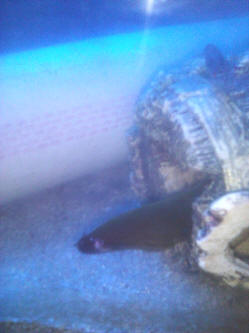
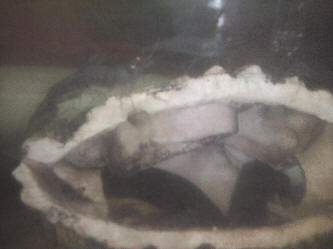
Echidna rhodochilus, finally. Feeding
10/28/17
Hello Bob, Neale, Marco and all you good people in WetWebMedia, After years of
searching, I finally obtained a small Echidna rhodochilus (35cm), and I'd like
to share its pictures with you. It's a lovely eel, but very amusing, just
minutes after being released in my aquarium, it already terrorized my shrimps
and ate two of them.
The previous owner hand-caught this eel from a river mouth called Muara Tawar in
North Bekasi, a neighboring city of Jakarta. He already kept this eel in his
aquarium for about a year, in the same water from the river where he caught it,
and haven't weaned it off live food yet. This particular Echidna won't eat dead
shrimp. Since I have steady access to live shrimps, I don't mind this. But I
heard that eels love a variety of different foods, so, If I put Sailfin mollies
in the aquarium, will they causes harm to the Echidna if it eats them?
Thank you and have a nice weekend!
Best Regards,
Ben
<Hello Ben. Congratulations on getting hold of this fish! Nope, Poecilia species
are harmless, at least in terms of thiaminase. They are, of course, the same
risk as any other farmed fish in terms of internal parasites and pathogens.
Home-bred specimens should be safer, so if you have the space and inclination,
producing your own livebearer or killifish feeders is relatively safe (though
Poeciliids seem to be plagued with Camallanus worms that could transfer from
mother to offspring, so even here, I'd be careful). Gut-loaded shrimps are a
safer and more natural foodstuff for Echidna species that have, on the whole,
crushing dentition for invertebrate prey compared to the pointed teeth of the
piscivorous morays from other genera. Gut-loading is important though because
crustaceans tend to be high in thiaminase, hence shrimp and prawn meat being
considered an unsafe staple diet for these (and other) carnivores. I will also
remind you that 'freshwater' morays lose their appetite when the salinity is too
low, so kicking up the salinity may be helpful. Bob and Marco have written
extensively on this/these fish; see here:
http://www.wetwebmedia.com/FWSubWebIndex/fwmorayeels.htm
http://www.wetwebmedia.com/FWSubWebIndex/fwmorayart.htm
Cheers, Neale.>
|
 |
|
Re: Echidna rhodochilus, finally
10/28/17
Hello Neal!
<Ben,>
Thank you for the kind words & advice. That was fast!
<Thanks for the kind words.>
Again many thanks. I think I don't have the inclination to breed the mollies
myself, so I'll have to stick with fortified shrimps for now.
Anyway, there are still some shrimps left in the eel tank, and seems like
they'll all be consumed within a few days, so, after they're all gone, how
many days should I wait until I put on some more live shrimp?
<I would not overfeed; with subadult to adult predatory fish, the aim is to
offer food only when they're actively hunting. Personally, I prefer the "little
but often" approach with predators, offering them small daily meals
rather than infrequent big meals, simply because it limits the risk of
regurgitation or uneaten food being left in the tank. Other people prefer a more
'natural' approach where the fish receives a substantial meal, but maybe 2-3
times a week, but taking care to remove any regurgitated or leftover food before
water quality was compromised. But whatever approach you take, a couple notes
about Morays. First, they hunt by smell. Adding too many food items at once
means the 'smell' gets spread around the tank, and the Moray can have trouble
finding it. So get some long forceps or something like a kebob or satay skewer,
use this to hold a single food item, and place the item somewhere just upstream
of the Moray. Wiggling the food enticingly can help, especially if the food is
silvery, like a small piece of fish. If the Moray is settled and hungry, it will
start hunting.
The second time is to keep the food bite-sized. Morays can't chew, and despite
their ferocious reputation, they actually favour small, easily swallowed food
items. Once the food item is taken, repeat a few minutes later. If the Moray
shows no interest, it's probably had enough, and you can skip feeding until
tomorrow or the next day.>
This particular Echidna Rhodochilus is already 30 cm in length so I assume it is
an adult, which shouldn't be overfeed, right?
<Quite so.>
And thank you also for the advice for raising salinity when necessary. I'll try
to find a hydrometer so I know exactly what is the salinity rate of my eel tank
& adjust accordingly. I have access to seawater (the blessed life of people who
lives in coastal cities & not far from estuaries :D ) so it's not inconvenient
to mix some seawater to the eel tank.
<Indeed! Sounds nice, especially if you can vary the salinity periodically, up
or down, as you see fit. Brackish water fish appreciate this, even though they
don't need it. Often you'll see them perk up their behaviour almost as if
they're exploring a new tank.>
Best Regards,
Ben
<And to you. Cheers, Neale.>
Re: Echidna rhodochilus, finally 10/28/17
Hello Neale,
Again, many thanks for the feeding info & salinity tips!
<Welcome.>
Speaking of feeding, the remaining shrimps are rather large, and when I turn
down the lights, they gather above the Echidna's cave. I wonder what's going on?
Are they teasing the eel?
<Nope. More than likely scavenging, and if the Moray withdraws to his cave to
eat his food, there could be all sorts of small food fragments thereabouts
attracting them.>
As in "hah, we're too big for you, you cant eat us, heh heh!"? Should I evict
them later?
<Unless they recognise the Moray as a threat, there's no reason for prey animals
to keep away.>
Best Regards,
Ben
<Those are quite big shrimps, for sure! But gut-loading with traditional fish
flake, Spirulina and, if you can get it, Sushi Nori algae sheets, will all help
to boost their vitamin content and turn them into useful food items. There are
marine-grade vitamin supplements, such as Selcon, that can be used -- sparingly
-- to good effect as well. With freshwater and marine carnivores, a lot of
failure over the long term -- months, years after purchase -- may be explained
by lack of vitamins, including Thiamine.
Longer term of course, getting your Moray onto a fresh and frozen diet will be
helpful. Cheers, Neale.>
Re: Echidna rhodochilus, finally
10/29/17
Good day Neale!
<Ben,>
Thank you for the tips for fortifying the feeder shrimps. I can give them both
fish flakes (available here) and the nori seaweed (I think I saw them on a mall
somewhere). The Echidna is so cute, it is worth all the efforts to give it a
good home.
<Quite so. A nice fish, and like all Morays, amply rewards good care.>
Speaking of home, I just find this video on YouTube, of a Gymnothorax Tile
sharing an aquarium with a Polypterus, both seemed to be at peace with each
other, and both still retain their huge appetite for food (though their owner
seems to be able to wean the G. Tile away from live food & able to give it
frozen shrimp...)
https://www.youtube.com/watch?v=bFXue8NHFRs
Is this some kind of black magic, or is there some kind of chemical stuffs
involved?
<No, just luck and time. Gymnothorax tile WILL NOT live its full lifespan in
freshwater, and that specimens just a baby.>
G. Tiles are supposed to be brackish water to marine species, while Polypterus
are totally freshwater species.
<Yes and yes.>
How could they share the same aquarium like this, without affecting their
appetite and behavior?
<The "freshwater" Morays certainly do live some months in freshwater, and
youngsters maybe even a year or more. But eventually, without fail, they stop
eating. Aquarists who fail to give them brackish water usually end up with a
starved, then dead, Moray.>
If this is a brackish water setup, maybe the Polypterus has some tolerance to
higher salinity?
<Unlikely. While the Ropefish, Erpetoichthys calabaricus, has some tolerance for
slightly brackish conditions, I'm not aware of any true Bichirs in even slightly
brackish habitats.>
If yes, maybe I'll introduce a Polypterus or two to keep my Echidna accompanied.
What do you think?
<Bad idea. Morays make poor companions. The fact they hunt by smell means they
sometimes bite their tankmates! I'd tend to keep yours either singly, or in due
course, with some large, robust brackish or marine companions --
big sleeper gobies, brackish water lionfish, toadfish, that sort of thing, maybe
even Scats and Monos if you had enough swimming space for them. In low-end
marine tanks, pretty much anything will work, including robust
Damsels and Sergeant Majors. Any of these would make more realistic companions.>
Best Regards,
Ben
<Welcome. Neale.>
|
Re: Echidna rhodochilus, finally 10/30/17
Hello Neale,
<Ben,>
Thank you for confirming my thoughts. Everything I read about G. Tile online
pointed out that this particular fish is more brackish to marine than
freshwater.
<Quite possibly migratory; Fishbase suggests an anadromous life cycle, living in
the sea or estuaries, but spawning in the freshwater parts of rivers. In any
event, the experience of those keeping this species suggests brackish will work
fine long term, but freshwater doesn't.>
So, I understand that combination of Polypterus and G. Tile is "suicidal", if
it's too brackish, the Polypterus would eventually suffer, if it's too fresh,
the G. Tile will suffer. Not good!
<Indeed. Suicidal would suggest either of the fish are choosing to die in the
wrong conditions -- not the case here!>
As for my Echidna, for now I will let it enjoy the tank by itself and its prey
shrimps. This little guy really has personality, I noticed that if the lights
are bright, it will behave like a dragon on its lair, sitting nicely on its
cave. But when the lights are dimmed, after awhile it will start to "patrol" its
surroundings & terrorizing the shrimps. Fascinating isn't it?
<Absolutely, and precisely how they behave in the wild. During the daytime
Morays are inactive but not asleep, and will indeed lurk with their heads poking
out, showing an interest in what's happening in their part of the world. At
night they become active, and that's when they hunt.>
I will eventually get a friend for the Echidna. Sleeper goby sounds cool, and
it's a fierce-looking fish, just like the Echidna, so they will make a great
conversation piece.
<There are some excellent large Sleepers out there, but do bear in mind such
tankmates need to be at least as big as the Moray, otherwise biting is a risk;
even if the Moray doesn't actually kill the target, its bites can quickly become
infected.>
I am thinking to get myself a G. Polyuranodon, but I wonder, will they get along
together?
<Morays can get along in very large systems with plenty of caves, but they can
be unpredictable, so I would tend to keep them singly. Do read here:
http://www.wetwebmedia.com/fwsubwebindex/fwmorayart.htm
There's a section on tankmates.>
Have a wonderful day!
Ben
<It's almost bedtime here, so will save that for tomorrow! Cheers, Neale.>
|
 |
Re: Echidna rhodochilus, finally 10/31/17
Hello Neale,
<Ben,>
Thank you for the interesting info about G. Tile behavior. Of all three species
that is labeled "Freshwater Moray", perhaps G. Tile is the least deserving of
the title. G. Polyuranodon perhaps is the most deserving, but even so, I think
G. Polyuranodon and E. Rhodochilus will do better in slightly brackish water, as
it's their natural habitat.
<Indeed. But I'm not sure any true eel (Anguilliformes) is 100% freshwater --
even the true freshwater eels, Anguilla spp., return to the sea to breed. My
assumption would be that freshwater morays will have a marine
stage to their life cycle, at the very least, and even Gymnothorax polyuranodon
is rarely found more than a few km inland, indicating that even though adults do
seem to be primarily freshwater to low-end brackish, they do need to be able to
get to the sea to breed properly (whether directly or via planktonic larvae I do
not know, and don't think anyone else does either). Do see, for example, here:
https://www.ncbi.nlm.nih.gov/pubmed/21722111
Plus the various Fishbase articles on freshwater morays.>
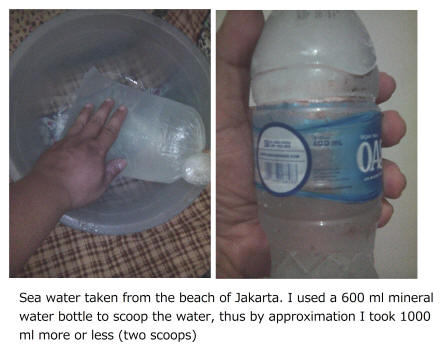
Today I went to the seashore to collect some seawater (about two bottles of 600
milliliters), will mix some of it to my Echidna Rhodochilus aquarium sometime
later, to change the salinity, and let's see how the Echidna behaves afterwards.
<Cool.>
I am still unable to find any local fish store which even know what a Hydrometer
is, and I am too poor (for now) to buy it online from abroad, but I'll keep
searching.
<For brackish, they're not essential. If you mix, say, one bucket of seawater
with three buckets of freshwater, you'll have around 25% normal seawater, i.e.,
SG 1.005 at 25 C. That's fine for most brackish water fish.
Provided each water change is done with something along these lines, one part
seawater to three parts freshwater, any slight discrepancy in specific gravity
(or salinity) won't be enough to cause harm to your fish or filter.>
Thank you and have a nice day!
Ben
<Welcome! Neale.>
|
Re: Echidna rhodochilus, finally
11/1/17
Good day Neale,
<Hi Ben!>
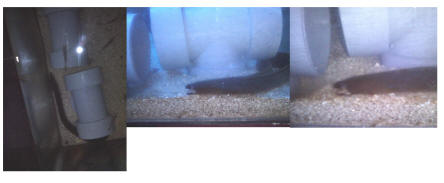
Yesterday I have mixed approx 1000 ml of seawater, taken from the beach of
Jakarta, to the Echidna aquarium. I also decided to take out the ugly white pipe
and replace it with two shorter, darker pipes, which matches my
aquarium better. Echidna seems to like it better, as he seem to enjoy chasing
shrimps round and round the two pipes.
<No doubt. PVC pipes are fine, but they do reflect light unnaturally. Can work
nicely once covered with a bit of algae though, or if buried in coral rubble.>
After the seawater addition, Echidna still behaves more or less before, except
for a few changes. I notice that it is now "calmer", not darting around quickly
during its "patrols" as often as before. And it seems to leave its cave more
often, in favor of the two new pipes. My friend, the one who own a Polyuranodon
that I've been trying to buy for years (unsuccessfully), noted that Polyuranodon
also behaves more or less the same, if it has more than one hiding places, it
will use all of them, not just stuck to one place. Have you observed this with
other morays you have seen/kept?
<Yes; Morays are definitely territorial, but they are also curious, and in their
way, intelligent. Anyone who has kept Freshwater Eels (Anguilla spp.) will have
noticed the same thing. These are 'cunning' animals that learn their territories
well, and expect to have a 'get-away' burrow or two that they can use if chased
or otherwise molested.>
Anyway, according to Google, my home in Pulomas Jakarta is only 12 km from the
sea. The North Bekasi area where my Echidna were caught, has more or less the
same distance from the sea, so maybe our rivers here in Pulomas and North Bekasi
are not pure freshwater, but perhaps have some brackish water mixed in.
<Possibly, but it may well be that it's plain vanilla freshwater, and the
proximity to the sea is more about reproduction, as we've discussed before.
Or it could be these fish are casually migratory. By that I mean they simply
swim up or down river as the mood takes them, perhaps several times a year.
Adult Scats, for example, certainly do this, and can be found 50 km
inland, even though they are more common in the sea or estuaries. The truth is
that we don't really know very much about how brackish water fish live.
They are not well studied by scientists, and fishkeepers are not as experienced
with them as reef fish or rainforest fish. People keeping freshwater Morays are
doing groundbreaking stuff here, and it's useful to keep notes and discuss with
other fishkeepers.>
I'd love to check their salinity once I get my hands on a proper Hydrometer.
<And I'd love to hear what you learn!>
If it's true, that explains how my friend is able to keep Polyuranodon for years
simply by using the water from the river, no marine salt required.
<Quite so.>
Thank you for pointing me to Fishbase and the scientific paper. I also find your
interesting comment in this forum:
http://www.fishforums.net/threads/identify-my-brackish-moray-eel.105762/
<Oh! That's going back a while.>
You said: "...Gymnothorax polyuranodon for example is said to be a catadromous
species, that is, while adults may inhabit brackish or fresh waters for extended
periods, they return to the sea to breed. This agrees with Schafer's records of
these fish being found 'a long way upstream in completely fresh
water'....Gymnothorax tile on the other hand is *suggested* to be anadromous,
meaning that it inhabits brackish and marine waters as an adult but breeds in
brackish or fresh water....Echidna rhodochilus isn't referred to as either, so
by implication may be euryhaline, swimming and breeding wherever it wants..."
<Hmm...>
I found it so fascinating. So, there are not much scientific info about Echidna
Rhodochilus?
<Not really, no. If you Google 'Echidna rhodochilus' you will get some links,
including a first report of the species from mangroves of the
Andaman & Nicobar Islands, which is cool. I do suspect they're simply plain
vanilla euryhaline brackish water Morays, rather than true freshwater species,
as might be the case for (adult) Gymnothorax polyuranodon.>
That's too bad. I hope my observations here on my own aquarium will help to shed
some lights on this fascinating fish.
<As do I.>
I also hope that someday people would find a way to breed Echidna Rhodochilus. I
think it's the ideal pet moray. It stays small, not so aggressive, it's
freshwater to brackish, it's very cute and it has long live if taken care
properly.
<It does seem to be a very good aquarium fish, given the right conditions.
Some of the smaller marine Morays have a well-earned place as rock-solid
aquarium residents, and with a bit of care, Echidna rhodochilus would seem to be
much the same sort of fish. Healthy specimens are really gorgeous,
with a lovely velvety sheen, and as you say, they're relatively mellow -- though
I wouldn't trust them with small or delicate tankmates.>
Well, have a nice day and thank you again for your wonderful discussions, you're
very kind & a true expert of this field!
<Thanks for the kind words.>
Best Regards,
Ben
<Cheers, Neale.>
|
 |
Re: Echidna rhodochilus, finally 11/3/17
Hello Neale,
<Ben,>
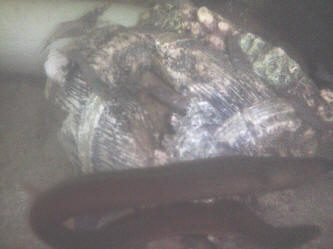
Thank you for your advice about the PVC pipe. Tonight I took out Echidna's cave
and replaced the PVC pipe back in. I noticed that the cave has rough edges and I
am afraid Echidna will scrape and hurt itself on those edges.
<Can certainly be a risk, but these eels do inhabit oyster reefs and mangroves,
so probably have some common sense here. Nonetheless, "safety first" is a good
maxim!>
Here is a clip of my lovely Echidna before I took out its cave. I hope it will
forgive me. My friend told me that Echidna Rhodhocilus are not as easily
stressed as other morays, is that true?
<Probably; they are physiologically adaptable, that is sure. Morays are hardy
anyway, and among the tougher marine fish, so a euryhaline one is likely to be
remarkably durable. The flip side though is that they've been
abused a bit over the years, kept in freshwater systems for too long, and surely
some have died prematurely because of that. We don't really know that much about
their diet and reproduction either, so might be missing
important things in those directions.>
https://www.youtube.com/watch?v=McgRWm92xN8
<Nice!>
I am fascinated with your info that it is us, Freshwater Moray keepers, who are
leading the (informal) research on FW moray behavior. I want to share this video
clip with you, sent to me by my friend who keep several Polyuranodons.... in
"FRESHWATER" for years ("Freshwater" because I he said he just fill his aquarium
with the water from the river where he caught the eels, but I never ran a
salinity check on those waters).....and after
years, he was able to train his Polyuranodons to eat BLOODWORMS... Isn't it
amazing? Here is the clip:
https://www.youtube.com/watch?v=816Z5mD9NDs
<Likely a major source of nutrition in the wild. Mosquito larvae are very common
-- and very important -- parts of the freshwater food chain. They are also
common in brackish water habitats too.>
Now you can put it on your notes, that there is a prove case from Indonesia, of
Polyuranodons actually kept in "freshwater" for years and trained to eat
bloodworms!
<Your messages are shared with everyone who reads WWM, whether now or in the
future!>
Off course, we have to take into account that this is Indonesia, the natural
habitat of these eels, and they are being kept in the water from their own
rivers, and the surrounding temperature is pretty much the same
(they are literally being kept in a city of the same island where they were
taken from). Therefore this should not be interpreted that I am advising fish
lovers in other countries (especially Western!) to start keeping Polyuranodon on
freshwater and feed them bloodworms, I don't! Because what works here in
Indonesia might not work in other places.
<Quite so. Your specimens have endured less handling and shipping -- it can
easily be months between capture and ending up in an American or European
aquarist's fish tank. That will make a difference.>
Well, thank you for your continuing attention and support!
Best Regards,
Ben
<Always glad to talk. Cheers, Neale.>
Re: Echidna rhodochilus, finally
11/6/17
Hello Neale,
Again, many thanks for your input & continuing support! WetWebMedia is really
blessing for all of us fish-lovers everywhere!
<Thanks for the kind words.>
Now I am inspired to train my Echidna to eat bloodworm too. Will post here the
results, though I am sure it will take a while. Maybe I will get another Echidna
as well, because what's better than one Echidna Rhodochilus? TWO Echidna
Rhodochilus! :D
<If they get along, at least...>
I will also try to acquire a G. Polyuranodon for the same purpose. Maybe when I
get two Echidnas, I will trade one for a G. Polyuranodon :D
I have thoughts on obtaining a G. Tile, however this species grows big, and I
don't have that much space in my current house for another aquarium.
Plus, though it is a known species in this part of Indonesia where I live, G.
tile and E. Rhodochilus are harder to find than G. Polyuranodon or even E.
Nebulosa.
<Really?>
Getting an FW moray around here is a bit tricky, because these days most of our
local fish catchers who supply ornamental fishes for fish shops, does not really
understand the taxonomy of the fishes. They use "catch-all"
terms for the fishes, for example, any eel types they caught in the estuarium,
they will say "It's a Belut Muara" (estuarian eel), whether it's Gymnothorax
Tile or Gymnothorax Undulatus or Echidna Nebulosa or even Gymnothorax javanicus.
I have to inspect what they caught, and sort the fishes by myself.
<Interestingly, when I Google the "Belut Muara" name I end up with mostly
Synbranchus-type swamp eels, such as Macrotrema caligans. These are
brackish-tolerant freshwater fish, more of low-end systems than mid-to-high
salinity systems. Synbranchus eels tend to be extremely aggressive and
predatory, so approach with care.>
It's much more effective to buy the fishes from hobbyists who hand-caught their
stocks, and know enough taxonomy to identify what they have caught... but then,
these hobbyists often developed emotional attachments to their pets & won't sell
their favorite ones.
<Indeed.>
Well, this has been a wonderful discussion, I hope it will be useful for
WetWebMedia readers & all "FW" moray lovers everywhere.
Thank you & Best Regards,
Ben
<And you; cheers! Neale.>
|
Re: Echidna rhodochilus, finally 11/15/17
Hello Neale and all you good people in WetWebMedia,
<Hello Ben,>
As I promised, here is the latest update of my Echidna Rhodochilus.
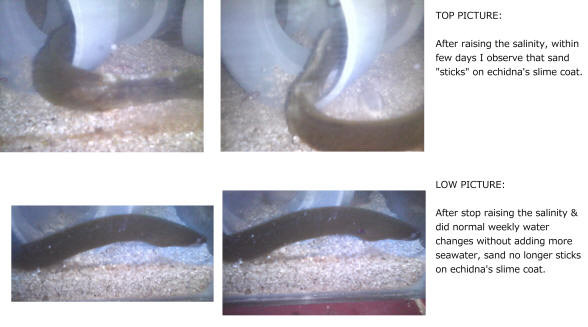
1. After I raised the salinity by pouring in seawater gradually, I noticed that
sand sticks on echidna's slime coat. I thought it was some kind of disease, but
when i gently touched the echidna, the sand came off. So I stopped raising the
salinity, at the weekly water change I no longer add seawater & did the water
change using freshwater from my well. Just a few days after, echidna went back
to normal with no more sticking sands.
<Quite normal behaviour. Mucous production is one way that scale-less fishes
like eels adapt to their environment. It's perfectly normal for them to produce
extra mucous at times, and eels of all kinds are famous for
doing this. It may well be that salinity changes trigger mucous production,
perhaps because it slows down water loss in more saline water.>
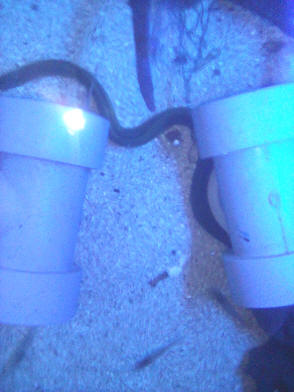
2. Echidna Rhodochilus are amongst the smallest of the moray, but they are
actually strong enough to rearrange their aquarium. My echidna is able to uproot
my bogwood ornament and moving its home pipes around as it sees fit. It is more
active now than weeks ago when I first got it.
<Again, eels are noted for their strength. Despite their sluggish behaviour
during the day time, they are actually effective and powerful predators at
night.>
3. It is very docile though, it never made any attempt to bite me whenever I
stick my hands inside the aquarium to put the pipes and bogwood back in place.
<On the whole Morays are known to be curious rather than aggressive towards
people, even wild Morays in the oceans.>
4. Maybe later, I'll temporarily (not long-term, maybe just days) put docile pet
fish from my other aquarium to test their compatibility with Echidna in a
semi/low-end brackish condition. I have a Monopterus albus which are larger than
the Echidna, and whose docility are guaranteed, it has been housed for years
with two Polypterus palmas, three clown loaches and two yo-yo loaches, and it
never caused trouble. Seems like a perfect candidate for the experiment. Or
maybe I put the clown loaches, as they have grown rather big and I am sure
echidna won't see them as food.
<Does sound like a good candidate for this, but I will caution you that
Synbranchids are often reported to bite companion fish, so keep a close eye on
things.>
And thank you for the tips in selecting caught fish. We never know what got
caught by local fish catcher here. Besides aggressive eels. sometimes even
marine food-fish like ikan layur/ribbon fish (Trichiurus lepturus) end up
in estuarium and get caught. Those fishes has nasty teeth!
<What a cool beast! One of the neatest fish I've seen in aquarium shops in
England is another eel, Congresox talabonoides, sometimes called the Pike Conger
Eel. It's a brackish to marine fish, and seems quite hardy and
peaceful. But it is predatory, and apparently sometimes reaches over 200 cm in
length!>
Best Regards,
Ben
<Thanks for the photos. Cheers, Neale.>
|
 |
|
Brackish Moray not eating... w/ non-brackish fishes
4/20/14
Hi my name is Hennie and I have a G tile eel my SG is 1.010
and pH 7.3 . I have my eel now for a week and it will not eat I
try every day with shrimp and nothing. He has lot of hiding places
and there is 2 Oscars 3 Malawi cichlids, rope fish tyre track
eel and 2 sharks. What could be the problem
please.
<Umm; likely the other fishes present... Not compatible. You
need another system, or two, three... DO read re each of these species;
their compatibility, system needs... they can't live well or long
together.
Please read here:
http://wetwebmedia.com/FWSubWebIndex/fwmorayart.htm
the linked files at top. Bob Fenner>
Thanks
Re: Brackish Moray not eating... w/ non-brackish fishes
4/20/14
Thanks so much I have taken a look at the link and understand a lot now.
Thanks for your help
Hennie
<Grateful to help you save the health and life your aquatic charges.
Cheers, BobF>
re: 4/20/14
Sorry to ask now again but I see him opening he's mouth wide open a few
times now should I be worry or is it normal
<... Normal. B>
re: 4/20/14
Great thanks much now I will not bug you with my beginner questions haha
thanks.
Hennie
<Do keep studying, learning... and sharing. B>
Long time, no email....another eel problem 10/16/12
Hi again Marco.
<Hi Alyson.>
It has been awhile since our last emails to each other which was a good
thing because I wasn't having any more problems until now.
<Yeah, I'm used to girls only calling when in trouble or need of
something... jk.>
First off, specific gravity is 1.019, ph 7.9, nitrates 0 and
ammonia 0. Ok, my Gymnothorax tile has been on a hunger strike.
Normally, I wouldn't be alarmed because that's a given with these eels,
but it has been going on for 3 1/2 weeks. It seems like "he" has grown
out of his caves so I bought some bigger ones thinking maybe he was
stressed due to lack of hiding spots. He will not go in them or any of
the other hiding spots at all. Ever since he started his hunger strike,
he likes to stay out of hiding which is very abnormal.
<True.>
The other eel is fine and is eating regularly, but my big one will not
eat at all. When I try to give him food, he turns his head and goes
crazy swimming around the tank almost as if he is searching for food. I
have tried many different types of food, including his favorites, but he
will not accept it. I have noticed that he seems interested in my GSP at
sometimes though, never lunging at it, but very "interested". I guess my
questions are 1. Is there anything that you suggest for me to try?
<3 1/2 weeks is not too long. I had an older G. tile in the past, which
once or twice a year would stop feeding for almost 2 months. But I
understand your concern, especially since the eel seems to prefer to
stay in the open. Measured water parameters seem to be very good, so I
doubt it is environmental. I'd recommend patience. Keep on trying to
feed the eel once in a while and have an eye on any changes in its
behaviour and physical appearance.>
and 2. Since he is showing "interest" in the GSP, should I maybe try
live food and see how he reacts?
<If you are desperate you can do that. I guess it would not hurt, but
think the second eel could be a problem here. Sometimes I had more luck
when feeding at night. Another guy over here has also used the smelly
stuff you add to your bait for fishing to get aquarium fishes on hunger
strike to eat. There are commercial products specifically for eels sold
in bait stores. I was never eager to put such food into my tanks, but he
had some success. Since hunger strikes have occurred on a regular basis
with G. tile there was the hypothesis this could be related to their
natural life. This species is speculated by some to migrate prior to
mating season and other fish species stop feeding at this time. But this
topic was never properly examined to my knowledge.>
Once again thank you Marco and hopefully like always, you can help me
get this problem under control.
<Not much of help here, I fear, but maybe something to calm the nerves.
Keep us updated.>
Yours truly, Alyson
<Good luck and take care. Marco.>
Re: Long time, no email....another eel problem
10/25/12
Hey Marco, well still no change in my older eel's appetite. I have not
tried live food yet just because I am very wary of how it may affect my
water parameters. He still will not eat at all. When Im trying to feed
him, now he goes completely nuts swimming around the top of the tank and
trying to jump out (he almost succeeded one time). I have noticed a
couple of weird things though, figured I'd get your advice. Ok, I know
that there has not been a case of captive g. tiles mating before and
there is no way to tell the sex, but the past week I have noticed that
my two eels wrap their tails almost together and then after they are
done doing whatever it is, they start wagging their tails. (Yes, I know
this sounds crazy, just imagine watching it lol). The older g. tile (the
one with the eating problems) now has a white circle on his belly where
Im assuming his/her "parts" would be. I know this is a long shot, but do
you think maybe they might be trying to mate and that's why the older
eel is "stressed"?? Like I said I know it's a long shot, but I have no
clue. If this could be the case, what should I look for? Eggs? Babies?
Lol, any advice would be greatly appreciated because I just want to feel
a little at ease about this craziness that is going on in my tank.
Thanks again. Alyson
Re: Long time, no email....another eel problem
10/24/12
Hey Marco,
<Hi Alyson.>
well still no change in my older eel's appetite. I have not tried live
food yet just because I am very wary of how it may affect my water
parameters.
<It won't affect the water parameters in any different way or amount
than frozen food would.>
He still will not eat at all. When Im trying to feed him, now he goes
completely nuts swimming around the top of the tank and trying to jump
out (he almost succeeded one time). I have noticed a couple of weird
things though, figured I'd get your advice. Ok, I know that there has
not been a case of captive G. tiles mating
<None documented in detail to my knowledge.>
before and there is no way to tell the sex,
<which some morays change through their lives.>
but the past week I have noticed that my two eels wrap their tails
almost together and then after they are done doing whatever it is, they
start wagging their tails. (Yes, I know this sounds crazy, just imagine
watching it lol).
<Sounds like mating behaviour documented for some moray species such as
Zebra eels or Kidako morays, while other morays participated in what
might be called an orgy.>
The older G. tile (the one with the eating problems) now has a white
circle on his belly where Im assuming his/her "parts" would be.
<Mmh... keep an eye on this. I hope this is not disease related.>
I know this is a long shot, but do you think maybe they might be trying
to mate and that's why the older eel is "stressed"??
<I don't think the shot is a that long (see the last mail for the idea
that hunger strikes sometimes might be related to mating). It cannot be
ruled out at this point. I know G. tile specimens have produced eggs in
captivity, but am not aware of the details.>
Like I said I know it's a long shot, but I have no clue. If this could
be the case, what should I look for? Eggs?
<Possible.>
Babies?
<No. All morays have very long planktonic larval stages, which makes it
almost impossible for private hobbyists to raise them to adulthood. Even
the pros have not done that to my knowledge.>
Lol, any advice would be greatly appreciated because I just want to feel
a little at ease about this craziness that is going on in my tank.
Thanks again. Alyson
<Watch out if the private parts area shows any changes. Egg filled
morays usually become very fat, sometimes more than twice their usual
diameter. Also look out for eggs. Continue trying to feed every few
days, there's not much more you can do. Good luck. Marco.>
Re: Long time, no email....another eel problem
11/11/12
Hi Marco :(
<Hello Alyson.>
There is still no change with my big G. tile.
<Sorry to hear that.>
He still will not take food nor is he interested in live food. He's been
hiding a lot more rather than just laying out in the open, but he still
continues at times to just swim around the top of the tank like crazy.
Last night he must have done that for at least 20 min. That white spot
that I mentioned last time (near where his "parts" would be) is still
there, not growing or anything like that. I am at a loss of what to do
next. I don't want to watch him wither away to nothing.
<Did it even loose a significant amount of circumference/weight?>
I know that there really isn't much I can do at this point,
<I agree.>
but any other ideas on how to get him to eat would be great. Thanks
again. Alyson
<There still is the idea of using baiting liquids from the fishing shop
to make the food more attractive as noted in an earlier mail. Can't
promise it will work, though. You indicate there are no definite signs
of a disease, which in my opinion is good. Personally, I would continue
to try offering food every few days and not try the baiting liquids.
Good luck. Marco.>
Re: Long time, no email....another eel problem
11/11/12
Hi Marco, yeah I am definitely going to try to use the baiting liquids.
"He" has definitely lost some body mass, but not as much as I would
expect from going this long without eating. Hopefully when I try this
baiting liquid, he will at least stop flying around the tank to give it
a chance. I will let you know. Thanks again. Alyson
<Okay. Good luck and take care. Marco.>
Re: Long time, no email....another eel problem - 12/02/2012
YAY, Marco he finally ate!! I have waited my eel out for (lost
track) and I have spent a ton of money at the Asian grocery stores on
seafood. He ate twice!! River shrimp (who would have thought). I am so
happy just to actually see him eat so I can be rest assured that he is
in fact getting some sort of nutrition. I still do think him and my
other G. tile have something going on because he is VERY protective over
the tunnel that the other eel is in. If the other eel comes out, my big
eel will chase any fish away that is anywhere near the other. I think it
is sweet, but I am just happy that my big eel is eating again. Thanks
again for all your help. Alyson
<I'm very glad the hear that, Alyson. Following our emails (see below)
your eel ate last around the mid to end of September. That's a hunger
strike of around 10 weeks. It's not short, but also not too uncommon.
I'm happy for you it seems over. Cheers, Marco.> "Freshwater" Moray Eel Two Questions, fdg., sys. 4/1/12
I want to start off by first thanking you guys for your wonderful site!
<Thanks for your kind words.>
I have been maintaining my brackish water tank using all of your incredible
advice. Well on to the questions....First off I have a 40 gallon brackish water
tank PH is at 8, nitrates and ammonia levels are all normal and temp is kept at
80 deg F. Started off by having gravity level at 1.010, but have slowly over
time raised it to it's current reading of 1.021. In the tank I have a
"freshwater moray eel" or as you refer it to a Gymnothorax tile, a green spotted
puffer and a "freshwater" flounder/flatfish.
<Not the best tank mates, these eels can become really incompatible when growing
up.>
I first purchased my eel about two months ago and of course he went on a hunger
strike, but after raising the salt levels to 1.021 the eel has been eating. My
concern is he is eating like crazy! He accepts food by tweezers and his diet is
consisting of freeze dried krill, shrimp, muscles, silverbacks, ghost shrimp and
tilapia (I like to keep his diet varied). I read on your site that juveniles
tend to eat every other day and adults eat twice a week. My eel eats two times a
day each time taking two different foods. He doesn't seem to just be stuffing
himself because when he has "had enough I guess" he goes back into his cave. Is
this normal for him to eat like this??
<Oh, that's what I often ask myself about some people.>
I feed him at a specific time in the morning and at night and he is readily
waiting for me, sometimes barely letting me get the food in the tank. When I
first got him (assuming its a he) he was very skinny about the circumference of
a dime and 11in long. Now he is almost the circumference of a nickel and 13 in
long. My question is, should I keep his feeding habits the same, or if not what
amount he should eat?
<You offer much more to him than nature does in my opinion. I'd feed
significantly less, about the size of the eel's head per feeding. Feeding every
other day is sufficient. There are some reports on the negative results of
overfeeding moray eels, e.g. by P. Purser in the TFH book and there are
examinations of eels caught in nature showing they don't eat every day (some
larger species only once per week or less.>
My next question is, I read that when juveniles, the eels live in brackish water
and eventually move to full saltwater when older.
If this is true, when should I convert to a full saltwater tank?
<It's easier to maintain, because you can use a skimmer, live rock. You've
almost reached marine salinity, so I see no reason to not convert to full
saltwater.>
Thank you so much for your time and I look forward to hearing from you!
<Also see:
http://www.wetwebmedia.com/ca/volume_4/V4I2/Freshwater_eels/freshwater_eels.
htm . Cheers, Marco.>
Re: "Freshwater" Moray Eel Two Questions 4/1/12
Thank you very much for responding so quickly!
<No problem.>
I am going to reduce my eel's food starting today. Do eels beg?
<If by begging you mean that they expect to get food from a known source: yes.
In some areas moray eels accumulate below the nets of large offshore fish farms.
Every time the fish within the nets are fed, the moray eels come out to get
their share, which falls through the net.>
Lol, because that is going to be the hardest part in reducing his diet. He
literally "begs" by sticking half of his body out from his cave and faces
towards the surface waiting for me to feed his fat butt when I come in the room
every morning. In regards to his tank mates the green spotted puffer and the
flatfish, so far the eel is very accepting of them, but I will watch as he gets
older to see if he acts aggressively towards them. Thanks again for all of your
help!
<Welcome. Marco.>
Gymnothorax tile eating shrimp
2/5/12
Hi there.
<Hi Niki.>
My eel eats 2 frozen shrimps every week. Today I was feeding him
a shrimp on a kebab stick when he ripped the whole shrimp of the
stick and swallowed it whole! Usually he would only bite off a
bit and eat the rest later. After swallowing the shrimp I could
clearly see the shrimp inside of him (A big bump formed inside
him - about in the middle of his body). He swam around the tank a few
times and then retreated to his cave. I went back a few minutes later
still seeing the shrimp inside him. Is this okay?
<Yes, no problem, when it can be swallowed, it's apparently not
too large.
Try to keep the diet more varied:
http://www.wetwebmedia.com/fwsubwebindex/fwmorayart.htm>
Thank you Niki
<Welcome. Marco.>
Brackish Water Snowflake Eel in Freshwater; sick,
starving... 01/10/10
I purchased a fresh water snowflake eel at a pet store about a month
ago.
<Gymnothorax tile, a brackish water species that doesn't live
long in freshwater.>
The eel was in a fresh water tank with other cichlids of which he is
with now.
<Not for long.>
I have a 55 gal fish tank and the water levels are good.
<What's the salinity? At minimum, you need at least one-quarter
seawater salinity, 9 grammes marine salt mix per litre or about SG
1.005 at 25 C/77 F.>
There are plenty of hiding spaces, surface tension, filtration and O2.
I haven't had much luck with feeding from what I have observed; I
have been feeding frozen shrimp and have fed feeder guppies.
<Brackish water morays notoriously starve when kept in freshwater.
Perhaps it's their way to tell the fishkeeper they're dying.
Whatever the case, once moved to a brackish or marine aquarium it will
start feeding.>
It is hard to get ghost shrimp where I live.
<You don't need live food. Feeder Guppies -- unless you're
breeding your own at home -- aren't a safe food, so stop using
those. You cannot use live fish bought in a pet store as food. It's
unsafe, and a good way to make your fish sick. In the right environment
these morays are quite greedy.
They hunt by smell, and small morsels of tilapia fillet and cockles
offered at night make excellent staples.>
I recently noticed the snowflake eel violently shaking while swimming
and kind of just hanging in some of the plants with his face in the
rocks; his body also appears to be more white and splotchy than when I
first got him.
He has also developed red spots along his body.
<An extremely bad sign. This fish is under intense environmental
stress. It needs brackish water conditions, immediately.>
I have tried feeding by hand and he doesn't seem to be interested
in anything. Any help you can give me is greatly appreciated. Thank you
for your time. Sincerely: Tamarie
<Do read here, Tamarie:
http://www.wetwebmedia.com/fwsubwebindex/fwmorayart.htm
Cheers, Neale.>
FW Moray eel behaving strangely
9/18/09
To whom in my concern
I've got a FW Moray eel who suddenly started behaving strangely,
jerking head, moving head side to side, more active than usual.
<No such thing as a Freshwater Moray Eel. There are only
brackish-water Moray Eels that someone is keeping in freshwater for the
time being. Do see here:
http://www.wetwebmedia.com/fwsubwebindex/fwmorayart.htm
Gymnothorax tile is the most common species. Invariably they get sick
when kept in freshwater for too long, and loss of appetite is one of
the most common signs of a problem. Aim for at least a specific gravity
of 1.005 at 25 degrees C to start with. That's about 9 grammes of
marine salt mix per litre (i.e., as used in marine tanks, not
freshwater "tonic" salt). Within 6-12 months, you'll need
to up that to around SG 1.010, about 15-16 grammes per litre.>
Once we fed him a mussel and he regurgitated it 3 times before
swallowing it. He use to like mussels but refuse to take any now.
<Mussels contain thiaminase, so should be used sparingly, no more
than once a week. The rest of the time offer foods without thiaminase,
e.g., lancefish, cockles. Do read here:
http://www.wetwebmedia.com/ca/volume_6/volume_6_1/thiaminase.htm
>
He seems interested in food but does not want to take any now!
<Move him to brackish water, quickly.
http://www.wetwebmedia.com/BrackishSubWebIndex/bracsystems.htm
If you have a marine aquarium, he'll do well there, too.>
We would appreciate your help in this matter as we are not sure what
this behavior means. Should we be worried?
<Yes, very worried. This is a classic first sign your Moray is
stressed.>
Thanks
Mervyn & Theoni
<Cheers, Neale.>
Gymnothorax tile feeding problem
5/22/09
Hi,
<Hello.>
I have two Gymnothorax tile which are keeping in a 5 gallon brackish
tank with no tankmates. Both of them are around 20cm long.
<Wow, these can reach 60cm, a much larger tank is needed
ASAP.>
I have gave them a cave for hiding. Their diet is shrimps, squid,
scallop, bivalves and prawns. The food is frozen. They are very
active and look healthy. Usually they are hiding in the cave during
daytime and sometimes swim out to look around. They like swimming
outside the cave at evening and night. One of the G. tile eats a lot
and I do not worry about it. Another one will eat, too. However
although it looks hungry at first, after it grabs two to three pieces
of food, it will stop eating. I am feeding them every two days now.
Will it be too little for it to last for two days?
<No, it is fine.>
I have tried to give it food everyday but it just eat about one to two
pieces. Will there be any problems?
<Nope, do see:
http://www.wetwebmedia.com/ca/volume_4/V4I2/Freshwater_eels/freshwater_eels.
htm. It took me less than 10 seconds with the Google search tool to
find you this great reference.>
Thanks a lot!
Hoyi
<Welcome, Scott V.>
Re: Gymnothorax tile feeding problem
5/22/09
Hi,
<Hello>
Thanks for your fast reply! I feel relieved now.
<Welcome.>
I will get them a new tank as soon as possible, too. Thanks for your
advice!
<Do, ASAP. Even on Craigslist a tank tenfold the size (really what
you need here) could be had very cheap.>
Hoyi
<Scott V.>
True Freshwater Moray found? Impossible? --
02/06/09 Hello, Hello Moray Experts :) <Hi Trevor.>
Trevor here with some fairly interesting things to discuss, it seems,
perhaps, as supported by about.com and Fishbase that there is, perhaps
a true freshwater moray? Even the About staff seem to have been
confused at first but say it's confirmed. If not it seems they
should be corrected ASAP because it was very misleading if they're
wrong. <Feel free to do so, the text is around since a few
years.> The eel in question is Gymnothorax polyuranodon.
<Ah'¦ know it, kept it.> Supposedly they've dug deep
into their research, whatever that may be, and found that this moray
lives primarily in fresh water. It seems suspicious, as I look over to
my Gymnothorax tile next to me and think that they must be confused.
Certainly, it's a brackish fish, as they list it as venturing into
brackish water, right? <G. tile mostly occurs in mangrove swamps
with high salinities or 100% marine salinity during the dry season. It
also travels up river mouths, possibly to get rid of parasites or to
breed. In captivity it does best in a marine tank.> I found all this
somewhat interesting and wondered if it could really be true. One more
question, would you happen to know the pricing on this "Spotted
Freshwater Moray?" <The ones in Europe cost the equivalent of
about 60-80 USD in the stores, they only available every few years.>
Even if they are brackish, I've been thinking about getting another
moray. These are quite attractive. Fishbase:
http://filaman.ifm-geomar.de/Summary/SpeciesSummary.php?id=17227&lang=English <I exchanged your link, because the English server seemed to be down
when I tried.> About.com's "Freshwater" Moray list:
http://saltaquarium.about.com/cs/eelprofilesindex/l/blfweels.htm
Thanks, Trevor <Trevor I know the text at the site you linked to and
have most of what is known to science re this eel as well as own
experiences and reported experiences of others from the pet fish trade.
As you can see G. polyuranodon occurs in various habitats from
freshwater to marine, was found as far as 30 km away from the coast.
It's even speculated this eel could be catadromous (living in
freshwater, but travelling to the sea at breeding time), you can call
it an euryhaline fish. With regard to its captive care, I've tried
everything from freshwater to marine and have to state that they did by
far the best in a marine tank, while the ones left in freshwater at the
shop did much less well, refused to eat with time, looked much less
vibrant. So, G. polyuranodon does much better in freshwater than its G.
tile cousin, but still at some point of care you will not be able to
avoid salt completely without endangering the health of the animal. But
it is a great pet and truly justifies the additional costs related to a
marine setup. Have a look at the WWM articles on freshwater moray eels:
http://www.wetwebmedia.com/fwsubwebindex/fwmorayeels.htm and
http://www.wetwebmedia.com/fwsubwebindex/fwmorayart.htm No pet
moray without salt. Sorry. Marco.>
Re: True Freshwater Moray found? Impossible? II,
fdg., sys. -- 02/07/09 Hey again Marco, <Hi
Trevor.> Well, a question about the other eel, (not G. tile, but
polyuranodon). How hard is it to get them to eat? <Just the same a
G. tile or other morays. May take days to weeks, but given pristine
water conditions and salt they'll eventually start eating. G.
polyuranodon is a little more shy, and although they may become longer
than G. tile, they are even slimmer and remind me somewhat of ribbon
eels.> My G. tile eats just fine in his brackish water setup and
even comes out to investigate his tank at night. ...and one last thing.
Is it normal for a G. tile to bulk up? <Yes to some extent about
once a year I notice a slight gain of girth. I guess that may be prior
to their breeding time. With age they also become a little more
stout.> I've seen the small, skinny ones all the time though,
I'd like mine to pick up some weight. He does eat regularly, but he
just does not eat all that much. It's as if he's set to eat a
predetermined amount every day. <Just don't overfeed. This can
cause liver problems in the long run. If it does not want to eat
anymore, it's okay.> He's healthy, a deep gray/blue color
with tiny bright-yellow spots on him. The mollies don't stand a
chance, and the bits of squid, octopus and silversides are relished as
well. I try and rotate his diet to give him enrichment and some good
nutrition. I think I'm doing everything correctly so far. <Yes.
You can add fish vitamins once a week to the frozen foods.> The eel
is very responsive to food and is always looking out across the room
from his PVC pipe that's buried in the gravel. Speaking of gravel,
is it better to keep them on sand or gravel? <Does not matter.>
The guy at the fish-specialty store told me morays prefer sand to
gravel but... I always see them in reefs where there's no sand, and
they certainly don't hang out in the open all day although I do
know from videos online that they come out at night and hunt for fish
among the rocks and coral. <As G. tile comes from mostly mangrove
swamps and estuaries, a fine grained substrate like sand does resemble
its natural environment more closely. However, for captive care it does
not matter, the usual aquarium gravel or even better crushed coral is
fine. Just avoid substrates with sharp grains. Personally, I prefer
sand for the moray tanks, too, for the purpose of natural
denitrification, which takes place in well populated marine sand beds.
As a side note, many moray eels do not inhabit the reefs, but sea grass
beds, gravel fields and muddy bottoms.> Any further advice? Thanks,
Trevor. <You seem to be doing very well. Marco.>
|
Gymnothorax tile not eating -- 07/27/08
Hi guys, <Hello Erin.> I have owned a tile for about 8
months, he has recently stopped eating. I have been keeping his
salinity at approx 1.010 and the temp about 28 degrees. <Are
you using marine salt intended for marine aquariums, not
'aquarium salt' or something else? Do you use a
hydrometer or refractometer to measure the actual
salinity/specific gravity?> I have added plenty of rocks and
caves for him to hide in and I have had the water tested,
everything is as it should be. <Which would be nitrates below
30 ppm and a pH between 7.5 and 8.4. No nitrites or ammonia.>
His diet was mainly frozen krill and green peeled prawns.
<This diet of only crustaceans needs vitamin additions, esp.
vitamin B. More variation would be beneficial.> He has not
eaten for about 7 weeks and has no obvious signs of sickness, I
am thinking about making his tank full marine as it is the only
thing I have not tried. <I agree, this might help. Don't
raise the salinity too fast, though. You need to avoid killing
the filter bacteria. 0.002 to 0.004 per week is enough and
measuring ammonia and nitrites will help you to determine if the
filter bacteria are still working. The rise should be done with
large water changes.> Any advice would be much appreciated.
Regards, Erin <7 weeks appears like a long time for a hunger
strike, but is not life threatening per se. The reasons for
hunger strikes are often not known, sometimes the eels are
overfed, sometimes the environmental conditions have to be
improved, sometimes permanent damage has been done by improper
diet and/or keeping in the past. As long as the eel has not lost
too much girth and has no internal damage (which we cannot
determine) it likely can survive. If it starts eating again, you
should offer a wider variety of food and provide enough vitamins
that way. Especially vitamin B can be destroyed during some
freezing processes, and krill should not be the main staple.
Please also see
http://www.wetwebmedia.com/ca/volume_4/V4I2/Freshwater_eels/freshwater_eels.htm
. Good luck. Marco.>
Re: Gymnothorax tile not eating
-- 07/29/08 Thanks Marco, <You are welcome, Erin.> The
salt I have been using is marine salt called "Red Sea"
but for the conversion over to full marine I have been buying in
marine water. <If your salt can be used for marine tanks, it
is okay.> I took out 20 litres and replaced 10 and will
continue to do this every 2-3 days until I have reached marine
level. Is this too fast? <Depends on the tank size, of course.
Your hydrometer will show it. For a 120 l tank this is sufficient
and can be done 2-3 times a week. In a larger tank you may change
more.> What is the best food to feed him in order to provide
him with Vitamin B. I have put in feeder shrimp but he so far he
is ignoring them. <The fresher the food, the higher the
vitamin B content in general, even in frozen food. But in krill
it appears to be very low. It is also possible to add vitamins
from the pet shop. Let's see if the feeder shrimp vanish. In
general they also love mussel flesh, scallops, clams, pieces of
marine fish, prawns, shrimps and squid. Use as much variation as
possible, (I buy unseasoned seafood mix intended for human
consumption) and you'll supply him with all he needs.> I
have been using a hydrometer to measure the salinity. I added the
10 litres of marine water last night and there is no change as
yet to the reading, does the temperature of the tank affect the
salinity? <Not the salinity, but the specific gravity, which
is what you are measuring with the hydrometer. Specific gravity
or SG are numbers like 1.010. Your temperature is okay, but can
be cooler (about 24-28°C). > I have read the page
you wrote about the eels, I have found it to be the most
informative site yet which is why I wrote to you for advice.
<Thanks.> Thank you again. Erin <I wish you good luck
with your moray eel. Feel free to mail if changes occur (symptoms
for disease, decline), if he starts eating again or if further
questions arise. Cheers, Marco.>
Update on Erin's moray eel
-- G. tile -- 08/04/08 Hello Marco, <Hi Erin.> I have
done all water changes etc, <What is the salinity now?
Nitrates?> there doesn't seem to be a marked change in the
eel, as far as I see he still isn't eating <Are the feeder
shrimps still there?> but I did seem him out swimming and for
the first time in a while and noticed a pink spot about the size
of a small coin near his anal region. I wonder what this could be
and if you have any ideas. <The area around the anus is cream
to pink coloured at this species. If this is what you observed,
it is no reason for concern.> Many thanks Erin <Did you try
any other food like mussel flesh or a small piece of squid? Are
there any symptoms for a disease? Good luck.
Marco.>
Re: update on Erin's moray
eel -- G. tile -- 08/05/08 Hi Marco, <Hello Erin.>
Thank you for the reply. The water conversion is still slowly
going on, the salinity is about 1.013 on the hydrometer,
<Sounds okay. I'd continue the water changes with salt
addition.> nitrates read normal, <The less nitrates, the
better.> but he does seem a lot happier and more active. The
feeder shrimp I think grew too big so I bought 10 smaller ones,
it is hard to try and count them all, as some have died and the
others have eaten them. I bought the seafood mix and tried some
squid and mussel flesh, <Very good.> but still no go!
<If he starts eating again, he surely will enjoy it. I'd
continue trying it every few nights with small pieces.> He
still isn't showing obvious signs of sickness or loss of
weight and his colour still seems normal... <Sounds good. It
appears you are doing everything right, the rest might be up to
the eel.> If I did overfed him in the past, how long would he
fast for if this is possibly what he is doing? <The longest
fasting periods of moray eels in general that are documented were
between 8 and 10 months (those eels survived). So there still is
a lot of hope, but I know this can be nerve wrecking. If this eel
has no internal damage I am confident it will eat again.>
Thanks again, Erin. <Thank you for the update. Best wishes.
Marco.>
|
Feeding a freshwater moray eel 06/14/08 hi,
first of all what a great site!!! i brought a moray ell 3 weeks ago. he
is in my freshwater 30 gallon tank that has been up and running for
about 2 months with some small loaches and sucker fish. The ell is
12" long and looks a bit like a Muraena helena. he has the
sticking out nostrils and is coloured light brown/beige with little
yellow/white spots on his body with a small fin along his back. do you
know what type of ell this is? i will try and get a picture from my
friends camera. The other question is about him feeding He has been in
the tank now for 2 weeks and seems happy. he comes out when there is no
one watching and when the light is off but most of the time sits in his
hiding pot. i have put live shrimp in the tank over the weeks and they
have all gone but my loaches eats them so im not sure if he's been
eating, as i have never seen him eat. he's not interested in shrimp
meat, or dead dilles. im wondering if he's ok or if he needs
something else to eat thanks a lot Chris <Hello Chris. The so-called
'freshwater moray eels' are in fact brackish/marine fishes.
There are several species in the trade, but by far the commonest is
Gymnothorax tile, a pinkish-brown species covered with tiny yellow
spots, and that's the species you likely have. They do not do well
in freshwater permanently, and most simply die after a few months.
Given morays can easily live 10+ years when maintained properly, there
is absolutely no justification for keeping them in freshwater (or for
that matter for retailers to sell them as freshwater fish). A common
symptom of insufficient salinity is a lack of appetite, which is what
you are seeing. At minimum, you need to maintain them at SG 1.005
(about one-quarter normal seawater salinity), and many would argue
(myself included) that at least half-strength seawater (SG 1.010) is
required for permanent success. Obviously they cannot be combined with
loaches or other freshwater fish. Moray eels are primarily nocturnal
and hunt by smell. This means you can't combine them with more
active nocturnal fish. Some specimens remain good community fish their
entire lives, provided they are combined with tankmates of equal or
larger size. The best approach seems to be to keep them either alone or
in groups. Others become more aggressive and will bite bigger fish even
if they cannot kill them. Do read Marco's excellent article on
these fish, here:
http://www.wetwebmedia.com/fwsubwebindex/fwmorayart.htm Once you've
digested that, review how to create a brackish water aquarium here:
http://www.wetwebmedia.com/BrackishSubWebIndex/bracsystems.htm Because
eels aren't terribly active, you don't need a huge aquarium;
125 litres/30 gallons is ample for a single specimen, particularly if
you have high capacity filter and do regular water changes. At high
salinities, a protein skimmer will help a lot too. Hope this helps,
Neale.>
Gymnothorax tile eating questions, Proper food for
Gymnothorax tile -- 06/12/07 Hello! <Hi Amanda.> I just love
your website!! So much information! <It's great you like it.>
I have a wonderful Gymnothorax tile. I have had him (I'm not sure
how to sex them, so I just call it a him) <Will compose an article
on sexing moray eels in the coming months.> for about 2 years now
and he's doing wonderful. He has grown a lot since I first got him
and is a joy to watch him at night. <Sounds good.> At the moment
he has a selection of ghost shrimp, rosy minnows <not appropriate
feeder fishes.>, and a few guppies. He has the tank to himself
except for feeder fishies. He has his own awesome cave that he sleeps
in all day. And other rock structures, plants <freshwater or
brackish water? Hardness? If fresh, are you sure it is a G. tile? 2
years in freshwater would be an exceptionally long time of survival for
this species.>, and tubes to hide in when he's out at night. He
likes to hang out in one of the tubes and wait for fish to swim in.
He's a lazy hunter sometimes. <Sounds familiar.> I have 2
questions about feeding him. 1) Should I leave the smart fish in the
tank? It seems that with every sacrifice, a few fish are smart enough
to learn that the eel cruises the bottom of the tank for food and so
they stay at the top, safe and uneaten. The eel tries his best to eat
the little buggers but they are just too fast for him. Some have
managed to stay alive long enough to grow big enough that the eel
isn't interested in them anymore. Should they remain in the tank or
be removed and "freed" to their own tank? Is it bad I feel
like the Emperor of Rome, deciding if the gladiators (fish) die or be
set free? Hehe <Removing them would be good to avoid overfeeding,
which is a common reason for the short lifespan of captive moray eels.
Like humans they tend to eat more than they need. If you enjoy the fate
of the feeders is your own decision. I prefer feeding frozen food and
use feeders only for freshly imported specimens or to train difficult
species such as Rhinomuraena quaesita and Pseudechidna brummeri. I
consider frozen food to be more simple and safe. See this very good
article by Neale:
http://www.thepufferforum.com/forum/library/feeding/feeders/ on the
ethics of feeding fishes and appropriate species. See
http://www.wetwebmedia.com/ca/volume_4/V4I2/Freshwater_eels/freshwater_eels.htm
for proper care for G. tile. I'd stop feeding minnows and vary the
diet with sea food.> 2) I have been reading the eels prefer
crustaceans <Some species do. G. tile eats almost anything mobile
including most crustaceans.>. I did at one time attempt to keep a
larger shrimp (name escapes me atm) in the tank. That lasted all of one
night. Eel gobbled that guy up, even though it was fairly large. My
question is, would feeding him crayfish be okay? <Yes, as long as
the diet is varied.> Eel is about 16 inches long (I'm not brave
enough to try and actually measure him, nor do I want to stress him out
trying to) and about as big around as a quarter. I am worried that the
crayfish could hurt him or the eel get hurt trying to eat the tough
shelled guy. <You could freeze the crayfish before feeding it to the
eel.> If it is okay, what size range would be safe? Of course, the
smaller the better, but what would be considered too big? <About the
size of the head of the eel (1-2 in.) should be safe. Larger ones could
try using their claws, although I think they would not be able to cause
serious wounds as long as you don't throw some lobsters in
there.> Thanks so much! Amanda. <Hope that helps. Marco.>
Eel eating habits 9/23/06 I have a brackish
water moray eel that is albino <Unusual> that has been doing very
well. I have had him for about eight months now. The only concern I
have with him is he is beginning to eat more than he has been. Can he
eat too much? <Mmm, yes, possible> I place some guppies and ghost
shrimp in for him to eat at his pleasure. He has been doing well except
recently he has been eating more than usual. Is this abnormal or
something like a phase eels go through? <Can't say> I have
added a butterfly goby and a few other fish but they are too small for
guppies as food and the only other fish capable of taking guppies was
my leopard bushfish and he died (I believe he may have been stuck by
the butterfly goby as one of the two I bought was also found dead). I
have watched my eel gulp a shrimp or two then continue to go after
guppies and just keep trying over and over. He used to not eat like
this before. Is there any reasons I have given here or that you can
think of for such a voracious appetite? <Mmm, no> One last
question on eels in general. I have heard that all eels go to the
Sargasso Sea to spawn. Is this true or is it a specific species that
does this? Thank you <Anguilla rostrata solamente. BobF>
Freshwater snowflake moray I got a snow flake about 2 weeks
ago and it wont eat I've tried all sorts of food (Tubifex
worms.. live...crustaceans..) please help ... please mail any info you
might have thanks <Do have patience... these Eels frequently go on
food strikes when first moved... do keep trying various meaty, live
foods, including smaller earthworms (like those you can dig up, or buy
at bait stores), and if your other fishes, plants et al. can tolerate
it (they should), do place a teaspoon per ten gallons of non-iodized
salt (ice-cream, kosher, pickling...) in this system... should help
stir appetite and act as a general cathartic. Bob Fenner>
Freshwater Moray Eels I really appreciate the time that you
took for this site. <Ah, you're welcome. It was made for
you.> I would like to buy a fresh water Moray Eel. I guess I need
some help and no one in pet stores really know anything about
freshwater. I am going to put it in a 75-100 gallon tank. What kind of
sand should I put down? <Something fine/r... and calcareous.
Please see the "Marine Substrates" section and "Moray
Eels" under the Marine Index (the freshwater species are touched
on there)> Is possible to order a fish through the mail?
<Certainly> Can I feed them gold fish? And better yet how about a
book on fresh water moray. This would really help. <Not really
goldfish, but other live or frozen/defrosted meaty foods. Take a look
at the WWM site cited, then fishbase.org then your search engines under
"Freshwater Morays"> Thanks, Michael <Be chatting my
friend. Bob Fenner>
Freshwater morays Hi Bob, I have been reading the FAQ on
freshwater moray eels and was wondering if you could help me out with a
query of mine. A friend of mine recently acquired 3 freshwater morays
directly from a wholesaler. He was informed that they were a freshwater
species and that the specimens were actually bred in captivity in
freshwater. <Really? Hmm, have just this last week finished spiffing
up this section of WWM... no Morays (Muraenidae) have been spawned,
reared in captivity... the larval history phase, the leptocephalus, is
very problematical...> He does not have the Latin name but we
believe them to be Echidna rhodochilus and they range in colour from a
peppery speckle to whitish. <Yes... wish I had better pix of the
white and black geographic "races"... very beautiful> I am
surprised to hear that they were bred in freshwater but apparently this
is the case. They are about 4" long and currently being housed in
a 20 gal aquaria where they are doing well and feeding on river shrimp.
<Neat> Due to the eventual size and conditions they require he
has offered them to me as I have a 150 UK gal brackish tank housing
Figure eight and green spotted puffer fish. I am interested in taking
these fish but am wondering if my current tank inhabitants are suitable
tank mates for these morays. The puffers range in size from 1-4 inches.
<I suspect there might well be trouble with the Puffers both biting
these tiny eels and consuming all their food. I would at least put a
serious barrier/divider between the front and back of a section of your
tank to keep them separated> I look forwards to hearing your reply!
Many thanks, Kris Graff <Be chatting. Bob Fenner>
Re: freshwater morays Hi Bob, Thanks for the info and the
quick reply! I was wondering if it would be an option to grow the eels
on in a species tank and then introduce them to the main brackish tank
with the puffers when they are at a decent size. Would I still see
problems here as regards to the eels catching food? <Possibly... the
Puffers might be able to be trained to accept food in one corner, the
eels the other...> I will send you some pictures of the eels as soon
as possible. My friend has three of different colour phases, the white
is indeed very attractive. Once again, thank you for your help, Kris
<Be chatting my friend. Bob Fenner>
Freshwater Eel? Hi..! <Hi, Carlos... Anthony Calfo in your
service> A few days ago I got an eel, searching at the web found is
just one alike and is called lycodontis tile eel, is just exactly the
same I have but I'm not sure if it is a snowflake eel (?). <no
sir... you have a variegated "freshwater eel", which favors
brackish water and if kept in freshwater may be stressed not to feed...
but not a snowflake moray eel> This is now 6 inches, small but
healthy as I think, it open its mouth sometimes when quite in a place
and moves greatly but feeding is kind of concern, since 4 days ago
never seen it eating, I tried freeze dried blood worms, <good food,
but not likely to be taken> fish flakes ( as pet shop owner
recommended) a <that person needs a good book... the only way that
eel is going to eat flakes is with a slingshot> and now after more
research I set a toothpick with beef heart with just small bites on it
but not sure if they were from the eel. <hmmm... perhaps> What do
you recommend about this situation? <try crustaceans (live and
frozen)... krill (FD and Frozen maybe)... live ghost/grass shrimp very
good> my eel is moving and breathing as usual so I think is healthy,
color, eyes and dorsal fin ( from head to tail) is ok.
<excellent> What kind of eel is this one.? probably it just eat
live fish and need to try. Best regards. <live fish not necessary, I
believe. keep us posted, Anthony>
Eel food..? Hi..! searching on your site I found my eel is
just the same as: Gymnothorax polyuranodon . <excellent, Carlos...
but that is a good stretch from the tile eel species mentioned in your
first e-mail. The feeding advice stays the same... but did you buy the
eel in fresh or saltwater. If saltwater, disregard the history
mentioned in the last e-mail. Best of luck to you, Anthony> Thanks.!
Attn. Carlos Gorgon
Just got a "freshwater snowflake eel" Ok at the
risk of sounding like an idiot...I just got an eel...the guy I bought
it from said it was a freshwater moray snowflake eel, he seemed to know
what he was talking about and was fairly helpful...the eel is about 6-8
inches long and in a 10 gallon tank... water is entirely fresh and
clean...I got some frozen silversides from the guy I got the eel from
and was wondering if this is a good food for him? I threw a few in
there, about an inch square cut from the package, I let it thaw and
then dropped them in front of his hiding place (a plastic decorative
aqua-gator with hollow belly and mouth open) he didn't move for
them...I have fish gravel rocks on the bottom and a filter that I got
from Wal-mart...I guess I just need to know exactly what steps I need
to take to make this a happy healthy eel that isn't going to die on
my fiancé©.....she will be crushed....please help me....I
know that all this is probably in the FAQ but I wanted it
personally...if you could send a reply to my e-mail address I would be
extremely grateful....thanks a lot.....Mike <you are correct my
friend. There is so much to say, and at times we are pressed so dearly
for time to try to keep up with e-mailed queries that restating covered
topics can be difficult. The eel species needs to be ID first as a true
fresh, brackish or marine species. The 10 gallon tank is obscenely
small whatever it is. Diet will depend o species again, but is likely
to include crustacea (live shrimp (ghost/grass), crayfish, krill,
cocktail shrimp frozen). If it seems to respire fast it may need salted
water indeed. Please browse articles and FAQs starting here:
http://www.wetwebmedia.com/FWSubWebIndex/fwmorayeels.htm Best regards,
Anthony>
Freshwater moray eels... actually brackish 11/18/05 Hi-
I have a 180 gal. tank that I've had for a long time. My fish have
been thriving for many many years. Three years ago I felt really sorry
for two "freshwater" moray eels in a shop in a tiny tank.
They looked terrified and had no shelter. I know from scuba diving that
they like to stay in caves or overhangs and I could tell these guys
were miserable and terrified. I went ahead and bought both of them,
then went on the internet to see just what I needed to do for them. I
upped the salt in my tank to one tablespoon to 5 gallons. My other fish
are doing fine after three years. I have Jurupari, one mono, and one
"fat" goby. So the eels have been great and happy-- they each
have their own cave, they were eating calamari, shrimp, krill, salmon
and smelt. <Me too!> I know they can go a few weeks without food,
which they do sometimes. They are off the food again. The problem is
that for the last two and a half MONTHS they haven't eaten, they go
into one cave together (which they NEVER would have done before), one
has a swollen throat, the other has a lump on his chin, <Likely
goiters... from a lack of iodine (can, should be administered
exogenously) and the cumulative effects of life in too
"fresh" water> and they are just acting very strange. The
goby is looking grayish (he's a dark brown normally) and his eyes
are a little cloudy. The eels and the goby won't eat and the other
fish seem to be ok. The water tests are all fine. I've upped the
salt to one tablespoon to two and a half gallons of water and upped the
temp to eighty five. A week later, they still don't look good. If
you can help me with this I would appreciate it greatly. Also, do you
know how long "freshwater eels" live? <Years when kept in
brackish (spg of 1.005-1010) to marine (as adults) water> Thank you
very much-- Dana Mardaga. <Bob Fenner>
"Freshwater" moray eel (03/11/03) Hi, my name is
Nate and I've had a "freshwater" moray now for about six
or seven months. <Hi -- Ananda here, seeing those quotes around
"freshwater" and hoping you do indeed have it in brackish
water...> He ate very vigorously for about six and a half months,
now he will not eat. I read a lot on the internet about them
and their feeding habits, and it's has only been about three weeks
since he last ate. <Do also check our articles/FAQs on these fish:
http://www.wetwebmedia.com/fwmorayeels.htm
and http://www.wetwebmedia.com/fwmorayfaqs.htm>
That's not my main concern though; he now has developed white
splotches on one side of his body near his tail. The water
has been tested and seemed to be completely fine. If you
have any idea or advice it would be greatly appreciated.
Thank You. <Could be a number of things. Without specific numbers
for any of your water quality parameters, or more info about the tank,
it's impossible to be certain what the problem is. I would do a
water change on general principle, and perhaps change the tank salinity
a bit. Do look for photos of ich and compare to what's on your
fish. If you have ich, check the WetWebMedia site for treatment info.
If it isn't ich, a photo and detailed tank and water quality stats
would help us ID the problem. --Ananda>
|
|