|
FAQs on Diagnosing/Identifying Freshwater
Protozoan Parasite Diseases
Related Articles: Freshwater Fish Diseases, Freshwater Diseases, FW Disease Troubleshooting, Ich/White Spot Disease, Choose Your
Weapon: Freshwater Fish Disease Treatment Options
by Neale Monks, Formalin/Formaldehyde,
Malachite Green,
Related FAQs: Freshwater
Protozoan Parasite Diseases, FW Fish Parasitic Disease 1, Ich/White Spot Disease, Velvet Disease, Worm Diseases, Cichlid Disease, African Cichlid Disease, Aquarium
Maintenance, FW Infectious
Disease, Freshwater
Medications, African Cichlid
Disease 1, Cichlid Disease,
Betta Disease 1,
|
|
|
spots on my new angelfish 10/3/12
Hi, I love the site, very informative. I haven't been able to find an answer
to my question yet though, So here it is. I purchased an angelfish
from a lfs which I have always heard of as having a pretty good reputation
with hobbyists so I didn't think too much about it in the store, but now
that's it is home I am thinking about it constantly. The problem is the fish
I bought has brown/black spots along its sides and some spots that look
almost like holes on its face.
<I see these both>
Otherwise the fish is pretty normal. It's kind of shy but doesn't hide all
the time, it has been eating, and it's colour looks good. I don't think it's
a colour locus (if that is the word) that comes naturally with the fish
because when he gets startled or whatever and he loses his stripes the dots
remain. According to the fish store the father was wild, and the mother was
tank raised and the fish is supposed to be a altum/scalare cross, which is
another reason I was willing to take the risk. To make matters worse I don't
have a quarantine tank at the moment, so I've exposed him to the other fish
in my 70g. the dots are just that, dots. It doesn't look like they are
breaking the skin and not protruding or anything. I also read in another
article on your site that there are wild parasites that can exist in the
fishes skin but don't harm it or leave the fish without being eaten by
another animal etc so I wonder if they could be something like that. The
marks on the nose are a bit different, they aren't really protruding but
they look a little different almost like the go further in or something. To
me they look more like holes but it's hard to tell. I have included some
pictures to help, although the quality isn't the best. In your
experience what do you think it could be and what steps should I take now
that I have stupidly exposed my tank? Thanks!
<Mmm, well, the black raised "dots" are likely a Sporozoan or Microsporidean
involvement, for which there is no cure as far as I'm aware (though I might
try adding Chloroquine Phosphate to foods in an attempt at curing)... the
holes in the face are symptomatic of the condition termed Head and Lateral
Line Disease/Erosion... might be related to the stress of the "dots"... but
often a nutritional issue. Read here re:
http://www.wetwebmedia.com/FWSubWebIndex/FWHLLECauses.htm
and the linked files above. Bob Fenner>
|
.jpg)
.jpg) |
|
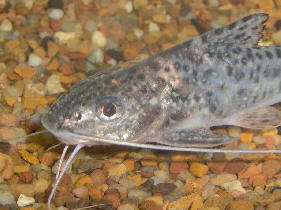
Mr. PICTUS HAS ? Like a game-show... Ich!
4/9/10
Hi Crew !
Mr. Pictus, here, has come down with something. This does not
look like run - of - the - mill Ick, to me.
<But it is... in a very high density stage... You need to
raise the water temperature very high, now... IF the other
livestock can take it to the high 80s F>
This appears more like he was dipped and rolled in cream of
wheat. It is raised and tan in color. And he is loaded
with it. This is the best pic I was able to get.
Most likely this has been stress induced. Last week I moved him
to a different tank. Tank mates were 4 Checkered Barbs and a pair
of Jewel Cichlids...The infamous Rhett and Scarlett. The Barbs
were the first to go in...left for two days, then Mr. Pictus was
put in and left for two days, then Rhett for two days, then
Scarlett.
When Pictus was put in he never quite settled in. Instead of
cruising he was zooming. I had him in there for a week and
couldn't take it anymore so I put him back in the other tank.
He zoomed for a day then went in his log and seemed ok but
yesterday he looked exhausted. He just rested his head in a
branch opening and had short but rapid breathing...not right for
him. Last night I moved his log to have a look see and found him
covered in this.
I moved him to the med tank. He had also broken his long whisker.
The whisker looks like he snagged it on something because it is
slightly bent at the point of the break. If he makes it will it
grow back?
<If not rotted too far back, yes>
I heard these Pictus are sensitive to meds
<This is so>
so how should I proceed.
I was trying to re-create the original conditions of when Rhett
and Scarlett were breeding.
BTY, New 55 gallon, Carib Sea Instant Aquarium substrate,
Established Emperor 400 HOB filter. Params ammonia and nitrate -
0, nitrate - trace, PH - 8.
<Too high for a Pimelodid>
Thanks again ! You guys are the best !
Sooz Vaughan
<Read here: http://wetwebmedia.com/FWSubWebIndex/fwichsenslvstk.htm
and the linked files above. Bob Fenner>
|
 |
|
Re: Mr. PICTUS HAS ?
4/9/2010
Hi Bob,
Mr. Pictus's whisker doesn't appear to have any rot but
is just bent slightly at the point of the break.
<Evidence of decomposition... call it what you will>
I kicked up the heat in the med tank where he is by himself.
Though I am still unclear as to do I use salt or not...just heat
?
<No salt on Pimelodids... read>
There is sooo much to read and Mr. Pictus is in such bad shape.
He already went belly - up while I was waiting for your reply. I
turned him right side up where he still is. This advanced stage
came up very fast as he was clean when I first put him in the new
tank and clean when I put him back in his old tank. ( I would not
have put him in the main tank if he showed any signs of Ick !
<Do take extreme care NOT to move anything wet from this
system to your other tanks... hands, arms included>
He just wouldn't settle in the new tank. Bam during the
course of a day he looked like this ! I'm glad I checked
on
him last night ! One of the Checkered Barbs is now showing little
icks on his tail (in the new tank ). Everyone in the old tank
seems to be doing business as usual. The Checkered Australian
Rainbows even mated -again- this morning. ( and a feast of caviar
was had by all ! LOL )
All of these fish had been together last fall ( Pictus ,
Checkered Barbs and the Jewel Cichlid pair ) until the Cichlids
babies hatched on New Years Day. I took Mr. Pictus out a few days
after the babies started coming out.
I pulled the carbon and put some QuICK Cure in the tank with the
Jewels and Barbs. I am going to hang loose with the main tank but
will watch it very closely.
Thanks a Bunch !
Sooz Vaughan
<Do keep us updated Sooz. Cheers, BobF>
Re Sick Pimelodid 4/9/2010
> Hello Bob,
<Hi Neale>
> I read your reply with interest. I was going to answer that
one, and felt it looked like Costia. Guess I'd have been
wrong.
<Actually... I/no one can/could be sure here... as usual w/o
microscopic examination... The symptomology are similar for
both... and some other Protozoan parasites of fishes... I really
wish there was a simple method of our describing, illustrating
the more common species, get more folks to purchase a cheap USB
'scope.>
> I am confused by your comment about not using salt with
Pimelodids. How can you treat Ick with just heat?
<Have done so many times... perhaps analogous to folks staying
in bed, elevation of their body temperatures effecting cures for
infectious diseases>
I didn't think that worked. For what it's worth, quite a
few Pimelodids enter brackish water in parts of their range,
including Pimelodus blochii and Brachyplatystoma vaillantii, so I
don't think the necessarily low salinity is likely to cause
harm.
<Mmm, how to put this Neale... Between you and I, and knowing
each of our backgrounds, I would choose to make "less
general" statements on a daily basis; but I have found on
the Net that it is very important to make "hard and
fast" statements to keep hobbyists out of trouble. I would
not expose Pimelodus/Pimelodella spp. to salts... particularly
the likelihood that many would/do choose NaCl... I assure you,
the high temp. suggested here, if applied in time, will effect a
permanent cure>
Certainly no more so than with clown loaches or Mormyrids, where
you'd use salt rather than copper.
<Yes>
> Cheers, Neale
<And you, BobF>
Re: Mr. PICTUS HAS ?
4/11/10
Hello Bob and Crew,
More observations on the broken whisker. It has been changing
rapidly in the last 24 hours. I can clearly see the rot now and
earlier this morning the other whisker began to rot as well.
Sorry to report Mr. Pictus has expired around noon today.
<Ahh>
On a side note to Neale (and a much happier one ) My Banjo Cat
was put in with the Guppies and a trio of Kuhli Loaches when last
he and I wrote. The Banjo Is really cool. He eats from my finger
now. Actually comes down
seeking the pellet. He has a good appetite and appears to be
doing fine. He has a very small territory. Seems to be no more
than a 6 " range from his shady plant. Of course I don't
know what he does when the lights go out but he's close to
his plant the rest of the time and not afraid to come out at chow
time.
Thanks once again for your input.
Sooz Vaughan
<Will share w/ Neale Sooz. Cheers, BobF>
|
FW Parasite problems (RMF?)<<>>
-- 3/30/10
Dear Crew Member
<Hello,>
I have several niggling health/parasite problems in my freshwater
aquarium. I have done much reading, much sifting through the WWM FAQs
and related articles, but I fear that now the information I have
gathered is beginning to diverge rather than converge, and was hoping
that you might be able to provide guidance on my next steps.
<Okay.>
I would like to begin by defending the tank itself. It is a sumped,
280L (73 US Gal) planted tank with soil underlayers in both the display
and sump. The lights are timed so that when the main tank is dark, the
sump is lit. Plant growth is excellent, and no fertilisers are added
(as per Walstad doctrine). I have never (yes never) registered any
ammonia, nitrite or nitrate in this heavily planted tank, and pH is
steady at 7.5. General Hardness is 4, while KH is the only thing that
fluctuates a bit between 4 and 6. Apart from the problems that I will
list, the fish are vibrant and feed well. In fact I have never seen
them so 'happy'. But:
<Sounds a good tank so far.>
My main concern is an aged Bolivian ram. I acquired this fish when it
was fully grown a year ago. Its symptoms are flashing (focusing on the
gill area), darting, shimmying, and flecks on its eyes. Sometimes its
skin looks a little shredded -- white lines from the back of the head
along the flank, as if it has been cat-scratched. But then this last
symptom will suddenly disappear, the flashing will calm down and I am
tempted to think that it has got over whatever problems it has. Except
they return.
<Right. Now, ruling out water quality issues (by far the most common
reason for chronic, low-level health problems with nebulous symptoms)
the things to consider are toxins, diet, stress and some type of
non-lethal parasite. Toxins could be things like paint fumes. Not a
common problem, but possible if the tank is near a workshop or garage.
Diet is generally not a major cause of problems with small community
fish, but dried foods do lose their nutritional value once opened, so
some care needs to be taken here. Stress can include behavioural
interactions. For example, one time I kept some large freshwater gobies
and had no idea why they constantly exhibited sores on their flanks.
Then I noticed the Otocinclus feeding on the mucous on these fish. One
thing many aquarists don't know is that Otocinclus are
semi-parasitic and view large fish as moving buffets, and if hungry
will scratch away at such fish, causing inflammations and excess mucous
production. Finally, there are mystery parasites. Farmed fish generally
come with predictable parasites such as Ick and Camallanus worms that
are common in fish farms and in tropical fish shops. But wild fish can
and likely often do come with low-level infections of non-lethal
parasites that we don't notice and so don't treat.>
Concern number two is the five Corydoras sterbai in the tank. They will
flash against the substrate.
<Typically implies irritation of the gills, e.g., by ammonia or
velvet.>
These were new fish added in the second month of the tank. One of them
has always had a white dusting on each flank (which I didn't notice
in the shop), and a stumpy, Nemo-esque pectoral.
<Genetic.>
This dusting is not Ich, and does not seem to change or shift. But they
are all feeding and growing well and otherwise happy.
<Possible velvet; would at least treat assuming it was, since no
harm will be done. Salt works well here. See here:
http://www.wetwebmedia.com/FWSubWebIndex/SaltUseFWArtNeale.htm
>
Problem number three is a very old Otocinclus that occasionally
'furs-up'. Every two months or so it looks as if it is in the
last stages of a fatal illness -- and then the next day any sign of it
has completely gone. Perhaps some sort of mucous excretion here?
<If the "fur" is off-white to grey slime rather than
fluffy, then sure, could be mucous. Commonly caused by what we usually
call Costia, or Slime Disease.>
The other three Otocinclus are fine, fat and have grown very well.
<Good.>
Problem four is my shoal of cardinal tetras. They have been with me for
over two years now, but currently seem to have some sort of grey-white
bean-shaped (like a tiny grain of rice) parasite that sits vertically
on their flanks. They flash now and again, presumably to try and
dislodge whatever these things are. The suspected oldest fish of this
shoal is the worst affected.
<Without a photo, it's difficult to say. Could be a Fish
Pox/Lymphocystis type thing, and in itself not fatal but a sign of some
environmental stress.><<More likely embedded Microsporidean
colonies... common, not treatable as far as I know>>
(Might age be a theme here? The ram, the Oto, the original tetras -
could this point to dietary deficiency? I feed frozen, recently opened
flake food, and crushed algae and cichlid pellets.)
<Sounds good.>
It is a similar case with the marginatus Pencilfish that I acquired
(about the same time as the C. sterbai) -- the same tiny flattened
rice/bean on their flanks, almost as if they have swapped one of their
scales for a discoloured one. Could they have in fact lost scales for
some reason from an invisible parasite, rather than the mystery bean
shape being the parasite itself?
<Possibly.>
Other inhabitants that are unaffected are 2 glass blood-fin tetras, 10
Boraras brigittae and 1 female Apistogramma trifasciata. The tank is
also home to 2 Nerite snails, Malaysian trumpet snails, 'small pond
snails', Amano shrimp, cherry shrimp, and other unidentified
shrimp.
<All these invertebrates will likely be killed by copper-based
medications, so be careful how you treat the tank.>
I must point out that the ram, the cardinals and the blood-fins had a
similar parasite in a previous incarnation of this tank. When I added
the sump, I was able to isolate them, cook them at 30'C and treat
heavily with copper. Whatever it was appeared to clear completely.
<Good. However, do consider that moving them to another tank was the
cure, rather than the copper. If the Otocinclus are attacking other
fish, then separating them will help the victims heal. If there's a
toxin of some sort in the display tank, the hospital tank can provide
relief. In other words, be open minded.>
However, all plants were transferred to the new tank (despite sitting
in a bucket for a week with a double dose of copper treatment), as were
the shrimp, who spent time in a separate tank with the micro-Rasboras
(who appear completely immune to whatever this is). Perhaps this
parasite survived either via the plants, or the shrimp. Problems
started again before the micro-Rasboras were added, so they can be
excluded as the main cause.
<OK.>
I must state that I do not believe this to be a water quality or
husbandry fault (apart from a lack of quarantine on my part, mistakes
in transference etc). To repeat, I have never tested anything amiss in
this tank, and all species should be fine within the water parameters,
and with each other. There is no overt aggression in the tank. I think
I introduced new pathogens either by not quarantining new stock (which
I certainly will in future), or letting old ones ride in on the shrimp
(or in the shrimp).
<Shrimps won't carry parasites as such, but any wet object,
including shrimps, can carry the free-living stages for a period of
time, perhaps a day or so.>
So unfortunately these parasites are there now -- but can you help me
ascertain what they are and recommend a course of action? Already I
have raised the temperature to 29'C (84'F) and have added a UV
sterilizer, although this does not appear to have made a significant
impact.
<It won't. UV is good at reducing the prevalence of free-living
parasites, but by itself it's almost never the cure.>
From my research so far I'm thinking that it could be Costia,
Chilodinella, Icthyobodo or some sort of fluke, or a combination of
these -- but quite honestly I don't have a clue.
<Costia (= Icthyobodo) is a good guess for "slime disease"
type things.>
I have not yet added a treatment, as most of them look to be
shrimp-killers, and to be frank, apart from a bit of flashing, the fish
have been generally fine. But obviously I wish to eliminate the
pathogens from the system, and the ram's discomfort is evident
enough to now be worrying.
<Yes.>
In terms of stages I would like to 1) try temperature raising to
30'C and UV sterilization
<Warming the water can speed up the life cycle, but it can also
stress certain fish, so balance the two things.>
2) perhaps (although I'm not keen) try adding salt (would this help
if it were flukes? -- opinion seems divided)
<Salt is a low-risk approach for treating Velvet and Ick. To treat
Costia requires high salinity dips and a somewhat higher salinity in
the tank, so while low risk in itself, it has to be done properly. Salt
water dips can help treat flukes. Do read here:
http://www.wetwebmedia.com/FWSubWebIndex/SaltUseFWArtNeale.htm
>
3) trying a shrimp-friendly anti-parasite medication (Praziquantel --
if I can get hold of it here in the UK)
<Yes, you can get this from a vet. I would treat the fish in a
hospital tank and leave the tank fallow for a while. Alternatively,
keep at least some shrimps and snails in their own tank in case the
ones exposed don't survive.>
and finally the last resort of 4) resorting to a formalin and
copper-based medication.
<The nuclear option!><<I would NOT do this>>
Other options I have considered are moving the shrimp to a spare 40L
tank and treating the main tank. However, what would I do with the
shrimp then?
<Once isolated for a few days, shrimps shouldn't carry any
viable fish parasites at all, provided they really are isolated. That
means taking care not to mix nets, buckets or anything else that could
bring more free-living parasite stages into the shrimp tank. Do review
the literature here at WWM re: treating marine whitespot in reef tanks;
essentially you're doing the same thing here.>
How long would they have to be in isolation to be guaranteed parasite
free?
<In theory things like Ick can live without a fish host for a day or
two, but in practise you want to leave the tank fallow for a couple of
weeks at least. Again, refer to the marine articles on this
topic.>
Alternatively, do I cram all the fish (if I can catch them - Sheesh I
do not look forward to that afternoon) in the 40L, blitz them with
heavy meds and leave the main tank and shrimp fallow?
<Could work, though 40 litres would be a bit tight. Try using 5
gallon buckets with lids if you need extra "tanks". If you
add a heater and filter of some sort, these can work fine for a
week.>
Would this work or will the pathogens hide in the substrate?
<They can't hide indefinitely, and there really is an expiration
date of sorts on the free living stages of most parasites.>
This tank will one day become a reef tank, so avoidance of copper in it
would be preferable.
<Indeed.>
Any insight you can offer would be much appreciated.
<Hope this helps.>
I apologise for the length of this query. Let me finish by saying that
WWM is by far the number one web resource I know of for problem solving
- I have used it to research two unrelated issues already, with
excellent results. Your generosity with time and information is, quite
frankly, no less than a credit to humanity! So big thanks.
<Kind words indeed. Cheers, Neale.>
Yours
Joe
Re: Parasite problems (RMF?) -- 3/31/10
Hi Neale
<Hello Joe,>
Thank you for your excellent, attentive response. I am enlightened on
several issues, and corrected on my diseases! I hope you don't mind
me coming back at you with a couple of points/queries.
<Fire away.>
Firstly, I've read your article on salt use, and I will give it a
try, on the basis of treating velvet. For optimisation, I assume I keep
the UV sterilizer on at this stage?
<Can't hurt.>
Secondly, I did not know that Otos could go that way. I have not
observed this behaviour (despite occasionally observing the tank at
night with my rear bike-light), but will remain vigilant. When this
condition was previously 'cleared' the Otos were in the same
tank as everyone else - so I think they might have an alibi on this
one.
<Not saying the two things are connected, but I wouldn't trust
Otocinclus, period, and that's based on witnessing the havoc they
can cause.>
Thirdly, I am sorry to say that today I noticed that both the Apisto
and the blood-fins have now started flashing. I am certain that they
try and scratch their gills. All of them - they are all trying to
scratch their gills - it is gills, gills, gills - this I would strongly
bet on. So from what you wrote I would assume that you would think this
is indicative of either a) ammonia b) a toxin or c) velvet?
<You can't tell which of these. So has to be a process of
elimination. Test for ammonia; consider possible toxins; treat for
velvet.>
I feel confident I can discount ammonia - as soon as a problem arises
my tests kits get used - sometimes several times a day, sometimes late
at night. I use different test-kits, and have the water tested at
different fish shops. Never anything amiss.
<Good.>
Regarding toxins, I (and my family) are very careful around the tank,
concerning cleaning products etc. I would have thought that if there
was a toxin in there, all fish would be immediately irritated, rather
than this progression of irritation, that is currently leaving the
micro-Rasboras unaffected.
<Yes and no. For example, air-breathing fish (like Corydoras) are
going to be more sensitive to airborne pollutants than other types of
fish. Then again, some fish are intrinsically more resistant to poisons
than others.
To give a textbook example, among marine fish Opsanus tau is famous for
being able to live and breed in harbours where virtually everything
else has gone. So there are shades of grey here.>
When I added the fish back to the tank (after their stay in a holding
tank where they were treated) there was no sign of any flashing for a
few weeks - possibly even nothing before I added the C. sterbai. Is
there any other avenues I could pursue to discount a toxin being a
problem?
<Could be air, could be errant children (not to be ignored, this,
how I lost my first goldfish as a boy), and also things in the tap
water, e.g., chloramine if not treated for, or copper, if not treated
for.>
I worry there isn't. As a long shot, could smoking (in the garden)
and then feeding fish somehow put toxins into the water?
<Can't see how.>
But again I would expect a non-gradual progression of irritation -
blanket irritation if you will, rather than this flashing behaviour
moving slowly from fish to fish. What do you think on this
reasoning?
<Yes, it's what you'd expect. But the thing with biology --
as opposed to the other sciences -- is that there are always
exceptions.>
So I will try the salt approach at 2g/l. While I have you Neale - this
is probably a no-brainer, but do I go with cheap table salt, or should
I give them some Maldon?
<If using salt from the grocery store, then I would use, and have
used, rock sea salt or better still kosher salt (which doesn't have
any additives at all). But ideally, use aquarium/tonic salt -- not
marine salt mix. The cost difference will be trivial, and perhaps worth
it for peace of mind.>
Thanks again
<Pleasure.>
Yours
Joe
<Cheers, Neale.>
|
Re Rosy Tetra Following - Please Help (RMF, any better
guesses?)<<Mmm, no>> 11/28/09
Hi again,
<Hello Chris,>
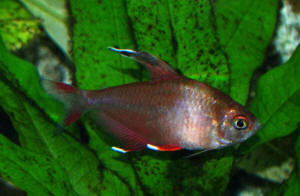
Please see photo of my rosy tetra, attached. As a follow up to my
last email (below), I'd been having concerns about my Rosy
Tetras. Since then I've been watching and have seen no
bullying, the three have been hanging out together and eating
well, though still their colouring was lighter than usual.
<Usually a bad sign with these fish. Like a lot of South
American tetras, Rosy Tetras have colours that can change with
mood and health.>
Last night all 3 seemed okay, all ate and were swimming fine.
This morning one was dead, with a thick white band on its body. I
looked at my other two and am upset to find that a second looks
like he is in bad shape. He has a white band as well (see photo).
It is also protruding but that is hard to tell in the photo. He
is swimming but didn't eat today.
<Likely sick.>
I am also starting to see what looks like the start of a white
patch on my third though not as advanced. He is eating and
swimming fine. My other fish are showing no signs of this
thankfully.
<May be specific to the Rosy Tetras, e.g., a virus or
protozoan parasite. A parallel could be made with Pleistophora
hyphessobryconis, what we call Neon Tetra Disease although it can
affect related small characins as well.>
I have a 4 gallon quarantine...should I move both fish to it
using cycled water and filter medium, and if so, is there
anything you can suggest I do to help them (temperature,
medication?).
<If this is something analogous to Pleistophora
hyphessobryconis, there's no real cure beyond removing (and
euthanising) sick fish to prevent cross-infection. Typically
Pleistophora hyphessobryconis works its way through all the Neons
(or whatever) in the system, and then dies out without harming
unrelated fish (catfish, livebearers, etc.).>
Any idea what this is? And should I move both of the tetras
(concerned about bullying in such close quarters by the healthier
one).
<I'd destroy any sick fish that aren't feeding;
they're unlikely to get better.
http://www.wetwebmedia.com/euthanasia.htm
>
I do weekly water changes, Nitrite and Ammonia are 0 and Nitrates
are between 8 and 10. As below, it is a 20 gallon tank.
Thanks so much! Chris
P.S. One thing I noticed is that my tank temperature has gone
from the usual 78 to 75, though I would have thought this might
help since they like cooler water. I am trying to regulate the
temperature now, as this fluctuation has never happened
before.
<Can't see relatively small temperature changes like this
causing problems.
Sorry can't offer anything more helpful. Cheers,
Neale.>
|
 |
|
Follow up - It's wide-spread now - Please Help
12/2/09
Hi Neale/Crew:
<Hello,>
Well, things have gone from bad to worse. Since writing the email
below on Saturday, I've lost all 3 of my Rosy
Tetras but it doesn't stop there.
<Oh dear. This really does sound like some type of highly
contagious pathogen akin to Pleistophora
hyphessobryconis.>
When I came home yesterday one of my red phantom tetras seemed to
have pop eye in his right eye, just starting. I watched every
fish closely last night and everyone ate and was full of energy,
even him.
<Hmm...>
When I came home tonight I went to check on the red phantom with
pop eye and found another red phantom had died (had no pop eye,
no visible symptoms). He had appeared 100% normal last night. I
was then shocked to
also find a dead swordtail - again, 100% normal and pushing his
way around to get food last night as usual - very active and
nothing unusual on his body.
<Oh dear.>
Now two of the four remaining tetras appears to have pop eye. The
other two seem okay. I have two remaining black skirt tetras that
appear okay.
<Oddly, Pleistophora hyphessobryconis doesn't affect all
tetras, even while it *can* infect distantly related fish such as
Angels and Goldfish. So you can get some very odd situations were
Cardinal tetras don't get Pleistophora hyphessobryconis, but
Neons do. It may well be that your Black Widows are resistant,
unlike the Rosy tetras. I'm not 100% sure that you're
dealing with Pleistophora hyphessobryconis -- though the loss of
colours, swelling, and then death are consistent -- but there may
be some other, highly contagious Sporozoan at work here.>
Six Cory catfish appear fine, one (Elegans) is appearing sluggish
tonight.
My Farlowella and 5 little Oto cats seem okay.
<I would be surprised if your catfish succumb to the same
thing, but as stated above, distantly related species have been
infected with Pleistophora hyphessobryconis even though it's
normally considered a disease of Neons. That said, I've found
Corydoras elegans to be one of the more delicate species in its
genus.>
I did my weekly water change last night because I was concerned
about the pop eye, tested water levels an hour later and they are
still great.
Ammonia 0, Nitrite 0, Nitrates around 8. That is constant for my
tank.
Water temperature did not change, and I used chlorine remover in
the water as always.
<Cool.>
It hit me that a while ago I introduced 2 elegans Corys to my
tank. One was lethargic from the get-go, the other was very
active but died two days later. I had assumed at the time they
died from the stress of travel. I think what I've learned is
a very painful lesson in not quarantining, unless there is
something else in my water that I should test for. I also
introduced a plant about two weeks ago but not sure if that can
cause problems?
<Right... this may well be the issue. My experience of
Corydoras elegans was not dissimilar, having "rescued"
two lonely looking specimens sitting in a tank at my local garden
centre. A few days after buying them, they were both dead. I do
wonder if this species is a host for some type of microbe that,
under certain circumstances, can cause problems. I will add
though that even though they shared a tank with some Peppered
Corydoras, those Corydoras remained perfectly healthy; indeed, I
still have them and every year they present me with another batch
of baby catfish. So whatever it is that Corydoras elegans may or
may not carry, it doesn't necessarily affect other catfish.
As you say, quarantining is always important.>
Please help...I know that I will likely loose more fish by
tomorrow if not sooner. Should I medicate the tank, and if so
with what? I am very concerned that medication will hurt or kill
my catfish (cories and Farlowella).
<So far as I know, Sporozoans are very difficult to cure. Your
best bet is to remove any infected fish on sight, and humanely
destroy them. Done ruthlessly, this can sometimes stop the cycle
of reinfection.>
Thanks as always for any help you can provide - I am at a
loss.
<These sorts of infections are rare but always frustrating. I
can't begin to tell you how many Neons I've lost (or seen
others lose) because of Pleistophora hyphessobryconis. For all my
(supposed) skills at fishkeeping, Neons are the one species
I've never been able to maintain. In other words, usually
what happens is you let the infection burn itself out, removing
any infected fish and adopting a wait-and-see approach towards
the others.
Typically, the fish that survive are resistant, so no medicating
is required. It's debatable whether the pathogen can remain
dormant in a tank with no suitable hosts, and if it can, for how
long. But I'd tend to err on the side of caution and not add
any more specimens of any species that succumbed in the
past.>
Chris
<Cheers, Neale.>
Re: Follow up - It's wide-spread now - Please Help
12/2/09
Sorry, a bit more info if this will help.
<Fire away.>
I checked PH just now and it is right where it has always been
(in the "ideal" range).
<Which is? For most community fish, around 7 to 7.5 is the
ideal. Below pH 7.5, biological filtration works less
effectively, and below pH 6.0 it doesn't work at all. So I
tend to recommend people keep the pH just above
7, even in situations where acid-loving species are being kept
*unless* acidic pH levels are critical to their health (as with
Ram cichlids for example).>
I don't know what else to test - everything is fine. I think
my Elegans is okay, as he is active now. I might have caught him
during a rest.
<Cool.>
My two red phantoms definitely have pop eye but are active. I
have noticed the one who had pop eye last night seems to have it
a bit worse today.
<Would isolate these in another tank, and realistically,
euthanise them.>
I've just examined every single fish and there is not a
single symptom I can see. No loss of colour, fins are not clamped
or torn, no white spots, no fungus. Nothing is visible other than
the two with pop eye. All are active and eating.
<For Pleistophora, and perhaps other Sporozoans, the main
transmission mode is when healthy fish peck at weak/dead fish, so
it's important to isolate sick fish from the healthy
ones.>
That is also how it was last night which is why I'm shocked
that my sword and tetra, who appeared in perfect condition and
were active and feeding were dead today.
<Oh.>
I should also mention that none of my fish was dead for very
long, in fact most of them that had died in a breeding trap.
<Would not use a trap. When isolating these fish, you
absolutely should isolate them: another tank, and with nothing
moving between this tank and the display tank. Euthanasia is
often more practical.>
If one looked bad in the evening I would place him in the trap so
the others couldn't consume the body in the event he died
overnight. I had hoped this precaution would prevent any further
contamination.
<It won't; circulation of water through the trap into the
tank will allow pathogens to spread.>
Finally, my tank is well established and I have had no real
problems with water quality or fish loss in the 2+ years it has
been running.
<Cool.>
I hope this additional can help you help me! Thanks again for
your thoughts.
Chris
<Cheers, Neale.>
Re: Follow up - It's wide-spread now - Please Help
12/2/09
Hi Neale,
<Chris,>
Thanks very much for the prompt response.
<Not a problem.>
As expected, when I checked the tank first thing this morning I
could barely tell apart the 4 remaining red phantoms from the 2
black skirted because all have lost all colour. They are
essentially transparent now. I have moved them to another
tank.
<Sad news.>
I've noticed that the tail of my remaining sword has a tiny
little bit of raggedness on the tip (barely visible) which
wasn't visible last night so I'm watching him
closely.
<Do so; while I'd be surprised if he caught the same
pathogen as the tetras, it's not impossible. The symptom you
describe sounds more like physical damage, or possibly Finrot,
though this latter isn't common in well run tanks.>
Otherwise he was happily devouring a catfish pellet this morning
and was active.
<Good.>
Thankfully all cories, the Farlowella and the Oto cats seem
great, in fact they seem to be enjoying the new-found space.
<Also good news.>
The only positive in this is that the fish seem to be succumbing
very quickly - it doesn't appear to be a slow decline so
hopefully they aren't suffering too much.
<This is actually a typical characteristic of Sporozoan
infections: by the time symptoms are visible, the fish is days
away from death.>
One question - should I be doing 10% water changes more
frequently than once/week to try to remove the pathogens, or keep
to the weekly schedule?
<You aren't going to "dilute" the pathogens, so
for the sake of simplicity, I'd stick with the usual 25%
water changes per week.>
Thanks again, Neale!
Chris
<Sorry I can't offer anything more helpful. Cheers,
Neale.>
Re: Follow up - It's wide-spread now - Please Help
Thanks again, Neale.
Even though the news isn't great, your support is very
helpful. I'll focus now on hoping the remaining fish
survive.
Chris
<Good luck with it! Cheers, Neale.>
|
|
FW Parasites? (RMF, second opinion on the photos)
10/20/2009
Hi Crew:
<Hello Carla,>
During the past couple of months, one of my tanks has been
experiencing numerous fish deaths resulting from what appear to
be bacterial infections. The first to succumb was a White Cloud
(Tanichthys albonubes). The next five were all Threadfin Rainbows
(Iriatherina werneri). The symptoms would begin with a small
whitish spot on the body ringed with red, then over the course of
7 - 10 days, the spot would spread, and I would begin to see
bright red streaks around the eyes, gills, and/or base of fins
(which I believe is a sign of septicaemia).
<Can certainly be the case. Can also occur as a reaction to
environmental stress, the equivalent of sunburn or chemical burns
on humans. All the redness means is that superficial blood
vessels have become expanded or congested.>
I also occasionally saw stringy white feces on some of the
fish.
<Again, this can mean a variety of things, from constipation
through to Hexamita infections.>
At this point I would euthanize the fish with clove oil, but on a
couple of occasions the fish died on their own. The deaths
occurred one after another, not concurrently, with usually a
couple of weeks between deaths.
<I see.>
At the first sign of infection, I would transfer the ill fish to
my 10-gallon hospital tank, and, since I don't have much
faith in antibiotic baths, treat with either Metronidazole mixed
with food, or Jungle Anti-bacterial Medicated Fish Food (Sodium
sulfathiazole 2.3%, Nitrofurazone 0.13%). (The fish were still
eating well during the first week or so after infection.) This
treatment had no effect.
<It's worth mentioning that while antibiotics can help
with some (mostly opportunistic) infections, there are some
primary infections, such as Mycobacteria, that are essentially
untreatable.>
I realize that most bacterial infections are a sign of poor water
quality, and this has me puzzled, because I am fussy about my
fish. The Threadfins were even spawning within days of getting
sick.
<Interesting.>
Parameters are as follows:
-40 gallon tank
-Ammonia: 0
-Nitrite: 0
-Nitrate: 0 (heavily planted)
-pH: 8.0 - 8.2
-Temperature: 25 C
-Hardness (my KH/dH test kit is in the mail, but according to our
City's water quality report, the water is very hard).
-Remaining tank mates: 3 Black Mollies, 5 Dermogenys pusilla, 5
Cherry Shrimp, 1 Threadfin Rainbow (the last one), 1 White Cloud
(also the last one), 1 Scarlet Badis.
-15% weekly water changes (I don't do the usual 25% because
of the Halfbeaks' sensitivity to water chemistry
changes).
<Fair enough.>
Since I feel my water quality is good (although perhaps the pH is
too high for Threadfins and White Clouds?),
<Yes, your pH/hardness is a bit high, but in itself, this
shouldn't be killing them.>
I thought perhaps a parasite was responsible for making the fish
vulnerable to bacterial infections. I do on occasion see the fish
flash, although oddly, never the Threadfin Rainbows. There was
never any sign of Ich or Velvet. So I pulled out my old
microscope, and took skin scrapings and gill samples of three of
the deceased Threadfin Rainbows. Since I really had no clue what
I was doing, the results of the first two fish I examined were
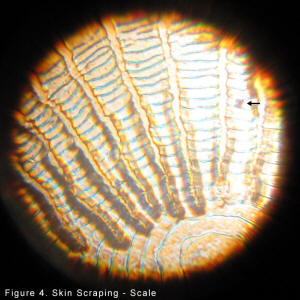
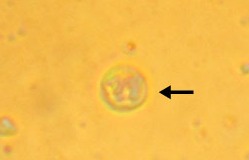
"inconclusive." However, by the third fish, I felt I
had enough practice to get an acceptable wet-mount and take a few
rudimentary photographs. I would really appreciate it if someone
could take a look at the attached photos and determine if there
is anything suspicious. I have placed arrows near things that
look suspicious (to me), but I have no experience with this and
they could well be normal microscopic detritus.
<Indeed. I am not a microbiologist. I've asked Bob to
chime in here. While "scinscraping1.jpg" and
"scinscraping2.jpg" have circular cells in them
reminiscent of the Whitespot parasite Ichthyophthirius
multifiliis, I'm not enough of an expert to confirm that
either way. I will make the point here that both Whitespot and
Velvet are dangerous precisely because they break the skin and
make the fish vulnerable to secondary infections.><<Does
appear to be Ichthyophthirius... RMF>>
Please note that my microscope is a very inexpensive unit, and
probably not very good, and I took the photos with my digital
camera stuck up against the eyepiece, so the quality of the
micrographs is not great.
<They look great to me!><<To me as well.
RMF>>
If you have any tips to pass along to improve my microscopy
skills, that would be great!
Thank you so much, and thanks to all the crew members who take
the time to help aquarists and their charges!
Carla
<I can't offer any easy diagnosis here. I'd do a
couple of things myself though. Firstly, I'd not buy either
of these fish from that particular retailer again. Or at the
least, not from the current batches. Obviously both White Clouds
and Rainbowfish need to be kept in schools, but I'd sooner
leave them as singletons for now than risk mixing them with any
more possibly infected fish. I'm saying this because it's
possible that whatever is killing your fish came in with these
newcomers. If you can get some of these fish from a new batch a
few months from now, or immediately from another retailer, then
that might be an option. Either way, I'd buy one species at a
time, and quarantine them for, let's say, a month in the 10
gallon tank. I'd maintain that tank as per treating
Whitespot, i.e., heat (28 C/82 F for the White Clouds, and 30
C/86 F for the Rainbows) plus a little salt, 2 to 3 level
teaspoons of salt per gallon. This won't stress the fish at
all, but will help deal with any Ick or Velvet parasites. After a
month, it should be clear whether the fish are healthy or not, in
which case, you can move them to the display tank. Hope this
helps, Neale.>
|
 |
|
Re: FW Parasites? (RMF, second opinion on the photos)
10/21/09
Neale and Bob,
thank you so much for your reply.
<Neale is "marked out for Weds." Will share>
I suppose that one cell does rather resemble Ichthyophthirius.
That would explain the flashing. Is there a strain of Ich that
can cause a low-level, long term (2+ months) infestation, and
would the Ich be hiding in the gills?
<Yes and possibly yes>
I've always assumed if Ich was left untreated, the fish would
rapidly become covered with parasites and die.
<Mmm, not so... can be resident as a low-infectious
population... Triggered to infection, hyperinfection by
circumstances... weakening of host/s>
Although I have read that fish previously exposed to Ich (which
almost all my fish were when I first acquired them), have some
resistance to it.
<This seems to be the case>
I plan to eradicate the Ich using the salt/heat method, then
convert this 40-gallon tank to low-end brackish for the Mollies,
Halfbeaks, and Cherry Shrimp. I can move the Scarlet Badis to my
heavily-planted 10-gallon (which houses one male Betta splendens
and one rogue baby Molly who was banished here because she
insisted on pick, pick, picking at my Halfbeaks).
I'll then re-home the Threadfin Rainbow and White Cloud with
other aquarists who already have schools of these. Then, Neale,
I'm going to order your "Brackish Water Fishes"
book and decide on a shoaling fish and maybe a few little
oddballs for my brackish tank!
<Is a worthy read>
I will follow your advice and quarantine for a month (I usually
quarantine for only two weeks) and treat as for Ich with
heat/salt.
Thanks again!
Carla
<Welcome Carla. BobF>
Re: FW Parasites? 10/21/09
Neale and Bob, thank you so much for your reply.
<Neale is "marked out for Weds." Will share>
<<I'm back today, though!>>
I suppose that one cell does rather resemble Ichthyophthirius.
That would explain the flashing. Is there a strain of Ich that
can cause a low-level, long term (2+ months) infestation, and
would the Ich be hiding in the gills?
<Yes and possibly yes>
I've always assumed if Ich was left untreated, the fish would
rapidly become covered with parasites and die.
<Mmm, not so... can be resident as a low-infectious
population... Triggered to infection, hyperinfection by
circumstances... weakening of host/s>
<<I agree with Bob here. I simply don't believe the old
story of Ick "lying dormant" in the gravel for months
or years, and then suddenly attacking.
Much more likely that healthy fish have immune systems that keep
chronic infections at minimal levels that cause no harm, much
like E. coli and humans. It's only when something goes wrong
in the tank, and the fish's immune system collapses, that the
formerly small Ick population multiplies dramatically.>
Although I have read that fish previously exposed to Ich (which
almost all my fish were when I first acquired them), have some
resistance to it.
<This seems to be the case>
I plan to eradicate the Ich using the salt/heat method, then
convert this 40-gallon tank to low-end brackish for the Mollies,
Halfbeaks, and Cherry Shrimp.
<Should work grand. Only a very low salinity is required,
1.002 to 1.003, and you'll find virtually all plants will
thrive under such conditions.
It's such a low-cost, no-brainer approach for keeping Mollies
I fail to see why people resist keeping Mollies in such very
slightly saline conditions.>
I can move the Scarlet Badis to my heavily-planted 10-gallon
(which houses one male Betta splendens and one rogue baby Molly
who was banished here because she insisted on pick, pick, picking
at my Halfbeaks). I'll then re-home the Threadfin Rainbow and
White Cloud with other aquarists who already have schools of
these. Then, Neale, I'm going to order your "Brackish
Water Fishes" book and decide on a shoaling fish and maybe a
few little oddballs for my brackish tank!
<Is a worthy read>
<<Kind of you to say so, Bob; Carla, hope you enjoy
it.>>
I will follow your advice and quarantine for a month (I usually
quarantine for only two weeks) and treat as for Ich with
heat/salt.
Thanks again!
Carla
<Welcome Carla. BobF>
<<Good luck, Neale.>>
|
I really don't think it's ich Hi, I'm
writing about a problem with my Pleco. I bought a clown Pleco recently
and put it in my tank, and a few days later noticed a few white bumps
on his body. I don't think it's ich... I've had fish with
that before, and ich looks like sugar or salt sprinkled on the body,
right? <Usually, yes> This looks more like he has warts.
They're about the size of his eye or larger. I read up to see if it
was a fungus, but all the stuff on fungus described it as
"cottony"...and this isn't cottony, it's smooth.
Yesterday it spread to our loaches... I don't know what it is, so
I'm not sure how to treat it. On that note, though, all I have in
the tank are Cory cats, upside-down cats, loaches and the one Pleco. So
would I need a special medication, since they're all scaleless?
<I would treat this as it has spread... and may well be parasitic in
nature... with a less toxic "ich" medicine (are good for most
all external parasites) at half dose, raising your water temperature to
the mid 80's F., and possibly adding a teaspoon of salt per five
gallons of water (okay for Corydoras at this concentration) over a
period of three days> It's a 55-gallon with an undergravel
filter, if that helps... Thanks for your help, Sarah <Does help. Do
monitor your nitrogen cycle and have new water available in case you
need to change... Bob Fenner>
Discus with Hexamita? - 02/02/2004 Please help...I don't
want to lose me discus fish. I have been treating with rid-ich for 5
days now. The ich is almost gone, but the fish have developed cloudy
eyes, a whitish clear coating on their bodies and ragged fins. <This
sounds perhaps like "skin slime disease" - caused by
protozoan parasites, likely Hexamita, or possibly Ichthyobodo (Costia),
Childonella, Trichodina.... All should respond favorably to
Metronidazole administered in food. Metronidazole can be found made by
Aquatronics (Hex-a-Mit, green or blue box) and by Seachem (simply
Metronidazole).> I have a 55 gallon aquarium. Temp is at 86 degrees.
Nitrates, nitrites and ammonia are ok. Ph is at 7. I've been doing
a 20 - 25% water change daily, and I added 8 tablespoons of aquarium
salt to the water. Please let me know what else I should do.... <A
good start - and may in and of itself effect improvement or cure. I
would still treat with Metronidazole in food.> Thank you sooooo
much, Anna <Wishing you well, -Sabrina>
|
|