FAQs on Malawi Cichlid
Systems
Related Articles: Malawian
Cichlids: The Mbuna and their Allies By Neale Monks, Stocking Lake Malawi Community
Tanks by Mary Bailey, Malawi Peacocks, The Genus
Aulonocara by Mary Bailey, Tanganyikan Cichlid Systems, African Cichlids, Dwarf South American Cichlids, Cichlid Fishes,
Related FAQs: African Cichlid Disease 1, Cichlid Disease, Cichlid Disease 2, Cichlid Disease 3, African Cichlids in General, African Cichlid Identification, African Cichlid Selection, African Cichlid Behavior, African Cichlid Compatibility, African Cichlid Systems, African Cichlid Feeding, African Cichlid Reproduction, Cichlids of the World, Cichlid Systems, Cichlid Identification, Cichlid Behavior, Cichlid Compatibility, Cichlid Selection, Cichlid Feeding, Cichlid Disease, Cichlid
Reproduction,
|
|
About to give up; Mbuna stkg., beh., disease f's
4/4/20
Hi there,
<Hello.>
It was suggested that I forward you guys a post I put up on
cichlid-forum.com today, in hopes you may offer some advice. Here it
is. Thank you.
<Sure.>
Hey guys, new here. Been keeping fish for about 20 years and am so
frustrated the last year or so I’m about to abandon ship. I’ll try
to give the full story. About a year and a half ago I had a thriving
75 gallon Mbuna setup. Beautiful tank with happy fish. Then, I got
the bright idea to upgrade to a 125 gallon and have had problems
ever since.
<Oh dear.>
During the move about a year and a half ago, a couple of the fish
got stressed obviously but all made it until one came down with what
I believed to be columnaris or fin/mouth rot.
<I am glad you've made the connection between stress and disease.
What I'd further throw into the mix is social behaviour. Mbuna
operate best when overstocked. That's because no one fish can
actually secure a territory, and paradoxical as it might seem, the
fish are more aggressive when they hold a territory than when
they're trying to claim a territory. Net result, overstocking
doesn't stop aggression, but it does dial it back. In the wild, the
fish live in huge numbers and have the space for weaker fish to be
pushed out into less desirable areas where aggression is less. For
sure those fish won't be able to breed, but they aren't outright
killed. In captivity, the weaker fish can't do that. Anyway, if your
fish had been overstocked in 75 gallons, and you switched them to a
new, bigger tank, two things would happen. First, all the
territories would be disrupted, so they'd all be struggling to claim
a patch. Secondly, with more space, it's easier for more aggressive
individuals to claim and hold a territory. Their aggression would go
up a notch now, because they'd switch from "house hunting" to
"actively attracting a mate", and that means they'd be even more
aggressive than before. At least, this is how I understand it!>
It quickly spread and I vigorously tried everything to cure my
beloved Mbuna. After a long battle and numerous antibiotics and
treatments, the majority died and the few remaining were horribly
sick and I euthanized them. At that time I took down the entire tank
and cleaned everything and drained it completely. It all sat in my
garage completely empty in -30 degree weather as I live in
Minnesota.
<Well, that should deal with any parasites, but bacteria are well
able to go dormant through such cold, especially if dry.>
Now, a year and a half later I just set up the 125 gallon again and
performed a fishless cycle using Dr. Tim’s ammonia. Cycled in about
a month, and conditions were pristine. Nice hard water, ph around
8.5, no ammonia or nitrites obviously and very low nitrates. Temp is
a steady 77 degrees. I introduced 20 Mbunas from <vendor name
removed> on Tuesday this week. They all appeared healthy but took
cover as expected. None would eat or come out and now it is day 3
and same story. However, upon closer inspection tonight it appears
that several of the fish have symptoms of the columnaris or fin rot
yet again. Could it be that the crap survived on my rock or tank
walls with no water in sub zero temps for over a year?
<Bacteria? Yes. Bacteria are not killed by cold (hence why freezing
food delays spoilage, but doesn't stop it). Furthermore, the
bacteria involved in Finrot and Columnaris are opportunistic and
latent in all aquaria. There's really nothing you can do to stop
them getting into the tank. Even a course of antibiotics diminishes
them, and allows the fish's immune system to clear them out of the
fish's body -- but they will always be present in the aquarium. If
nothing else, their spores get into the tank from our hands, from
the air, likely even in new water unless we're sterilising buckets
and pipes each time we use them.>
I just don’t believe that is possible. I’m so incredibly frustrated
that I’m considering just giving up on the hobby. <vendor name
removed> will refund my money but that’s not the point. I just don’t
get it. Any help or advice would be greatly appreciated. Thank you
<When it comes to this sort of mass death, my gut reaction is to
leave the tank running, fallow, for a couple of weeks. This will
break the life cycle of many parasites. I'd carry on adding fish
food, of course, to give the biological filter something to work on.
A bit of fish fillet or a prawn works just as well, decaying away
over the days, releasing ammonia for the filter bacteria (nitrifying
bacteria) and keeping the good bacteria that start the decay process
(ammonification bacteria) happy as well. If you have a tank where
plants are suitable, and there are plants in Lake Malawi, these are
really helpful too, because they bring in lots of good bacteria on
their leaves and roots. They also help balance the tank a bit,
removing waste and providing a bit more oxygen. Anyway, either way,
let the tank sit for a while. Then sit down and be realistic about
things like water chemistry, water quality, and the frequency of
water changes. I don't often recommend carbon, but if you've had a
mass die-off, the use of carbon (replaced every few days) is one way
to remove dissolved organics that might have been toxic, such as
paint fumes. Even better are the high-end chemical adsorbents like
Purigen. Basically, treat the tank as if it had fish, but do your
best to clean it without killing off the good bacteria. Now, after a
couple of weeks, think about introducing a few fish. Obviously pick
robust species, but the key things with Mbuna are to choose the
least aggressive species first, working upwards through the pecking
order. Juveniles often (always?) travel better than adults, but the
flip side is sexing juveniles can be hard. Finally, and this can be
a bit brutal, if you've utterly failed with one group of fish --
perhaps they aren't the right ones for your water chemistry,
time/budget, etc. Maybe think if some other type of fish might not
be easier. In a big tank, Aulonocara for example might well be a lot
easier to keep than the more aggressive Mbuna, or there may be some
Haplochromis-type fish that would work even better. Hope this helps.
Cheers, Neale.>
Saltwater to freshwater conversion, Malawi sys.
1/4/19
Hi there,
I have a 110 gallon FOWLR tank that I would like to convert to
freshwater and keep Lake Malawi cichlids.
Can I keep the live rock and sand and use it in the freshwater set up?
<Likely so; yes; unless the rock is very sharp>
If yes, would I have to remove it and clean, or could I just keep doing
freshwater changes until salinity is zero?
<Were it mine, I'd very likely drain the tank down, remove to rinse the
present substrate, air-dry and blast the rock with a hose... and re-set
up....>
Thank you for providing such a brilliant site!
Paul W
<Certainly welcome. Bob Fenner>
|
Water quality question... Mbuna
5/7/15
Hello, a friend of mine referred me to y'all after I asked him a few questions
about my tank.
<Okay>
I have a 6ft 125g Mbuna tank with about 15 fish in it. Over the past year, I've
been slowly losing fish.
<Mmm; perhaps aggression alone here at play.... otherwise common are
environmental issues (need hard, alkaline water, some salts addition beneficial
depending on your source water>
Occasionally it might've been aggression, but rarely. I've noticed two ailments
thus far. Parasitic (sunken belly),
<What do you use as feed for these fishes? Know that they need a large portion
of their food to be low-protein (algal) based>
and most recently PopEye in one fish.
<One-sided? Likely just a physical trauma if so>
My PH:7.6 AMM:0 Nitrite:<.25
<Needs to be 0.0.... check your test kit; and see WWM re rendering zip>
nitrate:0
<? Mysterious.... how is NO3 rendered thus here?>
My question is, what other water quality issues can I check that might cause
these illnesses?
<Nothing jumps out here chem./physically>
have probably twice as much filtration as I need for a tank of this size.
I've never been one for consistent water changes, but Im guessing that would be
the first place to start. I do clean the tank and get as much debris, poop and
food out as I can. Any suggestions would be much appreciated.-Jason
<Again; my guess is on social issues... the more agonistic species harassing,
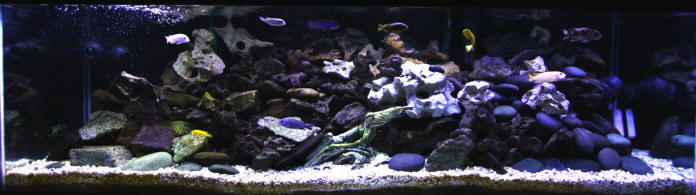
killing off the less so. Do you have records of who died in what order? Could
you send along a pic of the system, its inhabitants? Bob Fenner>
Water quality question /Neale 5/8/15
Hello, a friend of mine referred me to y'all after I asked him a few questions
about my tank. I have a 6ft 125g Mbuna tank with about 15 fish in it. Over the
past year, I've been slowly losing fish. Occasionally it might've been
aggression, but rarely.
<With Mbuna, this aggression aspect is insidious. Not all Mbuna are
compatible, and stronger sorts gradually wear down weaker sorts, resulting in
eventual deaths, often for no obvious reason, but lack of body mass in
the dead fish can be a clue that starvation was a factor. Classic scenario is
where people keep an even number of male and female Mbuna, but end up with just
the males because the females were harassed to death. Likewise combining
relatively placid non-Mbuna (such as Aulonocara) with Mbuna, and you end up with
just Mbuna because the poor old Aulonocara die the death of a thousand cuts. Do
let me direct you to some relevant reading:
http://www.wetwebmedia.com/fwsubwebindex/StkgLkMalawiTksArtBailey.htm
For the most part, you can't really have a general Mbuna tank into which any old
Malawian species goes. Just doesn't work that way.>
I've noticed two ailments thus far. Parasitic (sunken belly), and most recently
PopEye in one fish. My PH:7.6
<A trifle low for Rift Valley cichlids.>
AMM:0 Nitrite:<.25
<This is enough to cause deaths over extended periods. Nitrite must be
zero. Review the amount of food going in, the amount of fish being kept, and the
amount of filtration. Aquarium filters sold for fish tanks are wildly optimistic
in their recommended tank sizes... usually where they say "suitable for 10-20
gallons" what they mean is "10-20 gallon tanks lightly
stocked with small fish such as Neons". What they don't mean is cichlids, Plecs,
etc. Rift Valley cichlids especially are very sensitive to dissolved
metabolites. Would always recommend water turnover rates at least 8-10 times the
volume of the tank per hour, plus weekly water changes of 25% or more.>
nitrate:0
<Are you sure the nitrate is this low? Most municipal tap water has
nitrate levels upwards of 20 mg/l, and in cities this can be much higher. A
bunch of Mbuna will be pumping out nitrate. Since nitrate isn't used up in
aquaria (unless you have so many plants you're cropping weekly) it only gets
diluted at water changes, so most folks keeping freshwater tanks have
nitrate levels around 20-40 mg/l. Put another way, unless you have zero nitrate
in your tap water (unlikely, but check), and/or export nitrate via massive
amounts of plant growth, you can't possibly have zero nitrate in a freshwater
aquarium.>
My question is, what other water quality issues can I check that might cause
these illnesses? I have probably twice as much filtration as I need for a tank
of this size. I've never been one for consistent water changes, but Im guessing
that would be the first place to start. I do clean the tank and get as much
debris, poop and food out as I can. Any suggestions would be much
appreciated.-Jason
<At least three avenues for investigation here. Hope this helps, Neale.>
Re: Water quality question /RMF again
5/8/15
Thanks for your reply. I just tested the water again and the Nitrates
and nitrites are both zero.
<Strange that the Nitrate is zero>
As far as food, its a veggie based with a hint of protein that I get from my
local shop. The fish that died from PopEye was the largest fish in the tank and
a bumblebee or bumblebee hybrid. Both eyes were popped out and he was
very bloated.
<Yikes; have you read re Malawi Bloat?>
As far as fish in the tank, I've forgotten a few, or just don't know because
they might be hybrids. In addition to the pics, I have a few yellow labs, white
labs, cobalt white, albino Bushynose Pleco, 4 small cats similar to an elongated
cat and that's about it. As far as filtration, I have 3 Eheim 2217's
<A fave>
and an Eheim surface skimmer. My tap water is very hard naturally, but
Im not certain of my waters alkalinity.
<Do you add any supplements?>
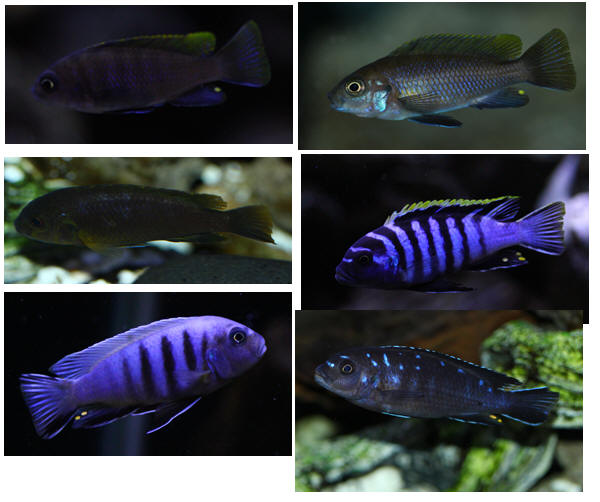
I know what the fish on the bottom right is, but do you know what the others
are?
<Need bigger pix>
Again, thanks for your help. -Jason
<Cheers, BobF>
|
 |
|
Re: Water quality question 5/8/15
Hey, thanks for your reply. I checked my water again today and both my Nitrates
and Nitrites were zero. I live way out in the country, so that might be a reason
for my water showing no nitrates. What can I Do to raise the PH a bit?
<The best, easiest and safest... additions of sodium bicarbonate. See Neale's
piece on WWM re water hardness>
Are there any other things I should test for in my water? What is the purpose of
the water changes if the WQ is testing fine?
<Dilution of whatever may be the trouble here. Tell me where these rocks are
from. B>
Re: Water quality question. Mbuna IDs.... to ChuckR
5/9/15
This is the pic I was referring to. I enlarged it a bit. I know what the bottom
right is, but Im uncertain of the others. I do not add any supplements to my
tank. Any suggestions? Thanks again! -Jason
<Will send the pix along to Chuck Rambo (our cichlid expert). Bob Fenner>
Re: Water quality question 5/9/15
The majority are lace rocks.
<Mmm; some have issues w/ soluble (excess) phosphate>
The round ones are river rocks from a landscaping place. I've had them in 2
other tanks prior to this tank and this tank has been established for 3 years
now.
<Good assay>
I use those round rocks mainly as dig protection. I layered the bottom of the
tank with them, then covered them with substrate. When the Mbunas start digging,
they wont go all the way to glass, but will have those rocks to dig in-between.
-Jason
<Am/we're back to the general mis-stocking aggression issues of Mbunas as your
source of mortality here. BobF>
|
Pseudotropheus saulosi tank; and stkg. 8/7/14
Hey Crew,
<John>
It's me again. :D I did a lot of research this time before coming, just
hoping you can give me a little guidance and verify I am on the right
track. I am looking to purchase a used, but cleaned Fluval Venezia 350
"corner" tank. The dimensions are 48x34x25.5 inches. Which according to
your site is above the minimum for a cichlid tank. So that's a plus. My
one worry is the tank is that it is pre-plumbed for the filter system to
go into the cabinet. It comes with a Fluval 405. They claim it is a 1300
LPH filter, which is roughly 3.7 turnover. I read that these fish like
roughly 6-8x turnover.
<Yes; or more... I'd like ten times plus... dirty fishes that require
clean water, high and consistent DO>
I would add a powerhead to give them more water movement as suggested.
<Good>
I am worried depending on stocking if this turnover would be suffice or
do I need to look to add an additional filter?
<More; another would be better... A large hang on would be my choice>
I looked at the FX5 but all the tubing is different which would mean
boring out the holes in the tank, which I do not want to do. Any
suggestions here?
My idea for the tank is setting up rock structures from the sides to
meet in the back point of the tank, with a crushed coral or coral sand
substrate with no live plants. I read the crushed coral is good to
keeping the pH up?
True statement?
<Yes>
Would adding some driftwood be a bad idea as I know it has a pH reducing
effect?
<Yes; a poor idea. Look to adding rock/work that will also boost
hardness and alkalinity (made up of CaCO3)>
Now to the big question which I need more help on is stocking amount or
maybe adding another breed of fish besides Pseudotropheus saulosi which
I like for the males in the strong blue and the females in the yellow. I
know to kelp hostilities low I need to keep 1 male per 3-4 females. I
want to to have a good active cichlid tank, as this tank will be a focal
point in the room, but I want to try and stay true to the biotope. Also
for a cleaner crew any suggestion with these fish?
<Yourself... You could add one, two tough species of Synodontis that
might help... the Mbuna are too likely to beat up, kill Loricariids of
size>
And any input is welcomed. Thanks again. Sorry for the long e-mail. :D
V/R
John
<Cheers, Bob Fenner>
Re: Pseudotropheus saulosi tank; plus stkg.
8/7/14
Thanks for your speedy and helpful response Mr. Fenner!
<Welcome!>
I was looking at possibly using Texas Holey Rock, which is in ample
amounts here (Germany) and not so bad on the wallet.
<A good choice>
I know that will also boost the pH which will help. I have never used
it, but I am worried about possible algae growth, but the Mbuna should
do a good job to keep it in check, no?
<Likely so; yes... there are more/less palatable species of algae for
sure>
Any particular hang on you would suggest?
<I really like the Hagen product line here; but there are others>
I have been reading about powerheads for these set ups, and I see them
ranging from 800 l/h to 4000 l/h. Thinking somewhere around the middle.
I still cannot think of a good number of stocking. I have read with
Mbuna you either understock or overstock, which I don't agree with, but
this is my first cichlid tank. What would you suggest in a 350l for
stocking, number wise?
<Ten smaller fish/specimens... two inches or so>
Is it better with these aggressive fish to stock at once or slowly stock
in sets of 1 male 3 females?
<At once... single males per species are best in small volumes like
this>
I can just see some fighting going on, when new tankmates come into the
picture further down the line. I just know when I had my piranha tank,
that when I added new tankmates later on, they got beat up for a little
bit. Thanks!
<BobF>
V/R
John
Re: Pseudotropheus saulosi tank
8/7/14
Mr. Fenner,
Last time I'll bother you for awhile (hopefully). :) In your advice of
using a hang-on, what is your opinion on internal filters?
<Not as big a fan... take up volume; harder to clean...>
Specifically the Eheim Power Line XL
(https://www.eheim.com/en_GB/products/technology/internal-filters/powerline
)
? I think with the hang on, I would have to make hood adjustments, and
want to try and keep it un-modified.
<Perhaps a canister then... more money; but can be situated to provide
more complete circulation and air/discharge along the surface>
Thinking that if I was able to position behind the rocks to hide it,
something to that effect. Also with your suggestion of Synodontis,
long as its the same size, would an Upside-down
Catfish work in this situation or
would a Synodontis Multipunctatus be better suited? Thanks again!
-John
<Bigger is better... see WWM re Mochokid stocking/selection. B>
Acei Cichlid Compatibility
1/19/14
Hi!
<Hello Lauren,>
Your site has been an invaluable resource for me as my husband and I try
to set up our tanks. Currently we have a 55 gallon tank with: 1 Rainbow
Shark (about 1.5 inches), 3 Electric Green Tiger Barbs (about 1 inch
each), and 1 Acei Cichlid (about 1.5 inches at this point.
<I see.>
I'm trying to put fish in slowly so I don't overload our tank, so I plan
on getting at least three more Tiger Barbs next week to calm them down.
<Indeed, the more Tiger Barbs, the less chance of them being nippy. They
should work nicely with the Rainbow Shark because that species is bigger
and quite brusque itself. But the cichlid is more of a gamble, and it's
easy to confuse territoriality or predatory behaviour with being able to
fight off a nippy tankmate.>
My husband wants Cichlids, but also wants lots of activity and color in
his tank.
<As a broad, reliable rule -- don't mix Rift Valley cichlids (what are
inaccurately called "African Cichlids" by some) with community tropical
fish. Pick one option, and tailor the tank around that. Of the Rift
Valley cichlids, there's a further subdivision between the Mbuna (which
are always best kept amongst themselves) and the non-Mbuna things like
Peacocks and "Haps" (which are all best kept *away* from Mbuna). Of
course there are a few South American and even some West African
cichlids that might be kept in a community tank, notably Angels and
Kribs. But many casual hobbyists aren't aware that these are cichlids
and tend to assume "cichlids" and "Rift Valley" cichlids are one and the
same thing! In short, sit down with your spousal unit and ask him to
explain what he means by "cichlids". You may well get lucky with a
single Pseudotropheus acei in a community tank, but beyond that, mixing
Rift Valley cichlids, especially Mbuna, with community fish is a bad
idea, a VERY bad idea. Besides different personalities, they have
different environmental requirements. Do bear in mind the Pseudotropheus
acei will need hard, alkaline water, whereas the barbs and shark are
more soft to middling hardness water fish.>
I've already seen some aggressive behavior with the Acei and the Barbs,
but I don't know if rounding out the school by adding more barbs would
help this or not.
<Adding more Tiger Barbs will reduce fin-nipping and fighting on the
part of the barbs, but it's an incremental thing. Six is better than
four, but not as reliable as ten, and a dozen is even safer.>
Obviously the Barbs aren't schooling half the time because there aren't
enough of them and there's usually aggression when they split up and go
it solo.
<Yes.>
Any recommendations for this tank? What to add, what not to add?
<See above. The Pseudotropheus acei isn't a community tank fish by any
sane standard, though by Mbuna standards its pretty mellow (which is
just below "psychotic" by community tank standards, bear in mind, since
all Mbuna need to be tough, pushy fish just to survive in their
extremely competitive environment in the wild). Pseudotropheus acei
would be a great choice for use in a quiet Mbuna system alongside
Labidochromis caeruleus for example.
The two species are pretty much a classic combo, in fact! No need to add
any other species because the two of them offer a nice contrast in terms
of colours (blue vs. yellow) and occupy different levels of the tank
much of the time.>
Any help would be appreciated, as I'm completely new to this.
<Much on WWM to help you, but do also look for modern books on cichlids
at your local bookstore or library.>
Also we have a 15 gallon tank with an Angelfish and an Albino Rainbow
Shark. (Both are fairly small, under 2 inches.) I know they will
eventually outgrow this tank, and am planning to upgrade to a 35 gallon
tank within the next 2-3 weeks.
<Wise.>
We originally had a single Tiger Barb with the Angelfish (before we
found your site), so the poor thing was nipped at quite a bit, but the
next morning the Barb was swimming sideways and upside down and died by
that afternoon.
<Oh.>
We haven't had any problems with any of the fish in that tank since.
Once I upgrade to the 35 gallon tank, I was thinking of adding another
Angelfish and some schooling fish. What do you think about Cardinal
Tetras?
<A good combo with Angels, but do need soft, or at least not hard water
to do well. Easier choices can be found, such as Penguin Tetras, Emperor
Tetras and especially X-Ray Tetras.>
Again any suggestions would be most welcome.
<See above.>
Thank you in advance for all of your help. I know for a fact that I
would be lost without your site.
<And thanks for the kind words.>
- Lauren
<Cheers, Neale.>
Re: Acei Cichlid Compatibility
1/24/14
Hi again!
<Welcome.>
Thanks so much for your advice. We're watching the Acei carefully, and
if any problems appear, we've resolved to rehome the barbs and shark.
<Cool.>
I have one last question. Since my last email, we have added more tiger
barbs (one more of the electric green, and two of the regular striped
tiger barbs). Now that there's six of them, they're schooling
beautifully.
However, the Acei is schooling with them! He's barely ever alone
anymore.
Have you seen this before?
<It's quite common for fish to school with a different species,
particularly when young. While I've not seen this specific combination,
I wouldn't be too alarmed provided all the fish are happy and feeding
well.>
Thanks again,
- Lauren
<Cheers, Neale.>
Biblio. of Malawi Fishes, over 1,700 citations
1/1/14
http://malawicichlids.com/mw14001.htm#2013list
Haps/Peacock Stocking Options for 330 G tank
Stocking Options for a 330 G Malawi Cichlid Tank
– 11/20/12
Hello Crew: I`m new to this hobby - and I really love your site. I
have a new (for me) 330 G tank that I set up this fall (2` x 2` x 12`).
Currently, the water parameters are as follows: pH @ 7.8, ammonia
0, nitrites 0, nitrates 60, water temp. @74.5F. My water is
naturally on the hard side. I tried some live plants, but they did
not survive the cichlids. I have three live plants left, some
plastic plants, lots of rock: marble, limestone, river rock, and
about 1/3 of the tank is covered in sand, no obstructions - for the
peacocks. I have a Rena XP3 filter with Purigen and Super Elite
activated carbon in the filter trays, along with the other media, two
110 Aqua Clear HOB filters, 2 Aqua Clear 70 pumps, and 2 blue Poret
filters with water lifters in them. I have two large pieces of
drift wood with many caves near the rocks. I do about a 25% water
change week 1, and about a 40% water change week 2. I try to fast
them one day a week, but its hard not to feed them, especially when they
do their `little dances`.
I started myself off with a few mixed Mbuna in a 70G before I found this
large, custom built tank that came with stock. After it was set
up, while I was away on holidays, my spouse moved all the fish into the
large tank and disposed of the 70G. :( I now have the
following stock in the big tank:
6-7 Labidochromis Caeruleus (aka "Yellow labs"; 2 @ 3'', the rest
various sizes)
5 Iodotropheus sprengerae (aka "Rustys")
* Protomelas taelianautas (aka "Super Red Empress"; 1 dominant male
beautifully coloured @ 51/2'' He is the second dominant tank boss, 2
subdominant males @ 5'' that have taken on the female colouring,
numerous females)
2 Metriaclima Estherae (aka "Red Zebra"; 1 @ 3'', 1@ 2'' )
1 Metriaclima Estherae OB - 1 ''
1 Pseudotropheus sp. Acei (aka "Yellow Tail Acei")
* Otopharynx lithobates 'Mumbo Is.' - and I think there are a few
'Zimbabwe Rock' also - (aka ''Sulphur Head'') - 1 white blaze male
@5'' who is my tank boss, 2 subdominant males that take on the female
colouring about the same size as the dominant male, numerous females)
* Capadichormis chrysonotus 2 males, several females
2 Metriaclima Lombardoi (aka Kennys; both males @ 31/2''
each)
1 Labeotropheus OB fuelleborni (about 3'')
2 Aulonocara Jacobfreibergi 'Eureka' Peacocks (1@ 3'', 1 @
2'')
2 Melanochromis Johanni (aka electric blue johanni, 2 males)
5 Hemichromis binnaculatus (Blood Red Jewel Cichlids -
juveniles - 2 males, 3 females less than 2 '')
5 Aulonocara Peacocks - Rueben Reds - juveniles - too young
to tell sexes yet @ 1 ''
1 Red Top Hongi (male about 3'')
1 Melanochromis hybrid ? (Started out as silvery
pink, now has coloured up similar to the electric blue johanni but is
larger and is relatively peaceful @3 1/2'')
1 Giant Sailfin Pleco (@14'')
1 Medium size sail fin Pleco @ 7''
1 Cuckoo catfish @ 2 1/2'')
2 Bristlenose catfish @ 3'')
1 Freshwater crayfish - Procambarus Clarkii sp. orange
*The females are similar: silver with three black splotches or
silver with black line below lateral line, sometimes with or without
blotches. All together, there is about 16 of them in various
sizes.
I have read many articles that state it is not wise to keep
haps/peacocks together with Mbuna, including Mary Bailey`s on this site,
except for the very peaceful species such as the yellow labs and Rustys.
This is the reason why I am re-homing the other Mbuna. While the red
zebra and kennys have not killed any fish, they are very territorial and
will not let others near their claimed homes. The ones left are all
peaceful - for now. Will have to wait and see about the other red zebra
and OB red zebra which are still small, and no trouble at the moment. If
that changes, I can re-home them later.
Along with the two kennys, and the large red zebra, I`m re-homing the
medium sized sailfin Pleco. I will keep the yellow labs, the
Rustys and yellow tail acei with the haps and peacocks. I know
that the yellow tail acei is a schooling fish so I will likely get 4
more. I`ve heard the same about the cuckoo cats. Should I
get another one?
< If your cuckoo cat is a Syn. multipunctatus then a few more will make
them feel more at home.>
My main concern is that I read conflicting info about peacocks/haps in
terms of mixing species. It is clear that it is not good to mix
species with similar looking females due to cross breeding and
hybridization. However, an article I read suggested that you can
keep 4 different species of Aulonocara if you pick one from each of the
following sub-groups: Chitande, Jacobfreibergi, Stuartgranti, and
sand dwellers (like Gertrudae). So far, from my reseach,
I discerned that the Otopharynx falls into the Chitande sub-group,
correct?
< The genus Aulonocara is characterized by the cichlids having a series
of pores along the bottom of the jaw that that pick up vibrations of
food items living in the sand. Cichlids without this feature are not
placed in the genus Aulonocara. The Otopharynx is not a peacock. In the
hobby it is usually placed in the hap group.>
The Eureka peacock falls into the Jacobfreibergi sub-group, correct?
< Correct >
So I could then select a Stuartgranti species such as the Stuartgranti
maleri or Ngara species? As for the sand dwellers, I do not want
any at the moment. Was this article accurate? Can I also get
the Stuartgranti ("yellow Regal") or Ngara ("Flametail") with the other
Aulonocara or is this inviting cross breeding?
< Generally, blue colored peacocks and the Jake groups do best in Malawi
community cichlid tanks. Yellows do best in a species only tank. I would
recommend getting males only unless you are planning on breeding
them.>
Afterwards, I am looking forward to adding some Copadichromis borleyi
(Kandango) and Copadichromis . Can I, or is it better to select
only one from these two sub-groups?
< Go with the borleyi since the females will have some color on
the fins.>
Or in other words, does the rule about
Aulonocara apply to the other species as well?
< Here is how it works. If you have this big tank full of blue fish, the
females will breed with the dominant blue fish. This means your fish
will cross breed and your tank will have numerous little strange
cichlids that don't look like anything.>
I would also like to get one Crytocara Moorii (aka "dolphin head").
To this mix, can I add Protomelas sp. steveni Taiwan (Taiwan Reef) or
Protomelas sp. spilonotus Tanzania (Liuli) or will this be inviting
cross breeding?
< Yes>
I also like the following fish: Pundamillia nyererei, Cynotilapia
Afra (Cobue), Haplochromis ''ruby green'', Pseudotropheus demasoni,
Pseudotropheus Saulosi, and Pseudotropheus Socolofi and I have
considered some Lethrinops. I prefer to keep the fish smaller than
the 6 inch length, a few bigger are OK but I don`t want to get too much
into species larger than 10 inches. I prefer more herbivores than
carnivores. My concern is that I would like to utilize all of the
tank, not just the mid section or bottom.
I appreciate selecting stock is very individual, but I would be
interested in hearing your suggestions on stocking this tank.
< Skip the Victorians. They will have a difficult time competing with
the Malawi cichlids. In my Malawi tank all the fish have color or at the
least an interesting pattern and get along. I would recommend the
following:
Yellow labs ( Good stock have a orange -yellow color with black fins) or
Labidochromis chisumulae ( Blue male with white female).
Rustys ( Both sexes look alike)
Ps Saulosi ( Blue striped male with yellow orange female) or Ps demasoni
(Both sexes are blue with black stripes).
Ps acei ( Both sexes look alike, feeds on algae on driftwood )
Ps lanistacola ( Malawi shell dweller)
Mel parallelus ( Black male with blue horizontal stripes, females are
white with black horizontal stripes)
Red Fin ( Colorful male and females are silver grey with red fins)
Red Top L. trewavasae ( Blue male with red dorsal fin, females are a
bright orange color.) or L fuelleborni Marmalade Cat ( beautiful mottled
fish)
C. moorii ( both sexes look alike but get big humps on their foreheads)
You get the idea. Keep all the fish colorful unless you are interested
in breeding. Then keep them in a species only tank.>
As for the high nitrates, have you heard of Maglife USA`s new substrate,
Nitrastrate that is naturally buoyant and reduces nitrates? Has
anyone tried it? Does it work? Do the fish like it? I
am in the process of setting up a refugium to cycle the fish water
through that will help reduce the nitrates
< Nitrates are converted to Nitrogen gas by anaerobic bacteria. I would
increase the filter maintenance, occasionally vacuum the gravel,
and try a vegetable based fish food high in Spirulina to reduce the
nitrates. Haven't heard of the product but have seen similar claims on
products over the years that may work for awhile.-Chuck>
Re: Haps/Peacock Stocking Options for 330 G tank 11/22/12
Stocking a 330 Gallon Malawi Cichlid Tank II
Thanks for your insight and comments, Chuck! Yes, my catfish is a
Syn. multipunctatus so I will add two more. Thanks for the
clarification on the peacocks. The species you recommend seem to
be sufficiently different from one another so as to discourage cross
breeding. I'll do more research on the stock you suggested and
then decide. With your suggested stock list, does Mary Bailey's
rule of thumb re: inches of fish/square foot of tank still apply?
< Since most cichlids are territorial it is wise to be aware or there
passion for their own area. Mary's rule is s good place to start but it
is not species specific. I would give a little more space to some of the
more aggressive species like Ps elongatus types and very little
territory to the less aggressive species like the Ps. acei . When it
comes right down to all fish are individuals and you will have to watch
you fish to determine the limits of their territories.>
What vegetable based fish food have you used with good results?
< When you look at the ingredients listed on the package for Spirulina
food you will see fish meal as the first main ingredient. This is
because fish will not eat pure Spirulina. Spirulina should be
lists close to the top as a list of ingredients. I feed Zoomed Spirulina
20, OSI also makes a very good food. Some brine shrimp flake and
plankton flake fed sporadically will enhance the fishes colors. Stay
away from any type of worm food. Lake Malawi cichlids don't do well on
bloodworms, glassworms or earthworm flake.>
I live in a rural area, so my LFS is very limited in choices so I will
likely have to order on line.
< Good luck.-Chuck> Cheers, AW.
|
African cichlid dying... Malawi bloat? Beaten
9/4/12
Hello there. I have a red zebra cichlid who is suffering from what I
thought was Malawi bloat
<Mmm, no; don't thinks so>
but I am unsure and now think the treatment may have exacerbated the
problem.
She is a female red zebra in a 55 gallon African Cichlid set up. I have
had her for about two years since she was only about 3/4"! She is now
about three inches long, has made it through two sets of offspring with
the dominating male of the tank, has made it through multiple brutal
attacks by the males in the tank
<Not this one though>
where I thought she would dye <die>
because her fins were all gone.. ultimately, she is generally a very
tough fish!! And my favorite fish in the tank! I currently have 8 fish
in the tank. I want to increase the number to decrease aggression, but
every time I add new fish, they are killed within a couple of days.
<Too late to add more here>
About two weeks ago I added three new fish. Two of the new ones were
attacked to death and killed within the first week. I of course removed
them immediately and followed with water changes. Yesterday morning, my
red zebra wouldn't eat. I was thinking maybe she was holding fry again
but I couldn't see into her mouth and her jaw didn't look extended, so I
just kept an eye on her. By the afternoon her fins were all frayed and
she had some white areas on her body that looked like scales had fallen
off. She was hovering near the top of the tank, stiff looking, and
smaller fish were swimming up to her and nibbling at her. She wasn't
even fighting back or trying to swim away. I removed her, put her into a
5 gallon bucket filled about 2/3 with tank water and 1/3 new water, with
a heater and bubbler. By the evening, the white patches were spreading,
she was laying on her side at the bottom, breathing hard, and her chest
area on her underside looked very swollen. I did some research
and thought her symptoms sounded like Malawi bloat
<... no; this fish was beaten to death. A 55 gallon isn't enough room
for what you have in mind, Mbuna need space, habitat to get away from
each other>>
so I ran out to the store to find some Metronidazole or Clout. Of course
my LFS did not carry anything useful... all I could find was Tetra
Parasite Guard which was the only product containing Metronidazole but
unfortunately it doesn't say what the percentage or mg of the
ingredients are. I put a half tablet into a cup of water, let it
dissolve, and added it in. I also added 1 tsp Epsom salts as I read it
is helpful to clean their bowels if it is truly Malawi bloat.
This morning when I left for work, she seemed okay. She was at least
sitting up right instead of on her side, but the white patches were
spreading more and were kind of slimy looking. By the time I got home
from work this evening, the water was very cloudy, and she has some
areas that almost look like blood blisters on her fins and body. I can
even see some small vessels. She was also floating upside down.
I filled a clean 5 gallon bucket with new water, moved the heater and
bubbler, added some more salts, no antibiotics this time, and once the
water got to temp, moved her over. Within minutes she was back on her
side instead of floating upside down. She looks terrible though.
I'm very upset because she is my favorite fish and I would be sad to see
her pass. At this point I don't know if there is something else I can
try in order to help save her or if it is better to just humanely
euthanize her :(
Any insight would be great
Thanks,
Nicole
<As stated, I don't see much promise here... maybe the removal of this
one fish will "re-set" the social dynamic in this tank, allow all to
live together for a while longer. Bob Fenner>
|
|
|
Re:
Mbuna (Acei, specifically) question Mbuna (Acei, specifically) question
II, repro./sexing /Chuck
3/14/12
<Chuck's take>
Thanks Bob. The tank is heavily planted and I've provided lots of
caves using the cheap flower pots from home depot & sanding the
edges down after cracking the sides off w/ a hammer and chisel.
You may (or may not) also be interested to know that the aceis were
flashing quite a bit, without any signs of parasites, but when the
flashing spread to other fish I pre-emptively treated with a
form/malachite green Ich treatment and it appears to have cleared up
the flashing.
As with anything I'm sure early treatment of parasites is the most
effective.
Would you know of any way to gauge the sex without venting? I'm not
sure if egg spots are a reliable indicator - everything I've
read says that aceis are difficult to sex.
< In the lake they are found in large schools feeding on algae
attached to floating logs so they are not nearly as territorial as most
Mbuna that scrape algae off of rocks. Both sexes look exactly alike. If
you are not going to try and vent them then adult males may have longer
fins and be slightly larger than the females.-Chuck>
Re: Mbuna (Acei, specifically) question /RMF
3/14/12
Thanks Bob.
<Hey Eddie>
The tank is heavily planted and I've provided lots of caves using
the cheap
flower pots from home depot & sanding the edges down after cracking
the sides off w/ a hammer and chisel.
<I see>
You may (or may not) also be interested to know that the aceis were
flashing quite a bit, without any signs of parasites, but when the
flashing spread to other fish I preemptively treated with a
form/malachite green Ich treatment and it appears to have cleared up
the flashing.
<Good>
As with anything I'm sure early treatment of parasites is the most
effective.
<Yes>
Would you know of any way to gauge the sex without venting?
<Behavioral clues are best, more prominent egg dummies... size (all
else being relative)...>
I'm not sure if egg spots are a reliable indicator - everything
I've read says that aceis are difficult to sex.
<Not when behaving "sexually". Cheers,
BobF>
African cichlid mouth brooding
3/5/12
Hi there. I have a red zebra who is currently holding eggs. I
have 8 different Malawi cichlids in a 55 gallon tank.
I have had this set up for almost 2 years. I have never noticed any of
the cichlids to hold eggs until
now. My question is do Malawi cichlids cross breed?
<Oh yes... a mess>
Or is she likely holding unfertilized eggs? I have no other zebras for
her to breed with.
<Can will/ interbreed w/ most any Mbuna of the same genus, even
other genera at times>
The species I have are as follows:
Labidochromis caeruleus (yellow lab) (MALE)
Melanochromis cyaneorhabdos (blue johanni) (MALE)
Metriaclima estherae (red zebra) (FEMALE)
Pseudotropheus socolofi (pindani/powder blue) (MALE)
Melanochromis auratus (auratus/ golden Mbuna) (FEMALE)
Pseudotropheus crabro (bumblebee) (SEX UNKNOWN)
Maylandia lombardoi (kenyi) x2 (1 MALE and 1 FEMALE)
Thanks for your help!
Nicole
<Bob Fenner>
Mbuna (Acei,
specifically) question, beh. in a new sys. 2/20/12
I recently acquired some aceis and 5 electric yellow labs. The aceis
seem to do nothing but swim along the front of the glass back and
forth.
<Likely seeing their reflection... reacting to this. Try taping a
piece of paper on one end of the aquarium>
The behavior seems odd to me as the labs and other fish are much
calmer. The aceis are still eating, but it's somewhat half
heartedly - they will take food as they swim past it but aren't
aggressively seeking it out. They have
only been in the tank for about 24 hours now. Should I be
concerned?
<No; not really... all should settle in w/in a few days. I do hope
there is a good deal of room and decor here... as the Mbuna can prove
quite territorial. Search WWM re these two species. Bob
Fenner>
Stocking; Malawians (was: re: Whitespot on
giraffe Catfish) 1/17/12
Hi, this does help a lot. Have already witnessed the benefits of the
salt on the giraffe Catfish and have made provisions to relocate
him.
<Good and good.>
Also the malawis, there is an abundance of takers for the Frontosa when
he gets a bit larger.
<Uh, you do realise Frontosas are NOT Malawians? They cannot be kept
with Malawian cichlids. The common Malawian cichlids kept by US
fishkeepers will hammer these gentle giants, and any Malawians small
enough not to cause harm will be viewed by the Frontosas as food.
Please do learn the difference between Malawian cichlids in the general
sense, Mbuna specifically, and Tanganyikan cichlids as something else
again.>
I have seen some Neolamprologus brichardi which look lovely.
<Again, not Malawians but Tanganyikans. There's a real problem
with many fish shops selling "African Cichlids" and giving
the idea to less experienced hobbyists that all African cichlids are
alike. Mbuna are
insanely aggressive hyper-territorial rock-dwelling fish very different
to the Peacock cichlids of Malawi (Aulonocara) and different again to
the "Utaka" cichlids of Malawi. All three of these groups are
very different to Tanganyikan cichlids that (except perhaps for
Tropheus spp.) tend to be much shyer and less overtly aggressive
(though no less territorial in their way). Let me stress once again,
you cannot keep Malawians and Tanganyikans together, and shouldn't
even keep Mbuna with other types of Malawians
(though Labidochromis are somewhat peaceful by comparison and can be
kept with Peacocks).>
And will keep the giant Plec. Thank you for your time and words
here.
Although it was a given there was too much in the tank, it always helps
to hear this from someone else and my tank will benefit from the
wisdom.
Until next time.
<Indeed.>
Greg.
<Cheers, Neale.>
Merging Tanks 9/19/11
Mixing Lake Malawi Cichlid Tanks Together
Hello. I'm seeking advice that perhaps you may be able to
provide.
I currently have 2 Mbuna Cichlid tanks - a 36 gal and a 55 gal. The 36
gal has been up and running for about 2.5 years and currently has 1
male Red Zebra and 1 female Electric Yellow lab. The 55 gal has been
running for a little under a year and has 5 fish: 2 Red Zebras (1 male,
1 female), 2 Blue Cobalt Zebras (1 male, 1 female), and 1 male Electric
Yellow lab. The water conditions in both tanks are nearly identical (pH
8.2, KH ~12, GH ~10).
I've noticed lately that as the fish in the 55 gal tank mature, the
aggression is starting to show, particularly, the males to the females
- the female red zebra especially. I'd like to balance this
aggression by adding more females to obtain the magic 2-3 females/male
ratio. However I'm worried about moving the male Red Zebra to the
55 gal since it would then be 2:1 male:female.
So my questions are: 1. Would moving the 2 36 gal tank fish to the 55
gal tank be ok?
< When adding fish you need to do a few things. Lower the water temp
to the mid to low 70's F. This will reduce the aggression. Then
rearrange all the rocks and decorations. This will make the fish
establish new territories.
Put the new fish in a night. Do in on a night in which you will be
around the next day to referee the new set up. >
2. If I were to add more fish to the 55 gal so as to get the 2-3
females/male ratio, would a 55 gal tank with what would then be 9-12
fish succeed provided I added more filtration and maintained my current
schedule of weekly 20% water changes (currently have a canister filter
rated for 80 gal and a HOB filter rated for 25 - would probably add
another HOB filter)?
< The water circulation should be 3 to 5 times the tank volume per
hour.
Keep the nitrates under 20 ppm with water changes.>
3. Should I just not move the male red zebra from the 36 gal tank and
restock with other compatible cichlids?
< Whenever you( add Lake Malawi cichlids together the fish will the
same colors are going to have difficulty adjusting to the new
territories. You can try it out but there are no sure
things.-Chuck>This would ruin my plans for converting the 36 gal
tank to a community freshwater tank).Thanks! - Aaron
Helping friend w/ African cichlids.
Stocking a 25 Gallon Lake Malawi Cichlid Tank
8/7/11
Hi crew! So my friend recently set up her 25 gallon aquarium and is
dead set on keeping African cichlids. More specifically Lake Malawi
Cichlids. I personally think the tank is too small to properly keep
Africa cichlids but she's dead set on them. So long story short she
has asked me to help her stock the tank as she feels my knowledge of
fish is better(yet she won't listen to me on the tank size issue
*sigh). So I was thinking maybe a trio of electric yellows, a trio of
demasoni (maybe a couple more to spread out the aggression?), and a
small school of upside-down catfish (the dwarf kind). I know Kribensis
(also from Africa but not Malawian),or shell dwellers would probably
work better, but I'm hoping the stock list I've come up with
would work. I'd like your feedback on this and maybe some
alternatives? Thanks so much, Hannah.
<In the wild most Lake Malawi Mbuna types rarely get over 3 inches.
In the aquarium they grow much larger. I would go with a group of small
, 1 inch individuals and let them grow up together. This will reduce
the chance of breeding an hopefully reduce the aggression. Try to get a
group of 12 fish that are not the same species or are even close in
markings. Forget the catfish and the Kribs. they would be torn up very
quickly. Look into getting the "Enjoying Cichlids" by Ad
Konings to help you with the tank set up and maintenance.-Chuck>
My new 90 gal African Cichlid Tank Want to be 3/4/11
Malawi Tank Set Up
Hi WWM Crew! I have been reading your site for about 6 yrs and you all
do a fantastic job!
Thank you :) Anyway, I get to start a 90 gal brand new from the box
(sorry, I've only had used, so I am very excited) I know I will
have to cycle it for a few weeks, but my hope is that I can get a
Malawi set up going. Some specs on the tank are:
The tank is 48" x 18" x 24"
A Rena canister filter rated for 175 gals
1 or 2 Tetra deep water air pumps
A 300w heater
,(not sure which one, recommend any?)
< Heater reliability has become a problem, look for recommendation
and check with return policy from a local retailer.>
3 LED bubble wands
2 LED Moonlight bubblers
Aragonite sand (not sure if I want 1" or 2" yet)
And either Holey rock or Lava rock (if I go lava, I want black. I'm
trying to avoid a green or red coloring in my tank)
Lights will also be changed. It's a double strip and I am thinking
of going metal halide. What do you think?
< Double strip will be fine.>
But, my main question is this. I want to pile my rock up in a bow
shaped cove to the water line. I want Mega cave systems running through
it. The kind of thing where you will only see sparse fish till feeding
time. Make sense. I know and am prepared for the cleaning and extra
work all these rocks take. What I can't find out is if this is
possible and/or advisable as per weight restrictions on my glass floor.
I know to put the rock in before the sand.
But how much rock will a 90 hold? I really want to build this up. Maybe
3/4 of the tank. Like a saltwater setup almost.
< Support the entire bottom of the glass with a piece of plywood.
Maybe line the bottom of the glass tank with a piece of Plexiglas to
protect the glass from falling rocks.>
And one minor question. I have a 55 gal SA cichlid tank that I am
replacing with the 90 gal. I don't want the extra weight on my
floor. Anyway, my dad is taking my JD's and my Pleco (5") is
going into the 90 maybe. But I have 8 male black and pink convicts. 6
are about 5" and the rest are about 3" I also have 6 females
that are about 2". I have been told that Africans will take up the
entire tank and SA will only use the bottom. I have seen Convicts in
African tanks before. So would it be ok to put my boys in there. They
are so lovely and I don't want to part with them but I really
can't have both tanks.
Thank you so much for your time Mandy
< Do not mix rift lake cichlids with South American cichlids. they
will not go together over time.-Chuck>.
Re: My new 90 gal African Cichlid Tank Want to be Stand Support and
Mirror Backgrounds 3/4/11
Thank you so much, Chuck!
I'm not sure if I will need the plywood as the stand that comes
with it is a solid top, but it is a good idea for future reference. I
have been reading about egg crate being a good cushion. Any truth to
that?
< Never had any experience with egg crate. Just used plywood or
Plexiglas.>
And one other thing, then I will leave you alone :) I want to paint the
back with a silver or sepia colored mirror paint. I want to avoid the
traditional backgrounds. My BF says that the fish will get confused and
run into the glass. I'm not sure about that. Any thoughts?
< Cichlids will react to their reflection in the mirror background.
if it is dull enough not to reflect their image then it should be
fine.-Chuck>
Thank you again Mandy
Stocking A 150 Gallon Mbuna Tank
1/5/11
Hello WetWebMedia staff. I am contacting you from Iran. I have a 150 US
gallons tank and its dimensions are 63 inches by 20 inches by 31
inches. I use neutral gravel and extensive rock works with many caves
and tunnels for landscaping. The filter circulation is 750 gallons per
hour and if it becomes necessary, I can upgrade the filtration to twice
this much. The tap water's hardness is ten degrees and its pH 7.8.
I plan to keep a community of Mbunas and the stocking list is as
follows:
1. eighteen-twenty Ps demasoni
2. six or seven albino Ps. socolofi
3. five-six L. fuelleborni
4. eight Electric Yellow C. Labidochromis
5. five-six red Ps. Zebras
And now my questions. Is this a good stock list or I'll witness
world war III? Is there remaining room to add more fishes to this list?
If yes, should I add to the number of these fishes or I can add new
groups of them?
In this list, who you guest to be the bully and who would be
bullied?
< The fish you have chosen are different enough that the patterns
will not confuse them into thinking that they are alike. The
fuelleborni and zebras will be the largest and be the most territorial.
The yellow labs and the albinos will be the ones kicked around the
most. You can add more fish depending on your water changes. Keep the
nitrates under 20 ppm. I would recommend getting all the fish at once
as juveniles and let them grow up together. This way the pecking order
will be established once they turn up as adults. Older males can be
removed and leave you with one dominant male of each species. this will
cut down on some of the aggression. Keep the water in the mid 70's
F or else the fish will want to breed all the time. I
recommend getting "Enjoying Cichlids" by Ad
Konings.-Chuck>
cichlid issues
Managing Mean Malawi Cichlids 12/6/10
I could spend all day reading through all your wonderful info! Thanks
for all your hard work!
< Thank you for your kind words.>
I have a 55 gallon tank which used to house 5 cichlids, all measuring
about 4-6 inches, and 1 Pleco. The aquarium shop I purchased them from
had them labeled as "random cichlids", so I sent pictures to
another shop to have them identified. The results: pearl zebra (male),
OB peacock (female), zebra obliqueden (male), Labidochromis caeruleus
(not sure of sex), Labeotropheus fuelleborni (female). The
Labidochromis caeruleus would swim completely vertical in the corner of
my tank. He/she did this from day one.
He/she ate just fine. Then out of the blue he/she started getting
wounded by the tank bully. (I believe my bully was the pearl zebra,
though I was told it was probably my zebra obliqueden.) I added lots
more rocks for hiding, but nothing seemed to help. He/she would receive
a wound... heal... repeat. Finally, I took the fish back to the shop I
bought it from, and was told that the fish "had been ousted by the
other fish", and that, "there is nothing I can do except
remove him/her". I really loved that fish, but sold it for fear
that he/she would just die otherwise. After my Labidochromis caeruleus
was gone, my OB peacock became the target. (At least I think that was
the problem.) She was always fine before. I saw no physical problems
with her at all. Then she stopped eating, started losing weight,
swimming vertical, then hanging out at the bottom of the tank. (It
almost appeared as though she couldn't stay afloat. As soon as she
would stop swimming she'd sink really fast. Even crashing on the
tank floor, sometimes.) I looked for eggs and found none. Every other
fish seemed just fine. Is this just due to stress?
<When fish are constantly being harassed they may develop internal
infections that may not be noticeable on the surface.>
I did extra water changes upon noticing her strange behavior (I weekly
change out 20 gallons anyhow.), rearranged the tank, and added more
hiding spots, I also bought some egg crate and separated her from my
suspected bully. Nothing helped. She eventually died. :( Was there
anything else I should have tried?
<When a cichlid is being bullied the best thing to do is remove the
fish until it recovers.>
I really want to avoid this sort of thing in the future. Are these
particular fish not good tank mates?
< In the wild Lake Malawi cichlids are very territorial. The bigger
the territory the larger the source of food reserves and an increased
ability to attract a mate. When they are placed in an aquarium with a
few other fish then the aggression is taken out on the lowest fish in
the pecking order.>
No matter how many hiding spots I add to my tank, my pearl zebra seems
to claim them all! Is it just going to be impossible to keep any other
fish with this guy?
< The best way to put a Malawi cichlid tank together is to buy many
small fish and let them grow up together. They will establish a pecking
order when they are small and are less capable of inflicting damage on
each other. Now that the fish are larger it becomes much more difficult
to match up suitable tankmates with a fish that is an established
bully.>
I've read that overcrowding my tank may help. With a greater female
to male ratio. Is this accurate? Others say "never overcrowd your
tank". I love these fish and want to make this work. However,
there is so much conflicting information out there that I'm
confused half the time!
< Overcrowding an Mbuna tank is a common way to keep these fish, but
you need to be prepared first before trying this. Make sure that the
filters turn the water over at least 5 times per hour. Keep the water
temp around 75 F. Feed a food high in Spirulina algae content. You need
many hiding places. Then when you add other Mbuna around the same size,
you need to add them at night and rearrange the rock work the next day.
This keeps them trying to establish territories. Adding 25-30 adult
Mbuna can be expensive.
Females are less aggressive that males so that will help too.>
Another thing, my Labeotropheus fuelleborni currently has fry in her
mouth. It has been about 16 days since I noticed the lump in her mouth.
Is it OK to remove the fry now, or is it better to wait closer to 21
days?
< I would remove the fry after 7 days, after the egg sac is
completely absorbed.>
I put her by herself in a 10 gallon tank, as she was being chased
endlessly by my pearl zebra. This is the tank I'll keep the fry in
until they are big enough to make it on their own in my large tank.
Should I just
let her release them?
< No I would strip the female after a week. The longer you wait the
thinner she will become.>
My fear is that she'll eat them before I get the chance to remove
her.
< That is why I am recommending that you strip her after a
week.>
Also, could her breeding be the reason for all the other tank
aggression?
< No not really. the aggression is caused by the bully fish having a
large enough territory to feed on the algae off the rocks. The bigger
the territory the more food is available. The breeding female is a
bonus to the area.>
If so, what more can I do in the future? I've done hours upon hours
of web reading, but cannot seem to get this all quite figured out! Any
advice, to my hopefully not overwhelming amount of questions, would be
greatly appreciated! Thanks! -Lisa
< I would like to recommend a book. It is called Enjoying Cichlids
by Ad Konings. It is written by many cichlid experts from around the
world and can give you some very useful insights on managing cichlids.
-Chuck>
Aggressive female cichlid
Malawi Cichlid Pecking Order 8/19/10
Hi, Wonderful Crew, I have a 75 gallon tank with a variety of Malawi
cichlids, most of which are Mbuna.
Among the mix are 3 Metriaclima zebras: a male greshakei, a female
estherae, and a pearl (callainos).
I can't sex the pearl. I thought it was female. The greshakei and
the estherae have mated a number of times and produced offspring.
The pearl is ignored by the otherwise aggressive greshakei and other
male fish in the tank (which is why I assumed it was a female).
The pearl seems to be on a mission to kill the estherae. From what I
can tell, it tries to get the estherae to let go of the fry in her
mouth while the estherae is holding.
In addition, and especially after the estherae comes out after
releasing her fry, the pearl chases her around the tank relentlessly. I
have built a big reef of lava rock for the fish to hide in, but I am
worried about the
estherae. I just introduced a female (from what I can tell) greshakei,
so I'm hoping this will at least give the male another female to
"bother" and also distract the pearl.
I have read through all of my books and searched the internet, and
I've read maybe one account of a female cichlid trying to get fry
from another female's mouth.
Have you heard of this kind of behavior with zebras? The fact that the
pearl is ignored by the males but is so aggressive with the female
doesn't make sense to me.
Any help or insight would be appreciated. Thanks, Laura
< In the wild , males are aggressive to defend territories. Since
many cichlids eat algae, the bigger your territory the more algae=food
you control. If you have excess food you can share with a female and
entice her to spawn with you. When a male enters the territory they are
chased away as competition. Within the male's territory there is
also competition from the females. The most aggressive female will
chase other females out of the territory. This means there is more food
for her to eat and have a bigger spawn when she breeds. When she has
bred she can no longer use her mouth to defend herself. Other females
will then drive her off and the next most dominant female will then be
able to spawn. In the aquarium the brooding
females have nowhere to go. They end up getting beat up by dominant
males and non breeding females. This is usually why I recommend
removing a female out of a community tank that has just
spawned.-Chuck>
African reproduction woes
Malawi Cichlid Aggression 6/11/10
Hello, I have set up an African cichlid tank with 3 Aulonocara
Stuartgranti
(German Red) and 3 Yellow Labs. I just got the second German Red female
yesterday and the original female has not stopped harassing her
since.
She spends most of her time hiding under a shell or behind one of the
plants.
Do you know why this would be?
< There is a pecking order among the males and the same for the
females for breeding rights. This way only the best males get to pass
on their genes with the best females.>
Before I added her the peacocks seemed to have no interest in spawning
with one another and now she (original) stays on the heels of the new
female any time she shows her face? Could the original now be
interested in spawning?
<If she was interested in spawning the males would be the aggressive
ones in the tank and both females would be hiding.>
Also, the 2 smaller Labs appear to be attempting to spawn (looks like
they are chasing one another's tails in circles in the substrate)
but every time they start the largest Lab comes and chases them apart.
I believe the largest to be a male, if I got another female or 2 would
he leave them to their thing or would he still interrupt them?
< Once again the fish are expressing a pecking order. The two
smaller yellow labs already know who the main lab is. They are fighting
for number two spot.>
There is plenty of rockwork and plants around the edges of the tank and
the middle is all open swimming area so everyone should be happy. I
have 2 Tetra whisper filters, both rated to filter the tank by
themselves, and a powerhead in the tank so there is a lot of current as
well. I really want one of these species to spawn but have never bred
fish before so I don't know if I'm missing something. Thank you
for your time.-Joshua
< In the wild their territories are larger than most aquariums. When
adding new fish you should re-aquascape the tank to provide all new
territories.-Chuck>
Re African reproduction woes
Peacock Cichlid Breeding 7/10/10
After I have watched these fish more I have noticed that the original
"female" has egg spots on it's anal and caudal fin, a
dull yellow sheen to it's body and a purple sheen to the head, but
is still grey over it's whole body. I believe that this fish is
male. My question is this; are Aulonocara females capable of coloring
themselves as a male in order to remain dominant? I have read that many
species of African Cichlid can do this and that by removing a false
male (dominant female) smaller specimens will come to color and spawn.
The fish I think would be the dominant
female is about 4 inches and has no egg spots and seems to have
absolutely no interest in mating but it is yellow and purple like the
males should be. Does this sound possible? If not what could I do?
<In a breeding group, there is usually only one dominant male. Other
males in the group try to mimic females so the dominant male
doesn't beat them up. In an aquarium the nondominant males have
nowhere to go to escape. So
they try to fool the dominant male and sometimes fool their owners too
by resembling females. I recall a young friend with a group of 17 fish
that would not breed. We took out the dominant male and a couple days
later
another male colored up out of the group. Eventually we had 14 males
and three females. The best looking male was left to spawn with the
remaining three females. If there are no males in the group than a
dominant female
can take on some male characteristics and she then dominates the group.
These shemales usually don't color up as well as the males but may
end up being able to spawn with females when they are very
old.-Chuck>
Mbuna tank
Stocking a New Lake Malawi Cichlid Tank 6/10/2010
Hi, How are you?
< So far so good.>
I currently have a 29 gallon tank with 7 Mbuna. I'm not sure what
type they are. I have 3 yellow labs (I think), 2 that are orange, one
blue with black on his fins, and another that was blue with vertical
black stripes that is
turning yellow now. They range in size from slightly over an inch to
2.5 inches. I plan on moving them into a 75 gallon tank. My concern is,
the people at the pet store told me these fish need to be kept over
stocked and
that 7 was a good amount for 29 gallons. I realize people at pet stores
aren't usually right but I just wanted to make sure. :) Should I
buy some new ones for the 75 gallon tank? Can I even do that or will
the old ones kill the new ones? Or is 7 really a good amount for a 75
gallon tank? Thank you in advance for your time! Lindsay
< You have a pet store that is right on the money. Mbuna are
territorial.
They have teeth that they use to scrape algae off of the rocks and can
inflict lots of damage on another fish. When one fish sets up a
territory it will defend it against all other fish. The idea is the
more fish you have the aggression will be spread out and single fish
will not get picked on too much. This will require lots of water
changes and a large filter that will need to pump at least 300 gph.
Keep the water at around 73-77 F.
Too warm and they will want to be breeding all the time and really be a
handful.-Chuck>
Mbuna Cichlid Compatability 5/26/10
Thanks for the work you do with the website; it has been very
informative for me.
<Cool.>
I have kept simple community fish for several years and am now planning
on setting up a 55-75 gallon Mbuna tank with a sand substrate and a lot
of rocks to provide as much of a natural environment as possible.
<OK. But this aquarium is small for Mbuna. I'd think VERY
carefully before doing this. By all means look at Malawians, but avoid
Mbuna.>
I intend to use two Marineland Penguin 350 filters and do weekly 30-40%
water changes. My target pH and temperature are 8.0 and 78*F
respectively.
I would like to put several different species in the tank with one male
and three females of each (if possible; I know sexing is difficult at
the juvenile stage) and need to know if I should expect problems with
hybridization or too much aggression.
<Yes and yes.>
The fish I'm considering are Labidochromis Caeruleus,
<An excellent species, and along with Iodotropheus spp.,
Labidochromis spp. make good additions to Malawian communities. They
mix okay with Dwarf Mbuna, in particular Pseudotropheus demasoni and
Pseudotropheus saulosi, but shouldn't be mixed with the non-dwarf
Pseudotropheus or any of the Melanochromis or Labeotropheus.>
Melanochromis Johanni,
<Not quite as psychotic as M. auratus, and a single male should
ignore dissimilar fish kept with it. But be sure not to add any
cichlids with similar colouration.
Metriaclima lombardoi, and Maylandia greshakei.
<These are both what I loosely call Pseudotropheus, and can/will
hybridise.
(Many Pseudotropheus species were cleaved off into the genus Maylandia,
but for reasons too tedious to discuss here, a minority of
ichthyologists prefer the name Metriaclima rather than Maylandia for
those species. The main thing for aquarists to understand is that
Pseudotropheus, Metriaclima and Maylandia are all the same thing as far
as Mother Nature is concerned, and all will interbreed given the
chance, with a high probability of producing hybrid offspring. So for
long term success, do not mix Pseudotropheus, Metriaclima and/or
Maylandia. Anyway, as for aggression, Pseudotropheus lombardoi is
aggressive, about the same as Pseudotropheus zebra, so wouldn't be
my choice for a peaceful community. Pseudotropheus greshakei is perhaps
a touch less aggressive, but not enough to make a difference here. Do
look at Pseudotropheus demasoni and Pseudotropheus saulosi instead.
Cynotilapia spp. can be worthwhile too, though getting good quality
Cynotilapia afra is difficult thanks to chronic mixing and
careless breeding of the different regional forms. At least some
Aulonocara would work in this tank too, if there was adequate open
water for them.>
All would be added to the tank as juveniles at as close to the same
size as possible. My main concern is for the aggression level of the
male Johanni.
<This will depend on the availability of caves and the colouration
of the other fish. Melanochromis johanni isn't a peaceful fish by
any definition, but it is towards the lower end of the Mbuna aggression
scale, unlikely virtually all other Melanochromis.>
Also, should any of these species be expected to breed and/or hybridize
when kept together in a tank of this size?
<Yes and yes.>
Very Respectfully,
D. DeWald
<Do spend a little time reading books by Konings and Loiselle before
buying these fish. It's easy to make a random Mbuna tank that ends
up with hyperdominant male and a bunch of hybrid offspring. But
it's quite difficult to create a stable, attractive Malawian
community that offers a range of colours and behaviours you can observe
at leisure. Cheers, Neale.>
Re: Mbuna Cichlid Compatibility [Chuck?]
5/26/2010
Neale,
Thanks for the quick response and advice.
<Most welcome.>
I've purchased a 75 gallon aquarium and am planning on pursuing the
Mbuna setup with some modifications.
<OK.>
How many species can/should I put in a tank of this size while
maintaining proper male/female ratios and what species would you
recommend?
<I think two or three carefully chosen, dwarf or near-dwarf species
would work well here, preferably in harem situations of one male with
two or three females. Labidochromis are sufficiently mild that 2 males,
3 females
would be fine. But male Pseudotropheus and Melanochromis tend to be
much more aggressive towards each other and unresponsive females, so
you really don't want more than one male within each group of these
species.>
I have a group of Labidochromis caeruleus already in another tank and
would like them included in the setup.
<They are an excellent species and highly recommended. It's a
shame the other Labidochromis species aren't more widely traded, as
on the whole they're quite mild, trustworthy fish, if a bit too
nippy for hard water community tanks. Do also be sure to introduce the
Labidochromis before anything more aggressive, e.g., the Pseudotropheus
demasoni or Melanochromis johanni.>
I read up on Pseudotropheus demasoni as you advised and am worried
about the aggression they show toward their own kind.
<Indeed.>
Is it true they must be kept in groups of 12 or more?
<All territory-holding male Pseudotropheus are aggressive towards
each other and unresponsive females, so to some extent it's true
that overstocking tanks reduces aggression by making it impossible for
any one male to claim a territory. On the other hand, it's
male/male aggression that usually ends up with physical damage or
death. Given space, and especially if the females are introduced before
the male, a single male Pseudotropheus demasoni with 3-4 females should
do okay. There are no guarantees, but it's an approach that works
more often than not. Of course, you also keep just female
Pseudotropheus demasoni!>
Thanks again, D. DeWald
<I've cc'ed our cichlid guru Chuck here, so if he has any
ideas on this, I'm sure he'll chime in. In the meantime, do
track down the Konings or Loiselle book of your choice, and have a good
read. Cichlid communities do need to be planned if they're to work
in the long term. Cheers, Neale.>
Re: Mbuna Cichlid Compatibility [Chuck?]
Subject: Re: Mbuna Cichlid Compatability 5/28/10
<Unfortunately most of the Lake Malawi cichlids in the hobby belong
to the Mbuna group. These cichlids make a living by defending a large
rocky area. This area is guarded to keep other cichlids away so all the
algae will be
consumed by the dominant cichlid. He can then allow a potential mate to
enter his territory if she is willing to spawn. In most aquariums there
is not enough room to establish a territory so then the entire tank
becomes the territory. All fish are then subjected to attacks by the
dominant fish.
When that fish is removed then another moves up the ladder and starts
the process all other again. Cichlids like Labidochromis do not eat
much algae so develop weak territories to attract potential mates. Here
are a few
guidelines that I use when I recommend fish for a Lake Malawi community
tank. Get all colorful fish. In many cases the females are rather drab
and silvery. Many cichlid species have females with just as much color
as the males. Get at least six of each species. Assuming a sex ratio of
50/50, this will leave you with three of each sex. Pick the best male
and get rid of the other two. This will leave you with a small harem of
each species.
Put all the fish together in the tank when they are under two inches.
All of these fish will be immature and can then peacefully group up and
establish a pecking order. Keep the water temp below 77 F. Many
aquarist's keep the water too warm. This creates a breeding frenzy
and the males will be "on" all the time. Don't pick
cichlid species with the same colors and markings. Many times they will
be mistaken for conspecifics and treated as such. Cichlids that are
colorful and not too aggressive would be Mel. parrallelus,
Labidochromis sp. Ps saulosi, Ps acei, Ps
lanistacola/livingstoni, In a lager tank I would try a small group of
red zebras and a small group of a Labeotropheus species.-Chuck>
Re: Mbuna Cichlid Compatibility [Chuck?]
6/10/2010
Neale,
Continuing with the 75g Mbuna setup... I've decided to get
Labidochromis caeruleus and Pseudotropheus acei (extremely
clichéd beginner setup, I know)
<With good reason. It's a combo that works. Nice contrast in
their colours and behaviour. Also eminently compatible with some sort
of Synodontis!>
with a black background and black sand to emphasize their colors.
I'm looking for one to two more reasonably mild mannered Mbuna
species to put with them that will add some color.
<I wouldn't another Mbuna, but rather a midwater cichlid that
won't compete for space. Remember, the Mbuna are merely a subset of
Malawian cichlids;
there are lots of others!>
I love the look of Pseudotropheus demasoni, but I think they're out
because of the danger of hybridization with the aceis (aggression also
being a factor).
<Certainly a risk. Besides, that's more of the same. You want a
different shape and a different colour.>
Any suggestions?
<Iodotropheus is always an option, and very mild mannered, but the
specimens widely sold really aren't all that colourful. Most of the
haplochromines should work too, for example Nimbocromis livingstoni,
the smaller Aulonocara (e.g., Aulonocara baenschi), and the
"Utaka" cichlids (e.g., Protomelas and Copadichromis spp.).
Your tank is unfortunately too small for Cyrtocara moorii, one of the
nicest of the big but peaceful Malawians. Also, don't discount the
idea of a school of dither fish. A school of Swordtails or Australian
Rainbowfish would not only add colour, but would also encourage good
behaviour from the cichlids. I wouldn't add these alongside
midwater cichlids, but if all you had were rock-dwelling species,
they'd work well.>
Very Respectfully,
D. DeWald
<Cheers, Neale.>
Malawi cichlid water chemistry 12/20/09
Hello crew, I have a question in regard to general water hardness. I am
planning a Malawi Mbuna tank. It is to be a 125 gallon with a wet/dry
sump system. My tap water has nitrate issues in the order of 25 ppm.
The plan is to use RO water and add the needed minerals to obtain the
correct GH and KH. Baking soda will be used to maintain KH. Could you
tell me just how much of what I should add to the RO water to achieve
Proper GH. Lots of sites/folks suggest using Epsom salts. This takes
care of the Mag but what about Calcium?
Can I use calcium Chloride? What should I shoot for in ppm for both
components?
<Use a Rift Valley salt mix, either prepackaged or put together
yourself using the recipe given here:
http://www.wetwebmedia.com/FWsubwebindex/fwh2oquality.htm
The precisely values don't matter all that much (that page includes
the recommended ranges for Malawian cichlids) provided you're
consistent from
week to week.
Cheers, Neale.>
African cichlid setup - fluidized bed?
Fluidized Filter Bed on a Lake Malawi Mbuna Tank 9/16/09
Hello Crew, First, thank you for offering such a wonderful resource to
hobbyists such as myself. I've learned more from this site over my
past few years in the hobby than from any other sources combined.
After successfully running a freshwater fish-only system for about 5
years now, I've decided to move onto a new challenge: African
cichlids. I'm in the process of setting up an Mbuna biotope. The
following is my setup as it currently stands (no fish yet): 46 gallon
bowfront, Eco-Complete African Cichlid Sand, eheim 2217 with
EhfiMech/course pad/Ehfisubstrat pro/fine pad.
I plan to add rock as the next step, but prior to adding any fish I had
a few questions: As I understand it, aggression can be managed by
"overstocking" the tank. By doing this I would have a
considerable bioload
in the tank and I'm concerned about the 2217's ability to
handle this alone (even if not overstocked, I heard cichlids are messy
regardless). I'm also concerned that performing maintenance on the
2217 will overly disrupt my bio filter (as you probably know, the 2217,
while a workhorse, isn't exactly user-friendly as far as
maintenance is concerned). I've been researching additional
bio-filtration methods and one that has caught my eye is the fluidized
bed. I'm considering adding a fluidized bed to handle my biological
filtration, and changing out the 2217 media to handle primarily
mechanical, and as necessary, chemical filtration. I would be
performing a 25% water change weekly as I did with the freshwater
setup. Does this sound
like a viable alternative, or do you think I would likely encounter a
nitrate problem? Could you suggest an alternative method? Again, thank
you for your time. Billy in Boston
< Many of your ideas are right on the money. Fluidized beds are
great as long as the power stays on. When the power goes off for any
time period the bed collapses and the bacteria can die in a short time
when the oxygen is depleted. They do handle a lot of bioload in the
tank. Look into a power backup for the filter if interrupted power is a
problem..-Chuck>
Can the tank hold it? 7/27/09
Thanks for the earlier reply. I just have one more question, with it
being a lake Malawi biotype I am going to be placing 88 pounds of rock
and of 88 pounds sand, will the aquarium be able to support this
weight? Its 180 gallon tank.
<No problem, any commercially available tank and stand will hold
this without any trouble. Scott V.>
Stocking a Malawi Cichlid Tank - 7/16/09
Hi WWM crew. I am setting up a Lake Malawi themed tank with the
following key details, the main aquarium is 130 gallons and will be
filled with rock and sand, then the sump is a further 50 gallons and
will have sintered glass, filter wool and gravel. I am planning to keep
36 fish in this tank set up would you say that this is overstocking
this aquarium?
<Depending on the size and the species you plan on stocking with, if
you go with medium sized cichlids you will be fine if you watch the
water changes and keep the nitrates under 20 ppm.-Chuck>
Stocking A Malawi Cichlid Tank
6/26/09
Hi WWM crew, I am setting up a 130 to a 150 gallon Lake Malawi tank
setup, and was wondering what sort of population density I could have
in an aquarium like this, and if I am using a sump whether this would
mean I could keep more fish because of the increased volume of the
tank? I will also be using an external canister filter for additional
filtration. I have also read that pool filtration sand is a good
substrate for a Lake Malawi aquarium is this true? Peter thanks a lot
for your help
<The pumps in the filter and the sump need to move at least 450 GPH,
with more circulation being better. There are many variables in your
question.
The answer lies in the nitrate levels reached prior to doing your water
changes. The nitrate levels should not exceed 20 ppm. If you cannot
maintain these nitrate levels then you need to do more water changes or
change more water when you do get around to doing a water change. If
these nitrate levels cannot be maintained with water changes then you
need to decrease the bioload by reducing the number of fish. Lake
Malawi has lots of different cichlids ranging from a few inches long to
over a foot. You can keep more smaller cichlids and fewer big cichlids
in the same volume of water. If you were considering stocking the tank
with Mbuna then I would say that about 30+ fish would be just
fine.-Chuck>
Stocking A Malawi Cichlid Tank II 6/27/09
Thanks for the quick response Chuck. Yes I am only going to be stocking
Mbuna species and was hoping to keep 6 species with 5 specimens from
each.
My local fish store told me that in this size tank (150 gallon) that I
can choose pretty much any Mbuna species as aggression won't be as
much of a factor in a tank of this size, is this correct?
<Get all the fish at he same time. Hopefully they will be small and
will grow up together with a pecking order already established.>
I will be doing 25% water changes weekly.
< Check the nitrates often. This should work for a while but check
later on when the fish get older.-Chuck>
Mixing additives for a Malawi tank
4/26/09
Dear Web Crew
I'm setting up a Malawi aquarium, which will have its water changes
coming from 2 x 200 L containers. These are elevated to enable a
gravity-feed to the system. Every week or two, I'll have to fill
the drums with tap water and treat for chlorine etc., plus additives to
adjust pH, GH and KH. To make things easier for myself--and because
I'll be having a neighbour come in from time to time when I'm
away to do the top-ups for me--I thought I might make up batches of
additives for the containers so they don't have to be measured out
each time I fill up.
<Good idea.>
For each 20 L, I'll be using one teaspoon of sodium bicarbonate,
one tablespoon of Epsom salts, and one teaspoon of marine aquarium salt
mix.
<Yep.>
I have a couple of questions about this batching.
1.. Is it OK to mix these ingredients together and store them in a dry
form for later use?
<Yes.>
2.. Is it OK to mix these ingredients together and dissolve them in
dechlorinated water in a plastic bottle so the solution can be poured
into the containers when I fill them with tap water?
<No; I'd keep them dry, to prevent reactions between the
chemicals, water, and dissolved CO2.>
3.. If it's OK to do one or both of these routines, is there a
shelf-life for the mixtures?
<For the dry salts, mixed together, they should be stable for weeks,
likely months, especially if kept cool and dry (e.g., in a Tupperware
container in the fridge). I don't think anyone has actually done
any tests here, but none of these chemicals is terribly reactive when
dry. But still, do check the water chemistry of the water you make,
just to be sure.>
Many thanks for your help on this occasion and for past very
informative replies.
Les
<Cheers, Neale.>
Re: Mixing additives for a Malawi tank (RMF, would
you agree about the shelf life of alkalinity mix?)<<I
do>>
Thanks, Neale, for your prompt reply and for info I can always rely
on.
Les
<Let's see if Bob agrees first! But I can't think of any
reason why mixing your own salts wouldn't work; after all, you can
buy pre-packaged cichlid salt mixes very similar in composition.
Cheers, Neale.>
Oscars V Mbuna Cichlids 4/1/09
I just converted my 100g saltwater tank to freshwater. Been running for
a week now, cycling all over again (no patience) fishless and will
remain so for about another 2-3 weeks.
<OK.>
Changed the lights to two t-12 fluorescent (not wanting any live
plants).
<Depending on light intensity, algae can be a problem in cichlid
tanks.
Under dim lighting, diatoms are usually the thing. If the water
movement isn't strong, blue-green algae is common as well. Hair
algae tends to crop up in tanks with high levels of nitrate/phosphate.
Unfortunately, the pretty green algae that looks so nice on rocks (and
is eaten by the Mbuna) requires very strong lighting. In other words,
lighting may be more important than you think.>
Love Oscars but did not know if I had the space to keep two and if
anything else would be able to go in this size tank with two
Oscars.
<Best to keep Oscars singly, to be honest. Males are feisty, and
because you can't sex Oscars unless they're spawning, getting
two at random has a 25% chance of ending up with two males. If you get
a boy and a girl, a 50% chance, then the problem is that they will
spawn, and you're suddenly lumbered with hundreds of unwanted baby
Oscars. Much better to get one Oscar, and then fill out the tank with
some large dither fish (big barbs for example) plus a suitable
Loricariid Catfish and perhaps a Bichir for the bottom, if you like
oddballs.>
I am running the Fluval fx5 and will be getting a surface skimmer as
well.
<Sounds good. With big tanks and big fish, I recommend 6 times the
volume of the tank in turnover per hour, and ideally more. The Fluval
FX-5 should be ideal. Do keep the receipt though, or buy from somewhere
with a good returns policy (e.g., a local store rather than mail order)
because while Fluval filters are generally good, and I've often
used them, the odd lemon does seem to come off the production
line.>
I have also been looking at the Mbuna Cichlids but not sure how many
would work to stop aggression and how many I could get away with in
this size tank ( I would want the most fish possible if i went this
route).
<Some personal thoughts are here:
http://www.wetwebmedia.com/ca/volume_5/volume_5_2/malawian_cichlids.htm
Follow the links to other articles and FAQs. I'd HIGHLY recommend
spending some time tracking down any of the Konings or Loiselle books
listed here:
http://www.wetwebmedia.com/FWSubWebIndex/bksfwbrneale.htm
You can pick some of these up secondhand for very little money. People
make
huge mistakes with Mbuna all the time, and instead of the colourful
"freshwater reef tank" they were expecting, they end up with
a bunch of muddy-looking hybrids that batter the heck out of each
other. Among other things, social behaviour and hybridisation should be
considered. For beginners, there's a lot to be said for choosing
the smaller ("dwarf") Mbuna alongside relatively peaceful
species such as Yellow Labs. Whatever you do, don't scrimp on the
rocks, since the more cover you have, the better the fish will behave.
Overstocking is an option, but it has costs in terms of water quality,
and like all cichlids, Mbuna (and Malawians generally) are sensitive to
nitrate. The all-too-common approach of adding "one of
everything" tends to result in [a] the dominant fish killing the
weaker species; and [b] lots of hybridisation. Hybrids are a bane on
the hobby, and have really helped ruin this particular niche. Spend
money on quality fish. Choose fish from different genera to avoid
hybridisation, i.e., only one species of Pseudotropheus (including what
are sometimes called Maylandia and Metriaclima), one species of
Melanochromis, one species of Aulonocara, etc. Decide if you want just
random colour or interesting behaviours; if the latter, then creating a
proper harem makes sense, with one male and multiple (not just one!)
female. Quite possibly,
concentrating on a single species would work well, as here with
Placidochromis:
http://www.wetwebmedia.com/ca/volume_6/volume_6_1/placidochromis.htm
You could mix these with Labidochromis and Aulonocara quite easily,
resulting in a mix of blue, yellow, and red fish without any risk
of
(serious) aggression or hybridisation.>
The ups and downs of the two choices would be appreciated and any
information you could give me on doing a 100g Mbuna Cichlid tank would
be greatly appreciated as well.
Jacob
<Cheers, Neale.>
pH effect on nitrifying bacteria 3/28/09
I'm setting up a Malawi cichlid aquarium.
<Very nice!>
I intend to inoculate the tank with sponge filter media from a
friend's aquarium to begin the cycling process.
<Excellent idea.>
My friend keeps South American cichlids, and his aquarium pH is about
7. My aquarium water (tap water) is about 7.8 and is hard.
<Nothing to worry about.>
I've read that the bacteria may not survive substantial changes in
pH when transferred from one system to another.
<Yes, this is true, but if you acclimate the media just as you'd
acclimate fish, you'll be fine. In other words, put the media in a
bucket and just-cover with water from the South American aquarium. Over
the next, say, 30-40 minutes, add a cup or two of water every 5-10
minutes until the bucket is filled. When it's done, that's it!
Move the media into your filter, and off you go. As ever though, do
take care to check nitrite or ammonia in the days thereafter, and stock
the tank slowly, taking care not to overfeed.>
Should this be a concern for me? If so, can you suggest how I could
handle the transition? (I don't know anyone with an African tank
who could help me.)
Many thanks.
Les
<Good luck, Neale.>
Vallisneria, plants in the cichlid tank (Malawi, Tanganyika)
2/16/09 Hey Crew, First and foremost today I would like to
congratulate you all on a very well put together and extremely
informative website!!! I read your stuff till my eyes hurt almost every
night. Anyways, on to business. Here's my setup 100
Gal.(60"x24"x16"), Fluval 305(3 trays sintered glass, 2
trays API ammocarb, 1 tray nitra-zorb), Penguin 350 running standard
cartridges and bio-wheels, H.O.T. Magnum 250 running micron cartridge,
2 Hydor Koralia 3's, Hydor inline 300 watt heater, 60"
Hamilton HO lighting canopy with 1 each 10,000K day and actinic(room
for two more T5 bulbs) on for 10hrs per day. 80 lbs pea gravel mixed
with 20 lbs aragonite base cichlid mix, 80 lbs Utah lace rock, and 1
large piece African driftwood. Water parameters are PH 8.2, KH 9
degrees, GH 12 degrees, NH3/4 0ppm, NO2 0ppm, NO3 10ppm, temp 78
degrees. I use baking soda, Epsom salt, instant ocean marine mix, and
Kent trace elements for cichlids. All water mixed, aerated, and heated
the night before, of course. Maintenance includes gravel vacuum, 75%
water change(stocking density is heavy), filter maintenance, and water
testing, all weekly. Fish include various Malawi and Tanganyika
cichlids, all of which are thriving, two pair breed all the time. I
know they shouldn't be mixed, but all is well for over a year now.
Not much aggression as I rearrange rockwork weekly. If problems arise
I'll have a good excuse to buy another tank!!! Phew. Okay,
here's my questions. Will plants(Vallisneria, Java moss, Anubias,
etc.)thrive under my lighting? Should I add more bulbs to my hood? If
so what K temp? Can I plants these in small clay pots with fertilized
pond soil and then bury in my gravel? If so what would a good
soil/fertilizer combo be? What other plants will thrive in my water? As
well any recommendations for growing plant in a cichlid tank you could
throw my way will greatly appreciated. I know my beloved cichlids will
mow these like grass, but that's half the idea. Sorry if the tank
description was long, just wanted to be as descriptive as possible. I
would also like to thank the crew in advance for all the great pointers
I am sure to receive. Yours Truly, Victor <Hello Victor. Vallisneria
is very adaptable, and while it prefers really bright light, grows
reasonably well even under moderate levels. So provided you have at
least 2 watts per gallon, I'd fully expect Vallisneria to do very
well in your tank. Since Vallisneria species are native to both Malawi
and Tanganyika, they are one of the most appropriate plants to keep
with Rift Valley cichlids. Nimbochromis livingstonii for example is a
species that specifically inhabits Vallisneria thickets. Colour
temperature largely doesn't matter for plants because they are much
more adaptable in this regard than corals. But the ideal is around
5500-6500 K. Vallisneria can be planted in pots, but quickly grow out
of them as they expand across the tank. If you want just a small clump
of them in one corner, then those plastic pots with rock wool will work
fine, provided you remember to put iron-rich fertiliser tablets in
among their roots once a month. Alternatively, if you're growing
lots of Vallisneria, then using a plant-friendly substrate will make
sense, even if it's just one half (of whatever) of the tank. I find
a mix of pond soil and gravel to about an inch works great. Put a
gravel tidy (or any fish-safe plastic mesh) on top, and then cover with
another couple inches of gravel or sand. The gravel tidy will keep the
cichlids from making a mess if they dig. Putting large stones around
the first few clumps of Vallisneria will help prevent them being
uprooted. Epiphytes (Java moss/fern, Anubias, etc.) and floating plants
obviously couldn't care less about the substrate and rely solely on
fertiliser added to the water. Epiphytes tend to grow slowly, so a
half-dose per month should be ample. Floating plants are nutrient
greedy, so use a full dose for them. Floating plants are superb for
removing nitrate, which is useful in cichlid tanks, and also provide
the shade cichlids prefer. But do bear in mind most cichlids are
partially herbivorous, and will view many species as food. Hard water
is not a problem if you choose the right plant species, and in fact
things like Java fern and Vallisneria actually prefer it since the
bicarbonate salts are a prime source of the carbon they use for
photosynthesis (which can cause issues with KH and pH stability through
the light/dark cycle of the day, so once plant growth becomes rampant,
keep a check on water chemistry). Hope this helps, Neale.>
HOW TO CATCH A PREGNANT MBUNA <Read/hum
to the tune of "What do you do with a drunken
sailor"> 12/11/08 Hi Crew! I have a 550 litre
Malawi tank with holey rock décor. The tank is quite deep
(30 inches) so reaching the bottom with a net requires my whole arm
going into the tank. I have several females that are carrying eggs/fry
and I would like to separate them into my nursery tank to release them
when the time is right. This is not an easy task!! As soon as I put my
arm or the net in they dash under a hole in the rock and I can't
get at them. The big rocks have been siliconed to the bottom of the
tank to prevent them falling onto the sides of the glass so I can't
take them out. There are a couple of fry that have survived and are
hiding in tiny holes where the rock meets the sand. Can you recommend a
method of either catching the pregnant fish or the fry?? The pregnant
females don't come up for food of course which is when it would be
easier to catch them. Many thanks Brian <There isn't any easy
way to do this! The usual approach is a two-man operation, one with a
net to catch the fish, and the other moving rocks and trying to drive
the fish into the net. Choose a big net, the bigger the better, though
obviously a big net easily gets tangled up in the rocks, which is why
the other person pushes the fish into the net rather than you trying to
net the fish directly. Ultimately, this is why I recommend people only
combine specimens that either [a] won't breed or [b] won't
hybridise. That way, you'll either have no baby fish to worry about
or else whatever juveniles survive will be pure-bred species not
hybrids, so you can take your time removing them as/when they get big
enough to catch. You could of course try a baited trap (e.g., and empty
clear soda bottle) with some food in its that the fry could get to but
the adults can't. Do take care that traps aren't
"borderline" in size, such that adults can get wedged into
them. Turkey basters are also very good for sucking up baby fish.
Cheers, Neale.>
SYNODONTIS/PLECO FOR MALAWI TANK 10/14/08
Hi Crew,
I was hoping you could advise on some bottom feeders for my 125 gallon
Malawi tank set up. The fish I intend to stock are Iodotropheus
Sprengerae, Labidochromis Caeruleus, Pseudotropheus Saulosi and
Copadichromis 'Midnight Mloto' which I will be adding in that
order.
<All great fish and well chosen.>
I would like a few bottom feeders for this tank. Synodontis are nice
fish but I would like a species that doesn't grow too big, say
under 9 inches maximum and isn't a cuckoo fish that will lay eggs
in the cichlids batch where the cichlid eggs are likely to get
eaten.
<I wouldn't bother. Cichlids "sift" the sand great
themselves, and if they can't keep the substrate clean, then
you're overfeeding/under-cleaning. About the only thing you might
add are some Malayan livebearing snails to keep the sand turned
over.>
They will need to enjoy a majority herbivore diet with the occasional
treat of brine shrimp or
daphnia to fit in with the Cichlids. Can you please recommend a few
options??
<The only _bona fide_ benthic fish traded that would fit a Malawi
system would be Synodontis catfish and a few Mastacembelus spiny eels.
Mastacembelus can be great, but they're predatory, with at least
species being major predators on juvenile cichlids. Mastacembelus spp.
also suffer from being a bit delicate in some ways, and certainly very
prone to escaping. Synodontis are egg-eaters even if they aren't
brood parasites, and because they forage at night, when cichlids are at
their weakest (in terms of brood care) they just aren't an option
in tanks where you'd like fish to breed.>
I understand that common and bristlenose Plecos are often used in these
tanks. My PH is 8.3. Will this be within their tolerance range??
<Yes, they can survive, just, but they do tend to get hammered by
territorial cichlids. Consequently they hide a lot, and you may as well
not keep them because you won't see them much. That said, at around
pH 8, I have kept both Ancistrus and Panaque species in Malawi tanks.
If the pH wasn't higher than 8.0, the Horseface Loach (Acantopsis
choirorhynchos) might have been an option in a tank with a sandy
substrate. These fish are so fast moving they tend to avoid problems
with cichlids by burrowing into smooth (silica, not coral) sand. They
aren't especially predatory, despite their large size. The same
might be said for Garra spp., which also seem to thrive in moderately
hard (to 20 degrees dH) water.>
I would rather add fish that will thrive in this PH as opposed to just
survive. When should I add these fish relative to the Cichlids? I have
plenty of ocean rock for all residents to establish territory in so
this may not matter hugely.
<Honestly, I wouldn't bother. Apart from maybe Nerite snails,
nothing much will thrive under these conditions AND be harmless towards
eggs/fry.>
Any guidance you can give will be greatly appreciated.
Thanks
Brian
<Sorry can't make any better suggestions. Cheers, Neale.>
NEW MALAWI CICHLID TANK SET UP
9/19/08
Hi Crew,
I am about to set up my first Malawi cichlid tank and I was hoping you
could advise on a couple of issues with regards to PH and one related
to adding rocks.
<OK.>
The first one involves bacteria and PH. I have 2 existing tropical
tanks that I was intending to pinch some filter media from to kick of
the cycling of the tank. These tropical tanks contain hard water at a
PH of 7.2 (London tap). As the Malawi tank will need a PH over 8 and
will contain sand and rock to raise/buffer the PH, will the bacteria
adapt OK to the new PH conditions? I suppose my concern is that the
bacteria would suffer an equivalent of PH shock and die off as fish
would in this situation.
<This should be fine.>
The second query involves establishing the right PH in the first place.
If I had e.g. 40lbs of sand/rock in the tank and the PH was buffered to
e.g. 8.0, would adding more sand raise the pH more and more or does it
max out at some point?? I have seen a product called PH Up made by
API
which is a liquid that can be added to set PH at 8.3 (I am intending to
add this to new water during water changes to raise from the PH7.2 tap
water to PH8.3) but I would like to have the right amount of sand/rock
to buffer the PH to the same level to ensure it didn't alter up or
down between water changes as the sand rock leaches into the water. I
am assuming that just adding 7.2 water to 8.3 water will lower the
overall PH until the sand/rock buffers it up which is not desirable.
Are there any other ways to raise the PH of tap water before adding it
to the
tank??
<Don't rely on rocks or coral sand to buffer the pH; once these
are covered with algae and bacteria they're effectively isolated
from the water, so can't dissolve. Instead concentrate on adding
stuff to the water. There are commercial Malawi salts available, or you
can mix your own very cheaply. Once common recipe is this, per 5
gallons/20 litres:
* 1 teaspoon baking soda (sodium bicarbonate)
* 1 tablespoon Epsom salt (magnesium sulfate)
* 1 teaspoon marine salt mix (sodium chloride + trace elements)>
I also have some large pieces of holey rock for this tank, all about 18
inches by 9 inches. These are pretty heavy. I am concerned about the
rocks slowly sinking through the sand and hitting glass at the bottom
of the tank and cracking it. I have looked this up on the web and seen
that some people recommend egg crate. I was wondering if there was some
sort of plastic mat that I could place on the bottom of the tank before
adding the sand to protect the bottom. The plastic would need to
contain no chemicals that might poison the fish. Are there any other
ways to protect the tank floor??
<Here's the best approach. Cover the bottom of the tank with a
layer of gravel or coral sand to around 2-3 cm depth. Place a plastic
gravel tidy on top. You can buy these ready made to various sizes from
your aquarium shop. You can also use plastic mesh from the garden
centre, though you'll need to pick a plastic that's sold as
pond safe and is fine enough to not let gravel fall through it. Put the
gravel tidy on the first layer of sand/gravel. Now put your rocks onto
the gravel tidy. Silicone the rocks together if you're building a
significant height. Once you're done, use the remaining coral sand
or gravel to fill in the gaps on top of the gravel tidy. You'll now
have the mesh preventing the cichlids from undermining the rockwork and
also preventing the rocks from falling onto the glass at the bottom of
the tank as well.>
Any advise you may have is greatly appreciated
Thanks
Brian
<Cheers, Neale.>
|
Mbuna and Ammonia Problems 7/7/08 Hi
there. Wondering if you may make a couple of suggestions
regarding filtration, etc. <Sure thing!> A number of months
ago, I read Ad Koning's book on African Cichlids. Since I was
experiencing ammonia levels in my 55 Mbuna tank, I followed his
advice and fed the fish once every other day (vs. 2-3 times per
day). This brought on a great deal of aggression and I lost a lot
of fish. So I went back to feeding them twice per day - an amount
they can consume within 30 seconds. <I have to say I agree
with your experience. Whilst in theory feeding fish less than
once per day may have distinct advantages, on balance I'm in
favour of the "multiple small meals" approach. All my
day-active fish get two meals per day, but small ones. One in the
morning, another in the evening. The catfish get their pellets or
wafers at night, after lights are out. This way you spread out
the ammonia and problems with uneaten food.> I then commenced
doing 10% water changes every other day which did nothing to
abate the ammonia levels. <Ah; well, if you're getting
ammonia present "in real time", then there's three
things to consider -- overfeeding, under-filtering, or
overstocking.> I am back to conducting 30-40% water changes on
Saturdays. Despite taking ammonia tests, which show no trace of
ammonia, a few of the fish still flash. I've been treating
the water with Amquel which neutralizes ammonia and I have found
this effective. I also have a canister and a large hang on filter
equipped with ammo chips. I change the filter media once per
month (not at the same time intervals). <Chemical ammonia
removers only work up to a point, and once a dose has been used
up, any new ammonia produced by the fish is left untreated.
Amquel is of no value at all in this context; it is exclusively
for removing ammonia from tap water prior to adding fish.> I
understand bio media aid in the nitrification process. Both
filters are loaded with the stuff. What to do? I must be doing
something wrong? <As outlined above. Given the tendency for
Mbuna tanks to be overstocked, filtration has to be profound.
I'd reckon on a big canister filter at least 6 times and
ideally somewhere between 8-10 times the volume of the tank in
turnover per hour. So adding a second big canister might be just
the ticket.> Look forward to hearing from you. Lisa Mae
<Hope this helps, Neale.>
Re: Mbuna and Ammonia Problems 7/9/08 Hi Neale,
thanks so much. With both filters (canister and hang on) I'm
turning over an equivalent of 685 gph which meets the needs of
the 55 gallon tank. The canister is only filtering 185 gph which
is rather weak. Looks like I need to seriously upgrade the
canister. What about media Neale? Is zeolite effective if
changed/recharged once per month? What do you use to combat
ammonia levels and spikes? Thank you very much! Lisa. <Hi
Lisa. The problem with combining multiple "weak"
filters on a single big aquarium is that unless you position
their inlets and outlets carefully, it is very easy to end up
with corners of the tank with minimal water movement. Adding
powerheads can help, as will an undergravel filter. But in all
honesty, with fish are big and messy as Mbuna, filtration needs
to be robust. If you are detecting ammonia, then you clearly
don't have enough biological filtration. I wouldn't
bother with zeolite -- realistically this will be very expensive,
and removing some biological filtration media from one filter to
replace it with zeolite makes no practical sense at all. So, what
I'd look at is something like a couple of Eheim 2217
'classic' filters. These aren't expensive, have lots
of capacity for biological media, and are extremely reliable. At
about 260 gallons per hour turnover, two of them would give you
well over 10 times the volume of the tank in turnover per hour.
You could of course simply add one and use that alongside what
you already have, or combine one filter with a reverse-flow
undergravel filter that would take care of carbonate hardness as
well as ammonia. While old school, reverse-flow undergravel
filters are inexpensive to set up and extremely effective at
dealing with ammonia and solid waste. Either way, fill with good
quality ceramic media or sponge for biological filtration. That
should take care of your ammonia. In properly maintained, mature
aquaria with suitably sized filters, you shouldn't get
ammonia spikes or problems. It's as simple as this: if you
detect ammonia, you either have too many fish for your filtration
system; put too much food in the system for the filter to deal
with; or just don't have enough filtration for the overall
bioload. Cheers, Neale.>
Re: Mbuna and Ammonia Problems 7/9/08 This is
great info - thank you so much! My problem has to be poor
filtration - I only have about a dozen Mbuna in the 55 gallon so
I'm not overstocked. I'll swap my current canister for
the Eheim 2217. Thank you! <Hi Lisa. The concept of
"being overstocked" is a practical rather than
theoretical one, which is why I am leery of these
inches-per-gallon rules. If you have a system where ammonia never
gets to zero, you're overstocked. As you say, on paper at
least a dozen 10-15 cm Mbuna should comfortably fit into a 55
gallon system. But in practise these fish are so active and have
such high growth rates that it is very easy to find the otherwise
reasonably sized filter being overwhelmed. I have a 40 gallon
system in which I keep a few smallish tetras and glassfish along
with a 15 cm Panaque nigrolineatus. Although water quality is
perfect, the tank itself gets dirty very quickly simply because
the catfish eats wood and produces masses of brown faeces. So it
has two canister filters offering water turnover of almost 10
times per hour. Seems ridiculously over-filtered on paper, but
actually the least I can get away with! In other words, one
should go by empirical data -- ammonia tests for example --
rather than what is stated on the box the filter came in. Cheers,
Neale.>
|
210 Gallon setup - Malawis Setting Up a Big Lake
Malawi Cichlid Tank 4/16/08 Hi Bob and crew, I thought I
would run a few questions by you all. I've been more into the
marine side of aquaria for the last 10 years or so but I'm quitting
that side of the world and migrating my 210 gallon tank (7ft x 2ft x
2ft) into a Malawi cichlid tank in the next couple of weeks. I've
found a new owner for all of my angels and big 12" Niger trigger,
so they will be well taken care of in the future :-) Main questions are
focused and geared toward Nitrates (NO3) before I even get started. My
main filtration on this tank on the marine side for over 4 successful
years was 80% all skimmer (no carbon, nothing, nada) and 20% refugium
(macro algae in Mud filters) because I learned the hard way that
canisters were not for saltwater because they were nitrate factories,
and I saw that first hand. Is this different in the freshwater world?
< As organics accumulate the nitrates always have the potential to
increase. The best filter is one that is able to be regularly
cleaned.> I'll be using most of my existing equipment I have
been running, and some stored in closets for years. (2) Amiracle Mud
Filters (Medium sized), basically one for each overflow and both
connected via 1" PVC bulkhead for equal water levels. I had bought
2 of these 4 years ago because I got them on clearance for about $70
each with everything included, lol. They work great, and I'll be
replacing the live sand in there of course, with Eco-Complete plant
substrate to grow freshwater grass-type plants and other stuff that
will not grow high. Some idea of nitrate export anyway.... With a huge
ASM G5 skimmer, that's about all I needed, but now with the skimmer
gone, I'm scratching my head as to what to really filter this tank
with. From previous years (back in my Mega-NO3 days) I have a Eheim
2229 wet/dry canister that's full of Eheim's pro-substrate
media, Fluval 404 canister, and I think I even have a couple of Emperor
400 filters some where lying around. The more reading I've done
though today it seems as long as I keep the pre-filter sponge clean (3x
a week) the Eheim should not be that dirty inside and should only need
cleaning about once a month, and shouldn't become a NO3 factory???
But then again, I've read conflicting information stating that my
Eheim wet/dry canister filters were the only ones that were NO3 prone?
I have a shower stall in my basement, so water changes are not a
problem, but would love to have a plan for 30% - 40% water change every
2 weeks and maintain a nice "easy street" NO3 level for my
Malawis? (10ppm, maybe, experts weigh in ?? < Nitrate levels will
depend on the volume of fish and the activity of the fish selected.
Less than 20 PPM nitrate will be just fine.> I currently do about
50%-60% water change weekly in my 46-gallon bowfront that has my baby
Malawis in there right now. and that tank stays about 2-5 ppm now, but
only has a Emperor 280 hang-on filter on the tank and a sponge on a
powerhead..more info on those guys later..... Water circulation...whoa
boy...my marine side of life for the tank is Tunze Turbelle stream
pumps at each end of the 7-foot tank. I'm definitely pulling one
out since I don't want my Malawis feeling like they are in a
hurricane, lol. Even though Tunze's are not forceful and provide
gentle currents Smile The return pump on the marine system currently is
an Iwaki MD-55RLT, and I'm debating keeping that, or putting my
original Mag7 pumps back in each of the AMiracle sumps for each return
overflow connection. Lighting...well the 6-foot, 3x250w 14k halides are
definitely coming off to save money on my electric bill, lol. Probably
will go back to old-school, all-glass triple tube lights...gearing
towards the 50/50 and 420 actinics since they make my existing Malawis
in my 46 gallon look so pretty. The substrate in the tank will be
Eco-Complete Cichlid gravel and maybe a little bit of natural
gravel...probably about 75/25 ratio of the live Eco stuff. The tank
will be 'cycled' initially with a Red Empress adult male (about
5 inches) and 2 beautiful male peacocks (about 3.5 inches, think they
are called H-stripes???) < Never heard of H-Stripes before.> that
my local LFS is holding for me. I chose these because they are
supposedly a little more laid back, and they shouldn't just
'attack' my smaller guys that are waiting in the 46-gallon
bowfront once the big tank is cycled and ready. Ok..now for those
existing Malawis in that 46g tank. A 3.5 inch male Borleyai?
(definitely the Alpha boss right now), a 3 inch electric blue (2nd in
command), 2 red zebras, and a 2.5 inch Venustus Nimbo (definitely want
another one of him. pretty guy) Also have a 10 gallon tank with smaller
guys: a 1.5 inch OB peacock, and (3) 1-inch golden labs. I keep all
water in those cichlid tanks at 78F, pH 8.3 with SeaChem's Malawi
buffer. Ok guys...give me some pointers on the filtrations...you kinda
see what animals will be growing in there...and I have a lot of space.
Kinda leaning towards using the Eheim as major bio filter, and using
something S-I-M-P-L-E for mechanical like hang-ons; since I will be
letting refugium work do some filtering as well with whatever plants I
can grow in those Amiracle filters, and using either carbon or Purigen
in the filter pads on the AMiracle...Just don't want to fight NO3
anymore since I'm leaving saltwater, I should have an easier
life??? < Go with the two Emperor 400 filters. Easy and quick to
clean. Add the canister if extra circulation is needed. Gently vacuum
the mulm from the gravel when you do your water changes. Nitrifying
bacteria will live on the Bio-Wheels so you don't have to worry
about new tank syndrome.> Is the Venustus Nimbo that I have pretty
safe for temperament as far as cichlids go? < Your Nimbochromis
venustus will get about 8 inches long and will prey on smaller cichlids
that will fit into its mouth. Not very territorial unless it is getting
ready to breed. Then it will stake out a territory and chase all other
fish away.> I've seen pics of Nimbo Fusco...that no one ever has
in stock. but I figure that might be for a reason? Meaning the Fusco is
a pretty mean #%$& when he grows up? < The Nimbochromis
fuscotaneatus is a very beautiful fish that also gets very big. Once
again a fish eater that will catch and eat other cichlids up to 25% of
its body size.> Thanks for any helpful info, I've tried this
same text on cichlid-forum.com, and malawimayhem.com and just get reads
and no replies. Larry <The genus Nimbochromis is not very popular
with other aquarists since they get too big for most commonly
maintained tanks.-Chuck>
|
Lake Malawi cichlid questions,
comp. mostly 3/23/08 Hey crew, <Micah> A
few questions, on varying subjects. I've got a recently
established (no ammonia or nitrites as of yesterday, woo!) 55
gallon freshwater tank in which I keep 5 similarly-sized (about
2.5 inches each) Lake Malawi cichlids. I haven't identified
them all yet, though I'm decently sure that one of them is a
Pseudotropheus crabro, and one is a red zebra -- they're all
some variety of Pseudotropheus from what my research has told me.
Unfortunately, the only label on their tank was "assorted
African cichlids." <Mmm, too often a bunch of hybrid
junk> I've had these guys in my tank for about 3 weeks,
though this weekend, I added many cleaned river rocks that my
boyfriend picked out while he was camping in the mountains, and
built some cave structures out of them to add some variety.
They've already starting making the caves larger by
re-landscaping the substrate (a crushed coral aragonite type
deal), and seem to be enjoying themselves. I feed them a few
different foods, and I try to limit myself to feeding them once
per day. <Twice would be better> Depending on the day, they
get Spirulina-enriched brine shrimp, red bloodworms, pellets,
algae wafers, or something called emerald entree, which is a
frozen combination of krill, spinach, lettuce, and many other
things. They seem to be doing well, and I've been watching
them carefully since adding the rocks, and testing the pH
regularly to make sure the addition didn't throw anything off
kilter. If possible, they seem to be more active and more hungry.
I'm wondering if it's okay for me to be considering
adding 3 more "assorted African cichlids." That would
bring the total to 8 in a 55 gallon tank... I'm not sure
whether I'm just being greedy or not, as there are no real
aggression problems now since there's territory to claim
galore (between the fake and real plants, various decor, and rock
caves), but they're so fascinating to watch that I'm
itching to add more. Insight? <Should be done sooner rather
than... as these fishes can become fiercely territorial...
You'll read re the benefit of crowding or not...> Second,
I'm considering adding an algae eater...any recommendations?
<An armored South American... Loricariid...
"Pleco"... of size, toughness. See WWM re> Third,
I'm disassembling a small aquarium which contains a few
mollies and 3 ghost shrimp of varying sizes. The person
that's adopting my mollies isn't interested in the ghost
shrimp (they freak him out, apparently), and I'm trying to
figure out which of my 3 established tanks to add the ghost
shrimp to, in the hopes of keeping them not only from getting
eaten, but from eating their companions. I have the cichlid tank,
as described above, and I have a 20 gallon tank (also freshwater)
with 5 dwarf Gouramis, 3 balloon body mollies, 3 Danios, and 1
lonely Otocinclus. I also have a 10 gallon freshwater tank with 3
male guppies, 2 Hatchetfish, and 1-2 Otocinclus plus a seemingly
infinite number of common pond snails that I've given up on
eliminating. Which of the three tanks would you recommend as a
compatible home for 3 ghost shrimp of varying sizes? <Not the
cichlid...> Finally, one of the cichlids has utterly stumped
me in terms of identification. S/he started off a rich, chocolate
brown, but some time in the last week, has started to show
distinctly purple-looking vertical stripes. Any ideas? I
haven't been able to get a good picture. Thanks so much for
all your help! Micah <A few choices... Need a good pic. Bob
Fenner>
Re: lake Malawi cichlid
questions 3/26/08 Oh, and one more question. Would my
mbunas be interested in the little pond snails that are
attempting to hijack my smallest community tank? I'm more
than happy to scrape a few off and offer them up, I just want to
make sure that no harm can come of feeding small mbuna common
pond snails. Thanks again! Micah <Snails are a fine food for
many cichlids, either whole or squished. HOWEVER, you do need to
take care they don't transmit diseases. Obviously if the tank
donating the snails has whitespot or whatever, don't use
them. But more seriously, you want snails that have been in
captivity for a long period of time (many months, if not years)
and haven't been collected from a pond that contained
goldfish or similar. Snails are notorious parasite carriers, even
for humans. In aquaria, the parasites can't finish their life
cycles so quickly die out, but it is certainly possible for
snails in goldfish ponds to carry viable parasites. Unlikely, but
possible. But with this caveat mentioned, snails can be used
safely if the snails have lived their entire lives in aquaria.
Cheers, Neale.>
Re: lake Malawi cichlid
questions 3/26/08 Thanks so much, Bob! <Uhh,
Neale... RMF> I think I'm going to put the ghost shrimp in
the dwarf Gourami tank...the fish in there are big enough/fast
enough that I'm not terribly worried that either one will
bully the other, and from what I've read the lone Oto in
there would be happier back in my smallest tank with his friends,
anyway. <Otocinclus certainly are schooling fish.> As for
the brown cichlid, I've done more research and have more or
less positively identified him/her as a rusty cichlid (a/k/a
Iodotropheus sprengerae). <A lovely fish. Generally peaceful
and non-territorial. Often called the best Malawi cichlid for
beginners being hardy and easy to keep. Take care not to mix with
Mbuna (tends to get pulverised by them). Gets on well with Yellow
Labs though, as well as open water things like Aulonocara.>
Apparently the variety in diet has encouraged the little guy to
show off his true colors. Only 2 more to go, identification-wise.
Then on to gender! Heh. <Good luck.> Your site and
assistance has been invaluable, as always. -Micah <Cheers,
Neale.>
|
Mbuna aggression. -03/17/08 Hello there.
<Lisa,> Just a quick question. I experienced a horrible encounter
with introducing an Mbuna to an established tank yesterday. Despite
rearranging décor and shutting off the lights, about a half
a dozen Mbuna went after the new guy. They ripped him to shreds.
<Happens with Mbuna, unfortunately. Why you need to select species
super-carefully, and ideally introduce them all when young, and the
most aggressive last.> Poor guy. I immediately isolated him to a 10
gallon hospital tank and added Melafix (I also see you made this
recommendation for an individual with the same problem). <Not I said
the Little Red Hen. Melafix is not something I'd personally
recommend/use for this sort of damage.> Is there anything else I can
do for his damaged fins and open wounds? <Industrial-strength
anti-Finrot/Fungus medication of your choice. Maracyn for example.>
I cannot see any gashes but I know the mbunas' teeth are sharp...
<Indeed so, for scraping rocks.> Should I raise the temp to high
seventies? <I assume this is degrees-F! Yes, Mbuna should be
maintained at 25C/77F regardless.> I have plenty of filtration and
using an established sponge filter for bio and aeration purposes.
<Good stuff.> Thank you. Lisa. <Cheers, Neale.>
Re: Mbuna aggression. 03/19/2008 Thanks Neale. I
have Maracyn-2 on hand. I have about 1 tsp of Melafix in the tank. Is
it okay to add the Maracyn to the Melafix? Shall I do a 25% water
change first? Thank you. Lisa <Hi Lisa. Water changes are always
good when finish one course of medication and before starting a new
course of medication. Melafix and Maracyn can be used together without
problems. Cheers, Neale.>
|
Ngara cichlid, repro. of
Aulonocaras -- 03/10/08 Hi all, I have a trio of NGARA
peacock cichlid which I would like to breed. I have them in a 90
gallon aquarium. Is it possible to add additional cichlids to add
life and color. I do worry about hybridization so I know other
peacocks are out. If the answer is no, could I add additional
NGARA to the tank? What cichlids would be appropriate based on
the low aggression level of the NGARA's? Thank you in advance
for your help. <Greetings. Hybridisation should always be
considered when stocking cichlids, and I am very pleased that you
are doing so! Aulonocara stuartgranti "Ngara" is only
at risk of cross-breeding with other Aulonocara spp., so provided
the other fish in the tank were from other genera, you'd be
fine. Obvious choices for tankmates would be yellow Labidochromis
caeruleus and Iodotropheus sprengerae, both peaceful and hardy
Malawi cichlids. Avoid mixing Aulonocara with Mbuna; Aulonocara
are simply not aggressive enough to do well. One possible
exception might be Pseudotropheus 'acei', a reliably
docile member of the Mbuna group. To some extent this would
depend on the design of the tank -- the Pseudotropheus
'acei' like to hover above piles of rocks, whereas
Aulonocara will utilise open sand areas. Cheers,
Neale.>
Re: Ngara cichlid, sys. 3-11-08
One additional question if I may. I have eheim 2026 canister
filter and still noticing particles in the water column. Do you
suggest additional filter or am I just being overly critical?.
Thank you and have a great day. Phil <Yes, you likely need
additional filtration. For cichlids, anything less than 6 times
the volume of the tank in turnover per hour is likely to be
disappointing, and there's no harm in going up to as much as
10 times the volume of the tank in turnover per hour. Malawian
and Tanganyikan cichlids both love strong water currents.
It's a good idea to have a pair of filters, one optimised for
biological filtration (sponges, ceramic noodles) and the other
for mechanical/chemical filtration (filter wool, fine sponges,
crushed coral). That way you can regularly clean or replace the
mechanical/chemical media without worrying that you're losing
biological filtration. Cheers, Neale.>
|
Filtration For A 90G Malawi Cichlid Tank 9/6/07 I have a 90g
freshwater cichlid tank (mostly Malawi with a large Pleco) with 28 fish
of small to med size. The tank is 4 months old now and seems to have
properly cycled. I have one 250W heater, a Fluval 405 with the
recommended media (Foam screen, bio rings and carbon pouches) and two
bubble stones. pH is good (7.5 to 8+), no nitrites, the LFS says my
phosphates are somewhat high but not to worry about it unless I have a
big algae problem, which I don't. Plus I do 33% water changes once
a week (I don't always take all the decs out of the tank, but still
agitate and python much of the exposed gravel. I am wringing my hands
as to whether I should get an additional filter (It would have to be a
canister because I have no room behind the tank for a hang-on) which
would likely be the Eheim 2126 for the following reasons: 1) I have
never achieved what I would characterize as crystal clear water (only
briefly after doing a diatom filter of the water) 2)These are dirty
fish 3)I have a tendency to overfeed (albeit they only get fed very
other day) 4) It might be appropriate anyway given the size of the tank
and type of fish 5) We will start to travel weekends in the winter, so
the redundancy of the filtration and heater might make sense 6) It
might reduce on going maintenance 7) When I have changed the carbon, or
rinsed out the foam (but not the rings) I get cloudy water for 3 or 4
days which I think is a bacteria bloom. What are your thoughts? Thanks
in advance for your help. Thomas < For a 90G tank I would recommend
that the filter turn the tank volume over at least 5 times per hour
(450gph). Your 405 is rated at 340 gph without any of the media being
clogged. The 2126 is rated at 275 gph. When running unclogged both your
filters will run 615 gph. A little overkill but well worth the
investment in keeping your fish healthy. You still need to service the
filters on a regular basis. Just because the waste is out of the tank
it is not out of the system. That only happens when you clean the
filters. I would recommend that you alternate cleaning the filters so
you don't lose the biological filtration.-Chuck>
|
|