FAQs on the Moll
Selection
Related Articles:
Mollies, & Poeciliids: Guppies, Platies, Swordtails,
Mollies by Neale Monks, Livebearing
Fishes by Bob Fenner,Related FAQs:
Mollies
1, Mollies 2, Molly Identification FAQs, Molly Behavior FAQs, Molly Compatibility FAQs, Molly System FAQs, Molly Feeding FAQs, Molly Disease FAQs, Molly Reproduction FAQs, Livebearers, Guppies, Platies,
Swordtails,
|
%20MD.jpg)
|
|
Mollie needs help PLEASE? Beh., stkg.
10/29/18
So I've had my Dalmatian since May. My favorite of all. My male black
Mollie CONSTANTLY harasses her since June.
<Mmm; yes; this is "what they do"; hence the need for stocking more
females than males, having decor they can hide, evade each other, space
to get away>
She just had fry last week. Since her spine is all bent and keeps
swimming weird. I moved her to my other tank (no males just a community
Betta and a couple guppies) but is she sick or is this normal?
<Likely normal>
Took black stallion months to even get her pregnant of constant
harassment. I don't want to lose her. I can send pic or video if that
would help. Thanks in advance.
<Add more females if you have room; more floating plants... perhaps
watersprite/Ceratopteris. Bob Fenner>
Mollie needs help PLEASE? /Neale
11/1/18
So I've had my Dalmatian since May. My favorite of all. My male black
Mollie CONSTANTLY harasses her since June.
<It is what the males do. Ideally, keep 2-3 females per male, and even
better if you can add some salt-tolerant floating plants to help her
hide at times, such as Floating Indian Fern.>
She just had fry last week. Since her spine is all bent and keeps
swimming weird. I moved her to my other tank (no males just a community
Betta and a couple guppies) but is she sick or is this normal?
<Not normal.>
Took black stallion months to even get her pregnant of constant
harassment.
<It's very unusual for female Mollies (kept with males) to *not* be
pregnant, and much more likely that any fry were eaten by other fish
before you see them. But yes, harassment can cause them to miscarry on
occasion.
See above with regard to tips that can help.>
I don't want to lose her.
<Do review the basics.
http://www.wetwebmedia.com/fwsubwebindex/mollies.htm
Mollies appreciate warmth, hard water, a plant-based diet, and a bit of
salt added to the water. In fact they'll thrive in seawater, but often
become sickly in plain freshwater, and adding a scant teaspoon (around 5
grams) of aquarium 'tonic' salt or even better marine salt mix per litre
of water can make a huge difference. That's about two-thirds of an ounce
per US gallon.>
I can send pic or video if that would help. Thanks in advance.
<Hope this helps, Neale.>
|
 |
|
Re: Mollie needs help PLEASE?
11/1/18
My aquariums are in excellent status to suit Mollies and all levels of nitrites,
nitrates, ammonia, pH are all great
<Actual values would mean a lot more to me than this statement, I'm afraid.
What's "excellent" for Bettas is actually "terrible" for Mollies. So it's one,
or the other, but can't be both. Kind of like saying you're keeping both Camels
and Polar Bears in the same excellent environment. Can't possibly be true. Make
sense?><<Does to me; excellent allusion/comparison. B>>
and have been for months and there are a total of 5 females (1 Dalmatian and 4
white) to one male (black). I always use aquarium salt when cleaning and
pre-prepping new water.
<How much? Depending on the hardness and pH of your tap water, more or less salt
would be helpful. If you have very hard, alkaline water -- i.e., around 20
degrees dH, pH 8 -- then you might not need much salt at all. But if you had
soft water -- <10 degrees dH, <pH 7 -- then a sizeable quantity of salt would be
essential for Mollies to survive any great length of time.>
I never just add tap water.
<Good.>
Tanks always crystal clear. Seems like she gave birth and then ended up like
this the next morning and hasn't changed since. She is the only one having an
issue I see that way however I noticed the top dorsal fin on Midnight (black
Mollie) and Pearl (2 of the white ones) brown tint spots rather than his black
and her white and I used my lens to zoom in and almost looks as if my bristle
nose looks to be almost beginning to peel. Maybe too much salt?
<For the Mollies, no; for the other fish, could easily be. Salt SHOULD NOT be
used in standard community tanks except for treating specific illnesses. Put
another way, a "safe" level of salt for Bettas and Bristlenose Catfish will have
no, as in ZERO, helpful effect on your Mollies. The idea of using "tonic salt"
in community tanks goes back decades, and some aquarium shops still sell the
stuff, even though it's been debunked since at least the 1980s.>
I even have a community Betta and all seem happy but the Dalmatian (Spinky).
<Do please read the article I sent you last time. Mollies are NOT community
fish, and attempts to keep them thus usually have mixed results, at best. Some
live, some die, but hardly anyone gets all the Mollies they bought to live long,
normal lives in plain vanilla community tanks.>
I test my water after every cleaning, liquid test kit not strips,
<So again, please share the values, not your interpretations.>
and I never do the filter on the same day
<Good.>
I usually give 2 days between cleaning tank and cleaning filter.
<I'd even leave a week, but sure, this is fine.>
I have noticed a wee hint of stinky fish odor.
<Often normal. Could be decaying fish food around the hood/edges of the tank.>
But I was able to capture 12 of her babies in a breeder net.
<Cool.>
Thx for any and all other advice. Maybe the only thing different I've done
recently was add drift wood and feeding zucchini to my albino algae eaters and
Bristlenose buddy and my zebra algae eaters in my other tank but the other tank
seems fine. I did soak the drift wood (purchased at an actual fish store not
just a pet store) for about 7 days plus boiled prior and let cool before adding.
Thanks in advance.
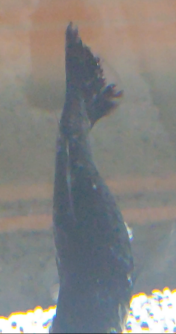
<The Molly with the white gunk is showing the classic 'something wrong, but hard
to say what' scenario you see with livebearers generally. It may be a parasite
called Costia (also known as Slime Disease) but often seems to be environmental.
High nitrate can be a cause, especially with Mollies, which in freshwater rarely
tolerate above 20 mg/l nitrate before showing a tendency towards disease. Read,
review your tank, and act accordingly.
Cheers, Neale.>
Re: Mollie needs help PLEASE? 11/1/18
Okay, thank you. Nitrates 0 ppm,
<I find that hard to believe unless you have rampant plant growth (i.e.,
removing armfuls of plants per week) and minimal stocking. Nitrate is the end
product of the biological filtration process. It goes nowhere. So should
accumulate between water changes. If it doesn't increase above tap water levels,
then either there's no biological filtration going on, or your test kit is
broken. Tap water supplies typically have somewhere between 10-40 mg/l,
depending on your supplier, so again, zero levels even for freshly drawn tap
water are extremely unusual.>
Nitrites 0 ppm, ammonia 0 ppm,
<Fine.>
pH around 7.6-7.8 if that helps.
<Good for Mollies; less good for Bettas and Bristlenose Cats. You don't mention
how much salt you add. Likely adding more (which would stress/kill the Betta)
would be a very good first step in the sick Molly's recovery.>
Both tanks. My tank with the Betta she is solely with guppies and mollies are in
their own tank.
<Understood. Regardless, Bettas and Mollies aren't really compatible for the
reasons described earlier. Mollies are best kept with Mollies, Mollies, or some
other type of Molly. Being slightly flippant there, but their need for
relatively warm water, brisk water currents, plant-based diet, hard water
chemistry, and realistically, the option to add significant salinity, all make
them tricky to house with anything other than fish from similar habitats. Some
coastal Killifish species can work, like Florida Flags, and some of the gobies
too, Knight Gobies for example, but otherwise Mollies are single-species rather
than community tank residents if you want 100% success.>
Thanks again.
<Most welcome. Cheers, Neale.>
Re: Mollie needs help PLEASE?
11/3/18
Well thanks for the education on mollies.
<We aim to please!>
Nitrites are at about the 30 mark
<Do you mean nitrate? Nitrite (with an "i") would be beyond lethal at 30 mg/l.
Nitrate (with an "a") at 30 mg/l would be typical tap water, a bit high for
Mollies (in freshwater, at least) and most cichlids as well, but acceptable to
most other community fish (tetras, catfish, etc.). So fine for general
fishkeeping, but not good for Mollies if you insist on keeping them in
freshwater conditions.>
but I test after 48 hours of water change so water has time to cycle through
biofilter.
<Nitrate will ONLY increase going through a biological filter. By definition
that has to be the case, since what a biological filter does is turn toxic
ammonia ions into less toxic nitrite ions, and then those less
toxic nitrite ions into almost completely harmless nitrate ions. Nitrate is the
end product, so kind of like dirty plates in a restaurant without a dishwasher,
as time passes, just as the pile of dirty plates gets taller,
so does the nitrate level in the fish tank go up. Nitrate is, in almost all
community tanks, removed (well, diluted at least) through water changes. If your
nitrate level is 30 mg/l out of the tap, then that's as low as it can ever go.
It'll creep up to 35, 40, 45 mg/l as the weeks pass. Under experimental
conditions, nitrate isn't particularly toxic until at least upwards of 100 mg/l,
but that's based on work with food fish done in labs.
Some aquarium fish are equally tolerant, but cichlids, Mollies, and most marine
fish are much more sensitive. They become sickly as nitrate creeps above 20
mg/l, and above 40 mg/l they often show severe health problems. In the case of
Mollies, it's often over-production of mucous that becomes the most obvious
thing, together with fin-clamping, rocking from side to side ("the shimmies"),
and a tendency towards diseases such as Finrot and Fungus.>
I also use stress zyme plus when needed.
<Let's be clear here. API Stress Coat is a useful product for use when shipping
fish or when introducing new livestock that may have been damaged in transit,
but otherwise serves no particular benefit above that of plain vanilla water
conditioner. So it's nice, but not essential. API Stress Zyme on the other hand
is almost completely useless. It may or may not speed up the cycling process,
reports are very mixed indeed, but what it doesn't do is magically improve the
aquarium once the filter is properly matured. Of
course API will happily sell the stuff, and it probably does no harm, but it
doesn't do anything a water change and filter clean won't do better.>
Bettas water is diff than the Molly tank.
<Good oh!>
Thx again. Going to redo something's. And I do have plants in the tanks.
Have a great day and again thx for your time.
<Glad to help. Neale.>
|
Male Mollies an over breeding, beh., stkg...
4/1/13
So my husband and I have had a fish tank for the last 7 years and we
have always chosen to get Mollies as they are beautiful fish, are rather
hearty (we have had some females live to be 3 years old), easy to care
for, tend to have fry that could survive getting eaten (had one family
last seven generations), and usually last a long time...
<Ahh, you likely have "good molly water" (hard and alkaline), have kept
the water not too warm, well-cycled, regularly maintained through water
changes....>
We also have them in a tank with one large (5 year old) gourami, danios, a
couple platies and two tiger barbs (not friendly fish but they have
adapted well...) At first we would always get a pair, one male and one
female. We learned very quickly that the males can be very aggressive
and actually (for lack of better terms) rape the females to death... Is
this what is truly happening to our fish?
<Can be trouble>
We can tell that the females are already pregnant and have been very
successful in keeping them and their fry alive but more often than not
the males will constantly chase the females around and try to mate with
them, even
after they are pregnant. We just bought some more fish because our
population was getting low and now have two orange lyre tail mollies and
two silver mollies. We asked for one male and three females
<Good ratio>
but got two of each and now both females are pregnant and both males are
still trying to breed with both of them. I have seen this in the past
and usually the female will give birth then die... I have had many
females give birth and survive, but I am just wondering... Is it
possible that our females are getting very stressed out by these males
"over matting" with them??
<Yes>
And if so... do I need to get rid of the males because they are very
beautiful fish and I don't want to but I also don't want my females to
get over stressed...
<Either that/this or add more females if you have room>
By the way we do normal water changes keeping our ph at about 7.6, use
aquarium salt to help all of the fish stay healthy and also regularly
change our filter media...
<Ahh, as I suggested above>
Just hoping for some suggestion because I have put the males in "fishy
jail" because they are over breeding with our females, but they males
get along together just fine! I just don't want our females to get
"raped"...
Help please......
Jeff and Erika
<Cheers, and thank you for sharing. Bob Fenner>
Re: Black Knife Sick, now Molly reproduction, stkg.
1/12/13
Well I know it has been quite some time since my last question. I would
like to quickly update you on the Ich :(. Black knife died when I went
to the LFS that morning, was very sad. All the other fish lived through
it however, except for the swordtail fry(have about 4 left). I'll get my
Black knife again in a few months :). I have one possibly small problem
and the only answer I can find is add more females. As I've said before
I have 3 Black Mollies (1 male 2 females). The male is obviously VERY
active and is CONSTANTLY all over the females. Both females are
pregnant, one being ultra pregnant (figured she would have done her
business by now but I think she hasn't due to the stress from the male).
I really rather not add another female, I don't want to overstock.
Anyway I'd very much like your advice in this situation please.
<I's likely trade in the male itself... some of the coming offspring
will serve as replacement fish>
Very rarely is the male swimming peacefully. 90 % of the time he's
swimming underneath either female. Females seem annoyed but since they
are mollies are they "ok" with this aggressive male behavior.
When I say aggressive I'm quite sure he's not nipping, more like he
swims with his face in her anal fin area and then swims around her
flashing his monster dorsal fin. Anyway Thanks again guys!
ps: perimeters 7.5 ph, ammonia 0, nitrites 0, nitrates 15.
<Cheers, Bob Fenner>
Restocking 29 gallon tank..... Temperature compatibility
with 2 tiny mollies? 12/9/12
Neale,
<Jill,>
I pick up some new fish tomorrow from a guy who has too many. You said
(I think it was you!) that cherry shrimp can be converted to low
brackish.
<Indeed. SG 1.001-1.002 at 25 C/77 F will do them no harm, and that's
ample for livebearers.>
So wouldn't this also apply to fire red shrimp because they have the
same name and they're just a color variation?!
<Should be fine, but the best approach is to try a few out and see what
happens. If they're still happy and feeding a couple weeks later, add
some more.>
Here's their info and the same 2 names as for cherry shrimp:
http://www.planetinverts.com/FireRedShrimp.html
You also told someone in the forum that the cherries prefer a cooler
temp....I saw this when I was trying to find info on if they were
brackish tolerant. People do commonly keep shrimp locally, though my
home averages 79 F most of the year. When we have cold days it will be
75 F inside my home at the coldest point, but temps usually climb higher
daily, even during winter. I'm in Texas.
<That will cause no harm to these shrimps. They're subtropical to
warm-temperate animals, native to China and Japan.>
I was intending to throw the fire red shrimp and some Endler's (that I
heard do tolerate brackish)
<Yes, and again, SG 1.001-1.002 will be ample, for these and the
Mollies. No need for more salinity than that.>
into the established 29 gallon tank with the 2 female baby balloon
mollies, and then slowly convert to low end brackish due to the mollies.
These mollies could eventually grow into a problem for the other fish, I
know this, and I will deal with that if/when it happens. They're
pretty small now...and I threw in a bunch of cover plants for hiding
places for shrimp and Endler's. I just want to know.....do I remove the
heater or set it at a lower temperature, and what temperature would you
recommend?
<I'd set the heater to 25 C/77 F and leave it at that. All will be fine
at this.>
Or is the temperature difference going to be bad for the mollies who
have been raised with it set for 78 degrees? It looks like they
will tolerate to much cooler, but I don't know if it would cause illness
to suddenly go from 78 to 72. (Though....it could run even warmer
naturally on a warm day. The shrimp may not like it, and I can't
afford a chiller!!) Thank you! I appreciate all of the helpful
advice you've given me to help restart my very 1st full sized tank.
If you say little mollies need to move out, I do have another tank I can
set up for them and I had been planning on setting it up anyway. I never
realized shrimp like it chilly.
<Tolerate more than like; they can, do thrive at tropical temperatures
all year around, even if that isn't what they'd enjoy in the wild. Mine
live and breed wildly at this.>
I see cherry shrimp in all the shops and they're kept on the warm side
like my home, though they're just stock and it's not their final home.
Many people keep air conditioning at 70-72 F, so I'm odd I guess!
Jill
<Hope this helps, Neale.>
Re: Restocking 29 gallon tank..... Temperature compatibility
with 2 tiny mollies? 12/9/12
Yes, thank you.
<"Real good", as Bob F would say. Cheers, Neale.>
|
are my mollies fighting? ph issues?
12/11/11
Hello,
<Hello!>
Me and my wife bought and set up a 14 gallon freshwater about 4
or 5 months ago and decided from the start that we were going
with all live natural decor.
<Nice. However, do bear in my 14-gallon tanks are on the small
side, and the lighting systems that come with them are often not
that strong. There are some exceptions, small tanks designed for
advanced aquarists, but most of the small, budget-priced tanks
will have, at best, medium-strength lighting so you need to
choose plants carefully.>
We began slowly stocking with just one of two fish at a time and
started with 3 sunset platies (1 male, 2 females) of course and
they have done spectacular throughout.
<Can be an excellent species. Not always good quality, sadly,
but if you do get good Platies without any diseases, they're
reliable fish, and should do well in a tank this size.>
We then added a few male lemon cobra fancy tail guppies and then
two regular fancy tail guppies and a common Pleco.
<Here's where things go badly. A Common Plec has no
business in this aquarium. It will get to 6-8 inches within 6
months, and 18 inches within 2 years. Return to the pet store
ASAP. If you must have an algae-eater, choose 3-4 Nerite Snails;
they won't breed, they eat nothing but algae, and they're
basically hardy so long as you don't add medications to the
tank.
Do also understand that Guppies aren't hardy fish anymore,
and they tend to do better in tanks tailored to their specific
needs. Slightly brackish water can be particularly
helpful.>
Everything was still fine for a few days but we lost a guppy and
then slowly started losing guppies thereafter, after noticing
that the guppies tales had pieces missing and were swimming
around crazily
<See above. Platies need fairly cool water, 22-25 C/72-77 F,
and this doesn't suit Guppies. Both Platies and Guppies also
need hard, alkaline water -- which you don't have. Fancy
Guppies being so delicate, they'll be the first to
succumb.>
we went back to the pet store and showed the local expert.
<Uh-huh.>
He said it was the Pleco harassing them and nipping at the
because it was keep with aggressive fish and other large Plecos
at the store.
<Rubbish.>
We then removed the Pleco and since we lost all of our guppies
eventually we got an albino Cory and 3 balloon mollies (one of
which is a creamsicle lyretail, a silver, and a black molly).
<Mollies DO NOT belong in this tank AT ALL! Return them.
http://www.wetwebmedia.com/fwsubwebindex/mollies.htm
They need at least 25, 30 gallons, and they also need warm, very
hard, very alkaline water, ideally slightly brackish. >
Everything was great except our creamsicle lyretail was a bit of
a bully, terrorizing the entire community.
<Tank is too small, and Mollies are aggressive anyway.>
We then moved and because of the living conditions we were at had
a horrible evaporation problem, losing about 3-4 inches a water
in the tank a week. After we got to the new place we bought a
gravel siphon and cleaned our gravel and the tank really well
bought all new vegetation (3-tall grass like plants, 3-ferns,
1-large Anubis on a rock, 1-spongy like moss ball,1- wreath, 1-
large piece of wood, and 1-bamboo).
<Take the Bamboo, Wreath, Grasses, and Ferns out. These are
non-aquatic plants. Some aquarium shops sell what are basically
houseplants as aquarium plants to what in the trade are called
"suckers", people who don't (yet!) know any
better.
http://www.wetwebmedia.com/fwsubwebindex/keepoutfw.htm
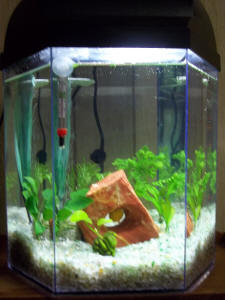
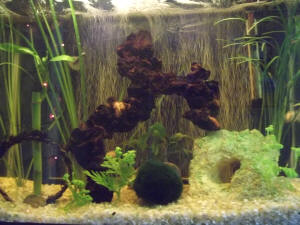
From your photos, I believe the Bamboo is Dracaena sanderiana; I
don't know what the Wreath is but it sounds dubious; the
Grasses are Ophiopogon japonicus; and the Ferns are Selaginella
willdenowii. Kept underwater all these land plants will die, rot,
and pollute your aquarium. Feel free to print off this e-mail,
show it to the retailer, and the two of you check online if you
want to see that I'm right and he/she is wrong. Explain,
forcefully, that you are no longer a sucker and do not want to be
sold this sort of rubbish.>
After getting everything setup and running properly we have added
a 14 inch bubble strip in the rear. We also run a bio-wheel
filter for our filtration. We also have added 3 Otos and 2 more
emerald green Corys to bringing our total to 3-sunset platies
(1-male and 2-female), 3- mollies (silver and black Sailfin
balloons, creamsicle lyretail) 3-otocinclus, and 3- Corys (1
albino and 2 emerald green).
<You're quite generously stocked for a small tank here.
Getting rid of the Mollies should fix things, but don't add
anything else. These fish will grow, remember, and some will have
babies.>
One of our female platies did give birth to 6 fry but we made the
mistake of letting them rejoin the community too early and now
only have 1 left in a new 5 gallon tank we have specifically for
that reason with a gold snail to clean. So now that you have a
background of our newly acquired hobby here come the
questions....As I said before the creamsicle molly has been the
obvious dominator of the tank since we got him bullying the
entire tank at his own will but within the past week the black
molly and him have been going at it non-stop nipping at each
other with their top fins all the way up the entire time. Now the
creamsicle molly has been hiding often and when the black one
does get near him he stays vertical tail fin down. The black
molly also is now doing all the chasing of other fish in the
tank.
Has the nipping order shifted in the tank or is the creamsicle
molly sick and just losing strength?
<Either; both. Hard to say. Get rid of them anyway. They
don't belong in this tank and will never be good
pets.>
Second question is....We have the test strip for multiple testing
of our tanks and do also take our water to the pet store to be
tested regularly.
All the other levels, i.e. nitrites, nitrates, alkalinity,
hardness, ammonia, all of that checks out except the pH levels
consistently remain lower than neutral.
<I do need the numbers here, not your opinions. For example,
your hardness cannot be "good" if your pH is 6.8.
Platies need a general hardness of 10+ degrees dH and a carbonate
hardness (~alkalinity) 5+ degrees KH. If you have these minimum
level of hardness, you should have a pH around 7.5.
http://www.wetwebmedia.com/fwsubwebindex/fwh2oquality.htm
So you're not telling me something I need to know. Likewise,
for me, an expert, the right ammonia and nitrite levels are 0 and
0. Yet some beginners think ammonia between 0 and 0.5 mg/l is
"okay", and nitrite between 0 and 1 mg/l is
"okay". They're wrong.>
On the test strips it appears to be around a 6.8 because the
strips only go one level lower than neutral we are not exactly
sure where it sits. We have the pH Neutral Regulator and the
Prime and have added multiple doses and it stays at a constant
level no matter what.
<Do not, Do Not, DO NOT try to change pH directly. Yes, your
pet shop will sell your pH up or pH down products. But these have
very specific usages involving water that has been pre-softened
or pre-hardened and needs supplemental buffering for one reason
or another. And surprise, those products are expensive and
profitable, so pet shops will happily sell them. What you
actually need to do is add some Rift Valley salt mix, as
described at the above link, at one-half the dosage described
there. That should create nice moderately hard water ideally
suited to Platies and acceptable to Corydoras catfish and, if
wanted some tetras, a school of X-Ray Tetras would thrive in this
water perfectly well. Better still, this mix it costs pennies a
month and apart from the marine aquarium salt, the Epsom salt and
baking soda are things you can buy at the grocery store!>
None of the other levels are crashing or have been having any
problems and we understand none of the levels will be solid until
a complete nitrogen cycle has completed but because of the
regularity we visit the pet store we have a pretty good
relationship with a couple of the aquarium department specialist
and they are stumped with this issue. None of our fish appear to
be sick or diseased of any sorts and we even have a severely
pregnant platy at the moment, the only strange or erratic
behavior at the moment is the battling mollies, which is the
reason I grouped the questions together. Do you have any insight
on what to do about raising the pH to get it a little closer to
neutral? We have came to conclusion as of now that we will just
let our tank cycle a little longer and with the addition of the
bubble strip that maybe things will even out itself because we
don't want to take the risk of adding pH-up chemicals and
disturbing the chemistry of the tank since all other levels
tested fine.
Just wanted to add that your website is great and keep up the
good work!!!!
<Thanks for the kind words.>
Thanks for any help,
Josh
<Cheers, Neale.>
|
|
|
Re: Mollies 11/9/10
Hello.
I wrote about a month ago, and I received excellent advice from Neale.
I have a few follow-up questions.
<Fire away!>
I inherited nine Dalmatian Molly fry about a month ago. With
suggestions from your site and Neale, I set up a 36 US gallon low-end
brackish tank for them. The tank is now fully cycled, and it appears to
be doing well (temp 80F, pH 7.8, ammonia 0, nitrite 0, nitrate 5ppm,
dGH 290ppm, KH 180ppm, SG 1.004).
<If you have problems with plants, cut the salinity by about a half;
SG 1.002 should be fine for Mollies, keeping the benefits of slightly
brackish conditions but with minimal stress on plants such as Indian
Fern, an ideal species for livebearers tanks in many ways.>
Now that the Mollies are about four months old, I can see that I have
five males and four females. So far, the males aren't chasing the
females (perhaps they haven't yet become sexually mature?),
<Oh, they're mature, but their hormones really won't kick in
until they're nearly fully grown. Dominant male Mollies can be very
aggressive. Does vary though.>
but I know it is only a matter of time before that begins. I understand
that the current ratio is nowhere near ideal, and my question is how to
best rectify that. Should I add females?
<Yes.>
If so, how many Mollies can I safely (and happily for them) have in a
tank my size?
<Oh, in a tank this size, allow 3 gallons per Molly, assuming these
are "shortfin" Mollies rather than the bigger
"Sailfin" Mollies.>
Also, I would like to have as few fry as possible (a space issue more
than anything). Neale suggested keeping Knight Gobies and Glassfish to
keep the fry count low. I am more partial to Glassfish, and if I
wouldn't be overcrowding my tank, I would like to purchase some to
deal with the fry.
None of my local pet stores stock Glassfish, so I would be forced to
purchase them online; is this an awful idea? I can find three different
species available: Giant Glassfish (Parambassis qulliveri),
<Parambassis gulliveri, a big (to about 22 cm/9 inches), predatory,
and rather feisty species; excellent and very beautiful freshwater
fish, but not for this tank!>
Indian Glassfish (Parambassis ranga),
<Yes, this is a good species for either fresh or brackish water.
Less predatory than Knight Gobies, but should make a dent on fry
populations.>
and Longfin Glassfish (Gymnochanda filamentosa).
<Very delicate soft water species; not recommended.>
Which, if any, of these would be best, and roughly how many should I
stock?
<You want to keep Glassfish in reasonably large groups because they
are quite grumpy fish that chase one another. I'd get at least
three, and ideally five or more. Allow two gallons per fish.>
Finally, it might be that one of my female Mollies is just now big
enough for it to become pronounced, but over the last week or so, she
has become slightly deformed. Starting roughly at her dorsal fin going
toward her mouth, her body curves left. She is just as active as the
other fish, and she eats well, but she does swim slightly crookedly. Is
there anything I can do?
<Not really. Dietary issues are sometimes to blame, so review diet.
But once the deformity is there, it won't go away. Inbreeding in
fancy livebearers means that poor genes, and resulting deformities, are
extremely common.>
Thank you so much!
Sincerely,
Amy
<Glad to help, and enjoy your fish! Cheers, Neale.>
Balloon belly mollies, stkg./sel. 10/18/10
I have had producing mollies for several years with no problems. This
last bunch is a different story, the babies grew up and acted totally
normal at first. The last month, they turned wicked and the males
killed every female I had. They didn't bother any of the guppies or
tetras, just the female mollies. Have you ever heard of a problem like
this?
<Hello. The short answer is yes, it is not uncommon for both male
Mollies and male Guppies to be extremely aggressive. The size of the
tank, the ratio of males to females, and the water temperature are all
factors.
Inbreeding can also be a factor, though this is a difficult one to
quantify, especially when you're starting off with highly inbred
varieties like Balloon Mollies. There's no simple solution, except
the usual: stock with lots of floating plants, keep at least 2 females
per male, and make sure the tank is big enough for the species at hand,
i.e., at least 20 gallons for guppies, and 30 gallons for mollies.
Cheers, Neale.>
Molly Fish Tank Stock 7/6/10
I am in the process of putting together a varied Molly tank. I have a
26 gallon bow front tank and was wondering approximately, what is the
maximum amount of fish I can have in it to ensure health and wellness
for all the fish? I don't want to overstock and increase the
likelihood of disease. I was hoping you could provide me with an
approximate number for my tank...thanks for your time.
Andrea
<Keeping Mollies on their own is a good idea, given their preference
for slightly brackish water. Allow 2.5-3 gallons per Shortfin Molly,
and 4 gallons per Sailfin Molly. If you're keeping both sexes,
allow (at least) two females per male, and in a tank this small keeping
more than a single male Sailfin will likely result in serious bullying.
Since all Molly species hybridise readily, unless you cull fry,
you'll soon be overwhelmed with crossbreed fry with little to no
commercial value. Getting rid of such fry won't be easy. That being
the case, either keep a mixed sex collection of a single variety of
Molly so you can easily sell the fry, or else just virgin females of
lots of varieties so that there's no risk of breeding.
You could of course add some predators to the collection, for example
Knight Gobies, which need brackish water conditions and will readily
eat Molly fry. All 3-4 gallons per Knight Goby. Cheers, Neale.>
New to mollies, new fry and questions 2/20/09
Hello! Very informative site. Glad to find knowledgeable and
enthusiastic folks willing to share time and info about our fishie
friends. My question(s): Have two female mollies (one about 3 yrs old,
the other adopted over Christmas) and this weekend introduced a male.
Just THREE days later, one of the females gave birth to only three fry,
though she still seems VERY pregnant. I separated the male (as he is
rather relentless in his pursuit of the pregnant molly) into a floating
plastic breeder type enclosure (only thing i had on hand) and also
cordoned the fry in a breeding net. All fish are still in same tank,
within their respective enclosures. My first question is whether it is
possible that my pregnant molly got stressed by a recent move (hours
before the birth. I moved the entire tank to another side of my room,
CAREFULLY), or is it possible that the aggressive male caused her to
birth the fry? Next, I just read something about fry needing a
different nitrate level than adults, and I am worried that maybe I
should not keep the fry in the community tank--though they seem to be
doing great (save for one who got stuck between the net and the plastic
frame of the breeding net and died ; ( )? I also get algae in my tank;
i have one algae eater and I do scrub the sides often enough to
maintain crystal clear water (i do leave a little bit for my algae
eater though), and I read that too much algae is also not good for fry.
Finally, my male is NOT happy being so constricted, but every time I
let him out he pesters the pregnant molly incessantly! (I mean
INCESSANTLY!) The older molly also picks on her a bit too. : ( I was
considering getting another female or two...what do you think about
that. Aside from the three mollies and one algae eater, I have 5 neon
tetras (who stay together and never bother anyone), so I am pretty
positive I have ample room for additional fish. I have a bio-wheel
filter (with two wheels and two filters), an aquarium heater (which I
keep around 78-79 since the fry were born), and I also have two
aeration hoses, one on either side of the tank. I only have two very
small live plants, and after reading a lot of molly info, it seems that
I may need to add more. This is a long email, but yours is the best Q
& A site I have found, so I really appreciate your taking the time
to read through this and look forward to your advice/answers! Peace,
Jenn <Hello Jenn. Yes, female Mollies (and livebearers generally)
are stressed when moved. At the most extreme, they can miscarry.
Mollies are far too large for breeding traps and should never, ever be
put in one. Frankly, only Guppies are small enough for them, and I wish
they were sold with a warning label on the box! Secondly, aggression
from males can, will stress the females. As I've written
repeatedly, males should be outnumbered by at least twice as many
females. Keeping equal numbers of males and females is cruel, precisely
because the males don't treat the females well, and will
essentially forcibly mate with them again and again, even if the female
is already pregnant. In the wild this instinct is understandable, the
males being smaller and much more likely to be eaten to predators.
Males also hold territories containing schools of females, and spend
much of the time driving off other males. So the actual opportunities
to mate are few, and need to be seized. But in the aquarium the females
can't hide, the males don't have any challenges, and the result
can be the female fish equivalent of Hell. Personally, unless the tank
is above 180 litres/47 US gallons in size, your tank should have just a
single male from a large Molly species (e.g., a Sailfin Molly) or up to
three specimens of a small Molly species (e.g., a Black Molly). All the
other Mollies should be females. Your tank should also have lots of
floating plants. These are crucial for two things. Firstly, they
provide hiding places for the fry, making traps and breeding nets
irrelevant. Secondly, they provide cover for the females, so they can
rest hidden away from the males. All Molly species need minimal nitrate
levels when maintain in freshwater aquaria. As you have hopefully read
before, Mollies do not always do well in freshwater tanks, and sodium
chloride helps to reduce the toxicity of nitrate, helping the Mollies
do better. Mollies do even better in brackish water tanks where marine
salt mix is used, because this raises the carbonate hardness and pH,
further improving their health. Obviously, Neons can't be kept in
tanks with salt or marine salt mix added, which is why Mollies and
Neons are NOT COMPATIBLE fish. Algae is the perfect food for adult and
baby Mollies alike. Much of this written elsewhere on this site; start
at the link below, and follow the links:
http://www.wetwebmedia.com/FWSubWebIndex/mollies.htm Cheers,
Neale.> W ild mollies, ID, sel. 9/27/08
hi
i live in the united kingdom and have kept a few Sailfin mollies. i
would like to have a fool grown molly of about 6" and i feel the
best way for me would be to raise wild mollies as i feel tank bred
mollies may have stunted growth due to cross breeding and
interbreeding.
<Your analysis is correct. The Sailfin Mollies sold in shops are
primarily Poecilia latipinna, but likely hybridised with other species
or else strains developed for colour rather than size. While these
Sailfin Mollies can get to about 10 cm or so, they don't ever seem
to reach the full 15+ cm lengths possible in the wild for either this
species or the related Giant Sailfin Molly (Poecilia velifera).
However, genetics is not the only factor. Mollies have been studied by
scientists because their size is dependent not just on genes but also
the social structure of a population and environmental factors (i.e.,
diet and water quality/chemistry). In other words, it's
complicated. Male body size is smallest in dense populations, in the
wild at least, so keeping a single male alongside a group of females
might work best. Mollies, like all other fish, grow fastest when young,
and while growth slows down as they mature, it doesn't stop. Among
breeders, it is said that male Mollies stunt very easily if overcrowded
when young, so one approach to take might be to rear a new generation
of Mollies at home, and remove some of the males to a very clean,
spacious tank so that stunting couldn't occur. This is likely
related to the observation mentioned above, that in the wild males are
smaller in denser populations.>
can you help me in finding either young wild Sailfin or about 2 pairs
of adult wild Sailfin mollies.
<In the UK, wild-type Poecilia velifera or Poecilia latipinna simply
aren't traded. If you want them, you have two options. The first is
to place a special order with a retailer you can trust. Several stores
handle top quality wild-caught fish, for example Wildwoods in London
(who do mail order as well as being retailers). What you don't want
is a retailer passing on plain Green Sailfin Mollies as wild-caught
fish of either species: Green Sailfin Mollies may look the same, but
they're captive bred and likely won't get so large. Your
alternative is to contact a livebearer special interest group, such as
the British Livebearer Association. This group has auctions at which
you can buy fish carefully bred to ensure they're not hybrids.
These will be cheaper than wild-caught fish, but just as good.>
thank you
<Cheers, Neale.>
Compatibility with Platies and Loaches... Mollies et
al. sel., no reading 2/25/08 Hello!?? I have? a relatively new 20
gallon tank setup.? I have 3 Yoyo Loaches and 3?Mickey Mouse Platies.?
They seem to? be getting along? well. The platies keep to themselves?
and the loaches are a little? more aggressive, but tend to play with
and chase their own species only.? I was wondering what other fish I
can get??? I am going to wait a few weeks, but would Mollies be an
option?? I have read that they like some salt in the water, do they
require that? I am looking to add more color (i.e. yellow, reds, blues)
? Thanks, <? Please read here:
http://wetwebmedia.com/FWSubWebIndex/mollies.htm and learn to/use the
search tool, indices... Bob Fenner>
Black Mollies for a 6 year old
10/23/06 Hi Crew, <<Good morning, Angel. Tom>> After
visiting my house, my niece became inspired to have an aquarium of her
own! So my sister got a small 5 gallon kit for her daughter, Caitlin.
<<Love to hear about children becoming interested in the
hobby!>> Never having had such a small sized tank myself, when my
sister asked for stocking suggestions, I explained the cycling process
and got her started growing some Aponogeton bulbs. I figured this would
help cycle the tank and give me some time to research small and hardy
fish that would be OK for this tank, while still giving them something
to look at and watch grow. <<A breath of fresh air here, Angel!
You can't imagine how many e-mails we receive that start similarly
only to dismally sink into a tale of how many fish had expired BEFORE
the hobbyist learned about cycling. Well done!>> This was almost
two months ago. The plants did well and had a big growth spurt after I
added some liquid CO2. They got too big so they are out of the tank now
and living in my outdoor pond. <<Okay.>> After the plant
adventure Caitlin really wanted a couple of black mollies, so this is
what her mom got her. They seem to be doing fine, their little tank
completed cycling with plenty of green algae growth in the sand and on
the tank glass. Water tests showed nitrites 0, nitrates ~10 ppm, PH
7.6. The mollies are eating well, even eating some of the algae in the
tank. Addition of aquarium salt really perked up the mollies, we added
5 tsp. I know some of the salt will eventually be removed with water
changes...how often should we add salt again? Also is Epsom salt ok to
use? I am thinking it is the same thing as aquarium salt but not sure.
<<Aquarium salt is pure sodium chloride, Angel. Not the same as
Epsom salt. As for replacing the aquarium salt with water changes, to
maintain the same ratio I would add a 'light' teaspoon to every
gallon of water added back into the tank. Note that this won't be
necessary if only 'topping off' the tank due to evaporation
since the salt won't evaporate with the water.>> My last
question is: one molly is very fat and we're certain she's
pregnant. When the babies grow it will be too many fish for that tank.
I was wondering if when the babies are newly born if it would be ok for
me to take them to my house and use them as feeder fish? I know mollies
breed so often... <<I've not heard of Mollies being used as
'feeders' but you're quite correct that the offspring will
overload the tank. If the adults don't get to the fry first,
I'd say to help yourself and see how this works out for
you.>> The tank has crushed coral sand for substrate, two bushy
fake plants for cover and a large piece of slate. Lighting and
filtration is built in to the hood. Anything else we can do to make
sure these mollies live happy lives? Maybe an air pump and a couple of
airstones? <<I like the airstone idea simply because many small
aquariums are often taller than they are long which doesn't provide
a lot of area for oxygen exchange at the surface. I don't think
this would be a bad idea in the least and, besides, the bubbles are
kind of fun to look at.>> Thank you for your help! I know you are
so busy helping people with many bigger issues but honestly I have
never had such a little tank and it is challenging thinking of what to
do about algae, babies, etc. in such small volume of water.
<<You've done very well in getting your niece started, Angel.
Perhaps we should be thanking you, instead. :) >> Many thanks,
Angel <<You're welcome. Tom>>
Molly
ratio's in a small community tank - questions Hello, I've
been reading over the site and have found it to be very interesting and
informative, and I have several questions that I was hoping you could
help me out with, so here goes: I have a 10 gallon tank that has been
set up for about a year and a half now which currently houses a female
black molly, a glassfish, and a longfin danio. I was considering adding
a few more fish, and my first choice would be to add more mollies. I
have read that it is best to keep mollies in 'harem' type
setups with several females per male, but I am also concerned that if I
added enough fish to obtain a proper male to female ratio I may end up
overcrowding the tank (I was told up to 8 fish for a 10 gal., but I
don't know how close to the truth that is...). At what minimum
number of females per male can I assume the molly I have now won't
be at risk of being harassed to the point of death or illness by the
male (she has become my favorite, and part of my intention in adding
more mollies would be to make her 'happier', so I'd rather
not risk it)? I have heard 2 females to 1 male as a minimum, but this
still sounds risky to me. If my tank is too small to safely add both a
male and the proper number of females, what about adding one or two
more female mollies? Would they be aggressive with each other, happier
to have a 'friend', or just indifferent to each others
presence? Speaking of aggressive behavior, my molly had always been
very peaceful and kept to herself in most of the little over a year
time that I've had her, but recently I notice her harassing the
other fish now and then. Would adding more mollies possibly stop the
aggressiveness towards the other fish, or is it likely that the other
mollies would also be aggressive with the other two fish and just make
matters worse for them? Once again speaking out of aggressive behavior,
I was wondering if communities of fish ever designate a 'pecking
order', so to speak, as other animals in group and community
settings sometimes do. Although I've never heard anything to this
effect and it seems especially unlikely in a tank with several
different kinds of fish, I've noticed in the past that when the
most aggressive fish in the tank dies, it seems that soon afterwards
one of the formerly peaceful fish soon assumes the role of the
aggressor. Just out of curiosity, does this indeed have something to do
with dominance roles and ranking, or is it just a coincidence? Also,
out of curiosity, what is the likelihood that the mollies would breed
if both genders are present in the tank (the molly I currently have was
the only survivor out of 16 fry and the mother, who gave birth only a
few hours after I had purchased her. Although the babies are quite
cute, I'd feel bad if I ended up with more of them only to have
almost all of them die again!)? Lastly, if there is no way I can safely
add more mollies to the mix, are there any other fish I could safely
add? Maybe more longfin danios or glassfish, or a different species all
together? Or would adding anything else just be a bad idea no matter
what? Thank you in advance for any answers or advice you can give me!
--Lea < Your tank is small so making sure that everyone gets along
can be somewhat tricky. If you want more mollies then by all means get
more mollies. The tank holding capacity is determined by a few factors
like (How many fish? How big are the fish? How much water goes through
the filter per hour? How often do you do water changes? How much water
do you change? Etc...)First lets determine how many fish you could keep
in you 10 gallon assuming that everyone gets along just fine. Your
filter should turn the tank over at least 30 to 50 gallons an hour. The
ammonia and nitrites should always be zero and the nitrates should not
exceed 25 ppm. If the water gets above 25 ppm before you do your next
water change then you have too many fish and the nitrates will build up
so you need to do bigger water changes or change the water more often.
Now for them all getting along. A male molly always want to breed. So
he is always going to be pressuring the female to breed. If you have
more than one female then his attentions will be divided between the
two. Obviously when there are more females his attentions will be
divided between all of them and then none of them will be stressed to
any great degree. You could lower the water temperature down to 77 F .
Then there will not be as much demand for then to breed.-Chuck>
|
|