|
FAQs on Freshwater Worm Parasitic Diseases:
Roundworms/Nematodes (Camallanus esp.)
Related Articles:
Nematodes, Flatworms, Anchor
Worms and Other Worm Parasites of Freshwater Fish by Neale Monks,
Freshwater Diseases, FW Disease Troubleshooting, Ich/White Spot Disease, Choose Your
Weapon: Freshwater Fish Disease Treatment Options
by Neale Monks, Invertebrates for Freshwater
Aquariums by Neale Monks,
Related FAQs: Worm Parasites, Worm Parasites 2, Freshwater Worms, (Freshwater Worms of All
Kinds) & FAQs on: FW Worm Disease
Diagnosis/Identification, FW Worm
Disease Treatments, & FAQs on Parasitic Worms by Group:
Platyhelminths/Flatworms: ( Flukes,
Planaria, Tapeworms and Leeches), Acanthocephalans, ,...
Anchor
"Worms": See FW Crustacean Parasitic Disease,
&
Aquarium
Maintenance, Freshwater
Medications, Freshwater
Infectious Disease, Freshwater Fish Parasites, African Cichlid Disease 1, Cichlid Disease, Ich/White Spot Disease,
|
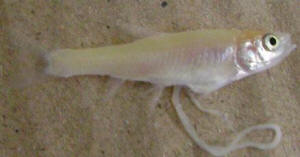 Almost
all Nematodes are white, tapered at either end, with no
discernible processes... In cross section, the esophagus region
is diagnostically tri-radiate in appearance.
Almost
all Nematodes are white, tapered at either end, with no
discernible processes... In cross section, the esophagus region
is diagnostically tri-radiate in appearance.
|
|
Camallanus worms and Flubendazole question
7/25/19
Hi Crew, :)
<Hello Kate,>
I have a 130 litre tank with 3 adult platies, 12 2 month old platies and about
40 1 month old platy fry. Recently lost 3 adult platies to wasting - assume as a
result of Camallanus worms.
<Could be, but farmed livebearers are, I believe, prone to wasting. Whether it's
exposure to worms on the fish farm, or latent Mycobacteria or even viral
infections, I cannot say. It's often the same process though: loses weight,
shimmying, off-white colouration on the body, and eventually death. I'm going to
further suggest that the environment is often a causative factor because you
often see so-called 'wasting disease' in tanks that aren't quite right for the
livebearers in question. High nitrate levels (anything above 20 mg/l) seems to
be one major factor, and I'd place farmed or fancy livebearers in the same
nitrate-sensitive category as cichlids. So while most community catfish and
characins will handle skipped water changes without problems provided nitrite
and ammonia are zero, extended gaps between water changes do seem stressful to
livebearers. Other factors include, of course, water chemistry (hard and
alkaline for most livebearers) and with Platies and Swordtails especially, high
temperatures. Platies are subtropical to tropical depending on the species,
Variatus doing best at 18 C/64 F, while fancy Platies, which are mostly Common
Platyfish genetically, should be kept around 22-25 C/72-77 F, with the lower end
of that range being best. Continual exposure to high temperatures will
dramatically shorten their lives, especially if oxygen is low. I mention this
because -- as you realise, I'm sure -- the UK is basking in extreme heat, well
above what Platies would enjoy. Increase aeration and/or floating blocks of ice
can be useful.>
I also have 10 neon and cardinal tetras in the tank who seem well and healthy.
The tank has enough filtration for about 300 litres. Shrimp and zebra snails
were moved to a second tank for now.
<Sounds good.>
My diagnosis of Camallanus worms is based in the red thread-like worms
protruding from one of the adult platy’s vent.
<Good call.>
I assume the others have it, too,
<Almost certainly true, but likely true for most farmed livebearers.>
so I have treated the whole tank with Flubendazole 48 hours ago and a small
amount of Epsom salt to ease passing the worms.
My questions are as follows:
1. As far as I can tell, the worms are still visible protruding from the adult
platy’s vent. Is this normal after 48 hours of Flubendazole? Should I try
something else?
<Multiple attempts are often required, with a decent (say, 50%) water change
before the second set of doses. Do also remember to remove carbon from the
filter, if used. If after 3-4 rounds the worms are still present, switching to
an alternative medication may be necessary, the worms being resistant to the
drug used.>
2. Also, some pest snails appear alive and well. I understand the Flubendazole
is toxic to snails, so is it normal the pest snails are unaffected?
<Does depend on the snails. Might also indicate the dosage was wrong (too low)
or carbon was used in the filter (removing the medication so quickly it didn't
do anything).>
3. Finally, one of the 2 month old fry, who is very small for his age, has a 3
mm long thick white wormlike thing permanently protruding from his vent.
<Oops!>
It’s perpendicular to his belly and definitely not poop. It (the white thing)
appears permanent day to day, growing week to week. What could it be? A
nematode? If so, why is the Flubendazole not affecting it? Should I try
something else?
<Might well be infected with worms, but could be something else, even a
prolapse.>
I have attached a bad picture of the fry. Sorry it’s so low quality. Very hard
to photograph the fry.
<Understood, and alas, the image isn't clear enough to be useful.>
Many thanks,
Kate from the UK
<Hope this helps, Neale.>
|
.jpeg) .jpeg) |
|
Re: Camallanus worms and Flubendazole question
7/26/19
Hi Neale,
Many thanks for your reply. Very much appreciated. I have to say I’m 150%
impressed with the quality of information on your site and of the advice. I
have an environmental science degree and I find the information available on
many other fish forums very ‘anecdotal’ and low quality. So thank you!
<Most welcome, and thanks for kind words.>
About the environmental factors in the tanks, The ammonia and nitrites are
0, nitrates are 10. GH and KH is around 13 deg (I have naturally hard tap
water). PH is around 7.5. So that should be both hard and alkaline - ok for
platies, right? Or does this need adjusting?
<Nope, sounds fine. But if you struggle with livebearers, adding a little
non-iodised salt, maybe 2-3 gram/litre, can help.>
About the temperature - normally I keep it at 24 C. Assume that’s ok based
on your description?
<Yep. Unless you have Variatus Platies or some 'breed' based largely on
them.>
Yes, we have a heat wave at the moment tank temp is up to 27 C during the
day... I keep putting ice blocks in the tank, although that only lowers the
temp by 1 degree C.
<Overall, yes, but the fish will swim in and out of the cold water sinking
down from the ice block if they want to, so the effect is rather better than
you might think.>
Is there any more efficient way of lowering the tank temperature for large
(130 litre) tanks? Do I just need *a lot more* ice blocks?
<Increasing evaporation will help, i.e., opening the tank and placing a fan
nearby to blow air across the water. Keep things safe though, and don't put
the fan somewhere it could fall into the tank! Don't do this if you have
'jumpy' fish though. If the tank receives direct sunlight, that can cause
real problems, so avoid that by drawing curtains or even placing foil on the
surface of the tank exposed to the light.>
Thanks for advice on anti-worm drug. I’ll do 4-5 more weekly treatments with
the Flubendazole. What other anti-worm drugs (active ingredient) would you
recommend if this doesn’t work?
< Medications that treat worms include Levamisole, Piperazine, Praziquantel,
Fenbendazole and flubendazole. Of these, only Praziquantel and flubendazole
are available as over-the-counter medications in the UK.>
Also, if I do a mid-week water change, do I have to redose with the
Flubendazole? Or just once a week is enough regardless of how many water
changes in between?
<As a rule, wait 24 hours after adding medicine before doing a water change,
and then dose as per the whole tank, not just the new water, when you need
to add more medicine. Why? Because after 24 hours the chances are good that
most, if not all, of the medicine will have been absorbed and/or broken down
by the biological filter. The exception here is where inorganic chemicals,
such as aquarium salt or Epsom salt, are used.>
Finally, the white growth on the fry is probably a prolapse. I have read up
about it on you wonderful site. I take it there is no treatment? I intend to
let him live out his natural life as long as not suffering. Is this what you
recommend? Or some other action I can take?
<In theory, a prolapse will heal itself in time. There's nothing you can
really do about the prolapse itself, but if the cause is a parasite load,
then treating for the parasites will speed things along. If worms are the
issue here, then you should see some recovery as you medicate for the other
fish in the tank.>
Many thanks and kind regards,
Kate
<And to you, too. Cheers, Neale.>
|
Kribensis and Camallanus 3/21/18
Both of my tanks, a 55 gallon and a 40 gallon are currently being treated for
Camallanus with Levamisole after I had a couple of suddenly ill and now dead
fish.
<Levamisole is a good choice here: relatively safe, and should not, in itself,
cause stress or harm to your fish, assuming it's used as directed.>
I noticed my Kribensis in the 40 with typical red bristle-looking worms
protruding from her vent.
<Sounds like Camallanus!>
So far, both tanks are doing fine, but this particular Kribensis has made a 180.
She’s social now, eats voraciously and doesn’t hide between the filter and tank
anymore.
<Nice!>
I thought she was just an antisocial fish. However, without exaggerating, she
has had a 2-3 inch, maybe longer, poo coming out of her for the last 4 days.
<Quite normal when de-worming. Sometimes the gut becomes irritated, whether by
the worms or the medication, and produces a lot of mucous. Such mucous will form
off-white to clear strings that contain little faecal material, hence the lack
of colour. If this persists for too long, say a week, you might think about
Hexamita infection, which is extremely common in cichlids, and also causes
white, stringy faeces (largely for the same reason, irritation of the bowel by
the parasites). In this case, Metronidazole is the treatment.>
I have seen nothing that looks like a warm, just regular poo. And it’s not the
same poo, but generally, if you look at her, it’s there. Occasionally she darts
quickly and it finally breaks free. After treatment, her very pale body
developed some color, but apparently any plumpness she had is gone. Is this
continuous bowel movement normal after a dosing?
<Can be.>
Was she just severely constipated?
<Could certainly be a factor, yes. If the cichlid is otherwise behaving
normally, nice colours, feeding well, socialising, and displaying no unusual
sores or pits on the lateral line or head (which often happens with Hexamita
infections) then all should be well. Finish the treatment as/when instructed, do
a decent water change, 25-50%, and see how things go!>
Thank you for any information!!
Kimberley
<You're welcome. Neale.>
Kribensis and Camallanus 3/21/18
<Oh, and by way of a timely post scriptum, Bob has just published a piece of
mine on identifying and treating 'worm' parasites that might well be useful:
http://www.wetwebmedia.com/FW%20Worm%20Art%20Neale.htm
Cheers, Neale.>
Re: Kribensis and Camallanus 3/27/18
Hello Crew!
I inquired a few days ago re: Kribensis with Camallanus worms treated with
Levamisole. The Krib had done a total about face after dosing, much more
energetic, eating voraciously, suddenly social etc.
<Good to hear.>
However, there was the issue of her continuous, long, and ever-present poop.
Neale suggested that if this continued for a week, then possibly need to treat
for Hexamita.
<Yes; ideally alongside an antibiotic such as Nitrofurazone that offers the best
"one-two" punch against a range of common ciliates and bacterial pathogens.>
Well, she's still winning the world record here with the long, seemingly
continuous poops. Going on 2 weeks now.
<Do also try Epsom salt (helps with constipation) and high-fibre foods (cooked
peas if she'll take them; brine shrimps and daphnia if she won't).
These are both harmless to the healthy fish, so feel free to treat in the tank,
alongside the Metronidazole and Nitrofurazone.>
She even fasted as couple of days, and still... So, I plan on finishing the
Levamisole treatment this week, and then start with Metroplex and Focus
(Flagyl/Metronidazole as medicated food). Does this sound like a plan?
<Absolutely.>
She is still quite pale and skinny, but still behaving much much better than
before the treatment for Camallanus.
<Good.>
Thanks for any advice in advance...and your help over the years has been like
solid ground for me when things get shaky!
<Glad to help. Cheers, Neale.>
Camallanus worms 8/23/17
Hello,
<Hello!>
I have a 90 gallon planted angelfish tank, with 6 angels, 3 rams, 2 bn Plecos, 1
iridescent shark,
<These can/will get enormous!>
and 2 mystery snails. I also have a 75 gallon goldfish tank with 4 each dojo
loaches and fantails.
<Understood.>
My concern is this, about a week ago I noticed my black angel acting
off, occasionally clamping her dorsal fin and hiding.
<First step when this happens is review the tank, cracking out whatever test
kits you have handy. I tend to do a big water change (25-50% of the tank) to see
if there's a problem with the environment. Often fish perk right up again, which
suggests a deeper issue, such as overstocking or filter problems.>
After 2 days of that I decided to do a just in case API General cure treatment,
which I have done before with no issues.
<Random medication is rarely the best approach, but API General Cure does
contain Metronidazole and Praziquantel, which are good against protozoan
parasites and intestinal worms respectively. It isn't the best treatment for
bacterial and fungal infections, or external ciliate parasites like Whitespot,
so while it has its place, it isn't the perfect go-to medication by any means.>
I got to a half dose when my gold angel who was previously healthy looking had a
fit. Swimming fast and erratically, then settling down to being nose up at the
top and very disoriented.
<If you can rule out environmental stress, I'd be thinking about a gill parasite
like Velvet, Whitespot or Dactylogyrus spp. that irritate the gill tissue
driving the fish nuts. Velvet and Whitespot are relatively easy to
treat, but note that Velvet especially can affect the gills without being seen
on the body, though sooner or later it will. Dactylogyrus spp. parasites are a
pain to treat, though API General Cure should help.>
I removed him to a hospital tank with just freshwater and prime, and after a few
hours he seemed to recover and even ate a little. Meanwhile in the big tank I
noticed my Pearlscale was now acting like the black angel, and
everyone else was acting normal. After 48 hours total since the meds were added
I did a huge water change and added carbon to remove the meds. I then tried
PraziPro (after removing the carbon) in all tanks. My poor golden in
his hospital tank had another freak out like before, so back into clean water
for him, and he recovered again. No other fish seemed effected in any other
tank. So I am now 24 hours in to the PraziPro for everyone except the
golden who is in just water and prime and doing well except....and here's my
next issue: last night while checking that fish I see, to my horror, a tiny
reddish string (worm) hanging from his ventral area.
<Praziquantel causes the intestines to twitch, dislodging the worms. Since
Camallanus worms are very common in aquarium fish, likely at "harmless" levels
in many fish, it could easily be the case that the Praziquantel caused this worm
to be expelled, but it isn't actually the reason the fish was acting odd.>
No other fish has this (yet anyway). The worm went in occasionally, but mostly
hangs outside. My water is filtered by a Hagen 406, and a TopFin 75 as backup,
ph is 7.6, no ammonia or nitrites, under 5 nitrates. I've bought
Fenbendazole
liquid 10%, but I'm not sure how to use it.
<Simply follow the instructions provided by the manufacturer or your vet.>
Any help would be greatly appreciated, thank you in advance!
Angie
<Hope this helps. Cheers, Neale.>
Re: Camallanus worms (RMF?)<Your resp. is fine> 8/23/17
Hello again and thank you for the fast response.
<Welcome.>
I neglected to mention that before the general cure I did check water
parameters, which were within normal limits. (Ph 7.6, 0 ammonia, 0 nitrite, <5
nitrates).
<Do check several times across the day, particularly pH and nitrite. "A stopped
clock tells the right time twice a day" is an old saying that reminds us that a
single data point doesn't tell you about change.
Sometimes pH will vary dramatically during the day (e.g., high levels of
photosynthesis under bright light causes pH to rise as dissolved CO2 is removed)
while nitrite changes tell us if the filter is unable to process the waste from
the fish too slowly, resulting in a backlog of nitrite for some hours after
feeding.>
My concern is also that if that fish nearly dies from PraziPro and general cure,
if its gill flukes or something like that would the femben cure that since metro
can't be used?
<Used as instructed, medications shouldn't kill the fish. Praziquantel has a low
risk of harm to your fish, though admittedly, it's not an especially good
de-wormer, and sometimes needs to be used several times and/or replaced with a
more effective medication.>
The instructions on the bottle are for cattle, so not helpful in fishies
lol.
<Indeed, and since I'm not a vet, I can't tell you the right concentrations to
use off the top of my head. Plus, some medications affect the pH, so in aquarium
situations come dissolved in a buffering solution to prevent such problems. So
while 2.5 mg per litre seems to be floating around on the internet, I can in now
way ascertain the validity of that (I'm on holiday and my fish books are all at
home).>
As a side note, I've got plans for the shark when he starts to get big.
<Cool.>
I've also literally just now brought back the femben liquid in exchange for
powder at 22.2 . (222 mg per gram) but still don't know how to dose since it's
labeled for dogs. Thank you again!
<A quandary indeed. I would still recommend using aquarium-specific medications
that take the guesswork out of things. Cheers, Neale.>
|
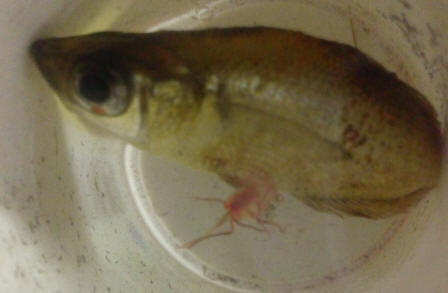
Callamanus worms!
5/26/17
Hello crew! Hope you are doing alright.
<Thank you Robert; yes>
Direct to the point, I've wrote a few times these past months due to many
unexpected and sudden deaths/ wasting, and I think I've finally found the
culprit. The pic is of an Iranian red rainbow that suddenly waited in less
than a week, and only when I found its corpse today could I conduct a proper
examination of it. Many times before the corpse would be half eaten when I
found it. But now I'm pretty sure that my planted tank is suffering of
Callamanus worms right?
<I agree; appears to be to me as well>
I'm planning on medicating with Fenbendazole, although I would appreciate if
you could give me other possible effective treatments. I also cant find a
correct dose to medicate the tank. ( should I dissolve it? Get the fish to
eat it?)
<Again; yes; and do please read here Re:
http://www.wetwebmedia.com/fwsubwebindex/nematodesfwf.htm>
as of right now all fish are eating and have a colorful appearance so I'm in
time to save them all. It is a 150 gal tank heavily planted with dirt
substrate. A collection of tetras, rainbows, fancy Plecos, Kuhli loaches,
rasboras, and dwarf cichlids inhabit the tank. There is also a 6 inch
vampire shrimp which I really would like to protect from medication. I hope
you can help me crew.
<Read on! Bob Fenner>
|
 |
|
molly sick? Env., worm.... 2/22/17
Hi my name is Steve.
<Kbytes, not Megs Steve>
. I have a 37 gal tank which I started from brand new in a new hobby .. and
of course I made the rookie mistake of adding too many fish too soon…
eventually all died off due to overstocking and ammonia spikes
<Yikes; toxic; debilitating>
at the end I had a Pleco (was a real trooper through all medications etc.)
and 3 mollies 2 female and 1 male, my other fish had no real symptoms other
then swimming upside down and eventually dying. My remaining mollies were
both pregnant several times but the male was very quick at eating the fry
straight from the oven so to speak! He eventually became lethargic and I
noticed (and through research) he had Camallanus worms and
shortly after the birth of 2 litters of fry the females finally showed signs
of it as well. 30 fry were in the tank and the male and eventually the 2
females passed away, over time only 2 of the fry survived.. eventually as
well the last of my “first” fish the Pleco died of Finrot… since then I have
only added 2 baby Plecos, one I had to put in because another of my tanks
got 2 cold in the garage (supposed to be hospital tank but the heater
couldn’t keep up with weather conditions) so I put the Pleco in the 37 gal.
the tank I have left alone to see if these 2 mollies would survive or show
any sign of the Camallanus it has been 2 months now and they seem to be
doing fine other then the smaller of the 2 mollies always had a real thick
white almost cylindrical something hanging from its anus… I have been
watching it closely and it was hanging out 1/8th to ¼ of an inch from its
body and yet feces was travelling through it.
<Reads like a prolapsed colon. Search this on WWM>
No change at all until this week when I noticed the thick white was now
getting longer and curving and bunching up underneath but not falling off..
today I noticed that the center of the white stuff is red (no sign of
Camallanus) and the outer part of the white looks almost cottony. My
question is .. because I have read that Camallanus reproduce through the
feces of infected fish could this be a sign that the mature Camallanus had
died off with the last of the infected fish and could this be the natural
reproduction cycle of Camallanus as I have read it takes several months to
cycle?
<Possibly; but again, this brings to my mind the poor fish's alimentary
canal protruding out of the cloaca, rotting off>
Sorry about the long winded explanation figured you should know the history
of my tank (failures) again the tank is a 37 gal , bio wheel filter, ph
7.5-8, 0 nitrites, just over 80 nitrate,
<MUCH too high. Please read here:
http://www.wetwebmedia.com/fwsubwebindex/fwnitrates.htm
and the Related FAQs linked above. You need to get this below 20 ppm...
there are ways detailed here to do so>
0 ammonia, 80 degrees F, 120 kH and 120 gH, I know my nitrates are high and
I am doing a 25% water change tonight to help lower it also I am attaching a
few pics of the fish in question..
<Need to crop, spiff and then send>
couldn’t get good focus on the blob but figured it might help. Should I
remove this fish all together to stop the respreads of Camallanus to be on
the safe side or could it be the fishes natural immune system killing off
the parasite?
<How did you treat for the roundworms?>
Since these fry were born in the infected tank my home town supply store
said they could have an increased immunity to Camallanus.
<Mmm; no such thing as far as I'm aware>
Thank you for any advice you can send my way!
<Welcome; steady on; you appear to have a good mind, steadfastness in your
favour. Bob Fenner>
|
|
Re: molly sick? 2/23/17
Hi and thank you for the reply.. the round worms I attempted to treat using a
pig dewormer in small doses soaked into their normal flaked food.
<Likely one of the anthelminthic compounds that are used for fishes...>
. I believe it slowed the growth of the round worms in the tank to allow the
fish time to react to it (and I know this was a long shot) but eventually they
all succumbed to the very hard to get rid of round worm, having no fish in the
tank to supply the worms with a host seemed to be my only course of action and
so far it worked, Yay.
<.... Please read here Re Camallanus:
http://www.wetwebmedia.com/fwsubwebindex/fwwormdisf2.htm
As far as my molly in question if you don’t think it could be “the return of the
round worm” then I will leave him alone and hope he gets better.. doesn’t seem
to affect him, he’s swimming eating and acting normal as compared to the other
molly, I resized and cropped the photos.. hopefully these pics will help you and
others determine what is wrong with their fish.
<Mmm; mollies are easily lost... for a few reasons. Try the search tool on WWM
to review. Bob Fenner>
|
 |
|
Fenbendazole Dosage Clarification (/ non-cysted intestinal
nematodes) 12/12/16
Hello Team,
<Joe>
Dr. Fenner
<Just Bob please. I have no doctorate>
gave someone a dosage for Fenbendazole a while back for deworming. He
said when feeding the medication directly to dose "50 mg/kg ( 23
mg/pound) of body weight once/week for 2 weeks." I was wondering if that
included a third and final dosage at the end of the two weeks. I believe
his reference was Edward J Noga's "Fish Disease: Diagnosis and
Treatment."
<Am looking at/up the stmt. in Noga's second ed. and see the ref. to the
second recorded trtmt. regimen. My take is that there are a total of
just two (2) administrations here. I'd like to cite the first regimen
listed (accorded to Gratzek and Blasiola 1992) of feeding 25 mg/kg for
three days (every day, once) instead... resulting in the same dosage (1%
of body weight per day)>
Thank you!
-Joe
<Welcome. Bob Fenner>
Have treated for Camallanus but still have signs
12/12/16
HI crew, I am very frustrated one of my platys presented with obvious
Camallanus worms, red protruding worms that went in and out. I treated
with Levamisole, the worms dropped quickly, for the stated amount of
time then one week later and then two weeks after that. My platys were
still pooping white stringy poop on and off in their poop and I was
noticing floating poop as well. I did the treatment again seeing as how
I was still seeing symptoms. As of now I am still having the same
problem. My LFS said to treat again since I am still seeing symptoms,
i.e. the poop, should I do this, or should I be doing something else,
could it be something new?
<I too suggest another treatment>
Thank you in advance for your help. Jenny
<Glad to assist you. Bob Fenner>
Re: Have treated for Camallanus but still have signs
12/13/16
Sorry to bother you again.
<Not a bother>
I am supposed to do my last Levamisole treatment of this treatment cycle on
Friday, this is actually my third try. However, one of my platys has ich
now, I spotted it yesterday. I got the tank temp up to 84.5 (high as it'll
go) but now I am unsure on how to proceed. I know I need salt, but I also
need to do the Levamisole.
<The temperature alone will cure the Ich; I would leave out the salt, add
the Levamisole. Bob Fenner>
Re: Have treated for Camallanus but still have signs
1/7/17
Hello again, So I finished my last treatment of Levamisole on about the
19th, I had treated my fry tank at the same time I have 7 that are 4
months old and 1 that is 5 months. The adults are doing well, but I am
concerned about the fry. They were fine before the treatment, no
symptoms, happy, swimming, eating etc. they were born in the infected
tank so I wanted to be safe. Now they have clear poop, they are still
eating normally and not all of them have it. What happened, did I upset
their intestines or are they actually infested?
<I'd guess more likely the former. I would cease treatments with
Anthelminthics>
P.S. My platy that had the ich passed away Christmas morning. Luckily
none of my other fish ever got sick.
<Bob Fenner>
Black ghost knife... Camallanus trtmt.
5/3/16
Hi! I'm having a real problem with my black ghost knife! We
recently got Camallanus worms in our tank (still not sure where it came
from).
<Other fish/es most likely; possibly from live or improperly processed
frozen foods (gamma irradiation, deep freezing...)>
We just treated our tank with Levamisole HCI powder yesterday.
<Mmm; I'd try Prazi/quantel first>
It told us to cover the tank for 24 hours to let no light in. Well we
just removed the blankets, and our BGK seems to have a large
lump where his 'neck' would be.
<Perhaps goiter (see WWM re; the search tool); or consequent a physical
injury>
He also seems to keep his face pointed inside the bubbles. Any idea if
this is normal or not?
<Mmm; poisoning of some sort... the usual defaults suggested,
water change/s, use of GAC... Bob Fenner>
Thanks!!!
Emily Galloway
Camallanus worms and treatment with Fenbendazole
4/13/16
Hello,
Recently I’ve noticed that my 55 livebearer tank has come down with
Camallanus worms. My stats are 7.5 pH, 0 Ammonia and Nitrites, and 0.5
Nitrates. I have multiple mollies and platys,
<Likely this is a variety/species that only infests Poeciliids>
a two different types of Corydoras catfish, a female bristle nose Pleco,
and 3 large mystery snails. Only the mollies and platys seem to have to
have the worms but I’ve decided to treat the entire tank through
Fenbendazole power that I’m going to infuse with their nightly frozen
shrimp meal. My problem is that I’ve read that mystery snails cannot
tolerate Fenbendazole and that I should move them while I treat but,
even though I have other tanks,
<Tis so>
I am not sure if snails can contract the worms or are carriers of them.
<Not of these Nematodes (they use crustaceans), but gastropod
mollusks
do/can serve as intermediate hosts to others>
If this is so I’m not sure if I should move them to their own tank or
take my chances treating them with the rest of the tank, they are
wonderful breeders and I’d hate to lose them.
<I would move them. And please read here:
http://www.wetwebmedia.com/fwsubwebindex/nematodesfwf.htm
and the linked files at top. Bob Fenner>
Please help.
Thanks,
Raven
Camallanus Consequences? Something else?
10/3/15
Hi Crew! I hope you are all well! I'm hoping you can give me some advice.
I did have a good 5 weeks or so after the Camallanus outbreak in late July, the
infestation stayed gone in the initial tank, none of the fish in my secondary
tank were affected and everything seemed fine. However 2 weeks ago one of my
beacon tetras started looking a bit wobbly in the water, head up/tail down and
taking a lot more effort to try and maintain position.
This had actually happened once before, prior to the Camallanus incident, and
that time I isolated the affected tetra in a breeder box (one of those 2 lt
hang-on style ones) so she couldn't eat food when I wanted her to fast, and
wouldn't have to fight a strong current etc. It was around a week maybe(?) but
not long before she was visibly better oriented and buoyant
again in the breeder box so I put her back in the main tank, and she was
seemingly fine.
I'm not sure if the more recent sick tetra was the same tetra as before, but
definitely one of the newer ones that I got to keep my original beacon tetra
company. Her condition rapidly deteriorated and within a day or two she had an
almost complete loss of buoyancy. At this stage she was still able to swim but
it was obviously very difficult and tiring so I isolated
her as before. The deterioration continued until she was laying on her side,
completely disinterested or unable to eat food but from there she got no worse.
She could still swim when disturbed or startled, and was quite vigorous, i.e. to
the point of still being a challenge to catch her in a net, but after a burst of
activity she would go back on her side again. Always the same side. Eventually
the downwards side got a bit dirty and irritated looking so I tried propping the
breeder box dividers diagonally so that she would at least be less on her side
and a little more upright. The downward side looked a little red streaked so I
tried some antibiotic which did clear that up. But the buoyancy issue never
improved. I tried moving the tetra to a bigger hospital tank once the "bottom
side" of the fish cleared up, and every now and then she would make the attempt
to swim around and even seemed interested in food again. But by now, she had
become very wasted and skinny, still couldn't swim well enough to aim for food,
still ended up on her side most of the time and was starting to become
permanently curled (away from the side touching the bottom of the tank). I
suspected whatever swim bladder issue she had was now permanent and after 2+
weeks she was not getting any better so I decided it was time to euthanize her
rather than let her linger on the bottom of the tank; I used clove oil. At this
point my suspicion was that she had suffered some internal damage from the
Camallanus infestation earlier on, since one of the beacons had a lot more worms
than the others. Initially I was concerned
that the floating pellets I'd been feeding (due to beacon tetras not eating
anything in the bottom half of the tank, once a food item drops lower than half
way they lose interest and won't chase the food) might have contributed but the
progression looked much worse than constipation.
Nonetheless, I stopped feeding the floating pellets and have not used them
again.
Anyway the reason I am writing is that today I have noticed another beacon tetra
with the initial signs of swimming at an angle, struggling a bit to maintain
buoyancy, and I am wondering if there is anything I could do differently to save
this fish from ending up in the same condition as the one I euthanized.
<Other than standard "good care"; I know of nothing>
Alternatively, does any of this sound like an untreatable tetra disease and
should I be removing affected fish and doing anything to treat the tank they are
in?
<If this were a commercial purpose... breeding facility; I don't doubt that such
fish would be removed, destroyed summarily>
The tank currently has beacon tetras, rosy barbs, guppies and Danios. Is it
possible that it is dietary related?
<Mmm; wouldn't other fishes be affected similarly? Ans.: I doubt it is dietary>
The fish get a variety of food (not all at once) - community frozen food, frozen
brine shrimp, chopped frozen Mysis shrimp (thawed before use), Spirulina + other
stuff pellets, sinking shrimp pellets, mashed pea occasionally, and very
occasionally flake food. Plus the barbs constantly pick at duckweed. I've been
worried about overfeeding so once or twice a week I only feed very lightly or
not at all. It is hard to tell whether the beacon tetras are getting enough food
though because they are a little more shy than the barbs/Danios, I try to get
around this by feeding at both ends of the tank at once so the feeding frenzy
isn't all in the one place.
<Your careful observation is the best assessment tool here>
The current parameters in that tank are: GH 8 KH 5 pH 7.8 Ammonia 0 Nitrite 0
Nitrate somewhere between 20-40 (a little higher than I'd like).
<I'd keep under 20 ppm. See WWM re control of NO3>
I've cleaned a lot of gunk out of the filter today and did another water change
(I'd done one earlier this week), I'm going to go back to de-gunking the filter
every time I do a water change instead of every second time since I think that
experiment contributed to the current high nitrate level.
Anyway you've helped me a lot in the past and I realise that there might be no
clear or easy answer this time but please let me know if anything obvious stands
out that I could try or that I should be wary of.
<Nothing jumps out...>
Thanks for your help and advice!
Cheers,
Bronwen
<Welcome. Bob Fenner>
Possible Camallanus worms 3/13/13
It's me again and I wouldn't bother you but I'm desperate for an answer
and I have read what your site has about these worms and I have other
circumstances that are confusing me. I admit, I'm a complete
novice but I have tried really hard and shed quite a few tears over
these fish and I'm trying hard, too hard according to some, but here's
my dilemma. I have a 26 gallon tank with artificial plants, a
tower with holes for hiding and a small treasure chest. I did a
fishless cycle to start and have gone probably four months with no
ammonia or nitrites. I have had a few issues with nitrates which,
thanks to your advice have been resolved with larger water changes each
week. I lost a Mickey Mouse platy a few months ago to dropsy prior
to getting the nitrate problem under control but had platy fry that have
flourished in the tank with no problems. Three were Mickey Mouses from
the one that died and the male died before that but I may have been too
new at this because I saw no problems before he left this world.
Things appeared to be going well until last week when my huge Red Wag
Platy became sick hovering on the bottom and then died. I was
shocked then when one of my older baby Mickeys became huge. Then
another of the smaller Mickey babies looked kinda bent in a downward
s-shape and his eyes looked pronounced as well as what looked like
labored breathing. I read everything I could find. Also, on
close inspection my orange platy looked a little bent. I rechecked
my water parameters and it was zero in ammonia and nitrites and 10
nitrates so I feared a bacterial infection and started treating with
Maracyn 2 but after reading the insert I added Maracyn since it stated
they could be used together
<Yes; all Mardel products are miscible/mix-able>
and I felt time was of the essence. I treated the 5 days
suggested. I had fishless cycled a 5 gallon tank for a quarantine
tank so I did a big water change in it, brought the temp to 80 degrees
and removed the two baby platys to it. The one that was bent is starting
to straighten out some, the other still hovers near the bottom but
doesn't lay on the bottom. The littlest one has started swimming
much more. Moving them was because my male guppies were also
picking on them some and wanted to eliminate any stress from their being
harassed. In my main tank I did a large water change today after
noticing that after the Maracyn treatment I had a slight ammonia reading
and added prime and some SafeStart to help re- establish my cycle again.
Tonight then I notice bright orange stick like (single) protrusions
coming from the anus of my male guppies!!! They eat great, swim
around great and don't act sick but in researching what it could be I
keep getting Camallanus worms as the probable issue. Left in my
main tank are my orange platy( slightly bent), two quarter inch long
fry, three male guppies and two Corydoras catfish. They appear to be
doing well and eat voraciously. I feed flakes and fresh cooked
shelled peas. I called PetSmart tonight because we don't have a
fish store in our town and asked if they had Panacur because it appears
to get the best reviews on curing the nightmare of these worms and they
acted like I was an idiot.
<I don't like, condone this rudeness>
I admit, I feel like one but I'm just trying to learn and to get them the
best help I can. Your site is the only place I trust to help me. I don't
want to do them harm even though I know treating these worms is often a
fatal deal. Also, I'm confused because they aren't thin, curly or
bristle like but appear thicker and don't appear to have movement.
Any advice you can give me would be greatly appreciated.
<Mmm, well, a photo of these worms would help, but there's little to no
harm in adding a vermifuge (I'd use Prazi/quantel) to their foods.
Please search WWM re Prazi use>
I hate the thought of euthanizing them all and tearing my tank apart but
I will do whatever you tell me to do. Thanks again for all you do
to help us beginners!!! One more thing please, since the Maracyn
and Maracyn2
helped my little platys, should I wait a day or two and do another
treatment cycle to maybe help him more since he seems to be better since
I know I will have to treat him and the QT for the parasite as well?
<Another treatment cycle of these antibiotics is not dangerous and may
well help>
Thanks again!!!
<Welcome. Bob Fenner>
Anisakis worm
10/8/12
Hi there, I was reading your section on roundworms and have a
question...
After you guys were great enough to ID a Kuhli loach for me (sans
photo), I went to my LFS and picked up three 2" p. anguillaris to keep
him company.
(Tank parameters are ideal, I am performing twice-weekly 30% water
changes.) When I got the loaches, the employee also had accidentally
given me a 1/2" red Ramshorn snail in the bag.
I thought it was alright but I don't really like Ramshorns and have a
million MTS anyway. So, I threw it in a 2g jar beside the tank. About
three nights later I got up and looked in the snail jar - a dozen coiled
little white segmented worms are down by the substrate that look like
Anisakis.
Naturally and regrettably I didn't think to quarantine the loaches. The
snail was also in the main tank for about 30 minutes while I set up the
jar.
Is it safe to assume the loaches are host to the nematodes as well and
are going to infect the remainder of my tank, even if I haven't seen any
in there?
Is there a possibility it isn't Anisakis, since I have a freshwater
tank?
It does not resemble any other small worm. Do I return the loaches or am
I already SOL?
Thanks,
Hilary
<Hello Hilary. If the worms are segmented, they're probably not
Anisakis-type nematodes (nematodes don't have segments; they're
unsegmented worms in old school parlance). But parasitic worms of
various kinds do infest fish, including loaches, so deworming isn't a
bad idea at all.
Various proprietary treatments exist, e.g., Prazi Pro. Cheers, Neale.>
|
Re P. pulcher biffo debrief and now a
parasite! 2/20/12
Thanks a lot Neale,
<Ah, someone who can still spell "a lot"! Seems to
be increasingly rare these days>
You confirmed most of my suspicions about what may have been
going on re: the Kribs acting like Mr. and Mrs. Smith, plus its
interesting to know that Kribs operate effectively as harem
spawners in the wild.
<Quite so. Was a surprise to me when I learned about this. Do
try and find books such as "The Cichlid Aquarium" for
more.>
My pair split parental duties for the first set of fry amicably,
with the female taking the lead. So far this time around it's
definitely a female-only affair, with the male hiding in another
cave and pretty much keeping out of the way while his wounds
heal. He is getting better though. Hopefully he's learnt his
lesson to stay away for next time - amazing how the female really
beat up on him, even though he's half as big again as she
is.
<"The female of the species is more deadly than the
male...">
Another issue falling into the category of never-seen-before has
cropped up in my 15 gallon tank recently. Inhabitants are 13
Cardinal tetra and 3 Amano shrimp, parameters NH3 - 0, NO2 - 0,
NO3 - 10-15 ppm, pH 7.2, KH 3, 28 deg C. From consulting your
dichotomous key, I suspect one of the cardinals to have a
parasitic worm/fluke/fish louse attached to it (see picture).
Being white, not red, leads me to believe it's not an anchor
worm.
<I agree. A worm of some sort. Looks like a roundworm
(nematode).>
Regarding treatment, I'm thinking a 35g/L salt bath (as per
your article on the subject of salt use) OR some kind of
commercial medicine.
<Hmm, would try a seawater dip first, as you say. Usually
these worms can't reinfect fish in aquaria because of a
missing host. Some exceptions, like Camallanus, but worth a
shot.>
Can you recommend a course of action? Does the whole tank need
treating or just the individual fish?
<Individual fish in terms of dips; otherwise, a standard
anti-helminth like Praziquantel or Levamisole for the whole
tank.>
Thanks a heap crew.
All the best,
Duncan.
<Cheers, Neale.>
|
|
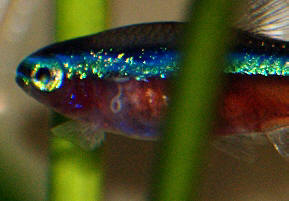
|
nematode infestation in cycling [future shrimp] tank
10/6.5/11
Hello,
<Katie>
I have a 6.6 gallon tank currently cycling (ammonia and nitrite both
around 0.25-0.5) that I'm intending to use for red cherry shrimp.
Presumably from some live plants I got at the pet store, I've got a
nematode (and pond snail) infestation (nematodes are swimming about in
the water and clinging to the glass). I want to rid the tank of
nematodes before adding any shrimp. It seems like the easiest method
would be to use something available at the pet store (e.g. parasite
clear tank buddies). However, these types of meds are not
invertebrate-safe. I'm okay with the prospect of losing the snails,
but would the harmful ingredients from the medication linger and harm
the future shrimp?
<They will not; given time (a few weeks), water changes...>
My research has been contradictory as to whether things like Prazi and
Levamisole Hydrochloride would be potentially harmful to shrimp.
<Both can be>
I would strongly prefer a treatment I can get from a pet store rather
than having to locate a veterinarian.
<Understood. Either here will do>
Thank you for your help,
Katie
<Welcome. Bob Fenner>
Re: nematode infestation in cycling [future shrimp] tank
Thank you!
<Welcome>
Camallanus, Fenbendazole 10/23/10
Hello,
And thank you for taking the time to review this inquiry. I have
recently found these parasites protruding from the vent of a inch and a
half Platy.
I think he has been suffering from this for awhile now, as I have
noticed a slight color change over the last month.(slightly reddish
orange behind his lower fins, around his tummy) The parasite recently
showed up in his vent in the last two weeks. At first I just thought it
was some fin coloring because it protruded to the same length as his
fins. Two days ago though, he was passing a significant bowel movement
when I saw more than one protruding at different lengths. For treatment
I've decided to go with the Fenbendazole as safeguard dewormer
222mg/g However, all the sites I've visited vary greatly on the
dosage. So will you please help?
<For long-term immersion (in the tank water treatment), 2 mg/l (7.6
mg/gal), once/week for three weeks. For feed 50 mg/kg ( 23 mg/pound) of
body weight once/week for 2 weeks...>
This is what I have so far. 10 gal. 4 real plants, and a piece of
driftwood. One 1 1/2" Platy, One 2" swordtail, One 2"
Dwarf Gourami, One Mollie, and one 1" Oto. I also just introduced
a 2 1/2" bamboo shrimp.
<I'd remove these during treatment>
I usually feed the every night little I have a Aqueon rear hanging
filter that came with the tank, I have a 50 watt heater that usually
maintains a temp of about 77 degrees F. I have a fifteen watt light
that they usually have on about 12 hours of a day. I add 1 1/2 tsp of
aquarium salt for every 2.5 gal. of tank water I change, as well as 1/4
tsp API Stress Coat+ water conditioner at the same rate. The ph of my
water is about 7.2 to 7.4, no ammonia, nitrites, or nitrates.
<No, as in zip, 0.0 ppm of NO3? Unusual>
The KH is about 40-80 ppm and the GH is off the charts as a result of
feeding a 7 day feeding pyramid.
<A bunk product. I would NOT use this/these>
I have only done one 25% water change since I got back from vacation a
week and a half ago. I was gone for a week. Did a 25% right before I
left.
As far as dosing with medication, I have been trying to be cautious. I
mixed 2.5 oz of water from the tank with 3 - 1g packets of the
Fenbendazole 222mg/g This gave me a slurry of around 9mg/ml (I think).
I gave the first dose yesterday at 1:00pm. It consisted of about 1/2 ml
mixed into 1/2 of a beef heart cube,
<I wouldn't feed this, beef/heart, to these fishes>
and let in soak for about a half hour. Since the fish were hungry, they
ate most of it. The second dose came today at 7:00am. It consisted of 2
ml of slurry with half a beef heart cube, soaked for about a half hour
then dumped it all in. They didn't eat as much the second time. I
increased the tank temp to 79 and shut off the lights since yesterday.
the Platy has been slow and shy since the first dosage. Hiding at the
bottom or top of the tank staying stationary in the dark spots. the
other fish seem okay though slightly agitated. In the past month I have
noticed the following behavioral changes.(in case they are relative to
this situation)The molly was flashing a bit before the first treatment.
(she is not doing it now)
The swordtail has become aggressive toward my Gourami. (there are
plenty of places to hide) The Gouramis pectoral fins have disintegrated
at the ends and have grown back (although thin) I did have one Oto die
last month.
<They can perish quite easily... esp. in small volumes as
yours>
His only symptoms I noticed was lethargy. I had him a couple of weeks.
I only feed them flake food with the rest of the fish. I think he
starved, even though there was noticeable brown algae accumulating on
the glass near the rock line.
<Might well be unpalatable>
I have since started supplementing the other Otos diet with blanched
zucchini. The slurry has remained refrigerated since it was mixed
yesterday.
Any thing I should change as far as water chemistry is concerned How
long do you think can I reuse the refrigerated slurry?
<Long enough... next week>
Should I increase the dosages?
<I would not>
If so, At what rate, and to what end?
<Depends more on the strength, concentration of the stock material
you're using>
Should I feed them in between dosages?
<Yes>
Do I remove my carbon filter the whole medication time?
<Not if the med. is being administered via food/feeding>
If so, when do I put it back in?
Do I ad Epsom salts as a laxative at a rate of 1tsp per gallon?
<Can, but not this... Read here:
http://wetwebmedia.com/FWSubWebIndex/SaltUseFWArtNeale.htm
If so, when?
Sometimes I have heard you need to treat with antibiotics also. Do you
recommend this practice?
<Not here, no>
I do have a new 20 gallon tank that I want to cycle for when I feel as
if all these fish are healthy enough to move to it for display. Then I
can have a 10g med/quarantine tank. I wanted to use an old filter or
some gravel from my current ten gallon tank to seed the new tank with
nitrifying bacteria, but now I'm afraid that I may taint my new
tank with parasites.
Thank you for your time in advance. Any help would be extremely
helpful!
Sincerely, Cody
<I would try Prazi... if the Fenbendazole doesn't do the job
here. Please read: http://wetwebmedia.com/FWSubWebIndex/nematodesfwf.htm
Bob Fenner>
Re: Camallanus - 10/29/10
Okay, thanks for that help. Now
I have another problem. I got home yesterday and noticed that
my dwarf Gourami has developed pop eye in his left
eye. Could be a injury.
<Very likely if just one eye has "popped". Can heal given
time and good water conditions; Epsom salt also helps significantly;
I'd also use antibiotics but I know others don't feel
that's strictly necessary. Do read: http://www.wetwebmedia.com/fwsubwebindex/fwpopeyefaqs.htm
>
My swordtail and my Gourami have been picking on each
other. (mainly the swordtail picking on the Gourami) anyway,
that problem has since stopped after the Gourami had a bunch of scales
missing from his head and a slight damage to his slime coat also had
nipped and split fins (he got the worst of it) the sword just had one
small spot on his tail fin.
<Male swordtails can be extremely aggressive, especially in small
tanks; if they're fighting, they probably won't stop doing so,
and the weaker one won't heal properly, if at all. Consider
separating them.>
It has since dissolved and eaten away the damaged part of his
tail...Soooo it almost looks like fin rot..
<Yes, very likely so; will need medicating anti-Finrot.>
Could all this be an underlying infection caused by the Camallanus?
<No.>
I still haven't finished treatment for that. My water is really
hard from a feeding pyramid I gave them when I was gone.
<Don't ever use these. Fish can go 2, 3 weeks without food and
not come to the slightest harm. Indeed, it's by far the best way to
handle fish in your absence.>
water changes haven't seemed to help reduce it yet. I do a gravel
vac/ 25%water change every week.. My carbonate hardness is very low...
According to my test strips it is at 0-20 ppm.
<Yes, is low, too low for livebearers such as Swordtails, I'd
wager.>
My general hardness is 180 ppm. My ph right now is neutral to slightly
acidic.
<Which Swordtails don't like; look out for signs of Fungus or
Finrot.>
When the KH is higher the ph usually stays around 7.2-7.4. No ammonia
No nitrites and little to no nitrates. I plan on getting another liquid
PH test kit to day so I can slowly bring up the KH without causing
stress to the fish.
<Baking soda in small amounts, about one-quarter to one-half a level
teaspoon per 5 US gallons should raise carbonate hardness. Don't
add to the aquarium, but add an appropriate amount to each bucket of
new water during water changes. That way you'll slowly fix water
conditions.>
I have no hospital/quarantine tanks, so all I can do to isolate fish in
another bowl of aquarium water or something if I need to. My tap water
seems really good, 7.4-7.6 PH, and soft.
<Soft is good for some fish, bad for others.>
I always treat it with the appropriate amount of API stress coat+fish
and tap water conditioner for the amount of water I am replacing. As
well as matching temperature and adding aquarium salts in the
appropriate dose recommended for general tonic and stress reducer for
tropical fish. Any ideas?
<Read: http://www.wetwebmedia.com/fwsubwebindex/fwh2oquality.htm
Cheers, Neale.>
Surprise! Camallanus Worms 7/11/10
Hi again.
<Rick>
Before I delve into the new problem I thought I'd give you an
update on the first time I contacted you. That was a little black molly
fry who had been ganged-up on and partially eaten. I'm pleased to
tell you that this little guy has been thriving in his little 4-gallon
hospital tank. His tail (including much of the
penduncal)<peduncle> has fallen off but healed over.
His pectoral fin that had been eaten regrew. He is understandably very
shy but he gets around pretty well now using the fins he has left. I
moved another similar sized fry into his tank and they have become
buddies. The damaged one cannot eat from the surface but enough falls
to the bare-bottom tank that he can graze all day.
On to the new problem. About 3 days ago I discovered a case of
Camallanus worms on the five first-generation mollies. I believe (but
don't know for sure) that these fish brought it with them from the
store.
I also noticed some on my two adult Siamese algae eaters that have been
in my tank for over 5 years. Tankmates: 3 African dwarf frogs and
roughly 20-30 molly fry between 1 week and 3 months old. I have seen a
worm on only one fry, a fry that seems to be undersized for its age--I
think a worm explains that pretty well. There are two more SAE youths
without symptoms and 2 Chinese AEs, one 4 inches, the other 1.5 inches.
No symptoms on either.
Water parameters: Temp 84 F (Phoenix summer, can't lower it much
without a chiller), pH 8.0 (naturally hard water but good for mollies)
MH3, MO2, NO3 all zero and stable. The tank is planted. Weekly 30-50%
water changes with bi-weekly gravel vac. Last one was about 1 week ago
and due for another this weekend.
Currently I have started the entire tank (and the two isolated molly
fry as well) on Jungle Labs anti-parasite medicated food 0.5%
Levamisole) following directions of 3 consecutive days a week for four
weeks. I am hoping this buys me a little time for the main problem I
have.
My research (including reading WWM) is 2-5 PPM Levamisole in the
water.
Unfortunately, I am having a terrible time getting my hands on any.
<There are other Anthelminthics more readily available:
http://wetwebmedia.com/FWSubWebIndex/fwwormdistrtf.htm
The local vet pharmacy wants an excessive amount of money (hundreds)
and doesn't want to supply sufficient quantity. I have not seen ANY
water additives with Levamisole at PetSmart or Petco, not even Levasole
for pigs or Avitrol Plus for birds. Nothing.
<Look for Praziquantel...>
I did find Fenbendazole in the form of powdered Safeguard meant for
canines, but my understanding is that this is only effective if
ingested.
What is my alternative if I cannot get my hands on Levamisole? National
Fish Pharmaceuticals recommends Paracide D
http://www.fishyfarmacy.com/products3.html#Paracide-D
in combination with De-Los (page down alphabetical)
http://www.nationalfishpharm.com/products.html
but I have no idea whether this would work.
Suggestions to treat the water if I can't find Levamisole?
Regards
--
Rick Novy
<Read the above linked FAQ page. Bob Fenner>
Re: Surprise! Camallanus Worms 7/11/10
Quick follow-up. Assuming I can find both, which is
preferred--Levamisole
or
Praziquantel?
<For Camallanus, the latter. B>
Re: Surprise! Camallanus Worms 7/11/10
Retract previous question. Further digging produced the answer.
BTW, I was very pleased to see your comments on my LFS AquaTouch. I
need to go there first for livestock from now on.
<Say hello to Mike... a very fine establishment... good practices,
people. BobF>
Re: Surprise! Camallanus Worms 7/11/10
Bob F:
<Rick>
You can tell from the minute you walk in the door at AquaTouch.
I've never seen a dead fish in any of their tanks and the staff
asks the right questions. I don't see Mike much--I think he's
on expedition right now.
I normally run into Erle, who says he met you in Singapore.
<Ah yes. Last year at Aquarama>
Next time I stop in I'll pass the message through him. (I've
got my eye on some Endler's in one of their tanks.)
Anyway, I'm pleased to say that I found a bottle of PraziPro at
AquaTouch so the tank treatment is now underway. Glad I could buy what
I needed from them instead of a big-box.
<Ah good>
The worms are turning brown, probably from the medicated food the fish
have been eating since Friday. I'm fortunate that I just finished
rereading *Manual of Fish Health* (Andrews, Excel, Carrington)
literally three days before I saw the worms and I recognized them
immediately.
Anyway, I'll send you an update in a couple of weeks.
Rick
<Thank you, BobF>
Surprise! Camallanus Worms 8/2/10
Bob F.
<Rick>
I wanted to give you an update on the Camallanus worm problem from
early July. I am almost done with the 4-week treatment with the Jungle
Lab's feed medicated with Levamisole. I have treated the tank with
PraziPro and plan to give another treatment next week. I should point
out that African Dwarf Frogs find PraziPro to be rather fatal. Live and
learn.
<Ah yes>
I have one female adult molly that is suffering far worse than the
others, I suspect she may be the fish who brought in the worms since
she is so much worse than the others. She is not eating much and I have
her isolated in a breeder box temporarily to make sure she has access
to food. In addition to losing her appetite, she is also developing a
case of pop-eye. Although she does still have the worms in her vent,
they are much darker than when I first discovered them. I suspect the
worms may be dead but the fish unable to pass them.
<Trouble>
I made an attempt to sedate her with clove oil to manually remove some
of the worms under the theory that she would be better able to handle
the damage from the hooks than the toxins from dead worms. However,
right or
wrong that turned out to be moot. Sedated, her muscles relaxed to the
point that the worms were pulled far enough inside I couldn't see
them. (Still, I must say sedating and reviving a fish is pretty cool in
and of itself.)
<Agreed; or, for me too>
See if you agree with my next plan of action. I will move her to a
separate 2.5 gallon tank I currently have empty. I will then begin
treating her with Fenbendazole (the one marketed for canines) in both
the water and the feed
using the concentration suggested by Edward J Noga in his "Fish
Disease: Diagnosis and Treatment" of 7.6 mg per gallon in the
water.
<Good. I will see Ed in a few weeks. We're both presenting a
couple of times at a fish disease workshop in Maine>
In the feed, since I don't have the equipment to measure the
correct dose for a molly at the rate of 11mg/lb, I will soak
freeze-dried food in the same concentration as the tank water then
feed. I plan to use freeze-dried blood worms and Tubifex worms to try
to encourage her to eat.
<Mmm, and may I suggest Daphnia (frozen/defrosted) and/or
Brine/Artemia...
for their laxative effect... Oh and a level tsp. of Epsom Salt per
gallon for the same>
As for the pop-eye, I will treat that with a broad spectrum anti-biotic
only if necessary after treating the tank water with Fenbendazole. I
hesitate to use the two treatments simultaneously.
--
Rick Novy
<Excelsior! BobF>
Re: Surprise! Camallanus Worms 8/3/10
Bob,
Sad news, the quarantined molly passed away last night.
<Mollienesia can be very tough IF collected, held properly... Sadly
very few are. B>
--
Rick Novy
Re: Surprise! Camallanus Worms - 8/10/10
Hi Bob F.
<RickN>
I thought we were done with this discussion, but alas, no. Seems that
the universe wants to test me on my research.
<As it is wont to do>
Summary to date: Camallanus worms treated with Jungle Labs
anti-parasite feed (0.4% Levamisole) and PraziPro for the water.
Finished week 4 of 4 last week with the feed. Badly infected molly died
in isolation, other fish seemed recovered.
Friday, I vacuumed the gravel, did a 50% water change and dosed with
the follow-up PraziPro treatment. Went out of town for two days and
returned to find one of my Siamese Algae Eaters had developed a case of
dropsy. This fish is around five or six years old and has only lived in
this tank during that time.
Current tank readings are:
Water temp 86F (Phoenix summer remember)
pH=7.8
NH3=0.2
<? Should be zip, zero, nada>
NO2=0
NO3=0
The temperature is typical (maybe 2 degrees higher than my normal tank
temp in the summer but nothing the fish hasn't experienced before
without issues). The ammonia reading is definitely abnormal. I
haven't had a reading other than 0 for NH3 for years and years.
I'm guessing that the ammonia spike comes from decaying waterborne
nematodes killed by the PraziPro. I'm also guessing that the cause
of the dropsy is adult nematodes decaying inside the SAE.
<Maybe>
I immediately halted the Prazi-pro treatment of the main tank by
putting the carbon back into the filter. I consider the nematode case
closed for this tank until I see evidence that conclusion is wrong.
Regarding the SAE with dropsy, I isolated the fish into a small
hospital tank with best possible water conditions and intend to feed
with best possible food (Per Manual of Fish Health),
<Oh! Am out to Maine this weekend giving two talks... at a fish
health conference where one of the authors of this newer book will be
also presenting>
mainly Omega One kelp flakes and perhaps an algae wafer or two.
Symptoms: Rapid "breathing" and pine-coned scales, especially
on the ventral surface.
I noticed some discussion of using Epsom salt in dropsy hospital tanks
but I can't find any information about how salt tolerant the SAE
is. Osmotic stress can occur from any salt, not just sodium chloride,
so I'm a bit skittish about that as a treatment.
<Not as big a deal as many folks think... Most species of fishes
(even non-fishes) can/do tolerate "some" salt content well...
in fact, are to degrees made for such exposure. MgSO4 is quite safe at
recommended dosages>
I have not treated with any kind of anti-biotic yet as Manual of Fish
Health recommends it only if isolation in good water conditions does
not cause the fish to recover.
<A wise approach>
Any additional advice appreciated. (I also, need somebody to tell the
universe that just because I can recognize these diseases doesn't
mean that I want or need a case of it.)
<I'll remind it here>
Rick
<B>
Re: Surprise! Camallanus Worms - 8/10/10
Hi Bob,
<Big R>
Good news. The Siamese Algae Eater is recovering. Bloating is way
down.
His body is almost back to normal size, though the scales aren't
quite laying flat yet. I added nothing to the hospital tank, just
conditioned water with filtration. I'll probably leave the fish in
that tank for a couple more days before moving him back.
The ammonia spike in the main tank is gone. Waterborne nematodes killed
by the PraziPro is the only explanation I can think of to cause a spike
3 days after a 50% water change.
Rick
<Looking up! B>
Re: Surprise! Camallanus Worms 8/15/10
BobF
<RickN>
Chalk up a win for dropsy recovery. My Siamese Algae Eater with dropsy
was moved to isolation and given best possible conditions. Bloating
reduced overnight and gone after 24 hours. Kept the fish in isolation
for another 3 days before moving him back to the display tank. He's
now acting as if nothing ever happened.
No drugs or chemicals used at all, just clean water and isolation and
catching it early.
Rick
<Thank you for this report/follow-up, BobF, out at the NEU fish
disease conf.>
Re: Surprise! Camallanus Worms 8/21/10
BobF,
<Ricardo>
Developments in the never-ending case of these nematodes.
Two adult mollies again have worms hanging from the vents, noticed only
today. Not as many as before but still worrisome. I don't know if
the nematodes are alive or dead.
<Me neither>
Also, one of my SAEs, I think the one that suffered from dropsy,
received an injury a while back. I originally thought this caused by
scales torn off while they were pineconed with dropsy. Fast forward,
there is now a large hole in that area and possibly some nematodes
inside that hole (have not removed the fish or sedated it). The hole
exposes part of the body cavity.
It is roughly 6mm long, 4mm wide and maybe 3 to 4 mm deep running from
the vent back toward the caudal fin. The fish is behaving normally.
What concerns me about this guy is that his body cavity will be exposed
to the Praziquantel if I treat the tank water again. The injury was
there just prior to the final tank treatment of PraziPro.
I considered destroying the infested fish but I also noted some
mucus-filled feces in some of my juveniles, and there are too many to
allow me to recognize individuals. That, and I really don't want to
destroy my SAEs as I have had them for five or six years now.
<Nice>
I'm considering giving food treated with Fenbendazole this time,
but I'm leery about treating the tank water with the injured SAE.
With that large of an injury I'm not sure if they would will ever
close.
<Can>
PS: Mike at AquaTouch said you may be coming to Phoenix in the next
couple months. I'd like to meet you if you are coming.
Rick N
<Oh!? Don't know re such a visit... But a nice town (when
it's not too dang hot!) to visit for sure. BobF>
Re: Surprise! Camallanus Worms
What are your thoughts about treating the tank water with PraziPro or
Fenbendazole with that open wound on the SAE?
<I don't think the Crossocheilus will be effected with
either>
Re Phoenix: it is nice when it isn't hot. Spent last 2 days w/o air
conditioning. Lost one fish in my 4 gallon tank as the water temp got
up to 96 degrees. Not pleasant of for fish or man.
<Agreed. B>
Re: Surprise! Camallanus Worms 8/27/10
Hi Bob,
<Rick>
How was Maine?
<Beautiful, worthwhile visiting, sharing>
Item 1) It has been one week since I treated the feed and tank with
Fenbendazole. Very difficult to accurately measure dosage without
proper equipment, but I think I got pretty close on tank dose by
estimating from a 1 gram package and medicated after a 75% water
change. For food, I filled an API test tube to the white line, put in
enough Fenbendazole to dust the surface, added dry flake and sometimes
freeze-dried Tubifex or blood.
Shook and added to the tank after about ten to fifteen
minutes--everything including the liquid, so the Fenbendazole
concentration in the tank increased slightly during treatment.
<Sounds reasonable>
Fed with treated food for 3-1/2 days as I experimented with the feed
before treating the tank. Put new activated carbon back into the filter
on fourth day. I also added some Epsom salt, I'd estimate about 3/4
TBSP to 1 TBSP per gallon--less than your recommended but I
couldn't find a write up specifically addressing Epsom Salt.
Since I stopped medicating the food, I have been feeding mainly kelp
flakes and little squares (~1 sq in) of both red and green seaweed
sheets.
Today, observed a lot of mucus-dominated feces from multiple fish of
all ages. Also observe a number of worms dangling from the vent of
several fishes to as long as 5mm. Again, I do not know whether these
nematodes are alive or dead.
<Mmm, look into a cheap QX (3) microscope... I have one>
It does seem that the vents are nowhere near as swollen as they were
when this whole thing began and the worms were protruding farther.
I'm also seeing far fewer worms per fish, although I do see worms
on juveniles
<On?>
now where I did not originally.
I plan to hit the tank water again in about 2 weeks and I guess I
should probably medicate the food 3 of 7 days per week until I'm
done with the tank water.
The main concern I have is that I do not know when to stop treating the
tank if I can't tell whether the nematodes are alive or dead.
<Need to see to discern... a/the microscope... I wouldn't feed
any longer than 2-3 weeks>
Item 2) Siamese algae eater with damage near his/her vent had a white
tube of something emerge on day 3 of the fenben treatment.
<Likely prolapsed colon>
I never got a decent look at it so I couldn't tell if it was just a
big streamer of mucus or a parasite. White, maybe 2 to 3 mm thick,
about 2 cm long. It doesn't look like a tapeworm based on the
photos in "Fish Health" but it does look about
the size I would expect one to be.
<Oh! Ed Noga was my dorm roomie at the NEU conf.>
Additionally, this fish has a white lump behind the wound, as if
something is trying to emerge through the skin (through why it
doesn't just go out the hole...) I tried to snap a photo with my
phone but the white spot doesn't show up well. I'm attaching
two photos of "Dewey" anyway. (And no, the guppy is not in
his mouth.) I'll try to get him into a dip'n'pour for a
better picture tomorrow as I am out of time here, but he is very quick
and his behavior is still normal.
--
Rick Novy
<Thanks for this report. BobF>
Re: Surprise! Camallanus Worms 8/27/10
HI Bob,
<Rick>
We actually have a microscope. The problem has been getting a worm
isolated.
<Move the fish to a bare tank for several hours, filter out the
water>
I finally managed to do that this morning.
<Oh>
Tried two fish without success, put the equipment away, then saw a long
length hanging from a vent and decided to set it all back up again.
(Isn't that always the way?) I finally managed to get the worm
removed, though I suspect this fish will be in some pain for a
while.
The nematode is definitely still alive. Under 100x and 500x I can see
motion both inside the worm and some smaller worms moving in the drop
of water I put on the slide. That's exactly what a video I saw (I
think on WWM but I cant find it) looked like.
I should think that the Fenbendazole would have had some effect since
the fish are eating normally, but it's starting to look like these
nematodes are indestructible.
Options on the table:
1) continue with Fenbendazole program for another couple of weeks.
2) Find and use some Levamisole instead.
3) Treat the tank again and this time also food with Praziquantel.
<I'd go with door number three. B>
Re: Surprise! Camallanus Worms 8/27/10
Thanks, I tend to agree--option 3. The Praziquantel gave me an ammonia
spike last time, so there is at least some evidence of efficacy.
I'll be in touch.
Rick
<Real good. B>
Re: Surprise!
Camallanus Worms 10/7/10
Hi Bob,
<Howdy Rick>
Here we go again. I went through round 2 of the Praziquantel treatment
and even left the treatment in the water an extra week the second dose.
I've had the activated carbon back in the tank for a week, and I
haven't seen any worms on the mollies, but that one remaining guppy
now has a worm in that ominous location.
<Dang!>
I guess tomorrow I clove oil him and try to yank it out so I can check
for life under the microscope again.
If the nematode is alive, what do you think about upping the
Praziquantel dose to 150% of normal dose? Or is it time to find
Levamisole?
<Either...>
--
Rick Novy
<BobF>
Re: Surprise! Camallanus Worms
Bob,
<Big R>
This is a bit unexpected. I anesthetized the guppy and couldn't see
any worms. Rather, some kind of gel was protruding from the vent, and
any small pressure on the abdomen would extrude more. I removed a small
portion to look under the microscope.
<Mmm>
It doesn't appear to be part of the intestine unless it was badly
decomposed. It was some kind of gray gelatinous mass, a blend of mucus
and body waste perhaps.
If what I saw last night were nematodes, they retreated well into the
cavity. This is an orange male guppy so I may have been seeing parts of
the pectoral fins or gonopodium stained with some blood, though they
sure looked like worms last night.
I did see one red line in the mass at 50x that I thought could be a
nematode but under higher magnification I don't think so.
<Maybe a blood vessel>
I saw no indication of motion in the gray mass or in a drop of tank
water I checked. (Wish I could
photograph the microscope image but no access to that kind of
equipment.)
<One of the reasons I stump for the very inexpensive Intel/Mattel QX
series 'scopes... not only do they hook up via USB, but one can
record, share images, even kinetic!>
Unfortunately, the guppy never woke up after I put him into fresh
water, which tells me that he was probably pretty weak to start with.
He was only out of the water about 90 seconds. I wonder if this is
related to the other guppy death we discussed last week.
I think I'll give the tank one more round of Praziquantel treatment
in case something is still on the loose in there.
--
Rick Novy
<Real good. B>
Re: Surprise! Camallanus Worms 10/7/10
Bob,
<R>
One other thing occurred to me. I have three remaining adult mollies
that are the fish who brought in the nematodes. The nematodes seem to
be surviving inside of them and I'm killing the offspring (of the
nematodes) before they can infest the second generation juveniles.
<Mmm, the Anthelminthics you're using should kill the adults
inside as well... Have you read re introducing these compounds in
foods?>
Right now the tank is a very hard but fresh chemistry for the SAEs.
But, how do Camallanus worms respond to salt?
<Mmm, I don't think it really matters to them much>
I'm thinking that if I isolate the three remaining old fish, I can
get eventually the problem down to a 10-gallon tank as I recover the
large tank. With only 3 female mollies with healthy behavior, I could
gradually up the salinity all the way to marine conditions since the
fish can handle it.
Any thoughts on that idea?
Rick
<Worth trying. B>
Re: Surprise! Camallanus Worms 10/8/10
Last time around I did dose the Praziquantel into the feed. I
haven't seen any evidence of nematodes for two weeks other than
what I thought I saw last night on the guppy. I was going to use the
two-barrel approach of isolating the older fish and upping the salinity
along with another round of Praziquantel treatments--including in the
feed--on the larger tank. The intention is to destroy any that might
still have survived. I suppose I can do a Praziquantel treatment to the
older fish at the same time I up the salt.
If the nematodes are still alive inside the three older fish and I
can't kill them, at least they will be isolated from the main tank.
That, and I have never heard of Camallanus impacting a marine tank.
<Mmm, actually... Nematode lumenal parasites of marine fishes, many
invertebrates are quite common>
By the way, and thanks for the microscope tip. I was unaware it
existed.
Looks like a fun toy.
<Oh! I have one right here... up to 400X, it's own light source,
you can dismount the scope from the base and hold it up to objects...
Really a neat tool. BobF>
Rick
Re: Surprise! Camallanus Worms 10/8/10
Strike that. Worm spotted on one of the older mollies.
Rick
<Oohhhhh. B>
Re: Surprise! Camallanus Worms - 10/09/10
Three older fish isolated in a 10-gallon tank, but not happy about
it.
(Interesting but understandable how the fish born in the tank are not
nearly as frightened of the net.) Unfortunately, I have to burn through
some activated carbon built into the filter before I can medicate or I
will have no filter media.
<Mmm, many medications are absorbed by GAC>
Large tank now has 150% dose of Praziquantel with the 2nd-generation
mollies and the SAEs.
Question on the 10-gallon tank as I start increasing the salinity
(marine salt of course). I seeded the cycle with a decoration and a
large silk plant. Generally when I do that I almost never read any
ammonia. What
impact will going brackish have on the bacteria?
<Can forestall them metabolically, even kill... there are different
species in marine/fresh environments>
I'm especially interested in the effects as I approach marine
conditions. I've never done a marine tank so this is new territory
for me. Anything to watch for in terms of crashing my cycle?
<Your fish's/es behavior, testing of water quality for ammonia,
nitrite...>
Also, I was looking at going to about 1.02 specific gravity over the
course of a couple weeks. Good target or too high?
<For mollies, fine>
Thanks for all the feedback.
--
Rick Novy
<Welcome. BobF>
Re: Surprise! Camallanus Worms 10/10/10
>>Mmm, many medications are absorbed by GAC>
The reason I haven't medicated that tank. I haven't decided how
I want to customize the filter yet because it doesn't meet my needs
out of the box.
Beginner kit.
>>Your fish's/es behavior, testing of water quality for
ammonia, nitrite...>
All the same NH3/HO2/NO3 test chemistry or do I need a marine kit?
<Fresh for fresh, marine for brackish and marine. B>
Rick Novy
Re: Surprise! Camallanus Worms -- 10/11/10
Hi Bob,
The fish decided to keep things interesting for me. One of the fish I
moved into the 10-gallon tank dropped 10 fry. Any idea if Praziquantel
has a detrimental effect on newborns?
<Should not>
3 Options. Leave them in the 10-gallon tank in a breeder box, move them
to the 46-gallon tank with Praziquantel in the water, or put them into
a 2-1/2 gallon tank that is unheated.
I'm leaning toward the latter as the water temperature of my other
tanks is still around 80F.
--
Rick Novy
<BobF>
Re: Surprise! Camallanus Worms 11/16/10
Hi Bob,
<Rich>
Quick question for you. I have some plants in my display tank that
is/was infested with Camallanus worms. I'd like to propagate some
of the plants via cuttings and move them into different tanks.
Obviously I don't want to transfer the nematodes. If I temporarily
place the cuttings into a plant-only tank, do you know how long the
nematodes will live without an animal host?
<I do not>
In other words, how long would I need to leave the cuttings in a
plant-only tank before it would be safe to put them into a tank with
fish?
Rick
<I would (overdose) treat the intermediate "plant systems"
w/ Prazi. B>
Re: Surprise! Camallanus Worms 11/20/10
Hi Bob,
I found another worm, this time in a second-generation molly one week
after doubled-dose Praziquantel treatment process finished. I'm
coming to the conclusion that the only way I'm going to eliminate
these nematodes is to euthanize all my livestock, sterilize the
hardware and start over.
Heartbreaking.
<No fun>
I might be able to save my beta tank, but I'm guessing the Amano
shrimp in there won't survive the treatment.
<Likely not. BobF>
Rick
Re: Surprise! Camallanus Worms
Hi Bob,
Quick question for you. I have some plants in my display tank that
is/was infested with Camallanus worms. I'd like to propagate some
of the plants via cuttings and move them into different tanks.
Obviously I don't want to transfer the nematodes. If I temporarily
place the cuttings into a plant-only tank, do you know how long the
nematodes will live without an animal host? In other words, how long
would I need to leave the cuttings in a plant-only tank before it would
be safe to put them into a tank with fish?
Rick
<I answered this already: Re: Surprise! Camallanus Worms
11/16/10
Hi Bob,
<Rich>
Quick question for you. I have some plants in my display tank that
is/was infested with Camallanus worms. I'd like to propagate some
of the plants via cuttings and move them into different tanks.
Obviously I don't want to transfer the nematodes. If I temporarily
place the cuttings into a plant-only tank, do you know how long the
nematodes will live without an animal host?
<I do not>
In other words, how long would I need to leave the cuttings in a
plant-only tank before it would be safe to put them into a tank with
fish?
Rick
<I would (overdose) treat the intermediate "plant systems"
w/ Prazi. B>
Re: Surprise! Camallanus Worms 11/20/10
The below was not send a second time intentionally. I thought I
deleted
all
the quoted text but apparently not. Sorry about that. In any case,
now
that I am sterilizing the tanks I will discard the plants too.
No reply needed.
Rick
<No worries Rick. Do take care. BobF>
From Neale: Surprise! Camallanus Worms 11/20/10
Hi Bob,
> Just a thought, but since this guy is working with mollies, why
not acclimate them across to strongly brackish or seawater conditions?
The worms certainly can't tolerate high salinities, so rearing a
generation in saline conditions, and then removing the fry to a new,
parasite-free aquarium -- perhaps the old tank deep-cleaned with all
gravel and plants removed, everything else sterilised, and the filter
re-matured from scratch.
> Cheers, Neale
<Might work. I'll send this on. BobF>
Re: From Neale: Surprise! Camallanus Worms
I do have 5 fry I could try this with. They are in a 2.5 gallon tank
with Praziquantel treatment right now. The main concern I have with
that plan is I plan to restock with Endler's livebearers known to
be pure strain direct descendants of fish collected in the wild.
<Endler's tolerate high salinities as well, though perhaps not
seawater.
Mixing Mollies with Endler's is a no-no; both are members of the
genus Poecilia, and hybrids between Poecilia species are common. While
I'm not aware of an Endler's/Molly hybrid, Guppy/Molly hybrids have
been widely reported.>
Dr. John Endler's himself vouched for the seller in direct email
communication with me. Thus, given the choice between mutt mollies of
questionable health and pure-bred Endler's that are endangered in
the wild, I choose to favor the Endler's.
<Understandable.>
The gravel in the tank won't be reused. I've grown fond of
Takashi Amano style planted tanks and this gravel is blue.
<Do understand that Amano-style tanks are designed for photographs,
rather than long-term use -- Takashi Amano being a photographer long
before he was famous as an aquarist. While planted tanks can be lovely,
and most of my tanks do contain plants, what you need to do to create
an Amano-style tank
may be incompatible with the requirements of many fish. Floating
plants, for example, are essential for breeding livebearing fish, both
in terms of creating shelter for pregnant females and hiding places for
fry. Yet Amano-style tanks never have floating plants!>
Rick
PS: Neale--I finally have a lead on somebody with desert gobies like we
discussed a few weeks back.
Re: From Neale: Surprise! Camallanus Worms (time for the WWM
Bulletin Board, perhaps?)<<past>> 11/20/10
<Real good. Enjoy these fish. Also very salt-tolerant! Cheers,
Neale.>
I still think planted is the way to go with freshwater anymore. Maybe
pseudo-Amano style would have been a better wording. You can still use
the Amano influence for the layout, but use plants appropriate for the
species intended to inhabit the tank. I've had decent success with
ferns and rock formations for fry to hide in and around.
<You misunderstand me. I'm not saying plants are a bad thing; on
the contrary, they provide many useful functions in freshwater tanks,
and I use them extensively in all my tanks. Floating plants especially
will protect ten times as many fry as you'll get with plants at the
bottom of the tank.
But the Amano model isn't uniquely informative if you're
wanting to explore the use of plants in fish tanks, and in some ways
eliminates things that fish prefer, and certainly limits you to a few,
small, inoffensive species and certain types of water chemistry. With
Mollies or Endler's, I'd sooner concentrate on the hard or
brackish water required, and choose utility plant species that provide
shelter and nitrate removal rather than just aesthetics. You'll
normally find Amano tanks attract aquatic gardeners happy with a small
clique of pretty tetras rather than fishkeepers after dwarf cichlids,
L-number catfish or fish breeding projects. This isn't to diminish
the fun to be had with the Amano approach, but merely to point out that
it's a particular kind of aquatic hobby distinct from
"serious" fishkeeping where the fish come first. Do
supplement your reading with studies of biotopes, e.g., Peter
Scott's excellent "The Complete Aquarium"
book, used copies of which can be picked up for pennies at Amazon.
Re-creating biotopes using plants, rocks and substrates is challenging
but fun, and beneficial for the fish in a way the completely unnatural
Amano model can't be.>
I intended an Endler's species tank from the start. I did think about
trying to crossbreed a molly with an Endler's as an experiment.
Endler's-guppy hybrids are so common almost all fish sold as Endler's
have some guppy in them (per Dr Endler's). I haven't seen any muppies
except in photos--neat and weird looking hybrids. Haven't even
found photos of Mendlers at all, but maybe it hasn't been attempted
much. I don't want to risk it with my current stock
of mollies.
<Quite.>
I'll send some photos after I have the Endler's tank(s)
established.
Probably with a different email header since this is seriously drifting
off-topic now.
Rick
<By all means join the WWM Forum, here:
http://bb.wetwebmedia.com/
That's the place to show photos, discuss plans, and solicit
feedback from experienced hobbyists and newbies.
Cheers, Neale>
Re: Surprise! Camallanus Worms 11/22/10
Bob/Neale,
Good news, I hope. The second-generation molly completely passed the
nematode. Unfortunately, in the thirty seconds between the time I saw
the nearly full nematode protruding from the vent and I returned with
the plastic box to catch the fish, the nematode vanished. Ergo, I was
unable to view it under the microscope. I think one of the other fish
ate it because I heard some splashing as I came back into the room.
However, since I can't check the worm for signs of life, I'm
back into observation mode until I see further evidence that the
nematodes are still alive. Looks like the mollies will live to see
December, and hopefully more.
Rick
<Indeed. Good luck. Cheers, Neale.>
Re: Surprise! Camallanus Worms 11/22/10
Unfortunately, I found two worms in the vent of another 2nd generation
molly. With the kids in school and the wife on jury duty today, I had
the house to myself.
It is done. Truly one of the most difficult things I have ever had to
do, and not with dry eyes. The worst was my C. Siamensis that I had for
6 years. I hope I never have to do that again.
Bob, thanks for all the help over the past several months.
Rick
<... No interest in trying other Vermifuges? B>
Re: Surprise! Camallanus Worms 11/23/10
Bob,
It's already done. I'm so angry at the big box that sold me the
infested fish in the first place.
The most promising thing I found was Sera Nematol
http://www.sera.de/nc/en/news/sera-stellt-drei-neue-heilmittel-vor/sera-med-
professional-nematol.html?sword_list[0]=Nematol
but I could not locate any US distributors, nor could I find anyone
selling it on Aquabid. Somebody would make a small fortune selling that
stuff in the US.
I also tried Fenbendazole as well as Jungle Labs feed containing
Levamisole.
The only powdered Levamisole I found was at an unreasonable price. One
feed store that lists it in their catalog (at a very low price) told me
it isn't being made anymore, so it's always back-ordered and
thus the "scalpers."
The mollies ate the feed I soaked in Praziquantel solution as lustily
as they eat everything else. Double dosed the water at the same
time.
Are there other options?
<Yes... Piperazine, di-n-butyl tin oxide, others...>
Maybe, but with the two most viable cures unavailable or unreasonably
priced, I think it would be like golfing at midnight.
<A good point>
I don't think there was a right answer to my problem and ultimately
I chose the option that lets me move on, and believe me it was not
easy. In fact, it was very difficult.
Rick
<Sometimes there are no good or at least easy, economical choices.
B>
Re: Surprise! Camallanus Worms 11/24/10
Thanks again for all the advice. Although it was a heartbreaking task,
I am excited about restocking with Endler's Livebearers. I will
send you a link to my blog when I finally post pictures.
End of thread, I think.
Rick
<Ah, real good. Do please send the link/post the pictures via the
WWM Forum rather than here! That way you can solicit comments from
other aquarists besides me or Bob. Cheers, Neale.>
|
Platy Parasites 7/3/10
Hi guys!
<Hello Krystle,>
I come to you today with what I believe is a parasite problem
(though I am no expert - hence why I turn to you). Approximately
a week and a half ago, I noticed that my two juvenile Mickey
Mouse Platies (3.5 months old) were
having strange poo. It looks like a very thin, clearish white
string with small, clearish white sacks or balls every centimeter
or so. The string stays intact for quite awhile, not
disconnecting until after approx. 2.5 centimeters in length.
<May be parasitic to be sure, but also review diet. Platies
are herbivores in the wild, and need a good quota of plant-based
food to do well.
Spirulina flake makes a good basic foodstuff, plus things like
cooked peas, cooked spinach, Sushi Nori, and slivers of cucumber
and blanched lettuce leaves. Restrict meaty foods -- including
regular flake food -- to the minority portion of their diet, say
2-3 times a week. Bear in mind that regular fish often do
perfectly well on Spirulina flake, so in and of itself this
"vegetarian" diet doesn't cause serious problems in
most aquaria. Avoid things like freeze-dried bloodworms and the
like because these high-protein, low-moisture foods tend to cause
constipation in herbivorous fish. Again, you can use them
occasionally, maybe once a week, but that's it.>
I have tried to take picture, but my camera is slow and not able
to catch the picture before the fish moves. I have drawn an
example and attached it to this email. Anyway, I waited to see if
they still had it the next day after I fed them. I found that
they had their normal poo shortly after eating, but also had the
stringy stuff later in the day. A few days after noticing my
juveniles with the stringy poo, my adult Platies seem to be
showing the same problem.
<I see.>
The juveniles have become anorexic and lethargic, not swimming
around much.
<A bad sign.>
Their color has faded slightly and they do not greet me at the
surface for food, which is very unusual. The adults seem fine
personality wise, but have not been exhibiting symptoms as long
as the juveniles, so I am sure they will get lethargic and
anorexic eventually. I forgot to mention that I feed frozen
bloodworms, frozen brine shrimp, and flakes (I rotate to provide
variety). I feed once daily. The only fish that I have are
Platies - 6 adults (2 male, 4 female), 2 juvenile, and around 20
ranging in age from 3 weeks to 2 months. I frequently take my
water up to the store to get tested and they always tell me
it's perfect, but they don't give me specific
numbers.
<I really do need the numbers here to say anything sensible.
Retailers may or may not be telling you the whole story here.
Just to recap, for Platies you need the following: Hard, basic
water (10+ degrees dH, pH 7.5-8); 0 ammonia and nitrite; and a
low to middling temperature, 22-24 C/72-75 F. Soft water, acidic
water, warm water, and poor water quality will make Platies
sick.>
While this was all going on, I was in the process of setting up
my new 55 gallon and planning to move my adult and older juvenile
Platies once it had been set up. A week ago I went to my local
pet store and talked to the guy in the aquarium section and
described my situation. He said that they probably had hookworms
and told me to use API Pro Series General Cure Anti-Parasitic
Fish Medication. He said that it would probably kill my fry that
is less than a couple months old (of which I have like 20). I
decided to wait until I got my new tank set up, transfer the
bigger fish that needed treating, and then treat them in
there.
<Generally, medications that work on adults to little/no harm
to fry. Even if they do, it's a price worth paying. So
treating fish is the priority here. If you have healthy Platies,
you'll soon have LOTS of fry!>
I have had my 6 adult Platies and 2 juveniles in the new tank for
a few days, and am ready to treat now. I wanted to wait a few
days so that it wasn't a whole bunch of stress all at once. I
am uneasy of treating because I have to remove the charcoal
filter and put the powder in the entire tank once, wait 48 hrs,
and then do it again. Before I took this major step, I wanted to
check with ya'll - the experts! Is this the right medication?
What kind of parasite is it most likely? Can I get the
parasite?
<Could be worms, though this is difficult to say without a
photograph.
Camallanus is the most common worm parasite among livebearers,
and though it doesn't seem common here in the UK -- I've
never seen it -- it does seem to be quite prevalent in the US.
Treatment is possible. Levamisole, Piperazine and Praziquantel
are often recommended, but don't work as reliably as either
Fenbendazole or
Flubendazole. Your options may be limited by what's available
to you via your retailer (in the US) or your vet (the rest of the
world).>
The tank that they are currently living in is a 55g with a Tetra
Whisper 60 filter system. I keep it at a constant 80 degrees. I
put aquarium salt in the tank (as I do with my other tank as
well) - 1 tablespoon per 5 gallons of water. I hope this helps!
Thanks
Thanks for your help!
Krystle
<Do read here:
http://www.wetwebmedia.com/fwsubwebindex/nematodesfwf.htm
http://www.wetwebmedia.com/fwsubwebindex/fwwormdisid.htm
With all this said, I'm not 100% sure worms are the issue
here, and some protozoan parasites can cause copious production
of faeces together with wasting; Hexamita is the classic example,
though this is primarily an issue
with cichlids and other perch-like fish rather than livebearers,
though it certainly can affect livebearers. Hexamita typically
causes problems when fish are stressed, often for dietary reasons
or poor water quality. Do read:
http://www.wetwebmedia.com/fwsubwebindex/hexoctfwfs.htm
http://www.wetwebmedia.com/metranidazole.htm
The medication used is Metronidazole, again from your retailer or
vet depending on where you live. Cheers, Neale.>
|
 |
Hello (Cichlidae; red tube from the anus)
11/13/09
I recently wrote to you about my tank and want to say you have great
advice. I have another question for you..one of my female peacocks has
some type of clear reddish tube coming out one of her reproductive
holes...does this mean she is pregnant or sick??
<Difficult to say without a photo. The spawning tube (or genital
papilla) on female cichlids looks like short, blunt tube with a rounded
tip. It almost looks like a little wart. It's very different from
the equivalent structure on the males, which are longer, usually
angled, and have a pointed tip. Anyway, female cichlids normally show
their genital papillae for very short periods, at most a day either
side of spawning. Males will show there for longer periods, often
several days. If your female is showing her spawning tube, she will
either be spawning or just about to, and she should be obviously
engaged in spawning behaviours of some kind.
Now, a prolapse is very different. This is where a bacterial infection
of the colon causes it to expand and protrude from the anus. This is
very serious, and is a good sign that environmental conditions and/or
diet are very wrong. Treatment with antibiotics, fixing the
environment, and feeding exclusively high fibre foods (e.g., cooked
peas, live daphnia, but nothing dried) can help. The use of Epsom salt
in the water may also help speed up recovery. Chuck outlines the basic
therapy on this page, about half-way down:
http://www.wetwebmedia.com/FWSubWebIndex/texascichfaqs.htm
Finally, there are Camallanus worms. These are red, clearly wriggling
worms protruding from the anus like little red threads. You will need
an anti-helminthic medication to treat them.
http://www.wetwebmedia.com/FWSubWebIndex/nematodesfwf.htm
Cheers, Neale.>
Yikes - Camallanus worms! 10/29/09
Hi Crew, I hope you all are doing well - I'm in a bit of a panic
and I hope you can offer some reassurance.
<Oh?>
A couple of months ago, I got three blue platies and some ghost shrimp
from Petco to be the sole inhabitants of a 10 gallon tank. Everything
was going great until yesterday, when I noticed one male laying low,
less interested in food than usual - still eating, but seemingly weak.
He also seemed to have a nip just in front of his gonopodium.
<I see.>
The next morning, it suddenly dawned on me! Much more likely than
someone nipping him there, was that these were Camallanus worms poking
out of his anus. I observed him, and sure enough they seemed to come in
and out. My heart sunk as I brought out the clove oil and pulled at
least 7 or 8 worms out of his anus. Sorry to be graphic, but pulling
them out actually seemed to eviscerate him somewhat - that's how
tightly they were attached.
<Indeed... not something you should do. At least some worms are
covered with hooks to prevent peristalsis pushing them out. Not sure
Camallanus worms have these hooks, but they likely have something
similar. So yes, pulling the worms can cause real physical
damage.>
They weren't moving though...I assume the clove oil killed
them?
<Anaesthetised them, more likely.>
Here's my biggest question: how scared should I be? I've read
that suctioning water can give YOU these worms, that the tank must be
sterilized, that the worms can be easily passed from one tank to
another by
shared nets, etc. I've read horror stories of people having not
just one, but two or three established tanks completely devastated by
these worms, just because one fish was infected...
<So far as I know, Camallanus don't infect humans. However, they
do seem to be able to infect other fish, if not directly, then via
faeces that are eaten by tiny copepods present in most tanks, and the
copepods are eaten by the fish (deliberately or accidentally, as the
case may be). So whereas most worm diseases can't complete their
life cycle in aquaria, Camallanus spp. can, which is why they're
such a pest. They do seem to be extremely common among livebearers in
the US and perhaps elsewhere as well.>
The thing is, I don't see how this could be so, because
wouldn't that mean that all the fish at this Petco are now infected
because of having a shared filtration system?
<And likely are infected. We get a lot of messages about Mollies,
Guppies, etc. with Camallanus worms.>
If these worms were really that contagious, wouldn't they be
devastating to the aquarium industry?
<The thing is, many people who buy relatively cheap livebearers view
them as "disposable". If a few die, they simply go buy some
more.>
I have already ordered Fenbendazole medicated flake, which I plan to
feed to the two other platies - I hope it won't hurt the ghost
shrimp if they happen to nibble at any.
<May or may not harm the shrimps; difficult to say. Little/nothing
is known about interactions between medicines used on vertebrates when
consumed by invertebrates.>
Should I feed the medicated flake to my other tanks, since at some
point I am sure I have transferred minute amounts of water from the
sick tank via nets, gravel vacuum - my own hands?
<So far as I know, Camallanus do not parasitise humans. Yes,
copepods or the free-living stages could hitchhike between tanks via
nets, buckets, etc. So there's a good argument for sterilising such
items between tanks. There are commercial products for this, or else
you can simply use a very strong brine solution, which will work almost
as well.>
Any help with this would be greatly appreciated. I have never had to
deal with intestinal parasites before. I thought they were relatively
rare, although often blamed for issues that are more likely to be
attributed to
water quality.
<For the most part, worms are relatively uncommon causes of sickness
and death. To clarify that somewhat, wild-caught fish may well come
with worms much of the time, but provided the fish remain healthy, the
worms don't cause problems. Once the worm tries to breed, the lack
of the other host(s)
in its life cycle becomes a barrier, and the infection ends. But
Camallanus is exceptional, and while not an across-the-board problem,
cichlids and livebearers do seem to suffer to a greater degree than
other fish groups.
I'll add here that while I've read many messages about these
worms from American fishkeepers, I haven't ever seen the problem
myself in the UK. So it may be certain areas (e.g., fish farms in
Florida vs. those in the Far East) suffer from this problem more than
others. An analogy might be drawn with the Dwarf Gourami Iridovirus,
which seems to affect fish from Singapore more than anywhere
else.>
To be 100% certain that this is what I am facing - well, it's
comforting to have a diagnosis, but incredibly worrying to know
it's the dreaded Camallanus worms. Believe me, I am praying to the
Fish Gods as I speak!
<Indeed!>
Thank you so much for any assistance you can provide.
Nicole
<Cheers, Neale.>
Possible Camallanus problem 7/30/09
Hi. I have a 38gal tank and i think i have a Camallanus infestation. my
angelfish has what appears to be a single Camallanus worm poking out of
his anus.
<Not uncommon with Angelfish and other intensively-farmed, low-cost
freshwater fish.>
However, he is not going off his food and does not have white slimy
feces.
<Yet...>
Also, it doesn't look like any of my other fish have Camallanus
worms. Is this Camallanus, or is it something else?
<Does sound like Camallanus. This will need treating with a suitable
anti-helminth medication. Levamisole, Piperazine and Praziquantel are
often recommended, but don't work at all reliably, and Fenbendazole
and
Flubendazole seem to be much more reliable. Since Camallanus worms are
contagious, it's important to treat your fish promptly. Cheers,
Neale.>
Re: Possible Camallanus problem -- 07/30/09
Thank you for your quick reply. I have heard that Flubendazole is an
ingredient in the dog de-wormer "safe-guard". How should i
figure out how to dose the tank with the Flubendazole, and how do i
figure out how much to dose the tank with?
<Not sure you can, unless you know how much Flubendazole there is
per dog tablet. While Flubendazole isn't particularly toxic to
fish, I'd still recommend getting veterinarian help before adding
dog or cat medications to your aquarium. Your best bet is to get a
product specifically for fish, such as "Fluke M Koi
Treatment" or "Discus Wormer Plus", and use as
instructed. These are UK brands, but I'm sure you can get
equivalent products in other parts of the world, too. Cheers,
Neale.>
Help! Female guppy with red line protruding from her anus,
and thin guppy. 03/04/09 Hello, I'm no newbie at keeping
fish, but my female guppy has developed a really strange problem, which
I think is caused by my male guppy harassing her trying to mate.
<This certainly will stress females. Do remember the three golden
rules of mixing male and female livebearers: [A] Lots of space; for
Guppies, that's 20 gallons (90 litres) minimum. Smaller tanks just
don't give the females any space to find some peace and quiet. [B]
Lots of floating plants; these give the females hiding places as well
as places for the newborn fry to hide. [C] Lots of females; always
always always have at least twice as many females as males. Anything
less means the females get constantly harassed. It's cruel to keep
them in "pairs", despite them often being sold as such. Me? I
keep a single male livebearer with 5-6 females. Works much better.>
basically there is a red line, not dangling, but protruding from her
anus. <Most probably Camallanus worms, which will need treating with
a suitable anti-helminth medication (Levamisole, Piperazine or
Praziquantel often recommended, but Fenbendazole or Flubendazole seem
to be much more reliable.).> (by the way, for a guppy do they have
separate birthing canal and digestive canal?) It looks sharp and
pointy? <Good question! In the case of Poeciliid livebearers, the
birth canal and the digestive system share a common opening called a
'cloaca'. This is similar to most vertebrates except for
placental mammals.> And its very thin--like a line on a page.
<Sounds very like a nematode.> She is eating well, is pregnant
(but not heavily pregnant), and is able to poop with no problems. Prior
to this, her anus hole looked big, and I thought she might have been
ready to give birth. <Hmm...> Have you heard of this before? Do
you think this could end up being a fatal problem? <Unfortunately it
is rather common among farmed livebearers, and usually when I hear
about it via WWM, it seems to be livebearers and cichlids, both farmed
under intensive conditions and consequently exposed to parasites more
readily. It's fatal if not treated, but can be treated
successfully.> Then the second part of my question, Have you ever
come across guppies that are just thin? I have this other female guppy
that has a thin abdomen, no matter how much I try to fatten her up to a
normal looking size. Meaning that her abdomen has a slight curve rather
than a straight line. <Could be a parasitic infection, or a
"wasting disease", or simply skinny genes... Would treat all
your Guppies with Fenbendazole or Flubendazole in the same tank, on the
assumption all may be infected to some degree, even if only the one is
obviously infected.> When she was pregnant, she became
"normal" sized, then after giving birth (and having all her
fry eaten by the other guppies), she went back to being thin again. She
has a good appetite, and if I put her in a large net and feed her, she
eats all the food and puts on weight, then the next day she is skinny
again. Is it possible for guppies to have worms...? <Yes.> Could
you advise me on this please? Thanks for your time....! Regards, --
Wanda <Cheers, Neale.> PS: I now think my other male guppy has
caught the "thinness problem". None of the other fish have
it, so I don't think it is contagious but I am not sure!! =[ and
that male has been swimming as though its tail is dragging it down, and
not been eating much. sadness. <Treat them all together! NM.>
Re: Help! Female guppy with red line protruding from her
anus, and thin guppy. 03/04/09 Thanks for your help! the male
guppy died half an hour after I sent the email...[?] <Oh dear!>
One last question: would it be a problem if the guppy fry get dosed by
the medication too? I am keeping them in a breeder tank within the main
tank for now. <They should be fine. Generally fish medications
don't harm baby fish.> And would the mediation affect the snails
I have living in my tank? <I'd remove them to another tank if
possible, especially if they're big/messy things like Apple
snails.> Cheers, <Cheers, Neale.>
Please Help Me! 11/04/2008 Hello, <Hello,> ok
to start off I have done a some research to try and find out myself how
to help my fish out but am still struggling to cure them and am hoping
you can help me out with that to do, I'm rather new at this fish
thing I have only had them for about 6 months. I'm in Canada and a
lot of the things that I have read about are not available in Canada
and can't be shipped here, also I am a student and can't really
afford anything extremely expensive. <OK; please next time use
capital letters where they should be. It's one of our few demands
from people who write in. Reading things without capital letters is
horrible to do, annoying us and making it difficult for site visitors
to follow. Normally we simply "bounce back" such messages for
correction; I'm in a good mood, so I'm replying. But next time:
no capital letters, no reply! Ditto for spellings; we depend upon
Google indexing our web pages, and when people visit because of Google,
advertisers pay for our bandwidth costs. If you send a message with
lots of poor spelling, it's basically useless to us because Goggle
can't index it properly. That's how this site works: you write
properly, we'll share what we know, and everyone is happy.> I
believe my fish have Callamanus, I only see it in my guppies but am not
sure if the others are infected as well. <Callamanus is distinctive:
red thread-like worms emerging from the anus. Quite common among
livebearers and cichlids, at least in some parts of the world. You need
a treatment specifically for worms, e.g., DiscoMed or Levamisole.> I
have a 30g tank with a few live plants in it, I have a heater in my
tank and the temp is usually around 80. I have 6 long skirted tetras,
<Gymnocorymbus ternetzi are notorious fin-nippers, and I
wouldn't let them anywhere near Guppies.> and upside down
catfish, <A gregarious species: keep at least three.> an algae
eater, <You WILL regret this; depending on what we're talking
about, either Gyrinocheilus or Pterygoplichthys, this fish will be huge
and also very aggressive in the case of adult Gyrinocheilus.> I had
4 guppies but they had babies and now there is 10 of them until I give
them to a friend (if they don't die first). I also have a silver
shark that is 2 1/2 inches long (in my tank temporarily until my
brother gets a bigger tank I hope it isn't infected, I cant see any
worms coming out of it but I don't want to move it back to his tank
cuz I don't want to risk his fish all getting infected) I also have
a separate tank with like 100ish babies that are a month old, I'm
also wondering if I also need to treat this tank since I think they
were born while the mothers were infected?? I have ready they can be
infected for about 3 months before you can see them. <The newborn
fry will not be infected directly from the mother, so far as I know,
but if kept with infected fish, could certainly pick up worms later
on.> since it is a parasite I bought API Aquarium Pharmaceuticals
pro series general cure anti-parasitic fish medication and followed the
instructions on the back. <Useless for Callamanus...> it has been
over 4 days and I do not see any changes in my fish, I was going to buy
the jungle food for parasites but thought I would give this a try
hoping it would work better. I live in a very small town and don't
have much of a selection when it comes to pet stores so PetSmart my
only option as a pet store with fish supplies, and they only have these
2 options. Is there something that I can order online that isn't
expensive that is available in Canada that will work faster? <See
above.> This parasite I thought of raising the temp like you are
supposed to for Ick and things like that, but I don't know if that
will help or not and the instructions for the medication I used said
nothing about the temperature. it also said 2 doses are required for a
full course of the treatment... should I put more in the tank because
it isn't gone yet? <The stuff you're using now won't
cure Callamanus.> I really hope you can help me because I don't
want my fish to die off... Thank you Stacey <There's a bunch of
stuff you need to work on first. First, why do you think Callamanus is
the issue? Have you first reviewed water chemistry and water quality? I
ask this because it isn't clear to me why you think your fish are
sick/dying. Almost always when fish die it is because of problems with
water chemistry and/or quality. In the case of Guppies for example you
need zero ammonia, zero nitrite, a basic pH around 7.5, and hardness at
"moderately hard" to "hard" on whatever scale
you're using. Fancy Guppies are not hardy fish, and suffer when
kept in poorly maintained (or simply the wrong) conditions. If you want
to get back to me with specifically what symptoms you are seeing in the
sick fish, and what the environmental conditions are (at minimum, pH
and nitrite), I can try to offer some more specific advice. Cheers,
Neale.>
Camallanus worms- Levamisole resistant?
8/18/08 Hello, <Maeve> I recently noticed some "red
paintbrush" protrusions from my Bolivian Ram's vent. I treated
with Discomed and the problem seemed to be taken care of. However, I
started to notice another worm sticking out again, and a round of
Discomed treatment didn't seem to do anything. I'm not sure
what else to use to treat this problem, as Levamisole (the main
ingredient in Discomed) is supposedly the most effective at treating
this problem. <Mmm, usually> I do have some Panacur
(Fenbendazole) which I have heard works, but I cannot find a reliable
dosage, <And am away in CT... from ref. sources... I would look
for/use Praziquantel here myself. The dosing instructions will
accompany this> and I'm worried about overdosing my fish, or
underdosing and developing a resistance to the medication. Do you have
any recommendations on what to use? Would Panacur be my best option
right now? Thanks *very* much. Your site is very informative, and I
searched all over, but couldn't find a solution to my problem. As
far as I can tell, a lot of sites/people recommend using Fenbendazole,
but no one really seems to have published how. <The ref.s I would
seek out are by Nelson Herwig and Edward Noga... but they're not
carried by most colleges... unless they have zoology departments...>
Cheers, Maeve <Bob Fenner>
Guppy question, dis. 8/2/08 Hello, Last night I noticed that
my female guppy had a bunch of orange lumpy stuff protruding from her
backside. I assume these are eggs? <Nope. Guppies are
livebearers.> They aren't coming off though. They're
"stuck" on her. I put her in a breeding container in the tank
to keep the other fish from picking at her, but what can I do for her?
She's not eating, but doesn't seem to be in pain. Please help!
<Without a photo, can't be 100% sure, but I wonder if this is
actually a Camallanus worm infection? These look like reddish threads
protruding from the anus. Treatment is using a worm-killing medication
such as Levamisole, Piperazine or Praziquantel (sold under brands like
Prazi Pro). http://www.wetwebmedia.com/fwsubwebindex/fwwormdisfaqs.htm
> THANKS!! Tara <Cheers, Neale.> Possible Camallanus worm infestation 5/22/08 Dear
WetWebMedia Crew: <Allyson> I have a 20 gallon freshwater tank,
(originally with an angelfish, <Need more room than this> 4
platies, 2 mollies and 4 white cloud minnows) and am having fish die at
the rate of about 1 per month (getting thin, listless, then refusing to
eat, and then dying). Since the water parameters were good, I thought
it might be a parasite infection and gave a couple of doses on Jungle
Parasite Clear (fizzy tank tabs with Praziquantel, Diflubenzuron,
Metronidazole and Acriflavine), <Good shot gun approach here> but
it didn't help. I am now down to the angelfish, 1 platy and 3
minnows. I did email WetWebMedia a couple of months ago and Bob Fenner
kindly suggested a good aquarist in my area since I live in San Diego.
They were very helpful and suggested that the fish might have been
weakened by the extreme hardness of our water and I started to used
deionized water. No luck. Over the past week I have noticed tiny, red,
stick-like things protruding from the anus of my angelfish, whom I have
had almost a year; he is otherwise behaving normally. A WWM search
causes me to believe I have a Camallanus worm infestation <Agreed...
very likely> and I went to the aquatic suppliers and they have sold
me Metronidazole, along with polymer to help bind the medication to the
food, and a garlic additive to make it taste palatable. Is this the
correct medication? <Mmm, no... need a vermifuge... not a
protozoacide> Your site suggested Levamisole, Piperazine or
Praziquantel, <Yes> but if you think that the Metronidazole will
also work, <... no> I will start using it. I don't want to
weaken the fish by giving them the wrong medicine, especially since
they are all behaving normally (for now) Thanks so much for your help
and your great site, Allyson <See WWM re Camallanus...
Vermifuges-Anthelminthics... Bob Fenner>
Re: possible Camallanus worm infestation
05/23/08 Dear Bob: <Allyson> Thanks so much for your
reply, especially since you seem to be on a different continent. Was
loathe to pester WWM about his but I really want a healthy tank. This
is so frustrating; I actually did read the faq on Camallanus (the whole
thing, very carefully) prior to going to the fish store (Aquatic
Warehouse fyi) with the information from your site in hand. The staff
swore up and down that the Seachem Metronidazole was the right
medicine. I will go back and try again. <Please do...> I am sorry
to hear that my 20 gal tank is not big enough for my beloved angelfish,
I do have an aquarium book, and did do some compatibility research
before buying him/her, as well as asking in the fish store (specialty
shop, not big box place) if it would be a good choice. I am trying very
hard to buy appropriate livestock and maintain the tank properly, but
it is becoming a disheartening endeavor. I am not used to creatures
under my care dying. My half- barrel water gardens have platies in them
which breed like crazy, and I do nothing but top up the water and put
in a little dechlorinator, yet the pampered indoor aquarium is a death
trap! <Mmmm...> Thanks again, and I will let you know how things
turn out, Allyson Mira Mesa, San Diego <Please do... ! We live off
Menkar Rd... 92126... on the Penasquitos Cyn. BobF>
Molly Question 03/26/2008 Hi
I've got a 160ltr tank which has been going for about 10 months
now, it's got mollies, platys, Endler's and guppies in it.
I've had a issue before with platy's dying from the skinnies,
but I've never had a problem with mollies before until now.
<What's the "Skinnies"?> I have 6 second generation
marble mollies, and over the last few days they have been feeling
poorly with the shimmers and tail fin clamping. Today they seem much
better, they are swimming around happily, eating and I haven't seen
a shimmer in over 24 hours. <Do check temperature and salinity, both
key factors with Mollies. Given you're keeping all livebearers
together, adding salt to this tank is easy and safe. I'd be going
with 6 grammes per litre of water, and use MARINE SALT MIX, not
"aquarium salt". The Mollies will be altogether healthier in
every way, and the other livebearers will appreciate the extra
alkalinity. If you have a hydrometer, what you're aiming for is a
specific gravity of SG 1.003.> However on 3 of them I've noticed
what appear to be 2 red spikes coming out of them. It's not fecal
matter, it's different to that, one of them it's coming from
it's anus, but the other two has it coming from higher up their
bodies towards their stomachs. Is this a normal thing? I've never
seen it before. <These are Camallanus worms, seemingly quite common
among livebearers in both the US and UK. So I'm guessing
there's an issue here with breeding and transport. In any case, you
need an anti-helminth medication. See here:
http://www.wetwebmedia.com/FWSubWebIndex/fwwormdisfaqs.htm > I'm
sorry if I'm being really stupid about this, I've have raised
them since birth and I really don't want to lose them now!
<Indeed!> Any help would be appreciated. Annabel <Cheers,
Neale.>
Camallanus woes 2/14/08 Dear
WetWebMedia Crew, <Kim> Before I present my problem, I would like
to thank you so much for your informative website. I have learned so
much from reading it and owe a lot to all your efforts. Please bear
with me for this long question - I just want to be thorough! <Be
so> First off, I suppose I should describe my setup. I have a 90
gallon planted freshwater tank with a 30 gallon sump and a 1.5 gallon
hang-on refugium. Filtration is provided by an Eheim Pro II 2028. For
lighting, I have 4x65 watt PC. I use pressurized CO2 and maintain it at
about 20-30 ppm; my pH varies between about 6.8 and 7.0. I keep the
tank at 77-78 ºF. The ammonia and nitrites have always been
zero, though I have had spikes with my latest problems, which I have
been combating with frequent water changes. For my plants' benefit,
I keep phosphates at about 1 ppm and nitrates at about 10 ppm. As for
livestock, I have 3 /Gold Gouramis/, 4 /Botia Dario, //1 Bushy-Nose
Pleco, about 20 Cardinal Tetras, about 15 Cherry Barbs, 6 Corydoras
trilineatus//, 6 Corydoras aeneus//, 6 Kuhlii loaches, 1 Betta, 2
Bamboo Shrimp, wildly reproducing Cherry Shrimp (which I love), wildly
reproducing snails (which I don't love, hence the Botia// loaches),
and 4 dwarf African-clawed frogs. It is landscaped with rocks, large
pieces of driftwood, and lush vegetation./ /Whew! Well, on to my
problem. Despite carefully quarantining all my livestock, a few months
ago I started having a few fish die with no apparent cause. After close
inspection and research (and the observation of red worms protruding
from the anuses of some fish), I realized they had Camallanus//
infection. I read a paper from "Aquarium Sciences and
Conservation" by Arne Levsen titled "Transmission ecology and
larval behaviour of Camallanus cotti// (Nematoda, Camallanidae) under
aquarium conditions". From this article and further Internet
research I determined the proper course of treatment would be 2 mg/L
Levamisole. I tried capturing just the fish that had evidence of
Camallanus// and moving them to my hospital tank, but I just kept
seeing more and more fish with it, and realized that the unthinkable
(treating my display tank) might be the best option. In the
aforementioned article, it seemed that Camallanus //would persist in an
environment without fish for up to 40 days, and since it would probably
be very difficult to even find and remove all my fish, my options
seemed limited. <This is so> I read further on Levamisole and
found aquarists agreed that it wouldn't harm my plants or
invertebrates. So, I got enough injectable Levamisole phosphate from my
veterinarian for the first treatment; and so began the rollercoaster
called my water parameters. As directed, I administered the medication,
kept the lights dark for 24 ours, then began massive water changes
(>70%). The first treatment resulted in several fish dying (which I
expected - I assume they perished from intestinal impactions of dead
Camallanus//). I continued regular water changes for the next two weeks
as my phosphate went through the roof (>> 10ppm, presumably from
the Levamisole *phosphate*), and the nitrites went up to as high as 0.5
ppm (I don't know why - something must have been dying, but I
don't know what!). Per the article and others' suggestions, I
siphoned the substrate as best I could, but much of it is inaccessible
from the plants and landscaping./ /I have done two more treatments
since then (but switched to Levamisole hydrochloride to avoid the
phosphate spike), all two weeks apart. From what I've read, 2
treatments is usually sufficient, but I am up to three and am still
seeing a few Camallanus// in the cherry barbs. <These may be
dead...> For the most part, the treatment has worked very well, as I
have watched many of my other fish, including the Betta, Pleco, and
Corys, clear up. Nonetheless, I know that "mostly cleared"
translates to "they'll be back", and I'm losing
confidence that further repeated treatments will yield success. Do you
folks have any suggestions as to how to clear up this infection once
and for all? Sorry again for the length, I just didn't want to
leave out any relevant details./ /Thank you so much for your time. And
keep up the great work!/ /-Kim/ <After the third treatment with
Levamisole, I would wait a few (three) days, execute another summary
water change, vacuuming... This treatment succession should "do
it". If the worms persist, I would continue with another
vermifuge: Fenbendazole, or Flubendazole. Unfortunately, the popular
Prazi/quantel has not proven efficacious. Bob Fenner>
|
Sick fish and some sort of
parasites 10/25/07 Hello. How is everything? I am once again,
in need of your guidance. I have a 55 gallon tank with 2 great
filters. I have 3 adult mollies, (5) 3 month old mollies, 2 dwarf
gouramis (male and female), and 7 adult mm platies and (2) 3
month mm platies. My tank is 6 months old and is well
established. On Saturday 10/20/07 I cleaned the tank out and
scrubbed the walls of it. There was some sort of white almost
microscopic worms all over it. Where could this come from??? I
use algae tablets and clean the walls every Saturday. I noticed
last night my molly with a beautiful tail has fin rot, so I began
treatment last night with some medicine. Maracyn. I removed
carbon from filters. This morning the white skurmmyworm things
are BACK....and are everywhere. Any advise. and 2 of my mm
platies are covered in slime...so they going to die Melissa
<Hi Melissa. The worms are either free-living nematodes
(thread worms) or free-living planarians (flatworms). In either
case, they're harmless. But they are an indication that your
tank has a lot of organic material lying about, because
that's what they eat. In a clean tank, these worms are simply
not a problem. So, given your other problems, I'd worry less
about the worms and more about the water quality. Mollies and
Platys are both sensitive to water quality, and Finrot and
Fungus, the problems you have, are caused directly by poor water
quality. Have you checked the nitrite and ammonia levels in your
aquarium? These need to be zero. Furthermore, Mollies have very
little tolerance for nitrate, so nitrate needs to be less than 20
mg/l. Regardless, "cleaning" an aquarium has very
little to do with scrubbing the glass. Indeed, tanks that are
covered in algae and look messy can have superb water quality.
Conversely, plenty of superficially clean aquaria have terrible
water quality. So, make sure you are doing all the basics:
Don't clean the filter too often, and when you do (maybe once
every 2-3 months) do no more than rinse the media in a bucket of
aquarium water. Don't waste your filter space with carbon;
instead, fill it with biological media. Sponge, filter wool and
ceramic media all work great. Make sure you do regular water
changes. 25-50% per week is a good amount. You tank isn't
heavily stocked, so you should be fine keeping these fish. One
last thing: Mollies do much better in brackish or salt water than
they do in freshwater. Adding 4-6 grammes of marine salt mix per
litre makes all the difference. If you absolutely must keep your
Mollies in freshwater, it is ESSENTIAL that the water is
spotlessly clean (zero ammonia and nitrite, and minimal nitrate)
and that the carbonate hardness is very high (at least 8-10
degrees KH). Otherwise, keeping Mollies becomes an uphill
struggle against disease. Platies tolerate slightly brackish
water very well, as will most other livebearers. But Dwarf
Gouramis not so much. For now, you need to treat your fish with a
combination Finrot/Fungus medication; Maracyn should do the
trick. Do make sure you remove carbon before using it though.
Lots of people forget this critical step, and wonder why their
fish medications never work! Once you're done, remember: Fish
are basically very healthy and trouble-free animals -- provided
you give them the water conditions they want! Cheers,
Neale.>
Re: Sick fish and some sort of
parasites 10/25/07 I should have mentioned that everything is
reading PERFECT. Zero ammonia and zero nitrate. The pH is
7.0....I really don't know what is wrong. I am using Maracyn
powder packets with carbon removed. How do I get rid of these
little white worm things. They are really grossin' me out and
are very unattractive. They have multiplied very fast.
Also.....my mollies had a ton of babies......they are doing well
it seems.....and have been in the tank for about 4 days. Thank
you so so much for all your time <Well, for a start, pH 7 is
way too low for livebearers, so that's likely a problem. What
this pH says is that your water likely lacks mineral content.
When keeping livebearers, the general hardness (dH) and carbonate
hardness (KH) are the keys to good health. Test the water and
find out. You want at least 5 degrees KH, 12 degrees dH, and
ideally above 10 degrees KH, 20 degrees dH if you want your
Mollies to do well. Nice and hard water should have a pH around
7.5-8.0. There are two approaches here. Firstly, you can add
Malawi salts to the water each time you do a water change. Malawi
salts are NOT tonic salts. Malawi salts are added to the water
like tonic salts though, and once dissolved into the bucket of
water will raise the hardness very effectively. A 50% dose
relative to what you need for Malawi cichlids should be fine, so
if the box says it'll treat 100 litres, it'll do 200
litres in your aquarium. Alternatively, you add crushed coral to
a filter. As the water washes past the crushed coral it will
absorb hardness minerals. Likely every month you'll need to
clean this crushed coral because bacterial slime makes it
ineffective over time. So compared with adding Malawi salts this
is "cheap and cheerful" but a little more work. It goes
without saying that while all livebearers like "rock
hard" water, not all other tropical fish do, so you need to
choose tankmates with care. This is why you have to research fish
before buying them. But please understand this: if your water
chemistry is too soft and acidic for livebearers (which it seems
to be) they will never stay healthy. Simple as that. Do you know
anything about gardening? It's like trying to grow heather in
an alkaline soil: the plant wants an acid soil, so however much
you try to help the heather, it'll just die. As for the worms
-- their numbers are directly proportional to the food in the
tank available to eat. Cut back on the food you give your fish,
and remove uneaten food at once, and Mother Nature will take care
of their numbers! They'll die back gradually. Really, these
worms aren't a problem, and in a stable, properly maintained
aquarium you hardly ever see them. Cheers, Neale>
|
| Camallanus... 12/16/07 Hi Crew! <Hello
Audrey,> How are you? I'm better. I've done some
research again, and this time, I really found interesting
information. I must not have been using the right keywords when I
last searched... In any case, it is reassuring. I have work to do
before I get any more fish, but at least I have a clear path in
front of me... finally! <Good-o.> Our last Molly died
yesterday. This is the 8th fish we've lost to Camallanus worms.
Our LFS sells infested fish (they should know better, and we'll
work on educating them). We've learned to recognize the look of
infested fish, and at least a third of their Mollies are way too
thin. Of course, we do know better now, but we had to learn the
hard way. <A tough lesson. Mollies are one of the more abused
species of fish in the hobby. A shame really, because they're
among my favourites.> Neale commented that he's never had
problems with Camallanus during one of our previous
correspondences. My reading leads me to believe that these
infestations are becoming more common, especially in livebearers,
due to the poor conditions in which those fish are raised (somewhat
like the Dwarf Gourami or Neon Tetra disease). It is likely to
become more common in the next few years, so you would do well to
read on the subject before the wave hits. <I agree. I also think
some diseases have a geographical spread. Most of the Mollies in
the US hobby come from Florida, as I understand it, and perhaps
Florida fish farms have a particular problem with Camallanus. In
the same way as the highest incidence of Dwarf Gourami viral
diseases seems to be Singapore.> The Camallanus worm is a
nematode. I've seen Praziquantel recommended for treating this
numerous times. It is what Bob usually recommends. <<Mmm, my
thought here re: am hopeful of the host fishes surviving the parent
infestation, and killing the released intermediates... Too much
chance of killing hosts with other cpd.s...RMF>> However,
there are few success stories with this treatment on the Internet.
It didn't work for me, but that might be due to the size of my
fish more than the treatment itself. In any case, the only really
effective medicine seems to be Levamisole, used as a cattle wormer
(often pigs, but also goats and such), or sold as a bird wormer in
some pet stores/vet supply stores. It's harder to obtain
because it's now used as an immune system stimulant in humans,
for example for people undergoing chemotherapy. It's apparently
safe for fish, inverts, plants and filter bacteria, and near
impossible to overdose. <My reading of anti-worming medications
and fish is that there are basically two sorts, ones that
irritate/spasm the intestine causing the worm to be expelled (e.g.,
Levamisole), and ones that kill the worm directly (e.g., Flubenol
15). Both can work well, but smaller fish are said to run a greater
risk of being stressed/killed by the first sort before the worms
are expelled.> Even with the Levamisole, treatment doesn't
always work. Especially in small fish, sometimes the worms
can't be expelled and rot inside the fish, causing infection,
bloat and eventual death. Those worms also tend to cause internal
damage, which might also kill fish after a few weeks. During
treatment, it seems the best thing to do is feed things like brine
shrimp, which help pass the blockage. Epsom salts might also help
somewhat. And, of course, vacuum aggressively and change a lot of
water (100% often recommended). Finally, most treatments don't
kill eggs, and it takes about two weeks for eggs to hatch, so the
treatment needs to be repeated every two weeks several times before
it can get rid of all traces of the worms. <Agreed.> I was
going to write an article on my findings, but there is no need.
There are at least two excellent pages on the subject available on
the Internet, and multiple forums. The trick is to search with the
right spelling (Camallanus, but you can also try Camallanus, and
there are some relevant pages where it's written Callamanus).
<I'd have thought many fishkeeping magazines would
appreciate some insight into this tricky problem. As I've said
earlier, it isn't one I've had to deal with thus far, so
I've certainly found your observations interesting.> The
first is here http://inkmkr.com/Fish/CamallanusTreatment/. It links
to an excellent article as well as a page with pictures. If
you're not sure of your diagnosis, take a look at those pics.
You'll have no doubt after this. Also, if you decide to go the
Levamisole way, read this page
http://www.loaches.com/disease-treatment/levamisole-hydrochloride-1.
I'm sending you pics of one of my small Mollies that went the
bloat way. It's an excellent illustration of the pinecone
scales, for those who are wondering if their fish is pineconed or
not. It's also a nice picture of a Camallanus-infested fish. I
hope the files are not too big. If they are, let me know, I'll
resend. <Informative photos; thanks for sharing.> I hope this
helps. We've been battling this for months, and this is our
first aquarium too. This has been very discouraging. I hope our
trials can serve in helping others who face the same problem.
<Sometimes that's the best you can hope for!> Thank you!
<And thank you for sharing. Cheers, Neale.> |
|
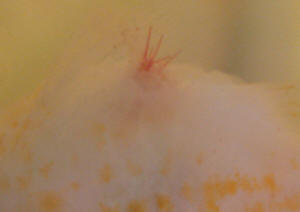 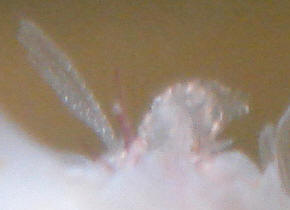
Lernaeids?
RMF would like to see this under a 'scope.
|
Newbie /anchor worms and Camallanus
worms, FW 12/12/07 Dear Crew, First let me apologize in advance for
any posting errors. I have never posted anything before. I have read
just about everything I could find on your site and the web, and still
haven't found a clear answer to my question. <Welcome> My
eight year old son and I are relative newbies to freshwater aquariums,
but we are learning fast. Several months ago, we got a 5 gallon
aquarium, with one live dwarf Amazon sword plant. We have a small under
gravel filter from our previous 2 gallon tank, a small heater and a
corner box filter, air pump (suitable for up to 10 gallon tanks). There
is a tiny snail, which I have only seen once. I assume it came with the
plant, and I don't know if it is still alive. After a couple of
weeks we got 1 fancy guppy. We had him about three weeks, and then got
another guppy and an Otocinclus. We did not quarantine (a lesson which
I have since learned), I also learned about water testing around this
time. Within a couple of days, the new guppy died of fin and tail rot,
and the Oto had ich. I treated the tank with MelaFix and malachite
green. <Better to simply elevate temperature here.> The Oto
struggled with ich off and on for several weeks, and eventually died.
Throughout all this, the original guppy appeared healthy. As I learned
about water testing during this time, we have been at ammonia 0,
nitrites 0, nitrates 2.5-5, ph 7.6-8.0. now for several weeks. We
waited several more weeks, before attempting to get any more fish, and
on 11/24/07 decided to get 2 more Otos to help with the algae. <Mmm,
I would not place Otocinclus in such a small volume, with such a high
pH... better to seek out other means of algae control. Posted on
WWM> They are currently quarantined, and so far appear healthy. The
day we brought home the new Otos, I discovered a parasite hanging off
the side off the guppy. After investigating on line, I am sure it was
an anchor worm. I removed the box filter/charcoal and I started to
treat with Jungle Parasite Clear, which said it was good for anchor
worms <... but adults, on host fish/es... must need be physically
removed...> and would not harm the plant like CopperSafe. The anchor
worm fell off, leaving a gaping wound in the side of the guppy. Despite
this, he continued to eat and was active. A few days later, several red
worms protruded from his anus, and one from the gaping hole in his
side. After more searching on line, I am sure from the photos I have
seen on line that he had Camallanus worms. <Mmm... no... these
Nematodes are stark white, round in cross section... Likely what you
are seeing are other/new Anchorworms...> I continued to treat with
the Jungle Parasite Clear which contains Praziquantel, Diflubenzuron,
Metronidazole, and Acriflavine. <Mmm... none of these will treat
for, kill Lernaeids... Please read here:
http://www.wetwebmedia.com/FWSubWebIndex/fwcrustdisfaqs.htm and the
linked FAQs file above on Organophosphate Use> This appeared to have
no effect on the worms, and the fish has now finally died (whether from
the worms or the wound). So my basic questions are these? <Likely
crustacean... Anchorworms> What do I treat the tank with to ensure
anchor worms (which I know is not a worm) and Camallanus worms
(theoretically they have a 30 day life cycle) are gone (since the
Jungle Parasite Clear didn't appear to treat the worms)? <Not
worms... just appear worm-like> What is safe for the plant?
<Please read the above...> Is the snail an intermediary host?
<Mmm, no> How long do I need to wait, keeping in mind I have 2
Otos in quarantine, waiting for all the algae in the tank. Do I need to
take down the whole set up and sterilize and start over? <Mmm,
possibly the best approach here now> If so, how? <See here:
http://www.wetwebmedia.com/clnaqfaqs.htm> How do I keep the bacteria
going in the tank since there are now no fish in there? <They will
be there> Thank you in advance for your advice. I have learned much
from your site. I wanted to introduce my son to the pleasures of an
aquarium, and all he has seen so far is a bunch of parasites and sick
fish. I realize we have just a tiny set up, but I had an aquarium when
I was growing up, and I wanted him to have the same pleasure it gave
me. I'd just like to get the new Otos settled. We know the 1 inch
per gallon of water rule, so we know we can only have a few small fish,
but we want them to be healthy, happy fish. Thanks again for your help.
Vida <Thank you for writing so well... Clearly and completely. I
want to state, make it known to you that the difficulties you and your
animals are suffering are not of your origination... The livestock you
have received has been infested, compromised... and not easily cured by
anyone's efforts. I would either bleach-wash and start over here,
moving the water from the Quarantine along with the Otocinclus... and
feed carefully till the system is established. Otherwise, Clout (tm),
Fluke Tabs (tm), other DTHP or Dimilin containing pesticide can be
added... Do please write back if you have further concerns, issues. Bob
Fenner>
Re: newbie /anchor worms and
Camallanus worms 12/18/07 Mr. Fenner, <Vida> Thank you for
your prompt reply. I think I will take every thing down and bleach it
out. Is there any way to save the plant? <Yes... can be peremptorily
dipped/bathed in an alum and water solution... See WWM, the Net re>
We like having a live plant as opposed to plastic. Likewise, how does
one safely add new live plants, as I realize they can introduce
parasites? <Rare, but yes... most all that is wet can/may> If we
are starting all over, we will probably add another plant or two, and
definitely don't want to introduce any new parasites. The Otos in
quarantine appear healthy and thriving, and my son would like them in
the tank. Here are some photo links, which show the photos why I
believe the fish had Camallanus. This looked very different from the
anchor worm on its side, and definitely appeared to be multiple red
worms in the anus. They would pull in and appear much shorter at some
times than at others. The anchor worm did not do this, it was the same
until it fell off and left the wound on the side of the fish. My
husband, who has a background in biology and a PhD in genetics, also
felt that the organisms protruding from the anus were Camallanus and
not the same as the anchor worm.
http://www.inkmkr.com/Fish/CamallanusTreatment/experience.html
http://img520.imageshack.us/img520/2897/parasiteen0.jpg
http://www.gaem.it/pubblico/articoli/malattiepesci/Camallanus/camallanus03.jpg
<I must commend you on your photographs. Some are very nice
indeed... These do appear to be Nematodes... reddish from feeding
likely> I had tried elevating the temperature of the tank to between
85-90 degrees (normally it is at 76 degrees) and adding a small amount
of aquarium salt for the ich, but was conservative with this because of
the plant and the Oto. The pH of the aquarium was running 7.2-7.6
before treating with the Jungle Parasite Clear. I suspect some
component of the medication fizzy tab has increased the pH.
<Possibly...> Thank you again for your assistance. Vida <Thank
you for this follow-up. Bob Fenner>
|
"Feeder" use in establishing cycling,
nematode? 10/2/07 Dear WWM Crew, <Kathryn> I have two
platys and a swordtail in my new aquarium and it is just about
done cycling (nitrite .25 and consistently dropping, ammonia 0).
The fish have all been doing well for about a month now <...
they've been in this system while it's cycling? Not
good> , except for a little feeder fish that died this
morning. <A comet goldfish? Other minnow? Feeder livebearer?
Frequent, make that almost-without-exception vectors of parasitic
and infectious disease...> (The feeder fish was provided to me
by the pet store as a way of establishing bacteria <Not a
suggested method... your system is likely infested...> and he
survived so I kept him.) When I removed him from the tank, I
found that his stomach was blown out and that there was a long,
white, string-like object hanging from the opening in his body.
(see picture). <Mmm, perhaps a nematode... could be the GI
tract...> He had been stuck to the filter intake. I am
wondering if what I am seeing is his intestines or a parasite.
(If it is intestines, I am puzzled at the stomach rupture, the
filter is a whisper filter designed for 5-15 gallon tanks.) I am
hoping you can help me figure out what happened because I want to
protect my platys and swordtail. Here is some background: For a
few days nitrate levels were spiking faster than daily 50% water
changes and salt could remedy, and I was doing multiple changes a
day to help alleviate the stress but despite my efforts, the
feeder fish started acting strangely. His gills darkened, on one
side noticeable more so than the other, and he began to swim on
his side and on his back, sometimes totally unable to right
himself. I imagined this might be related to organ damage caused
by nitrite poisoning, as levels nitrate levels had reached a 1.5
ppm at the worst. <Way past toxic> Prior to this behavior,
he had been a very hearty and active fish. Once the strange
swimming pattern began, he lasted about 48 hours. The only other
out-of-the usual condition in the fish tank so far as I can tell
is that my swordtail dropped a few fry, all of which disappeared
before I could run to the store to get a separate tank for them.
This also happened right before the feeder fish started acting
strangely. I appreciate any insight you can offer! Thanks!
Kathryn <Wish you had read here first:
http://www.wetwebmedia.com/FWSubWebIndex/fwestcycling.htm and the
linked files above... Bob Fenner>
Re: "Feeder" use in establishing
cycling, nematode? 10/3/07 Hi Bob, Thanks for your response.
Shortly after starting to notice stress in my fish, I actually
did a lot of reading on the nitrogen cycle and realized that the
pet store misguided me in letting me purchase so many fish before
cycling was complete. <All too common> Accordingly, I have
been adding salt, been on reduced feeding schedule, and doing
very frequent water changes to try to remedy the situation.
Hence, the tank is nearly fully cycled and the fish are well
(Except for the one in question). The problem I am really
concerned about at this point is, if this was a parasite (perhaps
a nematode, as you suggested), are there measures that I can take
to prevent my other fish from dying. <Mmm, possibly... there
are Anthelminthics... that are relatively safe, effective,
specific... Prazi... quantel... -pro... might be administered>
If it is the fish's GI tract, do you have any ideas of what
might have caused it to be coming out of the fishes body?
<Prolapse possibly... the tract of cyprinids however is much
longer... coiled inside... Do you have a microscope? A
cross-section near the "head" end (hard to discern
which is which) should reveal a tri-radiate esophagus in the
buccal region if so> If it is some how related to nitrite
poisoning, that situation is now under control. <But the
residual damage...> If there is something else going on
though, I want to make sure I take care of it. I haven't
found much literature to explain rupturing fish bellies. Thanks
again! Kathryn <Mmm, not much to refer to here... in the
popular literature or online. BobF>
|
|
|
|
Help with internal parasites,
again... Mollies 9/1/07 Hello Crew! <Greetings.>
I've had a few long chats with Tom about my Mollies with
internal parasites. This has proven as hard to get rid of as ich
and killed many fish. <Curious. My first question when people
have problems with mollies is whether they are keeping them in
freshwater or in brackish/marine conditions. In the former case
they seem to me to be irredeemably delicate, and successful
maintenance requires excellent (i.e., zero nitrate) water
quality. In brackish/marine conditions mollies are basically
indestructible. For me, it's a no-brainer: if you want to
keep mollies with the minimum fuss, keep them at 25-100% seawater
salinity (~SG 1.005-1.018). Ich/Whitespot cannot survive under
such conditions, Finrot and fungal infections are extremely rare,
and internal parasite "spores" (or whatever) cannot
survive the saltwater conditions so cannot infect healthy
fish.> It all started when we lost one small black balloon
Molly, and then realized that her companion was getting way too
thin and had the red worm-thing sticking out her anus. We tried
Metronidazole and a variety of other medicines, but she died
despite our frantic attempts at a cure. <Why did you use
Metronidazole? That's a drug primarily for internal bacteria
and to a less extent protozoan parasites. As far as I know, it
has no effect on multicellular parasites such as worms. For
those, you need something worm-specific (i.e., an anti-helminth
drug) such as PraziPro or Sterazin.> So, when we got two new
balloon Mollies, we treated them in the quarantine tank with
PraziPro (which is supposed to be effective) before we let them
join the two remaining healthy fish. We added them to our
apparently unaffected two remaining bigger Mollies, who came from
a different dealer (one orange male and one spotted female). We
lost the male two weeks ago (within three days he stopped chasing
the females, then one morning was lying at the bottom of the tank
gasping, then he was dead, no symptoms of anything). My boyfriend
just called to tell me the spotted female died today, and
apparently she has this red worm-thing again. What's worse,
one of the two living Mollies has a distended anus with some
white tube-like stuff protruding. <This is a dumb question
perhaps, but are you sure the problem here is worms? Parasitic
worms generally don't cause quick deaths. What you tend to
see is a gradual loss of condition or a failure to grow or put on
weight. By their nature, most of these intestinal parasites have
evolved not to kill the host outright, since they die when the
host dies. Wild fish commonly carry a parasite load, but
otherwise aren't harmed. Nine times out of ten, mollies die
from nitrate poisoning, Finrot, fungal infections, or acidosis.
This is especially true when the die "quickly".
Gasping, for example, is a good sign of respiratory distress,
which can be caused by poor water quality and a too-low pH. Just
a reminder, mollies in freshwater conditions (if you're
foolish enough to keep them thus) need three specific things:
zero nitrate, pH 7.5-8.2, and hardness not less than 20 degrees
dH. In brackish/marine conditions, the sodium chloride will
detoxify the nitrate so that isn't an issue, and the other
salts in the marine salt mix will raise the pH and hardness
automatically. Please note that "tonic salt" or
"aquarium salt" won't do anything other than
mitigate the nitrate, so are a greatly inferior product when
keeping mollies.> He's moving them to our
quarantine/treatment tank as we speak and will start treating
with PraziPro again. Should I also give them Metronidazole? I
know they can be mixed, but it's not supposed to be super
effective against those kinds of parasites. In any case, I'll
follow your advice. <PraziPro yes, Metronidazole no. As a
rule, unless a qualified animal healthcare professional has said
otherwise, you should NEVER mix medications. The synergies
between two or more drugs are unknown, and potentially lethal.
But more importantly, sit down and review your water conditions
and chemistry. If you're keeping your mollies in freshwater,
please understand that you will always be fighting to keep them
healthy. It's just the way it is with mollies. While they are
certainly freshwater fish in the wild, in aquaria they just
don't do well kept thus. Spend any time reviewing the
livebearer e-mails here, or postings on fish forums, and
you'll see that there are always bucket-loads of messages
about sick mollies.> Now, the only remaining animals in the
tank are a Nerite snail and two Amano shrimp (maybe a few Cherry
shrimp too but we haven't seen them in a while). <Ah, now
the good news here is both Amano shrimps and Nerite snails are
salt-tolerant, so you can raise the salinity of the tank to SG
1.003-1.005 without problems, should you choose to do so.> Do
I need to treat the main tank to ensure that all parasites are
gone? The fish are apparently reinfecting each other, and I want
to ensure that they don't get sick again when I put them in
the main tank. Do I need to leave the aquarium fallow? If so, how
long? Do I hunt the shrimp and move them out, then treat the
whole tank? Help! <Yes, you need to treat the tank. Yes, you
will probably need to remove the shrimps, as they tend to be
sensitive to medications.> Do I need to treat the Betta and
his Eclipse III too? He used to be in the same aquarium as the
Mollies, he might have been exposed... <Probably not, unless
you see some symptoms.> I know many people say that healthy
fish "strike a balance" with their internal parasites
and live in apparent health for years with them. This hasn't
proven true for me, those are nasty little bugs (and tough too,
after a week of PraziPro the worm was still hanging on) and
I'd be extremely glad to be rid of them, once and for all.
<My suspicion is that you're dealing with mollies that are
fundamentally stressed, and the worms are at best an
"excuse" for them to wave a little white flag and give
up.> Those have to be from the LFS, and they must have lived
for months with the things in their digestive systems without
showing any signs, since we haven't given them anything else
but Nori, flakes, sinking pellets and bits of corn for about a
month. They also get frozen bloodworms, and occasionally brine
shrimp, but they're both Hikari brand that's supposed to
be well sterilized. <The foods you list should be fine. Do
bear in mind mollies are primarily herbivores, and the ratio of
green to meaty foods should be of the order 80% to 20%. In fact,
feeding them exclusively on vegetable-based fish foods
(livebearer flake, Spirulina flake, algae pellets) would be
entirely acceptable.> I really don't want to battle
internal parasites AGAIN!!! <If you want healthy mollies, keep
them in brackish/marine conditions. If you want to have to deal
with "disease of the month" with your mollies, keep
them in freshwater. That's Neale's sage advice for the
day.> Thank you so much for your advice... once again! Merci
beaucoup! <You're welcome.> Audrey
<Neale>
Re: Help with internal
parasites, again... -- 09/01/07 Hi again, Neale! <Hello
Audrey,> Thank you for such a detailed answer. It did make me
feel slightly like I was a bad fish owner, but maybe I deserve it
for waiting so long to do what I know I should be doing.... >
<Curious. My first question when people have problems with
mollies is whether they are keeping them in freshwater or in
brackish/marine conditions. *blushing*... I know, I know... All
right... I won't ask any questions again until I do the
switch to brackish... I've been planning on it for ages, but
I was waiting until after we got the new apartment more or less
organized so we could move everyone to a brand new 30 gallons...
Looks like this is the signal to get a move on... Incidentally,
we never detect any nitrates. We have plants and a healthy dose
of algae so I suspect they get used up before our test kit can
detect them. We also had a light fish load, four very small
Mollies (balloon variety, they never grew) in 10 gallons (I know,
too small, we'll wait until we get the 30 gal we're
planning on before we get any more fish, but with the move
we've had to buy essential furniture before we can think of a
new aquarium). The LFS tells us we can put 10 Mollies in a 10
gallons... (!?!?!?!?!?!) Let's just say we have learned very
quickly to take their advice with a big grain of salt :-) pH was
always at least 7.5 and climbed very slightly during the winter,
high enough that I didn't want to risk most of the fish they
sell in the LFS, who need neutral or slightly acidic water. I
guess the big problem is with (hardness? alkalinity?), I need to
learn what scale it is measured in but the water here is a steady
9. You're going to say too low, I know. We used to add
livebearer salt, but after reading your advice (worthless, waste
of money, etc. unless used for a specific problem), we stopped
adding it to the tank a few months ago. We'll drop by the
marine LFS this afternoon and pick up some marine salt. <Ah,
you seem to understand what's going on, so there's not
really much more to add. Mollies just aren't as easy as
everyone thinks, with the result that lots of them (most?) get
sick and die rather quickly. I'd compare them to goldfish in
this regard -- they seem easy, but they're not. For aquarists
who want to stick with freshwater, I always recommend platies or
swordtails instead. On the topic of pH and hardness, it's
almost always safe not to worry about these (within reason). Most
common freshwater fish (as opposed to brackish water ones!) can
adapt to a wide range of values, so Neons, for example, may
*prefer* pH 5.5, near-zero hardness, but they'll *thrive* at
pH 8, 20 degrees dH if acclimated to it carefully and otherwise
looked after properly. What matters isn't so much the values
as the *stability* -- what most fish hate is pH and hardness
levels that bounce around. In other words, get fish that are
already thriving at the retailer, keep them in your local water
conditions, and use good filtration and regular water changes to
optimise water quality while diluting the background water
chemistry changes that happen in freshwater tanks anyway.>
See... sometimes it takes fish dying so that we learn. Another
red flag should have been that they've never bred... we
thought our male was sterile because try as he may, he could
never get one of them pregnant. In retrospect, maybe they were
just in the wrong conditions to breed. <Quite possibly. But
just as likely the fry got eaten or sucked up the filter or
whatever.> > <Why did you use Metronidazole? Ah, well,
because the only symptom we had was one dead emaciated fish and
one very thin, formerly very plump, fish and we didn't know
what she had, and this was recommended by the marine LFS and was
the only thing we could find FAST! The local LFS have never heard
of a cure for internal parasites. They just let them be. We did
our best on short notice. And then we did more research, and
found out about Praziquantel and other medicines, and tried to
get some locally but *nobody* sells it around here, we called
about 6 places, so I tried to mail-order it, but the two Canadian
mail-order stores I know of didn't have it in stock, so we
ordered Jungle Labs medicated food, which they wouldn't eat,
and then we ordered Gel-Tek, which does contain some Prazi, but
that didn't work, and finally the mail-order place got some
PraziPro in stock, but by the time we tried that I think it was
too late and the fish died, with three very visible red tails
sticking out of her anus. But at least we'd finally got to
the right medicine - I think. <I see. Sounds rather bad
luck.> > <This is a dumb question perhaps, but are you
sure the problem here is worms? Parasitic worms generally
don't cause quick deaths. What you tend to see is a gradual
loss of condition or a failure to grow or put on weight. I think
this is exactly what we were seeing, but didn't recognize it
in time. We've had some of those fish for six months and they
haven't grown. It's just so gradual that we don't
notice until the fish are too feeble to function properly. They
seem fine, and then one morning they're not quite right, and
a week later, they're dying. They never get to the not eating
stage. I'm not saying their death can't be due to
something else, and it might be more than one factor, but my test
kit tells me the pH is steady at 7.5 and that there are no
nitrates. What I see is fish that won't grow, and that after
a few months just stop functioning. When the male died he
hadn't chased the females for about a week, maybe more, we
just didn't notice at first... I feel bad for not noticing
those things, but they happen so gradually... and when we did
notice something wasn't quite right we didn't know what
the problem was. <OK. Again, you seem to have a sense of
what's going on already, so all I can add here is a second
opinion. Often, fish deaths come about from multiple small
factors acting in concert. Much as with sickness in humans. So
you need to watch for the small signs and act swiftly. Odd
behaviour is often one of the very best clues, and a lot of
experienced fishkeepers will hardly ever need to use test kits
because they can spot when things aren't right in established
tanks because the fish aren't doing what they should be
doing. I don't recommend that approach for beginners of
course!> > <PraziPro yes, Metronidazole no. As a rule,
unless a qualified animal healthcare professional has said
otherwise, you should NEVER mix medications. Ah, but in this
case, we know they can be mixed safely because most general
anti-parasite medicines contain at least those two, and sometimes
other medicines too. But if you say Metro is worthless in this
case, I won't use it. This is my understanding as well, but
sometimes we bow to people of superior knowledge, so I was asking
just in case, because I have some in my fish medicine cabinet...
<I'm not an expert on antibiotics for fish -- they're
essentially prescription-only in the UK, so when you get them,
the vet will tell you exactly how to use them. I'm happy to
let others give you relevant advice here. But me, I prefer to use
medications sequentially. It's also important to identify the
problem before using the medication; scattergun approaches are
risky because many medications can stress the fish, and if they
aren't fixing one problem, they could end up causing another.
Mollies should be fine, but things like loaches and pufferfish
often react badly to medicines, and stingrays and invertebrates
can be killed outright. So you need to treat medications with
respect. Identify the disease, choose your drug, and look out for
side effects.> > <Ah, now the good news here is both
Amano shrimps and Nerite snails are salt-tolerant, so you can
raise the salinity of the tank to SG 1.003-1.005 without
problems, should you choose to do so.> Yup, that's exactly
what I was planning on when we got the 30 gal. I didn't want
to do it with the Cherries in there, because from what I read
they're not salt-tolerant at all, and I can't put them
with the Betta because he'd rip them apart (he did it before,
so we tried some cheap Ghost shrimp, and only found shrimp
bits...). I was also trying to find a supplier of Bumblebee
Gobies, for the future, and I have lists and lists of
salt-tolerant plants, and know the ones we have now *should* make
the switch (Bacopa, Anubias, Java fern, and Vallisneria in
"quarantine" so we can screen for snails). We're
all ready. We just haven't done it yet. <Very good.
I'm not sure whether Cherry shrimps are good in brackish or
not. I'd personally risk it, at least to SG 1.003. Shrimps
tend to be salt tolerant (many, though not Cherries) have a
marine stage in their life cycle, as is the case with Amano
shrimps. Acclimating slowly is perhaps the key. I keep (and
inevitably breed!) Cherry shrimps and have found them to be
rather robust animals, for their size. All your plants are good
brackish water denizens, and assuming you have enough light and
good substrate for them, will adapt readily. You've also got
a nice mix there. When people rely solely on slow-growers like
Java fern and Java moss, they end up with algae problems.
Throwing in some Bacopa and Vallis should help a great deal.
Indian fern is another good algae-beater that tolerates low-end
brackish.> > <My suspicion is that you're dealing
with mollies that are fundamentally stressed, and the worms are
at best an "excuse" for them to wave a little white
flag and give up.> Then I'll work under this assumption. I
promise not to bother you again with my Mollie troubles until
they're safely in brackish water. Then, if I'm still
having problems, I'll let you have a go at it :-) <Heh!
Brackish water doesn't fix everything, and it certainly
won't cure infected mollies of things like intestinal worms.
But what it does do is make them orders of magnitude more robust,
and the salinity also suppresses many external parasites as well
as the infective stages of certain internal parasites. This is
why brackish water fishes have a reputation for being so
hardy.> > <The foods you list should be fine. Do bear in
mind mollies are primarily herbivores, and the ratio of green to
meaty foods should be of the order 80% to 20%. In fact, feeding
them exclusively on vegetable-based fish foods (livebearer flake,
Spirulina flake, algae pellets) would be entirely acceptable.>
Yes, they've been getting Nori at least a day out of two. I
tried peas but they don't eat it, but they do like corn.
I'll try broccoli next. Can you believe I haven't ever
seen a vegetable-based flake around? Sometimes I feel aquarium
shops around here are 20 years behind the times... Even the
sinking "algae" pellets have fish flour in them,
sometimes even as the first ingredient, so they're not really
vegetarian... I've been looking for something called
"Spirulina flake" but haven't seen it, just regular
flakes with Spirulina among the other ingredients. *sigh*. Maybe
I'm simply not looking in the right places. In the meantime,
we got some Nori for free at the local sushi place, we just ask
for a sheet when we pick up some takeout and with only four small
fish, it lasts a long time... and the Amano love it too.
<Interesting. I picked up Spirulina in a grocery store called
Hy-Vee in Lincoln, Nebraska over Christmas. So I suspect it's
a case of looking out for the stuff while you're on your
travels. It isn't critical though. You might even grow your
own: a plastic goldfish bowl placed outdoors and filled with
water will quickly develop a nice flora and fauna including
insect larvae and thread algae. Yum, yum! I love taking this
approach, because my "live food ponds" become
interesting aquaria in their own right.> Interesting unrelated
tidbit, our Betta eats everything, either floating, sinking or
lying at the bottom of the tank (flake, sinking pellets, Betta
food, live shrimp, dead shrimp, bloodworms and brine shrimp,
peas, corn, everything we ever put in his tank). He even tried
Nori. Well... he tried it the first time we gave it to him, but
stubbornly refused to taste it ever again :-) I guess even the
most wide-ranging tastes have their limit :-) <Indeed! But
that's the right approach to feeding fish. Let them have a
little of everything.> Thank you again, and sorry to be such a
bother :-) Audrey <Not a problem. Good luck,
Neale>
|
Parasitic Worms Coming Out Of Fish,
FW -- 8/19/07 Hi, I have a parasite ( micro worm like ) eating his
way out my blue and gold ram and killifish anus. It looks like
something is eating the fish's anus and you can see like 4 or 5 red
little worms coming out. I been looking on the internet and you guys
seen to have the more knowledge on parasites. I would appreciate any
help. < Most parasites like this can be controlled with Clout or
Fluke-Tabs. Just follow the directions on the package and they should
be fine in a few days.-Chuck>
Red, Protruding Spine-like things...
Ram hlth. -- 06/08/07 Hi there, <Hello.> I have three
Bolivian rams in my 40 gallon tank along with some other tank mates and
I just recently lost one of my rams. He had these red spines that were
protruding from his underside. Now I am noticing that the surviving
three also are beginning to show signs of this. <Hmm... are these
spines associated with the fins, or sticking out of the body far away
from the fins? Without a photo, it's difficult to identify the
problem.> Do you know what it is and if so, how would I go about
treating this? <My first guess would be Finrot. When the fins decay,
the membrane goes but the spines remain, and these could be the red
spines you're seeing. Untreated, Finrot will kill fish. It is
treatable using a variety of commercial medications. Ideally, choose a
remedy that treats fungus as well, as the two things often happen
together. Now, Finrot is 99% of the time a symptom of poor water
quality, so check the ammonia and nitrite levels especially. Bolivian
rams (like most other dwarf cichlids) are also very sensitive to high
levels of nitrate. You should be doing 50% water changes weekly, and
the nitrate level should be well below 50 mg/l. Ideally, as close to
zero as is practical. Hardness and pH aren't terribly important,
but you're aiming for low to moderate hardness and a pH around
between 6-7.> I really like these fish and I don't want to lose
anymore. <Yes, they're lovely animals.> Thanks and I look
forward to your reply, Trish <Good luck! Neale>
Re: Red, Protruding
Spine-like things -- 6/8/07 Hi Neale, Thanks for your reply.
<You're welcome.> Now, I would believe you except that my
levels are all good and I always do water changes... Now the other
thing is that these guys' fins are beautiful! There is nothing
wrong with any part of any of them. <Okay.> This red spiny thing
sticking out is protruding from the anus so is coming from inside the
fish. The one that died had them really big and they would go in and
out. The fish now just have a small piece poking out. Do you still
think this is Finrot? <Ah, the plot thinnens. No, this doesn't
sound like Finrot any more. More like intestinal worms. Rather rare in
freshwater fish kept indoors, but they do occur. If these worm-like
things are wriggling about and obviously alive, then they're
definitely intestinal parasites. You will need an anti-helminth
(anti-worm) medication to treat these. Depending on your local laws,
you will either be able to obtain such drugs from your retailer or from
a vet. In the UK for example, Flubenol is available over the counter
from aquarium retailers but most of the others used by American
aquarists are not. Your own mileage will vary, as they say. The only
other thing they could be is stringy faeces. This is actually very
common in cichlids, often through the wrong diet or as an additional
symptom to things like Hole-in-the-Head disease. In this case, the
stringy faeces hang out the back of the anus like threads, but are
clearly inanimate. If this is the issue, it's a case of identify
the problem, then treat. Diet can be fixed with, for example, more
vegetables in the diet. Hole-in-the-Head usually requires
antibiotics.> Trish <Hope this helps, Neale>
Camallanus dosage problem. Neotrop.
cichlid dis., Levamisole/Anthelminthic, FW 2/27/07 I have a
Camallanus problem in my 125 gallon tank, with 2 fish showing the worms
protruding from the anus. My pH is around 7.8, ammonia is 0, nitrite is
0, and temperature is 80.2 degrees. The fish are single specimens
between 2"-4"of the following: blue Acara, archer fish,
Nicaraguan cichlid, Red Hump Eartheater, Satanoperca jurupari,
Geophagus surinamensis, Bujurquina vittata, and Hypselecara temporalis.
I've looked this up on the Search, but I have serious questions/
doubts about dosing. The medication I have available is Levasole
(Levamisole hydrochloride) in the powdered form, and it brings 18.25
grams. <This is the total weight of what you have available?>
here are my questions: -What would be the appropriate dose for using it
in the water instead of adding to food? <Mmm, much better
administered via food/feeding> -How much Levasole would I need to do
this? <Mmmm, "lifted", or my new term
"meta-analyzed" from Noga's fish diagnosis tome: Oral
formulations: Feed 2.5 to 10 mg. Levamisole HCl/kg (you'll have to
guess the weight of the fishes...) = 1.1 to 4.5 mg per pound... for
seven days. As stated, I would not "pour the medicine" into
the tank... or use prolonged immersion in a bath... or encourage you to
try injections> -When do I repeat the treatment, and when do I do
the first water change? <Daily for repeats, for a week... and water
changes as they are needed or weekly IMO> thanks for the help, and
sorry for the long message. <Glad to assist you. Bob
Fenner>
Endless livebearer
frustration - this time Camallanus! 11/12/06 Hello Crew!
<<It's been quite a while, John. Tom>> I am rather
unhappy to be writing you again. Not unhappy with you, of course, but
unhappy that I actually have to write you about a problem yet again. As
well-documented on this site you probably remember that during the
summer I had endless problems with platys and guppies. <<I
recall, John.>> Those troubles finally settled in September and
October and things had been going well. I started a new aquarium setup
(a 160L tank), did a fishless cycle and stocked it after ensuring there
were no sick fish (i.e.: a quarantine regimen). The two other aquariums
I was running (a 96L and a 54L) were doing fine too after a long period
of "disequilibrium" and sickness amongst my fish. <<All
sounds good.>> However. <<Uh oh'¦>> I was
doing a thorough clean of the 96L today and afterwards I was observing
my fish, handiwork and my sparklingly clear waters when I noticed a
female guppy with some fine red strands coming from the anus area. Oh
no, I thought. Double oh no I thought as I had just transferred some of
the fry she dropped into the 160L tank. I did this because the tanks
had been running clean for a month or more with no new additions. To my
shock and horror I believe this guppy is infested with internal
parasites namely nematodes (Camallanus). <<Absolutely agreed,
I'm rather sorry to say.>> Thus, I am facing a rather
nightmarish scenario at the moment. I believe I have put contaminated
fry into my beautiful 160L tank and I believe I have a case of advanced
nematode parasites in a guppy in my 96L tank. Come Monday I will obtain
some Levamisole in order to treat this problem. The questions I have
are as follows: 1. How bad is my current situation given that I have a
fish with extruding (and visible) parasites? <<Critical though
not insurmountable, John. This will all depend on the extent of damage
to the internal organs of the fish. Levamisole hydrochloride is
absolutely effective in eradicating the worms and in increasing the
immune systems of the fish however, the guts of the fish may be badly
perforated. Time for some extreme 'finger-crossing.'>> 2.
What is the treatment regimen here? I have read that I need to dose the
aquarium water at 2ppm, is this correct? I assume there is no need to
treat the food, but to just put the Levamisole into the water, is this
correct? Also, how long/how often should I treat? <<Given the
fact that the parasites are visible, John, I would consider 5 ppm the
minimum dosage. (Have seen reports of four times this dosage being
administered but the lowest effective dosage is best.) You're
correct that the Levamisole should be added directly to the water.
It's absorbed through the gills of the fish. One dose should be
given over a 24-hour period followed by a massive water change. Repeat
after four days. Whether, or not, a third treatment is in order will
depend largely on how your fish are faring. If stress levels are low I
would consider a third application.>> 3. I have also read that
after treating it is still necessary to change 100% of the water, but
this seems drastic. Is this a misconception, or do I indeed need to
change out ALL the water? <<As much as possible, John, with
emphasis on 'possible' not just convenient. A re-infestation
can go unnoticed for months before you're back in the same boat
that you're in now. Less than 90% will leave too much potential for
missing the immature parasites. As an aside here, Levamisole reportedly
acts as a paralyzing agent on the adult worms. That is, the worms drop
from the fish alive even though they appear, for all intents and
purposes, to be dead. I think it highly doubtful that they can recover
from this paralyzed state but it makes a compelling argument for
replacing every drop of water that you can.>> 4. I have
invertebrates in the tank, specifically some radar shrimp and apple
snails (Pomacea bridgesii). Do I need to remove these invertebrates so
they are not affected by the Levamisole, and if so, where do I put
them? Is it possible they are carrying the nematodes?
<<Levamisole does not appear to have any adverse affect on
invertebrates. Camallanus does not 'require' an intermediate
host but it's a darned good bet your snails are acting as
'intermediates'. Removing these to other quarters until your
fish are clean and, then, reintroducing them is almost a sure-fire way
to end up back at 'square one.'>> Please, help - I am
vastly discouraged and can't believe I have run into yet another
crisis. My experience with live bearers so far has been absolutely
dismal and I am thinking never to go this route again.
<<You've had more than your share of troubles, to be sure,
but this one is a real 'doozy', John.>> Thanks in
advance, I truly and greatly appreciate all your help. <<I wish
you the best of luck with this situation, John. Best regards.
Tom>>
Camallanus rapidly leading to mass
disaster 11/16/06 Hello Crew - <John> I don't know if my
last email made it through, so I'll write you again with the latest
developments. I had a black female guppy with an obvious Camallanus
infection. I could not get Levamisole but was able to obtain
Mebendazole in 100 mg tablets. I dosed the tank at 5ppm (or about 4 and
1/2 100 mg tablets) for 24 hours. I lost the black guppy after this. I
vacuumed the substrate thoroughly and changed about 90% of the water.
Now my leopard Corys are looking very ill and falling over on their
sides. <Mmm... this might not be Nematodes here... but some effect
of the medication. Camallanus are not able to readily parasitize all
families of fishes> I have 6 of them and 3 look to be doing very
poorly and the other 3 look not-so-good. I am concerned that I will
lose all of them. I am terribly discouraged with all this. Combined
with the problems I had over the summer I am seriously considering
getting out of the hobby. I have spent over half of the 10 months I
have had the aquariums battling one problem after another and, to be
honest, I am no longer getting enjoyment from the hobby. <I would do
successive water changes to remove the Mebendazole, other
metabolites... keep the water near neutral in pH (or slightly
acidic)...> Unfortunately, I also have a 160L tank into which I put
some of the fry from the infected tank. As I have been reading about
Camallanus, it seems that this tank is in great danger as well.
<Mmm, yes, can be easily transmitted (their eggs, intermediates)
through the water> Do I dose the tank with Mebendazole now, or
should I wait? The reason I ask is that apparently the medication is
effective only against the worm when it is in the fish. <Yes> Is
Mebendazole even effective against Camallanus? <Yes... is a general
anthelminthic> If so, am I using the proper dose (i.e.: 5ppm)?
<Yes, should be> I am so completely discouraged by all this
especially since I have done my utmost (quarantine, choosing
"healthy" fish, etc..) to avoid such problems. At some point,
should I have the heart to continue keeping fish, is there something
other than livebearers I can try? Do you have a recommendation?
Regards, John. <I am a much bigger fan of Prazi/quantel here. This
compound should be readily available to you... through the Net... and
has a much wider range of efficacy. Bob Fenner>
Re: Camallanus rapidly leading to
mass disaster 11/16/06 Hi Bob, thanks for the reply <Welcome
John> Unfortunately I fear complete disaster for my tank. The Corys
are all but dead now and my guppies are in a very poor state too. I am
also spotting dead snails littered about the substrate. <As
stated/hypothesized... not a/the worm infestation, but some sort of
"cascade" event, subsequent to or consequent of the
medicating> About 65% of the fish in the tank are now resting on the
bottom and looking not well at all. <Move them... or barring this
possibility, start daily large (25%) water changes... with water set
out the day previous...> I cannot understand what I have done wrong.
To the word, this is what I have done to the tanks in the last 48
hours: As mentioned, I noticed the red worms on the female guppy.
<On? Not in? As in protruding from the vent?> About 24 hours
after spotting this I dosed the tank with 5ppm Mebendazole. 24 hours
after that I did a large water change (80%) <Too much, too soon>
and, abruptly, the problems started. The black infected female died,
the Corys began acting strangely (prior to the Mebendazole dosing these
fish were 110% fine - playing in the bubbles, eating, happy fish) and
now many of my fish (all livebearers) are fairing poorly. I was under
the impression that Mebendazole was non-toxic to the fish, but I am
leaning strongly towards the thought that it has a strong toxicity in
the Corydoras species. <Mmm, maybe> Do you have any info
regarding this? As I understand it, large water changes should not kill
my Corys - generally they spawn/become more lively. <There are a
good many possible negative interactions with so much new source water
being introduced... gas embolisms, pH shifts, excess/undetected
sanitizer presence... to name just three in widely diverging
categories> At this point, I cannot possibly dose my 160L with
Mebendazole in all good conscience - it has a large school of Corys and
I am not convinced that Mebendazole is harmless here. <And I hasten
to add that I doubt if this would be of any value in any case... I
suspect you don't have a Camallanus issue (need microscopic
examination, necropsy to be sure here), and if indeed there is some
pathogen involved (perhaps a fluke) it will not likely cross over from
a Poeciliid to a Callichthyid...> From what I have read,
Prazi/quantel is less effective than Levamisole. Should I be able to
obtain some of it, what is the treatment regimen? Dose at 5ppm followed
by a large water change after 24 hours? Do I repeat treatment? <I do
not want to urge you to go this route... I would not... I would move
the mal-affected fishes ASAP... leave the other (considered infested)
tank be as it is> As for the rapidly deteriorating 96L tank, do you
have any suggestions? <Yes... either move the residents or begin the
partial water change regimens... possibly with the addition of
activated carbon in the filter flow path> I am very hesitant to
change water as the fish are not doing well at all. Ammonia, nitrites
and nitrates are all 0ppm at the moment, pH is 7.2 which is the pH of
the tapwater and I am monitoring them closely, but I do not expect the
levels to change as I don't believe the Anthelminthics affect the
filter bacteria. <Mmm, under some circumstances, can/do, but not
directly, no> Given the above, do you have any possible inclination
as to what caused this disaster? <Mmm, no... nothing "jumps
out" as a causative mechanism... could be that the one fish was
genetically predestined to "destruction"... but the rest of
the circumstances? Likely environmental of some sort... soap/saponifer,
cleaner, aerosol making its way into the water... > Thank you for
your help. I would be at a loss without it. <Move those fishes. Bob
Fenner>
Re: Camallanus rapidly leading to
mass disaster 11/16/06 Hi Bob - one last email for the evening.
Thanks for all the help and your patience. <Welcome> To clarify,
the red filaments were coming from the anal vent. <Mmm... not
usually red or filamentous... Camallanus are white, tubular... have the
characteristic tri-radiate esophagus of Nematodes... on
cross-sectioning of their buccal regions> I was not accurate in my
last description. I have moved the Corys to the 160L tank. For the 1st
minute after the transfer, they swam about erratically, almost like a
whirling action. If anything, they appear "stunned" and
unwell. I am not sure if I can move the guppies as I have a Betta in
the other tank and he has "encountered" these guppies before.
With the sick Corys in the 160L, do you still advise treatment for the
parasite? <... I would not continue to treat them, no> One last
observation is that there is a whitish "fuzzy" substance
growing on some driftwood in the 96L tank. This wasn't there before
the water change - could be some bacteria? <Likely some mixed
populations of decomposers... acting on the wood itself... Not related
here> Thanks again. Much appreciated. <Bob Fenner, who would
"stay the course" at this point/juncture.>
Re:
Camallanus rapidly leading to mass disaster 11/18/06 Hi
again Bob, <John> I am pretty sure what I had was Camallanus. I
have found a picture via Google of a fish that has an apparent
Camallanus infection and this is what was coming out of the guppy in my
tank. What I observed was very similar to both this: http://www.rhusmann.de/aqua/bilder/camallan.jpg and this:
http://www.gaem.it/pubblico/articoli/malattiepesci/camallanus/camallanus03.jpg
<I see... nice graphics> That is what I meant by red and
filamentous... maybe red and stringy would be a better description?
<Mmm, I do think these photographs show worms of some sort... am not
so sure they are roundworms, Camallanus per se. Please see here:
http://edis.ifas.ufl.edu/pdffiles/FA/FA09100.pdf> It was
my understanding that the red colouration of the worm results from the
victim's blood. <Ahhh! Perhaps this accounts for the color>
In relation to the tank situation, at this point I have moved all fish
to the 160L tank and I will wait for some time before I shift some
occupants (probably not all, just the ones doing well) back to the
original 96L tank. I was thinking after about 3 days, but perhaps you
recommend longer? A week maybe? <Unless the stock is very
debilitated, I would shorten the time frame for moving> While I
wait, I was thinking to conduct 25% water changes every second day to
allow some aging time for the water to "mature" and for the
ecological balance of the tank to return. Is this feasible? <Yes, I
think so> Should I still hold off on any treatment plans? Thanks for
helping me through this - it's been a difficult situation here.
<I still want to "plug" the use of Prazi/quantel,
Levamisole, or Piperazine here, over the Me/n/bendazole... Bob
Fenner>
Re: Camallanus rapidly leading to mass disaster
11/19/06 Hi Bob, <John> Much thanks again. Here's an
update for you and in case any readers are following this saga. At the
very least it maybe can help guide somebody as to what NOT to do. I
have emptied the 96L tank completely of all residents. I had a male
Betta in there that rapidly became ill as well. He was lying on the
bottom with lots of excess mucous on his scales. I have also moved my
tetras which were not faring so badly, but again, they were covered in
excess mucous. It seems that the Mebendazole has either poisoned the
fish or has produced a secondary toxic compound that has affected the
fish. <Yes. An ongoing "fear" on my part> At the very
least, it has severely fouled the water in the aquarium. My plants seem
alright so far, but it may be a good week or more before I see any
effect on the plants. <...!> Regardless, after removing ALL
residents from the tank and placing them in the 160L tank (incidentally
I have lost 3 of 6 Corys, 2 are doing very poorly currently and 1 looks
as though it may survive). The other residents (guppies and a couple
other fish) have markedly improved over the last 24 hours just from
being in the different water. <Ah, good> I realize putting all
these residents in the 160L tank may expose that tank to the parasite,
but I believe there was no alternative. Anyways, I have been doing 30%
daily water changes in the fouled tank along with substantial vacuuming
of the substrate. Come Monday, I will put in a carbon filter (stores
are closed and I have no spares - sigh). My plan is to continue this
regimen for about a week (water changes, substrate vacuum) until
pristine conditions recur and then possibly restore some of the
original inhabitants. I realize that I should probably be treating for
the parasite here, but I think that some of these fish are in a very
precarious state and I don't feel comfortable treating with
medication just yet until the situation stabilizes. As I plan to wait a
week, I think this will allow the water and environment to stabilize,
improve the health of the affected fish and give me time to look into
the alternative medications. Does this sound like a reasonable plan
with a reasonable time-frame? <Yes. BobF>
Re: Camallanus rapidly leading to
mass disaster 11/20/06 Hello again Bob (and crew), <John>
This is just the latest update - I lost two more Corys, but one looks
as though it will survive. Surprisingly, I also lost a single neon
tetra out of a group of 11. I am not sure what caused that - it seems a
"mysterious" loss. <I agree> The rest of the tetras all
seem fine, so I am a little baffled by that. Regardless, with all these
fish in the 160L tank, I am having to monitor the nitrites carefully as
it is very overstocked at the moment. On that note, I want to ask you
if I should cut back/reduce the amount of food to help keep the
nitrites down? <Yes, I would... I'd eschew feeding altogether if
NO2 concentration exceeds 1.0 ppm> Is it okay to reduce the food
given there are some sick fish in the tank? <Yes... this is
better> In terms of the biological loads of the tanks, the 160L tank
is now over-stocked, so I plan on frequent 20% water changes and
nitrite monitoring. (Is it realistic to think the 160L tank can house
all these fish for another 5/6 days?) <Yes, should... You may want
to look into the product BioSpira here> But what I want to ask you
about is the 96L tank. It is sitting empty. I plan on it being empty
for about another 6 days. Is this amount of time sufficient to reduce
the nitrifying bacteria? That is, should I be adding a pellet of food
to the tank to keep the biological filter bacteria from dying off?
<Should be fine either way> Finally, in regards to the sick male
Betta - he seems more active after 24 hours in the new tank, but he is
still lethargic compared to before. <Fish respond more slowly than
tetrapods...> He is eating which I take to be a good sign. However,
his eyes are very cloudy. Do you know what would cause this and/or is
there something I can/could do about this? <Environmental... best to
just wait, if anything use "Aquarium Salt"... proscribed on
WWM> Perhaps it is temporary, but I am not sure and thought I would
ask. Best to you and the crew. John. <And you John. Bob
Fenner>
A Thank You ... using WWM!
7/28/06 Crew, <<Tom with you this time, Alex.>> Not a
question, but a quick thanks for all of your work. Story: One (not so)
fine day I noticed some short red wormlike things trailing out of my
Bolivian Rams' anuses. After less than five minutes on WWM, I found
a question from a person who had the same species of fish that also had
Camallanus worms, and saw how to treat it. Within a day of discovering
the worms, thanks to your site, I had purchased PraziPro and started
treating the fish in a quarantine. Unfortunately, it was too late to
save one of the rams, but the other, along with the Zebra Danios that
shared the tank, appear to have turned the corner in terms of vitality,
eating, etc. The point? Within five minutes of opening my web browser,
I: found someone that had the same problem, diagnosed the problem,
found the actual ingredient to treat the fish, found a common product
name containing said ingredient, and found how to effectively treat
using the medication. Many, many thanks for this great resource - my
fish and I are in your debt! <<A wonderful testimonial, Alex.
While I can't take credit for saving your fish, I assure you that
I'm proud to be associated with this fantastic group of folks. For
all of us, I thank you kindly for your complimentary post and wish you
continued good fortune in this great hobby of ours!>> Alex
<<My best. Tom>>
Camallanus Worms - Treatment
7/23/05 Hello, I am currently having a problem with treating
Camallanus worms (red worms hanging out of the anus) in my 75 gallon
aquarium. I know that there are several articles throughout your
website, but none of them seem to answer the questions that I have. My
aquarium currently houses three semi-adult Bolivian Rams
(Microgeophagus altispinosa), ten of their fry, and ten Otocinclus
affinis. Sadly I had to have two of the other Rams put down, and I have
lost a countless number of fry. I have tried treating them with
Piperazine citrate by treating the tank water and through their food to
no avail. Since then I have tried treating them with a newer product on
the market called Gel Tec Ultra Cure PX, which is supposed to treat
internal parasites, and contains Praziquantel (.0057%), <Not
enough> Metronidazole (.30%), and Flubenol (.03%); this did not get
rid of the worms either. I have been reading a lot of literature from
your website and others, as well as from numerous books. Many of them
said to treat with Piperazine citrate (which didn't work),
Levamisole, or Fenbendazole. I have finally found and purchased
Fenbendazole, but it is for dogs and I am unsure of the dosage as there
is little literature about dosing, and it usually is conflicting just
like anything in fish keeping is. > Ed Noga's "Fish
Disease, Diagnosis & Treatment", prolonged immersion calls for
adding 2 mg./l (7.6 mg./gal.) once a week for three weeks, orally 25-50
mg/kg body weight (11-23 mg/pd.) for two weeks> My fish and I would
sincerely appreciate anyone who could tell me how to dose the
Fenbendazole granules, as the vets here don't treat fish. It is in
1g packets, and contains 22.2% or 222mg/g Fenbendazole. I would prefer
to treat the water due to the fact that I have the Bolivian Ram fry,
but my three large Bolivian Rams will take medicated chunks of broken
up frozen bloodworms. These worms are basically eating my fish alive.
As of right now they only have a couple of worms protruding, but the
two that I had to have killed were suffering and badly infested. I
don't know how they have gotten Camallanus worms. These fish
aren't wild caught, nor have they been fed live foods, and they
haven't been in contact with any unquarantined fish. This is a new
tank for my five juvenile discus, and the Rams were supposed to be
cycling the tank for the discus. With the addition of Bio Spira the
tank cycled within a few days with only .25 NH3/NH4, and I never
detected any nitrites, so they never experienced anything overly
traumatic, and this is obvious to me because they were breeding a week
later. The tank is now only one and a half months old, and I don't
know if I'll ever move my discus to this tank as I have heard that
you basically have to, as another website stated, 'nuke the
tank'. These fish are my pets, and I care for them immensely. They
rely on me for care, and I will do anything to provide the best for
them. I perform frequent weekly water changes of 30% or more'
making sure it is of the same in temperature, pH, etc. although
I've upped this and am doing it every two days due to the way this
worm spreads through the fecal matter. The current parameters are pH
6.6, Nitrate 0, Nitrite 0, Ammonia 0, Buffering 70ppm, and Hardness
90ppm. I would like to thank anyone who is able to give me this
information, <Welcome> and if my fish parish due to this new
medicine I will hold no one responsible because my fish will die
without being medicated anyway. Any information on the origin of this
worm, treatment, and if it is safe to add other fish eventually, if
ever, would be appreciated. Having these fish killed is a last resort,
and I would only be willing to do so if they were suffering. Thank you
in advance for any words of wisdom. Sincerely, Angela <If the
"Panacur" doesn't kill off these nematodes, I'd look
to the product "PraziPro" next. Good life to you. Bob
Fenner>
Callamanus <Mmm,
Camallanus> Hi there. I have done tons of researching on the web
and still have been unable to find any suitable answers for my
questions. I'm hoping you can help! :-) I have been keeping fish
for awhile now, and have over 15 tanks. One that I have is a 6 gallon
planted tropical tank with the following inhabitants - 3 platies, 1
female dwarf Gourami, 2 croaking gouramis, and 2 cherry barbs. This is
where I'm having problems. A month or 2 ago, I was noticing that my
cherry barbs were not up to par, and upon closer examination, noticed
red wormlike things protruding from their vents. I removed them to a
quarantine tank and treated them with first Jungle Parasite Clear, and
then, after further research, Pipzine by Aquatronics. (I am unable to
find Discomed, I do not think it is being manufactured anymore.) There
wasn't much improvement, and I needed the tank they were in for
breeding, so I had to move them back to the 6 gallon. I then treated
the whole tank with another dose of Pipzine. The female cherry barb is
still eating, though she is very bloated and has been for some time.
The male is definitely on the way out. In the last few days, I have now
noticed that 2 of my platies are displaying the same worms. I am very
upset by this, as I do not want the entire tank to die out, especially
the croaking gouramis as they are very rare around here and I love
them. None of the 3 Gouramis in that tank are displaying any sign of
sickness, though the croaking have been in there the shortest period of
time (month or so). I cannot quite pinpoint what kind of worms these
are - they are constantly hanging out of the fish, they do not retreat
with movement, and are a reddish brown color. The most severe cases are
in the cherry barbs, who have 5-10+ worm tails(?) showing. I am afraid
that the gouramis are all affected too, but not yet showing signs. I
could move them to another tank, but I don't want to spread this
parasite. It has shown up in one of my Bettas also. If you have any
suggestions of what to do, what to treat with, etc, I would be
extremely grateful. I'm at my wits end and almost ready to quit the
hobby, this is so hard and I just can't seem to be able to do
anything about it. Thank you!!! Julie Waite <<Dear Julie, do not
quit!! You are on the right track. Your fish have Callamanus. You can
treat with DiscoMed, made by Aquatronics. If you do a Google search,
you will find lots of info on this disease. I would recommend you try
to find DiscoMed online, and order it from a reputable website. Since I
am Canadian, I can only recommend their website, http://www.aquatronicsonline.com/contact.htm
, I also found this link for you:
http://www.epetpals.com/cgi-bin/commerce.exe?preadd=action&key=031399111510
Hope this helps. -Gwen>>
Nematode/Worm Problems Hi! I have
a problem with nematodes infestation. Red spines are hanging from the
bottom of the fishes and they don't eat. I got this precious info
from WWM to use: "Anthelminthics (Piperazine, Levamisole (both in
Discomed (tm)) the family of chemicals called Benzimidizoles" but
cannot find any commercial product that would included those
ingredients. Discomed doesn't seem to exist anymore. Please help
me. Thanks! Dominique <Do a 30% water change, vacuum the gravel and
clean the filter. treat the tank with Fluke-Tabs and that will take
care of any invertebrates in the tank.-Chuck>
|
Capillaria? Hello, I seem to have a worm issue in my 55
gallon tank. I have done a bit of research, and got some good
information from your web site, and I'm pretty certain the
issue is some kind of nematode worm. I have a pair of dwarf
Gouramis and three Rainbowfish exhibiting signs of infestation
with long, clear to white, stringy stool. From what I have read,
an anthelminthic will clear the parasites from the fish, and I
have purchased some food with the remedy premixed. My question
is: what next? The stool droppings may very well have contained
eggs. Is there something I should also be doing to kill the eggs
and prevent re-infestation later? <Mmm, well... I would look
at the stools for eggs, authentication that this is indeed a
problem with roundworms (or sacrifice, or necropsy an individual
if it dies)... (might be protozoal... even environmental...), but
you can likely vacuum out the feces (daily) and remedy, break the
cycle this way if so. Bob Fenner> Thank you for your
assistance, Brook Harwood
Re: Capillaria? Hello again! Thank you for the fast
response. I have examined my tank and I think I can safely
eliminate environment. <As in rule out as a cause I take
it> I have a 55 gallon tank (planted) with a Whisper 60 filter
that peaks at 330 gph. Filters are changed every 28 days and I
change 15 gallons of water every week. The tank has been running
since January. Ammonia and Nitrite have been reading 0.0 for
quite a while now. Nitrate levels just before I perform a water
change run between 10 to 20 ppm and generally on the low side of
that range. My pH has been stable at 7.2 since the tank was set
up and I keep the temp right at 78-80 degrees F. I have a total
of six juvenile Rainbowfish, three dwarf Gouramis, three Cory
cats, two zebra loaches, a Pleco and a red tail shark. If I laid
all these fish together nose to tail they would only add up to
about 25" of fish though I realize many of them have some
growing yet to do. It did not occur to me that this problem might
be protozoan, so I guess I will have to keep that thought in
mind. The only thing that strikes me as obvious is Hexamita
(sp?). <Correct, old genus name, capitalized... now
Octomita> I have read this can cause digestive disorders in
fish, resulting in the unusual stool I have described.
<Yes> However, from what I've picked on this seems to
be a "cichlids only" kind of disease, <No...
affects, infests many fish groups> though it would make sense
that other kinds of fish could be infected if exposed. What sort
of product is effective in fighting this parasite? It sounds even
worse than worms! <Most often Metronidazole/Flagyl is
employed... through foods... Read here: http://wetwebmedia.com/metranidazole.htm.
Bob Fenner>
Re: Capillaria? - Success !!! Hi Bob, <Brook>
Thanks for all of your help. After two days of feeding the fish a
strict diet of flake food pre-mixed with Piperazine, they are no
longer showing signs of infestation. <Yay!> The
instructions that came with the food state they should be fed for
three consecutive days. After tonight I can return them to a
normal diet? <Yes> As an additional precaution, I also
treated the main tank once with Clout, which I was told is
effective at eliminating milder protozoan infestations,
<Agreed> also capable of purging some parasites (and their
eggs) from the gravel. My male Boesemanni and Splendid
Rainbowfish can be seen displaying to one another in a manner I
have not seen in weeks. Their lethargy had vanished completely by
this morning. Whether it was Capillaria or protozoan I seem to
have stopped it in its tracks. Many thanks to you for all of your
help! Brook <Congratulations on your success. Bob
Fenner>
|
|
Camallanus Worms - 01/19/2005 I have a
large planted freshwater community tank which includes a number
of Angelfish (9). The majority of the Angelfish (but not all)
appear to have short red sticks (approximately 1/4 in - 3/8 in)
protruding from or near their genitals. No other symptoms on any
other part of the angelfish's bodies or on any other of the
fish (German Rams, Bala shark, Corys, etc.). From looking at
books, it appears that the "red sticks" could be the
ends of anchor worms but I am puzzled that they do not appear
anywhere else on the fish. What do you think they could be?
<Likely Camallanus worms. Also, it is likely that all the
angels (and quite possibly any other fish in the tank) are
affected.> I regularly change the water (every week or two)
from 10-33%. <Have you fed them any unquarantined live fish as
food? This is a common parasite in livebearing fishes. Either
way, it is communicable - could be that one of the fish you
purchased spread it to the rest.> If anchor worms, what should
I use for treatment (formalin??) and should I treat the whole
tank or only those fish which display the "red sticks"?
<I would treat all the affected fish with Levamisole,
Piperazine, or Praziquantel IN FOOD. Some products containing
these medications are "Discomed" and
"Pipzine", which have instructions for mixing them with
food. Also, the following link offers foods already prepared with
medications: http://flguppiesplus.safeshopper.com/26/cat26.htm?519
. I understand the folks there are greatly customer-service
oriented, as well.> Thank you for the help. <Any time.>
Diane Thompson <Wishing you and your angels well,
-Sabrina>
Camallanus Worms - II - 01/20/2005 There
did used to be guppies in the tank. I had this parasite 2 years
ago and perhaps I never got rid of it as I thought. <I doubt
that you wouldn't have seen anything in two years - but I
suppose the parasites may have been too numerous to detect.>
What is the treatment for Camallanus worms? <Verbatim from the
previous response: "I would treat all the affected fish with
Levamisole, Piperazine, or Praziquantel IN FOOD. Some products
containing these medications are "Discomed" and
"Pipzine", which have instructions for mixing them with
food. Also, the following link offers foods already prepared with
medications: http://flguppiesplus.safeshopper.com/26/cat26.htm?519
. In fact, they offer a de-worming flake that would probably be
effective. You might call them to discuss this product and its
ability to combat Camallanus.> One more question on the
Camallanus worms. Since you say they are highly communicable, it
would seem one should treat the whole tank?? <Yes....
Especially since you may not be able to see symptoms in seemingly
healthy fish without a high-powered microscope.> Diane
Thompson <Good luck fightin' the good fight, Diane! Let us
know if we can be of further service. Wishing you well,
-Sabrina>
Re: Camallanus worms I previously asked you
advise on Camallanus worms in my mollies. You advised Discomed or
Pipzine. I am only able to get Disco-worm in this area. Its
active ingredient is Di- n- Butyl Stannate. Will this work?
<Likely yes... you might want to check for Praziquantel...
perhaps through a veterinarian> The tank has sailfin mollies,
Bettas, various tetras, gouramis, Plecos, Borneo suckers, loaches
and Neons. I also have African Dwarf Frogs, Apple snails and
prized plants. <I would NOT expose the amphibians, snails to
the metal (Stannate) medication... If at all possible, remove and
treat just the affected species (the mollies) in another
container...> Help please, I have already lost my favorite. He
was a male sailfin molly. He formed what looked like large water
blisters on the abdomen before he died. By the way I am positive
they are Camallanus worms. Classic ID. Thanks for your efforts.
Diana <Much to state, relate... best by having written and
posted survey articles on the common "fish remedies"
including di-n-butyl-tin oxide... nematode worms... This occasion
prompts me to re-new my efforts to get these pieces done. Do
check your local large library, college one... for a work by
Edward Noga... the information you seek/need is there. Bob
Fenner>
|
Dwarf Gourami and Camallanus Hi there, <Hello! Sabrina,
here.> Thank you all for keeping such a wonderful and informative
website. <And thank you for the kind words!> I have had two dwarf
Gourami in a 5 gallon QT tank with an established sponge filter for
approx 2 months. I plan on moving them to a much larger tank when
I'm sure that they are disease/parasite free. <Sounds like an
excellent plan.> About one month ago I noticed two tiny red threads
(approx. 2mm long) poking out from the anus of each Gourami. <Yikes,
that does indeed sound like Camallanus.> I ordered some Pepsofood
and fed it for three days and then once per week as directed with no
effect. <Although Pepso food is very useful stuff, I do not believe
it contains medicines effective against Camallanus.> The fish still
have a hearty appetite and do not display any unusual behavior or
appearance. <Always a good sign!> Recently I was reading an
article that suggested my fish were infected with the Camallanus
nematode. <Sounds like it. Though, is it possible what you're
seeing is just feces? Some red-colored foods will give fish red poo,
but the "threadlike" appearance you describe is classic of
Camallanus.> Many different medications were suggested on many
websites like disco worm, <Perhaps this was "Discomed"?
Discomed, manufactured by Aquatronics, contains Levamisole, and should
be effective against Camallanus.> Trichlorfon, fluke tabs, <Fluke
tabs are/contain Trichlorfon. This substance should be avoided unless
absolutely *nothing* else works; although it might be effective, it
could be very toxic to the fish.> Fenbendazole, <Likely would be
effective, but will be very hard to find, I imagine. Try looking for
the proprietary name "Panacur". However, this will be
difficult to dose, as it is usually found sold as a goat or horse
worming medicine.> and Levacide. <Perhaps
"Levamisole"?> Levacide was touted as being the best cure
for this problem. <If you mean "Levamisole", as above, you
can find that in Discomed, made by Aquatronics.> I did some research
on the web and could not find out where to buy this medication and
whether or not it would harm the biological filter. <Whether you use
Piperazine or Levamisole (or even Fenbendazole), it should be
administered via food, so it should not impact the nitrifying Ammonia
is 0 nitrite 0 nitrate 10ppm temp 78F and 25% WC 2 times a week with
dechlorinated water I keep heated and aerated in a bucket. <Sounds
great.> Has anyone had experience with this kind of infestation?
Which medication would be most effective and where can I get it?
<Either Levamisole or Piperazine should work for you. Most small,
non-chain fish stores do carry Discomed (Levamisole); however, you can
also find it available for sale at many online stores. You can also
look for Aquatronics' "Pipzine", which contains
Piperazine, and should also be very effective against Camallanus. If
you have trouble locating either of these, you might try contacting
Aquatronics ( http://www.aquatronicsonline.com/
). I believe there is a store locater on their 'site, as well.>
Can snails be a secondary host? <I don't *think* so; it is
usually spread through feces, I believe. It would certainly be a good
idea to prevent moving any life from the sick tank to another.>
Also, Camallanus I read is highly infectious. <It can be easily
spread if an infected fish dies and is left in the tank to be nibbled
on, or also again, through nibbling on feces (Mmmm, feces), so it'd
be a really good idea to siphon off any poo and gunk very regularly,
even daily.> If it has reached my other planted freshwater community
tank (18 gal, 5 neon tetra, 1 SAE, 2 Otto Cats), what medication could
I use with the sensitive catfish? <Certainly *not* Trichlorfon,
that's for sure. Piperazine or Levamisole should be fine,
though.> Thank you in advance for your help. Michelle <Sure
thing. Wishing you and your Gourami well, Sabrina>
Bloodworm Infestation (HELP!!)... Camallanus Hi, your
site's really great! I really hope you can answer my question
I'm at my wit's end! ). My question is ( I admit ) a bit off
the subject BUT still is related to external/internal parasites. OK, my
fish ( guppies, silver hatchets, loach, emerald cat, iridescent shark )
and one of my African Dwarf frogs are infested with bloodworms. I am
POSITIVE they are bloodworms ( thin, red, protrude from vent, and
aquarium has no other parasitic contact ). Anyway, my frogs NEED the
bloodworms to eat ( they won't eat anything else. <Have you
tried "Glassworms"? (actually chironomid/midge fly larvae),
small frozen/defrosted marine crustaceans? There are quite a few of
these offered by the pet-fish trade. Look for the Gamma brand...> I
feed them frozen ones, never live. ). I now know a feeding method that
prevents the fish from getting infested, but, now one of my frogs is
"wormy". Whenever my fish got wormy, it always died in the
end. I try to halt parasitic invasion by plucking the worms out of
their ventral areas ( it's really gross and I'm rather
squeamish. ). It seems to help, but my fish still die. Is there any
medication or wormer that I can use? <There are... a few worth
trying. Piperazine and Praziquantel may be had through your
veterinarian... you are looking for a vermifuge (as in "flee
worm") medication that won't harm fishes, frogs...> I have
no invertebrates in my tank, and all of the plants are fake yup,
plastic. ). I really don't want to hurt my fish and frogs. It'd
be great if there is a medication available. Please help me! "Worm
Picker-Outer"( that's really grossed out ) <Do keep us
informed of your progress. Bob Fenner>
|
Sick South American Leaf fish -- how to treat with a new
medication? (02/15/03) I have a South American Leaf fish
(Monocirrhus polyacanthus) who I believe is infested with
Camallanus sp. parasites. He has the swollen anus with red fibers
that move in and out. <That is the primary symptom...> I
have tried Piperazine (which I did not expect to work) and
Discomed (Levamisole). I dosed the Discomed at 1 tab/8gallons per
an article I read on a cichlid site. The results have been mixed:
fewer fibers, but some remain. There is one other drug I have
seen talked about, Ivermectin. I have this "gold standard
drug" but I can not find any recommendations on dosing. For
humans the dose is 150-200mcg/kg. Should I dose per volume
(kg=liters) of the aquarium? That would be a lot of Ivermectin
(almost 21 mg). <If you choose to try this, I would dose by
the weight of the fish, and administer the Ivermectin in
food.> I thought about moving him to a quarantine tank, but
his current tank would remain infected and will have to be
treated with Ivermectin anyways and the problem of dosing the
quarantine tank remains. <You might want to put the fish into
a quarantine tank anyway -- the substrate and decorations in the
main tank need to be cleaned, and you can somewhat mitigate the
problem by "screening" the larvae away from the fish.
Dieter Untergasser's "Handbook of Fish Diseases"
suggests suspending a fine screen above the bottom of the
aquarium, which the larvae will fall through, preventing the fish
from eating them off of the bottom of the tank.> Also, I have
read several articles about the use of Ivermectin with salmon to
treat sea lice, so I assume Ivermectin is safe for fish. Any
thoughts or ideas? <On Ivermectin, no. Untergasser suggests a
couple of different methods for treating this, which I'll
summarize. One is Concurat L 10%: dissolve 2gm in 1 litre of
water. Soak live bloodworms in this until the first ones die, and
then immediately feed the still-live ones to the fish. Another is
Flubenol 5%: add 100mg to 100gm feed mix. Then give that five
times every second day, with only one normal feeding on those
days. The book includes recipes for the feed mix, also. This is a
book I recommend to every serious aquarist with expensive or
unusual fish!> This is a very interesting fish and from what I
understand this infestation is fatal unless treated. I would
appreciate any advice or anecdotes you have to offer on my
attempt(s) to help it. <Do get the Untergasser book. You might
also be interested in its "big brother", Edward
Noga's "Fish Disease: Diagnosis and Treatment". I
would be interested in hearing which approach you take and how it
works out.> Thank you Steve Thornton MD <You're
welcome. --Ananda>
Update Re: Monocirrhus polyacanthus with
Camallanus infestation - 02/22/03 Ananda, Just an update.
<Hello, and thanks for the additional info!> The Discomed
actually appeared to have worked. I dosed 1 cap per 8 gallons
twice over 5 days with a 30% water change in between. The leaf
fish no longer had the bulging anus with the red fibers and
appeared to be getting back to normal as the feeder fish were
disappearing. <I did a little digging and found an alternate
way of administering this for fish that are fussy eaters.
Dissolve one capsule of Discomed in 2 ounces of water. Soak live
brine shrimp in that for a few minutes and immediately feed them
to the fish. This was fed to the fish -- killifish, in the
example I found -- twice a day for two weeks.> However, two
days ago he suddenly developed bulbous <bubble-like>
lesions on the right side of his face that proceeded to become
hemorrhagic looking. I tried dosing with PCN <penicillin>
and tetracycline after doing another water change, but it was
futile as was dead the next day. <I'm sorry to hear that
-- this is such a neat fish. Did those lesions release any
fluid?> I have never seen anything like this before. <I
haven't read about anything like this, either.> It was
strange that it only affected the right side of his face from
mouth to gills, but no lesions on left side of face or body. It
could have been a burn, but from what I don't know. The
heater is a submerged type and the temp in the tank was only 78
degrees. Unfortunately, I am stuck with only speculation. <Me
too. I'm going to pass this along to the rest of the crew and
see if these symptoms sound familiar to anyone. --Ananda>
Steve Thornton MD
|
|
|