 |
|
| Home | Marine Aquariums |
Freshwater Aquariums |
Planted Aquariums |
Brackish Systems |
Ponds,
lakes & fountains |
Turtles & Amphibians |
Aquatic Business |
Aquatic Science |
Ask the WWM Crew a Question |
| Please visit our Sponsors | ||||
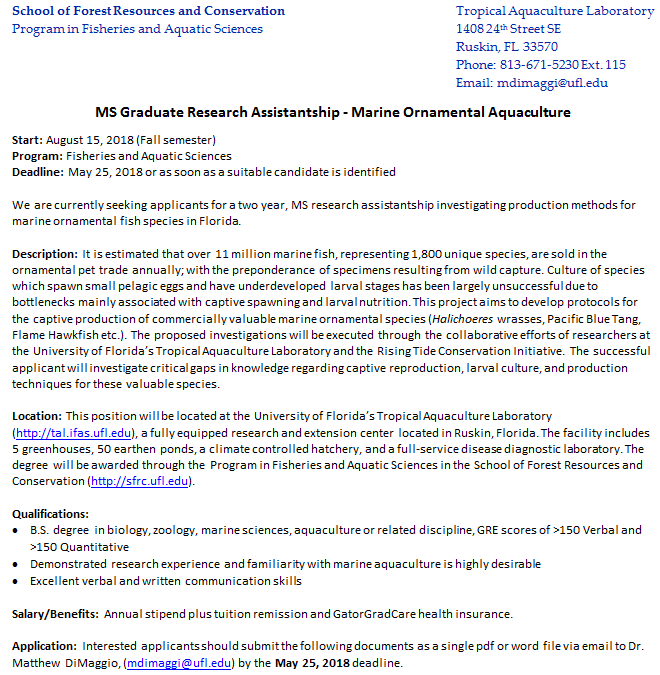
University of Florida Grad. student aquaculture oppty. 5/8/18
Breeding various fish 10/11/15 Aquaculture as a Career
9/19/14 Michigan Shrimp Farm – 02/20/13
Excess Fry, How To Sell - 11/05/2012 Re: Dither fish... breeding Convicts. (RMF, you may want to chip in here)<<Mmm,
no; you've done an admirable job>> – 07/27/12 Re: Rising Tide Update 12/1/11 Rising Tide Update
11/28/11 White eggs
7/11/11
What a great web site! In this case, Anabantoid
culture for profit 3/13/10 Spawning mops, making
3/6/10 Some questions, Cirrhilabrus nutr., Aquaculture of
marine ornamentals practices 1/13/10 Catfish fishery in Zimbabwe
11/13/09 Re: Catfish hatchery 11/15/09 Find out wholesale prices, Re: selling lvstk. to LFSs 12/30/08 Hi there! I've recently set up a tank of fancy guppies and they roll out a plethora of babies. The pet stores sell the adult fish for $2-3, so I think hmm...maybe I could start selling some to a local pet store every couple weeks to help pay off the cost of this hobby ;). <A good idea and a worthy project for sure... Providing better, local stock, reducing imports> The problem is, I can't view what wholesale prices are at any wholesale supplier websites I can find- evidently I must be a "business" to do this. Is there any way to view the prices local aquariums buy these fish for so I could know a fair price to offer per fish? Thanks, Nick <Mmm, it's likely better here for me to "cut to the chase" and make a statement re the "usual" sort of mark up for small (a dollar, more/less) aquatic livestock... It's generally marked up about 2-3 times... Triple crowning for somethings like guppies... so, If a store had them on offer for $3, they likely paid about $1... That being said, you might well do better to bargain for credit with the store in exchange for your stock... Something more like "half credit" toward what they sell them for. Does this make sense to you? Bob Fenner> Re: Find out wholesale prices 12/30/08 Dear Bob Fenner, <Yes Nick> Thanks- makes great sense! Really all I needed was a ballpark estimate to know how much to offer. -Nick <Ahh! Figured as much... Keep breeding!!! BobF> Swim Bladder in one day.. I think... Cichlid, Neotrop., Texas... env. dis. 12/17/08 Hi I am begging for help. <No need to beg; we're happy to help!> I have a 4 yr old Texas. <Texas cichlid, I presume?> She had babies about 8 months ago. She has killed the convict father, and tended to the babies herself. <She cross-bred with a Convict cichlid? Never heard of that before. Hope you didn't sell/give away the fry. Hybrid fish are a blight on the hobby, and while fine enough as your own pets, it's very unfair for a retailer to sell them to unsuspecting fishkeepers.> She started not eating about two weeks ago, and stayed away from them. <Broodcare in most cichlids does indeed weaken after a few weeks, though this varies.> A few picked on her, but she ran them away. I try to clean the tank a lot, due to messy babies. It has never been a problem. <It's almost always best to remove cichlid fry 2-3 weeks after hatching to their own tank for separate rearing. Because fry are very sensitive to water quality, they often stunt or otherwise do poorly when kept with the adults.> I unfortunately let the water level get low. After doing a partial clean, and refill, today I go see them, and she is swimming at the top, in a horrible U shape, Head down, and taking gasping air. <Almost certainly a reaction to a sudden change in water quality, water chemistry, or temperature. Texas cichlids need hard (10+ degrees dH), basic (pH 7.5) water around 25 C (77 F). If the pH had dropped between water changes, in particular because of insufficient carbonate hardness, then doing a big water change could have switched the pH from something acidic to something basic, putting a massive (and potentially lethal) stress on your cichlid. The only other thing that would do something similar is the introduction of some toxin; specifically, if the bucket had residues for something like bleach or detergent, that can cause severe reactions in your fish.> I moved her to small tank, fresh water, and Epsom salt. She doesn't swim anymore, unless disturbed, but still in a U shape, moving her fins rapidly but wont swim straight. <Moving fish in shock is rarely a good idea; much better to leave them to recover from the first shock rather than impose a second one on them.> I really don't want to lose my girl, I have always taken care of her the best I could. She is about 8" and healthy(i hope) the tank she was in is a 55gl, she has about 30 babies (still under 3in small) some smaller. <Please don't give away or sell those hybrid fry. It's one of the most irresponsible things any aquarist can do. If you can't house them yourself, then painlessly destroy them. I don't say this to be mean, but because of the "big picture" that sometimes gets lost when people get attached to animals as individuals.> Her new hospital tank is a ten gal, and Epsom salt with 82* water. How long should she take to heal, she wont eat anything, so i am really scared. <If she's going to recover from shock, then it may well take a couple of days before she's swimming right, and maybe even a week before she's ready to act normally around you and feed. Cichlids are among those fish that react badly to sudden changes. If the problem was poisoning, then performing repeated water changes to flush out toxins would help, but obviously the incoming water MUST have identical water chemistry and temperature to the outgoing water. I don't normally recommend freshwater aquarists use carbon for a variety of reasons, but if you suspect poisoning, then this is one those few situations where fresh carbon makes sense. As you know hopefully, carbon needs replacing every couple of weeks, so any old carbon in your filter will be doing precisely nothing useful.> Please help me..I love this fish <Good luck, Neale.> Re: Swim Bladder in one day..I think... (Euthanising hybrids, why it's necessary; RMF, feel free to comment) I must first say Thank you for the help you gave me. I now think that could have been what happened. She is still in the same condition as before, but now the color is much brighter, and she look a bit more relax, Thank for all your help. <Glad to hear it.> NOW, Yes the Texas and the Convict did mate, they were the only ones in the tank, for that four months. So yes these are hybrid babies. <Oh dear.> But really, you would purposely destroy (kill) a fish, that had no choice in what they were born from. <Yes. But before you condemn me for it, think logically for a moment. Single species fish are predictable in terms of size, temperament, breeding behaviour, likelihood of genetic diseases and abnormal growth patterns. Hybrids are none of these things Hybrids may be fine as youngsters, but they may be pre-disposed to problems as they mature, may exhibit reduced fertility, or may behave in aberrant ways compared with one or both of their parents.. By passing hybrids on to other aquarists, you also increase the chances of genes from species A getting into fish sold as species B. Someone buys species B, and then find it isn't doing any of the things it should be doing. It doesn't look like it should, and it's the wrong size, it can't breed normally. In many cases species cultivated by aquarists come from very specific places. This is common among the cichlid varieties from the Rift Valley lakes and Central America. These varieties are particular colour forms of species with distinctive genes. When "mixed" in aquaria that genetic uniqueness is lost. Is that a big deal? Yes, if you're a collector. But it's incredibly important if you're a scientist. Some of these varieties are endangered in the wild, a few even extinct. They only exist in captivity. Hybrids put additional stress on wild populations of fish as well. Sensible fishkeepers don't want to keep hybrids because of the problems mentioned above. Because so many hybrids are in pet stores, any serious fishkeepers demands wild-caught examples of many species prone to hybridisation. This means that instead of the trade building up supplies of captive-bred cichlids, there's still a huge industry collecting wild-caught fish, in some cases having a very real impact on the populations of wild fish. When aquarists allow them to hybridise or cross-breed, they're reducing the chances of keeping that species or variety from extinction. In every possible way, hybrids are bad. Hybrids are unpredictable, they're prone to problems, they make it impossible to set up balanced communities, and they increase the chances of wild fish going extinct. Hence as a broad comment, hybridisations is something aquarists should actively try to avoid. I'm an animal lover. I spend an hour or more per day volunteering at this web site to help people save the lives of their fish and reptiles. But I'm also a scientist and try to see the big picture.> I have read this type of article before, it had something to do , with breeders, losing money, Many fish from breeders are new breeds, cross bred, and a new species is born. Flowerhorn, is one to start with. <And pretty awful it is too. Nature has managed to come up with around 2000 cichlid species by herself, each one finely adapted to the environment it finds itself. There are plenty of different colours and behaviours, more than enough for everyone. And yet breeders in Asia thought they could out-do Nature and come up with something themselves. I suppose it's a question of taste, but to me the Flowerhorn is the fish equivalent of Pamela Anderson: silicone breasts, nose jobs, peroxide-blonde hair and tattoos all over the place. May be Hefner's thing, but certainly not mine. I'd sooner take the cichlids Nature has created, and do my best to learn about these wonderful fish on their own terms.> As far a fish stores, telling me they have no way of selling hybrids, people don't like them, so they wouldn't purchase them from me, but they would be willing to just take them off my hands for free. K-M-A... I was born in '69 not '99. <I'm assuming "KMA" is an insult. Fine. You may indeed keep your hybrid cichlids from breeding. But what about the other people? How long before they cross them with some other Convicts or Texas cichlids. And then, before you know it, there are messed up genes all over the place. And I'm here, having to answer questions from a person keeping what he or she thought was a Convict, but it's the wrong size, behaving in the wrong way, or getting deformed or sick for no apparent reason. What you're doing is selfish and irresponsible. You're doing what you think is acceptable by your personal standards, without considering the repercussions for everyone else, including the fish.> These are some of the most beautiful fish ever. They are big and colorful like the Texas, with black stripes like the convict..You can you tube some..but i haven't seen any as nice as these.. I am not a hobbyist, I just happen to have two fish, that had fry, so should I kill the fry, because of nature taking it's course? <Yes.> As a professional as you proclaim to be, I would think you would have some heart for the fish, that you spend much of your time learning, shame on you. <Why shame on me? My love for animals and for the hobby doesn't need your justification. I'm the guy spending an hour each day helping people. I think my wish to help animals have better lives is perfectly obvious. That I'm a scientist and fishkeeping writer as well simply means I'm looking at the situation from a wider angle than you are.> I would never kill anything, maybe you are someone that doesn't believe in mixed races also..what a shame. <Am mixed race, so your comment here is insulting as well as irrelevant. Humans are all one species, and certainly not one in any danger of extinction. Convicts and Texas cichlids are different species separated by millions of years of evolution, each adapted to different environments. With so many cichlids threatened with extinction in the wild, it's up to aquarists to help preserve them in captivity. Indeed, some are effectively extinct in the wild already, and the only ones on Earth exist in aquaria: species from Madagascar and Lake Victoria in particular.> I do thank you for helping me with my fish, but i also wished i had never come across your site.. <Look, as I said in the original message, I am genuinely not trying to be mean. But I do have a responsibility to everyone in the hobby and not just you. If you don't care about anyone else who might end up with your fish (or their descendants), and have no interest in the welfare of cichlid species, then that's not really something I can get my head around.> P.S. I do not sell these fish, I give them to close family, and the truth about them being hybrid. Plus they must give it back, if unable to care for it, just so they wont become fish food, for larger fish. They have a right to live just as anything else..Horrible, and shame on you... <I suggest you read some of what I've said about feeder fish and euthanasia for example. When it comes to senseless killing of fish, I'm absolutely against it. Much of what I write here is about keeping fish happier as well as healthier: bigger schools of tetras, livebearers with lots of females not just males, and so on. My record on animal cruelty is pretty clear. It's a shame you don't see that on those few times I recommend painlessly destroying fish (note the word "painlessly") it's not because I like killing fish. It's because there's a bigger picture here. If you're a vegan who has never harmed an animal in your life, then that's one thing; but if you eat meat and dairy, wear wool and leather, then you're already responsible for far more animal deaths than would be the case by euthanising some hybrid cichlids. The "right to life" you talk about is contextual; as a meat-eater and wool-wearer, I abhor animal suffering, but I accept that in some situations killing animals is necessary.> May Santa miss your chimney this year..for your evil thoughts... <Doesn't seem a very nice thing to say. Please look at the big picture; this isn't about cruelty to animals, but about responsibility and conservation.> Yes i know i am to old to believe in Santa, and 'no' he does not exist,. But it's snowing here, and i still have some holiday cheer...so...have a safe and pleasant holiday this year, okay I'll talk to Santa..you may have children.... <Well, okay. Cheers, Neale.> <<Mmm... the issue of producing, allowing hybridization between species in our care is important, and still (obviously) a bit controversial. For the reasons stated above in plain, simple terms, I am in agreement with Neale (Dr. Monks, he has a doctorate in Palaeontology (spelling in proper English)...). I too wish that we would choose to avoid this sort of "polluting"... as it is my concern that our planet is just too small, changing too quickly in ways that are damaging... self-defeating... to preserve the mix of genotypes/multiple allelism that is the overall biota of our world. Methinks that too much, too fast tinkering in allowing shifting of this mix is very dangerous indeed. I have several speculations as to probable ultimate outcomes from breaks in the "web of life" in a given biosphere... even world-wide... None are pleasant to contemplate. Mmm, lastly a further general statement re our choices, choosing as individuals... It has been my desire to impress on others how paramount it is to understand themselves, facts... science behind important decisions... Whether we have captive aquatic systems may seem minor compared with issues of our own "carbon footprint", ultimately whether we reproduce ourselves... But I assure you, the long- and- profound effecting actions of releasing non-indigenous species to habitats that they displace, affect other flora and fauna, and this question of mixing species that can, will possibly persist, go on to possibly genetically mix further, IS of extreme importance. I ask you as a fellow hobbyist, citizen and human of Earth to think carefully, to not engage in this practice. Bob Fenner>> Re: Swim Bladder in one day..I think... (Euthanising hybrids, why it's necessary; RMF, feel free to comment) 12/18/08 I was just going to send another e-mail, asking the Doctor to please excuse my language in my earlier reply. I in no way, personally meant to insult the Doctor, on his/her personal preference on the subject of mix race.. I too am of African/German heritage. I was completely out of line. <No harm done. Let's drop it, shall we?> I was am still stressing about my beloved Texas, She isn't doing any better, i can only pray that she does.<Cichlids do react badly, sometimes violently to sudden changes. Have done this myself once, when changing water, and accidentally adding freezing cold water from an outdoor rainwater butt into a dwarf cichlid tank. The fish went crazy, rolling onto their backs and turning black. They did all recover though. Keep the fish calm, ideally in a quiet, even dark, tank, and she should settle.> I may also assure you, that I am not in anyway, trying to inter breed any type of fish. They just happened to mate, they were in the same tank for three years, and then one day, there were babies. I still have them, because I don't want the fish store to pass them off as something else. They wouldn't buy them, but would take them for free, same story, different line... <OK, we agree on this. There's nothing wrong with hybridising fish for your own pleasure; it's when they get into the "food chain" so to speak, that things get messy. To be fair, many fish we keep as pets are likely hybrids already. Angelfish, Platies, Swordtails, Mollies, perhaps even Goldfish, to name a few. But these fish are normally sold as domesticated animals, and there's no risk of confusing them with wild-caught specimens because wild-caught examples of these are virtually absent from the trade. But cichlids are different, because we sell them not as domesticated fish but as true species, and so confusion between the "real thing" and a hybrid can cause problems.> Please let him/her know that the KMA is Kiss My Angel fish..I should have said that straight. <Good catch!> Still I under stand what you are saying, but even in the wild these things happen, so i would not understand, killing them because it happened in my tank. We all have our own reasons for things. But, to kill Gods creation, because of inter breeding, is not something i would consciously do. <That's fine. If you want to keep these fish at home and give them a good life, that's great. Giving them to people you know won't breed from them is also good. But please don't let them turn up in a pet store!> I do thank you other wise for the generous help your doctor gave me, to try and save my girl. <I'm a doctor of rocks, not animals. Not sure why Bob mentioned it, and it really isn't something that makes a difference here!> I thank you once more. Lori <Good luck, Neale.> <<Mmmm, I mention your scientific status for twofold reasons... that I'm impressed that a person of such academic caliber is willing to devote their time/efforts to help others in our hobby interest, and secondly, to bolster credence in your response (this IS the west after all). I would like to last make a comment re the supposed-safety of entrusting others with hybrids, or any matter outside of ones immediate control. This doesn't happen... no one has any recourse, knowledge of what might occur once this life is outside their systems... To make utterances otherwise belies a lack of veracity, knowledge or both. History is replete with examples of "animals, plants, algae, microbes... let go"... and their lessons/consequences. Lastly, the hypocrisy and lack of thought in ascribing to god/s our own actions/non-actions I find more than distasteful. I reject such assertions out of hand. We made these idols and make our own lives. That there is life, there is death... by "keeping" some, you doom others... Bob Fenner>> For Neale, please. Re: "pro-life view on fish hybridization" 12/18/08 Hi Neale, <Hello Nicole,> I hope this doesn't add to the spectacle, but I just thought I would say, once again: you have the patience of a saint! Your reply to the person who purported to have the "pro-life view on fish hybridization" was incredibly gracious, given that much of the message was personal bashing directed at you. <I prefer to view these things as simple miscommunications, and figure it helps if both sides try and state things a bit clearer next time around.> At least you were able to find a silver lining, and expound on the topic like the scholar that you are - informing many web denizens for years to come, surely. <Thank you.> I would like to reiterate the obvious: since fish are not able to be neutered or sterilized, if you are going to keep together species of fish that hybridize, and they breed (as is inevitable), the only sensible thing to do is to euthanize the fry or keep them yourself. Even giving them away to friends and family could be tricky, since a handful of hybrid fish containing males and females might well mate again and form yet another aberration! Giving them to the store who will accept, but not pay, for them - well, two words: feeder fish. <Unfortunately what you say is quite true, and an angle I'd not considered (feeder fish being virtually unknown in the UK). It is a disturbing though that any fish you give away to a pet store expecting to be re-homed could well end up becoming food for a piranha. That being so, painlessly destroying unwanted fry yourself is very definitely the humane option. It's also worth remembering not even one in a hundred cichlid fry survive to maturity in the wild; that's why most species produce hundreds of fry every couple of months, given the chance.> The "innocence" of the fish has nothing to do with the responsibility we have -- as their keepers in glass boxes -- to euthanize the fry. To ascribe innocence or guilt to a fish would be absurd. <From a theological perspective you are quite right; animals, being amoral, can be neither innocent nor sinners. To be honest though, I tend to work from a particularly good 'Calvin & Hobbes' cartoon where Hobbes makes the point that he doesn't *want* to be given human motives or behaviours, since he rather looks down on them. So why bring a decent, noble animal down to our level!> These fish simply cannot be sold, the same way a garden variety canine mutt cannot be sold at the pet store (only those designer hybrids like labradoodles and cockapoos, but that's another story - there's a fine line in there somewhere, certainly). <Variety dogs and cats are all within a single species, so though the parallel isn't precisely the same as humans (different "races" of humans don't equate to different breeds of dog) certainly all dogs are as closely related to one another in terms of genes as all the different humans on the planet are. That said, my dog breeding friends insist that there is much harm done in the dog world by careless breeding, not just in terms of unwanted mutts. But also things like German Shepherds cranked out on farms with genetic disorders, or "en vogue" puppies of various types mass produced with little interest in quality, just money.> Besides, if they bred once, they will likely breed again, and then what are you going to do with 40 more Texvict cichlids? I bet your friends and family will be less enthusiastic to receive them this time around! <No argument from me here.> Common livebearers are basically a lost cause, a "purebred platy" is an oxymoron. Malawi mutts are practically there, too...but now, this? <Again, no argument. As someone who loves telling people that African cichlids can be like coral reef fish in terms of colours, it's disheartening to see the same "mixed blue Africans" in the pet stores, again and again.> Keeping species of American cichlids from interbreeding is so preventable, and to say that these fish are desirable because of having such unique colors and shape is just unreal. Sir, that was born in '69 not '99 - who are you to be creating a new breed of fish? <In this case, it was a genuine accident, and while not something I'd personally want to see happen in everyone's aquarium, these things do happen. Like teenage pregnancies, there's a difference between what you might say in terms of public policy, and how you'd react when it was your own son or daughter involved. Not that I'm putting these things on an equal footing, I hasten to add! But simply as an analogy. As I said earlier this evening, there's nothing wrong with homing these fish yourself and enjoying them. But the main thing is that these fish aren't "turned loose" in the marketplace. If these fish did spawn again, this is one situation where removing the eggs and disposing of them would be entirely appropriate. Any catfish or loach of your choice should do the job for you, if you're squeamish!> Thanks for listening to my rant, in reply to the ranter. I personally hope that Neale finds lots of fish and telescope equipment in his stocking! <Hmm... wet fish flopping about in my underwear... sounds fun!> Wishing you all a very happy holiday, your friend in fish, Nicole <Thanks for writing, and have a merry Christmas yourself. Neale.> Re: Swim Bladder in one day..I think... (Euthanising hybrids, why it's necessary; RMF, feel free to comment) 12/19/08 Hi Bob, <Neale> I appreciate this, and thank you. But in all honesty, I doubt my (pretty minimal) scientific credentials matter much compared against the cumulative experience of the WWM crew generally. It's just a pleasure to be part of this team. Cheers, Neale <Ahh, my friend... in the final synthesis, we are indeed only whom we are, what we do... However, the benchmarks of our activity, credentialing is of note, use at times. As for myself, I am satisfied to have acted in my own best self interests, and have shared, am continuing to share with others. For their enjoyment, edification... BobF> Selling My Fish 11/11/08 Hi! My name is Bel. I am 15 and I love to raise Livebearers. I have 4 tanks: one 40 gallon, one 20 gallon, one 7 gallon, and one 1 gallon. I only have 4 neon tetras, and approximately 70 guppies, all raised by myself. I am at the risk of overpopulation and would like to sell some of them, but I am not sure how or where or to whom I should sell them. All the males and females are separated so I won't have more baby fry for now, but I love raising fish and would like to raise other Livebearers, but I'm afraid I'll have too many fish. I would love to keep all of them, but I already have more babies and I don't want inbreeding. All my guppies are from two fish, no inbreeding. All my fish are very happy and healthy. I'm scared that if I go to pet stores they won't buy my fish because I'm young and don't know a lot about breeding fish. And my female guppies are very plain and generic colored, like a sandy brown, so that might make it harder to sell them. But the males are very colorful. They have red tails with green sheen and black spots on their body. They also have some black and pink stripes. I don't think they are a specific type of guppy, I think they have a delta fin or a fan tail. They also don't look exactly like their parents. The males look like a mix of both parents. Here's a picture. Sorry if its a little blurry. Any advice on selling fish would be greatly appreciated! Thanks a million! Bel <Hello Bel. There's no perfect way to sell fish. You certainly can ask a retailer to take them from you, and often you'll get credit in return. I did this during the weekend with some livebearers that I'd bred, Limia nigrofasciata. Go to the shop first, tell them you have some fish, and see if they'll take them. Personally, I wouldn't sell them to a shop that trades in "feeder fish" or "feeder guppies" -- because your fish are essentially wild-type Guppies in colouration, it's possible some retailers might use them as fish food! Another way is to join a fish club. Fish clubs have auctions and you can also meet people who'll swap your fish for some of their fish. This is a great way to get hold of rare livebearers or particular strains of fancy livebearer. Or you could join a fish forum online: lots of these have a "buy, sell or swap" thread where people can trade fish. For what it's worth, I think your fish are nice, and I'm all in favor of wild-type Guppies. They're much hardier than fancy guppies, and make much better pets for use in community tanks. Cheers, Neale.> Peat moss to induce breeding? 10/6/08 Breeding, sel. FW species 8/18/08 hello everyone! <Hello! Hope you are having a great day! Merritt here today!> I just recently bought another tropical tank (which makes three) and I want to try and start breeding another breed of fish. I would prefer livebearers but I suppose that I could accomplish egg layers. <The best livebearer that comes to mind is killifish. I have seen some as colorful as Bettas.> I have been breeding Guppies since October and have been very successful. What breed of fish do you suggest for me? Bettas have crossed my mind but I don't have enough housing for them because the males need to be separated. <Do some research on the amount of work you would like to contribute to breeding before making a choice and I am only naming a handful of potential fish you could breed so don't limit your choices to these, they just happen to be some of my favorites. Some other types of livebearers that I have breed successfully are Mollies, Platys and Swordtails, they are in the same family as the Guppies so you should not have a problem. I have tried for many years to breed Bettas, but no such luck and I would not recommend them due to the amount of space they require. If you want to try some egg layers I would definitely recommend the killifishes due to their coloration. Here is a link so you can read up on the killifishes: http://www.wetwebmedia.com/ca/cav1i1/killies1Goldstein/killifishes.htm> Here is a short description of my tanks. Tank #1: Main Tank/ Bully /Show 29 gallon Tank #2: Baby Guppy tank 10 Gallon Tank#3: Guppy tank/ breeding tank 10 Gallon <Your system setup sounds perfect for the Mollies, Platys and Swordtails. -Thanks! <Hope you find a match!> _Sarah <Merritt A.> Don't know what I should do... Sel. FW fish species to breed 8/17/08 hello everyone! <Ave,> I just recently bought another tropical tank (which makes three) and I want to try and start breeding another breed of fish. I would prefer livebearers but I suppose that I could accomplish egg layers. I have been breeding Guppies since October and have been very successful. What breed of fish do you suggest for me? Bettas have crossed my mind but I don't have enough housing for them because the males need to be separated. <Before breeding any fish, ask yourself two questions: Firstly, what's your water chemistry? There's no point trying to breed something that needs water chemistry you can't supply. Secondly, are there limits on what juvenile fish you can give away/sell? A lot of fish shops won't accept "mixed" African cichlids or mongrel livebearers because they can't sell them. So if you're going to breed, say, Platies, you need to make sure you start with virgin females alongside males of the same breed so that you get consistent, sellable offspring.> Here is a short description of my tanks. Tank #1: Main Tank/ Bully /Show 29 gallon Tank #2: Baby Guppy tank 10 Gallon Tank#3: Guppy tank/ breeding tank 10 Gallon <A 10 gallon tank is fine for rearing livebearer or cichlid fry, but too small to house adult livebearers of the common types because the males are so aggressive and tend to harass the females. Even a 20 gallon tank will be too small for a male Molly or Swordtail who decides to throw his weight about (and most of them do). So reflect carefully on social behaviour before laying down the gold on a particular species of fish. If you live in hard water, you might consider something like shell-dwelling Neolamprologus, such as Neolamprologus brevis or N. multifasciatus. A colony of these (six or more specimens) could be housed very easily in a 29 gallon system. Fry could be removed and reared on separately, and selling these dwarf Tanganyikans shouldn't be difficult. If you're in a soft water area, then you could go with a group of dwarf cichlids, perhaps Apistogramma cacatuoides. Get one male and multiple females because Apistogramma are "harem" spawners. Alternatively, you could go with a pair of Laetacara curviceps or Pelvicachromis taeniatus. Again, selling surplus juveniles of these peaceful, colourful small cichlids shouldn't be difficult. If you want to do some unusual livebearer, I'd look at something like Dermogenys pusilla as an adaptable fish that's a bit more of a challenge than the usual livebearers. Being relatively uncommon in the trade, selling the juveniles isn't hard at all.> -Thanks! Sarah <Cheers, Neale.> Regarding mullet breeding -- 07/16/08 Respected Sir, I am Ph.D. student of aquaculture from India. I would like to know more information regarding induced breeding of mullet. If u have any information regarding this topic please help me by giving some latest paper and any article regarding the same. regards Gauri <Mmm, I worked on hormonal manipulation of Mugil cephalus for my Master's thesis... but many years back (the 70's)... I do have the bibliography from that time... in print, not electronic format... But I suspect you'd be better off generating a totally new one. If there are specific questions I might help you with, please write me. Bob Fenner>
Unexpected fish, FW Greetings to the Crew, <Tom> So, 6 weeks ago, I set up my 55 gallon quarantine tank to restock my 180 gal FW tank (previous one sprang a catastrophic leak). First, I kept a group of 8 giant Danios for 2 weeks, then moved them to another tank. Then, I moved a school of about 20 boesemanni rainbow fish into the quarantine tank for two weeks. Last, I kept a group of 6 Cory cats in the quarantine tank. As I was transferring the Cory cats, I saw very small (fry) fish in the quarantine tank. They don't look like baby catfish. Could they be boesemanni? <Yes... or possibly Danios> Surely they're not Danios, since I would assume the boesemanni would have eaten them during their two week stay. Or is it more likely that I picked up some fish eggs from the LFS during my purchase of the Cory cats? <Mmm, not near as likely> Or perhaps fish eggs came with the boesemanni (I ordered them from Foster and Smith.) <Also unlikely. Were the boesemanni of size? Reproductive size?> I am feeding them finely crushed fish flakes for now. What are your thoughts on what I likely have? There are about a dozen of the tiny fish. tom <I say... bonus! Enjoy them. Bob Fenner> Fish Repro... 12/31/07 Hi, I have a quick question for you guys. Can fishes still spawn even if they aren't kept in groups? Do all fish spawn? And last, how often do fishes spawn? <What? Mmm, no... all fishes do not spawn... that is, shed their gametes directly into the environment... See an ichthyology text re piscine reproduction. Bob Fenner>
Keeping Fry Tank Clean -- 09/10/07 Hello, I want to commend you guys on your wonderful website. I am a relative newcomer to the hobby (6 months), recently I noticed that my pair of Zebra Danios were ready to spawn. I separated them into a spare 5 gallon tank and when they spawned I replaced them into the main tank. The eggs hatched and I have around 20 fry. I have a sponge filter running and on advice from my LFS I added two snails unsure what type), however I am still having difficulty keeping the water clear. I do regular water changes and 1-2 days afterward the water is cloudy again. Can you please help me out here? Thanks, David <Hello David. Congratulations on your new babies! No idea why you were recommended to put snails into the breeding tank, but they shouldn't do any harm. Anyway, if the water is cloudy, you may be overfeeding the baby fish. Feed multiple small amounts rather than one or two big meals. Typically, 4-6 meals is considered about right for the first few weeks. Siphon out any uneaten food. A turkey baster is a very useful tool for this because you can pipette out detritus very easily without sucking up baby fish. But any similar device, like a syringe or pipette, will work well. You also need to do regular water changes; 50% every couple of days would be appropriate. Any basic filter should work fine for keeping the ammonia levels low. Hope this helps, Neale> Please help me for higher study - 7/23/07 Dear sir, Hope you are well. I am Nahid Akter from Bangladesh. Now I am serving as a Lecturer in the Department of Aquaculture, Hajee Mohammad Danesh Science and Technology University , Dinajpur , Bangladesh . Before Joining here as Lecturer, I have completed my Master of Science (MS) Degree from the Department of Aquaculture, Bangladesh Agricultural University, Mymensingh, Bangladesh. During my MS study, I have to conduct a research work and submitted a thesis entitled as 'Study on Health Condition of Freshwater Eels of Ailee Beel, Mymensingh' to the department of Aquaculture. My research work includes Investigation on health conditions of two freshwater eels, Monopterus cuchia and Macrognathus aculeatus of Ailee beel, Mymensingh district through clinical and histopathological observation. Moreover I have also studied the histopahtological study of other six (Puntius sophore, Nandus nandus, Heteropneustes fossilis, Channa punctatus and Mastacembelus pancalus ) small indigenous species. I think I am able to study any kind of fisheries related field. Thus I wish to do advance research in my related field. Please sir select me as your student. No more today. Wish your sound health. Keep in touch. Sincerely your's Nahid Akter <How is it that I/we may be of assistance? Bob Fenner> Re: Please help me for higher study, FW aquaculture 7/26/07 Dear sir, Hope you are well. Thanks for your mail but unfortunately I can't understand your mail. Most probably the message is flagged. So it is very helpful for me if you send me again the mail. Request to you please please help me. For your kind information here I have attached my CV so please see it and consider me as your PhD student. I am waiting for your mail. <Are you looking for a work or scholarly position with us? We are an all volunteer organization helping people, companies in ornamental aquatics via the Net. We do not do aquaculture, nor are we an accredited learning institution. Bob Fenner> Again thanks and best regards. Sincerely Mst. Nahid Akter Lecturer Dept. of Aquaculture Faculty of Fisheries HSTU, Dinajpur-5200, Bangladesh. Otocinclus <maybe Danio> fry, fdg. 6/30/07 About a week ago, maybe less, I had my husband remove a few plants that weren't looking so hot from one of our aquariums. He thought something along the lines of putting them in a bucket and seeing if they would look any better (It couldn't hurt) <Ahh... a good friend grows such plants almost year-round outdoors here in San Diego... spectacular results> So they were outside in a bucket...some morning sun, nothing too harsh. Tonight he was going to put the plants back in the tank and dump the bucket... being always worried about Cyanobacteria and such I bent down and peered real good at them, and noticed a tiny movement. We have some incredibly tiny fry. I have never seen any fry this small... the only breeding fish I have are angels and guppies I guess. But the tank these plants came from had: angels, serpae tetras, Columbian tetras, neon tetras, zebra danios, Otocinclus cats and a pair of Cory cats. <I see...> After looking at someone's video of fry, it looks like they may be Oto fry... very very tiny, almost invisible from the side. So they are in the hospital tank now, along with the plants from the bucket and in the water that was in the bucket... we had heavy rains today and the bucket overflowed. We have about 20 fry left. What should I try to feed them. <"Infusoria" would be ideal... see the Net re... But a pre-made commercial food prep. is the only thing practical here. See the Net, your LFS re such... "tube food"...> I thought of rotifers since they are tinier than baby brine shrimp, but if they are otos it would seem that wouldn't work at all. I also have a package of Hikari first bites that is as fine as talcum powder and contains many things, among them Spirulina, milt meal, along with some krill meal and such. <The liquid "tube food"... egg-yolk based...> I'd hate to see them die, especially after the miracle of even seeing them to begin with. Any ideas? If I put a hulled pea in there would they nibble on that? The plants have a little algae on them as well but the fry are so darned tiny... Julie <Might be the Danios otherwise... Oh, and congrats! Bob Fenner> Reproduction of fish in 10 G tank 6/6/07 I have a question about reproduction in my ten gallon tank. I have 2 Sunset Fire Wag Platies, 3 Red Eye Tetras, 2 Black Neon Tetras, and 1 Golden Algae Eater. Is it possible for the different types to reproduce together? <No.> I have also noticed that one of the platies is getting "chubby" and has a darkening belly. I am not sure what gender the fish are. <Possibly a pregnant female. As pregnancy goes on, the developing embryos are pushed against the body wall, darkening it in places. This dark patch is the "gravid spot". Female platies have triangular anal fins, whereas male platies have crooked anal fins bent over into a structure used to inject sperm into the female. So sexing them is usually easy. On top of that, males are generally smaller than females, though this isn't obvious if you have fish of different ages.> One of the Red Eye Tetras is fatter than the others. <Female tetras tend to be bigger and more rounded.> P.S.- The "chubby" platy has been getting slower and sometimes stays at the bottom of the tank. It doesn't go up for food very much when I feed them. Is there a way to check if my fish are pregnant? <No way to check as such, but as the female swells up her condition should be apparent. If you have boys and girls in the one tank, you can almost guarantee the females will be pregnant.> How large would the fry be? <Around 10 mm when born. Think about the size of a live brine shrimp, and you have a good idea of the size.> Would they be eaten? <In your 10 gallon tank? Yes. Please read over some of the articles here to find out how to avoid this. See: http://www.wetwebmedia.com/FWSubWebIndex/livebearers.htm , http://www.wetwebmedia.com/FWSubWebIndex/poeciliids.htm , &c.> Can a Black Neon Tetra Reproduce with a Red eye Tetra? <No.> -Josh <-Neale> Mullet culture, fingerlings source 3/19/07 Dear Sir: I am Maryam Jorjani and am working Golestan Fisheries Research Center in Iran. we are researching about propagation and larviculture Mugil cephalus. now we do not have this fish and we need to provide fry / fingerling. do you know person that help us? Thanks a lot .and I am waiting for your reply Maryam Golestan Fisheries Research Center Gorgan Iran Tel:+981712222601 Fax:+981712240290 <Pleased to meet you. I did work on this Mullet species' aquaculture years back... but I don't know where you can commercially purchase young. According to fishbase.org: http://fishbase.sinica.edu.tw/tools/aquamaps/receive.php M. cephalus range extends into the lower Persian Gulf... Could you collect it from there? (the young are easily seined in shallow water where found. Bob Fenner> Do you have detailed filtration set up for farm near to the sea ? Thanks and appreciate 1/3/07 <Mmm, for all the physical, mechanical aspects? No... Can you state specifically or at least more definitively what you're looking for...? What species you hope to culture... extensive vs. intensive? How big an enterprise... Do you need to supply your own electricity? Bob Fenner> "Believe nothing, no matter where you read it, or who said it, no matter if I have said it, unless it agrees with your own reason and your own common sense." -- Buddha (563BC-483BC) <Good spiel> Small rearing tanks... 11/27/06 Hey I was thinking of getting a 5 gallon tank to put baby fish in and I had 2 questions. One is about how many fry can <I> fit in one 5 gallon, and what kind of filtering and heating would be best for a 5 gallon tank? <Hey Tommy, JustinN here with you today. A 5 gallon tank would work for fry, depending on how diligent you are with water quality maintenance, and how large you wish to let them grow to. The number that would fit in the tank would be dependent on the species of fish you're wishing to breed. As far as filtration, a colonized sponge filter and a 25 watt heater should be sufficient. Hope this helps you! -JustinN> What to Breed? - 10/21/2006 Dear Crew, My precocious pre-teen daughter bred a pair of store-bought Bettas two years ago and successfully nurtured the fry with micro-worms and nauplii. She wants to raise another brood of fish fry next summer. My guidance to her is to breed fish that the local fish store (LFS) would be glad to accept. This way, the LFS can find good homes for them and we would not have to discard the fry. We are considering show quality Bettas from select breeders, and rarities, such as the Peacock Gudgeon (Tateurndina ocellicaudus), from New Guinea but we are running out of fish selection ideas. Do you have any recommendations for a freshwater fish that can immediately generate demand for its rare beauty? We are experienced with advanced husbandry practices for both freshwater and reef aquaria but wish to stick with relatively small (1 to 2") freshwater fish. We have built freshwater systems using Diana Walstad's ecological practices and currently maintain a marine reef system with natural nitrate reduction. Thanks very much, Paul. <Well you just happened to get a Pleco breeder to answer your question, so I'm too sure our ideas of beauty will match! But I like your idea of breeding the Peacock's. Or along that line, maybe Desert Gobies. Both are short lived fish, breed them or loose them. A good live bearer to work with would be Endler's. If you want to try breeding Plecos, try Albino Bristlenose. Easy to breed and there is always a market! If you want a Plec that is a little more fancy, and expensive, any of the species in the genus Hypancistrus will sell. Don> A Request: re the Myriad of influences on (et al.) breeding, hatching, rearing of FW fishes 7/18/06 Sir, I am a research fellow working in induced breading of some freshwater fishes. I have found your article in the internet-"Captive Production of Ornamental Marine Fishes: An Overview". The work, It seems necessarily a nice one. But sir, I doubt if there are so many physical and chemical parameters determining the spawning and later the survival of the hatch out larvae. <Indeed, there are several... as in the Middle English meaning of the word: "many"... some demonstrably more important than others...> My doubt is Sir, if this is the case, whether there is a chance to have any significant relation between the photoperiod and the hatching success of eggs? <Yes... a matter of science...> I mean Sir, after spawning and before hatching whether there is any effect of the photoperiodism on the development of the eggs Sir, your answer to this question will be very beneficial to me and I request you Sir to have a serious look upon this and reply me as soon as possible Thanking you Sir, Binesh. CP <Time to have a visit at the college library... Search BIOSIS, the Zoological Records... with the terms "Photoperiod", "Breeding", "Freshwater fishes", "Effects". Bob Fenner> Link/partnership issue ... prawn aquaculture in the Middle East - 05/22/2006 Hello, I have found your website http://wetwebmedia.com/ when searching the web on the topics related to my website theme. I must say your site content is very good and I think we would benefit much from possible partnership - for example link exchange. This would bring more targeted traffic to our sites, plus increase our websites' weight at the search engines, as they give greater value to the links from the topic-related sites rather than irrelevant backlinks. My website http://www.robian.com.sa/ is definitely related to yours. I would be glad to link to your site in return to you linking back to mine. Feel free to email me direct to XXXX@robian.com.sa to discuss the details on the possible partnership. Hope for the fruitful cooperation, Best regards, Yawar Nawaz, http://www.robian.com.sa/ <Our content and reader-base is almost entirely pet-fish/ornamental oriented... Not aquatic source protein generation. How would this link benefit our intended audience? Bob Fenner> Seaweed culture 8/31/05 Bob I was going thru ORA's website on how they culture seaweeds. What do they mean when they say they use "An air-generated method of tumbling the algae in large vats is employed to culture them." <Air bubbles, from pressurized air, are released in a circular (torus) fashion on the bottom of circular tanks, lifting water and the algae and turning it "donut fashion" in the water... gives all exposure to light, moves nutrients about. BobF> http://www.orafarm.com/algae.html regards Perry Fish Breeding Business... you've come to the right crewmember I have been searching all over trying to get information about starting a wholesale freshwater fish breeding business. Could you direct me to where I might locate some information? You seem to have all the answers. Thanks for a very informative site! >>Stacy, Not sure what species you are planning on breeding. Because of the costs involved few species are worth breeding for a profit in North America. The thing to start with is to identify what species you want to breed, and check to see if you can produce them at a competitive price. You will compete with places that have free heat and very cheap labour, mostly in Asia. So it is not easy. Some larger cities have a good market for locally raised angelfish, but unless you are able to produce large numbers and sell for cheap it may cost too much to heat the place and provide food and labour for your "product". Good Luck, Oliver Info on Growing Coral for Reef Restoration Hi, I am looking for information about growing coral in labs to have it eventually transplanted back on the ocean for reef recovery? Do you know where I can find information about this? <Mmm, there are plenty of such schemes, folks involved in such plans, only a few actually doing something re. Walt Smith is one of these latter> Do you have anyone on your website in the academic community that may know about reef restoration? <Mmm, likely Anthony Calfo is a good place to ask here> Thank you for your help. ~Melody White <Will Bcc both in hopes they will contact you. Bob Fenner> << See Google search here. Look for CORL (Coalition Of Reef Lovers), a non-prof. organization that supplies areas in need with concrete "cages" upon which to grow corals. They use coral plugs from the area, not lab-grown specimens. Also, ArtificialReefs.org, makes "reefballs". The AMDA is another avenue of exploration. Marina >> Researchers Reveal Infectious Impact of Salmon Farms on Wild Salmon A Dietician's Discussion Thank you for the information posted related to this topic. I forwarded it to my daughter, who is very involved with sea life and environmental issues, and below is her response, which I forward for the benefit of those interested in the topic. I have left her name and email address as well as website URL for anyone wishing to search further into the subject or make direct contact. Digna Cassens, MHA, RD http://groups.msn.com/RDForum >>Thank you for forwarding this research to me, I will be posting in tomorrow's "Dailies" on WetWebMedia. This is already a well-known problem, not JUST with aquaculture of salmonids, but in many other areas of aquaculture where wild stocks and farmed animals have an opportunity to mix. This would include the farm-raising of shrimp and other coastal species. It should also be noted that wild stocks are breeding with "feral" stocks, escapees, which is leading to other problems. These include change in growth and breeding rates, as well as longevity in the wild. All should know that, along with feed designed to improve color (visual appeal), such facilities often treat with antibiotics prophylactically (as well as to treat secondary infection due to parasitic infection) - this of course leads to many organisms becoming resistant to such, as well as "downstream" consumption - ingestion by humans. Folks should be aware that treatment of parasitic organisms is necessarily harsh/toxic. This may include the use of copper containing treatments. Ivermectin, typically an antiparasitic seen for the treatment of internal parasites in horses, is also being used. Sea lice are only one organism that is problematic, Cryptocaryon irritans is another problematic (protozoan) parasite. The salmon farming industry has fought long and hard to prevent studies that are harmful to their livelihoods, this would include the following. The debate is contentious indeed. Marina Harding<< Public release date: 29-Mar-2005 http://www.eurekalert.org/pub_releases/2005-03/s-rrt032405.php Contact: Jessica Brown <jbrown@seaweb.org > Researchers reveal the infectious impact of salmon farms on wild salmon Increase in sea lice infections of wild juvenile salmon are potentially deadly and extend for 30 km beyond farm. A new study published in the March 30th edition of the prestigious scientific journal Proceedings of the Royal Society B (a publication of the UK's national academy of science) shows that the transfer of parasitic sea lice from salmon farms to wild salmon populations is much larger and more extensive than previously believed. This quantitative analysis of parasite transfer is a scientific milestone in a contentious debate. It is the first to isolate and measure the impact of a fish farm on sea lice outbreaks in wild salmon. The study combined new field techniques that allowed comprehensive, individual observations of over 5,500 young wild pink and chum salmon over 60 km of migration route; an enormous data set from months of laborious fieldwork; and state of the art models of disease transfer. "Our research shows that the impact of a single farm is far reaching," says lead author Marty Krkosek. "Sea lice production from the farm we studied was four orders of magnitude - 30,000 times - higher than natural. These lice then spread out around the farm. Infection of wild juvenile salmon was 73 times higher than ambient levels near the farm and exceeded ambient levels for 30 kilometers of the wild migration route." This increase in sea lice abundance is likely to be damaging for already dwindling wild salmon populations in British Columbia, where the study took place. In Europe, transfer of parasites is generally accepted as a significant threat to adjacent wild populations - although European studies have not measured the direct transfer of sea lice from farms to wild salmon. However, a bitter debate continues in British Columbia and the Pacific Northwest as to whether salmon farms are contributing to sea lice infections of wild salmon at all. "Parasites are a key negative side effect of fish farms on the local fish stocks," says Andrew Dobson, an epidemiologist from Princeton University who researches infectious diseases in wildlife. "We're seeing similar effects in Scotland, Norway, and Ireland; in each area parasite amplification on fish farms seems to increase disease levels in the local fish community. However previous studies have not shown nor quantified the direct transmission. This study captures the chain of events." "Part of the contentious debate about sea lice is that there hasn't been this level of precision in the sampling and modeling," says coauthor Mark Lewis, a mathematical ecologist from the University of Alberta known for his work on West Nile virus and invasive species. "We have worked out the spatial footprint - the data are strong and show that the farms are having a significant impact over a very large area." The researchers isolated the effect of the salmon farm by studying the infection levels of migrating juvenile pink and chum salmon as they approached and passed a salmon farm. Within the study area, the salmon farms are anchored in a long thin fjord. Here the wild salmon have no choice but to pass by the farm on their seaward migration. The scientists developed new, non-lethal sampling techniques that allowed them to examine thousands of the fish for parasites, taking measurements every 2 to 4 km. The fish start in the rivers and head to sea, traveling en masse in large mixed schools. Thus the scientists could see the effect on the salmon as they moved toward the farm. They found that the juvenile salmon carried almost no sea lice prior to the farm but became heavily infected as they approached it. Unlike other species, pink and chum salmon leave their natal rivers while still much smaller than your baby finger - 3 cm long - and weighing only half a gram. "The youngest fish can be only days old when they encounter a farm," says Krkosek. "Some of these fish are so young their egg sacks haven't been fully absorbed - even fish this small are infected." The anchored farms, open cages of closely packed salmon, are aquatic feedlots providing the ideal conditions for the breeding and spread of sea lice amongst the adult fish. For the migrating wild salmon, the farm is a concentrated point source of infectious lice larvae. "We found lice levels exceeded what we would find normally, extending for 30 km - even though the farm is only about 0.2 km long," says John Volpe, the third coauthor from the University of Victoria. "Conservatively this means that the parasite footprint of the farm is 150 times larger than the farm itself." Sea lice can lower the fitness of salmon - and in some cases be lethal - as they create open lesions on the surface of the fish that compromises a fish's ability to maintain its salt-water balance. When infection rates are high enough, the parasites feed on the fish at rates greater than the fish can feed itself, literally eating the fish alive. Adult salmon can survive sea lice infection, but young salmon are much more vulnerable due to their small size. Under natural conditions, juvenile pinks and chum do not typically have to contend with sea lice because the adult salmon are far out at sea and are widely dispersed. By the time the migrating pinks and chum normally encounter lice, the juveniles have had the time to put on body mass and build resistance. The location of the farm near the natal rivers undermines this natural coping strategy. The field study also discovered a new cause for alarm: once the young salmon pass the farm and pick up the sea lice, the migrating school becomes a moving cloud of contagions. Sea lice larvae mature and reproduce on the seaward salmon with each louse producing 300-800 eggs. This second round of lice larvae can re-infect the fish in the school and can spread to other previously unexposed populations coming from geographically disparate regions. "At about the 30 km mark from the farm, those lice become reproductive," says Volpe. "In effect, the farm has exported its lice generating properties - a cyclical event establishing the potential for re-infections up and down the coast. As the abundance of lice increases, we are now realizing that lice will attack other species, not only salmon, but other fish such as herring which are the spark plugs of the entire ecosystems - everything depends on them - from salmon to whales to seabirds. Every commercially important fish is either directly or indirectly dependent on herring." "Previous studies have been dismissed by industry, but past studies haven't looked at such large samples or the spatial aspect," says fisheries biologist Ransom Myers of the University of Dalhousie. "This study goes far beyond a theoretical model. They tested the model in the real world, using an enormous data set, and saw the same patterns. It is a very thorough analysis." "We've tried to be very careful and conservative - but there is potential for a major impact on the survivorship of the migrating salmon," says Lewis. "The next step is to thoroughly investigate the degree of impact on wild populations," adds Krkosek. The authors concur that their findings point to a need to reconsider the premise of industrial scale fish farming in wild salmon habits. "There's a double bottom line here. The full ecological costs of industrial scale salmon farming must be quantified as well as the economic ones," says Volpe. "For the migratory runs we studied, there may be very little time left." Additional information and visuals will be available at www.math.ualberta.ca/~mlewis/SeaLice/npSeaLicePub.htm Using WWM Hi Bob, Last time I asked you a question I meant to ask how do you know if a white skirt tetra is carrying eggs can you help me thanks!! Louis E <Please read here: http://www.wetwebmedia.com/FWSubWebIndex/characiformfaqs1.htm Bob Fenner> A Good Question - Culling fry humanely When breeding goldfish and getting your spawn, what is the most humane way to cull the deformed or inadequate goldfish fry? Regards, M <To place them in a bag with little water, freeze them. Bob Fenner> Looking for Bass Fry I have searched internet and run across your website. I am emailing you and ask for your help because we think you are an expert in fishery or you have some contacts with those people who are in fishery We are looking for the larvae/fry of Green Grouper ( Epinephelus coioides or Estuary Cod ) with a large quantity for our fish farm in Philippines. We need : 200,000 larvae and fry per month ( for Fry, the size 1 cm or less than 1 cm is the best, the size 1.5 - 2 cm is OK ) If you can supply or help us to buy these quantities, please contact us at : azfish04@yahoo.com Thanks in advance Dean <Dean we don't "do" aquaculture, but would check through the World Aquaculture Society membership here. http://www.was.org/main Bob Fenner> FW shrimp cultivation Dear Bob, Can shrimps be cultivated in fresh waters - like farm dams where we raise tilapia (breams) fish? Best regards, Chileshe Mutale <Mmm, some species, yes... are polycultured thus. Bob Fenner> Eggs in Tank Hi. I have a 75 gallon freshwater tank. Perfect water. I have some Gourami, Pleco, Cory cats, Neons, Danios, moors, etc. Not very many. <OK, but I'd lose the goldfish (moor). They need cooler water than the others and are large waste producers> The tank has been set up for about 5 months. I recently went to PetSmart and purchased Neons. I went against my better judgment and bought them despite seeing an outbreak of snails in their tanks. <Not always a bad thing> Two days later, in my tank, I have groups of small white egg looking things, about the size of a pencil lead, probably 10-12 groups mostly on back of tank. <Cool> My two largest Gouramis have been pretty aggressive lately, <Natural, especially in males> but not causing damage. Are these eggs from the Gouramis, <No, they make a bubble nest at the surface> or could they be snail eggs? <Maybe, but don't sound like it. Common "pond" snails lay eggs in a jelly-like mass> No other changes in the tank, water same, filtration same. Help??? <I think your Corys are doing the nasty. A sign of your fine care. Congrats! I doubt you will get any hatching in this tank though. All your fish, except the moor, will eat the eggs. Even the parents. I would be surprised if the Pleco did not eat them all tonight. Not a bad thing at all. Don> Thanks Robyn Re: Eggs in Tank Thanks for such a quick response. I won't worry at all. I'll just keep watch. So far, it's been 4 days and they are still there. <Wow, you may get some to hatch then> I do feed the fish enough food, three times a day, so maybe they aren't that hungry or they haven't noticed them yet. Thanks again. Robyn <Oh, I'm sure they've noticed them. They just don't recognize them as food and aren't hungry enough to experiment. Any that do hatch will have a fair chance of survival. Not many fish that will take on those sharp stiff fins. Feeding could be a problem, but maybe not in your well (over) fed tank. I would hold off on cleaning the gravel for a little while. And that's the last time you will ever here me give that advice! Don> Greenhouse aquaculture 9/20/04 Hi Anthony, it was a real pleasure to get your reply. Your propagation book has been an inspiration to me. <ah, thanks kindly... very good to hear it> I am really looking forward to a greenhouse. I'm in the early planning stages- I'm going to take you up on your kind offer and will submit plans at some point for your thoughts, after the tour of Tropicorium and others- <I will help any/every way I can> One question- why would you want to heat the room rather than the water? <good question... always the air. You'll never see a productive/profitable fish room/GH run by heating the water... waaaay too expensive. Heat the air, and the tanks/water act like heat sinks. Very stable> It isn't that electricity is more expensive than natural gas? <depends on where you live... varies wildly all over the country. I have seen electricity from 4 cents to over 30 cents per kw hour> I would think that heating a large volume to bring the water up to temp would be very inefficient-I suppose the cost of 10k watt water heaters for each 240 gallon sized receptacle would be prohibitive compared to inexpensive warehouse-type heaters? <it is most always best to simply use a hanging furnace to heat the room/air. You see these everywhere in industrial applications. There's a reason for it <G>> Thanks for your help, Anthony- Charles<always welcome.. best of luck/Life. Anthony> Breeding Puffer with convicts? 8/18/04 Hi <Hi, Pufferpunk here> I was wondering if you could breed a Convict Cichlid with a Puffer fish? <About as easily as breeding a cat & a dog. Just won't work.> Also I was wondering if you could breed green Severums with Convict cichlids. <There has been success interbreeding different species of cichlids together, but I highly doubt you'd have much success with it.> Please email me back with the answer Thank you. <Instead of concerning yourself with breeding, why not try & study up as much as you can about the fish you have & do the best you can to keep them alive, healthy & long-lived? ~PP> Breeding Fish in the Home Aquarium Thank you Chuck!! Your information has helped me decide on three fish which I want to breed.<Hi, MikeD here today> The three are the Dwarf Gourami, Egyptian Mouthbrooder, and Zebra Danio. Now that I've said it, how would I go about pairing up each type of fish for breeding<With the exception of the Dwarf Gouramis, the other two are usually bred in larger groups, with a male and several females for the Egyptian Mouthbrooder and the reverse for Zebra Danios. And how do I tell the sexes apart.<Sexing adult fish of all three species is easy, with larger flowing fins and much more pronounced color being true of the males in all three cases. With both the gouramis and the cichlids, the females are often almost silver> After I obtain one or two pairs of fish what should the breeding tank look like and what should it contain<I suspect that you may have misunderstood Chuck in relation to the tank, as each species is easily bred in a 10 gal. tank, but it has to be a separate tank set up for just that purpose, for each species that you wish to breed>. I specially would like to know what type of filter is best for breeding tanks, are they sponge filters<By far the best, as they actually encourage the development of rotifers, an excellent first food for all three types of fish> or undergravel? You don't necessarily have to give all this info yourself maybe give me a couple helpful links. <I tried but we're experiencing technical difficulties today and each time I tried to attach a link the entire post was lost. Using either the Google here or your regular browser, entering "Breeding Egyptian MouthbrOOders", "spawning Zebra Danios" and "Spawning the Dwarf Gourami" should bring you back several easy to understand posting on the subject(s) Thank you for any more info you give me! Thanks again.<You are very welcome> Yours Truly, David Powell Freshwater breeding Hi, this is a great site its really help me a lot. I am fairly new to aquariums (besides bettas in 1 1/2 gal. bowls) and I have been through a lot of stuff in my first more or less six months. But now I think I've got a pretty good understanding of things and my tank has been doing great. And eventually I would like to try and start breeding fish, could you recommend any fish that don't require a lot of space (10 gal. at most) are easy to breed, and easy to raise the fry? I know it sounds kind of specific but I want to start out as slow as possible to avoid any more fish disasters. < Look at small live bearers such as guppies and platies. They give birth to live fry and you won't have to worry about eggs hatching. Just keep lots of floating plants in the tank for the babies to hide in. They will eat the same food as the adults you just have to break it up into smaller pieces. Keep the adults well fed are they will eat their babies.-Chuck> Thanks a lot, Mike Why do they eat their fry Hi I've been wondering why fish eat their own children is it because they don't get enough food or is it just because that's just how they are? < Most fish just spawn and scatter their eggs or release their fry and take no parental responsibilities for them. In the wild they are too busy surviving on there own so they see everything edible as food. Some fish like cichlids do take extra care of their eggs and fry by taking care of them for awhile.> I haven't got my fish yet but im getting Dalmatian mollies. I got a 10 gallon tank. Also do they really need salt in there tank? If they do can you just put regular salt in it or do you have to buy the salt mixture? < Rock salt is fine. They tend to do better with a little salt in the water. It helps build up a slime that helps fight diseases.-Chuck> Im very very curious! Thanks Brittany Lee Aquatic green house 4/30/04 I am building a green house in southern Mo. and had a few questions. What plastic will I need to optimize growth. <growth of what my friend... freshwater plants, pond fishes, marine corals?> This is all I am getting from the greenhouse sources because I am a welder and work in the air handling industry. <hmmm... do know that most plastic coverings for greenhouses inhibit most/all UV and that is not desirable for aquatics (some UV needed for corals in particular). The less expensive plastics with t he shortest lifespan are generally the best for our use as they admit the most UV (which you can finesse through the year/seasons with shade cloth)> Also I was thinking of using 60 gallon water barrels (the blue ones) and shaving off one vertical side and tops and plastic welding these together make a 8' long 2' wide 2' deep vat. <this sounds like reinventing the wheel... there are many cheap water holding products if you look around. Agricultural feed troughs, fiberglass liners, etc.> Also would you keep 24 vats on one system or 2? <No idea what you are growing here... cannot say. In general though... keep your tanks species specific. This likely means having more vats unless you will specialize in one species/family/group farmed> I have found a few used protein skimmer skids here and there on the net. thanks. Steve Schultz <have you seen/heard of my Book of Coral Propagation? it is 450 pages about coral farming... in greenhouses. Do consider. Anthony Calfo> Suggestion for your fantastic website. Hi Robert, kamusta kayo? <Well my friend, thank you. Buddha casts his shadow amongst us with your caring words> What a fantastic website, an aquarist dream, it just like an Aladdin's cave of information. I couldn't speak more highly about this website. <High praise indeed> I would like to make a suggestion and I hope it would make this website even more complete for a fish lover like myself. I would like to see one more topic on AQUACULTURE, perhaps in between Aquatic Business and Aquatic Science. <Yes, the best placement> Although my hobby is aquarium, aquaculture play a very important role in my formative years. Now I live in Australia but I grew up in Indonesia where aquaculture play a very important roles to improve the peoples diet particularly in the rural area as a provider of animal protein. My parent have two big fish pond (so my neighbors) where we grow a table fish, mainly MUJAIR (Tilapia mozambica), Tawes or Java Barb (Puntius javanicus) and of course Giant Gourami for that special occasion. <Ah, yes> I remembered we went to the market every 4 or 6 months to buy fingerlings from the fish merchant. I also remembered the farmer stock the rice field with Tilapia and Cat Fish (Clarias batrachus) during the flooding stage of rice growing and harvest the fish just before the dry stage of the rice growing. It's a bonus income for the rice farmers. <I see> I believe Aquaculture would play a more and more significant role as a food source, particularly in the developing countries. <More and more every year, yes> When I have more time in my hand, perhaps in the future, I would like to build a fish pond for an intensive aquaculture. I hope I could find the information that I need in your fantastic website. <And I hope you will be able to take a more active role in the production of the content therein> Once again thank you very much for a fantastic and informative website. Salamat Po, Cheers, Bintoro <Sama sama, Bob Fenner> HEY BOB (breeding peacocks German reds (Hormonal Manipulation ) Hey bob <Herrn Glen> my name is glen I am just start out a breeding set up for Aul. German Reds . <Very nice fish/ Kaiserfische!> I have 14 females 4" and 2 full sized full colored males , and some hap ahli + hap moorii to get started. I want to sell the local pet shops as the pet shops we have here don't have top quality fish . pet shop's here mainly have pond raised fish witch are deformed and VERY ugly (like lelupies that are brown and no longer yellow) . <Should be destroyed IMO> all the fish I bought were F1 's and very nicely colored . ok now that u know what my set up is here is my question . these Hormonal Manipulation you speak of will induce breeding right ? how do I get some ? and is it a good idea to give these shots to AUL PEACOCKS? I don't want to make deformed fish or discolored off spring . I have 3 females holding eggs at the moment and I have only had the fish for 2 weeks . please give your input on this thanks for your time bob.... Glen Chenoweth <It's unnecessary and not-advised to use injection/hormonal manipulation with these fishes. Aulonocara's are easily bred with just regular maintenance of a breeding colony (a male, few females) in a large enough system, regular good feeding, maintenance. If yours are not spawning as yet, I would look into adding protein to their diet, possibly elevating temperature. Please do look into books (in German, and English) on this group of fishes. There are some excellent accounts of their captive care including breeding. Bob Fenner> Marine water treatment, fish farm in Bali Hi Bob, <Hello Charles> I have read your news forum daily and I must say you are simple amazing like a walking dictionary in aquaria industry. Thanks for enlightening those like us who's still figuring out bits and pieces of aquaculture knowledge. I have indeed gained a lot by just reading your aquaria news in the forum. Hope to meet you one day. <Me too> I'm currently running a marine fish farm and would like to know any affordable and effective ways to sterilize my system water. Currently I'm using 2 UV light tubings for 15,000 litre of water in my holding however one aquarist told me to get commercial grade with multiple UV tubings in order to be effective. But getting commercial grade UV light tubings prove to be very expensive. How abt ozonizer for 15,000 litres of water? <Could be done... seek out the larger Sander's (made in Germany) units. If you have room, storing the water in the dark for a week or two, possibly bleaching it (with commercial concentration sodium hypochlorite) THEN dechlorinating it (likely with thiosulfate) are options as well> I have tried submerging LR in fiber glass but in less than a week most of them were dead. DO they need strong sunlight or constant lightings? <More needed are good protein skimming, water changes when water quality slides greatly> What other condition do they need in order to survive? Is it possible to put my posting in more obvious spot as I'm desperate in finding serious business partner for my uncle Ong Kian Huat in re-activating his existing Bali farm? <Where do you suggest?> It's such a waste that this farm with 100 tanks sit lying there untouched whereas many new investors were trying to start from scratch. <Agreed. Got to have aquariums, space> Sorry to email you so many questions as finally I have found a guru which can satisfy all my curiosities in aquaria matters :-) Pls advise. Thank you. Cheers, Stephen <Keep on planning, searching, contemplating your possibilities. Bob Fenner> Methylene Blue, Formalin effects dear Bob! would you please let me know the answer of my following questions: 1- it is mentioned that "Methylene blue" that is a common chemical for disinfection of fish egg, also has another function ,so that increase the animal pole of the egg's this correct? <Yes, a "side-effect"> if is, why the development of animal region of egg is important? <To enhance development> 2- also, in some reference we read about the use of Formalin (for disinfecting the culture media) for example 12 or 24 hours before introducing the fish or rotifer in the culture). what is the reason? <To reduce the likelihood of microbial, protozoal competition, disease> does Formalin loss its effect after these times .doesn't it have any danger for cultured organisms after this time. <Indeed it does. Depending on many circumstances, BOD, temperature... there might well be sufficient residue to kill all. I would rinse the containers thoroughly before using. Bob Fenner> regards Reza Oxygen bleaching agent--Sodium percarbonate manufacturer Dear
Sir I have your name and address from internet. I take the
liberty to write to you and see if we can establish business
relationship with you. We, Wuxi Wanli Chemical Co.,Ltd , ISO9001
certificated company, is a special manufacturer
of sodium percarbonate ,this material is also named as solid
hydrogen peroxide, it is an addition of sodium carbonate and hydrogen
peroxide, but easier to use than hydrogen peroxide, has the functions
of powerful cleaning, bleaching, stain removal, deodorizing and
disinfecting capabilities, meanwhile it
is environment friendly , Now it has been widely
used in detergents, oxygen generating agent, water treatment ,dye,
textile, pulp and paper processing, pharmaceutical industries . We own
superior facilities and advanced technology and enriched experience, so
we can provide most favorite price and reliable quality and delivery. I
hope you will have interesting in our product and establish long
business relationship in the near future. For more
information about us, pls visit http://www.wlchem.com We are looking
forward to have the pleasure of hearing from you soon. Shirley Yu Wuxi
Wanli Chemical Co.,Ltd Tel:86-510-2696999 Fax:86-510-2695999 Email:
wlchem@wlchem.com
Mystery Eggs Wow I have 6 eggs. I have them in a small fish tank with a heat lamp the temp is between 80 and 90 I mist it about 3 times a ay to keep some moisture there. The eggs are in peat moss that I got at the pet store. I'm doing what they said but I just want to make sure I'm doing this right and how long are they pregnant for before they lay there eggs <Nowhere in this email or subject line have you mentioned what kind of eggs you have. -Steven Pro> Paper details Hallo Bob Fenner, I am a postgraduate student of fish physiology, with a lot of interest in hormonal manipulation of fish reproduction. I downloaded your paper: "(A Review of the Literature on) Hormonal Manipulation of Fishes As an Aquaculture Technique", from the web. For correct citation/quotation, could you please send to me the details of this publication, i.e. correct names of author(s), year of publication, journal/book title, volume & serial number, and the page numbers. Please send also the bibliography. <Yikes... the Author is me, the date Spring 1977, this was a "position paper" done for a Hormonal Aspects of Behavior class in college. Considering the datedness, are you still interested in the bibliography? If so, I do have a copy I can mail you. Bob Fenner> Thanks Dorothy Ogony Department of Zoology University of Nairobi P. O. Box 30197 00100 GPO Nairobi, KENYA Pregnant fish? Hi, <<Hello...>> I was wondering if you could help me. How would I know if my fish is pregnant. All of the sudden its stomach got big and the others in the pack look the same as they did before. Please help. Thanks in advance. <<What type of fish is it? Cheers, J -- >> Young Fish Hobbyist Hey I'm 13.... and I need to ask you a question. I want to get some fish and breed them. I want to breed mollies. Right now, I have two female mollies and two males and I want to know how long it will take. thanks a lot Tyler <It should just be a matter of months given the proper environment. Take a look here http://www.wetwebmedia.com/FWSubWebIndex/poecillidfaqs.htm for additional Q&A's on the subject. -Steven Pro> |
|

|
Features: |
|
| Featured Sponsors: |