|
FAQs About Red Ear Slider Turtles 2
Related Articles: The Care
and Keeping of the Red Eared Slider, Trachemys scripta elegans by
Darrel Barton, Red Ear Sliders, Turtles, Amphibians, Red
Eared Slider Care, Shell Rot in
Turtles,
Related FAQs: RESliders 1,
RESliders 3,
RESliders 4, RESliders 5,
Red Eared Slider
Identification, RES Behavior,
RES Compatibility, RES Selection, RES
Systems, RES Feeding, RES Disease, RES
Reproduction, Turtles in General: Turtles, Turtle
Identification, Turtle
Behavior, Turtle
Compatibility, Turtle
Selection, Turtle Systems,
Turtle Feeding, Turtle Disease, Turtle Disease 2, Shell Rot, Turtle Reproduction, Amphibians, Other
Reptiles,
|
|
Re: Email #2 - Offer to help organize RES/Turtle
FAQ's... and note to fix Google search on "Ask" page
1/21/10
Hi Bob,
<Sue>
Regarding my offer to help that Darrel passed along to you, and to your
question about my thoughtsÂ….
First I want to say that you have a wonderful website, provide a great
service and I'm glad I found you guys! 2nd is I hope you're
treating Darrel well; he's very knowledgeable, informative and
entertaining!
<Heeee! I "treat" all people the same, but he is a
treasure>
3rd is Wow, you receive a ton of FAQs!! I noticed
a few things on the Turtle FAQs while going
through them before emailing the crew with my questions:
· There are many varied topics stored under very general
categories like Sliders 1, Sliders 2, Turtles 1 and 2, etc., rather
than under the applicable topic.
<Yes... and their "organization" is an ongoing, unfolding
effort>
· Other categories that are more specific like
RES Systemsï are still very
encompassing topics that cover a wide range of sub-topics.
· Some of the emails themselves (unfortunately a couple
of my own earlier ones as well!) were not confined to a single topic,
but often had multiple topics within them. This forced you guys to
either have to choose the most representative category to store the
email in � and/or store the same email in more
than one category, resulting in having a lot of information that's
unrelated to the category its stored in.
<Yes... this is almost all my work... and a mixed source of
amusement, consternation and enlightenment>
I realize its not critical if a given FAQ is not under the
�technically correct� heading
since you have the word search feature, but still it might make it more
convenient and expeditious for someone who might want to go to one
given category to have all of the related FAQs
listed together in one spot.
<Mmm, yes... and having put this site up in the mid 90's,
knowing "the fields" fairly well, designing the "sub
FAQs" categories as I have, you can very well appreciate the
intention to (over time) add "articles" to head each>
So 4th is that I'd be happy to offer to whatever help I can (if
you'd like to have any help) on any of the above! Some of my
thoughts as to how I could help with the organization of the Turtle
FAQ�s (wouldn't even know where to begin with
the other ones!) �
· Redistribute FAQs currently
located in the very broad categories (such as under Sliders 1 and 2
FAQs, RES Diseases, etc.) to one of the other
more specific categories.
<Good>
· Add subtopics under some of the very encompassing
topics like RES Systems 1 and 2 similar to what was done for Turtle
Systems 1 and 2. For example under RES Systems, create subtopics such
as Basking Area Options, Lighting & Heating Requirements, Water
Filtration & Heating Questions, Turtle Enclosures/Sizes (and maybe
under this even Indoor vs. Outdoor), Accessory
Items/Decorations for Habitat, etc.
<Very good>
· Unless you feel original questions should be archived
using the
exact words:
§ Parse out the
multi-topicï emails and
redistribute the topics within them to the appropriate categories where
they belong.
§ Rather than having so many questions essentially asking
the same thing, instead consolidate each group of repeat/commonly asked
questions under a single paraphrased one, and put the various answers
below them (hopefully the way I worded this is clear!), AND/OR leave
the original questions and answers intact and instead
Possibly create a list of the most
commonly asked FAQs at the
very top of each of the different topic sections that contain
paraphrased questions and answers � this might
help people more quickly get the answers to at least the most commonly
asked questions instead of having to read through all of the individual
FAQs sorted only by date, many of which overlap
each other and contain extraneous information (such as some of
mine!)
<This last is my preference>
Also FYI one thing I noticed on the �About Asking the WWM Crew a
Question page
· The Google Search for the WWM website under Direction
#1 doesn't work at least it doesn't for
me.
<Have just checked... Will fix!>
It just takes me to a blank page no matter what words I type in the
search field. I later found the alternative Home Page search field
mentioned under the �Tip�
link further down in the directions (which does work for me), but just
thought you should be aware that there may be a problem with the search
feature that's under Direction #1. If it turns out that its not
working for others as well, they may not think or know to check
�Tips� or go to the Home Page
� and possibly not bother trying to find an
alternative way to search the FAQs before
submitting an email question to you! Also, as an aside, the
�HOME� page link is a very
dark color and doesn't stand out very well at least on my
computer.
Anyway, if you'd like any help with any of the above, or as Darrel
put it, any of the other cut
work!, I'd be happy to provide whatever help
I can to further your very nice cause! Just let me know what would be
of most help. (Again, only turtle scut work, wouldn't have a clue
what to do with the other FAQs!!)
Kind regards,
Sue
<How to proceed here Sue...? Would you go through the present
archives, make up the pages as you deem worthy, and send them to me to
post? BobF>
Re: Email #2 - Offer to help organize RES/Turtle FAQ's
1/22/10
Hi Bob...Sue
<Howdy>
I'd be happy to try and take a stab at it .. are MS Word (2002)
files ok for you to open and copy from?
<Yes>
How about I start by just trying to re-categorize some of the
FAQ�s first and pass that by you?
<Sounds good>
Then if you think that all looks good, I could then look over the
emailed Q&A's for each of the main topics and try and draft up
a paraphrased list of the most commonly asked questions for each of
them .. though I may want to pass the drafts by Darrel and Neale first
to make sure I paraphrased the answers correctly. Sound OK?
<Very good>
If so, I'll get started .. can I clarify a couple of things with
you first though? - -
What would you prefer I do if I come across emails in Sliders 1, 2,
etc. that contain more than one topic question? (Â…i.e.
Should I copy it to the most representative topic, or to each of the
topics it represents, or would you rather I separate out the different
topic questions from the email?)
<Mmm, maybe... a good approach would be to somehow summarize the
contents... See an example here:
http://wetwebmedia.com/FWSubWebIndex/GFenvirondis.htm
Do you think this approach worthwhile?>
Also, if I happen to come across any generic email headings (i.e. such
as �Slider Questions�), do
you want me to keep the original heading intact or change it to reflect
the content of the question?
<Better to amend, re-state under that which the orig. was sent...
Lest I/others not be able to match up any further corr.. BobF>
Re: Email #2 - Offer to help organize RES/Turtle
FAQ's
Wow, you're fast!!! I like your idea; thanks for providing an
example!
Will be in touch...have a great (and hopefully sunny and dry!!)
weekend!
Sue
<Thank you Sue... getting a bunch done indoors for sure! Cheers,
BobF>
Re: Help with Turtle FAQ's 2/1/2010
Hi Darrel (a.k.a. Turtle
Czar!),
Here's my small contribution (attached) for
�WWM Appreciation Week�! The
message sent yesterday by another reader supporting WWM crew was well
deserved. I echo his sentiments for all of you and for the lives of the
animals you are trying to protect!
I've started reorganizing the turtle topics Â… Can I
get your (Right TM) :)
hee hee! � feedback on what I've done first
before I start copying the FAQ�s over to new topic
names? Since you seem to be THE main �go
to� guy right now for all of the turtle questions,
I figured I'd email you first.
Do you also want me to send this to Neale or Bob as well for their
input?
RE: the 1st file (see �Sample Topic
Links� above): For each of the 3 main categories
there are now (Turtles, Turtle Health/Disease, and Reproduction), I
created two main �sub�
categories of �Aquatic� vs.
�Terrestrial� turtles because
in general these two groups of turtles seem to (at least from what
I've seen on some of the FAQ�s) have
completely different needs all the way around no matter what the topic.
Do separate categories for them make sense to you? What about for the
�Turtle Health/Disease� and
�Turtle Reproduction�
categories � should they also be divided between
�Aquatic� and
�Terrestrial�?
Then underneath each of those two subcategories, I came up with a
starting list of topic
�links� after reading through
some of the FAQ�s. They're all based on type
of concern since I thought that might be what most people would likely
seek out first. For Health, I tried to gear the name more toward the
type of symptom than the disorder. There could be more added along the
way depending on what FAQ�s I come across, but how
do the topic names look to you so far? Are there any that you think
should be renamed, added, etc.? Especially for the
�Turtle Health/Disease�
category?
Then each of these topic links could take you to a separate page
containing FAQ�s for that topic. I put together a
sample of what one of those pages might look like for the
Feeding/Nutrition topic (See �Sample Topic
Page� above). Underneath the Topic Heading/Name
would be further links to specific species for that particular topic.
The species links could either take you to its own separate page, or to
a separate section of the page for the given topic. The sample I did
showed the latter option.
A related question to this, though, is whether many of the
FAQ�s should really be placed under a specific
species or not? For example, there are many FAQ�s
that specifically ask what to feed RES turtles, but which I assume
could also apply to other aquatic turtles (see the
FAQ�s for RES Feeding on the sample page I put
together as just a couple of examples).
Where do you think I should be putting those types of
FAQ�s … i.e. under
�RES� species or under
�Aquatic Turtles� in a
general link? Or both?
And please let me know if you have a completely different idea of how
you think the topics should be organized! You're the expert, so Ill
go with whatever you think will work best since I'm sure by now you
have a definite feel for the types of FAQ�s you
are getting!
One last question � I know that emails for
�crew@mail.webwebmedia.com
are intended for your FAQ reference library is this the best place for
me to be emailing you these types of more
administrative
questions?
Thanks, Darrel!
Sue
Re: Help with Turtle FAQ's
Sue, thank you so
much. Am sharing with our resident cheloniologists, Darrel and Neale,
for their input/response.
Cheers, BobF
RE: Help with Turtle FAQ's
Wow, you're up early on a Sunday morning! Thanks Bob, I'll wait
to hear from them. Kind regards, Sue
<Heeee. O'hi'o! Up baking Ziti for 150 hasher friends...
Good morrow! BobF>
Red Eared Slider, gen. 1/9/2010
Hello
<Hiya right back! - Darrel here>
I've just come across this site through a few others whilst looking
for help for my Red Eared Slider.
<Fortunate for you!>
I've grown really attached to him and his filter helps me sleep at
night so I would like to find out how to help him and fast to be honest
because I don't want him to die or get seriously ill.
<OK>
First question, what filter would you recommended using? Because at the
moment, me and my boyfriend know that we are using the wrong filter but
we are unsure of what filter is best to have. Some people have told us
Fluval and others have said Eheim and now we just don't know what
to do.
<I only use filters for water circulation, Louise. Unlike fish,
turtles produce so much waste that it's usually foolish to try to
get a biological filter going. Primarily you keep their water clean by
changing it regularly. As long as it circulates the water and keeps in
pretty clear, it doesn't matter which one to use. If you didn't
have one and were buying one, I'd go for an external canister
filter sized for the aquarium the turtle is in. What I mean by that is
this: if you have a 55 gallon tank used for a turtle, that tank is less
than HALF as full of water as it would be for fish '¦ so if
you buy a filter appropriate for a 55 gallon fish tank, it's more
than good enough for a turtle tank. The other thing I look for
'¦ is what kind of filters my local fish store carries,
because it's frustrating when you need a replacement part for your
Fluval and you find that all the stores in your area carry Eheim
parts.>
Second question, I think our Red Eared Slider might have a Respiratory
Infection or something. He has no mucus or anything around his eyes,
they are perfectly fine, the same as his nose as well. But this
morning, I noticed that what looked as if he was yawning but it seemed
more of him opening his mouth to catch something. He did this about
twice, normally it's just a one of thing. No bubbles were released
while he did this under water, he hasn't done it above the
water.
<So far, sounds OK>
Also, I seem to hear like a click noise or something. Do they make any
sound? Because my boyfriend thinks that I'm hearing things but it
sounds as if he clicks, again he does this rarely as well. He basks on
his island that we have for him,
<Your boyfriend basks on an island????>
but he prefers to bask when were out the room (which is most of the
day) or when we are watching TV etc when we can't see/watch him -
I've read that this is normal for Red Eared Sliders (?).
<The clicking sound is common, as is the yawning behavior. If
there's nothing else wrong, then don't worry>
He is still eating his food and he even swims backwards and forwards
looking excited and lifts his head out the water when we go to feed
him. We feed him - King British Turtle & Terrapin complete food,
King British Tubifex natural food and some bloodworms (these foods
aren't given all at the same time by the way either).
<Good. I raise my sliders from hatchlings to breeding adults on a
stable diet of Koi pellets. It's completely balanced for them.
Repto-min is another trusted brand, identical to Koi pellets - just at
a much higher cost>
And he's still swimming etc, so he is acting pretty normal to me
apart from at night when we turn his light off, it takes him forever to
go to sleep or sometimes if I fall asleep before he settles, I seem to
think he's had no sleep at all (but that just might be me
worrying). Sometimes he's up about 4-6 hours after I've gone to
bed and I can hear him banging around in the tank.
<This is all normal behavior for a Turtle '¦ but kinda
weird for a boyfriend>
So is there any sign of a slight Respiratory Infection?
<not so far>
Because as I said above, I really don't want the cute thing to get
ill and right now me and my boyfriend are pretty low on cash as well
but if he has to see a vet then we're willing to dig into our
pockets to get him to one but I'd rather use that as a last resort
to be really honest with you, why I asked on here to make sure and to
find out some advice.
<no trip to the vet right now!>
Thank you and I'm so sorry if I have confused you or not made any
sense anywhere, it's really difficult trying to explain what's
going on with him.
<You did very well, Louise! I enjoyed reading about the turtle and
to make a joke or two about your boyfriend as well.>
<Your turtle seems fine, so relax a little. Then read this care
sheet. It covers all the basics of turtle care. There are many fine
resources out there on slider care, and some may even disagree with
what's in this sheet. It's important for you to know that if
any information disagrees with this care sheet, they're wrong and
the sheet is right!>
<As long as you keep him well fed, well lighted and his tank CLEAN,
you should be fine.>
< http://www.wetwebmedia.com/FWSubWebIndex/RESCareBarton.htm>
Red eared slider questions... diet, sys., the universe! --
01/03/10
Hi Darryl...What a GREAT service you guys provide!!
<We do it because we like to help. And for the free food>
Unfortunately the only vet we had in our area who specialized in
exotics recently retired so it's a very valuable resource that you
provide! Thank you so much for your very informative response and
hilarious one as well!
<Bob Fenner says that I'm 'funny' but he doesn't
smile when he says it, usually he's shaking his head
'¦.. hmmmmm><<Hey, where IS that free food?
RMF>>
I very much enjoyed your humor (are all of you professional writers as
well?!)
<I've been described as an unprofessional writer>
Always good to end the day with a few good laughs, especially after one
week off with 2 kids! I hate to confess but I take better care of our
turtle than MY kids also!! (though haven't caved to Pop Tarts, soda
or potato chips just yet :-) ).
Thanks for the insight about changing turtle's home. I actually
thought he would welcome more space! Got an A+ in HUMAN psychology in
college, but guess I have a ways to go before figuring out the inner
psyche of a turtle!
<Don't ever let a turtle near your ATM card -- they have NO
impulse control>
Thank you also for your other ideas; will try them out! Wasn't
sure, though, about a couple of them you mentioned - hope you don't
mind answering a couple of more questions! Again, thanks so much for
taking the time to read all this...
* Re: nocturnal light - Would it be better to not have this? We put
this in not for a night light, but to keep the air temp inside his
aquarium warm during the night. We keep the regular room air on the
cool side - 68 degrees, so air temp quickly drops in his aquarium if no
source of heat is provided.
<True, but the outside air temp in most of his natural range drops
below 68 at night for 80% of year as well. What we want here is a light
and heat cycle that falls into his natural zone. That said, I'm not
sure it HURTS, either. Take it out and see what happens>
We chose black because it seemed to emit the least light. The red bulb
seemed overly bright.
<And Red Lights have that whole Honky-Tonk 'I'm the cheap
kind of turtle you don't take home to Mama: kind of feel, too. With
a black light, the worst that happens is that the turtle grows up very
laid back, with an almost unnatural affinity for 'stairway to
heaven' or 'in a gadda da vida'>
* I also assume that this black reptile bulb is NOT the same as the
dangerous black light??
<Yes. Black light is UV-A (long wave) UV-C is germicidal (very short
wave)>
* Re: live food - you mentioned not feeding live food but said you
feed earthworms.
<Right -- what I meant was trying to duplicate what appears to be
live food within their environment as if they'll hunt their own.
Live food that occurs within that system is not really that much of
their diet yet are often heavy with bugs and parasites that are bad for
them -- very much like my ex wife's cooking>
<Earthworms are not carriers of pathogens that are harmful too them.
Just a bit on the fatty side, which is why I use them as occasional
treats>
Do you feed these live or cut them up first?
<Saute' in garlic with finely chopped parsley and
cilantro>
<NO!!! Just one live one, usually on the basking area>
* Re: aquarium heater: You mentioned removing the heater in the water
if we have one. Yes we do have one, and put it in the aquarium back
when we got him because we read that young turtles should have a water
temperature of around 80 degrees.
<Again, they'd never see 80 degree water in their range unless
some backwoods redneck in Georgia was cooking him for dinner. 68 degree
water is just fine as long as he has a basking area that's in the
mid to upper 80's>
It's a black (not glass) thermometer, good quality one with
protective sheath. I know if we remove it, the water temp. will drop
quite a bit. Is a lower water temp ok for young turtles, and would it
outweigh the potential risk of our thermometer causing a micro-leak of
electrical energy?
<yeah -- we want to offer a range and let him choose>
Thanks so much Darryl, and HAPPY NEW YEAR!!!!
<yer Welcome!>
<[EDITOR'S NOTE: On behalf of Wet Web Media and all the rest of
the crew, we would like to take this opportunity to apologize to
Comedians, Professional Writers, Psychologists, Honky-Tonks, Jimmy Page
& Robert Plant from Led Zeppelin, Doug Ingle/Iron Butterfly,
Ex-wives in general, Rednecks, the State of Georgia (except for East
Dublin) and of course, to you, the reader. Sigh -- we were all hoping
that the meds would have kicked in by now]>
Sudden over activity and decreased appetite
12/31/09
Hi,
<Hiya -- Darrel here tonight>
Please help!!
<OK>
We rescued a baby red-eared slider from our backyard this past July. We
found him under a pile of leaves and surrounded by tall cement walls on
our lower patio. He would have likely died if we hadn't found him.
We took him to a local nature preserve who told us he was not native to
our area and that we shouldn't release him into our nearby
pond.
We purchased a 20 gallon tank with basking platform, Reptisun 5.0 UVB
fluorescent tube light, Zoo Med reptile blue day bulb 100 watts and
Zilla nocturnal black light 75 watts.
<Nocturnal light not necessary. In the wild, what they get at night
is -- dark!>
We also purchased a Fluval 405 filter. Water quality and clarity has
been great. Temp of water is 79.5. Up to this time turtle has preferred
a basking temperature in the range of 88 -- 90 degrees.
<Sounds good>
Once a day in the morning we feed him Zoo Med Aquatic Turtle food and
Sera Reptil Carnivor food, as well as fresh daily red leaf lettuce,
collard greens and mustard greens. We add a pinch of Rep-Cal Calcium
with Vit D3 to his food each morning and twice a week also add a pinch
of Reptimineral H.
<Wow -- you take better care of him than I take of my kids!>
<I feed mine Kay-Tee brand Koi pellets and twice a month, one
earthworm a piece.>
A few weeks ago we also put in about 10 ghost shrimp.
<Excuse me '¦'¦.>
<I'm a... let you finish '¦.>
<But I want to be VERY CLEAR HERE '¦.. >
<I feed my TURTLES the Koi pellets and earthworms, NOT my kids! The
kids eat McDonalds and Domino's, Pop Tarts and potato chips, Coke,
Spaghetti O's, Top Ramen and well, just about anything else you can
imagine two kids eating when they descend on my house like a pack of
locust.>
<OK, please continue'¦.>
We haven't actually seen him eat any, but right now only 2 are
left.
<Not really part of their natural diet, either. I urge people to
refrain from trying to feed turtles any kind of live food>
So far he hasn't gone much for any of the greens but has enjoyed
the other food.
<None of the greens you mention are part of his natural diet,
either. They trend toward green vegetables more as they get older.
While young, they are more carnivorous, opportunistic eaters
'¦ hmm '¦ again, just like my kids>
He's been doing great up to this point. His appetite has been good,
and he routinely basks for several hours each day. A couple of weeks
ago, we noticed he started cutting his basking time short and was
becoming more active than usual, with a focus on climbing the walls to
try to get out. He hadn't done this since the first few days we
found him back in July. Since he's also tripled his size since then
(carapace now about 3 1/2 " long), we
thought maybe it's because he's getting older and bigger. A few
days ago, we decided to try to fill his aquarium up to the top to
double his swimming area, and made a larger basking platform area above
his tank. However, this change seems to have only caused the problem to
become worse. Now he is focusing his complete attention on trying to
escape and is not basking at all. He would literally be begging for
food in the morning, but now over the last two days he's shown
almost no interest in food. He'll take only a
couple of bites of food in the morning then swim away. We're
completely stumped at this point as to why he's behaving so
suddenly and dramatically different. We feel part of it is due to us
expanding his environment; however as I noted earlier he'd also
been showing signs of changed behavior before we expanded it - in fact
this is what prompted us to try and change it.
<I understand. They're behavior is, at times, inexplicable, but
what you describe is very often caused by stress. Has anything else
changed? Day/night lighting in the room? Heaters or air conditioners
can cause vibrations that you and I can barely hear but can be
literally assaulting his senses. Do you have a heater in the water? If
so, remove it. And anything else that could cause a micro-leak of
electrical energy>
<You were right to look at environmental causes, but before changing
something that he clearly understood as 'home' and
'secure' it's best to look outside the immediate
surroundings and look at the bigger picture.>
Other than his changed behavior, everything else still seems fine. Skin
and shell look good, no drainage from eyes or ears, no mouth breathing.
Do you have any idea why his activity level and appetite might have
suddenly changed, especially when this first started a couple of weeks
ago when he was still in his original environment? Thanks in advance
for whatever your thoughts might be!!
<My first thought is that Koi pellets and earthworms might be
healthier for my kids than the junk they're eating now
'¦. But let me shake that off and get back to you
'¦.>
<Deeper water is 'nice' but I don't think turtles
appreciate it as much as humans think they do. It's always better
to give them AREA than depth. That said, in addition to checking for
outside influences, cover the sides of the aquarium to slightly above
water level '¦. See if limiting his visibility changes
behavior.>
<Sue, this is a guessing game. It doesn't sound like an illness
or a problem with a capital 'P' at this point, it just seems
like he's a little stressed and all you can do is change things one
at a time until you see an effect on his behavior>
Sue G. 12-29-09
RES... gen. care -- 11/09/2009
Hey this is Sonal (I'm from India(Mumbai)..)
<Good Morning. Darrel from California!>
I'm a new owner of a Red Eared Slider .. Its been only 2 days I
have brought it home.. it must be about a month or one & a half.
there are a lot many questions I want to ask. First I would like to
tell you everything in detail, so that you know what exactly happened
in 2 days..
<OK>
I kept it in the fish tank, I specially got for it, initially it went
inside its shell, but then started moving around. I gave him turtle
food sticks(which he did not eat) .Till then everything was alright.
After that it stopped moving, just kept floating. I saw some skin
around his neck and limbs peeling off. It did not even open his.. So I
took it out in a bowl, filled some water in it.. It did swim in it. But
next day morning, when I saw it, it wasn't moving at all. I asked
the shop-keeper, he said it wont eat for a day or 2 or behave this way
till it gets himself adjusted. I waited for hours, but its still not
moving.. not even moving his limbs, nothing at all.. His skin is
peeling off.. I have kept it in warm place..
<First, the skin peeling is not the most important issue. He could
be shedding or he may have a fungus, but we deal with that
later>
So, the actual problem is-its not moving, not eating(since 2 days), his
skin is peeling off..
<This is concerning to me. I must first ask if you are sure he is
still alive. Do you see his eyes move and see him breathing?>
<I am sending you a link below to an article on how to care for a
turtle that is ill. The most important thing is to get him out of the
water and keep him warm and dry. Just 5 minutes a day in a very shallow
bowl, just
enough to come up to the bottom of his neck, so that he can drink, poop
and maybe eat -- but other than, keep him warm and dry. Make sure he
gets UV light from a UV lamp or the sun (all that is in the article).
What is important is that we do not want him to get cold or stay wet
until he has regained his strength>
Could you just help me or tell me if there is something I can do.
I'm not understanding what actually is happening to him.. m really
worried.. I would like to know more about turtle care as in how to keep
it, about its basking, food, etc..(I don't have much knowledge
about it) I have searched a lot about it in the FAQs, but did not get
the exact solution to my problems.. (Please mail me on this id as soon
as possible)
<Also, I will send you an article on basic care>
Thanks a lot..
<you are welcome - get him warm and dry and out of the water as soon
as possible and keep him warm and dry until we can see him
active>
<care:
http://www.wetwebmedia.com/FWSubWebIndex/RESCareBarton.htm>
<treatment:
http://www.wetwebmedia.com/FWSubWebIndex/treating%20RES%20Dis%20DarrelB.htm>
Basking concerns, RES 10/17/09
Dear Crew
<Hiya - Darrel here>
I am a fairly new owner of two red eared sliders. They are active, seem
to eat well and generally seem to be doing well. I'm concerned that
I do not see them out basking and know this is essential to their
health. They are in a 55 gallon aquarium set up where they have both
water and land, as well as several other areas they can get out of the
water to bask. I do have a calcium bone in the water that I can see
they are using. I have pellets that I feed them, as well as some dried
shrimp occasionally and some soft meaty food. I have tried to give them
some romaine lettuce, but they do not eat it.
<Nor should they. Koi pellets or Repto-min turtle sticks (either
one) are a completely balanced diet for Red Eared Sliders. That and an
occasional earth worm as a treat (maybe one or two a month) is all they
need.>
They also will only eat food if I put it in the water, they will not
come out to get anything from the dish in the dry area.
<Sliders are water feeders, which is to say that they primarily eat
what they find in the water. The will, from time to time, climb up on a
bank and snatch something and then drag it back into the water in order
to eat it. You should hand feed them>
I have a basking lamp over the dry land area and a UV light over the
water area. It's possible they could be out basking when I am not
around, as they are still pretty skittish when there's movement
around the tank.
<possible>
Should I be concerned and/or is there something else I should be doing
to encourage them to come out of the water? Also, I have the basking
lamp on a timer and do not use the night heating lamp, is that night
lamp necessary?
<You should always be concerned .. just not worried. The first thing
to do is make sure you have a temperature gradient. If the water is
warm enough they won't feel the need to bask even though they need
it. The water should never be above room temperature and the basking
area around 85-90 degrees. This way they have clear choices..>
<No lights or heat at night ... let everything cool naturally and
then it will all cycle again in the morning. Here's a care guide we
have -- check your conditions against the guide and correct anything
that's not quite in order:
http://www.wetwebmedia.com/FWSubWebIndex/RESCareBarton.htm>
Question about Turtles, RES gen. reading
9/20/09
Dear Crew,
<Hiya -- Darrel here>
2 weeks ago I bought a Red Eared Slider from a local pet shop.
<I hope it wasn't an impulse buy....>
He's a little over 4 inches. I have him in a 10 gallon tank for the
time being .....
<A 10 gallon tank is quite small for a turtle that size, so
you'll need to start thinking of a bigger one. When you do,
remember to think wide and long more than deep. A "larger"
tank that is a "show tank" isn't much value to a growing
turtle>
.... with a UVB heat lamp .....
<Normally we get our UV from one type of bulb and our heat from
another.
He needs the UV-B wavelength and the temperature on the basking
platform should be between 92 and 95 (f) degrees -- make sure he has
both>
..... and a submersible water heater set at 72 degrees F.
<Bad idea for a couple of reasons (1) Unless you live north of the
Arctic
Circle, any room comfortable enough for YOU is find for his water. The
whole point of a basking light is so that he can choose to warm up
under the lamp or cool off in the water. (2) Turtles can break them ..
and then you have broken glass problems. I suggest you remove the
heater>
At first he was very shy but had lots of energy, always swimming
around.
Lately I've noticed that he doesn't have as much energy as he
did in the beginning.
<Probably because his environment isn't quite right yet>
Also I've tried to feed him Guppies, Strawberries, and Romaine
leafs but all he really seems to care about are his turtle sticks.
<Well, that's good -- because guppies, strawberries and romaine
aren't really good for him and not part of his natural diet anyway.
Repto-Min turtle sticks are a perfectly balanced diet for a Slider.
They are
essentially identical to Koi pellets, just a lot more expensive. Forget
the other foods and just make sure your turtle sticks are a high
quality brand that offered balanced nutrition.>
He won't go after anything that does not float at the top of the
water and he does not bask!! Ever!! I have a small floating dock for
him under the UVB lamp but he never gets on it!! He's always in the
water and does not
want to come out of it!!!
<This is a problem. A turtle's natural habitat is the land
surrounding the surface of the water. If he's not basking, then
he's not maintaining proper body temperature, he's not getting
the UV light necessary to manufacture essential vitamins and he's
opening his shell and skin to a multitude of bacterial and fungal
infections.>
So I'm just wondering if that's a bad thing?
<yes>
How can I get him to eat other things because I know he needs it!!
<Not our worry right now>
And should I be forcing him to bask in the light or just let him be in
the water??
<Little Spirky needs to be warm and dry MORE than he needs to be wet
and cool and you have to find a way to get him to bask. Possibly, if
it's not warm enough on the platform he won't bother. Does it
float around and
perhaps too hard to climb on? Fin the problem and fix it.>
<If necessary, take him out of the tank and place him in a box or
tub with high sides and the basking & UV lamps shining on one end.
If you place him in his tank, or even a shallow bowl of water, for 15
minutes a day in order to eat, drink and poop -- he can stay in the
box/tub for months if needed -- but he NEEDS the warmth and the
UV.>
<Here is a link to basic care. Check every part of your care against
the article -- and correct anything that's wrong>
< http://www.wetwebmedia.com/FWSubWebIndex/RESCareBarton.htm>
Re: Question, about RES gen. -- 9/22/09
Hi Darrel, thank you so much for your help!!!
<Not a problem!>
He wasn't an impulse buy, I've wanted a turtle for a long time
now, but I guess I didn't do enough research!!!
<But you came to the right place>
But just so I have all of this correctly...
I need to get him a bigger tank, so I'm thinking 20 gallons??
<That would be fine .. for now>
Right now I have one of those floaty foam ramp things for him to bask
on but he doesn't seem to like it, I'm guessing because maybe
it's not stable enough for him??
<That would be my guess, yes. They like their basking areas to be
stable>
I have been feeding him HBH Turtle bites, he likes them but the
question is are those okay for him? Should I be feeding him something
better? And is that all he needs? I don't need to try to feed him
anything else??
<I've never used that particular product but it seems fine from
what I read about it. Just remember that a good quality Koi pellet is
essentially the same thing and usually MUCH cheaper. I raise hatchling
Sliders to
breeding adults on nothing more that Koi pellets and an occasional
earth worm.>
And with the heat lamp how many volts would keep his basking area warm
enough?? It doesn't seem like the water heater is making the water
warm enough, it feels very cold to me.. so I was thinking of getting
rid of it anyway!!!
<Yeah - get rid of the heater. A basking lamp and a UV lamp are
usually different things. In my simpler setups, I use a 15 watt
VitaLite UV bulb in a cheap florescent fixture and then just a 75 watt
regular light bulb suspended over the basking area using a cheap
"clamp-lamp". Both the clamp lamp with a reflector hood and
the cheap 18 inch florescent fixture are available at most home supply
stores for very little money>
Sorry for the million questions!! I just want him to be happy and have
a safe healthy environment!
<No sweat -- we LIKE questions because questions lead to knowledge
and that's what keeps our wet pets safe & happy!>
Thank you so much for your time and knowledge!!
<Yer Welcome.>
RES question, sys., gen... 7/21/2009
Hello. I just got two RES today as a gift. Along with the turtles i
received a "Zilla deluxe aquatic turtle kit".
<Interesting product. The 20 gallon tank should hold in you in good
stead for a few years, but do bear in mind Red-ear Sliders get to
dinner-plate size eventually, and will outgrow that vivarium.>
It cam with 2 8.5 dome fixtures and a 75W day blue light blub and a
tropical 25 13W UVB fluorescent Coil bulb. i was just wondering if at
night do i turn off those lights or should i keep both on?
<Switch them off at night; indeed, a timer set to 12 hours on, 12
hours off would be ideal. You can pick one of these for a few quid (or
dollars, or whatever) from most hardware stores, and a two-way adapter
stuck into the timer would mean you could control both lights from the
same timer.
Easy-peasey.>
I have no idea on how to take care of these adorable turtles and i hope
you can help me.
<Do read here:
http://www.wetwebmedia.com/fwsubwebindex/RESCareBarton.htm
Red-ear sliders are pretty easy to keep, but there are some things to
watch for. You've got the UV-B issue covered, and presumably warmth
too with the daylight bulb, but the other issues are regular water
changes, a greens-based diet, and a regular source of calcium so that
they develop their bones and shell properly.>
Thank you,
Kelsey
<Good luck with your new pets! Cheers, Neale.>
RE: RES question
Thank you so much. You were a huge help! I'm sure my turtles would
thank you also.
<Glad to have helped. Cheers, Neale.>
slider turtles... sys., gen. 7/18//09
Hi,
<Hiya - Darrel here>
I recently became the owner of two red slider turtles. I sort of
inherited them. I was a teacher at a middle school in mid-Michigan. I
got laid off at the end of the year. I had two turtles in my classroom
the entire year that have been there for about 7 years. They were
extremely mistreated by students, the former teacher did not seem to
care too much about them, and the janitor informed me he was
responsible for caring for them only because he felt bad that they were
so poorly taken care of. They were in a tiny tank, no filter, and most
of the time the students threw food, gum and candy in the tank. After a
few breaks, when I returned, the tank smelled and looked like an
outhouse. So, needless to say, at the end of the school year, I brought
them home with me.
<Thank you -- on behalf of them!>
Now, having said that, I currently do not have any intentions of
returning them to the school at the beginning of the year. However, I
do not have the accommodations for them at my house. I do have a small
fish pond that I was setting up in my back yard that I have sort of
placed them in for the time being. I will keep them there if it is the
best option.
<Over wintering becomes a problem in your climate and then we have
to protect them from predators (raccoons, etc.) as well. You'll
have to do that with fish as well, but fish are in some ways
'easier' than turtles.>
I do not have the money to buy a tank, filtration system, chemicals,
and all of the other things I have read about on your website.
<You don't need much money. We'll get to that in a
minute>
My first instinct was to release them in my backyard, which leads to a
small creek. But, given that they have never been in the wild, I was
not sure how they would survive.
<Survival skills would be a small issue, but climate, predators and
diseases are. Believe it or not, captive turtles can carry respiratory
infections that they can deal with quite well but that can be
devastating to wild animal populations.>
<This is an important note to all pet keepers>
<Never ever EVER release a captive animal, fish or reptile into the
wild.
It's almost always fatal to the fish or animal you're trying to
help and when it's not it's devastating to local populations of
all kinds of different animals, damaging to the ecosystems ... and
ALMOST ALWAYS ILLEGAL!!>
They were able to survive in a very bad school environment for so long
with students that do not have much care for human life, let alone that
of a reptile.
<Tell me about it>
They have been in my back yard for a little over a month and seem to be
enjoying it. But, my concern is that when winter comes, will instinct
take over and they will automatically know to hibernate, or are they
going to just freeze?
<The hibernation is instinctual, yes. But on the other hand, not
every animal that hibernates lives through the winter and even fewer
animals that over-winter in a freezing pond survive it. These animals
CAN survive -- it's technically possible -- but by no means all DO
survive it>
I had them in the classroom and know that they were active the entire
school year. When I inquired to the former teacher (now principal) what
to do with them over the summer break, she informed me that she never
took them home and they were always fine when she returned in the fall.
Of course, the janitor informed me that he was feeding them over this
period of time and periodically changing their tank water.
<Red Eared Sliders are remarkably hardy animals but what that means
is that they can SURVIVE a remarkable amount of mistreatment and
neglect. That's not at all the same as saying that neglect or
mistreatment are in any way 'good' for them!>
I have never had turtles before, but want to do right by them. I think
I have a male and female (one has a longer tail than the other) and I
know they were both babies when they were given to the former teacher.
Okay, one last concern I have, since I have put them in my back yard,
their back claws have seemed to wear down to nothing and periodically
bleed. I think it is because they are constantly trying to escape
(which also makes me think I should just let them go).
<Again .. NO!>
There were rocks on the bottom of the pond (a plastic pre-form), but I
have since removed them and have not noticed the bleeding since then,
about 3 days ago.
<My guess is that they're bleeding as a result of metabolic bone
and tissue problems stemming from long term diet issues. Let's fix
that first. Go find a high quality Koi pellet at your local fish store.
They're inexpensive and are a completely balanced diet. Second,
assuming they're outside I guess they're getting lots of
natural sunshine? And they have a place they can haul out and
completely dry off? If so, we're covering the basics. Enough of
this and they'll start to heal themselves>
Okay, I know this is a lot, but I just want to help these little guys
out the best I can. I would hate for me to try to do them right and end
up harming them more than when they were at the school.
<Here's a link to a basic care article that will help you cover
the basics.
http://www.wetwebmedia.com/FWSubWebIndex/RESCareBarton.htm >
<the important thing to know is that you don't HAVE to spend a
lot of money. For example, turtles of any size will almost always
outpace a filter system. Eventually, even with the best filters, the
water has to be siphoned and changed. So ... if you can't afford a
filter, then you simply siphon and change more often (This goes for
ponds as well as in-home setups). When they come inside for the winter,
a simple Rubbermaid tub of sufficient size in your garage, laundry room
or enclosed porch will be fine. Suspend an ordinary 60 w light bulb
over the basking area and you've covered the basics. Proper UV
lighting is suggested, but if they've been outside all summer and
fall they'll be able to tolerate a few months with minimal
environment. Keep the setup simple so that it's easy to break down
and drain the water, etc. When things start to heat up in the spring ..
be patient. Don't jump at the first warm spell -- let the weather
stabilize, maybe late spring and THEN put them outside for the
summer.>
<It really doesn't take much money to give a good home to a few
turtles ... it just takes someone who cares!>
My res came home 2yrs later 7/1/09
Hello,
<Hiya -- Darrel here>
I really like your website.
<Why thank you! We're pretty proud of it too, but it's
always nice to hear adoration from our fans>
I have 2 Red Eared Slider turtles. On mother's day, my husband
picked up a Slider heading back to our house.
<Was your HUSBAND heading back to the house when he picked up this
turtle or was the TURTLE heading back to the house when your husband,
presumably out picking up other things ... happened to see him?>
I really believe it is Squirt, my turtle that ran away 2 years ago to
the day. I believe this because I could always pet Squirts head
whenever I would take her in and out of the house to her pool.
<It happens to me, too. Turtles are amazing climbers and eerily fast
why no one's watching. I've "lost" a turtle or two
and given up after searching everywhere ..... only to have them show up
again months or years
later ... often in EXACTLY the spot they were last seen.>
I scrubbed off the algae, and took a stool sample to a qualified vet,
followed by a visit. I brought to his attention, her underbelly, it had
a sort of rubbed off area, a little redness but not so much soft. He
gave us
silvadine ointment, and injections to take care of it on the inside and
outside. One question I have is, is this contagious to my two other
turtles? We have been doing both cream and injections for 2 weeks.
There
is not anymore redness on her belly. I would like to know if this is
still contagious to my other turtles.
<NO, you should be fine. For the most part, infections that affect
reptiles are commonly occurring in their environment and don't
affect a turtle until that particular turtle is debilitated by
something else.
After the redness is gone the infection is pretty much in
check.>
We want to integrate both in our pond. We have a beautiful 700 gal. But
we are also afraid that our female "TIM TIM" will be
territorial and not allow another turtle. We also have another 2yr old
waiting to attend the pond. Tim Tim and our Squirt that came back are
both 4yrs old.
<Sliders are usually affable enough in groups. They can be snappy
and a little territorial from time to time, but if the pond is big
enough that they can get away from each other when things get tense,
then yes, by all
means put Squirt in with Tim Tim. It will, of course, take some time to
adjust and just like any other mom, you should resist the urge to
interfere when they first start to get to know each other. One
suggestion is that
you make sure there are two different basking areas, so they can haul
out separately if they so choose. Another is to rearrange what you can
(rocks, branches, etc.) to make it a little unsettling for Tim Tim. If
Tim Tim is even a tiny bit unsure of her surroundings, she's less
apt to get nippy with a newcomer. This way, they both reestablish
themselves at the same time.>
|
Newbie Guppy and Turtle Raiser... reading
3/16/2009
Hi, guys.
This is my first time ever raising fish of any kind, and I am
absolutely totally ignorant of what to do. I have a 1.5 gallon
tank for my 5 male guppies and 1 female (yes, I know if I want to
breed I should have gotten more females), and I'm kind of
worried that the tank is way too small (after reading all I
possibly could on that subject).
<It is way too small... such little volumes of water are just
inherently too unstable to be healthy>
My mom wants to save as much money as possible, but I just want
the advice so that I can save up to buy stuff for my fish.
<I agree with your plan>
I also have a really tiny turtle (I think it's a red eared
slider, not completely sure)
<Appears to be...>
that I don't know it's gender of.
<... not easily sex-able at this size... but see WWM
re...:
So here are my questions (I have a lot, is that ok?)
1.Do I need to have a heater?
<Likely so... and posted... Start reading here:
http://wetwebmedia.com/FWSubWebIndex/RESCareBarton.htm
and then the linked files above>
2.What does Ph stand for, and why do I have to measure it?
<... read here:
http://wetwebmedia.com/FWSubWebIndex/fwph,alk.htm
and the linked files...>
3.Is it likely that my female will kill the males that aren't
'good' enough for her?
<Keep reading>
4.Can I play with my guppies(i.e. put my fingers in the water and
stroke them after scrubbing my hands)?
<Not a good idea... too likely to scratch them, wipe off
necessary body slime, perhaps introduce pollution...>
5.How often should I clean the cage?
<Reading...>
6.Can I put in my really small turtle(about 2" to 2
1/2" from tip of head to tip of tail) with them in their
cage, or will my turtle attack the guppies(or vice versa)?
<and more reading...>
7.According to the pictures, is my turtle a female or male?
If you can answer these questions, that would be awesome.
Thanks in advance!
From Janny
P.S. Sorry for the bad quality of the pictures.
<Please, learn to/use the search tool, indices on WWM ahead of
writing us... What you ask, and much more, need to know is
already posted/archived for you/all's use. Bob Fenner>
|
 |
I mportant question 3/14/09
Hi,
I got two baby turtles from a street vendor while shopping on canal
street. I did a lot of research on them when I got home and I believe
them to be RES turtles. I was sure to care for them at first I put them
in a tank with a couple o finches of bottled warm water and a big
floating rock.
I poured some food in. They refuse to eat the turtle food and now one
of the turtles has swollen eyes and is breathing with an open mouth. I
think they may be too cold with no heating lamp so I am going to the
pet store now. I am afraid the one turtle will die and I don't know
what to do to keep him alive he looks very stressed and close to death
he barely is moving besides his mouth and his eyes are so swollen he
cant see. the other turtle is much better looking swimming and looking
healthy,
HELP!!!
-Erin
<Greetings. Red-ear Sliders are difficult and expensive to maintain,
and buying them from a street vendor wasn't the best idea
you've had this year.
But saying that, if you're prepared to buy the equipment required,
and to take the sick turtles to the vet, not all is lost. The turtle
with the swollen eye is very sick and in pain; see here:
http://www.wetwebmedia.com/FWSubWebIndex/turteyedisart.htm
Respiratory tract infections are common when they are kept badly, and
could easily explain the open mouth behaviour:
http://www.wetwebmedia.com/FWSubWebIndex/turtrespart.htm
A vet can treat both conditions; but without veterinary assistance, the
turtle will die a miserable death. You also need to review maintenance.
You can't keep these animals in bowls or small tanks, and they
absolutely must have filtration, heating, and a source of UV-B light.
Expect to pay at least $100 for all these bits and pieces. On the
upside, kept properly, these animals are hardy, fun and quite long
lived. There's a great summary here:
http://www.wetwebmedia.com/FWSubWebIndex/redearsliders.htm
Hope this helps, Neale.>
Re: Important question 3/14/09
Neale,
Thanks for your help. I went to Petco today and got a bigger tank with
a UVB clamp lamp and some meal worms which they recommended. To try
feeding to the turtles.
<These may be eaten, but wouldn't be my first choice. Turtles
are HERBIVORES in the wild, so like sheep and giraffes, most of their
food is green and leafy. Juveniles, it's about 50/50 animal protein
and plant material, but for adults, more like 75% of the diet is
greens. Clumps of cheap aquarium plants (Elodea, Canadian pondweed)
last a week or two, and do the trick very well. Provide earthworms or
small pieces of seafood once or twice a week, or even the odd mealworm,
and that's it. Feeding the, at
least, is cheap and easy. The problem with mealworms is they drown in
water, and then the turtles ignore them, and you're stuck with
water pollution. Pointless really. Not sure why PetCo thought they
would help?>
I know it wasn't the best ideas to get the turtles in the first
place but I knew they would die sitting on the street corner in the
freezing cold at least if we took them they had a chance.
<Yes and no. The problem with "mercy buying" is you create
a market, so the guy selling them goes round to his supplier, and
orders some more.>
Do you know of anywhere a little cheaper then Petco I can order more
accessories from?
<Depends where you are. I'm in the UK, so my knowledge of the
market is biased in that direction! Second hand stuff is worth
considering: Craig's List and the like. Many online pet forums also
have buy, sell, swap sections. Darrel's article pretty well sums up
the bits you can economise on, and the bits you can't. Heat, water
changes, and UV-B are the essentials.>
I will need to order a better heating device then just the lamp.
<If money is tight, take care to get a heater they won't break!
Seriously, my turtles broke 2 glass heaters in a row before I got the
hint. Look for the ones with the plastic guard that goes on the
outside, so that the turtles can't knock the heater off the wall of
the tank, cracking it if it hits the bottom too hard. Fish shops should
have these in stock. They're no more expensive than the regular
kind of heater. In the UK for example, the 'Superfish Aquarium
Heater' brand comes with a black plastic guard as standard. Even
better are heaters that go underneath the tank. Reptile shops can kit
you out with this kind of stuff.>
I am calling the vet to make an appointment to have them both checked
out.
<Cool. Treatment shouldn't be expensive, and your vet may be
able to put you in touch with reptile clubs or animal welfare trusts in
the area that can help out.>
thanks !
<Once settled in, these are fab animals to keep. They can become
very tame.
But getting started is the tricky bit, but it looks like you're
making all the right decisions. Good luck, Neale.>
New Red eared sliders 1/11/09 Hello, <Hiya
Najah, Darrel here tonight> This Christmas my dad was given five Red
Eared Sliders and gave them to my son for Christmas. <Generally
speaking, I discourage people from giving live animals as gifts,
especially unexpected ones -- if the receiver isn't a fan of that
animal, he or she only inherits an unwanted responsibility -- Just
mentioning that....> The family loves the new addition -- <But in
this case, all works out!!!! Yaaaaaaay!> -- but I am becoming
worried. I have had them for about a week now and I haven't seen
any poop. They all appear to be healthy. <It may take a while for
their digestive systems to get into gear, Najah. This by itself
isn't worrisome.> All but one are scared of us. <Again,
nothing unusual. It takes all of them a while to adjust and even then
one of the nice things about these guys is they have individual
personalities. Some are friendly and others may well be a bit
standoffish all the time. > They generally hide when I come near to
the tank. I think that the car ride from Philly to DC may have shaken
them a little. <I can't say as I blame, Najah -- I took a train
from DC to Philly over 18 years ago and I'm still shaken up by it.
Rearranging anyone's whole world stresses them and it takes them a
while to acclimate.> I am having a hard time feeding them lettuce,
but they seem to really like carrots. I've read some info sites
that says to feed them carrots often is ok and others say to use
carrots moderately, which one is true? <Well, to be candid, you
won't find many Red Eared Sliders eating carrots in the wild. Any
site stating that the Pseudemys need a vegetarian diet are far better
than the ones that claim they eat fish and meats ... but still, I
can't see how someone can expect that foods they buy at their local
Kroger are suitable for turtles.> <I've said this before and
I'll say it again: Koi Pellets! Cheap, easily found at virtually
any pet store, 99.5% vegetable matter and -- A COMPLETE DIET for
Sliders and their families. I use Kay-Tee brand myself and I raise them
from hatchlings all the way up to breeding adults on just that, with a
very occasional (once a month) Earthworm tossed in just for variety.
Tetra's Repto-Min food sticks are good too. They're virtually
identical in makeup to the Koi pellets and a bit more expensive, but if
it makes you feel better feeding your turtles something labeled as
turtle food, this is the stuff.> <This is a link to a wonderfully
written article covering all the basics of Slider care in captivity.
Please compare your situation against the guidelines... and remember,
Turtles don't need very much at all, but they absolutely NEED what
they need. http://www.wetwebmedia.com/FWSubWebIndex/RESCareBarton.htm
> Thanks for your help. <You're welcome, Najah -- and
we're glad to have you in our world. Enjoy>
Question about "rescued" RES 9/13/08
My daughter was given a RES and a smaller (possibly painted turtle or
another type of slider with a red-orange plastron?
<Quite possibly another species, but they're all very similar in
terms of care, and most species get to around 20-30 cm in length, so
count as quite sizeable animals.>
Really looks like the slider except for the markings) from a friend of
hers. They had been ?rescued? from a drying up pond by her father. I
admit I am not much of a reptile person, but they had about 8 turtles
in a 10 gallon tank (stupid!) and I knew enough to want to help a
couple of them. They had them for about a month. I would like to know
whether it is best to let them go somewhere? or how long is too long in
captivity before they really should be kept.
<Releasing unidentified animals into the wild is never a good idea,
and quite possibly illegal. The issues are multiple. For a start, these
animals may have lost the instincts that would allow them to find food,
escape from predators, and plan for winter. Then there's also the
issue of what impact they would have on the local wildlife. While these
turtles may be native to your country, they might not be native to your
region, or to the particular lake or river that you'd take them to.
Many amphibians deliberately seek out waters that don't have
certain animals -- including turtles -- as being safer places to lay
their eggs. Acts of human kindness can actually end up being disastrous
in the natural world: A few decades ago some Animal Rights people
released Mink from a fur farm in England, and since that time the Mink
have prospered and systematically wiped out lots of native water
mammals, particularly Voles. So, if you decide against keeping these
animals, instead contact a local turtle rescue charity. There are many
of them in the US and UK and likely elsewhere. Do a Google search for
"turtle rescue" and you'll get a bunch.>
Please help me, I am really torn. The bigger RES paces back and forth
along the inside of the tank for most of the day ?I am going to guess
he is older. His shell is about 3 ½ inches long and the
smaller is only about 2 ½ inches long.
<He's still a youngster! Before deciding to keep these animals,
it's a good idea to pull out a side plate from a cupboard
(something bigger than a saucer but smaller than a dinner plate).
That's how big the average slider gets. Realistically, they need
tanks around the 150 litre/30 gallon size. While rewarding pets in many
ways, when turtles get sick they're expensive to treat. So you need
to invest a certain amount of money up front in terms of heating, UV-B
light (unless the turtles live outdoors), and filtration. On the other
hand, diet is simple and cheaper than most folks realise: they
don't need turtle food much, but rather greens of all sorts, but
especially things like cheap aquarium plants. Stick a bunch of Elodea
in the tank, and that's their food for a week!>
They are doing well? the smaller one basks a lot and seems really
content but I am not so sure about the larger (older?) one. If we need
to keep these little guys I need to be purchasing a 55 gallon tank at
least? and that means an upgrade in filter as well (of course).
<Do read here:
http://www.wetwebmedia.com/FWsubwebindex/redearsliders.htm
Once you've got the kit, these animals are actually very easy to
look after. They're fun to watch, and can become very tame. The
main problems people make are to give them the wrong food, not enough
warmth, and no source of UV-B light. None of these things is difficult
or expensive to supply (by pet standards, anyway) and once taken care
of, these turtles will thrive. But do always train your children to
wash their hands after handling them: turtle tanks, like fish tanks,
can culture Salmonella bacteria. The risk of serious harm is small, but
it's a good habit (and good advice) to treat *any* animal as a
potential source of infection and have the child wash up
afterwards.>
Before making this kind of commitment I need to know what is best for
the
turtles? should they stay or should they go?
<It's your call. On the plus side, learning the responsibilities
of caring for animals, plus learning about basic biology, are useful
things for any child. I say that as someone who's been a biology
teacher in a girls' school and often observed the difference
between those girls who are comfortable around animals and aware of how
they work, and those girls who know nothing more than TV and computer
games. Learning to care for animals and to take care of their needs are
life skills that become essential through their adult lives, whether at
work or in their own families. But on the other hand, reptiles
generally require a certain amount of effort to stay healthy, and some
expenses when setting up their enclosure can't be neglected. Few
reptiles genuinely like to be petted or handled, so these aren't
animals for children that want something to play with. While not
expensive pets by any means, they are long lived and consequently
require a commitment from their owners likely to last 10+
years.>
And if they were to go ?where should they be released?
<See above; contact a turtle rescue.>
I am ready to do whatever needs to be done. I have been doing lots of
reading and research to find out exactly what they need to be happy and
live a long time, but do NOT want to do the wrong thing. Please
help!
<I hope this helps. These are great animals and lots of fun, but as
a parent you want to be cognizant of the demands they place on you
relative to how much responsibility you can leave on your child's
shoulders.>
G Nelson
<Cheers, Neale.>
Re: Question about "rescued" RES
9/13/08
I just wanted to than you so very much.
<You are most welcome.>
I believe we will take them on...I may just be a reptile person after
all!
<Ah! Before you know it there'll be a Boa in the bedroom and an
Alligator in the kitchen! But seriously, yes, reptiles are fascinating
animals, and once you start learning about them, they can become a very
enlightening hobby.>
I just wanted to make sure that was the right thing to do...and I
really believe it is. We are going to get our 55 gallon tank and 100
gallon filter this weekend!
<Sounds great. Rather than worrying about the "100 gallon
filter" rating (which is often a bit of marketing rather than
based on anything sensible) do review the TURNOVER. This is how much
water passes through the filter. Turtles will do best with filters that
turnover at least 6 times the volume of the tank per hour. That's
about 300 gallons per hour in your case. The minimum would be 4 times
the volume of the tank, i.e., around 200 gallons per hour. You'll
find these numbers of the box and/or the pump. Don't waste your
time with "hang on the back" things; these filters lack the
oomph to really keep the water clean. Turtles are very messy, in
particular when they're moulting, and you have bits of skin
floating about. So if you want a nice clean tank, invest in the filter.
I'd recommend an external canister filter, but an internal canister
filter would be just as good. The argument between them comes down to
internal filters being more expensive in terms of turnover but a bit
easier in terms of maintenance. If you're on a budget, an
undergravel filter with a couple of powerheads would be a perfectly
serviceable alternative.>
I just needed some info from someone who really knew what they were
talking about! ;) (Oh, and I am so impressed at how my girls will ask
to hold the turtles...and just reach right in there and pick them up!
These can't possibly be my daughters!! They know very well about
Salmonella and how it can make you sick. They are great teachers for
their friends!)
<Absolutely! This is the best way for kids to learn science -- to
actually do it! When science is fun, they absorb the stuff like sponges
tank in water. For someone like me, who teaches science, this is
wonderful to watch and really helps kids to make the leap from simply
appreciating the natural world to truly understanding it.>
-Thanks Again, Genny
<Good luck, Neale.>
I luved ur site!, RES gen. husbandry 9/6/08 Hi,
Everyone <Hello,> I have a few Questions. But first let me tell
you a little bit about me. I luv turtles (manly red eared sliders) , I
had 2 but Just 2 days ago one died and I don't know why. For the
longest time he would just float, he could not swim down, but he
floated with a slant I did not think much of it until I found out he
was dead. And the one that's still alive was 2 inches bigger than
the little 1 that died. And I am 13. <Turtles are difficult,
expensive pets to keep. They need a number of things to survive. So
make sure you have all these things: A big tank (20 gallons for babies,
but much more for adults. They also need warmth, from a heater of some
kind. The water temperature must be 18-25 degrees C all year around.
They need a basking spot on dry land under a UV-B lamp. Without this
they cannot grow properly. They need a filter, to keep the water clean.
Be under no illusions here: the correct set up for these turtles will
cost $100-200. If you can't budget that, then please, return the
remaining turtle before it dies. Part of being an "animal
lover" is knowing when you can't keep that animal. Animals
can't make allowances because you like them; they have a bunch of
demands that absolutely must be met. If you don't do that,
they'll die. It doesn't matter whether it's a turtle or an
elephant.> #1. was he sick? #2. did the big one beat him up?
<No.> These questions are not related. #1. what size tank should
I have for when he grows to be an adult? <20 gallons for a baby, at
least twice that for an adult. Adults are almost the size of dinner
plates, easily 8 inches across the shell.> #2. if when I get a new
turtle and they lay eggs in the water do I leave them or take them out?
<The eggs rot under water. If you have a female turtle, you need to
provide it with a sandy box to put its eggs in. Sometimes females
become "egg bound" if they can't lay their eggs, and this
leads to a painful death without surgery done by a vet.> #3. how
many eggs does a female lay? <Couple of dozen, maybe more.
Varies.> Thank Everyone, Ty <Please do read here:
http://www.wetwebmedia.com/FWSubWebindex/RESCareBarton.htm And follow
through the linked articles at the top of the page. If you're
serious about keeping these animals, buy or borrow a book about them
too. Cheers, Neale.>
Red Eared Slider Turtles, reading -09/03/08 Hi, I
have recently acquired two baby RES, they are both about an inch and a
half long. They are in a ten gallon tank with a wet and dry area and a
75 watt heat lamp over it. Is this adequate? <Mmm> One of the
turtles spends absolutely all of its time in the water; it will only
briefly stick its head out of the water on the edge of the dry area.
The other spends all of its time basking in the dry area. Should I be
worried about them not spending time in both environments? <Not
unless there is apparent trouble...> And if so what can I do to get
them to go in both? Recently the turtle that spends all of its time in
the basking area has not been opening its eyes. <Like this> It
does every once in a while but very, very rarely, not even when I place
it in the water and it swims around. Should I be worried about this?
One last question, how often should I be cleaning out the tank? Any
help is much appreciated. <... Please read here:
http://wetwebmedia.com/FWSubWebIndex/RESCareBarton.htm and the linked
files above. Bob Fenner>
Red ear slider turtles, gen. and esp. fdg.
8/14/08 Hi! <Hiya!!> I have 2 red ear sliders--they are both
about 4 inches, in length (this is shell length, and shells are thick).
We got them in April of 2007, and they were quarter size, at that time.
They are best friends, we have no problems. <No jobs, school,
property taxes OR alligators trying to eat them (I have all the above)
-- they have easy lives!> My question is I think I have one female,
and one male? One has longer tail, the other has shorter, stubbier
tail. Claws look to be about the same size. They won't cooperate
long enough for me to check under tails. They have started to do the
"mating dance" (I think). They get nose to nose and one will
start fanning the face. Just for a few minutes, and then they continue
on their way. They are only in a 10 gallon aquarium with the lighting,
the basking rocks, and gravel, etc. We live in Buffalo, and on nice
warm days, I fill up the baby pool outside with driftwood, and let them
hang there for a few hours. With supervision, due to cats and kids in
the neighborhood. <I was born in Niagara Falls. Nice summers!>
Since they are only about 1 1/2 yrs old, isn't it too soon for them
to breed? <It's not the age, it's the size. Although 1 1/2
years is early, 4 inches is barely about the size that males start to
mature, so while it's not likely, it's POSSIBLE ... and the
fanning behavior is typical male slider courting behavior ... so if
you're not there yet, you're getting close> How old are red
ear sliders before they breed, and do I have a male and female, since
too, they are about the same size? We bought them together in Myrtle
Beach. Maybe female isn't mature in size yet? <That is correct.
The male matures at a smaller size while the female keeps growing and
gets bigger before she's mature. The male will get the nice, long
nails (a girl I know sites that as one more reason that life just
isn't fair). Once the male starts courting behavior this just
"bugs" the female for a few more years because she's not
interested yet,> They are extremely happy all the time, love to eat,
people and kid friendly, love to greet people as soon as anyone walks
into the room. <Really? That Warner Brother's Dancing Michigan J
Frog comes to mind> They'll come a running to side of the tank,
when they spot anyone. Oh, one thing I noticed (from having turtles
when we were kids), is they LOVE raw hamburger, and RAW turkey burger.
We feed them that off our fingers, (so they are not being overfed, and
leaving raw burger in they're tank), but every so often they grab
the finger and OUCH!! <You deserve to hurt for that. No. NO....
NOOOOOOOOOOOO! No Hamburger!! No Turkey!! No Hotdogs, chicken, pot
pies, pork chops, steak, Cheese Doodles or ANY other people food.
PERIOD!! And no wine or cocktails either (they have no self
control!)> <Diet --- bad diet and overfeeding are the #1 health
problems in turtles and most pets -- and what you're feeding them
isn't good for them, OK? Koi Pellets, Repto-min food sticks
(exactly the same as the koi pellets only more expensive) and a rare
and occasional earthworm> They pinch and pinch hard. <Another
reason not to do that. It won't be long before that pinch becomes a
skin break and then it's tetanus shots and antibacterial ... for
them -- humans can be infectious to reptiles> Need too know, though,
if I should start a nesting area, or anything. All we are seeing at
this time is we think the "mating dance". Could you let me
know? <She needs to be around 5 inches minimum straight carapace
length before she's even remotely ready ... so.... not yet.>
<BUT FIX THE DIET IMMEDIATELY PLEASE!!!!> Thanks
kindly----VaLinda <Pretty name!!!!!> <Darrel> < http://www.wetwebmedia.com/FWSubWebIndex/RESCareBarton.htm>
Re: Red ear slider turtles - diet 8/16/08
Thank you for getting back to me so soon. <Happy to do it!> Glad
to hear its a little early for baby turtle making too. Not ready for
that. <I feel the same way about my kids.> Thanks too, for the
input on no raw meats. It wasn't their main diet though, they
mainly eat variety of turtle foods. It was just a treat here and there
for them. I should of specified that. But, I'll make sure no more
raw meats. <The problem is that they can "fixate" on
something like that and then refuse to eat the balanced diet and then
you're in for problems.> They will be sad, though:(
<They'll get over it -- and they'll be healthier, too. Now
make sure they have proper temperature gradients and UV A&B
lighting:)> Thanks again for your great advice, I'll keep making
sure I keep well read on your columns. <We respond well praise!!!!
Thank YOU!!!!> Thanks again--VaLinda <Darrel>
| Re: Quick
Question About Turtles and One Comment
05/19/08 Sorry the pictures didn't come
through - I'll send as files. Thanks for your quick response.
Jen <Hello Jen. They all look happy and healthy! Nice set up.
Cheers, Neale.> |
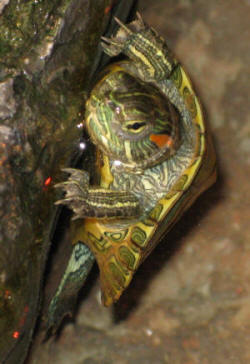 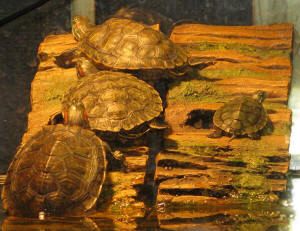 |
I need your help! RES care, humanity 3/30/08 Ok,
I need some help convincing my mom that my red eared slider turtle is
important enough to have all of the right habitat stuff. I don't
want my little Jimmy-Hendrix to die!!! <As always review water
quality, diet, and basking environment before panicking. Almost all
reptile deaths come down to not observing these rules. RESs need a
large aquarium with a filter (certainly no less than 30 gallons for an
adult, plus a filter with a turnover of not less than 4, and ideally 6,
times the volume of the aquarium in gallons per hour). The diet should
be 50% green foods when young, and 75% green foods once more than half
grown. Finally, these reptiles MUST have a UV-B source to bask under.
The tube or lamp WILL need to be replaced periodically; check with the
manufacturer on the recommended interval, but typically its something
like once a year.> My turtle is only one and a half inches both long
and wide, I have a 10 gallon tank, two basking spots, some Zoo-Med
Reptisafe Water Conditioner, Zoo-Med Turtle Treats, Zoo-Med Aquatic
Turtle Food. <Too small, wrong food.> I also have another kind of
food witch he seems to like better, it's called Tetrafauna
ReptoMin, is that as good for him as the Zoo-Med stuff? <Neither is
what you need. These turtles are HERBIVORES, like sheep and cows. They
want lots of plants to eat. Pellets can be used once or twice a week.
Suggested plant foods include Elodea (pondweed) and curly (not iceberg
or red) lettuce.> This is all that I have for him, no special lights
or anything. Are those necessary? <Yes.> Anyway, my question is
what other stuff do I need, habitat wise, to keep my little
Jimmy-Hendrix healthy? <A heater is also important unless you live
somewhere it rarely gets below 18C/65F. Because these reptiles are
super-destructive, get a heater with a plastic guard. Over here in
England these are standard on many of them anyway. When I kept turtles,
it seemed to me I was replacing the heater once a year!> And do I
need to add anything to his diet besides the turtle pellets and treats?
<Yes.> I need you guys to help me prove to my mom that turtles
are important enough to spend a few extra bucks on. So please help me
be a good turtle owner/pal. <Start by telling your Mom you need a
book. There are plenty at the library, book shop or pet store. Read, my
friend, so that you can do the right thing. These turtles get VERY BIG,
VERY QUICKLY, so be forewarned! Cheers, Neale.>
A gift turtle, RES gen. care 8/10/07 Hello crew,
<Hiya right back! Darrel here> Me and my wife just took ownership
of a little Red Eared Slider. It was given to us in a little plastic
container and we were instructed all we had to do was drop in a little
turtle food pellets and he's fine... <This person didn't
have a bridge for sale did they?> So we agree to take care of her.
After visiting 2 different pet shops is when we found out that they
were illegal <They're not terribly illegal -- they're fine
to have for educational purposes and as far as I can see, you're
getting an education.> .... and was not being properly taken care
of. So we purchased a 10 gallon tank, a 10 watt heat light, a UVB
light, a water filter and a floating log for her. We feed her the
little turtle pellets and tried lettuce, she only likes the lettuce.
What else do you recommend to feed this small Red Eared Slider? I use
Koi Pellets and/or Repto-Min food sticks. The koi pellets are cheap and
a balanced diet that contains a lot of vegetable matter -- perfectly
good basic diet. The Repto-Min is a bit pricey, but at least you can
buy it in small containers. That's just about IT in the food
department. Maybe an occasional earthworm for a "treat" but
you're a long way from worrying about that right now. Here's a
link about general care
http://www.wetwebmedia.com/FWSubWebIndex/RESCareBarton.htm> We
noticed that through out the day she has been keeping her eyes closed a
lot. We never have taken care of a turtle before, so we were not sure
if she they were ALWAYS that tired or if she was sick? Then yesterday
night we notice little white stuff between her eyes, I know it has to
be an infection so, how do we cure that? And so far what I have read
from the WWW it has to do with the water. But we bought a filter, and
clean out the "poop" every time, and I mean we keep it clean
and about 75 - 76 degrees, are we missing something? <The most
important thing right now is to make sure that she can get warm and
dry. The eye infection almost always comes from being too cold and too
damp for too long. A week of basking under the UV lamp combined with an
ordinary bulb for heat (it's in the link) may snap her right out of
it. If not, write back and we'll go into more detail> Thank you
for your help and by the I LOVE this website and what you guys are
doing. <Thank you -- we kinda like it too!>
Tell me everything you know about red eye sliders...
8/9/07 Hi I just purchased two red eye sliders. they are about an
inch and a half long. I have lots of questions. How long does it take
for them the grow. Also how do I ask you questions on the forums. thank
you. <Seek and ye shall find. Go to this page:
http://www.wetwebmedia.com/FWSubWebIndex/fwlvstkind2.htm and then
scroll down to the "turtles" section. Lots of stuff there.
You should probably start off with "Red Ear Slider Care" by
Gage Harford and "The Care and Keeping of the Red Eared
Slider" by Darrel Barton. As for the Forum, go to
http://wetwebfotos.com/talk/ and then Register, and then follow the
instructions. Cheers, Neale>
Re: Tell me everything you know about red eye
sliders... 8/10/07 Hi I was just wondering under what forum
do I ask post questions regarding my red eye sliders? They are very
small and I need lots of questions answered. You already gave me the
web site page but I cant seemed to find the forum for turtles. Thanks
again Christine <Hello Christine. There is no specific sub-forum for
turtles/terrapins. But it's hard to imagine you can't find the
information you need in the turtle articles at the main web site.
Pretty well everything is covered there. What size tank they need, what
food is best, why they need UV lighting, what temperature to keep them
at, etc. etc. Also, use the "Search" box on Wet Web Media to
find information. It's a standard Google search box. But if
there's something really obscure you can't find information on,
feel free to send a message. Cheers, Neale>
Red-Ear Slider How To's 5/23/07 Hello, <hello,
Samantha & welcome!> I am one of the many who purchased a couple
of red-ear sliders to only find out that it is illegal to buy/sell
these under 4 inches. Mine are the about 2 inches long, if that. I
bought them in very poor conditions and got home and purchased them a
10 gallon tank with rock substrate, a floating basking rock, a reptile
filter that hangs off the side of the tank, and a 50-watt basking light
that gives UVA rays. <You're doing all the right things!>
They love the basking rock and hang out there just about all day. Their
eyes are a little puffy and from what I read I'm sure it is because
of malnutrition. <Malnutrition and generally bad conditions, yes>
One is slightly smaller than the other, and the bigger one is more
aggressive, always crawling over the other. <that's not
aggression, that's just activity.> I have fed them some Turtle
Treats Krill, chicken, beef, tomato, they don't eat the romaine
lettuce. I am looking for some how-to's in my situation. What
should I feed these turtles at this age? Everything I read seems to be
for when the turtles are a bit older. <Not everything on that list
is of any value to them, so let's simplify the menu first. Please
get a small package of Koi pellets from your local pet shop. They
usually come in large or small pellets and try to get the small size if
you can. An alternative is Reptomin feeding sticks by Tetra. It's
basically the same as the koi pellets, just a lot more expensive. On
the plus side, you can buy it in small size containers. At feeding
time, offer about 8 or 10 pellets floating in the water and let them
eat as much as they want and then scoop out the remaining pellets after
they lose interest - this will help keep their water clean and that
food is all they need to eat. Period. I raise hatchlings to adult
breeders on just that!> However, the smaller one is the only one
that eats. But I can't get the bigger one to eat. It seems as
though he is always more concerned about trying to get out of the tank
or swimming away to notice there is food there. <You don't say
how long you've had them or how long the big one has gone without
food, so it's hard to say. But for now, if he's active and
otherwise seems healthy, let's give him a little longer to get
hungry.> The bigger one that doesn't eat is always under the
light, and he does get in the water sometimes. <That's what we
want! He chooses his environment as he sees fit -- that's
perfect> My light is UVA, do I need a UVB? <Yes, they need both
UVA & UVB so maybe you can add a fluorescent fixture over the tank
with a good quality reptile bulb. But they are very tolerant of
lighting issues so don't fret over that at the moment> Also, is
it okay to leave on all day? I have been keeping it on about six hours
a day. Any and all suggestions would be appreciated. <Try leaving
the lamp on 12 hours a day for now. Monitor their eyes for puffiness,
they noses for bubbles, their shells should be hard like fingernails
and they should be active. Then let's wait another week or so to
see if the big guy eats.> Thank you! <You're being a great
Turtle Mom, Samantha! Good work!>
Turtle, RES Care -- 5/14/07 Hello: My name is Rachel. Our
neighbor found a wild, very small RES trucking down the road here last
summer and brought it to our house and left it. At first I really
didn't want him but I decided to keep him and give it a whirl.
After a year of sickness, bad advice and wrong setups, my husband and I
have finally found the setup that appears to make this little guy happy
(this is the 3rd setup). We have him in a 40 gallon aquarium with a 305
Fluval canister filter, small river rock and a log with a basking lamp
and a water heater. I have the temp set for 80 degrees but it is
usually around 77 degrees. The water is about 8 inches deep. He is very
active and begs for food all the time. We have a calcium block floating
in the tank and he chases it and bites it. This seems to be a favorite
past time. He spends much of his time on his log basking. Sometimes
he's all tucked in and other times he will have one or both of his
rear legs sticking straight out. We have grown to love him and consider
him a life long pet. Here's what my questions are: Does the setup
sound okay? I've read conflicting articles about whether or not
RES's should have access to small gravel. I read a few weeks ago
that they need to ingest small rocks for health. Is this true? <Sand
or gravel is not required for health reasons.> We had much trouble
with the local pet stores telling us the wrong things. I finally just
did a mix and seem to have found the right thing. What types of veggies
and fruit should I feed him? < Kale and spinach are best.>
I've tried butter lettuce, cucumber and peeled grapes. He likes the
grapes but everything else he hates. Right now he eats pretty
exclusively pellet food with some occasional crickets. He does not eat
feeder fish. I currently have three very lucky feeder fish living the
high life. Should he have a companion and if so, do they need a larger
aquarium for a while? < Your male RES will not get lonely so a
tankmate is not recommended.> Our turtle is only about 4-5 inches
across the widest part of his shell, so he's pretty little yet.
I'm pretty sure he/she is a he. He is very aggressive when eating
live crickets and he has very long claws. I've also occasionally
seen what appears to be male genitalia from his upper tail region.
Should we trim his claws? < I would recommend leaving them
alone.> His shell is peeling alot. Is this normal? < Young
growing turtles seem to shed alot. As he gets older and starts eating
more vegetable matter and less protein his growth rate and sheds should
start to slow down.> The shell underneath appears to be healthy. We
were having alot of shell problems with him but we've gotten all
that cleared up. He was having shell problems when the neighbor brought
him to us. It took me a while to figure it out because I was frankly so
inexperienced. I had never even seen a turtle except in the zoo. I
washed his shell in Betadine scrub (being careful not to get it in his
eyes/mouth), soaked him in sulfa dip and then coated his spots with
iodine. I made a little newspaper nest for him in a little tub and
would put him in it for a few days. Then I'd allow him back in his
enclosure. He would usually eat well right away. It took a while and
alot of Betadine washes, etc., but it seems that all the infections he
had on his shell cleared up. I'm not sure if I used all the right
stuff, but it worked. His shell hardly peeled at all up until about 2-3
months ago when we finally got his problems cleared up and got him into
a setup that he likes. We are having problems with green algae. My
husband cleans the tank at least once per week, but we still can't
seem to combat this. What should we do for this? I really prefer not to
use chemicals. His tank is not directly in front of a window. <
Algae is a result of too much nitrogenous wastes in the water. Feed the
turtle in another container that can be easily cleaned out. Turtles are
messy eaters and their fecal matter with foul a tank very quickly. When
they are done eating they will soon defecate. Put the turtle back in
the main tank and dispose of the dirty water. The filter will require
cleaning more often too.> What about hibernation? Are you supposed
to allow them to go into hibernation at certain times of the year? If
so, how do you do this? < I would not recommend hibernation unless
you are serious about breeding turtles. They don't need it and it
can be dangerous to the turtle if he is not properly prepared.> What
about vitamins? I know they need them, but by what source? < If you
feed a varied diet with lots of veggies then vitamin supplements are
not needed. I might try a piece of cuttlebone to supply some calcium
and to allow the turtle to sharpen his beak.> Shell sprays, powder,
food variety? < A varied diet with pellets, insects, worms and some
veggies will be all that he needs.> I've been using shell spray
but probably not enough. < Shell sprays are not needed.> How many
hours per day should we keep the basking lamp on and what wattage
should it be? < The basking lights should be on during normal
daylight hours, 10-12 hours a day should be all that is needed. The
lamp needs to be hot enough to get the basking site up to at least 85
F. If the area is too cool then move the source closer or get a bigger
heat source.> I believe the one that's in his tank is a 65 watt.
Thanks for answering all these questions for us. We and our turtle
really appreciate it. Rachel < The tank lights needs to be replaced
every year to keep the UVB and UVA rays within the proper lighting
spectrum. These are separate from the basking light.-Chuck>
New Turtle Questions 3/21/07 Hello, We just purchased 2 Red
ear sliders from the pet store a few days ago and have been observing
behavior. I have so many questions, I'm afraid that they are going
to die. <The ideal time to ask questions are BEFORE you purchase the
turtles.> 1)We have a light / heat lamp for light and basking. Do we
turn it off at night? < A photo period of about 12 hrs per day
should be enough.> 2)Do turtles sleep when the light is off and for
how long? < When the lights are off and they cool down, they will
sleep until they are warmed up again the next morning.> 3)Is it okay
to pour hot water in tank to warm up? < Ideally you should get an
unbreakable electric aquarium heater to make sure the water temp.
doesn't get too low at night. 4)Turtles seem very lethargic at
times. Is this normal? < Turtles respond to the temperature of their
environment. If it is too cool then they will be slow. They will be
more active at higher temps.> 5)We have floating turtle food pellets
is this sufficient for now? <There are many brands of turtle food on
the market. Little turtles will eat anything for awhile. For long term
care start with ZooMed Aquatic Turtle Hatchling Food. This has all the
vitamins and minerals that little turtles need.> Sorry for all the
questions, I want to give the turtles a long & healthy life.
Thanks, Kori <Search on the WWM website for questions already
answered on turtles.-Chuck>
Red ear slider question 12/28/06 Dear Crew, <Paula> I
recently bought 2 baby RES to keep my third one company. <Mmm,
don't need "company"... not really social animals> One
of them was not doing so good with the others (not growing, not eating,
basking all day), so I put it on its separate tank, and added some eye
drops. Now, the baby turtle eats (only shrimp, does not like the
pellets!), but there is a strange white mucous right in between its
eyes. I constantly change the water, and I put it right under the heat
lamp. What could this be? Thank you so much! Paula <Please read
here: http://www.wetwebmedia.com/FWSubWebIndex/resdisfaqs.htm and
the linked files above, and the linked files in-text on turtle health.
Bob Fenner>
Blind Hatchling Turtles Given A Chance 12/18/06 I
have a question about blind RES. I work with many reptiles, but this is
my greatest challenge yet. I take in animals that others can't
help, or don't want to help. I just recently received two RES that
were born without eyes. Where the eyes are suppose to be, there are two
pin-head sized holes. They are both still hatchlings. One even has his
egg tooth still. Do you have any tips on how to stimulate their
appetite, or to get them to eat in general? I feel like they still
deserve a chance at life. I tried to agitate them to get their mouth
open, but that didn't work. I also tried to gently pry their mouth
open and place a small cricket in their mouth, but I only have two
hands. The only thing I can think of is to continue trying this to get
them to eat, and turn it into a conditioned response of them eating
when something taps them on the mouth. Any tips as soon as you can
would be greatly appreciated. Thanks. Joe Bob Jamida < You might
have to get them to smell the food under water first. I would try
holding a very small piece of liver in front of them under water with
some feeding tongs. Liver has a very strong odor and they might be
tempted to eat it. Very young turtles are still absorbing their egg sac
so it may take them awhile to get hungry. If they start to eat the
liver then slowly get them on aquatic turtle pellets/worms and insects
by mixing them with the liver. If these turtle do survive they will
probably need to cared for up to 30+ years.-Chuck> Turtles Getting Older 7/28/06 Hello. I like your site.
<Thanks> A family I knew was a typical "turtles are cute
let's get turtles" family and they ended up giving their pair
of red-eared sliders to me. Well I wanted to be responsible so I read
up on care, bought a bigger tank (twice now), and have tried to give
them a reasonably good home. They seem happy, except for the occasional
bullying. They act like they are well acclimated to my home, I've
never noticed any health issues (spots, mucus, etc that would be
obvious concerns). They swim around a lot, they bask, they shed, they
are growing so much every time I have guests they say they are huge. I
think they are about 3 or 4 now. One is about 6 inches long and the
other is about 4. Both lower shells are flat and I see no difference in
tails or claws, so I figure they must be the same sex, aside from the
whole size thing. I had thought they were both female until suddenly
the big one had a wound on the neck so I separated them. Since I only
have one light and one filter, I put the other one back in under
supervision so he can not be too deprived and they both started
fluttering their front claws at each other (so now they are both
males?). Is there any chance that a female will do the dance as well or
because I saw both of them doing it at the same time, is that
proof-positive that they are both males? < This fluttering is
usually associated with males but I guess females could do this
too.> I don't want to see either of them get hurt or have a bad
home. I live alone so I enjoy having the company. They beg for food
when I come home from work, which is fun at first but they will do it
for hours (I put a blanket up in front of the tank if it bothers me).
They like to watch TV and they have distinct personalities. I've
seen the big one trying to bite the tank wall before (presumably trying
to attack his own reflection) but he gives up after a short time and it
seems no harm is done. It's amusing to say the least. He also
learned to eat from my hand and now won't leave my hands alone
whenever I have to put my hands into the tank to do maintenance on the
filter (also amusing - I know it's my fault for playing around with
teaching them to eat out of my hands, so I don't blame him for it).
Any way, I doubt I can keep up two separate tanks for the next 40
years, any tips on how someone who lives in a very rural area can find
a good home for a turtle? < Give to a pet shop, place an add in the
paper, county animal rescue or even a school.> I think the littler
one lost the battle for dominance and is now afflicted with a sort of
"short man's syndrome" and has become more aggressive.
The big one is bolder but gentle with humans and likes to explore but
the littler one will bite people, although not hard enough to hurt
anyone, I worry about children and won't let them touch him, much
to their disappointment (and no worries, I insist on thorough hand
washing if any kids do get near the turtles). Another question, is it
important to feed them a varied diet? It's not very easy to get
specialized pet food in my area because mostly we just have your
typical cats, dogs, birds, goldfish, and farm animals. They've had
a diet of Wardley reptile premium sticks since I got them. I tried
feeding them some kind of lettuce-like green early on after I got them,
but they acted like they couldn't tell that it was edible. This
year I fed them some cherries that I tore into little pieces and they
were noticeably more enthusiastic for them than they are for their
normal food, so I am thinking I'll do that again. I'm not sure
if I can do worms and bugs, though. If I don't vary their diet am I
going to have to find homes for both of them instead of just one? <
Try earthworms, insects , kale and spinach. They will try them and
eventually learn to eat them.-Chuck> Sorry for the length and thanks
for your enthusiasm for water-loving creatures. Heather
Shipping
Baby Turtles - 04/08/06 We are hoping to purchase a few baby RES
turtles. We live in northeast Pennsylvania and are awaiting the warm
temperatures. At what minimum temperature do you think it would be warm
enough for us to consider having the turtles shipped? Thank you for you
assistance. < Baby turtles are usually born in the spring when
daytime temps are in the 70's. Most reptiles are shipped in
insulated boxes so they don't change temperatures during transit. I
would not ship anything unless the lowest temp was at least 40 F and
well above freezing.-Chuck>
New Turtle Owner Has Questions
3/22/06 Hi WWM, About a month ago I was given a RES as a birthday
gift. I have never owned a turtle before and never put much though into
actually being an owner/parent of one. However, I am obligated to
keeping this one healthy. I have observed "Wurtle" and am
trying to meet his needs. Initially it was his eating and he did not
want to bask. It is now that he has begun basking. A few things that I
have observed....1)He has shiny metallic looking spots on his shell,
one of the spots looks like a little hole. < Keep an eye on it .
Could be the start of shell rot.> 2) In the water it appears that he
has some type of filmy white stuff that kind of lingers attached to
him. This is located on his skin, neck, legs etc. < It is probably
nothing more than shedding skin.> I just purchased sulfur dip. I
will begin treating him tonight. Then I noticed when his eyes are
closed they do appear to be puffy. Is this a sign of an infection? They
appear fine when they are opened. < Could be something to be
concerned about. Get ZooMed Turtle Eye Drops and treat to be sure.>
Right before composing this, I noticed that when I was feeding him he
was dropping to one side. He also has sneezing and/or coughing issues.
< Respiratory infections can be deadly and may require antibiotics.
Check the basking spot with a thermometer. Should be between 85 and 90
F.> I have done a major renovation of his tank since he was given to
me. What am I missing? 20 gallon long tank, a FLUVAL 2, submergible
water heater, basking light-different for night and day, 1/3 of the
tank is filled with gravel and a rock sits on top for basking. The
remainder of the tank is separated by a partition and filled 1/3 of the
way with water and some gravel at the bottom so he can kick off. There
is a ramp made of rock to access the basking area. I live in NYC, when
changing the water is there anything that I should do? <If there is
gravel in the water section then it should be vacumed while doing water
changes.> Or, should I just use bottled water? <NYC tap water is
fine as long as it is dechlorinated.> Should I purchase a separate
fluorescent bulb? < A ZooMed ReptiSun 5.0 Florescent lamp is needed
for proper shell growth and helps against "soft shell" in
turtles.> I will admit, I lowered the temp of the water as per
someone in the pet shop hoping to force him to bask. What should the
water temp actually be? <Room temperature of about 60 to 70 F is
fine.> His diet consist of pellets daily. I began giving him 10
goldfish at a pop and he would eat them all in a matter of 15 minutes.
He refuses the carrots, lettuce and strawberries. What else would you
suggest. I would like to assure that he is getting the proper
nutrients. Please HELP! < Depending on the age of your turtle there
are commercial foods that are very good. Add occasional live fresh food
like washed earthworms, meal worms or king worms. Older turtles require
more vegetable matter in their diet like kale and spinach.-Chuck (
http://www.smileycentral.com/?partner=ZSzeb001_ZS)
( http://www.smileycentral.com/?partner=ZSzeb001_ZS)
Zena
Turtle Age And Spawning Green Terrors 3/20/06 Hi
crew. Thanks for the earlier help. I have recently purchased a red year
slider turtle.1)! wanted to know how can I calculate its age. Its about
2 inches. < It is probably a hatchling that was hatched about a year
ago last spring.> 2)My green terrors are not spawning. What can I do
to stimulate them to spawn. any help will be greatly appreciated.
Thanking you < Feed them heavily with good food like live washed
earthworms. The n do big 50% water changes while vacuuming the gravel.
Raise the water temp to 82 F.-Chuck>
| My baby res - 01/24/06 Hi there. I got my baby turtle in
December. It was shipped from turtlesale.com. I have all the lights
and the water heated. I took my baby RES to the vet last Saturday
because it hasn't eat since I got it. The first week it ate
once, but that was it. Then it started to get less active every
day. Yesterday (after the vet Saturday gave it a shot with Vitamin
B and antibiotics and other stuff to hydrate it) was more active.
The vet gave me 5 more doses of the medicine to be injected on the
food, but the turtle doesn't want to eat yet. I don't know
what to do. Also, the shell has some white spots, I was wondering
if that is from the water. (enclosed photo for you to see) <I
have kept turtles in the past and do believe that water quality is
a very important factor in keeping them healthy. I would continue
to follow the vets instructions and also keep the water pristine as
possible. Make sure you use a dechlorinator such as stress coat. I
would also keep the aquarium lights off to reduce the levels of
stress. Try feeding the turtle different types of foodstuff as
well. Good luck IanB> Please, let me know what can I do. I
don't want it to die. Thanks |
|
|
Turtle Won't Eat 12/24/05 Hi. My name is Roy and I have a
res in a 20 gallon tank , he is about 4 and half inches long. My
problem is that he wont eat the turtle sticks, all he will eat is
chicken and some lean meat, but I read that there diet can't be
just meat because its to fatty for his diet. I'm worried that he
might get sick. What should I do? < As turtles get older they become
less of a meat eater and more of a vegetable eater. Try some washed
earthworms, commercial adult turtle food, kale and spinach leaves
too.-Chuck>
New Turtle Questions 12/21/05 We just purchased our first
RES. My question to you is: Do you leave the basking light on 24-7?
< No, Put it on a timer to go on for 12 hours and then off for 12
hours. I would recommend that it go on at 10:00 A.M. and off at 10:00
P.M. This way when you get home you have a chance to watch him during
the week.> Also, my turtle sleeps underwater. Is this normal? <
When turtles sleep they go into a trance that slows down their
heartbeat and breathing. Sleeping underwater is normal for your
turtle.-Chuck> I thought they breathed in O2. Thanks. Tammy, Mesa AZ
Slider behavior 12/17/05 I had a question about my Red Eared
Slider and I am hoping you can answer it because I am definitely
puzzled. I've had him now for about 4 months and he is in a 10
gallon aquarium with a filter and all...and has been very active and in
the water with minimal sunning throughout the day. Now all of the
sudden, all he wants to do is sit on the turtle dock and bask, and
rarely does he go down in the water. He still eats and everything so I
would assume nothing is wrong, just wanted to check. If you have any
ideas or anything could you please let me know? I'd appreciate it a
lot. Thanks, Alex <Mmm, don't see a mention of a heater...
Please read here: http://www.wetwebmedia.com/FWSubWebIndex/redearsliders.htm
and the linked files above, particularly re turtle systems, behavior.
Bob Fenner>
New Turtle Questions 12/16/05 Hi there, I have 2 RES's
that I purchased at a mall kiosk (my 1st mistake, I know), but I have
been able to figure out most everything by now and they are doing well.
However, my 20 gallon tank is being overrun by green algae, and I have
been cleaning out the entire tank repeatedly for 3 weeks, but it keeps
coming back and just keeps spreading. Your site doesn't seem big on
it, but the people at PetSmart said as long as at wasn't brown
algae it wasn't harmful. But now its spreading onto their basking
rocks, and the water is even turning green! < Turtles are pretty
messy eaters. Excess food and turtle waste breaks down to ammonia that
is loved by algae. Filters help by developing bacteria that break the
waste down into less toxic substances such as nitrites and then
nitrates. Just like in a fish tank. The algae really doesn't hurt
anything, it just looks bad. Feed your turtles a little bit in the
morning and a little bit in the late afternoon. All uneaten food should
be removed after a couple of minutes. Get a filter and plan on changing
water a couple times a week. One turtle would be about 1/2 the work.
Two in a 20 gallon will get pretty crowded pretty quickly as they grow.
Scrape the algae off the glass with a single edged razor blade.
Don't worry about the algae on the rocks. Too much work to keep
clean.> Also, I read the water pH is supposed to be at 7.8. Mine is
at 6.8. What do I do to raise it? < You can go to a local fish store
and get some powder to raise the pH. I currently use the turtle floater
thing, the de-chlorinating fluid, and Turtle Clean. Lastly, one turtle
was opening his mouth (gasping?) this morning on the basking rock,
could he have gotten a chill, and if so, what should we do to keep them
warmer at night when the basking light is off? We have the water heater
set at 80 right now. Thanks for all your help!!!!!! < Turn the
heater down to 70 F. Check the temp of the basking spot. It should be
around 85 F. You turtle may have a respiratory infection. The
temperature changes will help. The spot may be hot enough already.
Reptiles sometimes cool themselves by opening their mouths to let
moisture evaporate and cool them down. Down worry about keeping them
warm at night . They are use to big changes in water
temp.-Chuck>
Red Eared Sliders Changing With The Seasons 12/13/05 Should I
adjust the basking and UV lamps for my sliders with the changing light
conditions as the seasons change outside? I keep my 3 RES's in a
large indoor pond that is heated all year round. Should I keep it
spring and summer all year (maybe 12-14 hours of light), or should I
shorten their days to reflect the fact it's winter coming on?
Again, the air and water temp will remain the same all year. Thanks!
LARRY in Los Angeles < As long as the water temperatures don't
change then I would not change the lighting. If you were trying to
breed them then I might try a different diurnal period along with a
cooling period. Then in the spring I might try to increase the water
temp and the lighting to simulate spring.-Chuck>
Sick/Blind Turtle 12/5/05 Hi, Guys! I read all the posts and
this is different. I bought four baby RES two weeks ago. After I put
them in the tank (new tank, floating dock, rocks, UVA/UVB reptile light
on side of tank, 2 10W incandescent on top) that one was blind. Or
rather, where his eyes should be are two beige areas, with the same
markings as his head. He basked a lot, and was reluctant to swim much.
He doesn't eat. I've tried krill, chicken, pellets, apple,
worms, etc. Put it wet, right by his nose and he doesn't sniff. He
wipes his head a lot, too, when feeling active. Every day I think
he'll be dead, and every day he is on the floating dock, head
tucked in, and not eating. He started gaping a week ago. No discharge,
just gaping, usually after swimming a bit. He never dives, just paddles
a bit, and then finds the dock again. Then gapes a few minutes. This
isn't good is it? I read some posts today and put him in a sulfa
dip bowl, with a basking rock, and a 100 watt light 12 inches away. Can
I pry his mouth open, and if I do, what should I try to feed him?
Thanks, Kate < He won't eat until he can see. He has a
respiratory infection. You can get some Turtle Eye Drops from Zoomed
and some vitamins as well. The respiratory infection may require
antibiotics from a vet. Check the basking spot with a thermometer. It
should be around 85 to 90 F. When he can see and is going into the
water on his own then he is ready to feed.-Chuck>