|
FAQs About Turtle Reproduction,
Young
1
Related Articles: My Turtle Laid Eggs. What do I do?
by Darrel Barton, Turtles, Shell Rot in Turtles, Amphibians, Red Eared Slider Care,
FAQs on: Turtle Reproduction & Young,
RES Reproduction & Young,
FAQs on: Young Turtle
Identification, Young Turtle
Behavior, Young Turtle
Compatibility, Young Turtle
Stocking/Selection, Young Turtle
Systems, Young Turtle Feeding,
Young Turtle Disease,
Related FAQs: Turtles 1,
Turtles 2, Red Ear Sliders, Turtle Identification, Turtle Behavior, Turtle Compatibility, Turtle Selection, Turtle Systems, Turtle Feeding, Turtle Disease, Shell Rot, & by Species: Cooters/Mud Turtles, Softshells, Snapping Turtles, Mata Matas, Tortoises, & Amphibians, Other Reptiles,
|
http://www.tortoisetrust.org/articles/articles.html#breeding
http://www.kingsnake.com/forum/res
http://petshub.com/forums/showthread.php?t=10729
|
Painted turtle breeding question
9/16/19
Hello,
<Hello. Apologies for the delay in replying.>
I’ve read Darrel’s write-up re turtle hatching and have a question. I’ve
installed a pond in my backyard and have 3 painted turtles (+koi and gf) in it.
Because I’ve lost a few turtles over the winter (Michigan; my pond is over 4’
deep, lined, in ground), I’ve started taking them inside now.
<Good approach.>
What I wonder, and can’t find via searching the internet, is because they’re
inside now and don’t brumate, does this change the ‘breeding’ season?
<Not directly. But most reptiles will use day length (often specifically UV-A)
to calibrate their internal clocks. Indoors this isn't possible, so breeding
tends to be a bit more variable.>
Or will they still likely mate March through June as they did in the wild?
<To some degree, yes, more or less. Day length will be the main triggering
factor.>
I ask because I would probably NOT know if my female actually laid eggs in the
indoor holding pool I’ve set up for them. Which means, come summer, they head
out to the big pond and a lot more space and I’d have to keep the indoor pool
going JUST IN CASE eggs were laid. I also worry if I’m not allowing brumation
and the breeding season is askew, that any eggs laid outside in the summer might
not have enough days for gestation.
<Understood. If you keep the turtles relatively cool and with the amount of
light over their tank limited, it's unlikely they'll lay eggs. Once moved into a
suitable enclosure with higher temperatures, more food, and longer day lengths,
this should trigger egg-laying.>
Another question; I have limited area where I’ve set up my over-winter pool so
can provide only modest ‘earthen’ area for possible egg-laying. Is there a
minimum amount for the female to actually feel comfortable? Or will she simply
lay the eggs in whatever space I’ve provided?
<It needs to be big enough she can move about and dig comfortably, but that's
about it.>
I currently have something equal to about 2 sq feet, about 12” deep.
<Sounds fine.>
And a final question; is there a optimal setup to make the earthen area
conducive for eggs to hatch? Basic ground temp? Percent humidity?
<The sand needs to be steadily warm, around 28 C, and the sand should be damp
but not waterlogged. The idea mix probably includes a bit of perlite or compost
to hold some moisture. But at the same time it needs to be airy enough the eggs
don't suffocate. Beyond that, the main thing is the sand isn't disturbed --
moving the eggs usually kills the foetus.>
Since I also overwinter orchids and tropical pond plants in the same room, I
think I’ve got that covered but if there’s something I’m missing, please let me
know.
<Sounds good.>
Anyway, I liked the write-up and hope either Darrel or another expert there can
help out.
Thank you.
Michael
<Hope this helps. Neale.>
Re: painted turtle breeding question
9/16/19
Thanks, Neale; it does help. I was going to keep the lights on for 12
hours, do you suggest I lower that number?
<Yep. Treat as per winter wherever you live; but do ensure the UV-B light is on
for sufficient time (at least 4 hours/day) for the turtles to get sufficient
vitamin D.>
(it was mainly for the tropicals I’m overwintering with the turtles.)
<Understood. Cheers, Neale.>
Aquatic Turtle Beh.; "Sittin' on the dock of the bay..."
Repro. 12/27/17
Hi,
<Hiya Darrel here>
i have 3 must turtles(2 females 1 male)in a large tank, one of the
turtles is spending a lot of time on the docking station, is she looking
for somewhere to lay her eggs?
<When they become gravid (with eggs) they get very active, nervous and
almost frantic>
.Also don't have enough space in my house to separate the turtles to
make another nest for her to lay them, if she is looking to lay eggs,
will she just lay them in the tank?
<Yes, or she will just re-absorb them. It's not a problem at all>
<That said, Bradley - when a turtle changes behavior, watch it very
closely. Is it alert and active? Does she eat? If she just wants to bask
more, that's OK - but if she's not active and stopped eating THAT is a
sign we need to talk about>
Kind Regards Bradley Saunders
TURTLE EGGS IN POND 8/1/17
Dear Crew,
<Hiya, Darrel here>
We rescued a turtle (painted, we think) a couple of months ago, and
brought it to our backyard pond. This morning we discovered two eggs in
the water on our water lily plant. Everything I read says they lay their
eggs on land.
<Yes, the get out, wander around until they find the perfect place, then
they dig a hole and bury them.>
Will these eggs hatch, or can we remove them and bury them?
<If turtle eggs are exposed to water for more than a few seconds they
are usually not viable. When a female expels her eggs in the water they
are usually not fertile to begin with, so I doubt you lost anything at
all. I would just dispose of them>
Thank you,
Margene
My Mississippi Maps hatchling 7/23/17
Dear Crew,
<Hiya, Darrel here>
I have a Mississippi map hatchling and a Peninsula Cooter in a 30 gal
tank. Whenever anyone walks by the tank the maps turtle (Max) swims
super crazy away. Now my Cooter (Thor) is beginning to do that to. Every
day I pick them up and pet their heads and say there name and like hold
them to my chest then give them a treat.
<That’s probably why they swim away. Being handled by humans is
basically a frightening thing to them.>
I was wondering if the tank was too big and they don't feel safe or me
picking them up is too early and now they are scared.
<That’s exactly right. To them, you are this HUGE thing and comes and
takes them out of their “world” and does strange things to them>
<Although – they like the part about getting a treat>
Because I have a Red-Eared Slider that is bigger and when I put my hand
in the water he comes and swims into it for me to hold I'm and say hi
and then he knows he gets a treat. (its quite cute cuz he won’t get off
my hand when I place it into the water, and when I do he moves his arms
all crazy like, super excited for his treat. I also have a western side
neck turtle who loves it also.
<You have it figured out. The Slider and the Side Neck have learned that
you are a source of food and so they are excited by your presence.>
So idk what I am doing wrong with my babies and why they are so
skittish. please help me I don't want them to be upset or them being
stressed nor over stressed.
thank you so much,
Raelynn Rettinger
<Rae, you already have it figured out. They are skittish because
they are scared. Remember that, in the wild, a baby turtle is
just a prey item. Bigger turtles, snakes, alligators and birds –
especially birds! And what does a bird do to a baby turtle? The turtle
is in the water, minding his own turtle business, thinking turtle
thoughts when along comes a HUGE monster that grabs the turtle and lifts
it OUT of its water …. Just before swallowing it! The idea that being
held close to another body is safe or nurturing is a mammal thing, not a
reptilian thing. To them it means being eaten or being crushed.>
<My suggestion is that you stop handling them, give them their treats in
the water until they associate you with food and good things and THEN
you can start to handle them and treat them more like family … just
keeping in mind that being handled will never feel like “fun” to them,
so a little goes a long way>
Fine porcelain "crackling" Turtle Eggs
7/11/17
Dear Crew,
<Hiya, Darrel here>
My 26 year old Eastern Box Turtles eggs look like a fine porcelain vase, with
small crackling on the eggs. All pictures of eggs online show them looking like
eggs from the fridge.
<The look of your eggs is more in line with my experience. They look white,
shiny and perfect when they are first laid but usually was they dry they get a
matte finish with blemishes>
The four eggs sit in Sphagnum Moss, half of the eggs covered, with moist paper
towel over them, and a lid sitting on top. They are kept at a temperature of
78-82. The container has small hole in the lid and in the base. The eggs are
about 58 days old.
<Sounds perfect>
Anyway, do some eggs have the appearance I've described, and still hatch?
<If they are fertile, yes. They may take anywhere from 75 to 120 days to hatch
based on the temperature swings as well as the average temperature. The rule is
to never give up hope until/unless the eggs collapse and begin to grow mold or
fungus>
Thank you for your expertise, and time.
<no charge! -- good luck.>
<Oh ... when you get hatchlings there may be issues with initial feeding. They
tend to be carnivorous when they are young, so what I do each day is soak them
in 1/8 inch of lukewarm water for a few minutes and then offer them a teeny-tiny
bit of moist cat food on the end of a toothpick. Sometimes it took two weeks
after the yolk sac adsorbed before they showed the slightest interest>
Lori ��
Male turtle with something that looks like a tumor on his penis.
7/25/16
Dear who ever I am speaking too,
<That would be the person reading this (me)>
I have 4 red ear sliders, two grown ones and two baby ones in separate tanks.
<Wise choice to separate them by size>
I noticed a month ago my turtle’s penis was out often I had though maybe they're
mating it had the color black which is normal. I don't wash the tank
occasionally:/ and I noticed my male turtle had the whole penis out and it has a
really big red thing above the penis still apart of it just above the head of
the penis. And I don't know what it is or why it's like that... any help?
<Not without a specific examination. There can be many different sizes and
shapes and some very odd formations along the way. As long as they are able to
extend it and retract it I wouldn’t worry too much about it. If you get a chance
to take a photo of it then we could be of more help>
wild painted turtle 6/5/16
Dear Crew,
<Hiya, Darrel here>
I found a large painted turtle digging a nest this morning.
<Way cool!>
She appeared to lay eggs (I was watching from the kitchen). When she
left there was a deep hole about and inch wide but she didn't cover it
up. Do I cover it (it's right where my dog can get it) or does this mean
she is coming back?
<She won’t be back, she probably forgot. If you cover the hole the eggs
MAY hatch naturally, but why not hatch them yourself? It’s not hard and
the babies are adorable {until they grow up, drop out of college and
come how with some loser who thinks he’s going to be a musician, at
least!}>
<read here:
http://wetwebmedia.com/FWSubWebIndex/TurtleReproArtDarrel.htm > I didn't
disturb her and she appeared to be content.
thanks,
Jeanne Paul
My female and male turtles
4/20/16
Hello,
<Hiya>
I have been wondering about this behavior that my
female turtle tends to do to the male, I am sure she likes a lot because
she follows him everywhere in the tank and when he hides she tries to
get in. But I am mainly wondering why she is always getting in his face,
she does not really get in his face she is always on top of his shell
and doing the twiddle of her nails in his face. He does not seem to care
at all so I assume he will never want to breed with her since he does
not care, but it could also be that she is still young she fits in my
hand while he is my whole hand and
is not interested in none mature turtles. not really sure if they will
ever mate but I am wondering why she keeps doing this and he is not
caring.
<First ... he is a she and she's not>
<The smaller one with the long fingernails is the male and he is indeed
trying to impress her with his attention and display of fancy claws. She
is, typically, not interested. For one ... males reach maturity sooner
than females, so he may be doing this for a year or two before she even
gets a clue as to what is up.>
Terrapin question; beh.; repro. poss.
11/1/15
Hi,
<Hiya - Darrel here>
I am confused by my terrapin's behaviour. She's not all quite active and will
always let us know when she's hungry by coming to the front of the tank and
splashing. She's otherwise content, she enjoys playing with the water filter and
rattling her claws on the outlet. However the last 24 hours she's behaving as if
she's ravenous, really agitated and trying to get our attention by clawing at
the glass and constantly splashing.
However, she's not hungry. Her cleaning and care routine has not changed, I
can't figure out any reason why she's upset.
Any ideas please?
Thanks a lot, Bex
<Bex, she may not be upset at all. She may be gravid. (That's a $5 word that
means she may have eggs). Many of the water turtles gestate eggs even when no
male is around. They eggs form inside them and then usually they reabsorb them.
Once in a while the eggs inside form a shell around them and then they can't
absorb them, so they have to lay them. At this stage
they get frantic and active almost all the time. If you take her out and let her
walk around she'll seem non-stop like she's "looking" for something. Back in the
tank she will be active and yet not eat.>
<This is all fine. If there's no male around then the eggs would be fertile.
Eventually she'll just expel them, even in the water, and then she'll feel
better. You can scoop the eggs out and dispose of them>
Re: Terrapin question 11/9/15
Oh wow, I had no idea about the eggs, that's really interesting. Thanks so much
for the fast response. So shall I just leave her be and let her get on with it?
How long might she be like this? Thanks again, Bex
<Eggs are one possibility, Bex, but it fits the description and the timing, etc.
In any case, yes, just let it pass (to make a pun)>
D
Reeves turtle over fertile? 6/28/15
Hi Darrel,
<Hiya!>
Thank you for answering my question last time regarding my gravid turtle!
<No charge!>
She laid 2 clutches of eggs since we spoke last, 3 eggs and 6 eggs respectively
which is normal.
A few days ago (her third time) she has been laying eggs very comfortably but to
a total of 9 eggs so far. I'm concerned that its too many and i wonder if there
is something i have been doing wrong?
<No, it's not too many. A single clutch is usually determined by physical space
-- the size of the eggs and how many will fit in the reproductive tract. In her
case, there were probably 6 in the left-hand duct and 3 in the right - although
there could have been as many as 6+6. What I'm saying is that her first clutch
was 9 eggs, laid 6 - then a pause - then 3 more. What you're seeing now is a
true second gestation of eggs. Unusual to be sure, but not rare or dangerous.
Just enjoy!!>
<As far as the number of
Help!!
MW
|
Baby yellow belly sick 3/21/15
Hi i am writing because i have a new hatchling and its sick. I have had the
hatchling for only 10 days and by the third day i noticed its eyes were closed.
By the 5 day i took my baby to the vet. It has been given two antibiotic shots
and no improvement. We took the hatchling to the vet today and it was given a
vitamin a shot. It hasn't eaten since we got it. I have
mealworms, blood worm, hatchling pellets and purchased critical care flakes to
try and feed via dropper with no luck. We also were prescribed eye drops. It
just doesn't seem to be improving. It lives in a 10gallon tank with basking lamp
and UVB light and filter with floating dock. I have purchased water conditioner
and have been cleaning tank every couple days.
I am at a loss as to why my hatchling isn't doing better and i don't know what
else i can do. Do you have any additional suggestions?
<If a turtle doesn't eat, then it won't put on weight, so your problem seems to
be getting your turtle to eat. Let's review. Turtles, like all reptiles, have
appetites dependent on metabolism which is in turn dependent on ambient
temperature. They won't feed much below 18 C/64 F, and it's significant that
baby turtles emerge from their eggs in time for late spring and summer rather
than the middle of winter. So check the temperature of your vivarium. If the
turtle spends most of its time basking and very little time in the water, the
water may be too cold. Check its temperature. While it isn't standard practise,
you can put a regular aquarium heater in a turtle tank to warm the water, up to
18-20 C, and that will be quite helpful in "intensive care" situations. Do
remember turtles mostly feed in the water, so if they're staying on land all the
time, they
won't get much to eat. Next, review the range of foods on offer. Some floating
aquarium plants are a good "buffet" meal for any turtle, so grab some of those
to start with. Also review the range of meaty foods.
Earthworms are like crack cocaine to most small predators, so if you can find
some, try offering these. Since you're already getting help from a vet, then
your turtle is getting the best possible support already, but as described
above, there are some ways to entice starving turtles to eat.
Force feeding is possible but extremely risky. If you force food into the
turtle, there's a good chance it'll go down the wrong pipe and suffocate the
poor thing. So while your vet might be able to do this, I would never recommend
it to pet owners. On the other hand, using a toothpick to place a very small
morsel of food inside an open mouth is doable, particularly if you have a turtle
that likes to "snap" when picked up. A tiny piece of prawn or a smear of
tropical fish flakes would do the trick nicely. Don't try and force its mouth
open though; again, the risk of doing more harm than good is a very real one.
I've cc'ed Darrel, our turtle expert, in case he has anything to add. Cheers,
Neale.>
Fw: Baby yellow belly sick /Darrel 3/21/15
Hi
<Hiya - Darrel here>
I am writing because I have a new hatchling and it's sick. I have had the
hatchling for only 10 days and by the third day I noticed its eyes were closed.
By the 5 day I took my baby to the vet. It has been given two antibiotic shots
and no improvement. We took the hatchling to the vet today and it was given a
vitamin a shot. It hasn't eaten since we got it. I have
mealworms, blood worm, hatchling pellets and purchased critical care flakes to
try and feed via dropper with no luck. We also were prescribed eye drops. It
just doesn't seem to be improving. It lives in a 10gallon tank with basking lamp
and UVB light and filter with floating dock. I have purchased water conditioner
and have been cleaning tank every couple days. I am at a loss as to why my
hatchling isn't doing better and I don't know what else I can do. Do you have
any additional suggestions?
<My immediate concern, Heather, is to get him out of the water. Although they
are normally aquatic, when a turtle is sick the warm wet environment works to
help the bacteria or fungus or whatever is ailing him. We have a treatment that
has become affectionately known as "dry-docking" which means to take him out of
the water and keep him warm and dry while he heals and/or recovers. You can read
all about it here:
http://www.wetwebmedia.com/FWSubWebIndex/treating%20RES%20Dis%20DarrelB.htm
>
<As far as his underlying sickness, the loss of appetite and the closed eyes all
point to a vitamin deficiency, which in turn is part of a dietary deficiency,
which Neale already covered.>
<You've given him the vitamin shot already. If you dry-dock him it will help him
rest and recover - then it's a question of if we caught it in time. For what
it's worth, if you've only had him 10 days, he was malnourished and vitamin
depleted before you got him.>
<http://www.wetwebmedia.com/FWSubWebIndex/RESCareBarton.htm>
Re: Fw: Baby yellow belly sick
Darrel I will remove the hatchling immediately from the tank with water. I was
thinking the same thing as far as it already being sick when i got the
hatchling. i just really hope we can save him or her at this point so i want to
make sure i do everything possible. We also have a older red ear slider in a 20
gallon tank which he "Soup" yes we named him soup started
out as joke but stuck. He is about 5 inches across his shell and have had him
for a year. He is very active and friendly. I noticed last night his stool is
soft like he has diarrhea. He eats feeder fish, pellets and meal worms. Should i
be concerned or do you think i should first add more greens since we really
haven't been giving him much? Sent from my Boost phone. |
 |
Help with slider egg
8/9/14
Hello,
<Hello Kim,>
I found your website while looking for information on incubating a
yellow bellied slider egg.
<Fire away.>
This egg was laid on 6/30/14. I have kept it in the same position it was
when laid.
<Essential.>
When it was first laid there was a noticeable dent in one side. The dent
filled in nicely after a few days. I have kept this egg in a plastic
container with potting soil in it on my porch (out of direct sunlight).
I keep a spray bottle filled with water nearby and mist it each morning
and evening (not the egg but the dirt). I keep a lid on it but sitting
askew because it doesn't have holes drilled in the top.
<Good.>
I started to candle it and have been able to detect an embryo and
vessels.
The night before last I noticed movement of the small embryo. I have
candled it every day since and continue to see movement. I also decided
to place a white paper towel over the dirt to keep the egg from getting
dirty so it would be easier to see through the shell when candling. I
just nestle the egg in the paper towel and then cover it slightly.
<Good.>
My problem/question is that this morning I noticed a concave dent in the
bottom that runs the length of the egg. I also notice that the side
(where the original dent was) seems weak.
<May well be if the shell was deformed. As the embryo grows, water
pressure inside the egg will change. Since reptile eggs aren't hard in
the same way as bird eggs, this can result in the shell imploding or
expanding slightly.>
I'm concerned because I have read that this denting/collapse usually
happens either when they die or right before hatching.
<Indeed; see previous statement.>
I don't think it's dead (yet) because I did see movement this morning.
It is also too soon for him to hatch (the egg will be just 6 weeks old
on Monday - and what I see moving is a very small spot). Do you have any
answers as to why the denting has happened? And is there anything I need
to or should do?
<Try to do as little as possible. This is the golden rule with reptile
eggs. Turtles have been multiplying away busily for some 200 million
years, and they really don't need our help. Indeed, the many endangered
species would do better if we left them alone, and that's almost always
a good idea with pet turtles too.>
I bought an aquarium heater, Styrofoam cooler, and thermometer today
with the thought that I might need to make an incubator that may keep
him at a more constant temperature and level of humidity. But I'm not
sure. If the dents are ok and not hurting things or if there is
something I'm doing wrong, please let me know. I live in south Alabama
if that helps.
Thank you so much for your help!!
Kim
<Rearing turtle eggs is very much trial and error. Everyone has their
own method (see the Internet for a slew of these!) though the
fundamentals are widely accepted. Since there's nothing you can do if
the turtle egg is damaged, carry on what you're doing, avoid handling as
far as possible (cracking the weak spot is more lethal than the egg
simply having a weak spot) and hope for the best. Have cc'ed our turtle
expert, Darrel, in case I've missed something. Good luck, Neale.>
|
Wild turtle 7/19/14
Hi there!!!
<Hiya - Darrel here>
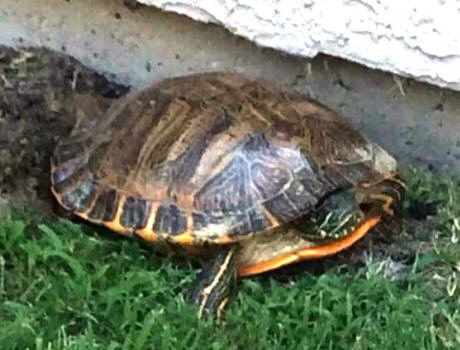
Great site. Today we saw a large pond slider (around a 12 inch long
shell) laying eggs. She was in the actual laying process when I saw her,
possibly burying. . Was really cool, even though there is a man made
pond, we live in north Texas and are in the middle of a major draught.
Anyways, she herself had filled the hole with water. As you will see in
the picture she laid them right up against a garage wall. My main
question is this....what can we do to help prevent the eggs from being
dug up? And as our temps are around 100 right now, how long is the
incubation? Thanks for the help in advance :)
<Here is everything you need to know:
http://wetwebmedia.com/FWSubWebIndex/TurtleReproArtDarrel.htm >
Wendi
<Good luck!!>
|
 |
|
Re: Wild turtle 8/1/14
Thanks for the reply.
<Sorry I'm so late, I was traveling and unable to access mail>
We used to have up to 10 various terrapins and tortoises when our kids
were growing up. We gave most to other herpetologists in the area though
someone stole out ornate Chinese box turtle out of our backyard :(.
Anyways, I think I will attempt the removal process as we won't be here
much longer, and I would hate to have the other kids around get to any
babies and injure or kill them. So, more questions for you :).
1. Will condensation from the box lid be sufficient for moisture over
the next 90 days or so?
<I usually test the moisture every 30 days and sometimes add a tint bit
using a syringe or baster (so as not to get the actual eggs wet)>
2. If not should I mist them and if so how often. (I would do the
separate boxes but I do not wish to move them more than one time)
<When I incubate tortoise eggs commercially, I do just that. I prepare a
new tray of vermiculite every 30 days and gently move the eggs. In your
case, just checking for moisture will be fine>
3. Will outside on a shaded balcony be ok?
<That depends. Summertime in Oregon or California, yes. Summer in
Phoenix no -- then inside, perhaps on an upper shelf in a closet>
4. The temp often gets over 100 here in the summer, is that ok once I
excavate them.
<Closet shelf then>
5. Is it best to dig from the outside into the chamber, straight from
the top or a combination of both
<I go from an angle and get VERY cautious as I dig. Remember to preserve
the orientation of the egg. I try to make a dot with a graphite pencil
(don't user a magic marker) on the top before I move them>
Sorry so many additional questions, but I want to do this right. I have
successfully rehabbed many species of baby wildlife, but never dug up
turtle eggs.
Wendi.
|
Reeves turtle gravid? 6/19/14
Dear WWM,
<Hiya - Darrel here>
I'm a concerned parent of a 3 year old Reeves turtle. In Hong Kong there
aren't a lot of Herp Vets so I asked the pet shop owner a year after and
he confirmed that my turtle is a female.
<OK>
She's really friendly usually and eats a LOT.. but recently she's been
acting really strange. She doesn't eat, she keeps running towards the
glass, not basking (she loves basking usually), and rearranging
everything. She hasn't touched her cuttlefish bone which she usually
consumes quickly.
<off her feed, unusual behavior and a sense of being …. Frantic? When I
see that the first thing I think is gravid. You may or may not be able
to probe her abdomen accurately so without a fairly invasive internal
exam it's hard to tell.>
On Google it keeps showing posts about female turtles being gravid and
wanting to lay eggs. I tried checking for eggs in between her hind legs
and her shell but I couldn't feel any eggs. Despite that I introduced a
sand box to her every night but she shows no interest.
<That is normal too. Usually they ignore any man-made nesting box that
is introduced suddenly. In order to really effectively use a nesting
box, it has to be connected and accessible via the main tank so that she
can visit at her convenience -- and this is important -- we attach these
boxes MONTHS in advance of the breeding season so that by the time she
needs it she'll take it for granted. And even with all that, many will
refuse to dig or lay and eventually drop the eggs in the water>
Please help! It's been about 5 days now. I'm not sure what to do at this
point and she's my first turtle.
<First - check for basic things. Make sure there are no outside forces
agitating her: No fans, motors, vibrations… nothing that would make YOU
nervous if you felt it. Next, make sure the water is very clean and
clear, the food offered is clean and fresh, etc. Last, put her in your
sand box every evening before dark and leave her there until after
daylight the next morning. Do this every day, like clockwork, for as
long as it takes for her to sense this as "normal" and not "special."
She may lay the eggs, or drop them in the water --or-- sometimes they
reabsorb the eggs and suddenly start acting normal.>
<If she has been well fed and is otherwise healthy, she can go 6 weeks
without eating -- so don't let that scare you. What I mean is the lack
of eating is always a disturbing sign because they are creatures of
habit… but the lack of actual FOOD is not to worry about.>
Thanks so much for your time.
-MW
Re: Reeves turtle gravid? 6/19/14
Thank you so much Darrel! I will give that a go right away. I've made a
bigger sand box and put potting soil which she seems to prefer and has
been digging a few holes.
Concerned 3/21/14
Dear Crew
<Hiya - Darrel here>
I need some help about 5 years ago I saw my ornate box tortoise
pooping out a white oblong soft rubbery substance I assumed it was a
still born egg
<it was an egg, yes. No way to know if it was fertile>
so I threw it away and today I went to go feed my 12 year old RES and on
the bottom of her tank was the same white oblong substance a couple were
still intact with like a runny almost yolk like substance and then a
bunch of pieces floating on the bottom I cleaned her tank and returned
her to it can you tell me what is going on I am concerned I don't have
the money for a reptile vet but if she needs to see a vet then I know I
have to come up with the money
<No need for a vet at this point. Your turtle is laying eggs. Turtles
often start to gestate eggs in their normal biological cycle but if the
eggs are not fertilized the female's body just absorbs them again. In
some cases even unfertilized eggs will form the outer shell, in which
case she lays them even through they are not fertile.>
<If your female has not been with a male for the last 5 years, there is
virtually no chance that the eggs are fertile - but if she has… then
they might be and if the eggs were laid on land (in other words not
expelled into the water) then it might be worth trying to incubate them.
http://www.wetwebmedia.com/fwsubwebindex/TurtleReproArtDarrel.htm
in either case, this is nothing to worry about. Just remove the egg
parts and clean the tank and she'll be fine>
Thank you...shanti ~~shanti Simon~~
Turtle laying eggs one at a time
Turtle Having Problems Laying Eggs 11/9/13
Hi there, In 2006, Chuck helped when my turtle got her head stuck in
some tubing.
She's generally been fine ever since. However, she's kind of a mess
right now. At the beginning of the summer, we saw she was acting
listless as per usual when she's gravid, but she wouldn't lay her eggs
in her dirt bucket.
We took her to the vet. He confirmed eggs, gave her vitamin shots, and
encouraged us to feed her more cuttlebone. In July, she managed to get
her flipper stuck in the filter intake after breaking the intake apart
(seriously not the brightest turtle). She pulled through and, with some
very bite-inducing physical therapy, is now okay.
However, she still hasn't laid all her eggs and now it's November.
Bringing her back and forth to the vet, plus the stress of life, led to
her having pneumonia (she's getting shots and is improving). She's
living in a new 45g tub with about a foot of soil and peat moss. The
ambient temperature is around 80 degrees and she has her basking lights
that bring the dirt to around 100/105 directly under the lamp, though
she doesn't seem to want to bask and spends a lot of time under her
cardboard box. She gets about a half hour of swimming time as per the
vet's suggestions. She's not eating every time we put her in; sometimes,
she'll eat 3-4 pellets and other times she'll eat 15-20. She can swim
better now but tires quickly. Much of the time she'll spend on the dock,
basking or chilling out with her head slightly submerged. What does that
mean?
< Ambient temps may be too high.>
As of now, she's laid two out of her six eggs. The vet says the turtle
needs amazing conditions but my turtle has laid eggs multiple times
before without any issues or Barry White. What can I do to get her to
lay the rest or is it time to get her induced? Thanks again, Veronica
< Normal turtle habitats have a cyclic temperature range. Hot during the
day and cool at night. If the habitat is kept too warm the turtle does
not have a rest period and she is on high metabolism all the time. In
fact most temperate turtles hibernate during the winter and
have a much better time reproducing in the spring. When conditions
are very good some turtles can double clutch and lay eggs in the spring
and the fall. Your vet can give your turtle a shot to induce her lay her
eggs. That may be the best coarse of action at this time to reduce the
stress of prolonged egg binding.-Chuck>
Pregnant Diamondback Terrapin
5/21/13
Hello.
<Hiya - Darrel here>
My concern involves my 9 year old female Diamondback Terrapin.
<When I was a kid in Florida and I wanted a turtle, by parents bought me
the basic care book on Turtles - and it had a Diamondback on the cover.
Thinking was THE coolest turtle in the world, I read and learned and got
all set up to have one -- and there was none to be had. All the
pet stores had were Red Eared Sliders, so I never got my Diamondback.
Even to this day I think about them kinda wistfully. Hmmm …
now I'm wondering if that's part of my problem?>
First off, I found her (and a male) 9 years ago off of a Jersey Bay when
I was walking home. The two terrapins were a little larger then quarters
so I imagined they had just hatched. Instead of heading to the bay, the
babies headed into the road and they were the only two out of about 20 I
saw that were still alive. Anyway, about a month ago my female started
wanting out of the tank constantly, attempting to climb out anyway she
could. I had no idea she was pregnant until about a week and a half ago
I found an egg at the bottom of the tank.
<Strange, frenetic activity during the early spring is a typical sign>
Since I found the egg, she would do nothing but lay out on the basking
dock 24/7. After two days of her not eating or swimming, I set up a
separate tank for her with a swimming area and a beach of crushed shells
and sand hoping she would lay the 'rest' of the eggs so she would start
acting normal. Since she's been in this tank she's ate some food, but
she still doesn't seem right. I'm very worried and I just want to know
if she's acting this way because there's more eggs to come, she's sick
or dying?
<She's probably not sick or dying. She probably is gravid (That's
a $5 word meaning 'pregnant with eggs') and she's probably
uncomfortable. Let me give you the general picture about turtles
and eggs:>
<Females often gestate eggs - even when there are no males present.
If the conditions aren't right in any number of ways, her body just
reabsorbs the eggs and that's the end of it. If the conditions are
good enough, the eggs will develop the hard shell on the outside.
Once that happens she can't reabsorb and starts looking for places to
lay them. They become nervous and active and frantically
walking around. Even when presented with a nesting box they'll
search every inch, often digging "test holes" just to see, only to
abandon them in favor of another and another and another. It
always reminds me of my ex-wife shopping for shoes - no male, human,
turtle or otherwise, could ever know what's better about one than
another but if we even dare to ask the question we're liable to get our
heads bitten off.>
<ANYWAY … if no suitable location is found they will often just deposit
them on the floating dock or even in the water - just to get rid of
them. In a very small percent of cases - and I mean one in perhaps
a thousand, the eggs just stay in the oviduct and sort of calcify into
stones. If that happens they seem to lead normal, happy lives, but
their fertile days are over.>
<What you can do for Snickey (assuming her name is Snickey) is to give
her a nesting box. Get a large plastic storage tub with high
sides from a Building Supply store and a bag of peat moss and a bag of
Vermiculite. The Vermiculite now comes only in large (2 cu
ft) bags called Therm-o-Rock. Mix half & half into the tub
until it's about 8 inches deep and then place it in the direct sun.
Place a cover over part, so there is some shade, and then put Snickey in
there and see what she does. You may have to arrange some
sort of additional walls so that she can't climb out, but if you leave
her in there for a couple days and nights, she might decide it's worth
trying.>
<Don't worry about her not eating or basking. She's well
equipped to go a week or two without either of those. On the other
hand, after a few days, if she's just sitting there looking at you like
she has no idea what she did to be put in turtle jail, put her back in
her regular tank for a day or two and then try again>
Any advice would be great. Thank you so much. -Sheena
Emydid repro./beh. 1/13/13
Dear Crew,
<Hiya Darrel here>
I have two turtles, a male Red-Eared Slider and a female Painted
turtle. I know they've tried to mate before (I was freaking out
because she was bleeding and he had a strange bulge so I took them to
the vet and that's what they told me).
<OK>
I see them doing, what I assume are, rituals all the time
(including
quickly wiggling their front fingers at one another).
<Yes, the male turtle waves his fingernails in front of the female, as
if he's saying HEY! LOOK AT MY PRETTY LONG FINGERNAILS! WANT TO GO
GET A CUP OF COFFEE?"
Meanwhile the female is thinking "AS IF!!! I WORK FOR YEARS TO
HAVE PRETTY
NAILS AND THEY BREAK AND CHIP IF I LOOK AT THEM TOO HARD, I SPEND EVERY
SATURDAY AT THE NAIL SALON JUST TO KEEP THEM FROM LOOKING LIKE HECK ---
AND
YOU COME ALONG AND WAVE THOSE THINGS IN MY FACE????
FUGGETDABOUTIT!>
Now I'm worried for a few reasons. The female seems to be getting on
half of the dock that we have in their tank but keeping her body under
water and biting at the air and then blowing bubbles under water. This
has been going on for a couple weeks and the bubbles are accumulating in
the dock area.
Tonight I came home and while she was doing that, the male was
apparently trying to mount her (getting on top of her while she was on
the dock and wiggling his tail underneath hers). I'm worried that she
either has a lung infection or she is trying to lay eggs (which I didn't
think was possible with two different species),
<Yes - all the Sliders, Cooters, Painteds, etc. will interbreed>
in which case I don't know as I have the proper set up for her to lay
them.
<When the female is gravid (with eggs) and it's time to lay them, she'll
usually behave differently - nervous, moving all the time, wandering
around her enclosure, scratching everywhere, etc. This behavior is SO
unusual compared to their normal activities, you won't miss it.
Building a nesting box for her is more complicated that just putting her
in a box of dirt, because even then they just might not find the right
spot. Ideally, the box should be at least 2 feet by 3 feet and
have at least 8 inches of a mixture of potting soil and vermiculite.
Place a small, incandescent 60w bulb at one end (about 12 inches from
the soil) to provide some ground warmer that other places, place her in
there for a few days and see what happens>
<All that said, in your case she's not exhibiting that behavior.
The gaping is not terribly unusual and the bubble blowing is a bit more
unusual, so I'm "concerned" at this point, but not "worried" if you
understand the difference.>
<Here is a link to an article on illnesses. The article
describes what we playfully call "dry docking" a turtle - and it's based
on this principle:
When the turtle becomes unhealthy, the warm moist environment they
normally enjoy becomes a problem -- when they are weak for any reason,
the warm moist world gives an edge to the bacteria and fungus that can
hurt them.
SO, we take them out, place them somewhere warm and DRY for a couple
weeks - and if they are fighting any sort of infection, the tide turns,
the advantage is on the Turtle and it's easier for her to lick whatever
is ailing her. Try it for two weeks - it's all carefully explained
- and let's see how she does.>
<
http://www.wetwebmedia.com/FWSubWebIndex/treating%20RES%20Dis%20DarrelB.htm
>
Please help!
<I hope we did!>
--
Love & rockets,
Maxine
Baby Painted Turtle, laying eggs? 9/25/12
Dear Crew,
<Hiya - Darrel here>
I have a baby painted turtle that I've had for five months or so.
Its shell was the size of a quarter and now it's probably about 2 1/2
inches long.
<That's impressive growth>
It stopped eating about 2 weeks ago so I did some research and
realized it didn't have the proper lighting, so it now has a heat
lamp as well as a UVB light. It seems to love the heat lamp and
has been on its rock basking a lot but still hasn't started to eat
yet. I noticed the past couple days it has been kicking its back
feet a lot and has never done this before.
<They do that as a normal part of basking>
It also seems restless and will jump on and off its rock and will
swim frantically into the glass.
<Also typical behavior - they do that when they see you coming because
they associate you with food>
I already did a lot of reading and all these things seem like
signs of egg laying.
<Not in this case - all signs of a typical turtle>
But I also read that they usually don't lay eggs until they're at
least 4 years of age.
<No, that's incorrect information - Reptiles attain sexual maturity by
SIZE, not age>
My turtle isn't even a half a year old yet. I'm just hoping
there is a reason for its loss of appetite other than illness.
<Let's not get too nervous just yet. Not eating for a few weeks
does sometimes happen for no apparent reason. First things first,
your description is that he's awake, alert and active? All good signs.
Is the shell firm and hard? No soft spots? The eyes are
clear? No bubbles from the nose?>
<If all the basic health signs are positive, then let's look at
environment. A warm basking area? Cool, clean,
unheated water? No dogs or babies or other 'monster-looking'
things that might be terrifying him?
Read this article on basic care - every word - and measure your care
standards against the recommendations.
http://www.wetwebmedia.com/FWSubWebIndex/RESCareBarton.htm if
everything is in line, STOP trying to feed him for another week - then
offer something like an earthworm and see if he doesn't go right for it>
Ornate Box Tortoise, repro. issue? 8/1/12
Dear Crew,
<Hiya Jaremiah - Darrel here>
I am really worried about my estimated eight year old ornate box
tortoise.
She mated with a male about two months ago and I started finding eggs
but it turned out to be another tortoise we have, she however has not
laid any eggs and is becoming lethargic and I am worried she is egg
bound.
<I wouldn't worry too much, Jare - while tortoise and turtles do get egg
bound, it's a LOT more rare than people think. Usually, if
conditions aren't right to lay the eggs and/or they don't expel the
eggs, they simply re-absorb them. They don't become a
problem until the hard shell forms and that usually happens just before
laying>
She won't eat but she will soak in her water in some kind of trance most
of the time.
<I feel the same way many days, recently>
The rest of the time she stays in a trance with her arms, legs, and head
out of her shell.
<That's only because she can't swill Bourbon>
She was digging holes and seemed to be preparing to lay eggs.
<Sometimes they dig around and for whatever reason decides it's not
going to happen, but it's too early to know that yet.>
I cannot afford a vet and it is so sad is there anything I can do to
help her if she is egg bound.
<The only thing to do is soak her in 3/4 inches of lukewarm water for 20
minutes a day. Occasionally that will stimulate expulsion.>
<But if you're asking me, monitor her for now. Let her be.
Offer food every other day or so, but let her go through what she has to
go through.
If she's still in this torpid state by September, then consider the
baths>
Jaremiah
FW: Ornate Box Tortoise 8/5/12
Thanks a lot, I have recently notice she has one eye she doesn't open
and some liquid was coming from it today. So I brought her inside in an
aquarium until she feels better. Is this ok. I personally despise people
who keep turtles in a small confined area, My habitat is almost 100
square feet, but it is over a hundred degrees and she doesn't dig into
the mulch like the other turtles.
<Discharge from the eyes, called 'weeping' is not uncommon in some
turtles, but it's not common in Box turtles. See about
giving her a vitamin A supplement. If she's eating, very
small chunks of liver (beef or chicken) can be given along with their
regular veggies and they usually gobble them up.>
<In a large garden-type area like you describe, are we sure that no one
has used any pesticides or snail-bait? Or fed her a snail from
another garden that did?>
Re: Ornate Box Tortoise 8/7/12
We have used Seven on our vegetable garden that is about ten feet away
from their habitat. We wash everything we give them. Could this be it.
<Snail bait is toxic to turtles - but unless she ate a turtle pellet or
ate a snail that had eaten a pellet, it wouldn't be a factor.>
She is a little lazy sleeping most of the time.
<It's not a great thing that she's sleeping most of the time, but then
again my box turtles are healthy and they're only active during the
morning and dusk hours. In the middle of the day they usually seek
shade and sleep.>
<If you continue to be concerned about her lethargy, bring her indoors
for a few days and see if more moderate temperatures and simply a big
change stimulates her in any way>
Terrapene carolina; repro. 7/29/12
Hi, I have an Eastern Box Turtle that has recently laid 3 eggs.
One she laid and didn't bury, so I'm guessing they're infertile. The
other 2 she laid under her "home". Is there anything special I should do
for her eggs?
<Chuck 'em away? Seriously, rearing turtle eggs is very difficult. For
one thing, if you move them so they aren't oriented with the "up" the
right way, you'll kill them. In zoos they draw an "x" on the top when
they expose the nest, and make sure to carry the eggs with "x" upwards.
In any case, if there isn't a male with the her, or hasn't been for a
few weeks, they won't be fertilised, so they're no more likely to hatch
into turtles than eggs from the grocery store hatching into chickens.>
I have them in a bowl with moist (but not wet) potting soil, they're in
a warm environment, and partially buried. I spray them everyday just to
make sure they're not drying out, I'm using distilled water because I
read tap water wasn't good for them. Am I not doing something, or should
I change something, because I would like to have at least 1 baby turtle
live. I caught her in the wild, so I know nothing of her past. Also, is
there a way that I can tell if anything is forming inside the egg?
<Yes, holding up to a light can reveal what's going on inside a few days
after laying. It's called "candling" because candles have been used in
the past. Google "candling eggs" and you'll get some photos. Infertile
eggs are just a dark mess after a few days, but fertilised eggs will
have visible blood vessels inside you can see. Smell is also a good
clue.>
-Miranda
<Cheers, Neale.>
Turtle
help 11/17/11
Hey
<Hiya - Darrel here>
I have two snake neck turtles and one of them has laid her
second egg, the first egg was hollow except for some yolk but
this second egg feels quite heavy. It was on its side underwater and
when picked up it was upside down until I flipped it around to right
side up, because the egg was found in water I presume that it is
already dead.
<Yes>
What should I do next time I find an egg? Should I make a nest in its
basking area, if so how should I come about doing this?
There isn't a whole lot of information on snake necks and it would
be very helpful, thanks :)
-Jamie
<The good news is that this is still in the realm of basics. Prior
to laying eggs, your female turtle's behavior will change.
She'll seem restless and over active or lethargic and under active.
She'll eat too much or not enough, etc. You should notice
this.>
<In a perfect world you'd add a nesting box to her existing
enclosure or add a deep tub of nesting mix (I'll get to that later)
into that enclosure. But if they're in a glass tank, what you have
to do is remove her to a separate nesting box. Unfortunately this is an
attempt to get her to lay eggs on OUR schedule and not let her
naturally lay them on hers. Many times a keeper will place the turtle
in the nesting box, leaving her there for DAYS and in the 15 minutes
that she's back in her home tank for drinking and eating, she plops
the egg right in the water. An external nesting box is an imperfect
solution, but it's what we have to work with.>
< I suggest that you get a dark sided plastic tub, approximately 24
inches by 16 inches by 30 inches tall (all these are VERY approximate).
If you find a container the right length and width, you can fabricate
higher sides even by using cardboard taped in place around the edges.
Add a basking/heat light of some sort. Make a mixture of Vermiculite,
play sand (sandbox sand) and potting soil in equal parts to cover the
bottom 6 to 8 inches deep, more if you can. Turn on the basking lamp
and point it toward one corner of the nesting box, so that part of the
substrate is HOT, areas around it are warm, and places further away are
cooler.>
<Place her in the box and for most of each day, returning her to the
regular tank in the evening. With any luck -- and a lot of patience on
your part (this can take weeks) she'll figure out what she's
supposed to do.>
<The hard part is that you have to notice when she has finally laid
the eggs. Usually you can see a change in her demeanor -- she's
calm again. Either she laid the eggs -or- if she hadn't found the
right spot and the eggs hadn't shelled yet (the hard outer shell
forms last) she may reabsorb them.>
<If you get the eggs, here's what to do next: http://wetwebmedia.com/FWSubWebIndex/TurtleReproArtDarrel.htm
>
Egg
question 8/10/11
Hello,
<Hiya - Darrel here>
I'm sorry if this seems like a silly question, but I'm having
trouble finding the answer when I search on Google
<Too much information is also as bad as not enough - not to mention
that every answer eventually gets to Google, right OR wrong>
It just strictly talks about breeding and nothing else. I've had my
painted turtle for close to seven years now and she
laid eggs right when I got her, I read everything I could about
hatching the eggs but I was unsuccessful.
<Here's a simple article about how to incubate turtle eggs:
http://wetwebmedia.com/FWSubWebIndex/TurtleReproArtDarrel.htm
>
My silly question is...Do female turtles lay eggs even when they're
not being bred? One sit lead me to believe that they lay them yearly
like a cycle and if you don't have a place for them to bury the
eggs the will retain them and become very ill? Which I feel like this
information isn't correct since I've had my turtle for so long
and she never laid eggs again, but it still got me all worried, I'm
only a teenager so I'm attempting to learn as much as I can about
turtles...sorry if this was a dumb question!
<Actually, Kelsey, that's a GREAT question!!!!>
I just don't want her to die because I love her :)
<Well, thanks for that Kelsey. We all appreciate that you care and
are trying to make a good home>
<Here are your answers: Yes, it is possible for a turtle to lay eggs
even if there has been no sexual activity. Some turtles have been known
to lay fertile eggs for as many as 10 years after their last mating.
Other times, for reasons we don't fully understand - if the seasons
and times and feedings and {whatever else} is JUST RIGHT, they can
gestate eggs for no reason at all.>
<Now here's where it gets interesting and/or complicated: It
takes the female a few weeks to gestate the eggs. During that time she
usually eats a bit more, but is otherwise acting normally. The eggs
inside her are soft, jelly-like things. If conditions are wrong (too
hot, too cold, too little food, too much stress not fully understood)
her body can just reabsorb the eggs. Toward the end of gestation, the
eggs "shell" or form a firm leathery outer covering in
preparation for being laid. As THAT is happening, your turtle begins to
act weird. Little or no appetite, swimming against the glass almost all
the time, roaming the basking area over and over listening to 60's
music and joining mainstream political parties yanno just
WEIRD.>
<This is the time that, if she is provided a nesting box with the
right kind of substrate at the right depth and the right temperature,
she'll dig a hole and lay the eggs. But even if she CAN'T find
these conditions, most of the water turtles will just eventually squirt
the eggs out ... on land even in the water just to get rid of
them>
<The dangerous condition that some people write about is called
"Egg Binding." And this happens when the she doesn't lay
the eggs or is having trouble expelling them. I have at times treated
this by inducing labor with Oxitocin - the same drug used to induce
labor in pregnant women. If the eggs bind and are not expelled, she can
carry them for the rest of her life (they calcify and become like
rocks) or they can decay and rot and she can get sick.>
<ALL THAT SAID . 99 out of 100 times, if they can't lay the eggs
they expel them in the water. Of the 1 out of 100 where they can't,
90% of those times the eggs calcify and all that means is that she
can't have any fertile eggs in the future so the egg binding
condition that leads to a serious health problem is a real long shot
and nothing I'd worry about on a regular basic.>
<Look for clear, alert eyes. Steady appetite. Basking and swimming,
etc. Normal activities keep her out of traffic and away from credit
cards (Painted Turtles have NO financial common sense at all!) and
she'll be fine!>
Re: Egg question, painted turtle 8/21/11
Thank you so much for your help!!!
<No charge!>
She's definitely a normal, happy, and hungry turtle!
<Does a parent proud, doesn't it?>
Also now I'll know what signs to look for in the future, so I feel
a lot better now :D
Thanks again!
<Tell your friends about us!>
Yellow Bellied Slider
Hatchling Questions 6/17/11
Dear WWM,
<Hiya - Darrel here>
I had a couple questions regarding my new turtles.
<Well, let's see if I have a couple of answers>
They're each about 1.5" in shell diameter.
<Hatchlings>
1. I noticed one of them sleeps with its neck almost completely
outstretched and its head resting on the basking log, is this an
indicator of the turtle being unwell?
<Well, it's not normal, so yes. It's an indication that
he's ill>
2. Their eyes are very slightly swollen and I've been giving them
eye drops daily, but I wanted to know what are some good foods that are
easy for them to eat but also rich in vitamin A.
<An earthworm, beef or chicken liver or shredded carrots - but with
that said, they need quite a bit more than just that. They should be
warm and dry, have extra amounts of UV-B lighting and a full vitamin
supplement in their food initially. The first link I'm going to
give you is on treatment of illnesses.
http://www.wetwebmedia.com/FWSubWebIndex/treating%20RES%20Dis%20DarrelB.htm
What is important to note is that illnesses to due to dietary or
environmental conditions took quite some time to develop and will take
quite some time to heal. During this time, their "normal"
warm, wet habitat can actually be a detriment to them. Also make sure
that they are eating a well balanced diet. ReptoMin food sticks and a
good quality Koi pellet are perfect foods. Coat a few pellets with Cod
Liver Oil and offer them during the feeding period.>
<Now, while they guys are in the ICU, you can take the time to go
over their normal housing and see if you have a proper setup. Here is a
link to basic care instructions:
http://www.wetwebmedia.com/FWSubWebIndex/RESCareBarton.htm
it's important to note that while they don't need very much in
the way of specifics, they absolutely need what they need. Food,
temperature, UV, etc. Read the entire article and measure your care
against the standards.>
3. Do you have any recommendations on how to change the water in their
tank? It's not exactly easy carrying out 6+ gallons of water every
week and generally only the bottom of the water gets cloudy so I wanted
to know if it's possible to remove the bottom water and just pour
in clean water to replace it.
<Essentially yes. Just like in a fish-based aquarium, you can siphon
out water from the bottom, actively using the tube to suck out visible
particles, and then replace that water with new water. If you have just
2 or 3 hatchlings and 6 gallons of water, you can repeat this partial
water change 4-5 times before a full, complete drain, wipe & refill
every 6th time>
Thanks so much for the help, I've spent many hours reading
information on the site!
<You are so very welcome!>
Jonathan
Re: Yellow Bellied Slider Hatchling Questions
6/19/11
WWM,
<JH>
Thanks for such a fast reply, I know my turtles will appreciate the
immediate help I can give them.
<Time is always of the essence in treatment of turtles and fish, Jon
-- they often show no outward signs of sickness until the condition is
quite advanced>
I read through the two articles and honestly I feel like I have a very
adequate environment set up.
<Excellent!>
They are in a 20 gallon long tank with two filters (a hanging one and
the zoomed filter that looks like a rock waterfall). The basking area
is between 87-91 degrees and the water temperature sits at 76.
<A tad on the warm side. 68 to 73 is best -- plain old Room
Temperature.
No heater needed or even desirable>
They have the basking light and a UVB bulb that are on for 14 hours
each day and then there is a red bulb that turns on at night which
keeps the tank at ~81 degrees over night. I'm feeding them Zoo Med
natural aquatic turtle food (hatchling formula) should I abandon
this?
<No - it's a fine food, Jon. I'm just partial to plain old
Koi pellets - I raise hatchlings to breeders on that one staple
formula>
When I put the turtles in isolation do I need two separate containers
for each of them, or can both be in the same one?
<the same is fine. Not only are we not talking about infectious
diseases here, but even if we were - both would be exposed to it. So
yes, by all means keep them together>
Should I continue with the heating light then red light at night to
maintain the day/night cycle?
<It can't hurt>
Thanks again.
<You're welcome, Jon>
Jonathan Hsu
Food gets stuck in baby
turtle's mouth 3/12/11
Hi there again,
<Hiya!>
Thank you for your advice last time.
<Yer welcome>
After 6 weeks isolation a few months ago my baby turtle recovered and
he has been doing fine, quite energetic, has an appetite however for a
while now I've noticed he seems to have more and more trouble
eating his food. At first I thought it was cute the way he tried to
tear at the food in his mouth with his hands, but now I see that the
reason why he does that is because the food seems to get stuck in his
upper mouth. The food now just gets stuck then floats away after he
unsticks it with his hands. Today he tried so hard to eat but could
not. He eventually gave up trying. :( I looked through your web but
I'm not sure what the problem is?
Looking forward to your reply and thanks in advance for your time.
Tiffany
<I've experienced that a few times, too. Not ME but baby
turtles, I mean. The problem is just the shape of the food and
therefore the size of the bite he takes>
<The thing to do, for now, is change foods for a little bit. If
you're using Koi pellets, they come in smaller sizes. If you're
using Repto-min food sticks, change to Koi pellets for a while.
(Don't buy a huge, expensive bag, just a small bag).>
<Also, visit your local pet store or bait shop and buy a small
container of earthworms or night crawlers. Offer the turtle one worm
and see if he's interested. You can dump the rest into your garden
if it's warm enough>
Re Food gets stuck in baby turtles mouth
3/26/11
Hello wet web media,
I feed him Zoo med aquatic turtle food, which is the smallest turtles
food I know out there,
<Here's what I'd do: try mashing some of the Zoo Med pieces
with a fork. Some will break into almost dust - and you can just toss
those away, but a few will break into smaller pieces. Place him in a
shallow bowl of lukewarm water - just up to his shoulders and after a
few minutes (for him to get over being freaked out) place the pellet
pieces in the water and let him eat. This way you'll be able to
closely see what he eats - AND the small pieces wont foul up the water
in your main tank>
my baby is around 1 inch shell big, some days he can eat some days he
can't, how often are baby turtles suppose to eat?
<I feed mine all the can eat in 5 minutes, every other day. When
they are about a year old, I change that to 3 times a week.>
I've also noticed that his under shell is a bit soft in the middle,
is this normal? Or some sort of vitamin deficiency or shell rot?
<Hard to say from way over here. Remember, Turtles need UV-B light.
They can't get that from sunlight that goes through glass (even
going through window screen blocks some of it) and the bulb has to be
within 8-10 inches of the basking area for a UV-B bulb to be
effective>
<read here to make sure youre covering all the basics: http://www.wetwebmedia.com/FWSubWebIndex/RESCareBarton.htm
>
Many many thanks you once again for your time and
advice!
Another event taking
place with Ralphie... Turtle, shell, now repro....
3/23/11
I last heard from you wonderful people on March 16th in regards to
Ralphie losing her shell. Well today Ralphie proved she is in fact a
female by laying 3 eggs.
<The tiny earrings and painted nails weren't a tip-off?>
I've read on line that she may have more and I am unsure of what to
do. It's 35 degrees here today so I am thinking putting her outside
to finish laying isn't the right idea but her tank isn't set up
with a place to dig (she has a platform to bask on but the rest of her
tank is water) can you tell me if she is going to get egg bound or
whatever it's called. I see many people warning about this on
line.
<She'll not likely lay eggs on ground that is too cold, so
outside isn't a good idea>
She has never laid eggs before to my knowledge. She hasn't mated so
is it possible that all she is going to have are the 3 she laid?
<The internal process is that the eggs are gestated and then, right
at the end - just before laying, the shell begins to stiffen. Many
turtles will gestate eggs and then absorb them again when there are no
laying conditions. Because Ralphie hasn't mated (that we know of
-it's 3am do you know where YOUR turtle is?) we can be certain that
the eggs aren't fertile and our concern is to help her expel them.
Shelled eggs that don't get laid can stick in the canal and
actually calcify.>
Would a box of dirt be OK?
<A box with some dirt and maybe some Vermiculite (a kind of potting
soil) mixed in and then set up inside the same room as her tank might
do the trick. But she's unlikely to do it while you watch. Put her
in the box, leave her overnight, then back in her tank in the morning.
Repeat for just a few days and if she has any eggs to expel, she'll
drop them>
Sorry to annoy you with questions but being female the idea of eggs
stuck sounds horrifying to me and I'd like to help her avoid that
if I can.
<No annoyance here. We live for this. We're chained to desks in
the basement of the Flemner Building in downtown Cleveland and this is
our only contact with the outside world so keep the cards & letters
coming!!>
She is still losing pieces of her shell and our vet seems to think it
is SCUD. Any thoughts
on that?
<The Vet has a few million more educational credits than I have AND
actual hands on exam of the turtle. If it's SCUD, then the course
of treatment is probably Baytril IM for 2 weeks. If it IS Baytril, make
sure it's diluted with saline as it's highly irritating and can
cause necrosis of the skin at the injection site. -- See - sort of
makes the egg thing no big deal, huh?>
My husband swears we are getting ripped off and the vet made it up.
<No, SCUD (Septic cutaneous ulcerative disease) is very real.
Ralphie needs to be warm and dry during the course of her treatment, so
read here on "Isolation"
http://www.wetwebmedia.com/FWSubWebIndex/treating%20RES%20Dis%20DarrelB.htm
This will work in conjunction with the nesting box - now we have an all
purpose place for Ralphie to nest, rest & heal.>
It cost me 90 bucks and hubby is now injecting an antibiotic every
night into poor Ralph. If he's right I'll never hear the end of
it.
<Awww don't worry. In time (say, about a week or so) he'll
screw something up so this will be a forgotten incident.>
<Meanwhile - since Ralphie is now "High & Dry" for at
least the next week and for best results 2 weeks. Take this opportunity
to clean and sterilize her home: sterilize the tank by adding chlorine
bleach. One cup per gallon of water [approx 75ml per liter] (not the
size of your tank, but actual volume of water - including filters). Let
the setup run for 24 hours, drain & rinse well with fresh water,
then break it down and wash with soap (such as dish detergent). Fill
again and run the setup for 24 hours, then drain, rinse and refill.
This is why we run the setup with the filter and gravel and basking
areas, etc. - every area the contaminated water could touch.>
Thank you as always for your help, Sara and Ralphie
Floating
hatchling 11/22/10
Hi crew.
<Hiya - Darrel here>
I have a question I have a little wild hatchling turtle that was given
to me since I like and have two other water turtles (red eared slider
and alligator snapping turtle).
<Just so you know the entire snapping turtle family will have no
problem at all eating a slider at their earliest opportunity. Snapping
turtles (Chelydra and Macroclemys) are two species that are always kept
alone. They'll even eat each other>
I don't know what kind of water turtle it is just that it is indeed
a water turtle. It was found outside very small even still had it's
beak
<egg tooth>
-- to break the shell. I took it to a local pet store to try to find
out some info on what kind it is and they told me to put it back but
also said it would most likely die since it was born so late in the
year and it is now cold.
<You're right in that regard>
I am an animal lover hence the two dogs, two cats, now three turtles
and a gerbil that I am not just going to let it die without giving it a
chance. It wouldn't eat for about a week or two which I read was
normal for new hatchling.
<OK>
He now does eat occasionally not daily but does eat.
<Nor should he eat every day. Turtles in captivity expend very
little energy. At the most, feed a captive turtle all it can eat in 5
minutes, 4 times a week>
He seems healthy for the most part except he floats evenly not tilting
to either side.
<That's normal .. so what do you mean by "healthy
except" ??>
He is in a small plastic tub with heated and filtered water and I also
have a UVB light on him.
<OK for now>
He can swim although not very well and I have never seen him go to the
bottom and sit, occasionally he somehow manages to get himself upside
down.
<The problem with shallow water is that they CAN get themselves
upside down and don't have the water depth to easily turn
over.>
What can cause the floating?
<Turtles can float. Not seeing the problem yet but I have a
guess>
I did notice once when I cleaned the tank I accidentally made the water
I'm guessing a little to warm (he started like panicking) but he
didn't float.
Although he didn't care for the too warm water he sank like a
normal turtle would. I am completely lost on this and why he floats
with water 77 degrees but sank when it was warmer (I didn't take
the temperature of the water but it felt a lot warmer than the normal).
Any suggestions on what is wrong with the little fellow.
<Not yet - but 77 degrees is too warm for a typical water turtle.
We'd like the water temp to be in the low 70's and the basking
spot to be in the high 80's to low 90's so that the turtle can
make his own choices about warm or cold.>
Thanks,
Mary
<Mary, can you please do this? Can you use a camera, even a cell
phone camera, to take pictures of all three of your turtles and then
email those to us? What I'd like is a picture from
"almost" head first, meaning directly at the shoulder one
from 4 feet away and one as close-up as you can get it without losing
focus. If I can see pictures of all three turtles, I may have some
answers and suggestions for you>
Attn: Neale - Aquatic
Turtles, sexing, repro. 7/27/10
Hi, You told me I probably had sexed my turtles wrong due to the finger
wiggling situation.
<I did indeed suggest you might have got them sexed back to
front.>
OK, how do I know for sure which one is male and which one is
female.
<Turn them over. Look at the tail area. On females, the combined
urogenital opening, the cloaca, is near the end of the tail. The tail
after this opening is usually short, less than the distance between the
base of the tail and the cloaca (sometimes called the pre-cloacal
length). Females usually have quite short tails overall. Males have the
cloaca nearer the base of the tail, and the bit after the cloaca is
usually about twice the distance between the base of the tail and the
cloaca. The tail is usually much longer overall. I know this sounds
complicated, but if you have two turtles next to each other, and
they're the same species, it's usually pretty easy to tell one
sex from the other.>
And...how do I tell if one of them gets pregnant?
<They don't; they lay eggs.>
How long is their pregnancy?
<Females will lay eggs within a few days of mating. HOWEVER, they
sometimes lay their eggs even without mating. Although infertile, the
females will try desperately to lay them in soft sand or coconut fibre,
and if they can't do that retain the eggs in their bodies, leading
to Egg Binding. This is a VERY serious problem that can kill female
turtles.>
My large aquatic turtle is as big as a man's hand and the small one
is only as big a golf ball. They were about the same size when we got
them last September. Any help you can give will be greatly appreciated.
Thanks again,
Cliffie
<Cheers, Neale.>
Attn: Neale 8/9/10
Hi again, OK, we followed your directions for sexing our
aquatic turtles and think we have it right now.
<Cool.>
I don't believe my female is carrying eggs now.
<Good. Does happen though, even with females kept alone, so do
please keep your eyes open.>
We read a book on what to look for when carrying eggs and she
doesn't have any of those symptoms yet. We'll watch for that
but back to my original question emails ago, why does the male turtle
do that finger wiggle thing at my female turtle?
<Why do builders whistle at passing women? It's just a way for
the male to get some attention. I expect it's annoying. For what
it's worth, females need to be fairly large to be sexually mature,
and tend to be larger than
males of similar age. So if the female is small with a shell length of,
say, less than 10 cm/4 inches, chances are she's immature. Male
attention will simply annoy her.>
She's so much smaller than him, should I move her to a different
tank?
<There's an argument for that. They don't need friends and
do fine alone.
Also try making two basking spots so that they're not next to each
other all the time.>
I do take them out of the big tank and feed them in smaller separate
fish bowls. Thanks for all your knowledge!! Cliffie
<Good luck, Neale.>
Aquatic Turtles, repro.
beh. 7/20/10
Why does my female aquatic turtle act like she wants to scratch the
eyes out of my male aquatic turtle? She's larger than he is and she
will get right in his face and wiggle her finger nails right toward his
eyes. I'm afraid she's going to hurt him. Any information and
help you can give will be greatly appreciated.
Thank You, Cliffie
<Hello Cliffie. Are you sure you sexed them right? The fingernail
wiggling thing is usually done by the males to the females. There's
no reason I can think of for a female to do it to a male! In any case,
no, no harm is done.
The only thing to make sure of is that once the female is carrying
eggs, you ensure she has a sand-filled tray somewhere for her to lay
her eggs, otherwise egg-binding is a common, and potentially fatal,
problem. Cheers,
Neale.>
Turtle mating ritual or
dominance? 5/21/10
Hello Crew,
<Hiya! Darrel here>
April 14, two years ago, I found an Eastern Painted Turtle hatchling
which I adopted. I have kept it in a bowl on my desk at work Mon. thru
Friday, bringing him home with me on the weekends. This April, I set up
a ten gallon aquarium for him/her at work, which he/she shares with a
small crab (not me). Since it has been in its new home (two months), it
has almost doubled in size. (Is this normal?)
<The crab?>
<No, you mean the Turtle, right?>
<Reptiles do not grow to the size of their enclosure, as is
sometimes the case with fish, but what CAN happen is that a larger
enclosure leads to more comfort, more activity and more eating, all of
which lead to faster growth>
Last Friday (5/14) I found another Eastern Painted Turtle hatchling
which I adopted. I have it in the bowl vacated by
"Killer".
<Wow. What are the chances of that?>
Several self-proclaimed turtle experts (research vets) have told me
that because both turtles are the same species, Killer would not harm
"Ditto".
<Well, it's like this: The sliders, Cooters, Painteds &
family are not combative or predatory upon each other. Generally they
can live happily in families or even a colony. But with that said,
individuals can get snappy at times and the rule I generally follow has
two main components [1] Match them to relatively the same size (no
hatchlings with grown adults because one little 'snap' from an
adult female is 'hey! Where did my arm go?' to a hatchling) and
[2] give the group a large enough environment so that individuals that
don't get along can get away from each other. Not likely in a 10
gallon tank>
I have tried putting the hatchling in the larger tank for several hours
each day and until this afternoon there were never any problems. Today,
Killer started vibrating his/her claws on both sides of the baby, but
without actually coming in contact with it. I put Ditto back into the
smaller bowl and my search for info on the internet brought me to you.
I found an answer from '06 'Mixing turtles' about mating
rituals and an answer from '07 'Mixing older & younger
turtles together' about the older turtle showing the younger one
who is the boss. Is it possible that both answers apply (even though
both turtles are Eastern Painted)? Does this mean Killer is a male? I
know the larger tail and longer claw nails are distinctions, but I have
nothing to compare against.
<Killer is probably a male, if for no other reason that he's
exhibiting male behaviors. The thick tail thing is a subjective
judgment, but the front claws are obvious: They either look like short
nails barely extending beyond the hand or they extend OUT and are
clearly long nails. Let's assume Killer is a male>
I can barely see the baby's claws at all. Does Killers response
mean that the baby is a female? Will a larger female turtle show
dominance the same way?
<No way WE can tell with a baby, as the sexual characteristics
aren't visible on the outside until the turtle grows quite a bit.
What Killer can tell that we don't know>
<This is my suggestion: Since we can't tell and don't care
and Killer thinks she's a girl let's call Killer the expert in
this situation and giver her a girl's name>
Any feedback would be appreciated.
<My secondary feedback is regarding the tank and the bowl -- proper
nutrition, proper basking and especially UV lighting. All pretty much
covered in this article:
http://www.wetwebmedia.com/FWSubWebIndex/RESCareBarton.htm >
Thanks for your time,
Carolyn
<Yer welcome>
|
Agitated African mud turtle 03/20/10
Hello -
<Hiya! Darrel here>
I have a female African mud turtle (Pelusios subniger). Her name
is Ruby. I've attached a couple of pictures (I think
she's the prettiest thing!). I've had her for 10 years,
and, according to the information I received when I got her, that
would make her about 25 to 30 years old now. Ruby has always been
very healthy and hardy. She even survived a 7 hour plane trip
without batting an eye when I moved from San Diego back to
Connecticut..
<She is a cutie!>
Back in 2002 (I'd had her for two years then) she became very
agitated. Kept trying to climb out of the tank, always digging,
swimming.... so agitated. I was getting anxious since she was so
anxious. I did some research online, but just couldn't find
anything that described her symptoms. A few weeks after it
started, I came home from work and found eggs on the bottom of
her tank. They were all crushed by then, and, of course drowned.
Now that I knew to look for eggs, I was suddenly able to find
articles regarding her behavior. She was trying to find dry land
in which to lay her eggs! She had never laid eggs before in the
two years I had owned her, so I just didn't expect it.
Afterwards, I took her to the vet for an X-ray since I had read
that if turtles with eggs can't find dry land, they might
retain an egg or two in the hopes of eventually finding dry land.
And holding on to eggs might require surgery, and surgery is very
bad for turtles. Luckily Ruby didn't have an egg on her. And
she hasn't laid any eggs since that whole episode.
<Usually, when they can't find suitable nesting sites,
they just drop them in the water, but it never hurts to
check>
Now that whole thing, of course, has been kept in my mind, just
waiting for it to happen again. I have found articles barely
describing breeding, but none tell me outright if females kept
alone will regularly produce eggs. If so, how often? Why did she
suddenly produce eggs 2 years after I got her? Although, I did
read the females of some species of turtle can hold on to sperm
packets for up to two years, waiting for the right time to
fertilize their eggs....could that have happened to Ruby? I have
almost no idea of her history prior to my getting her from a
reptile/aquarium shop in San Diego.
<She obviously was a party animal down in 'Diego,
wasn't she? Sneaking out at night, maybe hopping the border
(it would be easy for her to swim the river, after all) and be
back before you work up. Clever girl!>
Anyway, it's been 8 years since that whole drama, and for the
past 5 years she has been living in a well lit, well filtered,
well warmed 210 gallon tank. She looks healthy as normal. She
lives with guppies, glass shrimp, snails, sometimes crabs,
sometimes mollies or other fishies - all are sources of both
entertainment and nutrition for Ruby. She also has 3 tinfoil
barbs and a gibbiceps as non-food companions (although I've
seen her take half-hearted swipes at them on occasion).
<That is my #1 complaint with live fish-as-food for turtles.
Forget the fact that they're usually not part of their diet
anyway they rarely catch them and eventually you end up with the
fish as pets! Complaint #2 is that feeder fish are very common
carriers of parasites, but I'm not going to be a downer this
morning>
She's almost exclusively carnivorous, but every now and then
I'll also give her some banana plants - she really likes
eating the roots. She (and her tank buddies) also get frozen
shrimp, frozen blood worms, and live meal worms. I did try earth
worms once - never again! What a mess! She snubs turtle sticks.
She has a cave that serves as her underwater shelter as well as
her sunning rock. She has rocks and fossils and things lying
around for her to push and dig up and wedge herself under so she
can take a snooze without floating to the surface. As far as I
can tell, she's happy and healthy. (As an aside, the first 5
years I had her were under the same conditions, except she was
just in a measly 55 gallon tank.) Okay, so that's her and her
current living situation.
<Sounds like the care is great! The only think I watch for in
the mud, musk & snapping turtles is that their
caves/logs/snags are sufficiently big enough that there is no
possibility of getting stuck & drowning>
Back to the questions.
So, it's been 8 years since that whole egg-laying business.
This past week she has become all agitated again. In the fall and
winter she does tend to semi-hibernate, not eating for days,
snoozing under water for hours. And in the spring and summer, she
does become active again, gorging on food, shedding her skin,
growing another mm or two. But the activity this past week... it
makes me think of eggs! She ISN'T trying to get out of her
tank, so maybe I'm paranoid. But I've had her for 10
years - I know her behavior pretty well, and this is unusual. Her
eating has also dropped off quite a bit. Not entirely, but
usually when she's knocking around in the tank, it's to
get some easy food handed to her (rather than hunting it
herself). But she just watches the frozen shrimp sink to the
bottom whenever I try to feed her. And actually, I've also
noticed the guppy population is pretty strong at the moment. I
haven't had to supplement them with fresh blood for a few
weeks now (this time of year she usually decimates them, so
I'm regularly buying new ones to keep the population up.) So.
Right. Question. Should I be worried about eggs?
<Worried, no but help her out a bit: Get a plastic container
(like a small-ish storage tub, fill it 1/4 full with vermiculite
potting soil (not the horticultural type, just the regular
potting soil) and put her in that and leave her for an hour or
so. She'll wander around for a while, try to climb out, etc.
but eventually she'll settle down and either burrow in (which
is a fine way to spend an afternoon) or she may try to dig a few
test holes. It's sort of hard to explain, but the difference
between "get me out of here!" and "Hmm, can I nest
here?" behaviors are pretty obvious.>
Should I even be worried about eggs, or was that a one-time
fluke? And if it isn't eggs, what is up with Ruby? And if it
is eggs, what is the best way to handle it?
<What you have appears to be nesting behavior, even if
there's no nesting. The increased, wrestles activity combined
with loss of appetite is the indicator. These behaviors are
triggered by other events (the presence of males, seasonal
temperature changes and/or day/night cycles, etc) and trigger the
production of eggs (when possible) and the nesting behavior.
It's possible (and common) to have the behaviors without the
eggs and also possible to have infertile eggs, but that's
less frequent.>
....Okay, well, I hope I haven't written so much you stopped
reading somewhere in the second paragraph. I think the world of
Ruby, and I hate it if I can't figure out what she's
looking for.
<Probably just what we all look for Barb -- Good conversation,
a nesting site and a decent Cheese Steak without having to go all
the way to Philly>
Thanks so much for any help you can give me!!
<Yer welcome! Write back when you have more to tell>
Barbara
|
  |
turtle eggs
2/9/10
is it normal for a reeve's turtle to lay eggs as often as every few
weeks?
<If kept with a male, then yes. When sexually mature, turtles and
terrapins will mate once and then the female can store the sperm across
a period of months or even years. Once the sperm is used up, she should
stop laying
eggs, but that can be a while.>
we aren't interested in hatching them; we just want to be sure our
turtle isn't stressing herself out.
<So long as she lays the eggs, and you keep her sufficiently well
fed that she's in good health, it isn't something to worry
about unduly. A calcium-rich diet will offset the calcium she uses to
form the eggs.
Protein will make up for what she provisions as yolk within the
eggs.>
also we think that she doesn't get them all out as she has two hard
marble sized lumps at the base of her tail. is everything normal or
should we be concerned & do something?
<Yes, be very concerned. Egg binding is common among females if they
can't find a good nesting site. Some females will drop their eggs
almost anywhere, even underwater, if they can't lay them, but in
general female turtles need a sandy pit of some sort. If the eggs
aren't laid because she can't find somewhere big and soft
enough for them, she can end up egg-bound. This is painful,
life-threatening, and requires veterinarian help. Typically, hormones
are used to force egg laying, a bit like inducing labour. In fact the
Oxytocin used is the same hormone used with pregnant women. In extreme
cases, surgery is required. Egg-binding clogs the cloaca, restricting
elimination of waste, and a rotting egg quickly becomes a focus for
bacterial infection. It cannot be treated at home. Call your vet or
animal welfare charity for help ASAP.>
thank you
<Cheers, Neale.>
Frequent turtle
eggs 1/21/10
Dear Crew,
<Hiya - Darrel here>
we acquired an approximately 7 yrs old Reeve's Turtle 4 months ago.
She has laid 3 clutches of eggs so far! It seems to be once a month.
First 6 eggs, then 4, now 5. She is mostly in the water with a basking
platform so
the eggs are in the water. We dispose of them but are concerned that
she is laying them so frequently! Is this normal? She has a cuttlebone
that she chews on. Also, we are concerned that she might not be getting
them all
out. Her backside on both sides of her tail feels hard like there's
a marble on each side of the tail. Help! What should we be doing for
her?
<Eileen, it's doubtful the eggs are fertile, but it's not
out of the question. Make her a nesting box. Get an 18 gallon plastic
tub from a building supply store and put a 50-50 mixture of potting
soil and vermiculite in it. Try to get a depth of around 8 inches. Put
a lamp of some sort (a regular incandescent lamp is fine) shining on
one corner -- to
make it hotter than other places in the next box and place her in
there.
You can leave her for a day and overnight and just peek in occasionally
to see if she's digging and/or depositing. The chances aren't
good and she's likely laid all the clutches she'll lay this
season, but it's always a fun thing to try and to hope for. If you
DO get eggs that haven't touched the water, this article will tell
you how to incubate the eggs. Good luck.>
http://www.wetwebmedia.com/FWsubwebindex/TurtleReproArtDarrel.htm
My turtle laid 4 eggs.
how to take are of them???? 11/22/09
Hi,
<Hiya - Darrel again>
My Turtle is FAMILY: TRIONYCHIDAE (Softshell Turtles) Indian Flapshell
Turtle (Lissemys punctata andersoni).
<Another one?>
my turtle laid 4 eggs on 20th September 2009. so I 1st keep it rapped
in towel & cotton cloth after 5 days. then I got sand from the
river & put it the box , which I filled with moist river sand. what
other things I need to take care of it? do I need sun, water, room,
rooftop & what else location & things for it???
<Well, we have a link here for freshly laid turtle eggs>
< http://wetwebmedia.com/FWSubWebIndex/TurtleReproArtDarrel.htm>
it has been 3 months now how do I check the progress of my Turtle Eggs
or they wont hatch now?
<But it's a little late for this care>
- 1st I kept them(in plastic box with river sand) in a Normal room with
normal room temperature.
- Then later for 3 week I kept it on my roof top where it got direct
sun light in morning & cold temperature at night(that might be same
situation in its natural place/habitat right??)
- since last 2 weeks I brought it back to normal room temperature,
because of extreme cold season at night & a lot of rains last 2-3
weeks.
<That's a lot of change and stress on the eggs, Rehan. My GUESS
is that they're not fertile or they would have hatched by now --
HOWEVER, we have a saying "incubate until they go rotten"
because stranger things have happened to eggs that did indeed
hatch.>
<Unless the eggs look black or smell rotten, you have very little to
lose by continuing to try. Treat them as stated in the article for 90
more days before giving up>
thanks in advance.
Turtle rearing
5/31/09
I had a Florida soft-shell turtle lay a clutch of eggs on the canal
bank behind my house. we have a lot of opossums and raccoons in
the area plus tons of ant hills. I would like to bring the eggs in and
keep them safe until they hatch then release the babies to the canal (I
know natural selection continues on then as well).
<Would strongly suggest you leave the eggs where they are. Over the
last couple hundred million years, turtles have evolved to be pretty
good about finding "just right" places for nesting that
balance heat, shelter, security, and moisture. In some places it may
even be illegal to tamper with turtle nests, so do check this very
carefully.>
can you help me with how I should go about doing this?
<Almost always, the best option is to leave them be, or perhaps use
chicken wire to create a cage over the nest that keeps casual predators
out. But that won't stop animals like raccoons that are good at
digging, and obviously ants will get in no matter what. If you must
move them, then the
two things to watch are the orientation of the eggs and the temperature
of the incubator. Rolling the eggs can (will) kill them, while the
wrong temperature will either kill the embryos or skew the sex ratio
towards males or females.>
the eggs were laid about a week ago. is it too late to move them?
<Moving turtle eggs (and indeed reptile eggs generally) is extremely
difficult because they must be kept the right way up at all times.
Typically, scientists use a marker pen or soft pencil to mark an X on
the top as the sand is removed, and then lift the eggs with the X
upwards and into some type of egg box that keeps them that way up
between the nest and the lab.>
will they have a better chance at maturation leaving them alone or
should I go ahead and take them in?
<I'd perhaps get expert advice first. Since you're in St
Lucie, try calling the Smithsonian Marine Station on Hutchinson Island;
while they're mostly about marine stuff, there might be an
ecologist on hand who could help advise on what you're planning to
do. Failing that, if it really looks like the eggs are going to be dug
up, then you have nothing to lose by moving the clutch of eggs
yourself. You can either move them to a reptile egg incubator
(typically a plastic dish filled with vermiculite warmed to around
25-30 C depending on the species being kept, in your case whatever
local air temperature is should do) or else re-bury them into a
similar, 15 cm deep sandy nest on your own property, protected with
chicken wire as
best you can. The eggs hatch in about two months.>
and what do I need to do for them once I do.
<Until they hatch, you don't really need to do anything! Once
hatched, these snappy little predators will consume small prey of all
kinds, though earthworms are perhaps the ideal to begin with.
Maintenance of Trionyx species more generally is freely available in
the hobby literature.>
thank you, Ginny
Ginny Cornett
Hands for Paws
Port St. Lucie, FL
http://www.handsforpaws.org
<Cheers, Neale.>
Re: turtle rearing
thank you so much for the excellent advice.
<Happy to help.>
and I totally concur. I would only do it if there was a good reason for
the turtles. my dad was all hot about me taking them in a hatching them
- I tried to tell him it wasn't a good idea - but hearing it from
you
convinced him! thanks!
<Good!>
I am looking into getting a weatherproof infrared motion-activated
camera that I can set at the nest and turn on around the hatch date -
now that would be cool! Ginny
<Sounds cool indeed. Good luck, Neale.>
Snapping turtle mating
& comp. 1/25/09 Dear Crew, <Hiya Sucari, Darrel
here tonight> I have a 2 year old 7 inch snapping turtle and, age
unknown 5 inch Red Eared Slider in a 50 gallon tank. <Actually, what
you have there is a tragedy just waiting to happen.> They lived in
the same tank for about a year now with no problems they get along
great. <Get along great? Tell jokes? Like the same movies? Enjoy
lively political debate without crossing the line?> For about a
month now I have noticed that they are trying to mate. I was wondering
if I should have any concerns? <I sure would have concerns, Sucari.
For one thing, these mixed relationships rarely work out. What would
the neighbors think? What about the in-laws? And the kids? Red Eared
Snappers? Snapping Sliders?????? And the kids! Think of the kids!!!!
How sad to have a clutch of babies that swim into the pond to try to
lay in wait to ambush a piece of river grass or hyacinth?> Thanks
<OK, seriously, Sucari. All kidding aside, most turtles are very
tolerant of dissimilar species. They don't compete for food, no
mates to speak of and no territorial issues that really matter. Neither
see each other as a threat. And I too have seen Sliders and Snappers
and Soft Shelled turtles all kept together in relative harmony ...
until that day when one of them is just GONE. Sliders are non specific
scavenging herbivores and Snappers are ambush predators with very short
tempers and an instinctive, vicious 'ambush' strike that pretty
much destroys what it touches.> <This is not to say that all
snappers are mean or evil, Sucari. My snapper, Biff, is mild tempered
and easy to handle and he puts up with a LOT before he starts to show
any signs of stress. But still, I never EVER forget that he is a wild
animal with a tiny brain.> <My point ... if there is any chance
it has escaped anyone so far ... is that everything will be just fine
right up until JUST the moment that the snapper attacks and kills the
slider. Will it ever happen? Maybe not. But how will you feel if it
does?> <Please separate them as soon as possible> <Regards,
Darrel>
At what age do turtles mate?
Will older turtles try to mate with babies? 10/16/08
Hi,
<Hiya -- Darrel here tonight>
Here's my story.
<It's sad, but true - you met a girl named Runaround
Sue?>
I have a 30 gallon tank with 3 turtles, one is a soft shell turtle
about the size of a sand dollar or around 3 inches long from head to
tail
<I like Softshells. When fed and otherwise cared for I find Trionyx
to be fairly good citizens>
I also have 2 painted turtles; one is a hatchling barely bigger than a
quarter but around 7 months old and the other is around 4 - 4 1/2
inches long head to tail.
<I like the Chrysemys too! (btw: in case you were wondering, no real
reason to mention the softshell's or the painted's scientific
names .... I'm just showing off!)>
I have seen the larger painted turtle act aggressively toward the
hatchling, but after upping the amount of food it seemed to stop, but
lately the larger turtle seems to be exhibiting mating behavior or what
I think is similar to mating behavior according to what I've read.
The larger turtle will chase it and go face to face with it and clap
it's front feet together in front of the baby, really close to it.
I've been trying to watch it closely to make sure it isn't
biting it's face, but so far I haven't seen that.
<What you are saying is indeed mating behavior and the problem is
that the turtles you have mature by SIZE .... not age.... so even if
the Painted were the same age, the male would become interested in the
female years before she could return his affection. The entire family
of Emydids (there I go AGAIN - showing off!!!) are pretty much social
and get along great in groups, but that is a generalization. If your
particular male happens to have an aggressive attitude, then one bite
is all it would take to kill the little one. Depending on the size and
shape of your tank you could perhaps make a partition for the little
one -- or get it it's own tank ... which opens the door to get 2 or
3 more to join it and that leads to a place that looks like mine
(http://www.xupstart.com/wwm ) -- it's fun!>
Also, most of the stuff I've read says to feed turtles around 3-4
times per week, we've been feeding ours 2-3 times per day and they
always seem hungry. They aren't growing very rapidly however, from
what I've observed.
<Reptiles metabolize food relative to the amount of food, light and
heat they have. You're feeding them WAY too much and at best
they'll become obese and have health problems. 3-4 times week is
MORE than enough. Really.>
There are a few minnows in the tank with them that the larger painted
turtle will eat if I don't feed him daily.
<I feel your pain. I once tossed some feeder goldfish into my
outside turtle pond and 6 years later they were so big they were
picking on the adult turtles so they had to be put into the Koi pond.
Fish and turtles just DON'T mix.>
The water is kept fairly warm, but I'm not using a heater and I
only have a normal aquarium florescent light on the tank, but they seem
very healthy and active.
<They need basking heat -- a 60 to 100 watt incandescent will do ...
but the florescent needs to be a full spectrum bulb. Aquarium lights
for fish aren't quite the same>
They have reptile sand, aquarium rocks, a filter, a bubbler and a
floating dock in the tank.
<read this: http://www.wetwebmedia.com/FWSubWebIndex/RESCareBarton.htm
>
Thank you in advance for taking the time to read this and respond!
<No problem, Shannon - just put me in your will!>
Shannon
2 part question about turtles and
identification 8/26/08
Dear Crew,
<Hiya -- Darrel here>
Ok, so this is a two part question, first what kind of turtle is
this??
<Oh dear .. if I'd known there was going to be a test
I'd have studied!!>
<When I first looked at the pictures my sense was that it was a
Rhinoclemys (a South American Wood Turtle). When young their
carapace (top shell) is fairly flat and somewhat resembling an
Pseudemys (the slider families) and as they mature it becomes more
domed like a Box Turtle (Terrapene). In this case, Google is your
friend. Try Rhinoclemys T Terrapene and reeves turtle and see
what you think>
I got him from a lady who was not taking care of her and she gave
her to me. After cleaning her up I put her in my 100gal tank with
my RES who is a male (very long claws) who I have had for about a
year, and is just a little smaller then the new turtle.
<Not sure the new kid on the block is an aquatic turtle though
-- from most aspects it appears to be semi-aquatic at best and
needs more dry land. Your identification from more comparison
photos will tell all.>
The other day I noticed my RES vibrating his legs in her face, so
he wants to mate with her, so if you know what kind of turtle this
is, are they close enough for them to mate or is he barking up the
wrong tree?
<Yes, in this case my guess is that you're shaving the wrong
beard, to make a different metaphor>
thanks for your help!
<I'm also passing your pictures along to a more learned
colleague for his opinion. Neale?> |
 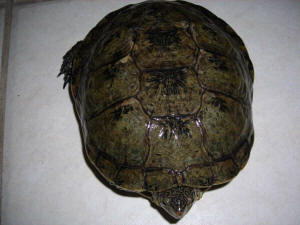 |
|
2 part question... Turtle ID,
cross-breeding? -08/27/08 Ok, so this is a
two part question, first what kind of turtle is this?? <I have
absolutely no idea. The fact the shell is domed rather than flat
implies its either an amphibious or fully terrestrial species
rather than a truly aquatic species. The front feet appear to
lack webbing, but the back feed are webbed, so again, I'd
tend to go with some type of amphibious rather than truly aquatic
species. I would be keeping this species in an enclosure with
equal amounts of water and land, and I'd also make sure the
water wasn't too deep. But I really think you need to get in
touch with a dedicated Chelonian support/rehoming site such as
Turtle Homes: http://www.turtlehomes.org/
They have contacts and resources for identifying
"mystery" Chelonians.> I got him from a lady who was
not taking care of her and she gave her to me. After cleaning her
up I put her in my 100gal tank with my RES who is a male (very
long claws) who I have had for about a year, and is just a little
smaller then the new turtle. the other day I noticed my RES
vibrating his legs in her face, so he wants to mate with her, so
if you know what kind of turtle this is, are they close enough
for them to mate or is he barking up the wrong tree? thanks for
your help! <They are absolutely not the same species! Male
Red-ear Sliders will attempt to mate with anything. So long as he
isn't harassing her, I wouldn't worry too much. Cheers,
Neale.>
|
River Cooter... eggs, ethics...
beh. - 6/20/08 Hello, I found a turtle laying eggs on my
property in Floral City, Florida. I guess it was some type of river
Cooter. I did not want to get to close and scare it away. I noticed
that there were other nests with eggs shells around and I believe that
something is eating them as this is a mostly uninhabited acre of land.
In an effort to save the eggs I covered the nest with a open milk
crate. I don't want to leave it too long. I don't know how long
it will take for them to hatch. Do you have any suggestions for
protecting them but still allowing them to get free once hatched.
Thanks Melissa <Hi Melissa. There's two ways to handle this. You
could either take a "big picture" approach, and let evolution
handle things. Female turtles that aren't able to make good choice
about nest site and nest depth need to have their genes removed from
the gene pool. So protecting the eggs isn't doing the species any
good in the long term. The other approach is to find out if the species
in endangered, in which the loss of even a few clutches of eggs is a
very bad thing. Your local Fish & Wildlife agency will be able to
help here (being British, I can't admit to knowing anything useful
about the freshwater turtle fauna of North America!). On the whole,
turtles produce a lot of eggs because the eggs and juveniles are
subject to high levels of predation; it's only the luck few turtles
that get big enough to have a thick shell that live for decades, even
100+ years. Often collecting turtle eggs is prohibited (again, check
with your Fish & Wildlife bureau) so removing a few and rearing
them yourself isn't really an option. But if this species isn't
so protected, as is likely the case with common freshwater turtles,
then do read this excellent article at the World Chelonian Trust
specific to the precise situation you're in:
http://www.chelonia.org/Articles/Emergency%20Incubation%20Techniques.htm
Good luck, Neale.>
Re: river Cooter 6/23/08 Neale, Thanks for your input.
I guess I will just let nature take its course. I never really thought
about it the way you explained the gene pool only about the poor cute
little babies being eaten. But, I think its a good theory so I'll
just watch the nest and see if she was smart enough. Thanks again
Melissa <Often the safest and best approach where a species
isn't endangered. But you may care to identify the turtle and
figure out if it needs a bit of help from humanity. Or maybe even
collect a couple of eggs to rear yourself as a pet project. Cheers,
Neale.>
|
Sliders mating - 6/20/08 I have a pair of yellow belly
sliders and they have started the mating ritual, please can you
tell me what happens now and how to raise a successful clutch, I
live in North Wales, U.K., Kind regards, Angie x <Hiya Angie,
Darrel here today> <In response to your inquiry I wrote a
web page this morning and hooked it onto my site. I'll try to
get it linked to WWM soon with pictures, but in the mean time ...
go here
http://www.xupstart.com/wwm/ and the third line down
Help! My turtle just laid eggs! should answer most of your
questions. If not, please write back>
Re: Sliders Mating 6/23/08 hi, sorry to
bother you again would an airing cupboard be ok? Kind regards,
Angie <Hi Angie. The average UK airing cupboard won't be
warm enough to rear the eggs of tropical/subtropical reptiles.
(For everyone outside these fair islands, an airing cupboard is a
closet built around the hot water storage tank, and is used to
keep linen warm and dry.) You can of course test the
maximum/minimum temperature of your airing cupboard using a
standard max/min thermometer of the type used by many gardeners
in their greenhouses. If it stays steadily warm, then fine. But
chances are it won't be steady enough unless you have hot
water 24/7, and even then you need quite a narrow temperature
range for success. For Red-ear Sliders, you need to keep the eggs
warm, at precisely 27 C if you want a mix of males and females,
for anything up to 4 months. The only practical approach is to
use an incubator, either purpose built or fabricated using a
glass tank, under tank heater, and Vermiculite. Periodically you
will need to spray the eggs so they stay moist but not wet. The
eggs must never, EVER be turned over, and preferably hardly moved
at all. Typically reptile breeders use a permanent marker to put
an "x" on the top of the egg as laid by the female, and
ensure that end is always upwards. Cheers, Neale.>
Re: Sliders Mating 06/23/08 Thank you for getting back
to me so quickly but how do you make an incubator and where can I
buy vermiculite? Kind regards, Angie <Angie, a basic incubator
needn't be big -- a 5-10 gallon tank would be ample.
You'd put a heating mat underneath the thing (you buy these
from pet reptile stores, small ones cost about the same as an
aquarium heater). The guy in the reptile store should be able to
advise on what model will work well for your needs; in a
centrally heated home, only a low wattage unit is likely to be
required for this purpose. Fill the glass tank with coarse
Vermiculite (bought at a garden centre, very cheap) to a depth
sufficient to hold the eggs securely. Get a house plant sprayer
from somewhere (again, cheap). Put a sticky plastic thermometer
on the tank so you can check it stays at the right temperature.
Too warm or too cold and you'll either get all of one sex, or
worse, no turtles at all. That's it! Warm it up, pop in the
eggs carefully, use the Vermiculite to stops the eggs rolling
about, but don't cover them. Spray them periodically so the
vermiculite stays moist but not wet. Put on a lid if you're
worried they're drying out/cooling down too easily. Make sure
there's good ventilation though -- fungus is very bad in
humid, still air containers. Dead eggs will begin to smell
quickly, and they should be removed as you go along. Minimum
hatching time is about 2.5 months, maximum about 4 months, so in
between that you should check them periodically for signs of
movement. Hope this helps, Neale.>
|
Turtle Eggs in our Garden
6/16/08 hi this is Jessica <Hiya - this is Darrel> A little
over two weeks ago I found a large turtle laying eggs in our garden.
<Now how cool is THAT?????> I don't know what kind of turtle
she was but she did leave behind two nests. She definitely left eggs in
one of them but not sure about the other one it was covered when we
found her. <Jessica -- take a look at this list and see if any of
these turtles look familiar. Doesn't have to be an exact match, but
see if you can pick something that looks close.>
<http://www.lantera.com/wwm> I would like to know how long until
the eggs will hatch? <It all depends, Jessica. When I collect a
clutch of turtle or tortoise eggs, it's usually "90 degrees
for 90 days" and most turtle or tortoise eggs will hatch -- IF
they are fertile (not all eggs laid are fertile) and IF the ground is
properly moist (but not wet) and depending on a lot of other things,
too. Temperature dictates time. If a clutch that will hatch in 90 days
at 90 degrees is incubated at only 87 degrees, barely 3 degrees lower,
that 90 days becomes 118-125 days. In the wild (or in your garden)
temperatures will be lower and will go up & down on different days,
so there's no way to tell how long.> Is there anything to that I
could do when they're hatched? I plan to let nature take it's
course on if they all hatch or not but I would like to know a little
about keeping one or more of the little guys? <See if you have go to
the hardware store or building supply store and get what they call
"hardware cloth." It's like screen only the squares are
larger and it's a much stiffer material. Make a circle about two
feet in diameter and about a foot or so tall. Dig a small trench around
where each nest is and put the hardware cloth around it. Then take
another piece and cover the top. You might need to devise some way to
hold it into the ground. Sometimes I take a couple of long thin wooden
dowels and place them through the sides of the cylinder like an
'X' laying on the ground and then put bricks on the outside
ends of the dowels. This is to keep any nosey pets or wild animals from
digging and it also will keep anything that hatches from wandering
out.> <This is really all I have to tell you right now if
you're going to leave the eggs in the ground. They might hatch this
season, or next spring -- we'll just have to wait & see. If for
some reason you decide to try to dig the eggs up and hatch them in the
house or garage, that's a delicate & complicated thing and
you'll have to write back and we'll talk about it> if you
would like to have more information on what I know of them I will
answer as best to my knowledge as I can. <Please keep us posted!>
Thank you for your time! <you're MORE than welcome, Jessica,
good luck!>
Yellow
Belly-laying eggs 5/18/08 Hi, My female yellow belly has laid
eggs for a few years now. However, she always lays them in the water.
Does this mean that the eggs are infertile? <Well, they're dead
anyway. To remain viable, they need to be laid on land, in warm, dry
sand. Whether or not they were fertilized depends on the presence of a
male of the species in your vivarium.> If I take them out as soon as
I see them will this save them if in fact they a fertile? <Moving
reptile eggs almost always kills them. If you want to rear hatchling
turtles, you need to create a place the female can dig and lay her
eggs, and then very carefully remove them to an incubator. The egg must
not be rocked, rolled, or otherwise disturbed because this invariably
kills the embryo.> and what can I do to get her to lay eggs on land?
<She will look for a deep bed of warm, dry sand before laying them
anywhere else. So provide that.> Thanks Michele <Good luck!
Neale.>
Box Turtle Eggs 2/8/07 Hello,
<Hi, Pufferpunk here> I have a box turtle who is laying eggs and
it looks like she is stepping on them. The turtles (male and female)
are in a terrarium in the house. I just acquired them a few months ago
and they were living in an apartment all their lives judging by their
size they are probably 5 or 6 years old. I have one that's outside
as well. I didn't want to take the chance of them getting sick with
the cold weather. I'm going to put them outside in the spring.
<Be sure the enclosure is well secured. A fence dug deep
is necessary to prevent them from escaping. Recommend
2"deep & turned in 8". Same for the
walls--they can climb, so turn in the top of the walls 8"
also. Chicken wire works well.> I found the first egg
Thursday evening on the 1st of Feb., the second on Tues. the 6th an
another one yesterday. I have them separated in the vermiculite, moist
like all the site say. The moisture level is at 80. I check it
regularly. It's after she has it before I see it when she steps on
it. Maybe she's not stepping on it but that's what it looks
like. It's right in the middle of the egg. Is there a chance that
they are ok? The first one was fine. <I have seen eggs
with a side that is concave. Should be alright with some
moisture. Keep them moist but not wet. Box turtle eggs are
temperature-dependent. The incubation temperature should be
84°-86°F if female offspring are desired, keeping the temperature
around 72°F will produce males. Lower 80s might produce some of
both. To tell if the eggs are fertile, within a few days the
yolk should settle to the bottom part of the egg. Within 10 days to 2
weeks you should see veining in the eggs if you candle them with a pen
light or flashlight in a dark room. If everything works out you'll
have young'uns in about 60 days. Once hatched, the hatchlings will
require the same care as the parents except for feeding. They will need
a higher proportion of insects and other carnivorous foods in their
diet. It is best not to house the parents with the hatchlings.> How
long will she lay eggs? I thought I read 24-48 hours? Can you give me
more info? I've never done this before. <For more info:
http://turtle_tails.tripod.com/raisingbabyturtles/tour8.htm
Good luck with your turtle breeding. Baby box turtles are
the cutest!!! ~PP> Thanks for you help, Jennifer
Wollard
Eastern painted turtles repro, behaviour
- 1/31/08 I have two eastern painted turtles in a 20
gallon tank with all the necessary apparatus. They are definitely
opposite sex. The female is approximately four years old and the male
is three years old. The female is about 4" and the male is half
that size. Problem: They have been together about three years. In the
last year or so when I go to feed them the male becomes aggressive,
attacking the female and biting her head, pulling her under water. Once
he sees the food floating on the top he leaves her alone and begins to
eat. He does not do this to her any other time but feeding time. Should
I separate them? Do turtles prefer to be with others or along? If it ok
to keep them together how should I set it up for them to reproduce this
spring? Thanks for your help Carol <Carol, unfortunately it is quite
common for male turtles/terrapins to become snappy towards one another
and towards females. There's no real fix as such. About the best
you can do is put them in an enclosure that has two (rather than one)
islands so that they can rest and bask separately. Turtles are not
really social animals, and they can be kept perfectly well on their
own. In fact in a vivarium as small as 20 gallon (far too small for
them, really) I don't think you will be able to keep more than one
specimen permanently. If you want to breed these animals, you will need
something bigger than a 20 gallon tank. At the ages your turtles are,
they are both sexually mature, and will breed readily given the chance.
A big problem with females is egg-binding, which happens when the
female cannot drop her eggs. Precisely why this happens is a complex
issue, but you should be aware that a sexually mature female that is
trying to dig or climb out of the tank is likely wanting to lay eggs,
especially is she looks swollen. Egg-binding is an issue that needs vet
help. Anyway, mating is obvious, with the male mounting the female and
(simply put) seeming to scratch her eyes out with his front flippers.
Eggs are laid a few weeks later. The female will lay the eggs in a
fairly deep pit of some sort containing a mix of sand and coconut
fibre. Incubating the eggs requires that they be kept warm (around 25
C) and very, VERY still. Hatching takes a couple of months. Few people
breed turtles in captivity, but it is certainly do-able. Cheers,
Neale.>
Pregnant
Turtle?? 8/20/07 I have 4 turtles currently living
together...3 yellow bellied sliders and 1 red-eared slider. I have
raised them all since they were the size of a quarter! I have 2 males
and 2 females. They have been doing courtship behaviors for years, but
I have never once seen an egg. They are all in a 55 gallon aquarium
with mega filtering, and heating. I know its small but, its temporary.
They have all been living comfortably for years, so I do not understand
what is wrong. <UM, if they've been living comfortable for
"years" then ... what is your definition of
"temporary"?> About a week ago, my largest female yellow
bellied slider and my largest male yellow bellied slider, both nearing
5 years of age, began mating behaviors. Now, my female slider is acting
sluggish. She sleeps for long periods of time as if she is hibernating.
She keeps her tail tightly tucked in, and sometimes shields it with her
feet. The male turtle is constantly bugging her and continues to swim
on top of her, biting her on the neck or feet when she comes up for
air. She still has an appetite, but stays away from the other turtles
until dinner time. She does not seem sick. Her eyes are clear, her
breathing is normal, and she is very active around dinner time. But,
she seems so tired and sluggish that I am afraid she is sick.
<She's probably not sick, she's depressed. Male sliders (in
fact, all the Pseudemys) reach sexual maturity many years before the
females because it's based their size and it's not uncommon at
all for the females to be bugged and harassed by the males. When the
females can't get far enough away, they can begin to act as you are
describing.> I thought she was pregnant so I separated her from the
other turtles and put her in a nice little environment but nothing
happened. She just crawled around for a little while and slept the rest
of the time. Now I put her in there to give her a break from the
harassment of the other turtles. Also, the male turtles both have
actually been seen dropping their you know what's! <You're
doing the right thing -- a 55 gallon tank simply isn't enough room
for that many ... um .... active turtles. My suggestion is to put the
MALES in another enclosure temporarily, maybe putting them back in just
for feeding, and give her a couple of weeks to come out of her shell
(to make a pun!)> The only turtle acting normally is my younger
female yellow bellied slider. What is wrong with my turtles!? <I
don't think she's pregnant (technical term 'gravid')
she just sounds grumpy.>
A Turtle gave us some eggs! 5/25/07 Hi,
<hi> I live in Louisiana, last night a turtle laid eggs in our
back yard. <that's a neat thing to witness, isn't it?>
She covered them and left. Will she return?
<No, Michelle, she's done her job. Normally Nature
would take it's course from here on> Do the eggs need
care? It's very warm here but I am concerned that they
will get enough moisture or be harmed. Please help. <There are three
choices, Michelle. (1) Do nothing and let nature take it's course,
knowing that not all egg clutches hatch and even then not all babies
dig their way out (2) Take some hardware cloth or chicken
wire and make a cylinder (and top) around the egg site to protect them
from predators like raccoons, possums, dogs, cats & kids and then
wait until nature takes it's course. (3) Dig the eggs up
and incubate them. Steps 1 and 2 are self explained, so here
goes number 3: Buy a bag of Vermiculite from your local home supply
store and a small plastic container (like Tupperware) about as big as a
shoebox. Poke some holes in the too of the container -- use
a screwdriver or scissors -- about 6 holes will do. Mix the
vermiculite 1/2 and 1/2 with slightly warm water. This means
1/2 and 1/2 by weight, not by volume. We don't want MUD
... just moist potting soil. Place about a 1 or 1 1/2 inch
layer in the bottom of the plastic container. Now comes the
fun part -- dig the eggs up. You have to be REALLY
careful doing this for two reasons -- first, you can break the eggs --
so after you dig down a little bit you need to use something like a
brush to wipe away the dirt or use your fingers really carefully (this
is a lot like dinosaur fossil hunting like in Jurassic
Park: careful, careful, careful!). Second, unlike
bird eggs, once a reptile lays the eggs, you have to keep the UP end
facing UP -- never rotate them. Some people put a
pencil mark on the top part just as they take them out ... but I just
treat each one like ... well, like an egg ... and I never take my eyes
off of it from the time I take it out of the hole until I place it in
the plastic container ... always keeping the end that was UP ...
up! Place them gently in the vermiculite ... 1 inch apart
and around 3/4 down into it. When all the eggs are in place
... put the lid on gently and place the container somewhere that will
stay warm ... like your garage -- but on an out of the way shelf where
they can be left alone. Try to find a place that doesn't
get jarred by door slams or vibrations, all of which are bad for the
eggs. Now, just wait somewhere around 90 to 120 days
(depending on the temperature) and maybe you'll be a turtle
mom!> Thanks, Michelle <lets us know how it turns out,
OK>
Re: Turtle repro.... Where are the eggs? -
6/25/07 Darrel, you are such a gem. <Yes, I am ... and you show
a tremendous sense of taste and style for noticing!> By the way, I
believe that we have met once, a few years ago, at a herp convention in
Valley Forge. <There are two reasons this is unlikely. The lesser of
the two is that I've never been to Valley Forge and the greater
being that, for better or worse, I'm not the sort one
"believes" they've met -- if we've met in person, you
KNOW it .. and even with drugs and years of therapy you never forget --
just ask my ex wife!> I'll let you know if we find anything
after our second dig. <Happy Spelunking!> This turtle is indeed
young, only about 5 years old, and she was raised in captivity (bought
illegally as a baby in N.Y.C. Chinatown) and given to us a few summers
ago, when she had outgrown her aquarium. Her name had been George up
until we got her. <My entire current herd of Sliders and Cooters are
the progeny of tiny babies obtained essentially the same way> Our
male Red Eared Slider immediately began to court her. He didn't
seem to succeed until last summer, <Turtles generally attain sexual
maturity by SIZE rather than age, so captive males often spend a few
years "waiting" for their female cage mates to catch up. In
slow growing species, like the pair of Map Turtles I have ... the male
spends almost a decade in utter frustration while the young female
seems to spend that same amount of time totally annoyed with him.>
and we began to make preparations for an expectant Georgia to lay her
eggs then. I am fairly certain that this first clutch will have been
fertilized. <as we speak, I'm watching a pod of Spur Thigh
Tortoises (G. sulcata) poking their heads out of eggs in my incubator
-- a wonderful and fun time awaits you next year!> Many thanks
again. Elisa <Yer welcome, Darrel>
|
Re: We found the eggs! -
06/27/07 Dear Darrel! <Yes, Ma'am?> We found them!!
<she's talking about Red Eared Slider Eggs, folks! Amazing
how DEEP they were, huh?> See photos! <How cool!> I
think the gentleman I met spelled his name Darryl and misspelled
just about everything else, therefore, I was certainly mistaken!
(He was from an old mailing list about turtles to which I no
longer subscribe). <It's OK, Elisa -- all that matters is
that you have the correct "Darrel" now!> And by the
way, my husband is the one who misspelled "tutle" on
the attachments. <Heh Heh .... silly goose> On to study all
the internet has to offer on incubation. If you have any
incubation and/or Red Eared Slider hatchling care sheets already
prepared, please send. <Why yes, I do. Get a plastic container
from your local building supply or hardware store about the size
of a shoe box. Buy a bag of Vermiculite at the nursery
department. Mix a batch of warm water & vermiculite 50-50 BY
WEIGHT (see below) and fill the shoe box container 1/2 full.
Place the eggs in the container in EXACTLY the orientation that
they were when you found them (Turning reptile eggs can be deadly
to the embryos - but if you didn't know that and you've
already turned them, don't sweat it .. just don't add any
MORE changes). After placing the eggs gently in the container,
fill the rest of the container with your vermiculite & water
mix until the tips of the eggs are barely sticking out. While
you're doing this, Ron should poke about 6 small holes in the
top of the container and have it ready to snap (gently) in place
when you're done nesting. Now ..... 90 degrees for 90 days.
At 80 degrees ... up to 240 days (all times approximate, your
times can and will vary) If you have an incubator that's
great. If not, a high shelf in your garage where it stays kind of
warm all summer will do just fine. But this is important --
vibration from slamming doors or dresser drawers can damage and
destroy the embryos ... so you want some place out of the way.
That's all you "have" to do. Now ... what *I* do??
About 45 days into the cycle, I'll prepare fresh vermiculite
in another shoe box and I'll gently uncover and transplant
the eggs -- making sure to preserve orientation. I do this to
preserve the moisture content and that helps the eggs
develop.> A very excited Elisa and Ron <Congratulations,
Darrel> <50-50 by weight!!! 2 cups of Vermiculite and 2
cups of water would make MUD that would drown the eggs. The easy
way is to put a plastic pitcher on an electronic kitchen food
scale, zero out the scale after the pitcher is in place and then
fill it with vermiculite and then record the weight. After
dumping that into a clean mixing pail, replace the pitcher and
fill with water to the same weight. No Scale? No problem!!! Place
a ruler flat on top of a pencil laying on the counter. Place a
drinking glass filled with Vermiculite carefully on one end of
the ruler and an empty (identical) drinking glass on the other
end of the ruler. Make sure the pencil (the fulcrum) is centered
... then fill the empty glass with water until ... the home made
scale starts to balance! Yes, you'll have to sort of hold the
glasses in place and no, your measuring won't be as accurate
as a scale ... but it WILL BE more accurate than really matters
.... FAR more accurate than Nature herself. Then, once you know
the water level in the glass to equal one glass full of
vermiculite, you can repeat this until you have a full mixing
pail.>
|
|

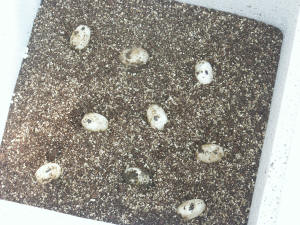
|
A Mystery turtle and some turtle help, fdg.
young 5/24/07
Hello, I'm Jessie. <Nice to meet you
Jessie, I'm Darrel> Recently, my mother found a baby turtle
roaming around while at work. So she brought it home (mainly because
our family has a need to care for animals... and it was cute). It's
a bit larger than a quarter and has intricate yellow markings. These
markings include 2 swirls near the back of its shell and black spots on
the underside of the shell (these are just main markings I'm trying
to point out it has yellow stripes everywhere). The spots are on the
underside of the rim of the shell, other than that it has an all yellow
underbelly. Oh, an it has this little ridge on its back. Now I've
been doing research, and I think that it is a baby River Cooter.
<That what I was thinking, too.> She found this turtle kind of
out of its area. You see, it says that this turtle lives in the
northern part of Florida, but we live in Sarasota. I'd
be happy to send pictures of it... when my dad comes home with the
camera. <many different cooters live in Florida, Jessie and I'd
guess this one lives in your area. You don't have to
send pictures> I HAVE been trying to find out what I could about
Florida turtles and about baby river cooters. Unfortunately, I find
myself in a very difficult situation. 1. I don't know how old it is
so I don't know if its still using the yolk for food. <I doubt
that it is, so it's time to start feeding it> 2. I am lacking
the foods that the sites I have visited suggest feeding to this turtle
(cut up minnows or lettuce) <a small cotter would like Koi pellets
that are available cheaply at your local pet store> 3. I'm not
completely sure if this turtle will be a permanent pet. Seeing a show
it's a baby, it's cute, we love animals, and my Dad seems to
have taken an interest in it, I'm guessing it will be.
<let's hope so! They make fun and interesting
pets> Can anyone help me? And or does anyone have suggestions?
<first, make sure it has a place to get wet and a place to get dry
and warm and is safe from any other animals like dogs or
cats. They like sunshine, but direct Florida sunshine can
get that little guy overheated quickly, so never leave him alone out
under the sun. Here is a link to a care sheet that will tell
you a lot more http://www.wetwebmedia.com/FWSubWebIndex/redearsliders.htm Good
luck to you, Jessie, and thank you for writing
us!>
Tough Love Is Needed When Feeding Turtles -
04/20/07 When feeding my hatchlings in their feeding tank I put
assorted food in their feeding tank (pellets, shrimp, krill, and micro
size pellets for hatchlings), in the tank they live in I put red and
romaine lettuce for them to munch on as well as a cucumber slice every
few days which they love. The problem is that since I introduced the
shrimp and krill about 4 weeks ago both hatchlings have stopped eating
all the pellets and only eat the shrimp and krill. I just read on
another website that this is not a healthy diet and the shrimp and
krill should only be a treat - how can I get them back onto pellets? I
tried today to get them to eat the pellets and they wouldn't - I
weakened when they seemed to be begging for the shrimp and I gave in
and gave them some! Help... how do I break the cycle and get them back
on a healthy cycle? I'm also afraid I am overfeeding my larger
turtle's shell is definitely pyramiding and the smaller one's
shell is starting to pyramid - I want to stop it now before I cause too
much damage. Thanks Jen <Your turtles have you well trained. Larger
turtles need more vegetable matter in their diet. Too much protein
makes their shells very hard and thick. As the turtle grows the shells
stops growing and the turtles are trapped in their own straight jacket.
I have seen turtles suffer this slow death before. Once you see it you
never forget it. Hatchlings really need a varied diet to get all the
vitamins and minerals they need. They can get imprinted on shrimp and
never eat anything else again. Do not feed your turtles anything for
three days. Offer the hatchling turtle food for 5 minutes. Remove any
food after 5 minutes. Next day do the same thing. Eventually they will
start to eat the pellets. Feed the pellets for a week before offering
anything else.-Chuck>
Turtle Laying Eggs 4/13/07 I have read some of
the cached links. But I still need much more info, please. How does one
create a sand laying area in a tank? < Divide the tank, place a
combination of 50% sand and 50% peat moss in the dry area.> Or if I
am able to create an area in the yard this summer then how do I
transition them back to an aquarium for winter if this is what is to be
done? < When the air temp highs get below 65 F then bring them back
inside for the winter.> And what do I do IF I am able to see the
eggs in the water before they are eaten? <They are probably no good
and need to be discarded.> Please tell me or refer me to a site that
tells me what the outside area should be like and what I do with the
eggs in the water? < Do a Google search on the California Turtle and
Tortoise Club Website for the info you need.> I have raised my 2
females and 1 male since they were half dollar size and the girls are
now 10" long and 9" wide, weighing about 2 lbs each, my male
is half their size. I use a Cascade 1000 canister filter and
considering putting the in-tank pump back in also. The turtles are in a
55 gal wide with 1 large Zoomed basking platform. Which only holds 1
girl and the male on top. There is about 40 gal of water. They have
lived here since babies and eat feeder fish, turtle pellets, crickets,
and large worms. For the last week they have not had a light coz the
clip lamp wore out and I couldn't find one with a goose neck strong
enough to not fall in the water. So I went to the pet store and spent
the money for one there but it really is not strong enough either. I
see in this time one of my girls has acquired a yellowish rough spot on
her neck skin. Could you give me some info on this too? < Could be
shedding, if not a bacterial infection.> It was not there a week
ago. They are both growing again. Well the shells are losing scutes
this time. I love my turtles and want to make their living quarters as
desirable as possible for all seasons. Do you think I might have enough
room in the tank for a second basking platform? < Conditions are
tight any additional room would be a benefit.> Should I put a sulfa
block in the tank? < With the irritation and temporary lack of
proper lighting the Sulpha Block may be a good idea.> Thank you for
listening this is the first place I have found that I was actually able
to write to someone for help. I have had concerns for some time but not
able to find the info I want. Please don't hesitate to email me. If
you don't email directly with the info where do I find your
response? < On the WWM website for all to see.-Chuck> I am very
very excited to get some info. Thank you again in advance for your
response. Dee
Keeping, Feeding, Sexing Map Turtles
3/28/07 Hi there. We have two Mississippi Map Turtles that we
bought as hatchlings in November of last year (2006). My
first question relates to how much we should be feeding
them. We have two different types of pellets but haven't
managed to get a definitive answer of roughly how many we should be
feeding them so we have no idea if we are massively over/under feeding
them. At the moment we feed them every day and give them
approx. 8 pellets each - they gobble these down in a few seconds which
makes us think they need more but I'm sure I remember being told
that they should only have a few each? I'm very worried
as I read somewhere that if you over-feed them, their shells can crack
which we obviously don't want to risk happening. The pot says to
feed them as many as they will eat in five min.s but with our two that
would be LOADS - is that right?! We have tried them with
other food as well as the pellets but they don't seem to be very
interested - they will occasionally eat freeze dried shrimp but
won't touch live river shrimp or most other things. < Feed your
turtles three to four times a week. Keep feeding them until their
appetite starts to slow down indicating that they are getting full.
Then remove all the uneaten food. When they are hungry again they will
be very active and searching for food. this is a sign that they are
hungry and can now be fed again. try the new foods after not feeding
them for a few days. Hungry turtles will try anything. Hatchling turtle
food is best with treats of washed earthworms and insects.> My
second question relates to the sex of the two turtles. At
what age should we be able to tell what sex they are? < At about 4
inches you should be able to se some of the different sexual
characteristics.> I know the females will eventually be bigger but
when would we notice a big difference between them if they were
different sexes? One has always been larger than the other
but we don't know if that is just "one of those
things". Also, please could you tell me any other signs
that will enable us to tell them apart and at what age we should be
able to notice them? Many thanks. Adele Davis <When two turtles are
kept together one always seems to be dominant and get most of the food.
This dominant turtle always seems to grow faster regardless of the sex.
This can make determining of the sexes difficult for a while, but
eventually the female will grow larger that the
male.-Chuck>
Different Species Of Turtles Trying To
Mate 3/27/07 Hello !I am hoping you can help
me. 2 years ago I found a painted turtle and have
been taking care of him with no problems. My daughter
thought it might be nice to get him a "friend" so we picked
up a baby map turtle. We have had them together
for about 5 months now and they seem to be ok
together...I do however feel they get a little rough once in a while.
Anyway, my question is this... He seems to be trying to mate
with the new turtle a lot . How do I know if she has become
pregnant?? and is it dangerous if I don't know that she
is and do nothing?? What do I do for her once I
know that she is? I have a 30 gallon tank with a
basking rock and gravel . and some plants but nothing
else.....am I doing anything wrong ?? please
help thanks Susan <
Your situation is a standard case for people who try to get their
turtle "friends". In the wild turtles look upon other turtles
as competition and try to chase them away from their territory. You
have now two different species that don't get along. Now that it is
spring the hormones are raging and the male turtles are trying to
breed. It may be breeding or it just may be a territorial situation. I
doubt a female would allow a different species to mate with her despite
the male's advances. The new turtle may still be gravid from a
previous mating in the wild and have nothing to do with this situation.
If the female is pregnant then in a few weeks she will be digging a
nest in the sand/gravel to lay her eggs. Unless you plan on getting an
incubator I would recommend that you throw the eggs away before they
rot.-Chuck>
Crossing Turtles - 03/02/07 Hi there! I
have a yellow-belly slider about 4 long in an outdoor FL pond 125 gal,
though the center is taken up by a huge basking rock. Theres
also a couple feet of fenced area around 2 sides of the pond for them
(dug down about a foot & curves inward a few inches at the bottom).
I was given a RES today thats only slightly smaller than my yellow
about 3.5 - and as his tail & claws are MUCH larger than my yellow
Im assuming the yellow is a female & the RES is a
male. (I cant really tell by the bottom shell the RES may be
slightly concave or just my imaginationthey yellow looks flat or even
bowed out a bit by the tail) If so, is it possible these 2
will produce hatchlings? If they do, what would the babies
be called slider mixes? < It is possible for your turtles to cross.
Not sure what the baby turtles would be called.> I know color fades
with age & this RES is much paler than other young, smaller ones
Ive seen kinda a drab olive color - does that mean hes near adult or
adult sized? < Older turtles are usually more drab than the brightly
colored hatchlings.> How big would a female need to be to breed?
< Around 4 inches.> I have no idea how old she is bought her
several months ago & shes grown fairly quickly since then. Last
question: the area around the pond is sandy, pebbly soil covered with a
couple inches of topsoil. The topsoil tends to become quite
firm and it seems it would be hard for the female to dig a nest in
it. Do you think Id have to change it for a successful nest?
< Sandy soils are best for incubating eggs. The sandier the soil the
better the chances of hatching. Your soil does not sound very good.>
Would I still be able to water the plants in the turtle run if there is
a nest? < Excess water can drown turtle eggs. A light watering every
day would be better than a deep soaking once a week.-Chuck> Thanks
in advance for the great site & helpful info!
Tamara
Sexing Yellow Bellied Sliders 2/25/07
Hi. I recently purchased a yellow-bellied slider. I'm
not really sure how old it is, but it's about 2-3
inches. I am looking to determine the sex of the
turtle. I've read that you said males will have longer
claws and tails, while females' will be shorter. But, I
have only one turtle so I can't compare a male and a
female. So is there another way I can determine the sex of
the turtle? -Thanks < Males may have very long
front claws. Almost to the point to where they look like they will get
in the way. The females nails are usually in the same proportion to the
claws as the younger turtles. A male will have a very long tail. Once
again the tail will grow out of proportion to the rest of the turtle
while a female turtle's tail will seem the same as a young
turtle.-Chuck>
Turtles Mating
12/9/06 My son has two painted turtles in a 55 gallon tank. We have
proper filtration and UV lighting. The larger one has a shell length of
around 4", the smaller one around 3.5". I believe they are
both female since they both have flat bottoms. We have had them for
over two years and they seem to get along well. They both share the
basking area at times comically with one on top of the other. I started
noticing that the larger one sometimes approaches the smaller one and
extends her front legs and shakes them at the smaller one. In fact I
believe she injured the smaller one's eye with her claws. I placed
the injured turtle in a separate tank with a sulfa block, then treated
the eye with Terramycin. They were separated about two weeks. I just
placed the smaller one back in the tank and the larger one immediately
started up with the leg shaking. But now the smaller one seems to be
the aggressor and is going for the larger one. The smaller one looks as
it is trying to mate with the larger one because it keeps coming around
the other one's back and trying to climb on it. Currently the tank
has no land area except for the basking spots which are just piles of
slate. Any ideas on what is going on and more importantly what should I
do. Thanks < Male turtles tend to be smaller and have longer front
claws and a longer tail. It is possible that you have a pair and they
are now getting old enough to breed. Painted turtles are not as
aggressive as red eared sliders so I would let the water cool down and
the aggression should cool down too. If you want to breed them then in
a few weeks you will need an area with damp sand for the female to come
out of the water and lay her eggs.-Chuck>
Turtle nipping other turtle feet,
Turtles Trying To Mate 12/3/06 Okay, here is the
scenario, we have 4 turtles in a 125 gal. tank with all the proper set
up, (i.e. UV basking lamp & dock, Fluval 404,heater,etc.).1 musk or
mud turtle,1 yellow belly NW pond turtle, 1 painted, and 1 Red-eared
slider who is presumably female and larger than all the others. They
are all healthy, eat well, etc. until recently the painted and NW pond
have begun relentlessly pursuing the RES and nipping at her rear feet.
They have even made some bite marks and the RES is trying to swim
around with her rear legs tucked in. She is larger than both of them,
why doesn't she fight back? Is this a seasonal thing? Like maybe
she is in season and they are nasty little boys looking for action?
What can I do about this behavior? There is no dirt or nesting material
in this set-up, so if she is in season will she need an area to lay
eggs? We don't need her to reproduce, but does she need to? Do I
have to separate her? If so, for how long? Should I treat the small nip
wound on her, and with what? I hope that this too shall pass as this
set-up is nicely done and we have hopes of building an indoor pond for
them, and our hatchling size turtles when they are larger, to
cohabitate with each other. < In the wild turtles view each other as
competition. They stay away from each other and only come together to
mate. In the aquarium they are all forced to get along. If their is
only one female then the other males in the tank will mate with
whatever female is available. Try cooling the water temp down to the
low to mid 60's. You may have it too warm for them. Cooling it down
will slow their metabolic rate and take them out of the breeding
temps.-Chuck>
Infertile Turtle Eggs -
06/07/2006 I have two red ear sliders that I have had for almost 7
years. For the past few years around this time of the year I
have noticed eggs in the pond, but by the time I see them they have
been eaten by my turtles and all that is left is the
shells. I thought both of them were females so I don't
know if the eggs are infertile or I was wrong about the sex of the
turtles. Is there a way to determine if the eggs are fertile
or not? Thanks, Laura <If the eggs were fertile the
female(s) would probably be laying them on land and burying them when
they were done. Females have short stubby front claws and a short tail.
Males have rather elongated front claws and a much longer tail.
Infertile eggs go rotten pretty quickly in the summer heat but you
can't really tell right after they are laid.-Chuck>
Breeding Wood Turtles -
05/22/2006 Hi. My name is Celia, I am twelve years old. On
Christmas of 2003, I got a north American wood turtle and she was about
7 months old (just born the spring before). I got another turtle in
2005 for her because we wanted her to hopefully have a companion to
mate with. Unfortunately the newer turtle died and we quickly got
another one so that Woody (my older turtle from 2003) would not get
lonely and sad. Now it is 2005, this new turtle is a year old and doing
so great! We are so happy! They seemed a little annoyed with each other
at first but quickly warmed up. They would get near each other and were
not afraid. The younger, newer one (Corky) is about half the size of
Woody though (Corky - Male Woody - Female). But Corky isn't afraid
to climb on Woody and show her who is boss. Because of their extremely
sweet behavior towards each other I don't know if they are gonna
mate when I'm at school or asleep so I won't be prepared. The
man I bought the turtles from says that they will mate in about three
or four years, but from what I have read I don't think that is true
for every turtle. My turtles are about the same age, maybe eight or so
months apart, but they are both about two or three years old. So does
the age difference or the size matter? <The turtles actually need to
be old enough. Because of food and temperatures you turtles could be
considered large for their age and still not be old enough to
breed.> Would it keep them from mating if they wanted to? < If
the turtles are actually close enough in size then you may see some
mating activity in the late spring and early summer. Probably in the
morning after they warm up.-Chuck> It would help very much if you
could help me so that I am prepared when it happens, Thank You,
Celia.
Woodland Turtle Laying
Eggs 5/15/06 My daughter was given a jeweled woodland
turtle for her birthday. We do not know how old this turtle
is. This morning when she woke she discovered a what looks
like an egg in the tank. Now do you know if this a good or
bad one? < It is probably a bad one now.> Do I need to remove
this from the tank? < Yes or it will rot and pollute the tank.>
Any help you can give me, I would be grateful. Thanks Juli <
Woodland turtles are semi aquatic and need an area of dry land as well
as water. Turtles will dig a pit in the sand and lay their eggs. The
eggs will then be buried with no further care by the
mother.-Chuck>
Found Turtle Eggs -
04/19/2006 Hi I was just wondering if by any chance you could send
me some pictures of turtle breeds and what their eggs look like.
<Most turtle eggs look alike so a photo really would not be much
help.> See my boy friend found some eggs this weekend while we were
at the river. They were in a hole in like a cliff type deal along the
river. They were about 5 feet from the rivers edge. The hole
that they were in was horizontal. They weren't fully
covered and there was about 8 there from what we could
tell. My boyfriend pulled out about 3 and one went further
back and another was empty on a small ledge below where the other eggs
were. I've got 2 of the eggs at home in a small
incubator, the heat isn't too much though. The eggs are about an
inch in length and about a 1/2 inch in width and is all
white. The shell isn't too thick because when we held it
up to the sun we could see straight through it. Please help me out, I
don't want to be hatching something out if it's going to
be something poisonous, you know. Thank You, Sosha
Marie < The nest you describe is consistent with descriptions of a
turtle nest. Snakes and lizards usually lay eggs under rocks and logs.
Chances are the female was chased away while laying the eggs or else a
predator uncovered the nest. Turtle eggs can be moved in the first 24
hours with out too much danger of hurting them. After that the egg yolk
attaches to the side of the shell. If the egg is moved it tears the egg
yolk from the shell and can kill the egg. Keep them moist between 75
and 85 F and see if they hatch after a couple of
months.-Chuck> <<Editor's note: PLEASE do not
take ANYTHING from its natural habitat if you don't know how to
care for it, let alone if you don't know what it even IS....
-SCF>>
Turtles Laying Eggs - 04/19/06 Is the mating season for
females before or after she lays eggs? Also is it better to get
just one turtle as a pet or do they want a friend with them? Thanks,
Stephanie < Turtles actually do best by themselves and don't
really get lonely. Turtles usually mate before the eggs are laid but
may still breed and lay an additional clutch later if they are in good
shape.-Chuck>
Turtle Eggs - 04/19/06
Hello! My house mates and I recently acquired 3
turtles. To the best of my knowledge we have a map turtle, a
painted turtle and a red belly slider. They're all still
pretty small. (The painted is the smallest.) I
have seen the map turtle do the "mating dance" towards the
RBS but have seen no interest on her part. What is the
likelihood that the two of them will reproduce? < Not likely but not
impossible.> Also, the tank they are all in does not have any sand
or soft soil. There are a lot of small rocks that stay dry,
would that work as an area for egg laying? < No, the eggs require
soft sand/substrate to provide a consistent damp and uniform
temperature.> And finally, what do you know about Map turtle
reproductive organs? A few weeks ago while cleaning the tank
I thought I saw the maps "thingy". However, I was sitting by
the tank this weekend and saw the map on the bottom of the tank, head
pulled in, with the most gigantic, black, spiky thing poking out of his
tail. Please, tell me what in god's name that
was. Thanks for what ever information you can give me. Sarah
< It could be the hemipene of a male map
turtle.-Chuck>
Crossing Turtles -
04/02/06 My boyfriend and I have 3 turtles, a Red Ear Slider,
Mississippi Map, and Western Painted. We have been noticing that
the RES seems to be doing the "courtship jive" thing you
discussed to the Mississippi Map turtle. Do you think that they
are courting each other? I guess I am just wondering if turtles that
aren't the same type court and mate? < It is spring and love is
in the air. Male red eared sliders will court anything, rocks logs and
other turtles. It is highly unlikely that they will mate, but in an
enclosed set up any thing can happen.-Chuck>
Baby Turtles With
Problems 1/7/06 Hi, I have 4 baby turtles (RES) and two
of them have eye infections. I wasn't sure if I should separate the
sick ones from the other two. One of the sick turtles aren't eating
for over 2 weeks and I am very concerned. How can I make him eat ?
:( Thank you. Please help . <Keep the turtle's
water clean. Make sure the basking spot gets up to at least 85 F. Use
the proper lighting for vitamin development. Use Zoo Med Repti Turtle
Eye Drops and feed Zoo Med Hatchling Aquatic Turtle Food.
They may have a vitamin A deficiency too. Chuck>
Wood Turtle Laying eggs
12/5/05 My wood turtle finally laid eggs. Years ago I was in
contact with a breeder in Port St Lucie FL. He gave me instructions to
purchase some type of medium used in potting soil and place it in a
Tupperware container with the eggs. I don't remember the specific
instructions. Do you have any advice or who I can contact. We have had
the pair for many years but this is the first time she has laid eggs.
Thank you Janet < You need the advice from an experienced turtle
breeder. Go to tortoise.org and I think they will help you. The Calif.
Turtle and Tortoise Club has been around for a very long
time.-Chuck>
Two Different Turtle Species
Mating 11/16/05 I have two turtles in a 75 gallon tank in the
winter and in a 150 gallon pond in the summer. Since I have moved them
to the tank for the winter, the yellow belly is doing the mating
ritual. Is it possible that these two turtles will mate? < Probably
not.> The yellow belly is a male but I am really not sure about he
wood turtle. How do I tell if this is a female and should I separate
them? < The male turtle will court just about anything when
conditions are right. The wood turtle may be a male if the lower shell
is concave or kinda hollowed out. This is so the male turtle can mount
the female during mating. Females are usually flat on the bottom.
separating them may be a good idea. Wood turtles prefer a semi-aquatic
set up anyway-Chuck> Love ya, Giggles
Sexing Yellow Bellied Sliders
10/22/05 I got two yellow bellied sliders about a year ago. One is
larger than the other and has longer nails. Which one is male or
female? < Usually the female is larger with shorter nails and a
shorter tail.> Also the smaller has seemed to be sleeping a lot is
there an explanation for that? < Could be sick. The larger turtle is
dominating the tank and the smaller one is not getting the nutrition
and care it needs.> And last how can you tell if a yellow bellied
slider is pregnant? < Females are large, fat and have an incredible
appetite. Especially in the spring time when things warm up. Though
this is not always certain, adult pairs will usually produce
eggs.-Chuck>
Turtle Laying Eggs 8/20/05 Hi. I
have 2 large RES I put them in a large fenced pond about 3
months ago. I noticed her laying eggs on 7/8/05 I dug them up
carefully there was 5. Then today 8/18/05 I
noticed her laying more I haven't dug them up because I
wanted I know if they will lay unfertile eggs. I thought
they were both female. Then I wanted to know how often
they will lay eggs. Thanks very much Natasha <
Females that are in very good shape and well cared for will still lay
and bury infertile eggs. They will not hatch and should be removed so
they don't attract predators or ants. Usually turtles lay eggs when
the weather starts to warm up. If they are in very good health a female
may (Double-Clutch) and lay a second batch later in the year if the
weather stays warm-Chuck>
Box Turtle Babies 8/16/05
I am getting Eastern Box Turtle Hatchlings from a friend. A
clutch of three eggs have hatched and one more clutch of 5
eggs should hatch in the next week or so. His adults are 4
females, one male, one unknown, so I don't know if my turtles will
be siblings, half siblings, etc. I have requested two hatchlings,
he suggested I take three (the babies are too small to sell and he
knows I will take good care of them). I am concerned that if I
get three and end up with two males and a female, they will fight when
they mature in five years or so. Should I be concerned?
< Worry about it in 5 years.> He thinks most will be females
because they were incubated at 88 degrees Fahrenheit. If I get a
male and a female, will their offspring have problems if they are
related? < Probably not.> Also, he is going to keep them until
they absorb their yolk sacs and begin eating. After that point,
is there a large mortality rate if I take proper care of them? <
Absorbing the egg sac is the critical time. After that they need to be
feed well to build up fat reserves.> (if you tell me "yes"
I am more likely to take three) My friend had really good luck
with last years babies. Also, at what temperature should their basking
spot and the cool side of the cage be? < 70 to 84 F> I have heard
conflicting temperatures, my book says 75-82, but I don't know if
they mean the basking spot should be 82 F and the cool side should be
75??? < Box turtles are found over a wide geographical area that
varies in temperature. Keeping the temps in this ball park will be
fine.> My friend keeps his outside, so they thermoregulate
naturally. Thank you in advance for any help you can provide.
< Follow your friends advice. He is doing very well with his turtles
and you should try a copy his success.-Chuck>
Turtle Laying Eggs? 8/11/05 I
have a red eared slider, its about 4 inches big. First I know a male
has long claws and a female has short claws, should I be able to tell
what my turtle is now? < Yes> Second it moves the rocks in his
tank around, if it is a female does this mean she's trying to lay
an infertile egg, its also moving rocks from its basking area into the
tank with its mouth, what does this mean? <The female will use her
hind legs to dig a hole for her eggs. Moving gravel with her front legs
is probably searching for food.-Chuck>
Turtle Eggs 8/5/05 Hi! Recently
my turtle, who I've had for eight years, has laid four eggs. The
problem is that she does not have a mate, and she has not been in
contact with any since she was about a month old. Is it normal for a
turtle to do this? Is it possible for the eggs to hatch? Thank you!
< Females turtles that are in good shape and well taken care of
occasionally lay infertile eggs. They will not hatch and should be
discarded.-Chuck>
Turtles Breeding 8/4/05 I have a
female yellow belly turtle who I am pretty sure is pregnant by our
painted turtle. Today my daughter noticed the male turtle
eating something coming from the rear-end of the female
turtle. She got the male turtle off and the black stuff went
back into the female. I am not sure what is going on except
that I told her to put the female turtle in a tank by herself and watch
her. I know for a fact that they did mate. I saw
it. How long are they pregnant before they hatch and then
how long till the eggs hatch and how do I preserve them. I
have had these turtles for 12 and 9 years so they are very well taken
care of. Please help Thanks Yvonne < If the female has
eggs then she should be laying them within a couple of weeks after
mating. The eggs are laid in a sandy burrow that the female excavates.
Once the eggs are laid they can be moved to an incubator within 24
hours. After that they should not be moved or they will die. Water
turtles take up to 6-8 weeks. Sometimes they go on for a very long time
before they hatch. Keep them humid and around 80 degrees F. Keep the
eggs in the same orientation in which they were laid. Keep the same
side up.-Chuck>
Slider Sexing Hello, We are
Child Development Center in Weston and we do have a red ear slider
turtle who's name is Chocolate she is about 10 years
old. We were actually wondering if there is a way to tell if
a turtle is male or female. If you can provide us with this
information we would greatly appreciate it. Thank you, Beginnings'
kids <Hi, the easiest way to tell is to look at the claws
on their front feet, the males will have much longer claws than the
females, the underside of the males will also be slightly
concave. The females will usually grow larger than the
males. Good luck, keep those little hands
washed. Best Regards, Gage>
Red Eared Slider My turtle has
been acting up lately. When I let her out of the tank she goes to a rug
and seems to be enjoying herself. Is it possible she is masturbating?
Her tank has become real sudsy also? Please help! <Hmm, I am not
familiar with this behavior in turtles, you might post your question on
some of the turtle discussion forums to see if anyone else has
experienced something similar. Best Regards, Gage http://forums.kingsnake.com/forum.php?catid=32
http://www.turtletimes.com/Forums/default.asp
>
Red Eared Slider Eggs Under
Water hi there- I've read a lot about turtles laying
eggs, and now it's happened to me. well, not me, but my turtles.
She laid two eggs. what I'm concerned about is the fact that
they're underwater. is that safe? also, I found them trying to
clean out the tank, and I'm afraid I jostled one a little
bit. 1. can they still hatch underwater (safely) 2. can
they be moved around at all? how delicate are they? thank you thank you
thank you thank you. -nick <Hey Nick, sorry it took me so long
to get back to you, I do not have much experience breeding sliders, but
am fairly certain the eggs should be moved to an area where they can be
properly incubated. Check out the link below for some more
information. http://petshub.com/forums/showthread.php?t=10729
Best Regards, Gage >
Red Eared Slider Aggression
<Hi, MikeD here> I have three red eared slider turtles and
noticed that the two of them have been showing what I think are signs
of aggression. They take both of their front feet and
vibrate them in front of their face while at the same time, aim for one
another. A friend of mine was wondering if this was a sign
of courtship?<It sure is! Males have very long claws/toenails on the
front feet and they "flirt" with females by placing their
paws in front of their face and doing just exactly what you are
describing. Males MAY do this as a sort of "hand
jive" with other males as a stylized form of a dance in lieu of
real and possibly fatal attacks. You might also want to consider giving
the female access to some dry ground for egg laying, where they dig a
pit similar to those excavated by their larger, more famous marine
relatives!> Thanks! <You're welcome> Slider
Fanatic
Red Eared Slider Turtles <Hi,
MikeD here> First of all, thanks for the speedy reply!<You're
welcome> If it is a female and male and they are courting
one another, than what do I do if I do not have a space for them so
that she can lay her eggs?<That's a tough question that only you
can answer. If she HAS to she may lay them on the rocks or even in the
water, but there's an equal chance that she'll retain them and
become egg-bound, which can be fatal. My solution, of course, is to get
a larger container where you can build a dry land section to the
terrarium> They are all in a 20 long tank with about
eight inches of water with about 10 inches of rocks piled up so that
they can get out of the water and "bask" in the heat
lamp.<Nowhere near large enough. They will grow to about
10"-12" long each> Also, one of the sliders got
out of the tank and fell to the floor!<Might I suggest a screen top
as well?> It's shell is cracked a little bit but its
been eating and swimming fine. Someone had recommended to
put baby oil on the shell to promote growth.<I'd use a good
antibiotic ointment for a day or so, then superglue along the crack,
depending on the size of course> The other two have been
digging in the rocks quite a bit.<They'll likely injure
themselves soon if you don't fix this situation as
well> I don't know if they are looking for a place to
build their nest, but I don't know what I will do if I have turtle
eggs!<I'd be more concerned with your turtles surviving than
about any eggs, which certainly won't. They can be hatched and the
babies raised quite easily, but not without a well designed enclosure,
which you do not have. My honest suggestion is to do some reading and
consider building a terrarium for your charges where they can be
healthy and you will then truly enjoy them> Thanks! Slider
Fanatic
Slider Stuck First of all,
thanks for the speedy reply! If it is a female and male and
they are courting one another, than what do I do if I do not have a
space for them so that she can lay her eggs? They are all in
a 20 long tank with about eight inches of water with about 10 inches of
rocks piled up so that they can get out of the water and
"bask" in the heat lamp. Also, one of the sliders
got out of the tank and fell to the floor! It's shell is
cracked a little bit but its been eating and swimming
fine. Someone had recommended to put baby oil on the shell
to promote growth. The other two have been digging in the
rocks quite a bit. I don't know if they are looking for
a place to build their nest, but I don't know what I will do if I
have turtle eggs! <I hate to say it, but if you cannot make room for
them, it is in the best interest of the turtles for you to find an
appropriate home for them. It is all too common for a pet
store to sell young sliders with a 20long setup. Great for
them, they made the sale, but what about the turtle? They
need a lot more room than this. Climbing out of the tank
just emphasizes the point. A cracked shell should be looked
at by a vet, it is hard for us to see the extent of the
damage. I recently had to find a new home for my Mexican
musk "honey". Heartbreaking yes, but it was in her
best interest, which is what we have to consider. We may be
attached to them emotionally, but they are going to die. If they are
courting and breeding is not the plan they should be separated, there
is a chance that she could become egg bound and die. There
is no chance for a successful clutch without the proper
conditions. Best of luck, and please consult with a quality
reptile Vet for the best way to handle your current situation- Gage>
Thanks! Slider Fanatic
Gay Turtles? 11/29/04
<Hi, Pufferpunk here> I have 2 male red ear slider turtles in a
75 gallon aquarium. One is about 5 inches long the other slightly
smaller. Every once in a while they stroke each other with their front
claws. But lately the smaller one has been trying to bite bigger one.
They sit together on basking platform eat well like to float on weeds
together but the little one seems more aggressive. The bigger one does
not seemed to concerned about the little one. However I thought he
might be getting stressed out with this little turtle bugging him all
the time so I separated them. Well the big one started swimming back
and forth along wall would not bask. Then after a week I put them
together again. The big one stopped pacing wall and basked again. They
got along fine then 2 weeks later I noticed little one being obnoxious
to big one again. What should I do? They miss each other when gone but
bite each other when together. They are both males they have the long
front claws. Thanks <As far as I know, the claws are not how turtles
are sexed. It is by their tail. The males have
short, stubby tails & the females have long, fat
tails. It doesn't seem that they are hurting each
other. It seems more stressful to keep them separated, as
the larger one stopped basking, when the smaller one was
gone. There has also many instances of homosexuality in the
animal world. ~PP>
Question about baby red -eared
sliders Hello, Hello my name is mike, I
have 2 red eared sliders that I bought in may, and they have gotten
bigger since. One is about 4-5 inches and the other 4
inches. And just recently I bought two more babies (red
eared sliders). I was wondering if it is ok to put them with
the bigger ones. thank you for taking my question. <
Turtles should all be close to the same size. They are incredible
eaters and the larger ones would eventually pick on the smaller ones as
food items when they got hungry and you weren't around. They may
not be able to kill the smaller ones but the could bite off a leg and
then you will be taking care of a imperfect turtle for the next 15+
years.-Chuck>
greatly
appreciated,
Mike
D
Red eared slider baby hatchlings
I had 4 new red eared turtles and 2 of them died I keep the water clean
I have a 20 gal long aquarium, basking ramp, light. filter .... I have
well water do turtles water need to be tested like the water of fish
and if so what are the levels I need to keep < Water chemistry is
not as critical for turtles as it is for fish. If the turtle shells are
soft and mushy then the lighting is wrong. They need a bright warm full
spectrum light to bask. These little turtles are usually pretty hardy
under the right conditions. Hopefully you are giving them a varied
diet.-Chuck>
Sexing Turtles Hi. I have two
red-eared sliders. One of them I just got, and it's bigger than the
other one. I don't know what sex either of them are, but I think
the smaller one is a girl, and the larger one is a male. The big one
that we just got, I noticed, has recently started blowing bubbles a
lot. What does that mean? Write back as soon as possible!! ~BY <Red
eared sliders are usually very easy to sex. Males are usually smaller
than the females, have longer front claws and a much longer tail. The
bubbles thing is normal. If they are blowing bubbles at the surface
like they have a mucus then it might be signs of a respiratory
infection. Simply blowing bubbles under water is not a
problem.-Chuck>
Sexing Red Eared Sliders Hi. I
have two red eared slider turtles and I was wondering what age I can
tell what sex they are?- Sean age 9 me , not the turtles < Red eared
sliders sex can usually be determined when they are around four inches
long. At that time the males should be developing longer front claws
and have a longer tail. Females of the same age should be larger than
the males. -Chuck>
New Turtle laying Eggs 6/31/05
Hi, We found a turtle about 6 weeks ago and now it has started laying
eggs. It has been exposed to another turtle-the sex I am not sure of
yet- What do I do? She has backed her bottom literally into a pile of
dirt and will not move. Earlier today, she laid an egg out in the open.
Do I remove her from her eggs after she lays them or keep her in the
same aquarium? I'm trying to get in touch with a turtle rescue team
near me for answers but have not heard back from them yet. I really
want someone to be able to help these eggs survive if in fact they are
fertile. I do not have a basking lamp. Should I get one and put it
shining on the eggs? Help please. I'm very uneducated about turtles
and hope to put her in safe hands after all of this. Thanks < If
this was a wild native turtle then you probably caught her moving
between bodies of water and should have released her. The eggs are
probably fertile. If this is a red eared slider then it is probably an
escapee and the eggs may or may not be fertile. Either way, if you
really want to try and hatch these eggs then here is what you need to
do. Within 24 hours after the eggs are laid they can be gently
transferred to an incubator. This can be any device that keeps the
temperature between 75 and 80 degrees with keeping the humidity
relatively high. Keep the eggs in the same position they were in when
you picked them up. The embryos attach to the side of the egg shell
within 24 hours. Twisting or turning the eggs can sometimes shear the
embryo from the shell and kill the embryo. Direct heat from a basking
light will dry the eggs out and kill them. In the wild turtles bury
their eggs in the warm sand were the temperature varies little and
there is always some moisture so the eggs don't dry out. I use to
fill a 10 gallon aquarium with about 4 inches of water and place a
submersible heater set at 78 degrees in the bottom. I would then place
a brick in the center of the tank and place a Tupperware square bowl on
the brick. In the bowl I would put about an inch of coarse sand place
the eggs on top of the sand. In 8 to 10 weeks some would hatch. Leave
her alone until she has laid all her eggs then make your
move.-Chuck>
Red Ear Slider Need info on how
to distinguish a red ear slider is male or female...thanks. Jeff
<Please read here: http://www.kingsnake.com/forum/res/ Bob
Fenner>
Turtle Gender I have two turtles
"red ear sliders" .How can I tell male or female? The store
where I got them said they were male & female, but how can I make
sure.. Thank You, Gina Lauro <quite easily... as they mature, the
males grow very long nails on the front feet while the females stay
short and stubby. Males use the nails in a courtship display to
stimulate females to spawn. Best regards, Anthony>
Red Ear Sliders I have two red
ear sliders. I just want to know how to tell them a part. Write Back,
Gina <Males have the long nails. -Steven Pro>
Re: eggs wow I have 6 eggs . I
have them in a small fish tank with a heat lamp the temp is between 80
and 90 I mist it about 3 times a ay to keep some moisture there . the
eggs are in peat moss that I got at the pet store . I'm doing what
they said but I just want to make sure I'm doing this rite. and how
long are they pregnant for before they lay there eggs <Nowhere in
this email or subject line have you mentioned what kind of eggs you
have. -Steven Pro>
sorry about that . we have red ear sliders. and marry xmas
and happy new years <Hello, I do not have any experience
breeding/incubating red eared sliders, I did find the following link
which looks like it has some useful information. Best
Regards, Gage http://www.tortoise.org/archives/elegans.html>
Pregnant Turtle? Hi a month ago
a turtle wandered into our flower bed in our front yard. she's a
red ear slider, and her shell length is approx. 12 ". since this
is the first time I've ever had a turtle I have been on the
internet almost everyday since looking for information about how I
should care for her, etc. The only problem is that many of the websites
say one thing, and another says something completely different.
<Everyone has their opinions, and there is more than one way to keep
a turtle.> I got a kiddie pool, left it outside next to my house,
and put some bricks in so they just peeked out of the water in order
for her to bask. there's no filter at this time, so I change the
water every 2 or 3 days. <I would do partial water changes, and look
into getting a filter. Also, depending upon where you live,
she will need to be housed indoors for the winter.> I read that red
ear sliders mate in the spring and lay their eggs in the summer. is
this true? <From what I read, the breeding season is March-July.>
also, how do I know if she is pregnant? <I do not have much
experience in the breeding department. As far as I know, the
female will start to eat less, and become very active looking for a
nesting spot. I cannot find my turtle book right
now.> she's obviously mature enough to have mated in
the spring. the nearest body of water to my house is 100 yards away, so
she may have come to land in search of a nesting ground. if she is
pregnant, I read that you should put the eggs in a container half
buried in moist vermiculite. why is this? <First you need to put in
some soil for her to dig a nest and lay her eggs. Then
excavate them and move them to a separate container for
incubation. The moist vermiculite helps to insulate the eggs
and keep them moist.> cant I just use moist, shredded newspaper or
paper towels instead? <I am not sure, I would just go with the
vermiculite.> and what temperature do the eggs have to be in?
<High 70s to mid 80s.> none of the websites have said the same
thing. It would be really really awesome if there were eggs. <Better
yet, babies. I strongly recommend a good book on slider
husbandry, if she is pregnant, you have to worry about her laying the
eggs and not becoming egg-bound, then if she does lay them you will
have to incubate them, and if they hatch successfully, you will need to
raise them. ugh, I get tired just thinking about
it. I would also find a good reptile vet in the
area. The link below is to a care sheet on Melissa
Kaplan's site, she knows her stuff. Best of Luck, Gage
http://www.anapsid.org/reslider.html
> Please help! thank you! -new turtle owner
Is my turtle pregnant? ok I
promise this will be the last time I ask anymore questions lol... first
of all, my res has been acting very strangely over the past two days.
since yesterday, she kept trying to get out of her kiddie pool. I mean,
very very frantically trying to get out, like she was going to dye if
she didn't. after watching her all morning, after lunch I went to a
small area of my lawn that's behind my house where the grass had
all died and was replaced by dollar weeds and moss. I spent about half
an hour clearing the weeds and stuff away and put them in a pile. next,
I dug a few inches into the 'deweeded' area and thoroughly
turned the dirt around. the dirt was mostly sand with chunks of clay
mingled in. I crushed the clay, fenced off the area with some wood and
bricks and whatever I could find, then put my turtle in the area. the
deweeded area is 4'x5', with a few inches of weeds surrounding.
I spent the whole afternoon sitting by a window overlooking the area,
but in vain, because the turtle did nothing but try to escape. of
course the fence stopped her, and she flipped over on her back a few
times (then got upright again by digging her head into the sand and
pushing), but NO NEST DIGGING. I don't understand. the sand is
moist enough to dig in, the clay is no problem at all since I crumbled
it up, but no digging! so I put the turtle back in the pool after 4
hours of waiting, but then she started to frantically try to get out
again. this morning I put her back in the area, misting it slightly
first, but after all these hours she has done nothing but try to
escape. what am I supposed to do?????? if I leave her in the kiddie
pool, she tries to get out like a dog is going to maul her, but when I
put her in a nesting spot, all she does is try to get away. its getting
a bit frustrating, and I will be glad for ANY help or advice
whatsoever. I have tried palpating her in the area right in front of
her hind legs, but feel nothing by the way, her shell isn't 12
inches long, sorry. its about 8 or 9 inches long thank you
<Hmm. It sounds like she is either not pregnant and just
acting crazy, or maybe she is not ready yet. I would try
incorporate both the land and the water in her enclosure maybe with a
sort of A Frame or something going over the side of the kiddy pool so
the turtle can come and go as she pleases. The land area
will need to be fenced in of course. Best Regards, Gage>
Slider Love Hello I have two
red-eared sliders--a male and female who have co-habited in a 75 gallon
aquarium for three years with no problems. HOWEVER in the last few
weeks they have become very hostile to each other--he often tries to
engage her in mating but she will respond by attacking him and then he
attacks her (biting mostly) to the point where I have had to pry them
apart--no serious injuries have occurred and I have tried to take them
each out of the tank for several hours to give them alone time....will
this end? is this normal behavior? what can I do to stop it? Is buying
a separate tank my only option? Thanks for your help Louise <Hi
Louise, I have never tried breeding sliders, so I am not familiar with
their breeding behavior. From what I have read it sounds
like he is feeling frisky and she does not want any part of it, and
this is when the aggression starts. The link below is to the
first site I found that mentions breeding, the sites I check out after
that all seem to have identical information. http://reslider.free.fr/breeding.html
I would see if I could find a good discussion forum to see if anyone
else has had a similar experience, chances are that many
have. I found a forum on turtletimes.com http://www.turtletimes.com/ I would
start there. If the aggression gets too bad or one gets
seriously wounded, I would definitely separate them. Best of
luck, let us know how it turns out or if we can be of further
assistance. -Gage>
Turtle Eggs I have a question
about freshwater turtle eggs. How can you tell if the eggs
the turtle lays are good or bad? And how long before the hatch? Thanks
for your time. <It depends on the turtle, I am going to assume a
pond slider of sorts. If you have a male and a female who
performed the mating rituals (as opposed to a lone female), chances are
you have good eggs. Fuzzy eggs are bad. You will
want to keep the eggs moist and warm, mid to upper 80s. Best
of luck, Gage>
Side Neck Turtle Incubation We
have a side neck turtle that has laid eggs and we have put them in a
Tupperware bowl with Vermiculite with a little warm water, we are going
to put a light over them, but we don't know anything
else......PLEASE help us, give us any source of info we can use Thanks
Kristi <Hey Kristi, I have never incubated turtle eggs
myself, I would start with the articles at the link below and see if
you can pick up a book specific to Side Neck Turtles for specific
information on temperature and what not. Best Regards, Gage
http://www.tortoisetrust.org/articles/articles.html#breeding >
How Do I Know if my Turtles Babies
are Still Alive my turtle just laid eggs and I don't know if
there is some thing in there or not or if she is going to have more
babies help < Take the eggs out of the water and bury them in a
potting soil vermiculite mixture and incubate them at a constant 80
degrees if you can. You will be able to tell in a couple of weeks if
the eggs are good or not. Keep the soil moist but not wet and you may
have baby turtles in a couple of months. -Chuck>
Determining Sex of Juvenile
Turtles Hi!<Hi, MikeD here> Today I purchased two
adorable turtles, the size of a quarter<Those are newly hatched and
often quite delicate>. I figure they are Painted Turtles,
because of their colors<Many little turtles offered for sale are
quite colorful, with the most common being the Red-eared Slider, which
is green with yellow striping on the neck and one red stripe in the
middle. True Painted turtles have red edging around the shell and no
"red ear", but in either case, determining the sex is done
the same way.>, but how can I tell whether they are male of
female?<For now this is nearly impossible. As they get larger males
will develop very long "fingernails" on the front feet, while
the females will remain short, the same as on the rear feet. The males
"court" underwater by placing their feet in front of their
face and waving these long front claws. Another method is by
"probing" to locate the hemipenises (they have two each), but
this again ought to be done when they are larger and by a professional,
as it entails risk of serious injury if done
incorrectly> I would really like to know, please answer
back. Thank you,<You're very welcome> Melissa
C.R.
Sexing a Painted
Turtle 11/22/04 Hi, <Hi, Pufferpunk here> I have a
21 year old painted turtle that I adopted from I friend about a year
ago. <Now that's an old reptile!> My friend
claims that some time ago should found a small egg in the turtle's
aquarium and so she assumed that the turtle must be female. <Very
good guess.> But when I held one of my female box turtles up next to
the glass of the aquarium to say hi to the water turtle, the water
turtle started doing that weird hand swishing mating ritual, which
would suggest the turtle is a male turtle, right? <I think the egg
was the giveaway on this one. It must be a female
turtle. You can also tell by it's tail. Males
have tiny short tails & females have longer fat
tails. My turtles do happy dances whenever I go near their
tank, thinking they might be fed.> Assuming my friend wasn't
hallucinating or lying, where could an egg possibly come
from? Strange question, I know. <Unless there was another critter in
the tank to lay an egg, it had to come from the
turtle. ~PP> -LG
Turtle Questions Hi, My name is
Ben I am 12 years old and I have some questions that I would please
like you to help me with. I got two yellow bellied turtles for
Christmas. They are now nearly 5 months old and already are showing
signs of mating. The male is maneuvering in front of the female and
flapping his front legs franticly. No biting occurred so maybe they
were just playing. I don't know. Could you please help me? <
Five months is pretty early for mating behavior in turtle. If they are
really older and you have had them for only five months then it could
be a mating behavior. Females are usually larger and have shorted
tails. Males are usually smaller and have longer claws and a much
longer tail.> Also I have a large enough tank to last them a while
but when they grow I know you're supposed to move them out side
into a pond (which I have the resources for) but I live in cold and wet
Ireland and even in the summer it's not great so what should I do
when the problem arises? < There a number of things you could do.
For long term housing you could get a very big aquarium, large plastic
tub or any other large clean vessel that would hold water. You then
need to set up and area where they can get out of the water to bask
themselves. This could be a log a pile of bricks or anything else. Over
the basking spot you need to give them a light source that provides
heat, UVA and UVB light for up to 12 hours a day. The water can be
heated to 65 degrees F using a titanium submersible aquarium heater.
You really should go with the metal heater so the turtles don't
break like they would a glass one. A large siphon hose could be used to
change the water in the tub. Look at pond filters to keep the water
clean. Basically you are making an indoor pond. Natural sunlight
through a window will help but I would still recommend these other
things to be sure.-Chuck> Yours sincerely Ben P.S. I think your
site
Turtle Laying Eggs Hi, My name
is Jamie. I am in need of some help. I have not been able to find
anything close to my problem. My turtle came from the wild as a young
turtle. I have had her (I now know she is a she) for about 7 years. We
have no other turtles. She is in a 55 gal tank that has fish, snails,
and a crayfish. The problem is that we have found eggs in the tank.
There has never been another turtle for her to mate with. She never
laid eggs in the past. I don't know if this is something that can
happen or if I am mistaken all the way. I read the listed information
on your site and found it very detailed on many topics. I hope that you
can shed some light on this for me. Thank you in advance for your time
and help. Thanks, Jamie < Sexually mature female turtles in good
shape often lay eggs in the springtime. The eggs are infertile and
should be thrown away. She will need a little extra care. She will be
hungry and probably need some vitamins too to regain her strength. You
have been doing a good job caring for her.-Chuck>
Murtle Laid an Egg Dear Crew: We
have a 25-26 year old female painted turtle, by the name of
Murtle. Murtle is healthy and happy and lives in a (3/4 full) 75
gallon aquarium complete with a heater, a dry platform, an underwater
cave, a UV basking light, etc., and she has her own school of guppies
to keep her tank clean. Murtle has never been ill except an ear
infection when she was around 10 years old, the vet gave her antibiotic
shots and she recovered rapidly. Murtle has not been exposed to
another turtle in about 10 years as she killed both of the males that
we tried to acquaint her with. Every spring Murtle seems to go thru a
cycle, she suddenly eats all of her guppies constantly begs for
additional food and is very cantankerous for a few weeks. Then
everything suddenly goes back to normal. We have jokingly
referred to it as her annual turtle "heat" cycle. This year
was no exception, the guppies disappeared a couple of weeks ago, but
today we had a surprise. Murtle laid an egg. Is this just her
body trying to reproduce without a mate? <This is an infertile egg
that is occasionally laid by female turtles in captivity.> Is she
wanting to reproduce? < This is probably less a function of what she
wants and more so a function of her reproductive cycle responding to
being well taken care of and spring time.> Can this activity
hurt her? < It doesn't hurt per say but it will deplete her of
vitamins and minerals. I would make sure she has a well balanced diet
and include some vitamins.> Is there any way to stop this type of
activity? < Not really, it is caused by her hormones.> Is there
anything special we should be feeding her in addition to her ReptoMin
turtle floating sticks, occasional geckos, bugs and fruits? < I
would add some washed earthworms, crickets dusted with calcium powder
and kingworms that have been gut loaded with a good reptile
additive.-Chuck>
Keeping and Breeding Sideneck
Turtles Hi there. I tried finding an answer for this on the other
questioners' queries, but their answers either weren't specific
enough or didn't exist. I am the proud owner of an African Side
Neck turtle, named Elijah, whom I've hesitantly labeled a male.
Unfortunately, I'm not entirely sure of my turtle's gender or
age. When I bought him he was in a tank at Petco with other ASN's
and some RES's. However, I was not informed of his age or gender by
the shopkeeper. Is sexing in ASN's similar to sexing in RES? With
long claws and long thin tails meaning it's a male (I read that
that only applies after five years old)? Or does that not apply? <
In general male turtles tend to be smaller than females of the same age
and some species do have longer front claws. Look at the belly of the
turtle. Males usually have and indented belly area to mount the female
during mating. Females usually have a very flat belly area.> And how
might I tell my turtle's age by looking at him? He's about six
and a half inches long, if that helps. < Very difficult to determine
an exact age.> I'm asking all this, because I'm intending to
breed him/her when he/she reaches sexual maturity, so perhaps you might
be able to tell me when that might be for this breed, as well. Thanks a
bunch! Stephanie < Breeding herps is usually not too easy to do. I
would recommend that you go to Kingsnake.com and get in contact with
some serious turtle and tortoise clubs to see if you really want to get
into this area.-Chuck>
Turtle Eggs 6.12.05 We found a
turtle in our driveway that we expected was pregnant because of the
season and the size. It was heading towards construction and was not
very colorful. So we put it in our old turtle tank because we
didn't want it to get hurt. (Especially if it was pregnant.) We
were feeding it our aquarium turtles` mushed worms and it was eating.
While we were gone it laid eggs and we did not have time to put a nest
in for them. Now she keeps running over them and we don't know if
she'll try to bite us if we try to take the eggs or the
mother out of the tank. Will she bite us? Do the eggs need
their mother? Do you think we should put them in a butter
container full of moist soil/dirt? How long till the eggs hatch?
THANK-YOU! <So far as I know a turtle will build a nest deposit the
eggs and be done with it, no tending to the eggs. I am not
sure where she deposited the eggs but if it is not a safe, warm, moist
place they probably do not have much of a
chance. The time it will take to hatch will
depend on the species of turtle. Try to determine the type
of turtle you have and do a search on incubating turtle eggs there is a
lot of good info out there on the web. You have to be pretty
slow to get bit by a turtle, when you put your hand in the tank the
turtle will either run/swim the other way, ignore you, or try to sample
your fingers as a possible food source (if she gets a hold of your
finger pain will vary depending on species). Best Regards,
Gage (who has been bitten once by a Mexican Musk
Turtle)>
Breeding Turtles Hi there..
Quite a few years ago I was young and decided I wanted 2 pet turtles,
so my dad brought home 2 baby yellow belly sliders, and I'm
guessing about a year ago [I was living with dad, the turtles were with
mom] one of them laid eggs. We're not sure which one we still
don't know if ones female, ones male, or they're both female or
what], mom tried to incubate them following a book she had, but they
died, it didn't work. Just tonight I noticed they were acting funny
so I walk over and there's a single egg there, being messed with by
one of the turtles, pretty much torn apart. Frankly, We don't know
how to deal with this, and I have some questions. Their habitat is a
large tank not sure how many gallons], full of water, with a big rock
in the middle they can climb on to bask and regular fish-take rocks on
the bottom. There's also a heat lamp over the tank. I believe I
remember being told that sand would get in their shells and irritate
them, is that true? <No.> Don't they lay eggs in sand/dirt?
< Sand is needed for the turtles to deposit their eggs. If there is
no sand then they have not place to deposit the eggs.> How exactly
can you tell when a turtle is preparing to lay eggs? < Usually the
female will excavate a pit in a sandy beach along the river or stream
bank. once the eggs are laid the female buries them and takes off.>
I've seen this on some sites but they're all different, and I
wonder if there's any other way of predicting it? < Not really.
If your turtles are in good shape then you can pretty much expect this
sort of thing every spring.> Do they lay eggs once a year or.. is
there any usual schedule or is it just random? What does it depend on?
< Usually in the spring when the weather starts to warm up.> If
we found eggs ..not torn apart and battered around =/] in our tank,
what do we do? < If you have a pair of turtles with one being a male
with longer front claws and a longer tail , then you could set up a
sandy area for the female to deposit her eggs. If you have two females
then the eggs are infertile and should be thrown away.> Take them
out, and what exactly do we need to set up an 'incubator' for
the eggs? What sort of dirt/container/whatever do you recommend? How
will we know if they are fertile? What are your personal
thoughts/opinions on this? Any tips? ANY Help on this would be very
much appreciated! -Chelsea. < Turtle eggs can be moved in the first
day and placed in a sandy type medium. They should remain moist so they
don't dry out and maintained between 75 and 80 degrees. In 8 to 10
weeks the eggs should hatch. I would recommend you do a Google search
for breeding turtles to get some specific facts on breeding your
specific species of turtle.-Chuck>