Archive 40: Daily Pix FULL SIZE
(For personal use only: NOT public domain)
(Mmm, right click, add, set as background...)
To: Today's: Desktop size
download , Today's FAQs, SW Archive1,
SW
Archive2, SW Archive
3,
SW Archive 4, SW Archive 5,
SW Archive
6, SW
Archive 7, SW Archive 8,
SW Archive
9, SW
Archive 10, SW Archive 11,
SW Archive
12, Archive 13,
SW Archive
14, SW
Archive 15, SW Archive 16,
SW Archive
17, SW
Archive 18, SW Archive 19,
SW Archive
20, SW
Archive 21, SW Archive 22,
SW Archive
23, SW
Archive 24, SW Archive 25,
SW Archive
26, SW
Archive 27, SW Archive 28,
SW Archive
29, SW
Archive 30, SW Archive 31,
SW Archive
32, SW
Archive 33, SW Archive 34,
SW Archive
35, SW Archive 36, SW Archive 37, SW Archive 38, SW Archive 39, SW Archive
41, Freshwater
Pic of the Day Link,
|
|
.JPG)
|
| Dendrochirus brachypterus
("Brack-hip-tur-us") (Cuvier 1829), The Shortfin Dwarf or
Fuzzy Lion is a rarer, more heavy bodied dwarf, often showing up
with a good deal of yellow, brown and green mixed with red
markings. Brach dwarfs are aptly named in reference to their very
large pectoral fins with almost no emerging ray tips. This is one
of the most personable marine species, quickly getting to recognize
and respond to it's owners presence. Red Sea 08. |
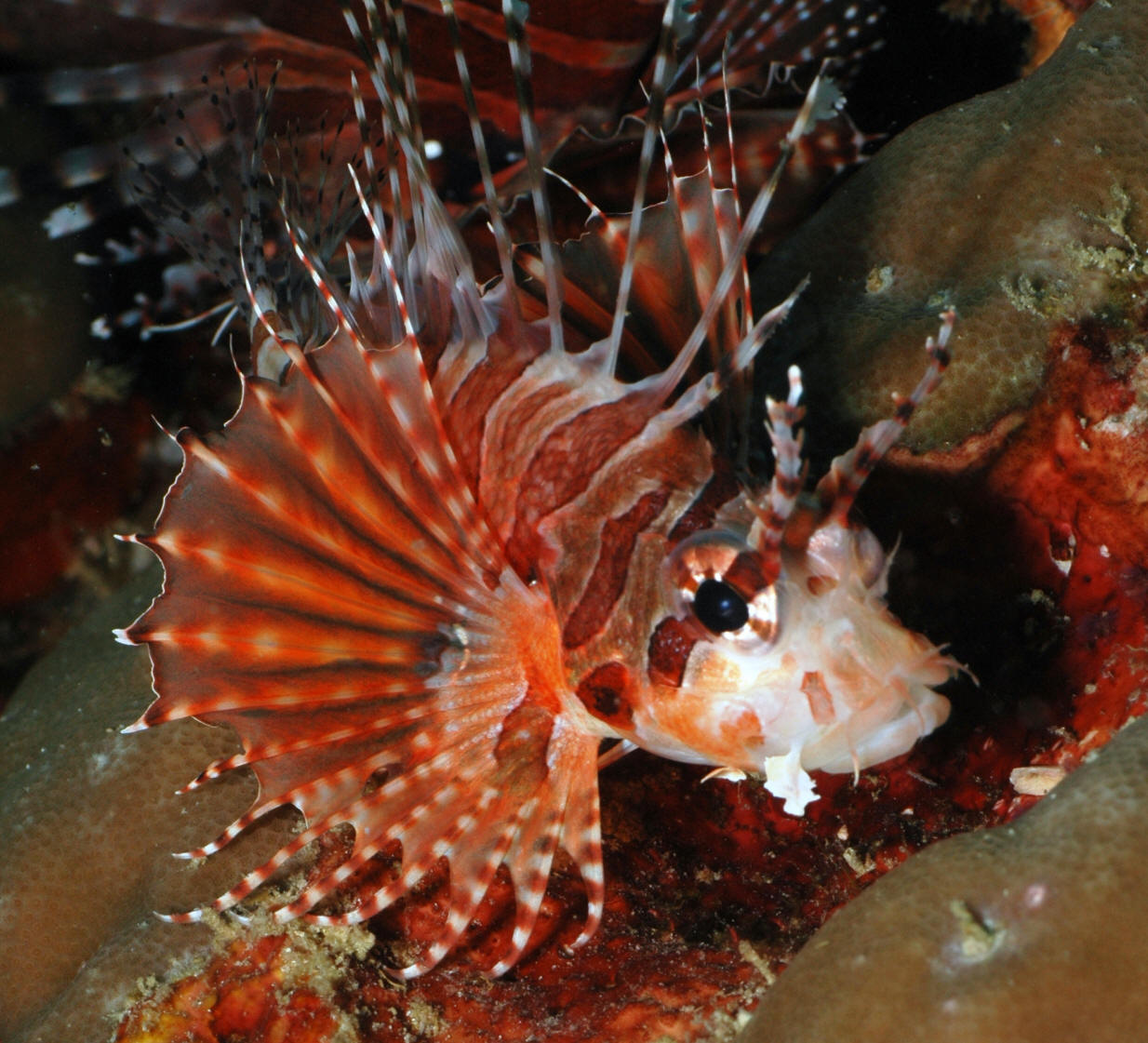 |
| Dendrochirus zebra (Cuvier
1829), the Zebra Turkeyfish, is the most common dwarf lion is
similar in many ways and degrees to P. antennata and P.
sphex. The one sure distinguishing mark of D. zebra is
the presence of two white spheres on it's caudal peduncle. To
ten inches in length in the wild. Indo-West Pacific; Red Sea, East
Africa, to Southern Japan, Australia. Sipadan
08. |
.JPG) |
| Dendronephthya sp.
Indo-West Pacific. Polyps in groups of varying number on the distal
branches of colonies. These are supported by internal and surface
(visible) sclerites. Feed on very fine plankton and dissolved
organic matter. Very difficult to maintain in captivity. Red
Sea 08. |
.JPG) |
| Dendronephthya sp.
Indo-West Pacific. Polyps in groups of varying number on the distal
branches of colonies. These are supported by internal and surface
(visible) sclerites. Feed on very fine plankton and dissolved
organic matter. Very difficult to maintain in captivity. Red
Sea 08. |
|
|