|

Sexing Carinotetraodon
travancoricus,
The Dwarf Puffer
By Amy Janecek
Pufferfish are
one of the most fascinating groups of aquatic creatures out there. Between their
puffing abilities, unique swimming methods and intriguing personalities, they
have quite a following. As more fish keepers strive to successfully keep and
spawn Puffers, they discover one of the largest challenges… accurately sexing
the fish and convincing a group to live together in harmony, or at least
tolerate each other. A very large portion of the Puffer family does not display
any externally visible gender differences, and co-specifics are extremely
aggressive to their tank mates, opposite sex or not. Therefore, a successful
pairing is extremely difficult, and attempts to keep pairs or groups often
result in injured puffers and a distraught fish keeper. As a result, many Puffer
owners have resorted to keeping their fish as singletons.
Luckily for us, Carinotetraodon travancoricus is
one of the few species of puffer that can be accurately sexed, housed with
co-specifics and successfully spawned by the home aquarist. The Dwarf Puffer,
also known as the Pea Puffer, Pygmy Puffer and occasionally the Malabar Puffer
is a small freshwater Puffer found more and more often commercially. While Dwarf
Puffers are considered to be somewhat less aggressive towards tank mates than
other Puffer species, they are still Puffers and can inflict some impressive
damage on any and all tank inhabitants. One of the key aspects to successfully
keeping Dwarf Puffers, whether your goals are breeding or simply a stable
display tank, is to stock the puffers at a 1:2 male to female ratio. In other
words, have at least two females for every one male in the tank, and provide a
minimum tank size of 3-5 gallons for each Puffer.
This sounds easy enough. However, as any experienced
fish-shopper has found out, most of the fish sold in commercial stores are
juveniles. Dwarf Puffers do not display their adult sexual characteristics until
they are nearly full grown, usually between .5” to 1” in body length. When they
are smaller, it is more difficult to accurately sex the Puffers as both sexes
resemble females in general appearance. As an added challenge, stressed, sick or
frightened puffers will often dull their colors to a point where gender features
are indistinguishable. To the educated eye, however, there are many differences
and accurate sexing is certainly possible.
 |
 |
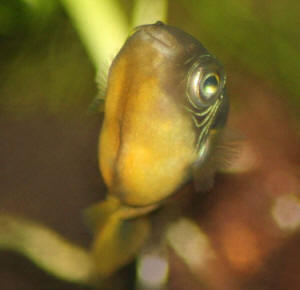
| Male specimen showing yellow
belly color an dark belly stripe. |
Male speciment showing eye
"wrinkles", dark green/yellow body color and striped body markings |
Male Dwarf
Puffers are generally the easier gender to identify. They have several distinct
features females do not. One of the first characteristic features to appear on a
maturing male Dwarf Puffer is yellow body coloring, especially on the belly and
tail. Males also have “wrinkles” around their eyes; markings that almost look
like iridescent cracks in the skin surrounding the eye socket. A dark belly
stripe, running from just under the chin to the anus, is another easily visible
male characteristic. The male body color is often darker shades of green
on the top half of the body, fading into the yellow belly color. The
spotted markings will blend with age into lines resembling blotchy stripes
running laterally down the sides and into the tail of the puffer as it matures,
instead of the random, isolated spots of a juvenile or female. Males will often
“display” to the females and other males, raising up a crest along their top
line and darkening their body colors to an olive green.
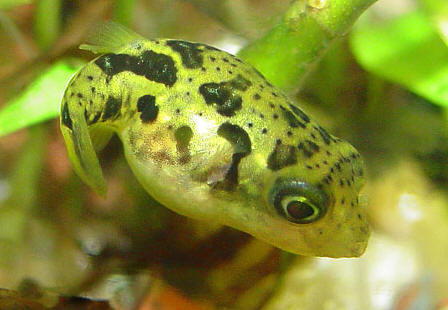 |
| Female specimen showing rounded
belly, lighter coloration and random spot markings. |
Female Dwarf
Puffers are less streamlined, with rounder bellies and slightly larger bodies
than males. Their markings will differ with each individual fish, but often
remain similar to juvenile colors and markings. The body spots are generally
isolated round or irregular, in no distinct pattern. The lower body is generally
white or light colored, with no belly line running down the center, or
“wrinkles” around the eyes. Females are often less shy and more active than
males, spending most of their time on the search for anything edible.
Using these identification guidelines, it should be
relatively easy to set up a properly stocked and acceptably peaceful Dwarf
Puffer habitat that will keep you entertained, amused and interested for years
to come.
For more information on keeping this and other puffer
species, visit www.ThePufferForum.com.
|
This genus of pufferfish includes a number of small, strictly freshwater
pufferfish from South and South East Asia. Apart from their size, the
most characteristic feature of this genus is pronounced sexual
dimorphism: the makes are usually much more brightly coloured and
invariably posses erectile ridges along the belly and back. In fact, the
scientific name of the genus, Carinotetraodon, comes from these
structures, karina meaning ‘keel’ in Greek. When males are
displaying to females, or threatening one another, they raise these
keels, presumably to make themselves look more imposing. Both sexes can
puff themselves up in the normal manner when alarmed, just like other
pufferfish.
Although Carinotetraodon spp. are territorial and snappy towards
one another, like most other pufferfish, their small size makes it
possible for multiple specimens to be accommodated in a sufficiently
large aquarium. Under such circumstances, males and females will
eventually pair off, and following some fairly rough courtship behaviour
they will spawn, often in a thick mass of Java moss. The male will then
drive off the female and guard the eggs until they hatch, which normally
takes about three days. Once the fry are free swimming, after another
couple of days, they will accept tiny lived foods, such as microworms,
and after a week or two they can be weaned onto newly hatched brine
shrimp and small Daphnia.
There are three species of Carinotetraodon regularly traded, of
which the most common is probably Carinotetraodon travancoricus,
an Indian species often simply called the dwarf puffer. It is indeed a
tiny fish, barely 2 cm long when mature, and a densely planted 40-litre
(10 gallon) aquarium will comfortably house a single make and three
females without much risk of aggression between them. Unfortunately,
males and females are very similar when young; so sexing the fish in
your retailer’s tanks is difficult. However, once mature, sexing them is
quite easy: while both fish have a dark band along the ventral surface,
the male’s is much darker. Males may have stronger overall colouration
as well, particularly when spawning, but this is an unreliable indicator
because there is so much variation in the colouration of these fish
anyway. Besides variation between specimens, individual fish can also
change their colours depending on their mood.
Carinotetraodon travancoricus are
confirmed fin-nippers, and keeping them with tankmates such as small
tetras or barbs is a bit of a gamble. On the other hand, they generally
get along well with dwarf suckermouth catfish (Otocinclus spp.)
and freshwater shrimps (Caridina spp.). As far as feeding goes,
these fish are very adaptable, and will take all kinds of live and
frozen foods, including small snails, bloodworms, clean Tubifex
worms, and Daphnia. Brine shrimp are a good treat and willingly
taken, but their nutritional value is low so they shouldn’t be used as a
staple. One nice thing about Carinotetraodon travancoricus is
that it is predominantly day-active, and is in fact remarkably outgoing
given its size. It is also very tolerant of water chemistry, doing
equally well in both slightly soft and acidic conditions and moderately
hard and alkaline ones. As with all pufferfish though, it does not
appreciate rapid changes in pH and hardness, and is very intolerant of
nitrite and ammonium. Provided they are kept in a well-filtered, mature
aquarium, these are lovely fish, and excellent oddballs for the aquarist
with only limited space.
Less commonly encountered is the red-eye puffer, Carinotetraodon
lorteti. Found throughout much of South East Asia it has been known
to the hobby for decades, often being traded under an old name,
Carinotetraodon somphongsi. Though well know, its availability has
been patchy, almost certainly because its high level of aggression and
persistent fin nipping make it impossible to keep in a community tank.
In terms of basic requirements, this species is comparable to the dwarf
puffer in most respects, though being a larger fish it does need a
bigger aquarium. A matched pair may be housed in a 40-litre (10 gallon)
aquarium. Males are easily distinguished from females by their colours;
males are basically brown with mustard yellow stripes across the head
and back. The belly is cream-coloured belly except for a reddish stripe
across the keel running from just behind the mouth to the base of the
anal fin. The tail fin is greenish-blue and fringed with a thin white
band. Females are attractive but in a different way, sporting a mottled
pattern of light and dark brown above and off-white below. Both sexes
sport red irises, from which comes their common name.
The
least widely seen of the three popular Carinotetraodon species is
the red-tail puffer, Carinotetraodon irrubesco. It is sometimes
muddled up with the red-eye puffer, and females of the two species are
virtually identical, the only obvious difference being that female
Carinotetraodon irrubesco bear thin brown stripes on the belly that
female Carinotetraodon lorteti lack. Male Carinotetraodon
irrubesco can be immediately recognised by their red tails, but they
also have red dorsal fins and the lighter bands on the dorsal surface
are tan coloured rather than yellow. While it is a toss-up which of the
two species is the more attractive, Carinotetraodon irrubesco
definitely has the advantage as far as personality goes. It is
relatively peaceful and can be kept with a variety of other fish,
provided slow moving species with long fins are avoided. My own species
seem to get along well with cardinal tetras, gobies, Otocinclus,
and juvenile halfbeaks.
Two
additional species of Carinotetraodon are traded very occasionally, the
Borneo red-eye puffer, Carinotetraodon borneensis, and the banded
red-eye puffer, Carinotetraodon salivator. Male Borneo red-eyes
are similar to C. lorteti but the with greenish-yellow banding
instead of bright yellow and they also have a distinctive blue tail.
Female Borneo red-eye puffers are essentially identical to female C.
lorteti, though the colour banding on the back may be a trifle more
yellowy. Banded (or striped) red-eye puffers are easy to recognise
because of the vertical banding on the head and body. These bands vary
in intensity, being most obvious on spawning males, but even on
quiescent males should be apparent. Female striped red-eye puffers look
a lot like female Carinotetraodon irrubesco. Unfortunately, males
of these two species are extremely aggressive, both towards
females and other fishes in the aquarium. Aquarists intent on spawning
these fish, should they be lucky enough to obtain them, will almost
certainly need to condition the female apart from the male, and only
introduce the male when she is carrying eggs. Even then, there are no
guarantees that they will spawn, and separating the fish if things turn
nasty will be essential. |
| Dwarf & Other FW Tetraodont Puffers on WWM:
Freshwater to
Brackish Water Puffers &
FAQs 1,
FAQs 2, FAQs
3,
FW Puffer Identification,
FW Puffer
Behavior,
FW Puffer Selection,
FW Puffer Compatibility,
FW Puffer
Systems,
FW Puffer Feeding,
FW Puffer Disease,
FW Puffer
Reproduction, & Brackish:
BR Puffer Identification,
BR
Puffer Selection,
BR
Puffer Compatibility,
BR
Puffer Systems,
BR
Puffer Feeding,
BR
Puffer Disease,
BR Puffer Disease 2,
BR
Puffer Reproduction, &
Puffers in General,
True
Puffers,
Alone But Not Lonely: The Importance of Keeping Puffers Individually
by Damien Wagaman
Green
Spotted Puppies, er… Puffers
by Jeni Tyrell (PufferPunk) &
FAQs,
Carinotetraodon travancoricus, Malabar or Dwarf Pufferfish
FAQs,
Tetraodon mbu, the Mbu Puffer &
FAQs,
Tetraodon miurus, the Congo or Miurus Freshwater Puffer
FAQs,
FAQs on:
Tetraodon schoutedeni, the Congo, Spotted Congo, Leopard Puffer,
The Pig-Nose or
Arrowhead Puffer, Tetraodon suvattii, miraculously malicious by Heather
Cooan &
FAQs,
Small Puffer Dentistry By Jeni Tyrell
(aka Pufferpunk) &
FAQs,
(Big) Pufferfish
Dentistry By Kelly Jedlicki
and Anthony Calfo &
FAQs,
|
|
|