 |
|
| Home | Marine Aquariums |
Freshwater Aquariums |
Planted Aquariums |
Brackish Systems |
Ponds,
lakes & fountains |
Turtles & Amphibians |
Aquatic Business |
Aquatic Science |
Ask the WWM Crew a Question |
| Please visit our Sponsors | ||||
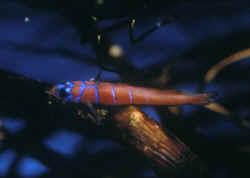
Re: flatworm ID... Cool Water Marine Systems 10/1/07 Mich, <Hello again!> Thanks for the reply! <Welcome!> The flatworms are neat, but you're right, they're dangerous. <Not necessarily dangerous, but can get to be an issue.> You were working late last night, <Ahh, yes... I am quite the night owl.> hope you have the weekend off. <Yes! YAY!> I thought I'd reply and answer your question about the temperature. <Wonderful... glad you are sharing I know naught about these systems.> I guess you can call this a "cool-water" tank. I set it up earlier this year with all intentions of making it a sub-tropical tank with temps between 65 and 68 F. I planned it around seahorses either H. breviceps or H. whitei. Unfortunately, as soon as the tank was ready, those species were no longer available commercially in the US. <Figures.> I know some hobbyists who are keeping them, but not raising fry. Sad, really, because the fry are benthic (demersal) and relatively easy (when it comes to seahorses). <Perhaps there are individuals who are breeding these lovely creatures... Have you tried www.seahorse.org ?> I am keeping it at 70F right now for my Catalina gobies <Beauties!> and some tropical things I got greedy about. <Heehee!> I feel that this is too warm for the gobies. I don't understand why even reputable dealers insist that these fish can survive long term in warmer temps. <A shame.> It's a simple lie. <You are absolutely correct here my friend. I respect and understand your frustrations here.> I'm in the middle of moving, <I hope to be soon as well.> so once I get all settled, all the tropicals will be moved into their reef, and the subtrop tank will go back to its normal 65*. With nothing but a pair of Catalina gobies, because I can't find any cold-water dealers. <You may have more luck with individual hobbyists. I presume you have seen this link http://www.wetwebmedia.com/cold.htm > From what I've heard, it's hard to get a permit to collect off of the coast of CA. <I am unfamiliar with CA regulations on this issue... Check the daily Q & A for possible comments from RMF. http://www.wetwebmedia.com/daily_faqs3.htm > <<Harder all the time. RMF>> Steve Weast has a phenomenal cold-water tank (very cold, he keeps it in the 50's), <Brrr!> but he collected himself years ago. <Neat!> I have really been hoping that cool-water set ups would take off and become more popular; they are cheaper to run than photosynthetic reefs. <And can be quite beautiful. I saw some very pretty ones this year at the Shedd Aquarium in Chicago with my friend and fellow crewmate Jorie.> Do you fellows know of any place where I could at least pick up some subtropical live rock? <I do not. Hopefully RMF may comment here as well. Thank you for sharing. Mich> <<Do have your dealer/s contact the "usual suspects" wholesalers in the LA area... They can contact the people who are licensed, do this collecting. Bob Fenner>> Catalina Gobies spawning? 2/6/07 Hey Crew! <Darby> A week or so ago y'all schooled me on my tank ( a NanoCube 24). Since that time, I have found a new home for a Lawnmower Blenny, reduced the number of snails and hermit crabs (given away, not "force evolved"), <Interesting term> and I have stabilized my water temp at 74*F. It is currently so low due to the trio of Catalina Gobies, for whom I am searching for a new home. Despite the low water temp, my polyps and shrooms are doing well, as well as my Potters Angel (who refuses all food except for green sheet algae placed in a very particular spot, which he devours like it is going out of style). <You are fortunate> This morning, I noticed that a pair of the Catalinas were guarding a hole in the side of a rock, even going after the Potters when he came near. Inside the hole I can see some peachish colored spheres, which I take to be eggs. To me, however, they look to be too large to have come from such a little fish. <Mmm, do "swell up" over time> I was thinking about setting up a 10gal cold water tank for the Catalinas, but fear that may now be out of the question. I've been able to find very little on the breeding of Catalinas, and would appreciate any finger pointing, directions, advice, or general ramblings that may aid these little guys and what I hope will be their brood. Darby <I would be getting on down to a large (college) library re culture of food organisms for Lythrypnus dali young... and leaving all the fishes in place for now. Bob Fenner> Re: Catalina Gobies spawning? 2/6/07 Thank you for your reply Bob. Right now I'm sure wishing that I was living back in San Diego again, as I'm betting the libraries there would have some great stuff (as well as taping into Scripps and the Birch). <The Birch/SIO library is an absolute treasure... and vastly underutilized... Ssssshhhh> This morning I notice that almost half of the eggs have gone missing. I know that my Peppermint shrimp was out cruising last night, and also a couple of hermit crabs, and that the Catalinas had bedded down in a cleft nearby. Could the shrimp and crabs have eaten some of the eggs? <Oh yes...> Thanks again, Darby <BobF> A little good news'¦ Keeping the Catalinas Cool! 3/21/07 Hey there, <Hi there!> As I have plagued you Crew with questions and concerns, I just thought that I'd pass along a little good news! <Yay! Good news! Whoohoo!> I had some Catalinas that hatched a clutch of eggs in a warm tank. <Yes, I remember.> Only 2 fry survived the ravages of community tank life (dang Peppermint Shrimp and Damsel!) before I could get them out. <Yes, I remember this too.> I was able to give them to a buddy who has a much cooler tank, and the two fry are now living it up in splendid luxury and...er... coolness. <YAY!!! Responsible reef keeping... or not keeping!> They even have buddies, as his Garibaldi has spawned, and about a dozen fry have made it. <Sweet!> (No idea how he came by the Garibaldi by the way, as Texas a long way from our old San Diego stomping grounds. <I saw one this weekend at a LFS in Pennsylvania.> Aren't they still protected? <Mmm, don't know... RMF?> He also has a small Sheepshead, but don' t tell anyone! <His secret's safe with me... I can't speak for the other 20,000 or so users we have per day!> Anyways, the Catalina fry are doing superb, and growing quickly. <Excellent!> Someday soon they'll make their way to his "So Cal" display tank, and there will be much rejoicing. <*twirls finger in the air* yaaay. -Mich> Darby Potters Angel <Lawnmower Blenny and Catalina Gobies> in Possible Danger Related to Lack of Research. Howdy! <Hey there!> I'm not sure where to start, so I'll start from the top and be very verbose (my apologies).... <No apologies my friend.> 2 months ago I set up a brand new "NanoCube 24" by JBJ (24 gal) with about 30 pounds of live rock, and 2 bags of live sand. The rock came from a friends 75gal, which he had for 6 years. There is about 16 gal of water in the tank (at a guess) and it has been doing fantastic. <OK.> I let it cycle for about 3 weeks, then inserted my test pilot, a small Yellow Tail Damsel, who also did great. <Not the most ideal means of cycling a tank. Please read here for future reference: http://www.wetwebmedia.com/estbiofiltmar.htm > The following week, the insanity overtook me, and I had a trio of Catalina Gobies, 5 different button corals, and few very pretty mushrooms delivered. <Mmm, yes, insanity and impatience. My, this is not a good mix. Catalina Gobies (Lythrypnus dali) are a cool water species, preferring water temps between 64-71 F. Please read here: http://www.wetwebmedia.com/lythrypnus.htm Your corals are found in tropical waters. An appropriate temperature would be around 78-79 F.> The mushrooms were in baaaad shape, most having detached from their strata and curled into spit wads. <Is that the technical term?> Currently, 1 is doing great, 2 are doing ok, and the other 2 are loses. <See temperature suggestion above and below.> The button corals have their days where they are wide open, and their days where they are partially open.... <See temperature reference above and below.> At this point, all of the fish were doing great. Some hermit crabs and snails were added to help with some algae, eventually swelling to 16 crabs (tiny blue legs, zebra, Scarlets, and some normal Mexican red legs), and about 12 snails of various kinds (the Turbo snails will be exiting the tank in a day or 2, due to their constant tossing of my corals). <A lot of crabs and too many snails for such a small system. High likelihood of starvation for the snails.> 2 weeks ago I inherited a Lawnmower Blenny from a friend, and he too is doing well, though I have never seen a blenny swim freely so much... <He's probably hungry.> He seems to eat well, and everyone gets along. <The minimum recommended tank size is 55 gallons for a Lawnmower Blenny (Salarias fasciatus). The Blenny may starve in systems that are not well established or have insufficient algae growth. Your system is too small and too new to be an appropriate home for this fish. I would try to find a more appropriate home for this fish.> A small peppermint shrimp also came with the blenny. <OK.> 4 days ago, my girlfriend heard me say "That is a beautiful fish. I wouldn't mind getting one at some point, like when I have a 75..." at which point she wandered off to look at the puppies. When I got home from work the following evening, she surprised me with that beautiful Potters Angel acclimating in his bag in my 24! I was delighted, yet also totally freaked out. I called the pet store, and they wouldn't take him back. Now, they had him for 2 months, and he has done better than any other Angel (save a little Eblii they had). I took about 2 hours to acclimate him, and during the transfer from bag to tank, my dog barked, which surprised both me and the fish. He became tangled in the net due to that gill spike, and it took me about 2 minutes to extricate him with very small scissors snipping the net. <Aye!> Since then, he has been very active in the tank, and was nipping at the glass, rocks, and strands of algae the very next morning. I've recently done a profusion of reading, and I am in fear that he won't last in my little 24. So far, he seems very happy, but only eats off of the rocks, and occasionally nibbles at the dried seaweed I clip in. No one chases anyone around, and it is a very peaceful tank with everyone mingling and swimming about, including the Potters. I change out about 2-3 gallons every 3 days, using RedSea for my salts. and the daily temperature beings at 72*F in the morning, at is usually at 75.5*F in the evening when I turn off the light. <This water temperature and its fluctuation is less than ideal for your system, best to keep temps stable and warmer, 78-79 F.> I've been able to keep "perfect" water quality, with almost nonexistent Nitrite and Nitrate, and the KH is at the optimum level. My question is... what can I do to keep this fish happy and alive? <Actually the Potter's Angel (Centropyge potteri) is the most appropriate fish you currently have in your tank. I would try offering some well-rinsed frozen foods soaked in Selcon several times a day. The problems lie with the Blenny and Gobies. Your system is not an appropriate home for either. The gobies do not belong in your system. They require a cool water setup. The gobies need to be relocated to an appropriate cool water home. The blenny should be kept in a larger more established tank.> I've called a few stores in the area, and the only one willing to take him off of my hands will only take him for free. I'd hate to break my wonderfully misguided gals heart by giving her gift away, and I do like the Potters so.... Any advice or help would be GREATLY appreciated. <Your girl seems to have done more homework regarding appropriate choices for you system than you have my friend. She is not as misguided as you may think. Her selection is more appropriate than your selection of a Lawnmower Blenny and Catalina Gobies. Your water temperature should be higher and more consistent. You have too many snails and quite a few hermits which will compete with the angel for algae. Please do more research before making purchases. The lives of these amazing creatures are solely in your hands. You may want to consider a book by Robert M. Fenner titled "The Conscientious Marine Aquarist" to help you on your journey. I think you will find it most helpful. It is a book I continuously reference. It is money well spent. Thank you, Darby <Welcome. -Mich> Re: Potters Angel <Lawnmower Blenny and Catalina Gobies> in Possible Danger Related to Lack of Research. Mich, Thank you very much for your advice. <Hello Darby! You are quite welcome!> Doing research can be so very frustrating because there are so many contradictory sources out there, especially the people in the shops "who know" and urge you on to get things going quickly. <Yes, it can be a big challenge, but doing your own research is essential to be successful in this hobby. Shame on shops who encourage quickness... the antithesis of appropriate.> I may have found a home for the Lawnmower Blenny, and a good number of the snails will be making an exit this evening. <Very good, as long as they are going to appropriate homes.> I'll continue to look for some place for the Catalinas, as I'd hate for their lifespan to be shortened on my account. <Yes, a shame these fish are occasionally sold as tropical species to well intended folks as yourself.> Perhaps I should set up a second tank ( I have a 10 gal that could be used for that, but it would be too small, except for a refugium). <This might be a good temporary solution. Where they are at now is too warm. The issue here really is temperature. In many places in the world this system would require a very expensive chiller. If you are in a Northerly climate, there is a possibility, but these fish like it as some would say, cool, I would say, brrr... cold.> Another question, if you don't mind: How can I keep the water temperature from fluctuating, without heaters or chillers? <Mmm, you need a heater if you're keeping tropical fish, my friend. These are quite affordable, tiny ones are less than $10 and super deluxe go for around $50. I am shocked that you don't have one. Go get one ASAP. And while you're out, stop at your local bookstore and pick up a copy of "The Conscientious Marine Aquarist" by Robert M. Fenner. This book will be a tremendous resource for you. I reference it frequently. It is money well spent and you will use it as long as you are in the hobby.> I keep my house at a constant temp, so I can only theorize that it is the lighting system raising the temp, which I was assured that the Nanocubes were immune from. These little systems don't leave very much, if any, room to add systems... <Yes, an inherent problem, but add a heater please.> thank you again, Darby <Welcome! Mich> Catalina gobies 1/19/07 Hello Crew, <Paul> I haven't asked a question in a long time but I have been researching and reading your site a little too much. <Heeee, is this possible?> My LFS says Catalina gobies are fine in tropical tanks <Mmm, no> so I thought about purchasing a couple. They told me they have never had problems with them in their tanks. <Time frames... likely have been fine kept for short periods> However I went home and read up a little on your site and the info I came across says they are temperate species. <Indeed Lythrypnus dali is... can see this fact on Fishbase.org, elsewhere...> The information was in an article and was short (a couple of sentences) but stated they will not survive long term in a tropical tank. <Most specimens do not... ones collected in warmer months (all come from the Californias...) do a bit better...> This LFS had quite a few and when I went back they had sold most of them and they swear they will survive in my tank. I declined to purchase them but apparently many people had already purchased them. I have not been steered wrong by your site so I declined (a rare moment of clarity from a bad impulse buyer) but for others Catalina Gobies in tropical tank? Thanks Paul <Thank you for your note. Please find here: http://wetwebmedia.com/lythrypnus.htm an article as yet unpublished in the pulp zines (by me)... Bob Fenner>
Ballad of the Catalina Goby - 10/17/06 Do Catalina blue banded gobies do okay in brackish water? <<No, they are marine.>> I want to put them in a cool brackish tank. General info on gobies and goby relatives always mentions that fishes of these groups are found in brackish as well as salt water but when you actually look at them species-by-species brackish water is almost never mentioned. <<Likely the ones you have researched are marine species.>> Can you tell me the tolerance range and the preferred ideal SG for the Catalina blue banded goby? <<1.023-1.025>> Thanks <<Glad to help. Lisa.>>. Catalina Gobies Thank you for your QUICK response about the "fish capacity". You mention the green brittle stars are fish predators. Are the brown brittle stars fish predators as well? Also, you mentioned that the Catalina goby is a cold water fish. How cold?? Very Respectfully, Wayne >> Less so, but still yes, the Brown Brittlestars are predatory. Catalina gobies (Lythrypnus dalli) collected during the summer months... when the water temp. is a balmy mid to upper sixties will live in water in the low seventies for some time (about half live a month)... the ones collected in other seasons have to be kept in a system with a chilling mechanism. Bob Fenner Keeping Catalina Gobies - 4/13/04 I was wondering about Catalina Gobies. <OK> I have been searching on the 'net, and I found some places that said they are impossible to keep, <What??? If kept at reef temps then yes> nonetheless breed in captivity <They do breed in captivity and were actually some of the first fish farmed in the 70's. They tend to spawn in the summer months (water tends to often be colder than normal due to upwelling> (recommended temp 72-75 F there) <This temperature recommendation would cause extreme stress on this small goby and there is notoriously high mortality rates associated with this goby when kept in a warm water environment> and another said they were one of the best coldwater fish, and are quite easy to breed in captivity (temp. 66-72 F) <At the Monterey Bay Aquarium we keep the water temp around 58 to 60 degrees. We don't often see mating behavior but we are able to keep them full term (approx. 2 years) with very little to nil in the way of disease and mortality. Do quarantine them thoroughly though. Also, be sure to get them from a reputable dealer> I know the second temp is correct, <60 degrees is a good number to shoot for> but what is "proper care" for this awesome species. <Very striking when kept in small schools, the small Catalina Gobies will dart in and out of the rockwork and perch on their favorite lookout in the coldwater reef aquarium. It is not usually an aggressive fish, but may quarrel with con-specifics if housed together in a small tank. An aquarium of 30 gallons or larger is usually suitable. Although it will tolerate a tropical water temperature, (76 to 78ºF will result in higher than normal mortality), the Catalina Goby thrives in the cooler temperatures associated with the island where it is found, Catalina Island, off the coast of Los Angeles, California. Temperatures there range from 58 to 72ºF. In fact, it is quite hardy and disease resistant if kept in the proper environment. In the wild, the Catalina Goby eats small pieces of fish and plant material. In the aquarium, it will consume almost any prepared foods for carnivores, Mysid shrimp, table shrimp, and vitamin-enriched brine shrimp. It should be fed twice per day.> BTW this is Robert from the 900+220 tank. <Glad to meet ya Robert> I would like to have 8-12 blennies <Do you mean gobies?> in the 220, with lots of rock, anemones, crabs, small fishes, Nudibranchs, <careful> 'cukes, <Again, be careful here> macro, LS, and an eel (JK) <Hahahahah. Sounds about right> Thanks in advance. <Thanks for being part of it all. ~Paul> Robert Catalina gobies Hi Bob (or Lorenzo or...), I came across an interesting display the other day at the LFS. the guy had pairs or single Catalina gobies placed throughout his reef section. I figured he was victim of a terrible shipment mistake since he is shown to be (thus far) rather knowledgeable. I asked him & he said: "no, no mistake. I ordered them all." I asked why, since they are all going to go to ill equipped homes, as very few people set up cold water aquariums. He said that these were aquacultured or tank raised (I forget which) and as such, are actually accustomed to warmer water. I have a small tank running @ 76 degrees and was tempted, but it sounds sketchy to me. Is this TR story really BS? <Mmm, as far as I'm aware folks don't raise Lythrypnus dalli in captivity (yet)... though other Gobies are in good numbers (Gobiosoma species). These folks might want to check their invoices, with their supplier... These animals might live at 76 F. for a while... if collected during the summer (the surface temp. off of San Diego, approaches seventy or so, but at depth... it's much cooler (low sixties...)... not a good gamble. Bob Fenner> Catalina Goby Lifespans Just one quick question. Is it true that Catalina Gobies have a short life span? >> Lythrypnus dalli? Historically, in captivity,,, yes... Probably ninety some percent die within a month of collection.... These are cold/cool water animals... can be kept in a biotopic setting (California coast line)... In the wild, they live a few years... Bob Fenner |
|

|
Features: |
|
| Featured Sponsors: |