|
Related FAQs: Caulerpas, Caulerpas 2, Caulerpas 3, Caulerpa 4, Caulerpa 5, Caulerpa Identification, Caulerpa Behavior, Caulerpa Compatibility/Control, Caulerpa Compatibility 2, Caulerpa Selection, Caulerpa Systems, Caulerpa Nutrition, Caulerpa Disease, Caulerpa Reproduction/Propagation,
Green Algae,
Refugiums, Marine Algae ID 1, Marine Algae ID 2, Marine Algae Control FAQs II, Marine Algaecide Use, Nutrient Limitation, Marine Algae Eaters, Culturing Macro-Algae; Controlling: BGA/Cyano, Red/Encrusting Algae, Green Algae, Brown/Diatom Algae,
Related Articles: A closer look at Caulerpa
- Common aquarium species and their care by Adam
Jenkins, Green Algae, Algae Filters
Articles, Macro-Algae of the
Caribbean and FAQs about
them, Avoiding Algae Problems in Marine System,
Algae
Control, Marine Maintenance,
Nutrient Control and Export,
Marine Scavengers, Snails, Hermit
Crabs, Mithrax/Emerald
Green Crabs, Sea Urchins, Blennies, Algae
Filters, Ctenochaetus/Bristle Mouth
Tangs, Zebrasoma/Sailfin Tangs,
Skimmers, Skimmer Selection, Marine Algae, Coralline Algae, Green Algae, Brown
Algae, Blue-Green
"Algae"/(Cyanobacteria), Diatoms, Brown
Algae,
/The Conscientious Marine
Aquarist
Green Algae of the Family
Caulerpaceae
|
|
|
By Bob Fenner
|
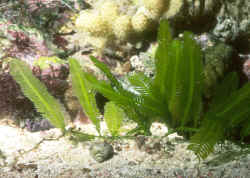
Caulerpa taxifolia
|
|
Feather algae will it be a nuisance? 10/25/07
Yes. Hey Everyone! <Hi Ryan, Mich here.> Been a while since
I asked a question so here goes! I recently moved, and in the
process of moving, the bottom of my aquarium broke out,
<YIKES!> and so bought a much larger aquarium (33 to
a 90) <So not all bad! Heehee!> Anyway, while the new tank
was cycling my corals were being babysat in my father-in-laws
reef. I recently brought a few of my corals home and on a
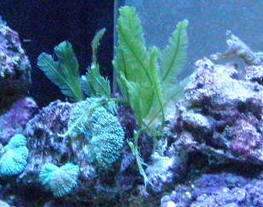
mushroom rock was a type of feather algae. I'll include a
picture as I'm unsure of the species. <Looks like Caulerpa
taxifolia.> Will it be a nuisance? <Yes.> It seems to
grow fairly fast, <Yes it does.> and if I need to get rid
of it, will anything eat it, <Some tangs, if hungry
enough.> as opposed to picking it off? My advice: Start
picking! And try to remove in as large and intact of pieces as
possible to avoid further spreading.> My father-in-laws
tank is quite grown over with the stuff. <I'm not
surprised. I just had a discussion about this tonight with
ScottF. This stuff is way too easy to lose control over IMO. Once
it gets into the display it can be a real pain to eliminate. I
would be diligent with its' removal.> Any info would be
much appreciated!<More info here:
http://www.wetwebmedia.com/caulerparepro.htmhttp://www.wetwebmedia.com/caulerpacomp.htmGood
luck! Mich> ~Cheers! Ryan
I am asking again. Will you PLEASE put something else in
this box. I don't even want to refer people to this page.
http://www.wetwebmedia.com/caulerpaalg.htm Caulerpa
taxifolia, one of the best species of the best genus of algae for
marine aquarium use. How about something like this for an
alternative: Caulerpa taxifolia, Excellent for nutrient export
but not without problems. OR Caulerpa taxifolia, Excellent for
nutrient export but not problem free. OR Caulerpa taxifolia,
Excellent for nutrient export but can create it's own set of
problems. This stuff is a PITA IMO. I have gotten it into the
main display and what a headache! At least give people a
warning... not that half will read it anyway but surely there
will be some who do! Thanks,
Michelle
<Have no time... Will post this. B>
|
|
|
These multi-shaped macro-algae deserve
their title as "most popular". It might sound bizarre, but
these are the largest single-celled organisms in the world; and their
so good-looking, they appear artificial (!). Caulerpas grow
prolifically in established aquaria, often to the point that they have
to be routinely thinned to prevent overcoming other tank
inhabitants.
Most Caulerpas look like creeping vines with alternating
leaf-like projections emanating from their two-dimensional profiles.
Their 'holdfast' organs provide anchorage in the gravel and on
solid decor. As all the pieces tied together are of the same organism
(actually all one cell), take care not to
break off their interconnecting strands. This often results in the
severed section disintegrating.
Several of the seventy or so species are available
through retail, mail order and culture facilities. The most popular are
the changeable, grape-like Caulerpa racemosa, feathery
Caulerpa sertularoides, Caulerpa taxifolia, and
Caulerpa mexicana, and the solid-bladed Caulerpa
prolifera.
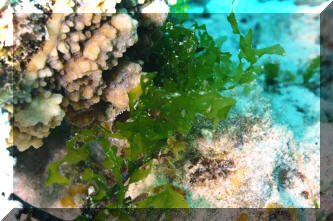
| Caulerpa brachyphus
Mauritius 2016 |
|
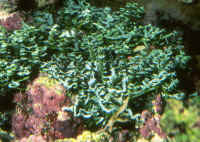
| Caulerpa cupressoides
|
|
| Caulerpa ethelae. Mauritius 2016, Di
pic |
%20MD.JPG)
|
Bigger PIX:
The images in this table are linked
to large (desktop size) copies. Click on "framed" images
to go to the larger size. |
|
%20MD.JPG)
|
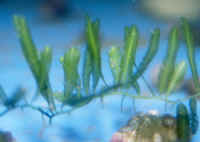
| Caulerpa mexicana Sonder ex Kutzing
(see AlgaeBase) |
|
Bigger PIX:
The images in this table are linked
to large (desktop size) copies. Click on "framed" images
to go to the larger size. |
|
%20MD.JPG)
|
| Caulerpa paspaloides; Cozumel 2016 |
%20MD.JPG)
|
Bigger PIX:
The images in this table are linked
to large (desktop size) copies. Click on "framed" images
to go to the larger size. |
|
%20MD.JPG)
|
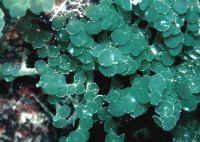
| Caulerpa peltata, Queensland,
Australia. |
|
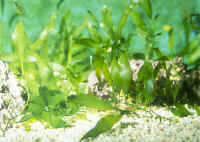
| Caulerpa prolifera, likely
the most common species (of many) in use in marine aquariums.
Originates out of both coasts of the Atlantic in warm waters and
the Mediterranean. |
|
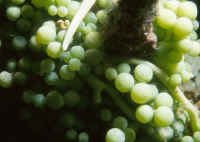
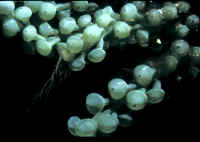
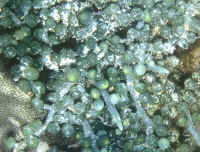
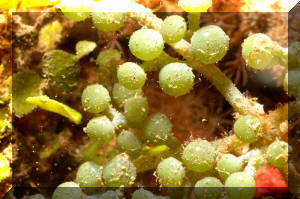
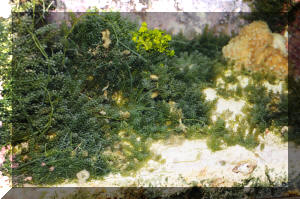
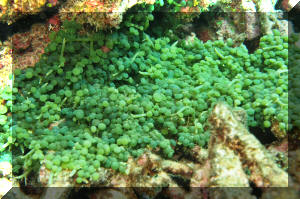
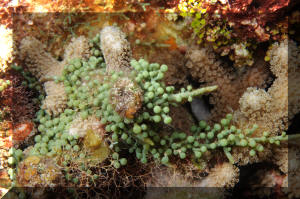
| Caulerpa racemosa, (Forsskal) J. Ardagh. Green Grape
Algae. At right in Hawai'i. Below: A close up
and not in Cebu, P.I., and Cozumel |
|
Bigger PIX:
The images in this table are
linked to large (desktop size) copies. Click on "framed"
images to go to the larger size. |
%20MD.JPG)
 |
|
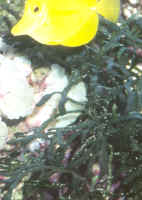
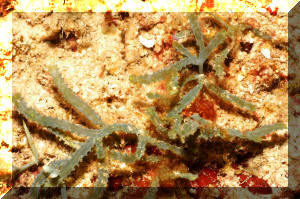
Caulerpa serrulata
Aquarium image.
|
|
Bigger PIX:
The images in this table are linked
to large (desktop size) copies. Click on "framed" images
to go to the larger size. |
.JPG)
 |
|
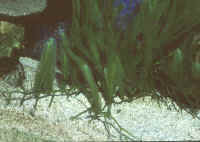
Caulerpa sertularioides
Aquarium image and Belize images
|
|
Bigger PIX:
The images in this table are linked to large
(desktop size) copies. Click on "framed" images to go to
the larger size. |
|
%20MD.JPG)
|
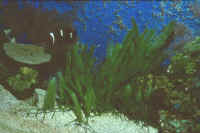
| Caulerpa taxifolia, one of the best species
of the best genus of algae for marine aquarium
use; though an extreme pest when/where (mis) introduced in the wild.
RELEASE NOTHING from your care into native habitats, EVEN if it occurs there
naturally. Mixed w/ other, non-indigenous species, such introductions can
easily spread contaminants, parasites, pathogens. |
|
Bigger PIX:
The images in this table are linked
to large (desktop size) copies. Click on "framed" images
to go to the larger size. |
|
%20MD.JPG)
|
|
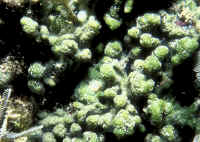
Caulerpa webbiana
N. Sulawesi image.
|
|
Bibliography/Further Reading:
Baugh, Thomas M. 1988. Caulerpa prolifera; an attractive
species which does well in the marine aquarium. FAMA 5/88.
Brawer, Marc. 1971. So you want to keep marine plants.
Marine Aquarist 2(2):71.
Brelig, Allen. Plants in the reef system. FAMA 6/93.
Caribaldi, Lou. 1973. Seaweeds are not weeds. Marine
Aquarist 4(4):73.
Giovanetti, Thomas A. 1989. Caulerpa enemy of the
miniature reef aquarium? FAMA 10/89.
Hoff, Frank. 1988. Coral reefs of Florida, part II; the
algae. FAMA 1/88.
Hoff, Frank H. 1983,84. Marine algae of the genus
Caulerpa, parts 1,2. FAMA 10/83, 4/84.
Jacobs, William P. 1994. Caulerpa; this tropical alga is
the world's largest single-celled organism. yet it differentiates
into a complex structure of leaves, stems and roots. Scientific
American 12/94.
Kraft, Herbert. 1959. A step forward for marine
aquarists; Caulerpa prolifera, a plant for salt-water aquaria. TFH
5/59.
Mancini, Alessandro, translated by Paolo Macedone. 1995.
Tropical algae of the genus Caulerpa Lamouroux, 1809. FAMA 6/95.
Mayland, Hans J. 1975. The leafy algae, Caulerpa
prolifera. Marine Aquarist 6(4):75.
Smit, George. 1987. The ecological marine aquarium, part
four; the use and benefits of live rock and Caulerpa in marine
aquariums. FAMA 8/87.
Sprung, Julian. 1989. responding to questions re the
sexual reproduction of Caulerpa in captive systems. FAMA 2/89.
Thiel, Albert J. 1988. Keeping and growing marine
macro-algae. FAMA 8/88.
Tullock, John H. 1983. Growing marine 'plants'.
FAMA 3/83.
Wilkens, Peter. 1992. Green water in the aquarium; the
sexual reproduction of Caulerpa algae. TFH 2/92.