 |
|
| Home | Marine Aquariums |
Freshwater Aquariums |
Planted Aquariums |
Brackish Systems |
Ponds,
lakes & fountains |
Turtles & Amphibians |
Aquatic Business |
Aquatic Science |
Ask the WWM Crew a Question |
| Please visit our Sponsors | ||||
Learning to use WWM, coral colour change from
dealer... 8/8/11 To Cover Or Not To Cover; That Is The Question --
12/16/10 stony coral... nutr., school question 11/28/10
Carbon dosing or Too Much Light? (I definitely don't
think the latter here) -- 04/08/09 Re: Carbon Dosing or Too Much Light? (I definitely don't
think the latter here) -- 04/09/09
Smoke (from the coral... a fire in the sky...) 08/23/08
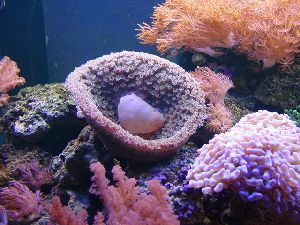
Hello, My friend Marc posted this video up on Reef Central and I
thought that you guys would be the smartest plan of attack to ID it.
There is ?smoke? coming out of this coral and he doesn?t know what it
is. This is the second time it has happened. The inside of the Monti
?blob? is hollow as he states in the video so really anything could be
living in there. I truly think something is spawning, but do you have
any notions? <Hmm, I agree. Something is spawning. My guess would be
a bivalve living in/under the coral (which is not unusual). Once I was
fragging a Faviid of mine and was a bit shocked to find several (decent
sized) bivalves living inside it (no parts of which I had never seen).
I took them to Ron Shimek and he told me they were indeed living
bivalves (err... not so living by the time he saw them, but had been
living in the coral). So, apparently, it's not uncommon for them to
be living in/under corals, even if we can't see them. And if they
are there, I assume they have an outlet/inlet to the water and that
they must spawn somehow. Thus, that's my "educated"
guess.> http://melevsreef.com/video/smoke_part2.wmv Jessica
<Best, Sara M.> Weird Tank Happenings, For Good Or Bad? (All Sounds Good To Me)... Scler. beh. - 01/19/08 Hey "guys" it's actually been a while this time!! <<Hi there Ryan!>> I've had some odd things going on in my tank recently. <<Oh?>> Mainly, my corals are changing color, it's quite interesting, to me anyway. <<Changing…how so?>> Here are my tank parameters and specs that have remained unchanged for months. Ammonia 0, nitrite 0, nitrate 0, phosphate 0 (per Salifert), calcium~400, alk 10 dKH, temp. 80, SG 1.026, Mg a little low at 1150. My lighting is 2- 250 watt XM10K MH supplemented by 130 watts of actinic T5's. Turnover rate is about 56 times per hour on a 92 gallon tank with a 30 gallon fuge/sump. <<Yowza…a high energy zone indeed! (and not to be interpreted as a bad thing)>> This tank is mainly setup for SPS corals. <<Excellent>> So here's what's happening. My blue/green Acropora tortuosa has changed from green and blue to a really strange bluish red with ice blue tips. My green slimer has changed from totally dark green to a red, I'm not kidding, it's actually turning red. <<Odd…and very cool>> My Favites brain changed from green and brown to neon green and yellow. <<Neat>> My Favia which is red, has been showing rapid growth, splitting it's mouths to create more "polyps" and expand. Pocillipora has gone from dark green to a more pastel colored greenish yellow. Most interesting to me is the Acropora granulosa that has changed from kind of a bleached green to a red color. <<Hmm, here seems to be a trend here…(red)>> As you can tell things are changing to a red hue. <<Ah yes!>> I have other Acroporids that have remained unchanged, which makes me even more confused. <<Not a concern I think>> It was suggested to me that my tanks nutrient level has decreased allowing the corals to change to a color that absorbs less light (not an exact quote). <<I can't say exactly what, but yes, this is essentially correct…though not necessarily a result of a "decrease" in nutrients>> I was wondering if you had any ideas of what could be happening here? <<I'm sure you are aware that many of the corals we keep develop their coloration based on the parameters of their environment. I believe that (some of) your corals are simply reacting/adjusting to available foods/feedings, bio-minerals, soluble Nitrogen products, lighting…and oh yes, water movement! This happens in all marine systems (natural and captive), and you seem to have happened upon a combination of elements and husbandry practices that are intensifying/changing your corals in a very positive/pleasing manner. The fact that "all" your specimens are not reacting is not unusual…different strokes…>> I would also like to add that I have Cyanobacteria which I've had for a year or more, so I am not nutrient free. <<Indeed…and if you were these changes would be different…and likely not so pleasing. Reef organisms "require" many of those elements upon which we spend much effort and money trying to "strip" from our systems. The key is not total elimination, but rather, finding a "balance" of elements that meet the needs of our desirable organisms without allowing "uncontrolled" proliferation of undesirable organisms (e.g. - nuisance algae, Aiptasia anemones, Cyanobacteria, etc.). The presence of a small measure of these "undesirables" does not mean failure as a reef keeper…and certainly is no cause for panic/drastic measures that often cause more harm in the long term (e.g. - dosing antibiotics). But I digress…[grin]. Do also consider these changes may in no small part be due to the heavy water movement in your tank which allows the corals to more effectively feed and shed metabolites, as well as increasing access to the "available" organic nutrients and other needed elements such as oxygen>> Thank you for any ideas, Ryan <<Happy to share. Eric Russell>>
Pavona/Montipora identity questions... 10/23/07 Hello crew, <Chad> I bought a nice piece of plating metallic red/orange Pavona this weekend and I'm wondering if it has the same potential growth rates as a plating Montipora. <Mmm, no. The Acroporid has a much greater growth rate potential> The polyps are quite large and I have read that they do not need additional feedings, is this true? <Not IMO... I would purposely feed all captive Scleractinians> I have a 250 MH lamp (10,000 K) shining on it. I believe both the Pavona and Montipora came from Tonga. <Possibly, yes. Both genera are collected from this island nation> The Montipora was sold to me as a "Superman morph" that has not morph yet since being out of the ocean. <Interesting terminology> To be honest I'm not sure if it is even a Montipora once I saw some of the polyps come out. This is an encrusting piece that is purple with purple polyps but the polyps look exactly like miniature start polyps. They even have the white dot in the middle of them. Do you have any idea without a picture what this could be? <Not really> The encrusting flesh is not as soft as the star polyps but very similar being purple and encrusting but hard like Montipora. Thanks for any additional information you can provide. I have done plenty of research on the internet but to no avail. That is why I seek council from the best. Thanks, Chad <Perhaps a set of J.E.N. Veron's "Corals of the World" for Xmas... Bob Fenner> Question...if you have time. Corals, zooxanthellae relations, respiratory physiology 1/9/07 Ok, it is a long thought process and I might have to do it in a series of questions with each answer if that is ok..... <Okay> If the Zooxanthellae in a coral, through cellular respiration uses carbon dioxide and light to produce sugars, is it then producing oxygen as a bi product? <Yes> If so, does...or even better...can the Zooxanthellae consume oxygen out of the water column while cellular respiration is at bay (at night)? <Again, yes> Also, does coralline algae use cellular respiration? <This is so... both the "forward and reverse reactions... of photosynthesis"> Is there any other contributors present in a reef tank that produce oxygen (aside from the obvious macro/micro)? <None in appreciable quantities> It could just be yesterdays news, but I have formulated some hypothesis trying to find the fundamentals of carbon dioxide and it's role in the reef aquaria and would value your opinion on the subject. <Is an extremely rate-life limiting matter... and a source of "happy balance" twixt, among" pro- and eu-karyotes on this planet> As always, thanks for your help. Justin / Dr. J <Always fun to speculate. BobF> The big question polyp extension 01-08-06 Hi guys and thanks for a great site!!!! <Hello and thank you.> Here is my run down of my tank specs: Size 36x24x25 Lights 250 de Helios 12500 14 inches from water with two VHO 110watt actinics. With 140 pounds of live rock Two sea swirls connected to a sequence dart with not much head pressure Precision marine calcium reactor Salt 1.025 Calcium 380 Ph 8.4 - 8.25 Temp 79.5 - 78 Now everything seems to be doing great fish and coralline is doing well. Corals are showing growth but there is not much polyp extension. There is tons of extension at night it is crazy of the difference between night and day. I have a milli that has nice fuzziness but not like it is at night. I have a plana Acro table that has good ext at night, but occasionally puts them out in the day. One of my Acros has never extended a polyp in the day.... Is the problem that they are still acclimating because they are still pretty much 1.5 inch frags? I have the dart dialed back a little should I raise the output a little. I am guessing it probably has about 2000 gph with the head pressure and all. Is it bad for the coral to be occasionally passed over by the sea swirl with direct force for a second or so? I do not want to rip the polyps of the coral when flow hits them directly for a second or so. Because there seems to be a lot of flow coming out of the outlet..... I hope I am not sounding paranoid just new to SPS. Thanks so much and I hope I made sense with my question. <You are witnessing nature and evolution at their finest. Your corals will extend their polyps to feed at night because there is more food in the water column at night. There is also a polyp protection factor to consider. At night there is far less of a chance that a coral nipping fish will swim by and graze on the coral's polyps. If you want to see their polyps during the day your will need to start feeding your corals, during the day, this will make it worthwhile for the coral to extend its polyps. Travis>
New corals and new lights affecting old corals? Hi crew, hope all is well. With your help, I have upgraded my 90 gallon tank to 2x250 HQI Ushio halides + a 96 watt 50/50 PC. Berlin skimmer, closed loop, and reservoirs also. After I upgraded, my "old" corals ( green star, a flowerpot, and a bleached BTA) responded very well- all were opened fully. In the last 2 weeks, I added an Acropora, a small SPS(?) plate coral, a fist sized birds nest coral, and a disc coral with several polyps. All of these are doing very well. Just last night, I added a medium sized bubble tip anemone and a clown fish- they are both very happy, and were symbiotic in less than 10 minutes of introducing them. Soon after I added the Acro, plate, disc with polyps and birds nest, my older corals have remained only partially open. My flowerpot has 3 small featherdusters on it. << Well two things here. First of all flowerpot corals are terrible aquarium corals, and I wouldn't be surprised if it slowly dies. In fact I'd be surprised if it lives and grows. But in regards to your other previous corals I think maybe the lighting upgrade is just too much too quickly. Give them some time, and if you can slowly increase that light. >> My water chemistry has remained constant- salt- 1.024, 0 ammonia, 0 nitrite, 0 nitrate. pH is 8.1, alk is about 11, I rely on 10% weekly water changes to keep my calcium up. Why are my old corals pulled in? << I think they are stressed from the changes, it may take a few weeks. >> If it is because of the new corals, will they get used to them in the near future? Your advice is more than appreciated. I'm sending a pic of the BTA and clownfish I bought a little over 24 hours ago. << I think giving them time is best, and also slowly raising the lighting. >> James, Prov, RI << Blundell >> Acros only open at night 11/26/04 Hi all, <cheers> I have read every thing I could find on your site and I still can't get the answer I am looking for. First let me tell you about my setup. My 55 gallon tank has been running for 18 months with DSB, remora skimmer, 15X circulation, PC 260 watts (lamps 5mths old), mech. filter for charcoal and lots of live rock. My measurements are 1.024,0,0,0, ph 8.35, pH .05, temp 80, cal 400 and alk 8.5. All test are double checked by my LFS once a month. I have a clown, flame angel and a hawk fish, all since the beginning. My corals are lots of mushrooms, zoos, one Xenia and on the top Acros, pink birdsnest, trumpet, plate and a brain coral. All corals have a good separation. I feed the fish a large variety of frozen foods. The corals I feed a cocktail of Phycopure and Cyclop-eeze or DT's and for the larger coral I feed bits of fish food like Mysis. On Sunday I stir the top of the sand bed, clean my skimmer, 10% water change and run test. I have no algae problems, lots of coralline algae and everything is growing and happy. In fact, at least once a month, I have to pull some of the corals and give them away. When I first got the Acros, they opened during the day for 2 weeks but for the past 4 months the Acros open only at night. I see lots of them in other tanks that are open during the day. I have tried to entice them with food during the day but it does not work. <hmmm.. since they do not feed organically very well/heavily... this is not a principal influence (feeding). More likely water flow is the culprit. And the change from behaviors on arrival is simply their acclimation (or even suffrage if the flow is too low or way too high)> However, they eat well at night. I have to believe that my Acros are getting all they need. I know that I could use more light but they are at the same level as the birdsnest and if it is growing, I don't think that light is the problem. <agreed> Do you have any ideas? <lots... the Pittsburgh Steelers should try to run Jerome Bettis again this week and give Duce at least another week to rest> If you think it is the lights are VHO ok? <very fine lights and good color. I like the URI brand best. Change any brand VHO by 10 months> MH just put out too much heat. <Ahhh... actually not my friend. It really is a misinformation. VHOs as close to the water as they need to be if effective (less than 3") are also hot. And either lamp style can easily be cooled with a single muffin fan (9 watts) and a well-designed fixture. MH are a better value by far in the long run considering lamp life, trueness of color, intensity (bang for your buck on light produced per watt), etc> PS I owe you all a big thanks. I have saved a lot of money. Fan vs. chiller in the summer, proper equipment selection, etc. Thanks <very welcome my friend. With kind regards. Anthony> Coral excrement or brown jelly - 9/8/04 Hi- I'm new to the hobby, and absolutely love the site. Thanks for all the work you put into this. <It is our duty to pay our knowledge and experience forward.> Here is my question: I started my tank about three months ago. <New one> It's 46 gallons, 50# live rock, 2-3 inches live sand. It has two 250-watt 20K metal halide lights and one 40 watt actinic. (I suspect I was oversold on the lights, but I want to get a clam down the road). <You have plenty of light. I have a 250 watt PFO on my 20 gallon with four clams> The protein skimmer is a Cyclone BakPak 2, and there's also an Eheim filter. <Sounds brilliant> We started with 1/2 dozen each blue-legged hermits, and two types of snails. After a month, we added two perculas and a feather duster (my personal favorite), and three emerald crabs. After about another month, we added a cleaner shrimp, a hammer coral, and a frog spawn coral (we put these guys at opposite ends of the tank). <Excellent choices for your size aquarium> My question is about the frog-spawn: both corals cleared QT looking great, <Quarantine? Excellent!!!!!> and seemed happy in the big tank (full extension, good color). About a week later, the frog spawn opened it's oral disk and spewed an inch-long gob of brown mucus. <Likely a stress induced zooxanthellae slough caused by water chemistry and lighting adjustment. No need to worry much> I immediately assumed brown jelly, <Whoa!!!> siphoned the goo out of the tank, and removed the coral back to QT. <Not a good idea as you will stress the animal even more> I gave it a 30-second fresh water dip, and a 3 minute iodine dip. <I would not continue this practice as there is no scientific evidence that supports that this iodine and freshwater even make a difference in the treatment of brown jelly. I would do one freshwater dip before the coral goes into quarantine and that is it.> It wasn't happy and released all it's mucus once it was back in the tank. <Again, this supports the theory of stress induced adjustment.> I thought it was a goner, but 10 days later, it looked well enough to be released from QT. Within an hour of being back in the main tank, it spewed again. <This is an adjustment or acclimation to lighting and water. Anymore movement will cause decline of this coral. We recommend placing the coral at the bottom of the tank and slowly adjust (move) the coral to its final resting place within the tank after a few weeks of acclimation. Be sure to research where your corals come from in the wild to create likely living requirements. Your frogspawn and hammer require less lighting than SPS so I would place these corals lower in the tank.> This time, the volume was much smaller, but it did the same thing: it opened it's mouth, ejected goo, and then closed it's mouth. It is back in QT, but before I molest the poor thing any further, I was wondering if maybe it was just making coral poop. <More or less.> Both times this happened, it was the day after a feeding day. <Exactly! If "things" go in then it has to come out.> By the way, I obsessively check ammonia levels every other day in both tanks, and all other parameters at least weekly. <Excellent. In a new tank I recommend every day or so and weekly later I have had trouble keeping the temp down, and it's been 80-82. <No worries. I keep my tank at 78 to 81 depending on the heat of the day. Which has been really hot here in the Bay Area as of late. Unbearable come to think of it!> I know this can be a contributor to brown jelly. Otherwise, water quality has been good. <Sounds like you are on your way. You have excellent husbandry practices. Keep in mind the tank is still in a period of adjustment for a few more months. So feed lightly, keep a water change schedule, and I would not add any supplements if you can help it. ~Paul> Thanks for your help!
|
|

|
Features: |
|
| Featured Sponsors: |
.jpg)
.jpg)
.jpg)