|
FAQs about Red Calcareous and Coralline Algae
Identification
Related Articles: Coralline Marine Algae, Red Algae in General, Avoiding Algae Problems in Marine System,
Algae
Control, Marine Maintenance,
Nutrient Control and Export,
Marine Scavengers, Snails, Hermit
Crabs, Mithrax/Emerald
Green Crabs, Sea Urchins, Blennies, Algae
Filters, Ctenochaetus/Bristle Mouth
Tangs, Zebrasoma/Sailfin Tangs,
Skimmers, Skimmer Selection, Marine Algae, Coralline Algae, Green Algae, Brown
Algae, Blue-Green
"Algae"/(Cyanobacteria), Diatoms, Brown
Algae,
Related FAQs: Coralline
Algae 1, Coralline Algae 2,
Coralline Algae 3, Coralline Algae 4, Coralline Algae Behavior, Coralline Algae Compatibility/Control,
Coralline Algae Selection,
Coralline Algae Systems,
Coralline Algae Nutrition,
Coralline Algae Disease,
Coralline Algae
Reproduction/Propagation, Red Algae
in General, Red Algae 2, Red
Algae 3, Red Algae
Identification, Red Algae
Behavior, Red Algae
Compatibility, Red Algae
Selection, Red Algae Systems,
Red Algae Nutrition, Red Algae Disease, Red Algae Reproduction/Propagation,
Marine Macro-Algae, Use in Aquariums,
Marine Algae ID 1, Marine Algae ID 2, Marine Algae Control FAQs II, Marine Algaecide Use, Nutrient Limitation, Marine Algae Eaters, Culturing Macro-Algae; Controlling: BGA/Cyano, Red/Encrusting Algae, Green Algae, Brown/Diatom Algae,
|
|
 |
New Print and
eBook on Amazon
Marine Aquarium Algae Control
by Robert (Bob) Fenner
|
|
Coralline Algae, Cyano, or ??? 8/3/19
Hi Bob -
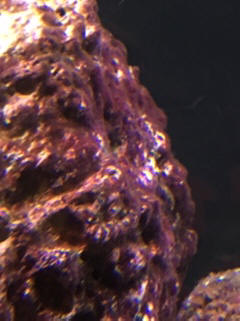
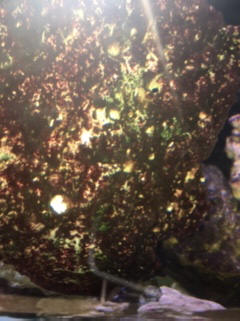
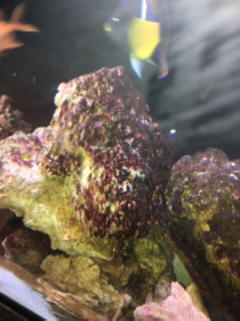
I am stumped trying to figure out exactly what's growing on my glass and rocks
in my 265 gallon FOWLR tank. I've attached a few pictures. It doesn't come off
very easily at all. Frankly, to get it off the glass you have to use a scraper
with some force, then to get it off the rocks, good luck as a tooth brush will
very slightly thin it out, but if I really wanted it off, more likely it would
take a steel brush with some force to get it off the rocks. Further, when I
scrap it with force off the glass it comes off as a dust, not in sheets.
Thus, based upon this hard consistency my gut tells me it's Coralline Algae, yet
I am used to Coralline algae being pink or light purple, not red in color. It's
a dark, burgundy red, similar in color to cyanobacteria, but I definitely can't
siphon it out like you can with cyanobacteria. Should I be concerned?
Thank you,
John
<Hey John. Coralline (encrusting Reds, Rhodophytes) are very different to the
touch than Blue Green "algae"/Cyano... The latter are slimy; and of many
different colors. Reds are not slimy, but hard, crusty... From your description
and photos this appears to be BGA...
Yes to being concerned... conditions that allow, encourage BGA are deleterious
to most all other life forms as are some of the metabolites of Cyanobacteria.
Please read here re the several approaches to control:
http://www.wetwebmedia.com/bluegralgae.htm
and the linked BGA Control FAQs above. Bob Fenner>
|
 |
|
Re: Coralline Algae, Cyano, or ??? 8/4/19
Ugh. Terrific article. Thanks Bob!
<Cheers John! BGA is defeat-able, avoidable... Like steering a large ship w/ a
small rudder; takes a while, but... slow and steady is the route to go. BobF>
|
|
Coralline issue; ID from pix? 12/13/17
<19 megs of pix? Did you read our requirements?>
Posted over on r2r and they suggested to email you guys and see if you
know what kind of coralline algae this is.
<... Kind? As in species? Not w/o microscope imagery>
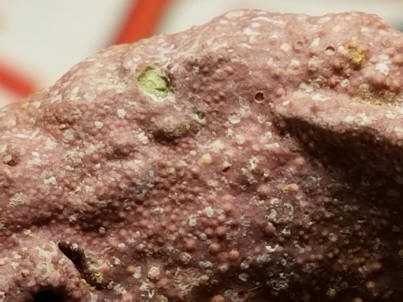
Grow supper fast. Grows in to shaded to dark places and is slimy when removed
from the tank or rubbed on in
tank. The one shell pic has been out of water now 9 months been rinsed a few
times in tap water. Here is the post over on R2R about it and what I have went
threw in my tank.
https://www.reef2reef.com/threads/aggressive-coralline-algae-or-some-type-sps.303101/
Thank you if you respond and thank you if you don't would understand.
<See, as in READ on WWM re Corallines? Bob Fenner>
|
 |
|
Hair turning red 4/30/11
Hi,
<Ian>
I have visited your site many times and always found the answers
to my questions amongst the pages. It's been really helpful
as I've only had my tank 6 months and everyday seems to bring
a new question! Anyway, I searched for an answer to my latest
query but could find none so I am writing to you today.
<Ok>
My 24g marine aquarium is going fine and water parameters have
been stable and good for some time now. Ammonia, nitrite are zero
and nitrate and phosphate as near to zero as possible (less than
1ppm each). Ph varies between 7.9 and 8.1 depending on time of
day and specific gravity is 1.023.
<I'd raise this... see WWM re spg>
I have a few different corals which seem happy
but I notice that one of them is growing
red.
<... Do you mean the algae here?>
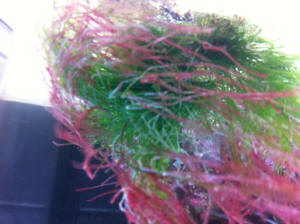
By that I mean the new growth is red. When I bought this I was
told by the LFS that it's maiden's hair. You can see it
in the first attached picture.
Is it supposed to be red or is this some kind of Cyano growth? I
would say some bits have doubled in length in 2 weeks but all the
new growth is red.
<Yes>
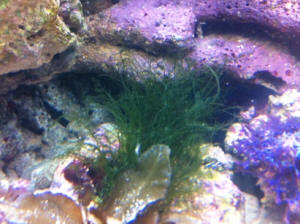
A second patch has grown all by itself on a piece of rock that
another coral came with. I've attached a picture of that too
as it doesn't seem to be growing red at all. Is this second
one also maiden's hair or is it something different?
<Just more resistant for now>
In which case is it desirable or not? It looks more fern-like to
me.
<This is a Chlorophyte, a green algae, being overgrown by a
type of encrusting Red Algae...>
Kind regards and thanks in advance,
Ian
<Welcome. Bob Fenner>
|
|
|
Re: Hair turning red 4/30/11
Hi again and thanks for the super-quick reply!
<Welcome>
Apologies for asking too many questions in one sentence but does
your answer "yes" refer to it being normal to be red or
to it being a Cyano growth?
<Sorry for the lack of clarity. This green growth is an algae,
not a coral, and the one patch is being overgrown by a
Rhodophyte... a red algae, NOT a Cyanophyte. B>
Kind regards,
Ian
|
Re: Hair turning red 5/2/11
Hi once more,
<Ian>
After the clarification I decided to give the algae a
"hair-cut" to remove the red-encrusting ends.
<Mmm>
I did this in the presumption that the red was not
desirable but with hindsight I'm not sure why I thought
that. Was that a correct assumption - that the red
encrusting algae is bad?
<Is not "bad" for your system... a bit of
natural succession. Is bad for the "maiden hair"
algae... in that it will slow down its growth
somewhat...>
There seems to be a lot of conflicting opinions on the
internet regarding this and I'm not sure which to
believe.
<Then do nothing till you understand>
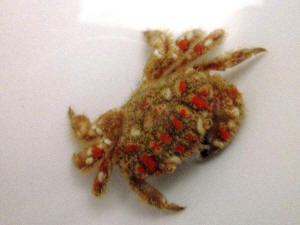
Anyway, whilst attempting a hair-cut a crab scuttled out
from underneath.
It's about 2.5cm across and seems to have lost a claw.
The nearest thing I can find on your ID pages is
Lissocarcinus laevis
<Nah>
but I cannot find information about whether or not he is
desirable in a reef tank with fish and other invertebrates.
I have attached a photo.
<Most Decapods are not... if this one isn't doing
any apparent damage, I'd leave it be; enjoy it>
Kind regards,
Ian
>And you, B<
|
|
|
|
|
Coralline algae Identification requested.
12/7/10
Hello Wet Web Media!
<S of C>
The WWM site is overwhelming, it takes ages for me to search any
given topic. SO much information here that I can never know where
to start; but it makes for good reading all the same.
<Mmm, the topic/s of ornamental aquatics are so vast
themselves... we do have a search tool onboard to allow the
viewing of cached terms... And the indices are as logical,
descriptive as I can (ongoing) make them...>
I have spent many nights sifting through bits and pieces. Anyway,
I've done what I could to search the site, and the web for
information. Failing that, I thought I would once more ask for
some help identifying something that has caught my attention.
Last time it was my mini carpet anemones <3
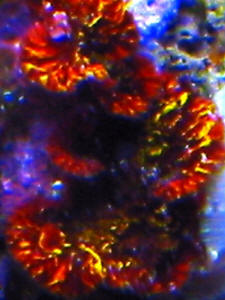
What I have is, I think, Coralline algae. This is not unusual, I
have all manner of it growing everywhere. It's something that
enjoys my 10 gallon tank and grows with alacrity. What is
unusual, at least to me, is that a small area of the coralline
has grown with "yellow highlights" It seems to be
entirely different from what else is in my tank. Red, purple,
Pink, Green... Please tell me, what is this beautiful
specimen?
<... Don't have "that" much confidence in my
guess here... is the underlying bit hard, stiff to the touch?
This looks like some sort of blue green (the red stuff)
overgrowing... perhaps Lobophora to me. Reach in and give it a
twist... is the underlying bit flexible? The outer, reddish
material slimy?>
My latest change to my system was a new bank of lights and some
frags. The tank did have about three months of
"neglect" due to some unfortunate events. The coralline
and corals did not suffer, most of it continued to flourish-not
the mushrooms though.
This is so very pretty
I have included a picture of the algae in question as clear as I
can get it. the area it covers is about two inches high and about
¾ inch wide at most. I would like to encourage
it's growth as I love algaes.
Thank you so much for any help you can give and for helping me
out in the past.
<Welcome! Bob Fenner>
|
|
|
|
Re: Coralline algae Identification
requested. -- 12/08/10
Reply: regarding my "Coralline" algae Identification
request
Thank you so much for your prompt reply
<<Welcome>>
<... Don't have "that" much confidence in my
guess here... is the underlying bit hard, stiff to the touch?
This looks like some sort of blue green (the red stuff)
overgrowing... perhaps Lobophora to me. Reach in
and give it a twist... is the underlying bit flexible? The outer,
reddish material slimy?>
I have to admit, doing the test you request is a bit difficult as
these are very small, but I did Google Lobophora and brought up a
very very similar looking algae with the beautiful red and yellow
highlights. When I did attempt to test it, yes it seemed to be
somewhat flexible and a bit slithery to my touch.
<Ahh! Then at least NOT a coralline>>
Thanks so much.
<<Welcome S and or S/S. B>>
|
Red Stuff On My Rock, Nullipora
11/23/09
Hello:
<Hi Paul>
I have had this problem with my tank for about a year or so and this
time I cant seem to solve it.
The tank is a 175G Oceanic bow ,and has various creatures within it and
they are no problem.
My issue is a red hard coating on all my live rock I have tried to
mechanically remove it and it won't come off. I think it piggy
backed on a batch of live rock I bought and it spread and stayed. Its
not coralline algae, I have that still in spots, but its the same
consistency. Its not slime algae I have had that before and used slime
remover and it left, this is different and even though I have taken a
piece of live rock out and tried to scrub it off it will not come off
easily.
I have seen this red stuff being referenced on the net and its been
said that there is nothing that will take it out. I used an urchin and
it eats it but unfortunately it also eats coralline algae and can't
get in tight spots.
I guess my question if you guys have the time would be, have you heard
of something like it and a way of removing it short of scrubbing my
rock clean? I have had this tank for 5 years.
I understand that I probably have omitted a lot of info but I am trying
to keep this letter short in the hopes someone has heard of this stuff
before, and an explanation of all the other stuff I have in the tank
would not take up time which I have a feeling you guys don't have a
lot of.
<The colors of these algae are most typically pink, or some other
shade of red, but some species can be purple, yellow, blue, white or
gray-green.
You likely have a red variety of coralline algae. The urchin eating it
is a good indication of this.>
Thank you in advance.....
<You're welcome. James (Salty Dog)>
Paul Carragozela
Brown Coralline?
11/09/08 I've had a dark brown slightly reddish coralline
algae starting to spread on my back overflows, Koralia's and some
live rock. It looks just like the coralline type but the color is
wrong. I cannot seem to find anything about this type of algae on the
forum. Any ideas? <It could just be the red coralline instead of the
purple you are used to seeing. I'm supposing it looks brown because
of your lighting. If it is hard and crusty like the purple then no
worries. If it is filmy and slimy then it could be cyano or diatoms.
But most likely its just a different color coralline.> Thank you for
all the support! <Regards, Jessy>
alan
|
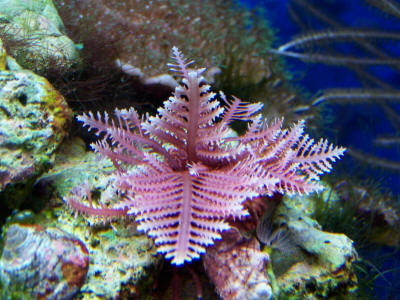
Algae I.D. 09/27/2008 Greetings Crew,
<<Good morning, Andrew today>> Thanks for the great
site! I have looked high and low for information on this algae
but I can not find it anywhere. Forgive me if I've simply
overlooked it. Thanks in advance. <<Corallina elongata i
would suggest. Please do use your search engine for plenty of
info on this algae>> John T. <<Thanks for the
questions, hope this helps. A Nixon>>
|
 Beautiful. Beautiful. |
|
Re: Algae I.D. 11/02/08 Hello
again Crew, <Hello, I'm so, so sorry this email does not
appear to have been answered after all this time.> I've
looked up Corallina elongata but I am unsure that is what I have.
I did find this page www.wetwebmedia.com/trialalgaeid.htm
<Ah, I'm glad you found that page.> with a similar
looking algae. (Very bottom row, in the middle) It's listed
as possibly being Fauchea. I'll keep up the search. <Macro
algaes are indeed often very difficult to ID by eye, by
picture.> Is it not ironic that our passion teaches us
patience but when we have questions we want answers right now?
<Hehe... "the more we know, the more we don't
know."> Thanks again for a great web site and for taking
time to help. I live in an area without a LFS and as far as I
know have the only salt water tank in town. I could not have done
it without Wet Web! <Great to hear, thank you for the kind
words!> John T <Best, Sara M.>
|
Coralline or not? 5/23/08
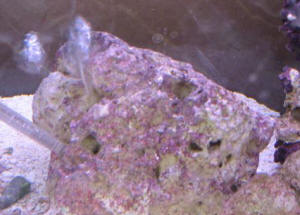
Hi WWM Crew, <Hello> Sorry to pester, but I've been
trying to determine if what is growing on my rock is/is not the
much-sought-after coralline algae or not (see attached photo).
<Looks like it to me.> I had a bit of a "red slime"
problem on my back glass that two Trochus snails resolved, but even
when they come to this rock, they have been unable to
"clean" it, nor have my burgundy hermits. I just stuck my
hand in and scratched it a bit with a fingernail, and it didn't
"ooze" off like the red slime did when I touched it.
<Sounds like coralline to me.> The rock in question is the
white(ish) one in the center. I picked it up from Hanauma Bay seven
years ago after it washed onto the beach. When I placed it in the
tank a month ago, it was totally white, but this stuff has turned
it progressively darker. I am not getting any kind of the same
growth on my glass or any other rock, so I'm a bit confused as
to why it would limit itself to this rock only. <Something is
favoring it's growth in this spot, lighting, water flow most
likely reasons.> An added bonus would be if you might be able to
give me an idea what this rock is. <Looks like fairly standard
reef rock.> Thanks, as always, for your timely and sage replies!
-DS-
<Welcome>
<Chris> |
 |
|
Red Fuzzy Coralline? '¦Not likely,
perhaps another Rhodophyta -- 08/26/07 Hello crew! <Hi
Dave, Mich here.> I have been researching your site and others
trying to figure out what is growing in my 90-gallon reef.
<OK.> I have a red feathery/fuzzy substance growing on a
lot of my rocks, snails and hermit shells. <OK.> I was
wondering if it was a type of coralline and harmless in my tank.
<Only guessing without a pic.> I am very familiar with
cyano and I don't think this substance is it. <OK, One of
many possibilities off the table.> It is very difficult to
scrub off, and grows in high flow areas unlike cyano. <Still
leaves a plethora of possibilities.> I read a similar query
asked by another gentleman on your site. The reply to him was
that it was coralline, and that he should drop some vinegar on it
to see if it bubbled to be sure that it was. I tried this
experiment on my substance and it did not bubble. <Then it is
likely not coralline or any other calcium based organism.> The
other gentleman described it very well, in my opinion, by saying
it appears to look like patches of red mold. <Many nuisance
algae come to mind, red turf algae or red hair algae such as
Polysiphonia, Asparagopsis, Anotrichum barbatum, Gelidium
pusillus, or perhaps a beneficial organism such as a red tree
Foram (Homotrema rubrum) Your expertise would be greatly
appreciated. <A photo might help here.> Thank you all for
this amazing site! <Thank you for your kind words!> Dave
Kansas City, MO. <Mich Gouldsboro, PA.>
Re: Red Fuzzy Coralline? '¦Not likely, perhaps
another Rhodophyta... BGA 8/28/07 Mich, <Hi there
Dave.> Thank you, for your quick and very helpful response!
<Welcome!> I have been researching your suggested algae
species and I am continuing to have problems identifying which is
growing in my tank. <Yes, does not look like what I was
picturing in my head with out the photos.> I hope that they
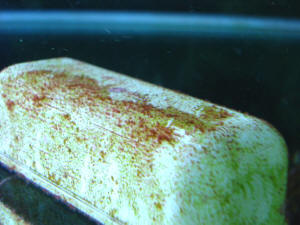
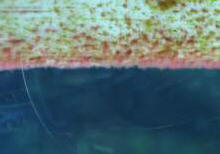
attached picture of the red substance growing on my glass magnet
might help you take a better guess at what it is. <Mmm, pics
are helpful. Is not a red tree Foram and likely not many of the
algae I suggested previously, is a nuisance alga, likely a
Rhodophyte, but beyond that I can't tell. Perhaps RMF will
comment on the dailies page.> <<Is highly likely
Cyanobacteria... a quick look under a few hundred power
microscope would show the absence of nuclei, organelles, the
distinctive circular DNA if higher powered... Please read on WWM
re BGA... RMF>> This is the way it appears everywhere in my
tank, (rock, hermit shells, powerheads) short, red, and fuzzy.
<No fun. Perhaps some improvements in husbandry would help?
http://www.wetwebmedia.com/nutrientcontrol.htm
http://www.wetwebmedia.com/marine/maintenance/marineMaint.htm
http://www.wetwebmedia.com/avoidingalgaeproblesm.htm > Thank
you for your time, <Welcome, wish I could be more helpful.
Mich> Dave Mmm, think I forgot to move an image into the
emails with images folder... re: fw: re: Red Fuzzy Coralline?
atten: Mich <No worries... was there somewhere. Found,
posted> Also He stated earlier: It is very difficult to scrub
off, and grows in high flow areas unlike cyano. <Is almost
assuredly BGA... B>
Re: Red Fuzzy Coralline? '¦Not Likely,
Perhaps Another Rhodophyta... Nah, Cyanobacteria -- 08/31/07
Mich, <Hi Dave.> Thank you again, for the quick and helpful
reply. <You're welcome!> I was however disappointed
that I could have some yucky cyano in my tank. <It happens to
all of us. Glad you can't see my tank right now!> Let me
give you a little background on my tank and husbandry. It's a
90-gallon reef with a medium bio-load. There is no detectable
nitrites, nitrates, or ammonia. However with the phosphate test
kit that I have, (which is very hard to read, maybe time for a
new one.) I think I may have a slight amount of phosphate in my
water, less than 5ppm (however, with the color chart its very
hard to determine if its actually 0) Calcium and alkalinity are
within parameters, and my ph. stays pretty steady, and high,
around 8.4. I have an all-glass model 3 wet dry. <If you have
a wet/dry, you most assuredly have nitrates, if your getting
readings of zero it is because your algae, nuisance or macro is
using it up. Yes, I do keep a close eye on my nitrates. ANS G-3
protein skimmer, which works great, and I use RO water. I
religiously change 4-5 gallons of water weekly. <About twice
that amount would be better.> I don't have a lot of live
rock, around 75lbs, and my sand bed falls into the poor thickness
range, 1 1/2 to 2 inches. <Nutrient sink and not deep enough
to be very helpful with anaerobic metabolism.> So I consider
myself very conscientious about my husbandry (except if it really
is cyano, it has to be from me being such a sucker to my Kole
tang.... he likes to eat, and I'm easy). <Heehee! Could be
a contributing factor.> So when I saw that yourself and Bob
both think its cyano, it really made me think about my feeding
habits. <Nix the Wet/dry, deeper sandbed, add some macro,
bigger or more frequent water changes...> Nevertheless, I took
your advice and took a sample of it to the local high school,
where my mother teaches biology and put it under a microscope.
<Cool!> It took a few adjustments, but I found that this
substance definitely has a cell wall and what appear to be
organelles, however I could not identify a nucleus. If so, does
cyano bacteria have anything that appears to be cell walls,
because this substance had a definite structure? <Yes
Cyanobacteria do have cell walls and although they are truly
prokaryotic their internal membranes are elaborate and highly
organized and may resemble organelles. The missing nucleus
further suggests Cyanobacteria.> I understand its very
difficult to take stabs at the millions of possibilities it could
be, but your advice has been so beneficial thus far, I thought
I'd put the ball back in your court. Any more guesses would
AGAIN be very helpful. <As Bob suggested, is likely
Cyanobacteria.> Thanks yet again, for your time and dedication
to your absolutely wonderful site. <WetWebMedia is Bob's
baby. I am but a minor contributor to his massive endeavor. But
thank you for these kind words on behalf on Bob on the rest of
the crew.><<Uh huh. RMF>> Dave
<Mich>
Kansas City, MO.
<Gouldsboro, PA>
|
|
|
Purple on My Glass 1/1/07 Hello there,
<Hi> I need some info on an issue with my 29 salt. I have some
light purple spots on my glass and powerhead and other things in my
tank. It won't come off with the algae brush. The LFS said that it
was ok, and he called it something but can't remember what he
called it. It kinda of crust, it scraps off with my finger nails. Is
there something that I can buy or use to get this off at least my
glass? Thanks for your info. Cody <Coralline algae, many scrappers
available to remove it from the glass. See http://www.wetwebmedia.com/corallinealg.htm for
more.> <Chris>
Coralline Algae/Alkaline Precipitation/Ca
Reactor Tuning - 12/07/06 Hi Eric, <<Hey Ken!>> I hope
all is well with you. <<Indeed it is...thank you>> Things
have been going well with the tank, but I have a few questions.
<<Ok>> The tank is set up 6 weeks now. The few soft corals
and star-polyps look good. <<Excellent>> I did buy a
clean-up crew about 10 days ago. I feel like I should put the snails on
the payroll. In the first two days they cleaned all of the greenish
algae I had on the rocks. <<Cool!>> The tank looks good. My
nitrate is less than 1-ppm and phosphate is zero using LaMotte
Colorimeter. <<Very good>> The pH is usually 8.10 to 8.20
and ORP has been about 415MV. <<More good news>> I also
have gotten more and more pink coralline algae on some of the rocks. My
first question has to do with that in the last couple of days I am
getting areas of a burgundy color on the rocks. <<Coralline algae
comes in "many" colors>> It looks to be more on the
areas that have some of the pinkish coralline. <<Conditions in
those locations are likely "optimum" for both
species...everything competes for space on the reef>> Also I
notice the burgundy color is all of a sudden on a lot of the turbo
snails. <<Very common>> Is this just another color
coralline? <<Indeed it is>> I am hoping that it is not like
red Cyano or something. <<Can usually tell the difference>>
I don't see this on most of the rocks and none on sand, powerheads,
sand etc. I tried scraping it off with my fingernail and it does come
off somewhat. It doesn't seem as hard as the pink coralline algae.
<<Differences in structure/composition>> I'm not sure
if this is coralline or not. <<Likely so>> I would say that
I see this burgundy color mostly on places that had pink to begin with
pretty much. My next question has to do with my AGA Mega Flow. Their
isn't really any algae on my rocks or tank, but I do have some
thick greenish layers of it in the overflow box only. Should I leave it
their, or manually remove it, or can I put a couple of my turbo snails
in there to eat it. <<Can remove or leave, whichever you
prefer...I would not put turbo snails in the overflow box (will
probably get there sooner or later anyway, but...) as they will get in
to the overflow pipes and restrict/block flow>> I thought about
snails and overflows but the Durso pipe and the return pipe are sealed
unit and nothing could get in there. What do you think? <<If you
have some kind of "screen" on the Durso then this may be
fine>> By the way, if I manually remove the algae will anything?
<<...?>> I don't want to spread it around the tank?
Also is it possible that this algae is in its own "container"
and it can act like a refugium in a way? <<Sure...on a very small
scale. If nothing else, it is removing nutrients...but I'll bet
close observation will reveal some tiny crustaceans living there as
well>> My last question and most perplexing and bothersome to me
has to do with my calcium reactor. I have an MTC Pro-Cal calcium
reactor. I don't run it all of the time as my tank is only 6 weeks
old and there isn't much in the tank to take up the Alk and Ca.
When my alk gets down to 8dKH, I turn on the CO2 and run it at 1 bubble
per second and the effluent at .02 ml as per the instructions. This is
their starting point. <<And as good as any>> I will shut of
the CO2 once the alk hits 10 or 11 dKH. My Ca usually is in the 410 to
425 ppm range. The strange thing is that once I run the Ca reactor for
a day or so, I see some of the rock (usually more evident where the
coralline algae is) start to get a whitish tone to it. It does not blow
off. Also, and more importantly, when I take a turkey baster, I can
blow off what almost looks like ash. <<Sounds as if you may have
some carbonaceous material falling out of solution>> This has
happened all three times I ran it. <<You may want to consider
experimenting with different reactor media>> I was wondering if
it was calcium precipitate, but how could it be? <<Easy
enough...the water can only "hold" so much material.
Maximizing alkalinity (11dKH) and calcium (425ppm) over saturates the
water with carbonaceous material. Try test your alkalinity AND calcium
after one of these events...likely BOTH have fallen as a result>>
All of the parameters are in check. I am not using limewater or any
additive and I do 20% water changes weekly with Reef Crystals. Do you
have any ideas? <<The reactor is probably "too large"
for the system (right now anyway) and is producing to much alkaline and
calcium reserve than the tank can "use." I would turn to one
of the two-part alkalinity/calcium supplements for now. Based on your
future stocking levels/specimens, you may find you don't need the
reactor>> By the way, I am using CaribSea Geo Thermal aragonite
for the media. <<Mmm, I see...this product is likely soft/more
soluble than others...try adjusting the reactor effluent to a pH of
about 7.0 the next time you use it and see what results>> I did
buy a kalk stirrer and plan on using it with my dosing pump and float
switch for top off water once I have the time to set it up in a few
days. <<Proceed with caution here...for now anyway>> I
appreciate your help. Regards, Ken <<Always happy to assist.
EricR>>
| To Be Coralline or Not To Be..... 11/11/06 Hi
there, <Hi> my aquarium is newly setup and cycled with live
rock and I've watched many colors change and algaes and such
spread, I now have a bright red patch of algae, that just will not
scrub off with a tooth brush, a lot of my rock is very deep red,
and I can scrub and scrub and it wont go away, what I am curious
about is this patch (on the photo) is it red coralline algae, and
should I worry about it? It had grown from two dime shaped patches
into one of that size in about 2 weeks! My nutrient levels are all
0ppm. Any insight you could offer would be great! ~Ryan You have
been sent 3 pictures. <A little hard to tell in these photos but
my guess would be that it is coralline and no need to worry about
it.> <Chris> |
| To be coralline or not to be..... 11/12/06 Hi
there, my aquarium is newly setup and cycled with live rock and ive
watched many colors change and algaes and such spread, I now have a
bright red patch of algae, that just will not scrub off with a
tooth brush, a lot of my rock is very deep red, and I can scrub and
scrub and it wont go away, what I am curious about is this patch
(on the photo) is it red coralline algae, and should I worry about
it? <Is coralline, not to worry> It had grown from two dime
shaped patches into one of that size in about 2 weeks! My nutrient
levels are all 0ppm. Any insight you could offer would be great!
~Ryan You have been sent 3 pictures. <Please read here: http://wetwebmedia.com/corallinealg.htm and the linked
files above. Bob Fenner> |
|
|
Coralline algae 11/19/05 Dear Bob, I have a
bit of a stupid question. I have live rock in my tank that has been
there for approx 2-3 mos. I have a 180g FOWLR. The rock is growing pink
and red encrusting algae. There are areas on the rock where there is
green algae growing and I am having a hard time determining if this is
coralline algae. The green algae doesn't look like it is
"encrusting" but when it grows on the walls of the tank it
feels like fine sandpaper. On the rock, the porosity of the rock that
is covered by the green is evident. Unlike the encrusting pinks where
the rock is "plated" I had a piece of dead fire coral in the
tank that first grew pink, then green algae. This algae is not removed
very easily and it is not slimy to touch. I have noted that it is now
growing in the gravel of the tank. Is this likely to be coralline ?
Jimmy <Well... encrusting is a descriptive term... usually
associated with given species of red, brown and green algae... if
it's hard, rough to the touch... is "encrusting"... but
coralline refers to Reds/Rhodophytes of algae species... and these do
look red, unless bleached (then white). Bob Fenner>
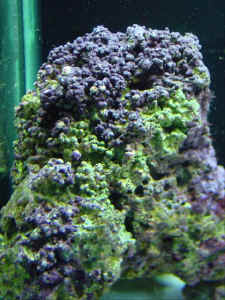
Coral / Algae Id and care WWM Crew, <Hi
there> Could you please provide an identification of the
material that is encrusting this rock (the "bumpy" purple
and green stuff)? I first thought that this was coralline algae,
but after searching your id pages and others on the web, I do not
know what to think. <Looks like an encrusting Red (coralline)
and some sort of green algae to me as well.> I would like to
also the care for this particular material. We think that it is
very attractive It came in on our LR, but as you can see on the
lower left hand portion of the picture, the material is receding,
and on the top of the rock, it is bleaching (turning white). On
another piece of LR that did not have as much of this material on
it, it is almost gone. <Please read here: http://www.wetwebmedia.com/corallinealg.htm
and the linked (in blue, at top) FAQs> Setup: We are setting up
a Oceanic 75 gal. mini reef tank. The equipment currently in the
tank are 2 MaxiJet powerheads,4-65W PC Coralife (2-10000K and
2-actinics),Prizim Pro skimmer, Oceanic w/d sump (bio balls removed
- put skimmer in the "old bio area" - the output of the
skimmer goes into the refugium with has LS and red Gracilaria
growing - reverse photoperiod of about 12 hrs.- which then
overflows into the pump area to be returned to the main tank),
Eheim power canister filter (with floss and activate carbon in it)
and a UV sterilizer (not on) in a separate loop. We currently have
about 60 lbs. of LR (LR is Fiji (45%) and aquacultured from FL
(55%)) and 45 lbs. of LS. The sand bed (mix of sand and LS) in the
main tank is 3" of fine sugar sand (a little medium fine
aragonite mixed in). The tank is about 8 weeks old. <This is
"very young"... and has a direct bearing on the
vacillation in the encrusting algae you are experiencing... You
need to maintain biomineral and alkaline reserve levels... over
time... to grow all> The tank was cycled with the uncured LR and
LS. For the past 4 weeks our water tests have shown ph 8.2, ammonia
0, nitrite 0, nitrate 0,and a temp. of 80-82F. Within the last two
weeks we have been testing alkalinity and calcium. The current
results are KH 11 dKH, GH 40+dkh (got tired of dropping reagent -
is this possible or do I have a bad test kit?), and CA of 255. I
know that I need to increase the CA levels. <... please have a
read on WetWebMedia.com re these materials> I have been adding
small amounts of Kalkwasser to increase the CA, but from reading
your website, I would guess that I am close to a precipitate
snowstorm. Therefore I need to do water change to lower the
alkalinity so that I can raise the CA -- Do I understand this
correctly? <Partly> We added the PC lights about 3 weeks ago
(before only ambient lighting and 1 48" NO Coralife flour.).
Over the last two weeks this material (referred to above) on the LR
has been receding (mainly the dark and light purple, and dark and
light green algae -- the pink coralline seems to be growing well
within the last week (after we started supplementing the Ca - small
spots on the glass, on the dead rock, and a little on the sand). Is
the receding material due to the water quality issues (low Ca and
high Alk.) and/or acclimation to the new lights? <More the
former> Or is this too much lighting for this tank? Or some kind
of disease? <No on both counts, your system is "settling
in"... you need to settle on a regimen of testing and whatever
supplementation you're going to utilize. I encourage you to
look into simple two part systems (Wilken's/C-Balance,
Stark's ESV...) and stop the yo-yo'ing with Kalkwasser. Bob
Fenner> Thank you in advance for your assistance!
John |
|
|
Red coralline VS Cyanobacteria Hi guys, hope
you are all well. <Hi and thank you we are all well and happy.> I
am in the process of upgrading my tank after a near total loss, so I
let the tank sit with minimal maintenance for several weeks (which did
good- the corals I have left all have come out in full). <Sometimes
less is more.> I have had red-slime problems in the past, and I
would siphon it out and blow it off the rocks with a turkey
baster.<That is a good practice but I would use the baster first
then siphon it out.> I cannot blow this red stuff off the rocks, its
hard to brush off with a toothbrush (even with toothpaste-:)) it
"feathers" off the rock (like tree fungi), and is nearly the
same color as Cyano. Is it red coralline? <It is absolutely
coralline algae. If you want to be sure take it out and put it into
some vinegar. If it bubbles then your are in business.> Thanks for
being there to answer oddball questions! <Not a problem! MikeB>
James
- Questions: Is It Coralline? Or Is It
Cyanobacteria? - Hello. I've started the hobby for about 6
months. Now I have: 2 yellow tail damsels 1 fire damsel (mean little
buggah, constantly fighting with or getting picked on by one of the
yellow tail) 1 clown fish 1 yellow tang 1 blue tang 1 cleaner shrimp 4
brittle stars 4 turbo snails I recently notice a bunch of white
critters on my glass...the fire damsel has been picking on these for
awhile since I got him. And now the pods are everywhere which I'm
assuming is good? <Yes.> During the whole time I started I
don't have a sump nor skimmer. my first water change was a month
ago...since then I do a 5 gallon water change once a week or more
depends. As of now, I notice red pinkish patches on my rocks. The
patches aren't very thick... just a very light covering. I was
thinking it was Cyanobacteria (something I shouldn't want?) My
cousin said it might be coralline algae and the only coralline are on
the tips of my turbo snails (I could be wrong) or the water I've
been getting. And I don't know what I've been doing to promote
coralline. <It happens [or not] on its own... in presence of
adequate calcium.> I do however have a killer green algae farm
growing on the right side of my tank just for my tangs just until I can
put together more rocks to start on coral. If it is coralline, is it
possible for one color coralline changing to another color? <Not
usually. A quick note: in the future, please don't send along such
large images. They clog our inbox and then block other's email from
coming in. Thanks... cheers, J -- >
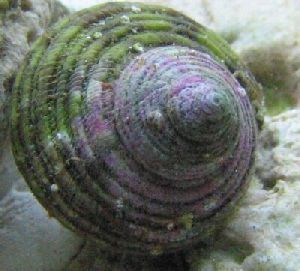
| Coralline Algae 24 Jan 2005 Aloha WWM crew,
<Aloha Richmond, MacL here with you this morning.> I was
wondering if the color crust on my turbo shell is coralline?
<That would be an affirmative.> If so, could any of the algae
on my rock in picture 2 be coralline? <EEK I didn't see
picture two, just picture one but I'm guessing that it could
be. Coralline is very hard to the touch an actually hard to
remove.> How can I go about in promoting coralline growth and
detour the others from competing with it? <Coralline generally
shows up on something, on the sides, on the rocks etc. It needs
calcium to flourish.> The 3rd picture is a old empty turbo shell
that has brown hair like algae and some kind of brown fuzz rug on
it. Is this type of algae anyway good and how do I go on about of
getting rid of it if it comes a problem? <Honestly I would pull
it out right now and pull all of it off. That algae is terribly
difficult to get rid of and it won't hurt the empty shell to
just pull it out of the water.> Currently I quarantined my blue
tang, yellow tang, 2 yellow tail damsel, fire damsel and clown fish
because the tangs had a little outbreak of ich. The tank has been
running with only 4 brittle stars, 4 Turbos and a cleaner shrimp.
It's been a little over a week and my pod has 4x its population
but then these brown hair started showing up as well. <No tangs
to eat it would be my guess. As soon as they go back it should all
disappear but you don't want to let it get ahead of you.>
I've also notice some of my pods are turning red or maybe this
is a stage in growth? I saw one of the red pods attached to another
pod then two more pods attached on to the red pod...eventually the
other 2 let go but I don't know what happen to the pod with the
red pod on it. <I've never seen one that has red on it but
its not out of the realm of possibilities.> Lastly, I was
thinking about removing the filter trays and just left my sand rack
and use the filter as water current to move the water, is that a
good idea? I figured that those filter only trap poop and other
debris and I could just buy a separate carbon pouch if needed.
<I'm assuming you have lots of live sand and live rock in
the tank to work as your filter instead? Should be okay if so. Lots
of circulation is important to the tank.> |
|
|
Coralline Algae i.d. Hi Bob. Could you describe in details
how to identify coralline algae? Secondly, if these algaes are growing
on the power heads, is it okay to remove them or ignore it? Please
advice. Thanks. >> Don't know if I can... they're
encrusting with CaCO3 base material... so, if you dry some, it'll
turn white, foam with the application of an acid... have no pores (old
designation, Nullipora, to distinguish...)... Do you have a microscope?
Or, can you feel the matter with your hand? If it's hard, this IS
likely some type(s) of coralline algae. Okay to ignore on most
anything... would remove from viewing panels (gingerly, like with fancy
commercial plastic scraper or credit cards), but that's all. Bob
Fenner
Coralline Algae Bob- I was reading an article penned by you
located at http://www.wetwebmedia.com/corallinealg.htm. I was wondering
if there was any difference between the algae in your article and the
encrusting coralline algae located off the coast of California?
<Mmm, same groups down sometimes to the genus level as the tropical
corallines... and both gorgeous. Dave Wrobel wrote widely on such
"cold water reefs" incorporating these rhodophytes... still
haven't caught on largely.> They look identical to me...but
I'm wondering if they are. Thanks in advance. D.M. Daniels <Be
chatting. Bob Fenner>
Yellow Spots... Maybe Algae, Maybe Encrusting, Not Definitely
Coralline Bob - Thanks for answering all of our questions. I have
yellow spots growing on the sides of my 75 gal saltwater tank. The
spots are as large as a dime and start as a small dot. They have to
scraped from the sides with my fingernail. Is this a type of encrusting
algae? <Not a very encrusting variety if so...> If the spots were
purple, I would say they were coralline algae spreading from the live
rock. Any ideas? <Lots, but none re this organism or mix... Please
read through the many materials posted on WetWebMedia.com re algae,
their control, marine system maintenance. Bob Fenner>
-- Thanks
|
|
New Print and
eBook on Amazon
Marine Aquarium Algae Control
by Robert (Bob) Fenner
|
|
|