|
Related FAQs: Fishes of
Hawai'i, Articles on: The Best
Butterflyfishes of Hawai'i, Triggerfishes of
Hawai'i,
Related Articles: Introduction to Fishwatcher's Guide
Series Pieces/Sections, Scott's Trip to
Maui/Hawai'i, Holualoa property,
A Fishwatcher's Guide to the
Marine Fishes of Hawai'i
Part 2 of 5, To: Part 1,
Part 3, Part 4,
Part 5
|
|
|
Bob Fenner
|
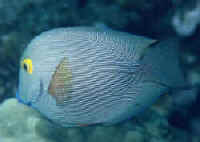
A Kole Tang
|
Squirrelfishes and Soldierfishes, family Holocentridae
More often than not this family's Hawaiian members are simply
offered as (Hawaiian) Soldiers or Squirrelfishes, sometimes with a
concessional reference to genus (i.e. Myripristis sp.,
Holocentrus sp.). The most common aquarium Squirrel species from
here is aptly enough, the Hawaiian Squirrelfish, Sargocentron
xantherythrum (1), a great captive that stays reasonably small
(6"). Just as easygoing, but getting three times bigger, the Giant
or Longjawed Squirrelfish, S. spiniferum (2) is also
occasionally caught out of Hawaii for our interest. Watch out for this
Squirrel's venomous gill plate spines.
What are often labeled as Hawaiian Bigeye Squirrels, are actually
Soldierfish, subfamily Myripristinae. Out of Hawaii two species make up
the bulk of shipments; the Brick or Black Soldierfish, Myripristis
amaena, and the Bigscale Soldierfish, M. berndti (both
2).
A note re the common name "Hawaiian Squirrelfish". There
are a few non-Hawaiian holocentrids sold under this moniker. All
require about the same care and rank the same in aquarium
suitability.
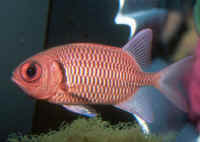
| Myripristis amaena
(Castelnau 1873), the Brick Soldierfish. West-Central Pacific;
Indonesia, Philippines to Hawaii. To about ten inches in length.
Monterey Bay Aquarium photo. |
|
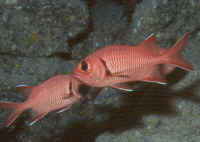
| Myripristis berndti Jordan
& Evermann 1903, the Blotcheye Soldierfish. Indo-Pacific,
including eastern Pacific in distribution. To one foot maximum
length. Best from Hawai'i. |
|
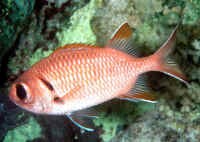
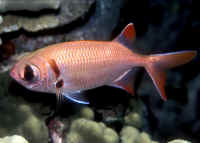
| Myripristis kuntee
Valenciennes 1831, Shoulder-bar Soldierfish. Indo-Pacific; East
Africa to Hawai'i. Two to 55 meters. To eight inches total
length. Reef-associated. Leading part of spiny dorsal fin
yellowish. One off of Queensland, Australia, another off
Hawa'i's Big Island. |
|
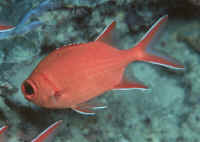
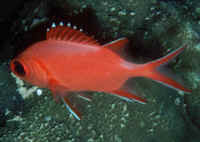
| Myripristis vittata
Valenciennes 1831, the Whitetip Soldierfish. Indo-Pacific. To ten
inches long. Another under-utilized species available in good
numbers. Like most Soldierfishes, feeds on plankton at night.
Maldives and QLD, Australia specimens. |
|
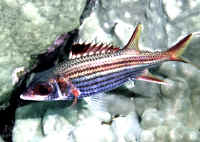
| Neoniphon sammara (Forsskal
1775), the Sammara Soldierfish. Indo-Pacific, Red Sea to the
Hawaiian Islands. To about a foot long. An occasional import. This
one in Hawai'i, off Kona. |
|
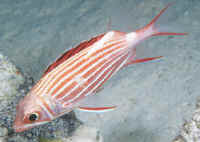
| Sargocentron diadema
Lacepede 1802, the Crown Squirrelfish. Indo-Pacific, Red Sea to
Hawai'i. To nine inches in length. The most common Pacific
offering in the family. Very similar to Sargocentron
xantheryhthrum, but diadema has a very dark dorsal fine with a
white stripe in its lower area, xantherythrum with a red dorsal
with white spine tips. Shown in the Red Sea during the day,
Kona at night. |
|
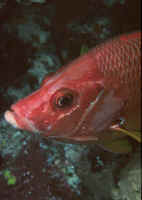
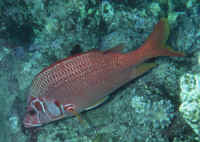
| Sargocentron spiniferum
(Forsskal 1775), the Sabre Squirrelfish. A beauty, but often lost
to trauma in capture and shipping and too large for most systems
(to eighteen inches in length). The first image made in the
Maldives, the second in the Gulf of Aqaba, Red Sea. |
|
Ecotype: Shallow to deep reefs, hiding under overhangs and in caves
by day, foraging outside by night.
Trumpetfishes, Family Aulostomidae:
The Pacific Trumpetfish, Aulostomus chinensis (2) is becoming
more of an item and staying alive more as time goes by. Caveats for
it's care are cautious selection of tankmates, (not too inhaleable,
not too pesky), the employment of a covered (they jump) large system
(ultimately hundreds of gallons), and plenty of live foods at least at
first.
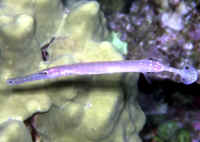
| Aulostomus chinensis (Linnaeus 1766), the
Chinese Trumpetfish. Indo-pan-Pacific; eastern Africa to Panama. To
thirty two inches in length. Brown, green, mottled... to yellow. At
right: Big Island of Hawai'i. |
|
Ecotype: All areas of the reef, often still in a vertical
orientation, sometimes co-hunting with another predaceous fish, or
stalking within a school of another species.
Cornetfishes, Family Fistulariidae:
| Fistularia commersonii Ruppell 1838, the
Smooth Flutemouth. To 160 cm. From the entire tropical
Indo-Pacific; Red Sea, Africa to Mexico. Shown: small (one foot
long) individual in shallow water at night in Fiji. |

|
Pipefishes and Seahorses, Family Syngnathidae:
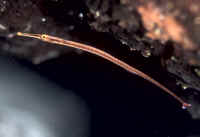
| Doryrhamphus baldwini
(Herald & Randall 1972), Redstripe Pipefish. Hawaiian endemic.
Often found in dark caves in small aggregations of a few adults. A
facultative cleaner.. To 5" in length. Hawai'i
image. |
|
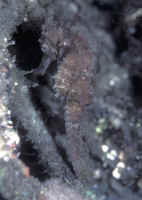
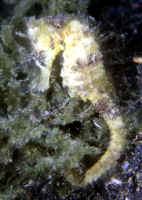
| Hippocampus kuda Bleeker
1852, the Common or Spotted Seahorse. Indo-Pacific; Pakistan,
India, to Hawai'i, Society Islands. To a foot in length
(stretched out). Found in calm waters amongst algae, seagrass. N.
Sulawesi images at right. |
|
Family Scorpaenidae: Scorpionfishes.
The Hawaiians, being of Polynesian derivation have some
scorpionfishes that they call Stonefish though the virulently venomous
Synancea verrucosa does not occur there. Luckily the dangerous
Stingfishes (subfamily Choridactylinae) and Waspfishes (subfamily
Tetroginae) are also absent. The two Scorpionfish that are regularly
offered out of Hawaii are superb aquarium species. The endemic Hawaiian
or Sphex Lionfish, Pterois sphex (1), and Leaf Scorpionfish (1),
Taenionotus triacanthus stay small and beautiful, and alive.
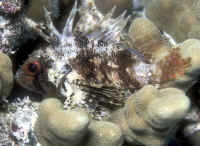
| Dendrochirus barberi
(Steindachner 1900), the Green (to the dive interest) or Hawaiian
Lionfish. Eastern Central Pacific; Hawai'i and Johnston Atoll.
Found in 1-50 meters of water, generally on coral or resting in
rocky recesses. To about six inches total length. Very venomous to
the touch. Here off of Kona. |
|
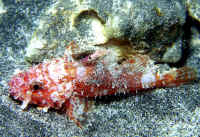
| Iracundus signifer Jordan & Evermann
1903, the Decoy Scorpionfish. Has a marking above the largely
transparent base of the anterior dorsal fin that resembles a small
fish... that this species undulates as a lure. Indo-Pacific near
the ends of reef slopes on sand and ledges. To five inches long.
Hawai'i image. |
|
|
Pterois sphex Jordan &
Evermann 1903, the endemic Hawaiian ("Dwarf") Lion;
often mistakenly sold as Antennata lions which they closely
resemble in terms of pectoral finnage. Sphex lion fins are
shorter, less colorful and more clubbed in appearance. Though
more costly than the majority of lions which are imported from
the Philippines and Indonesia, Hawaiian lions are my favorite for
hardiness. To eight inches.
|
|
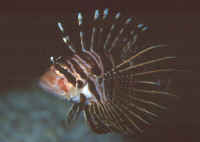
| Scorpaenodes parvipinnis (Garrett 1864),
Lowfin Scorpionfish. To 14 cm. Indo-Pacific; Red Sea to Tuamotus,
Hawai'i. Found in areas of rich coral growth. Cryptic,
reclusive by day. N. Sulawesi pic. |
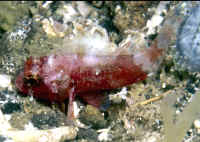
|
| Scorpaenopsis cacopsis Jenkins 1901, Titan
Scorpionfish. Long third dorsal spine. Hawaiian island endemic. To
twenty inches long. Big Island pic. |
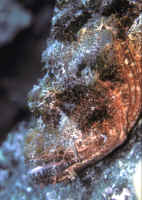
|
| Scorpaenopsis diabolus (Cuvier 1829), the
False Scorpionfish. Indo-Pacific; Red Sea to Hawai'i,
Micronesia, Australia. To 30cm. Right, in Hawai'i. |
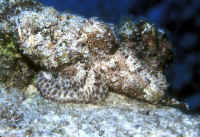
|
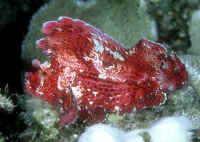
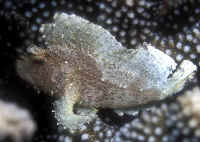
| Taenianotus triacanthus Lacepede 1802, the
Leaf Scorpionfish. Indo-pan-Pacific. To four inches overall length.
Usually found amongst reef rocks on a open setting, rocking like a
falling leaf. Molts twice a month. Feeds on small fishes, fry and
crustaceans. Comes in browns, blacks, yellows, reds and At right,
in Hawai'i. |
|
Some of the other 23 Hawaiian scorpaenid family members are suitably
small and good-looking, but they rarely make it into pet-fish
markets
Ecotype: Like their second common name, Rockfishes are found on the
bottom, generally motionless amongst the rocks and sand. Virtually
undetectable to prey and divers.
Helmet Gurnards, Family Dactylopteridae:
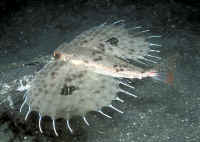
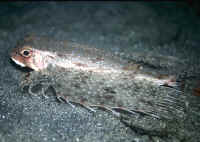
| Dactyloptena orientalis (Cuvier 1829), the
Oriental Flying Gurnard. Indo-Pacific; Red Sea, East Africa to
Hawai'i, Tuamotus, Marquesas. To 40 cm. Demersal; lives on
shallow sandy bottoms. Only member of genus found on oceanic
islands. N. Sulawesi images. |
|
Orbicular Velvetfishes, Family Caracanthidae:
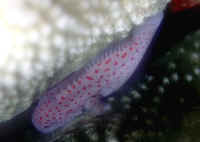
| Caracanthus typicus Kroyer 1845, Hawaiian
Orbicular Velvetfish. To 1.7 inches total length. Lives in the
protection of live coral, particularly Pocillopora eydouxi.
Big Island pic. |
|
Groupers & Basses- Family Serranidae. As far as serranids
go, Hawaii is rather depauperate. There are three Basslets,
Liopropoma species that are good looking, but too deepwater to
be commercially viable. Likewise some Anthias hail from here,
but most are also too far down. A few specimens do make their way in,
though they're rightfully high-priced. The Hawaiian Fancy Bass or
Bicolor Anthias, Pseudanthias bicolor (2) is often listed by
wholesalers in the genus Mirolabrichthys. Formerly called a
subspecies of P. ventralis (2), the Hawaiian Longfin Anthias,
P. hawaiiensis is now recognized by Randall as a separate
species. Occasionally, much as for the Flame Angelfish, this fish is
caught (in more than 100') and shipped elsewhere for the aquarium
trade.
The only bass regularly caught for our use is a non-endemic. The
Blue Dot, Argus or Peacock Grouper, Cephalopholis argus (1) was
imported to the Islands back in 1956 from Moorea, French Polynesia as a
food and game addition. It grows to two feet in length.
| Cephalopholis argus Bloch & Schneider
1801, the Peacock or Argus Hind or Blue-Spotted Grouper.
Indo-Pacific, Red Sea to French Polynesia. Introduced into
Hawai'i and the tropical eastern Pacific coast as a food and
game fish. To a foot and a half in length. Make
excellent aquarium specimens for large fish-only systems. At right,
a large one in an aggressive display in Hawai'i. |

|
| Pseudanthias bicolor (Randall 1979), the
Bicolor Anthias. Indo-Pacific, Mauritius to the Hawaiian Islands.
To five inches in length. Also a hardy large reef aquarium species.
One male by itself or with several females. Aquarium and
Hawai'i pix. |
  |
| Pseudanthias hawaiiensis,
Randall 1979, the Hawaiian Longfin Anthias. Looks very similar to
Pseudanthias ventralis but found only in Hawaii. Up to four
inches in length. A male pictured on the left, and the female on
the right. Images from the Kona side of the Big Island of
Hawai'i. |
  |
Ecotype: Near rocky areas to deep reefs where they can skulk and
dive into crevices.
Bigeyes, Family Priacanthidae: Have... very large eyes and
deep, compressed bodies. Mostly red in color but can quickly change to
silver and red barred to all silver. Feed on large zooplankton by
night. Four Hawaiian species, two deepwater.
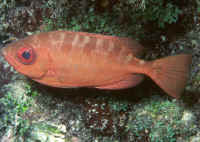
| The circumtropical Glasseye,
Heteropriacanthus cruentatus (Lacepede 1801), can be found
most anywhere seawater is warm on the planet. It grows to a maximum
of one foot in length. This one in St. Lucia in the
Caribbean. |
|
Hawkfishes, Cirrhitidae. Most Hawkfish species that come out
of Hawaii are available for less money from further into the
Indo-Pacific. Nonetheless, a few Arc-Eye (Paracirrhites
arcatus)(1) and Forster's or Blackside (P. forsteri) (1)
Hawkfishes make it into the trade from Hawai'i. Far fewer Longnose
Hawks, Oxycirrhites typus (1) come from here due to greater
depths and incidental relative high costs, though they make great
aquarium specimens.
The Blood Red or Redbarred Hawkfish, Cirrhitops fasciatus (1)
is a real beauty, stays small (4.5") and very hardy. It has an
unusual broken distribution, found only in Hawai'i in the Pacific
and Mauritius and Madagascar in the Indian Ocean.
Lastly, and the least attractive and largest (at a foot long), the
Stocky Hawkfish, Cirrhitus pinnulatus (2) is occasionally caught
out of here.
| Amblycirrhitus bimacula
(Jenkins 1903), the Two Spot Hawkfish. Indo-Pacific: East Africa to
Hawai'i. To three or so inches in length. Found in shallow
turbulent water. |
|
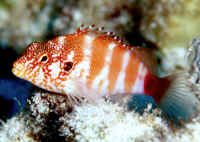
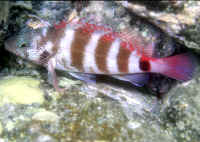
| Cirrhitops fasciatus
(Bennett 1828), the Redbarred Hawkfish. Punctuated distribution in
the Indo-Pacific, including Hawai'i (where most often shipped
from), Reunion, Mauritius, Japan, Madagascar. To five inches
overall length. Kailua-Kona, HI images. One of two species in the
genus. |
|
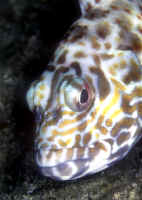
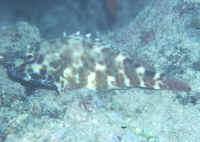
| Cirrhitus pinnulatus
(Forster 1801), the Stocky Hawkfish. Indo-Pacific, including the
Red Sea. To a foot in length. An occasional import that does well
in captivity, including reefs that don't house small motile
invertebrates or fishes. Eight and four inch
specimens in Hawai'i. |
|
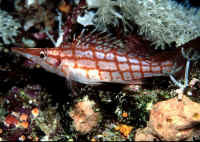
| The Long-Nose Hawkfish,
Oxycirrhites typus (Bleeker 1857), The Hawkfish most
hobbyists have seen and want. Found in the Indo-Pacific, including
Hawai'i, This superlatively suitable aquarium species reaches
approximately five inches in total length. Red Sea
image. |
|
|
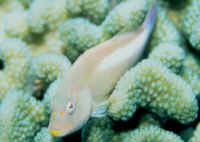
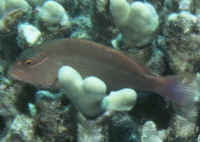
The Arc-Eye hawkfish,
Paracirrhites arcatus (Cuvier 1829). With an interesting
U-shaped three color patch behind the eye. They grow to about 5
inches in length and come in two basic color varieties; one
flesh-toned, the other a darker brown based. Both of these in
Hawai'i.
|
|
| Forster's or Freckled
Hawkfish, Paracirrhites forsteri (Schneider 1801). With a
body marked by dark spots on the front half and horizontal bands on
the rear. This species can be testy and eat goldfish near their
full length of almost nine inches, so be careful when purchasing a
larger one. Indo-Pacific. Below: tiny, juvenile and adult dark form
in Hawai'i. |
Ecotype: Coral reefs, resting on top of coral or rock, or hiding
under it.
Cardinalfishes, Family Apogonidae: Small (under five inches)
reclusive fishes (nocturnal feeders) with large eyes, big mouths (one
of the few families of mouthbrooding marines). Two dorsal fins, stocky
appearing bodies. Ten species occur in Hawai'i.
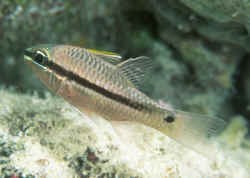
| Apogon kallopterus Bleeker
1856, the Iridescent Cardinalfish. Indo-Pacific, including the Red
Sea (where this one was photographed at night while foraging). To
six inches in length. A larger specimen out during the day in the
Maldives also shown. |
|
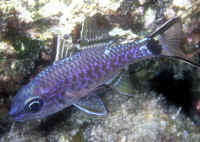
| Apogon menesemus Jenkins
1903, Bandfin Cardinalfish. May be same species (A. taeniopterus)
as found elsewhere in the Indo-Pacific (according to fishbase.org).
Distinguished by bar on caudal according to Randall. Big Island pic
at night. |
|
Sand Tilefishes, Family Malacanthidae: One Hawaiian species,
often encountered in pairs on sandy bottoms... rapidly dives into sandy
holes on approach.
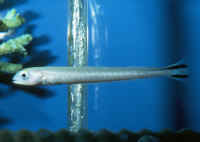
| Malacanthus brevirostris Guichenot 1848, the
Quakerfish. Found widely in the Indo-Pacific; Red Sea to Panama,
including Hawai'i. To almost thirteen inches in length.
Aquarium image. |
|
Remoras, Family Echeneidae: Aka sharksuckers for their habit
of attaching to sharks with their modified dorsal fin. Sometimes
Remora remora is encountered attached to large sharks, and
Remorina albescens on manta rays, but most often seen is
Echeneis naucrates.
| Echeneis naucrates Linnaeus 1758, the Remora
or Sharksucker. Circumtropical. To 110 cm. in length. Most noted
for their modified dorsal fin attachment organ, by which they join
temporarily with a variety of hosts (whales, dolphins, ships,
divers...). Even used by humans for a fishing tool! A free-swimming
small individual in Fiji and a larger pair swimming about in the
Bahamas. |
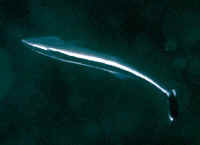 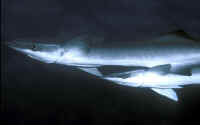
|
Jacks, Family Carangidae: Mainly large, silvery predaceous
fishes that are constantly on the go and wary of divers. Have two
dorsal fins and a lunate caudal.
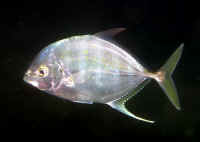
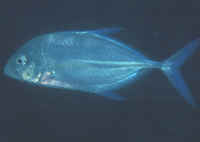
| Carangoides orthogrammus (Jordan &
Gilbert 1882), the Island Trevally. Western Indian Ocean to Mexico.
To twenty eight inches in length. A young one off of N. Sulawesi
and a larger one off of Maui in the Hawaiian Islands. |
|
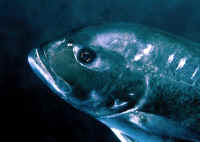
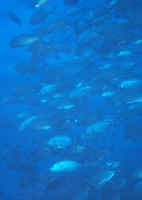
| Caranx ignobilis (Forsskal 1775), the Giant
Trevally. Indo-West Pacific; East Africa to Hawai'i, Marquesas.
To more than five feet in length, 53 kg. This one of a group
hanging around our dive boat in Queensland, Australia, and a school
off Richelieu Rocks in the Andaman Sea off Thailand. |
|
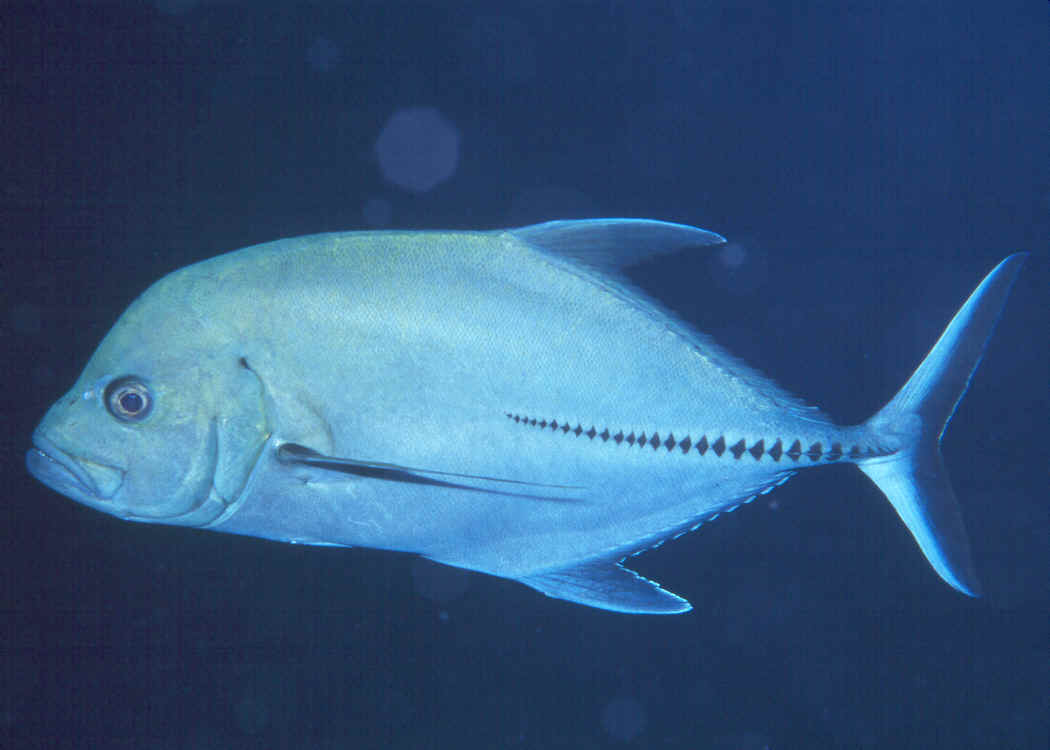
| Caranx lugubris Poey 1860, the Black
Jack. Circumtropical. To a meter in length. This one in the
Bahamas. |
|
|
Gnathodon speciosus (Forsskal 1775), the
Golden Trevally, what a beautiful fish! As a juvenile to
adulthood this bold, golden splendor is a sight to behold…
all shiny gold to silver bodied and finned, with an assortment of
vertical black barring. My first memory of this fish is as a boy,
snorkeling off of Southern Japan. A tiny yellow,
almost-just-a-dot fish "leading" just before my
mask… like a miniature pilot! (THE Pilotfish, Naucrates
ductor is part of this family btw). Small juveniles do
associate with jellyfish, sharks and divers, likely for
protection.
|

|
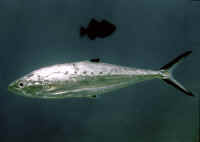
| Scomberoides lysan (Forsskal 1775) the
Doublespotted Queenfish. Indo-Pacific; Red Sea and east Africa to
Hawai'i. To three and a half feet total length. A minor game
fish... perhaps a candidate for large public aquariums? Image made
in Kona, HI. |
|
Snappers, Family Lutjanidae: Rounded, longish bodied fishes
with big mouths to match. It seems like Hawai'i has a good
representation of these important game fishes, but of the five species
found here, only two that are relatively uncommon are naturally
occurring (Aphareus furca, Aprion viresens in shallow
water, Aphareus rutilans, two Etelis and four
Pristopmoides sp. in deepwater).
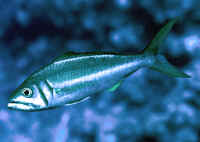
| Aphareus furca (Lacepede
1802), the Small-Toothed Jobfish. East Africa to Polynesia in
distribution. To sixteen inches in length. This one off of
Queensland, Australia. |
|
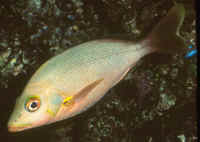
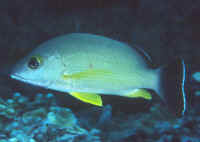
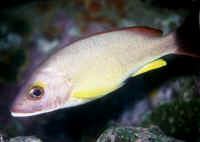
| Lutjanus
fulvus (Forster 1801), the Blacktail Snapper. Indo-Pacific;
East Africa to Marquesas, Line Islands, Japan, Australia.
Occasionally used as an aquarium fish. Young found in sheltered
bays, around mangroves. Adults on surrounding reefs near boulders.
Feed at night on fishes, crustaceans, sea cucumbers, squid and
octopus. Pix from Hawai'i (aquarium at Waikiki), Bunaken,
Indonesia and Nuka Hiva, Marquesas, Polynesia.
http://www.fishbase.org/Summary/SpeciesSummary.cfm?ID=262&genusname=Lutjanus&speciesname=fulvus |
 |
 |
 |
|
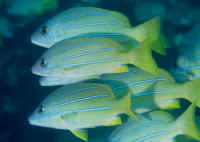
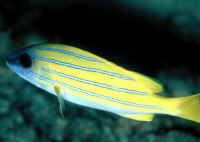
Lutjanus kasmira (Forsskal
1775), the Common Bluestripe Snapper. Indo-Pacific; Red Sea,
eastern Africa to the Marquesas, south to Australia, over to the
Southeast Atlantic; South Africa. Here in the Maldives and
Australia. Note the lower third of the body is white and the
presence of only four blue stripes.
|
|
Emperors, Family Lethrinidae: One species in Hawai'i, the
mu!
| Monotaxis grandoculis (Forsskal 1775), the
Humpnose Big-Eye Bream, Mu. Indo-Pacific, including the Red Sea and
Hawai'i. To two feet, but a slow grower, and attractive when
young to midsize. Below a two inch juvenile in the Cook Islands, a
six inch sub-adult off Queensland, Australia, a ten inch specimen
off of Kona, Hawai'i, and a one foot adult in the upper Red
Sea. |
Mullets, Family Mugilidae:
Part 2 of 5, To: Part 1, Part 3, Part 4, Part 5
|
|