|
Related FAQs: Fishes of
Hawai'i, Articles on: The Best
Butterflyfishes of Hawai'i, Triggerfishes of
Hawai'i,
Related Articles: Introduction to Fishwatcher's Guide
Series Pieces/Sections, Scott's Trip to
Maui/Hawai'i, Holualoa property,
A Fishwatcher's Guide to the
Marine Fishes of Hawai'i
Part 4 of 5, To: Part 1,
Part 2, Part 3,
Part 5
|
.JPG)
|
|
Bob Fenner
|
Along the trail at
Makalawena Beach on Hawaii's big island.
|
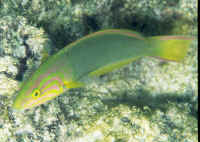
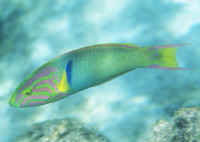
Macropharyngodon, geoffroy, the Potter's or Shortnose
Wrasse (3). Other authors rate this species higher for aquarium use; I
have never found them to be tough. Like too many species/specimens of
the genus, they die "mysteriously" overnight.
|
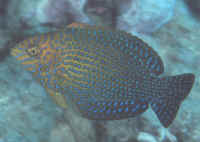
Macropharyngodon geoffroy (Quoy &
Gaimard 1824), Potter's Leopard Wrasse (3). Found in
Hawai'i to Micronesia and the East Indies. A look-alike for
Potter's Dwarf Angelfish, Centropyge potteri. A very
delicate species. Maui and aquarium photos.
|
|
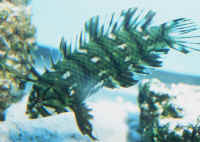
Novaculichthys (nee Hemipteronotus) taeniourus,
the Rockmover or Dragon Wrasse (1), a tough customer that will
constantly "remodel" your tank, its surroundings.
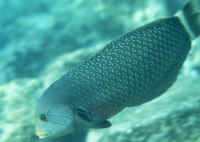
| Novaculichthys taeniourus (Lacepede
1801), the Rock Mover, Dragon or Indian Wrasse (2) is a very hardy
fish that is more often killed by aquarists than dies from other
influences. As an aquarium specimen this species requires regular
"beefy" feedings of animal-based foods. It is a
gluttonous feeder that quickly starves if underfed. Not for reef
tanks, Razorfishes are territorial and aggressive fishes. To about
a foot in length. Juvenile in captivity and adult in
Hawai'i shown. |
|
|
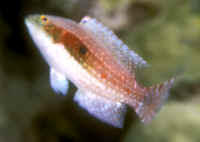
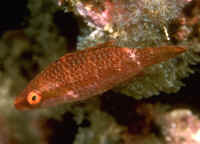
Oxycheilinus bimaculatus (Valenciennes
1840), the Twinspot Wrasse (2) is right about the right size at 6
inches maximum, but this shy beauty really takes a beating in the
process of collection, holding and shipping from the wild.
Indo-Pacific out to the Hawaiian Islands. Formerly placed in the
genus Cheilinus. At right, a male and female in
Hawai'i. Below: a juvenile, intermediate and adult in N.
Sulawesi pictured.
|
|
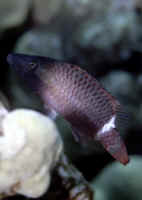
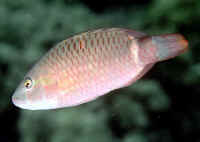
| Oxycheilinus unifasciatus (Streets 1877),
the Ring Tail or One-Banded Wrasse (2) is the widest ranging member
of the genus. Found across the Pacific's Oceania through the
Indian Ocean and Red Sea, and growing only to about a foot, it
still does poorly in captivity. Formerly placed in the genus
Cheilinus. Easy to miss as it is secretive, hiding in and
amongst coral, rubble on the bottom. A juvenile and subadult off
Kona. |
|
Pseudocheilinus octotaenia and P. tetrataenia, the Eight and
Fourstripe Wrasses (1); great, small aquarium additions for peaceful
fish-only and reef systems.
|
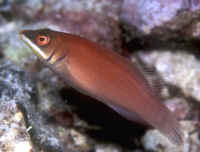
Pseudocheilinus evanidus Jordan &
Evermann 1903, the Pin-Striped or Striated Wrasse (2). I like
this fish's other common names, the Disappearing or Vanishing
Wrasse for its bashfulness. To a grand size of three inches.
Indo-Pacific, including Red Sea and Hawai'i. This one off of
Kona.
|
|
|
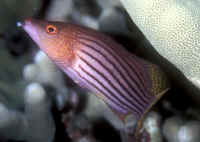
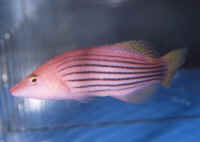
Pseudocheilinus octotaenia Jenkins 1901, the
Eight-Lined Wrasse (2) comes in two color morphs, one more
orange, the other more pinkish in body hue. Both can become
agonistic toward other fishes. Under-crowding, over-decorating
and keen observation are called for here, as always.
Indo-Pacific, including Hawai'i.. To five and a half inches
in length. Hawai'i and in captivity.
|
|
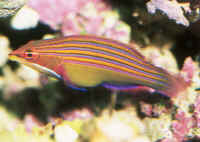
| Pseudocheilinus tetrataenia Schultz 1960,
take a guess, yes; the Fourline Wrasse (2), is mainly collected out
of Hawai'i. It is also a three-incher that like all members of
the genus is best kept one to a tank. Western central Pacific. To
three inches total length. |
|
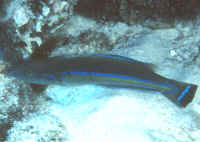
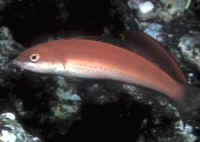
| Pseudojuloides cerasinus (Snyder 1904), the
Smalltail Pencil Wrasse (3)(male pictured) is the only member of
the genus to be offered in any number. Even out of Hawai'i,
specimens are difficult to keep alive. At right, male and female in
Hawai'i. |
|
Stethojulis balteata, the Orange Line or Belted Wrasse (2).
Terminal phase males are good looking, but are the zenith in excited
behavior in the wild and captivity.
|
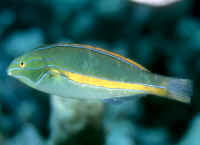
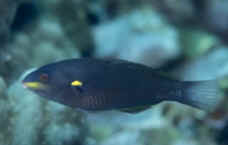
Stethojulis balteata (Quoy & Gaimard
1824), the Belted Wrasse (3), is an Hawaiian endemic. This is the
most common and hardiest member of the genus, but still has a
dismal survival rate. A male and a female off of the Big Island.
To six inches long.
|
|
Thalassoma ballieui, the Blacktail Wrasse (1) is a stout fish-only
system possibility.
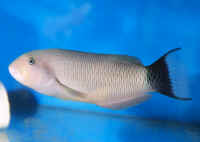
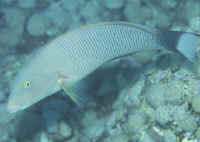
| Thalassoma ballieui (Vaillant & Sauvage
1875), the Blacktail Wrasse (1), a newer import from the Hawaiian
Islands. To fifteen inches long. A rather plain, but hardy species
for fish-only systems. Eastern central Pacific, Hawai'i and
Midway Islands. Aquarium and one off of Oahu. |
|
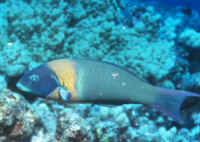
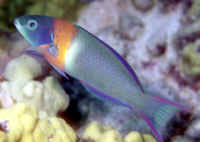
T. duperrey, the endemic Saddle Wrasse (2), Randall lists as the
most common near-shore fish of Hawai'i.
|
Thalassoma duppery (Quoy & Gaimard
1824), the Saddle Wrasse (2) is the most common reef fish in its
endemic Hawaiian Islands. To ten inches in length.
|
|
T. lutescens, the Sunset Wrasse (2) very rarely found here
(much more out of the tropical Eastern Pacific). Hybridizes with T.
duperrey.
|
Thalassoma lutescens (Lay & Bennett
1839), the Yellow Moon Wrasse (2). West Pacific and eastern
Indian Ocean, to ten inches. Easily confused with the more common
Moon Wrasse, T. lunare. Here are images of an initial
phase individual and male in the Cook Islands, and another in
Nuka Hiva, Marquesas.
|
T. purpureum, the Surge Wrasse, T. quinquevittatum, the
Fivestripe Wrasse, and T. trilobatum, another Christmas Wrasse are
three very similar appearing species that are offered occasionally
along with others as "miscellaneous" and "assorted"
wrasses (3) out of Hawai'i. As with this moniker applied to other
aquatic livestock groups elsewhere, avoid these fishes. Most don't
live in captivity. If you can't identify the organism to species
and meet its living requirements, please don't encourage their
further destruction by paying for them.
|
Thalassoma purpureum (Forsskal 1775),
the Surge Wrasse (3). Indo-Pacific, to more than one foot long.
This one in the Seychelles.
|

|
|
Thalassoma quinquevittatum (Lay &
Bennett 1839), the Red-Ribbon Wrasse (3). Indo-Pacific, to
six inches. Aquarium image.
|

|
|
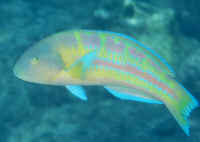
Thalassoma trilobatum (Lacepede 1801), I
wish was called the Three-Line Wrasse, but it's another of
the Christmas Wrasses (just how many labrids are green and red
anyway?)(3). To twelve inches overall length. This image taken in
Hawai'i.
|
|
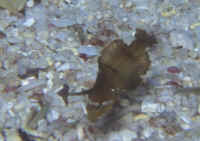
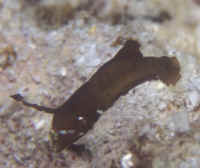
| Xyrichthys pavo Valenciennes 1840, Peacock
Wrasse. Indo-Pacific; Red Sea, eastern African coast all the way
over to the tropical eastern Pacific coast, Hawai'i... To
sixteen inches in length. Occasionally offered to the trade as
juveniles. Often mistaken for leaf litter in the wild. Feeds on
crustaceans, mollusks. |
Need adult pic
|
Ecotype: Every possible habitat, sand flats, rocky reefs, depths and
open waters; by species. Some require soft sand to burrow, sleep in,
all need cover and tank tops.
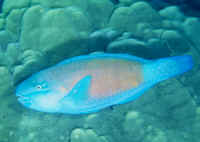
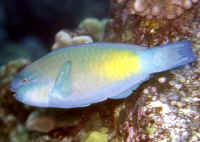
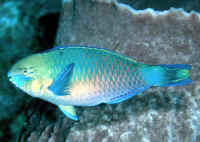
Parrotfishes, Family Scaridae. Cousins to the wrasses, none
of these colorful sand-factories live in captivity coming out of
Hawai'i. Unfortunately, a few species of "assorted",
"miscellaneous" Hawaiian Parrotfishes are sold in the trade.
Most often seen are terminal males of the Bullethead and Palenose
Parrotfishes, Chlorurus sordidus and Scarus psittacus (3). Don't
buy these fishes!
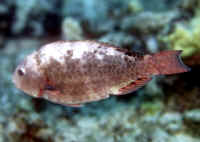
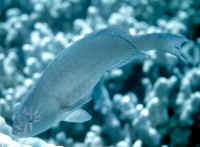
| Calotomus carolinus (Valenciennes 1840),
Caroline's Parrotfish. The most wide-ranging species of the
family, Indo-Pacific, eastern coast of Africa to tropical eastern
Pacific. To eighteen inches in length. Feeds mainly on benthic
algae and seagrasses. Pictured: At right, a female and a male in
Hawai'i. |
|
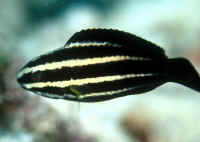
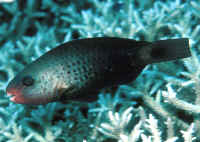
| Chlorurus sordidus (Forsskal 1775), the
Daisy Parrotfish. Indo-Pacific, Red Sea to Hawai'i. Mainly
feeds on benthic algae. To sixteen inches overall length. A
juvenile and initial phase (female) at right from Pulau Redang,
Malaysia. Below, images from Hawai'i the Cook Islands and
Malaysia... of terminal males. A highly variably colored
species. |
|
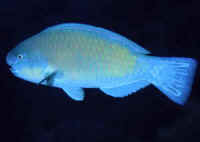
| Scarus psittacus Forsskal 1775, the Common
Parrotfish. Indo-Pacific; Red Sea, southern Africa to Hawai'i
and the Marquesas. To a foot in length. This terminal male
off Two-Step off the Big Island. |
|
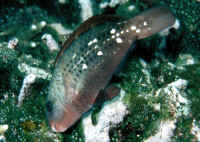
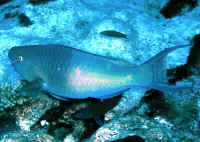
| Scarus rubroviolaceus Bleeker 1847, the
Ember Parrotfish. Indo-pan-Pacific; eastern Africa to Panama,
including Hawaii and Galapagos Islands. To twenty eight inches in
length. Shown, a female and male off Gili Air, Lombok,
Indonesia. |
|
Ecotype: Found swimming around rocks and the coral heads they scrape
for food.
Sandperches, Family Penguipedidae: Two species in
Hawai'i, one shallow, one deepwater.
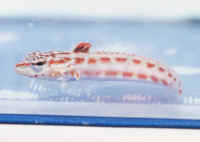
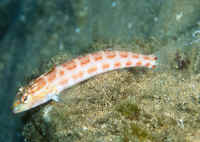
| Parapercis schauislandi (Steindachner 1900),
Schauinsland's Seaperch. Indo-Pacific; Africa to Hawaii. To
eight inches in length. Shown: a juvenile in captivity and adult
off Maui. |
|
Blennies of all sorts, Suborder Blennioidea, Gobies, Family
Gobiidae. There are a few dozen species of these largely small
and bottom dwelling tubular fishes out of Hawai'i that might be of
use to the aquarium trade. Very few are captured on a regular basis.
Perhaps with the continued growth of reef type systems and biotopic
presentations this will change.
Saber-Tooth Blennies:
Plagiotremus: Two Hawaiian species. So mean/aggressive they bite
divers!
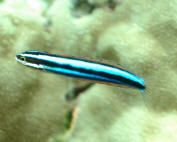
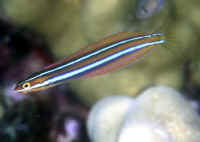
| Plagiotremus ewaensis (Brock 1948),
the Ewa Blenny. To four inches in length. Endemic to Hawai'i.
Pix from there. Feed on bits of fishes about them. Difficult to
adapt to captive foods. |
|
|
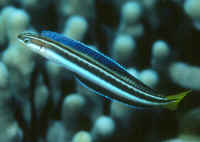
Plagiotremus goslinei (Strasburg 1956), the
Biting Blenny. Endemic to Hawaii. To three inches in length. This
one off of Maui.
|
|
Sea Whip & Other Gobies:
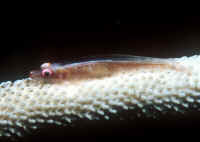
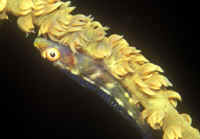
| Bryaninops amplus Larson 1985, the Large
Whip Goby. Indo-Pacific; Madagascar, Seychelles to Hawai'i. To
6 cm. One off of Queensland, Australia, another off
Kona. |
|
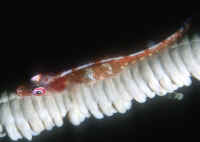
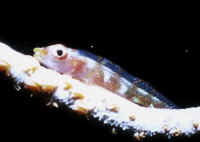
| Bryaninops yongei (Davis & Cohen 1968),
the Whip Goby. West to Mid-Pacific; Australia to Rapa, Hawai'i.
To four cm. This one off of Mabul, Malaysia. Here in a typical pose
where a pair will reside, the antipatharian Cirripathes
anguina. Look for them when underwater (found 3-45 m depth).
Mabul, Malaysia and Nuka Hiva, Marquesas, Polynesia pix. |
|
| Coryphopterus sp. Hawaiian Sand Goby.
According to Randall, formerly misidentified as Fusigobius
neophytus (Gunther 1877). Here in shallow sand on the Big
Island. |
.JPG)
|
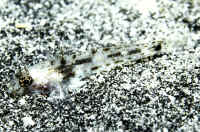
| Hazeus nephodes E.K. Jordan 1925. Stout
spine at anterior of both dorsal fins. To two inches in length.
Found only in Hawai'i and Marshall Islands on the sand. Kona
pic. |
|
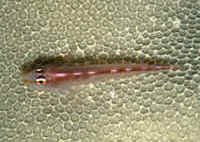
| Pleurosicya micheli Formanoir 1971,
Michel's Host Goby. A transparent species with an internal red
striped on top of its vertebral column. To one inch in length.
Indo-Pacific. This one in Hawai'i perched on a Porites
Coral. |
|
Part 4 of 5, To: Part 1, Part 2, Part 3,
|
|