|
Related FAQs: Saber-Tooth Blennies, True Blennies, Combtooth
Blennies 2, Blenny Identification, Blenny Behavior, Blenny Compatibility, Blenny Selection, Blenny Systems, Blenny Feeding, Blenny Disease, Blenny Reproduction, Ecsenius Blennies, Blennioids & their
Relatives,
Related Articles: Ecsenius Blennies, Combtooth Blennies, Blennioids and their Relatives,
/The Conscientious Marine
Aquarist
Saber-Toothed Blennies,
Family Blenniidae, Tribe
Nemophini
|
%20MD.JPG)
|
|
By Bob Fenner
|
Meiacanthus ovalauensis
|
Saber-Tooth Blennies:
Are all marine (excepting Meiacanthus anema which ventures
into brackish and freshwater), found in the Indian and Pacific Oceans.
They are notable for having all their fin rays unbranched and are long
in appearance, some almost eel-like. Five genera (Aspidontus,
Meiacanthus, Petroscirtes, Plagiotremus, Xiphasia) with about fifty
species.
These Blenniids of the genera Aspidontus and
Plagiotremus should be avoided at all costs (unless you want to
keep one to a tank by itself or with non-fishes). These vampires have a
pair of enlarged canine teeth in their lower jaw for ripping scales and
bits of flesh from other fishes. Some do this by stealth, hiding in a
hole in the reef and darting out for a fast-attack chomp. Others are
sophisticated underwater con-artists, closely mimicking benign, even
beneficent fishes.
Genus Aspidontus:
The Genus Aspidontus: Perhaps the most celebrated
example of mimicry is between the Sabertooth Aspidontus
taeniatus and the legitimate cleaner wrasse, Labroides
dimidiatus. The blenny look-alike has the body shape, color, even
the "cleaner" dance down to a "T"; but watch out
host fishes. This nasty little biter won't be cleaning, it'll
be chomping a piece out of your hide.
How easy is it to be fooled over which
is the blenny, wrasse? Take a look at Dakin's book (p. 180), the
fish pictured is misidentified as the blenny Aspidontus;
it's the wrasse, Labroides. The Baensch & Debelius,
WEB/HRA/REH standard reference works cited in the bibliography
accurately identify and illustrate both. The false cleaner A.
taeniatus is readily differentiated by its underslung subterminal
mouth.
Bigger PIX:
The images in this table are linked to large
(desktop size) copies. Click on "framed" images to go to
the larger size. |
|
%20MD.JPG)
|
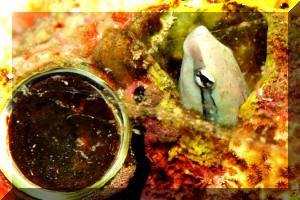
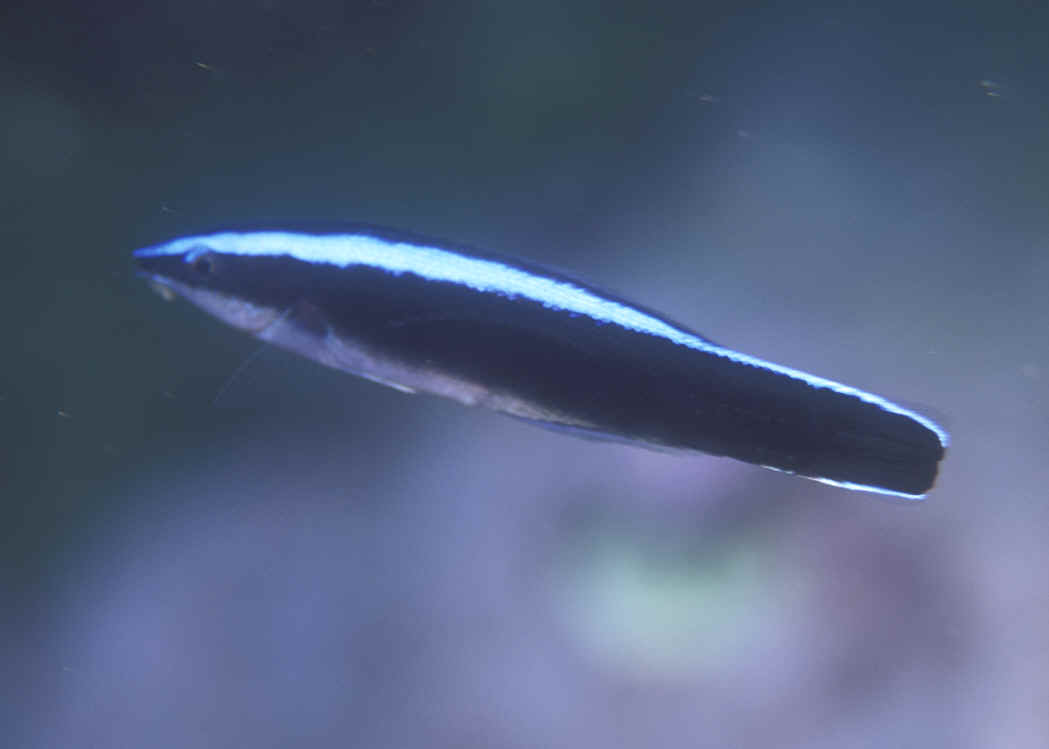
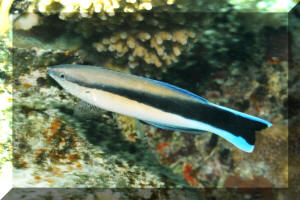
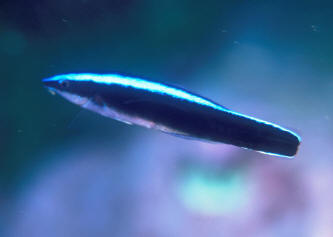
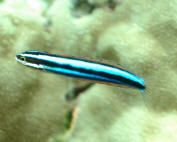
Aspidontus tractus Fowler 1903, (formerly A. taeniatus Quoy & Gaimard
1834), the False Cleaner. Mimicking Labroides
dimidiatus in both color, markings and behavior, the False
Cleaner sneaks up on unsuspecting victims and takes a bite out of
their flesh or scales. This fish is discernible from its wrasse
look-alike mainly by its sub-terminal (underslung) mouth. As you
might guess, rarely offered (by accident) in the trade/hobby.
Note the terminal mouth in the wrasse, subterminal in the mimic blenny.
Nuka Hiva, Marquesas image on left, Labroides on juveniles at
right.
http://fishbase.sinica.edu.tw/Country/
CountrySpecies
Summary.cfmCountry=Indonesia&Genus
=Aspidontus
&Species=taeniatus |
|
Bigger PIX:
The images in this table are linked
to large (desktop size) copies. Click on "framed" images
to go to the larger size. |
|
|
An opposite benefit is conferred by the Forktail Blenny
Meiacanthus oualanensis on the Canary Blenny (one of many with
the same common name), otherwise better called the golden mimic blenny
Plagiotremus laudandus flavus. As you know, very few fishes
tangle with the blennies of the genus Meiacanthus due to their
venom-gland bearing enlarged canines. The canary/golden mimic blenny,
bold phony that it is, swaggers about in upper waters without fear.
Genus Meiacanthus:
The genus Meiacanthus: these beautiful,
delicate-appearing blennies possess strong predator deterrents;
enlarged canine teeth with associated venom glands. Unlike most
Blennioids Meiacanthus have a fully functional swim bladder and
"strut their stuff" above the bottom with impunity.
Despite their fangs, the genus makes good general
aquarium and reef tank additions, being left and leaving other fishes
alone. Though the genus' venomous bite does not rival a stone or
lionfish sting it is painful to humans. I
would avoid hand-feeding them.
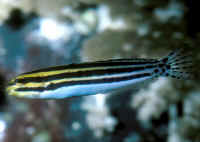
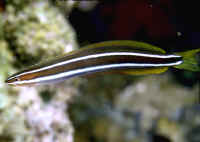
The Yellow, Forktail, Vampire or Canary Blenny
Meiacanthus ovaluanensis should definitely be mentioned. It is a
standard blenny offering. Two of my other favorites in the genus are
the longitudinally striped M. grammistes and M.
atrodorsalis, though there are plenty more. There are twenty two
described species in this genus.
Bigger PIX:
The images in this table are linked
to large (desktop size) copies. Click on "framed" images
to go to the larger size. |
|
|
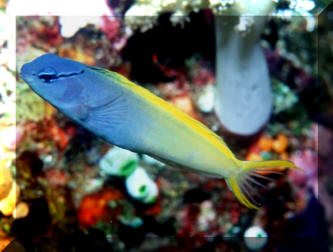
Meiacanthus bundoon Smith-Vaniz
1976, the Bundoon Blenny. Pacific Ocean: Fiji and Tonga. To 8 cm.
This one at House of Fins in CT. http://fishbase.org/Summary/species
Summary.php?ID=25790&genusname=
Meiacanthus&speciesname=bundoon |
|
Bigger PIX:
The images in this table are linked
to large (desktop size) copies. Click on "framed" images
to go to the larger size. |
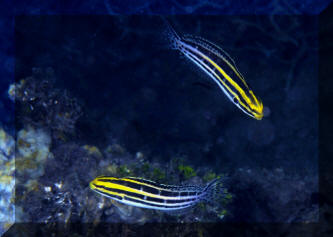 |
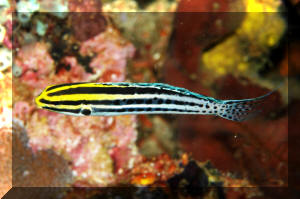
| Meiacanthus nigrolineatus Smith-Vaniz 1969,
the Blackline Fangblenny. Western Indian Ocean; Red Sea and the
Gulf of Aden. To 9.5 cm. This one off of Na'ama Bay, Sharm. See
the mimic Ecsenius gravieri as well (on the True Blennies
page) |
|
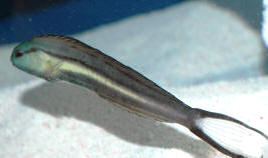
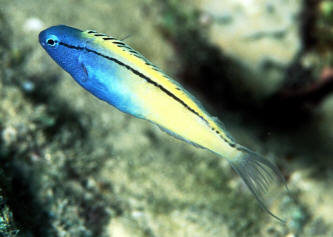
| Meiacanthus oualanensis (Gunther 1880), the
Yellow Forktail or Canary Blenny. Western Pacific, Fiji Islands. To
about four inches in length. A beautiful import from the South
Seas. Feeds on plankton. |
|
Bigger PIX:
The images in this table are linked to large
(desktop size) copies. Click on "framed" images to go to
the larger size. |
|
|
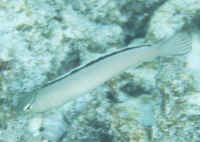
| Meiacanthus smithi Klausewitz 1962, the
Disco Blenny. Indo-West Pacific; Sri Lanka to western Java Sea. To
a little over three inches in length. This one in the
Maldives. |
|
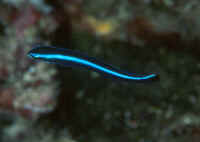
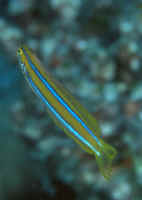
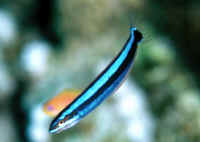
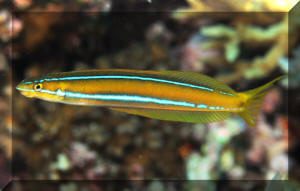
Genus Petroscirtes: 23 valid species, 31 nominal.
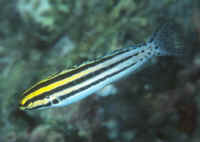
| Petroscirtes breviceps (Valenciennes 1836),
the Shorthead Sabretooth Blenny or Striped Poison-Fang Blenny
Mimic. A mimic of Meiacanthus grammistes (see above) (most
easily told apart by Petroscirtes underslung mouth). Indo-West
Pacific; East Africa to the Micronesians. To 11 cm. Can and will
bite if handled. N. Sulawesi pic. |
|
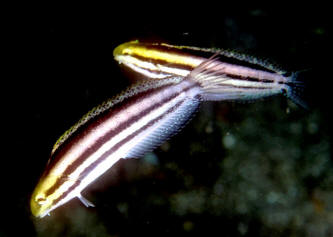
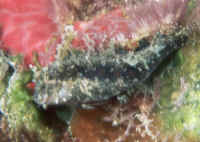
| Petroscirtes mitratus Ruppell 1830, the
Floral or High Fin Blenny. Indo-Pacific; Red Sea to Samoa. To a
little under three inches in length. This two inch one photographed
in the Maldives. |
|
Bigger PIX:
The images in this table are linked
to large (desktop size) copies. Click on "framed" images
to go to the larger size. |
|
|
Genus Plagiotremus: Nine species. So mean/aggressive
they bite divers! The same species may look quite different, depending on the
fish it is mimicking.
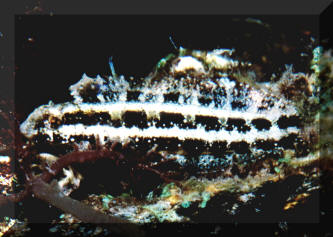
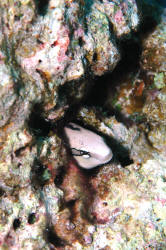
| Plagiotremus azaleus (Jordan & Bollman
1890), Sabertooth Blenny. To four inches in length. Eastern
Pacific: Gulf of California to Peru, including the Galapagos.
Photographed here in the Galapagos. Live in tubeworm and
tube-building snail shells. Hide in associations of Rainbow Wrasse
to ambush fishes for scales and flesh. |
|
Bigger PIX:
The images in this table are linked
to large (desktop size) copies. Click on "framed" images
to go to the larger size. |
|

|
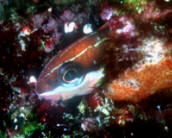
| Plagiotremus ewaensis (Brock 1948),
the Ewa Blenny. To four inches in length. Endemic to Hawai'i.
Pix from there. Feed on bits of fishes about them. Difficult to
adapt to captive foods. |
|
Bigger PIX:
The images in this table are linked
to large (desktop size) copies. Click on "framed" images
to go to the larger size. |
|
|
|
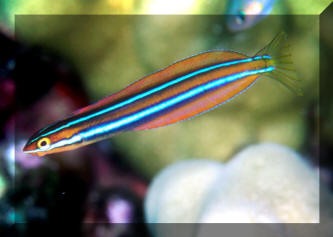
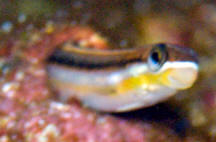
Plagiotremus goslinei (Strasburg 1956), the
Biting Blenny. Endemic to Hawaii. To three inches in length. Off
of the Big Island.
|
|
Bigger PIX:
The images in this table are linked
to large (desktop size) copies. Click on "framed" images
to go to the larger size. |
|
|
|
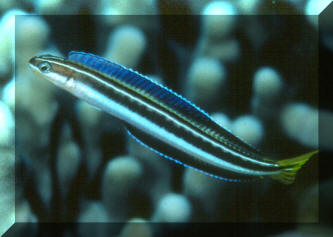
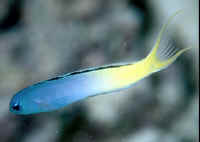
Plagiotremus laudandus (Whitley 1961), Bicolor
Fangblenny. Western-Pacific; P.I., S. Japan to Lord Howe, Micronesia.
All yellow subspecies P. l. flavus occurs in Tonga and Fiji. To 8 cm.
Mimics Meiacanthus atrodorsalis. Eye at extreme front of head
comparatively. Fiji pic.
|
MD.JPG)
|
Bigger PIX:
The images in this table are linked
to large (desktop size) copies. Click on "framed" images
to go to the larger size. |
|
%20MD.JPG)
|
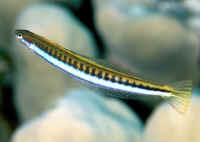
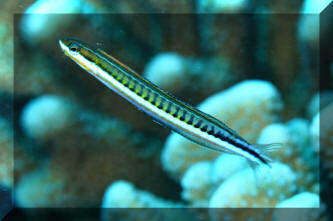
| Plagiotemus tapeinosoma (Bleeker 1857), the
Piano Fangblenny. Indo-Pacific; Red Sea to the Line Islands. To
five and a half inches in length. Some in the upper Red Sea and
Queensland who bit me. |
|
Bigger PIX:
The images in this table are linked
to large (desktop size) copies. Click on "framed" images
to go to the larger size. |
|
%20MD.JPG)
|
Bibliography/Further Information:
http://rspb.royalsocietypublishing.org/content/275/1631/117


%20MD.JPG)
.JPG)
%20MD.JPG)
%20MD.JPG)