| Brackish Question &
Answer Page (FAQs) |
|

|
|
|
We ask that, before
submitting, you refer to...
Tips on Asking
Questions,
Ask the WWM Crew a
Question,
Query Corrections Referral
Page, FAQs on FAQs. EDFP, TBPFAQs,
SWPOTD, Last Few Days Accrued
FAQs,
 Subscribe to the Daily Pics Subscribe to the Daily Pics
|
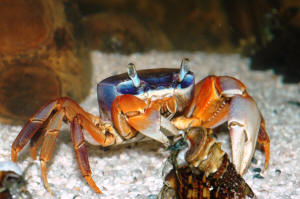
Cardisoma sp. (likely C. armatum).
Southeast Asia, Indonesia Land Crabs. Soap-Box Crabs for how
they're individually shipped (in plastic soap-dishes closed
with rubber bands) to prevent cannibalism. To eight inches
across... Not a community tank item... Actually not totally
aquatic... if you're lucky, yours will crawl out of the tank
and leave.
Full Size
Link
|
________________________________________________________________________
|
Fish Issue ID 2/21/20
Hi WWM,
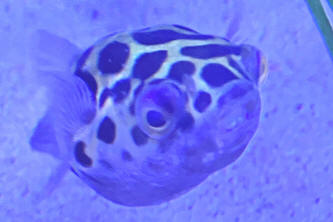
My GSP has developed some kind of growth on his right eye.
Could you guys help me ID it and suggest a treatment for it? He also
looks like he has an internal growth because he has this large hump on
the right side around mid body.
Let me know if I could provide any more information to help ID this
issue.
Thank you,
<Do read here:
http://www.wetwebmedia.com/popeyefaqs.htm
If on the one eye, usually trauma, perhaps exacerbated by the
environment; if on both eyes, disease more probable. The addition of
Epsom salt (1-3 teaspoons per 5 gallons/20 litres) alongside the usual
marine salt mix used in his brackish or marine system should provide
some support, though the use of antibiotic may be helpful if there is
signs of inflammation or dead tissue. Adult GSPs maintained in
freshwater systems never stay healthy for long, so it's important to
review the environment in any case: GSPs need moderately brackish to
fully marine conditions; SG 1.010-1.025 at 25 C is about right. High
levels of alkalinity and oxygen are both essential.
Cheers, Neale.>
|
 |
|
Re: Fish Issue ID 2/21/20
Thanks for the quick response Neale. I'll get started with the Epsom salt.
<You're welcome. Cheers, Neale.>
|
|
Brackish tank mates
1/21/20
Hello!
I'm a long-time patron of your website, and I have to say I really
enjoy reading how passionate you all are and the entertaining
delivery of the wealth of knowledge that you share. Thank you.
<And thanks for these kind words.>
I have a question regarding my 30 gallon brackish tank (I've had the
brackish set up for around four years- SG 1.011/temp around 79F - I
use instant ocean about one cup per 5 gallons and have a 90g
canister filter running). I started with a swarm of BBGs and an SG
of 1.005, then added a Knight Goby and some nerite snails. I've
since slowly raised the SG and added a figure 8 puffer, Zebra hermit
crab (they got along just fine!!) and nine Endlers. I knew the
endlers would become food for the KG, but figured they would be fun
to watch in the meantime(and fun for the KG- I have one left now). I
apologize in advance if that seems cruel.
<I get cruelty is subjective, so will set that aside. The real issue
is live feeder fish cause health problems. Firstly, they're an
unknown quantity in terms of what parasites or bacteria they
introduce into the fish that eat them. Wild fish can't really avoid
this risk, and some (many, even) will be infected with parasites.
But pet fish should be kept free of such parasites. Secondly,
there's some anecdotal evidence that predators fed on live fish are
apt to being more aggressive and/or predatory towards tankmates,
while those that only see frozen or fresh foods don't acquire those
traits to the same degree. Hunting down a few guppies doesn't really
add anything to the life of your Knight Goby, so the argument that
it
'enriches' their existence doesn't justify the potential health
risks.>
Anyway, the BBGs have since passed away (might have been the
increase in salinity or that they weren't great stock to begin with-
though I had them for over 2 years).
<BBGs aren't really brackish water fish, despite their reputation.
Some species do live in estuaries, it is true, but the farmed ones
you see in pet shops are a fresh to low-end brackish species that
does best with just a little salt, maybe SG 1.002-1.003. I've
maintained them just fine in soft, slightly acidic conditions
similar to those they inhabit in the wild.
They're actually more likely to starve to death than suffer from a
water chemistry issue. BBGs are easily starved. They need decent
sized meals, but resolutely ignore anything that's not fresh, live
or frozen.>
I now have a tank with a figure 8 puffer, knight goby, two nerites,
and one swordtail endler's livebearer. I realize I don't need the
salinity so high and will likely back off slowly to around 1.008.
<If that; SG 1.003-1.005 is absolutely fine for this selection of
livestock.>
The KG is very healthy but has gotten shy over the years, and mainly
sticks to his preferred cave. The Figure 8 is very chill and has
never shown any sign of aggression toward its tankmates.
<Yet, anyway!>
Here's the question: I'm thinking of adding some Desert Gobies if I
can find them- like maybe two or three at most. If not, my brother
has a bunch of Kribs and would be willing to give me three (I do not
want to overstock my tank). What do you think about these two
options given my tank setup?
<Kribs would only work at the lower salinity range, since they're
not really brackish water fish. They inhabit the Niger Delta, for
sure, so have some tolerance. SG 1.003 is not a problem, and they
might even handle slightly more. But they're better in soft water
with a neutral pH. Not only do their colours look much more intense,
you also avoid the problem of just getting male fry (the ratio of
males/females depends on pH, with 7 being 50/50, and above 7,
increasingly more males and fewer females). As for
Desert Gobies, they simply don't belong here. Continual warmth will
shorten their lifespan, and since they're basically annual fish, you
want to keep a colony that's breeding otherwise you'll have none
left after a few months (assuming you buy near-adults).>
I know Kribs get really aggressive when mating, but they would also
add some great color contrast- If I got a group of females maybe
they would be chill?
If neither option is good, I also wouldn't mind having a swarm of
BBGs back in the tank but I fear the SG is too high.
<Perhaps, but I'm more concerned they'll be Knight Goby food, or
else simply starve.>
What do you think?
<I'd be looking at more robust tankmates. Have you considered
Etroplus maculatus? The wild-type is charming, if understated, while
the all-orange farmed form is very colourful.>
Thanks for your response!
Daniel
<Most welcome, Neale.>
Re: Brackish tank mates 1/22/20
Hello again!
<Hello Daniel,>
Thank you for your advice.
<Most welcome.>
Given your recommendations, I think I'll slowly lower the SG to the
1.003-1.005 range over the next few or more water changes.
<Sounds wise.>
Also, I've given up on the Desert Goby and Krib idea and will consider the
Etroplus maculatus. I agree with you the wild-type are rather charming in
their way.
<Yes; their colours change significantly with mood, as well as during
breeding; there is another species called Etroplus suratensis that gets much
bigger (around 15 cm/6 inches) but is very beautiful when kept
properly.>
I think they could be a good addition to my tank. I also read that they eat
algae, and would have no problem foraging in my tank in-between feedings.
How many would you recommend?
<I would certainly keep a group; all Etroplus are social (if not actually
schooling) fish and if kept in a reasonably big group, six or more, you'll
avoid the territorial bullying you might get with pairs.>
I'm quite fond of my F8 puffer and KG. I want to make sure that they're
getting enough good food to eat- I currently feed mostly frozen brine
shrimp, krill, conch/urchin/marine worm cubes, soft-frozen reef caviar
(bought mostly for the BBG but the F8 and KG like them too), and
occasionally feed them super worms (large mealworms for reptiles sold at the
pet store). The super worms provide some crunch for puff's teeth.
<Your fish seem to eat better than I do -- conch and caviare!>
Sometimes I give them bits of scallop and crushed mussels from the market-
also good for puff's teeth. However, I've not had luck feeding my puffer
snails- he just sucks them out of their shells and doesn't get the proper
teeth grinding effect from crunching on them.
<Correct. Puffers are easily smart enough to select the least demanding way
to gather food.>
I've trimmed the puffer's teeth twice now- using tricaine-s (ms 222) with
baking soda to neutralize acidity- and that has been successful but I would
like to keep his teeth trimmed naturally if possible. Do you have any ideas?
<Realistically, nope. While puffers presumably do keep their teeth trimmed
in the wild, the reality is that we don't offer the sort of high-fibre,
low-nutrient foods that would do that. You could try smearing prawn or fish
onto a pumice stone, and he'd have to pick away at the rock to get some
food. You can also try offering less processed and more whole invertebrates,
the 'wholer' the better! Try offering steadily bigger and more robust foods
-- cooked crayfish or king prawn legs initially, but scaling up to things
like crab or lobster legs as budget allows.>
Lastly, in the past I've added live ghost shrimp to the tank and both the
puffer and KG enjoyed the live snack. Is this a good idea?
<Yep, especially if gut-loaded with greens-based flake food first (such as
Spirulina flake). On the other hand, crustaceans (as well as mussels) are
high in thiaminase, which causes long term problems, so need to be a
minority food (unless gut-loaded or vitamin-enriched) compared with white
fish fillet, insects, snails, and cockles.>
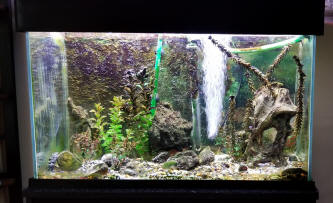
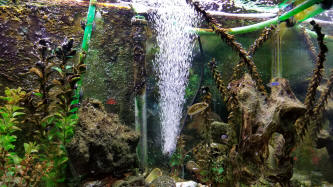
I've attached two photos of my tank in case you're curious.
<Thanks for sharing!>
In one of the photos, all three fish came out to see what I was up to (KG is
poking out of the cave in the back). Thank you again for taking the time to
write back!
Regards,
Daniel
<And to you, best wishes, Neale.>
|
  |
Red Claw Crab not Eating 12/29/19
Hello! Hardly anyone knows anything about red claw crabs, as I
cannot find any answers as to why my red claw crab has stopped
eating!
<Let's see if we can help.>
He is kept in brackish water conditions, has filtered water, and
water that is always about 74 degrees Fahrenheit.
<Right. Let's review first. By "brackish", how salty are we talking
about? The first thing you do when brackish water animals misbehave
is change the salinity. Many if not most come from places where the
salinity varies, so just making a change can have a positive effect.
But the bigger issue is that you need to be using a substantial
amount of salt, not the teaspoon per gallon amounts often mentioned.
I'd suggest one teaspoon per litre (i.e., a salt concentration of
about 6 gram/litre) to produce about one-sixth normal seawater
salinity. If that didn't do the trick, feel free to double that
amount, which would get you around one-third normal seawater
salinity. Either of these would be much closer to real world
situations for Perisesarma bidens. Next up, review air temperature.
23 C/74 F is very much towards the low end for a tropical animal,
and I'd crank the water heater up to 25 C/ 77 F. In cold conditions
tropical animals will slowly lose vigour, and loss of appetite is an
extremely common symptom of that. Death invariably follows soon
after, though it may take weeks to happen.>
He is able to climb to get air or be in water when he wants. I have
sand substrate. When I first got him, he would eat his food fine,
but now, he won’t eat at all. I noticed he wouldn’t eat, so I ended
up putting his food right in front of him, and he still won’t eat
that food.
<Loss of appetite in crabs is almost always a symptom of
environmental problems. Review as stated above.>
I don’t think he’s molting, because he’s been acting this way for
about 2 weeks and I was told molting should only take about a day.
<Correct, and moulting crabs tend to hide away. They do need a
source of iodine to moult successfully, for which purpose either
offer regular portions iodine-rich foods (Sushi Nori is ideal) or
else specific iodine-enriched crustacean foods sold for use in
marine aquaria.>
Also, I don’t think it’s a calcium problem, as I give him special
vitamins that help provide him calcium every 3 weeks. I’m really
worried about him, and I have no idea why he is not eating.
<Hope this helps. Cheers, Neale.>
Re: Red Claw Crab not Eating
1/1/2020
Thank you very much for this help! Right after I added more salt, he
molted the next day.
<Great!>
Does he absolutely need to eat his exoskeleton? If so, he is not
eating it.
<No, he doesn't need to eat it, but most crabs do, simply to recycle
the calcium. If he doesn't, that's fine, but do add some suitable
replacement, like a small shell-on prawn that he can pick apart and
consume. Failing that, just dusting whatever he likes to eat (fish
meat, banana, etc.) with crushed cuttlebone or even fragments of
edible snail shells (escargot) will have the same usefulness. Some
crab foods are calcium-enriched and may be good enough on their own,
but personally, I'd make a point of offering
extra calcium immediately after moulting. Cheers, Neale.>
Re: Red Claw Crab not Eating 1/11/20
I’d like to thank you for helping me with my red claw crab.
Unfortunately, he has passed away even after adding a proper amount
of salt and turning up the temperature, as he just did not eat at
all.
<I'm sorry to hear that.>
I don’t know the reason for his refusal to eat, but after taking
your advice, he seemed to have more energy and would actually
approach the food (but still didn’t eat it). Maybe he was sick?
<Indeed, or perhaps, he'd been away from salty water for too long.
These are tricky animals to keep well -- they need brackish water,
high humidity (cold or dry air quickly kills them), and food that
contains all the nutrients including iodine and calcium. So while
inexpensive in themselves, and not demanding in terms of space, they
are tricky.>
I don’t know, but I’m glad I found your website and got some help.
You are very knowledgeable about these creatures, and people who are
having trouble with their pet crabs are fortunate enough to be able
to contact you for help. Again, thank you very much.
<You are most welcome, and thanks for these kind words. Good luck
with your next pet! Cheers, Neale.>
|
Damselfish Identification - Neopomacentrus; & BR use
11/20/19
Good evening,
<Hi Joel>
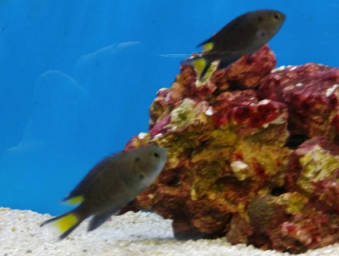
I was at a local fish store today and came across these two lovely looking
Damselfish in the store's batch of "Assorted Damsels". I've only been
keeping saltwater fish for a short period of time, but have sufficient
experience in brackish fishkeeping to tentatively identify them as
Freshwater Demoiselles (Neopomacentrus taeniurus). I've never seen them
before in person and pictures online of the related N. cyanomos sometimes
appear similar, so I was hoping you might be able to verify for me.
<These appear to be Neopomacentrus taeniurus>
Sadly, I don't think they are appropriate for either of my tanks. My 125
gallon brackish tank at 1.006 may be too "fresh" and may squabble with the 8
Orange Chromides in it. On the other hand, I'd worry that it would fight
with my Talbot's Damsel in my 55 gallon saltwater.
In either case, just seeing this rare (to me) Damsel was enough of a treat.
Thank you for your time.
Joel
<Am going to ask Neale Monks here to respond re Pomacentrids for brackish
systems. His background w/ such systems is extensive. Bob Fenner>
Re: Damselfish Identification - Neopomacentrus /Neale
11/20/19
Hello Bob, Joel,
<Neale>
Yep, agree with the identification of your damselfish as Neopomacentrus
taeniurus, but with the cautious that there are other species, such as
Stegastes otophorus, that do look quite similar (especially the yellow
tail). That said, Neopomacentrus taeniurus does have a more deeply-forked
tail, suggesting your initial identification may well be correct.
I’ve seen Neopomacentrus taeniurus kept in freshwater tanks where they had
been in situ for at least six months, seemingly without harm. Companions
including Corydoras catfish and Angelfish of all things, and while the water
was certainly hard, it wasn’t salted. I suspect 1.006 will probably be
tolerated perfectly well, as these are truly euryhaline fish rather than
marine fish that happen to handle brackish water for longer or shorter
periods (as would be the case with, for example, Sergeant Majors). In some
places (including various oceanic Pacific islands) they inhabit completely
freshwater habitats alongside classic peripheral freshwater fish types like
Gobies that, in common with Neopomacentrus, have a marine reproductive stage
but as adults inhabit freshwater environments. I believe Neopomacentrus
taeniurus breed in the sea, however, rather than spawning in freshwater and
leaving their eggs to drift into the sea. Hence finding Neopomacentrus
taeniurus in freshwater, brackish, and fully marine habitats.
<Ahh>
My understanding is that they’re often found in harbours, estuaries, and
tidally-influenced rivers and streams, often quite murky ones (hence their
drab colouration). Water depth is rarely very great (less than 3m by one
source). Allen refers to them as dwellers of ‘inshore reefs’ so I guess your
classic coastal rocky reefs with oysters and mangroves rather than offshore
coral reefs seem to be their preferred habitat. My guess would be that
they’re much like various Apogon and Gobiidae species that are found in such
places: perfectly well adapted to varying salinity, able to handle low
salinity, even freshwater, for extended periods, but probably happiest (in
the sense of being able to spawn successfully) when kept in mid to high end
brackish conditions or fully marine salinities.
They are planktivores by nature, but consume all the usual foods that you’d
give small Damselfish.
I agree, Orange Chromides would likely be viewed as a competitor. There’s no
particular reason you couldn’t accommodate both given sufficient hiding
places, but you’d certainly want to plan ahead. I don’t know enough about
Neopomacentrus generally to comment on their social behaviour towards other
Damsels in a marine aquarium, but would imagine Neopomacentrus taeniurus are
par for the genus. Possibly Bob can add more here.
<The genus is more toward the easygoing spectrum of damsel territoriality;
not quite Chromis. I do consider, as you've stated re habitat, that they
should co-exist w/ Chromides.>
That pretty much covers what I know! The problem is they’re hardly ever
imported, and almost never kept in freshwater or brackish systems. I’m not
aware of any long term records beyond what I’ve reported above!
I’d be tempted to try them out with the Orange Chromides, and as/when they
mature, if they start looking seedy, or else behave abominably, then move
them into a more rough and tumble FOWLR system.
Cheers, Neale
<Thank you, BobF>
|
 |
|
Re: Damselfish Identification - Neopomacentrus
11/22/19
Bob, Neale,
<Hello Joel,>
Thank you for the additional information and advice. The mention of
Apogon was very interesting as well - I'm really only familiar with the
more common Pterapogon and Sphaeramia Cardinals and was unaware of any
brackish Cardinalfish.
<I know nothing about the estuarine Apogon species, except that they
exist.>
The temptation was too great and I purchased one of the Demoiselles,
acclimating it to 1.006 over the better part of the evening. It colored
back up right away in the tank and was eager to eat so I am optimistic
it'll do well.
<Me too; by all accounts they are very hardy, much like other Damsels.
Given virtually all the bread-and-butter Damsels have been kept in
high-end brackish conditions for years (i.e., at SG 1.018) during the
earlier years of the marine hobby, I imagine the truly euryhaline
species to be very adaptable.>
There was mutual interest between the fishes but no hints of aggression
thus far. The tank includes multiple pieces of PVC pipe covered in
oyster shells, slate caves, and lots of plastic plants so hopefully
there will be enough territories for all. I don't typically see
Chromides protecting spaces/caves for the most part so it's a fairly
mellow tank.
<Cool. Chromides become more aggressive when spawning, but their ecology
is interesting, since they mix with schooling Green Chromides as some
sort of 'cleaner fish' symbiont. So they're probably 'wired' to be
fairly easy going with fish they don't see as an immediate threat.>
As you mention this is an uncommon fish in the trade, would you be
interested in periodic updates on health, behavior, and compatibility
with some of the "classic" brackish aquarium fish? I'd be happy to
provide.
<I'd be most grateful, in fact, to receive such!>
Thank you again for all your time and help,
Joel
<Cheers, Neale.>
|
Re: Damselfish Identification - Neopomacentrus
12/5/19
Good evening,
<Hello Joel,>
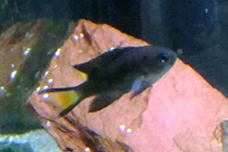
Almost two weeks ago I purchased a Freshwater Demoiselle (Neopomacentrus
taeniurus) for my 125 gallon brackish tank. I thought I would give you an
update on how everybody is doing thus far.
<Sure!>
The tank is 125 gallons, currently 77 F, about pH 7.8, and dH 15. The
specific gravity is normally kept at 1.006, though I checked today and it's
crept up to 1.008. Not a huge deal I imagine, but I'm going to bump it back
down next water change.
<Indeed, no big deal. Truly euryhaline brackish water fish, like these, can
adapt to anything from fresh to seawater within minutes, in the sense of it
not causing them long-term harm. There's some scientific evidence it likely
takes them days to properly, fully adapt, but unlike marine or freshwater
fish, exposure to salinity changes isn't actually lethal or even stressful,
and in the wild they'd have to be able to handle these simply to survive.>
So far the Demoiselle has been in fantastic health. Great color, fins look
perfect, and very healthy appetite. I feed a variety of wet and dry foods
over the course of the week - he seems to like the New Life Spectrum, Bug
Bites fish food, Brine shrimp, and tiny bits of tilapia I offer every few
days. He doesn't appear interested in Nori, but otherwise is eating just
about anything offered.
<Great. They're zooplankton feeders, so disinterest in Nori isn't altogether
surprising. Unlike some reef Damsels, they aren't major algae eaters. That
said, if your chap takes algae-based flake food, that'd be a really useful
addition to their diet, as it is for most fish.>
As far as behavior, he claimed one of the PVC pipes closest to the filter
and heater as a "home base" but doesn't spend a great deal of time there
unless accidentally startled. I see him mostly swimming among the Orange
Chromides; occasionally (two or three times over the week) I may see a quick
dash towards a Chromide of smaller size to make them leave his territory,
but so far haven't seen him dash more than a few inches or physically attack
another fish. He'll also do this towards the Knight Goby
who similarly enjoys hiding out in pipes. My Scats are all left alone,
though it took a few days to realize they don't actually pose a threat.
None of the inhabitants seem to pay him much mind.
<Sounds good. He does seem to have staked his territory, and with a lot of
Damsels, any negative behaviours are really circled around that patch. If
they're left alone, for the most part they leave others alone.>
All in all, I'm happy with this purchase. I will keep an eye as he grows to
to make sure he doesn't get too "punchy".
<I think BobF referred to this genus as one of the more clubbable species,
so with any luck, all should be well. Sometimes moving rocks or whatever
around to create obvious territorial boundaries is a useful trick.>
Thank you for your time,
Joel
<And thanks for sharing. Cheers, Neale.>
|
 |
|
Ick Cure 10/12/19
Good Moring,
Can I use ick cure in my tank that has a Columbian catfish in it.
thnx
<The API product? I would NOT use Malachite Green on scaleless
catfishes...
Instead, a real cure can be effected here by raising temperature,
and possibly adding sea salt. Please READ here:
http://www.wetwebmedia.com/FWSubWebIndex/fwich.htm
and the linked files above. Bob Fenner>
Ick Cure /Neale 10/12/19
Good Moring,
Can I use ick cure in my tank that has a Columbian catfish in it.
thnx
<I can think of absolutely no reason why you would have to. None at
all.
Columbian Shark Catfish are brackish to marine catfish, any above SG
1.002, Whitespot/Ick parasites simply won't survive. The free-living
stages will be killed immediately, which means, at tropical
temperatures, infected Catfish moved into brackish or marine
conditions should be completely free of Whitespot/Ick within a week
or so. Conversely, if you're keeping the Columbian Sharks in a
saltwater system, moving them temporarily into low-end brackish or
even hard freshwater should kill off the marine Ick, Cryptocaryon,
within a few days as well. Oh, and if you're keeping Columbian
Sharks in a plain freshwater tank, then don't. Just don't. Add the
salt, and the Whitespot will go! Cheers, Neale.>
Scatophagus Aggression 10/3/19
Good evening,
<Hey Joel>
I have a 125 gallon brackish tank, kept at 77F and 1.006 specific gravity.
The inhabitants are 5 Orange Chromides (ranging from 1.5 to 2.5 inches), 2
Silver Scats (7 inches and 3.5 inches), a Green Scat (2.5 inches) and a Green
Spotted Puffer (3 inches). I do understand that GSP in general are not good
community tank specimens but over the 4 years I've had this fish, he's been with
snails, hermits, Damsels, Mollies, and Blue-Eyes (in various tanks) and has
never nipped a single animal. He seems to prefer to keep to himself. He's not
the issue in this tank.
<Okay>
My concern today is with my Scats. I've had my big Silver Scat for a few years
since it was about an inch long and more recently picked up a second Silver to
grow and keep company. Having read on WWM that Scats are best in odd numbers and
are fine in mixed species groups, my next purchase was a small Green Scat. The
Green Scat, despite being smaller, is very hard on the smaller of the two Silver
Scats.
<Interesting>
It used to be just some pushing during feeding times but over the past 2 months
has grown more into antagonizing.
The small Silver still is out in the open, is eating well and not hiding, though
is constantly being chased and I worry it's causing him to be stressed and is
probably not helping my skittish big Silver Scat to
adjust.
My queries are twofold:
1) Do you expect that they will mellow out with age or that it will get worse
from here? I'm pretty sure it will get worse since it's already been going that
way, but figured I'd ask. I understand I'll likely have to
rehome the Green Scat.
<My experience has been that scats do "mellow" as you state... in time>
2) In your experience, is Scatophagus more aggressive than Selenotoca? If I
rehome the Green, I'd need to decide if I want to try and special order another
Silver Scat or try again with an (easier to find) Scatophagus specimen. I've
never had a single problem over the years with either Selenotoca I've owned,
even though two animals isn't a great sample size.
<More an independent issue w/ Scatophagids. Have encountered some that are
"mean" of all species. IF you are concerned... (I would) move the green to a
plastic floating colander (yeah, like for straining the flying spaghetti
monster) for a few days, leaving the lights off... This "time out" often acts to
reduce aggression, allow the animals to reorient>
I really appreciate your time and advice.
Thank you,
Joel
<Thank you for sharing. Bob Fenner>
Re: Scatophagus Aggression /Neale
10/4/19
<<Will add this/these observations to BobF's comments re: Scatophagus and
Selenotoca. Yes, aggression varies with age, older specimens tending to become
more lazy and accommodating. But also it's more social jockeying than
aggression. If the Scats are different sizes, a definite pecking order will
exist. Scats are not the worst by any means, and you will see this with Archers
and Monos to an even greater degree. This contrasts with Colombian Shark Catfish
which school together amicably with any specimens too big to be viewed as food.
Anyway, mixing species can help, and works really well between Monos and Scats,
where Scats bludgeon their way through the squabbles Monos have, dissipating
aggression while the Monos regroup.
In the absence of Monos, adding extra Silver Scats would probably work, the
point being that pecking order aggression is most acute where the dominant fish
can easily bully one or two tankmates. In large groups, five or more specimens,
this gets harder. On top of that, Scatophagus tend to be much more pushy than
Selenotoca, this latter species being really quite gentle and placid most of the
time. (Indeed, it's a charming, underrated species with the looks of even the
nicest marine species.) Scatophagus are, as you probably know, the "garbage men"
of the reef and coastline, seemingly ignored by many/most predators because of
their unsavoury habits, and because of that, they seem to "go anywhere, do
anything" which gives them their friendly charm as pets, but can also make them
a bit thuggish in
small to medium sized tanks. Cheers, Neale.>>
Re: Scatophagus Aggression 10/6/19
Bob, Neale,
<Joel,>
Thank you so much for your time and advice. I went to the local fish store today
and asked them to order another Silver Scat for me. In my experience it normally
takes about 4 to 8 weeks to get in the fish I order.
<Not too bad.>
I don't believe my tank (at 125 gallons) can accommodate my current bioload and
3 additional Scats to spread out aggression, at least at adult size.
I'll keep an eye on the current Green Scat during this time and if the behavior
gets worse I will trade him in once a new specimen is available.
<Understood. Hopefully with additional Silver Scats, the Green will mellow a
bit.>
Thank you again,
Joel
<Most welcome. Neale.>
|
Please help - sick puffer 8/19/19
Dear crew,
<Ray>
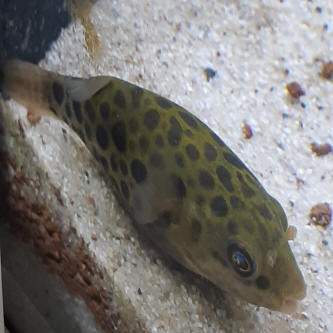
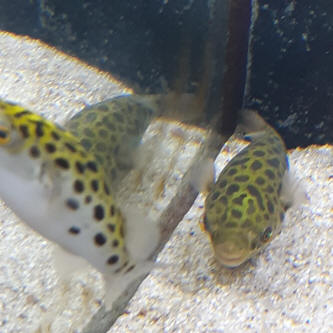
Could you please give me some advise on my sick puffer. It is a 3 inch Tetraodon
nigroviridis.
<I will, but am referring you to Neale Monks here as he is far more
knowledgeable re these Tetraodonts>
It started after he ate some snails from another tank. He (or she) was pinching
its tail and started to change colour. See pics
<I do>
I have 3 of them and the other two have no problems and are bright coloured.
<I see this as well>
This is about a week. I first put him in a small tank and treated him with
ESHA2000. He didn't take that very well; started to float on its back so I took
him out immediately.
<Good>
After a week (yesterday) I treated him with 'SERA BAKTOPUR DIRECT' for 30
minutes and directly after that with 'EASY LIFE VOOGLE'
Sometimes he's real 'lively 'and swims around but often he's just apathetic
lying on the bottom of the tank.
The water is good, other fish don't have any problems. Salinity is about 1.005
What should I do?
<Mmm; were it me, mine, I'd cease treatment/s... this fish may have a bit of
"stomach ache" from snail shells... and there might be some value in adding a
bit of Epsom Salt, but I'd just wait at this point. The fish doesn't look
skinny, diseased nor picked on, and will likely be fine in days>
Kind regards from The Netherlands
Ray
<Cheers, Bob Fenner>
|
 |
|
Please help - sick puffer /Neale
8/20/19
Dear crew,
Could you please give me some advise on my sick puffer. It is a 3 inch
Tetraodon nigroviridis.
It started after he ate some snails from another tank. He (or she) was
pinching its tail and started to change colour. See pics I have 3 of them
and the other two have no problems and are bright coloured.
This is about a week. I first put him in a small tank and treated him with
ESHA2000.
<I'm surprised; my puffers have usually done quite well with this product.>
He didn't take that very well; started to float on its back so I took him
out immediately.
<Fair enough.>
After a week (yesterday) I treated him with 'SERA BAKTOPUR DIRECT'
<Another antibacterial medication; reasonably good, if less good than an
antibiotic.>
for 30 minutes and directly after that with 'EASY LIFE VOOGLE'
<Not familiar with this.>
Sometimes he's real 'lively' and swims around but often he's just apathetic
lying on the bottom of the tank.
The water is good, other fish don't have any problems. Salinity is about
1.005
What should I do?
<One thing is to try increasing the salinity and see if that perks him up.
With any brackish water fish, this is a good first step. It replicates what
they experience in the wild, and some simply seem to enjoy it. Another thing
is to try increasing aeration. Sometimes extra oxygen helps, and this
in turn suggests the aquarium is perhaps less good than we thought. Many
brackish water species prefer high oxygen levels that replicate the tidal or
littoral habitats they prefer. Finally, and again a good step with
brackish water fish, is to review water chemistry. Most prefer high
alkalinity and a pH well above 7; aiming for 15-20 degrees dH, 10+ degrees
KH, and pH 7.5 to 8.2 is ideal.>
Kind regards from The Netherlands
Ray
<I will observe that GSPs are not really social, and while some specimens
cohabit in pairs or trios, not all will do so. Look out for behaviour that
might suggest bullying or at least antagonism. Your fish looks essentially
healthy, and I would not be randomly medicating unless you have clear
symptoms of a disease. Lethargy and dark colours on GSPs can mean nothing
more than social or environmental stress. Review, and act accordingly.
Cheers, Neale.>
Re: please help - sick puffer 8/20/19
Dear Neale, Bob,
<Ray,>
I thank you for your answers. They are very helpful to me.
<Most welcome.>
I'll stop any medication and start increasing aeration and the salinity. I
will also check the water parameters.
<Very good!>
Thanks again and have a nice day!
<You too.>
Kind regards,
Ray
<Cheers, Neale.>
|
Spawning Figure-8 Puffer (Tetraodon biocellatus)
7/21/19
I apologize if im in the wrong place, but i wanted to ask if you guys had any
info on figure 8s besides the common info.
<Perhaps!>
My questions are as follows
1. What conditions are required to breed them.
<The species has been bred only very occasionally in aquaria. It is often stated
that reproduction is cichlid-like, with the male protecting the eggs until the
fry become free swimming. However, this doesn't agree with the scientific
literature, which reports that the species scatters eggs and extends no
broodcare at all "Spawning of eight Southeast Asian brackish and freshwater
puffers of the genera Tetraodon and Carinotetraodon in captivity"). This report
stated the eggs hatched after 5 days, used up
their yolk within 4 days of hatching, and became free swimming on the following
day. Pufferfish fry are tiny and difficult to rear, and you will need suitably
small live foods.>
2. What are the best methods to sex them.
<Again, unknown. These fish are almost certainly monomorphic, with no visible
differences between the males and females. To be fair, you could predict the
males would be more aggressive and more likely to defend specific patches of
territory, given the breeding behaviour. But that's about it.>
3.what are the best conditions for them to thrive in?
<Low-end brackish conditions seem to be best, at least for aquarium maintenance
and breeding. There's no question that the species also occurs in freshwater
environments, even more commonly than in brackish water. But it doesn't do as
well kept that way. The scientific literature includes at least one report on
spawning, and that took place in brackish, not freshwater conditions. While the
adults were maintain in quite strongly brackish water (20 ppt) for 'several
years', they were moved in higher salinity (30 ppt) for a month, and then across
the next month the salinity was decreased in small steps until it reached a
lower level (9 ppt). By this time the female had become swollen with eggs. The
eggs were maintained at this salinity after the adults were removed, hatching
taking place as described above. The fry were initially fed brackish water
Brachionus, and after 35 days, graduated onto Artemia nauplii. After 60 days
they were moved onto the usual frozen foods such as krill, minced clams, etc.>
4. If i were to have a large group of them would that decrease aggression and
allow them to shoal or school, boost the odds of them breeding? and what would
be a good group size if so?
<Realistically, yes, you'd want a group, and you'd want to keep as many as
practical. I'd suggest no fewer than 6.>
5. If you have good resources and info on figure 8s id really appreciate it.
<The paper described above is probably the only truly authoritative article on
spawning these puffers. It is available via ResearchGate, for example.>
6. Thank you
<Most welcome. Neale.>
55 gallon FOWLR tank stocking
7/2/19
Good evening,
<Am here now Joel; howsit?>
I am new to saltwater tank keeping but about 6 weeks ago upgraded my 29
gallon high end brackish (1.015) tank to a 55 gallon FOWLR tank. Mostly,
I wanted to provide tankmates for my 3.5" Green Spotted Pufferfish (Dichotomyctere nigroviridis) who I've had for about 4 years, waiting
until
he exceeded 3 inches to start transitioning to saltwater per Neale's
advice. I tested the waters - pardon the pun - with Mollies both in the
29 and the 55 and have found my puffer to be very mild, not biting or
chasing any other fish at all during the time I've had him. He's even
ignored the hermit crab hitchhikers that arrived on some live rock, who
are still happy and healthy to this day. Understood that he may
eventually change his mind on the crustaceans, but for now their
inclusion is nice.
<Okay>
Currently, the tank sits at 1.023, pH 8.2, temperature 77F with about 40
pounds of live rock and 2.5 to 3 inches of aragonite sand substrate.
Given
my puffer's relatively mild nature, but understanding their potential to
be aggressive, I stocked fish that should in theory be able to
cohabitate.
The stocking is currently:
1 Green Spotted Puffer
3 Mollies - 1 male, 2 females (Poecilia spp)
3 Yellow Tailed Blue Damsels (Chrysiptera parasema)
2 Electric Blue Hermit Crabs (Calcinus elegans)
I originally selected the C. parasema due to WWM due to the facts that
they are at the low end of the aggression spectrum, that they are
suitable for
this size tank, and that I live in a small town that really only gets
Chromis, Clownfish, and "assorted Damsels". I would have gone for C.
talboti otherwise. I had 5 of the C. parasema, but two of them backed up
the other 3 Damsels and all 3 Mollies into a corner.... not unexpected,
but frustrating. I removed all the rock, caught the 2 offenders, and
returned
to the store. The third biggest is starting to be pushy so I'm keeping
an
eye on it and considering whether the last three should be returned to
the
store.
<I see>
In this case, I am at a loss for how to stock this tank. I've read
enough
of the articles to know that some of the WWM believe Chromis viridis to
be
a questionable choice in a 55 gallon, but would they be a better choice
than trying more Chrysiptera?
<Chrysiptera genus damsels would be better temperament wise>
I'm trying to go for a peaceful tank atmosphere and would prioritize
peace over fish that are more "classically beautiful."
Other than Damsels, I am not sure which families or genera to
investigate.
I am avoiding fish that are sedentary or have long fins (like Firefish)
to avoid puffer temptation but am looking for any nudge in the right
direction
to do research. I would appreciate any suggestions you could offer.
Thank you for your time,
Joel
<Well; you'll have to raise the specific gravity of the water for most
full-strength seawater species... there are (still) many choices. I'd
have
you consider other brackish to marine groups for now. Perhaps Scats,
Toxotids... Let's have you peruse here:
http://www.wetwebmedia.com/brackishsubwebindex/brlvstselfaqs.htm
http://www.wetwebmedia.com/BrackishSubWebIndex/bracinvertfaqs.htm
Bob Fenner>
Re: 55 gallon FOWLR tank stocking
7/3/19
Bob,
<Joel>
Thank you as always for the quick response. I found two of the
Chrysiptera
dead today, not sure if from aggression or illness, but in any case my
stocking plans are on hold for a few weeks while I keep an eye on it and
do some investigating.
<Okay>
Scatophagidae is my favorite family of aquarium fishes; my 125 gallon
brackish tank has two Selenotoca and one Scatophagus in it and they are
wonderful pets. I thought about Toxotes spp. but those that can tolerate
full saltwater got a little bigger than I really wanted and I feared
they would eat my (mostly smaller) current fish.
<They rarely eat all but the smallest fishes>
I will look into some brackish fishes as well; the Blue-Eye Pseudomugil
cyanodorsalis may be obtainable here, potentially Butterfly Gobies
(Neovespicula depressifrons) as well. Would love Diamond Killifish but
doubt I'll ever come across them. In any case, I'll speak to the stores
and see what they can order.
<Good>
Thank you again for your time,
Joel
<Do please keep us informed re your thoughts, activity here. BobF>
Re: 55 gallon FOWLR tank stocking
7/14/19
Bob,
<Joel>
Following up on our previous conversation. I was able to acquire 4 Pacific Blue
Eyes (Pseudomugil signifer)
<A fave species; I raise them here.>
which I am currently in the middle of drip
acclimating. They seem to be doing well at this current time, hoping they get
along with the Mollies and Yellow Tail Blue Damsel (Chrysiptera parasema).
<Hope the Damsels are small, the Blue Eyes big>
Besides that, I am currently trying some spare bits of Aegagropila algae in the
tank to see if it takes off. So far, after a week it's still perfectly green, so
that is a pleasant sign.
The store I went to did in fact have an available Talbot's Damsel (Chrysiptera
talboti), at a larger size than my current Yellow Tail resident - 2 inches
compared to 1.5. Given my Yellow Tail Damsel fought
constantly with the other Yellow Tails, is it likely it would also fight in a 55
with a Talbot's?
<Might; though most all Chrysiptera get along as individuals, between species>
Thank you as always for your advice,
Joel
<Glad to share. Bob Fenner>
Brackish puffers; sel., sys.
4/5/19
Hi Neale,
<Nathaniel,>
I am setting up a brackish water tank, currently it is 1.006 and I am slowly
increasing it to 1.010 (the reason being that it is a mature freshwater tank and
I don't want to kill all of the good freshwater bacteria by increasing the salt
content all the way to 1.010 on day one).
<Understood, but for most brackish species, 1.005 would be just fine.>
I am wondering, which of the 'marine' puffers will do OK in a brackish around
1.010?
<Interesting question! The obvious pick is Chelonodon patoca, which is a marine
species, but routinely inhabits estuaries and rivers. It seems completely
indifferent to salinity, and should do well in a half-strength system
indefinitely.>
I understand dog faced puffers are OK?
<Arothron hispidus will remain healthy for a long time in half-strength
seawater. Whether indefinitely is hard to say. The species enters estuaries, and
the juveniles live in them. But adults are really coastal marine, even reef
fish. Not really river dwellers. So fun inmates for a brackish tank while young,
but I'd probably move adults to marine tanks.
BobF?>
<<Yes; this species lives in full strength seawater as adults>>
Can a porcupine be kept in 1.010? - I am really keen on this one.
<Never seen these in brackish tanks, nor heard of them being recorded in such
conditions for extended periods. Adults are open water marine fish, and while
juveniles surely do inhabit estuaries, it's probably a temporary thing. I dare
say you could experiment, and if they showed signs of distress, returned them to
full marine conditions. But not convinced it'd be worth the effort.>
If so can these two be kept together?
<Generally these puffers are solitary and squabble in anything other than public
aquaria.>
is there any others you can recommend?
<See above re: Chelonodon, a lovely, and actually quite sociable, species.
It used to be very rare, but gets exported out of India fairly regularly.
There's a "Golden" subspecies or related species available as well, and it's
even nicer. If you have a really big tank, Colomesus psittacus is another marine
species that inhabits estuaries more or less permanently, but it's very rare in
the trade. You'd need good contacts in the South American trade to get it, and
unfortunately the more casual importers are likely to confuse it with the
strictly freshwater Amazon Puffer, Colomesus asellus.>
Thanks
<Welcome. Neale.>
Re: Brackish puffers (BobF, some input please)<<Ok>>
4/5/19
Thanks Neale,
<Hello again!>
With the Arothron hispidus, could they be introduced whilst the salinity is
still at 1.006 or best to wait until 1.010?
<When I bought my two specimens, they were sold as freshwater fish!
Juveniles (say, 1-3 inches long) would be just fine in a low-end brackish system
at SG 1.006, provided the water was reasonably hard, alkaline and well
oxygenated. Observe their behaviour, and if they are lively and feeding well,
act accordingly.>
Do you have any suggestions where I can locate a Chelonodon patoca? None
currently for sale at any of the regulars...wharf aquatics..wildwoods etc.
<Wildwoods is where I've seen them at least twice. Keith Lambert at Wildwoods is
pretty good at getting stuff if it's out there. Aquarium Glaser has them on
their (wholesale) stock lists so finding a store that works with them could be a
start.
https://www.aquariumglaser.de/en/fish-archives/chelonodon-patoca-2/
Again, speaking with the likes of Keith is going to be helpful.>
Thanks
<Cheers, Neale.>
<<AquariumFish.Net lists them for sale:
https://aquariumfish.net/catalog_pages/puffer_fish/puffer_fish_for_sale.htm
Otherwise I'd contact the folks at LiveAquaria.com if your LFS can't/won't
special order for you from their wholesale suppliers. Bob Fenner>>
Re: Brackish puffers (BobF, some input please)<<>>
4/5/19
Sorry, one last question,
<Sure.>
Could either of these species be kept with a green spot or figure 8 puffer in a
big enough tank?
<Juvenile Arothron hispidus are quite tolerant, but may be snappy if they feel
cramped. Adults are distinctly territorial, but otherwise not too aggressive. By
all accounts Chelonodon patoca is very easy going, and
should tolerate dissimilar species just as well as they tolerate one another.>
<<I would NOT mix the larger Tetraodontids with much smaller species; too likely
to be harassed and all food outcompeted for. BobF>>
Thanks.
<I'm going to direct you to some writings of mine on marine puffers that
tolerate brackish, here:
http://brackishfaq.blogspot.com/2016/08/marine-fish-in-brackish-water-aquarium.html
Some day I should import all of this into WWM, but for now, hope it's
useful. Cheers, Neale.>
Re: Brackish puffers 4/8/19
Hi Neale
Good news!
My LFS has found Chelonodon patoca on an import list with 17 available at £10.99
each. Great result.
<Indeed. And a very decent price, too. When they were in at Wildwoods they were
going for something around the £50 mark, I think.>
They’re going in a 5 foot by 2 foot that I’m going to slowly make brackish.
<Nice.>
At that sort of size tank - how many should I go for?
<Tricky. As juveniles, either a singleton or at least three. While a fin-nipper
according to some, it's apparently pretty peaceful towards its own kind given
adequate space and hiding places (they like to dig into the sand). But twos can
sometimes work out poorly in any species, so adding at least a third ensures
bullying is spread out a bit. Adults can get pretty large, though 30 cm/12 inch
specimens seem exceptional. Nonetheless, you should be expecting something
around 20-30 cm/8-12 inches when fully grown, and even in your very large
aquarium you might struggle to house three adults, let alone more. Rehoming
semi-adult specimens of these very rarely seen pufferfish shouldn't be a problem
though, especially given their utility in marine aquaria. So I'd be tempted to
get three and grow them on, but with the proviso that in 3-4 years I might need
either a bigger tank or to rehome two of them.>
Thanks
<Cheers, Neale.>
Green spotted puffer
3/30/19
I have had my green spotted puffer for 2 years now. I have him in a 5.5gallon
tank, ( I know he needs a 10 gallon tank)
<And the rest! More like 20+ gallons -- adult GSPs are, what, 12-15 cm/5-6
inches long.>
but he has been fine, until now.
<The "until now" is the key part of the sentence, really. Two years isn't bad at
all, so obviously you're doing some things right. But some things evidently
aren't right.>
His belly goes from white to black, and he is staying at the top of the tank at
a vertical angle.
<Signs of stress; when GSPs become inactive, dark in colour, and disinterested
in food, then something is very wrong.>
Or stays with his beak pushed into a corner of the tank. But the last 3 days he
has not been to the bottom at all and is being tossed around or flipping around
like an acrobat & I know that's not normal.
<This is very bad.>
I just did a 60 percent water change.
<What sort of water chemistry values are we talking about here? To recap, a GSP
this age really needs strongly brackish water; I'd be aiming for SG 1.005-1.010.
Needless to say ammonia and nitrite must be zero, but nitrate should also be as
low as practical; below 20 mg/l is ideal, and certainly no more than 40 mg/l.>
Filter is only a couple weeks old.
<I don't understand this exactly. Do you mean you changed the old filter for a
new one? If so, then the new filter could be cycling and ammonia and nitrite
above zero. That could easily account for the problem. If you mean the tank had
no filter at all until two weeks ago, I'm surprised this puffer survived until
now.>
I know not to change everything all at once. Is he dying? I think I'll die if he
does.
<My first step would be to check the salinity. Strongly brackish water will
help. If you're dosing salt in "teaspoon per gallon" amounts then you're not
doing it right. You really need substantial amounts of marine salt mix. For SG
1.005, at 25 C you'd be dosing the salt at 9 grams per litre (1.2 oz per US
gallon) which is quite a bit -- 9 grams is about 1.5 teaspoons of typical salt
mix. I'm also going to ask you to check the ammonia and/or nitrite levels. If
they're not zero, then that's a major problem that needs
urgent attention. I'm finally going to have you do some reading, here:
http://www.wetwebmedia.com/brackishsubwebindex/gspsart.htm
Hope this helps, Neale.>
More Spaghetti eel observation
3/10/19
Hello Neale, Marco and all of you good people at WetWebMedia,
<Hello Ben,>
Here are more observations of spaghetti eels behavior.
https://youtu.be/0h3ZRQzUKXQ
https://youtu.be/miFpO_fSUP4
<Very cool. Looks like a great brackish water community tank you've got
there.>
I traded the larger eel with a medium sized one. Now they both seems to
be same species. I also look forward to receive a Lamnostoma kampeni eel
maybe within a few months.
<Now that's something you don't see in the trade very often!>
My spaghetti eels now spend much more time under the sand. Often for
days.
They only come out when hungry. But once they feel hungry, they will
come out and will take chunks of shrimps bigger than their mouths.
<Cool. Do be careful with shrimp, prawn and mussel meat though. Contains
a lot of thiaminase. Implicated in long-term vitamin deficiency problems
in carnivorous animals. Use as maybe one-third or less of the food
offered. Use white fish fillet, cockles, squid and other thiaminase-free
foods for
the majority of their diet.>
They also make the interesting body knots like morays when eating. And
they also capable of snagging food 'from above' like a snake eel.
<Interesting.>
My procurer recommend me to put my moringuas in full FW, or if I really
have to have brackish (for my GSP and brackish tilapia), he recommend
low-end brackish. Higher brackish would make uncomfortable both Moringua
and Lamnostoma, he said.
<Certainly worth experimenting. With these eels what you tend to see is
a hunger strike if the salinity is wrong, weeks or months before the
fish dies. So if the fish continue to eat well in low-end brackish or
freshwater conditions, and there's no evidence of skin infections, then
they could well be fine. Realistically, they likely move in and out of
estuarine conditions, and there might be no "perfect" salinity, and
instead offering a few months in salty water, then a few months in
fresh, would actually be best.>
Well, that's my current observation. I will report more when I received
the Lamnostoma. Thank you and have a wonderful weekend!
Best Regards, Ben
<Thanks so much for writing. Lovely videos! Neale.>
Re: More Spaghetti eel observation 3/12/19
Hello Neale and all you splendid people in WetWebMedia,
<Ben,>
Thank you for your quick reply! And thank you for complimenting my aquarium.
Indeed it is a nice brackish aquarium community, low brackish at 1.005sg.
<Sounds great!>
The happiest inhabitants of my aquarium are the huge brackish tilapia (never get
to know its Latin/scientific name. It is caught in the estuarium together with
the mollies. I wonder what kind of tilapia is that?) and those two lovely
Tetraodon nigroviridis. Interestingly, all those scary stories about pufferfish
being aggressive barbarians does not apply on my tank, the puffers doesn't harm
anyone, not even the smallest of mollies. In fact the tilapia is much more
aggressive and greedy.
https://youtu.be/oUDXNEfEEeM
<Well, Sarotherodon melanotheron is the 'true' brackish water Tilapia, but most
of the farmed species will handle brackish, even marine, conditions, including
Oreochromis mossambicus, Oreochromis niloticus, Sarotherodon galilaeus and
Tilapia rendalli.>
My puffers loves to bite on empty clamshells & sea snail shells, maybe they try
to eat the worms and/or pieces of shrimps which sticks on the shells. Or do they
like to munch on those to get more calcium?
<Might be either explanation, or both.>
As for shrimps, thank you for your advice, I will try to give my eels more
varied diets as per your advice. Fish fillets usually does not survive human
predation in my refrigerator ;) . So I will stock on squids for the eels. BTW
what are cockles?
<Cerastoderma edule. But other burrowing marine clams probably just as good.>
Spaghetti eels are nice to have but I now understand why they are not popular as
pets around here. Their lifecycle seems to consist of hiding under the sand,
only came out for taking bits of food, then went back hiding for days. So most
of the times, a keeper of spaghetti eels would feels like having no eels at all.
They also said that larger morays would see much smaller eels as worms. So maybe
I will have to rehouse my Whitecheek to accommodate more smaller eels,
considering I will have Lamnostoma coming.
<Understood.>
I really hope I could upgrade to a bigger aquarium someday. Right now I usually
give away my eels once they grown too big for the aquarium.
Well, thank you very much for your kind comments, and I will keep you posted!
Best Regards, Ben
<And to you, good luck! Neale.>
To: Brackish
INDEX;
|
|