|
FAQs on Compatibility of Loricariids, South and
Central American Suckermouth Cats
Related Articles: Loricariids, Otocinclus, From Pan-ack-ay to Pan-ack-zee, A
Detailed Look at the Bizarre But Beautiful Panaque
Catfishes by Neale Monks
Related Catfish FAQs:
Loricariids 1, Loricariids 2, Otocinclus, Other
Loricariid Genera: FAQs on: Ancistrus, Baryancistrus, Genera Farlowella, Loricaria, Sturisoma,
Rhineloricaria: Twig Plecostomus, Genera Glyptoperichthys, Liposarcus, Pterygoplichthys, Sailfin Giants
among the Loricariids, The Zebra
Pleco, Hypancistrus zebra, Hypostomus, Panaque, Peckoltia: Clown
Plecostomus, Lasiancistrus,
Pseudacanthicus, Scobanancistrus, L-number catfish,
Loricariid
Identification, Loricariid
Behavior, Loricariid
Selection, Loricariid Systems,
Loricariid Feeding, Loricariid Reproduction, Loricariid Disease, Catfish: Identification, Behavior, Compatibility, Selection, Systems, Feeding, Disease, Reproduction, Algae
Eaters,
|
|
|
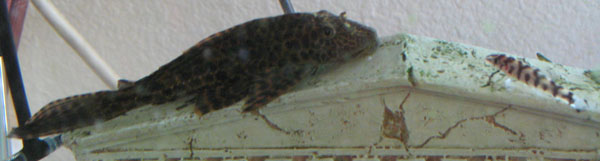
catfish escapades (Loricariid beh., comp.
f's) 10/10/16
Hi,
You have always been such a great resource for me and my fresh water
tropical aquarium. I just did a cleaning and 50% water change out. I
have a large Oscar and two large catfish(spotted... one light, one dark)
housekeepers. Until today they have always been fairly solitary in their
activities. But today they are inseparable and dancing together. What's
going on if you know????
Thanks.
Courtney
<Most likely territorial interactions if they're different species.
"Catfish" covers thousands of species, of which hundreds are kept as
pets, so no idea what you're talking about here. If you mean Plecs of
some type, usually Pterygoplichthys spp., these don't breed in aquaria.
They are territorial, and if you did a big clean, moving rocks and
bogwood about, they might be reasserting their territorial rights. Do
keep an eye open for damaged fins and other such scars: Plecs can and do
damage one another seriously when fighting, sometimes leading to death.
Cheers, Neale.>
Re: catfish escapades (Bob F; any books on fish behaviour you
recommend?) 10/11/16
<<Ah yes: Would have readers use BookFinder.com put in the two words:
"Fish Behavior"; and see the selection there>>
That's the funny thing, they appear to really be enjoying each other. It
looks like play and dancing. I haven't seen any aggression. At times
they look like synchronized swimmers side-by-side doing almost the same
movements.
<I'd still be cautious. Fish "size each other up" by swimming parallel,
usually but not always nose to tail. The idea is that they push water
onto each others heads and tails, and the one who can't push water on
both head and tail at the same time must be smaller, so backs down. Or
so the behaviour guys tell me! Precisely what's going on we probably
won't ever
know. But the point is, "play" as understood in higher vertebrates (a
recreational activity done in itself or to learn/practise a skill) has
not been convincingly demonstrated in many fish. The only ones I'm sure
about are Mormyrids (such as the famous Elephantnose) and these fish do
indeed have huge brains relative to body size, comparable to that of
birds and
mammals. For most fish the brain is quite small, and while I'm not
saying they're stupid, far from it, but behaviour tends to have a
strict, clearly defined function. So swimming of the sort you're
describing is more likely to be aggression, or perhaps social behaviour
if the species is a schooling species, or a pre-mating courtship
behaviour. There are some excellent books on fish behaviour out there,
including some aimed at non-scientists; "Pisces Guide to Watching
Fishes" is aimed at divers rather than aquarists, and is a bit old, but
it's very readable. Bob F might have some other suggestions.>
It's really a trip. They also like to bathe the large Oscar
which he allows.
<If by this you mean sucking on the Oscar's flanks, this isn't good at
all!
Plecs can do serious damage doing this, removing mucous (which
is what they're feeding on) but worse, lifting scales and making Finrot
more likely. It's also a clue the catfish are hungry. If that's what's
going on here, review diet, and provide more filling fare; for Plecs,
things like sweet potato and courgette are both good staples, along with
the odd piece of white fish fillet, prawn or clam. Bogwood is probably
useful too.>
Sent from my iPhone
<Sent from my computer. Cheers, Neale.>
Re: catfish escapades
Oh and I do believe that they are Plecs I bought them years ago when
they were quite small. They are both spotted but one is a lot darker
than the other but they match in size. They really are a couple of
characters.
<Cool. There are a few Pterygoplichthys species widely traded as
"Common Plecs". Pterygoplichthys pardalis is light grey with
dark grey squiggles. Pterygoplichthys multiradiatus is more light
brownish with dark blotches and spots. Pterygoplichthys gibbiceps is
beautiful wood brown with dark brown spots, very giraffe-like.
Hypostomus plecostomus is similar but seems to be quite rare.
Nonetheless, you can easily tell Hypostomus from Pterygoplichthys;
whereas Hypostomus has 7-8 rays after the dorsal fin spine,
Pterygoplichthys have 9-14 such rays after their dorsal fin spine.
Hypostomus are much smaller though, around 12 inches/30 cm rather than
the 18 inches/45 cm typical of Pterygoplichthys. Cheers, Neale.>
Plecos and snails in same tank.
4/17/16
I recently introduced to snails into my freshwater tank that already had
a Pleco.
I noticed the Pleco will not leave the snails alone and constantly bang
them up against the tank.
The pet store said they were compatible together however this is hard to
believe given the behavior of the Pleco.
Is this merely a competition issue and they shouldn't be together please
help thanks Gary
<Mmm; well; have seen and heard, read of occasions where various species
of Loricariids "got along" with snails; and ones where they
didn't. If your "Plecos" are doing more than simply cleaning off
the snails shells, they'll have to be separated. Bob Fenner>
|
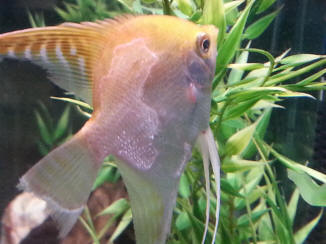
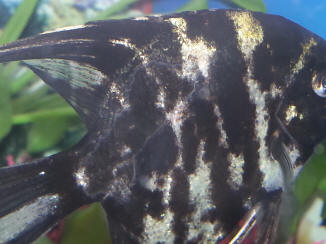
New Angelfish with suspicious "plaques"?? 4/10/16
<9.580 megs of pix? Why?>
Hi, I have searched everywhere for assistance with no results so I hope you
may be able to assist. Please see attached pics of 2 of the 3 angels
I purchased at my LFS yesterday evening. One looks great but the other two
have these "plaques"....I doubt any water quality issues as I've not had
them even 24 hours. All three are active and eating. ANY he'll
would be appreciated. THANK YOU! Kristi Jones
<Two of three... In a day.... is there a Chinese Algae Eater or hungry Pleco
in this tank?
Something is eating, riding these fish.... NEED TO BE MOVED ASAP, and
treated per WWM for infectious/bacterial "fin and body rot". READ. Bob
Fenner>
|
|
|
|
Re: New Angelfish with suspicious "plaques"??
4/11/16
Thank you....no algae eaters and yes, I have a couple small BN
Plecos but only had the fish 8 hours. Will move and treat. Thanks
again.
<Please do keep me/us informed of your progress, observations. BobF>
Re: New Angelfish with suspicious "plaques"??
4/11/16
Hi Bob. I think you were correct in your diagnosis. Saturday morning brought
the death (sometime during the night) of the gold angelfish and the marbled
guy had worsened in appearance (he was still quite active, BUT, he had
developed a "cottony" appearance to the plaque on his side and was nose down
to the sand on the bottom) but continued to swim around the tank. I removed
the dead fish and transferred the remaining fish to a quarantine
tank and treated with Tetracycline I had on hand. He did not improve,
unfortunately. He died late yesterday afternoon. The 3rd fish purchased with
these two is apparently healthy.
<Yes; the "tougher" of the trio... but... I'd still separate it from the
Loricariids>
Quite active, no spots of any kind and settled in with my established
angelfish very nicely. THANK YOU for your quick response and for your help.
Kristi
<Welcome. B>
|
HELP!!!
4/5/16
My African Parrot Cichlid tried to eat a Plecostomus
and it is stuck in my fishs aka Creamsicle mouth, its been 2 days. He is
trying to spit it out but since they have spiked fins it has to be
stabbing him. I cant afford a vet. What can I do, if anything?
<Try to extricate the Catfish yourself.... GET a friend to help you:
remove the fish to a wet hand towel and use a flat metal blade to pass
over the head of the Cat in the Cichlids mouth, move the blade to one
side and DEPRESS the lateral head spines of the catfish (backward) and
pull the Cat out as far as you can. NOW move to the right side of the
Cat and do the same with the spines there... continue till the catfish
is removed>
If there is absolutely anything you can think of please let me know,
either way please contact me.
<Bob Fenner>
re: HELP!!! 4/5/16
My fish has most of the Pleco down it's about A5 or 6 inch Pleco and
there's an inch maybe hang out of its mouth
<... may have to use a hand tool to hold onto the Pleco tail to remove.
BobF>
|
goldfish tail spiting; Plec incomp.
12/13/15
Dear Sir or Madam,
<Robert,>
One of my goldfish is being treated for Septicemia with anti internal bacteria
(Interpet)
<Probably not the medication I'd have used. This is plain vanilla Finrot, and
the red blotches are precisely what you'd expect. Where the bacteria infect the
skin blood vessels they cause blockages, and those are the red blotches. I'd be
using a Finrot medication; eSHa 2000 is my preferred choice. I personally don't
find the Interpet equivalents as good as the eSHa ones, and they're a lot more
expensive per litre/gallon of water.>
Had water checked, this was found to be ok,
<Define "OK". Finrot is almost always down to two things: physical damage or
water quality. In the same way as there might be the odd honest politician out
there, there might also be a case of Finrot that isn't down to these two. But I
wouldn't bet much money on it.>
the fish tail is splitting, (see picture) There are 2 more gold fish in
the tank and a Pleco they are all doing well.
<The Plec is the problem here. These ARE NOT compatible with Goldfish.
Not saying they're aggressive, they're not. But they are big, apt to bully
Goldfish (especially at night when you aren't looking), and sometimes "feed" on
the mucous produced by Goldfish if they're hungry. Since Plecs are always
hungry, this is quite a common situation. If your Plec doesn't
have 24/7 access to suitable fresh greens or vegetables (courgette, sweet
potato, etc.) it'll be looking for something to nibble on, especially at night
when they're active. On top of this, an adult (45 cm/18 inch) Plec requires,
what, 340 litres/75 Imperial gallons to do well. Unless you have a tank that
size, your Plec is probably pulling water quality down, which makes Finrot more
likely/worse.>
What treatment can you recommend.
Yours in anticipation.
R W Oswald
<Remove the Plec; treat as per Finrot. Job done. Nice to have an easy problem to
fix just for once! Cheers, Neale.>
|
|
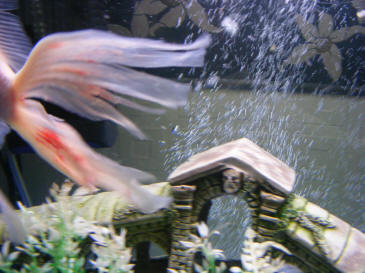
Got the sucked on by a Pleco bluessss!
|
|
Lg Oranda help... Loricariid incomp.
2/24/15
You don't happen to recognize the white on my gf side do you? We can't tell if
it's a sickened or maybe our Pleco attacked him?
<The latter almost assuredly.... tell-tale missing scale pattern>
He was fine two days ago, last night I noticed him like this, and today, the
white is kinda fuzzy!! He's missing a lot of scales in his side as well. We're
not sure what to do with him! :(
<Remove the Pleco; see WWM re avoiding GF infections>
Thanks
Lindsey Hernandez
<Welcome. Bob Fenner> |
|
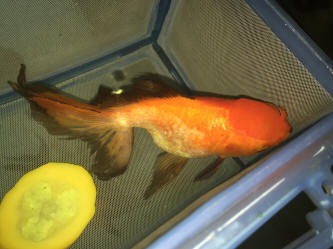
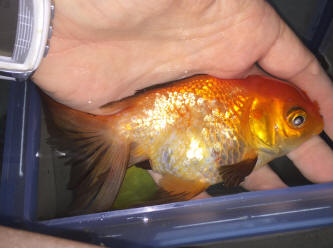
|
Please send either prev. corr.
or complete sentences. 3/25/15
Subject: More help
I've been at school all day and I just got home and checked on the Oranda...
He's fuzzy... Is that a fungus? I don't know what to do to help him. We took the
Pleco to the LFS, so he is gone now. Thanks again for all your help!
Lindsey
Re: re: More help.... GF trauma
3/26/15
I'm sorry,
I've been at school all day and I just got home and checked on the Oranda.
He's fuzzy where his scales had been taken off. Is that a fungus?
<Appears to be hyphae, mycelia... yes>
(His fins are also shredding more this morning)
I don't know what to do to help him.
<A bit of aquarium salt (1 tsp. per five gallons) is all I would do... that and
check (daily) re water quality. You want NO ammonia, NO nitrite, and less than
10 ppm of nitrate>
We took the Plecostomus to the Local Fish Store, so he is gone now.
<Good>
Thanks again for all your help!
Lindsey
<Be of good life, cheers. Bob Fenner> |
|
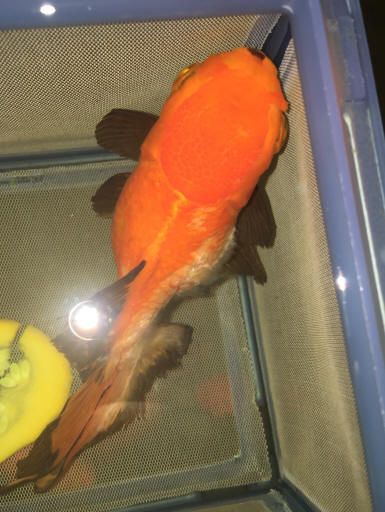
|
|
Re[2]: re: More help
3/26/15
Ok put 1/2 tank water 1/2 fresh and treated water in my 5 gal quarantine tank
with the 1 tsp per 5 gal of salt. What do I do daily to ensure no
nitrates/ nitrites/ ammonia?
<Biological filtration, water changes.... See WWM re. B>
He's looking worse :'(
Thanks.
Re[3]: re: More help
3/26/15
Ok, is there a common name for the hyphae, mycelia?
<True fungal "threads" (structures), versus bacterial look-alikes>
One site brought up body fungus. also, do I need to worry about my other GF
getting the fungus?
<Not so much>
Thanks.
Sorry for all of the emails... I am freaking out here!
<When in doubt, read. B> |
|
Someone ate my Pleco :( 11/20/14
Hi my name is Nichole, I have a 20 gallon tank with 6 sunburst wag
platies, 3 long finned rosy barbs, 1 black kuhli loach (I was not aware
they needed to be in groups when I bought it. I will be getting 2 more.)
<Good. They are quite shy at the best of times, and probably very
unhappy when kept singly.>
and until recent a baby albino bristle nosed Pleco. I had not seen my
Pleco (Muvtuv) for about 3 days. I really started looking for him on day
3 and emptied the decor and gravel from my tank until I found him. At
least what was left of him. Someone ate him :(( Any ideas on who or why
and maybe how to prevent it in the future?
<There's not much meat on a baby Bristlenose, and what you find _post
mortem_ is pretty much just the external armour and spines. Now, the
thing with Ancistrus/Bristlenose Plecs is that they're herbivores and
often
half-starved by the time you buy them. Avoid ones with hollow bellies.
Look at them in the aquarium shop. Look for species that are actively
feeding, e.g., on a piece of cucumber. Ones that aren't being fed are
probably
starving to death unless they're in a brightly lit planted aquarium with
ample green algae (and even then, it's a gamble). Older specimens (say,
8 cm/3 inches long) are more obviously healthy or starved, so it's
easier to
pick out a healthy one. Look for a chunky specimens with bulging out
eyes and a nice rounded belly when viewed from underneath. But with the
teeny-tiny babies, you really need an expert eye to pick out a healthy
one,
so only buy from tanks where they're lively, healthy-looking, and above
all visibly eating something.>
Thank you,
Sad fishy mommy,
Nichole
<Good luck with this usually excellent species, Neale.>
Large Pleco and baby map or musk, incomp.
12/10/12
Hi my name is Tim from Georgia
I have a spotted Pleco that is a little over a foot long in a 75 gallon
tank with a Fluval 305 filter no gravel as of yet. I was wondering if I
can add baby turtles I plan on getting to the same environment. I plan
on getting maybe 1 razorback musk and two Texas map turtles.
<Mixing dissimilar turtle/terrapin species isn't usually a good idea. In
this case, the Map Turtles have the potential to reach around 20 cm/8
inches in shell length, while the Musk Turtles are only about two-thirds
that size. They also have rather different diets, the Map Turtle being a
definite omnivore with a requirement for fresh green foods and only
limited offerings of meaty foods (though not quite so herbivorous as
"Slider" type turtles) whereas the Musk Turtle is a definite carnivore
that eats little green food. With this said, if you carefully controlled
what sort of foods were offered and provided adequate space, they might
cohabit. Razorback Musks are among the most tolerant of the Musk
Turtles, and (males) Texas Map Turtles aren't nearly as prone to
aggression as some of the Sliders like Red Ears, so they could get on
just fine. A lot will depend on the size of the tank (I fear 75 gallons
might be pushing your luck) and the availability of basking spots under
the heat and UV-B lamps.>
I doubt I will be able to keep the razorback with the Texas Map pair
from what I have been reading on this website. If I am wrong on those
two species not being able to coexist please let me know. But my main
question would have to be can I keep either of these turtles in the same
75 gallon tank as my large Pleco?
<Even if you managed to keep two adult turtles in 75 gallons -- and it
would require frequent water changes and a very large aquarium filter, I
seriously doubt that the humble Fluval 305 would be able to keep ammonia
and nitrite at zero. Remember, turtles aren't really too bothered by
ammonia because their skin is impermeable, and provided the water
doesn't smell and is kept clear enough for you to watch your turtles
easily, then the filter is doing its job. But that's a world away from
the excellent water quality fish require. Even on its own, the Plec (as
an adult at least) would put a heavy strain on the Fluval 305 and needs
an aquarium around the 55 gallon mark! Plus, the Musk Turtle especially
is an opportunist predator, while the Map Turtle mostly eats snails, so
a Plec substantially smaller than them might be viewed as "live food" by
either species of turtle. As you know, feeder fish aren't necessary or
even a good idea for pet turtles, so the bottom line has to be fish in
one tank, turtles in the other.>
I plan on getting a turtle topper and plenty places to hide for the
musk.
Can either of these guys exist with the Pleco or can they call exist
together?
<Few turtles work well with fish, and those that do tend to be demanding
varieties such as the Pig-Nose Turtle (Carettochelys insculpta). It's
quite common to see them in giant (200+ gallon) systems with all sorts
of tankmates, even Rainbowfish and Clown Loaches!>
Thanks for your time and sorry if this question has been asked but I
could not find it.
<Maybe not asked recently, but a perennial question nonetheless. Cheers,
Neale.>
Catfish compatibility 8/11/12
Hello crew,
I currently have a Bristlenose (Ancistrus sp) Pleco in a 55 gallon tank
and a clown Pleco (Panaque maccus) in another tank. Other inhabitants
are Glowlight tetras, Pristella tetra and some Platys. Would these fish
be compatible in the 55 gallon?
<Mmm, well, the Platies like harder, more alkaline, cool water than the
Tetras and Loricariids>
I'm also planning to add another Bristlenose of the opposite sex
sometime in the future, would that be ok?
<Should be; yes>
Thanks for your help,
Evan
<Welcome. Bob Fenner>
Black moor Goldfish
Peeling 11/27/11
Hi, my Black moor goldfish has began losing all of its scales on both
sides of its body, and I am finding its skin peeling at the bottom of
the tank.
<Yikes!>
Due to all of the peeling its sides are now showing a red color.
It shares the tank with another black moor and an algae eating
catfish
<... This is highly the cause... Is this Gyrinocheilus aymonieri?
Look it up on the Net and WWM>
in a 5 gallon tank which I know is too small for the
three fish.
<... then... why... are you killing these fishes?>
I've changed the water recently and have began doing a 30% water
change weekly. The day after I changed the water, the black moor's
eye began to bleed internally and now the outside of the eye is peeling
as well. It has also developed a cut on the top of the eye. It is
acting completely normal and eating regularly. I have had it for about
a year now and it has grown to about 5 inches. Its poop sometimes comes
of clear with brownish orange bubbles along with clear bubbles.
<... Look up the CAE name, remove it and move these goldfish to
sufficient space/quarters. Bob Fenner>
Re: Black moor Goldfish Peeling 11/28/11
The catfish is an Hypostomus Plecostomus
<Still very problematical; and still likely the culprit
here>
I wasn't aware how large it would grow due to it still being
small. I have moved the Hypostomus Plecostomus and the other one
inch Black moor Goldfish to a 5 gallon while separating the 5 inch
Black moor into another 5 gallon alone. All of the water has been
changed.
<... I would not change all of the water ever>
Is there anything I can do to make the skin better along with its
eye.
<Time going by, good maintenance and nutrition. BobF>
Re: Black moor Goldfish Peeling, Pleco incomp.
11/29/11
I removed the catfish, it was been two days and the black moor's
scales are now growing back. Thank you very much.
<Ahh! Thank you for this follow-up Melanie. BobF>
Quick cherry shrimp compatibility question,
Chaetostoma 1/18/11
I have a 35 gallon tank with 6 black neon tetras and a rubberlip
Pleco.
<Mmmm>
I bought 10 medium sized cherry shrimp the other day. I have observed
them the last few days moving about the tank and seeming to be eating
algae.
However, I have seen none today and, somewhat alarmed, have been
watching my tank almost obsessively for several hours with no sighting.
I did research before I bought, and the everyplace that mentioned black
Neons and cherry shrimp said they were compatible. Have I bought my
fish an expensive
snack? Is it possible the black Neons ate them?
Celeste
<Not the Tetras, but the Loricariid. Bob Fenner>
Re: Quick cherry shrimp compatibility question
1/19/11
Bob,
<Cel>
Thanks for your reply, and I apologize for the grammatical error. That
it could have been the Pleco was a passing thought I, unfortunately,
disregarded. Am I correct in assuming this would happen with any
Loricariid? Hope you are enjoying your vacation!
Celeste
<Mmm, I don't think I would trust any Loricariid with these
small shrimps... There are other "algae eaters" of use... Bob
Fenner>
Something ate the nose and eyes off my Plecostomus,
Neotropical Cichlids, other Loricariid incomp. --
06/09/10
Hi Crew!
<Hello,>
Once again, thanks for everything you do.
<Kind words appreciated.>
OK, the really not good part - something ate the nose and eyes off of
my Pleco !!!
<Likely another Plec.>
Now, the back-story: I had a 29 gallon freshwater tank up and running
for several years. The tank mates all had lived together for a long
time, since they were all 1" juvies. I started off with one male
Jack Dempsey (now 6"), 1 pair of young convict fish that were just
pairing up in the LFS tank, and one small Plecostomus (now 6"). As
Convict fish tend to do, they were hatching fry all over the place,
everyone was getting bigger, and the tank was getting cramped. This was
all part of my master plan to have a reason to get a larger tank. (Feel
free to use that tactic). Today I have the jack, Pleco, and 3
generations of convicts - maybe 6 or 7 convict fish of any worthy size
- all the ones that didn't get consumed so far.
<I see.>
So - this weekend I craigslisted myself a 55 gallon tank and stand, the
works, with 2 sad neglected Plecostomus in there.
<Oh dear.>
The tank had been drained down to about 3" water, and the last
water change was over a month previous. There was one bubbler stone
going, and that was it. Overall it was a very sad condition for the
fishes.
<Sounds it.>
The Pleco fish themselves are pretty large - one has to be a foot long
or more, and the other one is about 9". So anyways I got them
loaded up, and all the tank and stuff, came home, and threw them into
the 29. They were stuffed in there, but it is good water, and it was
too late at night to set up the new tank; I guessed that it had to be
better than laying around in 3 inch stink water.
<Likely so.>
Next day, I cleaned and then setup my new 55 gallon tank. I got all the
fish transferred (I used the water from the 29 + the same gravel that
came with the 55 so I think I'm good on the cycle I didn't stir
it up too much), but they seemed to be very agitated; my guess is
because 2 pair of convicts had fry when I moved them. One mom was able
to gather fry in her mouth apparently, and one was not. The mom that
did gather fry actually stayed in a decoration while I picked it up out
of tank and transferred it!
<...>
Once the debris settled in the former (29gallon) tank, I noticed a
school of fry in there - the other moms babies. I gathered them all and
put them in by the momma in the new tank, but the fry seemed lost, and
I didn't see the mom corral any of them either.
<...>
So, the fish count in the new 55 gallon tank is roughly 1 jack, about 7
convicts, some small convict babies, and 3 Plecos. The next day, they
still seemed 'not-settled', but were not really chasing each
other across the tank too much. They were VERY startled when I turned
on the light in the morning.
<Likely a reaction to the change in environment and social
hierarchy.>
Today, they didn't seem as startled by the light coming on.
Everyone looked OK. Everyone got fed breakfast. So later I come home
from work, and all the fish are sort of 'surrounding' this one
Pleco. They aren't hitting it, or attacking it, they are just sort
of 'around' it. I look at it. It's eye is gone! It's
nose flap thing is gone!! I look around its other side - all gone !
<Yep.>
It is sitting there breathing, attached to the side of the glass, with
no eyes and no nose. It is the middle-sized Pleco, the 9" one. It
looks like it's tail has been chewed on too.
<Indeed, and precisely what happened. Pterygoplichthys and
Hypostomus species are NOT social under aquarium conditions. Curiously,
in the wild they are schooling fish, but in the confines of a small
aquarium -- which is what yours is, given their size -- their social
structure goes screwy.
It is EXTREMELY common for one Plec to attack another when that
happens, and although they look harmless, those scraping teeth they
have work as well on flesh as they do wood and algae. Bottom line, you
should never, ever keep more than one Plec per aquarium unless you know
they get along.
Males are probably more aggressive than females, since it's the
males who defend the nests and eggs. But since sexing them is
difficult, it's hard to know what you're getting when you buy
these fish. I'd wager the damaged one is a male who was beaten up
by whichever of the other two Plecs is also a male.>
I instantly removed it to a 'nice' tank with goldfish, tetras,
and octos.
It is alive, but it has to be miserable. Is it going to make it
doc?
<Hard to say, but if the damage is superficial, and the fish is
medicated as per Finrot/Fungus, it should recover.>
So here are some of my thoughts and reasons for writing this epic
email: I really didn't find any info online about this sort of
behavior. I found one comment on a yahooAnswer
<Famously the worst place on the Internet for information!>
or something, that was it. I have had a lot of fish, including Pleco
and convict, and not seen this happen (yet.. up till now anyways).
<Is actually very common.>
I'm worried about my other 2 Plecos, and wonder if I should take
them to the LFS and trade them in.
<One Plec per 55 gallons is ample.>
If I trade them in, what sort of cleaner fish can live with
convicts/jacks - if Plecos somehow cannot?
<No fish "cleans" so if that's what you're looking
for, think again. By definition, adding a fish, even a Plec, makes the
aquarium dirtier and algae problems more serious.>
Is it possible that this Pleco was sick somehow and they know it, and
the fish are simply taking care of nature?
<No.>
Any comment and advice is most welcome. Sorry for the huge email, but I
hope it helps someone. Thanks! Saylor
<Cheers, Neale.>
Gymnarchus niloticus, gen... & cramming Loricariids,
other madness 4/28/10
Hi guys,
<Hello Craig,>
Thanks for such a wonderful site.
<Kind of you to say so.>
I'm picking up an Aba Aba knifefish tomorrow that is very young and
small, about 4 inches, that I ordered from my LFS.
<I hope you know what you're getting yourself into here. These
fish are insanely aggressive and require huge tanks.>
I currently keep two freshwater tanks, a 135 gallon and small 10
gallon.
<Neither of which is suitable for Gymnarchus niloticus.>
I know that the Aba will require a massive tank by himself as he
grows,
<Understatement if ever there was one.>
but will he be ok in my 10 gallon as a baby?
<No.>
I currently keep some small Plecos in the 10 gallon, a
"vampire" Pleco L007( 4"), an albino Bristlenose Longfin
Pleco (3" including his long fins), a royal Pleco (3"), and a
very small "snowball" Pleco (2").
<You are wildly overstocked already. Even if water quality is
acceptable now, it won't be for long, and the Royal Plec alone
needs a tank upwards of 55 gallons once it matures. As juveniles these
Plecs might be kept together in a 30 or 40 gallon tank, but these
catfish aren't necessarily friendly fish, and Royal Plecs
especially are notoriously intolerant of other Suckermouth catfish, to
the degree they can kill potential rivals.
Leporacanthicus cf. galaxias gets to about 25 cm, Baryancistrus L142 to
25 cm, Ancistrus to 12 cm or so, and Panaque nigrolineatus to well over
30 cm. Bear this numbers in mind, and choose aquaria
accordingly.>
I also have two snails in there to help keep the bio load balanced.
<What? Snails don't "balance" anything, and pray tell
me what "bio load" might be. If the pet store told you adding
snails makes the tank cleaner, then they took you for a ride.>
It has worked well for about 6 months now and the tank is doing
excellent.
<Not for much longer. After six months these catfish will have grown
appreciably, and really do need to be moved into a proper sized
aquarium..
My goal has been to raise some of these Plecs for my 135gal tank, but
only the L007 is near acceptable size for a transfer. The 135 gal has a
Ruby Oscar (12"), Green Scat (she's been in freshwater for 6
years now, 9"),
<NOT A FRESHWATER FISH!>
BGK (10"), Jardinei Arowana (12"),
<Do you have any idea how aggressive this fish will be when it
becomes sexually mature, which isn't far off.>
Jack Dempsey (7"), Common Pleco (15"), Orange Spot Plec
(8"), and a "chocolate albino" Pleco. Can I raise my Aba
in this small tank for a little while?
<No.>
Will he and the L007 clash? There's lots of hiding places, but am
thinking I may need to move the L007 to my 135gal, or just obtain a new
small tank to raise the Aba in for now. Also as far as food goes, I was
thinking live
Tubifex and frozen krill to start. Is that an acceptable well rounded
diet for this young knifefish?
<Least of your problems. Gymnarchus niloticus eats anything, and
provided you avoid fat and thiaminase, you'll be fine. Earthworms
are good treats for new specimens, but any fresh or wet-frozen fish
fillet and seafood should do.>
Thanks in advance for your help, you all are Godsends!
<Thanks.>
Craig
<Craig, you have some seriously insane ideas on mixing fish. I know
it's tempting to buy one of everything, but you really can't,
and just as you can "win" at Russian Roulette for a while,
that doesn't make Russian Roulette a safe game. Think very
carefully about what you're doing here, and what you're trying
to achieve. Some of these fish are among my personal favourites, so I
sense we share much in the way of taste. But there are limits to what
we can do when combining oddball fish in the same tank.
Read, reflect, and act accordingly. Cheers, Neale.>
Otocinclus, L134 Peckoltia; compatibility,
systems 3/25/10
Hello there,
I recently returned from a 2 week stint working out of town to find my
5.5 gallon over run with the soft green algae that Otocinclus fish are
supposedly fond of. The tank was intended for another project which
didn't pan out (my Australe Killifish pair was living happily in my
29 gallon awaiting transfer but couldn't compete for food in my
absence and died after the first week.) I had been contemplating adding
four Otos to my already cycled 29 gallon and now I'm wondering if
the 5.5 would make a suitable quarantine tank or if it is too small
even for the short quarantine period.
<5.5 gallons is really not much good for anything except for a Betta
and/or small shrimps, and as you've observed, they are
intrinsically unstable and can easily flip into problem mode. You might
use it to quarantine very small fish, up to 2.5 cm/1 inch, but other
than that, I'd not risk stressing community fish species in such a
small tank.>
I removed the majority of the algae with a toothbrush but there is
still a fair amount in the tank.
<Algae removal will reduce the problem, but you do have to research
why it happened at all.
http://www.wetwebmedia.com/ca/volume_6/volume_6_3/fwalgae.html
Without fail, algae comes back if conditions allow.>
There are a couple small plants (Cryptocoryne and some Alternanthera
reineckii clippings just floating) and some natural wood decor which
have been in the tank for 3 or 4 weeks. The tank itself has been set up
for just over a month, I used water from my 29 originally which I dose
with aquarium salt as a tonic about every second water change or
so.
<Why use salt? The use of "tonic salt" is old school and
provides no real benefits.
http://www.wetwebmedia.com/FWSubWebIndex/SaltUseFWArtNeale.htm
>
Is this a reasonable place to keep four Otos for a couple weeks,
considering the small size and minor presence of salt?
<Possibly. But Otocinclus require somewhat cool, oxygen rich water
with lots of water current. Their mortality in "Nano" tanks
is depressingly high, despite their wide sale for such.>
I also wanted to ask whether my leopard frog Pleco which lives in my 29
is indeed a suitable tank mate for Otos or if I have been mislead.
<In a big enough tank with cool (24 C), fast-flowing water and ample
green algae, a school of 6 or more Otocinclus affinis/vittatus should
coexist with your L134 Peckoltia sp. catfish. Peckoltia spp. feed
mostly on the bottom and consume bloodworms and soft vegetables, while
Otocinclus graze almost exclusively on green algae from plant leaves.
So there shouldn't be much overlap. But L134 prefers warmer water
than Otocinclus, so they aren't an obvious or ideal combination.
Almost all problems with Otocinclus come down to keeping them too warm,
without enough oxygen, or without enough green algae. I doubt 50% of
the specimens sold last even 6 months.>
Your time and advice is greatly appreciated.
Tyler
<Cheers, Neale.>
Sliders and Plecos 4/19/09
Hey,
<Howdy. Darrel here>
So I've had my yellow bellied slider (called Rambo) for about a
year now, he's(guessing its a he) been a happy little thing. He was
looked after by my younger sister for a while when I first went to
university and seemed a little depressed as he wasn't eating, so I
took him to university so I could care for him. That was at Christmas
time, and since then he's grown loads and eats a ton of food.
<It just goes to show you how easily turtles will thrive if given
the right kind of care!>
.About 3 weeks ago I brought a Pleco to keep him company, and thought
he's not to small for Rambo to want to eat it.
<Umm, not really. Turtles and fish don't mix that well.>
In the same week I got some locusts (I hadn't tried them before) he
loved them and seemed to give him a mass of energy and growth!!
<But they're LOADED with the wrong kinds of nutrients, fats
& things, Carrie. Sliders are omnivorous (as you discovered, but
primarily vegetarian. I grow mine from freshly hatched babies to grown,
breeding
adults on Koi pellets and an occasional (once a month or so)
earthworm.>
<Feeding the wrong type of food, or simply TOO MUCH food, will cause
growth to the point of obesity, but even before that shows on the
outside, fatty tissue diseases may take hold on inside.>
Last week I went away for the week but my boyfriend looked after them,
and because he works during the day Rambo wasn't getting his lunch
food and so he decided he would try and eat my Pleco!!
<Yeah, Turtles don't eat much fish because they can't catch
them well. In fact, it's comical and entertaining to see them
try... but every once in a while, base on sheer probability, the turtle
gets lucky and the fish gets
unlucky.>
Upon realizing this, my boyfriend put plenty of food in and Rambo
hasn't tried to eat the Pleco.
<Yes, but we could be over-feeding the Slider just to make him too
lazy to eat the Pleco.>
However the Pleco has lost half his tail fin, his top one, I think you
can see the bone of the fin and above his tail he has no fin and its
gone white around the areas The Pleco seems happy enough and keeps
clear of Rambo, but should I take the Pleco to the vet for a once
over?
<If it were me, no. Fish in general and Plecos particularly have a
tremendous ability to recover or compensate for physical damage as long
as their environmental conditions are pristine. So as long as your
water quality is excellent, the temperature is right and the food is
nutritious, the Pleco will likely recover. THAT SAID .... I'm not
sure the Pleco, who has an ideal range of 76-83F can survive long term
with a slider that should have water in the mid to low 70's. On
that same subject, it's hard to imagine keeping the water quality
of a turtle tank clean enough for fish to remain healthy.>
The Pleco has a hiding place so he can get away from Rambo. I'll
try and send a picture but I don't have a camera right now.
<Well, Carrie -- I think we've got the picture. What we COULD
use the next time around is a truckload of Capital I's, apostrophes
and other punctuation -- please remember that not all our readers are
keyboard kids who can read & write in TXT. (LOL)>
<Seriously, Turtles and Fish do not share an environment, Carrie --
they merely live on the outskirts of each other's worlds and share
seemingly similar needs. In the long term they will both be happier and
healthier
if they have separate homes.>
<Read this and check all your care against the suggestions
given:
http://www.wetwebmedia.com/FWSubWebIndex/RESCareBarton.htm>
Hope you can help!
<We hope we did!>
Thanks
Carrie
Will big Pleco eat baby cichlids? Plecos
and Cichlid Fry Hello -The eight year-old Oscar that I kept in
a 90 gallon tank along with an equally old and large Pleco died a
couple of days ago. I am not certain what I am going to replace him
with, but it will be a cichlid, or a pair of cichlids, of a large and
beautiful variety. It will not b an Oscar. My Pleco eats not only algae
but cichlid food. I am wondering if it would also eat baby cichlids?
Thank you, Bill < All Plecos will take advantage of any food source
available. Cichlid eggs and or fry will be eaten in a heart beat when
the parents are not able to defend them.-Chuck>
Loricariid aggression 1/4/08 Hello WWM
Crew, This is the first time I've written to the fresh side of your
website. I have a 150 freshwater tank that has been established for
over three years, and up until this point I have had a few minor
occurrences happen to this tank but nothing too serious. The livestock
that is in this tank include 7 Severums (five green, 2 gold) 2
rope/reed fish, 2 blue Acaras, 1 port Acara, 1 very large Fire eel (18
inches), three Plecos 1common, 1 L-113, and one king tiger Pleco, and
some trap door snails. Up until about three weeks ago everything had
been going just fine until I woke up one morning to find my common
Pleco swimming upside down, running into things etc. the first thing
that occurred to me was he had been fighting with the L-113 (note, both
of these fish are well over the 1 foot range) as they sometimes do The
L-113 usually winning out (these "fights" are usually nothing
more than minor scuffles). After about a day, my common Pleco settled
into a spot by a sunken log (upside down).We tried to turn him over but
it just seemed to upset him, so we left him alone. That's when a
curious thing happened, the larger L-113 Pleco shortly there after
wedged himself under a different log, and has remained there since. We
have not seen our king tiger Pleco, but that's nothing unusual
since their are plenty of places to hide and he is a bit shy. It has
been three weeks ago and I am starting to get very concerned. neither
one of them has moved from their "spot". They are still
breathing because I can see their gills moving. As far as eating I have
not seen either one of them move when I feed the rest of the troops,
when they are usually very active when food has been added to the tank.
My water parameters have been within the norm. temp is good pH is good
no nitrites or ammonia are present. I am at somewhat of a loss as to
what's going on, or what to do for that matter. Do Pleco's
hibernate? Help! Thanks, Steve <Large Loricariid catfish are NOT
good at sharing. Territoriality between specimens and between species
can be pronounced, and several species have been reported to kill
weaker tankmates. Large Panaque catfish for example will kill rasp the
skin from other Loricariid catfish they deem to be
"squatters" in their caves, reducing the victim to a bloody
pulp. Large Panaque will do this too each other too, which is one
reason they aren't bred in captivity, so far as I know; do read
Ginny Eckstein's piece over at Fish Channel for some idea of the
scale of carnage we're taking about.
http://www.fishchannel.com/media/freshwater-aquariums/species-info/catfish/royal-and-blue-eyed-plecos.aspx.pdf
Similar reports have been noted for Acanthicus and Pterygoplichthys. To
quote Planet Catfish, a single male Acanthicus "can easily be the
most dominant fish in a 1000 gallon aquarium". Oddly, many species
live in schools in the wild, but since most (male) Loricariids guard
their eggs and fry it is entirely possible that this aggressive
behaviour would be related to reproduction in the wild. In any case,
the bottom line is that few of the big species mix well unless so
overcrowded that they cannot establish territories. This is how they
are kept at your retailer, for example, and in itself causes problems
with water quality and doesn't entirely eliminate the problem of
skirmishes between specimens. When kept in twos and threes in
home-sized aquaria, collections of large Loricariids can be distinctly
unpredictable. The bottom line is that your fish may simply be at the
age and disposition where they won't get along. While you could add
a bunch more caves and hope for the best, my gut feeling is that it is
now time to decide which one you want to keep, and rehome the other
specimens. Cheers, Neale.>
|
Florida Gar and Pleco, comp., nutr. of Loricariids
7/24/08 Hi all-- I love your site, and have spent many hours
reading in the last few months since I discovered it. However,
I've had an issue come up that I have not been able to find
an answer to. I have a seven-inch Florida Gar in a 125 gallon
tank, with six larger-sized silver dollars and a Pleco. I am not
sure of what type he is, but he is definitely not the
"common type". He is brown, with a short, wide, compact
body, about seven or eight inches long. <Do bear in mind some
of these fish will get extremely large; Gar will exceed 60 cm and
potentially 90 cm in captivity if they are among the common
species traded, such as Lepisosteus platyrhincus, the species
usually sold as the "Florida Gar".> Lately, we have
noticed him interacting with the gar in a way we had not
previously observed. He appears to be sucking on the gar. I know
from reading your site and others that this is a bad, bad thing.
<Has been reported between these species, and yes, is damaging
to the Gar. When the skin is abraded, the mucous is lost and it
becomes much easier for secondary infections to get started.>
We chase him away and offer algae disks, which he goes for
(lately, he's seemed overly ravenous, often eating four times
the amount of disks that he used to). <People tend to
underfeed Loricariidae. Understand this: they are constant
grazers and mud sifters in the wild, and don't understand the
"two meals per day" notion many aquarists prefer. You
need to give them vegetable foods such as courgette, sweet potato
or carrot that they can nibble on through the day, plus bogwood
for fibre.> My question is this: is the Pleco suffering from
some type of nutritional imbalance that we can remedy? <Likely
not an imbalance, but quite probably not enough fibre, so that
the fish feels hungry because it isn't full. These catfish
are adapted to feeding on a bulky rather than concentrated
diet.> If he's just being rude, and that's definitely
possible, we can take him to the LFS. However, due to their lack
of adequate space for larger fishes, and the fact that hideously
overprice any fish that aren't tetras or mollies, therefore
forcing the fish to be there in less than ideal conditions for a
long period of time, I fear for his life. This would be a last
resort. Please help! Thanks. --Melinda <Seemingly no simple
answers here, but very likely these fish will need to be
separated. Perhaps try offering a better (more vegetable-rich)
diet, but if that doesn't help, you will need to rehome one
or other fish. Cheers, Neale.>
Re: My Florida Gar and his Pleco Friend, comp., fdg. -- to
Neale 8/9/08 Hi Neale-- Melinda here again. <Hello!>
You responded to my email a few weeks ago regarding our Pleco
(have since found out he is a rhino Pleco) and our Florida gar.
<Hmm... Pterygoplichthys scrophus, rather a nice catfish! Not
common in the trade, and I think quite a handsome beast.> The
Pleco was getting a little too friendly with Fluffy (the gar),
and seemed to be trying to snack on him. <Can happen; not
commonly, but does happen.> You suggested feeding a variety of
fiber-rich veggies, but predicted we'd eventually need to
separate the two. Well, Dino (the Pleco) had no intentions of
eating any of my tasty veggie offerings. In any case, we have
separated them. <Let's see if this helps. If not, then
back to the drawing board. I suppose you could try offering her
some meaty food. My Panaque is ostensibly a vegetarian, but she
enjoys raw mussels in the half shell, partially shelled shrimp
and other such delicacies. You may be able to tempt your cat to
eat these things instead of her tankmates...> Thank you for
your advice. --Melinda <Good luck! Neale.>
|
|
Common Pleco in a planted tank...... 6/30/08 Hey
there, Quick question....can I put a common Pleco in a 150
planted tank? By common, I am referring to Pterygoplichthys
pardalis. I am working on a 3D background, etc, and plan on
having various plants growing along the back wall
space-in-creation. The bottom/mid level will house various shapes
of large driftwood protruding from the "river
bank"....the very bottom will have various boulders, gravel,
and large driftwood. I am worried about a Plec eating plants and
disrupting their locale. That is the common complaint that
I've found on chat boards and bio-pages. However, more than
once I have read of the "exception". So I am confused
and looking for a blunt opinion in plain English. I have one
that's about 8 or 9 inches currently living in a bucket. (It
would be funny if I stopped this email right there, eh?) He was
in a 55......I parted that tank out. Had him in a 20 temporarily.
I also parted out my 150 reef and moved that in a 55 high current
reef......planned on getting a couple of large freshies to put in
the 150.......after 12 hours of moving the 150 inhabitants I went
on the back porch to have a beer. I heard a loud *!Crack!*.......
the 20 gallon, sitting on the counter with the tiniest little
nick in the corner glass finally gave way (had been running for
over 2 years). I chugged my beer laughing. All fish were saved
(Plec and some baby Cichlids that showed up one day in another
tank).....and they all now live in a 5 gallon bucket. The
cichlids are going to a different tank...... Well, my neighbor
has a gnarly fresh water planted tank and he turned me on to the
idea of that rather than a couple of big meanies. So....... Can
this Plec go in the planted tank? (Could have started and ended
this whole damn email with that one sentence!) Thanks in advance
for the info. It's funny that sometimes the simplest answers
to the simplest questions are the hardest to find. I've
searched everywhere!!!!!!!!!!!!!!!!!!!!!!!!!! Jon <Hello Jon.
The short answer is that Pterygoplichthys spp. tend not to eat
plants directly, being omnivores with a preference for algae and
benthic invertebrates such as bloodworms. This contrasts with,
for example, Panaque spp. that are almost entirely herbivorous
and feed on plants and wood rather than algae. However, this
distinction is somewhat academic, because large Plecs can and
will uproot or otherwise damage all but the most sturdy plants.
They swim like bricks, as you probably realise, and don't so
much avoid plants and bulldoze through them. In the process they
will uproot small plants and break the leaves off bigger plants.
They also like to burrow, and this sand or gravel shifting can
easily end up smothering plants. Finally, they have rasping teeth
that can damage soft-leaved and waxy-leaved plants in the process
of their grazing on algae. The best plants for tanks with Plecs
are robust but flexible and fast-growing species, such as Giant
Vallisneria. Java Fern can work well too, partly because it is
tough, but also because it doesn't need to be planted in the
substrate, so isn't uprooted or smothered easily. Anubias
might work well, though when kept with Panaque it ends up being
reduced to a Swiss Cheese Plant, so I'd not necessarily
recommend it. I'd also mention the fact Panaque destroy
painted polystyrene/resin backdrops that go inside the tank;
Pterygoplichthys may be different (it has less robust teeth) but
I wouldn't bank on it! Bottom line, large Loricariid catfish
generally do best in rocky tanks with bogwood and Java Ferns
where they can't do too much damage! Cheers, Neale.>
Re: Common Pleco in a planted tank...... -
7/1/08 Thanks Neale, I was thinking along the same lines as
your "bulldozer" idea, regarding the Pleco in a planted
tank, the more that I thought about it today. I am thinking that
with the setup that I will be having, smaller cleaners are
definitely the way to go here. I have to set up another rocky
tank anyways. He can stay in that bucket for a bit longer. Thanks
for the info and thoughts on the subject! Jon <Hi Jon. For
planted tanks, your best bets on the algae-eater front are
invertebrates, in particular Nerite snails and algae-eating
shrimps such as Neocaridina spp. If you want to supplement these
with fish, then go with small Ancistrus spp./Crossocheilus spp.
as grazers and perhaps Jordanella floridae for thread algae
control. That said, invertebrates on their own do a much better
job when used in sufficient numbers. For example, I'd reckon
on at least 4 Nerite snails plus 10 Cherry Shrimps per 30-40
litres. Cheers, Neale>
|
Leporinus vs. Pleco 6/5/08 I recent
wrote and had a nice email exchange with Neale. I had been given a
couple of banded Leporinus' who date leave my Bala sharks alone.
The Leporinus' are about double the size of the Balas who are only
six months old. What surprises me is that I had to move my Plecostomus
to a hospital tank. The Pleco is larger than the Leporinus' and I
thought of all fish, he was last I'd need to move. They kept
nipping and attacking the poor thing! <Absolutely typical for
Leporinus I'm afraid. Providing a deep cave in which the Plec can
hide completely can help, though the catfish will become completely
nocturnal if it feels unsure about swimming about during the day.>
Could they be "immune" to the Pleco's dorsal stinger -
the area where they kept pecking at)? <Not aware that any of the
Loricariidae actually have stings. While it is true the pectoral and
dorsal fin spines are serrated, I don't think they have venom
glands.> The Pleco doesn't show signs of injury and is in a
small 10 gal recovery tank alone in the interim for his own safety and
relaxation. <If the Plec is a big one, do check water quality: a 10
gallon tank isn't going to usefully dilute the ammonia produced by
a big catfish.> The Leporinus LOVE to eat peas, and I thought about
dropping some tasty ghost shrimp in to see if they like those. Either
way, they are quite graceful despite being a larger fish and fun to
look at. <Indeed they are lovely fish, and very opportunistic
feeders, and need a mix of greens and animal foods. I've watched
them destroy heads of curly lettuce, and don't even think about
putting them in a planted tank!> Skye <Cheers, Neale.>
Blended
tanks 4/30/08
Dear "Crew" I have been given the
opportunity to get a 35g tank and it's inhabitants. I have been
reading and trying to figure out how I could best combine these tanks,
although I do have plans for the 35g. I presently have a 125g with:
-small Pleco (not the common Plec), -a high fin Plec, -a small school
of Corydoras, -3 yoyo loaches, -boesemanni rainbows, -dwarf Neons
rainbows -swords -platys -diamond tetras. -small school for zebra
Danios. The 35g contains: -2 large Congo tetra -3 large black skirted
tetra -3 large clown loaches -1 large Plecostomus I have asked that he
try and return the Pleco to the LFS. Was this correct? Can I possibly
home him? <Could be okay in the 125 gallon system -- the small Plec
is likely Ancistrus sp., in which case the two will largely ignore each
other, provided the Ancistrus has a small cave it has exclusive access
to. The high-fin Plec isn't an obviously recognizable species to
me, though I'm guessing it's Glyptoperichthys gibbiceps. That
fish can be quite territorial, so again, make sure there's plenty
of hiding places so this species and the Pterygoplichthys pardalis
"common Plec" in the other thank. Loricariids can be tetchy
about sharing hiding places. Adult Loricariids are mostly only
dangerously aggressive towards their own species, but territorial
towards everything else.> It is my intention to move the Corydoras,
dwarf rainbows and the platys to the 35 and put the Congo and black
skirt tetras, and clown loaches (I asked, they are 4"long) in my
large aquarium. I have been reading about the clown loaches here and at
the loaches web site and think they will be fine water wise, apparently
get on fine with yoyos, but have some concerns about aggression to some
of the others. Can all the tetras tolerate these guys? <Should do.
From my vantage point it's difficult to give a 100% assurance
without water quality tests and so on. But I'd expect there to be
no problems. You may need to step filtration capacity up though, e.g.,
by adding another canister filter, so that the additional bio-load is
handled.> And about that Plec.... is it possible for my other two to
co-exist in the 33g? In which case I could home the large Plec in the
125? Actually now that I am writing about him, seems to me I have read
stories about those large Plecs damaging smaller fishes... like
sleeping tetras. <Plecs very rarely, if ever, eat small fish. There
are carnivorous Plecs to be sure, but they eat invertebrates sifted
from the mud. If they eat fish, those fish are dead or at least
moribund. So when people report their Plec ate a guppy during the
night, what they actually observed was the guppy died, and the Plec
then ate it.> Sorry, it is the rescuer in me, cat, dogs and now
fish. <!!!> If I go to get this tank on Friday should I just put
all the original inhabitants back it in for a month and then start
moving everybody around? I do not have quarantine room for everybody
although he said he has had the clowns for a couple of months but I
forgot to ask about the common Plec. <Should be fine. Perhaps lay in
a bottle of Whitespot/Ick remedy (or at least make sure you can buy one
at short notice). Clown Loaches are admittedly intolerant of many
medications, so do research your options here in terms of suitable
brands. Look for formulations safe for "scale-less" fish, or
else use half-doses and keep an eye out for unusual behavior.> I
would really appreciate any suggestions on this blended family
especially if I have missed something important in my reading.....This
seems like a big move to me and I do not want to cause to much strife
in my life or that of my current pets. <I can't see any obvious
problems, except perhaps with the Plecs.> Thanks so much. I might
not even consider this if you were not there to ask. Aileen
|
Just wanted to share - Pleco & Yoyo
03/19/2008 Hi everyone at WWM! <Rachel> Don't have a
question this time around, but I do want to extend another thanks
to Andrew for all his help with my SW setup questions.
(unfortunately, my SW tank plans have been bumped by house
remodeling? but someday it will be mine!) <Ahhh!> Went to
feed our current fish (55gal FW community, 55gal brackish, and two
happy Bettas) this morning, and was greeted with a scene of our
Pleco, who's between 5 and 6 inches, and the smallest of our
three Biota almorhae having a ?pow-wow? on top of one of our
Greco-Roman tank décor pieces. <Shades of Lord
Elgin!> I say the smallest of the three yoyos as they were all
the same size when we got them in December/January (me and my
memory here?), and we now have Big Loach (who's a little over 2
inches now), Middle Loach (just a little smaller), and Little
loach, who hasn't grown much at all. He/she hid for quite some
time (about a month and a half) after first introducing them to the
tank, but is now out pretty much all the time and active, so
we're still hoping for the best and keeping a watchful eye on
Little. Attached is a smaller image, with a larger version here on
my website. http://www.realmofsavage.com/images/big_n_little.jpg I
love WWM, and read all the latest FAQs every day. Keep up the great
work and I hope to be able to share some SW tank pictures in the
nearer future. =) Rachel Savage <Thank you my/our friend. Bob
Fenner>
|
|
|
|
Sick Gouramis... Pleco comp. -- 03/07/08 Hello, all.
I've read a great portion of your website, mainly the Q&A
section. I have searched in great lengths for problems similar to
mine, but to no avail. However, I have gathered a great deal of
knowledge about the hobby in general. <Very good; but please
don't think that replaces buying a book! Before you buy a
fish, buy a book -- there is so much to learn!> Apologies in
advance, this will most likely be fairly long. Also, I am at
great risk of sounding like some kind of *emo freak* as I never
imagined I would actually get so attached to fish. <I have no
idea what an "emo freak" is. Must be some sort of
American thing.> Here goes: My hobby started with a Christmas
gift. A 5 gal tank with built-in filter & light, hex shaped.
<5-gallon tanks are known in the trade as "buckets".
They're of no good for keeping fish, and certainly not by
beginners.> Being ambitious and completely ignorant, I filled
the tank and promptly added WAY too many fish. 2 Dwarf Gouramis,
which died within days of what I have read to be Dwarf Gourami
disease (brought on by ammonia poisoning, no doubt) and 5 (yes,
ridiculously, 5) Paradise Fish - Blue variety. <Oops.> I
did a very limited amount of research and learned that for the
fish I currently had still living, I needed at least 20gal.
<Not a chance. Paradisefish are mutually aggressive, and males
are very much "one to a tank". They will also fight
with other similar looking fish, including, I dare say, Gouramis.
Paradisefish are not community fish and are never, ever
recommended for beginners by sensible aquarists.> After
several fights with the hubby, he finally bought me a 29gal. I
filled it, moved the fish in, and started reading about the
cycling process. This is when I started to feel like a serial
killer. I read that Paradise fish are actually very forgiving in
regards to water quality, and if you are going to be cruel enough
to cycle with fish, they are ones to use. <Up to a point this
is true, but even hardy fish can be killed by high levels of
ammonia and nitrite. That's why you need to have your nitrite
and ammonia test kits, and as soon as you detect more than 0.5
mg/l of either, you do a BIG (i.e., 50%) water change. This may
well be as often as once a day for the first couple of weeks!>
So, I did frequent small water changes to keep the ammonia and
nitrites down, and eventually, the tank cycled. It has been
steadily 0 ammonia & nitrites, and low nitrates (10 or less)
for at least a month now. All my fish actually did great. I got a
black Sailfin Pleco for the algae problem. I read up on them, and
saw that they will "suck" on sick or slow fish, but
mine seem to be active and very quick. <The Sailfin Plec is
likely Pterygoplichthys pardalis or similar. These are HUGE fish
and require tanks 55 gallons upwards. Completely unsuitable for
this system. In any case, they have no positive impact on algae.
Think about it for just one second: algae grows when the water
has fertiliser added, i.e., nitrogenous wastes from the fish. Add
more fish, the water is more fertile, and the algae grows faster.
Add a huge catfish, and even though it's eating algae, it is
also eating catfish pellets and vegetables, so will be making the
water much more fertile. It's a case of one step forwards and
seventeen steps backwards. There are only TWO ways to control
algae: use lots of fast-growing plants, or use elbow grease and a
scraper. There is nothing else. Nada. Nix. Nyet. Non. Nein.>
Then... got up one morning, and one of my females looked like she
was missing scales. She was still acting normally, so I added
some Melafix, as it supposed to help with missing scales and
Finrot. <I'm not impressed with Melafix. Because it's
cheap and "New Age" people buy into it, but it
isn't any more effective than any other cheap, New Age
medication.> It only got worse from there. When I got home
that evening, it was an open (almost looked to bleeding) wound. I
searched the internet, and closest thing I could find was
AEROMONAS (hole in the side disease). <Hole-in-the-Head is not
caused by Aeromonas bacteria. These are different syndromes.
Almost certainly you're dealing with a plain vanilla
Aeromonas infection, what on a human would be considered sepsis.
The skin is damaged, and otherwise harmless Aeromonas bacteria
get into the wound and cause serious problems. Long term: death
through blood poisoning. Use something like Maracyn or eSHa 2000
to treat.> It seems, though, that this is more commonly
associated with wild or farm fish. <No, the problem here is
more than likely physical injury and/or poor water quality. I
hear what you say about the good water quality stats, but the
overwhelming experience of most newbie aquarists is variable to
poor water quality, e.g., by overfeeding, under-filtering, or
overstocking. So take a conservative approach, and assume the
worst case scenario.> I moved her to the 5gal (now hospital
tank, also cycled) and tried feeding her anti-bacterial food
(soaked and broken up first). She wouldn't touch it, and
developed dropsy that night. She was dead the next morning. <I
bet.> Next was one of the males. I tried parasite treatment on
him. Dropsy, and died within a day. <When masses of fish die
for seemingly random reasons, the problem is 99.99999% likely
water quality, water chemistry, or poisons. So: check water
quality, and do a 50% water change daily until thing settle down.
As for water chemistry, check the pH isn't fluctuating
wildly. Fish are somewhat tolerant of the "wrong" pH
and hardness relative to what they prefer, but what they
can't abide is changing water chemistry. Finally, consider
poisons. Things like paint fumes can quickly kill fish. Small
children are apt to dump things in fish tanks, so it's
important to make sure that doesn't happen.> Now my second
female has a hole on either side of her body, well behind her
gills, mid-body. Also - a large hole, as if something is eating
away at her, on her anal fin. it is near her tail. She is now in
the hospital tank, and I ordered Maracyn Two, which is on the
third day of treatment, and no change, only getting worse.
<Stop moving the fish to the 5 gallon tank. Pointless. Such a
tank is a death trap itself. Treat the whole tank with Maracyn.
Be aggressive with water changes (big, often). Study water
chemistry and quality closely. Above all: DO NOT FEED the
fish.> One of the males left in the main tank now has a hole
in his side, and the other has a hole in his anal fin, in the
same exact location as the female. I have tried to take photos,
and they just WILL NOT hold still long enough. If they won't
eat the anti-bacterial food, and the Maracyn doesn't help,
then I am at a loss. The girl in the hospital tank is developing
fungus, and I don't want to treat for the fungus while still
using the Maracyn, in case there would be a reaction. I am afraid
that they are developing secondary problems due to all the
HORRIBLE water conditions I subjected them to. If this is the
case, do they stand a chance at all? <If you do precisely what
I say, yes, some should recover, assuming any Finrot (for
that's the issue) is limited to superficial tissues. But if
the body cavity is infected, then realistically, no, the fish
aren't likely to survive.> Just a mention - the sick
female (now in hospital tank) was being harassed by the Pleco. He
would attach to her, and she would shake him off, but he probably
did the most harm while I was sleeping and could not monitor. Is
it possible this is what is happening to the other? I can't
imagine the Pleco would decide to attach to the anal fin,
though?? <Obviously this Plec needs to go back to the pet
store. This is non-negotiable. How, why it is sucking onto the
fish is largely academic (though I imagine it is hungry because
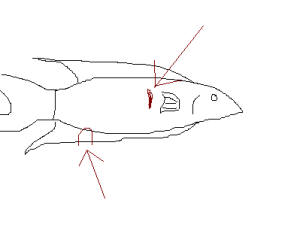
you are not providing the foods it needs).> OK, I drew a rough
image with Paint, which looks like a child created (hence the
file name "kindergarten fish") showing the same
location all fish are developing the hole in their sides and
fins. <Yikes!> I never dreamed I would feel so bad over
fish, but they are part of family now, and I really don't
want to lose them. What can I possibly do?? <Read, learn,
understand.> Thank you much, Jiffy <Cheers, Neale.>
Re: Gourami/Paradisefish problems --
03/07/08 Thank you, Neale, for your speedy response.
<You're welcome.> It seems my worst fears are realized
and I have done unrepairable damage to most of my fishy friends.
:( <Quite possibly.> Emo = emotional basket case, which is
what my hubby and most my friends think of me when I go on and on
about saving my fish. <I see.> As of tonight, the 5-day
Maracyn treatment will be completed in the 5 gal, and the girl is
not doing any better. The reason I have been moving them is
because the other fish seem to realize who is weak and pick on
them. <Oh dear.> Since the treatment did not work on her, I
will treat the remaining 2 (sadly, both males - maybe I need a
tank separator) in the large tank. <Does sound a short term
solution, at least.> The Pleco was purchased with the
understanding that it would eventually be returned, upon
aggression or growing to large for the tank, so he can easily be
returned to the pet store. Once he cleaned the tank, I started
feeding the sinking algae disks when I turned off the lights, and
witnessed him eating voraciously. I have read that they attack
sickly fish, and suspect this is the case here. <Loricariid
catfish are classic opportunists (like humans) and they will have
a go at whatever seems edible. That's their ecological niche.
While they rarely, if ever, cause problems in tanks with healthy
fish... in tanks where fish are dropping like flies, I dare say
even the best behaved Plec isn't above taking advantage of
the situation.> How long should I not feed? A couple days? the
duration of the Maracyn treatment? <The latter at minimum.
Fish can last a week without food, and after that week, feed
small amounts once per day. No more.> Finally, what book(s)
would you suggest? I will gladly purchase and read anything that
will help me to better care for my fish. <Many, many choices.
Go visit your local bookstore, and have a browse. Look for
something published reasonably recently so that it is up to date
in of filters, medications, etc. Don't be dazzled with pretty
pictures -- some aquarium books that are "coffee table"
type books look lovely to look at, but thin on information. Pick
something that clearly explains about filters, water chemistry,
disease and so on. If it has a section on community fish, listing
their water chemistry needs, preferred temperature, social
behaviour and diet then so much the better. You can use that to
decide what fish you want to get next. But right now your need
isn't for a book containing hundreds of fish or advanced
topics like plants or cichlids; you want something focusing on
the foundations of the hobby. Master them, and the rest of the
hobby is pretty straightforward.> Thank you so much for your
expertise, Jiffy <Cheers, Neale.>
|
|
Re: Discus Fish System,
Loricariid comp. 2/25/08 Neale/Crew of WWM,
<Hello,> Thank you for the quick answer once again. I have
two more questions: As far as the Discus go, I've read in
many places that they aren't good to mix with, say, a common
Pleco, because there's the possibility they will eat the
slime coat off the discus. <Correct; doesn't always
happen, but happens sufficiently often.> However, certain ones
that stay on the smaller side and aren't too active would be
okay. I really like the Gold-Nugget Plecos and have read they
only get to be 5-6 inches or so. How would this work?
<Baryancistrus sp. L018 could be okay, and does like quite
warm water, which meshes nicely with what Symphysodon wants. But
regardless: keep an eye on things, and act accordingly.>
Second, I've been reading a lot about filtration (still...)
and currently have a Penguin Bio Wheel filter.. rated for 30
gallons. Obviously this will not be sufficient for the 55 gallon
alone. I have two choices I'm kicking back and forth: an Aqua
Clear 50 HOB filter, for about $45, or an Eheim Ecco 2232 which
is rated at 127 gph for a 35 gallon tank for $89. (or another
brand/model...) Is the canister filter worth the extra money
here? <Yes.> My concern is in regard to the build of
nitrates (yes, I do realize they will build in all mech. filters
and have to be changed). <Nitrate build-up in canister filters
may well be an issue, but with proper maintenance it
shouldn't happen. Actually, "your mileage may vary"
-- I know people keeping very successful reef tanks that use
canister filters they clean only once or twice a year! The
benefit of canister filters is the generous water turnover and
the option for useful selections of media. Hang-on-the-back
filters come with these stupid "cartridge" modules that
contain useless junk like carbon and Zeolite. While great for the
manufacturers and retailers, they're a waste of space for
freshwater aquarists. What you want is a filter with empty
modules into which you can put good-quality media like Siporax as
well as filter wool that can be changed as often as required
(which will be OFTEN in a planted tank.> Thanks a lot for the
help! Eric <Cheers, Neale.>
Re: Discus Fish System; filter
options, and catfish -02/25/08 Good day, Thank you for the
answer in regard to the Pleco and the filter. I will definitely
keep an eye out for any harmful interactions. I did hear that the
discus actually 'like' the slime coat-action? (Even
though it's not good for them) Interesting.. <I doubt they
actually like it. There's a whopping great fish scraping
their skin off with big sharp teeth. About as much fun as having
a ferret in your underpants I'd imagine.> As for the
filter: the AquaClear 50 is rated at 200 gph, while the Ecco
Canister is rated for 127 gph. I guess I'm confused as how
the latter would be more flow? <In theory then the 200 gph
filter would be better. But my experience of hang-on-the-back
filters is that they are less good at cleaning solid wastes from
the bottom of the tank. They're also less flexible in terms
of media options, though that varies. In any case choose
whichever you prefer, provided the 4x volume of the tank in
turnover per hour is observed.> Is that because the canister
is more efficient, or the design? <Canisters are more flexible
in terms of options and accessories, but if you place one under
the tank it actually is less efficient in terms of turnover than
a hang-on filter at water level (because the canister now has to
work against gravity).> The AquaClear also has different
options for media, and I can use the pre-made 'bags' for
pretty much anything. <The bags are often pretty rubbish.
Anything pre-packaged does so to extract more money for less
stuff. Nothing sold to consumers breaks this law.> I do think
part of my hesitation (besides that which is listed above) is
because I am familiar w/ the AquaClear, while I've never used
a Canister before. <Almost all experienced freshwater
aquarists migrate from hang-on filters and internal filters to
external canister filters. They are just better value and more
flexible. Of course, you're free to do whatever you want, so
long as the basic rules are observed.> One last question (I
promise): what about noise levels? I have read favorable things
in regard to quality, longevity, etc. etc. about the Ecco (and
entire Eheim line, for that matter) but there's not much in
regard to how noisy it will be; in relation to the AquaClear.
<Canister filters can be noisy if they get air bubbles inside
them, but are generally silent when up and running properly.>
Thanks again, E <Cheers, Neale.>
|
Pleco question... hlth... aggr. damage? --
02/07/08 Hello Neale, I've been big fan of your answers on WWM
for long time. Excellent job, THANK YOU. <Very kind of you to say
so.> I have a question about my leopard Pleco L085. <Do we really
me L85? L85 is Baryancistrus sp. "Gold Nugget Plec", whereas
Pterygoplichthys pardalis is one of the (several) species called
"Leopard Plec" in the trade. I'm going to assume you mean
the Gold Nugget Plec.> It is currently in 55 g tank with 2 Severums
and 2 blood parrots. (I know you don't like them, but I have them,
enjoying them and taking care of them). <It's not that I have
something against Blood Parrots, they're just not my taste. Like
fancy Goldfish and Pit Bull Terriers. I'm sure they're lovely
pets. Just not for me!> Pleco had been in the tank for about 10
months and it's about 6 inches long. My water parameters:
Temp-80'C pH-8.0 NH3-0 NO2-0 NO3-10-25ppm (50% water change/week)
<All sounds fine, though very slightly warmer than I'd tend to
keep them. There's no real advantage to temperatures above 25C/77F
for most tropical fish, and indeed some positive disadvantages (faster
metabolism, less oxygen in the water). But if this works for you, then
great.> Food: Frozen food for algae eaters (I think you know what it
is)-4 times/week <Actually have no idea! But sounds useful!>
Algae wafers- 1 every night Fresh vegetables-occasionally I also have
big peace of wood in the tank. <I would mix this up a little;
Baryancistrus spp. are omnivores rather than herbivores, and appreciate
things like bloodworms, chopped seafood, even the odd bit of whitebait.
That said, most fish seem to thrive on good quality algae wafers (such
as Hikari Algae Wafers), and my Synodontis pretty much eat nothing
else.> Problem is that my Pleco is only fish in the tank who very
often has torn fins and tail. (Could it be due to occasional fight for
space and food with my parrots?) <Hmm... could indeed be scuffling
with the cichlids. But don't rule out [a] water quality issues and
[b] heater burns (catfish are wont to lie against heaters if that seems
a good hiding place). So check these other issues as well. In any even,
giving the catfish a nice burrow where the other fish can't harass
it should fix this. Clay pipes and flowerpots are ideal. Get one big
enough for the cat, but not for the cichlids. Problem solved hopefully,
as the catfish will basically stay completely out of sight while the
lights are on.> Also very often it has big gray spots all over the
body. These spots disappeared when Pleco start swimming or eating. But
when it is just lay down on the gravel it all covered with these spots
and fish looks terrible. <No idea what this could be. If we're
saying it changes colour from yucky to nice depending on whether
it's swimming, that's one thing. But if we're looking at
patches of dead skin or something that come off when the fish moves,
that's another issue entirely. Really need a picture to understand
this. It's also worth mentioning that the adults do somewhat lose
their contrast as they mature. This is pretty normal with Loricariids,
especially the ones with white spots on a black background. It's
very obvious on Ancistrus, for example.> I tried to find any info
about this in the web with no luck. Your help would be appreciated.
Thank you again, Mark <Hope this helps, but honestly am a bit
mystified. Cheers, Neale.>
Question Regarding Plecos 8/19/07
Keeping More Than One Pleco Per Tank Hi WWM Crew, I
have what I hope is a quick question regarding Bushy Nose Plecos. I
purchased an albino Bushy Nose Pleco (~1 - 1.5") a couple of
months ago and it is doing quite well. I have plenty of algae in the
tank and this little guy is always busy working the plants, driftwood
etc ... I would love to add at least 1 or 2 more Bushy Noses (not
necessarily Albinos) to my tank. However, I am pretty sure that I read
somewhere that you shouldn't/can't have more than 1 Pleco in
your tank. Not sure what the reason was, but I thought I'd get your
opinion before I go out looking for additional livestock. It can't
be size since this species only grow to about 4". This is why I
chose this species in the first place. By the way, are there any other
South American Plecos (they will be living with my Discus) that
don't grow too large (> 4")? Thank you in advance for your
assistance - again! Regards, Neil D'Ambrosio Jackson, NJ <
Plecos tend to be a little bit territorial. This means that they will
usually try and chase another Pleco away but this usually doesn't
result in any serious harm to either fish. The biggest problem is
getting enough food for these fish to eat. I would supplement the tank
with algae wafers if you are going to be adding more fish. There are
hundreds of Pleco species. Usually the clown pleco's stay around 2
inches or so. Otocinclus species are very small and very peaceful too.
Go to planetcatfish.com and check out all the
pleco's.-Chuck>
Crab Eating Plec or is it Plec Eating Crab? - 10/21/2006 I
have a rather large common-sail fin cross Pleco that is showing signs
of discoloration and his armor it starting to stick out. I have tried
krill shrimp to boost his color I have treated with a medication made
for many illnesses including parasites and scaling. I even tried
feeding him algae wafers. I am all out of options. I have seen that one
of my fiddlers is missing can a Pleco eat a fiddler by accident if so
can this make him sick? He is a male. I was also wondering if I need to
get him a mate or another larger Pleco. I have tiny tot the baby Pleco,
it is the same breed as he is, which by the way is fat and happy. I did
put my Bettas in the tank with him while I cleaned their tank and the
female is a bit more aggressive than the male which made them chase
each other and the female beta did challenge big boy. Could they of
stressed him out? I feel I am running out of options he's not even
full growth potential yet, he's supposed to get up to 18 inches and
he's only 10 could it be old age he is a rescue fish from a lady
that didn't want him anymore. Do I need to get him more tank mates?
Please help in stuck up the creek without a paddle... and need as much
help as I can get. <It may be that a bit of crab shell is the
underlying problem. Bloating is usually caused by either constipation
or an infection. If this is a blockage, and he's still eating, you
can try some fresh or frozen veggies. Shelled raw peas work well to get
things moving. If he's not eating you can try adding Epsom Salt to
his water. One heaping tablespoon per 5 gallons of water. For an
internal infection medicated flake is called for. But only if he's
eating. Internal infections that progress to a point where the fish is
not eating are very difficult to treat. In that case your best chance
is keeping his water pristine with very frequent (daily), and very
large (50%), water changes and crossing your fingers that his immune
system will kick the bug. I doubt a three inch Betta stressed out a ten
inch Pleco. Also, there are no crabs that can live a full life in
freshwater. So no more crabs, OK? Don> This is the
edited copy I am sorry I sent it before I checked last time I hope this
is better on your eyes. <Thank you!>
Plecos and Plants - 09/02/06 Dear WetWebMedia, I have
recently acquired two good sized dwarf Panaque a flash l204 and Panaque
albomaculatus LDA31. I have two questions to ask firstly is frozen
shrimp and meaty food like that correct? I have a large 450 ltr tank
consisting of a rainbow school, also I keep a few doras, flag cats and
some other l numbers as well as a greedy elephant nose. I'm worried
the Panaques will not get to the food before everything else has got
there, do you have any tips to get the food to them? And the second
question is that do either fish pose a serious problem to a planted
tank? My tank is mainly java fern and a good African tiger lotus
specimen that I don't want to loose, also some Aponogeton plants.
< Go to planetcatfish.com. Try to identify your Plecos based on the
info you have and what they look like. From their they will give lots
of good info about what your Plecos eat and how to keep them. Many
Plecos are nocturnal, so feed them just after you turn out the lights
should make it easier for them to feed.-Chuck> Best Regards and
Thanks for any advice you can give. Ben
Blind Pleco 7/25/06 Hi WWM Crew, I have kind of
an odd problem. I have a tank with a couple African Cichlids and a
"common Pleco" for cleaning purposes. I noticed today he
looked a little different, and coaxed him out in the open to discover
that where his eye used to be was a hole. I found the same on the other
side. The holes are perfectly round and don't show any other signs
of damage or infection. What could have caused this? All my other fish
are fine. Will the Pleco have any quality of life, or should I
"put him out of his misery"? Thanks so much for the help.
Chris < The African cichlids have fed on the eyes of your Pleco. He
will be fine as long as he can find some food on the bottom of the
tank. Not much to look at though.-Chuck>
Otocinclus and Comet DON'T MIX! EMERGENCY
07/21/06 Hi, love your website, thanks for it, but I have
a huge problem!! <<Hi, back. You're welcome.
Let's see what we can do. (Tom here, by the way.)>> I woke up
today to find my Comet munching on my Otocinclus! Actually, what I mean
by that is that the Oto was lodged in his mouth with about 25% of it
sticking out. He doesn't appear to be choking because he is still
breathing. <<I assume you're referring to the Comet because
the Oto doesn't sound to be in good shape.>> I got two new
Otos a couple days ago and since then they've both been lethargic
with clamped fins, each was tiny, 1 inched guys and my Comet (Harry,
don't ask) is about 4 inches long excluding his tail. He's
always been greedy and I think what happened is the Oto
died and the Comet finally could catch him and did. <<Not unusual
for Goldfish to do this. They tend to be "opportunistic"
feeders and your Oto gave Harry the chance he was waiting
for...unfortunately.>> No search engines helped me at all!
<<In fairness, it's not the typical inquiry.>> At this
point, Harry is moving slowly and keeps sucking or blowing his mouth, I
can't tell which. This is a major problem and one way or another
might solve itself before you answer back, but right now my main
concern is lack of ability to eat or transfer air in the swim bladder,
and of course lodging it in more and choking! <<As long as
he's moving water over his gills, he's not "choking".
He may not be very comfortable but he won't suffocate.>> Just
in case he lives and for future references please help! I tried using
metal tongs and I grabbed the protruding tail but I couldn't get it
out, I'm sort of nervous of pulling too hard. How do I dislodge it,
or can he digest the head soon enough and eventually pass it through??
(I seriously doubt it though.) <<I seriously doubt it, too.
Goldfish are primarily "vegetarians". Their systems
aren't developed for dining on other fish. Likely the dorsal rays
are getting caught in Harry's mouth as you try to pull the demised
Oto out. You might try twisting the Oto one way, or another, to get the
rays to "release".>> And should I remove my other
Otocinclus and my (very lively and quick) Algae eater? <<First,
if by "Algae Eater", you're referring to a common
Plecostomus, I wouldn't worry about this. Harry isn't likely to
be interested in a "lively and quick" tankmate. My concern
here, without getting on a soapbox, is that many Otos are
"captured" in the wild by the use of cyanide. I have no
direct knowledge of these fish being bred in farms, though it's
entirely possible that they are. In any event, the fact that both of
yours showed signs of lethargy and clamped fins indicates, to me, that
it's possible that they were taken with cyanide, a chemical that
will, unfortunately, stay in their systems. Otos, regretfully, show an
inordinate amount of "infant mortality", meaning that they
often die within hours, or days, of being introduced into the tank.
Fish that feed on the dead fish are going to be ingesting cyanide if
the deceased fish contain this in their bodies. My recommendation is to
get the Oto out of Harry's mouth regardless of what it takes and
remove the other Oto from the tank. Easier said than done, I know, but
you must do this.>> Thank you for your time, and sorry my email
is so long. This is my first major goldfish problem and I'm very
anxious. <<Not to worry. You're more than welcome and I
completely understand. Tom>>
Pleco and Goldfish, good idea?... generally not
6/13/06 I am owner of a 55 gallon tank, which uses two Emperor 400
Bio-Wheel Filtration systems. These are a necessity, due to
the 13 inch long-finned goldfish <A whopper!> I have, whose
superior filthiness remains over my tank. Recently, about a
month ago, I purchased a Plecostomus to help deal with the filtration
of algae. This worked wonders for the tank environment, the
walls clearly transparent, and the gravel much cleaner, however, the
Plecostomus started to push around my goldfish. <Yes> Now, the
Plecostomus is no more than 5 inches, and is no where near the size of
my goldfish, and yet my goldfish does not show any aggression, and he
does not even move away from his hostile attacker. The Plecostomus
swims under the goldfish, and chases him around, I fear this simple
aggression could lead to the serious injury of my prized goldfish.
<You are correct> I have read a variety of things to
do, such as remove the Plecostomus right away, leave it be, monitor it,
feed it algae disks, and the only one I have yet to try is to remove
it. <This is what I would do> I am scared, that the
Plecostomus will be overly stressed, and die from our lack of proper
temporary tanks in which to house our little beast. Our last
resort, it to have the Plecostomus spend the night in a 4 gallon bucket
with no filtration. I really do not want to subject my
Plecostomus to conditions like these, but I Will if I have
to. I will most likely return him to the Petco where I
bought him, but I don't want him to be killed either. I
would much appreciate some tips and/or guidance. Thank you
for your time and consideration in this matter. Thank you,
Chelsea R. <Unfortunately, most
Plecostomus/Loricariid species sold in the trade are incompatible with
Goldfish... too often "suck" on their bodies... dangerously
removing body slime, sometimes more. Better to use large, non-asexual
species of snails as cleaner-uppers with most goldfish systems. Bob
Fenner>
Big Plecos In A Community Tank 5/26/06 Hi, Great
Site! I have a bit of a problem, and figure you guys
can help me out. I have a 55 gallon aquarium with a cascade
filter Rated at 75 gallons) heater, plants, eco complete, light, etc.
Would it be ok to keep 3 common Plecos (8", 6",
and 4"), 6 cardinal tetras, 4 lemon tetras, several
Cory cats, 4: 4" Killie fish, and 2 smaller tiger clown
Plecos, and 6 Rams in this 55 gallon tank? < Go with everything
except the two larger Plecos. They will dominate the bottom of the tank
and make life very tough on the other fish.> PLEASE NOTE: These are
fish I have already (in separate tanks) I know this sounds like an
odd assortment, but I am trying to, umm... what's the right word
here... condense my collection. If this is not ok, please tell me the
minimum tank size in which I can keep these three Plecos.
<There are hundreds of different species of Plecos. Go to
planetcatfish.com and search for your Pleco to determine the total
size. They will also have tank recommendations too. Some of the more
common Plecos can get very big.> Also, at what temperature should
this assortment be kept? < Somewhere between 76 to 82 f
would be fine. The rams prefer it on the high end.> BASICALLY, I am
asking if 3 large Plecos will be ok to keep with smaller
tetras/cichlids!? < Too much disruption from the larger
fish.-Chuck> Thanks in advance!!! Anthony
Plecos For A Lake Malawi Cichlid Tank 5/9/06 Hi
Crew, I have 5 Malawi cichlid tanks and cleaning algae has almost
become a full time job. My LFS suggested adding Plecos and I narrowed
my choice down to Queen Arabesques. I chose these because I didn't
want plant eaters nor did I want Plecos that would outgrow my tanks
like the common Plecos that reach 24". When I went to pick up my
Queen Arabesques I noticed some beautiful King Tigers and decided to go
with 2 King Tigers and one Queen Arabesque, one for each of my 3
largest tanks. Right now they are in my quarantine tank and my question
to you is regarding pH. Here is my dilemma: Malawi cichlids
are usually kept in a PH of 7.8 - 8.2. I've read Queen Arabesques
do best in a of 7.6 or less. After purchasing the King Tigers I
read online that their max PH should be 7.2. I wonder if this is true
as Queen Arabesques are closely related and come from the same region.
My LFS told me the Plecos would adjust to the higher cichlid ppm. This
even suggested I take them from the LFS water (6.8 - 7.0 PH) and place
them right in my 8.2 PH tanks that very same day after slowly adding
tank water to their bag water over a period of several hours. I
didn't think such a drastic shift in PH was a good idea, and I had
planned to quarantine them anyway, so I placed them in QT (where they
have been 3 days) with a pH of 7.2. My plan has been to slowly raise
the pH over the course of 2 weeks. Now I'm questioning whether I
made the right decision choosing these Plecos, and whether the higher
pH will have long term negative side effects for them. Could a happy
medium be found by lowering the pH slightly in the cichlid tanks to 7.6
or 7.8? Or would this cause problems for the cichlids, as well? Please
advise. If I've made a poor choice in buying these Plecos, I can
always return them to the LFS. Cindy < Many Lake Malawi cichlids eat
algae. To reduce algae growth I would check the nitrates and try to
keep them under 25 ppm with water changes and by vacuuming the gravel.
As far as placing Plecos with Lake Malawi cichlids you have four
problems. First is aggression. These cichlids are very
territorial and will defend their areas using their sharp teeth. The
fins and eyes will be attacked and the Plecos will be forced to hide
most of the time. Second is temperature. Lake Malawi cichlids prefer to
be kept in the mid to upper 70's F. Your Plecos come from the Rio
Toucatins where the water is up to 82 to 84 F. Third is the pH. The
cichlids can handle a pH in the 7's but they will not show much
color. Any higher than that will stress the kidneys of your Plecos and
they may become weak and sick over time. Last is the diet. I am not
overly convinced that these Plecos even eat algae. Many of these Plecos
eat invertebrates, wood, and plants too. Check out their diet at
Planetcatfish.com.-Chuck>
Bushynose Pleco With Goldfish 12/05/2005 Good day. I
hear a lot about the compatibility of fancy goldfish and Ancistrus
temminckii and how it's usually a good match. But what about all
catfish within the Ancistrus family? I saw a catfish sold as "mini
pointed Ancistrus" at my LFS and I was told all within the family
have the same behavior. In other words, my fat (in a nice way) and very
slow moving Lionhead Oranda and calico Oranda should have nothing to
fear. What are your thoughts on this family and their compatibility
with fancy goldfish in general? Thanks a bunch! Ted < Go to
planetcatfish.com and check out the new Pleco you are planning to buy.
See if the water conditions are compatible with goldfish. Not all
Plecos in the genus Ancistrus have the same requirements.-Chuck>
Rubber lipped Pleco in a 10 gallon tank? 10/16/05 Greetings!
Three days ago I bought a rubber lipped Pleco for my 10 gallon tank.
<... too small...> I have had two zebra Danios and one angelfish
<... way too small...> in the tank for about 18 months now. Even
with weekly 1/3 water changes <... too much...> the algae is
barely under control so I thought a Pleco would be a cute and helpful
addition. <No> Unhappily, s/he died today! The Pleco seemed fine,
bright-eyed and swimming about a bit when not hiding, but then this
afternoon s/he abruptly died. I am so discouraged that I am wondering
whether I should try again with another or give up the idea of adding
an algae-feeder to my tank. <Not this type... needs more room
as do most of its family... Loricariidae> I don't want to harm
my current fish by introducing any diseases, and hope I haven't
done so already. I've decided to feed the fish less and have the
tank light on less in an effort to reduce the algae. <Good
approaches> I would greatly appreciate your thoughts on whether
those changes should be sufficient or whether I should try another
rubber lipped Pleco (or other small algae eater). Regards,
Mary <Umm, those (not often lucid) ideas archived here: http://wetwebmedia.com/FWSubWebIndex/fwalgcontrol.htm
and the linked files above... where you lead yourself. Bob
Fenner>
Re: Rubber lipped Pleco in a 10 gallon tank? 10/17/05 Bob,
<Mary> Thank you for the input. I'm looking on Craigslist for
a larger tank, maybe a 35 or 46 gallon. <<Isn't Craigslist
great? MH>> <Ahh, much better> That might be a
better size for my current fish and give me a chance to get a few more
fish once everything settles down, cycles, etc. Maybe even a Pleco!
<Oh, yes!> Thanks again, Mary <Excelsior my friend! Bob
Fenner>
Plecos and Goldfish 9/26/05 Hiya. I've recently
started a coldwater aquarium with a two fantail goldfish and a four
Danios (they have been in there for a couple of weeks). I love plecs
and would like to have one. Will a Plec get along with my other fish?
Also, can he be put in now or do I have to wait longer to let the tank
build up good bacteria? Many thanks. Rach <Not a good mix in most
cases. It's not a matter of aggression, but of water conditions and
temperature. Goldfish like cool water, 65 to 70 degrees. They produce a
lot of ammonia in their waste. Plecos are tropical and need a
temperature near 80 to thrive. They also produce a lot of ammonia. So
the tank would have to be fairly large to dilute the waste. But even
then, their is no good way around the temperature problem. 73 to 74 may
work for both, but is perfect for neither. Don>
Mixing Plecos and Goldfish Hi WWM, Hope you can give me some
advice as I'm fairly new to keeping plecs although I have kept
fancy goldfish for quite a few years. I read a question from someone
else who seemed to be losing plecs after a very short time. I've
also had this problem. After they have seemed healthy I suddenly find
they have died with no apparent symptoms. I also had heard that when
using treatments for coldwater fish that dosages have to be altered if
you have plecs in the tank. I also have 2 tiny Ramshorn snails &
wondered if you could advise me of any precautions I should take when
using treatments. Many thanks in advance. Lisa <Very generally
speaking dosages should be cut in half when dealing with most types of
catfish. IMO most plecs are starved to death. They must be target fed
at night or they will not get their share of the food. Rubber band a
piece of zucchini or shrimp to a rock and add it just before you go to
bed. But I'm more concerned that you are keeping goldfish and plecs
together. Goldfish do best in cool water. They thrive between 65 and 70
degrees. Plecs are tropical and require much warmer temps. I keep all
my Pleco tanks between 82 and 86 degrees. I'm afraid you are in for
many problems with this mix. Don>
Cichlids and Pleco's Hi Bob, My roommate was given a 50
gallon tank with 3 African Cichlids (one being very large and very
dominant - always chases the others around). A friend of
mine gave me a large Plecostomus and I added him to the tank
today. I am a bit worried though. The Plecostomus
just sits on the wall and the large African Cichlid comes over and
snaps at it's eyes and tail constantly. Will they get
use to each other and knock it off or should I find a new home for the
Pleco? Thanks! < Plecos usually come out a night when the
cichlids are asleep. Get him a hollow log or s cave for him to hide in
during the day. The cichlids should leave him alone after
that.-Chuck>
Bristlenose vs. goldies? Hi, guys! I've read
up on the various opinions on mixing fancy goldfish with
Plecos. The general consensus with regards to the
'regular' store bought Plecos is simply don't
mix. From personal experience, I can also attest to this.
<Often they start to "ride" the goldfish... not good>
However, I've read there is one particular exception with the
Bristlenose Pleco. Apparently, this whiskered-barbed wonders
don't really have a tendency chase and munch on the goldfish slime.
<I do agree this is so> What are your thoughts on this
mix? FYI, I have a 60 gallon with 2 weather/dojo loaches and
4 four-inch fancy goldfish (calico, Lionhead calico, black moor and
redcap Oranda). Thanks! Ted <Worth trying. Bob
Fenner>
Subject: leopard Pleco and royal Pleco best friends? Hello me
again. I am setting up a new 110 gallon tank and was wondering if I
could put a leopard Pleco (Pterygoplichthys gibbiceps) and
a royal Pleco (Panaque nigrolineatus) could be put together in
the same tank because I know Plecos belonging to the subfamily Panaque
are aggressive to each other. <Mmm, am inclined to dissuade you from
this mix... but actually don't know how well these two Loricariids
would get along... In all the years I retailed the more popular Panaque
we kept them one to a tank as adults... If the system were big enough I
guess you could try them together... observe if there is much negative
interaction... I doubt if there would be much damage with these highly
armored cats in a short trial. Bob Fenner>
A Little Freshwater Carnage 2.27.05 Hi, we're new to the
whole aquarium life, and have a 30 gallon freshwater tank with 7
cichlids and one algae eater who we call Homer. <Hello, Ryan helping
you out today.> Not sure if there are different varieties of them,
but ours is brown and bumpy, and about 4 inches long. About a month
ago, we noticed that the cichlids were picking on Homer, and then, much
to our disgust and amazement, realized that his actual eyeball had been
taken out of its socket! <That's pretty gory!> We
immediately put him into a separate sick box where he could safely
recover. After a week of separation from the others, Homer was put back
into the tank and seemed to be getting along well with one eye. Today
he got wedged between the coral and a ship in the tank, and we noticed
that his good eye had been scratched. We were gone for most of the day,
and upon returning home, realized that his other eye has now been taken
out as well. He's in the sick tank once again, but we're really
concerned for his well being once he's healed up enough to be
released back in with the others. <Not a great idea...I would take
him back to the pet store, and start managing the nutrients more
aggressively to impede algae growth.> Have you ever heard of this,
and what are his chances of living with no eyes? We realize that the
cichlids are aggressive fish, but is this a normal occurrence, and how
do we prevent it from happening again in the event that we need to
replace Homer? We're desperate for any information you can
provide. <It breaks down like this: Cichlids, with some
exceptions, are aggressive and territorial. You're keeping these
fish in a small enclosure- This much water in nature would be just a
piece of ONE fish's territory. So, natural war will be ongoing with
this selection. Now, a 30 gallon tank is great for single species
tanks, or less "touchy" tenants. I'd figure out what
species of fish you're keeping, and then make a few changes. Good
luck! Ryan>
Better Safe Than Sorry <Hi! Ryan with you!> I was just
wondering if goldfish and Plecostomus could live peacefully
together. I have seen websites that say yes, and others that
say no they can't. I just have 2 regular goldfish, who
are extremely active and very healthy, so I didn't think it would
be a problem, I just wanted an expert opinion. Thanks:)
<When I first started with goldfish I kept them with a Pleco- and
eventually suffered considerable losses. It's Russian
roulette, but because of disease. Goldfish carry SO many
diseases that tropical fish will eventually contract. It may
work for some time, but I would avoid this. Much better
tankmates for a Pleco or a goldfish, in my opinion. Hope
this helps>
No More Black Moor Greetings! <Hello> Your web site it
quite informative and very useful. <great> I have a
question for you. I have a 10 gallon tank with currently 5
goldfishes in it. <too many goldfish, you want about 10 gallons per
fish. Oh wait, that was not the question, sorry.> My black moor
goldfish died last week so I went and got one yesterday. I
put it in the tank and it seemed to be ok. However, this
morning it was dead, and I am wondering if the Pleco (algae eating
fish) attacked it. The reason for this is that all of the black moors
scales were missing, and it's tail looked really
raggedy. I watched the tank for a while, and I know that the
other goldfish was not attacking it. Have you ever heard of
anything like this? Looking forward to your answer soon!
<I have seen some aggressive Plecos, but they usually keep to
themselves. I am willing to bet this fish was picked over
after it died, probably by everyone in the tank. First thing
I would do is some water tests to see if those indicate any
problems. Best Regards, Gage> BV =^.^=
Plec for an Oscar tank Dear wealth of knowledge, I have a 75g
freshwater tank which is currently empty. I am thinking
about purchasing either 2 red Oscars or 1 red Oscar and 1 tiger
Oscar. My question for you guys is what my options for a
"clean-up" Pleco are, keeping in mind tank size. <I assume
by "clean-up" you want something to eat algae,
right? This in mind, I'd suggest the royal Plecostomus,
Panaque nigrolineatus http://www.planetcatfish.com/catelog/loricari/panaque/151_f.htm
. This is a pretty good grazing Plec, and should do a number
on algae; will likely need to be supplemented with greens (like
blanched zucchini, for one). It'll also require
driftwood, without a doubt. And might be a bad choice for a
Plexiglas tank, as they have teeth that'll wreak havoc on plexi,
leaving scratches.> I also wanted to know a little about freshwater
(red tail) barracudas. I have found it a little difficult to
find info on them. I am wondering about tank size,
compatibility, and how prone it is to disease. Thanks a
lot! Zack <Do you happen to have a Latin name for this
guy? Right now, I'm inclined to think you mean
"Acestrorhynchus falcatus". Try looking this up on
fishbase.org, and do a Google search on this name to see what info you
can get. Wishing you well, -Sabrina>
Smallest Pleco for Algae Hello. I have a small (30
gal) tank with a few cichlids in it and need something to take care of
the algae that is quickly building. Until the cichlids were
full size, I had a couple Chinese Algae Eaters in there and they worked
great. Well, all at once, they both got eaten so it's
time for a change. I was considering a Bristlenose Pleco,
but is there something else I should consider that stays small, eats
lots of algae, and won't get eaten by my
cichlids? I've been kind of anti-Plecos since
discovering how much waste they produce so I'm hoping if I get one
that stays small, they won't produce much waste. At
least, that's the theory. Thanks for all your help and your great
site. -Mike in BFE Illinois (p.s. This is the Cubs'
year!) >>Dear Mike: What kind of cichlids are you keeping in the
30g? I ask because a 30g is a tad small for many cichlids, as they will
be far more aggressive in smaller tanks. Which makes me wonder if you
will put into jeopardy any new species you might add. Also, how often
do you do partial water changes? High toxin levels will also make your
fish act aggressively towards tankmates that in other circumstances
they would ignore. That said, I think you are better off with the
Bristlenoses, anyways. They are the best choice for your tank.
-Gwen
|
|