|
FAQs on Bichirs, Family Polypteridae
Compatibility
Related Articles: Bichirs,
Related FAQs: Bichirs 1, & Bichir Identification, Bichir Behavior, Bichir Selection, Bichir Systems, Bichir Feeding, Bichir Disease, Bichir Reproduction, & FAQs on:
Ropefish 1, Ropefish 2, & Ropefish ID, Ropefish Behavior, Ropefish Compatibility, Ropefish Selection, Ropefish Systems, Ropefish Feeding, Ropefish Health, Ropefish
Reproduction,
|
%20MD.jpg)
|
Delhezi Bichir hunger strike & hunting tank mates /RMF
2/6/19
Hi WWM Crew,
My Delhezi Bichir was previously more than happy to eat beef heart, silver
sides, and black worms, but recently has gone on a hunger strike... I was giving
him the occasional treat of live saltwater crabs that I had been catching out of
my saltwater tank, so maybe that spoiled him into only wanting to hunt?
<Possibly a factor... I kept, fed Bichirs years back...>
He managed to snag a couple of my Congo Tetras that didn't quite grow fast
enough to stay out of "bite size" range. Ever since then, he's trying to use the
beef heart as bait for the other fish. He'll literally sit with his nose
practically touching it while lurking under the driftwood or Amazon Sword leaves
and just waits to see if any of the other
fish are dumb enough to come snag a piece.
<Interesting>
He keeps lurking to try and catch more fish. I've tried offering market shrimp,
scallops, crab meat, silver sides, beef heart, blackworms, live earthworms, and
Massivore pellets, but he's snubbed them all.
<Very strange that this fish refuses live earthworms...>
He's in a 75g with 2 Angels, 6 Congo Tetras, 6 Goyder River Rainbows, 4
Boesemanni Rainbows, and 1 Turquoise Rainbow at the moment. The Bichir is around
9" right now. The Angels, 4 Goyder River Rainbows, and 1 Turquoise
Rainbow are all full grown and not at risk of being eaten, but the others were
restocks after I had a problem with an Opaline Gourami killing half my tank
(who's since been removed)... I got the largest I could find to replace, but no
one sells Rainbows or Congo Tetras larger than 2-3"... I knew it was a risk, but
this guy's been so mellow and easy to feed until recently that I was hoping it
would work.
Is there any way to convince the Bichir to go back to non-live foods, or do I
just need to cut my losses and pull the Congo Tetras now?
<How long has it been since you saw it eat? Does it appear thin, the stomach
"caved in"?>
Maybe if I
isolated him in a spare 20g long bare bottom tank for a short time to keep him
away from the tetras until he takes food again? Or would he just go back to his
old tricks the moment he had fishy temptations again?
<I wouldn't worry if it's only been a week, ten days, and this fish has a good
index of fitness. I'd offer it a live earthworm every two, three days and be
patient at this point>
Thanks!
~Kim
<Welcome, Bob Fenner>
Delhezi Bichir hunger strike & hunting tank mates /Neale
2/7/19
Hi WWM Crew,
<Kim,>
My Delhezi Bichir was previously more than happy to eat beef heart, silver
sides, and black worms, but recently has gone on a hunger strike... I was giving
him the occasional treat of live saltwater crabs that I had been catching out of
my saltwater tank, so maybe that spoiled him into only wanting to hunt?
<This is definitely true. Farmed Bichirs may be more than happy to take dead or
pellet foods, but if they "discover" live alternatives, this can pique their
interest. If starved for a while, they will go back to what
they know, but that's really only viable in a tank with other big fish. If they
live with even potentially edible tankmates, they may try eating those before
settling back down.>
He managed to snag a couple of my Congo Tetras that didn't quite grow fast
enough to stay out of "bite size" range. Ever since then, he's trying to use the
beef heart as bait for the other fish. He'll literally sit with his nose
practically touching it while lurking under the driftwood or Amazon Sword leaves
and just waits to see if any of the other fish are dumb enough to come snag a
piece. He keeps lurking to try and catch more fish. I've tried offering market
shrimp, scallops, crab meat, silver sides, beef heart, blackworms, live
earthworms, and Massivore pellets, but he's snubbed them all.
<It isn't unusual for predators to stop feeding for a while. Hunger makes the
best sauce of course!>
He's in a 75g with 2 Angels, 6 Congo Tetras, 6 Goyder River Rainbows, 4
Boesemanni Rainbows, and 1 Turquoise Rainbow at the moment. The Bichir is around
9" right now. The Angels, 4 Goyder River Rainbows, and 1 Turquoise Rainbow are
all full grown and not at risk of being eaten, but the others
were restocks after I had a problem with an Opaline Gourami killing half my tank
(who's since been removed)... I got the largest I could find to replace, but no
one sells Rainbows or Congo Tetras larger than 2-3"... I knew it was a risk, but
this guy's been so mellow and easy to feed until recently that I was hoping it
would work.
<Delhezi Bichirs can be good tankmates, and generally ignore fish too large to
eat. I'd expect adult Congo Tetras to be fine, having myself kept these with
Polypterus palmas for example, and it's a very similar species. But as you say,
anything the size of, say, a Platy will definitely be at risk.>
Is there any way to convince the Bichir to go back to non-live foods,
<Time; lack of food; hunger. You could also try offering half-way house foods,
such as white fish or prawn fillet wobbled in front of his snout on the end of
forceps or cocktail sticks. Bichirs have terrible eyesight, but a good sense of
smell, so should fall for this trick if they aren't spooked.>
or do I just need to cut my losses and pull the Congo Tetras now?
<Could be a good move.>
Maybe if I isolated him in a spare 20g long bare bottom tank for a short time to
keep him away from the tetras until he takes food again? Or would he just go
back to his old tricks the moment he had fishy temptations again?
<Impossible to say for sure. I would not trust him with small teammates at all.>
Thanks!
~Kim
<Cheers, Neale.>
compatibility of rift lake fish; Bichir and Af. cichlids
9/29/17
Hello!
<Jonathan>
I have a question about compatibility. I have an 18 inch
Polypterus ornatipinnis in a 110 gallon aquarium. For some time
he’s been by himself, I got him as a small specimen but have been able
to pellet train him and he is growing well and absolutely beautiful. He
has become my absolute favorite aquarium fish. A while ago a friend who
was moving across country gave me a Labidochromis caeruleus. After
quarantine, I didn’t have a great place to put him, so I stuck him in
with the bichir. I figured he at least wouldn’t hurt the bichir, and
wanted to see if they might be compatible. They have been getting along
great, in fact the yellow lab cleans up after the rather messy bichir.
My question is, how suitable are other rift lake cichlids with this
fish?
<With smaller, peaceful species, should be fine>
I understand that this bichir inhabits lake Tanganyika?
<Yes, among other areas:
http://fishbase.org/summary/Polypterus-ornatipinnis.html>
Would something like Calvus work? or Neolamprologus brichardi?
<Both should be fine here>
Or would Malawi cichlids be able to withstand his boisterousness better?
<I'd stick w/ Tanganyikans. Malawians might bite the Bichir's fins;
would definitely compete for food>
I’d expect that if he were to land in a community rift lake tank, given
his size, it would probably be large (I have a 220 plywood tank not
being used, would this be suitable for a handful of cichlids and my
bichir?)
<Yes>
Any other fish that make particularly good tankmates with this guy?
<I'd investigate Characins and Catfishes, perhaps Mastacembelids that
hail from Lake Tanganyika and other parts of the Bichir's distribution
(per the Fishbase link above).>
Thank you
Jon
<Welcome. Bob Fenner>
Central American cichlids and Polypterus senegalus, separate
tank with P. ansorgii 6/28/12
Hello,
you site is a very enjoyable and helpful resource. And I hope you can
help me, regarding my fish tank/fish tanks.
Currently I have a 55 gallon tank that contains:
Polypterus senegalus - 8 year old fish, 8 inches and growing, certified
bully of the tank.
<Probably a male. Your tank is quite small, and while adequate for a
singleton, keep more than one Bichir and you need to provide real space,
especially if you have two males.>
I saw P. Senegalus described as "gregarious" in some articles - my fish
did not get the memo. He will chase, nip and chew on anything that
resembles a Polypterus, occasionally he will snap at cichlids or even at
my fingers when I clean the tank (it does not hurt at all, he can't bite
through thick human skin).
<Quite so.>
Polypterus senegalus albino - 1 year, 4 inch, certified perpetual victim
of bullying (I since provided him many little nooks, where he hides from
the bigger guy, but in the beginning - he literally could not get away -
Big Polypterus would chase him all over)
<Indeed.>
Polypterus Ansorgii - 1 year, nearly 10 inches, certified stand-in for
piece of driftwood - never bothered anyone, and until recently was not
bothered by anyone (now big Senegalus is snapping at him too). Barely
moves, always last to feeding (I feed mix of squid, krill and Hikari
Massivore Pellets). Recently took to hiding and lost a lot of his color
(was gorgeous olive-grey with dark marks, now very washed out - I think
because of stress)
<I see. Very likely these other Bichirs are either females or more
likely males, and the resident male doesn't like having them in the tank
with him! None of the Bichirs is "gregarious" though yes, there are
variations in how aggressive they are. On the other hand,
Reedfish/Ropefish are very sociable and should be kept in a group.>
3 Amatitlania N. - convict cichlids, all females, perpetually laying
eggs.
Electric Blue Jack Dempsey - 1 year old, 5 inch, blind to one eye (he
lost an eye, because previous owner kept him with Midas and other
aggressive breeds. When I got the poor guy he was barely holding on, so
I had to hand feed him back to health), very cautious because of
impaired
vision. He only now started to chase the smallest of convicts, but only
when it tries to occupy his flowerpot shelter, otherwise he is a very
gentle fish.
Panaque of some smaller species (Peckoltia?),
<Hmm… no, some Peckoltia may look like small Panaque species, but they
are quite different (the spoon-shaped teeth of Panaque are a dead
giveaway).>
about 3.5 inches and haven't grown any in a last year. I rarely see him.
<Quite so. Both genera are very retiring.>
Due to Polypterus Senegalus being a bully and Ansorgii needing more
space - I'm setting up a second 55 gallon tank to house Ansorgii.
Now the questions are:
1. would it be wise to try to house P. Ansorgii and P. senegalus Albino
together? Or will they fight? Or will Ansorgii potentially try to eat
Albino, given their size difference?
<See above. There are no guarantees any Polypterus species will get
along with another one. That's just not how they work. Two females might
bump along with only occasional snapping, but two males will likely be
perpetually hostile to one another.>
Right now there is no aggression between them, and large P. Senegalus is
snapping at their tails causing them stress. I hope Albino will grow
faster once he is in a less stressful environment
<Possibly, but albino anything tend to be weaker than the real McCoy.>
2. I would like to set up something closer to Central American Biotope
tank with Amatitlania and EBJD - and P. Senegalus (rather out of place,
but will have to be) - but I know that Central American Cichlids prefer
harder water.
Will it hurt Polypterus?
<Not especially. So long as the water is wildly hard, you should be
fine. Bichirs can thrive up to about 20 degrees dH, pH 8, though softer
water is surely preferred.>
Would the inter-Cichlidae aggression (there are a bit of jaw locks going
on among convicts) stress him out, once he has no other Polypteridae to
chase?
<Doubt it.>
3. If I separate all 3 Polypterids into their own 55 gallon, instead of
keeping the bully, will that be enough space for 3 fishes? Can I hope
that Senegalus will stop nipping his neighbours? Or will this not
provide enough space for them?
<See above.>
4. I saw a suggestion of Swordtails as a dither for Central American
tank (stocked with Vieja) - would they make good dither for EBJD/Amatitlania
tank too? How many would you recommend for 55 gallons?
<In 55-gallons, you could try a male and at least three females for the
best chance of success. You'll soon have a bunch of fry, too. Male
Swords are pretty hostile towards one another, and in a small tank like
yours, I'd not keep two males, and three males would need at least 6 and
probably 9 females to work well, and that'd overstock your tank.>
5. I noticed that Polypterus aggression picked up in a last month - is
it because it is summer and warmer temps. and longer days make him more
aware of environment? More territorial?
<Any/all of these may be issues, plus sexual maturity.>
Thank you very much for your answers. While this may seem a trivial
inquiry - please understand how much I appreciate your knowledge and
all the work you do to keep aquarists' community well-educated and our
pets happy!
Elena E.
<Most welcome, Neale.>
Blood Parrots, Senegal Bichirs, and Pictus Catfish; Compatibility;
Frozen foods 4/16/12
Good day!
First off, I’d like to say thank you to all the volunteers who take time out of
their days to help people with their fish; it’s greatly appreciated.
<Ah good>
I have a few questions (well five) that I hope you could answer, or direct me to
the link for the information? (I did search your site for a few hours, so I
apologize if my questions or similar questions have been asked before. ) But
first, a little back ground information.
I have an approximately 3” Senegal bichir
<Wow, small>
that after a month of QT currently resides in my driftwood, sand, Anubias
planted 29 gallon with a single male Betta and 8 black Kuhli loaches. (I am
aware that when he gets bigger, he’ll eat my loaches, but for the time being,
<And Betta>
they are much bigger than he is, and he’ll only be in there 1-2 months tops)
The water is about 80F and the pH is approximately 7.4. I do about 30% water
changes every 5 days or so.
Tomorrow I am picking up a 75 gallon aquarium. I am planning on having a 1” sand
substrate, with MTS to help keep it aerated, lots of large rocks and probably
some driftwood, along with Anubias sp. attached to the driftwood/rocks, maybe
some crypts as well. After it is completely cycled (I plan to use filter media
from my 29
gallon to help speed it along) I plan on moving Nim (my Senegal bichir) to it.
My first question, my friend currently has my peaceful 5” Blood Parrot (I had to
sell my 55 awhile back, she kept my BP so I could eventually get her back, my
Blood Parrot was with cherry barbs, blue tetras, gold and moonlight gouramis,
and an angelfish before, with no problems), would a Blood Parrot be an okay tank
mate for a Senegal Bichir in a 75 gallon?
<Should be>
Are there any temperature/major pH/compatibility issues?
<Mmm, no>
(I bought the Senegal when I was told by a few people they’d be good together,
but now I am hearing different from other people, so I would like your expert
advice)
My second question, (if one Blood Parrot is compatible with a Senegal), do Blood
Parrots do best kept when kept singly, or should I get another Blood Parrot?
<Best in groups>
I just don’t want my Blood Parrot to be lonely, she is quite shy and when I
move her to the 75 gallon, her marbled angelfish buddy will be staying behind.
My third, for my stock, I was planning on 1 Senegal Bichir,
1 or 2 Blood Parrot(s).
Then these are the fish species I am interested/plus the number I planned on
getting (not ALL the species though of course), could you please give me your
opinion as to the compatibility with Senegals and blood parrots? (I am so sorry
if this has been asked before, please just direct me to the link if that’s the
case, I don’t want to waste your time)
<Again, most likely fine together>
~ FOR SURE 4-5 Peruvian/Columbian Pictus Catfish (the Pictus catfish I am
interested in getting are sold at about 4” long, and MUCH bigger then my tiny
Senegal, I know they are riverine, south American catfish, while bichirs are
more from slow bog-like areas, and Blood Parrots, well I don't know what would
be their "natural" habitat, but I figure in a 75 gallon, it could possibly
work?)
<Possibly... though it will be very hard to get food to the Bichir... the Pictus
will eat it all>
~ Pair of Opaline Gouramis (the one’s I want are sold at
about 3-3.5”)
~1 or 2 Leopard Ctenopoma (Ctenopoma acutirostre, the one’s
I like are sold at about 2”, are they better off alone or in a pair?)
~1 Striped Raphael Catfish (sold at about 2")
<And hard to feed, even find this in a 75 w/ decor>
~1 African Feather fin catfish (Syno eur., sold a about 3-4")
<Most likely will blend in though hide during the day>
Any other fish that you recommend that would go well with Blood Parrot(s), a
Senegal bichir, and a school of Pictus catfish? (if they are compatible of
course)
<I suggest adding the new stock over months time...>
My fourth question, I have issues feeding other LIVING insects/ fish/creatures
(i.e. meal worms, earth worms, crickets, shrimp, etc) to my fish, and I am a
vegan, so I don’t buy/refuse to buy beef heart, tilapia, etc.
<I encourage you to seek out, use a good pellet based staple... Spectrum, Hikari
are my favorite brands>
I feed my Kuhli loaches San Francisco Bay frozen brine shrimp, Mysis shrimp,
and blood worms right now (along with shrimp pellets/algae wafers), would that
be a good diet for bichirs and the above fish (I’d throw in some fresh veggies
for the more herbivorous fish)? Would adding “freshwater frenzy-containing Brine
Shrimp, Bloodworms, Cyclops, Daphnia, Watercress and more” be a good idea as
well?
<All except the Bloodworms... see WWM re... and they may not take much to the
Watercress>
Thank you very much for all your time! Danielle
<Welcome. Bob Fenner>
Senegal Bichir Question, incomp.
02/08/12
Hi,
<Hello>
I have a 4x2x2 <Units? O credit> aquarium mainly set up for
catfish and loaches. I am considering adding a Senegal bichir.
<Not a good mix>
I would like to start with a juvenile and watch him grow with the rest
of the fish.
I am finding it difficult to find information about compatibility with
the rest of my fish and would like some information.
I currently have Raphael Catfish, Tandanus Catfish, Hoplo Catfish,
Berney's Catfish, Bumblebee Catfish, Clown Loaches, Pakistani
Loaches, a small Zebra Loach, Whiptail Catfish, Leopard Bush Fish,
Cuckoo Catfish, Severum, Kissing Gourami and a Black Ghost Knife. I
already have plenty of lava rock and plenty of driftwood as hiding
spaces and a floating plant which the Tandanus loves taking shelter
under.
What would be the chances the Senegal would consider any of these fish
dinner?
<Too likely>
Are there any in particular which would be an absolute no in terms of
compatibility and why? I may consider moving some fish around to
another tank if it is only a few which would not work.
Thanks!
<Might well bite any of the non-armored fishes. Bob
Fenner>
|
Jewel Cichlids with an African Brown Knife and a
Senegal Bichir? 1/24/12
Hello;
<Hi there>
I set-up a new 75 gallon
"quasi-specie" tank (have had a 45 gallon community
tank for years and ready for something different, which will be
in my office - a dream I've been nursing for years now, oh
yeah!).
New tank has fully cycled (a solid 4-5 weeks). Water is spot-on
neutral.
Don't currently oxygenate nor soften. Using a Fluval 405
(wish I had a little bigger).
<Or in addition, better>
I have always wanted a knife fish and think it would be a good
idea to start with a Brown African (sounds like they're less
delicate then their relatives). I decided on African Jewel
Cichlids and one Senegal Bichir as tank mates (I know this may be
hit or miss and will keep a careful watch and immediately adjust
according to exhibited behaviours). First, does this match make
sense?
<Might work w/ all growing together, starting smallish, esp.
the cichlids... a couple inches...>
I understand it may be touchy, but I'll provide tons of
hiding spots plus low-light and all will be introduced very
young...
<Ah good>
Second, how do I maximize chances of success? I've
already added the 5 jewels (is this ok, should I
go to 6 to avoid odd-man-out? and would these numbers be ok
given that I don't plan on mating them?).
<Depends on what they plan on>
Would I have been better to introduce the Knife or Bichir first
(and should I introduce them separately)?
<Not much difference at this size>
I'm going to add a big "rock structure" right
before introducing Knife and Bichir so Cichlids think they're
in a new area and will maybe be less territorial...? Will
also have a glass tube for the knife. There are already two big
drift woods and a big fake plant (red that real plants aren't
a good idea with Jewels).
Thanks in advance, your experience and guidance is very much
appreciated (as have been your articles for the past several
years!!).
-Jesse
<I wish you success. Bob Fenner>
Jewel Cichlids with an African Brown Knife and a Senegal Bichir?
Part 2 1/24/12
Sorry, me again... figured I'd send you a couple shots of my
jewel cichlids, because I don't find any other "jewel
cichlids" online with the same markings near the head
("brain-like" pattern, almost looks like a painted
mask). They're stunning looking fish... I also corrected a
couple tiny typos below (sorry!).
<Thank you>
<Wow, these appear to be a bit "juiced up"...
hormone treated... Will likely lose the blue highlights w/ time
(months). Cheers, BobF>
-Jesse
|
|
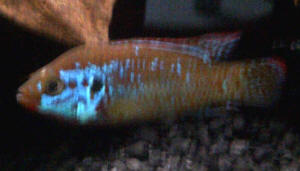 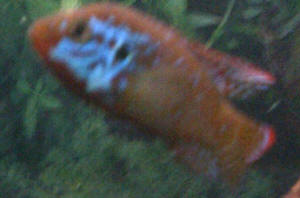
Re: Jewel Cichlids with an African Brown
Knife and a Senegal Bichir? incomp.
1/27/12
Thank you so very much for your advise (you guys are an amazing
resource!!).
<Welcome>
PS: So you don't think it's a problem that I'm not
oxygenating the tank?
<Could be>
PPS: I put the Senegal Bichir in (he's around 3.5/4 inches)
and a day later one of his fins was missing.
<?!>
I felt really bad and considered taking him our, but I think
they've straightened it out because he doesn't seem
worried and is swimming right up to the Cichlids (who are now
schooling very closely). I also think it may grow-back (being the
bridge to amphibians that he is...). Will keep you posted.
-Jesse
<Where did the fin go? BobF>
Re: Jewel Cichlids with an African Brown Knife and a Senegal
Bichir? 1/28/12
I assumed one of the jewels took a chomp at him...
-j
<Then they need to be separated. B>
|
Baby Polypterus
Compatibility 8/9/11
Hi Guys,
<Anthony>
Currently I have a 2" Polypterus delhezi, and a 3" Polypterus
Senegalus.
<Wow! Small specimens!>
Do you think that a 4" Polypterus Palmas Polli would make a good
tank mate for these little guys, or do you think that it might try to
eat the 2" ?
<They should be fine together... as long as there's
space/habitat and their kept fed>
Thank you for your time and thank you for your informative website.
Sincerely,
Anthony
<Thank you for sharing. Bob Fenner>
Corys + Senegal
Bichir 8/4/11
Hello WWM!
Thanks for all your help in the past!
I have a 12 inch female Senegal Bichir alone in a 50 gallon, I have put
some fish in with it before and they always end up with their tails
gone or bitten in half! Not sure why it's so aggressive, I feed it
plenty of frozen bloodworms and earthworms. I have 4 half inch leopard
Corys and 2 big 3.5 inch peppered Corys, would they be able to live
with the Bichir, or would that be a bad idea. Also I've always
wanted a knife fish, would any specie of knifefish coexist with it? Or
maybe even another eel such as a peacock eel? I really want something
else in this tank.
Thanks, Jesse
<Better than Corydoras would be Brochis species, such as Brochis
splendens, which are similar in shape and colour, but stockier and do
well with medium-sized tankmates. They also tolerate warm water better
than Corydoras, so will thrive at the 25-28C/77-82 F Bichirs prefer;
most Corydoras, including the two you mention, do of course need cooler
water, 22-25C/72-77 F. You must bear in mind though that these are
predatory fish, and while their diet in the wild is primarily insect
larvae and worms, they do eat small fish given the chance. So anything
Neon or Danio size is likely to end up eaten. Brochis, being armoured,
should be okay, but adults, not juveniles. Polypterus senegalus gets
along well with one Knifefish species, Xenomystus nigri; the widely
sold Apteronotus albifrons needs very different conditions and would be
difficult to maintain in the same aquarium, and needs more than 50
gallons anyway. Senegal Bichirs are territorial but will cohabit given
space, and you should get away with two females or a male/female duo in
a 50-gallon tank. Spiny Eels are difficult to maintain and feed, so
research them carefully.
http://www.wetwebmedia.com/fwsubwebindex/spinyeelsmonk.htm
Cheers, Neale.>
Black Ghost Knife fish and Bichir are
lonely 8/18/10
Hi,
I have been investigating your forums and information and I find your
expertise quite useful.
<Only "quite"?>
I have a particular question regarding my current fish tank. I have a
Senegal Bichir (4 in.) and a Black Ghost Knife fish (4.5 in.) in a 30
gal tank, too small for them in the long run for sure, however they are
doing wonderfully right now.
<"For now" being the operating phrase. Whilst the Senegal
Bichir might be kept in a 30 gallon tank indefinitely, the Apteronotus
needs a much larger tank, and soon. Do understand that relatively few
specimens survive into middle age, and they die prematurely PRECISELY
because they're kept in the wrong environment. People promise
themselves they'll buy a bigger tank when the time comes, in
ignorance of the fact Apteronotus come from oxygen-rich, relatively
cool fast-water habitats around rapids and waterfalls. They have very
little tolerance for stagnant water conditions and high nitrate levels.
To keep this species in a tank smaller than 55 gallons is, to be frank,
dangerous.>
The BGK is very active, even during the day, swimming back and fourth
and all over the place especially during feeding times.
<What they do in small tanks.>
The Bichir is the "ruler" of the tank and he goes where he
wants with not much of a care in the world (with the exception of a log
inhabited by the BGK). Right now the tank seems quite sparse for
inhabitants I am looking for possible tank mates that will fit my plans
in the long run.
<Least of your problems. Neither of these species needs tankmates,
and indeed adding catfish or loaches would be foolish. A school of
midwater characins such as Congo Tetras or Bleeding Heart Tetras would
make the most sense.>
I plan on expanding to a 75 gallon tank within the next year or so,
which makes it important that I choose fish that will work together in
a tank of that size. I had a Corydoras Catfish for a while, however I
think that the BGK picked on him too much and the Cory didn't make
it possibly because he was the little one in the tank.
<Correct. Corydoras are inappropriate to this aquarium.>
Currently I am looking at different tank mate possibilities including
an Oscar,
<No. Much too messy. Even in 75 gallons you'd be providing
barely adequate conditions for an Oscar and a Bichir, and the poor
Apteronotus would eventually die from the poor conditions.>
Pleco,
<No. Too much competition for food. Small Loricariids like a
Bristlenose might be okay though.>
Loach,
<There's really no suitable Loach that you'd keep singly.
Most are gregarious, and in sufficient numbers a school of Yo-yo or
Clown Loaches would be far too much competition for the Knifefish and
Bichir.>
or an Angel fish,
<Requires completely different conditions: still water, much
warmer.
Remember, you're keeping Apteronotus albifrons at a MAXIMUM
temperature of 24 C/75 F, and anything warmer will soon kill it. The
Bichir will be fine at that, as will most midwater characins. Likewise,
water turnover needs to be at least 8 times the volume of the tank in
turnover per hour. For a 75 gallon tank, that's 75 x 8 = 600
gallons/hour. That's a big-ass filter, and Angels will not like the
current produced.>
however I am not sure what would work out best and if I could get more
than one of those choices for the tank.
<I think you need to do more reading. Understand virtually everyone
who buys Apteronotus albifrons kills it within a couple of years. When
was the last time you saw a specimen 10 years old and 50 cm/20 inches
long?
Paradoxically, what this species needs to survive is very well known,
and has been for decades. German aquarists for example have maintained
this species for more than 16 years! So why is their track record
elsewhere so dismal? Because people assume they're "community
fish". They are not. They need very specific conditions.>
I would like to have a number of smaller (7-8 in.) fish as opposed to 4
large (over 12 in) fish in one tank, but I am not sure what the best
route is for my tank.
<You certainly could add a school of dither fish like characins that
will encourage both the Bichir and the Knifefish to swim about in the
open.
Surface swimmers like Giant Danios would also be good. Anything else
would be foolish unless chosen extremely carefully. As for catfish,
I'd look at either Ancistrus spp. or small whiptails such as
Rineloricaria that could be kept in small groups without undue
competition. Anything else would be daft.>
Do you have any suggestions on fish species that would work out well
for my situation?
Thanks for any and all help,
Steve
<Hope this helps. Cheers, Neale.>
Re: Cichlids... more rambling... re...
stkg., Polypterus comp. -- 2/3/10
Thanks again Neale. I like the idea of Congo tetras, but the Polypterus
is an ornate.
<Ah, one of the BIG species. This chap gets to around 50 cm under
aquarium conditions. I've seen adults, and they're huge, fat
things that tend to be kept alone because they're so snappy. A good
clue with bichirs is to look
at their jaws. If the lower jaw is longer than the upper jaw, then
it's likely a fish-eating species. The species that feed mostly on
insects and other invertebrates tend to have shorter lower jaws than
upper jaws.>
I've known he can't stay in that 20 and he'll be moving
into a 75 and maybe onto a 210.
<Well, yes. Certainly something around the 100 gallon mark.>
Reffing hockey games can make you a surprising amount of money.
<Cool.>
I looked at those two African cichlids. They are very cool. So
basically, the bichir should be kept alone, without any other fish (if
I can keep other fish with him right now please give me a few
recommendations)
and have fish added as he grows?
<They're best kept alone, or with armoured catfish (like a
Synodontis or an L-number Plec). Big, docile cichlids such as Oscars
and Severums can work well. In a big tank, a school of Tinfoil Barbs or
Bala Sharks can look
stunning in this sort of set-up. It's important to separate the
idea that predatory fish are aggressive fish. This is almost always not
true, because predators MUST keep a low profile if they're to
succeed, so swimming about
causing trouble is the last thing on their mind! Most of the aggressive
fish are actually herbivores of omnivores: Mbuna cichlids, Acanthicus
adonis catfish, Pufferfish, etc. In any case, Polypterus ornatipinnis
is waspish towards its own species and other bichirs, but tolerant of
peaceful tankmates it doesn't view as food.>
With the breeding pair, I think they just might stay in their 58 alone
and maybe be put in a 75. For the Polypterus would I be worried about
the final sizes of Rainbowfish and Congos.
<Both Rainbows and Congos would be dinner!>
How big do those 2 African cichlids get final size?
<Rhamphochromis range from "dwarf" species about 20 cm
long up to species over 35 cm long. Although equipped with needle-sharp
teeth and huge jaws, they're remarkably peaceful fish by cichlid
standards, and only view very small fish as food. Lots and lots of
species, so spend some time on Google and reading any Malawi cichlid
books you can lay your hands on.
http://www.wetwebmedia.com/ca/volume_5/volume_5_2/malawian_cichlids.htm
Altolamprologus compressiceps is about 15 cm when full grown,
Altolamprologus calvus is usually a bit smaller. They're both
specialist predators that feed on cichlid fry in the wild, but can be
maintained on pellets and frozen foods just fine. There is a very
popular shell dwelling form of Altolamprologus compressiceps less than
half the size of the standard species. It's called Altolamprologus
compressiceps "Sumbu Shell".
Anyway, these are Tanganyikan cichlids, and much will be said about
them in almost any book on Tanganyikans. There are some basic notes on
care elsewhere on WWM.
http://www.wetwebmedia.com/fwsubwebindex/tangcichsystems.htm
>
Thank you.
<Cheers, Neale.>
Re: Cichlids -- 2/3/10
Thanks again. I might just get a pretty Pleco to keep algae under
control and to eat those dreadful hybrid eggs and keep him with the
breeding pair and leave that alone. When talking about large, docile
cichlids, does this consider the Rhamphochromis?
<Not really, no. Rhamphochromis requires very specific water
conditions, different to those enjoyed by bichirs.>
My LFS has loads of Severums. Some big, some small. My question was not
completely answered though, or if it was I didn't catch the answer.
Can I keep anything with the Polypterus right now?
<Sure, so long as its not bite sized, not competition for food, not
aggressive, and not nippy. And bear in mind the bichir will need
rehoming fairly soon. If this was me, I'd save my money for now,
and buy something in a year's time when you have a bigger tank. If
you want something cheap and fun for now, why not set up a 10 gallon
tank for shell-dwelling Lamprologus? "Shellies" as
they're called are cichlids, they're fun, they're easy to
get, and they're small enough to do well in small tanks.
Great fun fish. Cheers, Neale.>
Polypterus ornatipinnis; tankmates, diet
3/14/09
Hey WWM/Neale,
<Hello again,>
Its been awhile since I've sent any e-mails for your advice.
I'd like to say thanks for your useful tips in your replies. For a
beginner like me and my sis who had no experience in keeping Ornate
Bichirs or Plecos, a year has passed and all of them are doing fine,
the Bichir reaching nearly a foot long.
<Sounds great!>
The reason for this e-mail is for some advice regarding further info on
Ornates and Plecos. Firstly, like the large Ornate I have, I was once
again given 2 more approximately 2-3 inch Ornates together with a 20
gallon tank. Apparently the owner did not want to risk these Ornates
dying as a quite a handful of fish they kept in the past, so they
handed it over to me. I am aware the tank isn't big enough and they
will eventually outgrow it, but for now they have ample space to swim
about and I added two 6 inch PVC pipes for them to hide. The last time
I asked, you advised not to keep more than 1 Ornate together unless the
tank was really big and many have said that as well due to their habit
of biting. But some fishkeepers I've asked have said otherwise and
they can be kept together. Both seem comfortable with each other at the
moment though. Thoughts on this?
<As is often the case "your mileage may vary". Or put
another way, there may be multiple factors involved. Sex is clearly
likely to be one, with male fish often more hostile towards one another
than they are towards females, or females to other females. I'm not
aware of Bichirs guarding their eggs, but males may still be
short-tempered with one another simply because in the wild they'll
be competing with one another for access to mature females. Other
issues may include competition for hiding places, aggression at feeding
time, and aggression caused by the use of certain types of food (live
food, particularly "feeder fish", does seem to increase
aggression when predatory fish species are being maintained). So there
is probably a suite of factors involved. If you can sex your Bichirs
(possible, by looking at the anal fin) you could opt for a group of
females, and then ensure the tank was big enough for all the fish to
have hiding places, and then to make sure only dead foods were used so
that their more competitive instincts weren't encouraged. But these
are all guesses; the reality is that Polypterus ornatipinnis is a
solitary fish in the wild and doesn't tend to work well in groups
under aquarium conditions.>
Secondly, just some further info on Ornates. How long do they live? I
heard 10 years but many have said they don't know.
<Surely well over 10 years. Even the small species like Polypterus
palmas will live for longer than 12 years. My guess would be that a
Bichir like an Ornate would have the potential to live 20+ years,
particularly if not kept too warm and given a balanced, not too fatty
diet.>
Are there sub-species of Ornates?
<None mentioned at Fishbase.>
Once read a magazine that recognised 4 sub-species that grows to
different lengths. And about feeding them like the last time I
inquired, I successfully fed the 2 small ones pellets. But the foot
long Ornate seems to be Â…rather fussy.
<Diet does change in the wild, adult fish being essentially
piscivorous compared to the insect-eating juveniles. Since they hunt by
smell rather than sight, live fish aren't required, but lancefish,
mussels, squid and the like would be viable options. Also, virtually
every Bichir or every size adores earthworms!>
Most of the time it opts to starve itself till we give it fish (some 5
days at a time!) and were not sure if it eats the pellets we feed it.
One person advised me to starve it till it accepts pellets since most
do that. Is this a good tactic?
<Can be. I'd not use pellets for Bichirs because of issues with
constipation; while acceptable now and again, I'd honestly
recommend a more varied diet than this, with a good deal of seafood and
white fish, taking care of course over the thiaminase issue.>
How long can an Ornate go without food?
<Adults likely have to do without food for a month or more during
the dry season.>
Will it remain defiant on its hunger strike till it perishes?
<Depends what you offer it.>
I certainly don't want it to die because it is picky about what it
eats!
<Earthworms. Very nutritious. Do collect from an "organic"
garden though; pesticides are an obvious danger otherwise. I
deliberately don't spray my garden for precisely this
reason.>
And finally, how do you tell about male and females among Ornates if
you're given a random specimen?
<Juveniles are essentially identical, but sexually mature males have
a much larger, broader anal fin (almost square in shape) compared to
the much smaller and narrower anal fin of the female (more
rectangular).>
That's all for Ornates. Finally, just a few questions regarding a
certain species of Pleco: The Bristlenose/Bushy-Nose Pleco. I was
planning on getting one or two to put it with the 2 small Ornates, but
not before I sort a few things out before deciding. The profile on WWM
says it tolerates alkaline water, but can it tolerate more acidic
conditions as my tank water tends to get acidic instead of basic?
<In common with practically all Loricariidae, the Bristlenose Plec
(Ancistrus spp.) is good across 5-20 degrees dH, pH 6-8.>
And because of its small maximum size as opposed to the potentially
large Ornate Bichir, will they become compatible or will the Bichir
�bully� it around?
<An adult Ancistrus might be okay, but it could be considered
edible, and even if not swallowed, could still jam the mouth of a
hungry Polypterus ornatipinnis. So I'd actually be looking at one
of the Loricariids around the 30 cm size range, like a Gold Nugget Plec
(Baryancistrus spp.), a Sunshine Plec (Scobinancistrus aureatus), or
the excellent L001 (Pterygoplichthys joselimaianus). if you have the
space, a Royal Plec (Panaque nigrolineatus) or an Adonis (Acanthicus
adonis) would be even better.>
Also, is it as hardy as common Plecos (I have leopards, I think)?
<Yes. Common Leopard Plecs (Pterygoplichthys spp.) would be ideal
tankmates too.>
The Bristlenoses are rather expensive and I don't want them to die
if I were to purchase them. Also, how long do they live?
<Ancistrus catfish can live for as long as 10 years. The larger
Loricariidae much longer, likely several decades. I have a Royal Plec
who is 15+ years old and not even half grown.>
I apologise for the unusually lengthy e-mail. Take your time in
answering it and thank you very much.
Gene
<Happy to help. Cheers, Neale.>
Pink convicts 11/6/08 I have a 55
gallon freshwater tank with all live plants. I had a kissing Gourami
and several angel fish in there for almost 10 years. They all died over
the course of the last year. Someone gave me 8 pink convicts and they
now "rule the roost". I want to put some other fish in the
tank, as they aren't really displaying any typical aggressive
behavior. My biggest one is probably about 2 inches long and the
smallest is coming up on one inch. A friend who works at the pet store
said that the majority of my convicts are female and I couldn't put
anything else in with them. Another friend introduced 2 Jack Dempseys
to her tank with 9 adult convicts (60 gallon tank) with no major issues
after 6 months. Is this a good match up? My husband has a 60 gallon
tank with 2 polypalmas and an upside down swimming catfish, also all
live plants and natural rock "hidey holes". He has been
eyeballing a barracuda for a while now and was wondering if they'd
get along. The polys have lived peacefully with several different
breeds of fish, but the catfish has killed a couple of the Gouramis
recently and seems to be intolerant of even the fish he "grew up
with". I don't want to spend the money on the barracuda, if it
will just get killed. Any suggestions? <Hello Maria. Convict
cichlids are very variable fish, and maximum size in particular varies
a lot, in part due to inbreeding. That will be especially true with
albino Convicts. That said, I'd expect even females to reach a
length of around 8-10 cm/3-4 inches. If they're smaller than that,
they're unlikely to be sexually mature, and hence not as aggressive
as they can be. Convict cichlids can be combined with other
Central American cichlids of similar size/disposition. Convicts tend to
bully "nice" Central Americans like Firemouth cichlids if
kept in tanks as small as your 55 gallon system, but in a 200 gallon
system I've mixed them well with Firemouth cichlids, Jack Dempseys,
Midas cichlids, and Jaguar cichlids. Armored catfish (big Plecs and
large Synodontis such as Synodontis nigrita) also work well.
However, you CANNOT keep them with Polypterus species. Polypterus are
too mild mannered and get bullied by aggressive cichlids. I've seen
people try this, and the poor Polypterus gets its fins bitten off!
Polypterus are gentle fish, albeit predatory, and best kept either in
their own tanks or in peaceful community tanks with quiet species such
as Silver Dollars. Freshwater "Barracuda" are completely and
utterly incompatible with Convicts. They are typically the species
called Ctenolucius hujeta, a gentle, schooling fish that needs to be
kept in a quiet tank in groups of six or more specimens. They are
tricky enough to maintain in good conditions, and keeping them with
something as aggressive as a Convict would be extremely unwise.
Ctenolucius hujeta is a predator, so don't mix it with small fish,
but happily eats invertebrates like river shrimps and earthworms, as
well as frozen foods. Make sure any specimens on sale are feeding:
avoid specimens being given "feeder fish" as these are likely
exposed to parasites and bacterial infections that will make your job
of acclimating to captivity even harder. Keep Ctenolucius hujeta in a
spacious tank; it is a nervous fish prone to jumping and will not
adjust to confining tanks. Cheers, Neale.>
Re: Pink convicts 11/07/08
Thanks for getting back to me. I have my 8 convicts (2 which have been
identified as male) in the 55 gallon tank by themselves. <Hmm...
wonder how they've sexed juvenile male Convicts? Most folks would
consider that pretty tricky! Inbreeding has removed the bright colours
from many fish, and when they're small, you can't really
predict which ones will turn into big males! So while you *may* have
them sexed, I'd be very cautious and open minded.> Will they
still get aggressive even with the low male to female ratio?
<Yes.> The 2 Polys have always been separate from the convicts
and are going into a 60 gallon tank with the upside down swimming
Catfish (so far) and my hubby wants to put a barracuda in the 60 gallon
tank with the Polys and the catfish. <You don't put
"a" Ctenolucius in anything. They're gregarious,
schooling fish. Single specimens are nervous as heck and have short,
miserable lives. By all means get a bunch (minimum: 3) and keep
with Bichirs and Synodontis nigriventris (this catfish is also
gregarious). These three species are more or less compatible. Just do
make sure the Ctenolucius hujeta don't feel confined or
threatened.> My question is whether or not the 'Cuda will get
along with the Polys and whether or not a 60 gallon tank is too small
to add the Cuda. <It should work. Ctenolucius hujeta isn't
terribly big (less than 20 cm under aquarium conditions) and easily
reared on frozen foods. Because the catfish and bichir feed on the
bottom, you shouldn't have any problems getting bloodworms and
earthworms into the Ctenolucius hujeta.> The Convicts are in a
totally separate tank. <Ah, very good. Cheers, Neale.>
Polypterus senegalus, sys, comp.
9/5/08
Hi all,
<Ave,>
I have a question regarding Polypterus senegalus; I've been doing
my research and am getting some mixed reports and as always I like to
talk to someone in the know!
<We'll do our best.>
I recently saw a trio of albino Polypterus senegalus in my LFS and have
fallen in love - I've been wanting some for a while now and at only
4" I would love to have one to grow on. I intend to get a set-up
for them (hopefully an African style one with either some
reedfish/dwarf spiny eel - I know they're Asian!
<There are Spiny Eels in Africa, both the rivers and the lakes, so
you're not really cheating!>
but fire eels and tyre tracks are way too big - an African butterfly, a
bush fish or three - get mixed reports about these guys in groups too -
any suggestions? - and maybe some Congo tetras).
<All should be fine; P. senegalus is relatively peaceful.>
Now the problem is this; my boyfriend has promised to make me a set-up
(well build the cabinet so I can house a couple of tanks in one unit)
for the species. Because I'm so excited and the senegalus are
small, I was going to keep them in a two foot for a few weeks - a
quarantine if you will - while the new set-up is created. I had
intended a 4'x18"x18" tank for them. I also wanted 2
senegalus; is this unwise and should I get only the one? Or will 2 be
ok?
<Two youngsters will be fine in that take for some months.>
I've read of people mixing different poly species together, but not
sure what sizes etc these are being kept in.
<Polypterus are snappy about their caves, so each fish needs its
hiding place. But they're not otherwise known for being
aggressive.>
Will 2 senegalus cause chaos?? What is the ideal tank size, and
I'll attempt some negotiations!
<You should be fine; if the ultimate tank is going to be fairly
large, I'd actually get three specimens: there's less chance of
bullying, because no one fish can be picked on all the time.>
Thanks
Jo
<Cheers, Neale.>
Polypterus senegalus tank mates
9/5/08
Found your website very helpful; had quite a lot of information on
Bichirs that I'd not found elsewhere.
<Cool!>
We have a 55 gallon tank at work that currently has 3 2" Clown
Loaches, 2 Dwarf Gourami, 2 2.5" Kuhli Loaches, 1 4"
Senegalese Bichir, and 6 other little fish that will eventually die or
be eaten by the Bichir. Not concerned about the little fish as
we're transitioning the environment. The Kuhlis may also eventually
be food for the Bichir, which will be sad, but not a big concern.
<The Kuhlis will be eaten. I'm not comfortable about leaving
fish to their fate in this way. For a start, the Kuhli loaches are
armed with sharp spines, and these could easily choke the Bichir. Other
fish can carry parasites you're not aware of; harmless to the host
at the moment, but dangerous to Bichirs. Finally, there's plenty of
experience that says that predatory fish that eat live foods,
particularly fish, become more aggressive. If you're planning on
keeping your Bichir with tankmates, then you don't want that to
happen. So my unequivocal advice is to get the small fish OUT OF
THERE!!!>
The tank's fish will revolve around the 3 Clowns and the Bichir,
Polypterus Senegalus. I know the Bichir is a mostly friendly and
peaceful fish so long as it's tank mates can't be eaten.
<Mostly true, but not always.>
The Dwarf Gourami I really like and I would like to fully populate the
tank with an assortment of all their varieties. My concern is that,
once the Polypterus Senegalus is fully grown, they might be pushing it
on the low end for tank mate size. Do you think this will work, or
should I look for a general population that is a little bit bigger?
<If the Bichir has already acquired a taste for live fish because
it's eaten the smaller animals in the tank, then yes, these Colisa
are at risk.>
A related question. If the Dwarf Gouramis are probably ok, but
borderline, should I get rid of the little fish I'm ok with him
eating before he does?
<YES!>
Thus maybe habituating him to the shrimp pellets and blood worms
I'm giving him?
<Ah, you understand perfectly. This is precisely so. Predatory fish
learn what's edible to some degree. So by controlling what's
available, you "program" the fish to behave in a certain way.
You want to be rearing this Bichir on frozen foods so that it becomes
lazy and doesn't think about hunting. If it knows that you dump
easy, tasty food in front of him every night, he'll stick to
that.>
Thanks,
-Paul
<Cheers, Neale.>
Ornate Bichir, mainly comp.
8/04/08 Hello WWM crew. I'm quite new to this hobby and the
reason why it began was because of a gift which was a single Ornate
Bichir. We have been keeping it for about 4 months now and it is
probably the hardiest denizen in the aquarium (about 120 litres).
I've got a few questions regarding it:-1) I read that Suckermouth
catfish tend to suck on Bichirs when they get larger and my aunt who
encountered this problem said it was fine. <Mmm, sometimes
Loricariids will do this... and it can be harmful> So far the 3
suckermouths in the aquarium have done no such thing, is it safe to
continue (they are slightly smaller than the bichir, which is about 6
inches)? <Likely so; I'd just keep an eye on all> 2) Bichir
seems to have strange bouts of "insanity" as while it remains
placid most of the time, it sometimes to swims like a madman around the
aquarium's walls, as if trying to fight its own reflection. Is this
typical behaviour or is there something wrong? <Not unusual... and
it may indeed be reacting to its own reflection as you state. I would
cover one end of the tank with dark paper (on the outside) to discount
reflection> 3) I understand that Bichirs are bottom dwellers, but I
don't know what type of fish would be compatible in this same tank.
<Most anything that will not bother the bichir, nor is slow, small
enough to be ingested by it... Your tank is not very large for too
much...> I worry because of pH, behaviour and growth rate. My sister
wanted pufferfish, but I read that they tend to nibble the bichir's
pectoral fins. <Yes...> Any suggestions? <Perhaps some
Rainbowfish, medium sized barbs, medium sized gouramis...>
That's all that I have for now, thank you for your time. - Gene
<Welcome! Bob Fenner>
Re: Ornate Bichir, comp. and now fdg. as
well 8/5/08 Hey Bob/Whom it may concern, its me
again. Thank you for your reply. Regarding the compatibility, you
mentioned 'medium' sized gouramis. I know that the Giant one is
out of the question, so would Trichogaster trichopterus be good
tankmates? <For Polypterus ornatus, you might get about with T.
trichopterus, but P. ornatus is a big fish when fully grown, and not
all T. trichopterus get as big after years of inbreeding as once they
did. T. microlepis or even T. pectoralis would be better. But actually,
I'd suggest one of the Anabas or Ctenopoma species. Similar to
gouramis, though a trifle more aggressive and territorial. I combined
C. acutirostre with P. palmas with great success for many (~12) years.
The Asian Climbing Perch Anabas testudineus is a great animal if you
track it down; very characterful.> If so, how many do you recommend
and will they be aggressive to the others? Oh, and the last e-mail I
sent I had neglected to mention that the Bichir shares the tank with a
bulky approx 3 inch long feeder fish carp that grew too large to be
consumed. <Trichogaster are somewhat gregarious though males can be
aggressive; Ctenopoma and Anabas are somewhat more pushy, but again,
the males more so than females.> I read in one of your articles that
feeding feeder fish is a bad idea for Bichirs, <Bad for all pet
fish. Contrary to "the wild", feeder fish are disease-ridden
and nutritionally unbalanced. There's also some good reports that
feeding live food tends to make predators more aggressive.> so the
best is probably worms (frozen)? <Earthworms and river shrimps are
loved by Bichirs. But since they hunt by smell, not sight, almost
anything that smells right will be accepted.> But I'm afraid if
I switch, my Bichir might not adapt to his new diet. <He will. Even
if you need to starve him a few days.> Continue with feeder fish?
<Nope.> Thanks once again for your time. - Gene <Cheers,
Neale.>
Re: Ornate Bichir; diet, social
behaviour 8/6/08 Hello WWM crew, how is everyone doing?
Thank you for you last e-mail. <Most welcome.> I'm not sure
now if my 120 litre tank can support one Ornate Bichir together with a
Snakeskin Gourami (as mentioned in the previous e-mail), if it can I
have to track down the snakeskin because the aquariums in my area
commonly sell Trichogaster trichopterus and giant gouramis. <Long
term the P. ornatipinnis is going to need a bigger tank than 120
litres. It's maximum size in the wild is 60 cm (about 2 feet) and
even in aquaria you can reasonably expect 45-50 cm. I've seen
adults and they are big, chunky fish. But short term, both are
air-breathers and should thrive in this tank while small.> (Is this
a snakeskin Gourami? www.aqua-fish.net/show.php?h=snakeskingourami)
<Yes; not the prettiest Gourami, but hardy, reasonably large, and
peaceful.> If I can't get my hands on this species, get three
spot gouramis? <You can certainly get them; I just can't
guarantee they won't be eaten. As I said, P. ornatipinnis is a big
fish.> Moonlight Gourami is really hard to find as I've never
seen it being sold in any of the aquariums in my area. <OK.>
Besides barbs, gouramis, climbing perches and Rainbowfish, any other
species that you have encountered personally that goes well with Ornate
Bichirs? <Pretty well anything around 20 cm upwards, non-nippy, and
deep bodied enough the Bichir won't view it as food. Spanner Barbs,
Tinfoil Barbs, Silver Dollars, Distichodus, Clown Loaches, various
catfish are all possibilities... but your tank is way too small for
these. You're going to need at least 250 litres for the Bichir
alone once its fully grown, and even at ~30 cm it'll be a squeeze
in a 180-litre tank.> Thanks again for you time. - Gene <Cheers,
Neale.>
Re: Ornate Bichir; diet, social behaviour... now
chatting re Neotrop. cichlid addn... send to BBs 8/7/08
The reply you sent was most helpful, thanks again. <Most
welcome.> My sister saw a fish called "green terror" and
took a liking to it. They were not very big, but I think big enough for
the Ornate Bichir to leave it be. I know its a neotropical cichlid and
it looks very much like the Jack Dempsey. According to your FAQ
archive, it seems this fish is fairly aggressive? How big do they get
and will they bother the Bichir? <The Green Terror is Aequidens
rivulatus. It is a beautiful fish, but as its name suggests, extremely
territorial and aggressive. Unlike most South American cichlids, this
species is aggressive all year around, not just when spawning. So it
tends to be kept with Central American cichlids. To be honest, no, I
wouldn't recommend combining it with a Bichir. Bichirs are
basically peaceful fish, and I've seen them pecked to death --
literally -- by things as seemingly harmless as Yellow Labs
(Labidochromis caeruleus). Cichlids try to drive the Bichir away from
"their patch" pecking away at their dorsal fins and lobe
fins, leading to secondary infections. Bichirs aren't fast enough
to swim away from danger. If you wanted a cichlid for the Bichir tank,
look to large, non-aggressive species such as Oscars or even better
Severums or Geophagines (Eartheaters).> Thanks once again.
<Cheers, Neale.>
Re: Ornate Bichir; diet, social
behaviour 8/9/08 Hello, its me again. Once again in
need of advice (sorry). <Hello,> Couldn't find Snakeskin
Gourami or Heros species (seemed to be sold out), so was thinking back
on Oscar. But I went to the aquarium and saw a good sized silver
Arowana, not a bad price too. But was wondering to myself, silver
Arowanas swim on top and ornate bichir swim at the bottom, so
would it be compatible ( read the pH for it and Bichirs were quite
similar)? Arowanas and Bichirs can work; Osteoglossum spp. are best,
Scleropages spp. can be much more aggressive.> Also, is 120 litres
enough to keep a silver Arowana? <Not a chance. 750 litres (200
gallons) is the recommended size. They are open water fish that are
sensitive to poor water quality and water chemistry changes, and they
also need masses of swimming room.> What about Chitala chitala? Are
they placid enough to be placed with Ornate Bichirs? <Wouldn't
recommend it; chitala is potentially very aggressive. Much
better off with a smaller species such as Apteronotus albifrons or
Xenomystus nigri.> On with Tiger Oscars. I saw the aquarium selling
another type called "Blood Oscars", the only difference was
visible was the red on the tigers being orange. Is it another species?
<No; yet another artificial variety.> I was thinking of getting
an/or 2 Oscars, but still unsure. What type of pH do they do best in,
more acidic or basic? <They prefer soft and slightly acidic, but
like most South American cichlids they're adaptable provided water
quality is good. Anything up to pH 8, 20 degrees dH is acceptable.>
Do they eat the same foodstuffs as an Ornate Bichir? <Pretty much.
Wild Oscars are omnivores eating most anything from small fish to plant
material including fruits, but their staple diet are
"crunchy" things like crayfish, crabs and snails. That's
why they have such strong jaws!> How fast does it grow and live
compared to the Ornate Bichir, as I don't want one growing too fast
and then bullying the other. <Oscars grow very rapidly. Do see here:
http://www.wetwebmedia.com/FWSubWebindex/oscars.htm > About my
Ornate Bichir, I find it getting too attach with a log we added in
about 4 months ago when we got it. The Bichir tends to flap its little
pectoral fins and retreat into the log every time we approach the tank.
<Pretty normal. These are nocturnal fish in the wild, and only when
completely at ease will they swim out in the open. Providing plenty of
cover (e.g., plastic plants or floating plants) will help here.>
After I cleaned the aquarium today, it still retains its aggressive
attitude if we move its log to clean underneath (trashing, darting
around quickly, splashing water). Is this normal for the Bichir?
<Yes.> If it isn't, how do I get it to be not so dependant on
the log, or do I let it continue? <Paradoxically, fish tend to be
more outgoing the more hiding places they have. So concentrate on
providing lots of shade and lots of caves. Eventually the fish will
feel as if he is always close to shelter, and consequently will swim
about in the open more readily.> I also saw an aquarium selling
bloodworm/or some sort of worm cubes, can I feed the bichir these?
<Yes, they love them. But with big specimens (30 cm+) you may find
he has trouble catching them before the filter sucks them apart, so be
careful. Chopped seafood (frozen, from the supermarket: mussels,
prawns, squid) provide the ideal staple. Cut according to the size of
the fish. Your Oscar will thrive on this too.> Sorry if there are
many questions, but thanks once again Neale/whom it may concern. - Gene
<Cheers, Neale.>
Re: Ornate Bichir; diet, social
behaviour 8/9/08 Hey again, thanks for the quick reply.
<You're welcome.> You mentioned food from the supermarket,
fish, squid etc. Assuming I'm changing the Bichir and possibly the
Oscar's diet to fish, squid and bloodworms, do I just wash the fish
and squid from the supermarket, chop them into appropriate pieces,
stick them on a stick -or use chopsticks- and leave it in the aquarium
for them to feast? <Pretty much.> Also, how many times a day do I
feed them this way (assuming the Bichir is around 6 inches and Oscar
either smaller or similar)? <As with any fish -- no more than they
consume within 30 seconds to a minute. Large predatory fish are best
fed daily (or two, very small, meals per day). Either way you're
aiming for your fish to look healthy but not fat, so use your eyes and
nitrite test kits to check you're doing it right! A healthy fish
will be lean, with a just convex belly but certainly not like it's
swallowed a ball! If you detect nitrite in the water, you're
definitely overfeeding.> About Oscar growing fast, the Bichir seems
to be growing slowly at the moment <Normal...> so is it likely
the Oscar will outgrow the Bichir quickly and disturb it? <Likely
not.> I'll keep the plastic plants idea in mind to make the
Bichir feel more secure, I don't think the Oscar's tendency to
rearrange things would be too much of a problem, filter might be
problematic though... <Use aquarium silicone to glue the plastic
plants to a slate or piece of glass. Bury said slate or glass under the
gravel. Problem solved.> Oh yeah, my sis and I also keep some
guppies (not same tank with Bichir). Though I help to look after the
guppies, she mostly tends to it. We've got about...6 pregnant ones
at the moment and 5 males, both kept separately. Do mother guppies eat
their own babies? <Not deliberately, but in a small tank with
insufficient floating plants for the babies to hide, yes, it
happens.> And do we keep each mother in her own spot so we can
remove them after they give birth? <I'd tend to leave the female
alone for a week or two to fatten up before placing her back in the
main aquarium. But don't put the female in a breeding trap or
breeding net! Fish hate them. Much better to use floating plants. Same
effect, less stress.> My sis is also curious with guppy
compatibility. Is guppy compatible with small puffer fishes or tetras?
<No and no. Fancy guppies are useless at swimming and everything
seems to nip them. Pufferfish would be a complete no-no, and I
can't think off-hand of a tetra I'd trust 100% with
Guppies.> What other fish can you recommend that can be kept with
guppies? <Just Guppies. They are so inbred now they are neither nor
easy to keep. Best kept alone. If you must mix them with something, go
with harmless Corydoras species.> Is it possible that a 3 inch
feeder fish grown too big goldfish/carp will bother them if kept
together? <Juvenile Carp generally tend to ignore livebearer fry; I
have a tank with Limia nigrofasciata fry and a few juvenile (3-4 cm)
Carassius carassius and they get along reasonably well. The Carp lose
out at feeding time a bit though. Mixing livebearer fry with anything
bigger is not a good idea though.> Once again, thank you for your
time. - Gene <Cheers, Neale.>
Re: Ornate Bichir; diet, social
behaviour 8/14//08 Hello, its me again, how's it
going? <Well, it's going, anyway.> Finally decided to get an
Oscar -or 2- to keep with the Bichir. The only problems with getting 2
of them is a) Since many have said it is almost impossible to tell the
gender of an Oscar, we are afraid if we get 2 males they will engage
fights and b) If they spawn we don't have an extra 2 tanks for the
Oscar and the fry themselves. I heard that -word of mouth- Oscars can
be told apart from dark blotches of colour on their pectoral fins?
<Never heard of this, and certainly wouldn't rely on it! But its
your tank, your money...> Feeding feeder fish is a no-no, but is
feeder shrimp safer? <Should be. Earthworms are my favourite choices
for settling in new fish. All fish love them, and the soil inside them
is rich with minerals as well as fibre. No risk of disease if collected
from an organic garden.> On guppies, is there anything to keep in
mind about conditions and such for pregnant guppies? We have 6 of them
in around a 1 gallon tank and one of them looks really bloated up. We
are afraid to keep it back in the 30 litre tank of 5 males as the males
might eat the fry after they give birth. <Add lots and lots of
floating plants. Makes a huge difference with all livebearers. Guppies
are notorious for eating newborn fry.> Also about conditions of the
water. pH is important to keep track right? <Yes; whatever the pH
is, it should at least be stable. pH 6-8 is fine for Oscars, but what
they don't want is variation. That's why I tell people to
concentrate on the carbonate hardness, not the pH. Provided the water
has adequate carbonate hardness and isn't overstocked, the pH
should be stable automatically.> The 120 litre tanks seems to get
acidic very quickly for some reason but fish are always doing well (for
some unknown reason). Though we don't like to take chances, why
does it get acidic so quickly while the 30 litre tank gets basic
quickly? <Do see here:
http://www.wetwebmedia.com/FWSubWebIndex/fwh2oquality.htm
http://www.wetwebmedia.com/FWSubWebIndex/fwsoftness.htm In particular
understand the several factors that cause ALL aquaria to become acidic
over time; the best you can do is resist this by slowing it
down/minimising the sources of acidity.> Thanks. - Gene <Cheers,
Neale.>
Dwarf Puffer/Polypterus
Compatibility 2/3/08 What a wonderful site you have! I
learned so much from browsing! Y'all are doing a wonderful thing!
<Thanks.> I'm not new with aquariums but I am expanding my
knowledge base and experience. Do you think a single dwarf puffer would
get along in a thickly planted cave-filled 55-gallon tank with one of
the smaller species of Polypterus? <Absolutely not. Dwarf Puffers --
if by that you mean Carinotetraodon travancoricus -- are persistent
fin-nippers. Bichirs are easily targeted by fin-nippers because they
are slow, clumsy, and rather docile. The other day I came across a
retailer with some Polypterus senegalus with various Mbuna cichlids,
and the poor bichirs had their fins bitten down to the bone. On the
other hand, an adult Bichir might simply view a small puffer as food,
with unfortunately consequences for both. Don't do it!> I plan
to have ghost shrimp, Asian clams, the ubiquitous snail, and not much
else. If the puffer will eat pieces of the Polypterus, then I'll
just have to give him his own tank and put somebody else with the
Polypterus. <Indeed.> And can the puffer eat Asian clams or are
their shells too hard? <Puffers might not eat the clams outright,
but they will attack the siphons, which would equally certainly assure
the death of the clam. Besides, Asian clams -- Corbicula fluminea --
are extremely difficult to maintain in anything other than an aquarium
set up to their specific needs. They AREN'T scavengers and the THEY
WILL NOT survive just by taking "stuff" out of the water.
They need feeding every day with some sort of filter feeder food of the
type used for corals and the like. In 99.999999% of the cases where
people buy these clams, they're dead in a few months. Sure, they
die slowly, but die they do.> Not that I drink too much or anything,
but people who drink too much alcohol and want to cut back might find
that the aquarium addiction is SOOOOOOO fun ... my beer goes flat
because I'm talking to all my creatures. <Indeed?> Thank you
for any advice you can offer. Take care -- Randi in Ohio <Cheers,
Neale.>
Gray Bichir (Senegal Bichir) --
11/19/2007 I have a 5 inch Gray Bichir all by himself in a fairly
large tank. <When considering tank mates, it would be good to know
the specific tank size.> Would it be possible to mix some exotic
fish in with him? <Yes, most Senegal Bichirs accept large tankmates,
only exceptionally there are specimens that take chunks out of fish of
a similar size.> I was thinking maybe a black ghost knife fish?
<Could work, but success cannot be guaranteed. Something more robust
would be preferable.> Or maybe even a needle fish? <Likely
food.> I really want something exotic and unboring. <I guess by
unboring you mean you want a fish with an unusual shape, an oddball so
to say. Larger cichlids would be compatible. Although they do not have
a spectacular shape, they are more active and often have brighter
colours than most of the fish generally called oddballs. Another Gray
Bichir would likely work, too. A more unusual shape would be
represented by a large spiny eel, a tire track or fire eel. Given the
specimens have an appropriate size, they are robust enough to compete
with this smaller Bichir species. They will grow much larger than the
Bichir, but cannot seriously hurt him. Be sure to thoroughly research
any possible tank mates and provide enough space. We are talking about
more than 100 gallons for an adult large spiny eel in the long run. See
http://www.wetwebmedia.com/FWSubWebIndex/polypterids.htm and
the linked files above, especially the one on compatibility. Cheers,
Marco.>
My gray Bichir, comp.
11/19/07 Hello WWM, I bought a gray Bichir about a month ago.
<Polypterus senegalus, also known as the Senegal Bichir.> He is
doing great growing and eating great. I was wondering what would be a
good companion for him (he is aggressive towards his food so I suspect
he is aggressive) <This particular Bichir isn't at all
aggressive. He hunts by smell, and to localise the food rocks his head
from side to side. Because his jaws are quite simple, he can't
chew, so to swallow food he has to "worry" it a bit to break
it into small chunks. So a lot of what looks like aggression is more
likely just plain eating.> A worker at my LFS said he would be good
with catfish and cichlids. <Indeed. This is a good species that
mixes with anything of comparable size that will leave it alone.>
Would a san Rafael catfish do ok? <Not sure what this is. Do you
mean the Raphael Catfish, Platydoras costatus? If so, yes, they'd
get on fine. But Platydoras costatus is a *sociable* animal and should
be kept in groups, not singly or in pairs. When kept alone it is
incredibly shy, and you won't EVER see it. It's also unhappy,
which is not nice.> Or maybe a upside down catfish with some
floating plants. <A school of Synodontis nigriventris would be
ideal. Besides being the right size, they're also from Africa, so
make sense "geographically". A trio would provide lots of fun
without overloading the tank. Floating plants like Indian fern and lily
pads make all the difference with these fish, encouraging them to swim
about during the day.> Or maybe just a Pleco? <Again, another
good choice.> Another thing for you that have gray Bichirs (dinosaur
eel as they sell them at pet stores) I found a great new
"toy" for them. what I did is I made a decoration just by
stacking rocks in a pile and I put an ornament type thing on top. I
thought he would just lay on it or avoid it. To my surprise I found him
wiggling through the cracks and having a great time. <Absolutely!
Fish need to interact with their environment, and in many cases giving
them things to explore helps them settle in. Bichirs are basically
nocturnal or at least crepuscular fish, and the more hidey holes they
have, the more outgoing they will be. Trapped in a bright, open tank
they tend to sulk.> Thanks <A great fish. Enjoy!
Neale.>
|
My dinosaur eel (Bichir), ID, gen.
11/12/07 Hi I bought a "Dinosaur eel" from my local
pet store and it is doing great eats readily etc.... but I
wondering if it can match up with any other fish because he seems
a bit aggressive and I want to have more variety in that tank.
Whenever I feed him blood worms he grabs onto them and thrashes
around crazily until its all down. Also I was wondering if a
small convict cichlid (1.5 inch) could go with him. Or any other
fish that could make a pair. Also it is only a baby, (4 inches)
and I realize it will get much bigger. I was also wondering if I
should feed it anything else besides high quality flakes, brine
shrimp, and bloodworms. Maybe some feeder guppies? thank you.
<I'm curious precisely what fish you have. Dinosaur Eels
are typically Polypterus species, also known as Bichirs (a word
for which the correct pronunciation has been lost in the mists of
time). The most common species in the trade is Polypterus
senegalus, a uniform grey-pink fish with a whitish underbelly. It
gets to about 30 cm in length. The other common species is
normally called Polypterus palmas by hobbyists but may in fact be
any one of a handful of similar species. It's mottled grey
above with a yellowy-white underbelly. Again, maximum size is
around 30 cm. The only other fish I can imagine this is would be
Erpetoichthys calabaricus, the Ropefish or Reedfish. This is a
very eel-like animal with a green body and orangey underbelly.
Maximum size in aquaria seems to be around 60 cm, but wild fish
approach one metre in length. Unlike the Polypterus species
already mentioned, this is a "schooling" fish of sorts,
and rarely does well kept singly. Keep in groups of three or more
specimens. By contrast, Polypterus species tend to be snappy, and
in some case outright hostile towards one another. All three of
these fish are good community fish when kept with animals too
large to eat. Cichlids, catfish and medium sized barbs and tetras
will work well. Anything too small (guppy-sized) will be eaten.
Erpetoichthys calabaricus is very peaceful and shouldn't be
kept with anything aggressive, or it becomes shy. There are some
other species of Polypterus in the trade, include some very mean
and aggressive ones that are normally kept alone (e.g.,
Polypterus Bichir and Polypterus ornatipinnis). But those species
are relatively uncommon. Fishbase is a good site to visit if you
are having problems identifying Bichirs. Do a search for
"Polypterus" and look them over. The Polypteridae is a
small family, so this won't take long. All three species
mentioned here feed primarily on invertebrates, particularly
insect larvae. Bloodworms and mosquito larvae make excellent
staples. None needs feeder fish, and for all the usual reasons
you shouldn't use feeder fish unless you are breeding them
yourself. If you want to give them live foods, then the correct
food items for these fish are earthworms, mealworms, river
shrimps, Gammarus, and the like. But since they hunt by smell,
live food is redundant. Anything that smells right will be eaten.
These fish adore frozen prawns and other seafood, chopped into
smallish chunks. As usual with nocturnal hunters, only put small
amounts in the tank each night; too much food makes it difficult
for these practically blind fish to locate the food because the
smell will be everywhere. A 15 cm Polypterus only needs a two or
three chunks of prawn about the size of your fingernail, or a
single cube of bloodworms. Hope this helps, Neale.>
My dinosaur eel... Polypterid gen. --
11/14/2007 Marco's go Hello, <Hi.> I am an
experienced fish keeper with 4 tanks of my own. And in one tank I
have a "dinosaur eel" and that is what the store I
bought it from said it was. The problem is I can not find a Latin
name for the little guy and need to find out more. <Have a
look here:
http://www.fishbase.org/identification/specieslist.cfm?famcode=31&areacode=&spines=&fins=
Each picture will lead you to a description and more pictures.
Should be possible to find the scientific name and give us
something to work with. Dinosaur eel is just a general name that
may be used for any of the Bichir species and others. Also read
http://www.wetwebmedia.com/FWSubWebIndex/polypterids.htm and
http://www.wetwebmedia.com/BrackishSubWebIndex/taxonomy.htm >
Right now he is only 4 inches and I know he will get to about 12
inches. <How do you know if you do not know the species?>
He is in a small little 5 gallon eclipse and is as happy as a
clam. <Tank too small'¦ produces lots of nitrogenous
waste and will be poisoning itself.> When it comes time to
upgrade the little fellow I am going to purchase a 15 gallon.
<Still too small'¦ for any Bichir.> And since he
only roams around the bottom I was wondering if there are any
compatible fish for the little guy. <Depends on the species
and personality of the fish. Cichlids and catfish of adequate
size can work, but you will need a larger tank first.> I know
he is aggressive because when I feed him his favourite foods
(blood worms) he goes crazy and attacks it and thrashes around.
If you don't know what this "dinosaur eel" is I
don't blame you. <I'm glad to hear that.> I can
give you some description. It is a Bichir and has a white under
belly and a fanned out tail. Its head also looks kind of like a
lizard. the back colour is sort of whitish brownish. <Please
have a look at the site linked to above and properly identify
your eel. If it is mottled white and brown compare it to pictures
of Polypterus ornatipinnis.> Thanks for your support and I
love your site it has helped me a lot. <Good to hear. Thanks,
Dinosaur Marco.>
|
Compatible Ornate Bichir and African bumblebee
cichlid 4/21/07 We have a Ornate Bichir (dinosaur
eel) in one tank and we are thinking of getting rid of that
tank. I have a African bumblebee cichlid in a really large
tank all by himself. <Not sure what an "African bumblebee
cichlid" is. Do you mean Pseudotropheus crabro, http://www.fishbase.org/Summary/SpeciesSummary.php?id=2359 ?
Always a good idea to use Latin names, saves confusion.> I was
wondering if they can be in the same tank??? I think we are just tired
of having two tanks. <If the cichlid is Pseudotropheus crabro
(maximum length ~9 cm), and given that the bichir is Polypterus
ornatipinnis (maximum length 60 cm) then absolutely not. The bichir is
a piscivore, and sooner or later will view the much smaller cichlid as
a snack. Bichirs hunt at night, when cichlids are (generally) at their
most vulnerable. If the cichlid is something else entirely, then
provided it is ~30 cm or so on length, i.e., big enough not to be
viewed as prey, then non-territorial cichlids and bichirs can be kept
together without problems.> Thank you Lisa Brooks <Cheers,
Neale>
Feasibility of housing a pair of Polypterus palmas in a 75
gallon 1/27/07 Hello WWM crew, <Travis> I will
soon be buying a 75 gallon aquarium that I plan to set up as a West
African planted tank. There will be a lot of driftwood,
Bolbitis and Anubias to provide multiple hiding places, and three
African Tiger Lotus plants will be allowed to float their leaves on the
surface to provide cover and shade. <Sounds very nice>
I wish to keep two Polypterus palmas in this
set-up. But, I have read on your fabulous site, which I have
referred to many times over the past three or more years since I
discovered it, certain things that make me cautious about doing
this. You have said Polypterus palmas requires an absolute
minimum of a 20 gallon, 30' long, aquarium; <About right>
furthermore, that Polypterus palmas is perhaps the only Polypterus that
can be maintained in groups. Yet you have also said for
other Polypterus species, that a 55 gallon is too small for two,
<Mmm, not for palmas IMO/E> and a Polypterus should best be kept
in a tank that is at least four times its maximum length. <Yes>
Interestingly, one of those old, seemingly outdated, aquarium books one
finds in the library said Polypterus palmas is 'best kept in
pairs.' So what do you think? <Have seen this species
kept in groups... doesn't seem antagonistic to its own kind... and
a 75 should be fine> Am I asking for trouble if I put a pair of
Polypterus palmas into my future aquarium? Thank you for your help.
Travis <Not at all in my opinion... And I'd add some lively
upper water level Characoids here... likely Alestes or
Phenacogrammus... Do send along a pic please of your set-up once
it's all up and going. Bob Fenner>
Bichir compatibility question
10/6/06 Hello WWM crew I am interested in getting a Bichir and I am
wondering about any compatibility issues i might have with my
established tank. I am currently running a 75 gallon tank with 2
Geophagus, 3 Clown Loaches, 1 Pleco and 1 Flying Fox. The Flying Fox
(3" or so) is the only one I'm concerned about the Bichir
eventually consuming, but I am also wondering about general
compatibility. I'm really interested in these little buggers, but
would hate to have anything go wrong. Thank you. David <Mmm, a
Polypterus (of not too-big initial size) should go fine with the listed
species... neither harming the others... You may have a feeding issue
at first... due to the Bichir not being "all that sharp"...
but with placing foods right in front... BobF> Mixing Bichirs With Other Things 8/28/06 Can Bichirs
and rope live together? The Bichir is about 7" long and
one of my Ropefish is about the same in length but the other one is
about 5" in length. and is it a good idea to keep African dwarf
frogs in there also? Thank you for your time. < They are both
closely related and have similar requirements. As long as they are
fairly close to each other in size and are fed often then they should
get along fine. The frog on the other hand will be quickly eaten by
either one of them the first chance they get.-Chuck>
Mixing Bichirs With Flounders
8/30/06 Sorry to bother you again. What about flounders? Is it ok
to mix the Bichir with the flounder? It's small but not that small.
<If the Bichir gets hungry enough he may attempt to eat it but the
flounder is pretty fast and it may be difficult for the Bichir to get
too him. The flounder likes cool temperatures and lots of live food, a
very interesting fish.-Chuck>
Ornate Bichirs Hi, I've been planning to keep an ornate
Bichir have a forty gallon tank do you thing that would suit one. Do
you know if you can keep water dogs or mud puppies with them. Thanks,
Mike > I wouldn't mix amphibians with the Bichir... they're
quite messy and too much competition for bottom space... Bob Fenner
Polypterus ornatipinnis Dr. Fenner: Hi. I've had 2
Bichirs together for almost a year in a 30 gal tank. The biggest one
used to attack the small one for a while but both survived. I also have
a horn Plecos and a Gourami. Three days ago I bought a 40 gal long tank
so my Bichirs could have more space since they are getting huge. The
big Bichir is about 8" long and since I moved them to the new tank
the smallest has been attacking him to the point of bleeding. I'm
very frustrated. Could you give me any advice if there is something I
could do or if I should separate them???? Juliana <I would
definitely separate these two... they are territorial in the wild and
in captivity when kept in too small a system (a forty is small)... and
they do get larger... Bob Fenner>
Re: Polypterus ornatipinnis Thank you for answering my email.
I'm in the process of setting up the second tank. Juliana <Ah,
good to read/hear. Have seen some great Polypterids around the world in
Public Aquariums... some that they've had for decades... and even
saw a Bichir on a cemetery wall in an ancient Pharaonic setting in
Egypt years back... one of my favorite groups of fishes. Bob
Fenner>
Compatibility I've had a Bichir 4 about a year now,
he's about 10" long and have recently purchased a Amphiuma for
the same tank. he's nearing 2' and seems aggressive to
everything but the Bichir. (he ate a gar already) should I be worried
or might they leave each other alone? <I would be/am concerned...
the Amphiuma (an amphibian to those out there browsing) will indeed at
least try to eat the Bichir... if it has eaten a Gar (family
Lepisosteidae)... I'd move them to separate quarters. Bob
Fenner>
Adding to Bichir Tank Bob, Now that I have the Bichirs in
their own tank, is there any other fish that would be compatible with
them? <Umm, yes... other African fishes from the same regions.
Please see fishbase.org are the species you already have, and
WetWebMedia.com re freshwater fish groups. Bob Fenner> Dave
Siecinski
Please help Yoshi (a Bichir) Hello, my name is
Erin. I have been active in the fish hobby for awhile, with
two 30 gallon tanks, one 10 gallon quarantine tank, a five gallon, and
12 Betta bowls. I would like to address in issue that has
arisen. <Wow!> I have had a fire eel, Astral, a Polypterus
delhezi, Yoshi, in a 30 gallon tank for around 3
months. They seem to be accepting each other just fine and
share the same hang out spots for nocturnal fish. Astral is
about 6-7 inches in length, and Yoshi is yet a baby at only 5
inches. Both take in a several ghost shrimp a day without
hesitation, and Yoshi loves his beef heart cubes. I just got
in my ornate Bichir and was shocked to see him already close to 9
inches and quite girthy. I have another 30 gallon set up
with African cichlids, but the tank with Astral and Yoshi is the one
with the eclipse hood. Have you ever known an ornate Bichir
to prey upon an Armoured Bichir of smaller size? I would
hate to lose Yoshi in such a way, he is a great fish. Thanks for
listening, and I hope to hear back from you. Erin.
<Unfortunately, the ornate Bichirs are reputed to go after others of
their species so a mix isn't advisable. Ronni>
Packin' In The Polypterids - 08/24/2005 Hi <Hello.>
I've just acquired the two fish above, <Polypterus ornatipinnis
and P. lapradei> both are approximately 9" and healthy looking
specimens. They are in a 48 x 15 x 18 tank <I assume this is in
inches? This is FAR too small a tank for multiple
Polypterus, even small, without severe
territoriality/aggression....> with a few catfish and a school of 8
convict cichlids as well as 2 small (4-5") senegalus. <Four
Polypterids.... in 55 gallons.... Not a great
plan. All the fish are healthy, greedy eaters, apart from the two new
Polys. I've not seen them eat yet after being in the tank for
almost a week, <Were these two quarantined prior to
introduction?> the senegalus are greedy eaters, constantly looking
like a bag of marbles and I was assured the ornate and lap where greedy
too. <Likely they are being prevented food by the existing P.
senegalus, despite the difference in size.... Possibly
fighting/getting stressed after dark....> I've tried offering
lance fish, live earth worms, blood worm, prawns and catfish pellets,
I've offered food in the day and at night when the lights are out
as they are nocturnal fish, but I've still not seen them eat.
<There is serious conflict here; these animals very likely will not
coexist with any semblance of peace.... One or all may end
up killed as they age/grow.> Any suggestions on what to do?
<Remove the two newcomers, and when the two P. senegalus (still
quite small) begin to grow and show aggression toward each other,
remove one. The only Polypterus species I've heard
regular accounts of peaceful groups is P. palmas.... and
even still, ALL Polypterids get too large in the long run for a 55g
tank. Much to think about, here, I fear.... I do
hate being the bearer of bad news. Please read here for
more: http://www.wetwebmedia.com/FWSubWebIndex/polypterids.htm .>
Kind regards, Ashley Etchell <Wishing you and your fishes
well, -Sabrina>
Polypterus predation 1/31/06
I just stumbled across your site today. Very
informative! I have dabbled in aquaria for many years, had a
fledgling maintenance business (more like a hobby playing with other
people's money as I knew nothing of business at the time and
learned a great deal about aquaria and business at my
expense). I have often thought of having a good sized
aquarium (2-300 gal) well planted, and stocked with feeder white clouds
and Neons in large quantities. I wasn't sure if the
Polypterid would be able to easily capture these small quick fish or
not. I guess it's the evil side of me that likes the
idea of the normal response of "Gee, look at the pretty fish"
followed by "What the heck is that thing?" as the
Polypterid eats one of their pretty little fish. That and I
just love the primitive look of the Polypterids and
lungfish. Any suggestions (that don't include
psychiatric help)? I noticed don't recommend UG filters
for Polypterids. What is the reasoning behind
that? I have typically used UG's with penguin powerheads
and have had good results. Would that create too much
current for them to surface and breathe? >> Dear Allen, These
fish eat at night when the barbs and tetras sleep. so they will have no
problem eating them at all. Except you will not see it eat most of the
time. Other than that it will work fine. Lungfish especially also eat
some snails in nature, so you may want to consider that as well. UG
filters are not ideal because these fish may uncover part of them, and
that would make them useless, I would recommend a strong powerfilter
instead. Good Luck, Oliver
Ornate Bichir 1/31/06
Hi Robert, I'm a big fan, your website has served me very well and
kept all the fish I've ever had alive and well. I'm going to
purchase an Ornate Bichir to put in my 55 gal. I plan on putting it
into my QT tank for at least a month before adding him to the larger
tank. The 55 gal has been up and running for several months now,
it's planted and uses a Fluval 304 and a Penguin 350 BIO-wheel for
filtration. All I have in it right now is a Pictus Catfish about 5 in.
The guy at the fish store told me I cannot put anything else in a tank
with an Ornate Bichir including other Bichir/eels and catfish. In your
professional opinion do think that an Ornate Bichir and a Pictus Cat
will get along or should I find the Pictus a new home? Thanks a
million, >> Hello Phil, There are hundreds of species of fish you
could keep with an ornate Bichir. They are not aggressive fish, so the
only think you have to keep in mind is that they are predators. They
will swallow any fish that fits in their mouth, including your pictus
cat if he is too small. Good Luck, Oliver
Mixing Crayfish And
Bichirs 4/09/06 Hi, thx in advance for answering my question.
I have a 40 gallon tank with (1) 4 ½' Australian blue
crayfish, (2) gold Gouramis, (2) pearl Gouramis, (1) Bala shark, (1)
Pleco. I would like to make a Bichir the final addition to
my tank, but of obvious reasons there may be a clash between my
crayfish and the Bichir. Do you have any thoughts on how
this setup will work? Sincerely Chad < The crayfish will try to eat
the Bichir at first depending on the size of each. As the Bichir gets
bigger there will come a time when the crayfish will molt and the soft
new shell will leave the crayfish vulnerable to attack by the
Bichir.-Chuck>