FAQs on Bichirs, Family
Polypteridae Systems
Related Articles: Bichirs, Related FAQs: Bichirs 1, & Bichir Identification, Bichir Behavior, Bichir Compatibility, Bichir Selection, Bichir Feeding, Bichir Disease, Bichir Reproduction, & FAQs on:
Ropefish 1, Ropefish 2, & Ropefish ID, Ropefish Behavior, Ropefish Compatibility, Ropefish Selection, Ropefish Systems, Ropefish Feeding, Ropefish Health, Ropefish
Reproduction,
|
|
3 Polypterus species and sizes and tankmates
7/16/17
HI,
<Hello,>
I have a 75 gallon tank with
1 Senegal Bichir 7”
1 Polypterus teugelsi 5”
along with
1 African Feather fin Catfish 7”
<Lovely, peaceful catfish.>
2 Turquoise Rainbows 3” each
<I'd add a few more of these.>
1 Pictus Catfish 4” and
<No threat to all but the newly hatched Bichirs.>
1 Angel fish 4.5” tall.
The tank is well decorated with many hinding spaces and a 2” sand
bottom. I have recently found a 3’ Polypterus delhezi 3”. My question
is, how long should I allow my to get before I can add him to the 75
gallon tank., and will any of the other occupants cause a threat to him?
Thank You
<I would not combine such a small Polypterus specimen with substantially
larger specimens. Once the little Polypterus delhezi grows to within a
couple of inches of the existing specimens, you should be fine combining
them. But very small juveniles, especially those with their external
gills present, are extremely vulnerable. Bichirs are snappy, and even
the smaller, more tolerant species like Senegal Bichirs can't be
completely trusted to leave smaller or weaker specimens alone. Use your
common sense here, even though the three species you mention should be
compatible, given space. Cheers, Neale.>
|
Hi, a few questions (and a little creativity); Bichir sys.
7/5/15
Hey guys! So, I've been doing a lot of reading about Polypterus
senegalus lately, because I really want one but I know how large they can get.
<30 cm/12 inches is what you should plan for, though often they a bit smaller
than that.>
The issue I'm running into, is recommended tank size. Some say 50gal, others say
no less than 100gal. I have a 60gal aquarium hard-scaped, and I was wondering
what you thought about me getting one and putting him in there?
<No problems at all. These are very accommodating bichirs, not difficult to
keep. 50 gallons is ample.>
Also, I would like to put some cichlids in too, any recommendations? (I love the
electric blue JD's but I didn't know if that would work?)
<I would not. Bichirs are easy targets for aggressive, nippy fish. I've seen
this precise species of bichir with its fins removed because it was kept with
"peaceful" Mbuna (Yellow Labs). On the other hand, Kribs work fine, and
Ctenopoma are even better. Check out Ctenopoma acutirostre.>
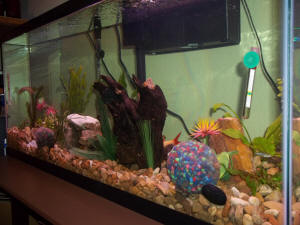
Lastly, I've included pics of the tank, and I was wondering if you had any plant
recommendations that would really help the tank "pop". Thank you!
Love y'alls site, my first stop when I have questions.
<Jaggedy rocks may be risky with bichirs as they are clumsy fish, easily
scratching themselves when alarmed. But that aside, Vallisneria in the sand,
Anubias on the rocks, and floating Indian Ferns on top to inhabit jumping and
provide essential shade. Of these three, Vallisneria could be skipped if
lighting is indifferent.>
P.S. that filter isn't staying in there. I'm getting a cascade 1000 canister
filter in 2 days and hooking that up to it. Thought you should know.
<Cheers, Neale.>
|
 |
|
questions regarding new baby bichir, ID, sys., diet...
9/27/12
Hello,
<Hello,>
I have previously owned bichirs, and currently own a delhezi bichir and
Senegal bichir (separate tanks). in my third tank, I have recently gotten a
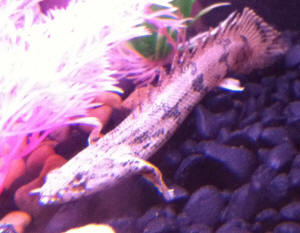
baby bichir. he looks like a saddled bichir but I am not sure. (see attached
pictures). His personality is very similar to my first bichir, which I
believe was saddled. He is very energetic, and likes to sit on top of the
plants, or squeeze between the heater and the tank wall. He looks like he is
hunting, but he is in there alone. Can you identify him for me?
<Looks like some sort of Polypterus delhezi to me, but the photos aren't
terribly sharp. Also, please do note we specifically ask for images no
bigger than around 500 KB a piece -- sending 7+ MB of images clogs up our
e-mail account and takes a while to download.>
In addition, what would be suitable tank decor for a baby bichir? What decor
do they seem to like? (my other two bichirs are duds and sit on the bottom)
<None of the Bichirs are terribly active; that's their nature. Generally, go
for a smooth substrate (so as not to scratch them when they root about) and
plenty of shade. Live plants are ideal, especially floating plants. If you
use plants that root themselves in the substrate, choose robust species not
easily uprooted, such as Giant Vallisneria or Amazon Swords. Otherwise,
epiphytes like Java Fern and Anubias are ideal, and also happen to tolerate
shade well.>
Also, what would be a good diet for a baby bichir? I'd prefer not to handle
raw meats/fish.
<You may prefer not to, but if you buy a Bichir, that's what you're getting
into. Fresh or frozen cockles and strips of tilapia fillet are two ideal
foods, being inexpensive and Thiaminase-free. Mussels and prawns may be
used, but sparingly because they contain Thiaminase, and long-term, too much
Thiaminase can and does cause serious health problems. Live river shrimp and
earthworms are good foods for subadults and adults, while very small
juveniles may do better with things like bloodworms. Most specimens can be
weaned onto good quality pellet foods such as Hikari Sinking Carnivore
pellets.>
I heard that feeding live goldfish was bad,
<Extremely bad.>
does the same go for feeder minnows/tuffys?
<Yes.>
Are there any frozen foods that would be good for him?
<See above.>
He doesn't seem too into pellets, and the store where I purchased him said
he had quite a few fish.
<Not a good sign. Sadly, in the United States especially, there's still a
huge ignorance about the dangers posed by feeding live fish, especially
minnows and goldfish, to carnivorous fish. Here in England aquarists keep
the exact same carnivorous fish and never touch live feeder fish. Since
we're all buying the same tropical fish exported from the same countries,
it's a mystery to me why American aquarists (and significantly, American
retailers) insist on using live feeder fish known to be Thiaminase-rich and
riddled with parasites. If you must use live feeders, choose a safe
livebearing species, deworm them, and then breed from them your own feeders.
Gut load before use. But as I say, there's absolutely no need to do this,
and doing the alternative and using fresh/frozen foods will be cheaper,
safer, easier, and less likely to cause problematic behaviours such as
aggression.>
I just want this little guy to have the best life he can, and I'm willing to
do almost anything to make him happy, he is already a very special fish.
Thanks so much and have a great day!
Alyssa
<Glad to help, Neale.>
|
 |
New Bichir, sys.
mostly 3/19/12
First, apologies. I'm sure this addressed somewhere else on your
site. I just couldn't find it. 3 questions:
<Fire away.>
I've kept bichirs before and adore the fish. Other than a HUGE
mistake on my part vis a vis feeder fish for one bichir and the
fascination of my brother's toddler when they fed two others while
I was on vacation, all of my bichirs have been happy, healthy, and
long-lived.
<Cool. These are nice fish.>
After moving cross country, and giving my old bichirs to a fellow
bichir enthusiast that I trusted to love them, I set up a new tank in
my new apartment. I cycled it for two weeks because I kept having water
clarity issues. I can't tell if it's just the angle of the
light in my apartment or actual cloudiness, as the water only appears
cloudy on one side of the tank and only from behind the tank.
The edges of my water level and my heater get white, hard water
crust on them REALLY fast, no matter how I change it.
1) Should I be worried? Should I strip the tank, rinse everything, then
refill with distilled?
<No need to worry. The crust is lime scale, indicative of
hard water, but often includes some dirty brown muck as well. You
shouldn't use distilled water in an aquarium, at least, not 100%
distilled water. If you want, a 50/50 mix of hard tap water with
distilled water is great. But bichirs are hugely adaptable, and hard
water does them no harm. If it's unsightly, use lemon juice or
vinegar to wipe away slight deposits and prevent the big crusts from
forming.>
I got impatient and bought a new P. senegalus. It's a really little
baby that still has juvenile stripes. I added a little water
conditioner just to be safe about 30 minutes before I added the fish. I
tested my water before I put Woola in his new tank, and had no
nitrates, pH7, KH and GH ~120.
<Sounds ideal.>
2) What is a good GH for Bichirs? My old water was much
softer.
<Bichirs are very adaptable, and anything from 2-20 degrees dH
(about 35-350 mg/l CaCO3) is fine.>
Now Woola (my new bichir) is "breathing" really hard. The
water should be plenty aerated. I use an external filter that I let
cascade into a corner of the tank to introduce air and then break up
some of the current with strategic plants.
3) Is the baby just freaking out
<Yes.>
from moving from an extremely bright and rather bare pet store tank to
my dimmer, bichir friendly decorated (lots of soft, long branch plants,
a bolt-hole log, and long bottom)?
<Indeed.>
There's probably a temp difference too. I floated him for ~20 min.
Should I be worried about how hard the gills are working?
<Worried, yes, but not overly so. Do make sure water quality is
good, and that the Bichir can swim to the surface easily (they drown if
they can't) so if necessary, lower the waterline for very small
specimens. Check the temperature is about right, 25 C being
good.>
He was definitely not doing this in the store tank. I cant' think
of where the water went wrong, but I'm afraid I'm going to wake
up tomorrow to a dead
bichir!
Thanks, Kathryn
<Cheers, Neale.>
Re: New Bichir 3/19/12
Thank you! That was very helpful. My bichir stopped hyperventilating
after awhile and is now chillin' in his hidey-log, make
displays at his reflection, or resting on some plants near the surface.
Thank you, WWM had really helped me with various species of fish over
the years. You guys are awesome!
Kathryn
<Glad things worked out well. Thanks for the kind words. Cheers,
Neale.>
|
Senegal Bichir, hlth., sys.
4/1/11
Hello, I have come to your site on several occasions for answers
to many questions and found it very helpful.
<Thanks for the kind words.>
I have a couple of issues I have not been able to find answers to
though and am hoping you can help... I recently (2 weeks ago)
upgraded from a 20 tall to an Aqueon 55 gal with an Aqueon CA55
filter which moves 355 gallons an hour or just under 6 1/2 tank
turns per hour. I used river pebbles/rocks purchased from the
Wal-Mart garden center which I rinsed very well, put in a few
live plants, rocks and a piece of wood.
<I see. While pebbles can look nice, they're a pain to
clean around, trapping all kinds of gunk! They're also pretty
unpleasant for some types of fish, primarily burrowing and bottom
feeding fish that like to root about in the substrate, so be
careful what you choose.>
In the filter I put the bio-filters from the old tank and put
some of the old gravel into pantyhose in the bottom of the tank
until the water cycles. Water conditions are: Fresh water,
Avg. Temp 75 degrees,
PH 7.8 - 8,
hard water,
nitrates in the caution zone and nitrites are in the stress
range.
I did a 15% water change/gravel vac the day before yesterday
<While you have non-zero nitrite levels, do 20% water changes
at least every second day.>
and added tank salt
<Why? Salt is of little value in freshwater fishkeeping, and
liable to stress those species that dislike it.>
and supplemental bacteria.
<Usually pointless, but shouldn't do any harm.>
And I reduced feedings to every other day.
<Ah! Good.>
The community consists of: 6" Albino Rainbow Shark,
7" Plecostomus,
4 Chinese Algae Eaters 4"- 6",
<These will NOT get along once mature.>
3 Zebra Danios and a
5.5" Senegal Bichir.
<A risky companion for life with Plecs and especially with
Chinese Algae Eaters. Bichirs are targets for fish that like suck
at mucous, and I personally WOULD NEVER trust such fish with
Chinese Algae Eaters.>
All of these fish I've had since they were an inch or so in
size except the Danios which were introduced as food
<Yikes! These use of feeder fish is not only expensive but
also dangerous.
It introduces parasites, it promotes aggression, and above all
else, Cyprinidae including Danios (and minnows, and goldfish)
contain too much fat and a substances called Thiaminase that
destroys vitamin B1. If you want to try live foods, try
earthworms. Of course, earthworms will vanish in a tank with
pebbles, die, and end up rotting. But in a tank with fine gravel
or smooth silica sand, the Bichir will hunt for worms and consume
them during the night. The natural diet of these small Bichirs is
primarily insect larvae: bloodworms, mosquito larvae,
etc.>
but are still a little too large for the Bichir to eat. My issues
are, other than the high nitrites, (1) the Danios have developed
very red gills.
<Reaction to non-zero nitrite levels.>
(2) The Bichir (Spike) spends a lot of his time swimming rapidly
back and forth the length of the tank.
<Stressed. They're burrowing fish, and psychologically
want to root about hunting for midge larvae and other wormy
foods. Your pebbles are frustrating that. Coupled with non-zero
ammonia levels, and potentially unpleasant and certainly
territorial tankmates (the CAEs) and you have a nightmare
scenario for this species..
Supposedly a bottom dweller he spends a lot of his time at the
top of the water. He started doing this shortly before I moved
him to the big tank and I thought he was just outgrowing the 20
gal but he still does it. Is this an indicator of something more
serious?
<Yes.>
And am I on the right track to stabilizing my water
chemistry?
<My gut feeling is that you aren't experienced enough to
be altering water chemistry. If you think a pH-down product is
what you want, or you don't understand how carbonate hardness
works to stabilise pH between water chemistry, you shouldn't
touch water chemistry. Hard, alkaline water is fine for Bichirs.
They are not at all fussy. But messing about with water chemistry
can be extremely risky.>
I went with river pebbles because I don't like the way the
color flakes off of regular tank gravel after a few vacuums.
<If your tank is dirty after you feed the fish, you [a]
don't have sufficient mechanical filtration and/or turnover;
or [b] are feeding much too much. Plain vanilla gravel
shouldn't change colour at all, but dirt and algae will cover
the granules if conditions in the tank aren't clean.>
Was that a mistake also?
<Yes.>
I sent a pic of the tank but couldn't get a pic of the red
gills because the Danios move too fast. Sorry, I probably have
more questions than you have patience, but thank you in
advance!
<Hope this helps. Cheers, Neale.>
|
|
|
Dinosaur Bichir and Oscar... env., hlth.
3/9/10
Hello,
<Hello,>
My name is Kyle I bought a Dinosaur Bichir about 4 months ago and an
Oscar about 2 months ago and they were very active and the other day I
noticed that there were tiny little white worms on the glass
<Planarians or nematodes; usually means you're (dramatically)
overfeeding and/or (seriously) under-cleaning the aquarium. Think of
them as rats or cockroaches, moving into the "kitchen" that
is your aquarium.>
of my tank so I cleaned it all out and everything and the next day when
I got home from school my fish were just laying there,
<Did you clean the filter? Did you clean the filter so aggressively
you killed off the filter bacteria?>
I put some food in for them but they never ate usually when I feed them
they swim around the top of the tank and a few hours later my Oscar
died and now my Bichir has this pretty big white spot on his back and
his back fin and it looks like he is bleeding from the inside around
it... can you tell me whams wrong with him??
<He has Finrot, likely from chronically poor water conditions. Treat
with an antibiotic. Don't waste your time with Melafix/Pimafix, and
try to avoid using anything containing copper of formalin, as these can
be toxic to Bichirs. Clearly, you need to ALSO dramatically improve the
way you maintain this aquarium. Polypterus senegalus is quite hardy,
but it does need an aquarium around 180 litres/45 US gallons to do
well, plus a filtration system rated at not less than a turnover of 6
times the tank per hour. Ammonia and nitrite levels should be 0, and
water chemistry should be soft to moderately hard, without an extreme
either way in terms of pH; 5-20 degrees dH, pH 6.5-8 works fine.
Cheers, Neale.>
Re: Dinosaur Bichir and Oscar 3/9/10
Well I wasn't home for about a week and I asked my brother to take
care of them for me and when I got home there was a bunch of uneaten
food on the bottom of my tank
<Well, there you go.>
and those worms so I took my fish out and cleaned everything with
boiling water
<Yikes!>
and got a new filter
<Why? If the tank is filthy, by all means siphon out detritus from
the gravel, and change up to 50% of the water on one day, another 50%
the next day, and so on until the tank is nice and clean. But never,
ever replace all the biological filter media at once. You can safely
change up to 50% of the biological media per 6 week period. But
changing more than that -- or deep cleaning mature media so it
effectively becomes new media again -- will cause major problems for
water quality. Without filtration bacteria in sufficient numbers, the
tank will crash as water quality plummets.>
I change the water in my tank once a month so the have fresh water and
because my other brother told me it helps them grow faster.. is there
any specific kind of antibiotic u would recommend?
<Not really, no; anything like Triple Sulfa or Maracyn II are good
choices and should do the trick. Cheers, Neale.>
Re: Dinosaur Bichir and Oscar 3/9/10
Ok ill remember that but I figured if the worms were in my filter I
wouldn't be able to get rid of them so that's why I got a new
one...
<The worms like likely come right back if conditions deteriorate.
They travel into tanks on plants, with live food, etc.>
alright thank you, can I get them at any pet shop or do I have to buy
them online?
<In the US, antibiotics for fish can be purchased at pet stores, but
elsewhere you will need to ask a vet. Antibacterial medications such as
eSHa 2000 may work in lieu of antibiotics, but it does depend on the
severity of the infection. Do follow the instructions, in particular
with regard to dosage and removal of carbon from the filter (if used).
All the medications in the world won't help if conditions in the
tank aren't good, so check nitrite level, and make sure this is
zero.>
thanks for everything, Kyle
<Cheers, Neale.>
Re: Dinosaur Bichir and Oscar 3/10/10
Alright
thank you for everything
Kyle
<You are welcome. Good luck! Neale.>
Senegal Bichirs, growth, beh., sys. --
12/14/09
How fast would you say a 4in Senegal Bichir to reach full length on
average
<These fish grow quickly. Expect it to reach at least 20 cm/8 inches
within a year. Maximum size is a bit over 30 cm/12 inches. You'd be
very unwise keeping a juvenile specimen in anything less than 100
litres (25 US gallons) and an adult will need something around 180
litres (48 US gallons). These fish are hardy, and provided you
don't do something stupid like give them "feeder fish",
you can expect a Senegal Bichir to grow quickly, get to a decent size,
and live a long time (decades). Cheers, Neale.>
Re: Senegal Bichirs -- 12/14/09
Thanks for answering! I have him in a 40g now I was just wondering how
fast I should buy a 75 ^^
<At you leisure, really. Wait until you find a particularly good
deal. 40 US gallons is healthy enough, though more space will allow
more tankmates and better decorations. But there's no rush.>
thanks for the help
<Happy to help. Cheers, Neale.>
Polypterus senegalus, sys, comp. 9/5/08
Hi all,
<Ave,>
I have a question regarding Polypterus senegalus; I've been doing
my research and am getting some mixed reports and as always I like to
talk to someone in the know!
<We'll do our best.>
I recently saw a trio of albino Polypterus senegalus in my LFS and have
fallen in love - I've been wanting some for a while now and at only
4" I would love to have one to grow on. I intend to get a set-up
for them (hopefully an African style one with either some
reedfish/dwarf spiny eel - I know they're Asian!
<There are Spiny Eels in Africa, both the rivers and the lakes, so
you're not really cheating!>
but fire eels and tyre tracks are way too big - an African butterfly, a
bush fish or three - get mixed reports about these guys in groups too -
any suggestions? - and maybe some Congo tetras).
<All should be fine; P. senegalus is relatively peaceful.>
Now the problem is this; my boyfriend has promised to make me a set-up
(well build the cabinet so I can house a couple of tanks in one unit)
for the species. Because I'm so excited and the senegalus are
small, I was going to keep them in a two foot for a few weeks - a
quarantine if you will - while the new set-up is created. I had
intended a 4'x18"x18" tank for them. I also wanted 2
senegalus; is this unwise and should I get only the one? Or will 2 be
ok?
<Two youngsters will be fine in that take for some months.>
I've read of people mixing different poly species together, but not
sure what sizes etc these are being kept in.
<Polypterus are snappy about their caves, so each fish needs its
hiding place. But they're not otherwise known for being
aggressive.>
Will 2 senegalus cause chaos?? What is the ideal tank size, and
I'll attempt some negotiations!
<You should be fine; if the ultimate tank is going to be fairly
large, I'd actually get three specimens: there's less chance of
bullying, because no one fish can be picked on all the time.>
Thanks
Jo
<Cheers, Neale.>
Re: Ornate Bichir; diet, social behaviour... comp.,
sys. 8/8/08 Hello again, sorry for sending so
many e-mails... <Getting used to it!> You mentioned in the
previous e-mail that Oscars are good companions, yet when I read the
FAQ and profile section for the Oscar, they seem to be rather
aggressive. The Ornate Bichir is hardy, but I'm not sure if the
Oscar will constantly pester the Bichir, as it is slow compared to the
Cichlid. I'm also not sure if the 120 litre tank can hold the Oscar
when it grows larger (not sure how fast they grow). <Oscars are
territorial and aggressive when spawning. And by community fish
standards, they're entirely unsuitable for maintenance with, say,
Angelfish! But for a big fish they are relatively docile and work
perfectly well with anything they don't view as either food or a
rival. They mix well with large, peaceful Polypterus spp.> Also:-
<Hmm...?> "Oversized and tough are by-words here. Oscars are
messy fishes to put it gently... and destructive toward objects like
siphons and tubing in their systems. Outside power filters (more than
one) are fine IF they are of the type that pull water into their boxes
(versus gravity fed siphons), and even these are better retrofitted
with suction cups on their in-tank parts. Canister filters of good
design are fine, but must be regularly (as in weekly) removed for
cleaning. Ideal arrangements for Oscar systems include outside sump
type filtration fitted with external pumps and internal overflows and
returns. Whatever mechanical means you set upon, make the filtration
easy to maintain and over-size in terms of capacity and flow."
<All pretty accurate.> "Heaters, filter parts, tubing... are
all just play things to Oscars. Hide, remote, attach with suction
cups... anything you want to stay in place... for a while."
<Yep.> From the article on your website, they seem to cause
problems with the filter equipment. The 120 litre tank I have is run by
the "bubblelator" and box filter system with a UV light
attachment, that means the Oscar will/might disturb my filter system
right? <Oscars will move/uproot/destroy anything they can. Partly
its territorial, and partly its curiosity. In any case you need to use
robust equipment and put as much as you can *outside* the tank. For
example external heaters that you add to the external canister filter
return tube works better than sticking a glass heater inside the
tank.> Also you mentioned medium sized Severums would be good as
well, Heros Severus is quite peaceful from the article and it seems
relatively well sized as well as pH range, good to keep with Ornate
Bichir? <Would be ideal. Other Heros species likewise, such as the
amazing 'Rotkeil' (or "red head") Heros
appendiculatus if you can find it. Traded but expensive here in
England. But stunning fish.> Thanks. - Gene <Cheers,
Neale.>
Gravel in Polypterus Tank 2/19/07 Hi,
I am setting up a new 75 gallon for my 7" Bichir (Polypterus
delhezi). Much ado is made in some forums about Bichirs and ropes
needing to be on sand, other references say fine gravel will do.
<Both can/do> Your website says dull gravel is okay for these
fish. <Yes... color-wise I think this shows them off best> My
question is about gravel size. The Bichir is currently on 1-2 mm
gravel. I would really like to use larger gravel in his new
tank. This would be easier to vacuum. <Ahh. Yes> Are the dangers
from gravel blockages in these fish exaggerated? <Mmm, I do think
so... "this too shall pass" generally> It rather seems
that bigger gravel would be spit out and smaller gravel pass through
and the danger might be from mid-sized stuff. I have on hand some 3-4
mm gravel and some 5-10 mm gravel. Would either of these be okay to
use? <IMO/E, yes> I don't want to find out the answer by
losing the fish! I was also thinking of feeding him on a plant saucer
so he wouldn't be picking his food out of the substrate. <Good
idea, technique.> Some foods would drift out but heavier stuff like
pellets would stay in. I really like this fish and don't want do
endanger him. Thanks. Tamera <Are neat animals...
Bob Fenner>
Polypterus Dear Mr. Fenner: I'm very interested to
acquire some Polypterus but I don't know where can I found some
photos of them biotope, because I love the "biotopical
aquariums". I have a 450 Liter aquarium, a 2500 liter/hour
external filter. How many Polypterus can I breed in ?? Thank you for
advanced: Xavi Well... if really interested... would encourage
you to do something in the way of a scientific literature search.
You're welcome to the input about such searches posted on the site:
Home Page ... Otherwise, an old, but still valuable source is Gunther
Sterba's works on freshwater fishes. Do a look-see through the
"used" book sources on the net for these. Bob Fenner
Polypterus I have a few questions on the ornate Bichir. What
kinds of foods do you recommend feeding them? How long is there
lifespan? How large do they grow? What the water temperature should be
and the PH? Thanks, MIKE > Meaty foods of appropriate
(mouth) size. The Polypterus I used to keep I mainly fed larval beetles
(meal worms etc.), earthworms (Oligochaete), and cut meat like cubes of
beef heart. This species (and others) live several years... the
biggest ornatissimus I've seen is about eighteen inches. Some other
Polypterids grow to more than two feet in length. Low seventies to low
eighties F. is about right temperature. pH about neutral is best in my
opinion as their water tends to go acid (which it is in the wild) with
aging. Bob Fenner
Bichirs Hi I recently just found your site. I had
a few questions about Bichirs before I go out and buy
them. I currently own a 20 gallon freshwater
tank. The only current resident in that tank is a freshwater
moray. I have added some aquarium salt to the tank to
alleviate any problems he's had with breathing. I'm
currently interested in turning this tank into a brackish water tank
and was wondering if Bichirs can cope with brackish
water. Also, what is the most active Bichir you can
recommend as I've heard the ornate Bichirs are very very
shy. Are there any other fish that would do well with these
two species? Oh and do you recommend any equipment for a
brackish water tank? Thanks for your time and I think your
website is great. Peter Kim <Hi Peter, Thank You for your comments
on the site! I would encourage you to keep fish in conditions that they
are evolved to. Bichirs are freshwater tropical African
fish. FW Morays are a Freshwater/brackish/marine
species. I would also be concerned with keeping any of these
species in a 20 gallon tank. Please type in "freshwater
moray" into the Google search at WetWebMedia.com and also see:
http://www.wetwebmedia.com/FWSubWebIndex/polypterids.htm
to read about Bichirs. Take note of the water chemistry
warning! Craig>
Senegal Bichirs problems Hi all, I have / had 2 Polypterus
senegalus 1 may have committed suicide. <Senegal Bichirs
usually are survivors given the proper living conditions. Though they
are known for jumping out of a poorly sealed tank. They need quite a
large tank to keep them happy.> I know they go after anything they
can fit in their mouth but, would that also include one of their own if
it is smaller then the remaining 1 thanks. <Senegal Bichirs are
carnivorous critters. They feed on live foods and dead meaty
foods such as earthworms, mussels and silversides. They do
show aggression to their own species, especially if you don't give
each fish a cave or something they can hide in and call their
own. It's not out of the question for one of them to
attack and kill a competitor... Though, none of the ones I have worked
with in the past had killed and eaten another Senegal Bichir.> Dave
<Hope that helped.-Magnus>
Packin' In The Polypterids - 08/24/2005 Hi <Hello.>
I've just acquired the two fish above, <Polypterus ornatipinnis
and P. lapradei> both are approximately 9" and healthy looking
specimens. They are in a 48 x 15 x 18 tank <I assume this is in
inches? This is FAR too small a tank for multiple
Polypterus, even small, without severe
territoriality/aggression....> with a few catfish and a school of 8
convict cichlids as well as 2 small (4-5") senegalus. <Four
Polypterids.... in 55 gallons.... Not a great
plan. All the fish are healthy, greedy eaters, apart from the two new
Polys. I've not seen them eat yet after being in the tank for
almost a week, <Were these two quarantined prior to
introduction?> the senegalus are greedy eaters, constantly looking
like a bag of marbles and I was assured the ornate and lap where greedy
too. <Likely they are being prevented food by the existing P.
senegalus, despite the difference in size.... Possibly
fighting/getting stressed after dark....> I've tried offering
lance fish, live earth worms, blood worm, prawns and catfish pellets,
I've offered food in the day and at night when the lights are out
as they are nocturnal fish, but I've still not seen them eat.
<There is serious conflict here; these animals very likely will not
coexist with any semblance of peace.... One or all may end
up killed as they age/grow.> Any suggestions on what to do?
<Remove the two newcomers, and when the two P. senegalus (still
quite small) begin to grow and show aggression toward each other,
remove one. The only Polypterus species I've heard
regular accounts of peaceful groups is P. palmas.... and
even still, ALL Polypterids get too large in the long run for a 55g
tank. Much to think about, here, I fear.... I do
hate being the bearer of bad news. Please read here for
more: http://www.wetwebmedia.com/FWSubWebIndex/polypterids.htm .>
Kind regards, Ashley Etchell <Wishing you and your fishes
well, -Sabrina>
|
|