|
FAQs on Bichirs, Family Polypteridae
Foods/Feeding/Nutrition
Related Articles: Bichirs,
Related FAQs: Bichirs 1, & Bichir Identification, Bichir Behavior, Bichir Compatibility, Bichir Selection, Bichir Systems, Bichir Disease, Bichir Reproduction, & FAQs on:
Ropefish 1, Ropefish 2, & Ropefish ID, Ropefish Behavior, Ropefish Compatibility, Ropefish Selection, Ropefish Systems, Ropefish Feeding, Ropefish Health, Ropefish Reproduction,
|
|
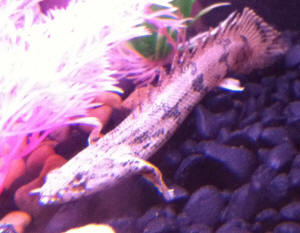
Delhezi Bichir hunger strike & hunting tank mates /RMF
2/6/19
Hi WWM Crew,
My Delhezi Bichir was previously more than happy to eat beef heart, silver
sides, and black worms, but recently has gone on a hunger strike... I was giving
him the occasional treat of live saltwater crabs that I had been catching out of
my saltwater tank, so maybe that spoiled him into only wanting to hunt?
<Possibly a factor... I kept, fed Bichirs years back...>
He managed to snag a couple of my Congo Tetras that didn't quite grow fast
enough to stay out of "bite size" range. Ever since then, he's trying to use the
beef heart as bait for the other fish. He'll literally sit with his nose
practically touching it while lurking under the driftwood or Amazon Sword leaves
and just waits to see if any of the other
fish are dumb enough to come snag a piece.
<Interesting>
He keeps lurking to try and catch more fish. I've tried offering market shrimp,
scallops, crab meat, silver sides, beef heart, blackworms, live earthworms, and
Massivore pellets, but he's snubbed them all.
<Very strange that this fish refuses live earthworms...>
He's in a 75g with 2 Angels, 6 Congo Tetras, 6 Goyder River Rainbows, 4
Boesemanni Rainbows, and 1 Turquoise Rainbow at the moment. The Bichir is around
9" right now. The Angels, 4 Goyder River Rainbows, and 1 Turquoise
Rainbow are all full grown and not at risk of being eaten, but the others were
restocks after I had a problem with an Opaline Gourami killing half my tank
(who's since been removed)... I got the largest I could find to replace, but no
one sells Rainbows or Congo Tetras larger than 2-3"... I knew it was a risk, but
this guy's been so mellow and easy to feed until recently that I was hoping it
would work.
Is there any way to convince the Bichir to go back to non-live foods, or do I
just need to cut my losses and pull the Congo Tetras now?
<How long has it been since you saw it eat? Does it appear thin, the stomach
"caved in"?>
Maybe if I
isolated him in a spare 20g long bare bottom tank for a short time to keep him
away from the tetras until he takes food again? Or would he just go back to his
old tricks the moment he had fishy temptations again?
<I wouldn't worry if it's only been a week, ten days, and this fish has a good
index of fitness. I'd offer it a live earthworm every two, three days and be
patient at this point>
Thanks!
~Kim
<Welcome, Bob Fenner>
Delhezi Bichir hunger strike & hunting tank mates /Neale
2/7/19
Hi WWM Crew,
<Kim,>
My Delhezi Bichir was previously more than happy to eat beef heart, silver
sides, and black worms, but recently has gone on a hunger strike... I was giving
him the occasional treat of live saltwater crabs that I had been catching out of
my saltwater tank, so maybe that spoiled him into only wanting to hunt?
<This is definitely true. Farmed Bichirs may be more than happy to take dead or
pellet foods, but if they "discover" live alternatives, this can pique their
interest. If starved for a while, they will go back to what
they know, but that's really only viable in a tank with other big fish. If they
live with even potentially edible tankmates, they may try eating those before
settling back down.>
He managed to snag a couple of my Congo Tetras that didn't quite grow fast
enough to stay out of "bite size" range. Ever since then, he's trying to use the
beef heart as bait for the other fish. He'll literally sit with his nose
practically touching it while lurking under the driftwood or Amazon Sword leaves
and just waits to see if any of the other fish are dumb enough to come snag a
piece. He keeps lurking to try and catch more fish. I've tried offering market
shrimp, scallops, crab meat, silver sides, beef heart, blackworms, live
earthworms, and Massivore pellets, but he's snubbed them all.
<It isn't unusual for predators to stop feeding for a while. Hunger makes the
best sauce of course!>
He's in a 75g with 2 Angels, 6 Congo Tetras, 6 Goyder River Rainbows, 4
Boesemanni Rainbows, and 1 Turquoise Rainbow at the moment. The Bichir is around
9" right now. The Angels, 4 Goyder River Rainbows, and 1 Turquoise Rainbow are
all full grown and not at risk of being eaten, but the others
were restocks after I had a problem with an Opaline Gourami killing half my tank
(who's since been removed)... I got the largest I could find to replace, but no
one sells Rainbows or Congo Tetras larger than 2-3"... I knew it was a risk, but
this guy's been so mellow and easy to feed until recently that I was hoping it
would work.
<Delhezi Bichirs can be good tankmates, and generally ignore fish too large to
eat. I'd expect adult Congo Tetras to be fine, having myself kept these with
Polypterus palmas for example, and it's a very similar species. But as you say,
anything the size of, say, a Platy will definitely be at risk.>
Is there any way to convince the Bichir to go back to non-live foods,
<Time; lack of food; hunger. You could also try offering half-way house foods,
such as white fish or prawn fillet wobbled in front of his snout on the end of
forceps or cocktail sticks. Bichirs have terrible eyesight, but a good sense of
smell, so should fall for this trick if they aren't spooked.>
or do I just need to cut my losses and pull the Congo Tetras now?
<Could be a good move.>
Maybe if I isolated him in a spare 20g long bare bottom tank for a short time to
keep him away from the tetras until he takes food again? Or would he just go
back to his old tricks the moment he had fishy temptations again?
<Impossible to say for sure. I would not trust him with small teammates at all.>
Thanks!
~Kim
<Cheers, Neale.>
Delhezi Bichir hunger strike & hunting tank mates /RMF
2/6/19
Hi WWM Crew,
My Delhezi Bichir was previously more than happy to eat beef heart, silver
sides, and black worms, but recently has gone on a hunger strike... I was giving
him the occasional treat of live saltwater crabs that I had been catching out of
my saltwater tank, so maybe that spoiled him into only wanting to hunt?
<Possibly a factor... I kept, fed Bichirs years back...>
He managed to snag a couple of my Congo Tetras that didn't quite grow fast
enough to stay out of "bite size" range. Ever since then, he's trying to use the
beef heart as bait for the other fish. He'll literally sit with his nose
practically touching it while lurking under the driftwood or Amazon Sword leaves
and just waits to see if any of the other
fish are dumb enough to come snag a piece.
<Interesting>
He keeps lurking to try and catch more fish. I've tried offering market shrimp,
scallops, crab meat, silver sides, beef heart, blackworms, live earthworms, and
Massivore pellets, but he's snubbed them all.
<Very strange that this fish refuses live earthworms...>
He's in a 75g with 2 Angels, 6 Congo Tetras, 6 Goyder River Rainbows, 4
Boesemanni Rainbows, and 1 Turquoise Rainbow at the moment. The Bichir is around
9" right now. The Angels, 4 Goyder River Rainbows, and 1 Turquoise
Rainbow are all full grown and not at risk of being eaten, but the others were
restocks after I had a problem with an Opaline Gourami killing half my tank
(who's since been removed)... I got the largest I could find to replace, but no
one sells Rainbows or Congo Tetras larger than 2-3"... I knew it was a risk, but
this guy's been so mellow and easy to feed until recently that I was hoping it
would work.
Is there any way to convince the Bichir to go back to non-live foods, or do I
just need to cut my losses and pull the Congo Tetras now?
<How long has it been since you saw it eat? Does it appear thin, the stomach
"caved in"?>
Maybe if I
isolated him in a spare 20g long bare bottom tank for a short time to keep him
away from the tetras until he takes food again? Or would he just go back to his
old tricks the moment he had fishy temptations again?
<I wouldn't worry if it's only been a week, ten days, and this fish has a good
index of fitness. I'd offer it a live earthworm every two, three days and be
patient at this point>
Thanks!
~Kim
<Welcome, Bob Fenner>
Delhezi Bichir hunger strike & hunting tank mates /Neale
2/7/19
Hi WWM Crew,
<Kim,>
My Delhezi Bichir was previously more than happy to eat beef heart, silver
sides, and black worms, but recently has gone on a hunger strike... I was giving
him the occasional treat of live saltwater crabs that I had been catching out of
my saltwater tank, so maybe that spoiled him into only wanting to hunt?
<This is definitely true. Farmed Bichirs may be more than happy to take dead or
pellet foods, but if they "discover" live alternatives, this can pique their
interest. If starved for a while, they will go back to what
they know, but that's really only viable in a tank with other big fish. If they
live with even potentially edible tankmates, they may try eating those before
settling back down.>
He managed to snag a couple of my Congo Tetras that didn't quite grow fast
enough to stay out of "bite size" range. Ever since then, he's trying to use the
beef heart as bait for the other fish. He'll literally sit with his nose
practically touching it while lurking under the driftwood or Amazon Sword leaves
and just waits to see if any of the other fish are dumb enough to come snag a
piece. He keeps lurking to try and catch more fish. I've tried offering market
shrimp, scallops, crab meat, silver sides, beef heart, blackworms, live
earthworms, and Massivore pellets, but he's snubbed them all.
<It isn't unusual for predators to stop feeding for a while. Hunger makes the
best sauce of course!>
He's in a 75g with 2 Angels, 6 Congo Tetras, 6 Goyder River Rainbows, 4
Boesemanni Rainbows, and 1 Turquoise Rainbow at the moment. The Bichir is around
9" right now. The Angels, 4 Goyder River Rainbows, and 1 Turquoise Rainbow are
all full grown and not at risk of being eaten, but the others
were restocks after I had a problem with an Opaline Gourami killing half my tank
(who's since been removed)... I got the largest I could find to replace, but no
one sells Rainbows or Congo Tetras larger than 2-3"... I knew it was a risk, but
this guy's been so mellow and easy to feed until recently that I was hoping it
would work.
<Delhezi Bichirs can be good tankmates, and generally ignore fish too large to
eat. I'd expect adult Congo Tetras to be fine, having myself kept these with
Polypterus palmas for example, and it's a very similar species. But as you say,
anything the size of, say, a Platy will definitely be at risk.>
Is there any way to convince the Bichir to go back to non-live foods,
<Time; lack of food; hunger. You could also try offering half-way house foods,
such as white fish or prawn fillet wobbled in front of his snout on the end of
forceps or cocktail sticks. Bichirs have terrible eyesight, but a good sense of
smell, so should fall for this trick if they aren't spooked.>
or do I just need to cut my losses and pull the Congo Tetras now?
<Could be a good move.>
Maybe if I isolated him in a spare 20g long bare bottom tank for a short time to
keep him away from the tetras until he takes food again? Or would he just go
back to his old tricks the moment he had fishy temptations again?
<Impossible to say for sure. I would not trust him with small teammates at all.>
Thanks!
~Kim
<Cheers, Neale.>
Senegal bichirs and convict cichlid feeding question
3/22/16
Hello and thank you for always having such great answers!
<Glad to help.>
I apologize in advance if the answer to my question can be found
somewhere here.
<WWM has built in Google search, try to use that ahead of time, most
stuff is covered already someplace or other. Try
http://www.wetwebmedia.com/fwsubwebindex/polypterids.htm>
I currently have a 55 gal with two juvenile Senegal bichirs (5in or so)
and a convict cichlid. They have lived together since they were very
small and have got along well. My convict is generally very docile and
previously was bullied by other cichlids, so he and the bichirs enjoy a
peaceful life. My question is, what would an ideal food be to offer to
both species?
<Well, the more important concern here is that there is rarely a case
where a non-obligate feeder should be fed the same thing all the time.
We need to find our captive critters with variety more than homing in on
a perfect
food as such. You wouldn't feed a person just one food all the time no
matter how healthy it is. One thing can rarely solve all nutritional
needs (despite advertising to the contrary!). Another thing to consider
is stimulation and behavior. As you have noted, these are very
interesting fishes behaviorally and IMO the behavior and "personality"
of a fish are more important than beauty. Bichirs are a really unusual
and unique ancient fish of which only a few other kinds of extant
compatriots still exist. So while as a rule it's a bad idea (for several
reasons) to feed live food, I would certainly make an exception for this
species due to its being essentially a species tank, your correct idea
that specific prey are key, and that their behavior is such a big draw
for you (me too).>
I have typically fed them frozen bloodworms which they all enjoy and
seem to thrive on, but the diet I've seen you recommend for bichirs
seems much more varied and likely better.
<The more varied, the better! Stimulation, more natural, laid-back
behavior, nutrition. The link above gives a good list of foods, some of
which seem surprising. Mealworms! Convenient to get at any pet
store...try them live. I would be a little leery of all the
pond-acquirable things that they would like such as small frogs due to
water pollution in the wild. The more types of meaty food, the better,
rotate them.>
I also have given cichlid pellets on occasion with all parties
satisfied. I am wary of my more sensitive cichlid having issues with
bichir food. I have fed the tank with feeder guppies (apparently a big
no no) with no ill effects that I have
seen and they do all appear to enjoy the thrill of the hunt... second
part to my long winded question- I recently started a tank of feeder
guppies separately and they have begun to breed. I am fortunate that my
local pet store has their own breeder tank; the guppies I purchased are
definitely more healthy than ones typically seen at big box pet stores.
<Home-grown feeder animals of any kind are usually better due to
control-ability of what they eat, and keeping out who knows what pests a
retailer may have. And cheaper in the long haul! Certainly worthwhile as
long as they are fed well themselves and are not used as a daily fare
due to the above concerns. -Earl >
If I fatten these guppies up and continue to keep a healthy adult
population growing, is this acceptable fare for my tank? Watching the
bichirs hunt is one of the most entertaining things I've ever witnessed
:)
Thank you in advance!
Alyssa Stone
re: Senegal bichirs and convict cichlid feeding question
3/22/16
Thank you for such a quick and thorough reply, I really appreciate it!
My spikers (bichirs) appreciate it too :D
dinosaur bichir; hlth. concern plus fdg. f'.... trauma likely
8/8/15
I know that is not the actual name, but that is what the pet store called it. He
is called Buddy now. it is the lighter color silver/yellowish. He is big now,
about 12 inches maybe an inch thick. I would say, maybe a little smaller. He has
been fine since I put him in the take months ago. Feed him around twice
a day pellets/bloodworms whatever it is that I have. (only because we have small
live fish for him to eat)
<Mmm; do see WWM re Bloodworms/Sewer Fly larvae and feeding freshwater fishes to
fishes. Problematical>
Water changes every week/two weeks
<I'd do partials every week. See WWM re this also>
because I have 3 black long finned tetras, 3 black and yellow (not sure if they
are guppies or not but in that family) 1 sucker fish, 1 big snail. So I know w/
that many I have to keep the levels right for them all and I try hard to do that
constantly. I live right next door to a PetSmart. He was the last
addition other than some small minnows for him to eat.
<Trouble... vectors for several parasites>
Not sure if that is killing him or not but something seems to be wrong with him.
He has started swimming funny. Like his head is too small for his body and there
is a small dark spot on top of head.
<Ahh; this and your relating of erratic behavior below lead me to speculate that
this Bichir has physically injured itself (very common) by "jumping" to the top,
crashing into a rock or the tank side....>
That has been a few weeks now but last week started the mess I am in now.
he just started swimming crazy flipping and rolling in circles and twirling all
over the tank when I would put my hand in to feed him/the others. He does that
anytime I get near the tank. Then last night. I thought it was it. he swam all
over crazy, and then went to the bottom and just sat there.
so I tried to get him out and he went crazy again and went to the corner to
hide. He seems to be breathing and fine but then just out of nowhere swims
crazy, flipping and rolling again in the sand at the bottom. I go to grab him
and it was like he just stopped fighting like he was out of energy. He is not
bloated in anyway like I have seen online. Am I feeding him the
wrong thing?
<To a degree... See (READ) on WWM re Polypterid feeding>
Before I fed him live fish and bloodworms (freeze dried).
<Oh! These are fine; as are good quality frozen, like Hikari brand>
Now, it's live fish and shrimp pellets. Is there something specific I should do
to keep this one alive that I might not know about?
<Archived...>
any help would be appreciated, these aren't just fish to me, he's my buddy, they
are my pets/my family.
Thank you,
Michelle
<Not much "to do" if indeed this is a trauma... placing the fish in another
established system w/ shallow (six inches or so) water might help it to recover.
Do the reading. Bob Fenner>
Re: dinosaur bichir /RMF 8/8/15
When I do water changes I only do about a 30% water change and vacuum sand.
Is sand bad to have?
<Not bad if kept moderately clean as you're doing>
should I get the bigger gravel? I changed to sand when I got him because they
said he would like to dig and hide. But, Will start working on all of that. I
have smaller tank I can get him to, and will start on the other food and stop
the pellets.
<The pellets are fine... but do read:
http://wetwebmedia.com/FWSubWebIndex/polypfdgfaqs.htm
If this does not work, how do I get him/tank tested for the
parasites/disease?
<PLEASE learn to/use the search tool, indices on WWM.... IF you so desired,
you'd need to learn to sample and use a 'scope>
How would I know?
<Bingo.... books, some on the Net re>
I have had the aquarium for about a year now and no issues for any of them
(until I got the bichir)
Thank you,
Michelle
<BobF>
Re: dinosaur bichir 8/8/15
Will do, thank you for the help.
Thank you,
Michelle
<W. B>
dinosaur bichir /Neale 8/8/15
I know that is not the actual name, but that is what the pet store called it.
<Guessing this is Polypterus senegalus, also known as the Senegal Bichir.>
He is called Buddy now. it is the lighter color silver/yellowish. He is big now,
about 12 inches maybe an inch thick. I would say, maybe a little smaller.
<More or less full grown.>
He has been fine since I put him in the tank months ago. Feed him around twice a
day pellets/bloodworms whatever it is that I have. (only because we have small
live fish for him to eat) Water changes every week/two weeks because I have 3
black long finned tetras, 3 black and yellow (not sure if they are guppies or
not but in that family) 1 sucker fish, 1 big snail. So
I know w/ that many I have to keep the levels right for them all and I try hard
to do that constantly. I live right next door to a PetSmart. He was the last
addition other than some small minnows for him to eat. Not sure if that is
killing him or not but something seems to be wrong with him.
<Indeed, feeding any kind of feeders is a game of Russian Roulette.
No idea why the use of 'feeders' persists in the US. You simply can't
predict what diseases feeders will introduce, and because of that, diagnosis and
treatment is extremely difficult.>
He has started swimming funny. Like his head is too small for his body and there
is a small dark spot on top of head. That has been a few weeks now but last week
started the mess I am in now. he just started swimming crazy flipping and
rolling in circles and twirling all over the tank when I would put my hand in to
feed him/the others. He does that anytime I get near the
tank.
<There is of course a disease called Whirling Disease that affects (mostly)
Salmonids such as Trout. It isn't proven to occur among tropical fish though I
suppose coldwater species like Minnows might introduce it. More likely though
we're looking at something else, difficult to pin down. Check firstly
environmental parameters. Many fish go loopy when stressed; the classic example
is what happens when too-cold water is added to a tank of cichlids. They lose
control. Fix the conditions and they get better.
Mollies are a more extreme example, "The Shimmies" just being a name given to
the neurological problems that improper conditions (low pH and high nitrate to
name but two) cause them. Constipation ("Floaty Bloaty Goldfish" syndrome) is a
common problem, primarily among herbivorous fish (such as Goldfish) but possible
with pretty much any fish that eats mostly pellet foods. Epsom Salt (1-3
teaspoons per 5 gallons/20 litres) works well against this as a mild laxative,
especially when the fish in question also eats something high fibre as well
(ideally peas or some other greens, but frozen brine shrimp work quite well
too). Finally, there is that old chestnut "Swim Bladder Disease", an almost
meaningless term that merely describes a situation where a fish is so sick it
can't control its buoyancy properly. Dozens of things can cause this, which
makes it hard to treat. Antibiotics are frequently recommended, and can work if
the cause was bacterial, which it often is.>
Then last night. I thought it was it. he swam all over crazy, and then went to
the bottom and just sat there. so I tried to get him out and he went crazy again
and went to the corner to hide. He seems to be breathing and fine but then just
out of nowhere swims crazy, flipping and rolling again in the sand at the
bottom. I go to grab him and it was like he just stopped
fighting like he was out of energy. He is not bloated in anyway like I have seen
online.
<So unlikely to be constipation, but nonetheless, trying Epsom Salt would be
worthwhile just in case. Epsom Salt does no harm and can do some good;
it doesn't react with other medicines, so is a good thing to use alongside, say,
an antibiotic.>
Am I feeding him the wrong thing? Before I fed him live fish and bloodworms
(freeze dried). Now, it's live fish and shrimp pellets.
<Please may I also stress that with carnivores there's always the problem of
thiamin (vitamin B1) deficiency. Can cause all sorts of symptoms including
nervous system problems. Shrimps, prawns and similar crustaceans and most fish
from the Cyprinidae family (minnows and goldfish for example) are the two main
food groups that cause thiamin deficiency because they contain an enzyme called
Thiaminase that breaks down this vitamin. It's a slow to develop problem that
might not cause ill health for months, even years, but it is likely a very
common reason for predatory fish mortality.
Minimise the use of crustaceans, and never, ever feed cyprinids. Never use
feeder fish anyway, but if you breed feeders from quarantined adults (the only
safe approach) then use killifish or livebearers ONLY because these carry no
particular health risks (cyprinids have the Thiaminase, while cichlids are spiky
and can choke predators). Vitamin supplements (mostly
sold for marine fishkeepers) can be used to minimise/eliminate the problem of
thiamine deficiency, and to a degree can also be used to treat it. Review diet,
and see whether this is a possible course of action.>
Is there something specific I should do to keep this one alive that I might not
know about? any help would be appreciated, these aren't just fish to me, he's my
buddy, they are my pets/my family.
Thank you,
Michelle
<Cheers, Neale.>
Re: dinosaur bichir 8/11/15
I have a question. I have a smaller tank he is in but Im having problems w/ my
little heater. Is it safe to put him back in big tank? Or do I need to keep him
separated while doing the medication?
<Epsom salt is harmless to other fish. Vitamin supplements (obviously) harmless.
Internal infection bacterial treatments (such as Maracyn, Kanaplex, etc.) also
safe for other fish, though the types you add to the water are LESS reliable
than medicated fish food (though Bichirs unlikely to eat medicated flake/pellets
anyway).>
Will get the medication today. Just in case. I honestly do not know what it
could be. maybe a combo ? I have fed him minnows over the last few weeks. I
think this is what is doing it.
<Certainly possible. Minnows are a double whammy: containing Thiaminase (leading
to Vit B1 deficiency) and parasite time bombs.>
He was fine before I put in the minnows (and I didn't do anything to them, I did
not know I should have kept them for a few days outside tank and then feed him
the fish, I just put right in from the fish store.....)
<Would have made precisely no difference keeping them in another tank a few
days, so don't beat yourself up over it. Many/most infections they carry
wouldn't be seen in the short term, other than, perhaps a sick fish simply dying
before use. To stress: don't use live feeders unless they're the offspring of
fish you've been breeding at home.>
That and when we took him out to put in other tank, looks like a dark grey dot
on top of head, might even be a hole? What do I do about that?
<Pray to the fish gods! More seriously, at this point, get the Bichir settled
and feeding again. Is he still spinning about? That's the key problem. Bichirs
do suffer physical damage quite easily (jumping to aquarium hoods and getting
burned on heaters without plastic heater guards) but such damage heals readily
if they're feeding and in good quality water.
Make sense?>
Thank you,
Michelle
<Welcome, Neale.>
RE: dinosaur bichir 8/11/15
Ok. I have him in a smaller tank so he can't thrash around as much. He does
sometimes, but nowhere near as much.
<Good.>
That has seemed to help calm him down on that part, just my little heater isn't
working so the water is getting cold fast, especially now that I am not home
watching water/warmth.....
<Understood. Do make sure he can't burn himself. Fault heaters are not worth
using: discard. If they jam on, they'll boil your fish in no time.>
i might just put him back in other tank so he is in good levels of water.
Eating- he's not doing a whole lot of that lately. He used to eat as soon as I
put food in tank, now it sits for hours and doesn't eat it all... Once I get
home and get the Epsom salt and the other stuff
<Do be careful about "stuff". Antibiotics and Epsom salt fine, but Bichirs are
intolerant of copper and formalin as used in numerous general purpose
medications.>
on him will see how he turns out. Hopefully he will start eating better soon- I
took minnows out tank and only feeding him bloodworms for right now.
<Do remove uneaten food from the tank; you want to keep water quality as good as
possible.>
thank you for the help.
Thank you,
Michelle
<You're welcome. Neale.>
Juvenile Ornate Polypterus Not Eating!
12/9/12
I have a juvenile Ornate Polypterus, approx. 3 inches, which was housed
for the past three months in a 29 gallon by itself.
<... this system is fully established, cycled I take it>
It ate very aggressively and was otherwise very active. I noticed about
10 days ago that it was lethargic and refusing food. I even tempted it
with meal worms and live
<http://www.fishlore.com/profile-ghostshrimp.htm> ghost shrimp, aside
from its regular
<http://www.amazon.com/gp/product/B00025K0ZI/ref=as_li_ss_tl?ie=UTF8&tag=fishlorecom-20&linkCode=as2&camp=1789&creative=390957&creativeASIN=B00025K0ZI
>
krill, (it will not eat meat pellets thus far). I had the water tested
and the
<http://www.amazon.com/gp/product/B0002566TC/ref=as_li_qf_sp_asin_tl?ie=UTF8&tag=fishlorecom-20&linkCode=as2&camp=1789&creative=9325&creativeASIN=B0002566TC
> ammonia and
<http://www.amazon.com/gp/product/B000255NC8/ref=as_li_ss_tl?ie=UTF8&tag=fishlorecom-20&linkCode=as2&camp=1789&creative=390957&creativeASIN=B000255NC8>
nitrite levels were perfect, as well as the
<http://www.amazon.com/gp/product/B000255NAK/ref=as_li_ss_tl?ie=UTF8&tag=fishlorecom-20&linkCode=as2&camp=1789&creative=390957&creativeASIN=B000255NAK
>
pH. The Nitrates, however, tested at 80ppml.
<Trouble. Likely indicates the root cause of trouble here>
Put
De-<http://www.amazon.com/gp/product/B002DVVICS/ref=as_li_qf_sp_asin_tl?ie=UTF8&tag=fishlorecom-20&linkCode=as2&camp=1789&creative=9325&creativeASIN=B002DVVICS>
nitrate in the filter,
<http://www.amazon.com/gp/product/B0002568S6/ref=as_li_ss_tl?ie=UTF8&tag=fishlorecom-20&linkCode=as2&camp=1789&creative=390957&creativeASIN=B0002568S6>
prime, emergency water changes every 2-3 days of 1/4 of the tank's
volume.
The Nitrates are holding at 80ppml.
<... too high>
I then tested my tap water and it tested close to 20ppml.
<Beyond the safe limit for potable water...>
The head guy at my fish store, who is also an eel keeper, both fresh and
salt, recommended getting the Polypterus into a hospital tank
ASAP.
<Why?>
I drained my 10 gallon hospital tank, and refilled it with filtered
water from the aquarium store, let it run and heat up to temp for awhile
and then tested the Nitrates. It tested at 20ppml, so I immediately
started acclimating the eel in a bucket with an airline tubing drip for
quite awhile before putting him in. He is responsive and seems fine, not
breathing heavily or anything, but still won't eat after 24 hours of
being in the tank. I am very worried that it is simply going to starve
itself to death.
Any advice on how to get this little guy to eat,
<Just time, patience, and fixing the NO3 issue, placing the fish back in
the larger (more stable) system>
what I can tempt him with, how long these fish can go without eating,
<Weeks>
would be GREATLY appreciated.
I have longtime experience in keeping these fish, and have never had an
issue like this before. In fact, I have a large one in a 72 gallon that
is quite healthy. Very confused and desperate to save it.
<Review what I've written above, do the reading, fix the main tank NO3,
move this fish back, be patient. Bob Fenner>
Re: Juvenile Ornate Polypterus Not Eating!
12/10/12
Thank you for writing back!!! The 10 gallon that I moved the
Polypterus into was a well established tank,
<Ah good>
with the filter and substrate (fine crushed coral)
<Mmmm>
in use for several years, 7 I believe. It as well had high Nitrates
before putting the fish into it. It had been kept for a few months
as just a hospital tank and hadn't had an occupant for awhile. It
tested at 80 as well. Now it is testing at 10/20. Hard to
tell with the close colors on the API kit between those two numbers and
is holding. He seems more responsive as far as coming up to me
when he sees my hand outside the glass, and he is moving around a bit
more, switching laying spots frequently, but he will not eat. I
put 3 Ghost Shrimp in there with him just to have some kind of food
source at all times that was not rotting. If he doesn't eat the
Krill after a bit, I remove it so not to add to the problem.
<Good>
It's refreshing to hear that they can go so long. He also doesn't
seem to be wasting away physically. I guess I will just keep
trying and hope for the best?
<Read where you were referred, and do one of the listed processes to get
water that is more suitable, less NO3>
I am finding it challenging to bring the levels down on the his former
tank, but am keeping at it diligently as I would like to eventually
return him to it until he grows out of the tank.
Thanks for the links as well!!!
-Sommer
<Welcome! BobF>
|
questions regarding new baby bichir, ID, sys., diet...
9/27/12
Hello,
<Hello,>
I have previously owned bichirs, and currently own a delhezi bichir and
Senegal bichir (separate tanks). in my third tank, I have recently gotten a
baby bichir. he looks like a saddled bichir but I am not sure. (see attached
pictures). His personality is very similar to my first bichir, which I
believe was saddled. He is very energetic, and likes to sit on top of the
plants, or squeeze between the heater and the tank wall. He looks like he is
hunting, but he is in there alone. Can you identify him for me?
<Looks like some sort of Polypterus delhezi to me, but the photos aren't
terribly sharp. Also, please do note we specifically ask for images no
bigger than around 500 KB a piece -- sending 7+ MB of images clogs up our
e-mail account and takes a while to download.>
In addition, what would be suitable tank decor for a baby bichir? What decor
do they seem to like? (my other two bichirs are duds and sit on the bottom)
<None of the Bichirs are terribly active; that's their nature. Generally, go
for a smooth substrate (so as not to scratch them when they root about) and
plenty of shade. Live plants are ideal, especially floating plants. If you
use plants that root themselves in the substrate, choose robust species not
easily uprooted, such as Giant Vallisneria or Amazon Swords. Otherwise,
epiphytes like Java Fern and Anubias are ideal, and also happen to tolerate
shade well.>
Also, what would be a good diet for a baby bichir? I'd prefer not to handle
raw meats/fish.
<You may prefer not to, but if you buy a Bichir, that's what you're getting
into. Fresh or frozen cockles and strips of tilapia fillet are two ideal
foods, being inexpensive and Thiaminase-free. Mussels and prawns may be
used, but sparingly because they contain Thiaminase, and long-term, too much
Thiaminase can and does cause serious health problems. Live river shrimp and
earthworms are good foods for subadults and adults, while very small
juveniles may do better with things like bloodworms. Most specimens can be
weaned onto good quality pellet foods such as Hikari Sinking Carnivore
pellets.>
I heard that feeding live goldfish was bad,
<Extremely bad.>
does the same go for feeder minnows/tuffys?
<Yes.>
Are there any frozen foods that would be good for him?
<See above.>
He doesn't seem too into pellets, and the store where I purchased him said
he had quite a few fish.
<Not a good sign. Sadly, in the United States especially, there's still a
huge ignorance about the dangers posed by feeding live fish, especially
minnows and goldfish, to carnivorous fish. Here in England aquarists keep
the exact same carnivorous fish and never touch live feeder fish. Since
we're all buying the same tropical fish exported from the same countries,
it's a mystery to me why American aquarists (and significantly, American
retailers) insist on using live feeder fish known to be Thiaminase-rich and
riddled with parasites. If you must use live feeders, choose a safe
livebearing species, deworm them, and then breed from them your own feeders.
Gut load before use. But as I say, there's absolutely no need to do this,
and doing the alternative and using fresh/frozen foods will be cheaper,
safer, easier, and less likely to cause problematic behaviours such as
aggression.>
I just want this little guy to have the best life he can, and I'm willing to
do almost anything to make him happy, he is already a very special fish.
Thanks so much and have a great day!
Alyssa
<Glad to help, Neale.>
|
|
|
Dinosaur Bichir 11/22/10
Dinosaur Bichir (gigantic fish crammed into 55 gallons; blind
Iridescent Sharks; the usual)
Hi, I have a Dinosaur Bichir
<Polypterus senegalus, an excellent aquarium fish.>
that I got along with 2 Iridescent Sharks and two Balas and a large
Pleco.
<In 55 gallons! Not a chance. Iridescent Sharks (Pangasius
hypophthalmus) get to at least 75 cm/22 inches in captivity. They also
grow extremely rapidly. Do please use Google and see how large these
fish get. The photos will astound you! Bala Sharks (Balantiocheilos
melanopterus) get to a good 30 cm/12 inches long, and require a good 55
gallons PER specimen.
http://www.wetwebmedia.com/fwsubwebindex/bala_sharks.htm
As for the Common Plec (Pterygoplichthys pardalis), these get to about
45 cm/18 inches within two years and while a singleton might be crammed
into 55 gallons, the result would be a murky, messy aquarium.>
They were all in a 55 gallon tank when I notice all the fish but my
Dinosaur Bichir got Ick. I got the tank cleared of Ick and the next
week one of the Iridescent Sharks had an eye missing.
<Unfortunately extremely common when Iridescent Sharks are kept in
tanks too small for them. They bash into the glass, damage their eyes,
and the result is blindness. This is so very common that it goes beyond
a joke. Seriously, when I hear someone has an Iridescent Shark in
captivity, I ASSUME that the poor catfish will be blind. Let me be
crystal clear here -- Iridescent Sharks are NOT fish for the home
aquarium. They're a food fish, with the size and growth rate
you'd expect for a food fish. Anyone who buys one of these fish
either [a] hasn't done any research at all or [b] has a 500 gallon
aquarium in which to keep it.>
I watched the tank closely and didn't see and fish fighting however
all the fish but the Dinosaur Bichir came down with a bacterial
infection. Finally got the infection under control and then noticed
that my Dinosaur Bichir was eating the fins of my sharks.
<Hmm actually pretty uncommon behaviour. Polypterus senegalus feed
almost entirely on insect larvae and worms, and don't normally bite
larger fish. They are territorial though.>
I switched the food to bloodworms hoping this would help not only with
her trying to eat my other fish but with tank water clarity. I have
tried for 6 months to get the tank clear and it seems like it just wont
balance out.
<Of course not! You have fish for a 550 gallon tank in 55 gallons of
water! Seriously, this is NEVER going to work. You need to sit down,
think about what you're trying to achieve, and then take back the
MANY fish you can't keep. In 55 gallons you could safely keep the
Bichir, perhaps a Bristlenose Plec, and then a nice school of Silver
Dollars or Australian Rainbowfish. That'd been lovely. Everyone
would have swimming space, and you'd have a tank that was healthy,
pretty, and easy to keep. What you're doing at the moment is just
plain unworkable.>
I have live and fake plants and plenty of hiding spots. I decided that
maybe the common denominator was my Dinosaur Bichir so I took her out
and put her in my 40 gallon tank which I new everything was balanced
and has a bushy nose Pleco in.
<Both eminently compatible species ideally suited to 40 gallons of
water.>
Within 2 days my 55 gallon tank is sparkling clear however the 40
gallon is horribly cloudy. Why do my tanks do this is there something
wrong with my Dinosaur Bichir ? the ph levels are spot on however the
nitrate/nitrite and ammonia levels always are high in the tank with the
Dinosaur Bichir.
<Overfeeding, overstocking, under-filtering likely a combination of
all three.>
Is there anything that can be done about this?
<Yes.>
Also my Dinosaur Bichir seems to prey on the injured or weaker fish
even though she is eating plenty of blood worms, should I get her some
feeder fish?
<Of course not. Feeder fish are possibly the worst thing you can
feed predatory fish, second only to poison. Polypterus senegalus should
be given a staple diet based around insect larvae and worms: earthworms
are excellent, bloodworms mostly water so less nutritious though
useful. Slivers of tilapia fillet and shelled cockles are also
excellent and Thiaminase-free. Once a week you can also offer chopped
mussels or prawns, but these contain Thiaminase so must be used
sparingly.>
Thanks Misty
<Misty, Misty, Misty I've rolled my eyes a few times while
reading this. I'm detecting lots of enthusiasm but not too much
research! But don't worry, I was there once. There's an art to
keeping big fish and oddballs, and that art depends upon planning. The
Bala Shark and the Iridescent Sharks have to go, you have no way of
keeping them. I'd lose the Plec, too. Then sit back, think about
what you're trying to create. Feel free to write back if you want
some tips on stocking. In the meantime, read here:
http://www.wetwebmedia.com/FWSubWebIndex/fwlvstksel.htm
There's a nice photo of a 75-gallon tank set up for Polypterus, a
school of Congo Tetras, and some other African oddballs. Lovely,
isn't it! Cheers, Neale.>
My first aquarium 12/19/09
Hey guys,
<Hello,>
Great site, I wish I had found it two days ago.
<Oh!>
I have a cycled 90 gallon tank that tests out very well (according to a
friend and the LFS). Its a sand substrate with lots of plants, rocks
and a great filter good for 150 gallon tank (I cant recall the name but
its top of the line, recommend by a long time aquarium enthusiast).
<OK, but do take the recommended tank size for filters with a
spoonful of salt. They're based on the best case scenario, i.e.,
small, guppy-sized fish, not big predators. In the case of a 60 cm fish
like an Ornate Bichir, you'd be looking -- at minimum -- for a
filter rated at 8 times the volume of the tank in turnover per hour,
i.e., 8 x 90 = 720 gallons per hour.
Anything less will eventually mean cloudy water and high
ammonia/nitrite levels. You may be fine now while the Bichir is a pup,
but Ornate Bichirs grow extremely fast, so plan on making an upgrade
soon, should that be warranted (and it almost certainly will
be).>
In it I have: two 5" Ornate Bichirs, two 7" Rope Fish and
plan on two African Leaf Fish. There is a hockey sock of Guppies,
Tetras and Cory's as well (tank cycling crew).
<Well, the Bichirs and the Leaffish will eventually view the Guppies
as food, and unless you bred them at home, that isn't something
desirable. The problem with farmed fish -- especially anything sold as
"feeders" -- is their health tends to be variable. Just
looking at farmed livebearers, the prevalence of Camallanus digestive
tract worms seems to be very common, especially in the US. Allowing
such fish to be eaten by a prized predator is likely to infect it with
parasites. So while there's a tradition among the less experienced
hobbyists to allow or even encourage their predatory fish to consume
small fish, it's something experienced hobbyists strongly recommend
against. There are things like Silver Dollars, Congo Tetras and some of
the larger barbs such as Spanner Barbs and Clown Barbs that would make
superb companions for Bichirs, so if you have the option, replacing the
smaller fish with these would be very wise indeed.>
I want a single elephant nose (but am intimidated by their difficult
reputation) or a Ghost Knife Fish as well.
<You are wise to be prudent. Neither of these species makes an
obviously good companion of Bichirs of the type you're keeping.
Polypterus ornatipinnis is a big, aggressive species usually kept only
with robust tankmates. Elephantnoses are extremely fussy feeders that
need to be kept in a tank with soft sand (never gravel) and they should
never be forced to compete for food, even with Corydoras. That path
leads to starvation.
Apteronotus albifrons is marginally easier to keep, but it's size
and sensitivity to poor water conditions, as well as its need for
strong water current and lots of oxygen, means it needs a different
habitat to Bichirs or Ctenopoma. In short, neither species is a good
choice for beginners, and indeed most moderately experienced aquarists
fail to keep them alive for long.>
Is this feasible?
<No. The Ropefish are going to have a hard life in here, and the two
Bichirs will eventually fight.>
Will the Bichirs fight? I just found out that they can get
territorial.
<Yes. All Polypterus are more or less territorial, with only the
smallest species, like Polypterus senegalus and P. palmas, being
manageable in groups. The medium sized and large species tend to be far
too intolerant.>
Any and all advice is more that welcome.
Warm Regards,
Rob
<Would sit back, review what you want in the long term, and then
rehouse those fish that break the plan. The Bichir community is a
classic, and a single medium sized species alongside things like
Synodontis, Hemisynodontis, Anaspidoglanis macrostoma, Ctenopoma, Congo
Tetras, and various West African cichlids can work extremely well.
Robust South American cats like Panaque, Hypostomus, Callichthys
callichthys and Hoplosternum littorale are also good choices. The
African Knifefish (Xenomystus) is a good companion for the smaller
Bichirs, but should be okay with an Ornate Bichir; that said, if you
could get an Asian Knife (Notopterus) -- but not a Clown Knife
(Chitala) -- these would be a better size for life with an Ornate
Bichir. That said, your tank isn't huge, so choice of tankmates
will be limited. Cheers, Neale.>
Polypterus ornatipinnis; tankmates, diet
3/14/09
Hey WWM/Neale,
<Hello again,>
Its been awhile since I've sent any e-mails for your advice.
I'd like to say thanks for your useful tips in your replies. For a
beginner like me and my sis who had no experience in keeping Ornate
Bichirs or Plecos, a year has passed and all of them are doing fine,
the Bichir reaching nearly a foot long.
<Sounds great!>
The reason for this e-mail is for some advice regarding further info on
Ornates and Plecos. Firstly, like the large Ornate I have, I was once
again given 2 more approximately 2-3 inch Ornates together with a 20
gallon tank. Apparently the owner did not want to risk these Ornates
dying as a quite a handful of fish they kept in the past, so they
handed it over to me. I am aware the tank isn't big enough and they
will eventually outgrow it, but for now they have ample space to swim
about and I added two 6 inch PVC pipes for them to hide. The last time
I asked, you advised not to keep more than 1 Ornate together unless the
tank was really big and many have said that as well due to their habit
of biting. But some fishkeepers I've asked have said otherwise and
they can be kept together. Both seem comfortable with each other at the
moment though. Thoughts on this?
<As is often the case "your mileage may vary". Or put
another way, there may be multiple factors involved. Sex is clearly
likely to be one, with male fish often more hostile towards one another
than they are towards females, or females to other females. I'm not
aware of Bichirs guarding their eggs, but males may still be
short-tempered with one another simply because in the wild they'll
be competing with one another for access to mature females. Other
issues may include competition for hiding places, aggression at feeding
time, and aggression caused by the use of certain types of food (live
food, particularly "feeder fish", does seem to increase
aggression when predatory fish species are being maintained). So there
is probably a suite of factors involved. If you can sex your Bichirs
(possible, by looking at the anal fin) you could opt for a group of
females, and then ensure the tank was big enough for all the fish to
have hiding places, and then to make sure only dead foods were used so
that their more competitive instincts weren't encouraged. But these
are all guesses; the reality is that Polypterus ornatipinnis is a
solitary fish in the wild and doesn't tend to work well in groups
under aquarium conditions.>
Secondly, just some further info on Ornates. How long do they live? I
heard 10 years but many have said they don't know.
<Surely well over 10 years. Even the small species like Polypterus
palmas will live for longer than 12 years. My guess would be that a
Bichir like an Ornate would have the potential to live 20+ years,
particularly if not kept too warm and given a balanced, not too fatty
diet.>
Are there sub-species of Ornates?
<None mentioned at Fishbase.>
Once read a magazine that recognised 4 sub-species that grows to
different lengths. And about feeding them like the last time I
inquired, I successfully fed the 2 small ones pellets. But the foot
long Ornate seems to be Â…rather fussy.
<Diet does change in the wild, adult fish being essentially
piscivorous compared to the insect-eating juveniles. Since they hunt by
smell rather than sight, live fish aren't required, but lancefish,
mussels, squid and the like would be viable options. Also, virtually
every Bichir or every size adores earthworms!>
Most of the time it opts to starve itself till we give it fish (some 5
days at a time!) and were not sure if it eats the pellets we feed it.
One person advised me to starve it till it accepts pellets since most
do that. Is this a good tactic?
<Can be. I'd not use pellets for Bichirs because of issues with
constipation; while acceptable now and again, I'd honestly
recommend a more varied diet than this, with a good deal of seafood and
white fish, taking care of course over the Thiaminase issue.>
How long can an Ornate go without food?
<Adults likely have to do without food for a month or more during
the dry season.>
Will it remain defiant on its hunger strike till it perishes?
<Depends what you offer it.>
I certainly don't want it to die because it is picky about what it
eats!
<Earthworms. Very nutritious. Do collect from an "organic"
garden though; pesticides are an obvious danger otherwise. I
deliberately don't spray my garden for precisely this
reason.>
And finally, how do you tell about male and females among Ornates if
you're given a random specimen?
<Juveniles are essentially identical, but sexually mature males have
a much larger, broader anal fin (almost square in shape) compared to
the much smaller and narrower anal fin of the female (more
rectangular).>
That's all for Ornates. Finally, just a few questions regarding a
certain species of Pleco: The Bristlenose/Bushy-Nose Pleco. I was
planning on getting one or two to put it with the 2 small Ornates, but
not before I sort a few things out before deciding. The profile on WWM
says it tolerates alkaline water, but can it tolerate more acidic
conditions as my tank water tends to get acidic instead of basic?
<In common with practically all Loricariidae, the Bristlenose Plec
(Ancistrus spp.) is good across 5-20 degrees dH, pH 6-8.>
And because of its small maximum size as opposed to the potentially
large Ornate Bichir, will they become compatible or will the Bichir
�bully� it around?
<An adult Ancistrus might be okay, but it could be considered
edible, and even if not swallowed, could still jam the mouth of a
hungry Polypterus ornatipinnis. So I'd actually be looking at one
of the Loricariids around the 30 cm size range, like a Gold Nugget Plec
(Baryancistrus spp.), a Sunshine Plec (Scobinancistrus aureatus), or
the excellent L001 (Pterygoplichthys joselimaianus). if you have the
space, a Royal Plec (Panaque nigrolineatus) or an Adonis (Acanthicus
adonis) would be even better.>
Also, is it as hardy as common Plecos (I have leopards, I think)?
<Yes. Common Leopard Plecs (Pterygoplichthys spp.) would be ideal
tankmates too.>
The Bristlenoses are rather expensive and I don't want them to die
if I were to purchase them. Also, how long do they live?
<Ancistrus catfish can live for as long as 10 years. The larger
Loricariidae much longer, likely several decades. I have a Royal Plec
who is 15+ years old and not even half grown.>
I apologise for the unusually lengthy e-mail. Take your time in
answering it and thank you very much.
Gene
<Happy to help. Cheers, Neale.>
A question regarding my Senegal bichir
3/13/09
Dear Crew, I am Avaneesh from Bombay, India. I have figured out that
your site is actually quite helpful.
My Senegal bichir has stopped eating much... the last time he ate
something was yesterday. Just a pellet and he even spat it out. I am
worried about my bichir, what might be its problem? He moves around
quite properly but seldom eats. My other fish, a Green Terror and a
Salvini Cichlid do not trouble him and they eat properly.. Water
parameters are quite good, temperature 26 degree C, Ph value 7, ammonia
0
what may be the problem?
<Greetings. Polypterus senegalus is a predatory fish, and this
species rarely eats pellets. The best foods for this species are fresh
or frozen foods. Depending on the size of the Bichir, you can feed
bloodworms,
earthworms, small pieces of chopped fish and prawn, krill, and so on.
They don't need live foods, but earthworms are extremely good foods
for them, and usually tempt specimens into feeding properly. Because
they hunt by smell (their eyesight is very poor) you may have problems
mixing them with
cichlids; Cichlasoma salvini for example eats very similar foods in the
wild, and I would expect this cichlid and the bichir to compete in
captivity. Feeding at night would be one solution, since cichlids for
the
most part sleep at night time. Personally, I'd be watching the
Aequidens rivulatus like a hawk! These are very mean fish, and Senegal
Bichirs are docile, even gentle, fish that are easily bullied by
aggressive cichlids. I have seen cichlids bite all the fins away from
Bichirs! You may find keeping the Bichir in its own 125-litre aquarium
much more satisfactory.
Cheers, Neale.>
Re: A question regarding my Senegal bichir
3/13/09
thank you for your reply..I have tried earthworms and they have really
encouraged its eating..Thanks a lot!
AVANEESH
<Glad this worked! Few predatory fish say "no" to
earthworms. Nature's perfect food? Cheers, Neale.>
Bichir question 11/13/08 Hi. I hope this is the
correct area for this question. Sorry, my Internet knowledge is fairly
limited. I have two young bichirs that I purchased in February.
One is a Polypterus delhezi and the other is a Polypterus palmas
buttikoferi. While the delhezi has doubled in length and girth, the
buttikoferi hasn't grown at all as far as I can tell. Still only
about 4 inches long, and not much thicker than a pencil. They're
together in a 30 gallon tank (with a 75 for future use), which gets
twice monthly cleanings. I feed them a combination of frozen
silversides and Hikari carnivore pellets. The delhezi is a pig, so I
frequently get to see him eat, but I have yet to actually observe my
buttikoferi in the act of eating. I'm assuming she (I have no idea
of actual gender) must eat something, as she is still alive. I would
think that the delhezi is hogging all the food, except I always
overfeed, and have to clean extra silversides out the next
morning. My questions are these: do palmas buttikoferi grow more
slowly than other species? I can't find much info online about
"gold dust bichirs" in general. Or is there some
non-communicable disease that might slow down growth. Are there maybe
dwarves in the bichir world? She seems otherwise healthy. Thanks,
Danielle <Hello Danielle. There are a bunch of things going on here.
To start with, while Polypterus species generally grow slowly,
Polypterus delhezi is noted for having a rapid growth spurt when young,
getting to 20-30 cm quite quickly, but then growth rate slows down
considerably. Polypterus palmas has a slower, more uniform growth rate.
There are is considerable variation in temperament between different
Polypterus species, with some being much more aggressive feeders than
other. Polypterus palmas is a comparatively mild species, which is one
reason that the Polypterus palmas species complex has become popular
with aquarists. I suspect that there is some bullying going on in the
tank, and part of the problem may be that the Polypterus palmas just
can't get enough to eat. Using small food items (such as
bloodworms) would help by making it difficult for the larger Polypterus
delhezi to hog all the food. It's worth mentioning that Polypterus
palmas feeds extensively on insects and crustaceans in the wild, and
the calcium present in unshelled crustaceans such as krill is
especially important because it helps these fish to produce their hard
scales. In fact bichirs across the board do best when given a diet rich
in calcium, though in the larger species frozen whitebait and lancefish
should provide this in the form of bones and scales. Next up, do always
remember the golden rule: if (non-green) food isn't eaten in 5
minutes, remove it! Messing up water quality isn't going to help
the situation. I suspect that the problem here is social, and these two
fish will need to be either put into a much bigger tank, or else kept
in different tanks. Cheers, Neale.>
Re: Bichir question 11/13/08 Thanks so much for the
info. I'm definitely going to try the bloodworm suggestion. If that
doesn't work, then I'll separate them. <Suspect this may be
on the cards anyway, but certainly worth trying alternative foods.
Bichirs don't normally "play nicely" with each other, and
all species can exhibit some degree of snappiness as they mature.>
But will that be setting me up for aggression issues later on if I try
to reintroduce them? <Almost certainly yes; once territorial fish
have established their territories, adding rival fish to the tank,
particularly smaller/weaker ones, tends to work out badly.> They get
along fine (other than possible food fights) now. Thanks. <Bichirs
are really best kept one to a tank. Possibly in a larger group you
might dilute aggression, and if none could hold a territory, then
no-one becomes the bully. This is why fish in retailer's tanks
often seem peaceful: they're overcrowded. This isn't always
viable in the home aquarium though because of water quality issues.
Life may be easier for you to put one Bichir in each tank and be done
with it. Cheers, Neale.>
Ornate Bichir, mainly comp. 8/04/08 Hello WWM
crew. I'm quite new to this hobby and the reason why it began was
because of a gift which was a single Ornate Bichir. We have been
keeping it for about 4 months now and it is probably the hardiest
denizen in the aquarium (about 120 litres). I've got a few
questions regarding it:-1) I read that Suckermouth catfish tend to suck
on Bichirs when they get larger and my aunt who encountered this
problem said it was fine. <Mmm, sometimes Loricariids will do
this... and it can be harmful> So far the 3 suckermouths in the
aquarium have done no such thing, is it safe to continue (they are
slightly smaller than the bichir, which is about 6 inches)? <Likely
so; I'd just keep an eye on all> 2) Bichir seems to have strange
bouts of "insanity" as while it remains placid most of the
time, it sometimes to swims like a madman around the aquarium's
walls, as if trying to fight its own reflection. Is this typical
behaviour or is there something wrong? <Not unusual... and it may
indeed be reacting to its own reflection as you state. I would cover
one end of the tank with dark paper (on the outside) to discount
reflection> 3) I understand that Bichirs are bottom dwellers, but I
don't know what type of fish would be compatible in this same tank.
<Most anything that will not bother the bichir, nor is slow, small
enough to be ingested by it... Your tank is not very large for too
much...> I worry because of pH, behaviour and growth rate. My sister
wanted pufferfish, but I read that they tend to nibble the bichir's
pectoral fins. <Yes...> Any suggestions? <Perhaps some
Rainbowfish, medium sized barbs, medium sized gouramis...>
That's all that I have for now, thank you for your time. - Gene
<Welcome! Bob Fenner>
Re: Ornate Bichir, comp. and now fdg. as well
8/5/08 Hey Bob/Whom it may concern, its me again. Thank you for
your reply. Regarding the compatibility, you mentioned 'medium'
sized gouramis. I know that the Giant one is out of the question, so
would Trichogaster trichopterus be good tankmates? <For Polypterus
ornatus, you might get about with T. trichopterus, but P. ornatus is a
big fish when fully grown, and not all T. trichopterus get as big after
years of inbreeding as once they did. T. microlepis or even T.
pectoralis would be better. But actually, I'd suggest one of the
Anabas or Ctenopoma species. Similar to gouramis, though a trifle more
aggressive and territorial. I combined C. acutirostre with P. palmas
with great success for many (~12) years. The Asian Climbing Perch
Anabas testudineus is a great animal if you track it down; very
characterful.> If so, how many do you recommend and will they be
aggressive to the others? Oh, and the last e-mail I sent I had
neglected to mention that the Bichir shares the tank with a bulky
approx 3 inch long feeder fish carp that grew too large to be consumed.
<Trichogaster are somewhat gregarious though males can be
aggressive; Ctenopoma and Anabas are somewhat more pushy, but again,
the males more so than females.> I read in one of your articles that
feeding feeder fish is a bad idea for Bichirs, <Bad for all pet
fish. Contrary to "the wild", feeder fish are disease-ridden
and nutritionally unbalanced. There's also some good reports that
feeding live food tends to make predators more aggressive.> so the
best is probably worms (frozen)? <Earthworms and river shrimps are
loved by Bichirs. But since they hunt by smell, not sight, almost
anything that smells right will be accepted.> But I'm afraid if
I switch, my Bichir might not adapt to his new diet. <He will. Even
if you need to starve him a few days.> Continue with feeder fish?
<Nope.> Thanks once again for your time. - Gene <Cheers,
Neale.>
Re: Ornate Bichir; diet, social behaviour 8/6/08
Hello WWM crew, how is everyone doing? Thank you for you last e-mail.
<Most welcome.> I'm not sure now if my 120 litre tank can
support one Ornate Bichir together with a Snakeskin Gourami (as
mentioned in the previous e-mail), if it can I have to track down the
snakeskin because the aquariums in my area commonly sell Trichogaster
trichopterus and giant gouramis. <Long term the P. ornatipinnis is
going to need a bigger tank than 120 litres. It's maximum size in
the wild is 60 cm (about 2 feet) and even in aquaria you can reasonably
expect 45-50 cm. I've seen adults and they are big, chunky fish.
But short term, both are air-breathers and should thrive in this tank
while small.> (Is this a snakeskin Gourami?
www.aqua-fish.net/show.php?h=snakeskingourami) <Yes; not the
prettiest Gourami, but hardy, reasonably large, and peaceful.> If I
can't get my hands on this species, get three spot gouramis?
<You can certainly get them; I just can't guarantee they
won't be eaten. As I said, P. ornatipinnis is a big fish.>
Moonlight Gourami is really hard to find as I've never seen it
being sold in any of the aquariums in my area. <OK.> Besides
barbs, gouramis, climbing perches and Rainbowfish, any other species
that you have encountered personally that goes well with Ornate
Bichirs? <Pretty well anything around 20 cm upwards, non-nippy, and
deep bodied enough the Bichir won't view it as food. Spanner Barbs,
Tinfoil Barbs, Silver Dollars, Distichodus, Clown Loaches, various
catfish are all possibilities... but your tank is way too small for
these. You're going to need at least 250 litres for the Bichir
alone once its fully grown, and even at ~30 cm it'll be a squeeze
in a 180-litre tank.> Thanks again for you time. - Gene <Cheers,
Neale.>
Re: Ornate Bichir; diet, social behaviour 8/9/08
Hello, its me again. Once again in need of advice (sorry).
<Hello,> Couldn't find Snakeskin Gourami or Heros species
(seemed to be sold out), so was thinking back on Oscar. But I went to
the aquarium and saw a good sized silver Arowana, not a bad price too.
But was wondering to myself, silver Arowanas swim on top and
ornate bichir swim at the bottom, so would it be compatible ( read the
pH for it and Bichirs were quite similar)? Arowanas and Bichirs can
work; Osteoglossum spp. are best, Scleropages spp. can be much more
aggressive.> Also, is 120 litres enough to keep a silver Arowana?
<Not a chance. 750 litres (200 gallons) is the recommended size.
They are open water fish that are sensitive to poor water quality and
water chemistry changes, and they also need masses of swimming
room.> What about Chitala chitala? Are they placid enough to be
placed with Ornate Bichirs? <Wouldn't recommend it;
chitala is potentially very aggressive. Much better off with a smaller
species such as Apteronotus albifrons or Xenomystus nigri.> On with
Tiger Oscars. I saw the aquarium selling another type called
"Blood Oscars", the only difference was visible was the red
on the tigers being orange. Is it another species? <No; yet another
artificial variety.> I was thinking of getting an/or 2 Oscars, but
still unsure. What type of pH do they do best in, more acidic or basic?
<They prefer soft and slightly acidic, but like most South American
cichlids they're adaptable provided water quality is good. Anything
up to pH 8, 20 degrees dH is acceptable.> Do they eat the same
foodstuffs as an Ornate Bichir? <Pretty much. Wild Oscars are
omnivores eating most anything from small fish to plant material
including fruits, but their staple diet are "crunchy" things
like crayfish, crabs and snails. That's why they have such strong
jaws!> How fast does it grow and live compared to the Ornate Bichir,
as I don't want one growing too fast and then bullying the other.
<Oscars grow very rapidly. Do see here:
http://www.wetwebmedia.com/FWSubWebindex/oscars.htm > About my
Ornate Bichir, I find it getting too attach with a log we added in
about 4 months ago when we got it. The Bichir tends to flap its little
pectoral fins and retreat into the log every time we approach the tank.
<Pretty normal. These are nocturnal fish in the wild, and only when
completely at ease will they swim out in the open. Providing plenty of
cover (e.g., plastic plants or floating plants) will help here.>
After I cleaned the aquarium today, it still retains its aggressive
attitude if we move its log to clean underneath (trashing, darting
around quickly, splashing water). Is this normal for the Bichir?
<Yes.> If it isn't, how do I get it to be not so dependant on
the log, or do I let it continue? <Paradoxically, fish tend to be
more outgoing the more hiding places they have. So concentrate on
providing lots of shade and lots of caves. Eventually the fish will
feel as if he is always close to shelter, and consequently will swim
about in the open more readily.> I also saw an aquarium selling
bloodworm/or some sort of worm cubes, can I feed the bichir these?
<Yes, they love them. But with big specimens (30 cm+) you may find
he has trouble catching them before the filter sucks them apart, so be
careful. Chopped seafood (frozen, from the supermarket: mussels,
prawns, squid) provide the ideal staple. Cut according to the size of
the fish. Your Oscar will thrive on this too.> Sorry if there are
many questions, but thanks once again Neale/whom it may concern. - Gene
<Cheers, Neale.>
Re: Ornate Bichir; diet, social behaviour 8/9/08
Hey again, thanks for the quick reply. <You're welcome.> You
mentioned food from the supermarket, fish, squid etc. Assuming I'm
changing the Bichir and possibly the Oscar's diet to fish, squid
and bloodworms, do I just wash the fish and squid from the supermarket,
chop them into appropriate pieces, stick them on a stick -or use
chopsticks- and leave it in the aquarium for them to feast? <Pretty
much.> Also, how many times a day do I feed them this way (assuming
the Bichir is around 6 inches and Oscar either smaller or similar)?
<As with any fish -- no more than they consume within 30 seconds to
a minute. Large predatory fish are best fed daily (or two, very small,
meals per day). Either way you're aiming for your fish to look
healthy but not fat, so use your eyes and nitrite test kits to check
you're doing it right! A healthy fish will be lean, with a just
convex belly but certainly not like it's swallowed a ball! If you
detect nitrite in the water, you're definitely overfeeding.>
About Oscar growing fast, the Bichir seems to be growing slowly at the
moment <Normal...> so is it likely the Oscar will outgrow the
Bichir quickly and disturb it? <Likely not.> I'll keep the
plastic plants idea in mind to make the Bichir feel more secure, I
don't think the Oscar's tendency to rearrange things would be
too much of a problem, filter might be problematic though... <Use
aquarium silicone to glue the plastic plants to a slate or piece of
glass. Bury said slate or glass under the gravel. Problem solved.>
Oh yeah, my sis and I also keep some guppies (not same tank with
Bichir). Though I help to look after the guppies, she mostly tends to
it. We've got about...6 pregnant ones at the moment and 5 males,
both kept separately. Do mother guppies eat their own babies? <Not
deliberately, but in a small tank with insufficient floating plants for
the babies to hide, yes, it happens.> And do we keep each mother in
her own spot so we can remove them after they give birth? <I'd
tend to leave the female alone for a week or two to fatten up before
placing her back in the main aquarium. But don't put the female in
a breeding trap or breeding net! Fish hate them. Much better to use
floating plants. Same effect, less stress.> My sis is also curious
with guppy compatibility. Is guppy compatible with small Pufferfishes
or tetras? <No and no. Fancy guppies are useless at swimming and
everything seems to nip them. Pufferfish would be a complete no-no, and
I can't think off-hand of a tetra I'd trust 100% with
Guppies.> What other fish can you recommend that can be kept with
guppies? <Just Guppies. They are so inbred now they are neither nor
easy to keep. Best kept alone. If you must mix them with something, go
with harmless Corydoras species.> Is it possible that a 3 inch
feeder fish grown too big goldfish/carp will bother them if kept
together? <Juvenile Carp generally tend to ignore livebearer fry; I
have a tank with Limia nigrofasciata fry and a few juvenile (3-4 cm)
Carassius carassius and they get along reasonably well. The Carp lose
out at feeding time a bit though. Mixing livebearer fry with anything
bigger is not a good idea though.> Once again, thank you for your
time. - Gene <Cheers, Neale.>
Re: Ornate Bichir; diet, social
behaviour 8/14//08 Hello, its me again, how's it
going? <Well, it's going, anyway.> Finally decided to get an
Oscar -or 2- to keep with the Bichir. The only problems with getting 2
of them is a) Since many have said it is almost impossible to tell the
gender of an Oscar, we are afraid if we get 2 males they will engage
fights and b) If they spawn we don't have an extra 2 tanks for the
Oscar and the fry themselves. I heard that -word of mouth- Oscars can
be told apart from dark blotches of colour on their pectoral fins?
<Never heard of this, and certainly wouldn't rely on it! But its
your tank, your money...> Feeding feeder fish is a no-no, but is
feeder shrimp safer? <Should be. Earthworms are my favourite choices
for settling in new fish. All fish love them, and the soil inside them
is rich with minerals as well as fibre. No risk of disease if collected
from an organic garden.> On guppies, is there anything to keep in
mind about conditions and such for pregnant guppies? We have 6 of them
in around a 1 gallon tank and one of them looks really bloated up. We
are afraid to keep it back in the 30 litre tank of 5 males as the males
might eat the fry after they give birth. <Add lots and lots of
floating plants. Makes a huge difference with all livebearers. Guppies
are notorious for eating newborn fry.> Also about conditions of the
water. pH is important to keep track right? <Yes; whatever the pH
is, it should at least be stable. pH 6-8 is fine for Oscars, but what
they don't want is variation. That's why I tell people to
concentrate on the carbonate hardness, not the pH. Provided the water
has adequate carbonate hardness and isn't overstocked, the pH
should be stable automatically.> The 120 litre tanks seems to get
acidic very quickly for some reason but fish are always doing well (for
some unknown reason). Though we don't like to take chances, why
does it get acidic so quickly while the 30 litre tank gets basic
quickly? <Do see here:
http://www.wetwebmedia.com/FWSubWebIndex/fwh2oquality.htm
http://www.wetwebmedia.com/FWSubWebIndex/fwsoftness.htm In particular
understand the several factors that cause ALL aquaria to become acidic
over time; the best you can do is resist this by slowing it
down/minimising the sources of acidity.> Thanks. - Gene <Cheers,
Neale.>
Re: Columbian Shark help!! (follow-up question). Ropefish fdg.,
comp. 3/16/2007 <<Hi, again, Andy.>> Great idea,
thank you for your assistance! I did as you suggested last
night and it already appears to be helping. They ate last night for the
first time in 3 days!! <<Glad to hear it,
Andy.>> One more question for you. In this tank (55gal
in the process of being transferred to brackish), there are also 2
spotted puffers, 2 Dalmatian mollies, and one Ropefish (Yes, they all
get along!). <<Still a good idea to keep a watchful
eye here.>> The sharks, mollies, and puffers gobble EVERYTHING I
put in there for food rather quickly. I'm afraid the
Ropefish won't be able to get any food and will eventually starve
as he doesn't seem to come out at all during feeding (I know
he's nocturnal). My question is this: Is there any foods
that are specific to Ropefish or anything I can put on the bottom that
he'll find when he comes out at night? <<Unfortunately, Andy,
the Columbians are going to be every bit as interested in whatever
foods you select as your Ropefish would be so, it might be more a
matter of when than what. Live foods are preferred by both but I would
offer that you should stay away from small feeder fish of any
description with your current stocking arrangement. (We almost
universally advise against this anyway from a nutritional standpoint,
however, it can/will trigger predatory responses in both of these fish
that the other fish, particularly the Mollies, don't need awakened.) You
might try a food like sinking shrimp pellets later in the evening.
These make it to the bottom rather quickly and might not get picked off
on the way down by the others. The Sharks, as you know, are scavengers
but changing up feeding times may give the Ropefish a chance to feed
while the others are less active.>> Thank you again for your
assistance, I love this website and you guys are a HUGE help! Andy
<<Thanks, Andy. We certainly appreciate that. If I may, while
you've just recently upgraded your tank, you'll need to keep in mind that
your Columbians will need even more room down the road. These guys grow
very large and the typical recommendation is about 50 gallons per fish.
I suspect you are already aware of this but I like to point this out
when the opportunity presents itself for our other readers. Keep up the
good work and good luck with your new tank. Tom>>
New armored Bichir First and foremost, kudos on
an amazingly informative website. Easily navigated, well
maintained, and chock-full of great ideas and tips. I
acquired a 100gal. tank with cabinet base and canopy a couple of years
ago. It was in pretty bad shape but with a lot of sandpaper,
stain, acrylic scratch remover, and elbow-grease it is an eye-catching
addition to my home. I initially started a cichlid tank but
quickly realized I was way in over my head. Unfortunately,
this cost me a couple of hundred dollars and approx. 15 innocent fish
their lives. I decided to go with a
semi-aggressive community tank, after a couple of months of mourning,
of course. After establishing the tank again, I
have slowly accumulated:
4
Bala
sharks 2
Kuhli loaches
1
silver
dollar 2
Gouramis
2
rainbow
sharks 1
upside-down catfish
1
Chaetostoma (Rubberlip) 1 mystery fish (girlfriend)
and 1
new armored Bichir. I love the Bichir but he doesn't
seem to be eating. I have tried frozen blood worms placed
directly in front of him as he is too slow to compete with the other
quicker fish (as I'm sure you know) but that didn't
take. He does seem to like the floating cichlid pellets I
had left over as long as I drop them directly in front of him, however,
I am hesitant to let him get used to these.
After perusing your website, I noticed that many offer
their Bichirs beef heart. My main questions
are: 1) How often should I feed him? and 2) What size/amount
chunks are best? (He is a young'n at only about 4-5 inches)
Also, on a side note: I have two large porous
lava rocks in the tank that have been 'infested'? with a
light-green covering, finding the majority of it where there is no
direct light. It doesn't seem to have any ill-effect on
water quality or the fish but I was still just wondering. <Just an
algae. Nothing to worry about.> I'd appreciate any
response and apologize in advance if I missed the answer to these
inquiries in the various FAQ's. <Good info on this oddball here.
http://images.google.com/imgres?imgurl=http://www.wetwebmedia.com/
PolypteridPIX/Polypterus_delheziAQ.jpg&imgrefurl=
http://www.wetwebmedia.com
/FWSubWebIndex/polypterids.htm&h=142&w=200&sz=6&tbnid=BQFcPersbSMJ:&tbnh
=70&tbnw=98&start=3&prev=/images%3Fq%3Darmored%2Bbichir%26hl%3Den%26lr%3D%26safe%3Doff
Hope this helps. Don>
Packin' In The Polypterids - 08/24/2005 Hi
<Hello.> I've just acquired the two fish above,
<Polypterus ornatipinnis and P. lapradei> both are approximately
9" and healthy looking specimens. They are in a 48 x 15 x 18 tank
<I assume this is in inches? This is FAR too small a tank
for multiple Polypterus, even small, without severe
territoriality/aggression....> with a few catfish and a school of 8
convict cichlids as well as 2 small (4-5") senegalus. <Four
Polypterids.... in 55 gallons.... Not a great
plan. All the fish are healthy, greedy eaters, apart from the two new
Polys. I've not seen them eat yet after being in the tank for
almost a week, <Were these two quarantined prior to
introduction?> the senegalus are greedy eaters, constantly looking
like a bag of marbles and I was assured the ornate and lap where greedy
too. <Likely they are being prevented food by the existing P.
senegalus, despite the difference in size.... Possibly
fighting/getting stressed after dark....> I've tried offering
lance fish, live earth worms, blood worm, prawns and catfish pellets,
I've offered food in the day and at night when the lights are out
as they are nocturnal fish, but I've still not seen them eat.
<There is serious conflict here; these animals very likely will not
coexist with any semblance of peace.... One or all may end
up killed as they age/grow.> Any suggestions on what to do?
<Remove the two newcomers, and when the two P. senegalus (still
quite small) begin to grow and show aggression toward each other,
remove one. The only Polypterus species I've heard
regular accounts of peaceful groups is P. palmas.... and
even still, ALL Polypterids get too large in the long run for a 55g
tank. Much to think about, here, I fear.... I do
hate being the bearer of bad news. Please read here for
more: http://www.wetwebmedia.com/FWSubWebIndex/polypterids.htm
.> Kind regards, Ashley Etchell <Wishing you and your
fishes well, -Sabrina>
|
|