Featured
Sponsor


FAQs about Morays Eel Identification 2

Related FAQs: Moray IDs 1, Moray Eels 1, Moray Eels 2, Moral Eels 3, Moray Selection, Moray Behavior, Moray Compatibility, Moray Systems, Moray Feeding, Moray Disease, Moray Reproduction, Zebra Moray Eels, Snowflake Morays, Freshwater Moray Eels, Other Marine Eels,

Related Articles: Moray Eels, Zebra Morays, Snowflake Morays, Ribbon Morays, The "Freshwater" Moray Eels, Freshwater Moray Eels by Marco Lichtenberger, Other Marine Eels

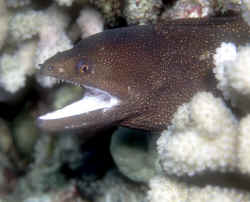
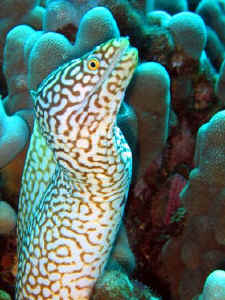
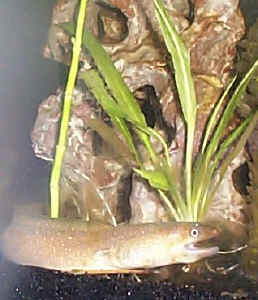
The most common Moray in Hawaiian waters, Gymnothorax meleagris.

Banded moray = yellow head moray? – 09/17/08
Hello all!
<Hi Chris.>
I’m a bit confused here. I have seen several sites saying that the banded moray and the yellow head moray are the same eel, and wanted to confirm that this is true.
<Ah, a common common names problem. What you notice is that a species can have several common names (see fishbase.org), and sometimes two species can have the same common name. Common names are also often different in different countries (e.g. Australia and USA). Therefore it is best to apply the scientific names to make clear which species you are referring to. Each species has just one valid scientific name consisting of two words, the genus and the species (e.g. Gymnothorax rueppelliae). When scientific names are changed due to new research results the old names are called synonyms.>
I also have seen that some sites show what looks to be more like a fimbriated moray as a yellow head moray.
<There are three species referred to as yellow head moray: G. fimbriatus (aka Fimbriated moray), G. rueppelliae (aka Rueppell’s moray) and G. undulatus (aka Undulated moray, Greenheaded moray). There are more than three species referred to as banded moray, e.g. E. polyzona (aka Barred moray, Girdled moray), Gymnothorax rueppelliae (aka Yellowhead moray), Gymnothorax enigmaticus (aka Tiger moray).>
All this has made me very confused because from what I understand these eels grow to be very different sizes.
<Of course, these are many different species with many different sizes.>
I also wanted to know about the banded moray photo Bob has on his eel information page.
Do all banded morays get that blue color, and will one be able to live in a 75 gallon aquarium with an undulated triggerfish.
<The one on http://www.wetwebmedia.com/morays.htm ? E. polyzona does get a greyish/brownish tinge with age and the stripes will fade away, but that will happen very slow in about 5-10 years when you start with a juvenile. A 75 gallon tank should be sufficient, if it is well filtered (!). An Undulated trigger is likely not a good tank mate, will bite the eel’s tail and fin (depends a little on the individual and its origin, though). See http://www.wetwebmedia.com/marine/fishes/triggers/balistapus/index.htm and the linked FAQs. With a potential adult size of one foot it’s also better suited for a larger tank.>
I hope my questions weren’t too confusing, thanks.
<Not at all. I hope this answer is clear enough.>
Chris
<Cheers, Marco.>

Re: banded moray = yellow head moray? II – 09/18/08
Thank you for your quick response.
<Welcome.>
From the information you have given me the moray I am interested in, and from Bobs web page, is Rueppell's moray. I have never seen this in any of my LFS, but would it be suitable in a 75 gallon aquarium?
<No. It is actually traded from time to time (sometimes erroneously labeled as E. polyzona) and likely can be ordered with some patience, but reaching 80 cm (32”) I believe they are too big for a 75 g. Scott Michael lists 75 g as the minimum for this species, but having seen adult specimens in aquariums I’d say at least 90 very well filtered gallons without any other fish and preferably even a larger tank. It also has to be noted that this species can be particularly aggressive towards its keeper. Cheers, Marco.>

Looking for an Eel Expert, ID, sel.    8/1/08
Hi Crew,
<Hello Kirk.>
I am a very confused on the difference between Muraena lentiginosa and pavonina.
<They are frequently confused in the hobby and even scientific literature.>
Fishbase and Live Aquaria lists lentiginosa as only getting to 2 feet long, a manageable size.
<That information is correct.>
Other sources list it as a fish eating monster topping out at 60 inches.
<Fish eating: Yes; monster: No; size: max. 2 ft.>
I would like to add an eel to my 8x2x2 (roughly 280 total gallons) "Aggressive tank", I of course don't want to lose any fish.
<A zebra eel would be the best choice.>
I had been considering the Brazilian Dragon (M. pavonina I think?), its tough to find much information on this guy as well, or the Goldentail Moray (Gymnothorax miliaris). Which one of the three (if any) of these would you recommend with fish?
<I do keep/have kept all three of the listed species and would only recommend the Goldentail moray for your project. The Brazilian Dragon (Muraena pavonina) gets significantly larger (about 70 cm, 28”) than indicated by fishbase (51,2 cm, 20”) and is the most aggressive moray species I have ever kept (I do have 2 of them at the moment). In my opinion they are best kept alone in single specimen tanks. M. lentiginosa is not that aggressive, but still more than the G. miliaris. Remember, even the G. miliaris is a predator that can eat any fish to about 1/4-1/3 of its own length. So your other fish should be larger.>
Tank mates would be Coral Beauty (big one) and Black Velvet Angel, Red Tooth and Sargassum Trigger, Harlequin Tusk and Sunset Wrasse as well as my most recent and final (other than an eel) addition a young Sohal Tang. I have kept a Snowflake and Zebra Eel for many years in another tank, just looking for something different to keep.
<The fish-eating morays are a definitely different experience, but a Zebra eel is certainly the most safe moray choice for fishy tank mates.>
Thanks for any help, Kirk .
<Welcome! Cheers, Marco.>

Dragon Moray ID – 07/26/08
Hello there,
<Hi Pat.>
I've done quite an extensive search, both on and off your site, and can't seem to find the information I am looking for.
I am currently looking at a specimen labeled Japanese Dragon Moray...it is certainly E. pardalis; my question is in regards to geographic, gender and size related influences on coloration. The myth seems to be that Japanese examples are better colored than their Hawaiian counterparts, males are more colorful than females, and that there is some variation in color throughout the life cycle of these animals. What I cannot find is any concrete information, only scattered sources of hear say.
<The myth is posted on WWM: “Sometimes the Japanese specimens have more white and red, larger spots and more contrasting colors, but such specimens may also occur in other areas, like Johnston island (see fishbase) or Kona. The Hawaiian ones regularly have more orange and less contrast, but I have seen absolutely comparable ones from Taiwan and Southern Japan. Have a look at fishbase or flickr for dragon morays/Enchelycore pardalis. The people publishing there have often noted where the eels were photographed, and in contrast to the fish trader had no reason to lie. There is no scientifically proven way to differentiate a Japanese E. pardalis from a Hawaiian E. pardalis. The same can be said about the gender of these eels, any definite proof for differentiation is lacking.”>
The animal I am looking at has a mostly rust red body with typical white spots, a nice orange/red/white head and chin and is roughly 20" or so in length.
Is there anyone there with specific expertise?
<Sorry, no reliable study has ever been done on this topic. So far you’ll only get hear say.>
Thanks in advance, Pat.
<Cheers, Marco.>

Need help with ID - Dragon Moray eel – 06/16/08
About to purchase a Dragon Moray and for all my research I just can't decide if he is a Japanese or a Hawaiian version.
<This is all the same species Enchelycore pardalis, which occurs in the entire area from the Comoros and Reunion to Hawaii including Taiwan, Korea, Japan and New Caledonia. There is some variability in the coloration, but color morphs are not restricted to specific areas (imagine how far the pelagic larvae are spread during their months of travel before becoming quite stationary eels). Sometimes the Japanese specimens have more white and red, larger spots and more contrasting colors, but such specimens may also occur in other areas, like Johnston island (see FishBase) or Kona. The Hawaiian ones regularly may have more orange and less contrast (just like your possible future eel), but I have seen absolutely comparable ones from Taiwan and Southern Japan. Have a look at FishBase or flickr for dragon morays/Enchelycore ramosa. The people publishing there have often noted where the eels were photographed, and in contrast to the fish trader had no reason to lie. There is no scientifically proven way to differentiate a Japanese E. pardalis from a Hawaiian E. pardalis. The same can be said about the gender of these eels, although claims exist about differences in colour and morphology, the definite proof for sexing them is lacking.>
As this is quiet an expensive purchase I want to make sure I get what I'm paying for. I have received excellent guidance from your team in the past so I hope you can help. Attached is some body and face pics.
<Beautiful!>
Thanks, Joe.
<Probably not the answer you’d want to have, but as exact as possible based on the latest literature and documented experience with this species. Cheers, Marco.>

Re: Need help with ID - Dragon Moray eel
Need help with ID - Dragon Moray eel II – 06/17/08
Marco,
<Hello Joe.>
That answer is EXCELLENT as always.
<Glad you like it.>
There is all this misinformation on the web and it's hard to tell fact from fiction. So your saying all the same just differences in colors and spots just like differences in peoples genetic make up.
<Yes.>
Lastly are these morays overly sensitive and short lived or are they just as hardy as the more common eels...AKA Snowflakes, Goldentails, Zebras, etc?
<Can be just as hardy and long lived as other eels and are often in their teens. But similar to other eels the use of cyanide to collect them, or copper and/or organic dyes to treat them preventively for parasites can drastically shorten the life expectancy of these animals. Dragon eels are often abused as status symbols and might end in inadequate systems, but I believe the percentage of dragon eels dying is not much larger than the percentage of dead snowflake eels. However, you might hear it more often, because they are so expensive and their loss upsets people possibly a little bit more.>
Thanks again, Joe
<I do wish you good luck with your eel in case you should decide to buy it. Cheers, Marco.>

Eel Identification – maybe a new one? 03/12/08
I was wondering if you can help ID this Eel?
<I can try.>
I know that it is in the moray family, but that is about it.
<…the high dorsal fin rules out a number of genera. This is most likely an Echidna, Gymnothorax or Muraena species.>
Currently the eel is about 2 feet and 2 inches long.
<More information available? Where is it from/was it seen? Is it an aquarium specimen?>
I've attached a picture.
<Thanks for sending the pictures, I fear they are little bit too blurry to see important details like if the teeth are long and pointed or how the body coloration is composed exactly, and if it changes towards the tail.>
Thanks Michelle
<There is a number of white speckled, dark eels coming into my mind, but even after looking through several books like Michael’s, and a few by Randall, as well as papers like the type catalogue of all Indo-Pacific morays none shows perfect fit with what I can see on the pictures.
Muraena clepsydra could look similar. It has little horns and always a white spot at the lower jaw in the corner of the mouth, as well as a large black spot at the gill opening. The description of Gymnothorax philippinus sounds also similar, but there is no picture material available for a comparison. With new moray species described every year and some appearing in trade before being described (e.g. Gymnothorax castelei) it is also possible this is a new one. It’d be good to have better pictures indeed. If I stumble over a better ID of this guy, I’ll get in touch with you again, in the meantime enjoy your without a doubt rare moray. Cheers, Marco.>


Viper moray care, ID  – 01/07/2008
Hey guys, Sam again.
<Hi Sam.>
My LFS just got in a young viper moray
<Nice.>
and I’m positive on what it is, but I can’t find any FAQs about its care. I’m pretty sure they don’t get too big.
<How did you come to that conclusion?>
Anyways, I was wondering about its care and if I could keep it with my G. tile.
<Unlikely. Basically all morays referred to as Viper moray (maybe one smaller exception see below) will try to eat your G. tile as adults.>
If not that’s fine I’m willing to set up a larger species tank. Any info would be extremely helpful.
<First you should try to find out what species it is. Several morays are called Viper moray in trade. Enchelycore nigricans is known under this name, can get to almost 3 feet, care is similar to the Dragon moray (see WWM re). Enchelynassa canina has also entered the trade as Viper moray. It reaches almost 5 ft and consequently needs something like 180 gallons for itself as an adult. Other Enchelycore spp. have been called Viper moray, too, they all have elongated tubes as anterior nostrils, while the Enchelynassa has 2 flaps at each nostril. Enchelycore carychoa is the only one I know that has been traded that’s smaller than 2 ft, it can be recognized by white spots around the pores at its upper an lower jaw, but it’s usually called Chestnut moray. If you can mail a picture of the head and maybe the body we could help you to ID this eel.>
Thanks for your time, Fischer.
<You are welcome. Marco.>

Viper Moray - follow up... ID  – 01/09/2008
I couldn’t get a picture of the eel from the pet store (cameras messed up) but I did find a pic of what it is and I’m pretty sure he’s a Chestnut.
<The picture (think it is copyrighted and don’t believe we can post it in the dailies) shows a Chestnut E. carychoa. It can be distinguished from other “Viper morays” by the white spots around the pores on the upper and lower jaw. No white patches, but nice spots limited to the pores just like in the picture you sent.>
Right now its about 12" and idk <what does that abbreviate? I do know or I don’ know?> how much bigger he'll get.
<Not much. Will stop below 15” if it is a Chestnut moray.>
Anyways thanks for your help and any info about the chestnut would be great.
<The most adequate of the Enchelycore species for home aquariums in my opinion. Care is similar to other moray eels. However, it will eat fishes and crustaceans small enough to swallow. This species can even be kept with other (not too large or too small eels). In case you want it, let the staff show you that it eats prior to buying it.>
Thanks again, Sam
<Welcome. Marco.>

Moray eel ID – 01/06/2008
Hello WWM crew.
<Hi Sam.>
I've had a moray for about a year or so now and I’m still not positive on the species. His body shape is pretty close to that of Gymnothorax nebulosa
<Personally I think the shape of the head is really different.>
but his coloration is a lot different. His (or her) body is a chocolate brown with golden flecks (or spots) and he is a lot more active and aggressive than a snowflake I had before.
<Gymnothorax tile. Often sold as a freshwater fish, very good your specimen is in a marine tank.>
I would like to know what species he is and what size tank he needs, he is currently in my 55 gallon soon to be moved to 100.
<Have a look here: http://www.wetwebmedia.com/ca/volume_4/V4I2/Freshwater_eels/freshwater_eels.htm. The ones shown in the article are older and have less golden spots than your moray.>
Also what other morays could I keep him with
<Same species works very well in my experience if introduced to the tank together. Gymnothorax polyuranodon works well, too. I would not try much more heavy species like G. eurostus, species with big heads like G. saxicola or meanies like the various dragon morays, even if some attain a similar size.>
and if any and what advice would you give me for future care.
<Varied diet, sometimes with vitamins, good water quality, fitting lid, no dangerous predators and you’ll probably have this eel for more than 10 years.>
I know your very busy but it would help if you could answer some of my questions. Thank you for your time,
Sam Fischer.
<No problem. Please write back if the link above leaves any questions unanswered. Cheers, Marco.>

Unknown eel – Peppered moray – Gymnothorax pictus – 11/15/2007
Hi there, WetWebMedia Crew!
<Hello, Marco here with you today.>
I have attached a picture of a eel that I bought a few days ago at my local aquarium shop. After asking the people who own the shop what kind of eel he was I was shocked to be told "they had no idea what it was"
<…assorted moray eel…>
but since it was the same price as the snowflake eels which he was housed with I decided to get him anyways. I've looked far and wide on the web for a picture which resembles this eel, and I cannot find anything!
<No surprise. There is definitely a lack of moray eel information on the net/trade/literature in my opinion.>
I was hoping you guys could help me out? So I guess my question is, by looking at the picture can a conclusion be made as to the species / name of this eel?
<A pleasure to do so. Is a juvenile Gymnothorax pictus (formerly known as Siderea picta) aka Peppered Moray aka Puhi kapa’a. Have a look at the eyes. See the 4 black spots at the border of the eye surrounding the pupil? That’s a typical characteristic of this species that may occur in several colour morphs, some of them quite famous in Hawaii for being almost entirely black and living in tidal pools consisting of black lava rock.>
The eel is approximately 11-12 inches right now.
<Hehe, can attain 4.5 feet (1.4 m), but usually stops at around 3-4 feet. I hope you have a large tank. Is a peaceful (for a moray!) crustacean eater, but may hunt fishes, too. Needs a lid, since it is also famous for leaving the water to follow intertidal crabs. The juvenile coloration will change to a white background with black dots, however, those beautiful circles will blend in and vanish with time. See an adult e.g. at http://www.wetwebmedia.com/moraysii.htm.>
Thanks so much for your time.
<You are welcome. Have fun with your eel. It’s gorgeous. Marco.>

Eel Id: Snowflake/Echidna nebulosa – 10/11/07
Hi,
<Hi Steve>
I want to buy this tank and the owners said that they have a snowflake eel. But the pics on the web are not what they have. Can you tell by this pic what it is, or tell me who to ask?
<Well, it’s not the clearest of photos, but it does look like a Snowflake eel to me. One thing to keep in mind regarding these guys is that the splotching/banding, etc, on the body does vary. Please see the photos at this link for comparison: http://www.wetwebmedia.com/snowflakemoray.htm.
Also, for future queries, please make sure they are not written in ALL CAPS. I went ahead and took care of it this time, but usually these are returned for correction. Thank you for understanding.>
Thanks,
Steve
<You’re most welcome. –Lynn>

Ultimate Live Rock Stowaway.. Eel Be Comin' Out the LR When he Comes, When He Comes  9/1/07
Hi Crew,
<Hi Barbara, Mich with you today.>
I have e-mailed you a few times regarding a 72-gallon saltwater tank I am setting up. I put water in it, and on Monday I put 100 lbs of live sand and 75 lbs of live rock in it. Today (Thursday) my husband and I found some sort of eel living in one of the rock's caves! I was expecting maybe a snail or 2, some cool algae, maybe a coral if I was lucky!!
<One heck of a hitchhiker!>
I searched all of your marine eel pictures and I can't figure out exactly what he is, the only one that looked close was the Zebra Moray. He is brown with wide white bands (hopefully you can see the enclosed picture!). I just want to be sure of what he is so I know if I have to try to get him out and return him to LFS or if he can be comfortable in my 72.
<This may be a Banded Snake Eel (Myrichthys colubrinus) He is a challenge to keep and you may want to consider finding him a new home. More here:
http://www.wetwebmedia.com/ophichthidae.htm
http://fishbase.sinica.edu.tw/Summary/speciesSummary.php?ID=8053&genusname=Myrichthys&speciesname=colubrinus
http://fishbase.sinica.edu.tw/Photos/ThumbnailsSummary.php?ID=8053
If this is a correct ID, the material I am referencing suggests a tank size of no smaller that 180 gallons, and generally this eel is not well suited for the home aquarium. Reportedly this eel is a challenge to feed and a very finicky eater. You might offer glass shrimp if available or try fresh shrimp, scallops or marine fish flesh impaled on a feeding stick. This eel should be fed until it appears to be full, twice weekly. Careful consideration should be given to tanks mates as well as many fish will nip at the eel.>
He was out of the water for close to 2 hours with the drive home and me getting the sand in, then the rock, I have no idea how he did it!
<Is tenacious.>
I will offer defrosted meaty foods, hopefully he will eat. He is curious about us when we come to the tank!
<A good sign.>
Thanks so much for your help!
<Welcome! Mich>
Barbara

Re: Ultimate Live rock Stowaway... Marco chimes in re Eel ID! – 09/01/07
Hi Crew, I have e-mailed you a few times regarding a 72 gallon saltwater tank I am setting up. I put water in it, and on Monday I put 100 lbs of live sand and 75 lbs of live rock in it. Today (Thursday) my husband and I found some sort of eel living in one of the rock's caves! I was expecting maybe a snail or 2, some cool algae, maybe a coral if I was lucky!! I searched all of your marine eel pictures and I can't figure out exactly what he is, the only one that looked close was the Zebra Moray. He is brown with wide white bands (hopefully you can see the enclosed picture!). I just want to be sure of what he is so I know if I have to try to get him out and return him to LFS or if he can be comfortable in my 72. He was out of the water for close to 2 hours with the drive home and me getting the sand in, then the rock, I have no idea how he did it! I will offer defrosted meaty foods, hopefully he will eat. He is curious about us when we come to the tank! Thanks so much for your help! Barbara
<Just a second (or third) opinion: Looks like a Echidna polyzona to me (bands and yellowish nostrils in combination with the blunt head), but there are several other banded eels and morays eels (e.g. Gymnothorax enigmaticus and many more). If E. polyzona is the species, care and character are similar to E. nebulosa (snowflake), it just stays a little smaller. In my opinion you could keep it in that tank (bigger tank would be better of course...), but it would eat smaller fishes and crustaceans while growing. They can survive quite long outside of the water and some of its relatives are known to leave the water in nature to hunt for crabs between rocks outside of tidal pools. Send a better picture and we’ll get you a better ID. What a give-away, I usually have to pay for eels... am just coming back from such a shopping trip. Cheers, Marco.>

Re: Ultimate Live Rock Stowaway.. Eel Be Comin' Out the LR When he Comes, When He Comes... Mitch? Miller? And a one and a two... – 09/01/07
Hi Mitch,
<Hi Barbara, Mich with you again.>
Thanks so much for your help.
<Welcome!>
Can the Banded Snake Eel be brown w/ white stripes?
<That was my understanding, but rechecking fishbase they are describing as black and white though I though it looked brown in some of the images and looked brown in another book I referenced which had an up-close image. I could very well be wrong. I am far from an eel expert. You've gotten three different opinions. I suspect Marco's vote may be the most likely winner. Do use the scientific names to do a Google image search. You will likely be able to tell which of these three are closest to what your little stowaway looks like.
That's what color this one is (I know it was hard to tell in the
picture!).
<Yes, and not just in your picture either!>
I offered defrosted squid last night and he voraciously accepted it!
<That is wonderful! I'm very glad to hear.>
That seems to be a good sign.
<Indeed it tis!>
He is more than welcome in the tank but if 180 gallons is suggested it is cruel to keep him in my 72. He has only come out of the rock 1/2 way, any suggestions on removing him from the tank?
<I think it is more important to determine who this stowaway is before you consider removal, as Marco's vote would be suitable for your tank.>
I will continue to offer meaty foods every other day or so.
<I wish you much success! Mich>
Barbara

Re: Ultimate Live rock Stowaway  9/3/07
Hi Marco,
<Hello Barbara.>
I appreciate all the expert opinions I can get!
<No problem, but I’m more a fan than an expert. Reading your e-mail reminded me to a case we had in a near life fish store, so I had to add Echidna polyzona as a possible banded candidate.>
I apologize for the blurry picture, he is voraciously accepting defrosted squid and clam so far.
<That's good news. Be careful not to overfeed, if it’s a moray. Many appear to be hungry most of the time.>
My husband and I will try to get a better quality picture while I am feeding him and send it along as soon as I can.
<Looking forward to it. See if you can get a good shot of the head, since most banded morays can be differentiated by characters of the head. A snake eel will also be easily identified that way.>
I'm getting attached to him now, so I'd love to keep him, but only as long as he can be comfortable and happy with us!
<As soon as we know what it is, I’m confident we’ll know how to care for it.>
Barbara
<Good luck with the camera. Marco.>

Re: Ultimate Live rock Stowaway 9/5/07
Hi Mich, Marco, Bob, crew!
<Barbara>
After surfing the web and your site, I do believe my hitchhiker is an Echidna polyzona, but I am still trying for an additional photo of him for confirmation or other ideas! I have been feeding him every other to every 3 days and he has happily accepted everything I have offered (including an attempted sampling of the turkey baster I have been using to feed him!).
I can't find a lot of information regarding his species, but I remember Marco said it was similar in temperament to the snowflake moray, so I have been researching them as well!
<Is very similar in care>
Obviously he was not in my original stocking plans for my 72 gallon! I was planning on a Yellow Tang, a Coral Beauty (about 3-4" currently), a strawberry Dottyback, an algae blenny and an orange tailed damsel. If I have room I'd love either a Falco hawkfish or a Twinspot hogfish. I was thinking I may still be able to add the Falco but I'm doubting I'll have space for the Hogfish. I won't have any inverts in this tank (I was already planning on a FOWLR system for this tank, inverts will be in my 30 gallon!). Does this still sound ok?
<So far... yes>
Thank you for all of your help!
Barbara
<Welcome. BobF>

Looks like Echidna nebulosa to RMF

Re: Ultimate Live rock Stowaway, follow up – 09/26/07
Hello Crew,
<Hi Barbara>
After much delay (I can't believe it's been nearly a month already)
<Me neither>
I have been able to take a nicer shot of my hitchhiker. The LFS where I got him told me he was a Zebra moray, but looking at pictures of Zebra versus Barred he looks like a juvenile barred to my inexperienced eye, hopefully you will be able to confirm either way from this shot.
<He (more likely a she) is definitely no Zebra moray, his dorsal fin is well visible (vs. hard to spot at Zebra morays), and the coloration of the snout is so unlike zebra morays. In addition, Zebra morays have tiny, white nostrils and no larger, yellowish ones, and so on… It is either a Gymnothorax enigmaticus (forget searching for pictures on the net, there are only a few true ones), or - what is much more likely - a Barred moray Echidna polyzona, as you suggested. Its blunt snout speaks for the latter one.>
He has really made me a fan of eels!
<Welcome to the club!>
He is doing very well, getting along nicely with his tank mates and accepting all foods I have offered; krill, squid, mussel, clam, shrimp, scallops, oyster.
<Sounds good.>
Currently I am feeding every other day to every three days depending.
<Great.>
He seems to feel like he should be fed several times a day though!
<Typically moray.>
Thank you for your help! Barbara.
<Anytime. Cheers, Marco.>

Looks more and more like Marco's ID was right. RMF.

Identify eel? – 07/01/07
Hello,
I was snorkeling in Hanauma Bay on Oahu (shallow region atop reef) and saw the attached eel (I think). While the pictures aren't great (sorry), it was a few feet (~3') long and had what seemed like a yellow head. I found information on yellow-headed moray eels, but they didn't seem to have the spotted/speckled pattern evident on their body from the pictures.
Thanks for any information.
Sincerely,
Becky
<I see these features... this is almost assuredly a Gymnothorax undulatus... a big puhi! See fishbase.org, WWM, the Net...Bob Fenner>

Moray eel ID – 03/30/07
One more question. Took the picture last week while scuba diving off of Roatan, Honduras. This eel was about 2ft in length.  I also saw three of these eels together, two of which were about 2ft and one was about a foot. They kinda remind me of Snowflake Eels in size, but as you can see are more beige than white.  Any idea what the species is?
<I’ll give it a try and suggest G. saxicola, a species reaching two ft, sometimes seen in trade. It is rare in the reefs and rather occurs on sandy bottoms; it predominately inhabits the Northern gulf, though. G. conspersus has the same black/white dorsal, but also a dark tail (not visible on the picture, you may remember their tail colour). G. ocellatus is similar, but has well demarcated white spots everywhere. G. moringa lacks the black/white dorsal. You may also try fishbase, they should have an ID key for the moray eels of the Western Atlantic. Maybe someone else in the crew has something to add. Great picture. Cheers, Marco.>

A beauty!

Eel  ID, probably no moray eel  2/28/07
Are there any moray species that stand on their tails and have their throats inflated? I have heard of tulip eels doing this which are supposed to be very aggressive. I do not have any good pictures of my fish to help determine if he is a moray or not, but the LFS sold him as a moray.
<Moray eels rather hide instead of standing on their tails. They inflate their throats while breathing. To get an idea of the ID a good picture is necessary. Without a picture you should try looking at http://www.wetwebmedia.com/congridae.htm and http://www.wetwebmedia.com/ophichthidae.htm and http://www.wetwebmedia.com/morays.htm for marine eels. Have a look at http://www.wetwebmedia.com/FWSubWebIndex/anguillids.htm and http://www.wetwebmedia.com/FWSubWebIndex/matacembelids.htm for freshwater eels. Check the related FAQs, too. Also check FishBase by entering the family names you found on WetWebMedia and selecting ‘all fishes’ to get a link to photos. For the swamp eel check Monopterus alba. It has a very typical head much unlike a real moray.>
I do not know growth rates of the swamp eel but my fish has not grown but little in length but he has gained some girth and he has eaten quite a bit for a year now. He also no longer has a pointed tail it is rounding out with possible fins can not see close enough.
Am I in a bad situation if mine is a swamp eel with my Gymnothorax tile?
<I would not recommend keeping any of them with other fishes maybe except their own species. May work for years, but even the scat is potential prey. Read the freshwater moray articles on WWM.>
So far they are both sharing the tree root ornament to hide in peacefully. I have my toad fish and red scat and the G. tile has no problems with them either and even lies on top the toad fish when out. I have seen people with swamp eels on monsterfishkeepers.com, but they are in fresh water. I have a brackish setup. The main question I have if this is a swamp eel should I be looking into finding him a new home at some point?
<Yes. Swamp eels need fresh water to lower end brackish water, the moray eel needs high end brackish or full strength marine water, both are incompatible.>
Thanks for your advice on this.
<You are welcome. Cheers, Marco.>

Re: moray feeding and behaviour     2/12/07
On www.monsterfishkeepers.com there is a person whose avatar looked like my eel. He said it was a tulip eel scientific name Monopterus albus. Do my picture suggest this maybe true and my eel is not a moray of some type?
<Mmm... possibly... your images were not clear or well-resolved enough to identify>
What does xanthistic refer to? I was just curious as I did not see this under the various species list.
<A type of/genetic condition that is characterized by a lack of skin pigmentation... but not albinism... which includes the eyes...>
I would like to know if an oyster toad fish is venomous or not and how big they can get in captivity?
<Is and you can find this information on fishbase.org>
This is a rather cool fish and the only one I know of having the distinction of being the only fish to travel in outer space.
<Mmm, not so... a few species have been used for various types of "zero gravity" research over the years>
Thank you very much,
Richard
<Bob Fenner>

G. favagineus???? - 02/07/2007
Bought a leopard eel, but doesn't really look like pictures on web he is about 18" long slender round light brown body with brownish/purplish spots all over, and spots get bigger as they move towards his tail  his front jaw hangs over bottom (overbite) the only flat part of his body is around his tail, always lays with head out of sand, need help to find info on him,
<Search WWM re: Gymnothorax favagineus, see if this is your animal (I hope not...).>
thanks a lot.
<Anytime, AdamJ.>

Leopard Eel II ...We can only work with what you give us - 02/09/2007
Not nearly as many spots, the spots are a lot bigger and more spread out.
<Okay, it's possible that your animal is in juvenile coloration, 18" is a juvenile. ....have you seen an adult G. favagineus? At any rate unless you get me a photo I'm not going to be able to help you any further. Sorry. Adam J.>

Moray Eel ID  7/31/06
I was in a Live Fish Store and saw an eel called a panther eel and they said otherwise it was an unidentified species. It was in brackish water at a setting of 1.008 and it sure looked like a moray. There was a picture on this site
http://animal-world.com/encyclo/marine/eels/eels.php that has the exact colors that this specimen had. The price of this eel was $100 and it was about 8" long but from the information I have obtained I am assuming that it will eventually need to be in a full marine setting. Am I correct?
<Yes.>
The picture I saw on your site of the Muraena lentignosa otherwise jewel moray has the same type markings. Are there color
variations within this species? What I saw had white spots encircled by black rings on a dark brown body. Are there other species other than a jewel moray that have these type markings?
<The color variations on this species can range from black, gold, brown, and white.  The appearance of the markings will change slightly with age also.  This eel is one of the smaller species of morays, attaining a length of 24".>
Thank you very much.
<You're welcome.  James (Salty Dog)>

Ghost Ribbon Moray? Pseudechidna, Rhinomuraena?  7/4/06
Hi,
<Hello there>
            I am looking for a little information/advice I bought what I am about 90% sure is a ghost ribbon moray thanks to your wonderful site.
The local fish store has had him for about a month and I thought he was really cute. He is quite reclusive and really doesn't venture out a
whole lot, hopefully that will change.
<Can... with a good deal of time going by, calm surroundings>
He is about 1' 6" to 2' and seems really healthy. I told the guy at the fish store I was interested and he was telling me that they are very hard to keep and almost never eat in
captivity.
<This is so>
He almost talked me out of buying him, I told the guy at the fish store that if he would eat in front of me I would buy him. The eel
ate two ghost shrimp. Now what I need is any and all the information you are willing to give on this beautiful creature.
<What little I know is posted on WWM... do  have an article coming out in TFH on Rhinomuraena... that pretty much rehashes the same. See fishbase: http://fishbase.sinica.edu.tw/Summary/speciesSummary.php?ID=10216&genusname=Pseudechidna&speciesname=brummeri
Is this your species?>
As of right now he is in only a twelve gallon nano <Much too small... take care that this fish doesn't "exit straight up">
for one more week when he will go into me 100 gallon show tank. Please any and all advice and information is welcome, I can find next to no information on these guys. Also is it possible to keep more than one in a 100 gallon long tank? Thanks again for the help.
<Mmm, no... not a social species. One to a system unless it is huge. Bob Fenner>

Moray Species? Yes...   7/2/06
Hi Crew!
   <Arthur>
  I bought a moray 3 weeks ago and I am guessing that I purchased a Stout Moray I would just like to have a second opinion on the specie
<Species... the other is "money">
my eel belongs to. If ever it's a Stout Moray, do you have any tips on feeding/keeping my eel or all of those I find in your feeding FAQs can be useful? Lastly, can you give me any articles I can read about Stout Morays, their characteristics/behaviours?
     Thanks,   
  Arthur
  - Hope this time the pictures will be of help! :D
<Mmm, of the three species commonly labeled as such by Fishbase.org, I'm guessing you mean Gymnothorax eurostus? http://fishbase.sinica.edu.tw/Summary/SpeciesSummary.php?id=6662
Can't quite make out identifiable characteristics from your "above" pix other than to state that this does look like a Moray of some sort... Likely piscivorous... Have you read through our materials on this family: http://www.wetwebmedia.com/morays.htm
and the linked files above. Bob Fenner>

Re: Moray Specie?   7/3/06
Thanks Bob!   
  I'll just visit the sites you suggested and hopefully get something out of it.
     Arthur
<Real good. Please do send along "side" pix of your Moray, progress reports re your experiences. Bob Fenner>

Re: Moray ID, beh.    7/13/06
Hi Bob!
   <Art>
  As requested, I tried my best on getting the best SIDE shot you asked for. Though the lighting might not help since the bulb I have in my tank is color blue. To help you distinguish it further the moray I have has a brown skin from snout to tail and fades to white around its belly with yellowish spots. In image IMG_0591 you may notice an elongated nostril (which may suggest the moray I have is in the Gymnothorax eurostus species). If you really cant distinguish it I might rule out that it is a stout moray;)
   <Is there a gold/ish rim about the eye? The head here reminds me of Gymnothorax miliaris: http://www.wetwebmedia.com/morays.htm>
  Anyway, I would also like to ask if its normal to morays to be shy?
<Oh, yes... most species are extremely so, particularly "when new">
Since mine is hiding under and behind its rocks all day long. The only time I see it out is during night time and in under poor light condition since I don't want to startle it. Lastly, what is the indication when a moray does not gape/open its mouth from time to time?
<That there is sufficient oxygen... little stress...>
Because one thing I know about Moray is that they open their mouth to breath. I catch mine usually like its in suspended animation. The only consolation I get from my moray is that it is able to hunt from time to time.   
  Thanks again.   
  Arthur
<Appears healthy from your photo, description. See fishbase.org re this species as well. Bob Fenner>

What kind of eel? Grammar?   6/16/06
WM CREW,
            A friend is a Miami party boat skipper. He knows I keep big morays. He caught an eel,4-5 ft long, greenish, with big pectoral fins and a tall dorsal to the tail. He said he had never seen one like it after years of running a party boat off Miami for years. He tried to save it for me but it was dying in the bucket so he released it. Bummer!. What do you think? Thanks.      Rip
<... Rip, you need to hit the space key twixt your sentences. This is/was likely a Gymnothorax funebris. Please see here: http://www.wetwebmedia.com/moraysii.htm
Bob Fenner>

Eel i.d.   1/10/06
Dear Robert Fenner,
<Abner>
                 Greetings!!!!!!!!!!!!!!!
                 I am Abner Bucol, an amateur Research Biologist, I am interested to work on eel taxonomy and ecology.
<Neat!>
I have collected and sent eels as well as other fishes to the United States National Museum for Natural History in Washington U.S.A. last October. However, I haven't received the I.D. of the eels and I have a new collection of eels and morays not included in the first batch of specimens. I want to ask if you can help
me identify some of them. I want to give some of the preserved specimens if you like. I can collect anytime just in case you want to have some.
<Mmm, am an amateur "pet-fish ichthyologist" myself... not a systematist of this or any other fish group>
               If you can send me some photographs of your identified eels and morays, you can send them via this email address. I really need your help Sir.......
<Most all my identified anquilliform pix are posted on WetWebMedia... If you are compiling, writing re the whole Order, I might be willing to send you a copy of all scans...>
              Thanks a lot. I hope you will respond to my letter..........
   Truly yours,
   Abner Bucol
<I would seek out ichthyologists who work on this group of fishes... and ask for their cooperation. Am BCC'g Dr. Jack Randall here in the hopes he can/will in turn refer you to such. Good hunting. Bob Fenner>

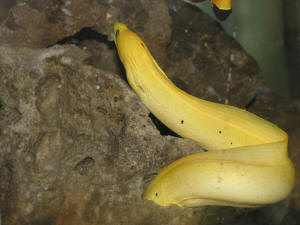
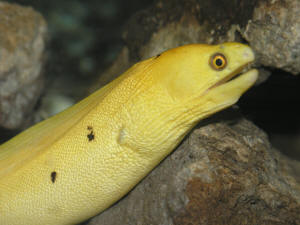
Yellow Eel ID
I've recently purchased an eel that was sold to the previous owner as a dwarf golden moray eel. There has been some debate as to the actual species of animal so I was hoping that I could get an ID here. I've attached a couple of pictures of him.
Thanks in advance,
Phyllis
<Nice pix of a gorgeous specimen. This is likely a xanthic Gymnothorax miliaris (Please see here: http://www.wetwebmedia.com/morays.htm), though there are a few other "golden moray" species that occur in the wild and trade from time to time. Bob Fenner>

Distinguishing Morays
Hey again. One more quick question- my new quandary is how do I tell if the specimen I am looking at is Gymnothorax miliaris (the mostly yellow morph) or Gymnothorax melatremus? I can't seem to find a clarification or a description of the later on WWM.
Thanks.
Reuben
<Give a look/see on fishbase.org re these two muraenids... easily told apart with pix of both in front of you. Bob Fenner>

Juvenile eel ID
Hi,
I work as a dive instructor in Little Cayman, Cayman Islands. I recently found a small (1 inch max) black eel with yellow dashes down its body and a yellow T - shaped marking on its head. Any idea what it might be?  Thanks. 
<Wow, that's small... might be a blenny actually... or if a true eel a Gymnothorax saxicola, Echidna catenata... You might go to Paul Humann, Ned Deloach's works on marine life of the area (see Amazon.com re), or fishbase.org under a search for Muraenids, Blennies of the region... see the search by locality, sort by family... Bob Fenner> 

Oops!
Bob,
<Jim ("I'm just a doctor!" Sorry re)>
Just a quick observation from your eels page: the photo of the Echidna catenata and the photo of the juvenile Gymnothorax favagineus are the same photo!  I figure one or the other has got to be incorrect (that, or the scientists have done that junior synonym thing again).  I only noticed because my eel that I have had for several years matches the photo, and I was trying to figure out which one it is!  My guess is chainlink, as it is only about 11" and doesn't seem to be growing very quickly.
Jim Jensen
<Thank you for this correction... and likely you do have a Chainlink as you state. Bob Fenner>

What's in a name... of a species of moray eel
Is the Banana eel the same as the Golden Dwarf?  They are both listed as Gymnothorax melametrus.  What and how often should they eat?
Thanks.
<Mmm, you've misspelled the moray's name... it's G. melatremus... Please see fishbase.org re the species many common names: http://www.fishbase.org/Summary/SpeciesSummary.cfm?ID=7284&genusname=Gymnothorax&speciesname=melatremus
see "More Information", common names...? And read through www.WetWebMedia.com re this species husbandry. Bob Fenner>

Mysterious Mini Moray!
This is a few pictures of the smaller "Super Hitchhiker".  Hope you can tell what it is.  They are both the size of a BIC pen and have never changed size for at least the past 5 years.
Ken Fleming
<Well, I'm going to go out on a limb and suggest that it may be a Uropterygius species, possibly U. kamar or U. micropterus...Just guesses at this point. These are both small species, but the size that you are describing is consistent with the "Golden Dwarf Moray", Gymnothorax melatremus (although the color is off). These "mini-Morays" top off at around 18 cm, well within the size that you describe. Perhaps some research on fishbase.org will help narrow down the exact species. Good luck! Regards, Scott F.>
McGraw/Kokosing

Fish on the Rocks?
File IMG_0797.JPG is attached.  I checked the last e-mail and it was attached to it as well so I don't know what happened or if this one will make it as well. Ken Fleming
<To be quite honest with you, I had a hard time picking out the details of the fish.  It almost looks like the tail end of a Canthigaster valentini (puffer) in terms of coloring!  However, if it's a moray, my guess would be a Ophichthus cephalozona or a Leiuranus semicinctus.  From the picture it looks like I was looking at the tail end of a fish.  I'm just making my judgment based on the color and general shape. If you can get a more clear picture and send it, I'll give it another shot.  Regards, Scott F.>

"Super Hitchhikers" (Eels In Live Rock!)
Dear Crew:
<Scott F. at the keyboard tonight!>
We purchased an aquarium along with 70 or so pounds of live rock.  I believe it was Fiji rock.  The rocks contained two eels that no one was aware of.
<Wow! Talk about a couple of cool "hitchhikers!>
(The original owner of the tank eventually saw the eels at night after having the rock about six months.)  We have had the tank for about 5 years and had it for a year before the eels came out during a feeding. I have not been able to find out what type of eels they are and haven't been able to get a digital picture of them as they rarely come out of the rocks.  They are both pale blue-ish/mauve colored and both are about the size of a pencil
with one being slightly larger than the other.  Every once in a while they will come partially out when we feed the other fish krill shrimp. We have emptied the tank on several occasions to move it or clean it and by holding the rocks above the water for a while, they usually drop out.  They always stay in rocks on the bottom so it's fairly easy to know which rock they are
in.  I have never seen eels like this for sale anywhere and haven't seen anything on the inter-net to help me identify them.  The closest I've found was a picture of a Herre's Moray that grows to 12" but the coloring was wrong.  Neither eel has grown at all in the past five years but the color may have changed from mauve to more pale blue.  Although they never bother anything, they do get feisty when netted and appeared that they would bite
(although their heads are so small) if actually held.  
Any help in identifying the eels, or whatever they are, would be helpful. Ken Fleming
<Well, Ken- I'd really have to see a picture to know what type of eels these are. I'd really like to see some...It would be interesting to see these fishes! Sorry I cannot be of further help here. Do get back to us! Regards, Scott F>
McGraw/Kokosing

Muraena retifera/lentiginosa? 2/24/04
How does one tell the difference between these two Morays?  I've checked Fishbase, Googled their scientific & common names, and scoured the printed word only to find ... they live in different oceans.  That would be helpful if the store where I bought my eel could tell me where he was collected, and since they cannot I'm stumped.  I'd ask the fish, but he can't talk with his mouth full (which is pretty often) well, actually only every other day).  Fishbase gave some very vague topical descriptions about Muraena lentiginosa which really don't help me specify (heh-heh) much.  They had just about nothing on the retifera species (not knocking Fishbase - it's been extremely helpful many times).  Or am I just overlooking the dead-easy giveaway between the two?
<Not sure here.  Our own WWM lists only M. Retifera here: http://www.wetwebmedia.com/morays.htm  At the bottom of page two, there is a list of references which may be helpful if you can track them down.  From what I was able to find out, most of this genus is aquarium appropriate.  They are generally crustacean feeders (less aggressive than piscivores) and don't grow too large.>
Some marine wholesalers I know of list "dragon" morays from two different locales - Mexico and Brazil.  The Mexican "dragon" is, of course, the jeweled M. lentiginosa.  Would that lead me to believe the Brazilian "dragon" to be the M. retifera?
<Even a wholesalers word that an animal came from a particular locale is dicey.  Similar animals are usually kept nearby each other, and those from different sources are often chosen indiscriminately to fill orders.>
Any time or assistance you can give me will be greatly appreciated.  Sorry for all the useless details in my question.  Thanks for all the website advice, too! J  <Glad to help.  Sorry for just pointing you in a very general direction, but you put quite a good stumper out there!  One other suggestion is to perform the same searches using Gymnothorax as the genus in case some incorrect nomenclature is in use.  Adam>

Mystery eel
Okay, I've got one for you.  This creature was spotted in Maui's waters by a
visitor who can't remember which beach he was on.  Not that it matters, but
it's not in Jack's book, haven't heard back from him, but have heard from
aquarists all over the globe.  No one can identify.  Can you, please?  We're
wondering if we have a new endemic species here.  Kate V., Maui
<Wowzah... have just come back from five weeks (minus the bunk week or so of western swell) of diving on Kona... and can't tell which puhi this is either. Am sending your pic to Dr. Randall for his input. Bob Fenner>

Re: mystery eel
Aloha Bob, hoping you might recognize this one.  This animal recently turned
up in Maui waters, and no one seems to know the species.  Do you, or anyone
you know recognize him/her?  I've sent this pic all over the world,
Australia, San Diego, and even Jack Randall (haven't heard back from him.)  
I work at Maui Ocean Center and our curator can't help.  We're wondering if
we might have a new endemic species.
<I've looked through all my print resources as well as fishbase.org... and sent (I guess re-sent) the pic to Jack... Maybe a cross, maybe a new species? Bob Fenner>
Re: A request for input re identification of a puhi
Bob: I know this seems wrong, but I think that eel is Gymnothorax eurostus, one
of the most variable of muraenids. In my paper on Hawaiian muraenids with
Eugenia Böhlke, I show five color phases. One from Midway is white with
black spots, a few of which are interconnected. I have seen a photo from
Japan that looks just like the photo you sent.
Aloha, Jack
<Thank you for this input... will share. Mahalo. Bob Fenner>
Re: eel ID
hey, Bob
<Antoine>
FWIW... the query at the top of the daily page
(currently) about that Hawaiian moray looks like G.
eurostus to me. While hardly an expert on eels (or
anything, for that matter, except porn stars of the
80s and Kim Chi... not to me mixed, by the way).. I
have always had a love for morays in the aquarium.
<... good call... I am about to post Dr. Randall's resp. re... and he says the same!>
The photo they gave you is clear enough to me (for
as much as we can ID from a photo)... telltale golden
nose regardless of the reticulated body pattern (or
not). FWIW
A-
<You da fish man! Bob>

My Eel, but What Eel is She?
>Hi there,
>>Hello.
>Thank you for taking this letter. I have a few questions on an eel that I have.  I have looked through your site to try and find out what the true name of it is and I can not find any  thing that would look like *her*.
>>Ok.. pic perchance?  
>She is about 20" long.  She is a very light cream color with a nice pure white edge on her top and bottom fins.  She is about as thick as a 1/4 inch and is as wide as an inch *from top fin to bottom fin.
>>Already sounds like a ghost eel, related to ribbon eels.  Lettuce take a look-see over at fishbase.org, shall we?  (Marina has Tracy hold while she runs a search on Fishbase..)  Wow.. not much to go on with Fishbase, but a Google has netted me this https://www.aquacon.com/images/sh09.gif Do take a look, if it resembles, then it's a ghost ribbon eel, listed on this site as genus Rhinomuraena, just as the "regular" ribbon eel.  Can't seem to find much more than that, but it's a start for you.
>Her Face has nice black small spots on it, though it does not cover her whole head, only the back behind her eyes and a few over her nose area, they are about the size of a small pin head.
>>That also fits the description of something called a snake or ghost eel.  Try here:
http://www.liveaquaria.com/product/prod_Display.cfm?siteid=21&pCatId=1737
>I have been told that she is a  female white ribbon eel. Hence the "she".
>>Ribbon eels do change color as they mature, and this includes sexual morph,  Try looking up Rhinomuraena quaesita.
>I have had her for about a month now and she is doing great. Eating well though she goes on spurts of not wanting anything then just goes nuts for food.
>>It would be good to determine what species this fish is.  If the "ribbon" eel, then may be problematic, are known to slowly starve to death in captivity.  If the snake eel/ghost eel, then it should be fine.
>I try to entice her about every 4 days. some times she wants it and some times she does not. I have been told this is natural for them and by reading through your site.
>>Not uncommon for this, though it does depend somewhat on species.
>I found her at my fave LFS. She had come in as a trade due to her liking to eat the small fish such as the (P) clowns. How she was able to do this I don't know cause she can barely take the silversides at their thickest point (girth).  She is very peaceful and loves to come out to be hand feed, she has her own little place under the rocks where she had made a cave, sharing it with the Tang!
>>DO be careful with hand feeding morays of any type.  Typically they have rather poor vision, and can easily mistake a finger for something more tasty.  If bitten, it will bleed copiously, styptic and antiseptic are in order.  Better to use a feeding stick or tongs.
>I have her in a 90 gal tank with a regal tang, Fox face and two Clowns.
>>Do watch your other fish, since she's already shown a propensity.
>Also a few soft corals, flame scallop ( that is doing just fantastic over the past month ) and other things.
>>Do try to target feed the flame as much as possible with food appropriate for filter feeders (your LFS should have this in stock).  They're another creature known to starve to death in captivity, rarely lasting more than a few months to a year.  Target feeding may be helpful.
>I would really like to find out what she really is, what other foods she might like, and how I can make things more cozy for her.
>>I would try fresh or fresh frozen meaty foods - krill, shrimp, squid, and the like.  It's good to soak in a good quality vitamin supplement a few times a week, I like Selcon.  You're already watching water quality with the other animals you have, so that's addressed.  Other than that, I hope she stays with you for many, many years, as many of these animals live for two and three decades.  Marina
>Thanks - Cupcake the Eel, and Tracy! :)

We Love Cupcake the Eel
>Hello once again!
>>Hi Tracy!
>First off, thank sooo much for the information that you have given me.
>>You are very welcome, Tracy.  Someone once said that it's not as important to have much knowledge as it is to know *where* to look for it.
>It has been the most that I have found so far!  
>>I'm so glad to hear that.  
>The first picture that you had sent looked kinda like her and I was a bit disheartened to see that it was not her...
>>Ahh.. but the first picture was of an animal with a dismal record in captivity, the second we can expect to enjoy your company for many years to come.
>...but then I had a look at the other one and wow! it was her! I was so happy to see her cute little face with that nice smile!  
>>Ok, girl, you are what is known as "all et up" with that eel.  ;)
>I want to thank you for sharing the information and looking up in places that I would have never thought of looking.  Please keep up with the good service and information for it is hard to find any where!
>>Would you say you really get what you pay for with WetWebMedia?  <giggle>  It *is* hard to find information and service, I know exactly what you mean, and I'm very glad I could be of help.
>I would have never thought that her small mouth could fit around my finger and that she is this dangerous to feed by hand.
>>She may not be able to get her mouth *around* your finger, but she could get a part of it.  If you feel very comfortable feeding her by hand, then you can certainly do so, but do be aware of the risks (especially as she grows).  Also, do offer her a variety of foods (not just the silversides).  Shrimp, krill, strips of fresh squid - these are all very good for her.
>I know she kinda goes for the side of my finger first until she smells where the food is then she grabs it and is on her way.
>>I used to work at a shop with a LARGE green moray, and certain of us would indeed feed this monster by hand, but we used very long pieces of food, and used a particular technique that is difficult to describe here.  The biggest problem is that they just don't see as well as we'd like to be able to distinguish, and even if they did bite you, it's an honest mistake (much like a nip from a great white shark, eh?).
>The caption of being an escape artist is so true.  Just as I was sitting here typing this out I had to rescue her from the down drain that leads to my sump, and the only way to get her out was trying to pick her up.... by the way they are very slimy and slippery when trying to get them out of small places ~laughing~
>>Indeed.  But, if she's willing to let you handle her like this, then I know you've got yourself an actual "pet".  She may even begin to "beg" for scratches, as some eels love being rubbed and tickled.
>Cupcake and I look forward to reading about the information from other users and gaining knowledge to a wonderful and fulfilling hobby!
>>Fantastic, I know you'll enjoy the experience (and THAT, my friend, is exactly why we're here!).
>Cuppy the Eel and Tracy:)
>>Marina

Re: picture of mystery moray
Here's the eel that i am having troubles identifying. I had actually referenced your pages about freshwater morays and brackish eels before even sending my first email, but nothing seemed to match my eel based on the descriptions and pictures on fishbase.org. I believe that it's still too young to have it's adult features for identification, which is driving me nuts. When all else fails, go back to the shops.... i checked the websites that sold fish and eels online. One eel that didn't show up on your page happened to be one of the best possibilities so far. Gymnothorax johnsoni , the white spotted moray, although I'm still not sure due to the patch color which isn't white.
<it's hard to figure what type of fish it is from descriptions... But looking at your photos Thank you by the way!) there is an amazing resemblance to a white spotted moray.  I have only seen one of those before in a display tank in Buffalo NY and it was only about 18 or so inches long.  But your photos do seem to resemble that one. Though yours does seem to have a more creamier base coloration.>
He's finally come out of his cave to go exploring, and i took this pretty picture of him with my two curious knight gobies taking notice as well. The second shot gives a picture of him with a good profile of his length. Using the side length of my aquarium like a 12" ruler, Coátl (coh-ah-tel) actually measures about 15 inches. There you have the best pictures that i can show so far. Any new ideas?
<Well, it's still extremely hard to tell, but I think that you have narrowed the field down to a good couple of choices.  Since most of the ones we had discussed previously, as well as the white spotted seem to need the same living environment I don't see any real extreme problems.  It's just that the annoyance of not knowing what the eel is would drive me a bit crazy.  But, just give it a good home and all should be well. Take Care.  -Magnus>

Re: picture of mystery moray
Congrats on your Diligent search!  I spent quite a bit of time on fishbase myself looking over eels after our last email session.  
It's hard not to believe that your eel is the Red Sea Whitespotted.  Congrats on narrowing that big field down.  
Hope you and your eel have a healthy and happy life!
-Magnus


Featured Sponsors:
Google
 
Web www.WetWebMedia.com

Amazon Honor System Click Here to Pay Learn More