|
FAQs on Tap/Source Water Use for Marine
Aquariums, Testing
Related Articles: Treating Tap water for Marine Aquarium
Use, Water Purification Using
Reverse Osmosis,
Related FAQs: Treating
Tapwater 1, Treating Tapwater
2, Treating Tapwater 3, &
FAQs on New Water Treatment: Rationale/Science, Chemicals (Chlorine, Chloramines,
Trihalomethanes...), Filtrants, Techniques/Tools, Troubleshooting, Products by Manufacturer/Brand, DIY Treatment Chemicals/Tools,
& Reverse Osmosis
Filtration, Specific Gravity,
Water Purification Using R.O 1. RO/DI 2, RO/DI
3, Nitrates, Water Changes,
|
|
|
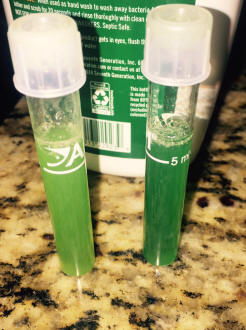
Guess which one is freshly mixed RO/DI
2/25/15
You bet it's the ammonia rest on the right.
<?!>
What the heck? Water is about 24 hours old heated with aquarium heater in clean
plastic storage box.
I'll test some in a new sample container, this is odd.
<I'd test the kit itself... with some distilled, spring... water of known zero
Ammonia concentration... Hey; not by any chance do you happen to be standing in
a litter box are you? Bob Fenner> |
 |
|
Re: Guess which one is freshly mixed RO/DI
2/25/15
Update on this case
1.) Fresh tap water is clean on test kit
<Oops>
2.) Removed D/I cart and tested right out of the R/O membrane. Better
but still contained ammonia.
<Appears that there's something... biological (live or not) "in" the
line or cartridge... time to systematically disassemble, bleach, rinse
the lines, toss/replace the modules, media; including the tris membrane>
I’ve been suspicious of this coral-life flo II unit ever since I bought
it last year. 4 stages new AquaFX filter media ordered (not from
corallife brand).
<Mmm; not a fan... Here comes da rant: Since the co. was sold... the
"consolidation" (a euphemism) in the trade... the new owners not into
QC, innovation... other than marketing and optimizing profits>
I also bought a TDS tester to monitor. If TDS is nearly 0 ammonia should
not exist, right?
<Yes>
I’m buying some jugs of water to do a water change before my tank
crashes.
<A good idea>
I’ve read about ammonia leaching out of RO once it has been depleted by
municipal water. It’s a scary failure mode since it’s supposed to be
pure.
<Again; yes; I agree. Bob Fenner> |
Water testing 3/19/14
Hi everyone
I was talking to the owner of my LFS last night and the conversation
came to the terrible quality of water test kits available to the
hobby
<Mmm; some better than others... Hach, LaMotte... kits made for others
by them>
and the huge price gap between hobby kits and what our local water
district uses. We finally decided that a really serious hobbyist and
certainly an LFS should send a water sample to a lab at least yearly to
get pro quality analysis, so here are my two questions; First, what
tests would you run that perhaps even the average store doesn't usually
test for?
<A tough question... You/all should know that samples change with
time... not the same w/ shipping. Maybe just the standard nutrient
tests: NO3, HPO4... perhaps Potassium for summat new>
For example, what tests would you run to prove that your R/O unit was
doing a tip-top job?
<Mainly TDS, conductivity.... one could use a mass spec...>
Second, if you've ever done this, is there a lab you'd
recommend?
<Most any QA, quality assurance lab will/would do>
Thank you in advance
Stan
<Thanks for sharing. Bob Fenner>
|
RO/DI Laboratory Analysis 7/7/13
WWM Team,
<Dan>
I have a question about water quality that is related to some advice
that Bob Fenner provided me a while back. I have been trying to solve
the overgrowth of a white substance on my live rock that Bob identified
as a mix " BGA, Protists and Sponges/Poriferans.." Since then I have
taken his advice and focused on RedOx and better mechanical and
biological filtration.
<Good>
One area of focus was on the RO/DI water that I create at home. The TDS
meter was showing 0 but I decided to send the product water to a lab for
analysis right after breaking in new membranes. The results are in the
attached PDF. My questions is... would the Silica level at .21mg/L be a
reason for concern?
<No>
Should I be worried about the trace presence of Boron, Iron, Silver,
Potassium in the product water?
<Mmm, no; not really>
I am tempted to run the product water through GFO before I mix it with
salt it to pull out the Silica, but I wanted to get another opinion. I
currently use a Coralife PureFlo II 4 stage RO/DI unit.
Thanks again for what you do!!!
Dan
<This water is fine for all pet fish uses. You could easily have "other"
chemical influence/issues from dissolving substrates/rock and foods. Bob
Fenner>
|
|
Boron 0.091 mg/L
Iron 0.040 mg/L
Potassium 0.450 mg/L
Silica 0.21 mg/L -- 0.05
Silver 0.0006 mg/L
|
Water Quality Report, source water for SW, potable
uses - 03/30/10
I have a 90 Gallon Salt water tank, and am establishing a 20 Gallon QT
tank in plans to obtain some new fish in the next month or so. I have
been buying RO water for my tank, and am debating on buying an RO/DI
unit.
<Do it... much cheaper, more convenient in the not very long
haul>
However after reading the FAQ's I saw some of you aren't
opposed to using good tap water that's been aged and treated.
<Oh! This is so as well. Depends on the quality of your source water
mainly>
I obtained a water quality report from the water company, and am
pasting below. There is <are> some copper and nitrates present.
Would you try using this water, or is it not worth the risk? Thanks,
Pam
Contaminant (units) Ideal Goal MCLG Highest Allowed Level MCL Detected
level Date sampled Range of detection Violation Source
Total Coliform Bacteria 0 Presence of Coliform bacteria in >1 sample
/ month 4 positive samples 6/08 25 samples tested Yes Naturally present
in the environment
Copper (ppm) 20 samples tested, no samples were above AL 1.3 AL=1.3
0.252 6/08-9/08 0-0.464 No Corrosion of household plumbing systems;
Erosion of natural deposits; Leaching from wood preservatives
Lead (ppb) 20 samples tested, 1 sample above AL 0 AL=15 9
6/08-9/08 0-38 No Corrosion of household plumbing systems; erosion of
natural deposits TTHM (ppb) Trihalomethanes N/A 80 71 11/26/2007 N/A No
By-products of drinking water disinfection
Haloacetic Acids (HAA5) (ppb) N/A 60 29.8 11/26/2007 N/A No By-products
of drinking water disinfection
Barium (ppm) 2 2 0.016 6/28/05 N/A No Discharge of drilling wastes;
Discharge from metal refineries; Erosion of natural deposits
Fluoride (ppm) 4 4 1.1 10/08/08 0.7-1.1 No Water additive which
promotes strong teeth; Erosion of natural deposits; Discharge from
fertilizer and aluminum factories
Sodium (ppm) N/A N/A 11.2 5/19/08 N/A No Erosion of natural deposits;
Added to water during treatment process.
Nitrate [as N] (ppm) 10 10 2.4 1/08-12/08 N/A No Runoff from fertilizer
use; leaching from septic tanks, sewage; Erosion of natural
deposits
Chlorine (ppm) MRDLG =4.0 MRDL=4.0 RAA 2.03 2008 1.6-2.7 No Water
additive used to control microbes
<Mmm, the NO3 is a bit high, but again, depending on what you intend
to keep, this water is not "that bad". I take it you drink
it, use it for cooking... Bob Fenner>
Water Quality... source, /potable and SW use
11/20/09
I got my well water tested by a lab for minerals, to help set up my
filter system for drinking and for my reef tank.
aluminum 0.299 mg/l
antimony <0.500 ug/l
arsenic <0.500 ug/l
barium 0.039 mg/l
beryllium <0.003 mg/l
boron 0.867 mg/l
cadmium <0.100 ug/l
calcium 3.31 mg/l
chromium <0.010 mg/l
cobalt <0.020 mg/l
copper 0,010 mg/l
gold <0.040 mg/l
iron 0.394 mg/l
lanthanum <0.020 mg/l
lead 1.54 ug/l
magnesium 0.332 mg/l
manganese 0.59 mg/l
molybdenum <0.020 mg/l
nickel <0.050 mg/l
phosphorus 0.096 mg/l
potassium <0.050 mg/l
scandium <0.050 mg/l
silicon 3.48 mg/l
silver <0.010 mg/l
sodium 247.0 mg/l
strontium 0.102 mg/l
titanium <0.010 mg/l
tungsten <0.050 mg/l
vanadium <0.010 mg/l
zinc 0.018 mg/l
hardness 9.63 mg/l
ph 7.56
What elements should I target for filtering for my reef tank? I will be
filtering iron, manganese and sodium to meet the guidelines for
Canadian drinking water quality. RO/DI filters produce to <too>
much waist <waste> water, I worry about the waist <waste>
because the well is my only source of water.
<Most of the elements you list are found in seawater, although not
in the same proportions. I'd consider making up an additional water
purification system using the same type of canisters used on RO
systems. Three canisters containing a 5 micron filter, carbon block,
and a mixed resin bed, should provide you with good drinking water by
using the output water from the filtering methods you state above to
feed the canisters. In your reef system use a Poly Filter, this will
remove most heavy metals including copper, and is also a great media
for increasing water quality in fresh and marine systems. You may want
to read here.
http://www.poly-bio-marine.com/polyfilter.html>
thanks Miles
<You're welcome. James (Salty Dog)>
Top off water and Testing for RO Water TDS
4/27/09
Bob and the Gang,
<Hello Joe>
Hope all is well.
My 135 G Reef tank loses a lot of water due to evaporation.
I add a fair amount of RO water to top it off weekly.
<Am I to understand you top off the tank once a week? Or do you mean
you lose a lot of water over the course of a week. If you are topping
off only once a week I suggest you try to do it more often, the longer
you wait before topping off the tank, the larger the swings in the
specific gravity of the water your tank will experience>
<There are auto top off devices available to top off the tank for
you and provide a more consistent environment for your tank
inhabitants. Search 'ATO' on the Google search box at the
bottom of WetWebMedia.>
My question is, should I be adding something to my top off water? Never
thought I had too, but I've read a
couple of places where they recommended adding something to keep the PH
up.
<It is possible to buffer the water, but not necessary, assuming you
are testing and adjusting alkalinity as needed. Just continue adding
topping off your tank with RO water, pH swings will be less noticeable
if top offs are done on a small consistent scale like with an ATO. You
can also aerate your top off water to remove CO2 from it prior to
use.>
Also, how can I be sure that my RO unit is working properly (I have the
Coralife Pure-Flo)? Is there something I can use to test the RO water?
I was reading about TDS testing but wasn't sure if that was
necessary.
<I would highly recommend testing the Total Dissolved Solids from
the effluent hose of your RO unit. Membranes do lose their potency over
time from normal use, but this can be accelerated depending on what
chemicals your city adds to the water. Testing TDS is one of the most
simple ways of checking the quality of effluent coming from a RO unit,
and basic TDS meters can be had at a very low cost.>
Thanks.
Joe
<You're welcome.
Josh>
Re: Top off water and Testing for RO Water
4/27/09
Thanks Josh. Yes I'm topping off roughly every week. I usually lose
close to 10 gallons a week! You make a good point about trying to do it
more often to avoid larger swings in specific gravity. I'll
definitely try to
do that.
I'll also look into a TDS tester.
Thanks again.
Joe
<You're welcome, I think you will come to enjoy not carrying full
buckets of water around. Josh>
Hand Held TDS Meter 1/6/08 Dear WWM Crew, First let
me thank you for the knowledge and unselfish time you donate to
aquarist in need. I read this website every day to gain knowledge, the
books help too. <Thank you Sue.> I just thought I would pass
along some information. For everyone who says they can't afford or
don't have a TDS meter. Go to Walgreen's Drug store and located
by the Britta Water Filters you will find a hand held TDS Meter for
$14.99. It is made by HM Digital and is factory calibrated and adjust
for temperature. Armed with this knowledge everyone can afford to have
a TDS meter. I know that this hobby is expensive and can strain the
pocket book so I wanted to let everyone know about a low cost and
accurate solution. Happy Reefing! Sue Marietta, GA <Thank you for
sharing this information. It will be passed along! ScottV.>
What to test for from my well water? Five years
ago I had a 125 gallon salt tank. But used it mainly for carnivorous
fish. I have been dreaming of getting into a reef setup. I recently
found a great deal. And have just purchased a 750 gallon tank. I now
live with well water and want to make sure I know what I'm getting
out of the ground. I do plan on getting it tested, but have a few
specific questions in regards to the required tests. My questions are:
1. Which tests do you consider absolutely necessary since their seems
to be and endless amount of things to test for. <I would consider
Ammonia, Nitrite, Nitrate, Chlorine, Copper, pH, and Hardness to be
necessary tests when determining whether or not well water is suitable
for use in your reef tank to be.> 2. I would like to know what
certain elements in my water would dictate either my using RO, or
RO/DI, or just Kold. I really do not want to tax my well with what I
understand to be a wasteful RO system. Unless absolutely necessary.
<I, personally recommend that everyone uses an RO/DI system for
their reef tank. Many units have lower waste water to clean water
ratios. However, if you feel so inclined to use your well water,
discovering traces of Ammonia, Nitrite, Nitrate, Chlorine, or Copper
would serve as a red flag, and should deem the well water unsuitable.
Low pH and low hardness are not make-it-or-break-it factors, but can
cause many headaches down the road.> PS. Your site seems to be the
most complete I have found for information. After reading a ton
of previous questions I see their are endless possibilities with how
best to set up systems. <You've hit the nail on the head.> I
thought I had a plan until finding this tonight. Now I know I better
spend a little more time gaining some knowledge before setting it
up. Thanks for your time and expertise. <Glad I could be of
assistance, Mike G>
What to test for from my well water? - II Wow,
what a great/quick response. Thank you. <You're welcome.>
Would it be sufficient to just use my RO when preparing to do a water
change? Or is it recommended that you also leave it running 24 hours a
day to aid in filtering the tank? Can you recommend any manufactures?
<What do you mean by "filtering the tank?" An RO/DI unit
takes tap water, or, in your case, well water, and converts it into a
much more reef-appropriate water. You use it to prepare water for water
changes and for top-off, but hooking it up to a reef as a filter, which
I assume you want to do, would convert the saltwater to freshwater, and
waste much of the water. Before you knew it, your 750 gallon tank would
be half full of near fresh water.> I was told to buy Aqua Medic
products. <Which products to buy is completely your choice.>
I'm considering buying: 1. Aqua Medic Turbo Floater 5000 @ 975 GPH
skimmer. 2. Osmotic 4 stage R/O 300 GPD 3. Riff 2000 Wet/Dry Any
feeling on these in particular? <1 and 2 look good to me, but I
would never personally recommend a wet/dry unit on a reef tank. It
serves only as a nitrate factory.> Thanks again, I will hold on the
questions until I further educate! <No need. This is a place to get
answers and to help you. We don't mind answering your questions at
all, Mike G>
Water testing This question is more for Steve and Anthony
(sorry Bob) being from Pittsburgh do you know where I can take my tap
water to get it tested? I live near Cranberry and would like to know if
my tap water is ok to use straight for filling my tank or not.
<actually... your water authority publishes an annual report and
weekly (perhaps daily) ones are available as well. Usually available
just for their asking... do give them a call. They must lawfully
disclose such information I believe. Do consider that all tap water
changes seasonally though... as such, for a truly tweaked tank... you
may still want to consider purified/buffered water to employ a
consistent quality of water for tank use>> Thanks You all are
great and Bob your book is like a bible to me and doesn't go far
from me. Lunch breaks and everything else are spent reading and
rereading trying to soak it all in. but still here I am on the site
trying to learn more. Colleen Thanks in advance Pittsburgh, PA <best
regards and thank you! Anthony>
What's On Tap? (Source Water Testing) Hi guys,
<Scott F. your guy today!> In an effort to get to the source of
my nuisance algae problem (brown slime on live rock and substrate)
which seems to be either brown diatom algae or Cyanobacteria. I am
getting my tapwater and tank water professionally tested. My hobby
grade test kits (Hagen and Red Sea) all say my phosphate, silicate and
nitrate levels are really low yet my tank says otherwise! <Yep-
you'd be surprised what happens in an aquarium. It is entirely
possible for a test kit to read undetectable levels of these
undesirable substances, yet still have a tank full of algae-covered
rock and sand. Many of the compounds that fuel nuisance algae growth
get bound up in substrates and rocks, and provide a continuous nutrient
source.> I am taking two samples ( in sterile containers sent to me
by the water consultant) , my tap water alone and my tank water. I am
asking him to test for Phosphate (should it be for organic, inorganic
or total phosphate ??) <Well- could be all of the above...I'd
look into organic phosphate, myself> , silicates and nitrates. While
I am doing this baseline testing is there anything else I should test
for which is important for my FOWLR tank. <Well, I think that
you're covering most of the major nutrients for nuisance algae
outbreaks that are found in source water> His pricing is very
reasonable and I need to know the source of my Cyano slime so I can act
accordingly. THX. <Well, source water is an important source of
these substances, but don't rule out some of the more basic things,
such as your husbandry practices (i.e.; water changes), protein
skimming, feeding habits, etc....All are potential contributors to
nuisance algae blooms...Look beyond the obvious, but don't forget
to look at the "basics" yet again. I'm sure that
you'll get to the bottom of your problem! Good luck! Regards, Scott
F>