 |
|
| Home | Marine Aquariums |
Freshwater Aquariums |
Planted Aquariums |
Brackish Systems |
Ponds,
lakes & fountains |
Turtles & Amphibians |
Aquatic Business |
Aquatic Science |
Ask the WWM Crew a Question |
| Please visit our Sponsors | ||||
|
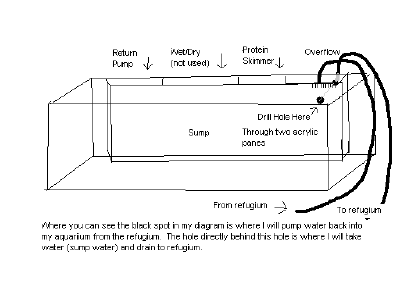
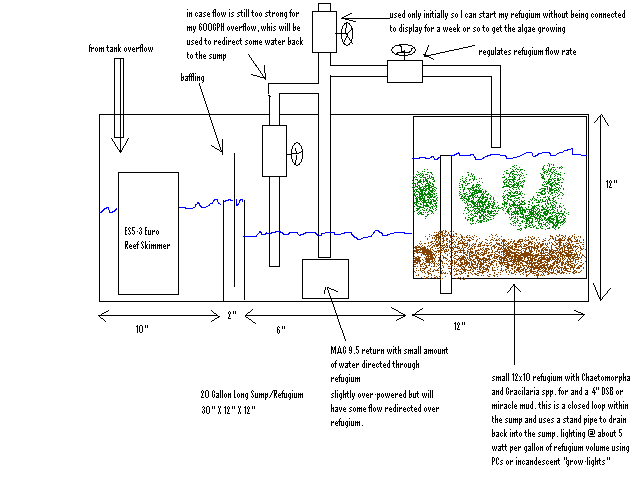
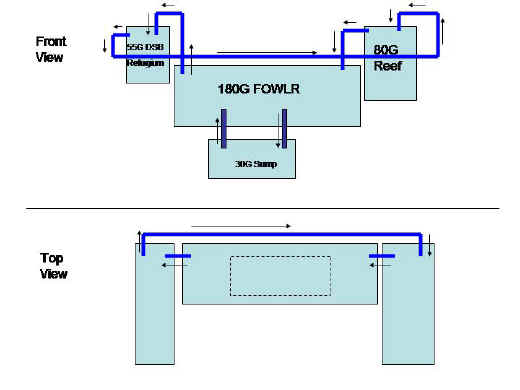
Refugium on a Tenecor 6/24/04 Good morning Bob, First of all, thank you for a wonderful website. I have learned most I know from your site and books. <Adam here today. I will pass your kind words on to Bob.> I have a few quick questions about my tank. I have a Tenecor 75 gallon with the simplicity plus filtration (wet / dry built into the back). I was wondering about how to turn the section in the back into a refugium and removing all the bio balls and such. Do you think this would be a good idea or should I try to modify a hang on refugium to fit behind my system? If I do this, what would be the best layout for this (live rock rubble, etc)? Thank you, Rob, Arlington, WA <Rob, these are difficult questions to answer without knowing more about your system. Except for heavily stocked predator systems, I am very strongly in favor or refugia and not in favor of wet/dries, so I strongly support your general plan. I would suggest removing the bio-balls from the wet/dry over a couple of weeks. As far as adding the refugium, you will have to consider aesthetics, convenience, space and cost. Don't be afraid to be creative! If you have an idea, and aren't sure, run it by us. When it comes to setting up the refugium itself, you must consider what your primary goal is. If you want nutrient export, consider a DSB and macroalgae. If you want pod habitat, consider crushed coral substrate and live rock rubble. A hybrid can accomplish both, but like any other system component, refugia must be carefully managed to prevent the accumulation of wastes. Best Regards. Adam> Any Refugium Is Better Than No Refugium! Hey Guys, <Hi there! Scott F. here today!> Just a quick question. I have a 100 gal tank with live rock(70lbs) and a deep live sand bed. I have been running it with a CPR Bak Pak 2 and two 802 power heads with pre filters that I use for mechanical filtration. I was running two Fluvals but one broke, and low and behold, my water got better, so I slowly removed the other one. Now I have zeros across the board on my water tests. <Go figure. That's pretty cool, though! Good pickup...Go with it> My question is, I want a refugium. Will the CPR hang on the back do the trick? I only run a few small gobies and mainly leathers, Acroporas and clams. <An interesting and challenging mix!> Trust only your advice. Erik Lobe <Well, Erik, I suppose that any refugium is better than none, but the refugium that you refer to is rather small, so it may not provide huge amounts of nutrient processing and food production. However, I certainly wouldn't discourage you from utilizing it! You'll derive some good benefits from the unit nonetheless. Have fun! Regards, Scott F.> - Planning Livestock and Refugium for New Tank - Hello All, It has been a while since I last wrote to you guys, however, I do frequent the Wet Web Media chat forums and find a bunch of useful information there. I am in the process of re doing a 125 gallon tank w/dual overflows (each hole is about 1.75 inches) and had a few questions about the sump/refugium (used to supply the main tank with home grown goodies) that I wanted to install under the tank. The inhabitants of the tank are going to be 2 Ocellaris Clownfish, one Purple Tang, one Royal Gramma Basslet, one neon blue goby, and one reef safe wrasse. I saw what was labeled a "Christmas Wrasse" at one of the LFS but have been unable to nail down the image on any of the fish websites. I have found something close but not exactly what I saw in the store. <Most likely a Thalassoma species of wrasse - more on these here: http://www.wetwebmedia.com/thalassoma.htm > I will also be keeping a couple of cleaner shrimp, a few snails, mushrooms, xenia, and a few LPS. <The shrimp won't last long around a Christmas Wrasse.> My lighting will be 4-96W PC. I currently have about 120 lbs of live rock (various origins) curing in a Rubbermaid tub. I have about 18 bags of south down sand to use in either the display or in the refugium (would a DSB in both be overkill?). <Both would be fine, but will cut into your water volume in the sump.> I was looking at implementing the Return Manifold as suggested by Anthony Calfo. Is it possible to use this manifold with a fuge? <Don't see why not.> All the information that I found in the Q&A was about using it with a sump. <In either case, you still need a pump to move the water out of the 'container' and back up to the main tank. Refugiums are just glorified sumps when positioned below the tank.> Also I was thinking about using a standard 55 gallon tank as the sump/fuge. I have read that if the sump/fuge was too narrow it would not allow the water enough area to slow down and render the fuge useless. Would this be too narrow to use as a sump/fuge. <Don't think so.> There would also be an Aqua C skimmer and a Supreme return pump in the sump. This would leave approximately 24"X12" for the actual refugium. <Think this will work well.> Any comments/suggestions are greatly appreciated. Jeff <Cheers, J -- > - Coral in the FOWLR, More Follow-up - Hi and thanks for the quick response on my questions, I really appreciate it. In regards to my sump/refugium, the order of water flow will be the following: Do you have any recommendations that I should consider. <Not really, your sump layout is pretty standard... works well.> I am planning on buying the PC's as you recommended and I will have a couple of reef safe fish (1-Fairy wrasse, 2-percula clowns, 1-royal gamma). I currently have a 90 gal with Live Rock. If there is additional info you might need, please let me know and I will reply. Thanks again for all your hard work and assistance, Jose H20 H20 In to Sump Out to Display Tank X X X X X X X X X X X 1 X 2 X 3 X X (Skimmer) X (REFUGIUM) X (Pump) X X X X X XXXXXXXXXXXXXXXXXXXXXXXXXXXXXXXXXXXXXXXXXXXXXXXXXXXXXXXXXX Baffle 1: Protein Skimmer (Euroreef CS6-1) Baffle 2: Refugium My refugium will consist of an eggcrate (1 inch off the floor) with 2" of Coarse Sand followed by a screen followed by a bed of 2" fine sand (aragonite) and maybe some small fragments of live rock on top of that. <Are you sure your sump will be deep enough to accommodate this sand bed - methinks your water level will be very close and low to the sand bed once the system is running.> Should I consider adding a some type of light or small burrowing animals/bacteria/make live sand? <Not at the outset... let it come into its own and decide later if you want to add vegetation. The entire surface area of the refugium is 1.5' by 1.5'. The reason why I am doing the refugium is for Denitrification. <Understood.> Baffle 3: Return pump to display tank <Cheers, J -- > Refugium Volume Hi all, <Hello, Ryan with you> I'm new to this site and have done a lot of reading but haven't found a direct answer to my question. I'm setting up a new tank. It's going to be a 125Gal. Fish and Live rock only (at this point). <Great> Below the tank I will have my sump on the left with skimmer and on the right a refugium. <Wonderful> Because of size limitations, both the sump and the refugium will each be 14.5"L x 18 W x 16 H. Is the refugium going to be too small for this tank? <No, not too small to be effective. Any area free from the mouths of predators will be beneficial to your system. Bigger the better, though> I could (if I have to) put a larger refugium tank in the middle section of my tank, 28"L x 18 W x 16H. <We're not talking a huge amount of volume increase here, so skip it. I generally encourage refugium volume to be somewhere between 25%-75% of their display. Even so, many aquarists have seen great benefits from a small, hang on refugium. Good luck! Ryan> This is an awesome site! Thanks in advance. I look forward to hearing from you! Kevin Gagnon. Tank Yikes! Remote Refugium? (And My Bad) >You said I could sell my large fish at LFS. I don't know what that is. If you typed in www.lfs.com, would you get it? >>Oh no! My bad, Cheryl! "LFS" is net-speak for local fish shop/store. >Also, I don't understand the remote refugium. How does that work if it isn't hanging on your tank? Where do you get them? Thanks, Cheryl >>Refugia have only more recently been made more convenient by manufacturers offering hang-on-tank models. You can make one yourself using a simple tub, properly plumbed, and pumped. Search our site (our Google bar) for MUCH information on them. Locating remotely means that it's not attached to the tank, thereby adding weight to one spot. I know one fellow whose 'fuge is under his house! Sorry again for the confusion. Marina Display refugiums Hi Guys, <Hi Dave! Adam here.> Enjoy your site. Been a reef keeper for 18 years, and have been through the natural progression of ups and downs with my tanks. I presently have a lightly stocked 75 gallon reef that is about 5 years old. It has about 75-80 lbs of live rock that is encrusted with coralline algae and about 1 inch of sand on the bottom of the tank. I run an empty sump and run a skimmer occasionally as my only filtration. I am looking to add a display refugium. I have a 2o gallon high that I have had drilled in the back at the top for 2 drains and 1 return line. Because of my space requirements I have to put it next to the display tank and want to make it interesting to look at as an additional display. My question is this. How much and what type of sand. How much and what type of Macro? What type of lighting? And finally since I am adding this to an excising systems do I have to worry about cycling etc...? <I would suggest about 6" of "sugar fine" aragonite sand, 8" if you can stand it. In addition to short term settling, the low pH of the deep bed will dissolve as much as 20% of the bed a year. You only need a small amount of macro algae to start. They will grow quickly. My strong favorite is Chaetomorpha. It grows fast, is attractive, makes good habitat for pods and compared to Caulerpa is fairly non-toxic. Lighting is easy. Anything from two NO fluorescents up to a couple of PC's. Anything more is overkill. Cycling will not be a concern.> Thanks and keep up the good work. Dave O'Brien <Glad to be of help! Please let us know if you have any more questions. Adam> Sump/Refugium Questions (1/22/04) I am a new reef hobbyist. I had fish only tanks many tears <You probably mean years, but many hobbyists have shed plenty of tears over the years.> ago and boy have things changed. <Yes indeed.> I am in the process of starting up a 75G reef. The reef will be mixed livestock and corals and I would also like a clam or two in the future. <Probably only one in that small tank. They get huge.> I have a Rubbermaid tub that I am using as a sump for now. I am going to build a sump soon. I have been reading "Reef invertebrates" and would like to build and use a 'fuge. I have a few questions. I think I want to keep the 'fuge and the sump separate. <OK> So I'm looking to pump water from the first stage of my sump into the 'fuge and them back out into the last stage (Water that has been run through my Protein skimmer). Is this a good way to get the water into the 'fuge before it runs through the PS? <An overflow from the refugium into the sump is better. See the first link below for a good diagram. Mine was made by a local shop and is all in one tank with a toothed divider between the two chambers allowing overflow from the refugium part to the sump, which contains the heaters & skimmer.> I am also somewhat unclear as to what type of 'fuge to use. 1) Live rock and DSB. 2) Macroalgae 3) A combination. <My favorite> If I try to do a combination do I mix the Macroalgae and the DSB/LR in one chamber or do it in 2 chambers? <Can be done in one if not too much flow that disturbs the sand.> Any directions along this line would be very helpful. I haven't been able to locate any pictures or directions from the web. So any links to that end would be helpful. <Try here: http://www.inlandreef.com/Images/DIY/Plumbing/refugium_plumb.gif and here: http://www.ozreef.org/> Thanking you in advance for any input. Jordan <Hope this helps, Steve Allen> - Refugium Methodology - Hi Crew, I have spent hours (possibly days) reading through all the information regarding refugiums and plenum on WetWebMedia and various other sources. It seems that, just as I think I have decided upon my design, I find other conflicting information so I am hoping to get your input. The refugium I am constructing is a 20g tall aquarium in the base of my 180g stand (space limitations). My purposes for adding the refugium are: NNR, phosphate reduction (current diatom problem on glass) and to provide food sources for a mandarin and for my tangs ('pods and macro algae). My plan was to add a plenum to the bottom of the refugium and to use 4'-6' of aragonite sand for a substrate, adding something similar to 'Miracle Mud' to the top layer of the substrate. One person commented: 'You don't need a plenum and a DSB, choose one or the other. <I'd agree with that.> Otherwise, they will compete and deplete the system of enough nitrates/phosphates to support coralline. <Don't know if I'd agree with that.> A refugium has a mud substrate for growing plants. If you use sand, this is not a refugium. <Refugium is actually a catch-all term, and has next to nothing to do with the substrate or depth of same to make it a 'refuge'.> You should just use a plenum as they are about 10X faster at removing nitrates.' Another person commented: 'Why are you using a plenum in a DSB? You should eliminate the plenum and just use the DSB.' Still others (in fact, one WWM crew response indicated: 'Why not get the advantages of using both a plenum and a DSB?' <Interesting... doubt that was me.> Of course I realize there will continue to be disagreement but what are your views on the above opinions? <I think a refugium will be whatever you want it to be. Substrate depth, plenum or not... these things matter only a little. Having a box with water in it and a lack of predators will create a refugium. Solving NNR issues and the like are a separate issue from the refugium - the deep sand bed for instance will likely have more affect in the main tank as it will have more surface area, but it will have some affect in a refugium. Same goes for a plenum, although less practical in the main tank if you have burrowing fish.> Will the use of a plenum/DSB refugium inhibit coralline growth? <Not in my opinion.> Would a mud-type addition (i.e. 'Miracle Mud', 'Funky Old Reef Mud', etc.) to the top layer of sand not be beneficial for growing 'pods and mangrove, Caulerpa or other macro algae? <No... this will happen with or without the mud. Mud typically has other benefits more relevant to water chemistry.> What are the best plants to grow for NNR and for tang food? <Whatever you can get your hands on that the tangs will eat.> Should 'janitors' be added to the refugium to reduce detritus or will they just reduce the 'pod population? <No... it would be much of a refuge then.> Thank you for providing some clarification, --Greg <Cheers, J -- > - Refugium Methodology, Follow-up - Thank you for the prompt response! <My pleasure.> I would like to just get clarification on a few responses. You said you agree with not using both a plenum and a DSB in a refugium. Which do you prefer and why? <Refugium - easier to get going and maintain.> Do you agree with the comment that plenums are 10x faster than DSBs at removing nitrates? <Not without some proviso, no I wouldn't agree with that.> So far, comments I have received are similar to "they are not both needed" or "there might be some benefit to having both but not likely". So it sounds like there might not be specific benefits for having both but I have not heard of any significant drawbacks to having a plenum and a DSB. If there is possibly (or possibly not) something to gain but nothing to lose from trying a plenum and a DSB in the refugium, I think I will try both. <Please, be my guest.> As you said, the surface area in a 20g refugium is limited (when comparing to the attached 180g tank) so my though it I need the most efficient method of NNR possible -- why not take advantage of both methods? <Why not build a larger refugium - I will say again, it's too small, even if you use both methods and a third no one has ever heard of, I don't think this will produce a useful amount of nitrate reduction.> FYI: I found the WWM article I mentioned -- regarding taking advantage of both a plenum and DSB. It was Bob Fenner who had this response (maybe I took it out of context?): "Will a plenum sump or a Caulerpa refugium be "better" for lowering nitrates? <Overall... the Caulerpa if you had to choose... you don't have to... you can/could have both in the same sump...>" (http://www.wetwebmedia.com/PlenumFAQs.htm) <Last time I checked, I was allowed to have my own opinions on such matters - you as well.> To answer my previous question about adding "janitors" to the refugium (keeping sand stirred / detritus minimized), you responded: "No... it would be much of a refuge then." Were you saying "janitors" would be predators of 'pods, therefore this would not offer much of a refuge for the 'pods or were you saying it *would* be much of a refuge for both? <Sorry - looks like the contraction got left out - it WOULD NOT be much of a refugium.> Thanks again! --Greg <Cheers, J -- > Sump/refugium size 2/17/04 Anthony, Thanks for the prompt reply, you know what I'm gonna ask next---its small (too small)........What do you recommend? I'm all ears. Thanks again, Sam <refugiums of any size will be of some benefit... but do try for 20-40% of the display tank size for a noticeable impact [public aquaria often use a 1:1 ratio!]. Make a DIY one upstream or downstream... or look at the larger HOB style ones. We cover the topic of refugiums at great length in "Reef Invertebrates" by Calfo and Fenner. kindly, Anthony> - Sump/Refugium Design - Hi guys, long time reader first time caller. I'm new to the saltwater arena and after reading all the great information on your site I decided I wanted to hook up a refugium to my main 47 gallon bow front tank either 15 or 20 gallons, I made up this design for my system and was wondering what you thought I'm not sure on many of the specifics yet but do you think my idea is practical? <A couple of issues occur to me: first, I don't think the barrier/weir will be able to be at the height shown in your diagram - typically, sumps shouldn't be filled much more than half to make room for the transit volume in the plumbing and overflow water when the power is turned off. Second... is it your plan to pump water under the plenum? It seems that what is your diagram suggests, but if this is the case, it won't actually perform as a source of denitrification. Do consider having your water coming in from the top of the sump, with the plenum intact and undisturbed at the bottom of the sump.> Should I used the carbon insert or just scrap it and same with the bio balls? <You'll want to run carbon from time to time, but it easiest placed in a bag in a high flow area of the tank. The bio balls should be fine as long as they are submerged.> Thanks for your help I look forward to your response. -Jeremy <Cheers, J -- > - Sump/Refugium Design, Follow-up - Thanks a lot for your help I'll make sure to change my design, and not pump the water up through the sand. I read that was good to do at another site thanks for the correction. <It might be good to do, but it won't really be a 'plenum' as you had described. It would just be a sand filter, and likely a problematic one at that. No worries - I think the change in design will treat you right. Cheers, J -- > Refugium Size 2/17/04 I currently have a 120 gallon reef tank with clams and a few soft corals. For fish, I have three dwarf angels, a yellow tang, a ocellaris clown, a Firefish goby, a Rainford goby and a scooter blenny. I am planning on adding a mandarin goby and a few more small ditherfish. At night when I search my tank with a flashlight, I haven't noticed a whole lot of fauna crawling around (tanks been set-up for about six months), so am considering adding a refugium. <excellent! they are invaluable IMO> Unfortunately, I don't have much room under my stand (taken up by the sump), so I am looking at a hang-on the back refugium (Aquafuge Hang-on Refugium--large). However, according to my calculations, this model only has a volume of 7 gallons (25" x 4" by 12")-will seven gallons of refugium have a significant impact on the populations of 'pods/other desirable flora/fauna? Thanks-your site is great. <anything will be helpful... but these HOB style fuges are truly tiny. Ideally, a refugium should be 20-40% of the display tanks size. [public aquaria often use a 1:1 ratio!]. Do consider a refugium plumbed upstream (above) the tank on a shelf next to the display top (can be just slightly higher for an overflow hole to drain in to the display... see our book "Reef Invertebrates" by Calfo and Fenner for extensive coverage on this subject). Anthony> - Refugium Setup and Livestock Levels - If my boss saw how much time I've spent reading all the FAQ's I can lay my eyes on, I'm sure he'd toss my rear end! On the other hand, just think how informed I've become, albeit at the expense of a good job. <Hard to convince me of the value of the trade off...> Oh well, priorities. My questions: 65 gal tank, recently built and installed 20 gal refugium/sump (net about 15 gal) with almost 4" DSB thanks to you guys on this forum. I read recently that you advise to have skimmer, refuge, then return section in that flow order, but mine is reversed. I can't change it for several reasons--will this work o.k.? <Yes.> Also have some Caulerpa in the DSB section--will I have problems with this? <Not necessarily - you can light the Caulerpa 24/7 and that will help stop if from going sexual. Also care when harvesting to pull entire plants, and not parts of plants - all will help.> And lastly, I have med. Sailfin Tang, 1 green Chromis, 1 yellow tailed damsel, 1 small Ocellaris clown, 1 sm. scooter. I want to add 2 more Chromis and another clown, perhaps a med. yellow tang. Will that work, or am I pushing the envelope?? <You were good right up to the second tang - think you can add all you listed with the exception of the tang - your tank just isn't big enough for two.> Thanks, and I love your very informed site--a pleasure to read straight-forward answers, unambiguous and dead-on. Thanks!........Barry <Cheers, J -- > DIY tanks Hi Bob! <Hi Joe> I am in the planning stages of setting up a reef system. I have read most of your Conscientious Marine Aquarist and have been engrossed in the FAQs on Wet Web Media. Both of which have been of great help to me in planning a system for my small world. <Glad they're of service> First question: I am a diy guy and would like to build a tank myself. Can the acrylic used for a salt water tank be Plexiglas or must it be Lexan? <Either one... more a brand name than a different formulation> I plan on incorporating an above tank refugium with a 75 gal. reef tank. In it I plan on having a 3 in. sand bed, a piece or two of live rock or plant rock, a mangrove or two and some sea grass. <Mmm, do (re)consider the mangrove... really needs more sand depth> The Refugium will be 24 in. X 18 in. and Have about seven inches of water over the sand bed and overflow into the main tank. This would give me about 10 gal. of water in the Refugium. <If space permits, do make the refugium sump MUCH larger... can't be too big> Is this big enough to use as a biological filter for my main, and besides cucumbers and hermits what else should I put in the second tank to either act as filtration, maintenance and food source for a reef and some fish? <Honestly... you'd be better off switching the tanks for function... with the 75 as the refugium... I say shoot for at least about half the volume of the main/display tank for your refugium> I plan on Having protein Skimmer to help carry the load. Probably a Red Sea Berlin turbo or classic. Thank you for this great site. Joe <Thank you for being part of it along with me. Bob Fenner> Refugium and sump sizing 09/09/03 <Hi Eric, PF with you tonight> Hello Crew - I have a dilemma! I'm in the setup phase of a large reef system that I've mentioned here before (375gal.). I have two tanks available for the sump and the downstream refugium, a 75 and a 55. I'm unsure which to use for which. I like the idea of the larger of the two for the fuge but not sure the 55 would provide enough safety net (evaporation, equip. room, etc.) for the display. <I'd say use the 75 for the 'fuge, but then I'm biased in favor of refugiums. Have you thought about using something like a feed trough for your sump? You can find them at farm supply stores, inexpensive and easily drilled.> If I use the 55 for the fuge will it be large enough to make a difference? Anthony's book recommends a refugium size of 20% of the display size for effective NNR, and although I will use a DSB in the refugium I will also be employing a DSB in the display. Am I wasting my time deliberating on this? <No, always better to plan things out now than look for a solution latter.> Also (if I may?) <Just this once... ; ) >, I'm intrigued about the use of an "animal" filter as opposed to a "vegetable" filter in the fuge. I'm planning an SPS biotope for the main display and was wondering if some of the hodge-podge of animals from my previously ill-advised "reef garden" could be employed in the refugium? This would consist of various mushrooms, zooanthids, pulse xenia (pom-pom I think), anthelia, cabbage coral, and a large and fast growing colt coral. <I'd say yes to the xenia, there are several members of the reef club I belong to who use it as a nutrient export. I'd say no the rest, for allelopathic reasons.> Could I (should I?) still use macroalgae in the fuge with the corals? <Chaetomorpha is my plant of choice> any pros-cons of one over the other? <Chaetomorpha grows faster and will harbor more life (worms, pods, etc. Xenia sells better to your LFS for credit though. Nothing says you couldn't divide the 'fuge for an area of each.> Let me say again what a valuable service this site provides. I've literally spent 3-5 hours a day (honest, my boss will testify <G>) for the last 6 weeks reviewing/researching information and opinions, and buying "updated" literature of Anthony's, Bob's, and others to "soak up" as well. <Glad you're doing research, I waited 18 months myself (but then, I'm a research junky)> Even joined the local marine aquarium club. <Great, you can also swap frags, a great way to get nice animals for your tank.> Thanks in advance (again!) for your time and dedication. Eric <Happy to help, let us know how it turns out, PF> - Sump/'fuge Sizing for a 375g - Hello Crew - I have a dilemma! <Howdy, Kevin here> I'm in the setup phase of a large reef system that I've mentioned here before (375gal.). I have two tanks available for the sump and the downstream refugium, a 75 and a 55. I'm unsure which to use for which. I like the idea of the larger of the two for the fuge but not sure the 55 would provide enough safety net (evaporation, equip. space, etc.) for the display. If I use the 55 for the fuge will it be large enough to make a difference? <It's always better to be bigger, but if you can't fit your basic equipment in the sump in order to have this larger 'fuge, the answer should be apparent.> Anthony's book recommends a refugium size of 20% of the display size for effective NNR and although I will use a DSB in the refugium I will also be employing a DSB in the display. Am I wasting my time deliberating on this? <It's not that big of a deal, you will be successful either way> Also (if I may?), I'm intrigued about the use of an "animal" filter as opposed to a "vegetable" filter in the fuge. <Sounds cool, aye?> I'm planning an SPS biotope for the main display and was wondering if some of the hodge-podge of animals from my previously ill-advised "reef garden" could be employed in the refugium? This would consist of various mushrooms, zooanthids, pulse xenia (pom-pom I think), anthelia, cabbage coral, and a large and fast growing colt coral. <This may take away from the SPS dominated display as the softies will release growth inhibitors into the water along with other nasties.> Could I (should I?) still use MicroAge in the fuge with the corals? <I think a xenia 'fuge would be a good idea, in combination with macro algae.> any pros-cons of one over the other? <Mainly about having colts and Sinularia in the 'fuge, I'd stick with fast growing xenia and macro algae.> Let me say again what a valuable service this site provides. I've literally spent 3-5 hours a day (honest, my boss will testify <G>) <Haha!> for the last 6 weeks reviewing/researching information and opinions, and buying "updated" literature of Anthony's, Bob's, and others to "soak up" as well. Even joined the local marine aquarium club. <Great, can't wait to see pictures! -Kevin> Thanks in advance (again!) for your time and dedication. Eric
Refugiums 9/25/03 I have never done refugium before. <do consider... they are of tremendous benefit! Many styles too... do not limit yourself to just a plant/macro refugium... we have extensive coverage of this topic in our new book Reef Invertebrates (Calfo & Fenner)> I am concerned about hanging it on the display tank (might not have enough room). Is it possible to add it to my sump where I house my protein skimmer underneath my tanks cabinet. <yes... called a "downstream: refugium> Does it require a light? If so, how much wattage? <that depends on if you are growing plants and algae for vegetable filtration... or just using deep sand for nitrate reduction... or a coarse matrix for zooplankton production> I see the AquaFuge by CPR seems to the better model. Do you know of any others? <CPR is very fine... homemade works just the same with a drilled plastic bin or small aquarium. It is simple a flow through vessel that is kept fishless for plankton production, etc. Read on my friend. Anthony> "In Tank" Refugium? Dear Crew <Scott F. your Crew member today!> I haven't written to you for sometime. I wish to share some theories with you concerning water changes and algae in my nearly 3 year old 130 gallon reef tank. I have not done a water change for nearly three weeks in my tank, plus my skimmer pump went on the blink (aqua bee Turboflotor). Yes I know its bad (work commitments etc). I have a mixed reef garden tank. Soft Sarcophytons and various SPS hard corals; low fish stock. <Okay...> Now while you may think this would cause nutrient build up and yellowing water, you would be right. I have corrected this balance, and my corals are on the up again. As you will agree, Xenia especially suffers with a lack of water changes, as it has done in my tank. It does however seem to be coming back with a bang, despite being next to a Caulastrea colony (also due to a fresh bag of carbon). <Well, the old "dilution is the solution to pollution" jingle holds true here...> Anyway to my point. I did notice during my lax maintenance schedule (we have all done it don't deny it) a build-up of hair algae on the back of the tank. A scourge to most of us aquarists. <Or at least, the cause of lots of headaches!> I am, however, going to be controversial and say that during this lack of maintenance my copepod (zooplankton) population went crazy. Putting the torch on the algae at night displayed how busy the zooplankton were in this colony. My SPS couldn't get enough. I have since kept purposefully a crop of hair algae out of display behind some rocks in my aquascape to allow these critters to go at it. <Sort of like an "in tank" refugium. I'm not a big fan of allowing nutrients to accumulate, but you can see that amphipods will tend to thrive with abundant foraging in a predator-free (or "low predator") environment.> Its an idea that works well for me as I don't have time to set up a refugium, as my pump outfeed is connected to a UV. Plus, as we scream ahead for completely clean sterile tanks (as some of us Europeans strive for); I think it gives pause for thought that we should understand that a tank full of coralline-covered live rock with no other algae isn't natural. <Very true!> I've snorkeled on reefs in the Maldives & Mexico and it's not like that in real life; some areas are covered in brown slime algae, quite naturally. I'm not condoning poor maintenance, but zooplankton live and thrive in hair algae. Plus it's natural in areas where flow is not so fierce. <All valid points, and well taken. I guess the bottom line for most hobbyists is to avoid excesses of accumulated nutrients, which lead to degraded water quality in closed systems. Nothing wrong with encouraging algae to grow if desired, just keep water quality high...> A refugium will provide this I know; but I think a mini refugium out of site in the main display works wonders. As long as it is kept under control of course, and water parameters monitored. <Wow- we just said the same thing! Good point> Speak soon guys Jim Griffin <Well done, Jim. Thanks for sharing! Regards, Scott F> Refugium >Hi guys, >>Marina here. >I've been running a 40 gallon FOWLR for several months now and I have been planning on adding a refugium for some time. While reading on your website, I have run into some articles in which people have taken off all filtration methods except for refugiums and protein skimmers and relied completely on macro algae filtration. I was wondering what your recommendations were. Thanks for all your help. >>Can be tricky, but my own opinion is that if running a 'fuge, why remove the small creatures (planktonic in nature) with a skimmer that you're culturing in a 'fuge? I/we do like very much natural filtration methods, and I honestly recommend you try to find the latest book published by Bob Fenner and Anthony Calfo, "The Natural Marine Aquarium--Reef Invertebrates", which has an EXTENSIVE section on refugia technologies, as well as an extensive section on macroalgae that would be suitable in such, and pertinent creatures to round out the well-functioning setup. Marina Refugium size 11/5/03 Hi, Currently I have a tank only, no sump or refugium. The tank has a DSB and undetectable nitrates. <good... but know that a small amount of nitrates is beneficial or even necessary for keeping corals (target 1-5ppm)> However, I have more algae than I would like and would like to start a refugium with macro algae as a nutrient export. Having read the info on your site, I have decided to go with spaghetti algae, rather than the Caulerpa that most people have. <very good choice> However, my reading on this algae describes it as a slow growing algae, so as I need enough to grow enough to be a worthwhile nutrient exporter, <hmmm... not true/the case at all with Chaetomorpha. Rather that most people don't care for it optimally. If given high light and high water flow (keep it tumbling) it will grow excellently> I am wondering what sized refugium to install. Is there some ratio I could use, i.e. 1/2 size of display tank, or something like that? Thanks. <yes... 50% would be very fine for a home tank size/ratio. Public aquariums use a ration of 1:1 Also, do consider reading our coverage in our new book "Reef Invertebrates". It has the most comprehensive how-to chapters on live sand and refugiums to date anywhere (nearly 40 pages). Best regards, Anthony Calfo> -'FUGE!!!- Hi all, I wrote before about adding a refugium to my tank. The problem from last time was the sump in my 65 is built into the back wall. My new plan is to add a 46 gallon tank side by side with my 65 gallon FOWLR (the top of the 46 will be approximately 5 inches higher than the 65). <Sounds good, provided you find a way to overflow the water from the 46 (drilling?)> I will disconnect the pump returning the water to my tank. Then I will pump water out of the sump into the 46 gallon. The 46 gallon will house a DSB and Chaetomorpha. So I will be shooting for 650 gallons to flow into the 46 gallon tank (I believe that is near the limit of my overflow in the 65 gallon). <I would leave an option to bleed off some of the return line directly in to the 65 should the 650gph be too much for the refugium (which it is).> That would be about 14X turnover. Is that enough for Chaetomorpha? <That's A LOT of flow, it would be good to keep algae like Gracilaria tumbling, but if you want to grow lots of pods and other stuff, you'll want to tone down the flow.> Now the big question...Will I be able to place a bulkhead at the top of the 46 gallon tank and gravity feed that much water back into the main aquarium or will I just flood the 46 gallon tank? <Too much for a 1" bulkhead on the side of the tank, or at least too risky.> And a follow up question. If this would work I am intrigued by the return manifold Anthony Calfo describes in his book. If you have an acrylic aquarium with top bracing are you supposed to build it inside the aquarium? <It can be modified to fit your needs!> Can this be done once the tank is running or would it need to be drained? <If you need to drill, you'll want to do it with a dry tank just in case you crack it (eek!).> Thanks again, Andrew - PS You guys are great! I tried so hard to get the right tank a year ago and now I just want to toss it because of this built in sump. When I finally purchased my tank the fish store guy referring to me, says to the owner, "He did his research BEFORE he bought the tank." HA! <Haha, one of those customers, aye? The ones w/ a clue :) >But if I never found your site I might not even want the refugium...Heck might not even do water changes...;) <Ah, wicked overrated ;) Good luck and happy reefing! -Kevin> Refugium Hi Folks, <hello> I am hoping you can help me make the best decision regarding a refugium. Firstly my existing set-up: > 350l reef tank, 6 months old. > Biological filtration provided by 55kg of Fiji live rock combined with 30x per hr water movement. No detectable nitrate. > Eheim canister containing floss (changed weekly to avoid biological build-up), chemical media (RowaPhos and carbon), with the return going through a UV. > Deltec MCE600 skimmer combined with 35mg/hr of ozone. > Deltec calcium generator. Calcium 420, dKH 11.2. <awesome equipment. I use there products myself and love them.> > Combination of metal halide and actinic lighting. > All corals, fish and inverts settled and growing nicely. > I would like to add a refugium, with overnight lighting. I want to stop my pH falling to 7.9 by morning, provide some natural food for my corals (throw away those chemical additives!), perhaps provide a few small critters for my mandarin fish to chase and chew! Now my problem . . . the tank is (a) a corner unit and (b) has not been drilled. My options: 1. refugium under the main tank, served by an overflow box. I am worried about potential flooding hazards and don't like the idea of the "critters" having to go through a powerhead to return to the main tank. <I don't trust over the tank overflow boxes either. I have had them fail to many times> 2. refugium next to corner tank, or above it. Plumbing would be "safe" (i.e., powerhead from tank to refugium, gravity brings it back down again), but the refugium would either be in the way of the corner tank or look cluttered in my wife "pride and joy" dining room) - divorce would surely follow, she would get ownership of the tank, would feed the fish to the cat, the get rid of the tank. Not the win-win situation I am looking for! <you could put a nice corner shelf above the tank and get a custom tank for it, but it is not worth getting divorced over.> 3. hang on refugium (I have a 5" gap between tank and wall). This could be a 24" x 12" x 4" CPR unit, or perhaps even better a specially made 24" x 24" x5" tank to fully utilize the space. <this looks like your best bet.> Getting the tank drilling unfortunately just isn't an option for me. Being pragmatic I honestly believe option 3 is my best bet; Do you agree? Now the key question - will a 5" by 24" by 24" hang-on refugium, containing a 6" aragonite fine sand bed, appropriate algae / planting and appropriate lighting give me the benefits I outlined above? or is this refugium just too small for a 350l tank? <Any refugium is better than no refugium. For what you want it for, it should be big enough. Good Luck MikeH> As always, thanks for your help. It is very much appreciated. Andrew Senior Refugium -12/5/03 Hi again! I am wanting to build
a refugium for my 75 gallon tank. <OK. I think this would be a very
good idea> The problem is I have no clue how to!
<C'mon, you can't find that kind of information somewhere??
There are books, our website has quite a few exchanges regarding this
and many others as well, local reef clubs, and also many forums. No
need to re-invent the wheel, so to speak.> I've checked your
site, but there is not much on building one. <Huh?? Start here
http://www.wetwebmedia.com/refugium.htm
and read the refugium FAQs. I see many links and information on how
best to design and plumb refugiums. Here is yet another site with some
links for refugiums (did a search with Google: http://saltaquarium.about.com/cs/refugiumsetups/
oh....and here....http://saltaquarium.about.com/library/weekly/aa041400.htm
also here: http://www.3reef.com/refugiums.htm>
I would mainly like to get a steady growth of amphipods
<Amphipods> and copiods <copepods> to feed my psychedelic
mandarinfish. <Needs a lot of live food stuffs. I think a refugium
is a great idea!!> Just to let you know the tank has many
amphipods and copiods but I would like to grow more. <A refugium is
a great idea. Peruse our site and look around the links I gave you. I
think you will have some luck finding something that will work both in
functionality and that will fit your budget as well. Thanks for the
inquiry. ~Paul> Thanks a lot again.
Refugium Confusion! Hi gentlemen, <Scott F. your guy tonight!> I emailed you about setting up a 75 gallon fish only tank. You suggested a refugium, and I am taking your advice. I would like to know if a 20 gallon Rubbermaid container would work, or do you suggest a glass tank? <A Rubbermaid container is just fine, as long as it can hold water!> Also, can I put the protein skimmer in the same sump? It would make it easier for me if I could. <You could. Ideally, a skimmer should be placed where it will receive direct inflow of nutrient laden water from the system> Also, how much light does the refugium need, or can I set it up without light? <Well, most refugia contain photosynthetic animals that will need light to survive and function.> I am a little familiar with them but could use some reference. <We have some excellent information here on the WWM site about refugia. Look on the WWM home page for more...> Also, would you suggest continuing using the Eheim Pro 2 canister filter or removing it? <There is nothing wrong with using the Eheim. The key when using any mechanical filter is to replace or clean the media very frequently, or trapped detritus and matter will decompose, degrading your water quality.> I was considering using powerheads. Thanks for listening. Ron <Powerheads are very useful for moving large volumes of water with relatively little electrical consumption. Certainly worth a look! Best of luck! Regards, Scott F.> Refugium Confusion! Hi there- <Hey! Scott F. at your service!> I hope all is going well, and frankly, I wish to apologize for this- there is every chance you have answered this/these question(s), but I can't find it in the pages and I have trouble searching for the match of all these variables. I've had an 80 gallon set up for about five months with few inhabitants and I decided to add a refugium to it. <A good move!> I went out and got a 20 gallon glass aquarium and had it drilled to maintain a constant water level (thinking ahead to the next big purchase, a protein skimmer). The water drops from my main tank into the refugium, and then overflows into my wet/dry. I know this is not the ideal condition, but I have read that it has been done before. <Yes it has...> My questions are: 1) The LFS has said that this design is bad and is useful for little more than increasing the water volume; further, they said the protein skimmer won't work inside it, but instead should be placed in the wet/dry after the bioballs. I've read quite a bit about this, and it seems that you disagree with placing protein skimmers after the biological filtration; who's right here? <Well, there are tons of opinions on this, as you have discovered! I like the idea of the protein skimmer placed where it will receive a steady flow of "raw", unprocessed water from the display, ideally before the water is subjected to further "treatment" downstream. Frankly, I'd dump the bioballs, and rely on the live rock/sand within your system (and the refugium) to do the work. Why accumulate nitrate when you have the rock, sand, and refugium to help process it?> In this case, should I put the skimmer in the wet/dry, or should I go ahead and partition off a section of the refugium for it like I had planned? <I'd put the skimmer in the sump, in an area of steady water flow and steady water level. Alternatively, you could construct a dedicated "level flow" box for the skimmer to be housed in...> 2) I have a few medium sized bivalves attached to my live rock, and I want to make sure they get enough food, so I would love for this to become a breeding ground for microorganisms. Also, I like tangs and dwarf angels, and in preparation for possible additions, I was thinking about using Gracilaria in the refugium. <One of my favorite macroalgae...It does need to be kept in motion for optimum growth> Would the algae also work to sap out nutrients from micro algae, or should I add Halimeda, too? <If you have enough macroalgae in the system, it will definitely compete with the microalgae for available nutrients. Halimeda is a wonderful macroalgae, too, but, being calcareous, it tends to consume calcium for growth (in fact, it's a great indicator of calcium levels within your system). I'd look to a more prolific "general purpose" macroalgae, such as Chaetomorpha ("spaghetti macroalgae"), which has the added benefit of being attractive to creatures such as Mysis and amphipods.> Will this grow too fast and pose the same risk of toxins as Caulerpa? <No, but Halimeda can go into a sexual phase when it turns white and essentially crumbles, forming the basis of aragonite...> 3)Is the water flow going to be a large problem? <Just don't make it too high> I was thinking about trying to put together a deep sand bed or even a plenum for hardcore denitrification. What would you suggest? <I like the simple "static" sand bed, myself> If I did this, would it still be recommended to put some small rocks to encourage microorganism growth? <Sure; it couldn't hurt!> 4) The wet/dry has a primary "blue" filter before the bio balls. Would the beneficial microorganisms be caught in this and never make it to my bivalves? <Well, many will make it through. It's important to change the filter media frequently. or it will become a "nutrient trap".> 5) I have thought about the flow rate, and have come up with a design to split the flow so that a percentage of the water goes into the refugium and then overflows into the wet/dry while the rest bypasses and goes straight to the wet/dry. <Sounds nice> 6) (random and unrelated) I had a skunk cleaner for about three months, and recently added a second. After a week (maybe they like each other) the original one is sporting eggs in her swimmerettes. Are these likely fertilized? Is there any way for me to try and raise these guys? <Hard to say...As far as raising them- it's tough, as they require very minute planktonic foods to feed the larvae...> Would it work to move the shrimp to another tank with air/sponge filtration until she lets them go? <Unless you can meet the specific feeding requirements of the larvae, I'd leave the shrimp where it is> Wow... that was a heck of a lot, and I appreciate your time. Thanks -Brendan <My pleasure, Brendan. Remember- there are tons of different ideas out there, and even more opinions on what's best...Take them all with a grain of salt, and do what's best for you. By the way, you'd be doing yourself a great favor to pick up a copy of Anthony Calfo's "book of Coral Propagation" for tons of good ideas! Good luck with your system! Regards, Scott F> Changing Refugiums Hi: <Hi Tracey, Don here tonight.> I've been reading past articles on refugiums. They are very enlightening, but none of them quite my situation. I currently am using an ecosystem hang-on refugium. I personally think it is a poor design. My Caulerpa grows just fine, but I do battle Cyanobacteria due to poor water flow through it. the water just wants to flow over the top not creating enough movement. Anyway, I want to setup a 20 gal. refugium beside my main tank. I am sumpless but use the space under my tank for my automatic top-off system. I know that you like the refugium slightly higher than the main tank, but this really isn't feasible do to the height of my main tank(45gal.). I'm working on ideas on how to plumb it so that it not only is functional, but also aesthetically pleasing. I want it to be of display quality. I also plan on incorporating my aqua-c remora hang on skimmer. The overflow from main tank will spill into first chamber which will be higher than the return chamber where the return pump will be located. I plan to use acrylic to box in from the sides to the back instead of from front to back which would expose that chamber. I'm going to go with a deep sand bed, live rock and some turtle grass instead of Caulerpa. Any and all input will be greatly appreciated. Thank You For Your Time <I am having a difficult time envisioning the setup you describe. Maybe you could sketch a simple drawing and attach it for review? I like the idea very much, but then go figure, my refuge on the 75 is VERY similar <G>. I like the DSB and I like the turtle grass. Maybe some spaghetti algae as well? Works very well for me. The live rock is really unnecessary unless you really want to have it for looks. I think you will be happy with your basic design.> Tracey Refugium Questions <Hi Stacey, PF with you today.> Not sure if I asking my question in the correct location... I see that there is also a "forum". What's the difference? <The forum is a bulletin board style system, and this is an email response system. Simple as that.> QUESTION: I am building a "hang-on" Refugium, as I have no sump. What size should I make it? Keep in mind I only have 6" clearance from the back of the tank to the wall. 50 gallon tank 75 lbs LR Sand/Arag bottom 2x96 powercompacts Few items of fish and coral (starting over) Basic design: Powerhead pumps to skimmer - which dumps into Refugium - which overflows back into tank. Thank you very much; Stacey <Well Stacey, as long as possible, and say 12" deep, and as wide as you can fit it, probably 5". You can light it with standard fluorescents, as for an algae species to use in it, I'd recommend Chaetomorpha, it doesn't crash like Caulerpa, nor produce allelopathic chemicals. Hopefully this helps, have a good evening, PF> Refugium >Hello Bob, >>Hoping not to disappoint, you've gotten into Marina's inbox. >About 2 months ago I put a 6" DSB into my existing 120gal Reef Tank. I removed the bio-balls a few each time over a period of 3 to 4 weeks and I have been trickle filter free for 3 weeks and everything is excellent. My question is that I would like to turn my sump into a refugium. >>Great idea. >As you know, getting gear in and out from a tank stand is a real pain in the you know where, especially when your sump is all glass. I am now thinking of making my sump in a modular fashion from acrylic. There would be 3 sections: 1.First section receives water from overflow 2.Second would be my refugium 3.Third would be holding volume for skimmer and return to tank. Each section would interlock by having pvc pipe mounted through a end bulkhead of 1 & 3. The middle section (refugium) would have the correct size holes (For PVC pipe) drilled in both end bulk heads. This would allow for the PVC pipes to pass through the bulkheads of section 2, thus allowing water to flow from one section to another. In designing the sump this way, you can just pull apart each section or just one for ease of removing for maintenance, etc. I want to make each section large enough to add more water volume to the main tank. I will be placing my heaters in section 1 and having alternate holes drilled on the outward end of section 3 to allow bulkhead fittings for external connection of main return pump and protein skimmer. Do you think that this idea has merit and worth pursuing? >>I, personally, am not an expert in the design and execution of sump/refugia, but I think this is fantastic. >Maybe there is something that I have missed. Also, I plan on adding a fluoro to the refugium which will be housed in a normal fluoro reflector. Would this be sufficient and what sort of lighting would be appropriate? >>I've gotten EXCELLENT macro growth using standard fluorescent bulbs (that were over my reef tank). I had to contact the manufacturers to get fluorescent spectrum and output information, and then used that to mix the bulbs. Just be sure that you're not using warm daylight bulbs (too high in the red end of the spectrum). What I had over my tank was a mix of three standard 4'-40W bulbs, plus one actinic for looks. The closer you can put them to the water, the better penetration you'll have, in my own opinion you've got a great plan. Best of luck to you, Lee! Marina Refugium and skimmer paths II - Ecosystem 6/16/03 Hi Anthony, Guess who? <hey, bub> I understand and agree with what you said about going with the skimmer in the first chamber. My problem here is that the sump (plexi-glass) has a top (permanent) which covers the first chamber with only an 1 1/2" hole in it where my overflow line (flexible1") dumps in. <if space allows you could tap a small skimmer box/aquarium inline before this unit to catch all raw water before flowing "downstream". All to avoid a top-mounted display model> I therefore began thinking about a HOT skimmer vs. the in sump type. The Aqua C Remora Pro looks to be a decent unit. Just read some comparisons and then some threads from your site about it. Would it be feasible to remove the bio-balls from the chamber, put in a Maxi-Jet 1200, Rio 1400 or comparable pump and run a line from it up to the hang on (about a 3' run)? <seems reasonable indeed... be sure to draw water from as close to the surface of the water in that chamber as possible, though> Another concern regarding this approach is the two slots (each 3" across by 1" high) in the bulkhead (6"off the bottom and 6" down from the top of the partition) I mentioned earlier between 1st & 2nd chambers of the sump, and whether the turbulence of the water coming into the first chamber from the overflow would have an adverse effect on skimming from this area. Would skimming from the top of the chamber & 3' of head still be effective or should I just use the skimmer as intended, i.e.; keeping the pump in the aquarium at the skimmer? Thanks, once again. <I have no strong preference for either mode... wonder if drilling the top lid wouldn't be a better idea. Heehee... or selling the ecosystem and having a nice, simple and spacious sump instead for $30 <G>> Let me know if I'm abusing the privilege with all these questions. You have the patience of a saint. Maybe we can have you canonized some day. <heehee... maybe I can get bronzed too... know anybody in micro-metallurgy?> Greg, a.k.a. Al Bundy, a.k.a. the pest, Binder Berkeley, IL <ciao, bub. Anthony> Refugium Confusion Hello! <Hi there! Scott F. with you today!> I was reading up on things on your site, which I check daily, and have been thinking about adding a refugium to my reef tank. However, I am confused about how to do so? <Wow! Lots of different ways to do so> I have a 7 month old 75 gallon reef tank, in which i only run a hang-on emperor filter (carbon). Other filtration consists of 50 lbs of live rock and 3 inches of crushed coral. I am awaiting a bonus at work for a skimmer. <A good goal!> How can I add a refugium? I guess I am asking, how does the refugium attach/hook into the main tank (plumbing)? Do you have any instructions or web sites where I can scope out some set-up instructions. <Tons of different ways to do it...Even premanufactured "hang-on" units! I'd look into a few DIY sites, such as ozreef.org, and pick up a copy of Anthony Calfo's "Book of Coral Propagation" for more ideas.> Thanks! Its funny, seven months in and I still know so little. I do know that whatever I can do for my livestock to increase their quality of life, is worth the time and effort. <My pleasure! Ya know what- you never stop learning in this hobby- that's the best part! Even after a lifetime! Have fun, and good luck! Regards, Scott F.> - Refugium in Sump - <Good morning, JasonC here...> Sorry for what must seem like yet another in a series of endless questions on refugiums. Your FAQ pages are endless. My problem is with trying to fit one in a stand of a 55. An above tank is out of the question and 2 separate sumps would be too tight. That said there are 2 basic designs I can use for an all in one. 1) An ecostyle sump <? I'm guessing you mean an Ecosystem-style?> 2) A basic 3 chamber design(chamber1 water input and skimmer) (chamber 2 water out) chamber 3 refugium with its own feed from tank, with water flowing back into 2.) Which of these do you prefer? <I don't really have a preference - both are viable, and depend as much on what you are trying to accomplish.> What depth for sand bed in refugium if I am putting in a 4-4 1/2" sand bed in the display tank? <I'd do something similar.> Does it matter where I put the heater? <Not really.> ( I know that it might sound strange, but ecosystems recommends not putting one in the refugium section. <Because the flow in a 'classic' refugium is low compared to the circulation in a tank, the flow may not be high enough to keep the tank heated.> ( When was the last time you saw a nicely planted freshwater tank without one? Thanks for the help. Can I send along a diagram for critiquing? <If you would like.> Thanks again, Ken <Cheers, J -- > - What? Some help? - <Good morning, JasonC here...> I have found your website invaluable and in appreciation for the volumes of information I have learned about saltwater tanks, I would like to help in some way. <Thank you for the offer.> I am a VP of product strategy for an internet company (that's still in business!). I am also the lead designer for our product suite. I have used Frontpage over that last 4 years to build hundreds of web pages and it doesn't include complete redesigns to improve the user interface and process flows. I include JavaScript when needed. I think I can help you here if you need it. <Well... I might have just the problem for you. Please contact me direct with your contact info and I'll give you a call at your convenience - jasonc@wetwebmedia.com > I have a 125 that was originally a "high-tech" planted freshwater tank (south American), complete with high lighting, CO2 injection and ph controller, etc.. I realized that the high tech approach puts huge stress on a closed system and I was constantly having to keep hardness, pH, magnesium, iron and other additives. Fluorite wasn't really doing the trick and I was in need of an overhaul if I wanted to reduce the effort. After reading a wonderful book called the Ecology of the Planted Aquarium by Diana Walstead, in which she advocates a very simple approach using actual potting soil, limited lighting and overfeeding to provide dissolved CO2 for the plants, I realized I needed to do a change. I decided to switch instead to saltwater and it has been up and running very stable for 1 year now. After reading your website, I have been correcting some mistakes that I initially made. I am adding aragonite sand over the crushed coral bed to create a DSB and have increased the water flow through the tank. I have also added 2 refugiums 4 months ago (CPR hang on). I would love to increase the size of my sump (only 10 gallons) but the DIY sump designs aren't really clear enough to feel comfortable creating one (could be another area for your website). <Indeed, although OzReef has a pretty good collection already: http://www.ozreef.org/diy/index.html > Your website is wonderful and doing a great service to keepers, fish and corals alike. If you would like my help, feel free to email me and I can give you my cell to discuss in person, if needed. Victor Berg <Look forward to chatting with you. Cheers, J -- >
Refugium for reef? (7-21-03) Good evening.<Howdy, Cody here tonight!> I have a 30g reef and I just got a Fluval 204. Before I open the box I was wondering if I should keep it, or just use my Seaclone 100 skimmer by itself, or build a refugium. <Get rid of the Fluval as they need almost daily cleaning and become a pain. I would go with LR and a skimmer. The refugium would be great and a very good filter, nursery, etc. There is a chapter on refugiums in WWM new book that explains how they work and the many things to put in them and so on. There is also much on them in our facts on the WWM site.> If the refugium is the best idea, would 10 gallons be good enough?<Yep. Cody> Refugium Setup Hello... I have been reading your site for 7 months now. Nearly every night, I comb through your FAQS pages and learn little bits of information on everything from copepods to anemones. I have whole text files filled with cuttings from your site! Thank you so much for all of your wonderful work in educating us stupid masses ; ) Anyway... After many years as an amateur aquarist and pond keeper (I dug my first Goldfish pond in my front yard when I was 7 yrs old...much to the surprise of my parents), I finally dived into the greatly feared saltwater realm. It is a truly magnificent lifestyle ; ) And I thought ponds were a big project! After much debate, my husband and I added a 10 gallon, fish free, refugium to our 30 gallon reef tank. We have stocked it with one piece of live rock, a bag of live sand, Grunge (from G.A.R.F.- another absolutely essential site for facts on reef tanks), critters (copepods, worms, etc.) from Indo-Pacific, and plants (Ulva, several varieties of Caulerpa, and a, yet unknown, brown floating, seaweed). It has a 4.5 inch sand/coral/grunge base with 2) 11-watt fluorescents on a 12 hr cycle, opposite the main 30 gallon tank. The only filtration is a Bio-Wheel/carbon filter system. The tank gravity feeds into the main tank and is returned via a Visi-Jet pump. Whew...all those words just to get to the questions! <Sounds like a nice setup> Here's the questions... 1) Should I pull out all of my Caulerpa? I have been pruning it every couple of days, however I have become increasingly aware that it is inevitable that it will go sexual and do very bad things to my tank. If I do pull it out what should I replace it with? Turtle Grass?? Is the Grape Caulerpa as bad as the Feather, if kept in a small quantity? I also have Red Tang Heaven which is doing quite well, and Ulva (hard to tell it's state...it just seems to Be). Will this be enough plant to do the job of purifying the system? <Caulerpa is showing a nasty side by waging chemical warfare with corals. I would remove it. Caulerpa is Caulerpa regardless of shape/size. The tang heaven is good and Ulva is ok. Chaetomorpha is the current choice of many> 2) What is a small or large quantity of plants?? Is there a point where the refugium plants become overwhelming to the system? Likewise with the bugs...is there a point of too many bugs?? (I doubt my 4 mth. old Mandarin believes there is a point of too many bugs). <Let the life in the refuge be your guide. Nutrient export is the goal, hard to have too much of that.> 3) Should I remove the carbon filters from my systems? I fear they may be counter-productive to the plants beneficial enzymes, etc. <Carbon's advantages outweigh the disadvantages. Change often (every couple weeks or so)> 4) I am also setting up a below tank refugium on my 120 gallon reef tank. I have no experience with bug transfer. Is there a good way to get the little critters from my refugium to my main tank? My Dwarf Lion anxiously awaits their arrival ; ) Is there a special net...some kind of bug call or something?? <Your return pump will handle the movement of 'stuff' from the refuge to the tank> Okay...I leave you to answer everyone's questions. I know you are all over-worked and under-paid ; ) <No problem, Don> Thanks so much for your endless, vital information...I couldn't have done it without you! Sincerely, Heidi Petty Downstream Refugium for Small Space 2/16/03 Anthony, Could you pass this on to Bryan and Dana? <great thanks for the tip, Bryan! We do not save e-mail addies at all for privacy (alas.. I cannot send it directly to them)... but will post this on the dailies for all to see/share> I just added a sump below my 39 Gallon tank and had similar space constraints. I replaced my AquaC Remora with an Urchin Pro in the sump and used a Lifereef Single prefilter/skimmer box, Slim-line 3" that is as small as the Remora for the overflow. It works great! The web site address is http://www.lifereef.com and it was $100 delivered. Bryan White <an excellent tip for those not DIY inclined! Much appreciation :) Anthony> Refugium Confusion! Hello again... <Hi there! Scott F. with you today!> I wrote earlier with a battery of questions about my refugiums...sorry if you thought I might be done. Refugiums are complicated beasts ; ) <It's always good to ask more questions...don't apologize about that!> This question is in regard to my 10 gallon, soon to be online, under tank refugium. I have no choice but to use a below-tank system this time (too bad...my gravity feed works so well). But alas, I am too short to reach a tank above my 120 gallon, so I see no other options. Okay...the question...Wouldn't it be just as effective to have the refugium feed into the last chamber of my sump or should I plumb it directly into the tank with a pump? <In my opinion, it should go right to the tank. One of the main purposes for utilizing a refugium is to supply nutrient processing and serve as a supplemental food source. By not returning the water from the refugium into the tank, you'll be depriving your system of the best benefits> I can't see any disadvantages to sending the refuge water up to the main tank with the sump return. <You can- but I think that the "processed" water is then being dumped back into the sump with the "unprocessed" water, further reducing the possibility of potential food sources (plankton, pods, etc) being released into the main tank> Either way it will have to go through a pump to get to the tank. Maybe I am wrong (quite possibly), but I rarely hear people talking about feeding their refuge into their sump...is there a reason? The benefit of less visible plumbing seems obvious. Perhaps I am just confused. Thanks again, Heidi <Heidi- you're not missing the point-just looking at it from a different angle! There are many ways to accomplish the same thing, but the prevailing thought is that a refugium should receive "raw", unprocessed water from the main tank, and return the "processed" water directly into the aquarium...But that doesn't make it the only way...Be innovative, try something different-but be sure that the configuration that you're using takes advantage of the refugium's potential. For much more on refugiums, see Anthony's "Book of Coral Propagation", and the upcoming "Reef Invertebrates" by Bob, Anthony, and Stephen Pro. Good luck! Regards, Scott F> Micro-Refugium - 02/26/03 Hi: <Hi Chris, Don tonight> I have a 55gal (48") FOWLR setup with 5" DSB, 25lbs. LR, Bak Pak 2R Skimmer, 800gph circulation. I am interested in a refugium, but I am currently out of cash. I was wondering if I can use an in-tank acrylic breeder that I have laying around and put some crushed coral (again, laying around) in it and get some sort of copepod, amphipod thing going? I read in the daily's recently that CC is a good substrate for their proliferation. Maybe stick a piece of algae in there too? <How big is the breeder? A gallon or two? You could set this up if you wanted, but won't have a real big affect. You really want at least 10G and 15G would be better. Now you could setup the breeder with the intent of using it to seed a larger refuge later? Hope this helps, Don> Thanks, Chris. Refugium Questions Hello to whomever is at the helm 2day. Once again just wanted to thank you all for the time and dedication that you put into the website and answering what must be an immense number of questions every day. <Ha! You have that right!> For all us beginners and experience alike your help and knowledge you provide is invaluable. <We are happy to help!> I plan on having a 4-5" DSB in my main 75G reef tank that I'm assuming will take care of any nitrate problems and a 20G sump for all the mechanical and chemical (carbon) filtration. 1. I read in one of the FAQs that a refugium can be used for nitrate control, vegetable filtration or zooplankton production. I understand how to setup a refugium for nitrate control, but I'm not sure how or why you would want to setup one for the other 2 options. I'm assuming it has something to do w/ livestock. <Vegetative filtration uses nitrates/nitrites for plant growth, then removal from system. Also provides pH consistency if lit on reverse photoperiod from main. Zooplankton is for fish and coral food. All good and helpful.> 2. I also read in one of the FAQs that Caulerpa can be a problem and that Seagrass would probably be a better choice. Would either of these choices become a problem in the main tank w/o pruning or having herbivores? <Use these in the refugium, not the main. Caulerpa is a good food source for Tangs, herbivores, but can become a problem w/overgrowth in main. I would use either in refugium and harvest to remove nutrients from system. Light Caulerpa on long/24 hour cycle.> 3. I was planning on a 10G refugium above the sump in my cabinet. <This might be a fun project, but really too small and in the wrong place to be of much use. Please read the refugium articles on WetWebMedia.com, these will help!> The pump for my return line is probably going to be a Mag 18 which will give me ~15x turnover. My question is, could I tee off of my main return line and have a valve to control flow to the refugium or would you recommend a separate pump in the sump to feed the refugium? <You can tee off the main, but I still recommend reading up on refugiums to see the best set-ups. These are usually over the main, pumped from a tee on main pump line, and draining passively into main, then from main to sump, and around again. Thus your 15X turnover is maintained with refugium in-line.> And if option 1 will work, will it take too much from the pump to maintain the 15x water turnover. <The added head height will need to be factored in.> I believe that's it. (until next time) Hope all my questions were clear and I anticipate your reply. Thanks so much once again for your dedication to life and this wonderful (EXPENSIVE) hobby. Best regards, Jeremy <Hope this helps Jeremy! Wish I could wave a wand and makes us all a bit wealthier! Craig> Refugium design I have been reading a lot bout refugia. Every article seems to leave out critical info I need to fully understand its purpose for the reef system. I'm wondering about a couple things regarding my infant 90gal system. I have a trickle filter, a Prizm skimmer, and hot magnum. I'm also using Chemi pure. I have like 150 lbs. of Fiji Live rock, and live sand as well. Lots of crabs, snails, and shrimp for cleanup, and rarely have to put my hands in the tank. Its really maturing well, I think.....What will a refugia do for me to boost my reef, and exactly HOW do I go bout attaching one to my system. i.e: Size, how to attach it, how to incorporate it with current system, pumps......what to put in it? I'm basically asking you to give me a run down, or step by step procedure, and the benefits for spending yet another couple hundred on an otherwise already large investment. I forgot to mention....I have a yellow tang, blue jawed trigger, midnight angel, one percula, one yellow bellied damsel, and a black goby of some kind, along with one very large leather coral, one brain, and a Fungia....assorted crabs, and shrimp/snails....They all are getting along just fine! Thx in advance for your response <Hi Tim, Don here tonight. I prefer an upstream refuge. The tank should be 20-25% of the main volume (bigger is better) with water flow around 5-10x refuge size. Have the tank drilled for an overflow gravity return to the tank. Use a power head in the main tank to deliver water to the refuge. A DSB (4-6") with some type of macro algae, like Chaetomorpha (spaghetti algae) and some type of daylight lighting over the refuge tank. The benefits are many. See here for more: http://www.wetwebmedia.com/refugium.htm> Sincerely Tim Refugium strategies 3/19/03 Yo guys, <yo dude> The WWM crew is the best (but) I sent in a question regarding the possibility of setting up a combo protein skimmer/refugium. My logic was that the "dirty" water from the tank surface would spill into the refugium first since this is the most nutrient dense water, which would benefit the refugium inhabitants. The "leftover" water would then be skimmed and returned to the tank. <there are many ways to employ a refugium... this is not one of my favorites in general (I prefer upstream). If you use a skimmer and believe in it at all... then it should always receive raw, overflowing water first to export organics before they can be mineralized (as with a trickle filter and to a lesser extent, refugium animals and biotic activity). Furthermore, an upstream refugium overflowing down in to the display suffers less impeller shear (minimal albeit) of plankton> I received two separate replies from you guys, both of which were in direct contradiction (one answer confirming my logic, the other suggesting the opposite, that the skimmer comes first, then refugium, then return to tank). What's the straight scoop? <either can work... based on the limited info provided, we can only share opinions. If you said your fuge was an animal filter (Xenia, Aiptasia, etc), I'd say keep it downstream for catching particles of food... if you said it was to be a plankton generator... I'd suggest upstream (for overflowing plankton and epiphytic matter). All have merits and limitations... there's no one best answer> It seems to me, IMHO, that having the refugium spill into the main tank would run the risk of possibly contaminating the main tank with nuisance algae. No? <not correct... frags and spores of nuisance algae make it throughout pumps and the entire system at any rate. No worries here.> Some clarification would be helpful... Silicon Valley Steve <best regards, Anthony> A Good Book? (for refugium info.) Hello Guys and Gals, I'm setting up a 30G marine tank, with hopes of keeping 2 or 3 small, compatible fish along with a few hardy, low-light requiring soft corals. I'm researching designs for a sump/refugium for this tank. Are there any good books (in your opinion) that deal with this subject thoroughly? <About the best currently is Anthony Calfo's "Book of Coral Propagation". A review of which can be found here: http://www.wetwebmedia.com/bkcoralprop.htm along with the link that you can order it from). A new book by this same fellow and I has even more coverage... and should be out in a month or two... And I encourage you to peruse Ozreef.com for good DIY input here as well> I would like to acquire a mandarin after the fuge was established about a year or so, but still looking into it. The 30 might be too small even with a good supply of pods from the live rock and refugium. <Yes> This is not a must have fish, but very interesting indeed! I am, however, very interested in the benefits and fundamentals of a healthy refugium for my tank. A tank this small can use all the help it can get. Thank you so much for your continued volunteer tutoring of us all. Respectfully submitted, --- Dave Adams <Do share your experiences. Bob Fenner> Refugium - 4/17/03 If I do set up a refugium, what would be the best way to set it up? Utilize a DSB, some live rock, and some sort of macroalgae? <One method of many> Not Caulerpa though, not a good choice IMO. <Go with what you are comfortable with> With some reef type lighting, like a small PC? <Yes> I have also read about using Miracle Mud, would that be a better choice? <Not familiar with the product per se. Have seen it and read about it. I must say, I like the idea of it, but just not sure of the product claims. But a mud substrate is a good choice here as well> I was thinking of a small, perhaps in the 5 gallon range, hang on refugium. <Would work if you have the space. There are many wonderful ideas, DIYs, methods, as well as products, available not only on our site but also many other reef sites, forums, and vendors.> I would think the water would be siphoned in the refugium and returned via pump. But would the propeller's in the pump slice up the pods enough to make them useless? <Not likely> Would it be possible to set up some sort of refugium in the sump, without lights? <Well, light is obviously important for macroalgae growth but I have heard of a 5 gallon aquarium with pumps to move the water, a deep sandbed of either crushed coral or oolitic sand, some sponges suspended in a tank or on live rock with no lights that seemed to be quite successful, but there are so many methods out there. My recommendation is to find what works for you, your space, and budget> Or would it be better to just grow some macroalgae in the tank? <You could do that anyway, as I like the look of it. You would need to be sure to crop/"harvest" it from time to time to maintain growth and the health of the plants> I am trying to think for the future. <And there is nothing wrong with that> I want to make sure that my system will be able to support the filter feeders for a long period of time. <Very good idea, and I applaud such thinking> My system may have some balance right now, but will the nutrients provided by live rock, live sand, dissolved fish food, and excrements be able to support the life of these inverts in the long run? <Hard to say. In some ways I want to say "I can see how that might work as long as you continue to feed appropriately and have plenty of places for the various life forms to live and hide", but then I do realize that the long term outlook is not good as the likelihood of the adults to be able to reproduce prolifically without predation (whether deliberate or accidental) is not realistic. Nature always seems to have a way of "happening" if you know what I mean. (Sometimes a cat, no matter how well fed, always seems to go after that bird. Not to eat it but because of a natural instinct. A poor example but you get my meaning.) I do feel that in time there just won't be enough adults to support the needs of the tank by way of larva as well as the various phases/sizes of "pod" growth. I think it best to give them a "safe haven" so to speak. With that, please take a look around the various sites out there and look in a few books. I don't know about you but I can think of a few knowledgeable authors to start with <VBG> Start here on your quest for knowledge if you have not already: http://www.wetwebmedia.com/refugium.htm Later, Paulo- > Re: New reef set-up questions I just saw another design for a sump/refugium, which makes better use of the sump's space as a refugium. <true... but they illustrate the very thing that I despise about downstream refugiums... they consume a significant portion of the sump proper. Without the reservoir of a large sump area (where the return pump is) you will be a slave to evaporation for fear of burning out your sump.> I am attaching both designs. My target is to have a DSB in my sump (I'll go without the plenum), which will be able to keep my nitrates as low as possible, with some live rock in it as well as some macroalgae (I do not yet what king of macroalgae my LFS can provide me). Can you please comment the pros and cons of these designs? Thanks Thanassis <Thanassis... I want to help you my friend... but it seems like I'm answering the same question over a bit. In the last two e-mails regarding your sump plans/designs, I have referred you to what I feel is the best and most direct/simple yet effective sump design (http://www.wetwebmedia.com/plumbingmarart.htm). This depicts a primary chamber that receives raw overflowing water first and then a large sump reservoir. The refugium can be treated in a downstream application (but separate small vessel) from the teed line off the return pump under the stand... Or... it can be fed (as an upstream refugium) above the display from the termination of the return line. Alas... I cannot state any more passionately how I feel this is best. Kind regards, Anthony> |
|

|
Features: |
|
| Featured Sponsors: |