 |
|
| Home | Marine Aquariums |
Freshwater Aquariums |
Planted Aquariums |
Brackish Systems |
Ponds,
lakes & fountains |
Turtles & Amphibians |
Aquatic Business |
Aquatic Science |
Ask the WWM Crew a Question |
| Please visit our Sponsors | ||||
|
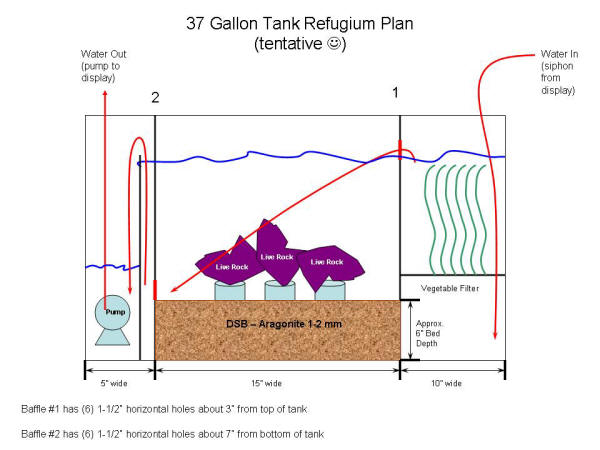
Refugium setup 8/19/06 Mr. Calfo/Mr. Fenner I have been reading your book Reef Invertebrates for help with setting up my 180's refugium. The tank itself has a 4" DSB, but for the fuge I was hoping to convert my 55 but space is at a premium as all has to go under the stand. I found a 20 X high (24H, 20W, 10D) to fit and drilled it for a 1/2 feed and 1" return with a DIY skimmer bar. <All too small...> I know bigger is better but this is all I can fit. I have some nice Caulerpa already and would like some help on lighting and flow and what I could add. <Is posted... see here: http://www.wetwebmedia.com/marsetupindex2.htm see the "fourth paragraph" down?> The feed line comes off a manifold that is T'd off from the main tank return that can be adjusted as far as flow with a gate valve. I figured I could build a small manifold to spread the flow around inside the fuge. I want a veg filter fuge and would like suggestion to add to the Caulerpa. I was going to go with a 6-8" DSB <... there's no room for this here> and add the algae and a few feather dusters and a green serpent star. Lights due to your reading I got a 96W PC that will be on a night cycle. Is this light too strong? How much flow would you recommend? I realize a bigger fuge would be better here but something is better than nothing. The tank is going to be heavy on the fish side and low on coral side ( a few SPS for some color) with a wide array of inverts (snails, crabs, shrimps, clams) set up Berlin style with strong skimmer and 200 lbs of LR and a OceansMotions unit for closed loop flow. Any advice or tips on my fuge selection is welcomed as the tank will be up by Labor Day I am planning. Thanks Jeff <Keep reading; your answers and much more are posted. Bob Fenner> Re: Refugium setup 8/20/06 Mr. Fenner thank you for the reply I have been reading all day (in your book and on WWM) for like 6 hours and I'm a little confused. Your book on pg. 48 you say small refugiums can still be worth while, <Yes, are so> but on the site and below it seems that if this is all I have room for then I should just leave it out. <Mmm... well... bigger would be better... you just won't be able to do "all that you'd like" with something of this size, dimensions... For instance, the DSB you mention... where will the "transit volume" of water (the water in play) go to should the pump or electricity fail? Need to determine the maximum height here... like fill the sump and tank up w/o the pump/s on... turn on, see/mark how far the water "draws down" on the sump, label this with a marker as the "Maximum" to allow it to be filled> Which one should I go with? Can the 20 X high fuge with 96 W light be made useful? <Yes, though if you could devise/construct a container of larger Width and Length that will fit... I would do so> What would you suggest I stock it with if I can use it? From reading (book & site) a deep sand bed 6-8" <Maybe 4-5"...> and LR, with a couple feather dusters and serpent star? <Mmm, not the latter... too predaceous> I am very confused as it seems there are several avenues to take. <Oh! There are!> Here is what I do know The 20 X high is all I have room for, maybe down the road (next home) I can build the 180 backed up to a wall where I can employ a large veg fuge on the other side but now with the calcium reactor and CO2 tank, sump/skimmer and Oceans Motions unit and Hammerhead pump all I have room for is a 20 X high (which I bought because it was the largest volume I had room for) as the book suggested. I hate to waste your time but being this is what I have what would you suggest to best benefit my 180? I am tired of reading. LOL Thanks again Jeff <Mmm, twenty inches in height is fine... do you understand what I'm referring to as "transit volume"? You're "about there" in understanding... do take a bit more of a read through WWM, using the search term "transit volume"... reading the cached views. Bob Fenner>
Refugium Selection 6/21/06 Hi, <Hello Gina> I am starting a small 40 gallon reef aquarium. I couldn't find anyone that had asked you this questions before, could you please tell me what refugium would work best with a 40 gallon glass aquarium? It measures, 36X18X16. I know you say the bigger the better, but didn't know if the 24" refugium by CPR would be too big and might cause a crack or something. I have an Aqua C Remora Pro skimmer on the back. Could you please steer me in the right direction? I need to grow pods in the fuge. Please let me know. <The larger refugium by CPR is only going to contain approximately four gallons of water at most, not enough weight to cause any harm to your tank. I'd go with the larger refugium.> Thank you. <You're welcome. James (Salty Dog)> Gina Refugium ... des. 5/29/06 Hi Guys and Gals, <David> Love the site can't get enough, but I have a specific question for you today. I am upgrading from my 15 gal tall reef (which I have had great success over the past year and a half) to a 135 gal with a 40 gal low sump/refugium. <Some improvement now!> In the refugium I want to keep Chaetomorpha and be able to produce a natural food source for the main tank as well as Natural Nitrate Reduction. I have the first of three chambers housing my protein skimmer PS 75 by Odyssea then through 1st set of baffles to the refugium. The 40 gal is 15" tall so to keep some reserve in case of a power outage I want it to run it at about 11" deep (4" to allow the display to siphon down. I know that the deeper the sand the better but would 4-5" suffice for my intentions of the refuge? <Yes> If so the water will now pass a second set of baffles and flow into the final chamber where I have a mag 9 pump to return to tank. Sorry for the lengthy letter but I want to try to get it right the first time. Finally my last question is do I still require a DSB in the display tank or can I get away with a couple of inches of Indo pacific live sand? <Likely can do w/o the deeper sand here. I would not have more> Also will 2 submersible 150 watt heaters suffice? <Mmm... maybe... I would have three, or two 200, 250's... Depends on the ambient thermal conditions, make of the tank...> FYI I am using an over flow with a single 1.5" bulkhead assuming I can get 500gph from this. <Can, but I'd go with two two-inchers... for noise reduction and upgrade potential...> I also will be using a Fluval 304 canister as well as power heads in the display tank. <... a canister filter? I would not do this> I know your going to give me heck but I have had 2 anemones/distichopora/polyps/colt coral/Kenya tree coral in my 15 gal with no problems mind you I keep a very close eye on it. Thanks again for all of the good you do to help people in this hobby. Thanks, Davey Jones Locker lol. <Aye be gar (what does this mean?) Bob Fenner> Refugium intake and outtake ... design - 5/18/2006 Hello WWMCrew !! <Esteban> First off, let me say that any time I have a question or need to research something before I buy it - I go to your site. It's comforting to know that there is information on your website about ANYTHING I ever need to know. With that being said, why the need to even ask a question? <Heee heeee!> Well, my question has a specific answer that is a hybrid of the WWM information. Anyway. I have a 250 gallon saltwater tank that currently has 150lbs of live rock (soon to be 250). Two overflows on the tank. A sump with sock filtration <Very useful... where "kept up with"> and an Iwaki 100 running into a Reefconcept (local brand) skimmer. Now, I want to setup a refugium in order to lower my eventual nitrates. Questions: 1.) Should I get a 55gallon or 75 gallon aquarium (each having one overflow) as my refugium? <"The bigger the better"> 2.)Will only having one overflow that returns refugium water to the main sump (via gravity) negate the effect of 20 more water gallons I would have from purchasing a larger 75 gallon aquarium? In other words, will a bigger tank just bottleneck itself with only one overflow return? <Mmm, nope> 3.) Will I still have to make 10% water changes every week even with these lower nitrate levels? Or can I do 5% every week or 10% every two weeks? <You'll see, be able to judge> Thank you in advance so much ! Ramon <Thank you for sharing. Bob Fenner> Deep Water Reef Tank? Tying together with another system via a refugium gambit - 5/18/2006 Greetings, I'm a long time viewer, but a first time writer. I have a very healthy 65 gallon LPS Pacific Lagoon reef tank with a custom 30 gallon sump/trickle filter and a custom separate 10 gallon 'fuge. I have over 130 lbs of live rock and about 60 lbs of sand in the main tank with a deep sand bed in my Chaetomorpha refuge. I also have a custom 4 foot counter current skimmer. The tank is lit by 2 175 Watt 10,000K halide lamps and 2 65W Actinic Power Compact lamps. Ammonia, Nitrite, Nitrate & Phosphate are 0. PH is 8.4, Temp varies between 75-80 degrees F, Calcium is 420 and Alkalinity is 11 dKH. I drip Kalk as top off water, and do bi-monthly water changes. For the fish load, I have 4 Chromis viridis (Green Chromis), 2 Pterosynchiropus splendidus (Green Mandarin), & 1 Zebrasoma flavescens (Yellow Tang). The corals are mostly LPS including: Euphyllia species (Hammer, Anchor, Hammer Branch, Frogspawn & Torch), Favites Brain, Lobophyllia Brain, Physogyra Bubble Coral, Caulastrea furcata (Candy Coral) and assorted zoanthids and mushrooms. Now the reason for my email... I was recently given a 29 gallon tank and wish to do a deep water/cave Pacific reef. I was planning on having some gorgonians, Carnation corals (Dendronepthya species), <Hard to keep...> Tubastrea (Sun Polyps), as well as some fan worms and sponges. I have an additional siphon overflow and a 600 g/hr return pump and was wondering if this type of setup will be able to be plumbed into my existing filtration/sump? <Mmm, could be> I know that I can do it, but would the water parameters and temperature be acceptable for such an entirely different ecosystem? <A given/guessed at risk, and benefits as well...> I have researched the feeding needs of most deepwater organisms, and know that my system produces tons of 'pods from the refuge. Combined with regular feeding of Artemia nauplii and live phytoplankton, will this be enough to feed the non-photosynthetic life? <Mmm, not likely. You will find that you need other provided foodstuffs> Will this feeding foul rest of the 'lagoon tank'? <Again, a possibility> I'm afraid to do this and lose my corals, but I also want to give these demanding non-photosynthetic corals the best chance possible as well as have something different from the traditional reef. Thanks for your time and expert advice. Steve Sochalski <Thank you for sharing... I would encourage you to provide another, separate sump for this new, small set-up... too much to risk by combining with the animals you list. Bob Fenner>
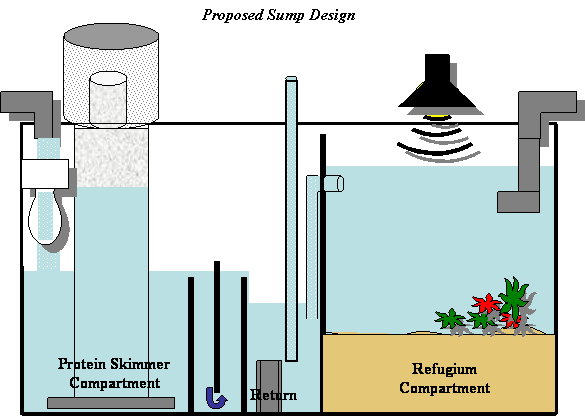
Sump/refugium design questions... more reading, cogitation to do - 4/24/2006 Greetings, WWM gurus! <Howdy Scott> I'm designing a sump, for my 75g, using a 20g (long) glass tank. I want this to be both a refugium (for macro-algae to eliminate nitrate and other waste), as well as provide enough bio-filtration that I can remove my HOB bio-wheel filter, and just run powerheads in the main tank. <Okay> I have about 20lbs of LR in the main tank now, adding more all the time, but I won't have the 1.0 to 1.5 pounds/gallon needed for LR filtration for some time. <Likely no worries> In my design so far, basically there's a suspended area on one end for bio-balls or rubble, a baffle next, which overflows into the main/refugium area (mainly for macro algae to help reduce nitrate). <... where be the skimmer chamber?> The height of that baffle will depend on if I want to submerge my filter media (bioballs or rubble). The refugium will be about 1/2 the tank, leaving about 1/3rd for return pump and future skimmer. <Mmm, do give the area on WWM re refugium designs a read (again?): http://wetwebmedia.com/refugdesignfaqs.htm and the linked files above... I would make a "constant level" area/weir at the "front" of your sump/refugium to accommodate the skimmer... from the get-go> I figured 2g of bio-balls would be enough for a 75g (since each g of bio-balls are supposed to handle 45 to 60 gallons). <... I would definitely skip a/the bioballs area... see WWM re> Would LR rubble, filling the same amount of space, be as or more effective? <More so> Is it best to have rubble wet/dry/trickled, or submerged? <The latter> If it should be submerged, I can turn the rubble containment area into a corner box or something. <Yes> For 2g of bio-balls, I'm allocating an area 4.5" wide x 9" tall x 12" depth, or 526 cubic inches. <Again, there are better uses of this space, money...> If I use LR rubble, in the wet/dry section (where water trickles over) is that enough LR, or should I increase the space allocated? <... please read the above linked areas> Or, is LR better submerged? I want to have a large volume for potential overflow in the event of power or pump failure. <Very good idea... test for this eventuality> If standard operating water level in the sump is 3", that will give me about 15.4 gallons of overhead, should the pump stop returning water to the main. That's about 3" of water in my 75g, which should be very easy to work with. <Good. You seem to have the concept> With 3-5" of water in the main area, that's about 4.6 gallons contained in the sump, half of which would all be pumped to the main tank if the siphon fails. That's barely over an inch of water to the main. <About right> So, I'd operate the tank about 1 inch below the very, very top of the tank, <... and the overflow level> and never have to be concerned with overfilling the tank. With the overflow siphon in the tank setup with about 1" of water over the "spill" level, I'd never have to worry about the sump overfilling. <Nor hopefully overfilling the tank itself should the siphon overflow fail> There'd be lots of leeway on either side. I'm not getting the benefit of adding a huge volume of water to the system (around 5 or 6 gallons total added), but it should be effective bio-filtration, a good place for a heater and skimmer, and I'd also not have to worry about flooding. Scott S. <Bob Fenner> Refugiums 4/20/06 G'Day from Downunder crew, <Howzit?> I am writing to get some advice on some changes I would like to make to my reef system. I have a 120 gallon reef tank that has been going for around 6 months and I have read with interest many of the posts regarding the use of a refugium. There is no one yet that I have found in my area that uses a refugium and my LFS has not used one or set one up either. <They will... assuredly> They gave me some feedback regarding their thoughts on the use of a refugium and agreed it may well be a beneficial addition to my system but could not comment based on experience. I have limited space under my tank (Australian houses rarely, if never, have a basement as many American households do <Actually, very few on the West coast do> and all I have is a large concrete slab) due to the chiller, sump and hosing and as such I have devised a plan to convert a section of my sump for a refugium. I have a 15 x 8 x 7 inch section that has been used to house bio balls and my LFS has instructed me to slowly remove these as the system matures. Would this be sufficient to create a refugium? <Yes... though larger would be better, this amount of space will make a discernible improvement> I am mainly after an environment that I can support the growth of macro algae's, amphipods and copepods etc to feed my live stock. I currently have a plenum setup in my tank (convinced to give it a go by LFS and to date it seems to be going well) so I assume I do not need a deep sand bed in my refugium? <Not necessarily, no> A second option is to plumb the chiller to the outside of the cabinet but this although not difficult would possible be less aesthetic (especially to the other half). <Very important> This would give me room to add a 24 x 14 x 18 inch refugium <Perhaps later...> and leads to me on to my second question (if I may?). Am I better off using that available room for a calcium reactor and sticking with the smaller refugium in the sump? <... can't tell from the information provided. Both pieces of gear are worthwhile though> I plan to extend my live stock to include SPS corals in the next 3 - 6 months once I am convinced I have my water qualities sorted and more importantly stable. I appreciate this is a bit all over the place but appreciate any time you could spare to enlightening me on these two subjects. <Reads like you've been reading and understand underlying principles, consequences. Am sure you've been over the materials archived on WWM re Refugiums... Bob Fenner> PS I would like to applaud Bob Fenner on the "Conscientious Marine Aquarist book he wrote. I recently purchased it and have probably read it cover to cover twice now. Cheers Marc "Best" Sump/Refugium Setup? - 04/16/06 Greetings from England, <<Back at ya from South Carolina!...but I did live in Ipswich for 3 1/2 years...>> I am in the process of spending the (vast) amount required to setup a FOWLR setup. <<Indeed mate...and a bit more "vast" over there than here!>> This will be my first marine tank, so I'm doing an awful lot of reading first and your site has proved by far the best resource on the net. <<Thank you for this...but please don't limit yourself to a single source/opinion>> My tank will be 1,200 L aprox (a 7 foot tank) and my prime objectives for it are for it to be as fish friendly and easy to maintain as humanly possible. <<Ahh...a "dream" tank then? <grin>...>> I would also like to build it to be as quiet as possible. <<Married, eh?>> My questions relate to the filtration and general "underneath" set up of the tank. <<Is that a "technical" term? <G> >> After a few re-designs, I THINK I've settled on the following. <<Alrighty then>> My problem is that there are so many options that I'm drowning in choices! <<But at least you have "choices">> I wonder if you could look over the following and answer a few questions? <<Be happy to>> The tank will have between 100 and 120KG's of live rock in it, with live sand to maybe 1" deep. This will be supplemented with another 2" or so of "normal" sand which will hopefully be colonized over time. <<It will...but might I suggest you add 3"-4" of the "dry" sand, and place the "live" sand on top of this>> Beneath the main tank, there will be two cheap 3 foot tanks. Each will be in three sections. <<ok>> The main tank will flow into the first small tank, which will be a sump. This will have crushed LR in the first area, which will hopefully act as some sort of crude mechanical filter. <<Some settling will occur here, yes>> My other thought would be Lava rock in this position. <<Mmm no, I don't recommend this...possible introduction of unwanted elements (metals, etc.)...stick with the live rock rubble>> This then overflows into the main section, which will hold the skimmer, heaters, any dosing gear I eventually buy etc., etc.. There is then a return area to the main tank. <<Were this me...I would move the skimmer to the first chamber to catch/process the raw surface water from the tank, and move the crushed rock to the center chamber>> From the first chamber in the sump, there will be a low velocity (3-4x turn over) feed into a separate 'fuge. This again will contain crushed LR in the first (small) section, and then have a 20" x 7" deep DSB/Miracle Mud area, with macro algae above it. This overflows to a third, small section that will feed back into the third chamber of the sump, meaning that anything that the 'fuge generates does not get skimmed. <<An important consideration...>> This will be lit on a reverse cycle to the main tank, to avoid major fluctuations in stats, etc. Firstly, does this seem suitable? <<With a few caveats, yes>> Have I missed anything major? <<The placement of the skimmer...in my opinion>> Secondly, some more specific questions. 1) I can't decided between MUD and a DSB. I read many opinions on each saying that one is better than another. <<That's opinions for ya! <grin> >> Is there a "right" answer? <<I have not used a "mud" substrate myself...but neither have I heard/read anything to convince me to switch from a good ole' sugar-sand DSB>> If not, which would be less maintenance/better for the fish? <<I don't like the idea of having to periodically "replace" portions of a mud bed...would much rather just "top off" my DSB as it "shrinks" from dissolution. As for which is "better"? If employed/maintained as intended...either I think>> 2) I have read that DSB's benefit from being turned over, and lots of suggestions as to what makes the best "turner-over", with everything from brittle stars to gob's suggested. <<Mmm...not "turned-over" as such, maybe just slightly "disturbed" (or maybe I'm thinking about myself...), though a sugar-fine DSB with adequate water flow will do just fine on its own (worms/micro-crustaceans)>> What would be your personal recommendations? <<I like/suggest less invasive species than some others here. I DON'T like sand-sifting starfish, much too efficient at what they do...will quickly deplete the biota in your sand bed...my opinion of course. Sand-sifting/sleeper gobies can be of benefit, but many of these are far more destructive than I like (Genus Valenciennea). My suggestion would be a bullet/dragon/brown-barred goby (Amblygobius phalaena). The gobies don't tend to dig as "deeply" as the Valenciennea species in my experience, nor do they seem as likely to grab mouthfuls of sand and "crop dust" the corals high up on the rock...though sand/bottom dwelling critters will get a sprinkle or two...but then these usually have mechanisms for dealing with it>> 3) Bob states in his book that Ozone is the best thing to add to a system, and so I am planning to add it into the skimmer. However, the ozone units that are practical to buy will not allow a skimmer of the size I plan to use to be fully supported. It would need to be 75% air and 25% ozone. Will this still generate the correct affect? <<Not sure I follow/understand this line of thinking. For your size tank, an ozone generator in the 200mg-250mg range should be sufficient. How "effective" it is will depend on the quality/efficiency of the generator...and I suggest you also employ a controller>> 4) As there seem to be so many vocal supports of both the Berlin method and the Ecosystem method, can I take it that both are equally as effective when used correctly? <<Likely so...many folks employ different methods/combinations of methods quite successfully>> 5) Will I have to modify anything in this design in a year or two if I move into making a reef tank? <<I don't think so...other than maybe adding more flow to the display tank>> Many thanks indeed. Steve <<Quite welcome, EricR>> Refugium Confusion (Installation/Methodology) - 04/16/06 Hi, <<Howdy>> I have an established 200 gallon acrylic reef aquarium that has a Tunze filtration system built on a rail system that sits on top of the tank. <<Deja Vu...I think I've been here before <G>...EricR here again>> The system includes a protein skimmer, also on top of the tank. <<Yes, typical for this manufacturer/method of employment>> The only other openings are the large access ports. <<Indeed...and typical of an acrylic tank>> There is 6" of acrylic between port and side. Cannot easily access back of tank because of how the Tunze system sits. <<I understand>> We want to add a refugium and have no idea how to make it happen. <<Mmm...and no sump to work with either...you need to install a gravity drain (as outlined in the previous email) to the refugium and then pump water back up to the tank>> We have our old 46 gal with a wet/dry and a 450gph return pump that we want to make our refugium. <<Have you researched and decided which refugium methodology you wish to employ? Mud? DSB? live rock rubble? lighted macro algae? A combination of these?>> It would sit next to our main tank. <<This is fine>> Should it be higher or lower than the main tank? <<Since you don't have a sump from which to pump water up to the refugium I would suggest placing the 'fuge lower than the display tank>> After reading some of the FAQ's I am very confused as far as flow rates, and what size hole to drill and how many. <<If you are only drilling to accommodate the refugium, then a 1" bulkhead will suffice with a 350-500 gph pump (MagDrive) for the return to the tank. If you are can't/are not willing to put the return line through the tank hood to return the water through/over the top, you will need to install a second bulkhead for the return line>> I am also not sure what bulkheads are. <<Ah...a simple Google search re "aquarium bulkhead" can help much my friend: http://www.marinedepot.com/md_viewItem.asp?idProduct=FT1113 ... A bulkhead is a water-tight fitting placed in the "hole" you drill in the tank which then allows you to easily attach your plumbing lines/fittings. Do be aware, a 1" bulkhead requires a 1 3/4" hole in the tank. Another Google search re "DIY aquarium bulkhead installation" will yield many links to examples of same>> I know what an overflow box is, but that is about it. <<I suggest you do some more reading-up to get a better feel for what you are about to attempt. Perhaps there is an aquarium club in your area you could contact for some "hands-on" help/advice...or if you have real doubts as to your knowledge/abilities, pay one of the local fish stores to come do the bulkhead installation (assuming one provides that type of service)>> The Tunze system has an intake of 950GPH, protein skimmer 300gph, 3 powerheads add another 900gph. <<All unrelated to the refugium>> We are looking to upgrade to the Tunze stream system, which will add approx 3000gph. <<These are great...use them myself>> With all of this flow and filtration in the main tank, how important is flow through the refugium? <<Flow through the refugium is slightly less important than flow in the tank. Try to achieve anywhere from 3x-10x the refugium's volume>> What should it be? <<Use a pump that provides from 150 - 500 gph>> I was hoping to find a way to siphon water over to the refugium i.e. overflow of some sort and use the return pump and plumbing we have on the wet/dry to push the water back to the main tank. <<Oh, okay...didn't realize there was an external filter source involved. It might be possible to tee off of the drain line (w/valve to control flow) for the wet/dry and run this line to the 'fuge, and have the refugium then drain in to the pump chamber of the wet/dry (You will still need to drill a hole in the refugium and install a bulkhead for a drain line...I don't recommend using a siphon overflow for this>>. Is that realistic? <<Possibly>> I am very sorry for these novice descriptions, but I am not good with plumbing or drilling issues. <<No worries mate...do try to get someone local (with experience re) over to have a look/help if at all possible>> I know how to clean my tank and take care of my fish. I would just like to take better care of them by adding a refugium. <<Is a step forward...a very worthwhile addition>> Thanks for your help, Jeri <<Please feel free to write back if you have some specific questions and I will try to explain further. Regards, EricR>> Refugium Confusion (Installation/Methodology) II - 04/17/06 Thanks Eric. <<Hello Jeri, you're quite welcome...hopefully I didn't just confuse things more>> I just want to make sure I understand your recommendation. <<Of course>> In the main tank we need 2 -1" bulkheads. One to drain to the 'fuge and the other to return from the 'fuge. <<You only need the one bulkhead for the return from the refugium if you can't/don't want to just bring the line in over the top of the tank>> Then on the refugium, we should drill a 1" bulkhead for the incoming water from the main tank. <<Not necessary for the "incoming" water...you can feed in from the top here as well>> Allow the water to go in the overflow down through the wet/dry and pumped back to the main tank. <<Mmm no, not back through the "overflow". You can/should use the return pump of the wet/dry, but let the sump drain in to the filter's pump chamber (will likely mean adding a bulkhead to the wet/dry for this). This is where the bulkhead in the refugium comes in...to allow water to drain to the wet/dry filter's pump chamber>> In the main tank with the bulkhead that will take water out to the 'fuge does that need to be covered with an overflow box? <<You will need some way to control water height, yes. You can do this with an overflow box as you mention, or you can simply use a PVC 'ell' on the inside (may need to be cut/trimmed for that "perfect" size/configuration) and "rotate" the fitting to control water flow/volume>> How far down should the bulkhead be drilled? <<Hmm...this is subjective, but I drill my holes so the "edge" of the hole is spaced the "diameter" of the hole away from any seam. In other words...the edge of a 1 3/4" hole (for a 1" bulkhead fitting) will be 1 3/4" from the nearest panel edge (top AND side if drilling in a corner). Is it safe to drill into a tank that has livestock in it? Obviously we have to lower the water level, but other than that is it safe? <<In my experience...yes>> What kind of tool is used for acrylic? <<The "Bi-Metal" hole saws used for wood work well for me...like this: http://www.homedepot.com/prel80/HDUS/EN_US/diy_main/pg_diy.jsp?CNTTYPE=PROD_META&CNTKEY=Products_2%2FPower+Tools%2FHole+Saws+%26+Accessories%2FSets&ProductOID=620925 >> For glass? <<You will need a diamond core-bit...like those found here: http://www.shopsmartxpress.com/AmeriGls/AmrDefault.htm?M9.htm >> I do plan on doing a lot more reading before anything else. And I'm sure my husband will do some research on it as well. <<Please do... Drilling glass or acrylic is not difficult but does require the proper tools/preparation/knowledge. You will also want to make sure the glass on your refugium tank (wet/dry?) is not "tempered" glass. Many tanks under 55 gallons are not, but check with the manufacturer to be sure. If you try to drill tempered glass the sudden release of surface tension as the bit starts to grind will cause the glass panel to "explode"! This is not particularly dangerous as long as you have on your safety eyewear...but it WILL scare the bejesus out of you. And obviously, it ruins the glass panel...along with your underwear <G>... Drilling acrylic is usually a bit less "dramatic' <grin>, but still requires some "finesse" to keep from "sticking" the bit. Research is definitely a requirement>> I just wanted to get us pointed in the right direction. <<I understand my friend...do some reading-up on the tools/procedures before starting...and let me know if I can elucidate further>> Thank you for your help. Jeri <<I'm happy to try; thank you for writing so well. Regards, EricR>> Tank/Refugium...Order of Setup - 04/12/06 Greetings crew!
<<Howdy!>> Thank you for your contributions to reef
keeping. <<Is a small effort>> I am a big fan of the
Natural Marine Aquarium Series and find your refugium analysis
compelling. <<Ah! As do I...>> I am starting a
36 gallon breeder tank (36 long x 18 wide x 12 deep) with a large
(24") CPR HOB refugium, 4x96 watt compact florescent, lots of
water movement and no skimmer. <<No skimmer?...a shame...would be
helpful>> I will change 1 gallon a week.
<<(!?) I hope this was a typo! Weekly
"1 gallon" water changes will not suffice in my
opinion.>> I will be using LR and LS from Tampa Bay Saltwater in
the display. The refugium will use Kent Biosediment, a reverse
photoperiod light and will house my heater. This will be a
soft coral tank with possibly 2 fish. I will be taking
things quite slowly. I want the tank and fuge to mature
before I build a population. Question: what order do you recommend
setting up the two environments?: 1) LR/LS in main tank first, allowing
the cycle to complete. Followed by setting up the fuge with
Chaetomorpha. 2) Set up the refugium first then do the LR/LS and cycle.
3) Do both at the same time. 4) Something else. <<Number 3...both
at the same time...is what I would do/did on mine>> Regards,
Chris Rousseau <<Cheers, EricR>> Refugium
Plumbing/Critter Transfer - - 04/10/2006 WWM gang,
<<"Gang" member EricR here>> I am in the process
of setting up my 265 tank (i.e. - still designing and have nothing set
up). <<Ah yes...good times...>> I have 4 overflow drains, 2
going in to a 30gal refugium that then flows into the reservoir where
the other two also drain. This then holds the skimmer and is
pumped back into the tank. <<Mmm...I would plumb things so the
refugium empties in the pump chamber, thus circumventing the skimmer as
this will remove many "desirable elements" coming from the
'fuge>> I'll have a closed-loop system also but
that's not important (I think) to this. My hope is to
have tons of copepods so I can have my favorite fish (hopefully male
and female pair of) Mandarin Dragonets. <<Very "cool"
little fish...but as much as a year or more down the road I guess you
know>> I will have a good amount of live rock and crushed coral
(fine grade) in the tank, but I am trying to figure out if the copepods
will get up to the tank from the Refugium w/this set up? <<In
deed they will, if you don't suck them all up in the
skimmer...>> I can still change the plumbing if I need to... Did
I not think this through just right? <<Consider my suggesting
about avoiding the skimmer with the refugium effluent and you'll be
fine. The "best" configuration if you wish to
tackle...would be to place the 'fuge "above" the display
and allow it to gravity feed to the tank>> Can I trap the
copepods and set them free in the tank above? <<Hmm...not sure
how you would accomplish this just offhand...but not necessary in my
opinion...they will get there.>> Thanks, |
|

|
Features: |
|
| Featured Sponsors: |