FAQs About Red Ear Slider (RES) Turtle
Disease/Health 4
Related Articles: Treating Common Illnesses of
the Red Ear Slider (& other Emydid Turtles) by Darrel
Barton, Turtle eye diseases; Recognising and treating
eye diseases in pet turtles by Neale
Monks, So your turtle has the Flu? Recognising and
treating respiratory infections in pet turtles by Neale
Monks, The
Care and Keeping of the Red Eared Slider, Trachemys scripta elegans by
Darrel Barton, Red Ear Sliders, Turtles, Amphibians, Red
Eared Slider Care, Shell Rot in
Turtles,
Related FAQs:
RES Disease, RES Disease/Health 2, RES Disease 3, RES
Health 4, RES Health 5, RES Health 6, RES
Health 7, RES Health 8, RES Health 9, RES
Health 10, & Shell Rot,
Turtle Disease 1, Turtle Disease 3, Shell Rot, Turtle Respiratory Disease, Turtle Eye Disease,
FAQs on RES Health by Type:
Diagnosis, Environmental, Traumas, Social, Nutritional, Growths/Tumors, Infectious, Parasitic, References,
& Sliders 1,
Sliders 2, Red Eared Slider Identification, RES Behavior, RES
Compatibility, RES Selection,
RES Systems, RES Feeding, RES
Reproduction,
|
|
|
Red Slider Health 6-15-2009
Hi,
<Hiya! Darrel here>
I have a Red Eared Slider, (Nick, for in a nick of time),
<I thought maybe it was a name you just thought of while
shaving.>
I rescued from a coworker. It is about 9 inches long from head to
tail, and was living in a ten gallon aquarium.
<9 inches is a very well grown female .. and 10 gallons was
WAY too small!!!!>
My coworker changed it's water only every few months and it
had a basking dock that was way too small to keep it out of the
water. In addition to that she only fed it turtle pellets and
left the regular lights on 24/7 when they weren't burned out
for months on end.
<Your co-worker isn't what we consider a 'pet
person' is she? In fact what we're likely to call her --
isn't suited for a family-oriented web site.>
At one point it quit eating for over a month. She had it in this
condition for two years. I convinced her over the summer to let
me take it home with me.
<Thank you!>
I now have it in a 55 gallon aquarium with a nice basking dock,
heat light, UV light, and a varied diet. It (not sure if it is a
boy or girl)
<A girl probably. Boys max out at 5-6 inches>
... was thrilled with the change in living status but has a slime
that hangs from its skin when it's swimming and has shell
issues.
<The song is over ... but the malady lingers on. The slime
could also be a fungus. You can swab the effected areas with any
commercially available athlete's foot cream or any other
anti-fungal. Let it dry for an hour before putting Nick back in
the water.>
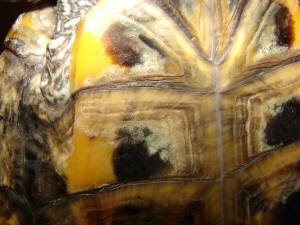
There are dark and light spots on the shell, the light spots are
around the edges mostly. There did appear to be algae under some
areas but this seems to have cleared up with the special lights
and basking dock.
<That two tone shell coloration is a typical color variation
for Sliders that age/size and isn't an issue. The cracking
around the edges appears to be the remainders of some shell
degradation (undoubtedly due to the original poor care). I would
expect it to improve a bit with time but never fully go
away.>
<The whitish areas in the pictures is likely hardened remnants
of the algae/slime that has been affecting her ... BUT ..... it
may be as simple as water spots or mineral buildup. Really. We
see many people concerned about that kind of condition .. white
spots and slight buildup .. and we just take the turtle and a rag
with a tiny bit of CLR and just wipe it clean and then rinse
it.>
<Sunlight, UV and a good diet (Repto-min food sticks or a high
quality Koi Pellet) is most likely all it will take.>
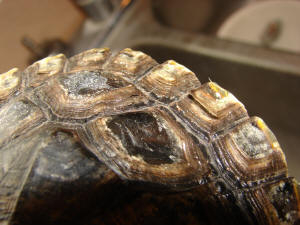
The edges of the shell around the perimeter are coming off in
sheets. Not just the top layer flaking off but a few layers at a
time. I have included pictures but need to know where to
start.
<Laura, I'm not seeing anything in those pictures that
concerns me. That shedding is natural growth of the shell and
considering that the shell has sustained a small bit of permanent
damage, it doesn't surprise me that it's shedding from
the center rather than the edge.>
<Nick is going to require a bit more attention to water
quality, fungal prevention and UV exposure than average. For
example, about once every other month I'd swab her entire
shell with an anti-fungal, allow it to dry a few hours and then
rinse with household vinegar. Make sure she eats well, basks
daily and gets DRY regularly and I think she'll do well in
your care.>
Thanks for your help!
Laura
<Laura, thank YOU for jumping in (that's a WetWebMedia pun
-- get it???? ) and saving Nick with your care and commitment.
She owes you!>
|
  |
Slider with bulge on side of head??? 06/04/09
Hello W.W.M. Crew,
<Hiya John, Darrel here>
I have a Red Eared Slider that is still very small. Recently I noticed
that on one side of his/her head its beginning to bulge. I noticed a
white spot at first and just recently discovered that it is beginning
to bulge. This is isolated to one side of the head. What could be the
possible diagnosis,
<If the skin is bulging my guess is that the turtle has an abscess.
It could be a bacterial or fungal infection that started on the surface
and grew inward>
and can it become fatal?
<yes>
What are possible treatments?
<The only proper treatment is to have a veterinarian open the pocket
and express the contents, John. If it's bacterial or fungal then
cavity can then be washed with the appropriate agent and stitched --
and then a course of medicine. If it's some kind of actual growth,
then the opening becomes the first step in the surgery to
correct.>
<I'm sorry to say, John, this is not one to try at home>
Thanks,
John C. Mabe III
Re: Slider with bulge on side of head??? 6/30/09
Hello W.W.M Crew,
<Hello again -- Darrel here>
I have a Red Eared Slider as I have mentioned before, and the bulge has
completely disappeared, thanks for the advice.
<The only advice I gave was to have a veterinarian treat the
abscess. This sort of thing doesn't "disappear" on
it's own, John ... so if there was no treatment of the bulge, the
probably abscess burst & released the infection into the rest of
his system.>
The new thing is that he now has begun to have large gapping
breath's and kind of squeaked on occasions as he does. I noticed
that he is now sneezing and discharge is coming out of his mouth.
<There you go. Sneezing and discharge are -- at the very least --
signs of respiratory infection.>
He also has lost his appetite.
<Because he's very sick>
My guess is that the temp of the water might be to cold? Lately its
been around 72.0-74.0 degrees.
<Perfect water temp as long as the basking area is 85-90 degrees and
the turtle is able to move easily between the basking area and the
water.>
I have an under-water heater that is supposedly set to the optimum
temp??
<No water heart necessary for turtles, John. Any room temperature
you can live in is fine for their water as long as they can get out of
the water to get warm and dry>
Now that he has symptoms is there something I can do to cure him
besides getting a heater that works right??
Thank you very kindly,
John C.
<John, at this point I'd say that you're only real hope is
an experienced veterinarian. He HAD symptoms before (a bulge on the
neck, remember?) that wasn't properly treated ... and now things
are much worse.>
<I realize that, for many people, a trip to a vet is simply out of
the question .. and that leaves us with second and third rate
treatments .... very poor substitutes ... that will almost certainly
not really help. In this case, the only thing left to you is to take
the turtle out of the tank entirely:>
<so:>
<Recognize immediately that the very environment preferred by the
turtle, warm and wet ... is also the optimal environment for the growth
of fungus and bacteria -- and even if neither are the primary illness,
you can be assured that if you leave a sick turtle in a warm, wet
environment long enough, fungal AND bacterial will seize the
opportunity to take hold and take over. For this reason, the single
most immediate treatment for any illness in a turtle is to remove them
from their tank, pond or enclosure and place them somewhere warm and
dry. Remember that, in the wild, water turtles occupy the habitat
AROUND the water as much, if not more than IN the water. Moreover, a
turtle in good health can survive months out of water and a sick turtle
really needs the rest.
A temporary shelter can be anything from an empty aquarium to a plastic
bin or trash can or even just a cardboard box with high sides (keep in
mind a determined turtle is an incredible climber). Add a heat source,
which can be a regular electric heating pad (if you're lucky enough
to be able to find one without the annoying 'automatic off'
feature) to a light bulb suspended over head. Ideally you want to
achieve a constant temperature of between 85-87 degrees. Since we are
deliberately taking away the turtle's choice to move from cool to
warm, we have to pick a constant that fits both needs. NOT having to
move between temperature zones and not having to swim or climb is the
first step on giving the turtle the ability to direct
his attention more toward healing.
You must also provide UV-A and UV-B light sources(NOTE 2), which
perhaps can be moved from his original enclosure or -- in the
alternative, a minimum of 10 minutes of direct (NOT filtered through
any kind of glass or screen) three times a day.
Assuming he is healthy enough to be moving, the regimen will be to
place him in a shallow container of luke warm (room temp) tap water
every day for 5 minutes in order for him to drink, poop and possibly
eat. Shallow means no more than half his shell under water when you
place him in it -- and really only enough to cover his tail and cloaca.
Assuming that he is being treated for his actual condition and
improving, he can go YEARS in this condition without ill
effects.>
<John, this MAY help the little guy's immune system be a bit
more able to fight off the infection, but I doubt it>
Red Ear Slider unable to grab food 6/1/2009
I have a red ear slider who is about 6 years old. I am not sure on
sex.
Based on size I would say female but we may have seen it's male
parts.
<The urogenital systems of turtles are largely internal, and the
penis won't be visible unless the turtle is actually mating.
Instead, look firstly at the claws: if they're long, it's
probably a male. Secondly, look
at the length of the tail. Males have longer tails, with the cloaca
(the combined anal/urogenital opening) nearer the tip than the base of
the tail, whereas on females the cloaca is nearer the base of the tail
than the
tip.>
The issue is he wants to eat but has trouble grabbing the food. He is a
bit lethargic and is no longer aggressive during eating time.
<If a turtle is clumsy when trying to feed, as yours is, that's
a fairly reliable sign of poor health. Review environmental conditions.
Check that the water is adequately heated, that the turtle has access
to UV-B light, and that the water is changed at least once a week.
There's a good summary here:
http://www.wetwebmedia.com/fwsubwebindex/RESCareBarton.htm
Also check that the turtle isn't wheezing and that it's eyes
are clear and bright, not groggy-looking or swollen
http://www.wetwebmedia.com/fwsubwebindex/turtrespart.htm
http://www.wetwebmedia.com/fwsubwebindex/turteyedisart.htm
These are both very common problems caused by improper diet, lack of
warmth, etc. Since turtles should live 15+ years, that you lost one
that was only 6 years old is a bit worrying. Some problems, such as the
lack of UV-B light or the lack of vitamins can take months, even years,
to cause death.>
We had another res which passed a few months ago I believe the temp got
to low we since have added a heater to the tank.
<Would be careful here; turtles can, will destroy glass heaters. Put
a plastic mesh called a "heater guard" around the heater.
Some heaters come with these anyway (or at least, they do here in the
UK) but aquarium shops sell them for use with cichlids, catfish,
etc.>
It appears he sees the food but just can't quite grasp the food I
have tried meal worms, brine shrimp, romaine lettuce, pellets nothing
works.
<Check his eyes!>
We were able to hold the food with a fork until he grabbed on but that
does not seem to work lately. I am afraid he will die if he does not
eat soon.
Need Help!!!
<Hope this helps.>
Nesa
<Cheers, Neale.>
Red worm & UV light question 05/29/09
Hi, I'm Felix from Malaysia.
<Hiya Felix. I'm Darrel here in California>
I have 3 little turtles in my tank for almost 2 months, have a basking
spot with a 100W light on it and a filtration system.
<Sounds good. Should I make the general assumption that you have
Emydid water turtles such as Red Eared Sliders?>
This afternoon I changed my tank's water and wash my filter. I was
shocked because there are worms in my filter, and I noticed tat my
turtles been eating them, they are small, red and the length of it is
about 0.5CM. Are they dangerous to the turtles? Most importantly are
they dangerous to us humans?
<There are hundreds of small worms and also worm-like creatures that
could be introduced into your tank, Felix. They could be some form of
Tubifex that came in as eggs inside a feeder fish or even inside the
turtle's gut when you got them. As far as harmful to the turtles,
generally no danger except that if left alone they will over populate
and pollute the tank. All creatures like this could potentially be
harmful to humans, which is
why it's important to always wash your hands after touching the
turtles or any part of their enclosure.>
<The proper course of action is to remove the turtles to a temporary
home and sterilize the tank by adding chlorine bleach. One cup per
gallon of water [approx 75ml per liter] (not the size of your tank, but
actual volume of water - including filters). Let the setup run for 24
hours, drain & rinse well with fresh water, then break it down and
wash with soap (such as dish detergent). Fill again and run the setup
for 24 hours, then drain, rinse and refill. This is a long process, but
you have to kill the worms and any larva and/or eggs that they've
left behind. This is why we run the setup with the filter and gravel
and basking areas, etc. - every area the contaminated water could
touch.>
<Now to prevent this, never introduce wild animals, feeder fish,
plants or untreated water into the tank.>
Another question is, my basking area doesn't have a UV bulb/lamp,
should I get 1 or is it ok if I bring them out at the sunlight
sometimes? How often do I have to bring them out? and for how long?
<they need sunlight or UV light every day, Felix. Twice a day for at
least 15 minutes each day -- and during this time you have to watch
them closely because if they overheat they will literally cook to death
in their shells. I strongly urge you to purchase a UV fluorescent light
-- there are brands out there that are quite inexpensive and work very
well.>
Thanks crew, u have a very very nice web page, and it's very very
very helpful ^.^
<We appreciate your compliments, Felix!>
Sick Red Eared Slider 05/19/09
Hi,
<Hiya, Darrel here>
I am hoping you can help me with my Red Eared Slider.
<I always wonder if I can help, too!>
He is a 5 year old male
<Is his name Herky?>
and has been in good health until recently. Approximately a month ago,
we took him to the vet because his eyes had become swollen. They did a
culture and showed me where his shell was pink on his belly. They
advised that he had e coli infection.
<Harrumph>
We disinfected the tank, bought a new filter, etc. We treated him with
antibiotic injections for 14 days and used antibacterial ointment on
his eyes until the infection cleared up. He seemed to be doing
fine.
<Here's my problem with that. E-coli is one of a number of
bacteria that occur naturally in reptiles, so what happened wasn't
that he 'caught' an e-coli infection ... but that some other
situation had debilitated him to the point where a naturally occurring
bacteria was able to get out of control. In essence you may have
treated a symptom and not a cause>
However, 3 days ago I came home and noticed that the cover had come off
of his tank heater. I fixed it and put it back into the tank. I then
noticed
that the turtle was not coming off of his log to swim, which is not his
typical behavior. He would still get into the water to eat but would
immediately return to his rock. I picked him up to look at his belly
and it seemed pink to me. In addition, he looked a bit swollen around
his legs and tail, he seemed a little bit orange where his legs connect
to his body, and he had sores on his feet. I think he must have stood
up on the heater when the cover came off. :( I took him to the vet and
she prescribed a wash and lotion to treat the burns. However, she said
that his belly doesn't look very pink. She said that his legs look
a little bit orange but she is not concerned and that he doesn't
seem swollen to her. I am not entirely convinced that the burns are the
only issue.
<I agree with you>
He is very lethargic and is definitely not himself. If his stomach is
pink, does that indicate a respiratory or other infection? Any thoughts
on the swelling or the orange color on the top of his legs? Any insight
you can provide would be appreciated.
<A number of things.>
<First and foremost, turtles do not need and should not have heated
water. As long as you live south of the Arctic Circle, any room
temperature suitable for YOU is suitable for his water. The point of a
basking area is to given him a warm place in contrast to a cool place
(the water) so he can choose. Your basking area should be 88-95 degrees
(f) [That's 31-35 degrees (C) for those of you that live in the
modern world] and the water 68 to 75. So get rid of the heater
please.>
<Now let's address Herky's actual illnesses.>
<Swollen eyes are a primary indicator of vitamin deficiency, mainly
Vitamin A, but a pink tinge to the plastron (belly) is unusual except
in cases of septic poisoning. I'd run another blood test but then
I'm here and your Vet is there and she's seen Herky and I
haven't and she's had several thousand more hours of veterinary
school than I have.>
<Let's assume he's active and eating. Get some Cod Liver Oil
onto his food pellets or some small pieces of beef liver into him. In
other words, increase his Vitamin A. Make sure he gets sufficient UV
lighting. Compare your care to the enclosed link Habitat, Lighting, AND
Food and adjust what needs adjusting. If Herky is appearing to thrive
(eating, pooping, swimming, basking & sleeping all in good measure)
let's ride this out for a few weeks and see if he improves. If you
can ask the vet to give you some vitamin and calcium injections to take
home (She'll have to show you how to do it, but it's not
hard)>
Thank you in advance!
<Yer welcome!>
(PS. The heater has since been replaced and I already feel like I
terrible pet parent over that incident)
<Ah, don't be silly. Trust me when I tell you that a really
terrible pet parent writes us to tell us that their last 24
turtles/fish/pets, etc. all died after a few months ... and ask if we
can recommend a pet store with a guarantee. GOOD Pet parents make
mistakes ... but they learn from them -- you're one of the good
ones!>
< http://www.wetwebmedia.com/FWSubWebIndex/RESCareBarton.htm>
Re: Sick Red Eared Slider 6/11/09
Hi again.
<Hiya ... Darrel here again!>
So Captain seems to be doing a bit better. The wounds on his legs are
healing. He did get another scab where his leg attaches to his belly.
We went back to the vet and she gave us some more antibiotic injections
and lotion. The scab looks like it is going away now. However, I just
noticed that the underside of his tail and legs look pinkish in color.
I am unsure what I am doing wrong, but it seems like every time I think
he is doing better, I notice something else. I'm worried about him
and I feel like I have been stalking out my vet for the past month. His
tank is very clean but he is still in the tank with Hook, his female
companion. They appear to get along; they swim together and even bask
on the same log at times.
However, he never had problems before we got Hook, and I am worried
that he is stressed or upset and his immune system is weak.
Any help you can offer is greatly appreciated.
<Well, any help we offer is certainly worth what you pay for it
.....>
<Ahem. I wouldn't worry too much about the pinkish color.
It's weird, but as a disease it would almost have to be sepsis,
which is an infection of the blood and everything the blood feeds and
Captain would be a lot worse off than he is now. A LOT. A WHOLE LOT ...
if you get my drift.>
<If you're even remotely concerned about stress, what I'd
like you to do is keep Captain warm and dry for four weeks while he
heals. Put him in a shallow bowl of luke-warm water for 5 minutes every
evening to drink, poop and eat ... then back somewhere warm and dry.
Turns out that a turtle's favorite condition (warm and moist) is
the best possible condition to grow every possible flora, fauna or
fungi that can hurt him.>
Thanks again!
<As always!!!>
Turtles dying in a Natural Pond 5/18/09
Hello,
<Hiya, Darrel here>
I have a friend who owns a property in SW Michigan. The property has a
spring-fed pond about 1.75 acres with varying depths of 5-7 feet, and
some max depths of 14 foot. There are the typical plant and grasses
growing in the pond and has a shallow area in a flooded wooded area.
His property is the only wooded area around and is surrounded by apple,
corn, and tomato fields. The water is pretty clear. We recently bought
10 red ear slider turtles and added them to the pond.
<OK>
The pond has also just been stocked with fish ( 400 3" bluegill,
75 largemouth bass, 100 perch, 50 rainbow trout, and 75lbs minnows.)
The pond appeared to be barren with the exception of frogs, few other
turtles, a muskrat and some small bluegill. Two weeks after adding the
turtles we have found 6 of them dead along with 3 dead large snapping
turtles. The fish all seem to be doing great. We also see some baby red
ear sliders. The turtle die-off has us stumped. Any ideas of what it
could be? Or any starting points on figuring this out would really
help.
<Off hand I can think of a dozen things, Jeff.>
<For one, when you say you 'recently' added 10 Sliders. What
was the average water temperature for the months prior and since?
Sliders can over-winter in cold pond and lakes, sometimes even under a
frozen surface, but they have to slowly condition for that ... and
slowly awaken and accustom to warmth again. My first guess is that
adding 10 sliders -- and that's assuming adult turtles -- to a
spring-fed pond in Michigan in April was a sudden shock to their
system. It's likely their digesting systems stopped and any food in
their gut rotted and gave them infections that killed them. And
that's just guess #1>
<Item #2 is that in a pond with Chelydra (Common snapping turtles)
and Large Mouth bass ... baby sliders have another name: FOOD ITEM.
Where Bass and Snapping turtles live, 1 in 100 sliders survive. And
speaking of food, what were the sliders eating?>
<Item #3 You don't mention when or how the snapping turtles
arrived, but you're talking about one of the hardiest chelonians
ever known. If they were introduced around the same time, I'd guess
it was an environmental/temperature shock. If they'd been around
longer and suddenly died, I'd look at water quality (Ph, toxins,
etc.). Any idea the gallons per hour flow from the spring?>
<Now, all that aside, let's step back and look at the bigger
picture. A spring fed pond that contains some grass and a few fish and
turtles but is otherwise barren. Perhaps it was already sustaining all
the biologics it could handle? Adding 700+ fish to an existing
eco-system like that is a process that takes maybe a year ... 10 fish
at a time ... so that the eco-system can balance itself. Also, getting
back to the original point, what is your basis for belief that this
pond has a bio-system than can handle 700+ fish and turtles?>
<The problem is, of course, it could be so many things that singling
out ONE thing seems unfair, but an overloaded pond is a given ....
it's the one that's inarguable ... so that's where I'm
going.>
Thanks, Jeff
|
Swollen neck, RES 5/4/2009
Hi,
<Hiya, Darrel here>
I have a female Red Eared Slider that is about 3 years old and
about 6 inches long. A few weeks ago I started noticing her neck
puffing up and it is so swollen now that she cant even get it
into her shell. Her head can go in most of the way but not all
the way. The rest of her body parts are swollen as well but not
as much as her neck. What can this be and what can I do to help
her?
<Swelling covers a lot of territory, Jewel -- from infections
to obesity and a number of issues in-between. First, did she just
START swelling a few weeks ago -- or did you just notice a few
weeks ago? Has it gotten worse since you noticed -- or is it the
same? Is she active and eating -- or listless? Does she climb out
and bask for reasonable periods? When she swims, does she have
trouble submerging as if she keeps floating UP -- does she have
problems floating as if she can't help but sink -- or seem
fine in this regard? What about her skin -- is it normal looking,
faded colors or appear to be covered in a gray film?>
<Does she have clean, clear water and proper UV lighting in
her basking area?>
<If you can provide us with some answers to these questions
and a better description of the swelling itself, we can be more
helpful in diagnosing.>
<In the mean time, if there's any question AT ALL about a
health problem, remover her from her tank and keep her some
-place warm and dry ( I often just use a high sided cardboard box
with an heating pad set on low). just about every illness that a
Slider can contract is made worse in a warm, wet environment, so
take her out, keep her warm and dry and then place her in a
shallow bowl of room temperature water for 10 minutes every day
just so she can drink, eat and poop.>
<And please write back with more specific information>
Jewel
Re: Swollen neck 5/5/09
Hi
<Hiya, Darrel here>
First off, if I accidentally call her a him, it's because we
just found out he's a she a short time ago. And thank you
sooooo much for being here and helping me!! I've called
places and gone to 2 reptile stores and they had no clue what it
would be.
I hate to say it but although I look at her several times a day,
I can't even tell you when she started to swell but I have a
photo of her from 1/5/09 and she was looking normal. The swelling
is pretty much the same
since looking at her 2 weeks ago.
<OK>
She does not act listless although her eating drive is not as
ambitious as it was a couple of weeks ago. I did buy new food for
her (turtle food) and was feeding it to her for about 1 week
before noticing her neck. I stopped feeding it to her when I
noticed it. There was also approx 12 feeder fish in the tank that
had gotten large because she could not catch them.
<That's a common problem, Jewel. Fish are not a
significant part of a turtle's diet and as I'm sure you
can imagine, Sliders aren't really adept hunters .. so the
fish grow bigger and just add to the fouling of the
water.>
The water was definitely not clear. I got rid of all of the fish,
cleaned the tank and dropped the temp in the tank to about 78
degrees (it had been at 82-84 degrees).
<The water temperature should be around 72-73 degrees and no
warmer.
Turtles kept indoors should not have a heater of any kind in the
water.
With proper basking temperatures, the idea is that the turtle
will choose her own temperature by basking to warm up or swimming
to cool off, so get that water temperature down please>
She stays mostly in the water or half in and half out because she
gets skittish when basking on the pad. I don't know if she
even knows how to really swim because her tank has never been big
enough to make any waves.
She seems to just sink when I try to show her how its done in the
bathtub. There is a UV light that I leave on all day and eve and
just shut off at night. It is approx 9 months old. And a heat
lamp over the basking area.
Her skin right now is shedding in very thin pc.s of clear or
grayish color.
I think I can download a photo of her if that will help.
<Read the instructions very carefully on the UV bulb, Jewel.
UV bulbs typically have to be very close -- which is to say that
an average bulb loses more than half it's energy at 8-10
inches from the surface. In fact,
at 24 inches above the tank they have no really value at
all.>
<For the moment, keep her warm and dry for a week (as I
suggested yesterday) and let's see if a less stressful
environment will allow her condition to improve.>
Thank you again!
Jewel
<Here's a link for you
http://www.wetwebmedia.com/FWSubWebIndex/RESCareBarton.htm
>
<check every aspect of your care against what's written
and correct anything that is out of line>
Re: Swollen neck 5-7-09
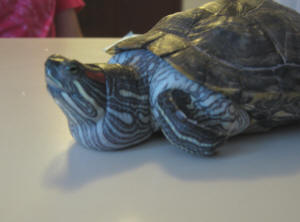
Here's a couple of pics of my RES.
Jewel
<Jewel, that's more than a swollen neck. That's
what's called edema -- a swelling of the tissues with excess
fluids. It could because the kidneys are not eliminating, a
bladder problem or any number of other issues, all serious and
all requiring veterinary care. Best case it's a vitamin
deficiency, Vitamin A&D most likely .. but at this stage
you'll need a vet to give injections. Oral application
wouldn't get enough into the tissues fast enough.>
<I'm sure that's not the help you were hoping for, but
that is, as they say, they way it is.>
<Best of luck to you ... Darrel>
|
 |
Re: Swollen neck 5-7-09
Thanks Darrel,
I actually took her to a vet this morning. He thinks she has some
sort of infection as well as respiratory problems. Mostly all due
to bad water conditions (which was my best guess). He gave the meds
to me to administer
every 3 days. Boy this will be fun! Never gave a shot in my life!
Wish me luck!
Thanks for your help,
Jewel
<Best of luck to you and little Molly>
<To everyone else, I'd like to take this opportunity to
mention that the amount of money and effort that Jewel is going to
spend on treating this illness is many, many, MANY times the cost
and effort of having prevented
the illness in the first place! Whether it be fish, foul, furry or
slithery .... it costs less time, less money and less heartache for
prevention than for treatment.>
<That is all.>
<carry on> |
Please help my red ear slider turtle 5/5/09
Hi, I'm Felix from Malaysia, hope that WWM crew can help me with
this, as I never pet a turtle before, it's my first time:
<Hello Felix! I'm Darrel and we're here to help you!>
Well, I bought 2 of my Red Ear Slider turtles few weeks ago, both are
not from the same pet shop, put them in a small plastic tank, with
water in it, feed them turtle stick which is the only turtle food they
sale here, wash the tank daily, it has a calcium bar in it and I will
pour some anti-chlorine liquid & some turtle clean liquid (which
introduce by the pet shop keeper, it contain beneficial bacteria that
will destroy ammonia and keep the tank clean) every time I wash the
tank.
<To save yourself some time and money, you can use KOI pellets (a
food pellet for Koi and Goldfish) that is as good a balanced diet as
anything else, available anywhere and inexpensive, too.>
<Also, turtles do not need to have dechlorinated water like fish do
-- and if you clean the tank regularly there is no reason to try to
have beneficial bacteria .. so you can save THAT money as well!>
As both of them are still small, like 1-2 inches, plan to get a bigger
glass tank, light and filter when they are bigger... Usually I put
under the sun for around 40 min.s in the morning around 10am, as the
pet shop
owner told me, I didn't use any UV light or basking area, they told
me that turtles need natural sun light, am I doing the wrong thing with
this?
<The amount of UV light they're getting from the natural
sunlight is adequate -- as long as that sunlight is not filtered
through glass or even window screen. Most people don't realize it
but window glass and even
window screens filter out large amounts of the beneficial UV light.
Also, if they ARE out in the direct sunlight, make sure they have a
place to crawl into some shade! Tint turtles can easily
overheat>
<But in their tank they DO need a basking area and that basking area
should have a small lamp over it in order to make it warm. Our goal is
to try to give them a choice -- cool water and warm, dry land -- and
them they will move from one to the other as they feel the
need.>
One of it mostly stay out of the water, it's shell is softer than
the other one, and will just be on the rock which I put in the tank,
with it's eyes close, but it does eat, is it sick?
<My guess is that it's not REALLY sick but that it's getting
sick. I think that, for a while, you should keep both turtles somewhere
warm and dry .. give them a chance to get really dry and warm ... and
just put them
in their water tank for 15 minutes each day so they can drink and
eat>
About my other turtle, it looks normal, eat a lot, and does not close
it's eyes, but something that looks like a white semi-transparent
object grow on it, and those object doesn't not grow on the shell,
but on the turtle's
feet, and neck, which the other turtle doesn't have this problem,
and I'm putting them together in a tank, what should I do?
<It sounds like a bit of a fungal infection, Felix. This will also
be helped from keeping him warm and dry. You can find any number of
antifungal creams at your local store -- the same you would use for
athlete's foot and you can rub a tiny bit on the skin once a
day.>
I'm sorry if my English is not that perfect, I just wanted to help
my turtle, please help me, we don have a qualified veterinarian that
deals with turtles here.
Thank you very much!
<Felix, your English is just fine and thanks for asking. Here is a
link to an article on simple and inexpensive ways to keep a turtle. It
covers everything you asked about and more. Remember, turtles don't
need a LOT of care ... but everything in this article are things they
ABSOLUTELY do need.>
< http://www.wetwebmedia.com/FWSubWebIndex/RESCareBarton.htm>
Another question, please help ^^ 5-7-09
1st of all, thanks Darrel for helping me out...
<No problem -- that's what we're here for! Well, that ...
and free food>
I bought Koi pellets and an antifungal cream for my turtle last night,
and start keeping them at a dry place, and will feed them every
morning, for few minutes, by putting them in water... Really want to
thank you for your advice... I'm going to get a light soon, and a
filter for my turtle, getting a bigger glass tank that can support 20
gallons of water... I survey around for the price, and good that I can
afford it...
<Remember Felix, Turtles live on the EDGE of water .. and near the
SURFACE of water, so if you can .. but a wide & long tank but not
so tall.>
I got another question, about the healthy turtle I mentioned earlier,
every time I touch it's feet, my hand got itchy for a while, then
it will be gone a few minutes after I wash my hand, may I know is it
normal?
<That sound like salt or alkali in the water. You should ALWAYS wash
you hands after handling any reptile (or any animal for that matter),
but turtles don't normally carry an pathogen or contaminant that
will make your hand Ick immediately... so just be mindful of the water
quality and otherwise forget it>
because my other sick turtle doesn't have that problem... I scared
tat it will make me sick too... is it serious?
<No, just wash you hands after handling the turtles, their food or
their enclosure.>
I have few question about my Sliders
4/28/09
Hi! I'm Roxel from the Philippines.
<Hiya! Darrel here from Southern California>
I got questions for my turtles. I have two (2) Red-Eared Sliders (Grub
and Schnitzel) both 4 and a half inch long. Grub is the eating machine
and Schnitzel is the stubborn one.
<But Schnitzel DOES eat, correct? Just not as much as Grub?
Sometimes, when one animal is particularly dominant, the other just
doesn't thrive ... or at least, not as well. If you suspect
Schnitzel isn't eating - or not
eating ENOUGH -- take him out of the tank and place him into a private
container of water 1 inch deep once a week. Give him an hour to
acclimate and them give him a private feeding. See if, after a couple
weeks, his appetite improves.>
One day, I'm cleaning their tank. I put them in a pail for a while.
The water is deep for them and as I observe them, Grub can float and
swim but Schnitzel stayed at the bottom of the pail and comes up to get
some air. I thought there was something wrong with the two. I made Grub
sink to the water but still he still floats up. I made Schnitzel come
up but he or she(still can't identify the two) sank YET comes up to
inhale some air.
<That's not AS strange as you might think, but worth checking
into>
This is my question: Which one of my turtle is unhealthy/sick?
<Not necessarily, Roxel. Both turtles SHOULD be able to float AND
sink as they desire and as long as this behavior is voluntary it's
not an issue.>
What are the ways (if there are) to make them heal?
<Several things. First, make some longer-term observations of them.
Do they both swim at times? Both bask at other times? Then spy on
them.
For example, sit in the corner of their room, out of the way, and read
a book. Glance up every so often and note their positions. Does Grub
ALWAYS float? Schnitzel ALWAYS sink to the bottom? Read three more
chapters and check again. Etc. Try again tomorrow. Make sure you have
enough samples to really know what you're seeing. If you conclude
that they really do both have some sort of problem, the next thing to
do is remove them to a place that is warm and dry (I use a cardboard
box with high sides and a heating pad on "LOW" in the bottom)
and leave them there for a week ... placing them in a container with 1
inch of water each day --separately-- for 15 minutes each, so they can
drink, poop and eat. This "drying out" will often help if
they have an air pocket or even some fungal gas pockets under the skin
... and the one that is always at the bottom can benefit from drying
out as well. Then place them back in their tank and observe again and
note what, if anything, changed>
<Check your standard of care against the link below, correct
anything that's wrong, but remember this: If their active... if
they swim and bask and eat with enthusiasm, chances are they'll be
fine!>
I'll be looking forward for your reply. Thank You!
<Yer welcome!!!!!>
< http://www.wetwebmedia.com/FWSubWebIndex/RESCareBarton.htm>
RES with tail infection of some sort/compatibility with
Mississippi Map turtle 4/26/09
Hello, I'm Erin
<Hiya! Darrel here>
I'm in need of identifying/treating a skin infection that my Red
Eared Slider has on his tail. I've had him for about 6 years now,
and he is has been in good health for the majority of those years. I
acquired him as a hatchling from a flea market, so I expected him to
have issues when I first got him. At around 2 he began to.. expel..a
tapeworm, which as a whole was about a foot long. I got medicine to
kill it, and he was back to normal. At 5, I came home and noticed he
was missing the longest claw on his right front leg. He has not seemed
to be phased by this, as he has remained active as normal.
<You're very attentive. That's great>
Anyway, aside from past issues, a few months ago he began to develop
pinkish gray areas of skin that became bloated and very unhealthy
looking.
I limited time he was in water and after about a month of long hours of
basking, the infected areas cleared up and I placed him back in his
normal tank. Well, it seemed as if he was fine, still very active,
still eating, but within a few days back in water, the skin problem
reappeared on his tail, no where else though. I did not want to put him
back in a mainly dry environment again, as I'm sure that, despite
clearing up the skin issue, is not particularly good for him.
<Actually no -- it's just fine! With daily access to a shallow
bowl of water for just a few minutes to hydrate, eat and poop, he can
--and should--go indefinitely this way. Sunshine or UV basking in
important, as is dry skin. As you've already found, warm and wet is
a perfect place to grow a fungus>
He is currently in a 75 gallon long tank, and seems happier than ever.
I have researched the symptoms of his tail and have not come up with
anything. The end of his tail is bloated in two places and pinkish. The
very tip of his tail is nubbish now, rather than pointed and is very
pink and slightly yellow. Can you please identify this skin problem and
help me treat it? If you need a picture to identify the problem, I do
not have one at the moment, but can provide one if needed.
<A picture would be helpful. I'm leaning toward a fungal
infection but the yellowness is atypical -- and external infections
usually do not cause swelling, so I think there may be something else
going on here.>
<Obviously a trip to an experience herp Veterinarian would be in
order, but if you don't have access to one or the cost is
prohibitive the continue the "first aid" approach that worked
before. Three things: One is that you need to keep him out of water
longer. Two is to treat the affected area topically with an over the
counter anti-fungal cream from your local pharmacy. Lotrimin, Tinactin
or any of the generic products will be just fine. Hydrate him, let him
bathe, eat & poop, then take him out, allow him to dry off and then
apply the cream. Let's do this for 6 weeks.
Third, if you can, take this opportunity to break down the 75 gallon
setup and sterilize it. I use regular chlorine bleach when I do this,
but I do it IN PLACE ... which is to say that after evacuating the
desired living things, I pour in 3 cups of the bleach, leaving
everything else as is.
What I'm trying to do is get the oxidizer into the filter, through
the filter HOSES, into any gravel or substrate ... ALL the places that
harbor bacteria and fungi.>
<A Mushroom walks into a bar and tries to order a drink ... the
bartender says 'sorry pal, but we don't want you in here.'
The mushroom responds with "well, why not? I'm a
fungi!">
<After 24 hours, I dose again and then after another 24 I neutralize
with Novaqua (or similar) and then I rinse by draining and refilling 3
times.>
<That only makes sense if you pronounce Fungi as ...... FUN-GUY not
FUN-GEE>
<Doesn't make it FUNNIER though ......>
<As with all first aid approaches, what we're really doing is
merely affording the turtle an environment more appropriate for healing
itself and warm/DRY will do that far better than warm/wet. If the
swelling doesn't go down within a few days then it may be more than
a simple fungal infection and more serious medical treatment may be
required.>
Another thing I am worried about is that a juvenile Mississippi Map
turtle has been introduced into the environment. I do not know the
history of the turtle, but it looks and acts very healthy. I have only
had it a few days and it has already grown out of the initial
relocation stress and responds to me and eats well. So far, the two
turtles have gotten along well, aside form the larger RES frequently
performing that vibrating-claw ritual at it, which I expected. Even
though the map turtle is not as large, and (I'm assuming) is aware
it is not dominant, it has not shown any hostility to the RES, even
while feeding.
<Well, the vibrating-claw ritual is actual the male's attempt to
interest the female in a more serious relationship, if you get my
drift. He's over there going "Look! See? See how long my
fingernails are???? Meanwhile she's on the other side going
"Oh great! Look at him! I've been trying to grow a decent set
of nails all my adult life and they keep breaking and
spitting if I just LOOK at them funny .... so here NAIL-BOY goes
flaunting his in my face ..... and THEN HE WANTS A DATE ???????? AS
IF!!!!!!!>
However, my main concern with this new turtle is that from being
exposed to the RES's tail infection, that it may also develop the
same issue. Do you think that this is likely, and if so, should I
immediately separate the two? Also, should I treat both (that is if you
can provide me with a treatment plan/idea) even if the map turtle does
not show signs?
<The Graptemys (Map Turtles) have two things going against them
here. First, they don't have as much natural mucus layers as the
Pseudemys (Sliders) do, which can make them more susceptible to ANY
kind of infection, but second they usually spend far more time in the
water -- they bask less often and for less time ... both of which leave
them more susceptible to any opportunistic infection. The bottom line
on the Map Turtle is that water quality is a far more critical issue
than for the slider. For this reason I strongly suggest you take an
aggressive approach to sterilization and since the Map Turtle will not
have a home during this process, I suggest that you give it the same
hiatus as the Slider, just without the cream.>
One final concern I have with my turtles is that I am positive my Red
Eared Slider is a male, and I'm not sure, but I believe the map
turtle is female.
<That would be my guess too, the Slider is undoubtedly male, and we
can both assume that since he's asking the Map Turtle for a date,
we can assume she's female. Or at least really hot looking>
I know different species can mate and not reproduce. I was just
wondering if Sliders and Mississippi map turtles are unable to
successfully fertilize and reproduce.
<I don't think so. At least I've never heard of it. Sliders
WILL cross with Cooters and Painteds (Pseudemys and Chrysemys) but
I've never even seen discussion about Graptemys. And even if it
WERE possible ... it would be like a cat wearing a pair of roller
skates -- regardless of how it happened, you know it just wouldn't
end well.>
I will be overjoyed if you can provide me with solutions to these
problems.
I just want my turtles to live long, healthy, and happy lives.
<That's what we all want, Erin. The first thing is to treat the
supposed fungal infection and a cleaning of the environment. Next,
check your care and conditions against the suggestions in the link
below and correct any deficiencies and finally, get them into a really
good retirement savings account while they can still shell out the
dough.>
<I can't believe I went for that cheap a joke>
Thank you for your time.
<Yer welcome!>
< http://www.wetwebmedia.com/FWSubWebIndex/RESCareBarton.htm>
Is My Red Eared Slider Normal For Its Red Coloured Poop?
04/23/09
Dear Crew,
<Darrel here>
I had been feeding my red eared sliders XO Turtle Food Sticks which
consist of two colours; Red and Green. Then I discovered that one
slider has red poop. I've surfed the net to know that it might not
be normal and may be due to passing of their blood out together with
the feces . But is this symptoms normal due to the natural colour of
their food? Or they are severely sick?
<Red tends to be a pervasive color and it often passes with the
stool, but it will not usually make the stool a bright or
"deep" red, usually just a bit pink.>
<Your first area of concern is that the Slider is active and eating
and has nothing "prolapsed" from his anus (this means no
internal body parts that are hanging out)... as that can be life
threatening. If that is the case
the slider needs medical attention that goes beyond what we can
dispense here. Assuming that is NOT the case (and it probably
isn't) then the next question is one of consistency. Blood rarely
colors the feces and does nothing else. If the turtle is bleeding
through his anus there will also be small amount of blood in the water
-- also a need for medical attention.
Failing that, change his basic food to a standard Koi Fish food pellet
or Repto-Min brand food sticks. Both are better nutrition, both are
green and if it's food related, the problem will clear itself
within a day or two.>
My RES, didn't move in warm environment and the body
looked odd. Is it dead? 4/24/09
Greetings WWM, my name's Mafer,
<Hiya, I'm Darrel>
Firstly I'd like to give you a compliment for having all these
interesting F.A.Q.s and guides, I've already added your site to my
favorites.
<Thank you! We like compliments! -- Keep 'em coming,
folks!>
Well, I'm new to turtles since I never had them before, and
they're actually my daughter's. Here's my case:
Last October my daughter was gifted and brought a couple of Red Eared
Slider hatchlings (not even 2 inches long) in one of those funny
plastic turtle tanks (now I've come to know that this was a
terrible place to have them at). I was unsure on how to care for them
but even then it seemed we had the hang of them, they liked dried
shrimps and lettuce but not pellets, and we washed their tank every
third day (now I know it has to be done daily).
<Generally we @ WWM are against giving live animals as gifts. As
much as they may appear to be a perfect fit, the love of animals has to
come from inside and the decision to keep them requires a commitment
and dedication that other people can not make for us. That, and we
think Money makes a better gift just in general.>
They basically were ok (even within the poor environment we didn't
know they were having) but for about a month now one of them had begun
to stop moving a lot. I used to do the warm water thing and it worked
since it started to move. I knew they could hibernate but winter has
passed already and it's pretty warm where I live.
<Sliders can indeed hibernate, but they'd never do so in an
indoor environment, nor is it necessary or even health for them. While
it's true that they cam even survive being in a frozen pond over
the winter, it's critical to note that not all that are frozen DO
survive. They fare much better in a constant, year round tropical
environment>
The other one was still ok, it moved and I could see it go and chomp
lettuce and have a swim or two but the other one stayed still and only
took out her head sometimes to breathe, so I was unsure on what to do.
I was careless though and didn't search for help and I don't
know whether there is a vet close to where I live. Yesterday my
daughter came alarmed and showed me that the turtle wasn't moving.
I put it under a low lamp to help her get warm since it was night and
couldn't get any sunlight (my daughter had done the warm water
thing already) but 20 minutes later it was still not moving.
<Unfortunately I can see this coming...>
The turtle had it's eyes closed, the head was half away from the
shell and it's front legs were close to the shell but the back ones
and the tail were loose and looked a lot darker than the rest of her
skin and soggy (even after being under the lamp warmth for so long).
She didn't react to poking either. So I realized it was dead...
What happened?
<On behalf of Bob Fenner and everyone here at WWM we're very
sorry for your loss. Every living thing in our care diminishes us all
when it passes, and especially when we think we could have prevented
it>
When she was alive I thought she was still hibernating, even more
because that turtle never actually really moved a lot. Since the
beginning that one had been the passive one while the other one moved a
lot. Now I feel truly guilty since I ended up liking them a lot but I
feel that I oversaw it thinking it was just her usual behavior and
would get better sooner or later. I want to understand what could have
been the problem in order to be prepared for future problems with the
one that's left.
Please help me.
<Climbing up on a BIG Soap Box - LISTEN UP EVERYONE! YES THAT MEANS
YOU!!!!>
<The first thing to realize with our reptile, avian and fishy
friends is that by nature, they are very stoic animals. In the wild,
predators target the young and the weak so naturally it behooves our
turtles, birds and fish to never show a weakness and never let on that
they are sick. Consequently -- and almost universally -- they appear to
be almost fine right up until the hours before they die ... and often
times by the time a casual observer notices their animal is sick,
it's either too late or catastrophically expensive to save them.
This is why we have the mantra: Observe your animals EVERY DAY! Note
their behavior EVERY DAY! Learn proper care and apply it EVERY DAY! If
one is acting odd or even differently, investigate IMMEDIATELY! Go
through your checklist COMPLETELY! Sometimes, they do act differently
"just because" and their quirky personalities can be a part
of why we like them so much. But just the same, if one of my turtles,
tortoises, iguanas or fish are acting differently or oddly, the very
first thing I do is check to see if I can find a reason. Temperature,
wet/dry/water/food/lights/fights/physical damage .... I look for all
possible causes and if I find a problem I correct it. If I have a
symptom, I treat it. If I see nothing wrong (or even if I do and I
correct the problem), I'll give the critter ONE DAY to show signs
of improvement before I get more deeply involved>
<If I scared you, I meant to. But the flip side is that once you get
in the habit of doing it, you can get it done in just a few
minutes.>
<Climbing off the Soap Box now>
<Now in your case, I'm going to suggest that poor health was a
result of poor diet and hygiene and that you can correct both quite
easily. For diet, forget the shrimp and lettuce and get some Koi
Pellets at a local pet store. If they don't have them or you care
to spend a bit extra get Repto-Min food sticks. That's ALL they
need to eat. The next thing, equally important, is lighting (unfiltered
UV light) and temperature. Again, easily correctible. The link below
will explain in much greater detail>
<If you can find a Vet in your area that has Herp experience
(that's what we insiders call Veterinarians that treat Reptiles ---
it's short for herpetological - which is basically the same as
reptiles except it sounds more scientific and by shortening it to
'Herp Vet' it makes us sound SO COOL) and you're able to
stand the fact that seeing a 2" turtle is a bit more expensive
that seeing a 75 pound Shepherd .... then I'd recommend a vitamin
and calcium shot. That said, if you check your care against the
suggestions in the link and correct things immediately, the trip to the
vet may not be necessary after all.>
P.S. : I posted this same question on a forum and was kindly given
plenty of information about the environment they have to be for staying
healthy. BUT, after reading several F.A.Q.s on your web and knowing so
little about turtles I began feeling unsure about whether my turtle
really died. I didn't
take pictures but I feel my description of her last state is pretty
accurate. My last question might sound pretty stupid but... Was my
turtle truly dead? As I'm not sure about anything right now I feel
awfully bad and terribly guilty since I already buried her. Please do
tell me whether I actually killed my turtle! I just can't stop
worrying about it and am desperate.
<It's an very odd state of affairs when I can comfort someone by
telling them that yes, their animal was in fact dead. But that appears
to be the case here. Please leave the guilt out in the trash can and
devote that energy to taking care of little Trilby (or whatever her
name is). If she benefits from the care you give and the tremendous
concern and compassion you clearly have, then her friend will not have
died completely in vain.>
Thank you WWM.
<Again, our thoughts and hopes are yours>
<Oops! Forgot the link!! http://www.wetwebmedia.com/FWSubWebIndex/RESCareBarton.htm>
Turtle With Bump on Cheek -4/23/09
Hi,
<Hiya back! Darrel here>
I have a two inch red-eared slider named Leafy that has a white bump on
its cheek. I'm wondering what it is and what I can do to remove
it.
<I'd need more information than that description. Growths from
under the skin usually look like a bump, but in the color of the skin
itself. A WOUND can often scab over and look a little whitish after the
scar forms, but then a FUNGUS will be white or white/gray and will look
somewhat fuzzy.>
I feed it ReptoMin sticks and shrimp. I wash the tank every week and
feed it every other day.
<That sounds like good care. What about lighting? UV lamp and a
basking lamp for heat? Unfiltered sunlight (most people don't
realize that ordinary glass filters out UV). What is the rest of the
environment?>
I waited a few days to see if it would go away by itself but it
didn't. I got it from Chinatown and it's my first turtle. What
should I do to help?
<Here's a link about our many responses to fungus
http://www.wetwebmedia.com/FWSubWebIndex/resdisf3.htm>
<If you think we've described a fungus, you can get ideas on how
to treat it. Otherwise try to send us a couple pictures>
<And here's a link to general standards of care.
http://www.wetwebmedia.com/FWSubWebIndex/RESCareBarton.htm>
Compare your standard of care and correct anything missing
Re: Turtle With Bump on Cheek -4/23/09 -- 05/02/09
It's just white and it looks like it's part of the skin, but
it's bulging out.
<It sounds like an infection has taken hold>
I bring it to a non-direct sunlight area every few days.
<Unfortunately, he needs direct, unfiltered sunlight every day
--or-- a set of Ultraviolet A/B lamps. Without this he'll never be
able to synthesize the vitamins he needs>
His tank has pebbles covering the bottom and a flat rock. There is a
little one-inch tower and a fake plant that he likes to climb on top
of.
<As long as he can get out and completely dry and warm -- again,
anything the "care" link has that you don't have ... must
be fixed>
I think it's about to die. He takes really deep breaths, moving his
whole head, and he's all stretched out. My brother rolled him on
it's back but it didn't move.
<Well, put him back upright, take him out of the water and keep him
someplace warm and dry. OUT of water. To be honest it sounds like
he's too sick to be treated. At minimum he'll need to be seen
by a veterinarian that can diagnose and treat him.>
What do I do? Should I get a new turtle?
<No, please don't. If this turtle passes away it's important
that you understand what went wrong and CHANGE things -- before getting
another.
The little guys in our care depend on us 100% for heat, light, food and
safety and we owe it to them to learn from our mistakes.>
<In your case, read the link AGAIN ... do further research on the
WWM site and do NOT get another turtle until you understand all the
care it needs and that you're sure you can provide that
care>
<We here at WWM are sorry for your troubles and we hope your little
guy pulls through, but at the same time it's our goal to educate
you so that it doesn't happen again.>
<Darrel>
<HERE IS THE LINK.>
<AGAIN>
< http://www.wetwebmedia.com/FWSubWebIndex/RESCareBarton.htm>
Red Spot on my slider's Shell. 4/19/09
Crew,
<Darrel crewing for you this evening>
I have a male and female Red Eared Slider, on my males shell he has
been shedding his scutes. I found a shedding scute on the back of his
shell that looked like it had some algae on it, so I helped him get it
off. Now where it was taking off, is a tiny spot, about the size of a
1/8in by 1/8in square and it looks to be red (almost like a really bad
sunburn or a blood spot).
<That happens sometimes when the scute doesn't shed naturally.
It's really not a good idea to try to help unless it's an
extreme circumstance>
When we check him in the morning, it is all white. He has his light for
12 hours a day, and he eats/basks normally. No other behavior changes
have been noticed. He still tries to mate with the female. I am
wondering what this could be. We do not have a reptile vet around, and
I am hoping that you could help.
<Well, you hoped correctly -- we can help.>
<Is the male's name 'Alexander' by any chance? Take
little Alex out of the tank each day, dry off the scute area with a
paper towel and coat it with Betadine (iodine/Povidone ... any of the
-dine disinfectants) and let it dry for an hour before putting him back
in the tank. This will help fight off infection while the tear heals
over.>
Thank you!
<You're WELCOME!>
Amanda
Red eared slider turtle diarrhea 4/19/09
I think my red eared slider has diarrhea and I'm wondering if it
could be from feeding it to much pellets or the goldfish? She seems to
be acting normal swimming and basking regularly and always hungry and
eating. Is there something I could do to fix this? Thanks Dan
<Hello Dan. Virtually all dietary problems with Red-Ear Sliders
comes down to them being given the wrong food. Just to recap the
basics, these are largely herbivorous animals in the wild, and 50-75%
of their food should be fresh green matter, such as curly lettuce or
cheap aquarium plants (Canadian Pondweed/Elodea is ideal). Pellets
should be just a small part of their weekly intake, perhaps a meal or
two per week for adults, slightly more often for juveniles, and feeder
fish should never, ever be given.
While there's a tradition in some parts of the world to throw
feeder goldfish at almost anything, it really cannot be stressed how
foolish this is. Besides containing dangerous amounts of fat and a
chemical called
thiaminase, goldfish reared cheaply enough for use as
"feeders" are parasite time bombs. If you've ever used
feeder fish, then really, anything could be wrong, and if the diarrhoea
persists, you absolutely must consult
a vet. There's a very good chance of an intestinal infection of
some type, potentially a debilitating or even a fatal one. But in the
meantime, make sure you [a] stop using pellets; and [b] switch to an
all-greens diet. See
how things go for the next week. Do also check you're providing [a]
UV-B light; and [b] sufficient calcium and vitamins, typically through
the use of reptile diet supplements. Your local reptile shop will be
able to help you get the stuff you need to cover these two issues if
you don't already have them. Cheers, Neale.>
Re: Red eared slider turtle diarrhea
Ok I will give that a try. I've tried giving her. Lettuce before
and she wouldn't eat it, so should I try different greens?
<By all means. While there's debate amongst expert turtle
keepers about the precise ratio of pellets to fresh greens, there's
a consensus that since wild turtles eat mostly plants, we should try to
replicate that to some
degree in captivity. Likely many diseases could be avoided by having
pet turtles eat more greens (pretty much as many human diseases could
be avoided by eating more greens, too). Do see this web site for a nice
list of what greens are safe and what greens aren't:
http://www.redearslider.com/plants.html
Chances are, you have access to many of these at low cost.>
Also I got her from Petco and they said they feed the turtles mainly
pellets so I was going to continue that but I guess I should try
something different.
<The sales reps at PetCo are usually well-intentioned, but they
aren't normally experts in what they sell, and consequently their
knowledge is limited. Hence the standard advice for anyone buying any
pet, from a turtle
to a tarantula, is buy a book (or get one from the library), research
the needs and healthcare of the species in question, and go to the pet
store as an *informed* shopper. I'm sure you wouldn't buy a car
or a personal computer without reading about the manufacturer and model
first? Just so with pets; know about them first, spend the money
second.>
Sent from my iPod
<Send from my MacBook Pro. Cheers, Neale.>
Re: Red eared slider turtle diarrhea 4/19/09
Would a turtle that has an intestinal infection act sick in any
way?
<Perhaps not until it was too late. Do review my comments from
before, make the changes, and if nothing improves after, say, a week,
consult a vet.
Cheers, Neale.>
RES abundant skin shedding 4/9/09
We (husband & I) have 3 RES, of varying ages, in a 110gal aquarium.
The largest is approx. 6" from head to tail; the smallest,
3".
They feed on a diet primarily of aquatic turtle pellets.
<Ah, do change this; except when very young, these turtles are
mostly herbivores, and without fresh greens they aren't going to be
getting the right balance of vitamins and fibre they need. Cheap
aquarium plants, such
as Elodea, works great as a staple, and you can reserve the pellets for
use once or twice a week, alongside green curly lettuce, small pieces
of white fish or mussel, and live foods like earthworms.>
There are 3 docks in the aquarium, each with its own 75watt UV bulb for
basking.
<Great!>
We use a canister filtration system, and the water stays around 75
degrees F.
<All good.>
They all feed and seem (from what I can tell) content.
<Like most herbivores, their appetites are large because they
"expect" to eat a lot of low-energy food, i.e., greens. When
we give them super-concentrated high-energy food, such as pellets, they
don't feel full
despite getting the energy (if not the vitamins and fibre) they
need.>
Now, for the question:
Is it remotely normal that they shed their skin, a lot?
<Yes; the more mechanical filtration you have, the less it's a
problem though, and if the water is filled with floating skin, either
up the water changes, or double the turnover rate of the filtration
system.
Realistically, you want 8-10 times the volume of the tank in turnover
per hour for adults.>
I have examined them out of the water (up close & personal), and
they seem to have healthy skin (i.e.: no inflammation, no
discoloration).
<Likely they're fine, though vitamin issues may make their skin
less healthy than it might be, just as humans have better skin when
they eat a healthier diet with plenty of fruit and vegetables.>
They just constantly have shedding skin coming off of them. Should I be
concerned?
<Not really, beyond by comments above.>
How can I help them (if they in fact need help)?
Thank-you,
Heather
<Happy to help.>
p.s. Please accept my most humble and sincere apology if this is a
ridiculous question you have previously addressed in your forum; also
if l have offended you horribly with any abuses of the English
language.
<Ah, it seems the wrong people worry about our occasional outbursts
on the issues of spelling and grammar! Cheers, Neale.>
Is my red eared slider sick? 4-6-09
Dear Crew
<Darrel here>
Recently, I did not change the water of my two red eared slider. One of
my terrapin fall sick and I brought him to a vet. But days after, the
other of my terrapin also seems to fall sick, as it started to drop its
skin and
have swollen eyes, his appetite also decreases. Is he sick and do I
need to bring him to a vet?
<bad water conditions may play a part, but swollen eyes are usually
a result of a vitamin deficiency.>
<One or two skipped water changes aren't a big problem, but long
term care issues certainly are.>
<Yes, if you can afford it please take him to the vet. There is NO
SUBSTITUTE for professional veterinarian care. However, please check
ALL of your care against the simple suggestions in this article and
make sure you are covering all conditions.>
< http://www.wetwebmedia.com/FWSubWebIndex/RESCareBarton.htm>
<I hope that helps>
Lethargic Red Eared Slider 2/11/09 Hello, <Hiya,
Darrel here tonight> I recently bought a baby red ear slider about a
week ago. <Congratulations!> Shell length is about 1 and
½ inches. He has the proper set up. UVB lamp and heating
as well. 2 dry spots and a filter. His water temps are typically 75 F
but now that he is sick, I bumped it up to 80. He hasn't eaten
since I bought him 1.27.09 and I assumed he was adapting to his
environment when he just recently started rubbing his eyes and tearing
up. <Not a good sign> I assumed it was the waters chlorine levels
and change the water to fresh water. <Turtles are fine in normal tap
water> Then his eyes were swollen shut and he's been sleeping
all day. I purchased zoo med Repti eye drops and that opened his eyes
then he closed them again. I have been using them for the past 3 days
now. He hasn't been active at all and just sleeps all the time and
I'm curious as to what illness does that lead to. <Reptiles and
Fish are very stoic animals, Marlie. That means that they don't
show most signs of illness until they are so weak they can no longer
hide it.> <My guess is that his feeding and climate have not
ALWAYS been as right as you have them and now it's mostly a
long-term debilitation.> He hasn't been swimming lopsided nor
coughs, sneezes, or has mucus secretions but he hardly wakes up. Can
you please tell me what is wrong exactly is his body fighting a
respiratory infection or just en eye infection? <Take him out of the
aquatic environment and place him somewhere warm and dry. I'd like
his air temp to be around 88 to 90 degrees constantly. Raising his
metabolism will help him a little bit in fighting off whatever is
getting to him. At least 10 minutes of direct sunlight each day as
well. We want to expose his skin to unfiltered sunlight (not thru glass
or even screen) for a few minutes, but not so much as to cook him
(turtles can overheat)> As far as the cause, mostly likely a vitamin
deficiency and the sunlight will help a bit. The big problem is that if
you can't perk him up enough to eat, he'll have to be force-fed
and that's not something for the novice. Warm him up as described,
place him in a shallow bowl of luke warm water once a day for 5 minutes
at which time you can offer him a few Koi pellets, ReptoMin food sticks
or maybe even an earthworm (pets stores carry Night Crawlers -- one for
him and the rest in your garden)> How can I make him eat, be active
and healthy? <I appreciate the desire and effort, Marlie, we all
feel the same. Hopefully he'll respond and start to eat and we can
get enough nutrition into him to help him recover.> Please help I
don't want him to die. <Nor do we, Marlie. Warm, dry, sunlight
and food and we'll all root for you!>
Turtle stops eating 2/3/09 Hi, <Hiya Rowdell,
Darrel here> I have had two Red Eared Sliders turtle for about 8
months and not one of them have been sick yet. I feed them food sticks
everyday, the water temperature is about 78-80 degrees and I clean
their aquarium about once a week. Four days ago one of my turtles
stopped eating, but nothing else seems wrong with him. I know turtles
can go along time without eating and I don't want to force him to
eat to eat. <So far, this sounds O.K. Many times they'll go
"off their feed" for a week or so and it means nothing at all
as long as they're otherwise healthy, active and alert. > He
also has been laying on his rock almost the whole time I have the light
on (about 13 hours a day.) I don't know what is wrong with him. Can
you help me? <Let's see what we can do, Rowdell. First, take a
good look at him up close. Look at his eyes. Are they open and staring
back at you? Looking around and any other movement? Or are they dull
and unfocused or closed? Look at his nose. Bubbles of any kind?
Breathing seems OK? Now check his skin. Bright green (same color as the
other turtles)? Now pick him up and smell him. Any odors? >
<Place him on the floor (assuming no dogs, cats or foot traffic) and
give him a few minutes to sense his new surroundings. (You may have to
back off a bit an not seem big and intimidating to him) Does he move
around and try to explore? > <If his eyes and nose are clear and
he's up and alert, place him back on his rock and observe any
changes over the next week. My guess is he'll be hungry again and
things will be back to normal. > <If his eyes or nose aren't
clear or if he seems weak and listless, then write back with specific
examples and we'll dig deeper. > <That's all for now --
best wishes! >
Re: turtle stopped eating - now more symptoms-- 2/4/09 Hi
thanks for replying back. <Happy to> My turtle still hasn't
eaten. We tried to get him new food but he won't eat it. There is a
new symptom now. His mouth looks like it had dried blood around. When I
smelled him he smelled bad, and he's been opening his mouth when he
has been breathing. His eyes and alertness seems to be fine. Do you
think this is an early stage of a respiratory infection? <It's
possible, but more likely a sign of other trauma and maybe something as
simple as cuts from a fight or abrasion from the environment.> If it
is what should I do? <The first order of business is to remove him
from the turtle tank and get him somewhere warm and dry. The moist,
swamp-like environment that is so perfect for a healthy turtle becomes
his enemy once any kind of sickness or injury occurs. Remember, he can
happily stay out of water for weeks if needed and if you give him 5
minutes a day in a shallow bowl of water so that he can drink, poop
& maybe eat, he can otherwise be in a warm/dry place for months! I
suggest something as simple as a cardboard box or plastic tub with
sides high enough that he cannot climb out. A simple dry washcloth or
towel on the bottom and a simple ordinary light bulb suspended above
part of it. Aim for around 88 degrees, but we still want him to be able
to move to and from the heat source a bit> <Once he's warm
and dry, try to clean the affected area with a Q-Tip or swab and if you
uncover any open wounds or cuts, rub some Betadine (any kind of iodine
solution) on it and place him back in his dry place. Then every day,
place him in that shallow warm bowl of water with a turtle stick or two
(no more) for no more than 5 minutes. Let him eat, drink, poop (or not)
then swab him off, apply iodine if needed and back in his box>
<If it is an internal infection getting started, the warm, dry
climate will help him fight it and you should see improvements in a
week or 10 days. If he hasn't eaten by then or if the small comes
back or gets worse, you'll need to seek professional veterinary
help. > <Best of luck, Rowdell -- We'll all keep a good
thought for you> <Darrel>
My RES Turtle, hlth., feeding 2/2/09 PLEASE HELP,
Can my 2 year old RES Turtle get sick and/or die from eating a feeder
fish infected with Ick and/or with any other kind of sickness? <Yes.
Though Ick itself isn't something reptiles can contract, any fish
that is sick is likely one kept under poor conditions, and other
illnesses can certainly affect your reptile. More specifically, you
MUST NOT feed feeder fish (e.g., goldfish or minnows) to pet reptiles.
This is extremely bad for them. Firstly, such feeder fish contain a lot
of thiaminase, which breaks down thiamin, and over time when used the
reptile will gradually develop a Vitamin B1 deficiency. Secondly,
feeder fish contain a lot of fat, and the fat accumulates around the
internal organs, causing health problems. Red-ear Sliders are
essentially herbivores, and around 75% of their diet MUST be green
foods. If it isn't, all you're doing is making him sick.> If
so how do I treat him? <Depends on the disease. If all else fails,
contact a vet.> I got some feeder fish about 2 years ago and picked
3 of them to keep for pet's. I never had a Ick problem until now. 2
of the 3 died from the Ick. I have 1 left and he is getting better
(slowly). <Ick is easy to treat and shouldn't kill fish. See WWM
re: Ick for more.> So I did some research to learn Ick comes from
stressed out fish being moved in and out of their environment. <Not
really stress as such, but yes, if you move fish between tanks, you can
expose them to the disease.> So what I need to know is how long does
it take for Ick to go away and now that he has had Ick once will it be
easier to get it next time around? <Once you have treated with an
appropriate medication (or with salt/heat) then Ick is gone for good.
However, if you add new fish, or potentially move anything into the
tank that can carry the free-living parasites, such as aquarium plants,
then Ick can come back.> Also should I keep feeder fish in a
separate bowl? <Goldfish should not be kept in a bowl. Doing so
kills them. Forget everything you have seen on the TV. They need big,
well filtered tanks. 30 gallons is about right for beginners. See here:
http://www.wetwebmedia.com/FWSubWebIndex/goldfish101art.htm>
Thank You, Donna <Cheers, Neale.>
I think my turtle is sick! 1/15/09 Ok I'm
freaking out.....I just noticed that my one of my sliders has developed
a bump on the side of his neck and his eye (on the same side where the
bump is) is a little pink in the corner. The water is partially changed
once a week and I have treated the water with Turtle clean. There are
five turtles total in the tank. I have added a ReptoGuard tablet and I
want to know if there is anything else I should do? <Without seeing
a photo of the turtle, it is difficult to be sure, but this sounds like
either a tumour, some type of sub-dermal infection and swelling, or
perhaps a nutritional imbalance similar to goiter in humans caused by a
poor diet. In any case, your turtle will need to be taken to see a vet.
Do understand that you don't have any options here, unless
you're happy leaving an animal to suffer. Internal problems
generally can't be treated at home. There's some advice on
finding a 'herp vet' listed here: http://www.anapsid.org/vets/ Since
most problems with turtles are caused by improper care, the easiest way
to prevent sickness is to understand the needs of your turtles. Be sure
to review Daniel Barton's article, here: http://www.wetwebmedia.com/FWSubWebIndex/RESCareBarton.htm
In particular, note the non-negotiable requirements for space, warmth,
green foods, and UV-B lighting. Miss out on any of these, and your
turtles WILL get sick. Cheers, Neale.>
Turtle medical help ~ 01/12/09 I have a small
turtle (1/2 dollar size) and type unknown....you know a turtle !!!
<Assuming Trachemys scripta elegans, the Red-eared Slider.> it is
bleeding out of its shell, although it doesn't seem to be hurt in
any way, it bothers my children. what could be the cause and what can
be done to help this fella out? <This turtle needs a vet, now.
It's in pain and suffering profoundly. The shell is essentially its
ribcage, and if it is bleeding through the shell, that means a serious
injury. Even if you're lucky and this is some sort of infection
that looks like blood but isn't, for example Shell Rot, you still
need a vet.> it is housed in a small plastic, hand held, aquarium
with river rock and non-chlorinated water about half way up on the
rocks. <Not an acceptable house for this animal. Please understand
turtles are expensive to keep and incredibly bad pets for children.
Since you own the thing now, it's your job to treat it humanely.
Firstly, you need to find a vet to either treat or euthanise this
animal as required (and no, you can't euthanise a reptile at home,
at least not humanely or painlessly). Don't know of any vets in
your area that handle reptiles? No problem: visit a relevant web site
(such as Anapsid.org) in your area (in this case, the US):
http://www.anapsid.org/vets/ Please realise that this turtle is in pain
and suffering. You can't treat it at home, and it isn't going
to get better by itself. You have two choices: take it to a vet, or let
it painfully bleed to death or die from some drawn-out gangrene-type
infection. Turtle shells are quite strong, and if they get broken,
it's likely because of some extreme force used on them. Children
shouldn't handle turtles unless they understand how to be gentle,
and certainly turtles should be kept away from dogs, power tools and
the like. Secondly, you need to review what these animals need in
captivity. Among other things you will need a big aquarium (some tens
of gallons), a heater, a UV-B light source, and a filter -- minimum.
It's a shame people buy animals before they learn what they need.
But I'm assuming you're willing to learn (and spend the money)
so that this animal is kept properly. That being so, have a read of
this excellent summary of their requirements. None of this stuff is
difficult to obtain, and most any pet store should carry the basic
things listed above. http://www.wetwebmedia.com/FWSubWebIndex/RESCareBarton.htm
> we feed this turtle small pellets from the pet store. <Not
adequate. Do review the diet of these turtles carefully. They're
herbivores, so the bulk of their diet needs to be soft green plants.
This aspect is cheap and easy to handle. They also need lots of calcium
and vitamins, and the UV-B light mentioned earlier is essential if they
are to process the vitamins they need to survive. Turtle pellets are,
at best, a treat to be used for, maybe, 20% of their diet, tops.>
thanks!! Michael <Hope this help, and good luck to your turtle.
Cheers, Neale.>
Turtle twitching/shaking head rapidly 1/7/08
I have a red eared slider that was kind of dumped on me by a friend who
was neglecting it, but since then I have taken very good care of him.
He is about a year old, maybe a little younger. He has a large tank
with a water heater, a swimming area and a dry area with a proper
basking lamp, and the temperatures are fine and the water is clean and
his diet his healthy. (I've done a lot of research since I first
got him). Yesterday I noticed the he was acting VERY strangely.
<Oh?> He is basking much more then usual and when he is on his
log he seems very agitated. He flicks his arms and legs out quickly and
shakes his head back and forth rapidly. <Hmm... not typical for
solitary turtles.> It almost looks like he is trying to scratch his
face, but he does flick his back legs a lot also. It is very bizarre to
watch and it has me really worried! I love the little guy :( He also
constantly turns around on the log in between the twitching, and he
will often jump into the water only to quickly come back out. <Agree
its odd, but unless there are reasons to suspect disease or vitamin
deficiency, I'm not sure its indicative of anything (at least, not
to me). Let's assume your turtle has access to UV-B light (do check
this: not all basking lamps are UV-B, some are UV-A, and some just
plain regular light). Let's further assume that it's getting a
balanced diet rich in greens and not too rich in anything containing
thiaminase (for example, shrimp or fish). The issue here is that
thiaminase and lack of UV-B cause vitamin deficiencies, and among the
possible problems are damage to the nerves, and this can indeed
manifest itself as odd movements such as convulsions. Although not
particularly common in turtles because most species are more or less
herbivorous, this is a serious problems for things like garter snakes
often given a fish-based diet.> When he is in the water he seems
fine, and his eyes are as bright and alert as always. He is a very
active turtle but I've never seen him do this. It's almost like
he is having a seizure. <At least some of these behaviours might be
social, for example threat behaviours aimed at you. But I don't
really know, and haven't heard of these sorts of problems in
turtles that are otherwise healthy and receiving the correct diet.>
I would love any advice. I live in a very small town and the vet
wasn't much help. Thanks Sam <For now, would observe, taking
specific care to notice appetite and any signs of things like eye or
respiratory tract infections. Odd swimming behaviour is one sign of
respiratory tract infections as fluid in the lungs causes problems with
buoyancy, but this won't be apparent on land. (On the other hand,
wheezing and mucous production are good signs of an RTI, so be on the
alert for them.) If the turtle is female and above a certain size/age,
say 10 cm/3 years, then egg binding can cause female turtles to behave
erratically. Uncorrected, this can lead to major problems, so do sex
your turtle, and be prepared for egg laying if "he" turns out
to be a "she". There's a great run down of "odd
behaviours" over at the excellent Red Ear Slider web site, here:
http://redearslider.com/unusual_behavior.html
Do have a look over them, and see if anything sounds familiar. Cheers,
Neale.>
RES with newly occurring green mold? on belly (plus spiffy
family-level joke courtesy of Darrel) 12/22/08 Two male Red
Eared Sliders - about 5 years old. <Sounds like the beginning of a
joke, doesn't it? Two Red Eared Sliders about 5 years old, walk
into a bar ....> Proper light, food, heat. <Always a good
thing> Suddenly, one of them has green ?mold? on his belly??
<too? many?? erotemes??? Not really!!!> It's a green and
smudgy; doesn't cover the underside of the shell, but it's
blotchy. Is that mold or a fungus? <yes> I did put in a sulfa
turtle about two days ago, will continued treatment help? <Probably
won't help much - but it won't hurt either. Sulfa is a
treatment for bacteria, molds and fungus but only so far as it makes
the environment less friendly to those things -- the problem is (and
this is the same with many if not most water "medicines" for
fish or reptiles) -- is that you can't get a high enough
concentration in the water to be effective. Enough sulfa in the water
to be of value would turn the water into mud. Not all my colleagues
will agree with this, but in my opinion (also known as the
"right" or "correct" opinion) Penicillin tablets
dissolved in water do very little but give you the most expensive
aquarium water in the neighborhood -AND- steal your time and money from
more effective treatments!> Thank you very much for any guidance.
<No problem ... so far> I do have a local vet who treats turtles,
although, they've only been in once. Wanted to see if I could treat
or if they need meds. <Yeah, we're not at Veterinarian time yet.
As long as they are active and eating, lets work on this ourselves.>
<Treat the turtles with daily cleaning of the affected areas. Wipe
dry with cloth, apply common household vinegar with a Q-Tip
[Technically, that's a Q-Tip Brand cotton swab on a stick! -- I
don't want Unilever on my case!] and keep them out of water and in
a warm dry place for a week or so. Place then in a shallow container of
water for 20 minutes a day to eat, drink & poop, and then back in
their warm, dry place until tomorrow. On alternating days you can use
Hydrogen Peroxide or even any of the athlete's foot compounds you
have or can buy that contain Miconozole (Micatin), Clotrimazole
(Lotrimin AF), or Tolnaftate (Tinactin). These will all attack a fungus
or mold, all will combat, but perhaps not cure, a bacterial infection
-- but all will help treat the condition more effectively than a sulfa
block.> <meanwhile, back at the ranch, we need to treat the
cause. Water quality, heat, light and nutrition are all suspects and AT
LEAST one is likely the culprit. I'm going to suggest you start
with water quality. Use this time in their vacation home to do a
complete breakdown and cleaning of their regular enclosure. As complete
as you believe your care to be, compare it to the hints in the article
(link below) and see if you can spot the weakest area.> Thanks!!!
<You're welcome - Darrel> <PS: Keep up posted!> <
http://www.wetwebmedia.com/FWSubWebIndex/RESCareBarton.htm>
<but wait .... there's more ......> <I'm not going to
leave you hanging ......> <Two Red Eared Sliders about 5 years
old, walk into a bar ...> <One turtle says to the bartender
"I'll have a beer, please"> <.....>
<.....> <The horse turns to the cow and says "HOLY
CRAP!!!! A TALKING TURTLE!!!!!!>
Sick Sliders 11/29/08 Dear Crew, <Hiya Chris -
Darrel here> I have two Red Eared Sliders that were both in one 20
gal. tank plenty of heat and light. After a few weeks one turtle
started to just lay on the basking rock all day eyes closed and not
eating. So I researched the problem and it led me to your web site. I
have now separated the 2 RES in two 20 gal tanks and started with the
eye drops. <It sounds like your research concluded that it was a
vitamin A deficiency so you're using eye drops?> It has been a
few days and the smaller less active RES is still just lying around not
doing much and still not eating. Also, every 30 seconds or so his
throat swells up, like it wants to throw up, but doesn't. <This
is occasionally seen in healthy turtles, Chris, but it's also seen
in turtles with respiratory problems (he's trying harder to
breathe) which is a likely and frequent companion of the Vitamin
deficiency> What may be wrong and what can be done to make him
better? <Chris - Almost all health problems with Sliders and their
cousins come down to Diet, Water Quality, Light and Heat, so my guess
is that you have one or more of these problems in need of
correction.> <DIET- The most common is diet and the most common
culprit is a cheap, prepared turtle food followed closely by home-diets
of the wrong kind of fruits, vegetables and meats. Repto-Min is an
excellent 100% diet as are any of the quality Koi pellets that you find
in better fish stores. I raised hatchling sliders all the way to full
grown breeders on nothing but Koi Pellets and the occasional (once a
month) earthworm> <Water Quality - some aquarists try to use the
same filtering concepts we use on our fish, but it's next to
impossible to have a filter-bed big enough to have a bio-cycle when
turtles are involved. Turtles need strong filters, LOTS of charcoal and
frequent, MASSIVE water changes.> <LIGHT -- also often
misunderstood. Proper amounts of UV-A and UV-B are needed to metabolize
the foods and extract and synthesize the vitamins. Most people are
unaware that glass windows, even screens in windows, filter out
substantial amounts of UV from natural sunlight and even fewer are
aware of how close the UV bulbs must be to the basking rock -- with
some bulbs, 6 tiny inches further away cuts the UV IN HALF.>
<HEAT - a single 60watt regular incandescent light bulb 10 inches
above the basking rock from 7am to 7pm is more than enough heat (never
heat the water itself) and make sure that there is ENOUGH water that it
stays fairly constant temperature during the day -- this way the
turtles have the choice or warm or cool> <My suggestion is that
you take them out of their normal habitat and keep them warm and dry
during the treatment phase. Put them in water for just a few minutes
every day to hydrate, poop and eat, but in a nice, safe, warm & dry
place with UV light during treatment. Continue the eye drops for two
weeks and meanwhile, correct the environmental problems in their normal
home.> CK <DB - here's some reading for you: http://www.wetwebmedia.com/FWSubWebIndex/RESCareBarton.htm
> <<Outstanding. RMF>>
Sick Sliders 11/27/08 Dear Crew,
<Hiya Chris - Darrel here> I have two Red Eared Sliders that were
both in one 20 gal. tank plenty of heat and light. After a few weeks
one turtle started to just lay on the basking rock all day eyes closed
and not eating. So I researched the problem and it led me to your web
site. I have now separated the 2 RES in two 20 gal tanks and started
with the eye drops. <It sounds like your research concluded that it
was a vitamin A deficiency so you're using eye drops?> It has
been a few days and the smaller less active RES is still just lying
around not doing much and still not eating. Also, every 30 seconds or
so his throat swells up, like it wants to throw up, but doesn't.
<This is occasionally seen in healthy turtles, Chris, but it's
also seen in turtles with respiratory problems (he's trying harder
to breathe) which is a likely and frequent companion of the Vitamin
deficiency> What may be wrong and what can be done to make him
better? <Chris - Almost all health problems with Sliders and their
cousins come down to Diet, Water Quality, Light and Heat, so my guess
is that you have one or more of these problems in need of
correction.> <DIET- The most common is diet and the most common
culprit is a cheap, prepared turtle food followed closely by home-diets
of the wrong kind of fruits, vegetables and meats. Repto-Min is an
excellent 100% diet as are any of the quality Koi pellets that you find
in better fish stores. I raised hatchling sliders all the way to full
grown breeders on nothing but Koi Pellets and the occasional (once a
month) earthworm> <Water Quality - some aquarists try to use the
same filtering concepts we use on our fish, but it's next to
impossible to have a filter-bed big enough to have a bio-cycle when
turtles are involved. Turtles need strong filters, LOTS of charcoal and
frequent, MASSIVE water changes.> <LIGHT -- also often
misunderstood. Proper amounts of UV-A and UV-B are needed to metabolize
the foods and extract and synthesize the vitamins. Most people are
unaware that glass windows, even screens in windows, filter out
substantial amounts of UV from natural sunlight and even fewer are
aware of how close the UV bulbs must be to the basking rock -- with
some bulbs, 6 tiny inches further away cuts the UV IN HALF.>
<HEAT - a single 60watt regular incandescent light bulb 10 inches
above the basking rock from 7am to 7pm is more than enough heat (never
heat the water itself) and make sure that there is ENOUGH water that it
stays fairly constant temperature during the day -- this way the
turtles have the choice or warm or cool> <My suggestion is that
you take them out of their normal habitat and keep them warm and dry
during the treatment phase. Put them in water for just a few minutes
every day to hydrate, poop and eat, but in a nice, safe, warm & dry
place with UV light during treatment. Continue the eye drops for two
weeks and meanwhile, correct the environmental problems in their normal
home.> CK <DB - here's some reading for you: http://www.wetwebmedia.com/FWSubWebIndex/RESCareBarton.htm
>
| My Red Eared Sliders!!!! Shell concerns,
nutrition 8/11/08 Hey!! <HIYA!!!!!!!> I'm
Priscilla from NY and I have some concerns about my Red Eared
Sliders. I have 2 and they were bought at the same time. They were
pretty much the same size. However, after I started taking care of
them, I found out that one of my turtles, grew a LOT bigger in a
short period of time, while the other, grew slowly. I realize that
on the website, the bigger turtle may be a female, but I'm not
sure yet. <Probably not that reason, Pricilla. Some people claim
that females grow a tiny bit faster than males while juveniles,
females mainly get bigger because they keep growing. It's too
early to tell their sexes.> One of the concerns is that I think
my turtles are fighting to get food, and usually, the bigger one
gets all the food. <that's more likely. In any group, even a
group of only two, there is some competition for food and other
resources and one animal will become more successful. Even in
situations where there is plenty of basking areas, food and other
resources, the dominant animal will simply thrive better than the
other, if only by a little bit. Slightly brighter, slightly bigger
... just .... better.> <Sometimes it's tricky to solve
the feeding problem. If you simply add so much food that the big
one gets full and swims off, there's usually so much food that
the water fouls. After you start feeding and the big one is eating,
use a net handle or a pencil and nudge the little guy over to a
different corner where you have just dropped a few pellets of food.
Sometimes I've even removed a smaller animal to a shallow bowl
of water for a private feeding once every week or so. If you see
that he gets a really good meal every once in a while he's
usually equipped to compete well enough on his own the rest of the
time.> The bigger turtle has a more vibrant-colored shell than
the smaller turtle. It has a dull shell. My biggest concern is that
I find that my turtles' shells look like they're shedding,
but they're not they're basically bits of the shell that
look clearish-whitish. It doesn't smell any way it
shouldn't smell. I understand that the bigger turtle's
shell looks like that because its growing, and shedding a lot of
skin, so it's only natural. But the little turtle... I
don't understand. Is it shell rot? <From here it looks like
normal shedding. The SKIN comes off as very small gray bits and
usually the pieces are too small to notice. When shreds of skin are
visibly hanging off of a turtle it's usually a sign of water
quality and fungal problems. The shell scutes (pronounced skoots)
come off as thin, transparent to translucent chips -- sometimes the
full size of each scute and sometimes smaller. This is normal
growth. Just before the scute comes off, it turns dull and starts
to wrinkle, which is exactly what your picture shows.> Or is it
not getting enough food? Does it need vitamins? <If they're
getting good basking temperatures (about 90f+), unfiltered UV A
& B lighting, clean water and high quality Koi Pellets or
Repto-Min food sticks then no, you don't need to supplement
their diet. As far as getting enough food, with just a little extra
effort on your part you can see to it that the little guy is doing
well enough to hold his own. I'll toss in a link below>
Thank you so much!!! <You are so welcome> Priscilla
<Darrel> <
http://www.wetwebmedia.com/FWSubWebIndex/RESCareBarton.htm >
<******************************************************************>
<************** SOAP BOX ALERT
**********************************> <**** This is America
where everyone is entitled to my opinion!!! ************> <I
get asked my opinion on food supplements all the time and my answer
is always NO!. And then yes. Let me explain.> <When a diet is
deficient in vitamins the first thought and often the choice -- is
to supplement with vitamins. The problem with that is ... that the
diet is STILL deficient in vitamins! If the animal is not getting
enough natural sunlight or concentrated enough UVA & UVB to
synthesize Vitamin D, you can certainly give the D ... but after
giving all the D in the world ... the environment is STILL
DEFICIENT in UVA and UVB. You end up compensating for a problem
instead of CORRECTING the problem. So what's the difference you
ask? Easy to answer: If your diet is deficient in vitamins or
nutrients then I guarantee you that it's too high in fat (or
too low in fat) or too high in protein or too low in whatever else
... to be good for them in the first place. PLUS ... you're
spending money on a diet that's improper and then spending MORE
on supplements. > <On the other hand ... when you solve the
problems .. when you're giving a balanced diet in an
environment with high water quality of the correct parameters,
light & temperatures of the right types, degrees and variances
.... then the supplements are no longer necessary!!!!> <But
then .. every once in a while, I add a few drops of supplements
anyway> <<Extremely valuable input/reminders for humans
and their own nutrition as well. RMF>> |
|
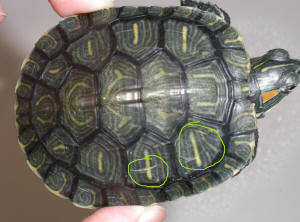
|
|
Red Ear Slider, defecation 7/29/08 I
have a red eared slider turtle at my house I had just feed
him/her when I noticed that a black sack cam out of his bottom
I'm not sure what that is <Likely just faeces. Aquatic
reptiles produce very loose faeces compared with the sticky, uric
acid-laden faeces you may be familiar with if you've kept
terrestrial reptiles such as tortoises. Cheers, Neale>
Re: Red Ear Slider; health -- 7/30/08 thank u
for your response but I have a few more questions <You are
welcome. But the way to be nice to us is follow our rules for
proper English: capital letters where they are normally put,
"you" instead of "u", "I" instead
of "i", and so on. We ask this from everyone, so others
can read the site easily. It isn't because we're trying
to be awkward.> 1.about the black sack I was talking about in
came out of his/or her bottom and went back in I don't think
it's feces. <Indeed. Well, it could be a prolapse if
something is hanging out for long periods. This would be
extremely serious and will require immediate veterinarian
attention. Sometimes male turtles will expose and retract their
penis for no obvious reason. Males can be sexed by looking at
their claws (which are very long) and the underside of the tail
(the cloaca (or opening) on the male is closer to the tip of the
tail than the base of the tail). Obviously if your turtle is a
female, then this isn't a possibility.> 2. what are the
signs of your turtle having eggs? <How big is this animal?
Females need to be fairly large before they start laying eggs.
Moreover, you should see the female attempting to find a site on
land to lay her eggs. She will need a bed of sand into which eggs
can be placed. Egg binding in females is a not-uncommon problem.
Untreated, it will lead to an agonising death. Please see here:
http://www.redearslider.com/reproduction.html
Cheers, Neale.>
|
| Res Shell -- 07/16/08 hi can u please check
the picture and tell me what is the problem with my res? thanks
<Looks normal enough to me. Do bear in mind that old scutes (the
"scales" that make up the shell) flake off as the animal
grows. The shell also turns from bright green/yellow to more
olive/brown. Shell problems come down to three things, so check you
have them all fixed: First, the water needs to be clean. Dirty
water promotes Shell Rot. Secondly, you need to provide a source of
ultraviolet light (specifically UV-B). A standard "reptile
basking lamp" will take care of this. Finally, you need to
give your pet enough calcium in its diet. Dried turtle food on its
own is NOT sufficient; you need to provide green foods (e.g.,
Elodea) plus calcium-rich unshelled invertebrates such as krill.
http://www.wetwebmedia.com/FWSubWebIndex/turtshellrot.htm
http://www.wetwebmedia.com/FWSubWebIndex/RESCareBarton.htm
http://www.wetwebmedia.com/FWSubWebIndex/resfdgfaqs.htm
If you're doing all these things, then your turtle will
continue to remain in good health. If you're not... well, fix
it! Cheers, Neale.> |
|
|
|
|