|
FAQs About Red Ear Slider Turtle Systems
2
Related Articles: The Care and Keeping of the
Red Eared Slider, Trachemys scripta
elegans by Darrel Barton,
Red Ear Sliders,
Turtles, Amphibians, Red
Eared Slider Care, Shell Rot in
Turtles,
Related FAQs: RES Systems
1,
RES Systems 3,
RES Systems 4,
RES Systems 5, &
Turtle Systems 1, Turtle Systems 2, Sliders 1, Sliders
2, Red Eared Slider
Identification, RES Behavior,
RES Compatibility, RES Selection, RES
Feeding, RES Disease, RES Reproduction, Turtles in General:
Turtles, Turtle Identification, Turtle Behavior, Turtle Compatibility, Turtle Selection, Turtle Systems, Turtle Feeding, Turtle Disease, Turtle Disease 2, Shell Rot, Turtle Reproduction, Amphibians, Other
Reptiles,
|
|
Re: RES turtles - Help finding more inexpensive care options
8/22/10
Hey Sue,
<Hi Sonal!>
Thanks for all the information.
<You're quite welcome.>
.. Wanted to ask you more about the heating and lighting bulbs. I
can't afford to get a UVB lamp.
Could you tell me how much would it cost approx., and if there is any
other option I can go for the cheaper option?
<The good news is that there are lower cost alternatives for ALL of
your turtle's minimal care needs -- heating, UVB lighting, larger
enclosure, filtration and food -- but -- the important thing here is --
they MUST get each of these needs met one way or the other. The care
guide link below that I also sent you in the 1st email tells you how
you can do all these things for less money. I'll briefly note some
of the options below, but please do read through this guide for more
complete information:
http://www.wetwebmedia.com/FWSubWebIndex/RESCareBarton.htm
>
<Turtles don't need a lot, but what they do need they absolutely
must have or they will become seriously ill. And -- it is significantly
more expensive (and harder) to treat a sick reptile than it is to treat
other animals -- or than it is to prevent it in the first
place.>
<Your turtles' shells have already shown some early signs of
illness. Odor is a sign of some underlying rot or infection, soft shell
is a sign of calcium deficiency. These will lead to even more serious
problems unless the root cause of them is addressed. Almost every
single disease a turtle has is the result of inadequate diet or
improper living conditions, so prevention and correcting their diet and
living conditions is where the focus of your care needs to be right
now.>
<Before doing this, though, again, please first remove your turtles
from their tank and follow the steps listed in the link here for warm,
dry isolation:
http://www.wetwebmedia.com/FWSubWebIndex/treating%20RES%20Dis%20DarrelB.htm
The *isolation* container can simply be an empty plastic bin or a
corrugated cardboard box with high sides so they can't escape (even
though they haven't gone at each other for a while, I'd still
keep them separated, even if it's just with a partition). As long
as you keep them warm (85-87 degrees F (30 degrees C) or so -- normally
this would be 88-90 F (31-32 degrees C) above their basking area in a
tank, but lower here because you're taking away their choice to
move between cool water and warm air), offer them a source of UVB, and
place them in another shallow container of water each day to eat, poop,
etc., they can live just fine like this while their shells improve, and
while you're working on fixing their more permanent living
conditions. It will also be healthier for them than where they're
at right now.>
<Here are some ideas for lower cost ways you can provide your
turtles with their minimal care needs; again refer to the link above
for more information on all of these things:
Larger enclosure: A plastic storage container JUST like the one
you're using right now is fine, but MUCH larger than what you have.
Choose one with the largest surface area (length and width). Turtles
like plenty of room to swim around. This will also allow you to try the
option of housing both of them together with separate basking areas and
some privacy spots instead of setting up 2 separate habitats.
Heat bulb: Good news here, too! All you need here is a regular light
bulb placed over their basking area. You'll just have to try out
different wattages and heights as you want to aim for 88-90 degrees F
(31-32 degrees C) basking temperature. You can get a cheap digital
thermometer at an electronics store or a relatively cheap one at a pet
store. The pet store ones are nice because they come with a suction cup
so you can attach it to the walls directly above the basking area.
Bottom line here though -- you MUST provide heat over their basking
spot. They need the proper amount of heat to digest their food
otherwise it will rot in their stomachs, and it will lead to a life
threatening illness. As a side note, place a screen (one with larger
holes than a standard window screen, so the UVB can filter through)
between the light fixture and the water to prevent the fixture from
falling in the water.
UVB Light: This plus heat above their basking areas are 2 critical
things your turtles need to have to stay healthy so some way you need
to get this. But the good news is, they're not as expensive as you
might think! Just replace the expensive food you've been buying
them and use that money instead to buy this bulb! Here is a link below
to the one I use, a ReptiSun 5.0 by Zoo Med. It's a top quality
bulb, and it's on sale right now on the website below. The 18'
is only $15 plus $7 shipping. You simply place it in an (also
inexpensive) 18' fluorescent light fixture from a home improvement
or building supply store. Again, place a screen (one with larger holes)
between the fixture and the tank.
http://www.petmountain.com/product/reptile-fluorescent-bulbs/504985/zoo-med-reptisun-5.0-uvb-bulb.html?gclid=COnl0p-szaMCFV195Qods2tMtw
If you have trouble here, write back and I'll give you some more
options, but this is what I'd recommend. And especially given
you're in a seasonal climate and can't take them outside in the
sun all year, you really do need this.
Water quality: You should start to save your money now for a good
quality mechanical filter. You are likely going to need it in the
future, especially when they get bigger and start producing more waste.
Right now, in addition to your daily changes, I'd also recommend
you also use a net to scoop up any waste as you see it in between
changes (before it breaks down in the water). For tiny pieces of
debris, you can *vacuum/suction up*. All you need for a *vacuum* is
some flexible clear plastic tubing and a bucket with about a
¾' (2 cm) diameter (both available at a home improvement
store or your pet store). You place the bucket lower than the tank,
fill the tube with water, plugging one end with your thumb as you fill.
Once filled, place your thumb on other end, put that end in the water,
the other end in the bucket and release. The tube will start to suction
out debris. You can move the tube around and control the *on* and *off*
by placing and removing your thumb from the end of the tube in the
bucket.
Food: Here is one place where you can now actually SAVE money instead
of spend! Just cut out all the food you've been feeding them and
replace with just one staple of a container of Koi pellets which are
MUCH cheaper! You can find these in the pond section of the pet store
or order them online. You can even buy them in larger containers to
save more money. Just keep smaller amounts out at a time; and keep the
larger container frozen in between. Supplement every week or two with a
couple of earthworms each, and give them unlimited greens such as red
and green leaf lettuce, dandelion greens (some grocery stores carry
these), etc. See if you can find/or if your pet store sells a plastic
clip with suction to keep them from floating all around and messing up
your water.
Diet supplement: For your female turtle who has some softer spots,
I'd also recommend a good quality powdered phosphorous-free Calcium
with Vitamin D3 supplement (the one I use is by Rep-Cal). Just add a
tiny pinch to Koi pellets soaked in a capful of water, and let sit for
about 20 minutes so the powder soaks into the pellets.>
<Again -- bottom line -- you need to do the above things now,
especially since your turtles have already been showing some signs of
shell problems, illness. This is a warning sign that their diet and
living conditions are not adequate and need to be changed.>
Both of my turtles can climb up the rock properly. My male turtle sits
on the rock for the complete afternoon and till evening everyday. Many
a times at night he sits and it seems like he doesn't want to
get
down. My female turtle also gets on the rock everyday but not as much
as the male turtle..
<It sounds like the basking rock you're using is adequate, and
your male is doing fine with it -- but a couple of other things here to
consider:
1. Make sure they can both fit on it at the same time. This is because
they both need to be able to bask on it for several hours each day to
stay healthy.
2. Make sure your female is not afraid to get on it or avoiding it when
he's on it. You mentioned she doesn't bask nearly as much as he
does -- and she also seems to be the turtle with more shell problems.
My guess is she may be avoiding it either because he's on it, or
because it's not warm enough for her. Try the heat bulb first; if
she's still not getting out much on it; then you will likely need
to get a 2nd basking spot just for her, or separate the two of
them.
3. You absolutely need to have both a heat and a UVB light above it as
described above.>
Also I wanted to add, about the behavior of my male turtle trying to
scratch the face of my female, he does it no more..he has stopped doing
that..and female turtle as such have no injuries till now..
Speaking about the nature, my female is more aggressive when it comes
to food..
<As you mention here and in your last email, your turtles are
already shown some signs of incompatibility. It's very common for
one turtle to become the *dominant* one whenever you have 2 or more
together. This is only going to become more pronounced as they become
sexually mature. The one we're almost sure is a male is already
almost there. Just something for you to keep a watch out for. Again,
ideally I'd keep them separate, but short of that I'd recommend
you feed them separately (you mentioned your female dominates here) AND
get a MUCH larger container so that you can provide them with their own
separate basking spots, and to enable you to divide up the larger tank
with some rocks, fake plants, etc.), so that they can each have their
own space and some privacy away from each other.>
<Regardless of compatibility, though -- either way you definitely
need to get a MUCH larger enclosure for them.>
Thanks a lot..
<You're welcome, Sonal. We're happy to help. Write us back
with any more questions or concerns and let us know how things are
going.>
RES, Bruno from Brooklyn... moving out to the NJ shore
pond/s... 7/19/10
Good morning crew,
<Hiya! Darrel here>
I adopted a RES, Bruno from Brooklyn, and is it turns out he is a she,
and will be living out her life in the quiet Jersey suburbs.
< Years ago, I'd have agreed with you. But lately I'm not
sure. There is some sort of show on Bravo TV these days '¦ I
don't understand it because I only see glimpses as I surf the
channels but it has something to do with women who live in New Jersey
and if they represent life accurately, New Jersey is a frightening
place!>
Her previous owner fed her mostly crickets and her shell, for lack of
the scientific word.. .is messed up.
<That may an unscientific word, but all scientists understand it. A
bad diet (which is what that diet was '¦ will absolutely mess
up the shell AND do damage inside. Thank your for rescuing her! I'm
sure Brunette thanks you too!>
I plan to make her permanent home my 1500 gal pond, complete with beach
front property to avoid the egg bound issues.
<Nice>
Do I need to give her an acclimation period before moving her to the
great outdoors? I'm anxious to get her on track with the proper
foods and lighting.
<Not this time of year, no. She can just go right in. (but read
below)>
I read the entire section on the RES and I was hysterical laughing at
many times and I also learned a great deal.
<I'm always afraid that people are laughing at the inappropriate
spots>
You all have helped me tremendously in the past with my goldies, whom
are all doing wonderfully may I add. I appreciate all the effort and
time you give, not to mention laughing while learning,
Sincerest thanks,
<no charge!>
Laurie
<Laurie, there are a few major considerations about outdoor turtles
-- all of which I've covered in an article that I've had in my
head for almost 4 years that has yet to be put to paper. Maybe later
this summer.>
<In the mean time:>
<For reasons no one understands, you can provide a turtle a
WONDERFUL home, complete with food, water(duh!), rocks, sun, garden,
beach, tiny little 7/11 on the corner .. just PERFECT '¦ and
for whatever reason, the turtle just decides to up and walk away. Often
we find them in the corner of the yard 6 months later, down in a hole
they dug at the base of a bush'¦ dried out, hard as a carp and
seemingly dead. We put them back in the pond, they wake up, hydrate,
return to what passes for normal in turtle-land '¦ only to do
it again in a month or a year or 5. If you can't fence the pond
itself with hardware cloth twice the turtle's overall length plus a
4 inch inward lip or some other barrier, scope out the yard to find out
what *IS* a perimeter you can secure. Remember all the letters you read
where someone said "I found this slider walking down the
road?" well, he wasn't on his way to work -- he was out of
someone's unsecured yard.>
<Weather is your turtle's friend AND his enemy -- while it's
true that turtles can survive over winter and even freeze over winter
'¦ it's important to remember that not ALL survive the
winters or the hibernation. Have a plan to house him indoors during the
cool & cold months. It doesn't have to be elaborate, a tub in
the garage with a heat lamp in the corner is fine, but letting nature
take it's course isn't the best choice>
<Raccoons, possums and other critters can and do visit ponds for
late night snacks. The good news is that they don't hunt while
swimming -- they stand on the sides and reach down in -- so try to
arrange the beach area so that the sides drop off quickly at
water's edge>
<The best thing about a pond, Laurie '¦ is THERE'S ROOM
FOR MORE TURTLES!!>
Questions about start-up care requirements for a red-eared
slider turtle 6/24/10
Hi, my name is Rianie
<Hi Rianie; I'm Sue.>
I have just recently gotten a RES ( or red-ear slider) and it's
still living in the little carry home tank that we brought it (home)
in.
<Welcome to the club, Rianie! Sliders are interesting and
entertaining pets. You didn't mention how many gallons your tank is
or how big your turtle is, but a 'carry-home' tank to me
suggests that it's too small, no matter what size turtle you have.
Turtles like to have lots of room and water to swim around in. The size
aquarium you need depends on how big your turtle is. A common guideline
is a minimum of 10 gallons for each inch of shell length. The way to
figure this out is to measure your turtle's top shell (carapace)
from one end to the other -- do not follow the curve of his shell and
don't include his head and legs, only his shell. So, as an example,
if his shell length is 2', you would need at least a 20 gallon
tank; 4' -- a 40 gallon and so on. A 'long' size aquarium
would be better for your turtle to give him more surface area to swim.
Keep in mind, though, that RES turtles grow to be about 8-12' long
depending on whether it's a male or female, so you are eventually
going to need a very large enclosure! However, there are some
inexpensive alternatives to an aquarium in case you can't afford a
larger size one right now; see the care link further down.>
I haven't had time to go get him a water heater.
<You don't need a water heater; more on this in a little bit
'¦>
or even a heat lamp.
<'¦ However, you do need to buy both a heat lamp AND a
separate UVB bulb -- right now -- for your turtle to haul out and bask
under each day. See more on this below. And whenever your time allows
and weather permits, taking him outside to walk around for a while on a
warm, sunny day to get the benefit of 'real sunlight' will go a
long way toward his overall health and well-being. If you do take him
out once in a while though, make sure you don't allow him to leave
your eyesight even for a minute or he could escape! As a pet, he no
longer has the skills necessary to survive in the wild.>
But, I have been keeping its water clean and ward (warm?) enough for
it.
<Water should be on the 'cool' side rather than the
'warm' side -- again read more on this below.>
<What specifically are you doing for filtration and/or cleaning, and
how frequently? Water quality is one of the top concerns for a
turtle's health as they eat, sleep and poop in their water. My take
on filters for turtles is that you either go with a top brand filter
that's 'rated' for several times the amount of actual water
in your aquarium (because turtles are so much messier than fish!), or
don't waste your money on a cheap one. It won't be able to keep
up with all the waste, and you won't be saving yourself any
'maintenance time'. However, you do what you're able
depending on how much you can spend. Just know that without a top
filter, you will need to do much more frequent cleaning. Besides water
changes, you also need to clean up any leftover food and poop
immediately after you feed him before it breaks down and decays the
water.>
My question is......How long can he live like this?
<Your turtle doesn't need a lot, but what he does need, he must
have and you should get now, otherwise you're going to land up with
a very sick turtle. Below are the minimum requirements you need to put
in place right now:
(1) Proper size enclosure: see above.
(2) Proper filtration; VERY clean water (as above) or he will become
ill: see the link below and adjust your care if different.
(3) Basking area: An easy to access, dry area in his tank for him to
haul out of the water to warm up and completely dry off each day;
otherwise his shell can develop fungus or a disease called Shell Rot.
I've personally had good results with the Zoo-Med floating dock. It
comes in assorted sizes and has 4 suction cups that attach to the
glass. However, there are many options; the care link below lists
several other good ideas.
(4) Heat lamp above the basking area: Turtles need to bask in warm air
to properly digest their food otherwise it will rot in their stomach.
See more below about proper temperatures for both land and water.
(5) UVB bulb above the basking area: UVB helps turtles to make/absorb
calcium which they need for proper shell health and growth; otherwise
they become much more prone to disease.
(6) Proper diet: Diet is simple and can include a good quality pellet
like ReptoMin or Koi; various greens or aquatic plants, and an
occasional earthworm (once every week or so) as a treat. The most
common mistake a lot of people make is to overfeed. Only feed your
turtle as much as he can eat in 5 minutes or so; preferably in the
morning to give him the day to digest it under his basking light.
Turtles under a year old can be fed once a day; after that 2-3 times
per week, or every other day is all that's needed.>
<If you're unable to provide all the things listed above right
now, the best thing would be to return the turtle. The good news,
though, is that none of these things HAVE to be expensive! In fact,
below is a link to a very helpful guide that will give you options at
both ends of the cost range as well as much more complete information
about how to care for your new turtle.>
http://www.wetwebmedia.com/FWSubWebIndex/RESCareBarton.htm
And how would I know if he prefers water to land? Or is it a fifty to
fifty chance that he needs to be able to move between them both?
<Your turtle needs time both in the water and on dry 'land'
each day. He will decide which one based on whether he feels like
warming up or cooling down. Turtles require the outside environment to
regulate their internal body temperature and organ functioning (i.e.,
as noted above they need the warmth of the basking light to properly
digest their food). They need to be given a clear choice between cool
water and warm land. A water heater is not needed or recommended. If
your turtle's water is too warm, he won't want to get out of
the water to bask. His water temperature should be around room
temperature, in the low 70's range (around 70-72 degrees F). His
basking temperature under the bulbs should be around 88-89 degrees. Pet
stores sell both water and land thermometers to make it easier to
check.>
I would also like to know how can I tell how old he is?
<At best, you can only 'guestimate' how old your turtle is.
You can try to guess his age by his size; however, it's not a
reliable indicator as many factors like diet, temperature, and
environment affect how fast a turtle grows. You didn't mention his
size, but roughly speaking, male turtles reach sexual maturity when
they're around 4 inches in length, and become adults when
they're around 7-9 inches. Females reach sexual maturity a little
later than males starting at about 5' long, and adulthood when
they're around 10-12 inches.>
< Rianie, please do read the linked guide above, and put all the
necessary things in place right now for your new turtle to assure that
you will both have many happy years together! Write back if you have
any more concerns after reading everything through. Good luck with your
new turtle and let us know how things are going! Sue>
Small red worms in RES habitat 5/21/10
Dear Crew,
<Hiya - Darrel here>
Last year I built a 350 gallon pond in my yard. Within 2 weeks a large
(6 inch shell) Red Eared Slider moved in.
<Amazing how they do that, isn't it? People will write in to say
that they had a turtle living in a pond in the back yard and one day it
just disappeared. Another will write in to say they found on wondering
down the middle of the street, and then some write in to say that a
turtle moved in and made itself at home. They do that. A 12 inch high
fence topped with a 4 inch inward-facing lip in the only way to assure
that the turtle stays safe>
I began feeding him HBH Turtle Bites.
<I use Koi pellets. It's 100% perfectly balanced for Sliders,
Cooters & family and has the added benefit of being
inexpensive>
I now consider him a pet.
<A word of warning - don't let him anywhere near your checkbook
or credit cards - Sliders are completely irresponsible with
money!>
Yesterday I took the filter system apart for cleaning. Inside the
filter I found dozens of tiny red worms. Can you tell me what they are
and what I can do about them?
<Hard to see from way over here, so I can't give you a name for
them. What I can tell you is that the slider could easily have been
carrying their eggs when he moved in, fish - especially feeder fish
introduced into the pond and even bird droppings can all introduce a
wide variety of worms into the system.>
<How to get rid of them involves a great many issues: You don't
write anything about the pond's eco-system. Fish? Plants? If
it's just the turtle, you can add a tiny bit of chlorine bleach (1
cup per week) will keep the water inhospitable. If you have plants
and/or fish, the best you can do is keep the water clean, do regular
water changes -- and keep the filter clean-clean-clean!>
<In any case, take the filter components out -- every part you can
disconnect including the pump, prescreens, etc. and wash them
separately in fresh water, then give them a soak in bleach (1 cup per
10 gallons) for an hour and then a thorough rinsing.>
Thanks
<welcome>
Red Eared Slider turtles, sys./pond -- 05/21/10
I found a large red eared slider today and am trying to find a pond to
put it in. Hopefully the people up the street will allow me to that. My
question is are they generally safe in that environment? I live in the
Houston, TX area and the winters can get cold, but not for long periods
of time. The pond is quite large but I don't know if there are any
other turtles.
<Mmm, if there are resident turtles, and yours is not "too
small", in good health, it should go in such a pond/setting.
Houston is fine year-round for Trachemys spp.... About the biggest
challenge/worry is the presence, likelihood of predators... Perhaps
better to offer such a pet on Craig's List, Local Fish Stores...
Bob Fenner>
Red Eared Slider turtles, Neale's go
I found a large red eared slider today and am trying to find a pond to
put it in. Hopefully the people up the street will allow me to that. My
question is are they generally safe in that environment? I live in the
Houston, TX area and the winters can get cold, but not for long periods
of time. The pond is quite large but I don't know if there are any
other turtles.
<Hello Rebecca. You really should contact your local Fish &
Wildlife Bureau or Animal Rescue. Releasing animals back into the wild
is a tricky problem.
Turtles may not be native to the ponds or streams in your area, so
releasing it into a nearby waterway has the potential to cause serious
ecological damage. If you keep pet fish or reptiles, there's a
chance it could pick up infections from you or the holding equipment,
and transport those infections into the wild. If the pet turtle is an
escapee from a home vivarium, it will have no idea about predators and
dangers, so if released will soon be eaten by a passing dog or squished
by a motor car. In short, resist the urge to set it loose, because that
wouldn't be kind, helpful, and may not even be legal. Call the
right people who know how to handle this sort of problem.
Cheers, Neale.>
Worms in RES tank!! 5/13/10
Hi guys,
<Hiya Dale - Darrel here>
As if I haven't been pestering you enough recently I have another
problem!
<never too late to correct that>
I noticed today that there are hundreds of tiny little white worms in
my tank! they are clinging to the glass and are floating in the water,
they look disgusting and I want to get rid of them. Gonna do a thorough
clean and filter/water change this weekend which will
hopefully get rid of them but I'm wondering if they are an internal
parasite and if they are harming the turtles.
<Yes and '¦ probably not in "normal" quantities,
but as an epidemic, yes>
I did a bit of Googling and checked out some things on Planaria and
nematodes, Planaria seem a bit bigger than my guests and nematodes seem
scary so I don't want it to be them! I don't feed the guys in
the tank and most of there poop is done in the feeding tank which begs
the question, what are the worms eating?? I have noticed that I have
had zero algae build up recently but I put that down to moving the tank
out of sunlight for the summer. I'm going to do an epic clean but
just wondering if you know what they are?
<First, regarding the cleaning - find a temp home for the turtles.
Fill their tank an extra inch higher than normal and add 1/2 cup of
bleach for every 5 gallons of actual water (not tank size, but actual
water volume). Remove your filter media and throw it away but keep your
filters running during this sterilization -- assume that the worms are
everywhere the turtles went and/or everywhere their water touched. Run
the system for 24 hours (make sure you have ventilation - chlorine
fumes are bad news) and then drain, refill with clean tap water, run
for 4 hours '¦ drain & refill again>
I found a thread with a link to this pic which looks exactly like my
fellas but the last post in the thread was from a guy claiming to work
for a herp vet and he said they have threadworms and will die. I'm
hoping he's an idiot!
http://img.photobucket.com/albums/v431/buslady/Animals/Cody%20and%20Spot/DSC08531.jpg
<Well, to me they look like most round worms look like in a picture.
You could take a few in a baggie to your local vet and ask him to
identify them -- but the fact is that identifying them doesn't
change anything. We still have to isolate the turtles and clean the
system and regardless of what type they are, they got there the same
way: either bad food or bad hygiene - both problems you can
fix.>
As always thank you so much and I would certainly be lost without your
past help!
<You're never lost Dale, as long as you know where YOU are. From
time to time the place you're GOING might be lost '¦ but
never YOU.>
Dale
Tokyo (formerly Essex ;p)
<lol>
RES and little red worms 4/2/10
HI!
<Hiya! - Darrel here>
I have 3 15 year old Red Eared Sliders that I have raised since they
were babies.
<Congratulations!>
Last night I cleaned the filter on their habitat and noticed little red
worms living in it. I haven't seen any within the tank or basking
dock itself. What are these?
<Tiny worms or larvae are not uncommon living in the filters, Rona.
The filters are an ideal breeding place for such creatures. There's
never any sure way of knowing how they got there, either. Often times
it's from eggs that were inside live food (this is one of the
reasons we discourage feeder goldfish, etc.) but it could easily be the
larvae of the eggs of some insect that just flew in.>
And can they be dangerous for the turtles or me?
<Not Dangerous with a capital "D" no, but not something
you want on your hands or body either. Here's the plan:>
<Move the turtles to a temporary home and sterilize the tank by
adding chlorine bleach. One cup per gallon of water [approx 75ml per
liter] (not the size of your tank, but actual volume of water -
including filters).
Let the setup run for 24 hours, drain & rinse well with fresh
water, then break it down and wash with soap (such as dish detergent).
Fill again and run the setup for 24 hours, then drain, rinse and
refill. This is a long process, but you have to kill the worms and any
larva and/or eggs that they've left behind. This is why we run the
setup with the filter and gravel and basking areas, etc. - every area
the contaminated water could touch.>
<Now to prevent this, never introduce wild animals, feeder fish,
plants or untreated water into the tank.>
Thanks for your time,
<yer Welcome>
R. Adams
RES.. sys./temp. 2/1/2010
I just want to know....how hot is "too hot" for my two
RES..they are about 3 inches, I'm not sure if they are males or
females? I keep their water at about 77-81 degrees (temp changes
through out the day) and their basking area
ranges from 88-93 degrees depending on how close the light is to their
basking area. They eat fine, they bask fine. One of them always bites
the other one. I just don't want to over heat my turtles, please
answer my question;) thank you.
<Try switching off the heater that warms the water. Let the water
get cool.
So long as the water isn't very cold, less than say 60 degrees F,
your Red-Ear Sliders will be fine. Optimal water temperature is
probably around 68 F, if they also have a heating lamp. What will
happen is they will warm up under their basking light, and cool down in
the water. Reptiles are VERY good at using behaviour to control body
temperature. Do read here:
http://www.wetwebmedia.com/FWSubWebIndex/RESCareBarton.htm
Darrel explains all the requirements these animals need in terms of
temperature. Cheers, Neale.>
Re: RES.. Sys. basking area 2/1/10
Thank you!! Is there a set temperature that the basking area should not
get any warmer than?
<Much above 30 degrees C would be bad.>
Or should I just keep the water cool enough so if they do get too hot
they can cool off?
<Largely, yes, they will cool down in the water if needs be. But if
the air is too hot under the UV-B lamp, they will not be able to
produce the vitamins they need, and ultimately, they will get sick. So
they need to be able to spend around 8 hours a day basking under their
UV-B lamp.>
Sent from my iPhone
<Sent from my Mac. Cheers, Neale.>
Re: RES..
Thank you for your time!
<My pleasure. Cheers, Neale.>
Red Eared Slider, gen. 1/9/2010
Hello
<Hiya right back! - Darrel here>
I've just come across this site through a few others whilst looking
for help for my Red Eared Slider.
<Fortunate for you!>
I've grown really attached to him and his filter helps me sleep at
night so I would like to find out how to help him and fast to be honest
because I don't want him to die or get seriously ill.
<OK>
First question, what filter would you recommended using? Because at the
moment, me and my boyfriend know that we are using the wrong filter but
we are unsure of what filter is best to have. Some people have told us
Fluval and others have said Eheim and now we just don't know what
to do.
<I only use filters for water circulation, Louise. Unlike fish,
turtles produce so much waste that it's usually foolish to try to
get a biological filter going. Primarily you keep their water clean by
changing it regularly. As long as it circulates the water and keeps in
pretty clear, it doesn't matter which one to use. If you didn't
have one and were buying one, I'd go for an external canister
filter sized for the aquarium the turtle is in. What I mean by that is
this: if you have a 55 gallon tank used for a turtle, that tank is less
than HALF as full of water as it would be for fish '¦ so if
you buy a filter appropriate for a 55 gallon fish tank, it's more
than good enough for a turtle tank. The other thing I look for
'¦ is what kind of filters my local fish store carries,
because it's frustrating when you need a replacement part for your
Fluval and you find that all the stores in your area carry Eheim
parts.>
Second question, I think our Red Eared Slider might have a Respiratory
Infection or something. He has no mucus or anything around his eyes,
they are perfectly fine, the same as his nose as well. But this
morning, I noticed that what looked as if he was yawning but it seemed
more of him opening his mouth to catch something. He did this about
twice, normally it's just a one of thing. No bubbles were released
while he did this under water, he hasn't done it above the
water.
<So far, sounds OK>
Also, I seem to hear like a click noise or something. Do they make any
sound? Because my boyfriend thinks that I'm hearing things but it
sounds as if he clicks, again he does this rarely as well. He basks on
his island that we have for him,
<Your boyfriend basks on an island????>
but he prefers to bask when were out the room (which is most of the
day) or when we are watching TV etc when we can't see/watch him -
I've read that this is normal for Red Eared Sliders (?).
<The clicking sound is common, as is the yawning behavior. If
there's nothing else wrong, then don't worry>
He is still eating his food and he even swims backwards and forwards
looking excited and lifts his head out the water when we go to feed
him. We feed him - King British Turtle & Terrapin complete food,
King British Tubifex natural food and some bloodworms (these foods
aren't given all at the same time by the way either).
<Good. I raise my sliders from hatchlings to breeding adults on a
stable diet of Koi pellets. It's completely balanced for them.
Repto-min is another trusted brand, identical to Koi pellets - just at
a much higher cost>
And he's still swimming etc, so he is acting pretty normal to me
apart from at night when we turn his light off, it takes him forever to
go to sleep or sometimes if I fall asleep before he settles, I seem to
think he's had no sleep at all (but that just might be me
worrying). Sometimes he's up about 4-6 hours after I've gone to
bed and I can hear him banging around in the tank.
<This is all normal behavior for a Turtle '¦ but kinda
weird for a boyfriend>
So is there any sign of a slight Respiratory Infection?
<not so far>
Because as I said above, I really don't want the cute thing to get
ill and right now me and my boyfriend are pretty low on cash as well
but if he has to see a vet then we're willing to dig into our
pockets to get him to one but I'd rather use that as a last resort
to be really honest with you, why I asked on here to make sure and to
find out some advice.
<no trip to the vet right now!>
Thank you and I'm so sorry if I have confused you or not made any
sense anywhere, it's really difficult trying to explain what's
going on with him.
<You did very well, Louise! I enjoyed reading about the turtle and
to make a joke or two about your boyfriend as well.>
<Your turtle seems fine, so relax a little. Then read this care
sheet. It covers all the basics of turtle care. There are many fine
resources out there on slider care, and some may even disagree with
what's in this sheet. It's important for you to know that if
any information disagrees with this care sheet, they're wrong and
the sheet is right!>
<As long as you keep him well fed, well lighted and his tank CLEAN,
you should be fine.>
< http://www.wetwebmedia.com/FWSubWebIndex/RESCareBarton.htm>
Red eared slider questions... diet, sys., the universe! --
01/03/10
Hi Darryl...What a GREAT service you guys provide!!
<We do it because we like to help. And for the free food>
Unfortunately the only vet we had in our area who specialized in
exotics recently retired so it's a very valuable resource that you
provide! Thank you so much for your very informative response and
hilarious one as well!
<Bob Fenner says that I'm 'funny' but he doesn't
smile when he says it, usually he's shaking his head '¦..
hmmmmm><<Hey, where IS that free food? RMF>>
I very much enjoyed your humor (are all of you professional writers as
well?!)
<I've been described as an unprofessional writer>
Always good to end the day with a few good laughs, especially after one
week off with 2 kids! I hate to confess but I take better care of our
turtle than MY kids also!! (though haven't caved to Pop Tarts, soda
or potato chips just yet :-) ).
Thanks for the insight about changing turtle's home. I actually
thought he would welcome more space! Got an A+ in HUMAN psychology in
college, but guess I have a ways to go before figuring out the inner
psyche of a turtle!
<Don't ever let a turtle near your ATM card -- they have NO
impulse control>
Thank you also for your other ideas; will try them out! Wasn't
sure, though, about a couple of them you mentioned - hope you don't
mind answering a couple of more questions! Again, thanks so much for
taking the time to read all this...
* Re: nocturnal light - Would it be better to not have this? We put
this in not for a night light, but to keep the air temp inside his
aquarium warm during the night. We keep the regular room air on the
cool side - 68 degrees, so air temp quickly drops in his aquarium if no
source of heat is provided.
<True, but the outside air temp in most of his natural range drops
below 68 at night for 80% of year as well. What we want here is a light
and heat cycle that falls into his natural zone. That said, I'm not
sure it HURTS, either. Take it out and see what happens>
We chose black because it seemed to emit the least light. The red bulb
seemed overly bright.
<And Red Lights have that whole Honky-Tonk 'I'm the cheap
kind of turtle you don't take home to Mama: kind of feel, too. With
a black light, the worst that happens is that the turtle grows up very
laid back, with an almost unnatural affinity for 'stairway to
heaven' or 'in a gadda da vida'>
* I also assume that this black reptile bulb is NOT the same as the
dangerous black light??
<Yes. Black light is UV-A (long wave) UV-C is germicidal (very short
wave)>
* Re: live food - you mentioned not feeding live food but said you
feed earthworms.
<Right -- what I meant was trying to duplicate what appears to be
live food within their environment as if they'll hunt their own.
Live food that occurs within that system is not really that much of
their diet yet are often heavy with bugs and parasites that are bad for
them -- very much like my ex wife's cooking>
<Earthworms are not carriers of pathogens that are harmful too them.
Just a bit on the fatty side, which is why I use them as occasional
treats>
Do you feed these live or cut them up first?
<Saute' in garlic with finely chopped parsley and
cilantro>
<NO!!! Just one live one, usually on the basking area>
* Re: aquarium heater: You mentioned removing the heater in the water
if we have one. Yes we do have one, and put it in the aquarium back
when we got him because we read that young turtles should have a water
temperature of around 80 degrees.
<Again, they'd never see 80 degree water in their range unless
some backwoods redneck in Georgia was cooking him for dinner. 68 degree
water is just fine as long as he has a basking area that's in the
mid to upper 80's>
It's a black (not glass) thermometer, good quality one with
protective sheath. I know if we remove it, the water temp. will drop
quite a bit. Is a lower water temp ok for young turtles, and would it
outweigh the potential risk of our thermometer causing a micro-leak of
electrical energy?
<yeah -- we want to offer a range and let him choose>
Thanks so much Darryl, and HAPPY NEW YEAR!!!!
<yer Welcome!>
<[EDITOR'S NOTE: On behalf of Wet Web Media and all the rest of
the crew, we would like to take this opportunity to apologize to
Comedians, Professional Writers, Psychologists, Honky-Tonks, Jimmy Page
& Robert Plant from Led Zeppelin, Doug Ingle/Iron Butterfly,
Ex-wives in general, Rednecks, the State of Georgia (except for East
Dublin) and of course, to you, the reader. Sigh -- we were all hoping
that the meds would have kicked in by now]>
|
Red Ear Sliders question, sys., Algicide use
11/20/09
I have two baby red ear slider turtles in a 10-gallon tank with
an overflow filter and a UVB lamp that is on 10 -12 hours a day.
The rocks in the tanks are getting lots of algae and I was
wondering if it's safe to put
algaecide in the water.
<Neither safe nor sensible. Using an Algicide is like
vacuuming a carpet:
it gets rid of the dirt that's there, but doesn't stop
the dirt coming right back. Total waste of money. Algae will grow
in any tank with adequate light and moisture. The spores come in
via the air and presumably drinking water, as well as attached to
whatever rocks, filter media, animals you have. The best approach
is simply to accept it, and wipe away with a sponge or plastic
scrubber whatever is excessive. Nothing you can do with chemicals
will stop it coming back. Installing some fast-growing floating
plants like Indian Fern will dramatically improve things, and
prevent algal grown below the waterline. Algae becomes a pest
when there's an imbalance between the number/size of the
animals, the amount of plants, and the volume of the water. Big
tanks that are lightly stocked and have lots of fast-growing
plants rarely have algae problems. The further you are away from
that ideal, the more likely algae problems become.>
The local pet shops don't know the answer to that question,
so I figured I'd ask you guys. Took the whole thing apart
yesterday and cleaned it, but the algae will be back before I
know it.
<Indeed it will. As you presumably realise, a 10-gallon tank
is adequate for at most three or four months where Sliders are
concerned. As they grow, they pollute more and more, and the more
nitrate and phosphate in the water, the faster the algae grows.
Within a year or two, your two Sliders will need a tank 55
gallons or more. Do not underestimate their growth rate, and do
not ignore the fact males are very aggressive.>
Barbara
<Cheers, Neale.>
|
 |
|
Question about baby Sliders, sys., fdg. --
11/09/2009
Hello,
<Hiya - Darrel here>
I had a concern about my two Red Eared Sliders. I got them as a
anniversary gift from my husband from a local girl who's
turtles had babies.
<Generally speaking, we don't recommend pets as gifts, but
they are great, low maintenance pets!>
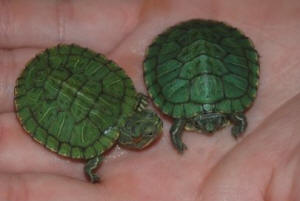
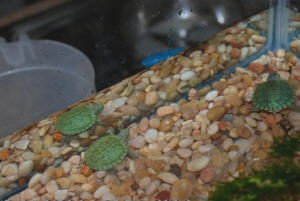
They are really small, as in a tiny bit bigger than a quarter.
One of them loves the water and is very active, just never seems
to want to leave the water. The other is always in it's shell
and always basking, never seems to want to go into the water.
Just recently he/she started to burrow itself under the rock bank
we have set up for them. Is that normal?
<No, it's not. Possibly there's something about the
setup that he doesn't like, or that scares him>
I feed them both in a separate container when I put them outside
to get some sun, I've never seen them eat though.. I think it
might be because they are eating the plant I purchased at the pet
store for them.
<That could be -- BUT it's really important that we know
they are feeding, so I suggest that you remove the plant for now
... and anything else edible, so that we have control over their
food and can eventually watch
them eat.>
I was recommended to get TeraFauna ReptoMin that has 3 foods in
1.
<Great food. Koi pellets are an almost identical food that
cost a lot less, but ReptoMin is excellent>
Again, I've never seen them eat it. Their enclosure is a 20
gallon long tank, with a water filter, water heater and bank of
rocks set up for basking with a light. I could really use some
answers from someone who
knows what they are talking about!
<Well unfortunately, You got me instead!>
<Remove the water heater and let the water become room
temperature. The difference between cool and warm is what causes
them to swim, bask, etc. Our job is to offer them the choice. As
the tank cools, I'd expect the one that swims all the time to
start to bask more. We'll get to the other one last.>
<As far as feeding is concerned, feeding them outside of their
tank is a good thing to help keep the water clean and at least
for now, when we're not sure, gives us the ability to verify
that they are or are not.>
<When a baby sits on land all the time all closed up (not
basking/relaxing)
it may be because he's sick, weak, afraid ... or simply not
happy. It's not easy to find which. I've seen Sliders
take a walk from a pond and bury themselves in a garden somewhere
-- and each time I bring them back, they stay a day or two and
take another walk & repeat the behavior.
Changing basking areas, moving rocks and other rearrangement can
often make it seem "new" to them and allow them to
settle. You'll have to experiment on this issue.>
<I'm enclosing two links, one on general care - that will
give you guidelines against which you can measure your care and
one for illnesses, which explains how you can take a turtle out
of it's habitat and keep it
warm & dry for a week or so. This isolation technique might
be just enough of a change or rest that the shy one needs to
kick-start his normal behaviors. Just remember to continue the
sun/feeding routine each day.>
Thank you for your time,
-Nichole
<Write back and let us know how they're doing!>
<care:
http://www.wetwebmedia.com/FWSubWebIndex/RESCareBarton.htm>
<treatment:
http://www.wetwebmedia.com/FWSubWebIndex/treating%20RES%20Dis%20DarrelB.htm>
|
 |
Re: A Slider Age Question -- 11/09/2009
Hey again,
<Hiya>
Thanks for the information. Glad to know I now have a baby and not a
hatchling. In response to the UV light. I have a lamp on her with a 75
watt UV bulb. I keep a thermometer at it and it does not get over 87f.
I
have it placed 12 inches about her platform. Is this warm enough for
basking?
<That's perfect! Is the lamp specifically a UV lamp or just a
heat lamp?>
I am making myself keep her temp down. Hard to do. She just lays at the
heater and does not want to move around much. Which by the way is not
glass. I have read the stories about the RES and glass.
<If she won't leave the water even as it cools down, you can
first try putting her under the UV & heat lamps and see if
she'll stay for a while (this may take many attempts). If not, try
rearranging things -- sometimes
there is just some sort of reptilian Fung-Shui going on where they just
don't "like" something. Big rock, vibration from a filter
... something that makes them nervous. Failing that, isolate her for a
week using the
technique described in the link below. She needs to get dry, warm and
under UV light far more than she needs to be wet -- 5 minutes a day in
the water is enough to keep her hydrated and healthy .. but we need to
get her basking.>
Now about the confusion thing. Your site did not confuse me. Everything
is very clear on your site. I have visited probably 50 different sites
trying to learn everything I can about the RES. Most sites have the
same
info concerning feeding, water quality and safety. The water temp on
some sites do say to keep the temp at 80f for a hatchling. Of course
being a new mom I was wanting to make her as comfortable as
possible.
<I understand. 80 is hotter than any water they'd ever survive
in outside. While it's true that I wouldn't let a hatchling
into 60 degree water (which is fine for a healthy adult), normal room
temperature for
humans (72-75) is perfect water temp for even a hatchling>
Thanks for the response. Great to know there is somewhere to go for
answers.
<Thank You>
TJ
<Darrel>
<treatment:
http://www.wetwebmedia.com/FWSubWebIndex/treating%20RES%20Dis%20DarrelB.htm>
Re: Age Question, sys. RMF wants to ask, "Whatever
happened to books?" -- 11/09/2009
Hello again,
The bulb I am using is All Living Things basking bulb for reptiles. It
is a 75 watt UVA Incandescent bulb. I did not really look at it before,
just bought it at a pet store. Does she need another kind of bulb?
<Yes - basking lamps are typically UV-A which is essentially the
visible & heat spectrum. What you need in addition is UV-B which
emit the wavelengths needed to synthesize Vitamin D and many other
healthy things.
Look into ZooMed's Repti-Sun brands as they're usually
available on-line for reasonable prices>
Tried putting her on the basking platform numerous times and she just
swan dives off fast. She is in her old plastic container with her lamp
on her now.
<It's a forced method, but at least she's heating and drying
off. (make sure you don't cook her) but keep her warm except for a
few minutes a day in a shallow bowl of water. Read that link about
treating common
illnesses. Even though she doesn't seem to be ill, the warm &
dry housing routine is still beneficial for her at this point -- at
least for a few days. AFTER you put her back in the water, she probably
WILL hide in the
water overnight, so don't let that surprise or discourage
you>
And I think you are right about the reptilian Fung-Shui. I had cleaned
her tank last week and moved some things around for my taste and did
not take into consideration it is her home and not mine. So everything
has been put back like it was. Hope this helps. I have even made the
comment before about how she doesn't like change.
<Neither do I>
Thanks, TJ
Re: Age Question... RES care -- 11/10/09
Do I keep her completely out of the tank for a few days? Or do I keep
her out during the day and put her back in at night? In her plastic
container she sometimes ends belly up and I don't want her to get
stuck like that.
<The container should be big enough that she can get away from under
the direct heat of her basking lamp>
Also, if she is a water turtle why is water bad for her?
<Water is her natural habitat, yes. But nature is cruel to the weak
and stressed. If she's weakened in any way that she can't
properly regulate her metabolism by heating & cooling she'll
eventually be too weak to swim and drown.>
Why can't I make her a dry tank and just dip her maybe twice a
day?
<Perfect! here's the link again, read the part on how to keep a
turtle warm & dry:
http://www.wetwebmedia.com/FWSubWebIndex/treating%20RES%20Dis%20DarrelB.htm
<Darrel>
Basking concerns, RES 10/17/09
Dear Crew
<Hiya - Darrel here>
I am a fairly new owner of two red eared sliders. They are active, seem
to eat well and generally seem to be doing well. I'm concerned that
I do not see them out basking and know this is essential to their
health. They are in a 55 gallon aquarium set up where they have both
water and land, as well as several other areas they can get out of the
water to bask. I do have a calcium bone in the water that I can see
they are using. I have pellets that I feed them, as well as some dried
shrimp occasionally and some soft meaty food. I have tried to give them
some romaine lettuce, but they do not eat it.
<Nor should they. Koi pellets or Repto-min turtle sticks (either
one) are a completely balanced diet for Red Eared Sliders. That and an
occasional earth worm as a treat (maybe one or two a month) is all they
need.>
They also will only eat food if I put it in the water, they will not
come out to get anything from the dish in the dry area.
<Sliders are water feeders, which is to say that they primarily eat
what they find in the water. The will, from time to time, climb up on a
bank and snatch something and then drag it back into the water in order
to eat it. You should hand feed them>
I have a basking lamp over the dry land area and a UV light over the
water area. It's possible they could be out basking when I am not
around, as they are still pretty skittish when there's movement
around the tank.
<possible>
Should I be concerned and/or is there something else I should be doing
to encourage them to come out of the water? Also, I have the basking
lamp on a timer and do not use the night heating lamp, is that night
lamp necessary?
<You should always be concerned .. just not worried. The first thing
to do is make sure you have a temperature gradient. If the water is
warm enough they won't feel the need to bask even though they need
it. The water should never be above room temperature and the basking
area around 85-90 degrees. This way they have clear choices..>
<No lights or heat at night ... let everything cool naturally and
then it will all cycle again in the morning. Here's a care guide we
have -- check your conditions against the guide and correct anything
that's not quite in order:
http://www.wetwebmedia.com/FWSubWebIndex/RESCareBarton.htm>
RES turtle questions... sys./lambda, hlth.
9/27/09
hello crew,
I have two red eared sliders, like 4/5 months old.
I don't have a heating lamp yet because it is pretty hot out
here.
<If you live somewhere warm, i.e., temperature doesn't drop
below, say, 18 degrees C/64 degrees F for more than a few days, then a
heater may not be required. However, you MUST have a UV-B lamp. This
needs to go above the basking rock. Contrary to popular misconception,
a plain heating lamp isn't
adequate or even essential. But a UV-B lamp is utterly essential.
Without this, their bones and shell, among other things, won't form
properly. The UV-B light is used for vitamin synthesis. Outdoors,
they'd get this from sunlight, but indoors they won't. Since
glass blocks UV-B, even putting the tank next to a sunny window
won't help.>
one turtle is much lighter in color than the other one.
Its shell is a little bit soft and sometimes he shakes his head as if
he wants to get rid of it. (his head)
the other one is doing fine.
Lately they have been sleeping all day. Hibernating?
<No; these turtles really don't hibernate much, and certainly
shouldn't in captivity.>
Not pooping, not eating
But they are not dead. should i keep them awake, or should i just let
them do what they want to do?
please help. :( thank you in advance.
<More than likely a lack of calcium in their diet and a lack of UV-B
light for vitamin synthesis. First step is to call a vet, so your
sickly turtle can get a check-up and a vitamin booster shot. With that
done, install a
UV-B lamp over the basking spot. Note you're after a UV-B lamp, not
a UV-A
light, not a heating light, and not an aquarium light. Cheers,
Neale.>
Out door pond 8/24/09
Dear Crew,
<Hiya Melissa, Darrel here>
I have purchased some red eared Slider turtles from a
good pet store they approx 5-6 inches long.
<Yanno, Melissa, without punctuation after the word
"store" -- you are technically telling me that you shopped at
a good pet store that was 5 to 6 inches long.>
<I guess today I'm just Mr. Language Person ... >
I did my homework on these fun creatures to add to my outdoor pond. The
issue I am having is that they have plenty of food and places to bask
in the sun, the pond is approx. 20 feet long, 15 feet wide and 3 1/2
feet deep to 4 foot deep at the other end, however my pond does not get
full sun light at all times
<How many hours of direct sunlight reach the basking area or shores
on an average spring or fall day? The amount of sunlight and UV they
can absorb even from a slightly indirect source may be plenty. How many
hours a day to they bask in direct sun?>
as well as I have found some turtles escaping the pond area. Once they
get out they can't get back in. Any ideas on why they keep trying
to get out?
<Yes, Melissa. Turtles wander. No one knows why, exactly, but they
do it.
If they are not confined they'll often wander out and never come
back.
I've found escaped turtles that were gone 3 months and buried
themselves in a corner of the garden under a plant. A pond area in
which you plan to properly keep turtles will require a hard barrier
around the perimeter. I use 1/2 inch mesh hardware cloth buried 3
inches down with a 4 inch lip bent inward 90 degrees at the top. Then I
plant tightly all around the outside, so that the little fence blends
into the background. Waterfall areas can be lined with brick, stone or
cinder block to create a barrier, but however you do it, it must be
done.>
Should I be worried about nights getting colder since they are located
in a pond outside and we are located in Iowa?
<Yes. While it's true that the literature says that all the
sliders (Trachemy scripta) can over-winter in a pond, even a frozen
one, the truth is that not all do survive it and even if they do, it is
hard on their physiology. You should have a plan for over wintering
them in your garage, porch or house in some sort of big plastic where
you can control the temperature. Best is to set them up like any indoor
environment like in our care guides, complete with basking lamp, UV
lamp, etc so that it's summer to them. Also, in the spring,
don't be too quick to put them outside. Wait until you're done
with the sudden cold snaps of early spring and well into the growing
season.>
Also some Goldfish have seem to be safe with the turtles however my
grandson just bought a Bubble Eyed Goldfish, brought it out Saturday
and it has been eaten already. Any idea on why some Goldfish ok and
other's not?
<Turtles are opportunistic feeders, Melissa. (Just like my brother
in law, they'll eat anything that's easy, cheap and doesn't
require leaving a tip!). While fish are not the main part of a
Slider's diet in the wild, the bubble eye was available and easy to
catch. At the same time, the opposite is true --- all of us long term
Turtilians (and yes I probably just made that word up) have stories
where we intentionally filled our pond with goldfish for the turtles to
eat and instead they thrived, grew, got names of their own and became
pets we have to worry about! I have two "feeder goldfish"
that are now 11 years old, almost 7 inches long and now live in my
girlfriend's Koi pond where they hold their own with a couple of 28
inch monster Koi.>
<So as a general rule, turtles and fish make a bad tank or pond
mates>
Also how many turtles would be too many for this size of pond?
<That's a huge pond for turtles, Melissa. If the water condition
is good, you could hold more turtles in the summer time than you'd
ever want to have to collect and house during the winter!>
<Assuming that you solve the fish problem, the sunlight problem and
the
fencing problem, I'd put 4 Red Eared Sliders (Trachemy scripta
elegans) and maybe 4 Pseudemys (Cooters, Red Belly turtles, etc) -- but
again .. no more than I can house and care for over the winter. And
this is AFTER I'd fix the other problems>
Thanks
<Yer welcome!>
IOWA Outdoor Pond
Red Ear Sliders... sys. 8/18/09
Crew@WetWebMedia:
<Hiya - Darrel here>
We just purchased three very small red eared sliders for our children
......
<Meaning that they get to ooh and ahh over them for a while before
they lose interest and then you and your wife get to care for them
forever, right? Well cheer up, they're fun and easy to care for and
with the exception of a very few individuals, Red Eared Sliders will
NEVER borrow your car and back it into a post, start dating people you
find totally creepy or decide that DAD is a 3 letter synonym for
ATM>
..... and we are wanting to ask a few questions about setting up the
tank.
We used to have salt water fish that were in a fairly good sized bio
ball filtration tank. The tank has been thoroughly cleaned (including
the balls being removed and hosed clean) and empty for more than 4
months. Our question relates to the safety of using this tank for the
turtles. We understand that there needs to be a 2/3 v. 1/3 water v.
ground area, which is fine, but we are concerned that the previous use
may impact the safety of the water for the turtles.
<AS long as it's been rinsed thoroughly I wouldn't see it as
a problem.>
Should we fill the tank and let the filter run for a few days and test
the water before we move the turtles or should we simply start in a
basic glass aquarium?
<It never hurts to run things for a while, just to check on how
things settle (pumps, hoses, leaks, etc.) but in general the only thing
I'd tell you is that it's almost a fantasy to get a biological
filter in balance in a reptile environment. The biowaste they produce
easily overwhelms all but the mightiest biofilters. Filtration is GOOD
and it's IMPORTANT, but get used to the idea of bi-monthly
siphoning and refilling and monthly to quarterly draining and
cleaning.>
<here is a like that contains everything need to know. The
information in here is enough to raise hatchlings into fully grown
adults that produce their own babies:
http://www.wetwebmedia.com/FWSubWebIndex/RESCareBarton.htm>
Thanks in advance for your help.
<Worth every penny!!!! Keep in touch as things progress!>
-Mark
Re: Red Ear Sliders and lizards in plastic container...
tog.!? 8/18/09
Darrel:
<Yes!!!!!!! Not like you win anything for the correct guess, but
you're right! It's me!!!!>
Thanks for the reply.
<That's why I'm here! That and the free food>
I forgot to ask you one other question. We also have an anole (just 1)
which is rather small....maybe 3-4 inches long. Could the three sliders
co-exist in the same aquarium?
<No>
We are also contemplating using our glass aquarium for the sliders as
opposed to the acrylic one and if we keep the anole in the same
aquarium, we will probably have a 50/50 ratio of land versus water. Any
thoughts?
<I have lots of thoughts, Mark, but over the years I've learned
not to give into them or listen to those little voices ......>
<Um..... OK, first. Sliders and acrylic aquariums are a bad
combination.
No matter how small they are, they manage to scratch the inside of
almost every square inch of the tank in a very short time. I think they
work in shifts and one may even stand on another's head to reach
the hard to get places, but in less time than you can imagine
they'll have the whole tank looking like someone sanded it.>
<Second, putting an Anole into a vivarium sounds like a good idea,
since turtles and anoles occupy different niches within similar
eco-systems, but the problem is that sliders are called "non
specific feeders" which means that -- much like my brother in law
-- they'll eat just about anything they can find as long as
it's easy, cheap and doesn't require leaving a tip.
As soon as you start mixing animals in this manner you're creating
an eco-system and eco-systems come with a thing called a food
chain.>
<So .... no.>
Thanks,
Mark
UVB light 07/23/09
Hi crew! It's me again, Felix from Malaysia XD
<Hiya Felix, Darrel here is Los Angeles!>
I have 3 Red Ear Sliders, I got everything except UVB light, it's
super hard to get it here, just wanna ask, those full spectrum
fluorescent light for fish tank, do they give UVB? I saw a lot, like
those that kill germ, those for aquarium plants... I plan to keep them
outside under the sun, but they're still small, their shell less
than 2.5 inches long... Any better idea
<Natural sunlight is by far the very best and only UV the turtles
need, Felix. That is IF they can get it directly -- it can't be
filtered through glass of any kind and even screen the size of window
screen or mosquito netting. Also, if they are outside, make sure that
they have shade where they can get away from the sun -- and lastly,
that there is enough water that the sunshine doesn't make the water
too hot. Remember, a small tub of water left in the summer sun will
easily reach 120 degrees and that can kill your little friends.>
<Inside the house, they really should have a dedicated UV bulb, but
on the other hand I have used full spectrum bulbs myself for many
years. The Vita Lite by Duro is a full spectrum bulb that I used for
many years and should
be easy to get since they have many uses. Just remember that the
effective range of the UV declines significantly beyond 8 to 10 inches
and place the bulb accordingly>
Re: Answer hazy: ask again... RES question
7/22/09
Hello
<Hiya- Darrel here>
I have another question for you. Last night the water in my tank was
crystal clear. After a four hour time span, the water went from clear
to cloudy. My filter seems to be working fine. Do you have any idea on
what could be causing this to happen?
Thank you.
<It's really hard to say without knowing some background. How
long has the vivarium been set up? When was the last time anything new
(substrate, rock, etc) was added? The obvious first place to look is
something that was added like a rock, a branch, etc. that simply
wasn't clean. Second is an explosion of microorganisms due to
sudden change in temperature and too much organic matter (food &
feces) in the water. This often happens when a filter is turned on
again after cleaning -- people don't realize that the insides of
the tubes and hoses slowly build up a mucus layer and when a filter is
stopped, cleaned and turned on again, these small growths dislodge and
cloud the water.>
<The problem is, without knowing what was different 24 hours ago,
it's just random guesses. Write back with more info .. more details
.... and I'll try to make more specific guesses.>
Re: Answer hazy: ask again 7/22/09
Dear Crew
<Hiya - Darrel here>
Sorry for not giving you any information to work with. The whole tank
has been set up for almost two days.
<In that case let's not worry about it. Drain it, rinse it out
along with
everything in it, set it up again and let's move forward>
I got my Red Eared Slider as a gift.
<I hope it was a gift you asked for and not an impulse
purchase>
The tank doesn't have much in it. 3 rocks that we previously
cleaned before we put them in the tank. An artificial plant that came
in the kit. Finally the turtles and the filter. The Temp of the tank
seemed to have dropped also. I don't know if that has anything to
do with it. I am worried that I may be harming my turtles, the temp. at
the moment is a low 70. It was 60 when the lamps were not on and with
the lamps on its still a low 70. Do you have any suggestions on how to
raise the temp.
<The water temp should be whatever your room temperature is. 60 to
75 degrees is fine, because the turtles climb out on the basking area
to heat up under the lamp. The point is to let them choose to be warm
or cool>
<Here's a link that covers all the basic aspects of care.
Turtles don't need much ... but they absolutely HAVE to have what
they need. Please check all aspects of your care against this article
and I'd bet they'll
live long and healthy lives.>
Thank you for any information you can give me.
<Yer welcome!>
<http://www.wetwebmedia.com/FWSubWebIndex/RESCareBarton.htm>
RES question, sys., gen... 7/21/2009
Hello. I just got two RES today as a gift. Along with the turtles i
received a "Zilla deluxe aquatic turtle kit".
<Interesting product. The 20 gallon tank should hold in you in good
stead for a few years, but do bear in mind Red-ear Sliders get to
dinner-plate size eventually, and will outgrow that vivarium.>
It cam with 2 8.5 dome fixtures and a 75W day blue light blub and a
tropical 25 13W UVB fluorescent Coil bulb. i was just wondering if at
night do i turn off those lights or should i keep both on?
<Switch them off at night; indeed, a timer set to 12 hours on, 12
hours off would be ideal. You can pick one of these for a few quid (or
dollars, or whatever) from most hardware stores, and a two-way adapter
stuck into the timer would mean you could control both lights from the
same timer.
Easy-peasey.>
I have no idea on how to take care of these adorable turtles and i hope
you can help me.
<Do read here:
http://www.wetwebmedia.com/fwsubwebindex/RESCareBarton.htm
Red-ear sliders are pretty easy to keep, but there are some things to
watch for. You've got the UV-B issue covered, and presumably warmth
too with the daylight bulb, but the other issues are regular water
changes, a greens-based diet, and a regular source of calcium so that
they develop their bones and shell properly.>
Thank you,
Kelsey
<Good luck with your new pets! Cheers, Neale.>
RE: RES question
Thank you so much. You were a huge help! I'm sure my turtles would
thank you also.
<Glad to have helped. Cheers, Neale.>
slider turtles... sys., gen. 7/18//09
Hi,
<Hiya - Darrel here>
I recently became the owner of two red slider turtles. I sort of
inherited them. I was a teacher at a middle school in mid-Michigan. I
got laid off at the end of the year. I had two turtles in my classroom
the entire year that have been there for about 7 years. They were
extremely mistreated by students, the former teacher did not seem to
care too much about them, and the janitor informed me he was
responsible for caring for them only because he felt bad that they were
so poorly taken care of. They were in a tiny tank, no filter, and most
of the time the students threw food, gum and candy in the tank. After a
few breaks, when I returned, the tank smelled and looked like an
outhouse. So, needless to say, at the end of the school year, I brought
them home with me.
<Thank you -- on behalf of them!>
Now, having said that, I currently do not have any intentions of
returning them to the school at the beginning of the year. However, I
do not have the accommodations for them at my house. I do have a small
fish pond that I was setting up in my back yard that I have sort of
placed them in for the time being. I will keep them there if it is the
best option.
<Over wintering becomes a problem in your climate and then we have
to protect them from predators (raccoons, etc.) as well. You'll
have to do that with fish as well, but fish are in some ways
'easier' than turtles.>
I do not have the money to buy a tank, filtration system, chemicals,
and all of the other things I have read about on your website.
<You don't need much money. We'll get to that in a
minute>
My first instinct was to release them in my backyard, which leads to a
small creek. But, given that they have never been in the wild, I was
not sure how they would survive.
<Survival skills would be a small issue, but climate, predators and
diseases are. Believe it or not, captive turtles can carry respiratory
infections that they can deal with quite well but that can be
devastating to wild animal populations.>
<This is an important note to all pet keepers>
<Never ever EVER release a captive animal, fish or reptile into the
wild.
It's almost always fatal to the fish or animal you're trying to
help and when it's not it's devastating to local populations of
all kinds of different animals, damaging to the ecosystems ... and
ALMOST ALWAYS ILLEGAL!!>
They were able to survive in a very bad school environment for so long
with students that do not have much care for human life, let alone that
of a reptile.
<Tell me about it>
They have been in my back yard for a little over a month and seem to be
enjoying it. But, my concern is that when winter comes, will instinct
take over and they will automatically know to hibernate, or are they
going to just freeze?
<The hibernation is instinctual, yes. But on the other hand, not
every animal that hibernates lives through the winter and even fewer
animals that over-winter in a freezing pond survive it. These animals
CAN survive -- it's technically possible -- but by no means all DO
survive it>
I had them in the classroom and know that they were active the entire
school year. When I inquired to the former teacher (now principal) what
to do with them over the summer break, she informed me that she never
took them home and they were always fine when she returned in the fall.
Of course, the janitor informed me that he was feeding them over this
period of time and periodically changing their tank water.
<Red Eared Sliders are remarkably hardy animals but what that means
is that they can SURVIVE a remarkable amount of mistreatment and
neglect. That's not at all the same as saying that neglect or
mistreatment are in any way 'good' for them!>
I have never had turtles before, but want to do right by them. I think
I have a male and female (one has a longer tail than the other) and I
know they were both babies when they were given to the former teacher.
Okay, one last concern I have, since I have put them in my back yard,
their back claws have seemed to wear down to nothing and periodically
bleed. I think it is because they are constantly trying to escape
(which also makes me think I should just let them go).
<Again .. NO!>
There were rocks on the bottom of the pond (a plastic pre-form), but I
have since removed them and have not noticed the bleeding since then,
about 3 days ago.
<My guess is that they're bleeding as a result of metabolic bone
and tissue problems stemming from long term diet issues. Let's fix
that first. Go find a high quality Koi pellet at your local fish store.
They're inexpensive and are a completely balanced diet. Second,
assuming they're outside I guess they're getting lots of
natural sunshine? And they have a place they can haul out and
completely dry off? If so, we're covering the basics. Enough of
this and they'll start to heal themselves>
Okay, I know this is a lot, but I just want to help these little guys
out the best I can. I would hate for me to try to do them right and end
up harming them more than when they were at the school.
<Here's a link to a basic care article that will help you cover
the basics.
http://www.wetwebmedia.com/FWSubWebIndex/RESCareBarton.htm >
<the important thing to know is that you don't HAVE to spend a
lot of money. For example, turtles of any size will almost always
outpace a filter system. Eventually, even with the best filters, the
water has to be siphoned and changed. So ... if you can't afford a
filter, then you simply siphon and change more often (This goes for
ponds as well as in-home setups). When they come inside for the winter,
a simple Rubbermaid tub of sufficient size in your garage, laundry room
or enclosed porch will be fine. Suspend an ordinary 60 w light bulb
over the basking area and you've covered the basics. Proper UV
lighting is suggested, but if they've been outside all summer and
fall they'll be able to tolerate a few months with minimal
environment. Keep the setup simple so that it's easy to break down
and drain the water, etc. When things start to heat up in the spring ..
be patient. Don't jump at the first warm spell -- let the weather
stabilize, maybe late spring and THEN put them outside for the
summer.>
<It really doesn't take much money to give a good home to a few
turtles ... it just takes someone who cares!>
RES... sys. 7/11/09
Hi...
<Hiya -- Darrel here>
I was just wondering what your thoughts are on leaving a Red Eared
Slider in a covered tank in the backyard. It would be on a covered
patio that does not get direct sun.
<OK so far. My first thought was that it doesn't take very long
at all for sunlight to heat a glass tank and all it's contents to
the point of cooking them ... but as long as no sunlight shines on the
tank sides, this might be OK>
I want to give her more room to run and swim and I just don't have
the space indoors. I can also bring her in during extreme weather.
<An enclosure on a porch is still and complete environment and must
supply all the elements - water, basking area, etc. The main benefit to
an outdoor enclosure is that it can be larger but if it's not
comprehensive ..
if she can't bask until she's warm and then drop into the water
to cool off, etc. then I really don't see the point.>
She has slept with me many times before!
<Presumably she doesn't snore?>
There is 1 thing that just occurred to me and that is we do get
raccoons in our backyard from time to time. Will they tear the screen
top off to get at her, I wonder?!
<Yes, they will. They can even open gate hasps. In instances like
this the entire top of the tank needs to be covered. What I'd so is
as follows:
Set the entire tank on a piece of plywood that is 2 inches bigger than
the tank all the way around (so, 4 inches longer and 4 inches
wider).
Construct a wooden frame just larger than the tank itself from 1"
x 1" lumber and attach 1/2 hardware cloth to that with screws or
nails (so now you have a screen "cap" that will fit down over
the tank top just like the lid of a shoe box. Now at either end, attach
a piece of wood or wire that stretches from the bottom wood to the top
wood that can be attached to each end of the top with a tiny padlock.
Done right, this will confound the raccoons and they'll just move
on.>
And is it actually fine for them to be out of the water for 8-10 hrs at
a time?
<That's perfectly OK as long as they don't get too hot OR
too cold.
Remember, water changes temperature a lot more slowly than air
does>
Thanks for the help!
<happy to do it!>
Jewel
A Slider, Mon? 7/8/09
Hi I'm Kelly from Jamaica,
<Hiya -- I'm Darrel from California>
I have a Red Ear Slider that I bought in may from a pet store and I was
told that it was one year old at the time. I was told that it is fed on
a pellets known as Aquamax 300. However, at the time of purchase the
store did not have these in stock and I was given another pellet known
as beta bites. The turtle seem to enjoy both, but I'm wondering if
this would be enough for it. I've seen in some of your articles
where reference is made to turtles being fed crickets and stuff however
I'm not seen where these are available at local pet shops. I do
have access to fishes. Would just the fish and pellets be enough for
it?
<No>
<No fish, no crickets, no stuff like that. Koi pellets are a
perfectly balanced 100% diet for all of the Sliders and other Emydid
turtles. I raise them from hatchlings to adults that breed their own
babies on JUST that and an occasional earthworm as a treat. Fish is not
part of their natural diet, can contain parasites and .. because the
turtles usually can't catch them, the fish thrive and you end up
taking care of them as well!>
Also, indication is made in some articles posted that meat can be fed
to them, is it any kind of meat?
<Nope. They're scavengers and opportunistic eaters to be sure.
If you give them a steak or a pork chop they'll eat it ... but that
doesn't mean it's good for them.>
And may I know the types please. Another thing that your articles
suggest as important is an UV lamp, but given the type of climate we
live in (tropical), would that be a necessity for my turtle? I do
ensure that he gets sunlight everyday or every other day, will this be
enough for him? Our temperature range is generally between 27-32
degrees Celsius year round.
<Your climate is perfect for him ... but the sunlight needs to be
direct.
Coming through glass does no good at all ... even through screen
reduces it's effectiveness quite a bit. The very BEST is a UV lamp
that you can place over his basking spot (next to the lamp that
provides heat) so that he gets both UV and heat when he needs it and
then can cool off when he doesn't.>
Thanks in Advance for your help,
<You're welcome. We enjoy helping!>
Kelly
<Kelly, I'm sending you a link to a BRILLIANT article that
covers the entire basics of keeping Sliders and similar turtles. The
author is experienced, well regarded in his community (did I mention he
was brilliant?) not to mention good looking. EVERYTHING you need to
know about the basics is in this article and you can compare every
aspect of your care to what this brilliant article mentions and
you'll be just fine.>
< http://www.wetwebmedia.com/FWSubWebIndex/RESCareBarton.htm>
Tank change affecting turtle? 6/27/09
Dear Crew,
<Hiya -- Darrel here today>
I've had a red eared slider for about 2-3 months now. We just moved
him to a 10-gallon tank and used water from the tap. I've noticed
that he keeps blinking and closing his eyes and "sleeping" on
one of his rocks for long periods of time. His rock is under the water
but close to the surface for warmth.
<I'm hoping you also have a rock or platform OUT of the water
for him!!!!
A Red Eared Slider will spend 60% to 70% of his day OUT of water,
warming and drying himself. They climb out of the water to seek warmth
and slide into the water to seek cool.>
He lifts his head up for air but keep his eyes closed. He also hangs
his head down like he's bowing. I've never seen him do this
before and I'm worried he may be sick or he may be shocked from the
tank change. I thought it might have been the pH level of the water,
but its the same water we've always been using and has seemed to
work fine. He ate when we first put him in the tank and seemed to have
normal energy but now seems to be more lethargic.
<Water Ph is not usually a problem for most water turtles. Any water
that you'd drink is within PH and Chlorine ranges for a normal,
healthy turtle.>
I've seen him blow a few air bubbles from his nose also. I've
read a lot on this site about eye and respiratory infections and
didn't know if this may be the same situation. His eyes don't
seem to be swollen... We fed him a minnow for the first time today
also.
<Bubbles from the nose is most probably a respiratory infection and
it needs to be treated right away! Obviously the first recommendation
is a qualified veterinarian. Failing that, take him OUT of his tank and
place him somewhere warm and dry. A temporary shelter can be anything
from an empty aquarium to a plastic bin or trash can or even just a
cardboard box with high sides (keep in mind a determined turtle is an
incredible climber). Add a heat source, which can be a regular electric
heating pad (if you're lucky enough to be able to find one without
the annoying 'automatic off' feature) to a light bulb suspended
over head. Ideally you want to achieve a constant temperature of
between 86-90 degrees. Since we are deliberately taking away the
turtle's choice to move from cool to warm, we have to pick a
constant that fits both needs. NOT having to move between temperature
zones and not having to swim or climb is the first step on giving the
turtle the ability to direct his attention more toward healing. You
must also provide UV-A and UV-B light sources, which perhaps can be
moved from his original enclosure or -- in the alternative, a minimum
of 10 minutes of direct (NOT filtered through any kind of glass or
screen) three times a day. Assuming he is healthy enough to be moving,
the regimen will be to place him in a shallow container of luke warm
(room temp) tap water every day for 5 minutes in order for him to
drink, poop and possibly eat. Shallow means no more than half his shell
under water when you place him in it -- and really only enough to cover
his tail and cloaca.
Assuming that he is being treated for his actual condition and
improving, he can go YEARS in this condition without ill
effects.>
<This is not, strictly speaking, a "treatment" for a
respiratory infection.
What we're doing is creating a condition that will ASSIST the
turtle's own immune system in fighting the infection and healing.
It will take 6 to 8 weeks of this isolation and treatment to help him
beat it. Remember that the infection will remain for several weeks
AFTER the last bubble is visible. If he doesn't respond or if his
condition appears to deteriorate, veterinary care will be about his
only hope.>
<Meanwhile, review your care and keeping conditions against the
article in the link below and correct anything that is wrong.>
Please help!
<I hope we did>
< http://www.wetwebmedia.com/FWSubWebIndex/RESCareBarton.htm
Turtle Tank Question 6/25/09
Hi!
<Hiya! Darrel here>
Here's the situation. I have two Red Eared Sliders
each in their own tank.
They are still relatively small and are in 10 gallon tanks until I can
afford bigger ones. Each tank has a 30 gal filter on it. The problem
I'm having is this, Mak's tank has been going through a filter
every other day.
The water is crystal clear but when you pull the filter out it is
covered in a slime.
<A very efficient filter>
I've tried cleaning out the whole thing, scrubbing and all that and
that made the new filter last for maybe a week. Yertle on the other
hand has a partly cloudy tank but the filter will last a good three
weeks or more.
<since Yertle's filter isn't clearing the slime out of the
water as efficiently, the slime stays in the tank and not so much on
the filter>
So my questions are, What is the slimy stuff in Mak's filter and
how do I get rid of it?
<It's slime. There is, of course, a technical term depending on
it's actual makeup and considering what organic residue, protozoa
and/or microscopic worms & all that are mixed in ... BUT we
professional Herp people use the term 'guck.'>
Is there a way to keep Yertle's tank clear?
<Yes!>
Hopefully I will be able to get each of them bigger tanks soon but I
just don't have that kind of money right now.
<Here's the thing: When you scrub the tanks, you're probably
not scrubbing inside the filter tubes, impellers. groove where the
filter slides in, etc. are you? The problem with 'guck' is that
if you don't clean and sterilize ALL of the water-portion of your
tank, you leave a colony of it behind, just waiting to reproduce. So
here's what you do: Get Mak and Yertle a nice box to live in for
about a week. Somewhere warm and DRY .. when they can get and stay
completely dry so that any guck living on them will dry up & die.
Don't worry about Mak and Yertle ... if they get a 15 minute bath
in a bowl or tub of shallow, room temperature water every day .. for
say ... 15 minutes (so they can drink, poop and eat) they can live for
years without being back home.>
<Meanwhile, put 1 cup of chlorine bleach per 10 gallons of water in
the tank>
<NOTE EVERYONE!!!!! 1 cup per actual gallons of WATER ... NOT how
big the tank is!!!! A 10 gallon tank (usually about 8.5 gallons actual
capacity)
half full of water would be 4.25 gallons of water! Do the measurements
and the calculations>
<Be sure to leave the filters running during this period. After 24
hours, you can drain the water, break the tanks down & scrub them
with soap and water ... and then rinse, rinse, rinse.>
<When I do this ... I repeat the whole process -- bleach for another
24 hours and then a second wash and second rinse, just to be
sure.>
<After the rinse, refill and restart the filters and allow them to
run for another 24 hours before putting Mak and Yertle back. From then
on, if you keep the feeding to no more than what they will eat in 5
minutes 3 times a week and keep the water changed regularly ... you
'll be guck-free.>
Thank you!
<Yer Welcome!!!!!>
-Beki
WATER DEPTH, RES sys. 6/9/09
Hi,
I have 2 RES in a 20 gal. tank.
<Need much more room than this>
They were hatchlings when they were given
to me and in a little over a year one is about 2.75" and the
larger one is 3.25". The friend who bought them for me also bought
her daughter 2. One of hers died and the survivor was deposited in my
tank. That one, the same age as mine, was still the size of a half
dollar. In two months, it is now the size of my larger one. Here's
my question. Their basking ledge is out of the water and the little one
fell off one day. She seems fine, in that she eats and basks and begs,
but she doesn't hang out with the larger ones
<Are not really a social species>
and when she swims, she tips to one side. As a result, I don't keep
the water too deep because I'm afraid she'll drown.
<Mmm, not likely to drown... and more water may be of benefit in
diluting wastes, maintaining stability>
Am I being over protective. Should I fill the tank deeper so they can
swim or should I accommodate her
apparent weakness. I appreciate your suggestions.
thanks,
donna
<I'd use more water... Please do read here:
http://www.wetwebmedia.com/FWSubWebIndex/ressysfaqs.htm
and the linked file above in the series. Bob Fenner>
Red-ear turtle... pond, sys. 6/7/09
Hi,
I just finished having a pond put in my back. I purchased a red-ear
slider he is beautiful and makes a great addition to my pond.
<You will need a fence to keep terrapins/turtles in place; they [a]
walk about; and [b] like to burrow, so unless the fence goes down a
good 15 cm or more below the soil, there's no guarantees the thing
won't escape.>
On day two he got out and I found him wondering around the yard, I
returned him to the pond the next day I could not find him after two
days I gave up. While attending to the fish he popped his head. Anyway
I was happy I went ahead and built a wall of rocks that I did not think
he could climb because they are straight up I thought if he tried to he
would just fall back into the water.
<I see. Terrapins can climb rather well, and in the wild, will
clamber onto rocks and wood to bask.>
Well now he is missing again, could it be he is hiding and didn't
get out.
<Possibly.>
It has been rainy and cloudy out (no sun for a couple of days) but he
hasn't even came out for food. In short my question is could my
slider just be hiding under water in the rocks waiting for the sun and
heat to come
back.
<Perhaps. Would certainly look about your garden a bit, and be open
minded to the possibility of escape.>
Thank You for any help you can offer
Addona
<Cheers, Neale.>
Red Eared Sliders and slime 6/1/2009
Dear turtle crew,
<Hiya, Darrel here>
I have two Red Eared Sliders (about 6-7 inches in length, 2 years old)
that I think are sick. Recently they have been covered in white slime
and gobs of the slim are on the bottom of the tank. Is this common or
does this sound like an illness? Could you offer me some insight on
this?
<White slime on a turtle is usually a fungal infection, but
"gobs of white slime on the bottom of the tank" sounds like
just plain terrible water quality. Turtles shouldn't swim in any
water you'd rather not swim in and
it sounds like you have a cesspool going.>
<First, take the turtles out of the tank. Using a bowl of lukewarm
tap water and a toothbrush, gently scrub & wipe as much of the
slime off of their shells and limbs. Naturally they'll tuck in so
you won't be able to
get much off their heads, but do the best you can. Rinse the brush
under running water as you go and rinse the turtles by short, quick
dips into the bowl. When they're clean, put them in a warm, dry
place -- a box or
container with high enough sides that they can't climb out.
They'll be here for a few days, so a hanging lamp for heating would
be a good idea .. as long as they can move out from underneath it to
cool down. Every day, put them in a shallow bowl of lukewarm water for
5 minutes so they can drink, poop and maybe eat... then a quick
scrubbing with the toothbrush and finally back in the warm, dry
place.>
<By the way>
<Did y'all know the toothbrush was invented in Arkansas?>
<Yep>
<If it had been invented anywhere else it would have been called the
TEETH BRUSH!!!!!!!>
<ahem>
<Meanwhile .. take the tank apart and rinse it out to get as much of
the slime out as possible. Wash everything you can reach with dish soap
and rinse again. Then put it back together with everything that touches
the water ... including the filter running ... Add one cup per gallon
of water [approx 75ml per liter] (not the size of your tank, but actual
volume of water - including filters). Let the setup run for 24 hours,
drain & rinse well with fresh water, then break it down and wash
with soap (such as dish detergent) again. Fill again and run the setup
for 24 hours, then drain, rinse and refill.>
<This is a long process, but the slime is everywhere and while
it's easy to remove enough that you can't SEE it, it's
harder to remove enough that it won't simply grow back.>
<Once you have everything set up properly and the bleach has been
rinsed away and the tank left running for 24 hours, put the turtles
back. Please read this link carefully and adjust any or all of your
care to meet the standards.>
< http://www.wetwebmedia.com/FWSubWebIndex/RESCareBarton.htm>
Thank you,
Stephanie
<Yer welcome!>
[Editors Note: WWM would like to apologize to any and all Arkansans,
people with missing teeth, any and all persons meeting or offended by
the Ozark/hillbilly stereotype and/or anyone, in general, that is
offended by this crewmember's jokes. Obviously we have very low
standards ... but we're working on it. Ed.]
<<Darrel... you are a hoot! RMF>>
Red worm & UV light question 05/29/09
Hi, I'm Felix from Malaysia.
<Hiya Felix. I'm Darrel here in California>
I have 3 little turtles in my tank for almost 2 months, have a basking
spot with a 100W light on it and a filtration system.
<Sounds good. Should I make the general assumption that you have
emydid water turtles such as Red Eared Sliders?>
This afternoon I changed my tank's water and wash my filter. I was
shocked because there are worms in my filter, and I noticed tat my
turtles been eating them, they are small, red and the length of it is
about 0.5CM. Are they dangerous to the turtles? Most importantly are
they dangerous to us humans?
<There are hundreds of small worms and also worm-like creatures that
could be introduced into your tank, Felix. They could be some form of
Tubifex that came in as eggs inside a feeder fish or even inside the
turtle's gut when you got them. As far as harmful to the turtles,
generally no danger except that if left alone they will over populate
and pollute the tank. All creatures like this could potentially be
harmful to humans, which is
why it's important to always wash your hands after touching the
turtles or any part of their enclosure.>
<The proper course of action is to remove the turtles to a temporary
home and sterilize the tank by adding chlorine bleach. One cup per
gallon of water [approx 75ml per liter] (not the size of your tank, but
actual volume of water - including filters). Let the setup run for 24
hours, drain & rinse well with fresh water, then break it down and
wash with soap (such as dish detergent). Fill again and run the setup
for 24 hours, then drain, rinse and refill. This is a long process, but
you have to kill the worms and any larva and/or eggs that they've
left behind. This is why we run the setup with the filter and gravel
and basking areas, etc. - every area the contaminated water could
touch.>
<Now to prevent this, never introduce wild animals, feeder fish,
plants or untreated water into the tank.>
Another question is, my basking area doesn't have a UV bulb/lamp,
should I get 1 or is it ok if I bring them out at the sunlight
sometimes? How often do I have to bring them out? and for how long?
<they need sunlight or UV light every day, Felix. Twice a day for at
least 15 minutes each day -- and during this time you have to watch
them closely because if they overheat they will literally cook to death
in their shells. I strongly urge you to purchase a UV fluorescent light
-- there are brands out there that are quite inexpensive and work very
well.>
Thanks crew, u have a very very nice web page, and it's very very
very helpful ^.^
<We appreciate your compliments, Felix!>
Re: UV light question 5/30/09
Thx Darrel for your advice...
<No problem, Felix>
There's another simple question I want to ask, I bought a new
Exo-Terra Sun Glow Neodymium Daylight Lamp 60 watt, it says that it
creates heat gradients for thermoregulation & Increases ambient air
temperature, with another 100 Watt light bulb, will it be too hot for
my little red ear slider turtles?
<Yes and no, Felix. Combined, you're putting 160 w of
incandescent light on the basking spot. In order to get the basking
spot to a constant temperature of 85-95f (29-35c) you'll have to
place the bulb(s) so far from the basking area that you lose the
benefit of the Sun-Glo bulb.>
The info of the product is :
http://www.exo-terra.com/en/products/sun_glo_neodymium.php just wanted
to know is it safe for my turtles?
<Felix, if you read the site section on lighting products, you see
that the one you picked out is UV-A (visual light spectrum) which
includes the spectrum of the regular 100W incandescent that you already
have. IN THEORY the wider spectrum bulb is providing much more
"natural" daylight than a typical soft-white household bulb
... but there are so many factors at play. I don't see on the site
there they specify the AMOUNT of output across the spectrum -- in other
words, if we could see a graph of the intensity at each wave frequency,
I'd bet that the amount of additional output doesn't justify
the cost. It's a great incandescent bulb, and if close enough it
would work fine IN PLACE OF your existing 100w bulb. However, when it
eventually burns out, you should go back to the cheaper household bulb
plus some UV-B bulb, or possibly their SOLAR-GLO bulb, which claims to
supply UV-A and UV-B in one bulb. As long as it can be placed far
enough away to get the proper heat on the basking area and yet not
greater than 30cm (11 inches) it might be a great single
solution>
Thank You...
<Yer welcome!>
URGENT: My red eared slider water temperature problem
4/16/09
Dear Crew
<Hiya Wicky -- Darrel here>
Okay, I need to a solution and some information , I have a Red Eared
Slider who is 2 inches . He/she eats daily. I feed him pellets which
he/she loves to eat and is always begging for more but the problem is I
read on various sites that Red Eared Slider need 80F temperature but
its so hot here that my water temperature is 86F now is that dangerous
for my turtle?
<It's not the best, but it may be a bit much to say
"dangerous." Typically I like the water in the low to mid
70's and the basking area in the mid to high 80's and let the
turtle choose which temperature is best at any given time. 86 degrees
is quite high for the water temperature, but not necessarily life
threatening>
And how can I prevent this?
<Prevention depends on cause! Is the basking lamp so powerful and so
close to the water that it heats it? Is the air temperature actually 86
degrees or is there sun hitting the tank and heating the water? Can the
tank be moved into the shade? Or a cooler room? Even in Canada, people
have been known to keep Sliders in large plastic tubs in their service
porches (sealed from the weather, but not heated) as long as the
basking lamp is on. Look around for ALL the factors leading to the high
water temperature and write back so we can consider each one.>
And another problem is when my turtle basks I notice his skin gets dry
like on his nose and face I can see some dry white patches like we
humans get on her skin in winters when we don't use lotion. I hope
you understand what I'm trying to say here I don't have any VET
here and I really love my turtle and am doing everything I can for
him.
<You sound very concerned and I hope we're able to help. The
whitish coloration can be a fungus, usually due to poor water quality
and VERY possible given the high water temperature, so search this site
(we have a Google Search Bar on the home page) for Turtle and Fungus
and you'll see lot's of possible solutions. Two things: 1) If
the water temperature is really that high, the water QUALITY needs to
be perfect. Make sure the filter is good, changed frequently and do a
50% water change every week.
Remember, if it's just your turtle, you don't need any kind of
water conditioner ... just old water OUT & new water IN. Now,
remember I said TWO things? The other thing is this: Sometimes the
white is nothing more than water spots!! Just mineral deposits from the
water that show white when the skin or shell is dry. For the moment,
focus on the reasons for the water temperature and what we can do about
that.>
He is in a 15-20 gallon aquarium please reply me ASAP! Will be highly
appreciated!
<Hope this helps>
<read here for other care info:
http://www.wetwebmedia.com/FWSubWebIndex/RESCareBarton.htm >
with best regards
Wicky
Turtle tank smells 12/01/08 Hi
Neale, I have two red ear sliders, and I just cleaned out my turtle
tank a day and a half ago. Last night I noticed that my tank smells
sour. What could this be? This has never happened before. Thanks
Christine <Do a 100% water change and give the filter a quick rinse.
If the smell goes away, you're fine, and it's just dirty water.
Turtle tanks need as much filtration as you can afford, and as many
water changes as you have time! If the smell is on the turtles though,
might be Shell Rot (rotting shells smell fungusy). Cheers,
Neale.>
Re: turtle tank smells 12/01/08
Thanks Neale, I have two eheim filters with a 75 gallon tank. The water
is a little more then a half full. Last week I cleaned out the filters
and changed the water. Two days ago I cleaned almost 100% of the water.
The water that was left was just the water in the filters. I did find
the water is constantly turning green. Could this be it? And how do I
get rid of it? Thanks Christine <Hello Christine! Hmm... I'd
change all the water, even the water in the filter. Put the turtles
aside in a bucket or box. Give the mechanical media a really good clean
in running water, and then clean the biological media in room
temperature, ideally dechlorinated water in a bucket until all the silt
is squeezed out. Give the gravel a really good clean, until it's
spotless. Put the tank back together again, but don't feed the
turtles anything but pondweed! See if that improves things. If the tank
gets smelly again within, say, a week, get back in touch. Cheers,
Neale.>
Hatchling Hibernation 11/10/08 Hello, <Hiya
Sandy - Darrel here> I have some Red Eared Sliders born March 2007.
<Cute little guys, aren't they?> I kept them in the house
until June 30, then in a pond outside. <The pond was both fenced
[they are amazing climbers] and covered [they make great snacks for any
number of birds, raccoons, possums, etc], right?> I live in
Sacramento, CA. That winter of 07, I put them in a large Rubbermaid
container in a insulated out building with proper lighting, filter and
temp. Then back in the pond when weather warmed. <I've done the
same thing many times, Sandy and I live in Los Angeles -- far south of
you. The only thing to watch for is that we wait until the weather is
actually warming ... not just a warm 'spell' that turns cold
again and distresses them.> If I leave them in the pond outside this
winter, will they freeze to death? Water temp today now at 2:00 pm is
59 degrees. <Important points here, Sandy. In northern climes, some
lakes and rivers freeze over and the turtles simply shut down
[hibernate] and get through it. But what's important is that not
all survive it! They CAN and DO die from hypothermia! But freezing
isn't your concern, Sandy. The real killer is that "too cold
to metabolize food but not cold enough to hibernate" weather that
Central and North-state are famous for. When they're too warm to
hibernate but too cold to digest food, the food rots in their gut and
they die from internal infections... and being reptiles, just like most
fish .. they LOOK just fine ... right up until the hours before they
pass on.> Should I put them in the out building again this winter?
Shell size is 2" to 3". <I certainly would. 4 inches
minimum for outside wintering and even then make sure that your pond is
big enough [mostly deep enough] that the water resists
"sudden" changes in water temp from our "oddly
warm" days to "amazingly cold" days -AND-AND- this is
very important .... stop feeding them about a month before so that the
food has time to pass through.> Thank you so very much for being
there for be to ask you this question. <Yer welcome! We like being
asked!> I want to do the right thing. <In your case, the
"Right Thing (tm)" is to continue to house them over-winter
for at least another two years ... maybe even longer.> Sandy
Separating Red Eared Sliders 7/17/2008
Hello, <Ave,> I have been reading and scanning your site for any
information pertinent to my situation. I have 3 red eared sliders, 2
females and 1 male. My male turtle is becoming aggressive towards my 2
females, and from what I have read so far it seems the wisest choice
would to be to separate the male from the 2 females. <May well be if
the habitat is too small. Sometimes a bigger vivarium with at least two
"islands" of land will mean the females can rest away from
the female easily enough. Most problems happen when they are crammed
into a too-small enclosure.> My concern is, after doing a lot of
reading, will the two females "miss" the male or will the
male "miss" the females? <They won't miss him at all.
Though do be aware that females can produce (infertile) eggs away from
the male, and this can lead to "egg binding" if they
can't lay them, a potentially fatal situation.
http://redearslider.com/reproduction.html Obviously this causes a great
deal of pain to the reptile, so you should be aware of the symptoms and
prepared to fix things should the worst happen.> Is there such thing
as turtle depression? <If there is, it isn't something known to
science.> I got them as babies 4 and 1/2 years ago and they have
never been separated since, and I don't want them to feel insecure
or lonely by me separating them. <Reptiles are generally pretty
phlegmatic animals and Red-ear Sliders at least aren't social
animals in the wild.> Also, I have read that female red eared
sliders are more aggressive than males. <Not heard of this.>
Would leaving the 2 females together be a recipe for disaster?
<Nope, assuming the habitat is big enough for two dinner-plate sized
animals.> They have not had a problem with each other at all so far,
only with the male. It seems that it would be ok to leave the 2 females
together as long as they don't fight. Any advice and suggestions
would be greatly appreciated! Thank you so much for your time! <Hope
this helps, Neale.>
What kind of algae is this? White threads, turtle sys.
7/10/08 I have this white string, very thin squiggling all over my
tank. Do you know what this could be? Could it be because the lighting
is to high. I had to separate them with a divider in the tank. With
that I had to add more lighting. Will it hurt my turtles. They are red
ear sliders. I noticed something was going on the other day when they
were rubbing their eyes. I cleaned their water and noticed that when I
filled the tank and started the filter all these white things appeared.
I have two eheim 2217 filters running. What should I do next. Christine
<Hello Christine. If the threads are white (particularly off-white
or grey) then they almost certainly not algae, but either fungus or
bacteria. In both cases, these imply organic matter that is decaying.
In fish tanks you usually see this stuff on wood that hasn't been
properly "cured" before use. It isn't in itself harmful,
but it does reveal a less-than-clean aquarium, and that in turn implies
you may have a background problem. In the short term at least, I'd
fill a bucket with water, switch off the filters, move the filters so
that their inlet/outlet pipes are in the bucket, and turn the filters
back on so the bacteria are happy with water flowing through the filter
media. Then I'd move the turtles to the same or another bucket. Now
I'd do a "deep clean" of the tank, scrubbing it right
down and siphoning out any detritus. While this will likely take the
best part of an afternoon, it'll be worth it if the tank is nice
and clean afterwards. Reconnect everything, put the turtles back, and
then see how things go. Make sure you aren't overfeeding the
turtles, and pay special attention to removing uneaten food. Cheers,
Neale.>
Re: what kind of algae is this? 7/10/08 Thanks Neale You
don't think I should clean out the filters or any parts in the
filter? I also so one of my turtles eating these things could that be
harmful. Also there eyes what should I do? Thanks Christine <By all
means clean the filter if you wish. Just take care not to harm the
filter bacteria: rinse the sponges/ceramic noodles in buckets of
aquarium water, and once the media is back inside the filter, make sure
the filter isn't switched off for more than 20 minutes. If the
turtles eat the fungus or bacterial threads, it will do them no harm.
Re: eyes, read here:
http://www.wetwebmedia.com/FWSubWebIndex/turteyedisart.htm They may
casually scratch their eyes if you don't dechlorinate the water, or
the water is dirty, but if persistent this can be a sign of a serious
problem. Cheers, Neale.>
Red ear slider habitat - 06/08/2007 Dear crew,
<Hiya Suyi> I recently bought a little infant red ear slider,
which I think is illegal as it was really small. <The original FDA
regulation attempting to stem the transmission of salmonella poisoning
among children made it against the law to sell or offer for sale any
turtle with a straight carapace (shell) length of less than 4 inches
(approx 10 cm) except for educational purposes, but that regulation
doesn't extend to your ownership of them. Some states and even some
localities have other and more restrictive laws regarding ownership.
It's always wise to check the regulations in your state, county
& city> The measurement of the shell from head to tail is only
3.7cm. However my other two 7 mth olds measures around 6cm and 6.5 cm.
They are now housed in a 2 ft tank. I was thinking if I could put the
little one in, but I am afraid the other two will attack it. Do you
think it is a wise idea to put them together or have them housed
separately? <Suyi, housing any animal of different size and/or
maturity is a question that faces aquarists and keepers of all types
and it's a question for which there are as many answers as there
are pets and keepers.> <Generally speaking, the Pseudemys
(Sliders & Cooters) and Chrysemys (Painted Turtles) are a friendly
and affable bunch and get along well at all ages and sizes. In the
wild, the babies instinctively head for the weeds and embankments and
stay there until they are 5 cm or more (2 In) but that is due to
predation from frogs, snakes and birds, not other turtles. In my larger
pond, I very often have hatchlings from egg clutches I failed to notice
and collect... so the babies hatch out and join the pond with their
fully grown parents, feeding and sunning and basking right along side
comparative giants -- and everyone seems to get along fine. And in your
case the hatchling would be housed in a more controlled environment and
they are much closer in size. It's LIKELY that your only real
concern will be making sure that the little one gets his share of food
and basking area.> <The reason I said "likely" is
because there is always a chance for things to go wrong. Turtles DO
have personalities and one snappy little yearling could ruin your
hatchling's whole day -- if you understand what I'm saying.
Beyond giving you general information, I'd keep the hatchling
separately until she is around 2 inches (5 cm) and then introduce her
into the tank with the others, who will only be around 3 inches (8 cm)
by then. I'll enclose a link here describing some basic and
inexpensive housing options> Regards, Suyi <Best of luck,
Darrel> < http://www.wetwebmedia.com/FWSubWebIndex/RESCareBarton.htm>
Re: feeding res Anacharis... now Sys. -
6/3/08 Hi Neale Thanks for the information. I have a couple of more
questions. I have two eheim filters running. (2017). So I am like a
little more then 6x's the turn over. <Sounds ideal.> How do I
keep the green from growing inside my tank? <The algae? Basically
you can't. The easiest way to control algae is to use a pad to wipe
away algae every week. Although low tech, this actually works fine. Do
a water change after each clean, siphoning out the loose bits of algae.
If you need to, you can switch the filters off for 5 minutes while
doing this without fear of the bacteria dying.> Also how often does
all the media need to be changed? <Changed, hardly ever; cleaned,
probably every 4-6 weeks. It's usually obvious when the filter is
clogged because the water becomes murky with bits of detritus floating
about.> I am a little confused about that. <The important thing
is to remember the filter media is "alive" with bacteria.
Rinse the sponges in buckets of aquarium water, or perhaps under a
luke-warm tap -- but never under a hot tap.> And most important how
do I tell if my turtles are two fat or not? <You can't really
because of their shells. Realistically, underfeeding a reptile
isn't all that likely because of how little they need to eat,
especially if plant food is there for them to graze. Turtles will eat
until they're ready to burst, but a sensible amount of food for a
15 cm/6" specimen would be 3-4 portions per week of meaty/dried
food plus all the green foods they can eat. By all means offer them
more if they're still hungry, but make any extra food green foods
rather than high protein foods. Green foods have almost no impact on
water quality, and will not cause any problems in terms of
constipation, fattiness, etc. that we worry about with reptiles
generally. Just do make sure the green foods offered are safe: there
are some greens that are potentially harmful, especially in excess. Do
see here: http://redearslider.com/plants.html Unshelled, high-fibre
meaty foods like unshelled shrimp are also good "fillers".
Really, think about the ideal human diet, and it's really not all
that far from what reptiles want -- lots of greens, lots of fibre, and
a modest amount of sugary and protein-rich foods.> Thanks Christine
<Cheers, Neale.>
My RES: Abbott and Costello 05/20/08 Hello There, <Hiya
Leeana, Darrel here> I have had my 2 RES since they were hatchlings.
Now, about 3 years later, they seem to be active adults in their 120
gallon tank. I would like to make them a pond in the near future, but
that's not in the budget at the moment. The tank remains about half
full, with a heat light, a f.s. light, a basking area with a tunnel
underneath. <Sounds really nice!> Here's the situation. The
tank is ALWAYS cloudy. I empty the water through a gravel siphon once a
week out my patio door. Its smells of ammonia. TERRIBLE. I'm afraid
to let guests into my home just because the smell is getting worse. And
yet the tank never seems to get any cleaner. It's almost a
green-white color, I can hardly see them at all! I can't tell you
how many filtration systems I've tried but NONE of them work. My
turtles like to take things apart, and charcoal would always end up in
the tank. I've given up on filters, and I've seen no better/no
worse without them. <Sounds really stinky. The problem is, I think,
that you're using the wrong KIND of filter. With turtles of that
size, in that large a tank, you need an external/canister filter.
Something around 100 to 150 gallons per hour. You can read a lot about
filtration as it relates to fishes here on WWM and a great deal of that
will center on the nitrogen cycle. In the world of turtles, while we
don't complete discount that ... our efforts are waste REMOVAL, not
waste breakdown. The waste output of turtles is an order of magnitude
greater than that of fish. The reason I bring this up is that when you
set up the "baskets" of a canister filter, use them for (1)
Mechanical filtration (2) Mechanical filtration (3) Activate Charcoal.
In other words, forget the bio beads. If you set up the filter properly
and run it 24/7 I'd guess you can change the filter media every
other week, the charcoal once a month and partial water changes every
week -- or so.> <Take them both out, drain the tank, 1/2 fill
with water, 1 cup bleach & scrub every inch that comes in contact
with water. Then drain, fill again & rinse. Then drain, fill again
& rinse. Then drain, fill again & rinse. Let sit dry for 24
hours. Fill, filter & add turtle (just Abbott)> Costello, one of
my RES, seems to have a dry-rot spot (I think?) Part of his shell is
constantly shed in the same spot. I don't know if this is the cause
of the smell or what might be keeping it cloudy, but I can't get
this turtle (Costello) to bask. Abbott, my female, has no problem at
all. She loves to bask. I take the two of them outside for two to three
hours every week, which forces them both to get out of the water for at
least a little while, but I'm not home to do that more than one day
a week! Abbott runs around, but Costello hides in his shell until I put
him back in the water. He's very unhappy when he's not in the
tank. Sometimes, he'll stick his head out, only to run into bushes.
<I'd put Costello in a box with high sides and ordinary light
for a week of so. I'd get him out of the water and DRY, DRY, DRY
while I treated the suspected rot. A daily coating of Lotrimin,
Tinactin, Miconlazole or any anti-fungal ending in "-azole"
for a week -- see if it improves. If so, keep it up for anther TWO
weeks (3 total) or if not, try wiping the area with Betadyne daily for
a week and see what THAT does. -Or- Betadyne in the morning and
antifungal in the evening. The important thing is to take Costello out
of the environment that encourages fungal and bacterial growth and keep
him out until other forces help heal his problem AND while the basic
water conditions are being treated as well! Put him in a shallow
container of water for 5 minutes every three days to allow him to
hydrate and poop. You can offer food -- he probably won't eat --
and don't worry about that right now.> I run all their
'toys' through the dishwasher, so I don't think its a
bacteria buildup issue? I don't use bleach because I'm afraid
it will harm them, but I've tried different environmentally
friendly cleaners along with Dish soap. Still nothing. <Unlike fish,
you can use bleach on turtle equipment as long as it's thoroughly
rinsed and dried afterwards.> Abbott has also laid eggs in the past.
Does this require mating or is it a general 'female' thing?
Maybe that's a probable cause? Anytime I find an egg its broken.
It's not SO regular that its a def cause, but it has happened
before. <Females will lay eggs when kept in the presence of males
even if no mating occurs. Eggs absolutely fowl the water and once the
eggs get wet they would never be fertile in any case. We can deal with
egg layer and nesting ... and even some more habitat modifications
later, after we clear up the water and get Costello's shell clear.
Fix this stuff & then write back, OK?> RES are illegal in NJ,
and it very hard to find anyone that knows anything about them here.
<When you outlaw turtles, only criminals will have turtles!>
<USUALLY, although New Jersey may be different, it's illegal to
SELL a turtle and/or you need to apply for a permit to KEEP turtles ...
which is not the same as it being illegal to HAVE them -- our
"official" suggestion is that you find the exact wording of
your state and local laws and ordinances especially if you plan a pond
at some point> Please tell me your suggestions! I don't mind
cleaning the tank, I just wished it would appear clear!!!! (Plus, Id
like to get some help for Costello if it is dry-rot!) <That should
be enough for now -- write back and tell us how it works!> Thank you
for any advice! <Satisfaction guaranteed -- or double your advice
back!> -Leanna D. Mays Landing, NJ <two links:
http://www.wetwebmedia.com/FWSubWebIndex/RESCareBarton.htm > <
http://www.xupstart.com/wwm>
| Filtration needs for outdoor RES habitat
05/08/08 Greetings and salutations WWM Crew, <Hiya
Kathy -- Darrel here> Thank you for your wonderful site! Very
informative. <And you show a great deal of wisdom and taste for
noticing!! Congrats!> After an exhaustive, yet entertaining,
search through the pond, turtle (slider) and filtration pages, I am
left with a few remaining questions as to how to provide the best
outdoor environment for our RES. <You have questions? We have
... um ... well .... let's wait & see> A bit of
background may be helpful. Our RES "George" joined our
family quite unexpectedly one day. One of our dogs discovered
George wandering through our backyard and kindly alerted us of his
presence by barking like mad! Given that we live in a Central
California suburban subdivision and have a fenced-in backyard, his
arrival was something of a surprise. After a fruitless canvas of
our neighborhood, we determined that George was to become part of
the family. <so far, so good> George is a male RES with a
carapace of approximately 6 inches. Right now, he resides in our
167 gallon outdoor pond. The pond has a 450 gph in-pond pump, a
biological filter, pond plants (including very tasty water lilies,
water hyacinth and duckweed) and a small fountain nozzle. The water
temperature ranges from 65 to 75 degrees for much of the year; in
summer, however, the water temperature can reach the mid-80's.
Since George's arrival, we have also added a floating, basking
platform for his sun-worshipping pleasure (of which, he makes great
use). George eats Koi pellets and occasional "Turtle
bites", which he enjoys quite a bit, as well as plenty of
water lily foliage and spinach/greens. <sounds nice!> And,
now, at long last, my question(s)... The biological filter seems to
be handling the addition of George very nicely. In reading through
the turtle pages, however, I see that it may be inadequate for his
long-term health and well-being. In your opinion, should I look to
add a mechanical filter as well? If so, what type/size would be
best suited to the task? Also, if I do need to incorporate the
mechanical filter, should it be used in-line with the biological
filter or independently? The filtration pages have so much
information that I must confess to being a bit confused and in dire
need of clarity. <Hmmm .. clarifying pond filter questions! A
veritable fountain of puns (OH DARN!!! I just did one!)> <If,
by a Biological Filter, you mean one of those in-pond basket
thingies attached to the pump, then I'd say yes it could
probably need augmentation. That said, remember that the surfaces
of the pond, plants, etc. are ALL part of the biocycle. Just like
in an aquarium, the thing we call a biological filter is often
adding some amount MORE biological filtration to a working
system> <To keep it simple, it is a practical impossibility
to have a substantial enough biological filter to keep up after
turtles the way you can for Koi. With JUST GEORGE it may be
possible, but if he writes to his family in Denver and invites them
over ... or if you're minding your own business at the pet
store when a Slider or Cooter leaps from the tank and into your
shopping cart (don't laugh -- it happened to me last week) then
you have to augment your system with more mechanical cleaning AND
... begin more frequent water changes. What I'm suggestion is
more like a canister power filter that you can fill with physical
filtration as opposed to something like a 'barrel' type
filter filled with bio-balls.> <Also, please keep in mind
that you are working in partnership with Mother Nature in any pond
and Mom is the senior partner. Research your options for "over
wintering" George out of the pond, because even in Turlock and
even for an animal that can survive in frozen ponds much further up
north, it's still very hard on them and our job is to always
look toward improving his odds.> I thank you, in advance, for
your advice. <You're welcome. We hope you like it.> Thank
you, Kathy in Turlock, CA <If the advice doesn't fit, bring
it back & we'll fix it for free!> <Darrel> Re:
Filtration needs for outdoor RES habitat 05/14/08 Hey Darrel
<Hiya Kathy!> Thanks you for your speedy reply! I think I
have a clearer idea of how to manage George's pond, now. In
reviewing your response, however, I realized that I hadn't been
nearly as clear in my description of the existing system as I could
have been. Sorry if my lack of clarity, muddied the waters, as it
were...(I believe the puns may be contagious...pass the word!)
<They certainly are! And once good humor starts and takes hold,
the only known antidote is to watch Sister Act 2 - Back in the
Habit> Re. George's system, in addition to the previous
info, I should have mentioned that there is one of those pre-filter
box thingies (as an aside, may I just compliment you on your grasp
of technical terms like thingie...I knew immediately to what you
were referring since I, myself regularly use equally technical
terms like thingamajigger & doohickey). The box has 2 layers of
filter media, around the pump. I clean this out regularly since
George's addition as it gets fairly mucky, fairly quickly -- I
think he does it on purpose! The outlet line from the pump, runs to
the exterior biofilter, which is one of those barrel deals, with 2
layers of filter media as well as a layer of bioballs. From there,
the water returns to the pond in a bit of a spillway/fall to add
aeration. I check the water quality weekly, using the same type of
test kit that we have for our indoor aquarium(s). So far, the water
quality has been excellent...am I missing anything beyond the
mechanical filtration? <You haven't missed a thing. At the
risk of repeating myself and being redundant (again) for our
reading audience, Turtles are not a percentage increase in filter
load, they are a paradigm shift in .. um ... solid waste output and
the very best way to deal with it is mechanically - get it out of
there.> Also, given that our little corner of California is in
the scenic Central Valley and regularly has summer temps in the
upper 90's/low 100's...I am planning on providing a shade
over part of the pond, to hopefully help moderate the water
temperature. Will this, in your considered opinion, in addition to
continued water changes, be sufficient to keep George happy and
healthy thru the summer? If not, any suggestions would be greatly
appreciated. <I think you're right on the money, Kathy!
Everything we discuss is textbook "quality care">
Thanks again for all your advice. <Worth every penny you paid
for it!> <here's some of my stuff: http://www.xupstart.com/wwm
> |
|
Red ear sliders, sys. 5/2/08 Hi I have two red ear
sliders. They will be a year mid - summer. I had them in a 10
gallon tank. They were the size of a quarter when I got them.
They are now about 3 1/2 inches long. <Grow fast, don't
they!> I just upgraded there tank to a 75 gallon. (figured
they would grow into it). <And how!> I have it set up with
a 50 watt basking light, 5.0 UVB light and a florescent light
that came with the tank. The air temp is around 80 during the day
give a little more as the lights heat up and 70 at night. The
water temp is 70 during the day and less when the lights are
turned off at night. I have two whisper bio filters going up to
40 gallons running right now with two turtle docks under the
basking and UVB light. I have the tank half way filled up.
<All sounds great.> Now my questions are is this to much
water? <Nope; so long as they can easily climb out of the
water onto the land, they're fine.> is the light o.k.?
<Sounds good to me. Do keep ahead of light bulb changes
though. Different brands have different life spans, so check with
the manufacturer on this issue. But all lights "wear
out" over time, and typically need to be replaced once a
year. After this time, the amount of light (including UV-B) can
drop below a useful level. Lights used purely to illuminate the
tank can be changed when they fail, but the UV-B light is
critical, and needs to be monitored and replaced as required.>
and my most important question is I need to know exactly the name
of the best filter to use and buy. I am so confused over this. If
you could help me out that would be great. <No one brand
stands out as "ideal". But Eheim filters are often said
to be the most reliable, so that's perhaps the direction to
go. I'd recommend any messy fish having a filter that offers
6 times the volume of the tank in turnover per hour. I see no
need to reject that rule for terrapins/turtles, so if you have
around 40 gallons of water in the vivarium, then a filter rated
at 40 x 6 = 240 gallons per hour would be about right. External
canister filters are the ideal for terrapins, being better able
at handling large amounts of solid waste without ridiculous
amounts of servicing.> Also is it o.k. if I take them out in
the summer. I live in P.A. I would love for them to get natural
sunlight if that is o.k. How long should they go for if it is
o.k. <Where's "P.A."? Doesn't mean anything
to me here in England, except "Personal Assistant"! In
any case, if you're in the temperate zone outside of the
subtropical natural habitat of this species, then you can't
leave it outdoors all year round. But across summer, provided the
air temperature doesn't drop below 15 degrees C at night,
that's no reason not to leave them in a secure pond area from
which the cannot escape. I do this with some tropical fish, and
it actually does them some good. Now, your main issue is that
terrapins are superb escape artists, and can burrow and climb
surprisingly well. Also, they are vulnerable to predation by
things like cats and foxes, so make sure those sorts of things
can't get into the enclosure.> Thanks Christine <Hope
this helps, Neale.>
Re: red ear sliders 5/4/08 Thank you for all the
information. I live in the U.S. and during the summer days it
gets pretty warm. So that's when I was wondering if I could
take them out. Maybe put them in a kiddie pool and keep an eye on
the water. It would only be for a couple of hours a day of course
while I am out there with them. Christine <By all means put
them outside for a few weeks when it is hot. But don't carry
them in and out for a few hours each day: animals don't like
to be man-handled and suddenly placed in a different environment.
They aren't like us, and think differently. To your eyes, a
sunny garden is a tranquil place to sunbathe, but to a pet
reptile its a bizarre and frightening place filled with strange
sounds and smells. So if you want them to have a
"vacation" outdoors (in itself not a bad thing at all)
create a safe, sheltered environment that they can settle into
around about May and then be brought back in once it cools down
in September. Make sure there are resting places and hiding
places, and of course the water still needs to be kept clean.
Cheers, Neale.>
Re: red ear sliders, shell
issues 5/5/08 Hi - Neale Thanks for all the information. I
have one more question. Since I changed over the tank 4 days ago
I took my turtles out and noticed that their shell very slimy.
They never felt like this before. Is this bad for them and what
do you think it is. Is there something I should do? Thanks,
Christine <Hi Christine. Odd shell textures can be caused by a
number of things. Hard water can cause a crusty (limescale)
deposit to develop on the shell. In itself not dangerous but
should be cleaned away gently with a toothbrush. Fungus is more
serious, and forms a fuzzy, slippery or slimy deposit. Related to
poor water quality, and potentially lethal, so needs fixing.
Treat the animal with a reptile safe anti-fungal medication, and
review water quality management (filtration, water changes,
overfeeding). Algae is common, and forms a greenish slime. Easily
wiped away with paper towel. Not dangerous, and probably normal
in the wild. Hope this helps, Neale.>
Re: red ear sliders -05/07/08 Hi
Neale Thanks for the information. How would I be able to tell
between a slippery slimy deposit of fungus or and algae that is
also slimy and slippery? Thanks Christine <Hello Christine.
Simple: algae is typically greenish brown, but can run from
reddish through to blue-green; fungus is off-white, perhaps
grayish. Hope that helps, Neale.>
Re: Red ear sliders 05/08/08 Hi Neale I am so
sorry to bother you again but I really need help. I don't
know what to do next. I don't want my little turtles to get
sick or die. <Indeed not!> It has been a week since I put
them in the 75 gallon tank. I have the two filters working up to
40 gallons each. (order another for 130 gallons). Have 75 watt
basking light, florescent light, and 5.0 ubv light. O.k now I
know this green slime because my basking dock has green algae on
it. <Algae is harmless, but most easily removed with a pad or
scraper.> There is a film on the water. Now my filters are
making soapy looking bubbles on top of the water. <Ah, likely
too much organic material in the water (consider what polluted
lakes look like -- froth!). So, reduce the food DRAMATICALLY, do
a big (90%) water change, rinse the filter media in aquarium
water. Switch to low protein (i.e., plant) foods from now on, and
use high protein foods (pellets, seafood) once a week and only in
small amounts.> Water is turning cloudy with what looks like
white flakes in it. <Do remember turtles (like all reptiles)
shed their skin, and this looks like big, transparent flakes of
dead skin.> It kind of looks like when the turtles shed. Could
it be that they are shedding so much from going from a 10 gallon
tank to a 75 gallon tank. <No idea.> Please help turtles
and me in desperate need. Thanks Christine <Hope this helps,
Neale.> Re: Red ear sliders 5/10/08 Hi Neale
<Christine,> Thanks for the information. I changed the
water and hooked up another filter. I purchased an eheim 2017.
<An excellent purchase; I have the Eheim 2217 (a similar unit)
and while "old school" in design, these filters are
reliable and very effective.> So now I have the three filters
going. A noisy little filter. <You can perhaps phase out any
small filters after 3-6 weeks (to give the bacteria time to
colonize the new filter media in the new filters). Provided
you're offering at least 6 times the volume of the tank in
turnover per hour, you're fine. With turtles, have one really
big external canister filter is what you need, and the less
clutter inside the tank, the better. I bought a useful little
unit called an Hydor ETH, basically a heater you put into the
outflow tube from the canister filter. When I kept turtles, I
found myself replacing the heaters once a year, because the
turtles would eventually smash them. So perhaps worth
considering.> I have given them romaine lettuce for the first
time and they are really not sure what to do with it. They are
looking for their pellets. <I bet. The issue is this: imagine
someone who loves steak. And then their doctor tells them they
need to eat salad and cut out the red meat. Yes, the steak is bad
for them, and yes, the salad is good for them -- but does that
mean the person would be happy to eat only salad? Nope. Same with
animals; when they get used to high protein diets, they can be
very sniffy about switching to the greens they should be eating.
But your job as the pet owner is to be strong, and give them what
they need, not what they want (like kids, I guess).> What
other kind of green is good for them? And I really don't know
how much I should be feeding them daily? <There's a great
article on "salad options" here:
http://www.redearslider.com/plants.html Note the point that as
turtles age, they need more greens. And also, not all greens are
equally good: some are 100% safe, some are best used as treats,
and others should be avoided altogether.> They will be a year
in at the very end of July I think. Every time I go over to them
its like they are hungry and looking for food. I don't want
them to be fat and I don't want them to be starving.
<Absolutely no risk of them starving at all. In common with
all reptiles, turtles can go for long periods without food. Many
carnivorous reptiles will literally only eat a few big meals per
month. Herbivores and omnivores eat rather more, but still only
less than 20% what a similar sized mammal or bird would eat. So
provided you are offering the right foods and otherwise keeping
them in good shape, they will eat when they're hungry.>
Have a good day Christine <Likewise yourself, Neale.>
Re: red ear sliders 5/15/08 Hi Neale How loud is
this Eheim 2217 filter suppose to be. <Eheim filters should be
pretty quiet. But if you configure the thing wrong, it can
"rattle". Air bubbles get caught inside the pump and
you get a very distinctive rattling sound. Do also check the
impeller itself is seated properly in its housing. The little
"stick" the impeller sits on can get worn or deformed
over time, and again, if this prevents the impeller from whirling
around in its socket properly, you'll get noise. Finally,
kinks and constrictions along the pipes can make the pump work
harder, and potentially this can result in extra noise. But
otherwise, all you should hear is a gentle whirring sound.>
Mine is really loud. Also I am a little confused about cleaning
the filter. When you change the water, and I clean the filter
wouldn't I be cleaning out all of the bio out of it that has
built up? <There's two or three aspects to cleaning a
filter, depending on your configuration. If you have just
mechanical and biological media, these are the two steps: First,
you rinse the biological media in a bucket of aquarium water or
under a lukewarm tap. The idea is to rinse off silt without
upsetting the bacteria. I always clean media in aquarium water,
but supposedly lukewarm tap water is fine. The second step is
cleaning the mechanical filter media. This can be rinsed in the
same way but more aggressively as required, and filter wool
pre-filter layers may need to be replaced entirely. The third
step is if you have chemical media, such as carbon. Depending on
the medium in question, this will need to either be cleaned
aggressively or else replaced entirely. Some chemical media wears
out within a few weeks (carbon, Zeolite) while others will work
fine provided any silt and bacteria are washed off (peat, calcium
carbonate).> How do I do this? <In the Eheim filter, the
mechanical media are normally at the bottom and the biological
media towards the top.> Change the water and filter? <Some
folks do indeed do both at once. Normally I change water every
weekend (or every other weekend if I'm feeling lazy!) and
clean the filter every 6-8 weeks. It will be obvious when the
filter *must* be cleaned because the water flow will drop
substantially.> Thanks Christine <Cheers, Neale.>
|
I need your help! RES care, humanity 3/30/08 Ok,
I need some help convincing my mom that my red eared slider turtle is
important enough to have all of the right habitat stuff. I don't
want my little Jimmy-Hendrix to die!!! <As always review water
quality, diet, and basking environment before panicking. Almost all
reptile deaths come down to not observing these rules. RESs need a
large aquarium with a filter (certainly no less than 30 gallons for an
adult, plus a filter with a turnover of not less than 4, and ideally 6,
times the volume of the aquarium in gallons per hour). The diet should
be 50% green foods when young, and 75% green foods once more than half
grown. Finally, these reptiles MUST have a UV-B source to bask under.
The tube or lamp WILL need to be replaced periodically; check with the
manufacturer on the recommended interval, but typically its something
like once a year.> My turtle is only one and a half inches both long
and wide, I have a 10 gallon tank, two basking spots, some Zoo-Med
Reptisafe Water Conditioner, Zoo-Med Turtle Treats, Zoo-Med Aquatic
Turtle Food. <Too small, wrong food.> I also have another kind of
food witch he seems to like better, it's called Tetrafauna
ReptoMin, is that as good for him as the Zoo-Med stuff? <Neither is
what you need. These turtles are HERBIVORES, like sheep and cows. They
want lots of plants to eat. Pellets can be used once or twice a week.
Suggested plant foods include Elodea (pondweed) and curly (not iceberg
or red) lettuce.> This is all that I have for him, no special lights
or anything. Are those necessary? <Yes.> Anyway, my question is
what other stuff do I need, habitat wise, to keep my little
Jimmy-Hendrix healthy? <A heater is also important unless you live
somewhere it rarely gets below 18C/65F. Because these reptiles are
super-destructive, get a heater with a plastic guard. Over here in
England these are standard on many of them anyway. When I kept turtles,
it seemed to me I was replacing the heater once a year!> And do I
need to add anything to his diet besides the turtle pellets and treats?
<Yes.> I need you guys to help me prove to my mom that turtles
are important enough to spend a few extra bucks on. So please help me
be a good turtle owner/pal. <Start by telling your Mom you need a
book. There are plenty at the library, book shop or pet store. Read, my
friend, so that you can do the right thing. These turtles get VERY BIG,
VERY QUICKLY, so be forewarned! Cheers, Neale.>
Green Water -- 03/18/08 Hey there! My RES is a
little over 6 years old and everything has been going great!! All of a
sudden after the last water change my water has turned green! So green
that I cant see my turtle swimming in tank, and that can't be fun
for him either! He's no where near the window so there is no direct
sunlight and the tank is as clean as it could possibly be! Is there any
other things that it could possibly be??? Thanks Hillary <This is,
as you seem to suspect, algae. It means you aren't doing enough
water changes and the filter is inadequate to the task. Sunlight +
nutrients in the water = algae. So do more water changes, and upgrade
the filter. For terrapins, you need a filter providing not less than
six times the volume of the tank in turnover per hour, and I'd
recommend at least 8-10 times the volume of the tank in turnover per
hour. A bigger tank will also help by diluting the problem. Nothing
else will work. While the terrapin likely doesn't care about the
algae as such, the fact you have algae at all indicates poor
environmental conditions, and long term that opens you up to healthcare
issues that are expensive to treat and painful for the animal. Cheers,
Neale.>
How big of a tank. RES sys. 12/25/07 Hi my name
is Russell <Hi my name is Darrel> I have three red eared sliders,
one male, one female, and one I'm not sure about yet but I think
its a little girl. <Sliders are sexually dimorphic, which means
it's very easy to tell the difference once they're mature.
Males are smaller than females and develop very long front claws
(fingernails)> I was wondering how large of a tank will all three of
them need when they grow up to full size. I want to keep them together
like they are now and want to use a glass aquarium. Is this even
possible? <Yes it is, Russell. But when they mature, a glass
aquarium isn't exactly the right enclosure for them -- they need a
wide surface area of water, even if it's only a 3 or 4 inches deep,
which is the opposite of most aquariums. Using the Internet, I'd
research what they used to call indoor ponds -- small ponds made out of
barrel halves or various tub shapes -- that can be combined with land,
dirt and slanted areas. You can make some very attractive water gardens
and planters that would be great for adult Sliders.> thanks. <Yer
Welcome!>
Re: Big trouble in Little Turtletown 12/7/07 Well
because we bought them off Chinese people in Chinatown.. <Yes,
street merchants aren't known for their animal husbandry
expertise> They obviously couldn't speak much English and
didn't mention anything what so ever about a basking lamp or any
temperatures... but most definitely I will take you advice with the
information you sent me! <Here's some more complete advice for
you -- a short article on how to keep them & keep them healthy.
You'll notice that it doesn't have to be expensive to keep them
well -- you just have to understand what's being said and then DO
it> < http://www.wetwebmedia.com/FWSubWebIndex/RESCareBarton.htm
> And he usually is very active but for the past few days he's
just bin slumped. The food the Chinese had sold to us is called
floating turtle glammarus pellets. It says in the back that its
specially made for all turtles <<There is no such thing...
RMF>> and provides complete diets. <It may very well be true,
but since I don't use it or know anyone who does, all I can do is
tell you what I personally use because I know that it will solve that
problem. Best of luck to you -- Darrel>
Re: Big trouble in Little Turtletown 12/7/07 I
honestly am very grateful for going out of your way and giving me the
advice you gave me... thanks and take care <No problem, Cilenie,
that's why we get the big bucks!> <oh wait .... we don't
GET the big bucks. Actually we don't get ANY bucks -- we do this
because we like helping people and their pets. So I'll accept your
thanks with great pleasure and at the same time thank YOU because
without good folks like you, we wouldn't have these jobs.>
<The jobs that don't pay anything. That we like. And the people.
{sigh} I need an aspirin!> <> <All kidding aside, Cilenie,
it's our pleasure!>
Re: Big trouble in Little Turtletown 12/9/07 Oh
by the way how much would the lamps go for?? And what am I better off
getting? The lamp or the thing that warms the water up? <>
<For those of you that just joined us, we're discussing some
small turtles and one that appears lethargic and/or ill very possibly
due to housekeeping issues> <> <UV lamps are not all that
expensive in the over-all scheme of things, but you'd have to check
both on line and in your local pets stores to see what is available.
I've used Vita-Lite fluorescent bulbs for years, mainly because
they used to be the only ones that published actual scientific data on
their bulbs. Recently I've been using Repti-Sun from my friends at
Zoo-Med with good results. Sorry, but that's as close as I can come
to being your personal shopper.> <For turtles, it's not a
good idea and almost any level to heat the water. Let the water remain
at room temperature and heat their basking area to between 88 and 93
degrees using a conventional incandescent bulb for the heat in addition
to the aforementioned UV bulb for health. There's a link below that
explains in more detail.> <For reference, that thing that heats
the water is called heater.> < http://www.wetwebmedia.com/FWSubWebIndex/RESCareBarton.htm>
Is an over-active Slider too hot? -- 11/16/07 Hey
Crew! <Hiya Jamie!> I read through your Faq's and I really
enjoyed the site. Thank you for the great info! Well onto my
questions... My first question is about my female RES that I bought
about 6 months ago, she's been very healthy and always active and
friendly. We keep her in long 20 gallon tank, with a heater/filter,
heat kept around 78 degrees, basking platform that she can easy climb
on, and a UVA/UVB lamp. She's about 4 inches now, maybe slightly
bigger. 1) First problem encountered with her was that she refuses to
eat any kind of pellets, we tried 3 different kinds and even soaked tem
in tuna to entice her. She dislikes them so much, she even acts like
they aren't there. After many tries, we finally decided to try to
keep a balanced diet (as best as we can) with veggies and extra stuff
(usually feeder fish, crickets, krill..etc.) Any suggestions on how to
keep a good stable diet? <The first problem is that the water is too
hot. Water temp should be around 65-73 and the dry land/basking temp
between 85-93 -- She needs to have a choice as to be warm & dry or
wet & cool and so far you've taken that choice away from her.
-- I'll address the feeding concerns a little later on> 2) For
some reason lately she has become extremely active and loves to climb
onto her basking platform and then attempts to climb out of her tank,
sometimes getting too close for comfort. She even ends up back flipping
into the water and one time got stuck. Any explanation as to why she is
doing this and how we can prevent it? <My guess is that she's
active because she's a bit over heated and her behavior will change
when you provide her the proper temperature gradients. Also, you'll
find that the water stays a bit cleaner and clearer at the lower
temperatures> <Now, as far as diet and diet fixations go ...
Sliders are not usually very picky. If she's otherwise healthy and
after about 3 months of correcting her temperature situation ... you
can just stop offering her any other kind of foods .... and offer the
Koi pellets once a week, scooping them out if she hasn't eaten in
15 minutes, and after about three weeks, she'll wake up & smell
the writing on the wall (to mix metaphors) and start eating the
pellets. If she's otherwise healthy, 3-6 weeks in nothing to HER
... but you'll be beside yourself with needless worry. Just for
comparison, I've had a box turtle so fixated on strawberries that
she refused any and all other food. When I finally started offering her
a proper diet or nothing at all ... she went for TWO YEARS and three
months!!!! It was a real test of wills with an animal that will likely
outlive me.> <Start by correcting her environmental issues and
read the link below -- check all your husbandry against the guidelines
and then ... when it's all perfect. Just out-wait her ... and
she'll come along.> Thank you again, and I hope to hear from you
soon. -Jamie in Chico, Cali. <Nice town, Jamie -- my son went to
college there! -- Darrel> < http://www.wetwebmedia.com/FWSubWebIndex/RESCareBarton.htm
>
| Help with a slimy Slider 11/1/07 Hello -
<Hiya Kassie! -- Darrel here today. My 100th reply on behalf of
Wet Web Media!!!!!!!> <Sorry, you don't win a contest or
anything, but I thought you'd like to know> I have a
red-eared slider - female, 9 years old - who shares a tank with
four small Danio fish (they've been in the tank with her for 3
years). I have questions about her water/tank. <I need to remind
you that it's not really a good idea to mix fix and turtles for
a lot of reasons, the most common being that on very rare occasions
the turtle will, given the opportunity of a sick or weakened fish,
make it into dinner. It doesn't happen often, and after 3
years, she's not likely to try to chase them -- but it needed
to be said.> 1) Attached is a picture of some algae I've
been fighting to eliminate (unsuccessfully; the water in the
picture is a little cloudy b/c I just re-filled the tank). I have
taken out all the rocks and scrubbed them clean. I do water changes
about every 3-4 weeks or so (so her water stays clear). I have 2
Fluval canister filters in the tank (330 and 400 series) - I clean
them about once every 6 months. The algae is mainly dark green,
slimy and covers everything - it leaves an oil-like sheen on the
water surface. I can literally peel sheets of it off the rocks,
etc. <It's called, appropriately enough, SLIME ALGAE.
It's usually a green-blue but also can be a deep green> What
causes this? <It's usually attributed to a bacteria
(Cyanobacteria) that thrives in dirty water especially with an over
abundance of organics. This is why we see it so often in turtle
tanks because total amount of food and turtle waste quickly
overcomes almost any biological filter you're likely to set up.
The Cyanobacteria secretes a substance than encourages the growth
of sympatric algae that is particularly slimy. Sort of like my
brother in law> What can I do to eliminate it? I have algaecide
that I use for my fish tank - can I use that for the turtle tank as
well? <The reason you've had such a hard time eliminating it
is that our typical cleaning techniques aren't effective
against a bacteria that is colonizing virtually every surface of
the tank, filters, the inside of the filter HOSES (didn't think
of THAT, huh?), air lines, stones, heaters, cords ... ANYTHING in
contact with the water. An algaecide will kill off the green matter
itself, but does nothing for the underlying cause. As soon as the
bacterium get another whiff of food or waste and go back into
production mode, the algae will appear faster than a lawyer at the
scene of a car accident.> <You can treat the bacteria with
erythromycin, but it's expensive through the vet and (in my
opinion) the commercially prepared stuff sold at pet stores is next
to useless. So do it the old fashioned way:> <What you need
to do here is a total break-down and initialization. Move the
turtle and the fish to a separate tank, tub or enclosure --
anything from a glass tank to a Tupperware tub (this is just for 3
or 4 days). Use the existing water and lamps and provide some sort
of basking area for the turtle. Meanwhile break down your tank,
wash the components in salt water (or ordinary table salt mixed in
ordinary water) and get them as clean as you possibly can. Rinse
the tubes and hoses in hot, hot, HOT water and then set it all back
up -- gravel, filters, logs ... just like usual ... but OUTSIDE
somewhere. Fill it with the normal amount of water and then add 2
cups of chlorine beach for every gallon of water. Make it stink.
Then run the full system, pumps, heaters, whatever ... for two
days. This will kill the bacteria, fungus, most viruses and almost
anything organic.> <Now we're half done> <Now
rinse. Rinse again and then rinse more. Drain all the water, refill
with fresh water from the hose, run the system for an hour and
drain THAT ... and then repeat.> <Now dry it off as needed,
take it back inside and set it up just as you would a brand new
system (because it is) taking care to condition the water (for the
sake of the fish) and remember to feed lightly since you'll
have no real bio-cycle set up for a few weeks.> A few months
ago, my turtle had a shell issue - hard white spots (calcified
shell) that were a result of an infection. As per the vet, it was
NOT shell rot. I imagine it may be related to the algae problem and
I don't want it to happen again. <Probably not related, but
as we address the root cause of the algae, this too will pass>
2) I usually fill my tank straight from the tap (using one of the
gravel vacuums), using a thermometer to check the temp (about 76
degrees) - do I need to add a water conditioner to the tank? If so,
what should I look for? <Treat the water for chlorine and/or
chloramines for the benefit of the fish> 3) How important is it
for my turtle to eat a varied diet? I have tried giving her
something besides turtle food (meal worms, crickets, veggies) but
she won't touch it. <She doesn't need a varied diet, but
a healthy BALANCED diet ... of which meal worms and crickets really
aren't. Try to switch her to a diet of Koi pellets, which are
inexpensive and the fish enjoy them too, or something identical in
composition to the Koi pellets only more expensive, such as Tetra
Repto-min. I raise a couple ponds filled with water turtles
including hatchlings that grew into adults than in turn produced
more hatchlings (you can't swing a cat around my place without
hitting a couple dozen turtles) and they ALL are fed Koi pellets as
a basic diet. 100% complete and balanced> <SPEAKING of
100& ..... Did I mention that this is my 100th response to Wet
Web Inquiries?> 4) I have two lamps (the aluminum half-dome
shaped kind) with bulbs that provide UVA and UVB but I'm having
a hard time getting the air temp on the basking rocks to be warmer
than about 82 degrees. I can't move the lights any closer to
the top of the tank. Is there a different type of light fixture I
should use? <In my opinion, yes. I use fluorescent UV bulbs for
my indoor UV needs. The relatively weak power of man-made UV means
that the bulbs have to be very close to the animal (8-12 inches) in
order to be of real value and incandescent bulbs can generate too
much heat at that range, so I use Zoo-med Repti-Sun bulbs in
inexpensive fixtures I get at the local home supply store. Then,
for heat, I use an aluminum cone spot lamp, as you already have,
with a standard 100 watt household bulb suspended and just the
right height to get 88-90 degrees on the basking rock. >
<Speaking of 100 watts ..... Did I mention that this is my 100th
response to Wet Web Inquiries?> Thanks so much for your help!
<You're most welcome, Kasie, we truly enjoy helping!>
Kasie |
|
.JPG)
|
|
|