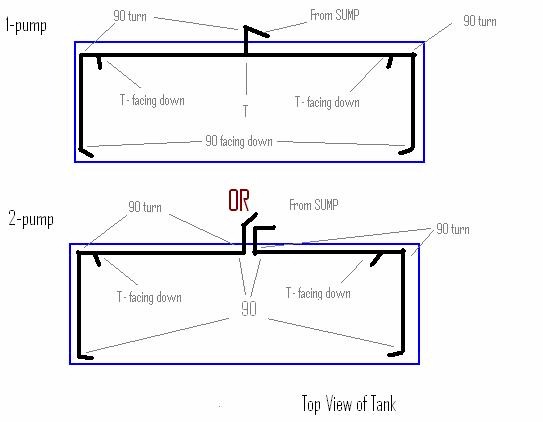
 |
|
| Home | Marine Aquariums |
Freshwater Aquariums |
Planted Aquariums |
Brackish Systems |
Ponds,
lakes & fountains |
Turtles & Amphibians |
Aquatic Business |
Aquatic Science |
Ask the WWM Crew a Question |
| Please visit our Sponsors | ||||
|
Return Pump 7/7/16
Does a bigger sump pump require bigger PVC pipe? Using WWM
5/7/14 Setting up a 65 gallon. Moving from a 37. Mostly SW pb plan
11/21/13 Return pump manifold 3/15/10 Reeflo pumps barracuda, incomp. ap.
11/22/09 Re: Overflow sizing, amount/Ca reactor valve... Now pb, pumps... chatting 1/28/08 Hello again Scott, <Hello Matthew.> I was thinking over how i would be plumbing this 150 gallon rectangle SPS reef system. The overflow will be one of the whole short sides, other 3 sides are viewable. I was thinking of doing a closed loop with a Dart for internal circulation, and running a 1500gph pump of some sort for the sump/refugium just like my reef, the only difference from what my personal reef has is using 2 Tunze's instead of a closed loop recirc dart pump. <Sounds good.> If i were to use two pumps like this, how would you go about feeding the 2" dart inlet and then return nozzles how could that be configured? Would you make two 1.5" strainers on the bottom of the tank tee into 2" inlet for the dart... <You could, I have done it this way a few times. Works out fine.> and return using 1" pvc teed and splitting into two ends.. <Hmmm, you will want to run 1.5" pipe out of the pump to get the full flow. You can start to reduce size as you tee it off.> Four 1" returns and located where..in the middle of the tank you think? <Sure, you can put them wherever you like, although do consider 3/4" returns instead. Four 3/4" returns are perfect for the Dart's flow and you can get LocLine in 3/4", making the returns easily adjustable.> I could build the live rock around the 4 returns like 2 islands of some sort. Im only unsure of placing bulkheads on the bottom of the tank incase of a leakage somehow from all of the pressure. Can they be tightened well enough to prevent that? <Not too much of a concern, although nothing is ever 100%. A smear of silicone on the gasket will make sure it seats and seals. Do not tighten them to much though, a good snug hand tight is really enough. Over tightening will either pinch the gasket out of place, cut it, strip the threads on the bulkhead or even break the bulkhead.> I hope i am not bothering you too much about all these things. Its a fascinating hobby/business for me that i enjoy. Im always thinking of new things and planning stuff and your advice is always appreciated greatly. <I too have fun with new systems. No two are alike, there is always some design and problem solving involved!> -Matthew <Have fun, Scott V.> Setting Up Plumbing on a Large Reef Tank -- 07/25/08 Hello all, <<Greetings Larry>> I've just taken delivery on a used 540 gallon tank (8' x 3' x 3'). <<Very nice>> It is drilled in back with two 2" bulkheads in the top corners (about 2" from the top), four 1" bulkheads evenly spaced between the 2" bulkheads, and five 1" bulkheads evenly spaced around 6" from the bottom. <<Wow'¦lots to work with here'¦excellent>> When I get it set up, it will be primarily stocked with LPS from the Faviidae and Caryophyllidae families. I plan to have flow at a rate of about 10 times volume per hour (5400 gallons per hour). Do you think that will be an appropriate turnover for the system? <<I'm a big proponent of heavy and vigorous flow Larry'¦ Some may disagree, but I would plan on at least twice this volume of flow. In tanks of size such as this, the 5400gph you are planning will be disappointing'¦and deficient for the overall best health of your corals/system>> I expect to get about 3700 gph flow from my existing pair of Tunze 6000s unless I alternate them with the 7095 controller, which would reduce the flow rate. <<As the owner of an eight-foot long reef tank myself, and outfitted with seven Tunze Stream pumps of differing models'¦these pumps will have trouble providing sufficient flow along the entire length'¦best to run them opposing each other and together on the controller set to 'Pulse' for maximum effect/water movement in this large tank, in my opinion>> I would like to feed by sump about 600 gph as this is the flow rate required by my protein skimmer. <<That's fine'¦though you certainly have the overflows to go a bit more with any problem'¦how 'bout 1200gph?>> The remainder of the flow I would like to get via closed-loop(s). <<You have the throughputs!>> I'm stuck in figuring out how to tie all of the bulkheads together appropriately to achieve my circulation goals. <<I would 'tee' the deeper intakes to one or more likely two external closed-loop pumps>> The prior owner used the corner 2" bulkheads as feeds to his sump and the four 1" bulkheads along the top as returns from the sump. If I did that, I don't think that I will get sufficient flow from the remaining bulkheads to generate the volume that I desire. <<Not true necessarily. The hydro-dynamics of a closed-loop are much different than those of a gravity drain. If you have a 2000gph pump with a 1' intake port, then you only need one 1' bulkhead to supply the pump. Granted, using bigger or multiple supply bulkheads will reduce the 'force' of the water flow at the intake if this is a concern>> I am considering running the 2" bulkheads to the sump, building a return that goes over the back instead of through the existing bulkheads. <<okay>> That would leave me nine 1" bulkheads for closed-loops. <<More than sufficient>> I could then run two closed-loops, each fed by two of the bulkheads along the top of the tanks and returning by two of the bulkheads along the bottom of the tank. <<This is okay'¦as long as the upper bulkheads are deep enough to not become 'exposed' by fluctuating water levels'¦and will certainly make keeping the intakes clean/open much easier than if they are deep or buried within the rockwork>> I would either close off the fifth bulkhead along the bottom or split one of the returns three ways instead of two. <<Okay>> Is this a reasonable/viable plan? <<It is>> Am I off base or missing something? <<Perhaps only in your perception of how many bulkheads are 'required' to feed the closed-loop pump. But as stated'¦more bulkheads will mean less suction force per bulkhead and less chance of 'trapping ' livestock against the intake>> Also, do you have any recommendations for pumps that would be appropriate for running the circulation? <<Ah yes'¦ Large Iwaki pumps for the closed-loops and an Eheim submersible for the sump return. Dolphin and Sequence pumps would give higher flow rates for the closed-loops, but you would need to increase the size of the intake bulkheads in the tank to match that of the chosen pump model. Though you 'might' be able to keep from starving the pumps by utilizing more than one intake per pump as you have planned>> I could use my Iwaki MD-100 for the sump, but it generates much more flow than I am planning for the sump and has high energy consumption. <<Would work for one of the closed-loops>> I would prefer something more efficient than the Iwaki. <<All things considered (quality, longevity)'¦a difficult task>> Thanks for your help! Larry <<Larry, if this tank is going to be positioned in/near a frequently used family living space you may well find the closed-loops and their associated pumps to be too much noise. If this is the case, you may want to consider spending the money re on more and bigger Tunze Stream pumps to provide for the flow in the tank'¦energy consumption will be a fraction of as well. Regards, EricR>> Re: Setting Up Plumbing on a Large Reef Tank -- 07/26/08 Okay, I was having trouble figuring out the flow as I was looking at the throughput for 1" bulkheads on an open-loop, which is considerably more limited. <<Ah yes>> I'm not certain I understand why a 1" bulkhead has different throughput for an open-loop than it would for a closed-loop, perhaps you can elaborate a little. <<The open-loop or 'gravity' drain is just that, it relies on gravity and the weight of the water to make passage through the plumbing. Air entrapment, turbulence, bends, et al, severely hamper and restrict the flow rate on a gravity drain system'¦though much of this can be alleviated by using large-diameter (1.5' and greater) plumbing and throughputs. On a closed-loop, the water is 'pumped or drawn' in to the plumbing by the direct connection to the pump volute. The 'power assist' so to speak, enables the water to flow much more smoothly and efficiently through the plumbing enabling a much smaller diameter throughput to flow at a much higher rate than a gravity system. Essentially, merely matching the plumbing and bulkhead to the size of the input on the pump is sufficient to meet the flow demands of that pump>> I will look into upping the total flow for the tank. <<Okay>> I am hesitant to go with 20 times volume as I have seen my Euphyllia unhappy when they get too much flow. <<A good point...and improper 'application' of the flow can cause damage to this fleshy coral from moving/abrading against its sharp skeleton. Still'¦I think you can apply more flow if cautious in your placement of these animals>> I have to be careful with the setup in my existing 225 gallon tank to insure that they are somewhat sheltered. <<Yes>> Of course it is easier to dial back flow than to increase it. <<Indeed>> The setup you describe on the Tunzes is exactly how they are set up in the existing tank. Since they are not on full force, let's say I am getting around 2500 gph out of the Tunzes. I could increase the flow through the open-loop. As you rightly point out, the 2" bulkheads certainly support it. <<Yes>> What if I used the top row of bulkheads as the prior owner did, with the 2" for outlet to the sump and the 1" as returns. <<A quick word here'¦ Even if you upsize to a 1200gph pump, you only 'need' one of those 1' returns. You can certainly use more, but the flow strength from multiple returns will be quite meager. Another option and one which I employ on my own system is to use multiple 'return pumps.' With your 2' drains, a pair of Eheim 1262s would not be a problem at all. This would give you a combined flow rate of 1800gph before headloss, and the redundancy would make your system all the more secure in the event of a pump failure (do also try to put the pumps on different circuits or at least different GFCI outlets)>> That leaves five 1" bulkheads near the bottom to play with. I could use one as an input to a Sequence Dart and return the water to the other four via an Oceans Motions 4 way. <<I like this but for the match-up of the 1' bulkhead and the chosen pump. The Sequence Dart 'has a 2' intake' for a reason. I really think the 1' bulkhead would starve this pump of water and create a micro-bubble nightmare for you. You could use one of the 2' throughputs to feed the pump'¦though you may have to supplement the remaining 2' drain with one or two of the 1' bulkheads if you do this, depending on the size of the sump return pump(s) you choose>> Or, I could do two separate closed-loops, running each with a Dart. <<True, though you would need t use both 2' throughputs here'¦and turn to the 1' throughputs to feed the sump thus limiting your pump choices there>> Since the Darts are rated at around 3500 gallons per hour, how much actual flow would I get in those scenarios? <<The closed-loops will give you pretty close to the rated flow capacity of the pumps as long as you match your plumbing to the inputs 'and' outputs of the pump volute (note that the output port on the Dart is 1.5'). Reducing either will effect the flow rate, while reducing the intake diameter may well create more severe issues. Perhaps a bit more exploring of pumps/options/configurations? Be chatting, Eric Russell>> Just got the Lifegard Customflo, do you guys need a write-up on it? 2/2/08 Greetings Guys; <Hans> In the past you've been very helpful answering a few of my questions, and the FAQ's continue to provide me with help! Now I see the possibility to give something back. <Ahh!> I just got a Lifegard Customflo system for my new 90gal FOWLR tank. I've noticed that there is NO information out there about this setup, and none of the dealer websites are any help either. Would you guys want a write-up on it, as I'm sure you get people asking about it from time to time. -Hans <Please do generate this review... I will offer to help you sell/place it first in the "print 'zines" and then in the electronic press. Do take photos! And send along to me here or at fennerrobert@hotmail.com Cheers, Bob Fenner> 250 Gallon Flow 10/22/07 Hi Crew, I am still in the process of setting up my 250G. The tank is 72x30x25. I wanted it to be wide so fish can swim both sides of the rockwork. Along with the sump return I am setting up a closed loop with 2 x 1.5" feeds located on each side of the tank about 2" from the bottom of the tank. I was thinking about putting suction strainers (such as the ones here: http://www.lagunakoi.com/prod202.html) on each one and building a "cage like" that in the October "Tank of the month" and building the rockwork around it. Seemed like a good idea. Now I am concerned that I will be getting too much flow around the bottom of the tank and stirring up the sand too much. I'm planning on around a 2" sand bed and then having the intake about 2"above the sand. The closed loop will be driven by a Sequence Dart pump. Also, only one side will be operating at a time. Each side consisting of a 1.5" feed and 3 X ¾" (or 1" ?) returns. The system will be set up so that when the left intake is open, it will output on the right side, and when the right intake is open it will output on the left side. Onto my questions; do you think that the 1½ " feed will starve the dart too much? <Sequence recommends that the intake line be as large or larger than the output line. That being said, many people plumb Darts with 1 ½ " intakes with no issues. Just be aware that there will be some diminished flow doing so. > Will there be too much suction in the lower portion of the tank (stirring up the sand)? <The suction at 2" above the sand is cutting it very close, especially when you consider that the suction in the line is not the only thing that can kick sand into the intake. Certain fish love to blow sand around. Reef pumps inevitably process some sand, but I would try to minimize it and put the intakes higher in the tank. You could even possibly angle the intakes up with elbows considering you plan to hide them with rockwork. This would give you some adjustability in the setup. > Will the 3 X ¾" returns generate enough flow? <I would probably make that 4 X ¾" or 3 X 1", 3 X ¾" would be awful brisk flow. As for overall tank turnover, without factoring in your sump return, this leaves you in the ballpark of 11-13 times turnover (accounting for intake size, plus there will be some friction loss), not much for SPS corals. It depends on what you want to keep in the tank and the flow of your sump return. > Grateful as always for your input. Olly <Nice tank, have fun, Scott> Re: 250 Gallon Flow 10/23/07 Thanks again for your insight, <Anytime, the question is much appreciated> as far as flow goes, I have another sequence dart that is plumbed into the 2x 1.5" overflows going back to 4 1"returns. <Two 1.5" overflows will probably not flow the full force of your Dart. You can put a ball valve on the output side and throttle the pump down. Do be careful about running your overflows at full capacity, some safety margin should be left.> Do you know of any calculator to figure out plumbing sizes? Ie, that 2x1" = 1 x1.5" . <The pump manufacturer has some good information on flow vs. pipe size on their website for pipe flows in accordance with their pumps. Reefcentral.com has an overflow calculator, but keep in mind this a numerical calculation and would be a best case scenario at full capacity. > What is your opinion on spray bars? I was thinking about plumbing the returns from the sump into two spray bars front and back at the surface. <Spray bars have the tendency to get clogged in a saltwater environment and can take a lot of trial and error to get the number of holes and the size of the holes just right. It would be less of a headache for you in the long run to stick with the 1" returns.> Thanks again, Olly <Thank you Olly, have fun, Scott V> Re: Pump & Stocking Advice, spray bar returns... using WWM 2/22/07 Thanks for your response. I really like the idea of including 2 separate schools of Anthias. I hadn't thought about that. Thanks for the recommendation. I would like to ask a couple follow-up questions. Would you recommend that I use a spray bar versus individual returns? <Mmm, actually, in the vast majority of cases, circumstances, no... much more to be gained by concentrating flow to a few discharges, rather than restricting same, having all come out in a bunch of smaller holes on one end of most systems> What height would you recommend that I suspend the MHs above my tank? <posted... most at least whatever the manufacturer, re-seller suggests... most often a foot or more> I've heard that you should suspend them a little higher for acrylic tanks? <Depends... should not "shine directly down on the acrylic...> Would you go with an Iwaki or Dolphin pump? I'm leaning towards the Iwaki. Would you recommend the 70RLT or 100RLT? Lastly, what depth would you suggest my sand bed be? Thanks again! Scott <All posted... please learn to/use the search tool, indices on WWM. Bob Fenner> Regulating Pump Flow... Inadequate Factory Overflows - 06/12/06 Hi Crew, <<John>> I bought an Eheim 1262 to use as the return from my sump to my 90g (with AGA Megaflow). <<I love Eheim pumps...wish we could get some of the bigger ones over here>> It's a great pump, but it seems too powerful for the Megaflow system. <<Not so "Mega-", eh?>> Actually, I should say it seems too powerful to run the Megaflow quietly - water rushes though the system and it sounds like a dishwasher. <<Typical of these undersized (Mega or not) factory overflow systems>> I've read through the FAQs and this seems like a common problem. <<VERY common>> One suggestion that helped was to increase the diameter of the hole at the top of the Megaflow drain tube. However, my system is still extremely noisy, unless I pinch and restrict the flow coming out of the Eheim. <<Replacing the Megaflow drain tube with a Durso-style standpipe might allow both an increase in flow AND a reduction in noise...but still no replacement for the simple want/need of a larger throughput>> So my question is (finally) is it safe to add a ball-valve on the return side of the Eheim, or will this produce too much back pressure and jeopardize plumbing connections? <<This is quite safe and satisfactory, though I would install a gate-valve as opposed to the ball-valve for better "finesse" of the flow. Magnetic drive pumps such as the Eheim respond to/endure this type of control/adjustment very well. But do make sure you install the valve on the "output" side of the pump>> Would it be better to step down to the Eheim 1260 and let it run unrestricted? <<Not in my opinion. The plumbing lines will eventually start to restrict from bio/mineral accumulation...but with a twist of the valve you can step up flow to compensate>> Thanks, John H. <<Quite welcome, EricR>>
Re: 375g setup Hi Anthony, <Out till 12/12> Thanks for the tip - I will follow up with him. When you commented "you don't follow", I was asking if switching the 2 DSB's would have any effect or make a difference (i.e. Thalassia in the refugium with sugar fine sand and the Chaetomorpha with fine sand in the tank). <Might indeed make a positive difference> Also, I wondered if this was going to be quite enough tank turnover...other than sea-swirls is there anything else that can perform their function? With their 1" max input it's going to take a lot of them ($$$$). Would I just plumb some of the additional returns as "direct" and aim them away from any specimens to avoid uni-directional flow ? thanks, Greg <Best to make, place a manifold of a few discharges... with one through-put to a few, or even an "over the top" arrangement to return water from a strong pump source outside this size system. Bob Fenner> Water flow questions 2/11/05 Hello crew. I sent this letter of inquiry to Bob Fenner first, then found the crew's email option floating around your site. Very cool site by the way! <Thanks! Glad you have found it useful!> I'm in the process of setting up my acrylic 48"x13"20" reef tank that's been down for a few years due to moving and busy schedule. I'm redoing the stand and hood too. Our living room looks like a workshop :) Would like someone to hold my hand as I venture forth with some plumbing advice/preferences. Technology has advanced a bit while my tank sat idle. The aquarium has one 5"x5"x19" corner overflow with a 1" bulkhead in the bottom, returning to the almost finished sump/refugium I am now making. My intention is to: 1) Drill another overflow in the opposite corner matching the existing one making two 1" bulkheads (large enough or drill them out to 1 1/2"?) using Durso stand pipe technology. <You may have to get your hands on the bulkhead and measure for the correct hole size since this varies by manufacturer.> I noticed on the Durso web sight that the stand pipe seems to only come in 1". Is there a reason? <I don't know. "Durso" standpipes can be made from just about any size pipe. If this site is selling them, I suspect that it is an economy of scale issue.> Will have 3/4" to 1" (preference?) return lines come up through same 5x5 boxes. <Bigger lines will get you more flow out of your pump. If you pump pumps more than about 500gph (at a head pressure equal to the height of the top of the tank), then go with 1", even if your actual outlet will be a smaller nozzle (SCWD, SeaSwirl, etc.). My personal preference would be to run the returns up and over the back edge of the tank. Advantages include less crowded spillway boxes, less clutter inside the tank and better access for the inevitable re-working.> Perhaps employ a squid valve to these return lines and a sea swirl (if needed) in the middle of tank on a separate pump. Am worried about water velocity hurting critters using a squid that will isolate return pump to only one line at a time. Valid concern? <This is a very valid concern, but easily prevented. One or the other of these devices should be plenty on such a small tank.> Was thinking of a pump that does around 1000gph. Good number? Pump recommendations? Also considered just using 2 sea swirl returns, both on all the time. <You will probably need two 1.5" drains to handle that much flow. Also, with that much flow, you will have to be more careful of blasting corals. I like Iwaki pumps for outstanding service records, but quieter pumps are available. Blueline pumps are newer to the market, but seem to get good feed back. They are less expensive and reportedly quieter than Iwaki. Dolphin pumps are nearly silent, but not head rated and have reliability issues (seal leaks).> 2) Make a new, longer overflow wall, center back, say 16"x4", for improved surface skimming and looks. If I go with this option, I will either drill two bulkheads (1 1/2"?) in the bottom of the tank behind the overflow and utilize the Durso stand pipe arrangement, or come in from the back of the tank up by the water line with two 2" bulkheads. The return lines have the same options, up through the bottom or in from the back. My worry with having bulkheads up high without stand pipes is noise. After reading many letters sent in to you guys, it seems noise is the #1 complaint. Twin 2" bulkheads should be plenty for moving 1000gph though, true? <Two 1.5" should handle the flow. No matter how you plumb it, noise will be an issue. Drilling through the bottom and using Dursos is the way to go if noise is a major concern.> 3) I guess a last option would be to plumb my return line(s) into a PVC pipe running along the upper back wall of the aquarium with several outlet nozzles, allowing for greater volume of water to be moved without creating flesh tearing force. Not as hot on this idea though. Worried about looks. <This can be an aesthetic problem, but can also be hidden. The risks of higher velocity returns must be balanced against the benefits of the turbulence produced.> Would any of these scenarios require added power heads? Would rather avoid them if possible. <Even at 3/4 of it's rated flow, a 1000gph pump will give you 15x turnover or more... plenty!> Just bouncing these ideas around in my head, trying to think of all the pros and cons . Would appreciate any feedback you have on what might work best. <If noise is a serious concern, do consider running your 1000gph pump on a closed loop and only turning a few hundred gph over through the sump. You will get all the flow with little drain noise.> PS: Am thinking of getting a new skimmer. The Aqua C caught my eye. Is it really worth the $? <AquaC gives one of the best "bangs for the buck", especially in hang on models. If you go cheaper, performance will fall off rapidly, and you will gain very little if anything by going more expensive.> Also thoughts on a calcium reactor? Never had one. Used a drip back in the dark ages. <This is largely a subjective question. Calcium reactors trade high initial cost for low hassle and low operating cost. However, they are a mechanical device and need to be maintained and do break. Kalkwasser remains a great choice, and "two-part" additives are very convenient (but expensive).> Thanks for the help, One who has definitely got the bug going again, (just ask my wife) Jim <Welcome back to the hobby! Best Regards. AdamC.> OVERFLOW & SUMPS Good day: Now that I have read all about the perils of siphon overflows, I want to get a tank with an built-in overflow. However, now I am reading that a pre-drilled 55 gallon All-Glass, for example, has 1 overflow, which is rated at 600GPH, but actually flows only 300GPH in reality?!? WHAT IS WITH OUR $%#%$# SOCIETY THAT EVERYTHING WITH A RATING IS ALWAYS OVERRATED?!? WHERE ARE THE CONSUMER WATCHDOGS?!? Ahem, sorry. Okay, so I only have a FOWLR at the moment, but I want a tank that can handle the future possibility of a reef. Your site says 20X flow for corals is good, right? <The more the merrier generally> What about just FOWLR? Will the 300gph (5.45X) be enough? <Likely so, yes> If I have to drill, I can't on the bottom because of the tempered glass. But I don't want the back drilled, because I need to have the tank against the wall for lack of space. Can I special order 2 overflows from the All-Glass (or other) factory? <Contact them and ask.> Do I want a tank without a tempered bottom? <... not really> It does not sound like a good idea. And what's with sumps "rated" for a certain flow? I am going to take a wild guess and say that they are overrated flow-wise too, right? <I suspect these ratings are "generalizations" as the physical restriction (for transit volume... the amount of water pumped up to the main/display tank) will be a matter of how fast the pump is able to pile water up above... in the surface area, drain configuration of the system> Why can't they handle as much as you push through? <Think about this... the water accumulates "on top" of the tank being pumped to... if/when the pump/s go off... that water will flow back down to the sump/s... It's a good idea to have as long, wide of sumps as possible, and to "practice" with filling all with the pumps turned off, turn them on, and mark the lowest level of the sumps achieved, mark this on the sump/s and never fill them more than this... to provide for the inevitable power, pump failure. Bob Fenner> anyway, thanks for being there! Rich. - Plumbing and Circulation - <Greetings, JasonC here...> Attached is a rather silly bitmap (Paint sucks) depicting my plans for a closed loop circulation system for a 75 gallon reef tank I'm planning. <Ahh yes, I got the image this time.> The pump will be an Iwaki WMD40RXLT rated at 1200 gph at 4' of head. I should get a few more gph since I'll be using it at about 2.5 ' of head. But with all the plumbing..... The PVC all around will be 1", modified at the tees to 0.75" to accommodate the flares and SCWD's. The outlets will be setup at different angles. <I think I get the picture...> "The SCWD (pronounced "squid") is a revolutionary device designed to provide alternating currents without the use of electricity. The SCWD mounts inline with 3/4" tubing, the two ports alternate the output, the bottom port is the input. A great alternative to expensive electronic ball valves. The SCWD will run on any pump with a minimum output of 50 GPH and a maximum output of 1400. The switching speed and current duration is dependent on the volume of water flowing through the SCWD. We have tested the SCWD with a mag 7 (700) gph and the port rotation was every 10 seconds. You can control the duration by controlling the flow going through the SCWD. " From Champion Lighting (page down on their home page and there they are.) <Yup, I just went and checked it out.> What are your thoughts on this arrangement? <I think it will most certainly 'work' - how well is hard to say, but I think it's a good plan.> Also, will 2 SCWD's be sufficient (at ~$50 each) to randomize/break up the flow? <If they work as advertised and don't break too often, I'm sure they will do fine.> Thanks for your input, you guys are great! Mike <Cheers, J -- > Overflows and pump sizes Hi to all, I just got my 55 gal corner bow drilled for 2 - 1" bulkheads. I am going to plumb down to the sump according to the directions and advice I have found on your faq's. I think I can handle that. My question is about the return pump. Dr. Foster's and Smith have GPH flow rates for 1" overflows at 600-800 Gph each. So, I am looking for a pump, but I don't know how much flow rate to shoot for. Should I get a pump rated at more than I need and throttle it back or get one just at the rate I need. I am looking at the Iwaki md 70RLT at 1500 gph at 4' <Hey Bryan! Use the flow rate/head chart for Iwaki's to see what they actually deliver at the head height (surface of sump water to surface of main tank water) you have from your sump up to the main. I would also advise oversizing the overflow plumbing to allow you some wiggle room and a chance to reduce noise with less flow-air sucking/pulling. Also search on Durso-pipe drains, a good idea.> That's it for the actual advice needed. Do you know of any aquarium clubs around South New Jersey? <Look at the club forums at WetWebFotos or Reef Central, I'm sure there are several choices.> Also I read some faq's about possibly putting something on your website to reduce your backlog of stupid questions. As a dedicated reader I say go ahead. I can't get over the number of people who write in about questions that have been answered so many times already. Some one suggested a page with links to the most popular questions like Ich. I honestly would like to see something like that although if the daily's get too boring (I.e. the tongue lashings directed at those who buy fish uninformed and then look for advice are all weeded out) you will lose one of the most enjoyable parts of the daily's IMO. Anthony is my favorite. I got a good dressing down from him when I first started as an uniformed fish keeper and not only did I learn from it. It got me motivated to actually do some work and research to make the lives of my charges better. <No stupid questions, just those we answered already! That's out Anthony! Sometimes a good tongue lashing with a little humor doesn't hurt! We're glad he helped!> You guys are a shining beacon (now that's just tooooo sappy) Bryan and Dana Flanigan <Thanks Bryan....Craig, the dim flashlight!> - Circulation - <Hello, you got JasonC again...> Whoops....sorry, I'm on a Bloomberg and it doesn't keep a history like that. I was following up on a question I had re: a 180 gall used tank I'm considering. I was going to order a new one w/ overflow boxes built in, but this used one which is $1000 less is not drilled or anything. I was wondering exactly what the best way would be to get the water from the tank to the sump. Jason said to get it drilled. <And I still say it...> I was just trying to get an idea of exactly what this method would entail and how effective if would be. <Any glass shop can do it for you.> I'm imagining something like 2 holes where PVC pipes would go up into the tank with straining caps on top. <Better to have multiple bulkheads on the back - there is much data on this in the FAQs, check here: http://www.wetwebmedia.com/plumbingmarart.htm http://www.wetwebmedia.com/circmarart.htm > These would in essence work as overflows right? <Yes.> Would 2 be enough? <More [bulkheads on the back] would be better, redundancy, increased circulation.> Thanks...Rick <Cheers, J -- > Re: water circulation Hi guys. I am planning a standard size 90 gal reef setup. I used your site to answer just about all my questions without even writing to you. Anyway, I just wanted to run through a simple water flow and ask for your input/approval. I plan on having four 1" bulkheads on the 90 draining into a 55 gal sump underneath. If I understand things correctly than this should be somewhere around 1200gph draining right. <Do think about doubling the size of your overflows and bulkheads, and look into Durso pipe type vents to avoid noise. The noise is really sucking air. Give it a bigger drain and a place to vent air.> The return would be supplied by 1" ID, reduced to a 3/4" manifold system, all powered by an Iwaki MD70RLT (which I'm sure you know is rated at 1500gph). Do you think this will give me adequate water flow for a 90 gal without running into problems such as gurgling jungle noises from the overflows? Also, how many outlets do you think I should branch off of the manifold? I am trying to avoid the use of ugly powerheads if I can. <Oversize the manifold pipe (there may be specs in with the Iwaki to such) to maximize available flow and downsize from there. Don't forget valves. Three or four inlets would likely work well, don't forget that future refugium! It's easier to put that tee and valve in now.> Any expert advice would be greatly appreciated. Ben from Pittsburgh, who is not thrilled about Kordell Stewart being back in for the rest of the season. At any rate, Go Steelers!! <Ben, Thank your lucky stars your not writing from Seattle like I am....At least the Cougs and the Sonics are hot. Have fun with the new tank! Craig> Undersized overflows All Glass tank overflows I have tested can have a flow rate of 700 gal per hour for each one. The way to do this is to used 1-1/4 pipe or tubing on the leaving side of the bulkhead to the sump. Used a Durso set up on the top side. All overflows on the 75 gal 90 gal will have 700 gal per hour. <10X turnover is adequate for fish only tanks...perhaps. But with the modern popularity of packed reef displays and stony corals... this is about half of what is needed. Hardly "reef ready" as the claims go. And impossible to upgrade if the consumer buys it and wants to put an averaged sized water pump on (most mid range pumps fall 1000-1500 GPH). So one cannot run enough flow through these overflows to keep sps corals, for example. A consumer must then contend with a custom drilling for extra holes (closed loop or other) or just have too many power heads in the main display to get enough water movement for coral health and growth (and to prevent detritus from building up). Adding heat from PHs and considerable expense overall to the project. Seems like it would just be more sensible for the mfg to provide larger holes. Plenty of room in the overflow tower. No harm if its bigger than some buyers need... it will just run at a safer level. Makes no sense to me if the R&D people actually own reef tanks and test these systems before they go marketing them as reef ready> The 120 180 gal tanks will have two overflows that will give 1400 gal per hour. <1400 GPH (and running dangerously at max for this overflow) is still a trickle in a 180 gallon reef). I have no qualm with the quality of construction... just the inappropriate marketing as "reef ready"> The elec. power has come back on too many days with out it. Thank you for the help solar works well. Gibson <that means the clam survived? I hope so my friend. Best regards> Plumbing issues These plumbing questions are in reference to a 180 gallon reef tank with the sump in the basement. In order to create water movement in the tank, I understand that there are three options: (1) external pumps only generating strong return flow, (2) internal pumps (such as powerheads), or (3) a combination of the foregoing. The first option seems the best, at least from the perspective of not having equipment in the tank, but it's more expensive and generates heat. <Actually, you are incorrect on the second two parts, about expense and heat. External pumps pass on much less heat into the water than powerheads and are comparable in price for the gph they generate. The expense part comes into play for you in particular because you are locating your sump in the basement. For most people, with sumps in their stands, external pumps are comparable.> Is it worth it? <Yes> If I go with the first option, at least one opinion counsels having two pumps running in tandem (in case of power failure?). <I like to do this. If you need 2000 gph, I would use two 1000 gph pumps, instead of one larger unit. That way if one ever breaks you have the second unit to get you by.> I guess the return outlets go back through the internal overflow (4 or 6 holes?). <I usually just plumb the return lines up and over the side.> A wavemaker could be coupled with this, thus alternating the flow among these returns. <External pumps are built for continuous use. Using a wavemaker on them could shorten their lifespan.> Does this make sense? Under this setup would there be any need to have some other internal pump arrangement (e.g. powerheads in addition or SeaSwirls?). <You should be able to create enough random, turbulent flow with external pumps that a wavemaker, powerheads, or other devices would be unnecessary.> >As a separate issue, there's the noise from the overflow, to which I believe you have referred other inquiries to the Durso standpipe and other such devices. However, I was advised that this could somehow increase the risk of flooding, to which my contractor responded as follows: <Unlikely> "The absolute best system with 100% no chance of overflow is the way I configured my overflow [which is to drill the holes in the back of the tank at the water line]. It again has 4 1" through fittings with strainers connected indirect to a 2" line back to the sump. If you think a 1-1/2" line can get clogged go to a 2" or even a three inch return line. If it were me I would have 8 - 1" through fittings manifolded down to a 3" return line." <I shun overflow boxes and do drill my tanks with holes near the top of the water line.> Is he right? <I am a bit confused by the above description of the plumbing, but I would use a least 6 1" drain fittings for a 180.> As always, your guide through this thicket of opinions is most helpful. Thanks. <You are welcome.> Sea swirls are the very best for wave making. I would recommend 2 - 1" sea swirls in a 6' long tank and have 2 Iwaki pressure pumps powering them. I would also run 2 - 1" return lines from the pumps <You may need 1 1/2" or even 2" return lines from your basement. -Steven Pro> The plan using motorized ball valves Great. I'm glad I'm on a good track. Would you then encourage the following plan for a 200 gallon tank with a remote sump in the basement: 1) Iwaki RLT 100 returning water from the sump to the tank splitting into two returns with the water alternating between them on a motorized ball valve. <Sure> 2) A closed loop also splitting into two returns with the water alternating between them on a motorized ball valve. The height of the returns inside the tank for the closed loop would be lower than the sump returns in order to create water circulation at a different level of the tank. The returns would be hidden in the rockwork. Any suggestions how high these returns should be if the tank is 24" high? <Mid level and also use two intakes as well as two returns to diffuse the pressure of the suction.> 3) I'm told that head pressure for a closed loop is not much an issue and so an Iwaki RLT 70 or 55 might be too much. So maybe the Iwaki RXLT, which is not rated for pressure, is the right choice, say the RXLT 30 or 40? <Do look at the flow charts provided by Iwaki and reprinted by just about any e-tailer to find the one that fits your needs.> 4) I like this plan, but for the fact that it contemplates only one pump returning water from the sump. I could have an unused pump in reserve in case of failure, but you previously raised the following concerns to this contingency plan, which have merit: "I am an aquarium maintenance professional that works out of his home, so I see things from that perspective. While for you and your own tank, you maybe perfectly happy with a spare pump sitting unused in the house. I don't want any more stuff than I already have to have around and I doubt any of my customers would want one either. I try to consider every possible catastrophe and design systems so that no matter what goes wrong they will continue to function and not flood. It is a liability issue for me. Also, if a pump were to fail, with two pumps, I can get to replacing the broken one when I have time. If there is only one main pump, I would have to drop every to fix it immediately." I'm concerned about having too may sump return pipes in my tank, but maybe should just overcome that concern for the sake of safety, right? <I don't see the problem/concern you have.> P.S. I'm puzzled by how the second pump would keep the sump from backfilling. Wouldn't the sump returns on the loop with the failed pump siphon back water to the sump in such large quantities that the second pump would not be able to keep up and pump back sufficient amounts to keep the sump from being overwhelmed? <You have a good question. Allow me to clarify. I always plumb the two return pumps on separate lines. In the event ones breaks (which is a very rare occurrence), the back siphoning one will over power the one pumping against head pressure. But that works to your advantage because the back siphoning one will soon suck up enough air to break the siphon and then just sit there. You get some of these benefits with a closed loop. If either one breaks, you will still have some circulation. But, if the return pump fails you loss your heaters, chillers, protein skimmers, carbon filtration, and everything else you hide in the sump. With two return pumps, all of these can still function. Best of luck to you! -Steven Pro> Wavemaker on the valves, not the pump Using motorized ball valves seems like a good way to go in order to create chaotic flow for a reef tank. As described in the link below, instead of the wavemaker turning the pumps on and off, this fellow engineered his system so the three way valve opens and closes, directing the water to the left and then to the right. Presumably, this is much better for the pumps, I think. http://www.rockcanyon.com/reef/flow.htm Is there any downside to this approach? <The only downside is expense and maintenance/possibility of failure, but this seems like a very nice idea and different than powerhead/wavemaker combinations the pumps are running at 100% all the time. -Steven Pro> Making Waves! (Circulation Enhancement) Hi guys, <Hi there! Scott F. with you!> I am renovating my 110g marine aquarium, and the first issue I am covering is the water circulation. At the moment it is pitiful with only a couple of powerheads. I am considering a centralized system powered by a single pump supplying approximately 6 - 8 outlet points placed systematically around the aquarium. <That sounds like a nice idea!> I am having difficulty designing a suitable system, at the moment making a PVC system with individualized gate valves on each outlet pipe seems like an unwieldy project that would not look subtle enough. <My thinking exactly> I wonder if you could advise me on the suitability of using 3 spray bars, each the length of my tank, along with 2 powerheads to cover lateral laminar flow. I understand that spray bars are prone to clogging up with coralline algae, and that is my principal reservation on this option. <That is actually my main concern with spray bars, too.> Do you think this project would be of use in a saltwater tank - http://www.tomgriffin.com/aquasource/DIYjuly01a.shtml <It's a nice project, and a useful end product, as long as it is maintained and algae doesn't become a factor. I am partial to a closed loop concept with say, two or three Sea Swirl rotating return devices. Yes, there is an added electrical consideration (minimal with the Sea Swirls), but these will create a very nice current pattern if configured properly. Check them out!> Thank you, and apologies for the longwinded email Regards Andrew Hough <Any time, Andrew! Good luck with your project! Regards, Scott F> Circulation Plans and PVC Sizing Hi Crew, I'm trying to create a plan for circulation for a reef project that will kick-off this Spring. <Ooooh, sounds like fun!> I want to find out the "best practices" as per the WWM Crew. My planned tank is a 400g (96"x24"x40") on a 30" stand with Ecosystem 7222 Filtration sump (72"x22"x20) adding roughly another 100g (net). I want to run 2-3 external pumps for redundancy and do not want any powerheads in the tank. After reading the Circulation FAQs and Anthony's BOCP section on the same topic, I believe I understand how water can re-enter the tank. I'm still having a hard time visualizing exact details of water leaving the tank beyond the generalities. I'm going to thank you in advance for answering these questions (they will be numerous). I consider WWM my final authority on theplans for my tank. My questions follow: - The FAQs, Bob's CMA, and Anthony's BOCP talk about 10x circulation per hour being mediocre and new standards being 20x or more. What should I be targeting here with SPS in mind? <20X> Also, should I be calculating based to max total gallonage (500g), total gallonage less displacement from rocks (at 1lb Fiji LR per gallon, how would I calculate this number), or max tank volume only (400g). <This is the circulation of the display itself, so the total volume of the display, 400 gallons.> - I was reading up on the friction loss and head with PVC pipe. Do you agree with these calculations as the best way to determine actual flow --> http://www.moneysaverpumps.com/TDH.htm or should I trust Dolphin's version here --> http://www.dolphinpumps.com/plumbing.htm . Also, is it really important to keep the flow rate velocity to under 5 feet per second as the first site indicates? (Which of course leads to larger pipe sizing and my next question.) - Given your recommended flow rate for my application, what size PVC would correspond to that recommendation? - Do you have a link or could tell me what max flow rate to expect through various pipe sizes? I am specifically interested in the max-flow rates for 1.5" and 2" pipes to correspond to the Dolphin AmpMaster 3000 and 4000 pumps (they draw 1 and 1.3 amps respectively). - I know that increasing pipe diameter reduces friction, but how do I calculate the flow of a specific outlet after introducing Tees in the manifold plan suggested in BOCP (I'm thinking that I would divide the flow-rate evenly for equal sized Tee's? But what was the flow through that segment of pipe?) <There are a number of sites that have calculators to figure pipe sizes, flow rates, head pressure, etc. Reef Central has a decent version. I would go with the pump manufacturers recommendations regarding pipe sizes to achieve the performance you want. Make sure you sufficiently oversize your pump and pipe sizes and pipe sizes on your overflows, they are very hard to increase once installed. Better to go bigger and use appropriate valves. PLEASE make sure you drill siphon breaks in your returns to stop siphoning in power outages, etc.> - Given the 40" tank height, how far down should holes be drilled for closed loop circulation or should near surface overflow holes be drilled? Also, I'm having a hard time visualizing Anthony's surface overflow shelf (and that's after seeing the picture -- help!) <Depends on inhabitants. Want anemones? I would use surface overflows or incredibly well shielded intakes. If you size your overflows adequately or have enough of them, you can feed the closed circulation system off of the sump and return to the sump via existing overflows (no additional overflows). The surface overflow shelf is just a full length skimmer/overflow box. It is a raised lip that skims from the full length and has bulkheads below the lip for drainage. Imagine a skimmer/overflow box that runs across the full length of the back of the tank.> - The FAQs state that I should be able to find closed-loop circulation plans on the web, but mostly, people just state that have one. Could you detail this here or point to a link? <This is exactly the same principle as the return system, except the 20X circulation applies to the closed loop system.> - Finally, when calculating head pressure for the vertical lift of water on a closed loop, do I use the total head height of 70" (30" stand + 40" tank) or the total height less the point where the tank is drilled for the intake (if drilled 10" from the tank bottom, would that would be 50" [30" stand + 40" tank - 30" point of drilling for closed loop]) Thanks again, Rob <Okay Rob, head height is measured from water surface to water surface no matter what system you are plumbing. So, it's from the top of the sump water level to the top of the display water level. Same for the skimmer/return/sump system, refugiums, etc. Again, just make sure you oversize enough to compensate for head height, plumbing, fittings, valves, etc. This is especially true on the overflows. Do a web search on Durso overflows and venting. More than anything, have fun! Craig> Circulation Plans and PVC Sizing Hi Crew, <cheers> I'm trying to create a plan for circulation for a reef project that will kick-off this Spring. I want to find out the "best practices" as per the WWM Crew. <best flow will be determined by species/genera kept instead... Stylophora and Porites require staggeringly strong water flows while Montipora can only tolerate moderate at best. Like lighting, your coral species selection will dictate hardware needed> My planned tank is a 400g (96"x24"x40") on a 30" stand with Ecosystem 7222 Filtration sump (72"x22"x20) adding roughly another 100g (net). I want to run 2-3 external pumps for redundancy and do not want any powerheads in the tank. <very good to avoid powerheads> After reading the Circulation FAQs and Anthony's BOCP section on the same topic, I believe I understand how water can re-enter the tank. I'm still having a hard time visualizing exact details of water leaving the tank beyond the generalities. <this is very much a case of needing to see the plumbing in person. Do seek a regional aquarist on one the message boards and in a local aquarium club to see their systems for perspective. Reefcentral has a forum of national aquarium societies and here on wetwebmedia.com we have a list of many in our links. I assure you that is will be well worth the road trip. Show up with beer and it will be smooth sailing <G>> I'm going to thank you in advance for answering these questions (they will be numerous). I consider WWM my final authority on the plans for my tank. My questions follow:- The FAQs, Bob's CMA, and Anthony's BOCP talk about 10x circulation per hour being mediocre and new standards being 20x or more. <true> What should I be targeting here with SPS in mind? <as per species... since you have the BOCP1... see notes in each family and genera section on flow requirements and do try to amass a most compatible collection> Also, should I be calculating based to max total gallonage (500g), total gallonage less displacement from rocks (at 1lb Fiji LR per gallon, how would I calculate this number), or max tank volume only (400g). <there is no golden rule... 20X is not literal... your very rockscape will influence the flow dramatically... very experimental here. Just get into the ballpark with flow (20x) and make fine tuned adjustments with output nozzles> I was reading up on the friction loss and head with PVC pipe. Do you agree with these calculations as the best way to determine actual flow --> http://www.moneysaverpumps.com/TDH.htm or should I trust Dolphin's version here --> http://www.dolphinpumps.com/plumbing.htm . Also, is it really important to keep the flow rate velocity to under 5 feet per second as the first site indicates? (Which of course leads to larger pipe sizing and my next question.) <wow... way too much math here for me to enjoy a very organic experience... Please do spend more time thinking about the corals in their 3-d environment rather than looking for a magic number, my friend> Given your recommended flow rate for my application, what size PVC would correspond to that recommendation? <that is dictated by the pumps needs/rating which has been sized by the corals needs <G>. Still... I suspect you will end up with 1" lines.> Do you have a link or could tell me what max flow rate to >expect through various pipe sizes? <Hmmm... it sounds to me like you have a genuine appreciation for the hard science of it all. Let me suggest you buy Escobar's "Aquatic Systems Engineering". Amazing and tell all on these various specs you seek> I am specifically interested in the max-flow rates for 1.5" and 2" pipes to correspond to the Dolphin AmpMaster 3000 and 4000 pumps (they draw 1 and 1.3 amps respectively). <wow... expensive to run... QC issues... and perhaps oversized for your needs here. Have you looked at two big Iwakis?> I know that increasing pipe diameter reduces friction, buthow do I calculate the flow of a specific outlet after introducing Tees in the manifold plan suggested in BOCP (I'm thinking that I would divide the flow-rate evenly for equal sized Tee's? But what was the flow through that segment of pipe?) <likely a moot point with a properly and slightly oversized pump, a flow meter (cheap enough and fun for you) and a bleeder line> Given the 40" tank height, how far down should holes be drilled for closed loop circulation <not important with properly guarded intakes (in and out... out guarded for fear of power failure and fish swimming in)> or should near surface overflow holes be drilled? Also, I'm having a hard time visualizing Anthony's surface overflow shelf (and that's after seeing the picture -- help!) <I can't help without a question dude... you already have the picture. Not sure what more to say <G>> The FAQs state that I should be able to find closed-loop circulation plans on the web, but mostly, people just state that have one. Could you detail this here or point to a link? Finally, when calculating head pressure for the vertical lift of water on a closed loop, do I use the total head height of 70" (30" stand + 40" tank) or the total height less the point where the tank is drilled for the intake (if drilled 10" from the tank bottom, would that would be 40" [30" stand + 40" tank - 30" point of drilling for closed loop]) Thanks again, Rob <I do believe you will be very satisfied to read Aquatic Systems Engineering and a visit to a local aquarists tank will be priceless. Just visit some big message boards and post a thread stating your general location and that you are searching for a local aquarist to chat with or are looking for a local aquarium society. Sites like ReefCentral are huge with many thousands of browsers. Best regards, Anthony> Playing With Sand And Moving Water! Hi guys, <Scott F. your guy today!> I have a live sand question. Talking to the rep from Pure Caribbean and he had mentioned seeding my DSB with 10% of total percentage of tank substrate with a live sand. <Good idea, IMO> My question is this. He said, "do not get that bagged/packaged stuff", make sure it is good quality." What does this exactly mean? I have never dealt w/ live sand and not sure where you get good sand from. The online merchants I looked at never did tell how it came (Premium Aquatics, Marine Depot etc...). <Well, I think what the rep was referring to is the so-called "live" sand that comes in the bags. These products are essentially inert sand enriched with a bacterial solution. Live, yes- but not filled with a diversity of life that you want from "true" live sand. Many etailers offer "live sand" that has been collected from, say, Fiji, or cultured in their own facilities. Most of these places offer sand that has a variety of worms and other desirable life residing in the sand. Alternatively, you can use "dead" sand, and get a "starter kit" from a place like Indo Pacific Sea Farms (my personal favorite) containing some of the desired infauna to "kick start" the sandbed.> Quick question about pvc plumbing. I believe the Dolphin Amp master web site says not to use a flex pvc or sweep fittings (what are sweep fittings?)<<Gradual turns... like a wave, instead of an elbow. RMF>> why is this? <To be perfectly honest, I'd consult the manufacturer on this one. I would not deviate from the suggested plumbing arrangements!> The dolphin site gave specs on figuring head pressure according how many feet to add if using 90, 45 degree angles etc.. but it never said anything about "T's. And last (sorry long winded). I have been researching different ways to return water to main tank w/o the use of powerheads. Possibly going with manifold return. IYE what are some different ways you have seen that are affective at good returns? Thanks Bryan. <Well, Bryan, I've seen some neat manifold returns that worked great! They were placed above the tank, and plumbed to a line that ran in a loop around the tank's inside perimeter, with lots of outlets along the way. Amazing water movement if done right! Also, I've seen closed lop systems plumbed to Sea Swirl return devices that are wonderfully effective, too. Lots of neat ways to accomplish this. Check out the do-it-yourself site OzReef for lots of neat ideas, or pick up Anthony Calfo's "Book of Coral Propagation" for other possible setups. Good luck, and have fun! Regards, Scott F> Pumps Hello, I have been researching water circulation for my aquarium. I have a 55 gallon aquarium with a 15 gallon sump. My return pump is a Rio 3100 with about 4 feet of 3/4 inch PVC attached to a spray bar. I noticed that there are some spots in the tank along the back wall on the sand that don't get much circulation, right below the spray bar. I was thinking of using a Y to split off the return, use maybe 1" or 1 1/2" pipe and raise the spray bar to the surface instead of being right above the sand. Then have the other section of the Y split off to the corners to act like two powerhead facing diagonally to the front center of the tank. <It is probably better to create some sort of manifold with valves to adjust how much water is directed to each outlet.> From everything I read, the two streams of water will clash and cause a variation in water flow, so that there might not be anymore dead spots for red slime to gather. Will this work? <Sure> Will the increase in pipe size allow more water to flow? <Yes> The sites I read talked about not restricting the flow with small pipe. (But they were talking about Dolphin pumps with a 1.5" outtake) The outtake on the Rio 3100 is about 7/8". What is your advice. <I would continue with your plan except incorporating the manifold.> I am trying to minimize pumps to minimize heat. <A good idea.> Thanks, Daniel <You are welcome. -Steven Pro> Re: pumps, Water flow, Manifolds and Power Heads Hello again, I was wondering if you could give me some clarification on the manifold concept. Is there some site, book, etc. that might show examples or plans. Thank you, Daniel <cheers, Daniel... I describe such a manifold in my first volume of the Book of Coral Propagation (excerpted below) and will place an illustration in the next volume (I'd offer it now but it hasn't been drawn in AutoCAD yet). Hope it helps... Anthony Calfo> "My recommendation for water movement in display aquaria is the employment of a large external pump (or more than one if necessary) driving a discreetly plumbed manifold above the display. A large pump can simply feed a single line of pipe that runs in a closed loop at or just above the system's water level (imagine a pump fed circuit of ¾' pipe, for example, fitting the entire inside perimeter of the aquarium). Around the perimeter of this manifold are to be numerous teed-outlets that can be adjusted, restricted or turned off. Swiveling 45-degree elbows work well for flow adjustments when fitted into tees glued at a slightly downward angle (in case of a leak or nozzle expulsion). The construction can be completed simply and inexpensively with PVC materials and has many benefits. Several 'nozzles' may be directed to converge in the water column to produce random turbulent circulation that is nearly as ideal as surge/wave motion but far less complicated to produce. The option of using flexible, interlocking pipe nozzles makes fine-tuned control of a manifold quite easy for aquarists with a larger budget. The absence of any powerheads in the display is an obvious aesthetic benefit. Despite their popularity, I do not recommend powerheads as a primary source of water movement. The disadvantages of powerheads include: the impart of heat to the display from submersion, increased maintenance (and increased risk of killing/damaging livestock through screened intakes or nitrogen-generating, fiber pre-filters), aesthetic detraction (ugly!), expense of quantity for commercial applications compared to the delivery of flow by large dedicated pumps, significant risk of electric shock by virtue of their construction (most do not have grounded plugs, and concerns have been expressed about stress from their operating noise underwater with magnetic impellor fields. The absence of dump buckets or surge devices above the display is equally convenient and practical. While dump and surge devices produce very good water movement, they require greater maintenance to build, install and maintain. The fast accumulation of salt creep from the splashing water and bursting bubbles on bulbs and lenses is destructive to the fixtures and the quality of light reaching invertebrates. One or two large external water pumps, instead, dedicated to water circulation will satisfy most displays smaller than one thousand gallons. Any extra cost incurred on initial purchase is easily recovered by pump durability and longevity (sparing the inconvenience of replacing cheaper, submerged power heads and any livestock lost due to their failure). The cost of operation is relatively inexpensive on magnetic drive models (beware of operating costs on direct drive pumps, however). My suggestion may well apply to the masses with generalized needs, but there are certainly exceptional cases where this application will not be the best or most efficient choice. Ultimately, aquarists must experiment and observe the health of their specific corals in display and propagation to determine nirvana with water movement." [Book of Coral Propagation, V1 Calfo page 157] Re: pumps, Water Flow and Manifold Hi Mr. Calfo, Sorry to keep trying to clarify. I found a couple websites, so I could try seeing what this might look like. Here is one site, the best I could find. http://www.hawkfish.org/snailman/diypumpmani.htm So, are you meaning that a single pipe would run up to the aquarium, where it would connect to a version of the above that encircled the top of the aquarium. <exactly... in a loop at the top of the aquarium to distribute water flow more evenly from all nozzles (as opposed to a single pipe like they have shown... which would allow more water to flow through outlets nearest to pump in the line)> There would be t's like on the above, with a gate valve or something similar to open and close off flow then at the end of the gate valve there would be a positional 45 degree elbow to direct the flow. <overall yes.. although the gate valves on each outlet (between the tee and the positional/swiveling 45) might only be appropriate for a larger aquarium. For smaller tanks (under 200 gallon) you may want to simply look into the various fitting and adjustable nozzles available with the snap-tite/lock-tite style plumbing (black interlocking and adjustable plumbing available from MO aquarium supplies) and some LFS> I hope I have the idea now. I am not very mechanical, but I think I understand know. Please tell me if I am right and where I went wrong. Thanks, Daniel <right on Daniel... I apologize that I don't have a handy diagram or photo for you. Best regards, Anthony> How to get powerheads out of my 55 gallon tank I would like to do away with powerheads in my 55 gallon reef tank. I took your advice and did away with the tidepool overflow box and drilled the tank. It now has a 1 inch bulkhead with a 1 1/4 hose going to the sump. <I am sorry to say, but a 1 inch bulkhead is only going to be able to accommodate about 300-400 gph. You are probably going to have to keep a powerhead or two.> What do I need to do to get the correct amount of water flow though the tank without using the powerheads? <It depends on your corals kept, but anywhere between 550-1100 gph of return water.> I have a RIO 2100 for water return and I know that is not big enough. I would like to have water flow coming from both sides of the tank. <The best thing is to build a PVC loop around the top of the tank with four or more outlets to distribute the water flow. -Steven Pro> Water Flow Hello, Quick question? I have a 55 gallon tank with a 1 inch bulkhead in the top left corner going to a 10 gallon sump. I know I should probably have a bigger sump but I can't get anything bigger under the stand. I am using a RIO 2100 for return at about 4 ft. I also have a powerhead 402 up in the top right corner and I would like to do away with the powerhead. <excellent and agreed> Could I add another 1 inch bulkhead and upgrade my return pump. <absolutely and a great idea!> If so what size return pump would I need and on the return could I add a T and split it to each side of the tank. Thanks <the pump size will be limited by the two drains... I would recommend at least 3 holes and preferably a 4th. Then you could run a pump of nearly 1000 GPH nicely with a teed return. Best regards, Anthony> Return Flow Bryan again. I bought Anthony's book and have been really enjoying it. But I do have a couple questions. Getting ready to start a new reef tank in my 75 gallon. Going to go with some corals. As far as return water from the sump, what are some suggestions you might have. One idea I have is on each end of the tank have a spray bar facing each other, causing a turbulent flow. <I would think this would create a more laminar flow.> Anthony made mention of a manifold around the top dimension of the tank with tees with moveable elbows to vary the flow. How exactly does this work? <You build a loop around the top of the tank using PVC pipe. Every so often you add a T in the loop. From that T, you reduce down to a movable elbow or a section of modular pipe (say the loop is out of 1" PVC and the movable outlets out of 3/4" or 1/2"). Modular pipe is like the stuff Oceanic Reef Ready tanks come with. The little black interlocking pieces that can swivel around.> Any suggestions? <I prefer the loop.> Thanks, Bryan <You are welcome. -Steven Pro> New Tank I am setting up my second tank. It is a 125 gallon tank, six foot long. I have 4.5 to 5 inches of oolitic sand and built a hang hood with three 175 halides and four 110 watt fluorescents run off an IceCap 660. My question is regarding water flow. I have a 600 gallon overflow plumbed into a 20 gallon tank with a Turboflotor 1000 and a Rio 3100 return pump. <Two problems as of right now, the siphon overflow and too small of a sump. This 20 gallon tank is going to give you problems trying to balance between top off and overflowing.> Right now the return pump is choked down as to not overflow my tank. <Well, the Rio 3100 is rated for 900 gph at 0 feet, so this is probably doing no more than 500 gph is your tank at full throttle. You have it slowed down, so you are way under the recommended 1250 gph total circulation.> It feeds a four foot spray bar that is just under the surface of the water. I can't really see the effects of the flow because all there is is sand in the tank. <If this is not fully set up yet, please stop and correct. You will have a good bit of work right now (shoveling out sand), but it will save you countless hours of work and aggravation later.> My rock will arrive Wednesday the 30th. <It sounds like you have a busy weekend cut out for you.> I want to make this a SPS tank. <Definitely correct your basic problems. See if you cannot jam something closer to 40-50 gallons as a sump under your tank. Also, I would look for two external pumps able to handle 1200 gph at zero head each. Lastly, get rid of the siphon overflows and get your tank drilled to handle 2000 gph as a minimum. Look at the multitude of plumbing and circulation articles and FAQ's on www.WetWebMedia.com for more information.> What can I do to increase water flow to recommended ten times the tank capacity? <The ten times turnovers recommendations are for fish tanks or reef tanks with LPS and soft corals. If you are going hardcore SPS you should try to attain 20 times the volume turnover/circulation.> Should I add a 800 gallon overflow and put my 3100 returning this water through another spray bar and add a 2500 for the other overflow. <See above> I don't mind the look of the bars. In time they should just blend in. <Agreed> I am not wanting to use powerheads as they are a lot of work. <Agreed again> Also is 150 pounds of live rock enough. <Should be fine.> And any ideas about aquascape. I was thinking of three little islands so I could see more sand. <That sounds fine, too.> My other tank is rock across the back and I don't want them to look alike. <I prefer a more open and interesting design, too.> Thank you for your time and help. <You are welcome. -Steven Pro> Closed Loop Circulation Hello Crew -- My nine month old reef setup is an acrylic tank (48 long x 24 deep x 20 high) containing about 125 pounds of LR, 2" aragonite sand bed, one yellow tang, one fairy wrasse, six green Chromis, two Firefish, several soft corals, zoanthids, and mushrooms. I want to add a closed loop circulation system which will allow me to get rid of the 4 PH's I currently use. The tank has a black acrylic "false back" which originally housed a trickle filter setup with an overflow on one end and a PH powered return on the other end. I removed the bioballs and now use this area as a built-in sump housing carbon, a Turboflotor 1000 Multi, heaters and some LR. I ordered an Oase Nautilus 45 pump (based on Anthony's glowing Oase comments in past FAQ's) which is rated at 1600 gph at 0' head. I am going to drill the back wall of the tank (which I'm a little nervous about) and have several questions: 1) How many 1" drain bulkheads do you recommend for this size pump (2, 3, 4 ???); <This external pump is now your new return pump, correct? Then you should only need one 1" bulkhead for it to draw water from.> 2) Where should I position the bulkheads, i.e., how far from the top/bottom of the tank and spaced how far apart (also could you humor me and affirm these holes won't structurally weaken my tank); <You want to drill the hole approximately where your old powerhead return was and your tank should be fine structurally.> 3) Do you recommend slip or threaded connections for the bulkheads and other plumbing components; <Either, but do include some unions with ball valves for maintenance.> 4) I can connect 2 bulkheads with a "Y", if you recommend more than 2, how do I tie them together; <You could use more T's, but I do not think that will be necessary.> 5) For the plumbing, do you recommend hard PVC pipe, flex PVC pipe, or vinyl hose with barb fittings. <Hard PVC pipe.> 6) I am thinking about splitting the 1" return into two 3/4" returns tied into a U-shaped spray bar which will run along the back and sides near the top of the tank. Any comments/suggestions re: this plan? <Sounds good. Several outputs is always better than just one.> Many thanks to the whole hard working crew, you guys provide an invaluable resource. Your website is my first stop every day. I have both Bob's and Anthony's books in my library and refer to them constantly. Keep up the good work. Bob L. <Thank you for the kind words. -Steven Pro> Sub tidal zone Aquarium habitat Hello, I am interested in turning a 20long or larger tank into a sub tidal zone habitat. I think it will be a good learning experience for myself as well as my children. Do you have any insight into resources and how to set up such a tank. <Mmm, interesting... something in the way of a fill/drain system plus maybe a twice-daily partial empty/fill mechanism to mimic two uneven (or so) tides?> I have just started searching the net and have found very little. Will the basic aquarium equipment be the same as any other tank or will there be special needs? <Most all the typical gear will be needed... and all pumps, heaters inside the system mounted low of course. Perhaps the simplest would be a rig of two principal components... a container higher than the system to accommodate the shorter term "wave action" (there are a few designs here... pls see: http://www.ozreef.org/) and a lower container that you can hang an airline tubing siphon to (securing it not too low in the main tank) with a pump in the lower sump on a float switch that will "turn on" when the siphon fills it to a certain level (not too high, lest the tank drain too much, break the siphon), and turn itself off when the lower sump is mostly empty). An interesting project. Bob Fenner> I appreciate any help. Thanks, Daniel Circulation & Crab Good Day 'O' Great Ones... <Holy cow... Wayne Gretsky joined the WWM crew. I didn't even know he liked aquariums!> Two questions for you today - firstly, I have attached my old email as a reference if needed for reference... I have been cycling my live rock for close to 3 months now and am continuously getting debris collecting on the bottom of the tank - <interesting... the rock is surely cured by now (zero ammonia and nitrite, yes?)> I still have not put the sand in because I was waiting for the detritus collection to diminish. <may be natural from a healthy microfauna... to be tempered in main display by very good circulation and protein skimming as expected> I believe I have adequate flow in the tank however your previous note suggested to have enough flow in the tank to prevent detritus from settling/accumulating... so, I am concerned. In your opinion would the addition of supplemental pumps or powerheads in the display be the way to go? <or a larger sump return if the overflows will handle it, yes> As suggested in the previous note I was trying to avoid this... Or when doing the water changes should I just siphon from the bottom of the tank? <helpful but not enough... add the powerheads if necessary for daily circulation... more is usually better> My second question: I believe I have a Cancer antennarius crab which is now in my sump - not knowing if this crab would cause more benefit than good I though I would play it safe until I could get direction from you. <More harm than good!> I have read through your section on crabs but it did not go into much detail. <we have a large section on crabs in our next book Reef Invertebrates (pre-sales September for March 2003 delivery or sooner)> In the tank so far I have an umbrella coral, colt coral, a selection of polyps and plan to add the standard selection of reef fish - tangs, angels, clowns, etc. at a very slow pace once I have worked out the bugs of the system. <no place for crabs in most reef tanks... too omnivorous if not carnivorous> Many thanks for your dedication to this hobby - you allow me to go into great debt investing in this hobby with confidence. :) Mike <thanks kindly, Anthony> |
|

|
Features: |
|
| Featured Sponsors: |