 |
|
| Home | Marine Aquariums |
Freshwater Aquariums |
Planted Aquariums |
Brackish Systems |
Ponds,
lakes & fountains |
Turtles & Amphibians |
Aquatic Business |
Aquatic Science |
Ask the WWM Crew a Question |
| Please visit our Sponsors | ||||
Closed loop... pb issue; cavitation from
too large pump, too small pb
8/11/14 Water Flow/Volume... <<RMF addenda>>
5/13/13
Wavebox and closed loop question
2/7/11
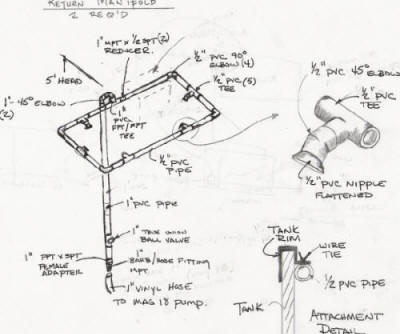
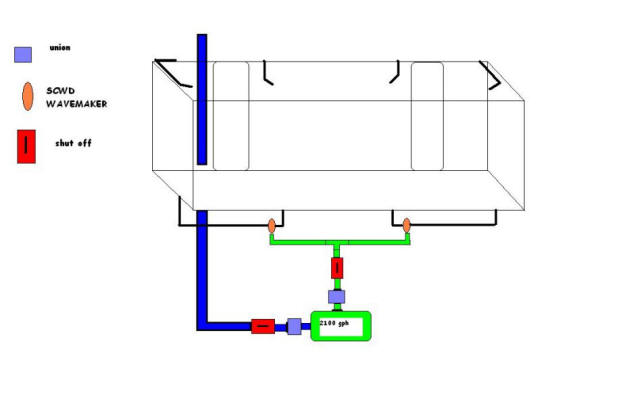
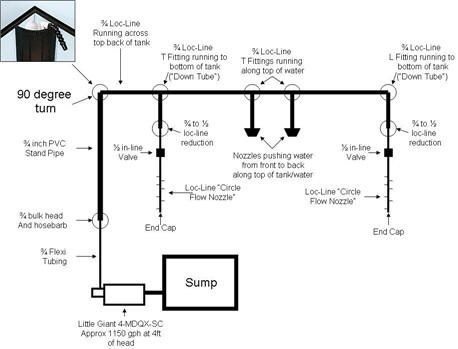
Closed Loop information, Return Manifold from
Sump 12/31/08 Team, Happy Holidays and New Year. <Thank you
and right back at!> Have not written in a while and hope everyone is
well. <Tis here.> I have read several very good threads but would
like input if you would be so kind. I inherited a 75g AGA standard
system with a single 600gph, off center left MegaFlow. Nice tank, not
very excited about the circulation possibilities. I am not a novice to
CLS but not a master either. Bottom line, the tank is older, have
checked with All Glass and the bottom and back appears to be tempered
(also used the cheap polarized sun glass method :) ). <Surprising to
me, glad you checked!> My favorite CLS option sans many powerheads
is as follows (and I so love the remarks you all do in parens after
comments :). Tear it up! <OK!> Intake: Utilizing the sump only,
with check valve, unions for maintenance and ball valve some control in
case of installing a larger pump. <Well, one issue already, the
check valve. I know many will disagree with this stand, but they are
completely worthless in marine aquaria IMO. The reason being they
cannot be counted on to work, an little obstruction will keep the valve
open.> Pump: More than likely a 1000-ish GPH like an Eheim MS or
Quiet One 4000HH. Return: Four, 2 per side, slightly varied depth but
no more than 4" down with loc line. Each side fed by a 3/4"
SCWD. My plan is to then use loc line for positioning. On the end of
each loc line feed, I will install 3/4" eductors to enhance flow
while not overpowering the overflow. I also am toying with the idea of
installing small ball valves on each individual run if I can get them
to mount properly in an accessible fashion; I have plumbed myself in
trouble several times - its no good to plan ahead when you can't
reach things easily. <Agreed.> Basically, I am hoping with the
eductors to augment the return flow so your opinion on the presumed
flows is appreciated. <Sure.> - Example, a 980gph HH pump that
has an initial rise of 4' would make the output roughly 850gph (it
will be nearly a straight shot up actually less than 4'. -
Installation of SCWD at the same height as CLS (basically) to reduce to
700gph appx. Each side of the SCWD having an outflow of appx 700gph,
then factoring in roughly 1% loss per each linear foot of PVC (roughly
5'), overestimating 5% loss per right angle (max of 4) would equate
to a 25% loss of pressure (and I think that's overestimating)
leaving appx. 525gph. <A reasonable estimation.> If I can tune
the two outputs on each side to effectively reach around 200gph, then
adding a factor of 3 for the eductor, that would be a total side to
side flow of 1200gph on each SCWD switch while still only draining 400
gph in the Megaflow (which should be about right for a Berlin or pseudo
refugium so nutrients can actually process versus passing the bacteria
by like fast food :) ). <But more than the 1' can truly handle.
I do assume you will be using the ¾' throughput as a
drain also, so you can handle the flow. But this does leave you with no
margin for error/safety in the overflow system.> And yes, will be
tapping the returns on the loc line branch about 1" below Megaflow
teeth in case of check valve issue - large sump can handle an
additional 10g or so on top of normal capacity. <Better to rely
purely on sump capacity as you mention. Skip the check valve, if you
have sufficient room in your sump there is no need for them at all,
they only diminish flow from your pump.> Am I succumbing to wishful
thinking or are my assumptions reasonable? I value your thoughts. <I
will take another possibly unpopular stand re the eductors. These
merely take a flow, pinch it down to a higher velocity and then force
this high velocity flow into mixing with the surrounding water. This
does cause more water to move directly out of the fitting, but I think
it is misleading to consumers to say it triples the flow. It does,
depending on perspective. Really for the amount of flow you will be
able run through the overflow you will only want a single
¾' return or dual ½' returns. Four
¾' outputs here will give you next to no velocity out
of each line to play with, direct your flow. If you want to keep away
from powerheads you will need to employ a true closed loop (not from
the sump), with an over the top intake much like those used by canister
filters.> Take good care! Happy New Year! <Welcome, good New Year
to you too! Scott V.> Closed Loop vs Vortech MP40w, Oceanic vs Aqueon 11/4/08 Hello WWM, <Hello Ryan.> Let me start off with you guys are great I spend days reading information on your website, the information is truly overwhelming but super informative. One suggestion for your website'¦. Could you make it look more like an excel spreadsheet? Then my boss will think I am working when I am reading! <Ahhh, a good idea ? Glad you have found the site of so much use!> I have had a 70 gallon reef running for 6 years and am ready to take the plunge into a bigger tank. My current setup is a disaster waiting to happen. I have two CPR over flows (the biggest ones they make) off the back of the tank draining at full capacity into my refugium/sump. And actually I to put one of the out puts of one of the CPRs directly into the chamber of the refugium where the pump connects because the refugium could not handle all of that water flow. My Dolphin Amp Master 3000 pumps the water back into the tank with 4 - ½ inch nozzles and a manifold 1 ½ pvc with about 40 1/8 inch holes down behind 120 pounds of Fiji live rock. <That is a lot of flow for the boxes to handle!> I know the tank is more rock that anything. The water movement is great my fish and soft corals love it but it took a lot of work to keep it from sand storming. This setup did cure my hair algae battle I fought for a couple of years. The Chaetomorpha in my refugium grows like a weed; I have to groom it down all the time. Also the halimeda in my tank grows like no other as well. I have some candy corals that I have split a few times, various polyps, and Xenias that are growing like crazy. Along with a yellow tang, some Chromis, and maroon clown. My snails and hermit crabs are doing great and I have a Stomatella population thriving. The problem which I am sure you have noticed is the overflow boxes, and the water levels to keep the pump not blowing air are at capacity. I put a ball valve on the return side of the pump to try and line it up with the overflows. Yes it has resulted in a couple of floods, my wife not so happy. <I'll bet.> I realize this potential disaster but have figured the wrath can't be that bad'¦'¦ My wife has limited my spending (like so many others) so I have been saving for a while. I want to make sure I am heading down the right path. I realize there are many different ways to accomplish the same thing but I am sure your collective infinite wisdom will be priceless. <Will try.> For the Tank I am looking at the Aqueon 180 with built in overflows. Realizing it is not drillable for my Dolphin Amp Master 3000/4000, or the Oceanic 178 or 215 (with over overflows) that would be drillable. <Do keep in mind the Aqueon can be drilled through the back/sides.> I want to run the overflows down to my refugium/sump and run a small pump (1200 GPH) back up for filtration. <These overflows typically have 1" drains, which are in reality only good for 300 gph per. You can special order any of these tanks with larger/more holes predrilled for a small charge per hole.> Obviously that will not be enough water turnover through those alone so I was going to drill 2 inch bulkheads (Qty 2) for a closed loop with my Dolphin Amp Master. Then at my LFS I found the Vortech MP40w's. I could go with the cheaper Aqueon tank and not have to drill but still keep the interior of the tank clean (No power heads/pumps visible.) Also I would not void the warranty by drilling the Oceanic Tank. <Reason to have them do it!> Realizing the money I save from going with the Aqueon Tank I will be paying more for the set of MP40w's with controller, but again would keep my warranty on the tank. So really I need a shove in the direction of the best way to turn over water in my tank between these two options????? I read up on your website about these Vortech pumps and I didn't find much'¦.. Any new experience on reliability and functionality of this product? <They have vastly improved in quality over the few years out on the market, you won't go wrong with these.> They are pricey but if they get the job done maybe worth it long term?? <They are IMO, you savings in power monthly will be noticeable over the Dolphin. More traditional powerheads can do the same for less, but then you have powerheads!> My thought is 1200 GPH through the refugium is plenty for filtration? <Or 600 gph, tis enough for filtration.> So what is the best way to increase circulation? <The Vortechs/powerheads.> Also is Oceanic tanks that much better than Aqueon (both made by the same company) is it worth it and still go with Vortech pumps requiring me to save a little longer? <Not IMO, unless you want to spend the big bucks on the Oceanic Starphire tanks.> Or is the versatility of a closed loop system (water flow in any direction) better than the Vortechs? <It is a tradeoff, but experimenting with the placement on the Vortechs, good flow can be achieved.> Wow so I have reread this questions a few times I apologize for its length. Any help and advice at all would be greatly appreciated. Thanks. Ryan <Welcome, have fun, Scott V.> Simple reading, Closed Loop 3/2/08 Please someone help me! As far as I'm concerned I have the biggest problem in the world. <Not really from my perspective, I see many with much worse problems'¦daily.> I have a 40 gal. reef tank with live rock and (2) two fish. My problem is that I have it built high over my kitchen countertop; my space is 4' 11'' wide 17'' deep and 2' 10'' high. I have on top a nova extreme T5 fixture on the right side, a PhosBan reactor on the back, a Lifegard fluidized bed filter, Prizm skimmer and Aquaclear power filter that I use for a mechanical filter inside of the tank. I have (6) six maxi jet powerheads, overflow from the Prizm and a 6'' tube from the power filter and on the left side I have a denitrator 6x6x12. My problem is that I have so many powerheads in my tank that it takes away from the beauty of the tank. I'm in need of some kind of knowledge on how I could get rid of all this stuff so I can enjoy my tank. <A simple closed loop with a circulation pump will do the trick, see here: http://www.wetwebmedia.com/pbh2oret.htm , tis the answer to your question.> My plan is to hang a refugium on the back and put all the powerheads inside of it this will add another bigger powerhead to the tank, and I want to add an Aquastep uv sterilizer also a ozone system. That leaves me (3) three powerheads for circulation. PLEASE, PLEASE, PLEASE HELP ME!!!!! Because I love my tanks! Oh, did I tell you that I also have a 75gal tank under the counter that's an open ocean <??> P.S. I can't enlarge my reef tank space and I can't replace it with a larger 55gal. Tank. Thank you sincerely <All is answered it the link above. Please proof, correct spelling and grammar in future queries. Scott V.>
Spraybar/Closed-Loop Questions -- 01/08/07 Crew, <<Hiya Joe>> First I just want to say that the web site is fantastic. <<We're pleased you think so>> I have found it a great resource as I have been setting up my various tanks. I am currently in the process of moving up from a 90 gal reef to a 210 gal AGA Mega-Flow tank. <<Excellent'¦and since you have been reading, I assume you know how many of us consider the 'Mega-flow' moniker to be a misnomer>> The tank is going to be a mostly SPS dominated tank so I want to have two separate closed-loop systems in the tank. <<Okay>> One will be a spray bar system that the live rock will be placed around to keep waste from settling anywhere in the rock. My questions on this system are; where should I place my intake (could it be placed inside the Mega-Flow to hide it or would the Mega-Flow not be able to keep up?) and how large should the intake be? <<Don't place the intake for your closed-loop in the drain overflow box'¦the box is not designed to handle the additional flow. Otherwise, you can position the intake anywhere you like'¦though low-down on the back/sides will likely be easiest to hide/disguise. As for size'¦match the closed-loop intake to the size of the pump intake>> How large should the piping for the whole spray bar be (I was leaning toward 1")? <<For the spraybar itself I would think ¾' pipe would be sufficient, as well as less obtrusive. The pipe feeding/leading up to the spraybar should be 'at least' as large as the pumps output nozzle>> How large will my pump need to be (I was think something around 3500gph)? <<Generally, the size of the pump for a closed-loop is determined by the number and size of the flow nozzles'¦but a spraybar will not be so easy to calculate I think. Obviously the size and number of perforations in the pipe will ultimately determine the 'force' of the flow'¦and is quite easily adjusted for here as compared to a conventional 'loop.' I think you can use about any size pump you like and 'experiment' with the spraybar to achieve the best results re. But personally, I think 1200-1500 gph for the spraybar would be sufficient'¦reserving the/a larger pump for your other closed-loop>> Should the spray bar be fed with one or two returns? <<Either way is fine, though a 'pair' of returns to feed the pump offers some redundancy as well as a decrease in suction/danger to your livestock>> Lastly, is this system compatible with a deep sand bed (I feel like it should be as long as I lift it 5" or so off the bottom to allow for the sand and keep the holes pointed up)? <<Indeed'¦as long as you take the flow direction in to consideration as you mention>> The second closed-loop system will be of Anthony Calfo's design along the top of the tank to provide random flow. <<Excellent>> My questions for this system are the same questions about intake (placement, size). <<And my answers are the same>> The same question about pump size? <<As stated'¦determined by number and size of flow nozzles. You should figure (after headloss) about 350gph per ½' nozzle and about 650 gph per ¾' nozzle in order to achieve enough 'force' to create a purposeful flow>> How many nozzles should be on the system (the tank is 6' x 2') <<I would employ at least six'¦eight if you have the pump for it>> What size should the piping and nozzles be (I was thinking 1" or 1 1/2" piping to 3/4" nozzles)? <<Again, match the feed pipe to the output nozzle of the pump (or slightly larger if you wish). The ¾' nozzles will be fine if a large enough pump is used, but on all but very large systems my preference is to use ½' nozzles'¦less intrusive, more forceful flow, can add more per a given pump size>> Do you think that this is a good setup for a SPS tank? <<Match your nozzles and pumps correctly and these closed-loops should serve well>> Please let me know if there is some way better for me to be doing this. Thanks so much for the help. Joe <<Happy to share. EricR>> Closed-Loop Musings...And Some Particularly Helpful Ebo-Jager Heater Info From a Reader/User of Our Site -- 05/17/07 Hello, <<Greetings>> This is my first email to the "Crew". <<Welcome!>> I usually just search the site for information. I am fairly new to the world of saltwater tanks, but I have had a freshwater tank of some sort for over 15 years. <<Cool>> I converted my 125 gallon freshwater to a saltwater tank almost a year and a half ago using the wealth of information from the WWM site. I had four 3-inch holes (two on each side) drilled on the back of the tank to accommodate 2-inch bulkheads. <<Excellent>> The glass company only had 2 or 3 inch bits. I also plumbed a ¾-inch closed-loop around the perimeter of the tank with 8 outputs. <<Very nice...and will require a very large/powerful pump to operate efficiently, something in the range of 4800gph after headloss>> I ended up capping one output off due to it's proximity to the Remora Pro Skimmer. <<Mmm, an excellent skimmer...but I would have gone for something a bit larger for this size tank>> I bought the skimmer before I decided to have the tank drilled. After reading about the numerous floods and the statement that it wasn't a question of if, but when, I decided it would be in my best interest to have the tank drilled. <<Yes indeed...though many such calamities could be averted if hobbyists would employ some redundancy to their overflow systems (i.e. -- use 'two' hang-on overflow boxes but supply only enough flow to max out 'one')...but still, my preference is to drill for 'gravity' drains as you have done>> I used 2 of the bulkheads for drains for the closed-loop, and one for a surface drain to the sump. The forth bulkhead is reduced down to 1-inch PVC and then down to ¾-inch PVC in the tank. <<This last is the sump return line then?>> The Remora Pro utilizes a Mag Drive 3 pump. I have a Mag 7 to pump water from the sump to the tank via a one-inch PVC pipe that over hangs the back of the tank. <<I see...then obviously the fourth bulkhead is 'not' for the sump return>> I also added a Mag 5 to pump water in a loop through a Coral 18 watt 6X UV sterilizer and then back to the sump. I am only supplying all the details of my setup because I read on the site is better to have a lot of information than not enough. <<Yes>> I also plan to reduce the number of pumps I am utilizing. I bought a Mag 3600 to run the closed-loop. <<You will likely have to cap a few more nozzles to achieve strong enough flow from the remaining nozzles. Figure on 550gph-650gph per ¾' nozzle...much less than this and the flow from the nozzles is too weak to be of much use>> At first, the pump was unbearable. I called the company and they sent me a new impeller. <<Good>> This did quiet the pump a lot, but the pump was still way too loud for a living area. <<This is often the case...and the reason I turned to Tunze to meet the flow requirements of my large SPS dominated reef system>> Also, the pump was mounted externally, but the heat transfer was way too much. <<This seems to be another common issue with this otherwise reliable/good value for the dollar brand of pump>> I have since read some of the postings on the site of people that have heat problems and/or noise problems with this same pump. Most all have the same problem I did. Way too much heat transfer and way too much noise. <<Indeed...common as stated>> The other 3 Mag pumps I have are submersed and are no problem whatsoever. They work great. <<Ah yes...and also stated, a reliable/good value pump brand>> However, I think it would save some people a lot of problems if they avoided the Mag 3600 altogether if they are planning on using it in a living area and/or do not own a chiller. <<Maybe so...though adding a lot of pumps/pumps of large size of most any brand will cause heating/noise issues in varying degrees (no pun intended), especially in concert with the intense/high power lighting associated with reef systems. Employing ancillary equipment/methods to deal with heat buildup is something reef hobbyists must consider as a matter of routine in many cases>> Also, my tank has about 10 feet of head-loss and the Mag 3600 just doesn't pump enough to run the 7 ½-inch outputs on my closed-loop. <<Ah, ok...you didn't state the nozzle size previously. For ½' outlets/nozzles you still need to figure 350pgh per nozzle...or in this case, a minimum of 2500gph after head loss>> They all have flow, just not enough. <<Yep>> 2 of the 7 have sufficient flow. <<All will work fine with a large enough pump>> Recently, I replaced the Mag 3600 with a Dolphin Amp Master 4000/3000 pump. <<These are popular pumps for closed-loop systems>> I was pleasantly surprised. This pump is super quiet and also, the tank is no longer too hot. <<Excellent...and apparently worth the extra cost>> I was amazed that I actually needed my heaters. Due to some dumb mistakes in my calculations, I ordered the wrong pump though. <<Really?...still too much head loss eh?>> I should have ordered the Dolphin 5600/4700 pump. <<I see>> Marine Depot stated that if I tried the pump I could not return it. However, Dolphin Pumps stated that I should go ahead and try the pump and if it wasn't pumping enough they would upgrade it. Well, they took care of me. I did have to pay the shipping so I did waste about $20, but Dolphin Pumps is sending me the 5600 pump for the difference in price plus shipping. <<Very nice...and so good to hear of such service>> It will also line up exactly with the pipes I have plumbed for the 4000 pump since the pumps are the same size and dimensions. <<Handy>> Now that I actually need my heaters, I kept noticing that my Ebo Jager heaters were set almost 10 degrees cooler than the temperature in my tank, but were still coming on. I have two 250 watt heaters in my 25 gallon sump. Well, after checking the temperature in my sump with my digital thermometer I realized that my sump wasn't a different temperature than my tank like I thought. <<Why would it be?>> I just assumed that the water was somehow losing heat on its way to the sump. <<Ah, I see...nope, doesn't happen that quickly>> It became obvious to me something wasn't right when the heaters were set lower than the room temperature, but were still coming on. How could the water be 73 degrees in the sump when the room was 75 degrees? <<Could possibly happen under certain conditions (a large system with lights out and fans on, providing evaporative cooling), but in most all cases the pumps/equipment keep system water warmer than ambient room temperature as you surmise>> I don't own a chiller and the pumps and lights create heat. <<Indeed>> Well, after a little searching on the net, I found out that the Ebo Jager heaters needed/could be calibrated. <<...?! ...really!>> After measuring the temperature of the sump with a accurate thermometer, I turned on the heaters and then turned them off just till the light went off. This temperature should have matched the temperature of my digital thermometer. Of course, it didn't. Now I realize this isn't rocket science, but it is very informative and useful for anyone having similar problems. After turning the knob on the heaters slowly just to where the light goes off, you unplug them. Then, you pull out on the knob at the end of the heater all the way, turn the dial to the correct temperature, and then push the knob all the way back in. "Presto"! I now have two heaters that work correctly. <<Wow...great information, thanks for sharing>> I also found that my sump and tank do have the same temp. <<Hee-hee!>> So in the course of about a week, my heat problem was solved, my pump noise problem was solved, and my fish should be a lot happier with the extra flow from the new 5600 pump. <<Excelsior!>> Also I read somewhere on the site not to put a shut-off valve before the pump. <<Can be used for maintenance purposes in conjunction with a union fitting, but should never be used to 'starve' the pump. If a valve is wanted/needed to temper flow it should be plumbed on the output side of the pump>> This ended up being a pain when it came time to service the pump because I had to block the drains and then drain water out of the pipes. It is definitely worth whatever head loss there is to have a shut-off valve before and after the pump. It's a hundred times easier to service or remove the pump. <<Much agreed>> Thanks so much for the wealth of information I was able to find on your site. <<Is our pleasure to serve/share>> I have learned a lot in the past 18 months or so and I just wanted to pass on some helpful information. - Jeff <<It is much appreciated, thank you for your contributions. Eric Russell>> Closed-Loop Or Not? -- 01/03/07 Greetings to all, and a Happy New Year. <<Howdy Bill...Happy New Year>> After a long delay, I finally have my new tank and stand in position. <<Neat!>> It is an All Glass 180 gallon with the Mega Flow system. <<A misnomer if there ever was one...>> When all is done it will be a Reef tank. <<cool>> I used a Dremel, and cut out the 'teeth' on the overflows, and siliconed black plastic gutter guard in its place. Converted the drain pipes to Dursos and upped the returns to 1' instead of 3/4". <<All good>> My 'plan' it so use 2 pumps for the returns, with one pump running for 5 to 6 hours, then the other coming on for the same duration creating a left then right flow. <<Interesting...and possibly a long enough interval so as to not greatly foreshorten the life of the pumps>> I'm at a stand still in my plumbing process though--my questions are--do I want to add a closed-loop, or hang a Tunze in the middle of the back, pointing towards the front. <<Mmm...the closed-loop will offer greater flow options...but the quality, efficiency, and ease of installation of the Tunze is hard to ignore>> If I do a closed-loop, I'm thinking of placing it on the tank bottom with the outlets sticking up just out of the substrate--which would be best in your opinion ?? <<Can't say I've ever seen/heard of this but the idea of it is intriguing. Assumably the force/flow of water would prevent any blockages from occurring...just be sure to install the manifold and pump as a 'true closed-loop' (will require drilling the tank) to preclude draining the tank empty in the event of a power outage. As to which is best (Tunze or closed-loop) that will depend on the needs/particulars of your tank, the size/location of the closed-loop pump vs. the Tunze pump, and your sense of aesthetics. Using my own situation as an example...I was unable to employ a pump with enough flow to run a closed-loop for my tank (375g...predominantly Acroporids) and still stand to be in the same room (in-wall design...no basement/fish room), so I opted for the Tunze Stream pumps to get the volume of flow I was looking for yet still be able to hold a conversation without yelling, watch the telly, etc. An added bonus is the power savings...the Tunze pumps really are power misers. The downside is the 'look' of these rather large pumps in the tank>> I have searched your site and can't find what seems to be the preferred circulation method. <<Ah yes, all a matter of opinion, likes/dislikes...not exactly comparing apples to apples here. My 'preferred' method (the Tunze pumps) may not be the same for the next person.>> Once I get this figured out, I'll place my order for my Live Rock, and begin the cycling process. I have my RO/DI set up and running, 100gpd, and it is being stored in 2 96-gallon Rubbermaid trash cans, one feeding the other. The tank will drain into a 40-gallon breeder, that will be the refugium, and that will gravity drain into the sump, my old 90-gallon Cichlid tank, (these are in the basement, behind the wall where the display tank is). I also have my lighting ready to go when needed too. What are your thoughts ??? <<The description sounds fine. I especially like the refugium draining via gravity to the sump (is what mine does), but be sure to have this drain directly to the return pump chamber to preclude excessive loss of beneficial organisms to the skimmer (you 'will' employ a skimmer I hope). As for going with a closed-loop or the Tunze pump...that decision is yours. Both methods can/do work well with proper application/design/placement. Is one better than the other? Not really...they both have their place...more often than not it comes down to what is the most practical...in my humble opinion>> Thanking you in advance for your time, Bill Fletcher <<A pleasure to share. Eric Russell>> Re: Closed-Loop or Not? - 01/04/06 Eric, (or whomever the lucky crew member maybe) <<It be me (Eric) again!>> THANKS for the reply. <<Hope it was helpful>> I can't take credit for the 2 main pump idea, I found it in the book "Ultimate Marine Aquariums". <<Ah yes, have that book myself...though I don't recall the double/switching pump system...perhaps time for another read>> As for using a Tunze, as you stated, they can't be beat in regards to quality, efficiency, and the ease of installation--it's just the "look" as you referred to. <<Yes...big...though this is less noticeable/less of an impact with the larger tanks. And even their size can be tolerated by most considering their performance...especially when coupled with the versatility of the electronic models>> If I go closed-loop, the tank will be drilled, and the pump will be under the tank in the stand--the only pump that will be in the same room as the tank, and it will be a complete loop. <<Ah good, much more efficient use of the pump opposed to plumbing from the basement. Though there is still the noise to deal with...but maybe this is not an issue here>> I do have a skimmer, and THANK YOU for pointing out that I will need to rethink its placement--Darn just when you think you got things all sorted out ;-) Bill Fletcher <<Ha! Indeed...but you don't want to be wasting those little goodies generated by the refugium! Good luck with your installation. Eric Russell>> Closed loop... alternative to powerheads, heat production 11/8/06 Greetings from Canada... A couple of quick questions.... 1-a closed loop of 6' long x1' wide powered by an 1800g/hr mag drive pump. How many outlets (minimum/maximum) can it handle to deliver adequate flow through 1/2" CPVC? It's a 125 gallon tank...72"x18"x24".. <Mmm... six to eight is about maximum/ideal here> The loop will be hung from the cross members in the centre of the tank as it's impossible for me to run it along the perimeter or build a sump. 2-The pump is going to be hung inside of the tank. Will it cause heat issues? <Will contribute to 1/2mVsquared here to an extent, yes> I currently run 8 powerheads <! Time to look into fewer, more powerful? Perhaps a "Tunze" Christmas this year?> so will there be much heat difference as I will obviously be removing the powerheads have appr 120 liverock 5" oolite aragonite sandbed and a remora pro skimmer. Thanks for your time and response...Pete <Only real time, experience can/will tell here... Mag pumps run hot... I suspect hotter than your collective powerhead assemblage currently. Bob Fenner>
Closed-Loop Design -- 10/16/06 Hi Bob, <<EricR here today>> I have a 72x28x18 reef tank, planning to keep SPS. Was thinking of having a closed-loop system with a Dart Supreme 3600 gal/hr. <<Sounds good>> What are your suggestions for the plumbing? I mean , where do you think I should position the outlet and the inlets? I was thinking of having the inlet at the back panel, about 1/3 the way from the bottom and the outlets at the sides of the tank, with one of them slightly lower than the other !! I will appreciate your opinion. Thank you, Ramy <<This could work fine, or you could fashion a return 'manifold' for the outlets. Check out this article by Anthony Calfo re ( http://www.wetwebmedia.com/pbh2oret.htm) and be sure to read among the linked files at the top of the page. Regards, EricR>> Closed Loop Pump - 10/15/06 I am wanting to add a closed loop to my 120 gallon reef tank to get rid of my power heads and I was wondering what size pump would I need to use for this. <??? Too many pumps and possibilities to answer this question. Time to start doing some math with plumbing and see which pump will do the job for you.> I am only using a 600 gallon per hour pump for my main circulation so my flow through my refugium isn't chaotic and to stop micro bubbles. So I need more power I was thinking about using a mag drive 24 that pumps out about 2400 gallons an hour is this to much. <Sure, why not?> I am just going to be keeping softies and LPS. Thanks. <Cheers, J -- > SW circ. manifold, Calfo 10/4/06 Hi everyone, Hate to be picky, but this one has to be answered by Anthony. I was reading the forum on Reef Central and would really like to see your Closed loop manifold, Any chance of getting some pictures of it? Thanks <Antoine is no longer with us. You might reach him at MarineDepot.com's comm. site. What pix we have of such are posted on WWM... use the search tool and/or the indices. BobF> Another closed loop question 9/26/06 Hi All <Robert> I've been reading all your info on closed loop manifolds and want your input on what I need to power this thing. At this point I only have a Iwaki 40RLXT running my sump and it's rated at around 1100 gph.. If I need a 20X per hour circulation, then my 157 gal tank needs around 3600 gph. Will it be possible to get a manifold to handle the 2500 gph I'll need? <Yes...> If so what pump would you recommend or do you have another suggestion on how to get the water movement I need. Thanks Robert <Posted... see WWM re. BobF> Closed-Loop Design/Stocking a 120 FOWLR - 09/22/06 Eric, Randy here again. <<Hey Randy!>> Well, I'm making progress on the 120 FOWLR project w/55 fuge/sump and have a few more questions. <<Okay>> I read on WWM almost every night and get lots of info, but unsure on a few things. <<Let's see if I can help "clear things up">> First, regarding my 120. I went ahead and had it drilled with 4 1-1/2" bulkheads. <<Excellent>> 2 1-1/2's will feed my 55 sump/fuge. I plan on using a MAG 9.5 that I have for the return w/4-5" of head. Does the 9.5 sound like it will be enough for the sump flow (before you say I need more flow, please read further about my closed loop flow)? <<No worries my friend...will be fine as the "return" pump>> Second, this is where I need your help. BTW: I have read a lot on the closed-loops and Anthony's article on the closed-loop. I see that there are many different ways. <<Indeed>> My plan for the closed-loop is: The other 2 1-1/2" bulkheads I plan to "T" together and run into my Iwaki WMD30RXLT. It will be mounted so it will only have 1 or 2' of head. <<Ok>> -From the 1" output on the Iwaki, what is best? -Should I run it into one closed-loop above the tank that will have 6 to 8 1" overhead "T's" with 3/4" flex? -Should I run it into one dead-end loop (I know, then it's not a loop) above the tank that will have 6 to 8 1" overhead "T's" with 3/4" flex? -Should I run either a closed-loop or a dead end perimeter with 6-8 outputs? -Should the above tank manifold be 3/4" or 1" with the Iwaki 30RXLT pump? -Is the Iwaki WMD30RXLT a good choice and fit for this loop idea? -Is there a better design idea with my 2 1-1/2" for the loop flow? <<Okay Randy, the first option is best/the most simple but I think I need to make something clear here. The size a and number of "outlets" on the closed-loop determine the size of the pump required...and vise-versa>> With 6 to 8 3/4" outlets you will need a pump with a terminal output after head loss of at least 4,800 gallons per hour to produce enough "velocity" at each outlet to be useful. Even if you reduce the outlet size to 1/2" you will still need about 2,800 gph. With the pump you have now, you're looking at a closed-loop with a maximum of "two" 1/2" outlets (three "might" work, but I don't think you have "quite" enough flow re). You need to figure about 350 gph per 1/2" nozzle/outlet, and 650-700 gph per 3/4" nozzle. With two 1 1/2" bulkheads installed, you have the option of using two smaller pumps and plumbing separate closed-loops to each half of the tank>> And last, I'm thinking ahead about stocking. Here are my thoughts and ideas I have also read some on this as of lately at WWM. I will have about 100-120 lbs of LR in there. Also, I have a 4.5" reef safe wrasse that I will add first. He is in my 46 reef now. I don't know what type he is but he is light green completely with several pinkish lines running horizontally across his face and body, all the way thru his tail. <<Do have a look through our articles on wrasse...especially the genus Halichoeres>> I want to add shrimp to the reef tank but they will be lunch with him around. <<Not necessarily, depends much on the species/individual personalities. I have several wrasse species in my reef that cohabitate quite well with my cleaner and blood shrimp. One thing to keep in mind when adding shrimp to "any" reef tank is to not just "drop them in" as you do food items but rather gently "place" them low in the rockwork where they can find refuge>> I would like a large angel. Is there one that I can sustain long term in the 4'x2'x2' 120 tank? (please say yes, I love the angels but have limited wall space). I am thinking of the Annularis, French, Koran?? I need something beautiful, hardy and obviously, not to large. Any thoughts. Can you suggest one? Price is almost, a main concern besides longevity (Inland Chicago area). I know, I'm not asking for much! <<The Pomacanthus annularis would be a fine choice...the other two get too large for this tank in my opinion>> I would like to add with the angel of choice, a dwarf flame angel, a yellow-eye Kole tang, a yellow tang, a sailfin tang or convict tang (I think that these are all different genera??). <<Mmm, three different genera (Ctenochaetus, Zebrasoma, and Acanthurus)...the yellow and sailfin tangs are of the same genera>> Should I only go with one tang? <<Exclude the sailfin altogether (gets too large here)...I think you could get by with a Kole tang and a Yellow tang...or the Convict tang on its own>> A Foxface, and a butterfly (I don't know much about them, what do you recommend?) <<Several good choices, check out this article for best picks: http://www.wetwebmedia.com/BFsBestWrst.htm>> Can I add one or two tomato clowns or maroons clowns? <<Mmm, maybe...but pretty much "full-up" mate. You need consider adult sizes of the fishes already selected>> I like the dogfaces but I read that they can emit a toxin?? <<Indeed...but again, your pushing/exceeding limits here>> I think the triggers are too aggressive, maybe a clown trigger?? <<Only of you want this to ultimately be the only macro-organism in this tank... There are trigger species that would be suitable, but your past adding any of these at this point>> I don't want to stock it to the limit. <<Is about what you've done>> You kind of see the direction that I am going, what do you recommend? <<Have stated re>> Also, I know that the tangs and the Foxface pose a threat, but I would like to be able to stick my arm in the tank if needed without to much concern. <<Have both in my tank...remain vigilant and you won't have a problem>> I know that the Foxface will usually hide unless cornered. <<Will become "accustomed", even curious to your presence...but not likely to be an aggressive/overt threat>> No eels, lions, poisonous puffers! etc. etc etc... <<Hee! No room for them!>> Thanks yet again for your time, help and devotion to our hobby. <<Is my pleasure to share>> WWM has become a one-stop-shopping reference tool for me, I love this site! INFO, INFO, INFO!!! Thanks, Randy <<Be chatting my friend. EricR>> Plumbing for a refugium & return manifold in 58 gal reef -
09/14/06 Brent here. Hope all the crew is doing well! Basic
background. 58 gal 36lx18,5wx21"h Tank. Intended use: Nice family
project for my son, daughter and me. My wife just shakes her head at
our willingness to research, learn and spend bucket loads of money.
I'd like to point out that my 8 year old daughter is probably more
enthused than me, and spends a lot of time searching the net for reef
fish, inverts, and ideas to help the project out. <Well worth the
investment all the way around> She has even created her own little
reef book complete with the fish, inverts and corals that she would
like, noting common name, species, a little bit about the species,
care, feeding etc along with a photo. Beats shopping or playing with
boys as she says! <Oh yes!> Anyway I digress. Back to the issue
at hand. Reef display with some LPS and some soft corals, mating pair
of Ocellaris Perculas, Lawnmower Blenny, Royal Gramma, Six Line Wrasse,
and a Flameback Angle added last, approximately 1 year after setup. T5
- 6x39 watt hood. I have a couple of general questions for completing
the plumbing on my 58 gallon, sump and possible closed loop manifold.
Just working to fine tune the details and wanted to get your input. 58
has the corner MegaFlow overflow built in. Wondering which manifold kit
is better the Durso or the MegaFlow kit? <Mmm, the former IMO/E>
Megaflow kit has the return pipe and end fitting for the in-let and
appears to be more complete with the perforated critter block for the
inlet. <Can get, thread in such a screen yourself...> I have a
CPR Large HOT refugium with maxi-jet 1200 that will incorporate MM with
Chaeto and the CPR CF light unit. Lighting cycle in the CPR refugium to
be on 24/7. Although I'm not married to this photo cycle. <I
would go with an overlapping RDP myself... Chaetomorpha should not be
illuminated continuously> I believe the CF is 19 watt? I'm
planning a 30lx14wx16 high sump/refugium with 4" DSB, sugar fine
aragonite, a small amount of live rock to seed and Chaetomorpha algae
with CF lighting 20 watt +/-. Lighting to cycle in the sump/refugium
off cycle from the display. I believe the actual refugium gallonage
will be around 10 gallons, not including the 4" sand bed. I also
have a CPR BakPak skimmer unit which I intend to have running full
time. I am planning to use a mag-drive pump, external, to handle the
return which will simply be plumbed back up to the MegaFlow inlet pipe
nozzle. Just not sure if I should use the mag-drive 5 or 7 here?
<Mmm... if it were me/mine, the 5> I am also thinking of
incorporating a mag 5 or 7 drive, internal, and creating either a
manifold return closed loop with squid on 2 outlets or trying to
incorporate Anthony's water return manifold http://wetwebmedia.com/pbh2oret.htm? <A good plan. The
seven here> Your thoughts and insight is well appreciated. And thank
you all for such a great site and willingness to help! <An
enlivening pleasure to share. Bob Fenner> Sump/Manifold Plumbing - 09/13/06 Hi again folks. <<Howdy Jim!>> I am smack in the middle of setting up my new 150XH reef (I know, it's a tall tank, but there were reasons), with a 40G Breeder sump/refugium. <<Cool!>> This was a very hurried job after my 72G bowfront sprung a major leak, <<Yikes! Been there myself mate>> but now that the fish and corals are all (relatively) happily settled in their new home (instead of Rubbermaid tubs in the middle of the living room floor), I am considering how to redo the current temporary plumbing into something more permanent and helpful. <<Okay>> The tank is a predrilled/overflow tank from Perfecto, with one corner overflow (I had anticipated two) which has a drain and a return fit with 1.25" bulkhead fittings. <<Mmm...better than the usual 1" I suppose>> My original plan was to run the 1.25" drain through a bushing, down to 1", and directly into the input of my Poseidon2 Vortex Venturi skimmer sitting in the first 9" compartment of the sump, probably without even using a pump--just let gravity drive the skimmer. Assuming I manage to achieve the right flow rate, which, based on the pump that came with the skimmer, should be 700-800 GPH, does this make sense, or is it a crazy idea? <<You will never achieve 700-800 gph with a 1" (bushed) gravity drain my friend...expect something closer to 400 gph. But from what I can tell from a quick scan of the NET, this skimmer is not a "recirculating" and thus won't work by simply feeding water to the skimmer body. This skimmer needs to pull water from the sump through the venturi pump to operate properly>> I was hoping this would assure 100% skimming of the incoming water, but I can just run the drain into the compartment and use the Via Aqua pump that came with the skimmer to drive it, if that makes more sense. <<This is what you will have to do>> Then through triple baffles/bubble trap (the idea for movable compression baffles was a huge help) into a 20"x18"x12" lighted refugium compartment with live rock, DSB, and macro-algae, then into a 7" return compartment with a MAG-12 return pump and a float valve for automatic make-up water. <<Sound fine>> I was then planning to run the output of the MAG-12 into a SCWD (by way of a union and a ball valve), and run one side of the SCWD into the pre-drilled return, adding an over-the-wall 3/4" adjustable return at the other end of the tank to achieve some random/surge circulation. <<I would use BOTH throughputs to feed the sump...one "may not" handle the flow from the MAG-12...at least not quietly>> I was then also planning to add a couple small powerhead driven circulation devices in the back, using a design I found on Reef Central that uses PVC to keep the powerhead up out of the tank and in the canopy where it doesn't add heat and can be maintained (strainer and PVC up to the powerhead, then PVC back down to the location where circulation is desired). <Hmm...have not seen this...>> Now that I've done some reading about plumbing on the site, I am questioning the entire plan. <<...?>> First, I am wondering if this would be enough circulation. I figure the MAG-12 should be pushing about 900 GPH at 6' head. <<Will be quite less after the SCWD...but still possibly more than the single return will handle efficiently/quietly>> Adding a couple 200 GPH auxiliary circulation devices would bring my total to 1300, or 6-7 turnovers per hour. Given what I have read, that doesn't sound like a lot. <<Maybe go with some 400 vs. 200 gph powerheads>> Of course, I know it's important to consider what I am keeping, which is all LPS, mostly Euphylliids, Caulastrea, and various brains and Fungiids, none of which particularly like very strong current, correct? <<Not really...they will appreciate some good flow...but not being directly blasted. It will likely take some finesse on your part>> Furthermore, it sounds like the SCWD would seriously reduce the flow rate of my return, and I don't think I want that. <<Indeed...maybe as much as 20%>> But the present, single laminar return is definitely not working. I was considering running my return into a manifold, but it sounds like the return wouldn't begin to have enough flow to drive a decent manifold, so I would need to install a second, closed loop system. <<Agreed>> I don't have any intention of taking the tank down to drill additional holes, so would it be possible to run a closed loop manifold without drilling? <<I wouldn't>> An internally positioned pump? <<Love those Tunze Stream pumps>> I can't imagine an overflow would work to drive a manifold! <<Not recommended>> How can I achieve decent, non-laminar flow with the present tank system? Any advice will be appreciated! <<Why not use a "smaller" return pump (returned over the top) and use one throughput for the sump drain, and the other throughput to feed a closed-loop?>> Jim Jensen <<Regards, EricR>> Flow Rates/Tank Turnover/Plumbing Confusion - 08/10/06 Hi, <<Howdy>> I used to have a 72Gallon Bow front tank set up but had to take it down. Now that I am setting it back up after a couple of years I had some questions on turnover rate and setup. <<OK>> I did read "Water Flow, how much is enough?" by Anthony Calfo and found it really useful. Since my tank is empty I have the option now to drill holes, plumb the way I want and get a quieter pump. I had a GEN-X 40 that will be my backup but it was too loud. I was shooting between 10-20X turnover. <<A lot of water to process through your sump...can be done, but usually requires some effort to get things flowing well/quieted down>> But while searching various web sites and talking to people I was advised that I only need 3-5 times turnover through the sump and I should just add a closed-loop to make up the rest. <<This would be my recommendation as well. This flow rate through your sump will be MUCH easier to manage>> Some say over skimming or reduce bubbles or noise etc. <<...?>> Some said it is not required in the sump or fuge. Is this correct? <<Is what 'correct'? I'm not sure what you are asking here, but if you mean 20x tank turnover through the sump then no, this is not "required">> It's been a couple of years so I want to make sure things have not changed. <<Mmm, the hobby is changing/progressing all the time...but fluid dynamics won't have changed>> Also I was going to put on a Sea-Swirl for more water movement. I was not sure if one in the middle of the tank or two on each end would be better. <<Will depend in part on how big (flow rate) a Sea-Swirl you opt for, but generally speaking, one at each end of the tank would be best for good coverage/flow throughout the tank>> But they seem to only be on the surface so my thought was one in the middle and have a Tunze Turbelle Stream Pump lower in the tank (ever use these? Are they good?). <<This configuration too could work...and yes, I am familiar/use Stream pumps in my 375g reef tank...an excellent product in my opinion>> Based on that I can then drill the back for my overflow in the corner or middle. I have a lot of options and need some help thinking this through. <<Glad to proffer my opinions>> a) One or two sea-swirls? <<Two>> b) Placement of overflow? <<Center...with a minimum 1.5" drain and 1" return>> c) Sea-Swirl(s), closed-loop, or from sump return? <<For a high flow rate/water movement...the Sea-Swirls (or Tunzes) or closed-loop>> d) Where to put the Tunze (opposite of overflow if in corner? or opposite of return from sump if not sea-swirl)? <<Either option is fine>> e) Where to put the return from sump if not sea-swirl? Corner, middle, opposite side of overflow? <<Wherever it is needed to provide/augment flow based on your other configurations>> f) Does the closed-loop get water from the overflow? Or do I drill back as source? <<The closed-loop pump will need its own "source">> Or add PVC with holes hanging in the tank. (hope that makes sense) <<For the closed-loop intake? Mmm, best to drill a bulkhead>> g) Pump Velocity T4 at 1275GPH - but with 4ft head and 3 - 7 90's depending on how many returns I have. This is not a pressure-rated pump but according to the flow rates I would get between 1080 - 900gph depending on the how many 90's I have. Is this enough? <<For which application?...it is more than you need for the sump return...likely not enough for a closed-loop>> Do I need more and should I have this split to two returns? Thanks, Jason <<There's much to consider my friend, please have a read through our plumbing FAQs, here's a good place to start (http://www.wetwebmedia.com/plumbingmarart.htm) and be sure to follow/read among the links in blue. Regards, EricR>> Manifold Plumbing 8/8/06 I have a 215G reef ready aquarium that I'm just starting to setup for a FOWLR and perhaps some hardy soft corals such as mushrooms. I didn't get the aquarium drilled for a closed loop due to the aquariums location, it is sitting on a stand that was custom made to fit in with a wet bar, without easy access to the rear of the tank should a bulkhead or plumbing fixture ever failed. I was planning to just use powerheads, hidden as much as possible behind rock work, to make up the additional flow that is needed. I now have an idea to make a manifold at the aquarium top, such as that in the article by Anthony Calfo, and using an internal submersible pump instead of an external pump. I'm figuring that I can hide one larger pump behind the rock work in a corner of the aquarium that will not be easily viewed. I can make a stand to keep it off the bottom, and build a cage for it out of black egg crate and gutter guard to help keep invertebrates safe. Using black pvc piping, I can return the water along the edge of the overflow making it less visible. This way I will not have multiple powerheads to hide, and I will only have one pump in the aquarium on which to perform periodic maintenance and upkeep. The aquarium is situated in a basement that averages between 66-68 degrees, even during the summer, so I don't think heat buildup in the tank should be an issue, in fact, I can probably use the additional heat. I can also run the same pump as I will use to return water from the sump. This way I can purchase a third pump as a backup for either of the other two in case one fails. I have been running searches on the Internet, and your site, trying to find an example of someone using a similar setup, but I have not had any luck. Can you please let me know if this sounds like a plausible idea? Thank you very much for your input and suggestions. <Sounds like it would work out OK. You may consider installing a SCWD Water Director (Wavemaker) on each of your returns. Less work with a nice wave making effect. See here. http://www.drsfostersmith.com/product/prod_Display.cfm?CatalogCustomerNum=&catalognum=&pCatId=10668&prodId=20229&catId=1137745&siteid=6 James (Salty Dog)> Kevin Return Manifolds/Horizontal Overflow...Closed-Loop Design - 07/30/06 WWM crew, <<Hello John>> Thank you for the wonderful website and wonderful dedication to this hobby/passion! <<A collective effort...quite welcome>> I am researching designs for a new tank. From reading Mr. Calfo's Book of Coral Propagation and WWM, I very much like Mr. Calfo's ideas of a return manifold and an internal horizontal overflow. <<Ah, yes...am familiar with this design>> Maybe I am just dense, anyway I am having difficultly visualizing how the two techniques would work together along the back wall of the aquarium. <<Well, let's see if I can help>> Would one just not have return nozzles on the back wall, if so it seems as if this would make the goal of random turbulent water flow more difficult? Could you please enlighten me? <<Mmm...the nozzles can be wherever you want them. No need to follow Antoine's example to the letter. You can position a couple nozzles at each back corner and; using ell fittings that are "not" cemented on, swivel these as needed to direct flow. And do keep in mind here...using a return manifold in this manner (fed through the sump with a gravity overflow), you will very likely not be able to push enough water to drive more than a couple/few nozzles with any real velocity. In my opinion, the return manifold is better suited to a closed-loop installation if the desire is for vigorous random-turbulent flow>> Also I was wondering your thoughts on connecting a SCWD to two halves of a manifold return (i.e.- the manifold would not be a single closed-loop; it would be two halves). <<Is doable. But re my previous comment, this is not truly a "closed-loop" system if you are using the gravity overflow/sump in-line with the manifold>> I was thinking that this might assist in creating a wave/surge action in the tank. <<Possibly...if this is a rather small tank and you use a pump that maximizes the SCWD's capacity>> One FAQ seem to suggest that the single closed-loop would be better with or without a SCWD. Your thoughts? <<A "continuous" single loop would render the SCWD a moot point as all the nozzles would still be in play, the SCWD would only be changing the direction from which the water enters the loop>> Finally, I am researching tanks and manufacturers. If I implement the above ideas, I will need to have the back wall of the tank drilled (not the floor obviously). <<For Anthony's full-length weir design, yes>> I can not seem to find any manufacturers who will drill the back wall. <<Hmm...may have to resort to a "custom" builder>> Does this have to be a custom job at a glass company or a DIY job for those of brave heart? Suggestions? <<Maybe order the tank through your LFS and have "them" customize it for you. Another thought is to go to the hobby forums (e.g.- RC, reefs.org) and post a query there re tank manufacturers willing to drill the back of the tank>> Thank you! John Bullard <<Quite welcome. Eric Russell>> Some Closed-Loop Methodology - 07/26/05 Hello crew and thank
you for the support that you guys <<and gals>> give to the
less experience people. <<Is truly our pleasure to help>>
Let me start by saying that the tank is not set up yet, haven't run
for 2 Years after a few hurricanes here in Florida wiped my whole
stock. Yes it has taken me some time, he-he, but yes I do miss it ).
<<Welcome back>> Ok, I have an All-Glass 75 gallon that
comes standard 1" drain and 3/4" return.
<<Mmm...indeed...>> I modified it to have a return line of
1" and 1 1/2" drain for more flow. <<Yay!>> Also
I made a closed-loop manifold 3/4" pipe with 6- 3/4" nozzles
with possibly two more that are capped now. Want to know what size pump
I can use for return and what for closed loop. I had a Mag-7 running
for return which my LFS sold me, but I still think is low for a
semi-reef tank. <<The Mag-7 is plenty big to serve as a return
pump here, but if you want more flow from your return and the increase
in noise, bubbles, etc is not an issue, then a Mag-12 should work
without overcoming your 1.5" drain. But plumb a gate-valve on the
output side of the pump to allow for some adjustment as/if necessary.
For the closed-loop pump, figure about 600-700 gph per nozzle to
provide sufficient volume/velocity from each of the 3/4" nozzles.
That means for your current configuration you need a pump that will
push (after figuring head) about 4,200 gph...more if you plan to uncap
the other two nozzles...and is a BUNCH of (too much?) flow for a 75g
tank>> This time I'm going stronger, better lighting, better
flow and better stock. Hard and soft corals and a some exotic fish. I
plan or would like to run a main pump running 24/7 for filtration and
another one only a few hours a day for closed-loop circulation on a
timer with a random setup. This will give a calm time for like feeding
and some days more current. <<Do be sure you are still providing
adequate flow when the loop is "off">> But I also know
that some corals like all time flow or current. <<Indeed...even
"require" it>> My big question is? Should I use only
one pump for everything and plumb and use the manifold of the
closed-loop also as my return or is my presented plan setup better.
<<Okay, couple things to mention here...1) If you use the
closed-loop for your return then technically it is no longer a
"closed-loop". A closed-loop system is one that is plumbed as
a "closed" or sealed unit directly from the tank to the pump
and back, i.e.- no sump. This allows the user to utilize high-flow
pumps with pipe diameters much smaller than those required to handle
the same water flow through a gravity drain...which brings us to the
next issue. 2) If you use the "loop" as a return manifold,
there is NO WAY your 1.5" drain will handle the 4000+ gph needed
to effectively drive six 3/4" nozzles to vigorous flow rates. So
my friend, to truly implement a closed-loop you will need separate
pumps for your return and the loop>> Any exterior pump
recommended? <<Lots of folks use the "Sequence" brand
pumps high flow closed-loop applications>> The size for each one
if two. <<Have already stated>> Or just one more powerful.
<<Not if you want a true closed-loop>> There will be
between 4-6 ft of head for the filtration and if going with two pumps,
only about 2 ft of head for the closed-loop. I was thinking of Dolphin
pumps, very quiet and energy efficient, but don't know what size.
<<Probably in the 5,000 gph range for the closed-loop...but this
is an awful lot of flow for this tank. An option would be to bush down
the nozzles to 1/2"...could go with a pump flow rate of about half
this or less (300-350 gph per 1/2" nozzle) and still get
sufficient velocity for good water movement, or simply reduce the
"number" of nozzles>> Other quality good brands are
welcome...And thanks for taking the time to advise all of us... Pedro
Velasquez <<Happy to assist, and do let me know if I have not
been clear here. Eric Russell>> Closed-Loop Plumbed Through Overflow? - 07/13/06 Friends at WWM, <<Greetings Scott>> What kind of problems would you foresee running a closed-loop and a sump out of the same overflow box? <<Hmm...would appreciate a bit more information to wholly understand what you are attempting. You'll need to plumb each to its own throughput/drain...you'll need to ensure the box can handle the volume of water/won't starve the pumps...and then there's the noise such flow/volume brings...>> Thanks, Scott <<Regards, EricR>> <RMF would NOT do this.> Re: New 90 Gallon Setup... closed loop issues 6/13/06 Hello Bob, <Scott> Thanks for your reply. <Welcome> Based on the expert advice I have been getting (including yours), I decided to increase the size of my new system to 135 gallon. This will afford enough space for external pumps, and hopefully provide more options for (healthy and happy) fish stocking. <Great> Also, I believe this size should provide adequate space for my Centropyge aurantius (currently in quarantine and eating habits continuing to improve). Would you concur or should I consider finding another home for this beauty? <In the wild this is one of the Centropyge species with a large "territory"... like many cichlids, it can be crowded a bit...> In discussing the new tank configuration with a LFS, they suggested an enhancement which I would be very appreciative to hear your thoughts about (I did not find it addressed in the Circulation FAQ's in WWM and apologize if it has been addressed before). Anyway, here goes - The current setup would use 2 overflows to feed an Ecosystem 3612 (roughly 1200 GPH per the manufacturer) and back to the display. The balance circulation (say another 1200 gph) would be provided by powerheads. My LFS representative suggests doing away with the powerheads and plumbing a separate loop taking water from the back of the tank (about half way up the tank) behind the overflow boxes (the boxes would be equipped with Durso standpipes so that a water column would remain in them). The lines would be joined together to feed a parallel external pump and back to the display via 2-3 additional bulkheads located at the lower portion of the tank. <Sounds like a plan> I like the idea because it eliminates the "issues" with powerheads such as heat generation, exposed intakes, etc., but am wondering if we are drilling too many holes in the back of the tank. Would you have any thoughts to share on this? <More holes can lead to more potential problems... if it were me/mine, I would not cut these through-puts quite so low... "just in case"... But near/closer toward the upper surface... not too close though, to prevent loss of water during change-outs> Thanks again for your help on this project. Scott <Glad to share. Bob Fenner> Overflow Questions
6/1/06 Hello Bob and the WWMC, <James with you today.> I hope
all is well and Hawaii was fascinating (jealous). <Talking for Bob,
Hawaii is always fascinating, something different on every dive,
correct, Bob?> <<Mmm, yes, but back in sunny southern Cal.
now>> I am starting to plumb my 50 gallon sump and refugium to my
150 gallon all glass tank and looking for some expert advice. I will
make this quick because I know you are all very busy. Is it possible to
connect three separate hang on overflows (1) 900 gph and (2) 1400 gph
to one central 3" drain pipe with vent? <Yes, a three inch
drain will handle this, but why on earth do you need that much flow for
a 150 gallon tank? Problem is, if the pump is not sized close to the
gpm of the overflows, you will always have problems with air in the
"U" tubes. So, at least a 3200 gpm pump would be
needed...That's going to be an awful lot of water moving in your
tank unless you are trying to establish a tsunami biotope. Ten to
fifteen times the tank volume is sufficient. You would be well over 20
times. Tell the fish to hang on for dear life.> The over flows
planned positions are... a 1400 gph at each end of the tank with the
900 gph in the center. Thank you again for your time, <You're
welcome. James (Salty Dog)> Mark Re: sponge filter in QT tank (saltwater)... and manifold pb 5/27/06 Great, thanks for the reply! Sounds like I should cut back on total amount I'm feeding or if I go with a Copper band B/F, I should look at trading him back in or leaving him in the 125 gal reef (if I get lucky and he doesn't eat too much of my corals). I have another question if I may, I put in a closed loop system in my 125 gal. (hooked up to a MAG12) I plumbed a manifold around the top of the tank with 8 outlets for lots of options on water flow direction. Would I be better off blocking off half of them so I get stronger water flow thus more turbulent action in the tank VS gentle flow out of all 8 outlets? Thanks again, Mike <Mmm, I'd get some slip plugs (insert, sans solvent) and push these in and see... may take pliers to extract... Bob Fenner> Refugium plumbing
question 4/18/06 Hi Crew- <Ed> I'm a bit confused about
the best way to plumb a refugium, sump and closed circuit return loop.
<Lots posted re on WWM... and lots to consider... many
"variations" on themes...> I'm planning on setting up
a 90 G Oceanic Systems "Tech Series" Tank with two return
overflows and two Megaflow accessory kits. The system will be designed
to ultimately house SPS, LPS, Clams, Mandarin dragonets and Wrasses.
<Not altogether compatible as you're likely aware> To ensure
that all are well fed I would like to run a RDP vegetable refugium with
Chaetomorpha macroalgae and a 4" DSB so that I can grow pods. Reef
Invertebrates, Calfo/Fenner has an illustration for a Downstream
Refugium on Page 53. If I understand correctly the refugium should have
a water flow of 5 to 10 times tank turnover. This would be
significantly lower than the 14 time turnover I had planned for the
Calfo designed Closed Loop illustrated on the WetWeb site. How can I
marry these two seemingly contrary requirements? <Two separate
pumps, sets of plumbing... Bob Fenner> Many thanks, Ed
Inlet for closed loop manifold - 04/05/2006 Good
afternoon WWM crew. <Trevor> I am currently in the planning
stages of engineering a closed loop manifold for my 180 gallon AGA.
Through your extensive FAQ, which is truly priceless, I believe I can
successfully generate the manifold component and also appropriately
"size" the pump for the desired flow rate in the display tank
relative to head, horizontal run, elbows, tees nozzles. <Yay!>
What I have not been able to clearly extract out of this wealth of
information is the appropriate inlet size relative to desired flow
rates in the display tank. I have come across information on drain
rates through bulkheads: ~ 300 gph, 750 gph, 1000 gph for 1",
1.5", 2" bulkheads respectively. Do these aforementioned
numbers remain the same if one is "attempting" to
aggressively pull water through the inlet with a pump or are they based
on a flow rate due to gravity's "pull" alone (my
instincts tell me that if most inputs and outputs on external pumps are
1" that a 1"inlet in the display tank should be able to
handle whatever the pump is rated ... but I have been wrong before and
I am sure I will be again)? <Can't address the last adequately
(is a great question/statement), but you are correct in questioning the
intake sizes as stated if there is any restriction/vacuum
consideration... that is to state, these diameters are idealized for no
such restriction, including intake screening> If I have a 2"
inlet in my display plumbed directly to the input of a pump of infinite
flow rate what would be the maximum flow rate that could be produce,
for simplicity, at the output of the pump (I am assuming at some point
the 2" inlet has to limit the pumps ability to intake water at a
greater flow rate .... <Let's stop here: about 800-1000
gph...> or am I wrong and my flow rate is actually infinite gph)?
<Ah, no. There are practical limitations, induced drag, sp3
hybridization, Brownian effects, affinities of water to contend
with> I want to maximize the flow rate of my closed loop manifold
using a 2" inlet from the display plumbed directly to an external
pump, but I do not know what I can expect to maximally pull through the
2" intake. <The above values are about it in practical terms...
one can (of course) pull/push more through a two inch diameter line,
but there are other considerations, principally screening issues, that
need to be addressed> Thank you in advance for the sharing of your
knowledge and experience, again, it is truly appreciated. Trevor <Is
this clear? You want to avoid "sucking up livestock",
cavitation, drawing in air... Bob Fenner> Return
Manifold, Pumps...General System Plumbing - 03/11/2006 I was
reading up on this method to get better flow but just had a few
specific questions. <As vague as possible, please.> I have an 80
gallon reef tank and I hate the powerheads. I have a return from my
fuge that is probably pushing 250-300 gph. I want to build a closed
loop system to eliminate the phs. <Do you want a true "closed
loop", or simply a return loop?> My tank is not drilled but it
has a piece of glass at the top of the tank under the canopy that I can
rest items on. <Better things to "fix" this in place.>
My idea is to build a loop system with 4- 6 outlets with a pump that is
rated for around 1000 gph but not have the pump submersed under the
water. Is this possible and what are the cons of this system. <Quite
possible. This is my preferred method of returning water to the
tank.> Also what pumps that are available would be the best choice
for my idea. <A shorter list to say which aren't...> Thanks
for all of your help and your knowledge is invaluable to us novice
reefers. Thanks Dustin <It's a lot to read I know, but I would
go through our FAQ's until it hurts. A lot of different angles to
take into account, but once you understand what not to do, the what to
do makes perfect sense. Have you read the Calfo article re this? Grabs
some toothpicks, prop open those lids, and let the coffee flow. -
Josh>
Understanding Closed-Loop Plumbing - 03/08/06 Hi all,
<<Hello>> As per Anthony's suggestion, I am in the
process of putting together a closed loop system for my 110 reef tank.
<<Great!>> The tank is drilled for the main overflow to the
sump and for the loop, I will be using an external magnetic drive pump.
<<Okay>> I was just starting to wonder how I am going to
get water into it? I have looked around, on the web, and the best I can
gather is that just like a canister filter would work, I will plumb
with pvc up to the tank to suck water out <<Mmm no, not
"suck"...you need to plumb so water will "flood"
the pump...as if through a bulkhead in the back/side of the
tank.>> I guess I will need to use some sort of screen at the
intake correct? <<A bulkhead screen, yes.>> The returns
will be a manifold of sorts around the perimeter with flex nozzles and
valves for control. Once plumbed up, do you just plug it in?
<<Yep>> I remember from my freshwater days, needing to
start the siphon on canister filters.....does that need to be done
here?...or like I said, just plug her in and let her rip? <<No
siphon, like I explained...you must flood the pump. If you read through
our FAQs on closed-loops this is/will all be explained.>>
Secondly, is there a concern, for example like with your sump plumbing
(overflow ) in the event of a power outage? It would seem not, as like
in a canister filter, everything is all sealed up? Is this correct.
<<Yes, but a "closed-loop" is not plumbed through the
sump...please have a look here (http://www.wetwebmedia.com/pbretfaq3.htm) and among
the indices in blue. Regards, EricR>> Closed-Loop Manifold Design - 03/06/06 Hi- <<Hello>> I'm researching my first Aquarium (will be reef with an emphasis on SPS, LPS and Clams and eventually a few fish). <<Okay>> I find WetWebMedia invaluable. <<Thanks...me too!>> I'm pretty settled on a 90 gallon tank and a 22 gallon sump with about 110 lb. of LR and a 4 inch oolithic <<or maybe oolitic>> sand bed. Would like to shoot for 14-15 times water flow and have definitely decided on the Water Return Manifold shown in Anthony Calfo's article. <<Ahh...excellent>> I am a bit confused however, and hope you can straighten me out. <<Uh oh...be careful what you ask for <grin>.>> The article states "...we need a dedicated supply of water here. Obey the manufacturer's recommendations for line size." Is Anthony referring to the pump manufacturer's recommendations for line size? <<Yes>> Would that be different from the pump outlet size? <<Unless otherwise stated by the manufacturer, you are usually safe to match your pipe size the inlet/outlet sizes.>> I am considering using an Iwaki MD70RLT and the outlet is one inch. <<Matching pipe to outlet size is fine for these pumps.>> I like his ideas for finessing the flow with valves and nozzles, especially since my reef will change significantly as the corals grow. <<Indeed>> He mentions using "Flexible Ball-Socket Joint Tubing." and that it can be connected to PVC. Is that Loc Line? <<Yep>> Anthony goes on to write "home aquariums of a couple of hundred gallons or less will likely use 1" or 3/4" pipe". <<Mmm...or even 1/2" to maximize water velocity.>> Loc-Line's largest parts are 3/4 inch and there are no T connectors available in 3/4 inch. There are plenty of valves and Nozzles available in 3/4. So what I'm really asking is can a Iwaki MD70RLT with a 1" outlet be used to deliver water to my tank though 3/4" Loc-Line hose and can the hose be T-d with PVC? <<Yes it can. Likely you will need to bush the outlets down to 3/4" (or even 1/2") anyway to provide enough water velocity.>> And most importantly will it do the necessary job. <<Yes...if you have done all your homework and configured it correctly <G>.>> Thank you for your patience. Ed <<A pleasure to assist Ed. Regards, EricR>> Closed Loop Confusion - 02/11/06 Hi crew, <<Hi Linda>> I tried to send this email before but was getting error messages. I have not gotten a reply yet so I thought I'd resend my question. My apologies if you have already received it! <<Mmm nope, don't believe we did.>> I recently asked Bob a question regarding a closed circ system. I was having noise problems from my pump and design. <<A common issue.>> I had an intake (1" PVC) go up and over the tank, but had a tee on the top with a cap (so I could clean the tube easily). Bob suggested getting rid of the tee in the intake PVC and try a smaller pump. <<Okey Dokey>> So I've been researching WWM for pump selection and came across several posts regarding closed-loop systems (I didn't know it had a name before :). <<Hee!>> Now I am confused! <<Ruh roh>> Many answers said to NEVER use an over-the-tank intake siphon (which is what I assume my design is). <<Does sound like, yes.>> However, Bob didn't seem concerned about my design, and other posts suggest using one. Drilling isn't an option and I'm doing this because of heat issues with the power heads so I wanted to use an external pump. <<I see>> So, two questions (okay, three): Should I use my planned intake? <<Sure>> Are there any better options? <<From what you just told me...doesn't seem to be.>> I want to get an Iwaki pump - what size would work best? (I know you get this question a lot, but I still am at a loss) <<A good choice (Iwaki)... But how much water do you need/want to move? How much "head" will you have to overcome? Shoot for something that will give you a minimum of 10x the tank's volume. But you'll also have to consider the design of your loop (angles, number/size of your outlets).>> FYI - my original plan was a 1" intake going up over tank and down to a 1" on the pump. Return is 1" flexible tubing into a 3/4" PVC "network" of 3 tees up the back of tank with 2 lock-line nozzles on each (6 nozzles total). (I already had the network). <<Are these 3/4" nozzles? I'll assume so for now. Okay...you will need a pump that will give you 550-650 gph PER NOZZLE after calculating head loss. This may sound like a lot, but you need this kind of volume to ensure adequate "water velocity" from each nozzle. When calculating head-loss, add a "foot" for each 90 degree angle and for each 'T'. So, for example...six 3/4" nozzles would mean a pump that will produce 3300-3900 gph AFTER head loss. If you need/want this kind of flow your looking at something like one of the 'Sequence' pumps (Barracuda, Hammerhead). If you don't need/want that much flow, you can bush down the outlets to 1/2", this would reduce flow requirements per nozzle to about 350 gph, meaning a pump that will give you 2100 gph or so after head loss. Obviously, you can downsize the pump still more if you cap-off some of the nozzles. Whichever way you go, my suggestion would be to "oversize" the pump a bit (10%-20%) and install a gate-valve on the output side to temper flow "if" necessary. Thanks in advance, Linda Braly <<Hope you find this helpful...Regards, EricR>> Closed loop 125 - 1/30/2006 Hello crew and thanks for such a great site. I have just finished a closed loop system using a RIO 2500 with 3/4 Inch PVC. Very easy to do by the way and way cheaper than buying power heads. <Yes> Please tell Anthony he rocks. <Will do> Anyway this is a huge increase in flow to this system. Most of the corals are happy about it and the rest I suspect will adapt. The only ones that concern me are a colt and a long tentacled plate. The plate is on the sand and the colt in on a piece of LR near the bottom. The plate I could move if need be but the colt is a rather large piece and if firmly attached to a huge piece of LR. The water is not directly blasting them but it is a good deal more than they are used to. Just wanted to know what your thoughts on this may be. <Posted> Also want to thank you guys for the great help with my refugium and DSB. Both must be working because my Nitrates are below 5 ppm (Salifert) from a high of 25 a month ago. May have been higher then that as I only found out due to a false Red Sea test kit. Anyway my tank has been doing great since I have be reading WWM Thanks again 125 gal reef 225lbs LR Aqua C skimmer All water tests check ok Ca 390 Alk 10.4 Mg 1212.5 Ph 8.3 <Sounds, looks good. Bob Fenner> Thanks again you guys rock Closed-Loop Manifold/Outlets/Pump Size - 01/18/06 I have been researching closed loop systems and the one on your website is by far the best one I've found. <<Tis some good info I agree.>> I searched through your site and couldn't find the info I needed so I'm hoping you can help. <<I will try.>> My tank is 36"L x 12"W x 21"H, well it's actually about 16 and a half inches at it's widest. I was wanting to put 6 to 8 tees in the manifold, but was wondering how many gph I should be trying to get out of each tee, and what size and brand of pump you would recommend. Thank you for your help! <<Assuming the tees are 1/2" you would want to shoot for around 350 gallons per hour per tee to achieve effective/useful flow/velocity. Limiting the outlets to six, a Mag-Drive24 submersible pump (installed with a gate valve on the outflow to temper flow if need be) should serve well here. Regards, EricR>> Manifold Plumbing - 01/10/06 WWM Crew, <<Howdy>>
Bob was kind enough to give me some feedback concerning a new set up a
couple of weeks ago. I'd like to see if I could bother someone with
specific questions about plumbing a closed loop, water return manifold.
<<No bother, shoot...>> Given the Oceanic RR 215 gal. tank
is not plumbed to get anywhere near the 20 to 30 times volume per hour
I want to support SPS corals, <<You wouldn't want this volume
of water flushing through your sump anyway.>> I'd like to add
a manifold system instead of using powerheads to accomplish this.
<<A good approach.>> For all practical purposes, I'm
considering the 600 GPH I'll be getting from the two 1 inch
overflows as insignificant for anything other than operating the sump.
<<About ideal for this, actually.>> I've looked at the
data for the Sequence Reeflo Hammerhead (1 1/2" inlet/outlet) and
see that the flow is 5400 GPH @ 5' head. Since this is a closed
system, am I correct in assuming the head will only be from the
plumbing or do I still have to consider the static head (5' from
the pump to the top of the tank) as well? <<Yep...and add a foot
of head to that for about every 10 feet of horizontal run and again for
each elbow/turn.>> At any rate, here are a couple of scenarios I
have been thinking about. Please feel free to give me my best option or
suggest another if I've really missed the mark. <<Okey
Dokey>> Drains: 1 1/2" PVC all the way to the pump. My
understanding is that the fastest way to burn out a pump is to starve
it on the inlet side. <<True...not to mention wasting
efficiency/flow.>> I will run pipe across the back along the
bottom of the tank and have four 1 1/2" openings every 24 inches
starting in one corner progressing to the opposite corner. <<Am
guessing these will be protected with some type of screen/grate to keep
from sucking up life forms? Also consider how you will be able to
access these later for necessary maintenance/cleaning.>> The pump
supply will come up the back of the tank at 36" (halfway between
the 2 corners), over the edge and down to the pump underneath. In each
of these cases, the drain design will not change. | | | | | | | | |
|______| |___| |___| |______| | |___________________________|
-----------------------72"--------------------- For the manifold,
I intend to use 3/4" PVC all the way around the top edge of the
tank (72" x 24") with 14 to 16 - 1/2" openings
alternating with 90 and 45 degree elbows to get as much water movement
as possible. <<I see you've done your homework...necking down
the nozzles allows you to keep water velocity up while allowing you to
add more output locations.>> I figure this gives me about 350-400
GPH out of each nozzle for 29" depth of the tank.
<<Excellent...you can always cap off a nozzle or two if you find
it necessary.>> There has been some question as to whether I can
move 5400 GPH through this manifold using 3/4" diameter pipe.
<<Mmm yes, another reason to use a pressure-rated high-flow pump.
There will be some amount of back pressure related to the pipe
diameter, but a pressure rated pump will handle this fine...and you
need the pressure to power all those nozzles.>> Manifold supply:
1. Single 1 1/2" PVC line running up the back of the tank beside
the drain line to the manifold, bushing down to 3/4". 2. 1
1/2" from pump to the base of tank, tee to both ends of tank,
horizontally, and up the back of the tank on both ends for two
connections to the manifold. Any feedback concerning the best plumbing
option <<I would keep it simple and go with option #1.>> or
better choices concerning the diameter of the pipe at any point would
be appreciated. <<I think you have all well in hand.>> I
may be over analyzing this, because every once in a while I think
ultimately, the manifold is only 3/4". What do I gain by not
bushing down the return to 3/4" from the pump, plumb it all with
3/4" and be done with it? <<This is viable actually, and
would likely have little effect/make a small difference. But may I
suggest... PVC pipe is relatively cheap, why not make up several
configurations and test them to determine which you like/works
best.>> Thank you again for the wonderful resource and all the
help. Sincerely, Lance Good <<Good luck with your project,
EricR>> |
|

|
Features: |
|
| Featured Sponsors: |