 |
|
| Home | Marine Aquariums |
Freshwater Aquariums |
Planted Aquariums |
Brackish Systems |
Ponds,
lakes & fountains |
Turtles & Amphibians |
Aquatic Business |
Aquatic Science |
Ask the WWM Crew a Question |
| Please visit our Sponsors | ||||
|
Where Does The Hole Go? Hi, I have a 30 gal. reef and want to add a refugium. I have an old 10 gal. sitting next to the 30 gal. it is full of 7 or 8 macro's and the bottom of the 10 gal. is even with the top of the 30 gal. I want to run a canister filter from the 30 gal. to the 10 gal., and drill a 1 inch bulkhead in the side of the 10 gal., and let the water return with no pump via gravity. I am not sure at what height to place the hole? I know near the top would give more water in that tank , but I am concerned about the amount of critters that would make it to the main tank with the return near the top without having a power-head in there stirring everything up? Thomas Giddens <Unfortunately, Thomas- that's one of those things that you're going to have to experiment with. I'd advise placing the hole towards the top, myself. Regards, Scott F>
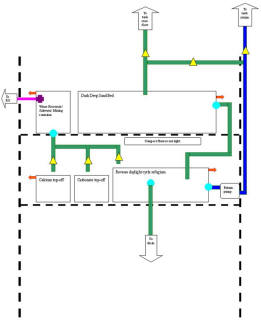
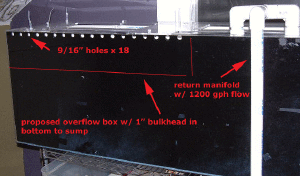
- 135 Set-up/Plumbing - Hi guys! Thanks for your great site! I've poured over it as well as others gathering info and have a few questions for you regarding my set-up. First off, this will be a freshwater tank which I will later turn into a reef. For now though I want to lay a good foundation to make the change easier and to have a great, clean, low maintenance and well set up tank. The tank is 72L X 18W X 24H and came with an Amiracle wet/dry with a single drip plate (24x12x14). This tank has one back/center overflow (3 sides at 6" each) I want to have at least 1350gph(10x) flow rate and am debating a bunch of plumbing, pump, filter issues: 1.. OVERFLOW: Considering my desired flow rate and current overflow box, what alterations to it would you recommend? <Get a second overflow installed? I don't know... not sure this single overflow will be up to your demands.> What's the max for this overflow and what diameter bulkhead should I use for it's downspout? <Uhh... you tell me, how big is that hole at the bottom of the overflow? I'm going to guess an inch - if larger, that is better, but if only one inch, then expect about 900 GPH max.> 1st concept: I've always wondered about the possibility of drilling intake bulkheads near the bottom of the tank and plumb them to the backside of the in-tank overflow box at the waterline - a sort of below the waterline overflow. My thinking is that this will aid in the removal of waste. <And water.> I'm not used to overflows and can't imagine effectively removing waste by only skimming water from the top. <Well... it's been working well enough for long enough that there are no significant changes in the design. I would caution you strongly about plumbing bulkheads well below the water line. Do make sure you have redundant valves and fittings beyond the bulkheads as a failure in anything attached to that bulkhead will result in draining your tank onto the floor.> 2.. RETURNS: For the returns I was thinking of using the manifold set-up. 2nd concept: create a spray bar along the back of the tank just above the sand level, elevating the rock structures just above the sand level with pvc stubs glued to the bottom of the tank. The idea being that this would help eliminate waste build-up and keep it waterborne. If I did this could I link a water level return between it and the pump to avoid back siphon during pump failure, would this work? <I think that in theory it will work - practical experience will tell the tale.> 3.. FILTER: How much additional sump will I need (something that I could later use as a refugium)? Do you think the single wet/dry will be ok for now (handle 1350+ gph?), what other additions or modifications should I look into? <Consider something other than a wet/dry if you plan on building a reef or refugium... look for a sump that is better adapted to this use. Wet/dries do not convert well to other uses.> (I know I'll need to get rid of the bioballs when I go reef.) <Actually, because the tank isn't set up yet, I'd recommend you just get rid of the whole filter and look for something else... don't wait to "get rid of the bioballs" - toss them now.> I want to keep mechanical filtration simple (such as drip plate or some other prefilter.) <How about a Berlin sump... simple micron sock to remove the waste.> I basically want to eliminate the need to vacuum and keep the tank as clean as possible. Suggestions please. <Cleanliness is only next to sterility in a marine tank. Sterility is not your friend or ally in marine husbandry.> 4.. PUMPS: I know you suggest Iwaki but I'm thinking (until I go reef at least) of going with the much more affordable "quite one" pumps. Unless you happen to suggest another better but still inexpensive pump. Would having two (redundant) pumps be overkill? <No.> I'm a little worried about depending on only one pump to run an entire system. What float switches do you recommend for preventing low sump/pump burnout? <Don't have any favorites here.> Thanks for the time and help! J <Cheers, J -- > - Plumbing the Through-View Tank - Hello, I am planning building a 58-gallon aquarium. Based on your recommendation, I would like the flow to be somewhere between 870 gph and 1160 gph. Would two 1" bulkheads be sufficient to achieve that rate of flow? What about two .75" bulkheads instead? <Think you can get that amount of flow through 3/4" plumbing.> I would like to put the aquarium in a place where it can be viewed from both sides. Accordingly, I would like to avoid the aesthetic ugliness of running pipe down the back of the aquarium. I assume that means that I will need to drill the holes in the bottom of the tank, but please let me know if you have a better idea as far as the aesthetics go. <Tanks can be constructed with this design in mind... overflows and return on the short end. Yes, you will want to address this or the tank will look awkward and unbalanced.> If I have pipes running through the bottom of the aquarium in the corners, will I also need to separate these pipes from the rest of the aquarium with a partition that is somewhat taller than the pipes? <Would be best and safest to have any holes in the bottom of the tank surrounded by an overflow box. Best to add double valves on the underside of the tank if not... cannot be too careful.> Or would there be no problem with simply leaving out the partition? Thanks so much, TK <Cheers, J -- > Tank Drilling Hello, Just a quick question. Should I have my glass 120 gallon (tall) tank drilled in the bottom or out the back? Thanks! Todd <Hey Todd, I have seen both ways work, but personally I would drill the back of the tank (assuming that it is not tempered glass). I am a firm believer in if something can go wrong it will. Myself, my floor, and my landlord would much rather have a leak on upper back of the tank than the bottom. I have never seen 120 gallons spilled on the floor and really do not want to. Best Regards, Gage> Re: Tank drilling Sorry to persist.... <Don't know what's going on with Gage's email but I'll give it a go> But I have just a few more questions. I am trying to find someone who will drill the tank. Most everyone does not want to attempt it. The only glass company that is willing to try it, sounds a bit flaky. <If this is a glass tank... much easier to drill before assembly...> If it were your tank (I know.... you would have bought it drilled), and you had to have it drilled..... where would you have the holes drilled (I mean can you be very specific, as in inches from top and sides), and how many holes, and what size? Also where would you purchase the bulkheads? <How big a tank? If it's a small one (less than more than a couple of feet in length/width, a couple of inches from the edge and top (you can manipulate the level of water inside the system with plumbing outside) to give you some "edge" for structural strength> Would you ever consider using a HOB overflow? If you had to use a HOB overflow, would you use a double intake type? <I would, have... even built, manufactured these years past... and I like the "waterfall" varieties better than the double intake designs, but greatly favor the doubles over single tube types> I very very much appreciate your input. Thanks, Todd <You're welcome. Bob Fenner> Re: Tank drilling Thank you for the super fast response. <Now it's the 18th?! Yikes> Where would you drill the holes at in the back? And how many? <Ahh, I see below from previous correspondence this is a 120 gallon system (likely six feet long). I would drill at least two, maybe three holes... if two, 2" inside diameter, and if three, 1 1/2" inside diameter... two at either corner set with two inches of glass at top and the side and the third at the same level in the tank mid-back> Can I just drill several return holes and avoid having to use powerheads inside the tank? <Yes> Do I still need to use an internal overflow? Or can I just put cages over the outlet holes? <Can use either one, I prefer the latter> And how many outlet holes should I have drilled? <IMO two> How can I determine if the tank is tempered? If it is tempered, am out of luck having it drilled? <The folks doing the drilling will be able to tell you. More likely than not the glass is not tempered though.> I appreciate all of your input. Thanks again! <You're welcome again. Bob Fenner> Re: Tank drilling Thank you very much for the replies. <Welcome> If I drill (3) holes 1 1/2" which should I use for the returns? <One inch ID should be fine> Or should I drill more for returns? I suppose I could just drill (3) holes and use the center for the output and the two end holes for the returns? <I would use two more holes for the return... about the same level a few inches from the overflow holes (you can fit manifolds, diverters inside the tank... threaded on to the bulkheads/throughputs> I guess I could then find some ball jets that could attach to the bulkheads to divert the returns any angle I wish? <Ahh, yes> I also imagine that I would need a stout return pump to push lots of water? What GPH size pump would you recommend? I was looking at the Velocity T4, but perhaps that is not enough flow for the returns to have good water flow? <Depends on a few factors... will you have a sump style filter arrangement... at what "head" (difference in water level)? Or will the pump have to "pull" or push through a mechanical filter membrane of some sort? Much to consider> The above should cover it. I very much appreciate your thoughts. Thank you again, <A pleasure to share with you. Bob Fenner> Re: Tank drilling Hello, Yes this would be for a sump style filter. The head would be approx. 3 - 4 ft. Just to reiterate. I should drill (3) 1 - 1/2" holes approx. 2" from top and sides. One being in the center. Then also drill (2) more additional holes for returns. These should be drilled about the same level and a few inches from the overflow/outputs. It sounds like I would then bring the three overflows down into one or two lines going into the sump. From the sump/return pump go to the (2) return holes on the back of the tank. These (2) return holes can then be used to divert the water at whatever angle is best suited via eyeball diverters. Thus eliminating the need for powerheads. <Yes> However, the pump will need to push enough return to make this useful. At the same time not drain the sump too quickly. Any suggestions on keeping this balanced? <Mmm, yes... an oversized pump with a throttling mechanism... likely a ball or gate valve... the water going into your tank will surely overflow back into your sump/refugium... the most important item (other than making the sump as large in volume as possible) is to initially fill all, turn the pump on and mark the level in the sump... and NOT fill the sump up any further than this...> Would hate to drain the sump or overfill it. Perhaps a few ball valves installed inline to fine tune/adjust the flow? Thanks! <That's the ticket! Bob Fenner> In Need of Overflow >Hello >>Hi. >I set up my 80 gal bowfront as a reef about 2 months ago. I bought from my local store 135 lbs of what they called culture worm rock. It is the best looking rock I have ever seen. This stuff has everything on it and it came with many creatures in it. I must have 20 crabs, many urchins, anemones, worms, feather dusters and a ton of stuff that I no idea what it is! I think that this rock was uncultured. >>Uncured, maybe? In any event.. >I have a thick film of silt or something on the surface of my water. What ever I stick in the tank it comes out brown coated. My wet dry skimmer is not picking it up. This surface stuff must be cutting my light projection terribly. Do you folks have any idea on how I can remove it? I have taken your advice and will be doing a 5 to 10% water change weekly, and tomorrow is the day. Can I lay a clean piece of paper towel on it to remove it? >>Short term solution, absolutely, just make sure it's not impregnated with anything (chemicals, scents, etc.). >I am running a Tidepool II with the three trays blue pad and carbon in a blue pad pouch and this is my only mechanical, chem. media. I have a chiller in the cabinet with the wet/dry and there is no additional room for any other Mechanical filter. I have a D-1 Diatom would that help get the water clean. Even though my water is crystal clear there is this coating on the surface. Thanks, Kirt >>I think you need to pull your water through some sort of overflow. You may be able to "retrofit" something yourself. Also, in this research, look into the Durso overflow system. I cannot advise you on flow rate, number of openings, or sizes of openings, but other crewmembers we have are very well-versed in these mechanical issues. Marina Overflow question Hi Bob, <Hello Bill> First, great site! Second, another question for you... I'm planning a basement fish room. There'll be two tiers of tanks forming an 18' wall. Lower tier 1 foot from the floor of 2-foot-tall 120 gal tanks. Upper tier 4' above the floor, mix of 18" tall tanks. I'm concerned about "bottom drilled" tanks, as the lower tier is planned to be 1 foot off the floor. With a 16' run from sump to the "farthest tank", I'm unsure if I can get enough drop to the sump to trust in gravity... <Me neither... how tall will your sump be? A four inch drop (minus the level in which the holes are drilled/overflow is set) is NOT enough to provide for gravity flow> In your opinion, which would be better -- hang on the back siphon style overflows back-of-tank drilled overflows <Only drilled> Or do I need to reconsider the height of the lower tier? Much higher and reaching into the top tier gets hard without a step stool. <I understand, but would not count of adequate flow (even using large drain/plumbing size... like 2" ID) w/o a good foot drop over this run (16'). If you can't lower the transit volume sump/s, refugium/s... you'll have to raise/move the lowermost tanks.> Thanks in advance, I'll probably be asking more advice before I'm up & running. --Bill <Be chatting, Bob Fenner> Mystery Fish Loss & Flow Unbalance (3/7/04) <Sorry for the delay. One of the crew is out, so I'm helping to clear his inbox.> I have two questions I hope you can help with about the same system: The system is a 72 gallon bow front with a crushed coral substrate and 75 pounds of Live Rock CPR Skimmer Emperor 400 Filter 150 gallon rated three chamber Wet/dry with overflow box Custom Sealife Lighting 300 Watt heater Two 165 GPH Power heads for circulation <Nice set-up.> Test kit says nothing wrong except approximately 100ppm of Nitrates <That high of a level could be the source of your problem> 1 Lunar Wrasse (large) 1 Yellow Tang (Medium 1 Clarkii Clown 1 Coral Beauty Angel 1 Regal Blue Tang (small) 1 Blue Striped Butterfly (Large) 1 Brittle Star <Too many big fish for your small tank. For instance, the Lunar Wrasse and the Regal Tang need at least 120G as they grow.> In the last two weeks all but the Wrasse and Yellow Tang have died off. <Sad> I have no idea what is wrong and need your help. Any ideas? <Hard to say. The nitrates could have weakened them for enough something else to get them. Perhaps they were stressed by not having enough space. Both are active swimmers. The Wrasse especially needs a lot more space than it has in a 72G with 75# of LR. Even the tank is pushing it at that size.> The second problem is restoring the balance between the tank and the wet/dry. <The nitrate factory.> For months it had a perfect balance, then I messed up and tried adding water into the sump and the tank became fuller. Since then I have not been able to restore the balance between the main tank and the sump. The tank slowly gains water at a rate of about a half gallon per day. <Scary. Imbalance is always a flood waiting to happen.> How do I recreate the balance so that the main tank no longer gains water? <Need more details of your plumbing. What sort of pump returns the water to the tank? It sounds like the pump is working faster than the overflow box. Is it a siphon overflow? Perhaps there is air built up in the tube and slowing the flow. Or maybe something else is clogging it.> Any help would be tremendous. Thanks in advance <Hope this helps. One of the plumbing-minded crewmembers may be able to help if you give more detail. You may also want to talk to the dealer who sold you the system. You can also get lots of suggestions by starting a thread in the equipment forum at the WetWebFotos chat site.> Aquafuge pro and closed loop circulation 3/2/04 Adam, No doubt about it I'm going closed loop for circulation. The biggest concern I have right now is drilling the back of a brand new tank for the intake to the pump. You know the feeling you get when something is brand new and you think you'd like to tinker w/ it but you need a push in the right direction? What I'm looking for here is a vote of confidence. <This is definitely a scary thing! If you do decide to drill, I would seek the advice of the tank builder and/or someone local who has experience. Aside from the risk of damaging the tank during the operation, you must be conscious of not weakening the structure of the tank and risking future failure.> My plan is to place a bulkhead w/ strainer about 8-10" from the bottom on the back panel for intake. <The lower you place the hole, the more water you can potentially lose if it ever leaks. Consider placing the hole higher and using plumbing to get your intake where you want it. It can be hidden in aquascaping. Do also consider simply plumbing the intake plumbing up and over the lip of the tank and into position (no drilling required). Now, reading about all the pumps out there and their different intake sizes leads me to another question: what size opening should I drill for 1400 gph flow? I have eliminated 3/4" so far, also eliminated the SCWD in the line because of it's 3/4" input/outputs (just murdered my flow rate). What I will end up w/ is a 1" manifold 4-5 outputs. Should I select pump first and then match input size? Marine tanks are not new to me, every aspect of plumbing is. <1" bulkheads should be adequate for 1400gph, and will match most pumps in this flow range. Purchase and measure your bulkheads to determine the required hole size. There is often some size difference between brands. Even if the pump has 3/4" outlet (Little Giant may), I would use all 1" plumbing for max flow.> Thanks, Sam <Best Regards. Adam> How To? Cutting airlift tubing... straight! Hi! Thanks for taking the time to answer this question of mine: How does one cut the uplift tube for the undergravel filter, without leaving it uneven? (hacksaw not an option.) Thanks! Laure' <Well... the best is a real new and/or higher quality "tubing cutter" like the ones you can find that "wrap around" metal pipe (and plastic) that you gingerly tighten while twisting about the cut... or, if you're REALLY eye-hand skilled you can "roll a line" on the tubing with a single edged razor blade by laying the tubing on a flat surface and rolling it with one hand while pressing with the blade with the other... OR there are PVC cutters that have a "cam action" so they don't pinch "the work" while making cuts... OR if you really have a bunch to cut a chop-saw (aka cut-off saw) with a plastic blade (don't forget safety glasses!) can do a whole lot of clean cuts in a jiffy... Bob Fenner> Goodbye power heads (re post) 2/27/04 Hi Anthony or other helpful crew member, <Whassup?> Some time ago I wrote you about setting up a "goodbye power head" system. I have a standard 75 gal non drilled reef on a regular stand. I was going to use a over the back siphon as input to the pump and then run it back up as in your design. <Yeeee-ikes. Siphon overflows are no part of any system I would/did/will ever recommend. They are patently risky in the long term at best. DO reconsider. If you cannot drill the tank, I'd rather see you go sumpless than use a siphon overflow> I am ready to "make it so" but have a few more questions. 1) On the intake, should I plumb it like a external Durso with a cap on the pvc so the pump can be primed? I am thinking it will always stay primed even if the power goes out or am I missing something? <missing much my friend... there are many things that can and will break this siphon over time: accumulated microbubbles from sump pump, skimmer effluent, O2 production off corals and plants by day, etc)> 2) Should I use a pressure rated pump or a volume? <not sure here without knowing/seeing the plumbing. Still I suspect it will not be that complex and as such either pump will work. I'd opt for pressure rated> 3) Would 1/2" pipe for the return be ok? as 3/4 just stands out around the tank to much. <Likely fine here... will require some experimentation> 4) What GPH would you recommend at around 4' head and 4 90 elbows. I was thinking around 800gph or so. <too low here my friend... opt for 20X for better results (10-20X is minimum and some of the best tanks have near 40X diffused). Find a pump that delivers 1500-2000 gph at the head you will apply>> Can you recommend a brand or model? I have shallow pockets! <good things are seldom cheap and cheap things are seldom good, bud. For how large this overall investment is (many thousands of dollars through the first few years)... saving $50-100 on a cheaper pump is not worth it. Buy quality made to last like Iwaki and enjoy is 3-5X longer than the cheap pumps. Opt for Japanese made Iwaki (better built)> Thanks to all the crew for the great service you provide to all of us! <thanks kindly, Anthony> 120 tank drilling 2/24/04 hello Anthony, I really like your idea with doing away with the "reef ready" tanks with the unsightly overflow towers. I plan on ordering a 120 from my LFS, I currently have a 90 dedicated to LPS only and do plan on keeping it that way (no mixed garden here, thanks to you, and the rest of the crew) , <excellent to hear!> but I'm running out of room and plan on transferring the inhabitants to the 120 one of these days. <its one of my fave size/shaped tanks: 2X2X4 feet> I would like you're opinion on how I should have the tank drilled , I plan on ordering the tank from all-glass and having them drill the back walls at the top to accommodate 1 1/2" bulkheads that have strainers on them for the overflows to the sump, how does that sound? <exactly the way I'd do it> or is there a better way that you would recommend? <spot on. And if it goes reef... then include a slender horizontal overflow sealed in front of the bulkheads for better skimming (see this in my Book of Coral Propagation or write back for the passage to be e-mailed to you)> I was thinking 4 or 5 holes would do? too many or too much? <hard to say.. you need to determine what corals you will keep, what flow they will need, and if you want to/can run all of that flow through the sump (versus less holes plus a closed loop and second pump). No powerheads regardless> Would you have a better idea than drilling then with a 90 degree elbow and a strainer on it to get this down to the sump to allow for more water flow (and a bigger pump) or do I not need this as much with LPS ? <good skimming is needed with all truly> Also I was thinking about drilling for the returns , should I do that or should I just run the piping up from the back of the tank? <that one is really just a personal preference. I favor up over the back and drilling less holes> I was thinking about you're closed loop manifold, if that makes a difference. thanks for you're help. <best of luck! Anthony> 120 tank drilling II 2/27/04 ok, thanks Anthony. You mentioned that I should install a skimmer box in front of the bulkheads, <not needed but helpful... much better skimmate> I do have your BOCP, I looked at it, but how can I build this?? and how do I secure it to the tank?? <its simply siliconed cut and seamed glass in a dry tank (or low drained tank)> One more thing, I asked if I should go with 4 or 5 1 1/2" bulkheads drilled, you needed to know what kind of animals I intend to keep in there to determine if I should go with that or less.... well I am going to keep it a dedicated LPS tank, so how many should I go with here to provide the flow these plump, fleshy corals will need?? <You really need to pick the corals by species name my friend... not just saying "LPS". That could mean Nemanzophyllia which suffers from even moderate water flow, to Hydnophora which requires remarkably strong water flow> Also my sump should be able to handle the flow right?, <yes... if designed well. Diffused flow to prevent excessive turbulence and bubbles being aspirated> as long as my pumps can put it out right? I could also lets say have 5 holes drilled and plug them if I don't need them, or if I someday want to add a closed loop pump to the system right? thanks once again. <all of these questions are really simple to see/understand if you'll take the time to visit some LFS shops to peep their functioning systems... better still, a local aquarium society with fellowship from local members to show you their tanks and systems. If none of this is possible, you can start or follow a thread with pictures on message boards to see how others do their systems. We are such visual creatures.. you need to see these systems in action and all will be so much clearer. Anthony> Ebb and flow and oh no! I am trying to get my pump and my overflow to move at the same rate, so I do not massive have amounts of air bubbles floating around my tank. I already have some basic Pvc valves, but I can't seem to get them to exactly equal <Best to have oversized sumps for transit volume, baffles, intake screens, what have you for dissipation, coalescing, avoiding mixing air and water. Flows cannot be matched as you are trying to do... rely on gravity my friend. Bob Fenner> Bulkhead Sizing... Thanks for all the answers! It was helpful! <Glad to be of service!> I have one other question though, I received my pump in the mail and attached it to my plumbing, when I found out that my overflow can not handle the pump rate (500 gph with a 1" overflow). I then found out (albeit too late) that a 1 pipe can only handle 300 gph. I built my overflow myself, but then I started looking at the retail ones (i.e.. CPR overflows) when I found out mine couldn't handle it. I'm a bit confused. These CPR overflows are rated at 600, 800, 1200 gph etc. yet they mostly all have 1 inch bulkheads. How is that they are getting a higher flow rate with the same pipes size? And would I be able to do something to achieve this with my current overflow? <Well, bulkhead size is so important when configuring overflows. I cannot recall a situation where someone has regretted going with larger bulkheads (like 1.5 inches or more..). Give it a thought. Unfortunately, the best advise I could give you would be to experiment with your current overflow, and perhaps consider the addition of another bulkhead/standpipe and see what kind of results you get...Good luck! Regards, Scott F> BH Overflow Size and Turnover...still confused !! 2/17/04 Good morning crew. sunny Scotland calling.. haha <Good morning! Warm Pennsylvania replying... more funny stuff!> I'm still unsure in my head if the bulkhead overflow sizes and water flow rate would be right to make this tank a successful reef tank. Here's where I'm confused I have a 180g main tank and considering something like a 60g sump. The 180 was drilled in the shop I bought it from with TWO, One and one quarter inch (1 1/4") holes, and I was figuring on returning the water via the Closed Manifold idea of Anthony's. <The closed manifold makes for excellent flow distribution.> Now I've read that you need somewhere between 10 - 20 times the total turnover per hour. would these 2 holes provide that kind of throughput, <Are the holes 1.25" (likely only to accommodate 3/4" bulkheads), or do the holes accommodate 1.25" bulkhead fittings? As a drain, 1.25" bulkheads will probably accommodate in the nationhood of 5-600 gph each, leaving you quite short of your target flow rate.> and if so what rate/kind of pump would you recommend (I'd prefer an external one if possible). <Iwaki is widely considered to be the "gold standard" by which all centrifugal pumps are judged, but GRI and Little Giant also make excellent pumps.> As a side thought, although the holes are only 1 4", as the bulkhead fitting comes out of the tank, would it help any to increase the diameter of the pipe here to speed up the water rate ?? <For returns, lager diameter pipe is helpful to increase flow, but this effect is very much diminished for drains. If you find that you are not satisfied with the amount of flow that your drains can handle, you may have to supplement with other types of circulation.> Many thanks Raymie (Scotland) <Best Regards! Adam> - Turnover - Can I get sufficient flow through the overflow on a 125 reef ready all glass tank using a Blueline 40 HD-X pump. <I think so... if it has two overflows, then it should be no problem.> Will I need to run all 4 bulkheads for drains or will the 2 one inch be enough. <The two should be sufficient.> Any suggestions I am trying to convert from J tube overflows to internal type. <I take it then that this is a new tank.> Tank has been set up 9 years and is stocked with SPS LPS and soft corals. <No worries. Cheers, J -- > |
|

|
Features: |
|
| Featured Sponsors: |