 |
|
| Home | Marine Aquariums |
Freshwater Aquariums |
Planted Aquariums |
Brackish Systems |
Ponds,
lakes & fountains |
Turtles & Amphibians |
Aquatic Business |
Aquatic Science |
Ask the WWM Crew a Question |
| Please visit our Sponsors | ||||
|
125 gallon tank, reef set up,
circulation/filtration 12/7/11 Consult the Experts, I do... 90 g
upgrade... reef... plumbing and moving plan 7/25/10
Tank Configuration 5/5/09
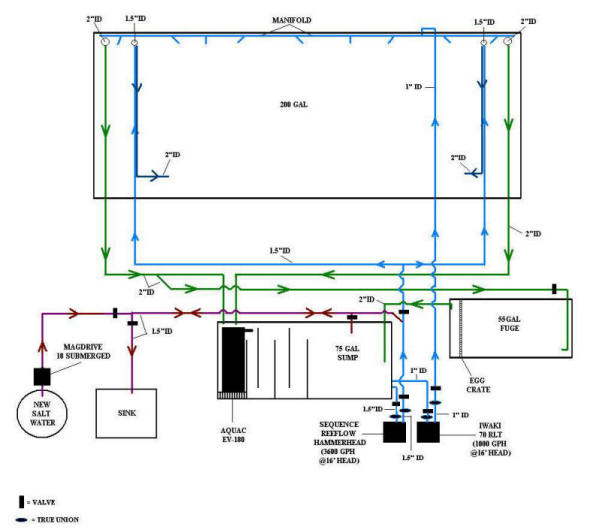
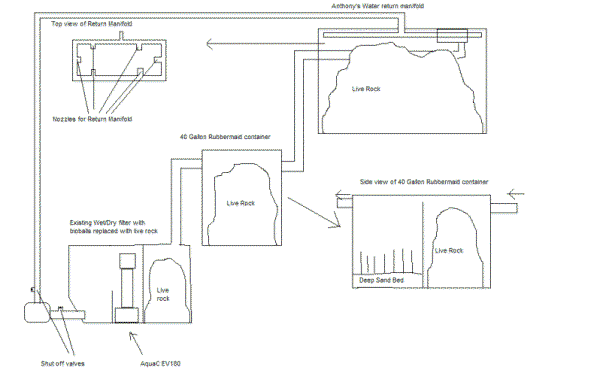
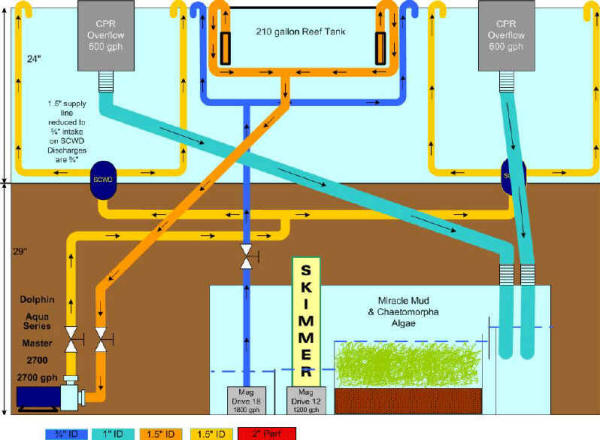
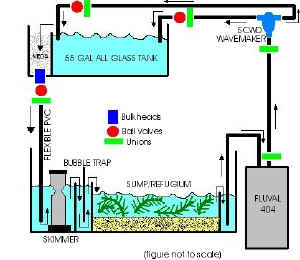
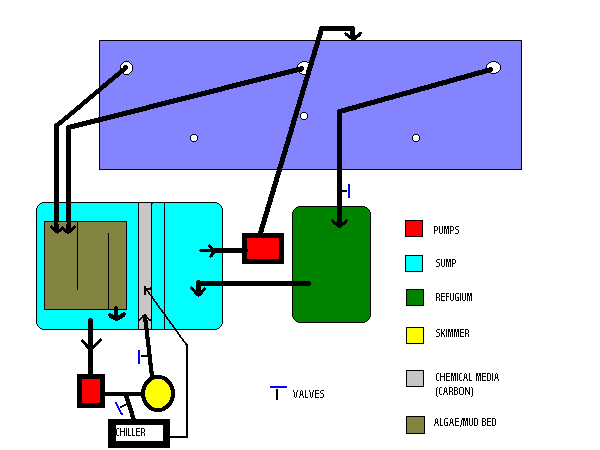
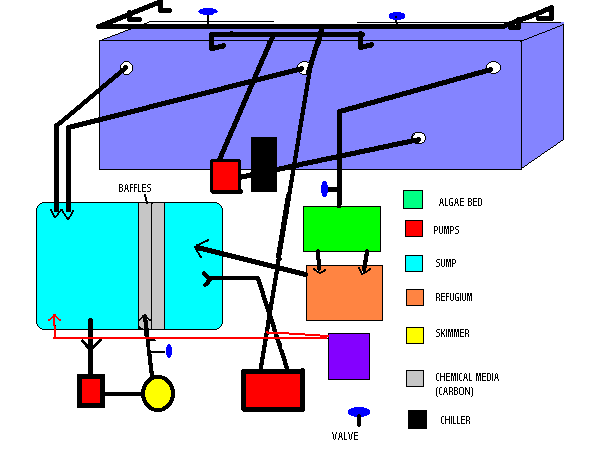
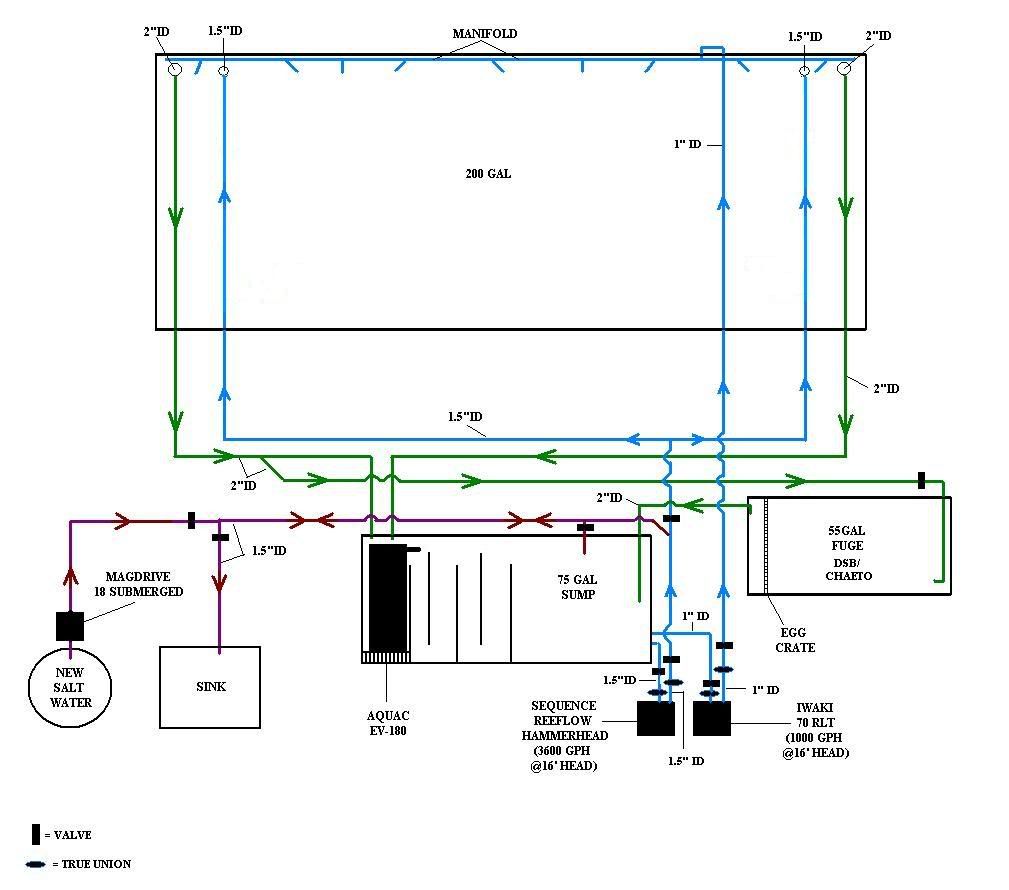
Confirming Plumbing Plan -- 03/03/09 Salutations my Wet Web Friends, <Greetings Russell> Having assimilated, to the best of my ability, the many many hours of reading here along with my experience with my current tanks, I have developed a plumbing plan for my new 180g (72"x24"x24") glass display and 125g (72" x 18"x 20") sump/refugium that I would like you to review to make sure I didn't miss something. All of the holes I am drilling are along the back top of the tank. I am installing the Glass-Holes 1500gph through-wall overflow which utilizes two 1.5" drains. <Am familiar... and you likely know that a friend and fellow WWM volunteer, ScottV is a partner in the co.> The 125g sump/refugium is partitioned such that, from left to right, I have a 36" refugium, 18" sump return with two Mag 12's, bubble traps, and then about 16 " for my AquaC 240 skimmer. One of the 1.5" drain pipes will go to the refugium, the other to the sumps skimmer section. Both side compartments then flow into the central sump return section. I will return up and into the back of the tank with two 1" PVC lines (or hose) that will reduce down to 3/4" once I enter the display ( 1" return may be a bit of an overkill but thought I'd reduce friction loss where I could). I will run a spray bar for each Mag 12 / 1" return line, mounted under the two center braces of the tank with three ½ " nozzles for each. In addition, I will drill two more 1.5" drain lines to feed a Dart pump for a closed loop system. The two 1.5" drains will tee together just prior to the 2" Dart intake. I ran two closed loop drains just to slow down the flow into each drain, strainer. <Good idea...> Dart output will be controlled by gate valve and fed up behind the display with 1.5" PVC then split into three 1" lines which will enter the back of the display. Two lines will feed a manifold that runs around the top perimeter of the tank with eight ½" nozzles. The third 1" closed loop return will be piped down the back of the tank to the bottom where I plan to push water up vertically through the rock-work with three ½" nozzles. I believe that I have accounted for real world drain capacities, pump output and return line/nozzle sizes and quantities. Do you feel that this is a practical plan/expectation? Thanks, Russell <Mmm... I'd propose to "do" the water movement part here differently... For one, you don't really need, nor can you use two Mag 12's on the sump/refugium... as the volume of water on the 'fuge side you'll want to be less than the 1.5" drain can deliver... I would go with just one Mag 12 or maybe bump this to a Mag 18... and even then with a valve on the discharge side for flow control. Using a Dart pump (a good unit I'll vouchsafe) for an externalized closed loop would also not be my first choice... For potential leak, energy use reasons... Instead I'd use two well placed internal pumps (Vortech my first choice, Tunze... even Koralias)... Placed per some of Jake Adams ideas... with a Wavemaker controller or not... Want to chat this over further? Am very sure that many other folks have other plans that they'd promote... with validity. Bob Fenner> Re: Confirming Plumbing Plan 3-4-09 Bob, thanks for your comments. I chose the two Mag 12's as my return pumps simply because I already have them; they are currently being used as returns on my 110g which is being upgraded to the 180g. <Ahh, I see... well, I'd just hold the one in back supply... myself, and use just one full time here... diverting some flow with valving to/through the 'fuge side> I had considered a couple different drain flow options and if the primary concern is flow through the refugium, a couple properly placed valves on the drain line can resolve that issue. You mention that I don't need the two Mag 12's for return pumps. Is this just a matter of not needing that much flow through the sump/refugium...slower flow, longer dwell time? <Mainly, yes> You also said I couldn't use the two Mag 12's. Is this again just a matter of overall flow volume? <Yes, and sorry for the lack of clarity... Though (I better look... yes...) the Mag 12 is rated for 1,200 gph... In actual application, the two will not produce such volume... and the Glass Cages 1,500 gph kit might well "keep up" with their pumping capacity... but there is a very real danger that "something" might/will eventually occur (a blocked screen...) and these pumps might overwhelm the through-put box... Hence my degree of adamancy re having superfluous capacity on the drain side... including more than one opening...> I chose the closed loop with the Dart primarily as a cost effective way to move a lot of water in a stony coral tank. It seemed that the cost/gph moved analysis favored a closed loop approach. <Mmm, look again... at real flow, mass water movement versus operational cost (electricity)... better by far to move much more water at a slower rate...> Another consideration was that the closed loop with many outputs also seemed to provide a lot of flexibility is directing flow versus the power head approach. I also was looking to clean up the look of the display by eliminating the power heads. Much of the reading I've done here seems to point people to closed loop systems so I wonder if you can expand a bit on why you favor the power head approach... <Am going to "goose" Jake Adams here... Am wondering if his excellent "water flow" pitch/presentation is available on the Net... Maybe here: http://www.archive.org/details/SierraSaltwaterSystemsMARS11_08_JakeAdams-DluidDynamics or here: http://sierrasaltwatersystems.blogspot.com/2008/04/podcast-max-marine-aquarium-expo-jake.html> is it just a leak potential and power consumption issue, or is there more, such as potential for wavemaker? <Mmm, do search the Net for articles with the product... Vortech...> Russell <Mmm, how to make a succinct statement here.... Comparing a centrifugal pump arrangement such as the external Dart pump, plumbing... one will get a good deal more pressure, but much less volume of water moved per kilowatt of power consumed... Your corals will benefit much more from having more water moved more gently... The placement of the internal pumps can be important... and the size, shape of the system, arrangement of structure in the system itself can aid/hinder your circulation. Do please peruse/listen to JakeA's pitch... and if you have a chance to see him in person... do so. Bob Fenner> Re: Confirming Plumbing Plan 3-4-09 Bob, <Russ... glad to catch this ahead of posting the dailies...> Ok, I understand your comments on the two Mag 12 return pumps....concern that they may/probably will overwhelm the 1500 gph overflow at some point even accounting for the total head loss. Also understand the issue of overall flow through sump/refugium. Points taken. <Sorry again for the incompleteness of expression on my parts here... Am lagging a bit today, from the eve's vino tasting> Regarding overall water movement in the tank, I had understood (apparently misunderstood) from reading that high velocity random turbulent flow was best for stony corals. This led me to pursue the closed loop system with multiple outlets at 300 - 350 gph each. However, as I understand your comments, assuming I can live with the aesthetics of power heads in the display and having to clean them periodically, I'd be better off with say, four Koralia 4's ( over Tunze or Vortech based on cost) at 1200 gph each, wavemaker optional...maybe added when funds allow. This would give even greater overall water movement(albeit with less randomness that the closed loop system) than the Dart with much less power consumption. <Mmm, I do wish I had time to do a bit look-seeing in the literature for you/all of us here... There are real scientific measures of water movement effects on growth rates... How to put this again in a petfish jargon general statement? "I like to "do" what seems to occur in nature... which is not at all like pumping through small ports at high velocity"...> I will check out Jake Adam's material for more enlightenment. Just goes to show what you have always said....many different paths/trade-off in this hobby. <Oh yes> I appreciate the conversation, thanks. Russell <Thank you Russell. BobF> Plumbing/new tank questions 8/27/08 Hello to all that help and support this site. It truly has been an inspiration (in a 'fishy' kinda of way) for my continued love and interest in the hobby; without it, I dread to think where the LFS would have taken me. <Heee, they're not all bad!> While I'm sure that many of my questions will have been answered in previous threads (I've spent countless hours reading as much as my brain can handle and looking for answers), I wanted to get input on my 'proposed' tank setup. I am upgrading from a 75 gal. (Very 'rigged' tank with a HOB overflow) to a 120 gal. Glasscages Rimless (48x24x24) with a single center overflow. I've heard mixed reviews on Glasscages, but would also consider that one bad experience will get the publicity of 100 good experiences. <Nothing wrong with their tanks.> Here are my questions I would appreciate opinions on before making the investment. With a single overflow I wanted to use a 2in bulkhead drain with a 1.5 in for the return line. I had originally thought about 2 corner overflows with 1.5in drain bulkheads, but like the look and space used by the single centered overflow (In my head I see two islands with a swim through for the fish, very open). Is this appropriate, and would I be able to 'fit' and 2in. Durso stand pipe into one center overflow (the tank will be about 5 feet away from the TV and noise must be considered)? <There is nothing wrong with a center overflow, however do consider having multiple throughputs/drains in the overflow. A single 2' can handle a good bit of flow, but it is a good idea to have another should the first on get plugged/fail. With a 1.5' return, I assume you plan on using a large pump? Depending on your planned flow you may want even more than two throughputs. Also be aware that the more flow you run through the sump the more bubble troubles you will have. Fitting the Durso in the overflow just depends on the dimensions of the overflow, you can specify to them to make sure there is room for this. > I'll be using a sump (40 gal. breeder) diagramed by Melev's site, it's the one that he demonstrates turning a glass aquarium into a sump/fuge. It is a basic flow from the protein skimmer through a bubble trap to the refugium which is separated by a 4in baffle and egg crate (to keep sand out of the pump). I would like to use an external pump (preferably an Iwaki) unless there is considerable noise reduction to the internal return pump. <Iwaki pumps are great reliable workhorses, but if quiet is what you want I would look elsewhere. I would look at the Eheim 1262 for the amount of flow you are talking about or even the Reeflo Snapper throttled back a bit if you want even more flow. Both are dead quiet and the power cost on the Snapper is hard to beat if you want a high flow return.> There will be 3 right angles and approx. 4ft of head for the return. I was thinking 1.5in for the return PVC. With this in mind (and any corrections you may have already made), should I consider an 1100 or 1600 gph return pump? Is this too much flow through the refugium and sump? <This is quite a bit to push through a 40 gallon breeder. Some get away with this amount of flow through these, but most have bubble issues. Do look at the Eheim mentioned above, the flow will amount to a few hundred gph less, more manageable.> I'm trying to keep the plumbing very simple, and trying to use as few as powerheads as possible. <On a tank this size it is often easier/better to have a dedicated sump return with a separate closed loop if you don't want powerheads. > Tank overview and proposed equipment: Coralife 220 Protein Skimmer (this will be upgraded around Xmas time.) ;) Current USA/Orbit. 48' 2x 250 watt Metal Halides and 4x 54 watt T5's. Any input on the light fixture? I will be mounting it to the ceiling and wanted something around $1000 that was an all-in-one unit. The tank will be open-top. <It is a nice fixture with a finished look, this counts since it will be out in the open!> Primarily, I want to get into keeping SPS with some specific LPS near the bottom half of the tank (considering the stronger MH bulbs). Excuse my being vague here; I am also purchasing several books as we speak, which are written by some of this site's contributors, to narrow this animal selection down. <A great idea for anybody.> Thanks for the time and support with this site. It is an invaluable resource for all in this hobby. <Thank you.> Thanks, Blake <Welcome, have fun setting up, Scott V.> Central filtration, plumbing 8/21/08 Hi I have been keeping marines since the 70's and reefs since 86. <Hey old timer!> I have run multiple aquariums on a central system for many years. I will now be building a large fish room. I am going to be running 18 aquariums on a single central system. In the past I have always provided each aquarium with a individual return branched off of the main pump return line. I was wondering if you have an opinion with regards to changing this set up and instead returning the water to the top row aquariums and allowing the overflow to serve as the return to the second row and so on to the third row with this overflow going to the sump. This would be easier to plumb and more economical as well. Let me know what you think Thanks! Glen <Will make a few general statements here. Overall, I would revert, stick with your first design... for a few reasons: One, the issue of disease transmission. It's much easier to be able to assure that what is going back through your centralized filter is clean, than have water mixed tank to tank. Ditto with controlling flow to and through any given tank... What happens if you don't want so much water in a tank below, but do want it in one above? Having done these sorts of set-ups over many years time, I assure you the individual in/out arrangement is vastly superior. Bob Fenner> Drains, Returns and Closed Loops, OH MY! 6/1/08 Hey Guys! <Brian> So here's where I am at and need some plumbing help. I have a 120g (48.5x24.5x24) AGA with center overflow that has a 1.5" drain. The tank is also drilled with 4 1" bulkheads along the back. I originally was going to use just the 1.5" to drain to the 40g breeder sump, and 2 of the back holes for returns with the other 2 for closed loop intakes, but after much reading on your site I think it might be best to change that train of thought. So here is where I am at, and would love to hear your thoughts. <Okay> 1.5" drain and the 2 outer 1" to drain into sump. That would put approx 2200ish gph into sump. <Uhh, no... about half this at most> So first question is with 5' of head, what should my return pump be rated at to handle that. <I'd stick with about 1,000 gph maximum calculated> Internal, external doesn't matter. I would run 1" return line back up T'd off to separate 20g fuge(this will gravity feed back to sump return area). The 1" return line would T off again up near tank and drop back over the top into tank. The other 2 1" drains would T together up to 1.5" to feed into Dart pump for closed loop. I would run the dart up through a OM 4-way, 2 returns would come up over the top to the front corners with loc-line, the other 2 would come over the back of the tank, run along the very back inside the tank to the bottom middle on each side and come back up through the sand with more loc line to generate flow back up. I have to run the lines through the tank as the bottom is tempered and can't be drilled. The goal is to have no powerheads anywhere in the tank. <Will, can be made to work.> I am sure there is something I'm missing in here, so any help is appreciated. Thanks, Brian <Just "missing" the estimate (of probable gravity/drain feed from the 1.5 and 2-1" lines) and need to consider the return in turn... all else reads as fine. Bob Fenner>
System upgrade, Connecting SW Systems -- 09/08/07 To the WWM Crew: <Flavio> I have a 125 G. marine and a 125 fresh. The distance between the tanks is about 50 cm. The marine system is a established one ( 6 years ) and is a growing soft corals, porous rock, and fish good mix. I intend to connect the two tanks, in order to double the water volume and to have the possibility to add more fish and propagate/divide some more grown corals, using the future new salt space. I think I have two options: Option 1: to connect the tanks using a water line between the bottom of the corner division (overflow) of the tank 1 and the bottom of the tank 2 ( the two tanks have 3 holes (with ball valves) in the bottom glasses); and also to establish a water line between the overflow of the tank 2 and the sump. The pump is the sump and feeds tank 1. Option 2 : just to add another pump in a bigger sump ( 60 G.) that feeds tank 2 and connect this one to a shared sump. <Mmm, I would go with Option 2. Gives you more flexibility... and less potential for disaster> Another issue is the new 125 G. of new salt water to fill the added tank. I use natural salt water. Do you think it is better to gradually mix the new with the "old", connecting the two tanks during, let me say, 10 minutes each day, or just connect totally since the beginning ? <I would do the latter... if the waters are about the same temperature... All should be fine> The added tank will have new water, new sand, new rocks. I am thinking to mix some tank 1 sand and rocks to the news in the tank 2. <I agree with you here> Please use this email to contact me: <Done> Thanks for your advice and for your so helpful site. Fla¡vio <A pleasure to share with you. Bob Fenner> Pump head vs. distance. Figuring Straight Runs Of Pipe For Head-Loss -- 06/19/07 Quick question. <<Alrighty>> I have been searching for this answer. <<Hopefully I can provide some illumination>> I know I have seen it places but can't come across it. <<Likely so...let's hear it...>> When sizing a pump and taking in to account head and pressure, how many feet of head do you account for when going in a straight/level line? ex...Is 10-foot distance equal to 10-foot of head? Thanks Bryan <<A very good question Bryan, and one, yes, I'm sure has been asked and archived. But no worries mate, we'll create another 'Google-hit' right here. The answer is yes, you do need to take any 'straight' runs of pipe in to account when figuring pressure/head-loss. A good rule-of-thumb is to add an 'extra' foot of head-pressure for every ten-feet of 'straight' pipe run. So to use your example... A 10-foot run of 'horizontal' pipe would constitute 1-foot of head-loss...but a 10-foot run of 'vertical' pipe would constitute 11-feet of head-loss...Understanzee? Always best to buy a pump BIGGER than you think you will need, and install a gate-valve on the output side to temper flow if necessary...in my humble opinion. Regards, Eric Russell>>
Plumbing New Reef Tank, Equipment Assembly Line (What order do they go in) 4/11/07 Hi Crew! <Hello David.> I have used your site a lot lately as I am going to be setting up a new reef tank. <Awesome.> I have had successful FO tanks in the past and want to graduate. <Yes as bad as it may sounds 'aquariums are like drugs, you have to get something new to get your fix'¦> Here is my equipment: 125 AGA MegaFlow tank 100 gallon sump (divided in two, 50 gallon sump and 50 gallon refugium) The sump does have a wet/ <Okay, great water volume.> dry area) The water flows into wet/dry area, into sump, then one of the return lines has a t with pipe going to refugium. Coralife lighting (4*96 PC , 2 are 10000k, 2 are actinic) <Well Power-compacts are probably my least favorite form of reef lighting. They depreciate in lumens rather quickly and have to be replaced every 6-9 month realistically 'the design of them literally makes the bulb cook/heat itself. High Output T-5's or VHO's would be a much better choice.> 2 turbo sea 1270 pumps for return AquaC EV120 w/jg fitting and Mag 5 pump (tank and stand were given to me for free so I'm stuck with them for good or ill ;-) I am planning on plumbing with flex pvc. <The flex stuff is best used in the areas where the pipes/pumps meat in conjunction.> My installation has the tank and stand on one side of a wall and the sump/equipment is going in the utility room on the other side of the wall. <Very cool.> My questions are: What is the best placement for skimmer, in the sump or in the refugium? Or split? intake from one are and discharge to the other? (a small pipe from return feeds refugium, water from refugium exits to sump) <The skimmer should most certainly be placed before the refugium and will only be efficient if it is allowed to process raw overflow water before the 'fuge.> If I add a uv sterilizer, can it also draw water into and return to sump? <Do you mean have the U.V. sterilizer fed my the overflow, no I wouldn't do that, if the U.V. is to be useful in any manor it can't have high volumes/high velocities of water pushed through it.> I haven't been able to find a good answer on placement issues. It seems to me that equipment in the sump would lose some efficiency by recirculating some of the same water over and over. <Mmm, yes but more will be loss if water is pushed through the sump to quickly.> I would also greatly appreciate any tips or hints you have for this system. <If you have any specific questions I'd be more than happy to answer them or point you in the right direction.> Thank you in advance, <Of course.> David <Adam J.> Re: Plumbing new Reef Tank - 04/12/2007 Hi Adam! <Hello again.> I read your response carefully and what I think I understand is that you think I should use flex pvc to connect pumps to sump, then use a short piece to connect pump to hard pvc then to return. (in essence isolate the pump with flex pvc and use hard pvc for the longer runs) <You got it.> The lights I obtained on a real steal before doing a whole lot of research. Do you think they would be ok to run until I am further along and can afford a new set of lights? <Yes the lighting comment was just more of an FYI...for you in the future...for other people now.> On the UV question, what I meant was should I use a small dedicated pump to run water through the UV with the pump taking its water out of the sump and returning it to the sump. <That's fine.> I have never used a uv unit before and it seems to me that a 40 watt unit at low flow should be able to service this tank and kill Ich parasite. <Will not completely eradicate a crypt problem, is a good tool to have on hand (wouldn't run 24/7) <<Mmm, why not? RMF>> but won't replace proper QT by any means.> Do you have any recommendations on models for this type of installation? <What you suggested is fine.> Do you think the EV120 choice is adequate for my setup? <Yes, good skimmer.> I had read that using 2 smaller skimmers is better than one larger one <Really? I haven't read/experienced that.> and was planning on maybe purchasing another one shortly. Is another one necessary? <I don't think so, not in this case.> (I always plan on upgrading that's why I got the one with the fitting for the calc reactor) Thank you very much for your help! <Anytime.> Sincerely, David Matza <Adam J.> Re: Plumbing new Reef Tank -- 4/13/07 Hi Adam! <Hello again.> Thanks for all the help! <No prob.> As far as the dual skimmer issue is concerned, I can't remember what website I read it on but the so-called guru said it was better to have two small skimmers rather than one large one. He said the reason was one skimmer would-be able to be chugging along at full speed when the other one was being cleaned. It sounds reasonable but in actual application might not be efficient enough to warrant purchasing 2 units? <Not in a cost effective manor anyway...> Just wanted to let you know that. You may get that question in the future. <Have received it before but have not much info, data to warrant using two, especially when large recirculating models are easy to come by now.> I have never run more than one skimmer at a time so I have no personal experience to judge his claim. <Have run more than one skimmer on a system before, but these have been very large commercial systems.> OH BTW, I have a fully cycled 20 gallon tank ready all the time for qt. I learned my lesson on that a long time ago. <Good...well not good you learned it the hard way...you know what I mean.> The best way to go is painfully slow, but then I have never had any fish losses due to ich outbreaks. <Well that is good.> I was just interested in the UV because since this is going to be such a bigger tank with way more expensive livestock I thought it might be prudent to have a little extra insurance. <Yes but be sure to read the articles on the web...WWM, pros and cons...just you aren't going in blind.> Thanks again for the help! <Anytime.> David <Adam J.> Plumbing a Mag-5 Pump and Calculating Head-Height -- 03/05/07 WWM- <<Adam>> I have a 65g. AGA tank with built in overflow rated at 600gph, <<Mmm...a single 1" drain likely...600 gph is "optimistic" and downright problematic...in my estimation>> and a Mag5 return pump. <<A decent enough make of pump>> The Mag5 is rated at 500gph, and 310gph at 4ft. <<Yes>> Is head-height determined by total distance between pump outlet and tank return outlet or simply height from return pump to top of tank? <<Is a bit more 'involved' than either statement. Head-height/head-loss is figured based on a combination of factors to include length of horizontal and vertical pipe runs (though these are not 'calculated' the same...I'll explain in a moment), plus the type and number of ells/tees/fittings/et al, and even the diameter of the pipe/tubing used. Calculating vertical pipe/tubing installations is simple...one foot of rise equals one-foot of head-height, and it is generally universally agreed that every ten-foot run of horizontal pipe is equal to a one-foot rise, as is each 90-degree ell and each tee fitting in the run. So, as an example...if you have a return line that rises two feet above the pump, makes a 90-degree turn, runs horizontally for 5-feet, makes another 90-degree turn, rises another two feet in to the tank, and terminates in a tee...you are imposing a resistance on the pump roughly equal to 7 ½-feet of head-height. Does this make sense to you? As for the diameter of the pipe/tubing, it is often advised to match pipe-tubing diameter to the output diameter of the pump...but in my experience; especially with the Mag-Drive pumps, I have found that 'upsizing' the pipe often yields better results/flow rates. For the pumps with ¾' outputs and smaller, I have found 1' pipe/tubing to work very well>> Is this pump vastly underpowered for my setup? <<That depends on what you want the pump to do. If the only purpose is for filtration/processing water through your sump and your head-height is equal to 4-feet providing 300 gph of flow then yes, I would consider this about ideal for a single 1' drain>> It seems a fine line between maximizing overflow flow capacity and overflowing the tank. <<Yes indeed...and that's even assuming the accompanying noise/surge aren't an issue>> If so what would you recommend? I am in the process of converting from Wet/dry to sump, so many possibilities. <<My recommendation would be to utilize a pump that; based on your plumbing configuration, provides about 300-350 gph to the sump...and utilize powerheads/closed-loop/etc for additional flow within the display tank>> Thanks for all the help! <<Happy to share. Eric Russell>> Increasing system volume & Long plumbing runs 1/26/07 After reading the FAQs I have decided to more that double the volume of my systems by placing a large sump and refugium in the garage and plumbing it through my crawl space back to my tank. I will be adding over 200 gallons each to my 120 gallon tank and to my 92 Corner. My main reason for doing this is ease of maintenance, system stability and reducing the risk of spillage indoors. I will have a 100 gallon refugium and 100 gallon sump. <This is a worthwhile cause. After all: The solution to pollution...> However, I need some recommendations. <Can do, pardner.> a) My 92 corner is about 70 ft (horizontal) and about 7ft (vertical ) to the new sump. 5ft of the vertical height is indoors before it gets to the crawl space and then another 2 ft drop over 70 ft to the sump. Will I have a problem in the drain to the sump? <Mmmm... Not a problem per se. You will definitely have a low flow-rate, and there is potential for a clog due to the shallow angle. I am not overly concerned for your system, as the benefits outweigh the potential problems. The reality is that there is a 7' drop, and water will flow. There are calculations available that can help with this setup, but my main focus would be on maintaining a straight and true slope, with no low spots for water and detritus to collect and cause restrictions to the already low flow-rate.> b) I do not think heat transfer will be that big an issue because of system volume and want to consider submersible first is this reasoning valid. <My opinion comes from a service-oriented point of view, but I think pumps should be reliable and low-maintenance. In many cases, that means a submersible pump can do the job. With 70' of hose and an unknown number of turns in the circuit, I am inclined to opt for a high-flow/low-speed inline pump. To address the heat-loss issue you mention, I think it is a genuine concern that two lengths of 70-foot plumbing (Vinyl or PVC?) *will* present a huge opportunity for cooling of the water. System size is a help here, but you have to consider that you may need a spare or pair of spare heaters for redundancy.> If so do you have any recommendations for a reliable, efficient, submersible pump that can pump 1200 gph 7ft vertical and 20ft horizontal through 2 separate returns (my Eheim 1262 wont handle the load unless I get an Eheim per return) <Mmm... was under the impression that you planned to build separate sumps/refugiums for each system, meaning one sump and fuge per tank. Is this a mistake on my part? You did say you would be adding "200 gallons each..."> c) Any Suggestions for raising the height of the skimmer since the Rubbermaid's are over 2ft? I have Euro-Reefs and Tunze's. <Milk-crate?> d) I would also like to have the same setup for my 92 Corner but I am concerned that by sharing one sump for two displays I could increase the chance of disease spreading if I have an occurrence. Is this concern warranted? <Absolutely warranted. *BUT*, I would remind you that under normal circumstances, with proper QT practices, you should be able to avoid undesirable vectors in your captive eco-systems. If it were me, I would research the feasibility of making two separate systems for your needs. > Thanks in advance <I enjoy the opportunity to assist! -GrahamT.> Plumbing/Water Flow In A Three-Sided Tank - 01/09/07 WWM crew, <<Howdy Brian!>> Got the Reef Invert book by Anthony and Bob and have been masticating on its colorful fibers. <<Hee-hee! But wouldn't a piece of gum be better?!>> Planning a system with upstream refugium, display, and downstream sump/fuge with return. <<Cool!>> I want the display to be viewable from both sides and along the width, more like a biotope than the standard, two dimensional wall reef. <<I see>> I am thinking 20" tall, 24" deep, 60" long acrylic (125). <<Ok>> I am having trouble imagining how plumbing might be incorporated to avoid obstructing the view. <<Will have to be run in/out from the "concealed" end>> Can I have symmetrical overflow, like reef-ready tanks but on the one 24" width which will face the wall to keep pipe out of view? <<Sure, you might even want to consider a horizontal overflow, or just bulkheads with screens...though the latter requires a bit more fuss to mange water levels/flow. Whichever method you choose, don't worry about the plumbing outside the tank on the end being visible. This was a concern for me when I installed my current system a few years back (in-wall system viewable from both sides), but once there is water in the tank the light refraction prevents you from seeing through the end panel>> Will this be inviting dead spots on the far side? <<Assuming flow will only be coming from the one end, you will need a full flow pattern, and in my opinion, preferably something that pulses/alternates intensity. A Tunze Wavebox would be ideal here I think, though if you don't want to give up the space associated re you could also get by with a pair of Tunze 6000 pumps mounted to/below the overflow and cycled with the Tunze 7095 controller>> BTW, I am thinking 1500 GPH flow rate for the display, <<I don't think this will be enough, especially considering the configuration. The Tunze pumps mentioned when combined will give you a bit more than twice this (when "both" pumps are at "maximum") and I think you will find this to be a big help at keeping detritus in suspension at the far end of the tank>> 1000 GPH for the up-'fuge (16x24x60) -- 'pod colony. <<Should be ok, but if you find the flow a bit much to manage here you can easily reduce by half and still be fine>> As always, thanks so much. Brian <<A pleasure to share, EricR>> Re: Plumbing/Water Flow In A Three-Sided Tank - 01/10/07 This is fantastic, Eric. Thank you. <<You're quite welcome Brian>> It's going to take me a while to digest. This whole thing is putting a strain on my spatial skills. <<Ahh...understood (had to think about that for a moment). Do give me a shout if I can be of further assistance. EricR>> Plumbing Question 11/13/06 Greetings, <Hello Tracy, James here in Michigan also.> I have been reading and reading and reading your site for weeks now. While I understand the idea of bottom filtration, and by this I'm simply referring to the drilled holes and not a plenum, I can't seem to find the plumbing parts necessary to set up the bottom filtration. My local aquatics store suggested the typical big chain stores for my needs. I have the bulkheads for 1 3/4" holes, but I can't seem to find an extender for the outlet or the rest of the plumbing parts to plumb to my canister filter. My local plumbing stores don't seem to have any of the sizes that I need. Is there a place to purchase plumbing supplies online? I've been searching and searching. <Here is a link to an etailer that sells such. A Google search will produce many more, some may be closer to you. http://www.thatpetplace.com/MainPro/IndexFishCleaning.aspx> I'm still slighting hesitant about going through the bottom, what with the potential for leaks & floods, so I'm still tossing around the idea of plugging the holes and going over the back. <Bad idea going through the bottom if a leak proof overflow box does not surround the pipe. All Glass Aquarium makes a kit that would fit the bill nicely, and it is a DIY project. Look here. http://www.drsfostersmith.com/Product/Prod_Display.cfm?pcatid=12078&N=2004+113794 This company also sells plumbing parts you are looking for.> I'm considering a CPR Bak Pak and an XP3 Canister Filter by Filstar, but I'm interested very interested in CPR's Cyclone, also. I've not considered lighting too much, yet, but thinking about a 4 light 48" with compacts and 5 moonlight LEDs. My goal right now is mostly LR with Corals and Invert's, maybe a couple fish. Clowns, gobies, shrimps, snails, etc. <Do search our website on above subjects. You will find much info here to help you achieve your goal(s).> Any suggestions or comments will be tremendously appreciated. I'd love to rush right into this, but am trying hard to hold back the reigns and do it right the first time. <I'd stay away from hang on overflows and go with an internal box such as the one I suggested. Seems like you are always fiddling with HOB's, air bubbles in the "U" tube, plugged pre-filters, pumps running dry because of siphon loss, etc. Do search, read, and learn on our site. Here is one link you can start with. http://www.wetwebmedia.com/plumbingmarart.htm> Thank you. <You're welcome. James (Salty Dog)> Tracy in Michigan - Plumbing Question, Follow-up - Regarding: elementary aquarium plumbing. <Suggest you pick up a copy of Aquarium Systems Engineering, by Pete Escobar. Should certainly find it at the book store in Scripps Aquarium [is where I bought my copy], but may also find it at one of your local fish stores. Cheers, J -- > I found "Aquatic Systems Engineering: Devices and How They Function", by Pedro Ramon Escobar. I suspect that this is the book you meant. <Yes, had typed that title from memory which I find falters more and more often these days.> From the table of contents, I think yes, you correctly detected I'd like this book. :) Joe <Cheers, J -- > - Proper Plumbing Sizing - >Is there a table for this somewhere? <Somewhere.> >How come no one else asks this question? :) <It's been asked before.> Hey, crew, Reef Central answers this question here: http://www.reefcentral.com/calc/drain.php They don't mention they necessity of duplicates on their calculator, but it's a start. It would seem to me that a tank running 3600 GPH should have 3 2" overflows. Joe. <Sounds about right. Thanks for sharing. Cheers, J -- >
Plumbing Design - 08/11/05 Hello Crew! <<Howdy>>
Thank you for the great advice so far. My tank is (oh so slowly)
progressing toward the day it will actually have saltwater in it!
<<agonizing, ain't it <G> >> I have a 180G. I am
not sure how large my sump will be yet, but I plan to do a separate
refugium. <<Goodonya mate! Is really the best way to do it, as
opposed to combining the two...in my opinion.>> It will be fed
water from a tee off the sump return line (already skimmed), controlled
with a gate valve. <<This can/will work, though I prefer to feed
raw tank water to a 'fuge. Nutrient export is part of the function
of a refugium, after all...and the critters you're trying to
cultivate will appreciate as well the organic matter that is going to
be removed by the skimmer.>> You can see a diagram of my plumbing
plans here: http://home.cfl.rr.com/homebrewed/fish/sump_plumb2.jpg
<<Nice diagram, but you're making it more complex than it
needs to be; and trust me, the more simple your plumbing the happier
you're going to be in the long term. This will work...but I think
you're going to have to "fiddle" with it constantly. Not
to mention I think you'll have a "noise" issue as well.
If you wish to discuss, let me know and we'll chat more.>> I
want the fuge to have a DSB, some live rock, and lots 'o macro
algae. <<Mmm...which macro algae?...may want to exclude the rock
from the 'fuge in favor of the increased water flow.>>
I'd like the fuge to provide food (small critters) to the main
tank. <<Most desirable/beneficial, yes.>> My main question
- I am trying to decide on an external return pump size and would like
to know how many times turnover you recommend for a refugium? If I were
to use a 20G refugium, would 400 GPH be way too much? Should I plan on
only 200 GPH? <<200 will probably do, but 400 is fine if the
plumbing is set up to (effectively) handle it. I would go for the
higher number and throttle back as/if necessary.>> Thanks, Randy
<<Regards, EricR>>
Re: today's diagram for plumbing design Hi Bob, Alright, I finally get to converse with the "Master". Just can't write enough about how great your site is. You guys have saved me from many mistakes before hand. I use your WWM FAQ as my hindsight if that makes sense. I've tried the marinedepot.com site. I'll check into the Dr. Foster's and Smith. If I ever have the opportunity to meet you the beers are on me! Thanks a million, Dick <Thank you for your kind, encouraging words. Will be looking for you and that brew someday soon. Bob Fenner> Re: today's diagram for plumbing design Hi Bob, Duh, I went back to MarineDepot and searched for strainer's AND there they were. I've been searching under overflows, fittings and skimmers with ton's of feedback, but nothing related to what I was looking for. There's another beer! Thanks, Dick <Thanks for the tip. Bob F, shooting for a six-pack> -180 plumbing query- I have a 180g reef ready Oceanic Tank
that is going to be a FOWLR, the manufacturer claims that the supplied
bulkheads should allow for 1800g/hour flow. After reading several FAQs
this does not seem realistic <Actually, it probably is. We run a 180
Oceanic at the shop at around 1500gph and the water levels in the
overflows are still very shallow.>, the return bulkheads (2, one in
each rear corner) are 3/4" ID and the drains (2, one in each rear
corner) are 1" ID. Do you think this is realistic, I would like to
attain this 1800g/hour flow. <I would say so, but install a gate
valve on your pump just in case> I am looking at using a Dolphin AMP
Master 3000 or 4700 which I would reduce to the size of the bulkhead
fittings right below the bulkhead. <Have you checked out the pump
curves on these guys? Even after a T and a few elbows, this may end up
being too much for the tank to handle.> I was also thinking of the
possibility of using the teed return manifold and using all 4 bulkhead
holes as drains, If you think this is a better idea what size pump
would you recommend and what would you recommend for plumbing (tubing
size etc.). <If you really wanted to go wild with the return this
would be a viable option, but I'd keep it below the max since who
knows how high the water level in the tank will go.> I was thinking
of running 1.5" pipe to the top of the tank and then reducing it
and splitting it into either 1" or 3/4" pipe with 3/4"
tees to direct the water. I know this is a lot and not necessarily
coherent but I would appreciate any help you can give me. <No
worries, and very coherent! I think the amp master 3000 would be a bit
much for this tank. Big dolphin pumps, IMO, are best used on a closed
loop that by-passes the overflows. Check around the forums for ideas on
intake manifolds as well as return options (sea swirls!!!). I would
pick a good sized return pump that wouldn't go over 1500-1800 gph
after you have taken into account all the head pressure (elbows,
t's, height, etc). I hope this helps! -Kevin> Regards,
Aspiring Reefer - Or Aspiring Plumber! Scott (or whomever working the keyboard tonight), <Scott F. here - cold drink in one hand, a taro roll in the other...hey - how can I type...?> Thanks again for all your help. Hope you will give me a little more :o) <Will try!> I'm in Argentina, so trying to do my setup right has been a real adventure. <Yep- I recall!> Anyhow - found the live rock, and a guy to build me a tank and drill holes. <Cool!> Proposed set up: 95 gallon FOWLR 60"L x 24"H x 16"W Aqua C EV 120 or 180 (guess bigger is better?) <If you can get the 180, that would be great!> Berlin Sump - 23"x12"x10" (supposedly rated up to 125 gallons) 100 lbs. live rock 4" or 5"sand bed (no live, but assume rock will fix that) Gonna try no additional filtration (unless you think I need it) <This is sounding soo much better than it did when you first started out! I'm really stoked for you!> Question is, how many holes, where, and how big? <Well- a lot of it depends on the pump, water volume, etc.. I'd look into a skimmer box built in the center, with at least two 1-1/2" to 2" standpipes...You'll be able to move a fair amount of water that way> Have been reading through FAQ's and still very confused (and scared I am going to have to go to plumbing school). <Yep- it's all part of the game. Trust me- when this is over- you'll be an expert...Every hobbyist in Argentina will want to hire you for your genius!> This is what I have concluded, rightly or wrongly, from reading FAQs (please feel free to comment/set me straight): For FO tank 10x water flow is reasonable (1000gph) <Yep- more if you can do it...> Powerheads in tank not optimal so will attempt manifold system. The outflow from 1000gph will require at least two 1" bulkheads (capacity 600gph each). Some differing opinions on this (some FAQs say they can only handle 300gph, at least the way I read it). <I think two 1 inch returns should handle it. Or, you could route the returns using hard pipe or flexible tubing into 2 1 inch Sea Swirl rotating return devices at the top of the tank. That way, you won't have to drill and plumb manifolds into the side of the tank...Just drill holes for them on top, or brace them if using a glass tank. One of many ideas...the possibilities, unfortunately, are endless! (as are the costs, LOL!)> One 1" return is O.K. for the manifold setup. Should I be using larger bulkheads for the outflow and returns? If so, what would you recommend? <As above...simple is good...> Holes should be drilled as near the top of the tank as possible, this applies to both the outflow and return? <I like to... It prevents disasters from floods in the event of power failures and drain downs...> If I am correct in assuming I need three holes, how would they be set up? Equally spaced along the back? Or should the two outflows be near each other, at the end of the tank where the inflow box of the sump (underneath) is located (shorter runs of PVC)? <I'd keep all returns at opposite ends...Or, you could use a PVC manifold running the entire circumference of the top inside lip of the tank, with PVC elbows all along the length...mega flow that way!> Should the single return be drilled at the center of the tank (on top) to provide for more even water distribution through the manifold? <Well- again- lots of ways to go...> Sorry if these are silly questions, or if I am totally confusing things. <No- you're not. This project is costing you a lot of money, so you are absolutely right to do the research now to get it right! I'd read up on the DIY site ozreef.org for tons of ideas that you can apply...good reading for aspiring reef plumbers!> Thanks again for all the help. Would not even attempt this without you. Jim <Well, I'm thrilled to be a part of it, as are all the members of the WWM crew! Feel free to write us again any time! Regards, Scott F> Aspiring Reefer-Or Aspiring Plumber? (Pt. 2) Gracias Sr. Scott, <Hola! Or is That Ola.. or- er... Well- I took 4 years of French in High School...LOL> I like the way you throw stuff at me when I ask questions that makes me work harder/learn more. Can't believe the stuff I know now I did not know a month ago, but still a loooong way to go (especially as a plumber). Thanks. <Yep- part of the fun is finding different ways to do things, and new ways around a problem...We can give you the tools, but there' nothing like learning it for yourself! Trust me on that! LOL> The tank guy is calling me, wanting to know how many holes I want drilled in the tank, how big, and where I want them. I have searched your site, and LOTS of others, but not making much headway. Couple of clarifications if you've got a minute. (warning - some of these are going to sound dumb). <nah!> My approach (if it makes sense) it to decide the hole/bulkhead size/placement issue, and while the tank is being built (couple of weeks) do more research on the plumbing. (will size the holes to the bulkheads, double threaded). <Absolutely- now is the time to make these decisions!> For a 95g FOWLR tank (60"L x 24"H x 16"W) Sump underneath, with external pump capable of handling 1000 to 1200 GPH (don't want powerheads, or much of anything non-living in the tank). Q1) For this size tank, with the proposed flow rate, will two 1" overflows (outflow from tank to sump) and two 1" returns (from the sump to the tank) be enough? Would one overflow and one return, larger size, work as well? Seems like it would sure make the plumbing easier? <I'd go with one overflow with two 1"-2" standpipes inside. In my opinion, better to have a bit more than too little...You can always dial the pump down a bit if needed...I like two (or more returns) to provide more circulation in the tank...Again- they don't have to be "static" returns (i.e.; bulkheads...)> Q2) If yes to above, place the two overflows near each other (or the one larger one) at one end of the tank (directly above the sump intake), as high as possible on the back wall of the tank? <Yep- although I favor an overflow in the center of the tank (one overflow box with two standpipes...> Q3) Place two return holes at the opposite end of the tank (or better one larger, like 1 1/2") same level as the overflow hole(s)? <I still like more than one...> Q4) Or something completely different (i.e., do I need more capacity for outflow to sump, like two 1 1/2" bulkheads)? <As above- couldn't hurt...> If you know any webpage that covers placement/sizing of holes/bulkheads please advise. Tried OzReef, several others, and nothing really explains it for the beginner (have read all the plumbing FAQs, and the article on marine plumbing is just a picture, as far as I could find). <Hmmm- you might want to search the "links page" on WWM or OzReef...there are plenty of plumbing-related sites out there (I just can't think of 'em at the moment!)...> As always, you guys are the best. Jim <We try, Jim! We have some great people here...In fact- you may want to shoot an email to Craig, the resident WWM plumbing guru- who definitely has forgotten more about reef tank plumbing than I'll ever know! Good luck! Regards, Scott F> Aspiring Reefer- Or Aspiring Plumber? (Cont'd) Scott, <Hey there!> One more question (actually three :o) and I promise to leave you alone for a while). <Never a bother!> Maybe I am missing the forest for the trees (info overload). Is the whole issue with drilling holes simply about providing a gravity feed for the outflow, so as to avoid the whole siphon issue (floods, etc.)? <Essentially, yes.> If that is the case, should I not even worry about a return hole/bulkhead and just run something over the top of the tank (PVC manifold, SeaSwirl, etc.)? <My point exactly! I really like Sea Swirls...no bulkheads to mess with, easy to use...a great way to go, IMO> Are there important advantages to having the return from sump to tank drilled w/bulkhead? <None that I can really think of...As long as your connections to the 'Swirls are tight, there is no additional leak danger, IMO> Finally, for the outflow to the sump, are there advantages to having two or more smaller holes (1") vs. one or tow larger ones? <Well, you can direct flow into different areas of the tank with two-or multiple- outlets...> Thanks again. <No problem. Regards, Scott F> Refugiums, macroalgae and reef plumbing Hello, <cheers> Can you tell me the best set up for a Ecosystem mud filtration unit, my tank will be a 125gl with twin overflows. I need to know what is a good pump, and how should I run the lines from the pump to a heater/chiller (aqua-Therm) and back to the return. I want to have at least 1000-1200 of gph for the sump and I need at least 600gph for the chiller so it will not freeze up, that is the manufactures states. I was thinking that I could use a Mag drive pump rated for 1500 or 1800gph to do the job. <please view the illustration and following links to get an essential take on the matter: http://www.wetwebmedia.com/plumbingmarart.htm http://www.wetwebmedia.com/pbfaqsmar.htm http://www.wetwebmedia.com/circmarart.htm http://www.wetwebmedia.com/reeffilt.htm how do you rate the Kent marine Biosediment to the miracle mud( I hope you are liquored up to tell me about it)? <I find them both to be equally useless and overpriced and would advise a deep bed of fine oolitic/aragonite sand instead (6" or more) :) > I also need to know why you said sea grass is a better choice than Caulerpa and why don't ecosystem tell you why. <actually... seagrasses are not the only or best alternate for Caulerpa. But Caulerpa is frightfully noxious if neglected and has been shown scientifically to impede coral growth. They are not found naturally together on a reef. Other algae like Chaetomorpha and Gracilaria are more stable and less toxic if neglected> They don't have the patent on plants, right so why promote a species of plant when there are ones that are better for filtration, <because Caulerpa was one of the very few "plants" available in the hobby when Leng Sy first developed his mud system and they are the only common macro that can remain in stasis if lit 24/7> how can I get some of this sea grass. <seek Chaetomorpha or Gracilaria instead from IPSF.com (AKA "Tang Heaven" or Hawaiian "Ogo")... or from inlandaquatics.com ("Spaghetti algae")> thank you, and I appreciate you site . Mr. McCoy <kind regards, Anthony> - Plumbing Considerations - Hi Guys, <Greetings, JasonC here...> I have been renovating the reef tank lately and have decided to upgrade my sump. An old glass tank of mine fits the bill perfectly, it is 38gal and fits snugly beside the main tank. The only thing holding me back is the potential loss of tank water turnover due to the plumbing involved. I am running the return line on a via aqua 4900, giving me 1056 gph (I'm converting from metric to give you guys a break, in litres that's 4000 lph I think). The via aqua has given me reliable performance, and is a quality piece of aquatic machinery, but I sense the head pressure may take a dive if I re-plumb the sump. Maybe not. <Well... do avoid 90 degree elbows like they were plutonium. You might even consider using flexible tubing to avoid sharp turns in the plumbing... would help that pump be all it can be.> Could you please advise me if the new sump is worthwhile considering the plumbing situation ? I would love the extra capacity and room to arrange my components. <If I'm reading this diagram correctly, the overflow into the new sump looks a little scary... would be easy to break that siphon... and maybe even harder to start without gravity doing any work for you. There doesn't seem to be enough height differential to have a proper siphon.> Would be better for you to have this sump below the tank.> To assist you in your considerations I have provided a schematic diagram of the tank and proposed changes (excuse the quality). Current length of return line : 3ft 3"; 2 PVC elbows to spray bar Proposed length of return line : 5ft (approx); 5 PVC elbows to spray bar Thank you for any help Andrew Hough <Cheers, J -- > Great plumbing article Hey folks, Thought I'd pass this along. Advanced Aquarist's Online Magazine has posted its latest issue, with a number of good articles, including "An Engineering View of Aquarium Systems Design: Pumps and Plumbing," by Sanjay Joshi, Ph.D., Nathan Paden & Shane Graber. It can be found here: http://www.advancedaquarist.com/issues/jan2003/featurejp.htm I only scanned through it, noting that it has a lot of equations and tables, and is based on fluid dynamics and hydraulic engineering references. Should be great for those with technical circulation questions that I see pop up in the dailies from time to time. Hope you can pass this along to those who need it. Later, Jeremy M. Dawson, Ph.D. <Thank you for this lead. Will post the link. Bob Fenner> Plumbing references hello I was wondering if you could steer me to a good reference for the plumbing of a system. My dilemma is that I have set up a 200 gallon FOWLR tank using PVC pipe and have the micro bubble problem. I have asked written you many times and you have given me good suggestions into trying to solve the problem, just seems I've tried everything a number of times and can't >solve it. I still wonder if somewhere on the return line there may be some small air leak, I've smeared with Vaseline on the joints but see nothing. My piping is dry, if there is a hole wouldn't there be some type of water leakage?? I'm at my wits end and ready to redo the entire plumbing for the system therefore wanted to know if you had any good resources? <Thereefweb.com-click on article-then "How To". These types of problems are frustrating and aggravating. We've all had these experiences. Reefweb.com is the source I used when I plumbed my first tank. If you have a bubble problem, rest assured that air IS getting into the return at some point before it enters your tank. I would examine the overflow lines. Do they make bubbles in the sump that are then sent up into the tank? Are you sure about your answer to this question? If you have determined there are no leaks in your plumbing (if you used pvc with cement, a joint leak is hard to imagine), the bubbles must be traveling from your sump through the return lines. Let us know how this turns out. David Dowless> Joe Reef plumbing woes Anthony, OK... now what if drilling the tank is not an option.....I mean, my next tank can be drilled, and every one from here on out that will share my central sump theory, but I do nor have the means at this point to break this whole system down (after nearly three years of trying to get it right) and send the tank out to be drilled. <no worries here. You likely have a professional aquarium service company (installing and maintaining aquariums for offices, homes, etc) in the area that can do this chore in an afternoon at your home. It is the case for most big cities> Anyway, you asked what cities I was near. I am in Danielson, CT....20 miles west of Providence RI....20 miles south of Worcester, MA...& 40 miles east of Hartford, CT. <awesome... there are several big aquarium clubs regionally for you. In fact... although not exactly in your back ////yard, I will be in Boston this weekend with Eric Borneman for a coral reef aquarium symposium. Road trip if you like! See here: http://www.bostonreefers.org/meetings/archive/2003/01/18/ as far as other clubs and places to network... do consider regional trips to RI, NY and MA to visit their clubs and events... well worth the road trip and fellowship. At Boston this weekend... there are likely to be 200-250 fish nerds just like you and me to chat with <G>. Tank tours too to visit aquarists homes (best of the best in the city). We have links to various clubs here on WWM (follow "links" link from the home page)... also, seek clubs from listings on message boards like ReefCentral (they have a club forums page).> I could probably grasp a non-gravity/siphon concept if I saw it on paper, as well as in person. <I would not use a siphon (u- or J- tube) under any circumstance. I am only recommending gravity overflows bud. Flood and fir hazards otherwise> Or maybe even in print, if you could expound a little. <indeed... but it would be much easy for me to chat it to you or for you to see it at another aquarist or shops place... I regret that it would take too long to write at length> In any case, I would like to create a huge remote sump to run this, and other future tanks through. Any advice would be greatly appreciated. <there is a very good book on this and related topics called "Aquatic Systems Engineering" by Escobar. Do consult, my friend> I apologize for the Super hero comment, and although my mind had not gone to the "plum harboring" place that yours did...rest assured that the image is now burned indelibly in my mind. <heehee... you'll never look at a plum the same way again> Thanks, I think. Look forward to your words of wisdom, if you can find the time between washing your tights. <I'm thinking of shaving my legs and having colored tights tattooed on instead. Then I will only have to wear a thong. Ha! Just a little fodder for your next therapy session> peace.-Your (now in need of therapy) friend in CT.....Pat <best regards, Anthony>'''''
Plumbing in a 50 gallon sump & 25 gallon refugium... Hi Bob, Now that I'm in my new home with all the extra room!!!! yes!!!!, I can get serious about expanding my salt water system. This is what I'm wanting to do. <Okay... am about to add a couple of tanks to our new/used place as well> I have a 55 gallon salt aquarium currently in my office setting next to the office closet...in the closet I'm mounting heavy duty shelving to support my 25 gallon refugium above main tank level to gravity feed main tank in office. Below shelving on the ground in closet, I'm placing a 40-50 gallon sump for skimmer, heaters, dosing, water changes etc...so, the sump & refugium will be hiding in closet, sounds great, yes!!! <Yes> Sorry to say, but the plumbing for this is pretty confusing, & the more I read your web posts the more confusing it gets. <Mmm, let's try to make all less-confusing... In fact, because "aquarium plumbing" pieces/articles aren't there, please take a look at the "Pond Index" articles on the subject (Plumbing, Check Valves, Pumps...) as the terminology, concepts, purposes are the same> Seems like everybody has a different way of plumbing. (use pumps here, gravity feed here, refugiums above/below main tank, use these valves & check valves here, this size of tubing...Holly God help me, my head is spinning!) sorry. <As long as "it works" doesn't matter what design is touted, used... "All roads lead to Rome"... > Bob, I just need a little bit of your time & wisdom on how to approach this project, the first of many more to come. Because I realize how important it is for good water quality management to succeed with a salt aquarium. <Okay> This is what I'm thinking & please correct me If there's a better way. Can I gravity feed from main tank to sump, use a pump to move water from sump to refugium & then gravity feed main tank from refugium... <Mmm, you could... but no way to match flow rates between/amongst non-pressurized systems... you would have to rely on float switches in the sumps below... and/or siphons to equalize water heights in the sumps as you state... and/or divert some of the water from the main sump (below) with a tee/manifold returning most of the water directly to the main/display tank... and only a bit of it in/through the upper sump/refugium. Do draw out what you have in mind, send here or via fax (858-578-7372)> also valves & check valves on each leg of system with some sort of a electrical shutoff valve on each leg if lose of power. <Again... I wouldn't get involved in this "balancing act"... Instead... devise a flow path that will not dump water on the floor given total power or individual pump failure... and test with a given volume of water in the system to see if this can/will occur... It will> Would this work or is there a much better way. Please, please I need your input to send me in the right direction. <Count on gravity...? As always, thanks so much for helping us green boys in this wonderful hobby. <Please do "pencil" out what you have in mind, including pumps, plumbing, valving, fittings, and send along. We'll hammer this out. Bob Fenner> Lee Harris Pumps, Pipes, Valves...Oh my (sorry oz flash back) Hello Mr. Fenner. Here I am writing with another idea. No design attached but that will be coming your way this weekend I think. I am asking about my thoughts on plumbing. I am rather dim witted when it comes to plumbing. I've done a lot of research and so far this is the ideas I have come up with. Could you let me know if I am on the right track? <Sure> 1) I would like the over flow to run down to the sump using 1 1/4" PVC piping. The outlet of the overflow box 1". <Okay... not too much need/sense to making the drain line down on a gravity feed more than the diameter than the line of the overflow box... and you may well want to fit the overflow line with an "aspirator"... a length of small diameter tubing (rigid or soft) to quiet the "downdraft" gurgle noise... This is fit into the overflow line, down a distance into the 1 1/4" in your case... and open above the height of the overflow box...> 2) I just got in the mail yesterday my new AquaC EV120 2002 skimmer (doing a happy dance here!) It was recommended that the pump I should use would be a Rio 2100 (not confident in theses pumps), Mag5, or Iwaki 20. I checked the g/h on these pumps and the range from 440-692 (the higher being that Rio) I thought, using the crazy mind of mine, that I could do something different. Could I use a Eheim 1060 (10' of head and I think 600+ g/h) to power not only my return (about 4 1/2' head) but the skimmer as well? <Yes, could be tee'd off, valved...> Just a thought I need your guidance on. 3) The return would use 3/4" PVC...or would going to 1" to 1 1/4" be wiser? <No... once again, best to stick with the size of the discharge on the pump line itself.> Or could I use 1 1/4" PVC and tee it off to two returns using 3/4" PVC for both of those? <Just stick with the 3/4"> 4) Forget ideas for 2 & 3 and use a closed loop for the return and a separate pump for the skimmer. hehe <Sometimes this works out best... as "adjusting" flow/pressure to a device on a manifold can be the Dickens... 5) I am confused about gate valves. Should they be used instead of the ball valves? For controlling flow rate I thought the gate valve sounds more, ah.. sound. :) <Gate valves are better in your case... easier to do finer adjustments on> I think I have bothered you enough with my questions! I hope to hear back from you soon, and with your permission, I will send another diagram of my plumbing design. Do take care and thank you in advance. Josh <No worries. Be chatting. Bob Fenner> Plumbing set up Bob, My husband is doing a project for college. He's taking plumbing in school and needs to get all the info on how you would set up multiple tanks all of them being on the same system. So if you had 100 tanks in a store running from the same system. How would you go about it and what would the plumbing be to do such a thing. And what type of filter system would be best used in a situation such as this. Thank-you for any info you can give Sneeker. <Please have him peruse the sections on "Plumbing" on the Marine Index, the same title and "Check Valve Use" on the Pond Index, and "Multiple Tank Set-Ups", "Flow Through Systems" on the Business Index on our website: www.WetWebMedia.com and contact me if he has further questions. Bob Fenner> Plumbing question Hi Mr. Fenner, I wrote to you two days ago about the plumbing of a refugium that would be in the basement while all the other plumbing would be above it, tank sump and all. <Yes, do recall> You answered me back some questions that I asked you but I'm still a little unsure about the plumbing, and gravity. <Ah, let's continue to try to make things more clear> If I use a separate pump, (in other words this will be completely independent of my filter system, where is the best place to pull the water from, in the tank itself, or from the sump. <The sump> If from the sump won't this pull more then what it was built to handle as flow, or will it all balance out by itself. <Hmm... all will balance out... with a calculation, test for "transit volume"... i.e. the matter of the water "in play" with the system up and going... Very important to try all this out... with the water just high enough in your intake sump (for the main/recirculating pump) to prevent cavitating (air-intake in this case), to turn the power off on the pump... wait several minutes to determine how high the water will rise as all settles... and then to use this "difference in heights" (the low mark to the settled mark) to mark your absolute highest/safest level of water in your sump/s... Do you understand this? We want to have the water be no higher in the sumps/basement then can be accommodated should the power or pump fail...> I was thinking of feeding the refugium in this way. A tube from the tank, or sump going down through the floor into the basement into a tee, which would split. <Yes, good idea> One into a refugium, and the other into just a holding container for increased water volume. <Yes... and this container can also be used as a live rock, plenum, deep sand bed... area> From the tee into the refugium would be controlled by a valve so as not to have a too strong current going through the refugium and then out to another tee that would connect to the pump to push it all back up to the main tank. <Sounds good> The other holding container would just be full flow through to the second tee. So far will this work o.k. One other question, in both containers I was thinking of controlling the water height with standpipe overflows, <Can be dangerous here... I would just use large diameter through hulls between the sumps... the refugium one near the surface, the others near the bottom of the physical sumps...> now can the input of each tank be the same size as the standpipe, or should the standpipe be bigger then the inputs? I hope this makes sense to you!! Greg N. Montreal Canada <It does... make the through-hulls aka bulk head fittings big, BIG... you will have regrets otherwise, I assure you... by way of gravity, with the size system/sumps and water flow you're talking about, small plumbing, and anything in the way of anything but very large stand pipes (like four inch diameter plus...) will not accommodate flow... You might want to locate Phil Escobal's aquarium engineering book, or have a real engineer take a look at your proposed specifications... Otherwise "size up"... trust me. Bob Fenner> |
|

|
Features: |
|
| Featured Sponsors: |
.jpg)